The American Tobacco Company v. Patterson and American Brands v. Equal Employment Opportunity Commission Entries of Appearance; Petition for a Writ of Certiorari to the United States of Appeals for the Fourth Circuit
Public Court Documents
January 15, 1981
-
Brief Collection, LDF Court Filings. The American Tobacco Company v. Patterson and American Brands v. Equal Employment Opportunity Commission Entries of Appearance; Petition for a Writ of Certiorari to the United States of Appeals for the Fourth Circuit, 1981. 6559ddb6-b79a-ee11-be36-6045bdeb8873. LDF Archives, Thurgood Marshall Institute. https://ldfrecollection.org/archives/archives-search/archives-item/03ec02b0-a711-48e0-8c7d-9d8356018d96/the-american-tobacco-company-v-patterson-and-american-brands-v-equal-employment-opportunity-commission-entries-of-appearance-petition-for-a-writ-of-certiorari-to-the-united-states-of-appeals-for-the-fourth-circuit. Accessed October 06, 2026.
Copied!
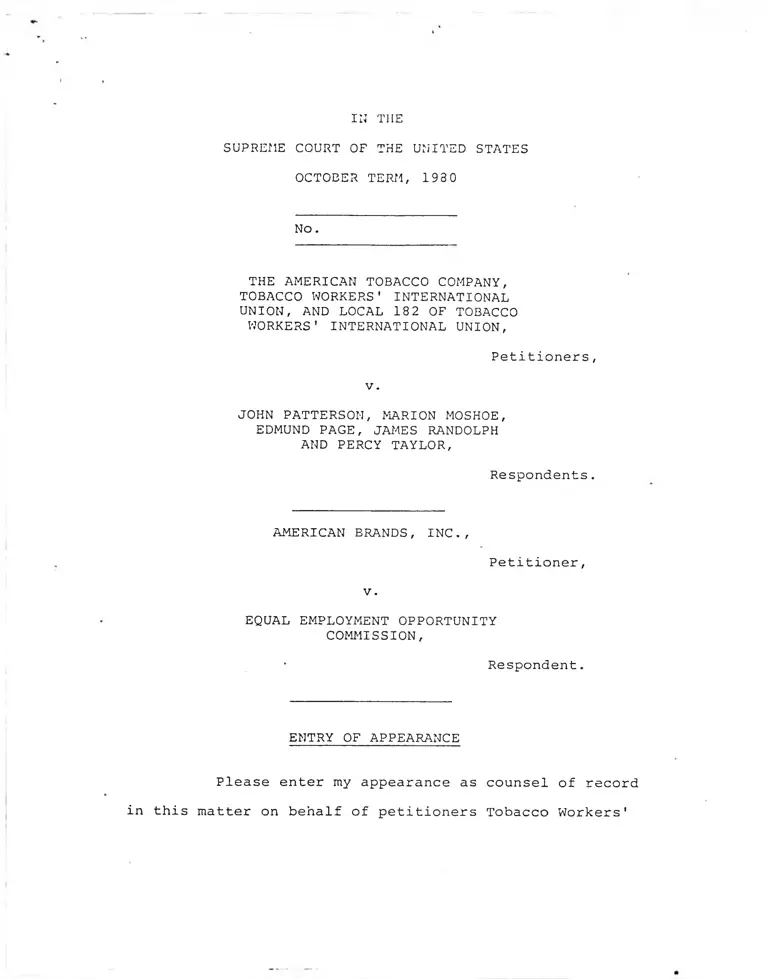
Ill THE
SUPREME COURT OF THE UNITED STATES
OCTOBER TERM, 1930
No.
THE AMERICAN TOBACCO COMPANY,
TOBACCO WORKERS' INTERNATIONAL
UNION, AND LOCAL 182 OF TOBACCO
WORKERS' INTERNATIONAL UNION,
Petitioners,
v.
JOHN PATTERSON, MARION MOSHOE,
EDMUND PAGE, JAMES RANDOLPH
AND PERCY TAYLOR,
Respondents.
AMERICAN BRANDS, INC.,
Petitioner,
v.
EQUAL EMPLOYMENT OPPORTUNITY
COMMISSION,
Respondent.
ENTRY OF APPEARANCE
Please enter my appearance as counsel of record
in this matter on behalf of petitioners Tobacco Workers'
International Union and Local 182 of Tobacco Workers
International Union.
Counsel for Petitioners
Tobacco Workers' International
Union and Local 182 of Tobacco
Workers' International Union
LEVIT & MANN
Third Floor, The Imperial Building
5th and Franklin Streets
Richmond, Virginia 23219
(804) 644-5453
- 2 -
IN THE
SUPREME COURT OF THE UNITED STATES
OCTOBER TERM, 1980
No.
THE AMERICAN TOBACCO COMPANY,
TOBACCO WORKERS' INTERNATIONAL
UNION, AND LOCAL 182 of TOBACCO
‘WORKERS' INTERNATIONAL UNION,
Petitioners,
v .
JOHN PATTERSON, MARION MOSHOE,
EDMUND PAGE, JAMES RANDOLPH
AND PERCY TAYLOR,
Respondents.
AMERICAN BRANDS, INC.
Petitioner,
v.
EQUAL EMPLOYMENT OPPORTUNITY
COMMISSION,
‘Respondent.
ENTRY OF APPEARANCE
*
Please enter my appearance as counsel of
i
record in this matter on behalf of petitioners American
Tobacco Company,
American Brands,
a Division of American Brands, Inc. and
Inc.
1 .✓ j ^ L c * - - ( ^ - ' 1 ^ ' '
Henry T. Wickham
Counsel for Petitioners
The American Tobacco Company,
a Division of American Brands,
Inc. and American Brands, Inc.
MAYS, VALENTINE, DAVENPORT & MOORE
23rd Floor, F&M Center
1111 East Main Street
Post Office Box 1122
Richmond, Virginia 23208
(804) 644-6011
- 2 -
I
iII
IN THE
&apmt? Glmirt nf thr ITuitPii Stall's
OCTOBER TERM, 1980
No,
THE AMERICAN TOBACCO COMPANY,
TOBACCO WORKERS’ INTERNATIONAL
UNION, AND LOCAL 182 OF TOBACCO
WORKERS’ INTERNATIONAL UNION,
Petitioners,
v.
JOHN PATTERSON, MARION MOSHOE,
EDMUND PAGE, JAMES RANDOLPH
AND PERCY TAYLOR,
Respondents.
AMERICAN BRANDS, INC.,
v.
Petitioner,
EQUAL EMPLOYMENT OPPORTUNITY
COMMISSION,
Respondent.
PETITION FOR A WRIT OF CERTIORARI TO
THE UNITED STATES COURT OF APPEALS
FOR THE FOURTH CIRCUIT
(Names and addresses of attorneys on inside cover)
H enry T. W ickham (Counsel of Record
for American)
D . E u g e n e W e b b , J r .
St e p h e n A. N o r th u p
M ays, V a l e n t in e , D a v en po r t & M oore
P. O. Box 1122
Richmond, Virginia 23208
804-644-6011
P aul G. P e n n o y e r , J r .
B ernard W. M cC arthy
P e t e r N. H il l m a n
C h a d bo u r n e , P a rk e , W h it esid e &
W o l f f
30 Rockefeller Plaza
New York, New York 10112
212-541-5800
Counsel for Petitioners
The American Tobacco Company,
a Division of American Brands, Inc.,
and American Brands, Inc.
Jay J. Levit (Counsel of Record for
Unions)
Imperial Building, Third Floor
5th and Franklin Streets
Richmond, Virginia 23219
804-644-5453
J am es F. C arroll
Air Rights Building
7315 Wisconsin Avenue, N.W.
Washington, D.C. 20014
301-652-1449
Counsel for Petitioner Unions
Petitioners, The American Tobacco Company, a Division
of American Brands, Inc., American Brands, Inc.1, (herein
after collectively “American”), Tobacco Workers’ Inter
national Union and Local 182, Tobacco Workers’ Interna
tional Union (hereinafter collectively “the Unions”) pray
that a writ of certiorari issue to review the en banc judg
ment of the Court of Appeals for the Fourth Circuit in
these cases.
QUESTION PRESENTED
Whether the immunity from Title VII liability given to
bona fide seniority systems under § 703(h) applies to sen
iority systems instituted or revised after the effective date
of Title VII?
1 American Brands, Inc. has no parent, subsidiary or affiliate re
quired to be reported under Sup. Ct. R. 28.1.
i
TABLE OF CONTENTS
Page
QUESTION PRESENTED ............................................................ i
TABLE OF AUTHORITIES.......................................................... f t
OPINIONS B E L O W ..................................... 2
JURISDICTION............................................................................... 2
STATUTORY PROVISION IN V O LV ED .................................. 2
STATEMENT OF THE C A S E ............................. 3
REASONS FOR GRANTING THE W R IT ................................ 5
I. This Case Presents An Important Question of Federal
Law: The Applicability of § 703(h) of Title VII to Post-
Act Seniority System s............................................................ 5
A. The decision below will have a chilling effect on labor
relations and affirmative action ....................................... 6
B. Neither statutory language nor legislative history sup
ports the Court of Appeals’ interpretation of this im
portant federal l a w .................................................... 10
II. The Result Reached by the Court of Appeals Conflicts In
Principle With Decisions of This Court and with a Sub
stantial Number of Lower Court Decisions........................ 16
CONCLUSION ............................................................................... 22
Appendix: En Banc Opinion of the United States Court of Appeals,
Fourth Circuit, November 18, 1980
ii
TABLE OF AUTHORITIES
Cases
Page
Albemarle Paper Co. V. Moody, 422 U.S. 405 (1975) ............... 9
Alexander v. Aero Lodge No. 735, 565 F.2d 1364 (6th Cir.
1977), cert, denied, 436 U.S. 946 (1978) ............................ 20
California Brewers Association v. Bryant, 444 U.S. 598
(1980) .................................................................................... passim
Consumer Products Safety Commission v. GTE Sylvania, Inc.,
_ U .S . 100 S.Ct. 2051 (1 9 8 0 ) .......................................11,15
Edmonds v. Southern Pacific Transportation Co., 19 Fair
Empl. Prac. Cas. 1052 fN.D. Cal. 1979) ................................ 21
Edmondsonw. United States Steel Corp., 20 Fair Empl.
Prac. Cas. 1745 (N.D. Ala. 1979) ........................................... 21
EEOC v. McCall Corp., 24 Fair Empl. Prac. Cas. 432
(S.D. Ohio 1978), aff'dsub nom, EEOC v. McCall
Printing Corp., 24 Fair Empl. Prac. Cas. 437
(6th Cir. 1980) ........................................................................... 21
Franks V. Bowman Transportation Co.,
424 U.S. 747 (1976) .............................................................. H> I 3
Freeman v. Motor Convoy, 20 Empl. Prac. Dec. 1̂ 30,090
(N.D. Ga. 1979) ........................................................................ 21
Gemsco, Inc. v. Walling, 324 U.S. 244 (1945) .......................... 15
Griffin v. Copperweld Steel Co., 22 Fair Empl. Prac. Cas.
1112 (N.D. Ohio 1978) ........................................................... 2 1
Griggs v. Duke Power Co., 401 U.S. 424 (1971) . .7, 16, 17, 18, 20
Hameed v. Iron Workers___F.2d _ , 24 Fair Empl.
Prac. Cas. 352 (8th Cir. 1980) .................................................. 20
International Brotherhood of Teamsters v. United States,
' 431 U.S. 324 (1977) ..........................................................passim
Johnson v. Burroughs Corp., No. 252 Daily Lab. Rep.
(BNA) D-l (December 31, 1980) (S.D. Fla. 1980) ........... 20
Local 1S9, United Papermakers & Papenvorkers v. United
States, 416 F.2d 980 (5th Cir. 1969), cert, denied,
397 U.S. 919 (1 9 7 0 ) ................................................................... 8
iii
Page
Pate v. Transit District, 21 Fair Empl. Prac. Cas. 1228
(N.D. Cal. 1979) . ......................................................'............ 21
Richards V. United States, 369 U.S. 1 (1962) ...................... 11, 12
Sanders V. Sherwin Williams Co., 495 F. Supp. 571
(E.D. Mich. 1980) ............................................. ....................... 21
62 Cases of Jam v. United States, 340 U.S. 593 (1 9 5 1 ) ........... 11
Trans World Airlines, Inc. V. Hardison,
432 U.S. 63 (1 9 7 7 ) ......................................................7, 15, 17, 19
United Air Lines, Inc. V. Evans, 431 U.S. 553 (1 9 7 7 ) .........passim
United States V. Bethlehem Steel Corp.,
446 F.2d 652 (2d Cir. 1971) ................................................... 8
United States v. Citizens & Southern National Bank,
422 U.S. 86 (1975) .................................................................. 12
United States v. Ironworkers Local 86, 443 F.2d 544
(9th Cir.), cert, denied, 404 U.S. 984 (1971) ........................ 8
United States v. Jacksonville Terminal Co., 451 F.2d 418
(5th Cir. 1971), cert, denied sub nom, Brotherhood of
Locomotive Engineers v. United States,
406 U.S. 906 (1972) ................................................................ 8
United States v. Oregon, 366 U.S. 643 (1961) .......................... 15
United Steelworkers of America, AFL-CIO-CLC V. Weber,
443 U.S. 193 (1979) ............................................................ ,9, 10
Statutes
Bank Holding Company Act, 12 U.S.C. § 1 8 4 9 (d ) ............... 12-13
Title VII, Civil Rights Act of 1964, as amended,
42 U.S.C. §§ 2000e et seq........................................................ passim
Title VII, § 703(h), 42 U.S.C. § 2000e-2(h) ....................... passim
42 U.S.C. § 1981 ..........................*............................................... 3
Transportation Act of 1958, Section 7(c), 49 U.S.C. § 303 . . . . 12
Textbook
2A Sutherland, Statutory Construction § 47.12
(4th ed. Supp. 1980) ................................................................ 12
iv
Articles
Page
Vaas, Title VII: Legislative History, 7 B.C. Ind. &
Comm. L. Rev. 431 (1966) ...................................................... 14
Cooper & Scbel, Seniority and Testing Under Fair
Employment Laws: A General Approach to Objective
Criteria of Hiring and Promotion,
82 Harv. L. Rev. 1598 (1 9 6 9 ) .................................................. 14
Legislative Source
110 Cong. Rec. 7206 (1964) ...................................................... 14
v
IN THE
j^ujirmp dmirt ai tlje
OCTOBER TERM, 1980
No,
THE AMERICAN TOBACCO COMPANY,
TOBACCO WORKERS’ INTERNATIONAL
UNION, AND LOCAL 182 OF TOBACCO
WORKERS’ INTERNATIONAL UNION,
Petitioners,
v.
JOHN PATTERSON, MARION MOSHOE,
EDMUND PAGE, JAMES RANDOLPH
AND PERCY TAYLOR,
Respondents.
AMERICAN BRANDS, INC.,
v.
Petitioner,
EQUAL EMPLOYMENT OPPORTUNITY
COMMISSION,
Respondent.
PETITION FOR A W RIT OF CERTIORARI TO
THE UNITED STATES COURT OF APPEALS
FOR THE FOURTH CIRCUIT
2
OPINIONS BELOW
The en banc opinion, of the Fourth Circuit as to which a
writ of certiorari is sought is unofficially reported at 24 Fair
Empl. Prac.’Cas. 531 and is set forth in the appendix to this
petition. Previous opinions of the Fourth Circuit in these
cases are reported at 535 F.2d 257, cert, denied, 429 U.S.
920 (1976) (“Patterson 1”), and 586 F.2d 300 (1978)
(“Patterson II’’). Previous opinions of the district court are
unofficially reported at 8 Fair Empl. Prac. Cas. 778 (1974)
(post-trial opinion on liability); 11 Fair Empl. Prac. Cas.
577 (1974) (opinion on relief); and 18 Fair Empl. Prac.
Cas. 377 (1977) (order denying motion to reconsider and
vacate prior findings of liability).
JURISDICTION
The judgment of the court of appeals was entered on
November 18, 1980. This petition is filed within ninety
(90) days of that judgment. The jurisdiction of this Court
is invoked under 28 U.S.C. § 1254(1).
STATUTORY PROVISION INVOLVED
Section 703(h) of Title VII provides (42 U.S.C. §
2000e-2(h)):
Notwithstanding any other provision of this title, it
shall not be an unlawful employment practice for an
employer to apply different standards of compensation,
or different terms, conditions, or privileges of employ
ment pursuant to a bona fide seniority or merit system,
or a system which measures earnings by quantity or
quality of production or to employees who work in
different locations, provided that such differences are
not the result of an intention to discriminate because
of race, color, religion, sex, or national origin, nor
i
3
shall it be an unlawful employment practice for an em
ployer to give and to act upon the results of any pro
fessionally developed ability test provided that such
test, its administration or action upon the results is not
designed, intended or used to discriminate because of
race, color, religion, sex or national origin. It shall not
be an unlawful employment practice under this title
for any employer to differentiate upon the basis of sex
in determining the amount of the wages or compensa
tion paid or to be paid to employees of such employer
if such differentiation is authorized by the provisions
of section 6(d) of the Fair Labor Standards Act of
1938, as amended (29 U. S. C. 2C6(d)).
STATEMENT OF THE CASE
These are employment discrimination cases, consolidated
for trial, in which the plaintiffs alleged violations of Tide
VII of the Civil Rights Act of 1964, 42 U.S.C. §§ 2000c
et seq., and the Civil Rights Act of 1866, 42 U.S.C. § 19S1,
at two separate plants of American located in Richmond,
Virginia—the Virginia Branch and the Richmond Branch.
Respondents John Patterson, et al., were plaintiffs in one
case, a class action alleging race discrimination, and re
spondent Equal Employment Opportunity Commission was
plaintiff in the other, alleging both race and sex discrimina
tion. American was a defendant in both cases, as was Local
182 of Tobacco Workers’ International Union.2 Tobacco
Workers’ International Union was a defendant in the class
action case only.
At trial, the district court found no post-Act discrimina
tion in hiring and job assignment, but found that American’s
seniority system, although “facially fair and neutral, 8 Fair
Empl. Prac. Cas. at 782, nevertheless violated Title VII be-
2 At the direction of the court of appeals in Patterson I, Local
182 was dismissed from the EEOC case.
4
cause portions of the system perpetuated the effects of past
discrimination in hiring and job assignment.* Found viola
tive were (1) American’s practice of separate seniority at
the two plants with loss of accumulated seniority in the
event of transfer, and (2) several lines of progression, in
which, although promotions are awarded on the basis of
seniority, only employees who have occupied the lower-
level job are eligible to bid on the higher-level job. In Pat
terson I the Fourth Circuit affirmed this finding and this
Court subsequently denied a petition for a writ of certiorari.
Thereafter, while these cases were on remand to the dis
trict court for back pay proceedings, this .Court rendered
its decisions in International Brotherhood of Teamsters v.
United States, 431 U.S. 324 (1977) and United Air Lines,
Inc. v. Evans, 431 U.S. 553 (1977). Petitioners thereupon
moved for relief from the prior finding of liability on the
ground that it could no longer stand in light of these de
cisions. The district court denied relief, but in Patterson II,
a panel of the Fourth Circuit reversed as to the practice of
separate seniority at each plant and remanded for a deter
mination whether that practice is “bona fide” within the
meaning of § 703(h). However, the panel, without discus
sion, failed to include the lines of progression within the
scope of that remand.
On rehearing, the court en banc, as had the panel, re
manded for a determination whether the practice of sep
arate seniority at each plant is “bona fide.” (App. at 11 to
12). However, the court did not similarly remand as to the
lines of progression. Although the issue of whether the
3 The district court also found that American’s selection of super
visory personnel violated Title VII, a finding which the en banc
court of appeals has now directed be reconsidered. (See App. at 13
to 19). The issues concerning* the selection of supervisors are not
involved in this petition.
5
lines of progression were a “seniority system” under §
703(h) had been briefed and argued before the court en
banc, the court did not decide that question.4 Rather, the
majority of the court of appeals held that in its view Ҥ
703(h) simply has no application to American’s job lines
of progression policy, whether or not it be considered a
‘seniority system’ in the mode of its operation” (App. at
8), and held that “the immunity accorded seniority sys
tems by § 703(h) . . . run[s] only to those systems in exist
ence at the time of Title VII’s effective date.” (App. at 10).
REASONS FOR GRANTING TIIE WRIT
I.
This Case Presents An Important Question Of Federal Law:
The Applicability Of § 703(h) Of Title VII To
Post-Act Seniority Systems
If allowed to prevail, the decision below interpreting
§ 703(h) of Title VII as having no application to seniority
* Curiously, the opinion of the court of appeals contains no refer
ence whatsoever to this Court’s ruling in California Brewers Associa
tion v. Bryant. 444 U.S. 598 (1980), the leading decision on what
constitutes a “seniority system” under § 703(h). Although the Cal
ifornia Brewers decision was rendered after oral argument occurred,
the parties called it to the attention of the court many months before
the en banc opinion issued.
6 Notwithstanding the absence of any specific finding below, the
court, sna sponte, found as a fact that the lines of progression first
came into existence after the effective date of Title VII. (App. at S
to 11). This finding was made even though the specific question as
to when the lines of progression were first instituted had not been an
issue at the trial, which occurred in 1974, years before this Court’s
decisions in Teamsters and California Brewers. As the dissenting
opinion below indicates, there is a genuine factual dispute on the
current record as to whether the lines of progression indeed ante
dated the effective date of Title VII (see dissenting opinion), and a
remand for proper factual determination would have been appropri
ate. Solely for purposes of this petition, petitioners treat the lines of
progression as having come into existence after Title VII s effective
date.
6
systems instituted or revised after the effective date of Title
VII will have a significant, negative impact on national
labor policy and will adversely affect affirmative action.
The interpretation is contrary to the express language of the
statute and not supported by the legislative history of
§ 703(h).
A. The Decision Below Will Have A Chilling Effect On
Labor Relations And Affirmative Action
International Brotherhood of Teamsters v. United States,
431 U.S. 324, 352 (1977), held that “the unmistakable
purpose of § 703(h) was to make clear that .the routine ap
plication of a bona fide seniority system would not be un
lawful under Title VII,” even where such systems perpetu
ated the effects of pre-Act discrimination. United Air Lines,
Inc. v. Evans, 431 U.S. 553 (1977), extended the holding
of Teamsters to preclude Title VII challenges to seniority
systems that perpetuated the effects of discriminatory post-
Act practices that had not been the subject of a timely
complaint." Last Term, in California Brewers Association
V. Bryant, 444 U.S. 598 (1980), the Court had occasion
to clarify the meaning of the term “seniority system” as it
appears in § 703(h). Therein, the Court indicated that the
term should be liberally, not narrowly, construed in view of
the backdrop to Title VII of the nation’s long-standing labor
policy recognizing diverse forms of seniority systems and
the necessity of affording significant freedom in their crea
tion. Id. at 608.
This case brings to the Court the opportunity to give
further, needed guidance as to the meaning of § 703(h).
By holding that “the immunity accorded seniority systems by
§ 703(h) [runs] only to those systems in existence at the
* See California Brewers Association V. Bryant, 444 U.S 598
, 600 n. 2 (1980).
7
time of Title VII’s effective date” (App. at 10) and that
§ 703(h) “has no application to seniority systems instituted
after the effective date of Title VII” (id. at 9 n.3), the
majority of the en banc court of appeals has created un
certainty as to the application of this important federal law
covering millions of employees and thousands of employers
throughout the nation. As this Court has recognized, senior
ity in the collective bargaining context “lies at the core of
our national labor policy. . . . ” Trans World Airlines, Inc. v.
Hardison, 432 U.S. 63, 79 (1977). The uncertainty as to
the status under Title VII of post-Act instituted cr revised
seniority systems clouds an area of such national importance
that the question should be settled by this Court.
The adverse impact of the ruling below on labor rela
tions cannot be over emphasized. In explaining its decision,
the majority below stated that “[s]ystems initiated in the
post-Act period must of course pass muster under the Griggs
[disparate impact7] analysis in the same manner as other
facially neutral policies or practices challenged as discrimi
natory in their consequences.” (App. at 10 n.5). In Team
sters, supra, this Court noted that the critical distinction
between claims of disparate treatment and claims of dis
parate impact is that “[p]roof of discriminatory motive is
critical” in a claim of disparate treatment, while “[p]roof of
discriminatory motive, we have held, is not required under
a disparate impact theory.” 431 U.S. at 335-36 n.15. The
decision of the court of appeals to relegate post-Act seniority
challenges to the Griggs disparate impact mode of analysis,
rather than apply the Teamsters analysis requiring proof of
purposeful discrimination, plainly signals an erroneous re
turn to the pre-Teamsters line of cases that had routinely
struck down seniority systems merely on the basis of per
petuation of past discrimination, regardless of the presence
7 Griggs V. Duke Power Co., 401 U.S. 424 (1971).
8
or absence of discriminatory motive. See, e.g., Local 189,
United Papermakers & Paperworkers v. United States, 416
F.2d 980 (5th Cir. 1969), cert, denied, 397 U.S. 919
(1970).
Carving out two such diverse tests under § 703(h), one
applicable to pre-Act seniority systems and the other to
post-Act initiated or revised seniority systems, is simply
illogical and negates the “[significant freedom [which]
must be afforded employers and unions to create differing
seniority systems.” California Brewers, supra, 444 U.S. at
608. Such negating effect flows from the Griggs disparate
impact analysis, with its primary reliance on.statistics8 and
its related difficult burden of establishing a business neces
sity defense6 to meet such a statistical prima facie case. In
order to be confident that a newly adopted seniority sys
tem or a revision to a pre-Act system would withstand such
an analysis, management and labor would first have to be
sure that the racial and sexual break down within depart
ments, lines of progression or other employment units
mirrored the relevant statistics. The fact that the initiation
of the system or a revision thereto was void of any dis-
8 Plaintiff in a case alleging disparate impact invariably establishes
a prima facie case through a statistical showing of imbalance. See,
e.g., United States v. Ironworkers Local 86, 443 F.2d 544 (9th Cir.),
cert, denied, 404 U.S. 984 (1971).
* Lower courts have held defendants to exacting standards under
the business necessity test, see United States v. Bethlehem Steel Corp.,
446 F.2d 652, 662 (2d Cir. 1971) and pre-Teamsters courts rarely
upheld a seniority system pursuant to claims of business necessity.
See, e.g., United States v. Jacksonville Terminal Co., 451 F.2d 418,
451 (5th Cir. 1971). cert, denied sub nom, Brotherhood of Loco
motive Engineers v. United States, 406 U.S. 906 (1972) (“ ‘[t]o be
preserved, the seniority and transfer system must not only directly
foster safety and efficiency of a plant, but also be essential to those
goals’ quoting United States v. Bethlehem Steel Corp., 446 F.2d
at 662).
9
criminatory motive and could pass muster under the bona fide
seniority system analysis enunciated by this Court in Team
sters would be irrelevant. The critical elements of national
labor policy recognizing “the give and take of free collec
tive bargaining . . . [and] the specific characteristics of a
particular business or industry, . . .” California Brewers,
supra, 444 U.S. at 608, would thus be substantially im
paired.
Furthermore, the inevitable result of the pre-Act/post-
Act dichotomy in the applicable analyses under § 703(h)
would have an unfortunate, damaging effect on affirmative
action. The majority below held § 703(h) inapplicable to
all post-Act seniority system “change[s] and formaliza-
tion[s] (whether in favor of or against employee interests)
. . . . ” (App. at 9 n. 4; emphasis added). As a consequence,
changes in pre-Act seniority systems made after the ef
fective date of Title VII, even though they benefit minorities
covered by the Act, will be discouraged because such a
change would consign the system to a Griggs analysis. Such
systems will be retained in order to preserve § 703(h) pro
tection and its bona fides analysis pursuant to Teamsters.
As the dissenters below accurately pointed out, even a
post-Act change made “in favor of a class of black employ
ees, will deprive the company and the union making the
change from the benefit of a § 703(h) exemption.” (App.
at 49). Such prohibitive effect of the majority’s ruling runs
directly contrary to this Court’s observation in United
Steelworkers of America, AFL-CIO-CLC v. Weber, 443
U.S. 193, 204 (1979) (citing Albermarle Paper Co. v.
Moody, 422 U.S. 405, 418 (1975)), that Title VII is “in
tended as a spur or catalyst to cause employers and unions
to self-examine and self-evaluate their employment practices
and to endeavor to eliminate, so far as possible, the last
vestiges of an unfortunate and ignominious page in this
10
country’s history.” 10
The restrictive principle announced below will disable
collective bargaining in' the important area of seniority. It
will inhibit management and labor from adopting employ
ment practices to meet a changing economy or industry. It
will put a damper on good faith efforts made in the spirit
of affirmative action to overcome vestiges of past discrim
ination. If allowed to stand, it will jeopardize hundreds of
diverse seniority structures established or revised in Ameri
can industry in the fifteen years since Title VII’s enactment.
For these reasons, the case presents an important question
of federal law which should be settled by this Court.
B. Neither Statutory Language Nor Legislative History
Supports The Court Of Appeals' Interpretation
Of This Important F ederal Law
The interpretation by the court of appeals holding
§ 703(h) inapplicable to seniority practices not in place at
the time of Title VII’s effective date is plainly inconsistent
with the express language of the section and is not sup
ported by its unusual legislative history. For this reason
10 The dissent recognized this conflict with Weber (App. at 49-50):
That part of the majority opinion providing that a company
and a union cannot alter a seniority system so as to make more
favorable the conditions of employment of minority employees
is directly contrary to Weber, I think. It requires a too strained
construction of the statute to hold that a seniority system ad
mittedly discriminatory in effect, as in Teamsters, is protected
by § 703(h) so long as it remains unchanged, but if it is
changed in favor of the minority employees, then the employer
and the union lose their § 703(h) exemption.
* * *
Such a conclusion, I suggest may sound astonishing, yet that is
precisely what the majority holds.
11
also, this important question of federal law should be settled
by this Court.
On its face, this definitional section11 makes no distinction
between pre- and post-Act bona fide systems. Had Congress
meant to cover one but not the other, it easily could have
done so. But Congress did not choose such a course. Rather,
Congress chose language which addresses all bona fide
seniority systems.
The court of appeals, in ignoring the literal dictates of
§ 703(h), departed from the cardinal principle of statutory
construction that “the starting point for interpreting a
statute is the language of the statute itself. Absent a clearly
expressed legislative intention to the contrary, that language
must ordinarily be regarded as conclusive.” Consumer Prod
ucts Safety Commission v. GTE Sylvania, Inc. — U.S. —,
100 S. Ct. 2051, 2056 (1980). A court “must, of course,
start with the assumption that the legislative purpose is ex
pressed by the ordinary meaning of the words used.” Rich
ards v. United States, 369 U.S. 1, 9 (1962). Where those
words are clear and unequivocal on their face, as here, a
court is “bound to operate within the framework of the
words chosen by Congress. . . .” Id. at 10. The proper func
tion of the court of appeals in this case was “to construe
what Congress has written. After ail, Congress expresses its
purpose by words. It is for us to ascertain—neither to add
nor to subtract, neither to delete nor to distort.” 62 Cases
of Jam v. United States, 340 U.S. 593, 596 (1951). That
function was clearly not followed below.
The court of appeals did not point, nor could it point,
to any equivocation or lack of clarity in the terms expressly
11 In Franks v. Bowman Transportation Co., 424 U.S. 747, 761
(1976), the Court stated that § 703(h) is definitional, its thrust
“directed toward defining what is and is not an illegal discriminatory
practice.. . . ”
12
chosen by Congress. Rather, the court deviated from the
plain language to effectively turn the section into a “savings”
or “grandfather” clause, exempting pre but not post-Act
systems, even though “it would be difficult to conceive of
any more precise language Congress could have used to
command” 12 coverage of all bona fide seniority systems.
As the dissenters below aptly observed, “Congress un
doubtedly knows how to write a grandfather clause if it
wishes, but in this case wrote an exception instead.” (App.
at 26 n .l) . Indeed, the same Congress drafted and passed
savings provisions in other parts of Title VII.13 The natural
inference is that § 703(h)’s clear lack of resemblance to
typical savings clauses14 was not unintentional.
12 Richards v. United States, supra, 369 U.S. at 9.
13 For example, § 703(b) as enacted called for application of the
“employer” definition of the Act on an annual step-down basis:
. . . Provided, That during the first year after the effective date
prescribed in subsection (a) of section 716, persons having
fewer than one hundred employees (and their agents) shall not
be considered employers, and, during the second year after
such date, persons having fewer than seventy-five employees
(and their agents) shall not be considered employers, and, dur
ing the third year after such date, persons having fewer than
fifty employees (and their agents) shall not be considered
employers:. . . (Emphasis added).
Section 701(e), as enacted, contained a similar step-down or savings
definition for “labor organization.”
14 Savings or grandfather clauses are “calculated to prevent hard
ship by saving accrued rights and interests from the operation of a
new rule.” 2A Sutherland, Statutory Construction § 47.12 (4th ed.
Supp. 1980). Such clauses invariably exempt an established class from
new regulation so long as that class possessed certain characteristics
by a date specified in the savings clause itself. See, e.g., § 7(c) of the
Transportation Act of 1958, 49 U.S.C. § 303, providing that “any
person (or its predecessor in interest) [who] was in bona fide opera
tion on May 1, 1958, over any route or routes or within any territory,
. . .” could apply for an authorization to continue the operation that
the applicant had previously performed. In United States v. Citizens
& S. Natl. Dank, 422 U.S. 86, 108 (1975), the Court considered an
archtypical savings provision to the Bank Holding Company Act, 12
U.S.C. § 1849(d), which stated (422 U.S. at 108):
1
13 '
Notwithstanding the unequivocal language of § 703(h)
and its dissimilarity to any known savings clauses, the
court of appeals believed its result was justified by the
“legislative history,” which it variously described as “con
clusively demonstrat[ing]”, “replete with indications,” or at
least “suggest[ing]” that post-Act systems were not intended
to be encompassed by § 703(h). Even assuming for the
sake of argument that the words of the section itself are
somehow ambiguous on this score and that examination of
the legislative history is appropriately warranted, that “his
tory,” such as it is, reveals no authoritative support for the
interpretive conclusion below. At most, that “history” is of
wholly ambiguous significance and falls far short of the
showing needed to disregard the words Congress expressly
employed.
This Court is no stranger to the circumstances preceding
the adoption of § 703(h). See Teamsters, supra, 431 U.S.
at 350-55; Franks, supra, 424 U.S. at 759-62 (noting the
“unusual legislative history” of the section and “the ab
sence of the usual legislative materials” surrounding its
adoption). The court of appeals purported to find support
for its conclusion in two pieces of this “history” : (1) a
memorandum prepared by Senators Clark and Case which
in part stated that “Title VII has no effect on established
seniority rights”; and (2) a memorandum prepared by the
Justice Department which stated that “Title VII would
(Cont. from preceding page)
“Any acquisition, merger, or consolidation of the kind de
scribed in section 1842(a) of this title which was consummated
at any time prior or subsequent to May 9, 1956, and as to
which no litigation was initiated by the Attorney General prior
to July 1, 1966, shall be conclusively presumed not to have
been in violation of any antitrust laws other than section 2 of
Title 15 [§ 2 of the Sherman Act].”
The court in the instant case was without authority to transform
§ 703(h) into a savings clause absent such clear legislative direction.
14
have no effect on seniority rights existing at the time it
takes effect.” (App. at 10 n.5). Neither piece of “legislative
history” can authoritatively support the conclusion reached
by the court of appeals.
The documents relied on below were introduced into the
record by Senator Clark on April 8, 1964, during the gen
eral debate on the bill passed by the House. They were
drafted in response to criticisms of another Senator that
the bill, which contained no analogue predecessor to the
eventual § 703(h), would, inter alia, “undermine the
vested rights of seniority;...” 110 Cong. Rec. 7206
(1964). “None of these documents [was] read on the floor
of the Senate, and there was no discussion of their contents
or of this specific seniority issue, then or thereafter.”
Cooper & Sobel, Seniority and Testing Under Fair Employ
ment Laws: A General Approach to Objective Criteria of
Hiring and Promotion, 82 Harv. L. Rev. 1598, 1611
(1969). Nearly eight weeks later, on May 26, following a
number of bipartisan leadership conferences, the so-called
Mansfield-Dirksen amendment was offered as a substitute
for the entire bill. See Vaas, Title VII: Legislative History,
7 B.C. Ind. & Comm. L. Rev. 431, 445-46 (1966). One
of a number of amendments appearing for the first time
was § 703(h).
Congress plainly designed § 703(h) as a clarification or
definitional provision of what is and is not an “unlawful
employment practice” under § 703(a); it would have re
quired no feat of legislative drafting skill to insert the terms
“existing” or “established” before the statute’s descriptive
phrase, “bona fide seniority or merit system.” That neither
“established,” “existing” nor any similar term of limitation
appeared in § 703(h) when it was proposed many weeks
after the introduction of the Clark and Case and Justice De
partment memoranda supports the view that the drafting
15
groups, and the Congress as a whole, specifically rejected
any such limitation. Instead of the assumptions made by
the majority below, it is much more logical to presume that
Congress, in view of the national policy favoring collective
bargaining and seniority, as recognized by this Court in
Hardison and California Brewers, supra, intended § 703(h)
to be applicable to all seniority systems and revisions there
to, whether instituted before or after the passage of the
Act, so long as bona fide and not the result of an intention
to discriminate. ■
Accordingly, the talismanic quality conferred by the
court of appeals on the isolated references in the “legislative
history” to “established” and “existing” seniority rights does
not withstand close inspection, particularly where the clear
words and ordinary meaning of the statute belie any such
- result. “The plain words and meaning of a statute cannot
be overcome by a legislative history which, through strained
processes of deduction from events of wholly ambiguous
significance, may furnish dubious bases for inference in
every direction.” Gemsco, Inc. v. Walling, 324 U.S. 244,
260 (1945). Petitioners submit that here there is no “clearly
expressed legislative intention to the contrary” of the “lan
guage of the statute itself.” Consumer Products Safety Com
mission v. GTE Sylvania, Inc., supra, __U.S. at __ , 100
S. Ct. at 2056." In sum, the court of appeals plainly erred
in divining a “legislative history” of nebulous foundation to
justify an interpretation of § 703(h) which constitutes a
blatant departure from the language of the section itself.
" See also United States v. Oregon, 366 U.S. 643, 648 (1961)
(isolated statements in the legislative history “have never been re
garded as sufficiently compelling to justify deviation from the plain
language of a statute.”).
16
II.
The Result Reached By The Court Of Appeals Conflicts In
Principle With Decisions Of This Court And With A
Substantial Number Of Loner Court Decisions
In holding § 703(h) inapplicable to post-Act seniority
systems, the court of appeals adopted a restrictive and
erroneously narrow interpretation. Such a construction,
reached without benefit of briefing or argument below on
that specific issue, represents a conflict in principle and ap
proach with applicable decisions of this Court, and a sub
stantial number of lower courts.
In Teamsters, the Court saw no distinction in § 703(h)
between pre- and posl-Act seniority practices, stating that
“[sjection 703(h) on its face immunizes all bona fide se
niority systems, and does not distinguish between the per
petuation of pre- and post-Act discrimination.” 431 U.S. at
348 n.30 (emphasis added).16
In Evans, the Court seemed to squarely reject the narrow
principle announced below that § 703(h) has no application
to post-Act practices (431 U.S. at 560):
The Court of Appeals read § 703(h) as intended to
bar an attack on a seniority system based on the con
sequences of discriminatory acts which occurred prior
to the effective date of Title VII in 1965, but having
no application to such attacks based on acts occurring
after 1965. This reading of § 703(h) is too narrow.
The statute does not foreclose attacks on the current
operation of seniority systems which are subject to
challenge as discriminatory. But such a challenge to
10 Petitioners do not claim that seniority systems are immune from
attack. The result they urge to this Court, i.e., analysis of post-1965
systems pursuant to the § 703(h) bona fides standard rather than the
Griggs disparate impact analysis, would by no means ensure blanket
immunity for such systems. It would remain for the lower courts to
conduct evidentiary inquiries as to whether the practice “is not ‘bona
fide,’ or . . . [if] differences in employment conditions that it has pro-
17
a neutral system may not be predicated on the mere
fact that a past event which has no present legal sig
nificance has affected the calculation of seniority credit,
even if the past event might at one time have justified a
valid claim against the employer. A contrary view
would substitute a claim for seniority credit for almost
every claim which is barred by limitations. Such a result
would contravene the mandate of § 703(h). (Emphasis
added; footnote omitted).
Hardison, supra, offers further support for petitioners’
view that the Fourth Circuit has erroneously separated post-
Act seniority practices from the ambit of § 703(h). In
finding that an employer’s duty to make “reasonable ac
commodation” to the religious needs of its employees did
not require it to take steps inconsistent with its seniority
system, the Court emphasized, without differentiating be
tween pre-Act and post-Act practices, that “seniority sys
tems are afforded special treatment under Title VII itself.” “
432 U.S. at 81. There was no suggestion that the Griggs
disparate impact analysis would apply to post but not to
pre-Act seniority practices. Instead, Hardison endeavored
to coalesce the earlier teachings of Teamsters and Evans
and necessarily rejected the application of Griggs to senior
ity systems (432 U.S. at 82, 83 n.13):
(Cont. from preceding page)
duced are ‘the result of an intention to discriminate because of race.’ ”
California Brewers, supra, 444 U.S. at 611.
*' This principle that seniority systems are given special treatment
by the Act itself is of critical importance and was not properly ap
preciated by the court of appeals. Its statement that § 703(h) is a
“quite narrow exception to Title VII’s general coverage of all ‘con
ditions of employment’ ” (App. at 9 n.4; emphasis added) is beside
the point. Although § 703(h) applies to relatively few employment
practices covered by Title VII, it does not follow that when an em
ployment practice comes within the section, the protection provided
by the section is to be narrowly applied. Teamsters, Evans, Hardison
and California Brewers all instruct that when a practice comes within
the ambit of the section, it is to be liberally, not narrowly, construed.
18
. . . absent a discriminatory purpose, the operation of
a seniority system cannot be an unlawful employment
practice even if the system has some discriminatory
consequences.
* * *
. . . § 703(h) unequivocally mandates that there is no
statutory violation in the absence of a showing of dis
criminatory purpose. See United Air Lines, Inc. v.
Evans, 431 U.S. 553, 558-560, 52 L Ed 2d 571, 97
S Ct 1885 (1977) (emphasis added).
Most recently, in California Brewers, the Court accorded
a similarly broad interpretation to § 703(h). There, the
Court indicated that the definitional thrust of the term
“seniority system” in § 703(h) was designed to be forward-
looking, and not static. “Significant freedom,” the Court
stated, “must be afforded employers and unions to create
differing seniority systems. . . .” 444 U.S. at 608. Such a
prospective view of the statute would not be possible if any
seniority system or revision initiated after the Act was sub
ject to the Griggs disparate impact analysis rather than to
the bona fides analysis under Teamsters.
The result reached by the court of appeals in this case
conflicts with the principles articulated by this Court in the
decisions noted above.
It mistakenly ignores the admonition in Teamsters that
§ 703(h) “on its face immunizes all bona fide seniority
systems. . . .” 431 U.S. at 348 n.30. Section 703(h) im
munizes both pre-Act and post-Act bona fide seniority sys
tems, as well as post-Act revisions to such systems.
By construing § 703(h) as a “quite narrow exception”
of no applicability to post-Act seniority practices, the court
of appeals committed the same fundamental error in ap
proach to § 703(h) as that squarely rejected by this Court
in Evans. The decision below, unless corrected, would sub
stitute for the holding of Evans a return to the perpetuation
19
concept of discrimination for all post-1965 seniority prac
tices, regardless of how untimely a charge might be.- This
result would be plainly inconsistent with the teaching of
Evans that an untimely challenged discriminatory act, even
if perpetuated through the operation of a seniority system,
is the “legal equivalent of a discriminatory act which oc
curred before the statute was passed” (431 U.S. at 558),
so long as the seniority system is otherwise bona fide under
§ 703(h).
The conclusion below that the interest protected by §
703(h) extends only to “those seniority rights already
vested in incumbent workers when Title VII went into
effect” (App. at 10) is contrary to this Court’s recogni
tion in Hardison that all seniority systems are afforded spe
cial treatment under § 703(h), that there is no statutory
violation in the absence of a showing of discriminatory
purpose and that collective bargaining, which universally
includes seniority provisions, “lies at the core of our na
tional labor policy,” 432 U.S. at 79. That conclusion is
also contrary to the lesson of California Brewers that
§ 703(h) is to be broadly interpreted and is forward-look
ing in its application to seniority systems in order to assure
that significant freedom is afforded in the creation of differ
ing seniority systems. Noticeably absent from the considera
tions of the court of appeals is this Court’s perception in
California Brewers that in enacting § 703(h) (444 U.S. at
608):
Congress passed the Civil Rights Act of 1964 against
the backdrop of this Nation’s longstanding labor policy
of leaving to the chosen representatives of employers
and employees the freedom through collective bargain
ing to establish conditions of employment applicable
to a particular business or industrial environment.
It does not behoove a court to second-guess either
20
that process or its products. Seniority systems, reflect
ing as they do, not only the give and take of. free col
lective bargaining', but also the specific characteristics
of a particular business or industry, inevitably come
in all sizes and shapes. (Emphasis added; citations
omitted).
The decision of the Fourth Circuit conflicts in result with
opinions of the Sixth and Eighth Circuits. These courts,
when confronted with challenges to seniority systems either
instituted or revised post-Act, analyzed those practices for
presence or absence of bona tides rather than applying the
Griggs disparate impact approach. Alexander v. Aero
Lodge No. 735, 565 F.2d 1364 (6th Cir. 1977), cert, de
nied, 436 U.S. 946 (1978); Hameed v. Iron Workers,__
F.2d —, 24 Fair Empl. Prac. Cas. 352 (8th Cir. 1980).18
Moreover, numerous district courts post-Teamsters have
likewise reviewed post-Act seniority systems under bona
tides analysis, requiring proof of discriminatory intent in
the adoption or maintenance of a seniority system as a pre
requisite for a finding of non bona tides.18 Liability should
18 The Eighth Circuit, in Hameed v. Iron Workers, held that a
referral seniority system initiated post-Act in a 1972 collective bar
gaining agreement “must be judged” under Teamsters and Evans,
which “immunize bona fide seniority systems which have a dispropor
tionate impact on blacks or other minorities, provided that any dis
parity is not the result of interntional [sic] discrimination.” Id. at 360
(footnote and citations omitted). Contrary to the approach of the
Fourth Circuit, the Eighth Circuit properly observed that “even if a
disproportionate impact had been shown, the seniority system would
not have been shown to be a prima facie violation of title [sic] VII
because Teamsters immunizes seniority systems from attack under
the disproportionate impact theories of Griggs.” Id. at n.12.
In Alexander v. Aero Lodge No. 735, supra, the Sixth Circuit
drew no distinction for § 703(h) purposes between pre- and post-Act
seniority practices, and analyzed the latter under the bona fides test.
10 See, e.g., Johnson V. Burroughs Corp., No. 252 Daily Lab. Rep.
(BNA) D-l (December 31, 1980) (S.D. Fla. 1980) (seniority sys
tem instituted in 1974 at a plant which did not open until 1968
not be different depending on the locus of the action.
Given the frequent challenges to seniority practices, it is
evident that conflicts between the decision below and
principles stated by this Court and the results reached by
the Sixth and Eighth Circuits and numerous district courts
present an important and recurring issue that should be
settled by this Court.
(Cont. from preceding page)
analyzed for bona fides under § 703(h); Sanders v. Shenvin Williams
Co., 495 F. Supp. 571, 575-77 (E.D. Mich. 1980) (pre-Act prac
tices and post-Act revisions to seniority system analyzed for bona
fides under § 703(h) notwithstanding claim of disparate impact);
Pate v. Transit District, 21 Fair Empl. Prac. Cas. 1228, 1245 (N.D.
Cal. 1979) (“[t]he seniority system created by collective bargaining
agreements in effect . . . during the period from 1968 through 1976,
because it applied equally to employees of all races, and was neither
created nor maintained with a discriminatory purpose, was a bona
fide seniority system” under § 703(h) (emphasis added)); Edmond
son v. United States Steel Corp., 20 Fair Empl. Prac. Cas. 1745,
1747 (N.D. Ala. 1979) (previous court-ordered seniority system
established in May 1973 ruled bona fide under § 703(h) over claim
of adverse impact); Freeman v. Motor Convoy, 20 Empl. Prac.
Dec. <j 30,090 (N.D. Ga. 1979) (seniority system adopted in 1969
“when the shop and yard employees were organized” referred to a
master for determination of bona fides under § 703(h)); Edmonds
v. S. Pac. Transp. Co., 19 Fair Empl. Cas. 1052 (N.D. Cal. 1979)
(challenges to pre- and post-Act seniority system practices analyzed
under the bona fides test of § 703(h)); Griffin v. Coppcnveld Steel
Co., 22 Fair Empl. Prac. Cas. 1112 (N.D. Ohio 1978) (post-Act
revisions to seniority system reviewed for § 703(h) bona fides);
EEOC v. McCall Corp., 24 Fair Empl. Prac. Cas. 432, 436 (S.D.
Ohio 1978), aff’d sub nom, EEOC v. McCall Printing Corp., 24
Fair Empl. Prac. Cas. 437 (6th Cir. 1980) (1966 adjustment of line
of progression incorporating workers without carryover seniority and
challenged under perpetuation theory held bona fide under § 703(h)
absent a showing of discriminatory purpose).
22
CONCLUSION
For these reasons, a writ of certiorari should be issued
to review the opinion and judgment of the Fourth Circuit.
Respectfully submitted,
H enry T. W ickham
D. E u g e n e W e b b , J r .
St e p h e n A. N o r t h u p
M ays, V a l e n t in e , D a v en po r t & M oore
P. O. Box 1122
Richmond, Virginia 23208
P a u l G. P e n n o y e r , J r . •
B ernard W. M cC arthy
P e t e r N. H il l m a n
C h a d bo u r n e , P a rk e , W h itesid e &
W o l f f
30 Rockefeller Plaza
New York, New York 10112
Counsel for Petitioners
The American Tobacco Company, a
Division of American Brands, Inc.,
and American Brands, Inc.
J ay J. L evit
Imperial Building, Third Floor
5th and Franklin Streets
Richmond, Virginia 23219
J a m es F. C arroll
Air Rights Building
7315 Wisconsin Avenue, N.W.
Washington, D. C. 20014
Counsel for Petitioner Unions
January 15,1981
App. 1
(to rt ni Appals
FOR THE FOURTH CIRCUIT
No. 78-1083
Jo h n P a t t e r so n , M arion M o sh o e , E d m u n d P ag e ,
Ja m e s R a n d o l p h a n d P ercy T a y lo r , each in d iv id u a l l y
a n d on b e h a l f of a ll o t h er per so n s sim il a r l y
SITUATED AND EQUAL EMPLOYMENT OPPORTUNITY
C o m m issio n ,
Appellees,
v.
T he A m e r ic a n T obacco C o m p a n y ,
a D ivision of A m e r ic a n B r a n d s , I n c .,
Appellant,
AND
T obacco W o rk ers’ I n t e r n a t io n a l U n io n
AN UNINCORPORATED ASSOCIATION; ET AL.,
Defendant.
No. 78-1084
John Pa t t e r so n , M arion M o siio e , E d m u n d Page ,
Ja m es R a n d o l p h a n d P ercy T a y lo r , each in d iv id u a ll y
AND ON BEHALF OF ALL OTHER PERSONS SIMILARLY
SITUATED AND EQUAL EMPLOYMENT OPPORTUNITY
C o m m issio n ,
v.
Appellees,
App. 2
T obacco W o rk ers’ I n te r n a t io n a l U n io n ,
AN UNINCORPORATED ASSOCIATION; LOCAL 182,
T obacco W orkers’ I n te r n a t io n a l U n io n ,
AN UNINCORPORATED ASSOCIATION,
Appellant.
Appeal from the United States District Court for the Eastern
District of Virginia, at Richmond. Albert V. Bryan, Jr.,
District Judge.
Argued June 5, 1979. Decided November 18, 1980
Before HAYNSWORTH, Chief Judge, WINTER, BUTZ-
NER, RUSSELL, WIDENER, HALL and PHILLIPS, Cir
cuit Judges, sitting en banc.
Henry T. Wickham (John F. Kay, Jr., Stephen A. Northup,
Mays, Valentine, Davenport & Moore, Paul G. Pennoyer,
Jr., Arnold Henson, Bernard W. McCarthy, Chadbourne,
Parke, Whiteside & Wolff on brief) for The American To
bacco Company, A Division of American Brands, Inc.; Jay
J. Levit (James F. Carroll on brief) for Tobacco Workers’
International Union and Local 182, Tobacco Workers’ In
ternational Union; Henry L. Marsh, III (S. W. Tucker,
Randall G. Johnson, John W. Scott, Jr., Hill, Tucker &
Marsh; Jack Greenberg, Barry L. Goldstein, O. Peter Sher
wood on brief) for John Patterson, et al.; Ramon V. Gomez,
Equal Employment Opportunity Commission (Abner W.
Sibal, General Counsel, Joseph T. Eddins, Associate Gen
eral Counsel, Beatrice Rosenberg, Assistant General Coun
sel on brief) for Equal Employment Opportunity Com
mission.
App. 3
hV ••
PHILLIPS, Circuit Judge:
In these consolidated Title VII actions brought by EEOC
and a class of black employees against American Tobacco
Company (American) and Tobacco Workers’ International
Union (Union) alleging race and sex discrimination in hir
ing, promotion, transfer and other employment practices,
the district court found violations and granted sweeping
relief which, with modifications, was then approved by this
court upon appeal. Patterson v. American Tobacco Co., 535
F.2d 257 (4th Cir.), cert, denied, 429 U.S. 920 (1976).
Following entry by the district court of a modified judgment
in conformity with our mandate upon remand, the Supreme
Court decided International Brotherhood of Teamsters v.
United States, 431 U.S. 324 (1977); United Airlines, Inc.
v. Evans, 431 U.S. 553 (1977); and Hazelwood School
District v. United States, 433 U.S. 299 (1977). Asserting
that these decisions constituted significant intervening
changes in the law entitling them to equitable relief from
the judgment, American and the Union moved under Fed.
R. Civ. P. 60(b) for appropriate relief.1 The district court
denied the motion and this appeal by the defendant-mov
ants followed. It was first heard by a panel of this court
which decided that while Evans and Hazelwood did not
entitle the movants to any relief from the judgment, Team-
'Defendants first moved for relief in this court, seeking a recall
of mandate and an order directing the district court to vacate its
modified judgment. The recall of mandate was denied on the au
thority of Standard Oil Co. v. United States, 429 U.S..17 (1976),
as not requisite to district court consideration of the motions for
relief. Jt. Supp. App. 2, 3. Defendants then moved in the district
court that the modified judgment be vacated and the complaints dis
missed on the basis of the intervening decisions. While the motions
did not identify the rule under which they were made, they are most
appropriately treated as motions under Fed. R. Civ. P. 60(b)(5)
for relief from a judgment certified as final for purposes of appeal
under Fed. R. Civ. P. 54(b). Jt. App. 183-84.
App. 4
sters might, and that remand for further proceedings in
light of Teamsters was required. Patterson v. American
Tobacco Company, 586 F.2d 300 (4th Cir. 1978).
Upon rehearing by the court en banc, we conclude that
the decision in Evans did not entitle the defendants to any
relief from the judgment but that the decisions in both
Teamsters and Hazelwood may require relief whose specific
form can only be determined by further proceedings in the
district court. Accordingly we affirm in part and vacate and
remand in part for further proceedings.
I
The factual background and protracted procedural his
tory of these cases is adequately set out in our earlier opin
ion, 535 F.2d 257, and in the panel opinion withdrawn upon
our en banc rehearing of the instant appeals, 586 F.2d 300.
It need not be repeated in full here; specific details neces
sary to our discussion will suffice.
By way of general background, the essential features of
the modified judgment from which relief by motion is now
sought are here summarized. Based upon findings of viola
tions by the defendants in transfer and promotion practices
affecting non-supervisory employees and in the procedures
by which supervisory employees were appointed, the judg
ment required American to: (1) post more definite written
job descriptions when vacancies occurred; (2) eliminate
lines of employment progression in six of nine job cate
gories; (3) permit blacks in the prefabrication department
in one branch to transfer to jobs in the fabrication depart
ment at another branch without losing seniority despite
American’s long-standing policy disallowing inter branch
transfers with retention of company seniority; (4) make
back-pay awards to employees unlawfully denied promo
App. 5
tions; and (5) develop and apply objective criteria for ap
pointing supervisory personnel. Reserved for judgment and
still pending for determination in the district court were the
individual claims for restitutionary back pay awards.
The defendants contend that the cited Supreme Court
decisions require relief in various ways from the further
enforcement of the judgment. We consider the effect of each
decision in order.
n
Teamsters
Defendants contend that Teamsters draws in question the
continued validity of those portions of the challenged judg
ment finding American’s branch seniority system and its job
lines of progression policy violative of § 703(a) of Title
VII and granting related relief. The branch seniority system"
was found violative on the basis that by imposing, without
justification of business necessity, loss of seniority upon em
ployees transferring from the lower paying prefabrication
department of one branch to the higher paying fabrication
department of another branch, blacks and women had been
effectively locked into the lower paying positions. 535 F.2d
at 263-64, 271. The lines of progression policy was found
violative of Title VII in respect of six of nine protected job
lines because of its demonstrated disparate impact upon
protected employees and the failure to show its justification
by any business necessity. Id. at 264-65, 271.
The contention is that Teamsters has now revealed that
both the branch seniority system and the job lines of pro
gression policy are immunized against challenge by
§ 703(h) of Title VII because they are, within contempla-
1 Frequently alluded to by the litigants as the “plantwide seniority
system,” essentially to distinguish it from the earlier departmental
system that it supplanted in 1963.
App. 6
tion of that section, “bona fide” seniority systems. We con
clude that under Teamsters the branch seniority system
must be held immune ’if bona fide within the meaning of
§ 703(h), and that this presents a factual issue requiring
reconsideration by the district court. We further conclude
that § 703(h) as interpreted in Teamsters has no applica
tion to the job lines of progression policy, so that no recon
sideration of the finding of violation or of the relief granted
in relation to this policy is required by Teamsters. Our rea
sons follow.
In pertinent part, § 703(h) provides that
[I]t shall not be an unlawful employment practice for
an employer to apply different standards of compensa
tion, or different terms, conditions, or privileges of
employment pursuant to a bona fide seniority . . . sys
tem . . ., provided that such differences are not the re
sult of an intention to discriminate because of race,
color, religion, sex, or national origin. 42 U.S.C.
§ 2000e-2(h).
When the original judgment was entered, affirmed on
appeal and modified on remand, the view in this and other
Circuits was, as expressed in United States v. Chesapeake
& Ohio Railway, 471 F.2d 582, 587 (1972), that, notwith
standing § 703(h), “seniority systems which perpetuate past
racial discrimination violate [Title VII].”
Teamsters expressly rejected that view, finding it belied
by the legislative history of § 703(h) and holding instead
that “an otherwise neutral, legitimate seniority system does
not become unlawful under Title VII simply because it may
perpetuate pre-Act discrimination,” 431 U.S. at 353-54. In
holding the Teamsters seniority system immune under
§ 703(h), the Court emphasized that by literal terms of the
statute a system’s immunity depends upon its being “bona
App. 7
fide,” and specifically pointed to the statutory requirement
that differences in treatment flowing from the system’s ap
plication not be “the result of an intention to discriminate
because of race.” Id. at 353.
Because the bona fides of the Teamsters system was con
ceded, the Teamsters Court was not, however, required to
give detailed attention to the criteria by which bona fides
in a contested situation is now to be determined. The Court
did point out that the system before it “did not have its
genesis in racial discrimination, and . . . was negotiated and
[had] been maintained free of any illegal purpose." Id. at
356 [emphasis supplied]. Also emphasized were the facts
that the system was facially neutral, applying alike to all
employees, equally discouraging all from making intra
company transfers involving loss of seniority; and finally
that the differences in employment conditions imposed by
the system had a rational basis in the practices of the af
fected industiy and were consistent with National Labor
Board precedents. Id. at 355-56.
From this it is clear that the modified judgment in this
case was entered under a misapprehension on the part of
both the district court and this court as to the proper ap
plication of § 703(h) to claims of Title VII violation
through the operation of seniority systems. At odds with our
then understanding^] lack of bona fides may not be rested
solely upon a finding of perpetuation of pre-Act discrimina
tion. See Johnson v. Ryder Truck Lines, Inc., 575 F.2d 471
(4th Cir. 1978). Defendants are accordingly entitled to
relief from that judgment to the extent the present or a re
opened record shows that the “seniority system” therein
found violative of Title VII is immune to challenge because
“bona fide” within contemplation of § 703(h).
By their motions in the district court, the defendants con
tended that both the branch seniority system and the lines
App. 8
of progression policy were now revealed to be immune under
§ 703(h) because their bona fides was manifest-on the
record. The district court, without differentiating between
the two and apparently treating them as constituting together
“the seniority system” in issue, held flatly that
the seniority system of the defendants in this case is not
a bona fide system under [Teamsters] not merely be
cause it perpetuated Pre-Act discriminatory practices
. . . but because this system operated right up to the
day of trial in a discriminatory manner. [Teamsters
citation omitted]. This system had a discriminatory
genesis. [Teamsters citation omitted] The background
of labor relations of this Company and the seniority
system clearly shows this to be true. The record in this
case clearly supports this finding.
Defendants, of course, challenge that conclusion. Because
we consider that application of § 703(h) to the branch
seniority system and to the lines of job progression policy
respectively presents separate questions dictating different
results, we take them up separately.
A.
We first conclude that § 703(h) simply has no application
to American’s job lines of progression policy, whether or
not it be considered a “seniority system” in the mode of its
operation.’ This policy was not in effect at American in
’ Plaintiffs have contended that 703(h) has no application to the
job lines of progression policy because, as administered, the policy
was not a seniority system within contemplation of § 703(h). With
out challenging the proposition that the job lines of progression
may constitute a 703(h) seniority system, see Teamsters, at 355 &
n.41, the contention is that the only seniority system in effect at
American was the plantwide (branch seniority) system; that it alone
determined progression even within the job lines of progression
App. 9
1965 when Title VII went into effect, but was only adopted
in January 1968 in connection with American’s general re
vision of its promotional policies. 535 F.2d at 263.*
We think that the legislative history of § 703(h), as ex
haustively analyzed by the Supreme Court in Teamsters and
adopted in 1968, there being no superimposed seniority system in
tegral to this separate policy. Plaintiffs seek and find considerable
support for this position in various formal representations made by
American in this litigation that the job lines of progression policy
was operated entirely on a plantwide seniority basis. This was not.
however, a factual issue directiy litigated in the case and the record
as presently composed is ambiguous on it. In view of our stated
basis for deciding that 703(h) has no application to seniority svs-
tems instituted after the effective date of Title VII, we need not
address this as a possible alternative basis for decision.
* Judge Widencr’s dissenting opinion challenges this factual asser
tion, contending that this policy was demonstrably in effect prior to
the effective date of Title VII in 1965. With all respect for his ex
haustive search of the evidentiary record and for the fruits of that
search in which he finds support for his challenge, we simply dis
agree with the inferences he draws and perhaps with the legal im
plication he derives from those inferences.
Without attempting here an exhaustive countcranalysis of the
factual record, our perception is that while the informal rudiments
of what is now described as a “job lines of progression policy” cer
tainly existed before 1965, the stated procedures adopted by Ameri
can in 1968 to control entry into and promotions within specifically
identified job “lines” involved enough of change and formalization
(whether in favor of or against employee interests) to constitute a
new policy, or at least one so radically altered from prior unstruc
tured procedures that it could not be considered simply a “routine
application," see Teamsters, 431 U.S. at 352, of those prel965
procedures. As indicated in text of this opinion, we construe § 703(h)
as a quite narrow exception to Title VII’s general coverage of all
“conditions of employment,” including of course promotional policies,
the prime subject of all types of seniority systems. In line with that
narrow interpretation, we consider that “routine application” should
be given a stringent reading against any employer seeking the special
insulation provided by § 703(h) for any seniority “system” alleged
to have been in place when Title VII was enacted. On that basis, we
conclude, as a panel of this court has long since assumed—without
intervening challenge of fact or law— that within contemplation of
§ 703(h), the job lines of progression policy here in question only
came into existence in 1968.
App. 10
in Franks v. Bowman Transportation Co., 424 U.S. 747
(1976), conclusively demonstrates that Congress intended
the immunity accorded seniority systems by § 703 (h) to run
only to those systems in existence at the time of Title VII’s
effective date, and of course to routine post-Act applica
tions of such systems. See Teamsters, 431 U.S. at 352. That
history is replete with indications that the interests sought to
be protected by this special exception to Title VII’s general
coverage of all “conditions of employment” were those
seniority rights already vested in incumbent workers when
Title VII went into effect.'
' The applicability of § 703(h) to seniority systems initiated after
the effective date of Title VII was not decided by Teamsters. See
Note, 52 Tul. L. Rev. 397, 405 (1978). The EEOC position is that
§ 703(h) has no applicability to seniority systems not in operation
at the effective date of Title VII. EEOC Notice N-915 (July 14,
1977), reprinted in EEOC Compliance Manual f 6500. We need not
here embrace in its entirety this EEOC interpretation of Teamsters
to agree that the legislative history suggests that post-Act seniority
systems were not intended to be included in the protection of
§ 703(h). A memorandum prepared by Senators Clark and Case
stated in explanation of the intended effect of this section that “Title
VII has no effect on established seniority rights.” 110 Cong. Rec.
7213 (1964). The Justice Department noted that “Title V lfwould
have no effect on seniority rights existing at the time it takes effect.”
Id. at 7207. In discussing this legislative history, the Supreme Court
noted in Teamsters that Title VII would allow “full exercise of
seniority accumulated before the effective date of the Act,” 431 U.S.
at 352, and that Congress did not intend to punish employees by
destroying their “vested seniority rights . . . simply because their
employer had engaged in discrimination prior to the passage of the
Act," id. at 353. The question of the application of § 703(h) to
seniority systems initiated after 1965 was not present in Teamsters
and apparently has not been authoritatively addressed subsequently.
Considering that Title VII is a broad remedial statute, we believe die
legislative history supports the view that only those bona fide seniority
systems in operation when Title VII took effect are entitled to the
protection of § 703(h). Systems initiated in the post-Act period must
of course pass muster under the Griggs analysis in the same manner as
other facially neutral policies or practices challenged as discriminatory
in their consequences. Griggs v. Duke Power Co.. 401 US 424
(1971).
App. 11
Because § 703(h) has no application to this policy, its
discriminatory effect was properly assessed by the district
court under the general disparate impact test laid down in
Griggs v. Duke Power Co., 401 U.S. 424 (1971). The vio
lation then found under that test and the related relief given
having been affirmed by this court, 535 F.2d at 264-66,
defendants are entitled to no relief from those portions of
the judgment related to American s job lines of progression
policy.
B.
There is no question that if American’s branch seniority
system is bona fide within contemplation of § 703(h) as
interpreted in Teamsters, defendants are entitled to relief
from those portions of the judgment related to inter-branch
transfers. This system, unlike the lines of progression
policy, was in effect when Title VII went into effect, and
seniority rights were then vested under it. Opening up ’inter
branch transfers to protected groups of employees without
loss of their branch seniority indubitably impinges retro
actively upon seniority rights already vested at the critical
time in employees in the transferee branch. It is this that is
forbidden by § 703(h), so long as the seniority system is
“bona fide." 431 U.S. at 348-55.
We turn now to the fact that the district court in ruling
on the 60(b) motion expressly concluded that in light of
Teamsters, American’s seniority system was not bona fide.
Implicit in that conclusion, earlier quoted, was the district
court’s understanding that, under Teamsters, American’s
branch seniority system would not be bona fide if it either
“had its genesis” or was thereafter “maintained” for an
illegally discriminatory purpose. We agree that this is
Teamsters teaching. Id. at 356. However, we do not think
that the record before the district court when it ruled upon
App. 12
the motion justified its specific conclusion that the system
was not bona fide under this test. Certainly there are not
in the record before us express findings of fact that would
support such a conclusion. Whether there is evidence suf
ficient to support the requisite findings of fact is doubtful in
view of the understanding of § 703(h)’s application that
reigned in this Circuit when the original record was being
made. In consequence, the present record does not permit us
to conduct a principled review of the district court’s ruling
on this point. See Schneiderman v. United States, 320 U.S.
118, 129-30 (1943); Kelley v. Everglades Drainage Dis
trict, 319 U.S. 415, 421-22 (1943); Knapp v. Imperial Oil
& Gas Products Co., 130 F.2d 1, 3-4 (4th Cir. 1942).
Because the issue of the branch seniority system’s bona
tides only emerged in its present contours after the original
record was made, we conclude that the relief invoked by
defendants under 60(b) can only be achieved by reopening
the record for additional proof and a new determination of
bona tides in light of Tcanisters.’
Ill
Evans
Evans held that Title VII was not violated by an em
ployer’s failure to grant retroactive seniority under its bona
fide seniority system to a rehired employee who had not filed
timely charges with EEOC following her earlier discrimina
tory discharge. Defendants here contend that Evans draws
in question the continued validity of the district court’s
judgment to the extent it finds violations of Title VII and
grants relief related to defendants implementation of its
1968 promotional system, because no timely challenge to
* For guidance in addressing the issue the district court may find
helpful the Fifth Circuit’s decision in James v. Stockham Valves b
Fittings Co., 559 F.2d 310, 350-53 (5th Cir. 1977).
App. 13
V v t
that system was filed with EEOC when die system was
adopted. We conclude that Evans is inapposite to die facts
of this case and hence requires no modification or recon
sideration of the judgment.
In Evans the Court specifically rejected the employee’s j
claim that the failure to accord her retroactive seniority
benefits constituted a “continuing violation” that was not
time-barred. Rejection was on the basis that the seniority j
system itself was not charged or proven to constitute an
existing violation of the claimants’ rights to nondiscrimina-
tory conditions of employment. In the instant case, by con
trast, the violations charged and found by the district court
were “continuing” in the very sense not present in Evans.
Here the promotional policies adopted in 1968 were alleged
by the claimants, found by the district court, and affirmed
by this court to involve a continuing pattern or practice of
discrimination that locked black and women employees into
less favorable job positions. These effects, unlike the denial
to the Evans claimant of retroactive seniority benefits, con
stitute truly “continuing” violations of Title VII. Hence,
claims related to these violations are not barred by failure •
to have challenged at its inception the policy which gave
continuing rise to them.
IV
Hazelwood
Defendants contend that Hazelwood undercuts the basis
upon which discrimination was found in appointments to
supervisory positions at the Richmond and Virginia
branches, and that they are accordingly entitled to relief
from related portions of the judgment. While we do not
believe that Hazelwood requires full relief from the judg
ment on the present record, we conclude that it does require
remand for reconsideration.
App. 14
Hazelwood made two critical clarifications in Title VII
doctrine that might significantly have affected the district
court’s original assessment of the evidence, its resulting
judgment, and this court’s initial review of that judgment.
The first has to do with the relevant time period within
which discrimination is to be assessed; the second, with the
assessment of statistical proof in respect of jobs claimed by
the employer to require special qualifications or skills. For
reasons that follow, we conclude that the judgment under
attack is not supportable on the present record under a fair
application of these principles from Hazelwood, and that
their proper application can only be insured by reconsidera
tion of the evidence related to the supervisory positions on
a reopened record in the district court.7
The district court’s original finding of discrimination in
appointments to the supervisory positions was based entirely
upon plaintiff’s statistical proof. This showed substantial
current disparities between the percentages of blacks and
women in the general population of the Richmond SMSA’
and those employed in supervisory positions by American
in its Richmond and Virginia branches’ and, again, between
the percentages of black and women employees in lower
level positions at American and those employed in super
visory positions by American in its two branches. Taking
into account that the supervisory positions had been filled
partially by hiring from outside and partially by promotion
and transfers from within American’s work force, the dis
trict court concluded that a violation of Title VII in filling
7 See note 1 supra.
8 There is no dispute that the appropriate geographical area from
which to draw base statistical data is that defined by the Richmond
SMSA.
8 This excludes any consideration of the special case of the Rich
mond office which, with only four or five post-Act vacancies in
volved, is not in issue on this appeal.
App. 15
these positions had been established by plaintiff’s statistical
proof. The district court considered but was unpersuaded by
defendants’ statistical evidence offered to rebut plaintiff’s
prima facie case. That evidence consisted of two elements
favoring defendants’ position that were then and now con
tended to be more probative on the issue than plaintiff’s sta
tistical evidence: statistical data showing the percentages of
women and blacks categorized as “supervisors’’ in the SMSA
figures compared with the percentages of blacks and
women employed in supervisory positions at American; and
statistical data showing the overall course of American’s ap
pointments to vacant supervisory positions since the effective
date of the Act.
While the record is not wholly clear on the point, we are
persuaded that the district court gave little, if any, considera
tion to these elements of defendants’ proof, presumably for
the very reason that Hazelwood had not then made plain
their great importance in assessing proof of discrimination
in this type case. Our reasons for this conclusion require
brief analysis of Hazelwood’s specific teaching on the rele
vant issues and of the district court’s order denying the Rule
60(b) motion.
As we recently pointed out in EEOC v. Radiator Specialty
C o.,------F .2d -------(4th Cir. Nov. 15, 1979) (slip op. at
17), Hazelwood and its recent progeny have now confirmed
the inappropriateness in the usual case of using general
population and general work force statistics as base data for
establishing discrimination in respect of hiring and promot
ing to job positions requiring special qualifications “not
commonly possessed or readily acquired.’’ In the instant
case, it seems obvious that in the pre-Hazelwood setting both
the district court in entering original judgment and this court
in review simply assumed the appropriateness of using plain
tiffs’ general population and general work force statistics as
App. 16
the base data for comparison with American’s employment
of blacks and women in supervisory positions; On the dis
trict court’s part this may have been because it rejected
American’s contention that special qualifications existed. If
so, the record does not indicate that this was the basis for
the court’s reliance upon plaintiffs’ statistics, nor would such
a conclusion have been supported on that record. The ques
tion whether special qualifications in the Hazelwood sense
did or did not exist for these positions could not be resolved
as a matter of law on the basis of the opposing parties’ bald
conflicting assertions, nor by looking simply to the manifest
nature of the positions, but required a factual inquiry whose
necessity was not then realized. See EEOC v. Radiator Spe
cialty Co.,___ F.2d a t____ (slip op. at 14-16). That fac
tual inquiry is required now to assure compliance with
Hazelwood’s teaching on the appropriate use of statistical
evidence to establish and to rebut a prima facie case of dis
crimination.
It is equally obvious that the district court and this court
in the pre-Hazelwood setting failed to assess the evidence
with appropriate regard for the relevant time period for in
quiry as that too has now been clarified in Hazelwood.
Basically, Hazelwood teaches on this point that the relevant
period commences no earlier than the effective date of the
Act.10 This has two critical consequences. It makes irrele
vant to the establishment of a prima facie case any evidence,
including statistical data, related to pre-Act employment
acts.11 Perhaps more critically, it permits an employer effec
tively to rebut a prima facie statistical showing of discrimi-
10 Under Evans, of course, the beginning of the relevant time
period may be at later times set by limitation periods for charging
violations.
11 Except for the limited purpose of proving inferentially the con
tinuation of pre-Act discrimination into the post-Act time period. See
Hazelwood, 433 U.S. at 309 n.15.
App. 17
nation in a current, static employment situation by showing
that within the critical post-Act time frame its employment
acts have been non-discriminatory. Thus, an “employer who
from [the effective date of the Act] forward made all its
employment decisions in a wholly non-discriminator}' way
would not violate Title VII even if it had formerly main
tained an all-white work force by purposefully excluding
Negroes.” 433 U.S. at 309.
In considering on the 60(b) motion whether Hazelwood
required relief from the judgment, the district court took the
view that its only possible relevance was “on the question of
whether the defendant should have been allowed to put on
evidence to rebut the plaintiffs’ prima facie case.” As to
this, the court pointed out, the defendants had been “al
lowed and they did, put on a substantial amount of evidence
in an unsuccessful attempt to rebut the prima facie case.”
Therefore, the court concluded, “Hazelwood . . . is inap
plicable to these cases.” Jt. Supp. App. at 23. As our discus
sion has indicated, Hazelwood goes well beyond simply
authorizing the presentation of rebutting proof by an em
ployer, and touches in critical ways upon the appropriate
mode of assessing the total proof adduced by both sides. Our
review of the record, including of course the district court’s
expressed perception of Hazelwood’s impact, persuades us
that reconsideration of the evidence on a reopened record is
required in order fairly to determine whether the judgment
can stand in light of Hazelwood
12 The possibly decisive force of defendants’ proof of post-Act ap
pointments if properly considered under Hazelwood's teaching is ex
haustively explored in Judge Widener’s opinion dissenting from the
withdrawn panel opinion in this appeal. 586 F.2d at 306-10. Without
attempting prejudgment of the matter, we draw attention here to that
analysis merely to emphasize our conviction that Hazelwood's im
pact may not have been fully appreciated by the district court in
ruling on the Rule 60(b) motion.
App. 18
As earlier indicated, it is clear in the first place that the
question of special qualifications for the supervisory posi
tions must be determined as a prelude to proper assessment
of the statistical evidence. If it is determined that no special
qualifications beyond those commonly possessed or readily
acquired are involved, then general population and work
force statistics within the relevant time period may appro
priately be used to determine whether plaintiffs’ evidence of
record establishes a prima facie case.” If it is determined
that special qualifications in this sense do exist, then the
most probative evidence will be qualified market data,14 and
13 This will require a rough break-out of appointments by hiring
from those by promotions (or transfers) from within American’s
work force. T he relevant labor pool for assessing discrimination in
promotion practices consists of qualified lower level employees.
E.g., Hill v. Western Electric Co., 596 F.2d 99 (4th Cir. 1979).
14 While we have earlier noted the possibly decisive force of SMSA
statistics as the appropriate qualified market data, see note 12 supra,
the question of their actual appropriateness will itself require analysis
by the district court. Defendants contend that we have already de
cided their appropriateness by stating in our original panel decision
that they provided a “more realistic measure of the company’s con
duct than the gross percentage of blacks and women in the whole
work force.” 535 F.2d at 275. This was said, however, in the context
of an evaluation of the propriety of the district court’s remedial order.
The question of their appropriateness for determining liability in the
first instance is an open one on the present record. The SMSA statis
tics give the percentages of blacks and women in the Richmond area
who are employed in jobs denominated as “supervisory” in the total
labor pool there analyzed. Whether these percentages substantially
reflect the percentages of persons in that pool “specially qualified”
for American’s particular supervisory positions is not manifest on
the present record.
Until the actual nature of any special qualifications required for
American’s positions is determined in some factual detail, the pro
bative force of the SMSA data will not be apparent. In any event,
plaintiff is not absolutely required to produce evidence of the actual
percentages of specially qualified blacks and women in the relevant
labor pool in order to make out a prima facie case. Other data, e.g.,
applicant-flow statistics, may be “very relevant,” Hazelwood, 433
U.S. at 308 n.13, though this has to be carefully assessed in light of
the particular situation in issue. See Dothard v. Rawlinson, 433 U.S.
321,330 (1977).
App. 19
general population and work force data may be found not
appropriate as the basis for statistical comparison.” In the
latter event, plaintiffs should be allowed on the reopened
record to adduce any evidence of qualified market data
available to them. See EEOC v. Radiator Specialty Co.,
----- F.2d a t------ , ____(slip op. at 15-18).
Next, in assessing defendants’ rebutting evidence, whether
on the present or a reopened record, proper weight must be
accorded its tendency to show nondiscrimination in post-Act
employment decisions, notwithstanding the inference of dis
crimination permissible under Griggs from plaintiffs’ statis
tical proof of a prima facie case. In order fairly to assess
defendant’s effort at rebuttal, it would seem necessary' to
establish on a reopened record the details of the relatively
small number of post-Act appointments (apparently around
30 in number) to supervisory positions: the approximate
dates when vacancies were filled, the race and sex of each
appointee, and whether appointment was by promotion from
within or hiring from without. Only so can a valid statistical
comparison within the relevant labor pool be made.
V
For these reasons, the order of the district court denying
on their merits the motions of American and the Union for
15 Hazelwood did not entirely rule out the use of general popula
tion and general work force statistics in “special qualification” cases,
simply pointing out that “[wjhen special qualifications ire required
to fill particular jobs, comparisons to the general population . . .
may have little probative value." 433 U.S. at 308 n.13 [emphasis sup
plied]. The question remains whether under the circumstances of a
particular case the statistical proof offered justifies the inference on
which the prima facie case rests. Our own post-Hazelwood cases have
made it plain, however, that where special qualifications are found
to exist, general population and work force statistics will not normally
suffice as the base data for establishing a prima facie case. See EEOC
v. Radiator Specialty C o.,____ F .2d_____ (4th Cir. Nov. 15, 1979);
Hill v. Western Electric Co., 596 F.2d 99 (4th Cir. 1979); EEOC v.
Chesapeake b Ohio Railway, 577 F.2d 229 (4th Cir. 1978).
App. 20
relief under Fed. R. Civ. P. 60(b) is affirmed in part and
vacated and remanded in part for further proceedings con
sistent with this opinion.
Affirmed in part;
Vacated and Remanded
in part.
App. 21
WINTER, Circuit Judge, concurring and dissenting:
I concur in the majority opinion of the in banc court with
respect to its treatment of the Teamsters and Evans issues
both for the reasons set forth therein and the reasons ex
pressed in the majority panel opinion, Patterson v. American
Tobacco Company, 586 F.2d 300 (4 Cir. 1978) (Patterson
II). I dissent from the majority’s application of the Hazel
wood principles to the instant case and from the remand for
further proceedings under Hazelwood both for the reasons
expressed in the majority panel opinion and those that fol
low. In my view the present record conclusively shows that
the requirements of Hazelwood have been amply met. Ameri
can has had at least one opportunity to demonstrate other
wise. It did not avail itself of that opportunity and the court
should proceed to final disposition without further delay.
I
I agree that under Hazelwood an employer may success
fully rebut a plaintiff’s prima facie case, which plaintiff
established by proving that the percentages of women and
blacks employed as supervisors is disproportionately low to
the percentages of women and blacks in the available labor
pool, by showing that the percentages of women and blacks
categorized as “supervisors” in the SMSA figures compared
favorably with the percentages of blacks and women em
ployed in supervisory positions by the employer. But, as I
understand the law, resort to the “supervisors” statistics in
the SMSA figures is predicated upon a showing by the em
ployer that tire supervisory positions require special qualifica
tions "not commonly possessed or readily acquired” by the
general labor force. EEOC v. Radiator Specialty C o .___
F.2d------, ------ (4 Cir. 1979) (emphasis added). If such
a showing is not made, the appropriate statistics to be con-
App. 22
sidered are those of the available labor force. I also agree
that Hazelwood teaches that the relevant period for de
termining discrimination in hiring or promotion is not earlier
than the effective date of the Title VII (July 2, 1964). [s/c]
On the question of the statistics to which the court should
turn to decide if plaintiffs’ prima facie case was rebutted, I
think that the stipulation of the parties, made June 24,1974,
supplies the answer. The parties stipulated:
56. Prior to selecting an employee for promotion to
a supervisory position the defendant Company gives
the local union an opportunity to make recommenda
tions.
57. The defendant Company has never had an edu
cational requirement for employees promoted from
hourly production jobs to supervisory positions.
58. Hourly employees of the defendant Company
do not have to apply or express their interest in holding
a supervisory position in order to be considered for
promotion to such a position.
59. The defendant Company does not have any
written guidelines which are used in selecting super
visory personnel.
60. The selection of supervisors at the Richmond
and Virginia Branches of the defendant Company is
left to the discretion of those employees at the super
intendent and manager levels of plant management.
I would think it obvious that if American permits a union
to nominate candidates for promotion, if it imposes no edu
cation requirement for employees promoted from hourly
production jobs to supervisory positions, if it does not re
quire a showing of employee interest as a condition of pro
motion and if it has no written guidelines for selecting super
visory personnel, relying instead on the unbridled discretion
of higher supervisory personnel, there is no requirement that
App. 23
employees hired for supervisory positions possess skills or
special qualifications not commonly possessed or readily
acquired. Even if, as the majority speculates, the district
court simply assumed the appropriateness of using general
population and general work force statistics as the base data
for comparison with American’s employment of blacks and
women in supervisory positions, that assumption was mani
festly correct. Irrespective of whether the district court in its
original decision or in its decision on remand articulated the
reason for its result with the legal nicety that the majority
would prefer, I see no point in returning the case.
It should be remembered also that, while the district
court was reconsidering its decision on remand, Hazelwood
had been decided. Our direction to the district court gave
American full opportunity to tender proof of the special
qualifications which it believed that it was necessary that its
supervisory personnel possess.1 American failed to' offer any
evidence other than that' already contained in the record.
Instead it stated to the district court both in writing and in
the oral statements of counsel that the present record was
sufficient and the issue to be decided was purely legal. More
over, before us, American relies on SMSA statistics which
have little relevance to the tobacco industry; namely, sta
tistics derived from construction craftsmen, mechanics and
repairmen, machinists, metal craftsmen, and other crafts
men. Thus from lack of proof of the need for special quali
fications, despite an opportunity to offer such proof, and
general inappropriateness of the statistical data asserted to
1 The actual sequence of what transpired was that after we decided
Patterson II defendants moved us to recall the mandate and to re
consider our decision in the light of, inter alia, Hazelwood. In deny
ing the motion, we stated in our order that “[t]he parties may present
to the district court all questions of law arising out of recent Supreme
Court cases . . . and they may offer such supplementary evidence as
may be pertinent. . . ”
App. 24
support American’s position, I would conclude that the only
relevant evidence on. the factor in question is the-stipulation
of the parties which, as I have shown, established that special
qualifications are not required. Since there was no necessity
of special qualifications, the correctness of the district court’s
factual determinations is unimpeached and there is no need
for a second remand.
II
1 also see no need to remand for a consideration of post-
Act employment decisions for, as I view the record, under
any test plaintiffs’ prima facie case was not rebutted.
During the post-Act period to the date of trial, American
hired or promoted approximately 85 persons to supervisory
positions at the Virginia and Richmond branches, 55 at Vir
ginia and 30 at Richmond.2 Of this number, 34% (27)
were promoted and the rest were hired from the outside. At
the Virginia branch, 6 of the 55 supervisory appointments
were of blacks— 10.8% of the total supervisory appoint
ments. At the Richmond branch, 3 out of 30 supervisory ap
pointments were of blacks— 10% of the total supervisory
appointments. Both of these figures are below the percent
age of blacks in even the Richmond SMSA supervisory
workforce (12% ), and more markedly so with respect to
the proportion of blacks in the overall workforce (23.6% ).5
2 "Die majority in banc opinion refers to the number as being ap
proximately 30 in number. Presumably this statement is based upon
the district court’s finding that “at least” 18 and 9 persons were hired
or promoted to supervisory positions at the Virginia and Richmond
branches, respectively. But the district court in later findings found
that from January 1, 1963 to June 1, 1973 there have been over 55
and 30 vacancies in the assistant foreman position at the Virginia and
Richmond branches, respectively, and since 1966, 4 vacancies in the
position of supervisor in the Richmond office.
2 For the reasons set forth in Part I of this opinion, I would deem
as the appropriate measure the proportion of blacks in the overall
work force (23.6% ).
App. 25
Thus, to me, the evidence of post-Act hirings and promo
tions to supervisory positions confirms and does not rebut
the plaintiffs prima facie case of racial discrimination in
post-Act recruitment of supervisory personnel.
There is further support for this conclusion in an analysis
of the appointment dates of the black supervisors. Of the 9
black supervisors at the Richmond and Virginia branches
at the date of trial, 5 were not made supervisors until after
January 3, 1969, when EEOC charges were filed. Since one
black supervisor had been appointed prior the effective date
of Title VII, this means that American voluntarily ap
pointed only 3 black supervisors during the period that its
compliance with the law is to be measured.
in
In the light of my views, it could be asked why I do not
join in the majority in banc opinion since I agree that re
mand under Teamsters is required and the record is such
that plaintiffs will prevail on both issues on remand under
Hazelwood. The short answer is that this litigation has pro
ceeded at a regrettably slow pace to date. The ultimate relief
to those of the plaintiffs entitled to back wages has long been
denied. Conversely American has been afforded a full and
fair opportunity to show how Hazelwood should change the
course of this litigation and it has failed or been unable to
meet the burden resting on it. I do not think that the ulti
mate decision in this case on any issue should be delayed
any longer than is absolutely necessary. Since I see no viable
issue under Hazelwood, I would not complicate the remand
by interjecting this issue.
Judge Butzner authorizes me to state that he joins in this
opinion.
App. 26
WIDENER, Circuit Judge, concurring and dissenting:
4
I
I concur in the result reached by the majority in part II-B
of its opinion, as well as in part IV thereof.
II
As to part III of the majority opinion concerning the
application of Evans, I respectfully dissent for the reasons I
have stated in my dissenting opinion at 586 F2d page 310.
m
I respectfully dissent to part II-A of the majority opinion
for the reasons I will set out below.1
The lynchpin of the majority’s holding, that § 703(h)
has no application, is this statement found on page 10 of the
slip opinion:
“This policy [lines of progression] was not in effect at
American in 1965 when Title VII went into effect, but
was only adopted in January 1968 in connection with
American’s general revision of its promotional policies,
555 F.2d at 263.”
11 would not find it either necessary or appropriate to make the
majority’s holding that § 703(h) only applies to seniority systems in
existence on the effective date of the Act, although I note that the
statutory language and legislative history do not require this holding.
The Supreme Court has specifically noted in Teamsters that § 703(h)
on its face immunizes all bona fide seniority systems. 431 U.S. 348, n.
30. Although § 703(h) is written as an exception and not as a grand
father clause, the majority simply transforms an ordinary exception
into just that. Congress undoubtedly knows how to write a grand
father clause if it wishes, but in this case wrote an exception instead.
New plants, for instance, are summarily excluded from § 703(h) in
the majority view, without stated justification.
App. 27
I have read page 263 of that opinion from beginning to
end, and, with respect, cannot read into it the meaning
given by the majority which I have just quoted. Indeed, that
opinion indicates, if anything, the lines of progression were
in existence at least as early as 1963. 535 F2d at 271. I
think the source of the majority’s statement is more likely
an uncritical acceptance and erroneous interpretation of
stipulation 38 filed in the district court, to which I will later
allude. In all events, without the accuracy of the quoted
statement, the opinion of the majority, that § 703(h) has
no application, is without foundation. I think the record is
uncontradicted and compelling that the factual statement is
demonstrably wrong.
In this case, the pretrial discovery, the trial, and the dis
trict court’s decision all occurred prior to the Supreme
Court’s decision in Teamsters. Therefore, it was not material
whether or not the lines of progression existed prior to 1965
(the effective date of the Act). It is thus not surprising that
the district court’s findings of fact do not address this issue
directly and can be read in two ways.1 The majority today
* The district court’s stipulation 3S states that a posting and bidding
system was instituted in 1968, and that there were exceptions for
nine named lines of progression. It does not state whether the lines
already existed in 1968 or whether the lines were created in 196S. In
light of the full record, the former interpretation is clearly correct.
The stipulation reads in full:
38. On January 15, 1968, the defendant Company instituted a
system (which is still in effect) whereby permanent vacancies
in classifications under the jurisdiction of Local 182 of the
T.W.I.U. at both the Richmond and Virginia Branches were
filled through job posting and employee bidding. Under this sys
tem, all such vacancies are posted on plant bulletin boards for
seven working days. Anyone in the bargaining unit may sign any
posting (bid on any job) with the exception of postings for va
cancies in the adjuster, learner adjuster, examiner-making, ex
aminer-packing, and dryer operator, textile dryer operator,
overhaul adjuster-making or packing, and turbine operators
classifications at the Virginia Branch and adjuster and learner
adjuster at the Richmond Branch. >
App. 28
simply assumes the lines of progression were created in
1968. Not only is this-assumption not correct, but the full
record clearly demonstrates that in 1968 lines of progression
were eliminated, except for the nine lines at issue here which
already existed and which were merely acknowledged as pre
existing exceptions to the posting and bidding system. On
remand, the district court should if necessary take additional
evidence, and in all events issue findings of fact on the
origins of the lines of progression.
The full record, even as it now stands, is replete with evi
dence that the lines of progression existed for many years
prior to the effective date of the Act.s The Company did not,
and still does not, use the terminology “lines of progression.”
The Company does use the term “qualifications” to describe
what are in fact lines of progression; that is, one became
“qualified” for a job at the top of the line by first holding a
job nearer the bottom of the line. The district court found
as a fact that both prior to and after the effective date of
the Act, job qualifications “referred to whether or not an
employee had filled a particular job before and was in the
opinion of supervisory personnel, familiar with it.” Finding
of Fact Number 8. (Appendix II 8 EPD, 9722, p. 6012,
E.D. Va. 1974.)
Of plaintiffs’ First Interrogatories to Defendant American
Tobacco Company, interrogatory number 7 calls for an
explanation of “the basis or rationale for each line of pro
gression . . . and each change therein described in answer to
interrogatory 6. . . .” (Record, v. I, p. 47, 50-51.) The
answer refers to a list of jobs “with qualifications other than
What this opinion refers to as stipulation 38 is actually paragraph
38 of stipulation 1. Other numbered stipulations referred to are the
numbered paragraphs of stipulation 1.
3 A search of the 52 volume record reveals no evidence to the
contrary.
App. 29
seniority.” The answer goes on to explain:
This means simply that an individual has to bid for,
and qualify on, the lower paid job first in each case
before that person may bid for, and qualify on, the
higher paid job. The criterion for requiring these
“qualifications” is based squarely on the necessity of
learning the first job before being able to adequately
perform the next one even after the regular training
period.
(Record, v. I, p. 287.)
The list of jobs referred to (which became Plaintiffs’ Ex
hibit 35M) is titled “EXPLANATIONS OF CLASSIFICA
TIONS WITH QUALIFICATIONS OTHER THAN SE
NIORITY IN ANSWER TO QUESTION 7.” The list then
describes each line of progression (Learner Adjuster to Ad
juster, Operator to Learner Adjuster, Catcher to Examiner-
Making, etc.) and gives a detailed explanation of the ration
ale for each one. It is beyond question that the Company
used “qualifications” as a synonym for lines of progression.
Interrogatory 6, referred to in interrogatory 7 (see
supra), reads in relevant part:
6. Describe in detail all changes in the composition or
structure of departments and lines of progression, or
in any job, including the creation, elimination, merger,
or restructuring of any department, line of progression
or job which occurred between January 1, 1960 and
the date these interrogatories are answered.
(Record, v. I, p. 50.)
American’s answer was dated July 26, 1973:
6. The significant changes in departments patterns of
movement (sic), etc., which have taken place since
January 1, 1960, are as follows:
App. 30
* * *
(b) The elimination of qualifications (except as noted
in answer to question 5) with the establishment of
seniority as the sole criterion for permanent promotion
to be effected through the posting and bidding system
in the contract of 1968 as agreed between the company
and the Union.
(c) . . . By 1968 the Company and the Union negoti
ated the elimination of qualifications except in the few
jobs mentioned in answer to Question 5.
(Record, v. I, p. 269-270)4 (italics added).
* Similar interrogatories were put to the defendant unions. The
local- and the international provided separate answers, all of which
are not illuminating. Plaintiffs’ First Interrogatories to Defendant
Unions, (Record, v. I, p. 30), includes interrogatory 23 (Id. p. 37):
23. State whether American Tobacco and defendant have en
tered into any agreements which in any way altered, restruc
tured, rearranged or merged the lines of progression in any of
the departments or units utilized by the Company for organizing
its employees by jobs performed. If so, . . . [state] Uie dates of
the agreements.
Defendant Local No. 182’s Answers to Plaintiffs’ First Interroga
tories (Record, v. I, p. 95, 98) states:
23. See attached copies of contracts. Chief negotiators for both
sides shown in back of attached contracts. Dates of agreements
also shown. Dates of negotiations not known.
The Defendant Tobacco Workers International Union’s answer sim
ply states that “International has not entered into any agreement
with The American Tobacco Company.” (Record, v. I, p. 100, 107).
Every union contract in the record, covering the period from I960
through 1974, states that promotions are based on seniority and
qualifications. None of the contracts mention "lines of progression."
See Plaintiffs Exhibit 35FF and page 9 infra.
Plaintiffs’ First Interrogatories to Defendant American Tobacco
Company, interrogatory 5 (Record v. I, p. 47, 49), is: “State whether
jobs in the plant are organized or grouped in any way into depart
ments and/or lines of progression.” The Company’s answer, in rele
vant part, is: “There are a few jobs with qualifications other than
seniority under the ‘posting and bidding’ system and these are listed
in the attached 1968 agreement between Management and the three
Eastern Locals (182, 183, and 192 of the TW IU).” (Record v. I,
p. 285). Notwithstanding what the answer claims, the 1968 agree
ment does not mention lines of progression or the particular jobs in
volved, and neither does any of the other union contracts.
App. 31
Since the answer describes the reduction in the number of
lines of progression which occurred in 1968 but does not
indicate the creation of any lines, the lines existed on and
before January 1, 1960. The lines of progression were
not created in 1968, as the majority assumes; they were
eliminated in 1968, with the exception of the few at issue
here. These few existed well before the effective date of the
Act, and were not eliminated in 1968 when the rest were.
The Company provided two sets of answers to each inter
rogatory, one for the Richmond Branch and one for tire
Virginia Branch. The answer to interrogator)' 6 quoted
above is for the Richmond Branch. The answer for the Vir
ginia Branch contains a paragraph identical to paragraph
(b) quoted above, and also adds:
By 1967, the pattern of downward movement, princi
pally of whites, had slowed somewhat, a few new hires
were taken in, some whites elected voluntary layoff
status rather than do some of the pipeline jobs, and
the Company and the Union negotiated the elimination
of qualifications except in those few jobs mentioned in
answer to question 5.
(Record, v. I, p. 287) (italics added).
The Answer to interrogatory 7 quoted above is for the
Virginia Branch. The Richmond Branch answer reads: “7.
Refer to Virginia Branch answers, same information is
applicable. (Note only classifications of Adjusters and
Learner Adjusters apply to Richmond Branch.)” (Record
v. I, p. 270).5 Lines of Progression were in existence prior
5 The EEOC put similar interrogatories to the Companv, and re
ceived similar answers. See EEOC Interrogatories 1-20 to Defendant
American Brands, Inc., d /b /a The American Tobacco Company, in
terrogatories 8 and 16 (Record, v. I, p. 195, 201, 203-204) and the
Company’s answers (Record, v. I, p. 315, 318, 321-324 (Richmpnd
Branch), and p. 327, 332, 336-338 (Virginia Branch)).
App. 32
to 1960, and all but the nine* at issue here were eliminated
by 1968/
It is more than merely interesting to recognize that the
named plaintiff, John Patterson, filed his charge not because
he would not enter a line of progression as may be inferred
from the various majority opinions filed in this case but
because the line of progression that he was in was eliminated
in 1968. Although a description of his line of progression,
like the others, was not formally reduced to writing, Patter
son and everyone else knew about it, relied on it, and Patter
son was understandably upset when it was eliminated. Pat
terson had been a factory supply handler, and there had been
a line of progression from that position to the position of
machine operator. Supply handlers were trained to be op
erators, and part of their job as supply handler was to relieve
the operator. In this manner handlers gained one or two
hours of experience a day as operators. (Record, v. XVII,
pp. 68-73,105-106, 118; v. XXV, p. 56; v. XVIII, p. 57D;
v. XIX, p. 4-5 (deposition of foreman Barnes); v.
XXXVIII, p. 18 (deposition of employee Howard); v.
XXXIV, pp. 43-44, 53-59-60 (deposition of Foreman
Thomas); v. V, pp. 135-136 (Trial Transcript); v. VII, pp.
627-631 (Trial Transcript)). Patterson gave the following
testimony at his deposition:
* Since the district court found that three of the lines were justified
by business necessity (see Finding # 31, EPD p. 6013), only six
lines are actually at issue. However, because all nine lines pre-date
the Act, they are all, if bona fide, protected by § 703(h), whether or
not they are justified by business necessity.
' American’s answers to plaintiffs’ first set of interrogatories con
tain numerous other references to the existence of “qualifications”
prior to 1968 and to the elimination or reduction in the number of
lines of progression in 1968. See, e.g., answers to interrogatories 20,
25, 26, 28, 29 (Record, v..I, pp. 294, 296, 298, 299, 300).
App. 33
Q. Did you file a charge of discrimination with the
EEOC?
A. Yes.
Q. I believe it was in 1968. Can you recall the specific
charge that you made at that time?
A. Yes.
%Q. What was that?
*A. Well, the charge was that they had—you want me
to go into detail on it?
Q. Be fine.
A. Well, I h,ad put in my time for my hours of receiv
ing a machine, which was supposed to be nine
hundred hours, and in the meantime after we put
in that nine hundred hours they gave out some
machines, but they dipped back across from the
agreement they made. They changed the agreement.
Q. Was this in 1968?
A. In ’68.
* * *
Q. Do you recall the employees who got those promo
tions following the posting?
A. No, I don’t recall that either.
Q. If I told you they were James Starkes, Isaiah Jones,
Milton Branch and Andrew Yancey, would that .
refresh your memory?
A. Well, that seems like the four that were brought
over after we had served our nine hundred hours.
I say that seemed like the four.
Q. And they were all senior employees to you, were
they not?
A. Yes, they were senior.
Q. And they were all black employees, were they not?
A. Yes.
* * *
Q. Now, as I understand it, the only claim of discrimi
nation that you made so far as your testimony in
response to Mr. Wickham’s question is that you
had accumulated 900 hours on the machine, is that
correct?
App. 34
A. Right.
Q. And that yon didn’t get a job as a machine operator,
is that right?
A. Right.
Q. There was no other claim of discrimination that you
are making?
A. Not for me.
* * * "
Q. Who discriminated against you?
A. From what I understand, they changed the rule in
the middle of the stream and I got hurt.
* * *
Q. How did they change the rule?
A. Well, from the way I look at it,- they changed the
rule when they reached over and got those four men
and put them into jobs like that and. left the other
men that had accumulated the hours with the less
seniority outside.
Q. Those four men were black men, weren’t they?
A. Yes.
Q. This is what you mean when you say you were dis
criminated against?
A. Yes
(Record, v. XXV, pp. 20-21, 23, 36, 27.)
Mr. Dillard (manager), in his trial testimony, confirmed
that this was the basis of Patterson’s charge. (Record, v.
VIII, pp. 982-982, 1035.) The elimination of this line of
progression in 1968 (from factory supply handler to ma
chine operator) formed the basis of Patterson’s charge.
Patterson was in a line of progression, but when this line
was eliminated and replaced with a posting and bidding
system, others with more seniority got the vacancies.
Taylor, another named plaintiff, also filed a charge with
the EEOC, alleging that his seniority rights were violated.
His complaint is identical to Patterson’s. He had acquired
900 hours’ experience as an operator, but when that line
of progression was eliminated in 1968, four other blacks
with more seniority got the position(s) he wanted. (Record
v. XXV, pp. 72-82 (Taylor’s deposition); v. XXXVIII, pp.
7-11, 18 (deposition of Howard, a black Union officer who
has been with American since 1946): v. VIII, pp. 9S2-9S4,
1035 (Dillard’s trial testimony)).
Every contract between American and the relevant locals
of the Tobacco Workers’ International Union clearly recog
nized that for some promotions, “qualifications” were neces
sary. Article 8 of the Union contract, for example, signed
on November 4, 1959 (effective January 1, 1960) con
tains the following:
All promotions and demotions shall be made in accord
ance with seniority provided, that, in the opinion of the
Management, there is no question as to the qualifica
tions and efficiency of the employee concerned. (Italics
added)
Identical or very similar clauses were included in ever}' con
tract since then (no earlier contracts appear to be in the
record). (See Record, v. XIV, Plaintiffs’ Exhibit 35FF,
Union Contracts effective January 1, 1962 (including
amendment of Oct. 27, 1964); January 1, 1965; January
15, 1968; January 15, 1971.) These contracts, interpreted
in light of the district court’s finding on the meaning of
“qualifications,” show that at least since 1960, a promotion
to certain jobs depended on whether or not the candidate
“had filled a particular job before.” This describes the es
sence of a job line of progression. Indeed, we so described
it in the first panel opinion in nearly the same words. 535
F2d at 265. The 1968 and 1971 union contracts continued
to use the terminology “qualifications.” They did not use the
phrase “lines of progression,” nor did they identify which
jobs are in lines of progression.
App. 36
Plaintiffs’ Exhibit #56 indicates which jobs, at the Vir
ginia Branch, required “qualifications” in 1963-if not ear
lier. The exhibit lists 82 job classifications in which, as of
September 1963, vacancies were filled by “the same system
of filling vacancies (promotions) as the Richmond Branch,
i. e., no qualifications, plantwide seniority only.” That list
of 82 jobs does not include any of the nine jobs at issue here
(adjuster, learner adjuster, examiner-making, examiner
packing, ADT dryer operator, textile dryer operator, over
haul adjuster, adjuster-prefabrication, and turbine opera
tor) . The sentence immediately following that list reads:
From September. 16, 1963 to January 15, 1968 pro
motions to the remaining job classifications at Virginia
Branch required plant-wide seniority and qualifications,
with “qualifications” prevailing over seniority.
This clearly shows that at least as early as 1963, in order
for an employee to get promoted to one of the nine jobs at
issue here (as well as others), the employee had to have
filled a particular job before. Lines of progression existed
at least as early as September 16, 1963. See also Record,
v. V, pp. 84-87.
The record is replete with evidence that as far back as
the 1950’s, for the jobs at issue here and for others, an em
ployee had to work in the lower paying job before being
promoted to the higher paying job. One of the nine lines
that was recognized as an exception to the posting and bid
ding system is the line from catcher to examiner (Stipula
tions 38, 41). The deposition of S. Kirby, who started with
American in 1952 as an Assistant Foreman, shows the fol
lowing:
Q. During that period of time [from 1952 to 1957],
what type of qualifications did you have to have to
App. 37
become an examiner?
A. You would have to be an experienced catcher.
(Record, v. XVI, p. 28-29; see also Id., p. 52.)
The deposition of John Dillard, Manager (Record, v. XVII,
p. 95), includes his statement that “To my knowledge, all
of our examiners in the Making Department, at one time
or another have been a catcher.” Thus, the line of progres
sion from catcher to examiner existed in the 1950’s and was
not “adopted” in 1968.
The progression from operator to learner adjuster was
also excepted from the general posting and bidding system.
(Stipulations 38 and 40, 8 EPD at p. 6010.) John Dillard
started with American in 1940 as a factory clerk and worked
his way up to become Manager in 1961 ( which position he
still held in 1973, the date of his deposition). (Record, v.
XVII, pp. 4-6.) Dillard’s deposition contains the following:
Q. To your knowledge, have there ever been any
learner adjusters who haven’t been operators?
A. To my knowledge, all of our learner adjusters have
come from the operating classification.
(Record, v. XVII, p. 94, emphasis added.)
E. B. Barnes started with American Tobacco in 1943 as a
hopper filler and tote boy, and worked his way up to become
foreman by the time his deposition was taken. (Record, v.
XX, pp. 3-5.) The following exchange took place at Barnes’
deposition:
Q. In order for a guy to be an adjuster, would it be an
advantage for him to be a maker or packer op
erator?
A. Oh, definitely, yes, definitely. It is almost a must.
You put somebody on there to make an adjuster
out of him, it would be like trying to take me and
App. 38
make me an engineer without giving me an edu
cation. t
Q. Do you know of any situations since you have been
there where a making adjuster is put to work with
out being an operator first?
A. I don’t recall any. I don’t know of any. I don’t
know of any.
Q. Is there any rule that says you have to be one?
A. I think this is one of the things that goes on the
posting notice when they post, to say the qualifica
tions are that you are an operator. If it was making
adjuster, that you were a making operator, etc.
(Record, v. XX, pp. 84-85.)
While the Virginia Branch had nine lines of progression,
the Richmond Branch had lines leading to only two posi
tions, learner adjuster and adjuster. (Stipulation 38, supra.)
W. F. Miller, assistant manager of the Richmond Branch,
testified at trial as follows:
Q. Now, under that departmental seniority, were there
any other qualifications [fjor promotions during
that period, other than seniority, departmental?
A. This was still prior to—
Q. Prior to 1963?
A. No, sir. The only qualifications were people that
were interested and could learn the job. Other than
we had one of our qualifications on the line of the
progress.
Q. The line of progression?
A. The line of progression; that you had to be a pack
ing machine operator before you became a learner
adjuster.
Q. And a learner adjuster before you became an ad
juster?
A. Yes.
Q. That line of progression is still in effect?
A. Yes, it is.
App. 39
Q. And it has been even since prior to the merger9
A. Yes, sir. ° '
(Record, v. VII, Trial Transcript, pp. 868-869. The
merger referred to is obviously the merger of the two
union locals which took place on September 16, 1963.)
H. Nuckols, Jr. was Machine Shop Foreman from 1955
to 1969. He also testified at trial:
Q. And what are the qualifications for becoming a
learner adjuster?
A. The basic qualification is that he have been a op
erator, machine operator, a packer, or making ma
chine operator.
Q. Why is this necessary?
A. Well, I would think it would be necessary in order
that he would become somewhat familiar with the
machine. That is just one of the regulations they
have had down through the times that they have
always used. . . .
Q. Now, sir, in order to become an adjuster, is it cor
rect to say that you must serve as a learner adjuster
first?
A. Yes.
(Record, v. V, Trial Transcript, pp. 241-242; italics
added.)
Nuckols further testified that to his knowledge, every ad
juster and learner adjuster has served as either a packing
or making machine operator (Id. at 244) and that this re
quirement was a prerequisite (Id. at 267).
G. A. Howard started with American in 1946 as a gen
eral laborer, and was a learner adjuster when his deposition
was taken. He confirmed that prior to 1968 the “qualifica
tion!. • •]” for learner adjuster was to have been an oper
ator. (Record, v. XXXVIII, p. 19.) Foreman O’Brien, in
his deposition, also confirmed that prior to 1968 adjusters
App. 40
were first operators. (Record, v. XIX, p. 38.)
Indeed, at least as early as 1963, the required qualifica
tion for “progressing” from operator to learner adjuster to
adjuster existed and was used to fill even temporary vacan
cies. Referring to the period from 1963 to 1968, Dillard
gave the following testimony at trial:
Q. What about your adjusters? Were they handled in
the same way as your machine operators?
A. The adjusters followed a progression that led to
the job. They had previously been an operator—
Q. I am only talking about temporary vacancies now.
A. Yes. I am telling you about temporary vacancies.
They had been an operator, and then they had been
a learner adjuster, and then they had been an
adjuster.
Q. And you filled the temporary vacancy in one of
those jobs by getting someone who had previously
done the job?
A. We had a list of people, and the list was set up by
seniority and qualifications, and we used the list.
(Record, v. V, Trial Transcript, pp. 122-123.)
The EEOC, in its Post-Trial Brief, states that “qualifica
tions” were used in the canvassing method of filling tempo
rary vacancies “From 1963 to 1968.” EEOC’s Post-Trial
Brief at 35 (Aug. 7, 1974). It is clear from the uncontra
dicted testimony at trial and in depositions introduced into
evidence that the line of progression from operator to
learner adjuster existed for many years prior to 1968, and
prior to the effective date of Title VII.
The same is true of the progression from learner adjuster
to adjuster. This line was also recognized as an exception
to the posting and bidding procedure. (Stipulations 38, 39,
8 EPD at p. 6010.) Dillard’s deposition includes the fol
lowing:
App. 41
Q. Have there ever been any adjusters who haven’t
been learner adjusters?
A. I don’t positively know the answer to that question.
In recent years I know that—and when I say recent
years, I mean in the last twenty-five years or so—
all of the adjusters have come from the learner ad
juster grouping.
(Record, v. XVII, p. 94, emphasis added.)
Employee Kirby’s deposition includes:
Q. During that period of time from ’57 to ’62, again,
how did someone become an adjuster?
A. Someone would have become a learner adjuster
before he would have become an adjuster
(Record, v. XVI, p. 42.)
Millers trial testimony, quoted supra, confirms that prior
to 1963 one had to be a learner adjuster before becoming
an adjuster. Nuckols’ trial testimony, also quoted supra, pro
vides further confirmation that the line of progression from
learner adjuster to adjuster existed well prior to the effective
date of Title VII.
Indeed, the plaintiffs argued that the “qualification” of
being a learner adjuster before becoming an adjuster has
always existed. The Plaintiffs’ Memorandum in Opposi
tion to Defendants’ Motion to Amend and Supplement
Findings of Fact and Conclusions of Law (Record, v. IV, p.
211) includes the following response to the defendants’
proposed Supplemental Finding #5:"
American Tobacco s Motion to Amend and Supplemental Find
ings of Fact and Conclusions of Law and to Proffer Additional Evi
dence (Record, v. IV, p. 130) includes Proposed Supplemental Find
ing of Fact # 5 ;
5. Both the Richmond and Virginia Branches established plant
wide seniority in 1963. The Richmond Branch has never used
prior experience on a job as a prerequisite to a promotion to
any job under the jurisdiction of TWIU Local 182. The Vir-
App. 42
5. Supplemental Finding # 5 is adequately covered
in the Court’s Finding # 8 . The Company’s suggested
supplement is incorrect, e.g. the Richmond Branch has
always required its TWIU "adjusters” to hold the posi
tion of “learner adjuster.’’ In addition the Virginia
Branch maintained “lines of progression” as recently
as the date of trial. (Stipulations Nos. 39-47.) (Id.,
emphasis added.)
Here, then, even the plaintiffs allege that the learner ad
juster-adjuster line of progression “has always” existed at
the Richmond Branch.’
The posting and bidding system instituted in 1968 also
recognized an exception for the progression from line
searcher to examiner-packing. (Stipulations 38 and 42, 8
EPD, p. 6010.) The Dillard deposition includes:
Q. All right, sir. It is my understanding, also, that in
. order to become an examiner in Packing, you
should have been a line searcher, is that correct?
A. Yes, sir, that is correct.
* * *
Q. Have there ever been any examiners who haven’t
been line —
A. I am not really sure of this one. I know that we
have not had any examiners that haven’t been line
[searchers] at some time in recent years.
(Record, v. XVII, p. 96; by “recent years” lie means
within the last 25 years, Id, p. 94.)
The Dillard deposition also indicates that the boiler op
erator to turbine operator line of progression has existed
ginia Branch used “qualifications” (prior experience) in certain
classifications until January 15, 1968.
(Stipulation directly contradicts the second sentence of the
proposed finding.)
* The Court denied defendants’ motion to amend and supplement.
Record, v. IV, p. 267.
App. 43 o
for at least fifteen or twenty years. (Record, v. XVII, pp.
100-101; see Stipulations 38 and 47, 8 EPD, p. 6010.)
Finally, even the EEOC claims that “qualifications” were
used, not after 1968, but “until 1968.” Plaintiff-Equal Em
ployment Opportunity Commission’s Post-Trial Brief at 33.
Plaintiffs, John Patterson, et al, agree. In their separate
post-trial brief, they claim that qualifications were pan of
“The American Tobacco Company’s Promotional Systems
Which Were In Effect Prior to January 15, 196S." Post Trial
Brief of Plaintiffs John Patterson, et al, at 62 (emphasis
added). Indeed, that brief at that page indicates the system
of “qualifications” was instituted “[f fallowing the merger. ..
on September 16, 1 9 6 3 ...,” as does the EEOC brief quoted
last above. The only reasonable meaning to “following” is
just following.
i
■
ii
IV
It is acknowledged that the majority holding as to the
effect of § 703(h) on the lines of progression within the
seniority system is based entirely on the fact that the lines
did not exist in 1965. I maintain this fact is simply not
in the record.
Because the question of exactly when the lines of pro
gression were initiated is so important in this case and
was never made such an issue of in the district court or in
the previous hearings in this court, I am of opinion the
remand order should include a direction to inquire into the
lines of progression to ascertain when and under what cir
cumstances they came into being.
I doubt that it is fair to the plaintiffs to decide the ques
tion on the record before us now, but should we so do,
the record is uncontradicted that the lines of progression
came into being at the very latest just following the merger
App. 44
of the two unions in 1963, almost two years before the
effective date of the statute.
Should such an inquiry disclose that which the record
tends to show, that the lines of progression were instituted
prior to the effective date of the statute, then the district
court should further inquire as to their bona fides.
V
Footnote 4 of the majority opinion, in refutation of the
facts disclosed by this dissent, I find, with all respect, equally
as unsupported by the record as is the body of the opinion.
There follows an analysis of the footnote, albeit some
what out of the same order in which the footnote is written:
A.
The footnote ends with the conclusion that, “within con
templation of § 703(h), the job lines of progression policy
here in question only came into existence in 1968,” and, as
a part of its authority for that conclusion, states that “a
panel of this court has long since assumed” that fact. A
principal problem with this case for some time has been the
assumption of facts rather than their finding from the record.
See, for example, my previous dissent at 586 F’2d 305, 306
concerning the promotion of supervisory employees, which
required a similar factual analysis. The majority here, I
suggest, assumes the same fact it says the panel assumed.
Assumption of facts, especially critical contentious facts,
is not an acceptable way to reach a decision, I think. Rather,
resort to the record is required.
While I acknowledge an “exhaustive search of the eviden
tiary record,” I must confess to disappointment because
there was no “exhaustive counter-analysis of the factual
record.” I suggest that a counter-analysis would not have
* . •* v;, App. 45 ' , '
supported the critical fact on which the majority bases its
opinion.
B.
The position the majority takes in its footnote 4 is in
reality twofold.
First, to support its conclusion that the lines of progres
sion were only adopted in January 1968, it concedes that
there were “informal rudiments” of such before 1965. Such
informal rudiment^, however, according to the majority,
were replaced in 1968 by “stated procedures adopted by
American in 1968 to control entry into and promotions
within specifically identified job ‘lines’ ”.
This conclusion of the majority, I think, is not only un
supported by the record, it is entirely refuted by the record.
Both the January 1965 and the 1968 collective bargain
ing agreements in their only references to lines of progres
sion state in haec verba:
“All promotions and demotions shall be made in
accordance with seniority except as otherwise agreed
to by the Company and the appropriate Union local or
locals, provided these promotions and demotions shall
be made without regard to race, color, creed, sex, or
national origin, and provided that, in the opinion of
Management, there is no question as to the qualifica
tions and efficiency of the employee concerned.”
We must remember that “lines of progression” was not a
part of the parlance of the employee, the employer, or the
union until this claim became contentious. The parties all
referred to job qualifications, as does the collective bargain
ing agreement. So, the “stated procedures” relied upon by
the majority as coming into existence in 1968 in fact were in
existence at least as early as January 1965. And not only
were they in existence, they were letter for letter the same.
#
i
App. 46
The above quotation from footnote 4 next provides that
the job lines involved were “specifically identified.” The use
of “specifically identified” as used by the majority may easily
have two meanings. One of the meanings is that the job
lines were “specifically identified” in 1968 but had not been
before. The other is that while the job lines had been “spe
cifically identified” before, they were governed only by
“stated procedures” beginning in 1968. Neither meaning
is supported by the record. Neither the collective bargaining
agreement of 1965 nor the collective bargaining agreement
of 1968 has any job line which is “specifically identified.”
As I have heretofore pointed out, the number of job lines
of progression was reduced in 1968. But, other than a reduc
tion in numbers, the job lines of progression remained the
same. The identity of the job lines of progression involved
was known to everyone both before and after the 1968
agreement, as were the qualifications to benefit by one of
those lines.
Footnote 4 goes on to say that within the specifically
identified job lines of progression, “enough of change and
formalization” took place in 1968 “to constitute a new
policy, or at least one so radically altered from prior un
structured procedures” that it could not be considered a
routine continuation of the old policy. I take issue with this
fact finding also, and note it was not made by the district
court but by this court.
That there was no “change” in the lines of progression
policy by the collective bargaining agreements is clearly
shown by the language of those agreements I have quoted
above. The majority opinion then suggests that there was
not only “change” but also “formalization” which had not
existed before. By “formalization” the majority opinion may
only suggest that that which theretofore had been informal
was made formal in 1968. The short answer is that the
App. 47
policy was formal both in 1965 and in 1963, as is again
shown by the collective bargaining agreements. What
could be more formal than a written contract between the
company and the union? I suggest that nothing could. And
I note that the majority does not demonstrate by jot or tittle
how anything became formal in 1968 which theretofore
had been informal. While it finds that there was a “new
policy” commencing in 1968, it fails to tell us what the old
policy was. Indeed, this would also seem to be impossible in
view of the letter for letter repetition of the 1965 provision
in the 1968 contract. The remarks just above also apply to
the majority’s finding that if the policy was not new, it was
“at least one so radically altered” that it could not be con
sidered simply a routine continuation of old policy. What
the policy was before alteration is also not explained in the
majority opinion, and, for the same reasons I have outlined
above, I suggest it is impossible to explain because there was
no difference.
The majority relies on Teamsters, 431 U.S. at 352, for
its legal conclusion that the policy it finds as either “new"
or “so radically altered” is not “simply a ‘routine applica
tion’ ” of “those prel965 procedures.” It emphasizes that
it construes § 703(h) as a “quite narrow exception” to
Title VII’s general coverage of conditions of employment,
and again emphasizes that it considers the “routine applica
tion” of pre-1965 policies should be “given a stringent read
ing against any employer seeking the special insulation pro
vided by § 703(h) for any seniority ‘system’ alleged to have
been in place when Title VII was enacted.” “On that basis,”
in the majority’s words, it carries its “stringent reading
against any employer seeking special insulation provided by
§ 703(h)” into fact finding, for the concluding sentence of
the fact finding, “on that basis,” is that the lines of progres
sion only came into existence in 1968. I do not think that
App. 48
Teamsters, or any construction of it, authorizes a “stringent
reading” against anyone, employer, employee, or union, with
respect to fact finding. I had thought courts must be neutral
fact finders.
If it be said that the “stringent reading against any em
ployer” is meant only to refer to whether or not § 703(h)
should apply, the majority has carried that “stringent read
ing” into full force and effect by the result it obtains on
account of changes in the lines of progression. The only
way the majority can find liability on this record without fur
ther fact finding by the district court is by giving such a
“stringent reading” against the employer and the union that
it actually finds liability when all the employer and the union
tried to do was to improve the existing conditions for the
plaintiff class, as I will set out below, for it must be remem
bered that each relevant change in the collective bargaining
agreements disclosed in this record, whether pre- or post-act,
has benefited the plaintiff class. None have been to its det
riment.
C.
While the above comments go largely to the majority’s
lack of factual support by analysis or by supporting testi
mony or exhibits to support its conclusion, and incidentally
to its construction of Teamsters, perhaps the most serious
error it makes in its efforts to support the key conclusion
as to the 1968 establishment of lines of progression is this: It
holds that if there is enough change and formalization of the
lines of progression policy, “whether in favor of or against
employee interest,” to constitute a new or radically altered
policy, then the new policy is not entitled to a § 703(h)
exemption. (Italics added.) “Employee interest” may only
be considered the interest of the plaintiffs since that is what
this case is all about, and there is no litigation at hand con
App. 49
4
cerning the interest of other employees. Thus, the majority
boldly holds that a change in a previously existing seniority
system, although the change may be in favor of a class of
black employees, will deprive the company and the union
making the change from the benefit of a § 703(h) exemp
tion.
Nothing I can think of could be less founded either in law
or logic.
In the 1968 contract, for example, there is a provision
for posting job openings either superimposed upon the
system of lines of progression, or from which nine lines of
progression were excepted. (1968 contract p. 4; stipulation
38.) Of course this action, especially when coupled with the
elimination of certain lines of progression as took place,
would only have had a favorable effect on the black em
ployees as a class, for the cases are too numerous to bear
citation, which, in their remedies for racially discriminatory
employment practices, provide for posting and bidding.
Thus, logic rejects this aspect of the conclusion of the
majority.
The law likewise rejects this conclusion in United Steel
workers v. Weber, 443 U.S. 193 (1979), in which the hold
ing of the court was that it was not a violation of the 196*1
Civil Rights Act for an employer and a union to agree to a
preference for minority employees. The court said that the
act is “intended as a spur or catalyst to cause employers
and unions to self-examine and self-evaluate their employ
ment practices and to endeavor to eliminate, so far as
possible, the last vestiges of an unfortunate and ignominious
page in this country’s history.” 443 U.S. at 204. Thus,
Weber approved actions by employers and unions designed
to alleviate previously existing discriminatory conditions of
employment. That part of the majority opinion providing
App. 50
that a company and a union cannot alter a seniority system
so as to make more favorable the conditions of employment
of minority employees is directly contrary to Weber, I think.
It requires a too strained construction of the statute to hold
that a seniority system admittedly discriminatory in effect,
as in Teamsters, is protected by § 703(h) so long as it re
mains unchanged, but if it is changed in favor of the minor
ity employees, then the employer and the union lose their
§ 703(h) exemption.
Not only is this conclusion contrary to logic and law, it
is a blow against minority employees and contrary to the
purpose of the statute. Hereafter, in this circuit at least,
neither an employer nor a union may safely agree to any
change in a seniority system existing before July 1, 1965 for
fear that its § 703(h) exemption will be lost. Thus, a sen
iority system as rigid as the one approved in Teamsters,
which protects a group of white employees, under the pro
visions of § 703(h), will receive the sanction of the statute
and the blessings of this court, wliile a seniority system
equally as rigid but which by the action of the employer
and the union has, since July 1, 1965, ameliorated a part
of the previously existing discriminatory conditions, will not.
Such a conclusion, I suggest may sound astonishing, yet that
is precisely what the majority holds.
I am authorized to state that Judge Russell concurs in
this opinion.
f
•i
r
i
i