James v. Valtierra Opposition of Appellants to Motions for Leave to File Briefs Amici Curiae
Public Court Documents
October 28, 1970
-
Brief Collection, LDF Court Filings. James v. Valtierra Opposition of Appellants to Motions for Leave to File Briefs Amici Curiae, 1970. 86a4de1c-b99a-ee11-be36-6045bdeb8873. LDF Archives, Thurgood Marshall Institute. https://ldfrecollection.org/archives/archives-search/archives-item/12016511-23ce-4161-9f68-1d5d575e8ca3/james-v-valtierra-opposition-of-appellants-to-motions-for-leave-to-file-briefs-amici-curiae. Accessed October 05, 2026.
Copied!
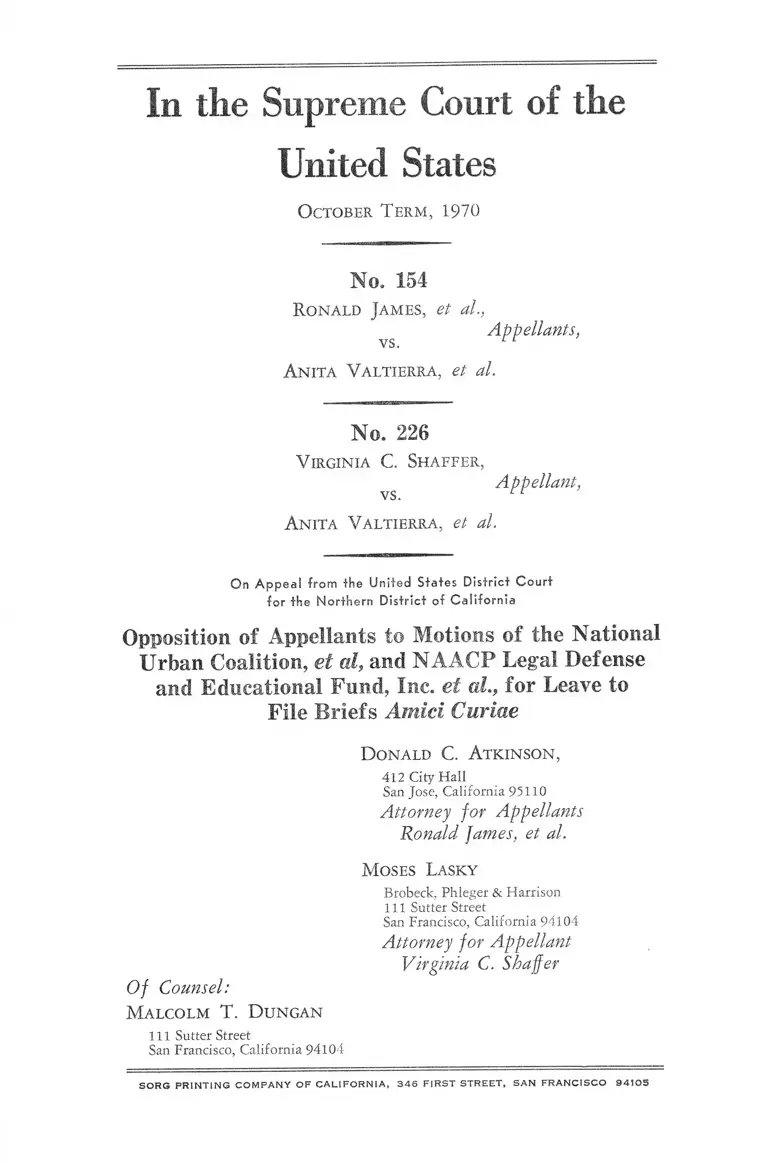
In the Supreme Court of the
United States
October T e r m , 1970
No. 154
R o n a l d J a m e s , et al.,
vs.
Appellants,
A n it a V a l t ie r r a , et al.
No. 226
V ir g in ia C . Sh a f f e r ,
vs.
A ppellant,
A n it a V a l t ie r r a , et al.
On Appeal from the United States District Court
for the Northern District of California
Opposition of Appellants to Motions of the National
Urban Coalition, et al, and NAACP Legal Defense
and Educational Fund, Inc. et al., for Leave to
File Briefs Amici Curiae
D o n a l d C . A t k i n s o n ,
412 City Hall
San Jose, California 95110
Attorney for Appellants
Ronald fames, et al.
M o se s L a s k y
Brobeck, Phleger & Harrison
111 Sutter Street
San Francisco, California 94104
Attorney for Appellant
Virginia C. Shaffer
Of Counsel:
M a l c o l m T. D u n g a n
111 Sutter Street
San Francisco, California 94104
S O R G P R I N T I N G C O M P A N Y O F C A L I F O R N I A , 3 4 6 F I R S T S T R E E T , S A N F R A N C I S C O 9 4 1 0 5
In the Supreme Court of the
United States
October T erm, 1970
No. 154
Ronald James, et al.,
Appellants,
vs.
Anita Valtierra, et al.
No. 226
Virginia C. Shaffer,
Appellant,
vs.
Anita Valtierra, et al.
On Appeal from the United States District Court
for the Northern District of California
Opposition of Appellants to Motions of the National
Urban Coalition, et al, and NAACP Legal Defense
and Educational Fund, Inc. et al., for Leave to
File Briefs Amici Curiae
Pursuant to Rule 42(3) of the Court’s Rules, Ronald James,
et al., appellants in No. 154, and Virginia C. Shaffer, appellant in
No. 226, object to the motions of The National Urban Coalition,
et al., and NAACP Legal Defense and Educational Fund, Inc.,
et al., for leave to file briefs amici curiae herein.
Already on file are a 78-page brief of appellees Yaltierra, et al.,
plaintiffs below, and a 38-page brief of Housing Authority of the
City of San Jose, which was a defendant below and, styling itself
appellee, seeks affirmance of the judgment against it. The Solicitor
General has advised that in a few days he will be filing a brief
in support of appellees.
1. Two proposed amici briefs are tendered for filing: One on
behalf of the National Urban Coalition and 15 other named organ
izations (hereinafter "Urban Coalition Br.” ) , and the other on
behalf of NAACP Legal Defense and Educational Fund, Inc. and
National Office for the Rights of the Indigent (hereinafter "Legal
Defense Fund Br.” ) .
2. Neither motion complies with Rule 42 (3 ), second sentence.
Neither sets forth any "facts or questions of law that have not
been, or reasons for believing that they will not adequately be,
presented by the parties” . In fact, neither motion says anything at
all about any factual or legal issues relevant to the disposition of
the case. The most either says is that movants believe they can
place the issues "in a national perspective” (Legal Defense Fund
Mo. 4-M; cf. Urban Coalition Mo. i i ) ; but what "relevancy to
the disposition of the case” (Rule 4 2 (3 )) that may have, we are
not told. The Urban Coalition Motion violates Rule 42(3) in
another way: it fails to "concisely state the nature of the appli
cant's interest.”1
3. Appellants received no request to consent to amici briefs
from any of the 15 organizations which now seek to join with the
Urban Coalition.2 * 4 Neither the request of the Urban Coalition nor
1. The caption and text under "The Interest of the Amici” occupy
the first eleven pages of the subjoined brief. Had they been placed in
the motion, as the Rule requires, it would have exceeded the 5-page
limitation in the Rule.
2. The Statement at Urban Coalition Mo. ii that "Petitioners requested
consent . . . .” is simply incorrect. The request came from Urban Coalition
alone, and for it alone. Not until receipt of the motion had we any inkling
that any of the 15 others wished to appear in the case. As to this, see
4, 7, infra.
2
that of the Legal Defense Fund in any way specified what the
interest of the applicant was, and the request of the Urban Coali
tion did not even state what position it proposed to take in this
Court. Appellants refused consent, counsel believing that the spirit
of Rule 42 (which contemplates extrajudicial disposition of the
question of participation by amici in the first instance) requires an
applicant to disclose both his interest and his position when seek
ing the consent of parties.
4. We respectfully submit that the purpose of the proposed
amici briefs is not to aid the Court by the submission of reasoning
to reach a proper judgment in the cause, but to impose upon the
Court knowledge of the desire of a large number of special interest
groups for a particular judgment.* That is not the office of an
amici brief. Thus Stem & Gressman, Supreme Court Practice
(4th ed.), states, p. 482 n.29, quoting from a policy statement of
the Solicitor General’s office in cases where amici seek to be heard,
” . . . The Department of Justice frowns upon the filing by
amici with merely an academic interest at one extreme, or
those who merely wish to engage in propaganda on the other.
Consent is given 'where the applicant has a concrete, sub
stantial interest in the decision of the case, and the proposed
brief would assist the Court by presenting relevant arguments
or materials which would not otherwise be submitted’.”
5. The proposed briefs are simply repetitious of the main
Brief of Appellees, which itself extends to 78 pages. The 63-page
Urban Coalition Brief adds nothing, except for a 6lA page sugges
tion (pp. 46-52) that the Article of the California Constitution
here assailed (which only provides for a referendum on housing
projects) somehow interferes with the right of interstate travel!
♦ That this is so is shown by the fact that National Urban Coalition
actually issued a press release simultaneously with the tendering of its
proposed brief in this Court on October 26th. See New York Times,
October 27th, 1970, p. 19, col. 2.
3
That far-fetched argument was not raised by the complaint, in the
court below, or by the parties, nor is it involved in any question
presented to this Court in Jurisdictional Statements or responses.
The 35-page Legal Defense Fund Brief raises no question not
thoroughly briefed by appellees, except for a 3-page argument that
a referendum that does not speak of race or refer to race is a
"badge of slavery” !
6. Appellees have no need for the assistance of the would-be
amici in the presentation of their case. Appellees are not repre
sented by incompetent counsel, and they are not unable to engage
the best and most zealous legal representation. Appellees already
have five attorneys of record, all financed by public or quasi-public
funds3; in addition, the Housing Authority defendants—who seek
affirmance of the judgment against them— are represented here by
able counsel, a member of the largest private law firm in Califor
nia. The Solicitor General, who needs no consent from us to file a
brief amicus curiae (Rule 42 (4) ) , has already indicated his inter
est and his position in this case by a motion (not served on us) for
leave to present oral argument in support of appellees. The Court
denied that motion October 19, 1970.
7. The motions for leave to file are out of time. Rule 42(2)
provides that, whether filed on consent or on order of the Court,
an amicus brief must be "presented within the time allowed for
the filing of the brief of the party supported.” Rule 42(3) provides
that when consent of a party is refused, the motion for leave to
file must be "timely . . . presented to the court.” Plainly these pro
visions mean that, if consent to the amicus brief is refused, the
proposed amicus must file his motion promptly enough so that the
Court may act on it before the running of the time of the party
3. Two of counsel for appellees give as their addresses the Law Schools
of the University of California and Stanford University. The other three
are affiliated with the Legal Aid Societies of San Mateo and Santa Clara
Counties, which we understand are financed by OEO money.
4
supported to file his brief. Here, appellant Shaffer’s brief was due,
and was filed (without request for extension) on August 13, 1970;
near the end of August, we received and refused the request of
Urban Coalition (and it alone) for consent to an amicus brief.
Appellants James et al. obtained one extension of time to file their
brief; not until that had expired did Legal Defense Fund even ask
for consent, which was received September 23rd and refused on or
about September 25th. In the face of all this, proposed amici do
not even present their motions until the very day the briefs of the
parties supported— after an extension of time requested and re
ceived by them— are due! Even a minimum of diligence would
have enabled proposed amici to comply comfortably with the time
limits plainly expressed in the Rule.
The result of these delays to appellants is that they would be
confronted with the necessity of replying to 214 pages of briefs,
plus whatever the Solicitor General may file. Reception of the
amici briefs, we submit, is oppressive to appellants, and aids the
Court not at all.
5
CONCLUSION!
For the foregoing reasons, the motions of The National Urban
Coalition, et ah, and NAACP Legal Defense Fund, et al., for
leave to file briefs amici curiae should be denied.
Respectfully submitted,
D o n a l d C. A t k i n s o n ,
Attorney for Appellants Ronald
James, et al.
M o se s L a s k y
Attorney for Appellant
Virginia C. Shaffer
Of Counsel:
M a l c o l m T. D u n g a n
October 28, 1970