Furnco Construction Corporation v. Waters Brief Amici Curiae
Public Court Documents
March 1, 1978
-
Brief Collection, LDF Court Filings. Furnco Construction Corporation v. Waters Brief Amici Curiae, 1978. f6510b97-b29a-ee11-be36-6045bdeb8873. LDF Archives, Thurgood Marshall Institute. https://ldfrecollection.org/archives/archives-search/archives-item/1473e455-2135-44e6-a9a4-b22f94068949/furnco-construction-corporation-v-waters-brief-amici-curiae. Accessed October 07, 2026.
Copied!
F. »* ' *
• K '■■'
• (■' ■ ■ ,
■i ,;-c ■■v...
, v . r ‘ v>
. y-; ■ t .. • v ./
' L '■•'{< ■ ' ' -l /
k
' ' , V*.
* \ >-*• J
v--
' »-. \
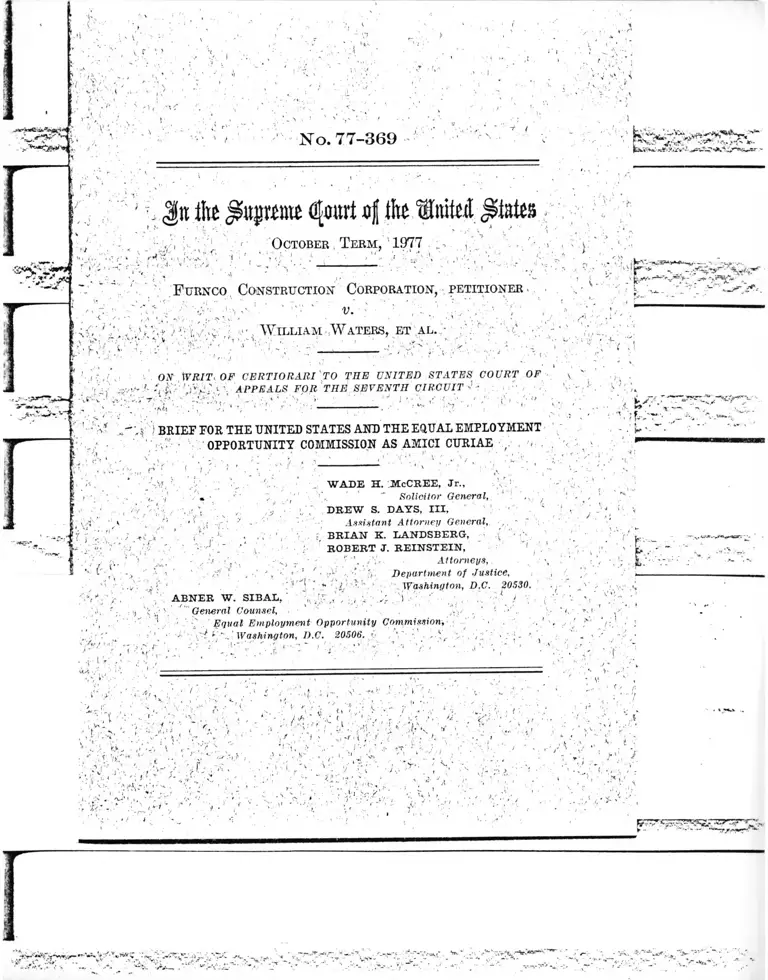
No. 77-369
' Jit iltt j&tjsttme (î ourt of flte Wiiitoi plates
-; , , - ' ’ ‘ v 7 ; - > *■><■ \% . i ' . . * V
' ;;:V' '.'r' October T erm , ‘1977 . j '■Vv: '.v,.'-- .■■>■ ',.a 'v.: " ;,a ,7
"•..v-. ■■■ <: .* i. .r*'vVv"*V,. !' 1 ’ ■•: - ; - ; ' " / :--j - 1 ./ ■..
■ '■> ' - r ■ ' ■ ' ■ ■ v • - . ; , v
"V ' ' ' ' F urnco Construction Corporation, petitioner ■
v.,.a v'. / ' ' " y -.
■’ i. v;! ' y . ' '■ * WILLIAM W ATERS, ET A L . : \ . : H. ■ ' . v . ' , < \ ; Z . V
' ; . r — .— {!
-v-“ ̂ ;
t‘ 7*;.»
7
'! 4 •' isvi* * .>£••• V J \ • APPEALS FOR
‘ • • ------ ------- ■ 1 ■v:-. ' ," "; ■-*...v
j BRIEE FOR THE UNITED STATES AND THE EQUAL EMPLOYMENT
o n Wr i t , o f c e r t i o r a r i t o t h e u n i t e d s t a t e s c o u r t o f
APPEALS FOR THE SE V E N T H CIRCUIT J - : , , ,
v-v
OPPORTUNITY COMMISSION AS AMICI CURIAE
: v r
f \ r
•/
* -15
j ■ . / ,-tv V -
. . ' V ' , l :
' v- , ^ \ -
■ ̂ , 0 ■ ’ •*,; ■’ .
' : m :> •: - . i ” 1
'Ul* ' fi •
S'
'•t
A B N E R W . SIB A L,
i i) 1' ^ v, " General Counsel,
_ W A D E H . JtcC REE, Jr.,
’ ' Solicitor General,
/ D R E W S. DAY S, I I I .
Assistant Attorney General, ,
.... t,' B R IA N K. LANDSBERG , -i { ‘
ROBERT J. R E IN ST E IN ,
- ; .• Attorneys,
■ ' , (A; Department of Justice,
J ' 1/ —■!'.1 Washington, D.C. 20530.
\ i-y.-y - y '' -er.. > ■' ’ ’ .■ "■ ■. ■ \ ■
•• ,'r r —
. 1 '< . C ; . Equal Employment Opportunity Commission,
•• • ••'• F ' Washington, D.C. 20506. v / V ■ y - i . .
i ^ • • ' ' ^ i . * ■ '
/ T. .
•• -'f ■
•' ,V<-.
i f - - ■ I , | -s'. A •
*\y
V ■ ,V- ̂"A ,
" ' . v ■
— V > ' . .
' r * S'- ^ ,
; </ r. ,... ̂ V - ** • fr ‘ ' *” ' . ' - 'j
j / , ; .r v
-••c c. ' " v ;
■ o ;
t /. ; ’ ; ; •
", / i : : . :y V.
* i ; •'
/ t / • ' . ••’ , ■ .; t ■ • ̂ 1 >, v!.. « t . ;/
m / ; ’ •/• • 1 , ,/4 », - t . V ' ; A K I* .
' - .v r - % . - ■i . - - ' ^ V ' . ' / O V - , V
V:' . V 1. ? ; ' '
- ' V ' . A ' ' - ‘ - ■ . ■ t- •
• ; , s’ : - >r r->., . 1 -
• ' r . - ■v . ■* A ■ ,!'■ •• . ; 1 ■ . ’ ■ . - M '. \
> • . . ̂ >,*• , . ;* . V • .
► - - r
f the United States and the Equal Employment page
criminatory reason rebutting the inference
of racial discrimination arising from t.ho
exclusion of all black bricklayers from its
hiring supervisor’s list and the resulting
failure to offer employment to Smith and
Sam uels-------------------------------------------
B. Furnco's practice of hiring only by supervisor’s
reference was properly found on this record
to be a legitimate non-discriminatory policy
rebutting the inference of discrimination
raised by its refusal to accept the applica
tion of Nemhard at the gate-------------------
Conclusion
CITATION’S
Albemarle Paper Co. v. Moody, 422 U.S. 405-------- 12,
Batiste v. Furnco, 503 F. 2d 447, certiorari denied, 420
U.S. 928_____________________________________
Baumgartner v. United States, 322 U.S. 665-------------
Baxter v. Savannah Sugar Refining Corp., 495 F. 2d
437, certiorari denied, 419 U.S. 1033--------------------
Brown v. Gaston Country Dyeing Machine Co., 457 F.
2d 1377, certiorari denied, 409 U.S. 982----------------
Castaneda v. Partida, 430 U.S. 482------------------ 9,14
mMk,
M J a S ,
October T erm , 1977
F urnco Construction Corporation, petitioner
W illiam W aters, et al,
C E R T IO R A R I TO THE EXITED S T A T E S COURT OP
APPEALS FOR THE SE V E N TH CIRCUIT
BRIEF FOR THE UNITED STATES AND THE EQUAL EMPLOYMENT
OPPORTUNITY COMMISSION AS AMICI CURIAE
IN T E R E ST OF T H E U N IT E D STATES A N D T H E EQUAL
EM PLOYM ENT O PPO R TUN ITY COMMISSION
* Federal enforcement of Title V II of the Civil
Rights Act of 1961 lias been vested by Congress in the
Equal Employment Opportunity Commission, the De
partment of Justice and the Civil Service Commission.
The Equal Employment Opportunity Commission has
authority to bring civil actions against private em
ployers under 42 U.S.C. (Supp. V) 2000e-5(f) (1).
The Attorney General has enforcement responsibility
when the employer is a state government, govern-
mental agency, or political subdivision. ^ u.o.^.
(and Supp. V) 2000c-6. This case raises questions
concerning the substantive reach of Title ^ I I , the
resolution of which may affect federal administration
and enforcement of the Act.
STATEM EN T
Furnco Construction Corporation (“Furnco”) is a
large contractor specializing in steel mill and blast
furnace relining. In August 1971, Furnco entered into
a contract with Interlake, Inc., to reline the larger of
Interlake’s two blast furnaces. Furnco’s superintend
ent, Joe Dacies, had authority to hire bricklayers for
the Interlake job. The choice of which bricklayers to
hire was committed totally to Dacies’ discretion (Pet.
3; Tr. 668-669, 693, 769).1 Dacies had worked in the
bricklaying trade since 1946 and had been a job super
intendent for Furnco since 1965 (Tr. 768). His gen-
nl.ni -rvT>«i<->+ir>o ia fn biTR bricklavers from a list which
court.
s 's
Dac-ies “ [o]nce in a while” accepts recommendations
from foremen or other superintendents (Tr. 770),
but he does not accept or consider written or job-site
applications from bricklayers because he always has
enough men “on [his] list” to fill the jobs (Tr. 773).
Dacies justifies his practice, which is common in the
firebrick industry (Tr. 35-38),2 primarily as a meas
ure to ensure the hiring of competent firebrick workers
(Tr. 771-772).
Although he had worked with black bricklayers
on firebrick jobs (Tr. 343-344, 359-360, 773, S73),
Dacies’ list consisted entirely of white persons (Tr.
777-778).3 But before the Interlake job started,
Dacies was advised by Furnco’s general manager,
John Wright, that he should try to have at least 16
percent of the work done by competent black brick
layers (Tr. 675, 777-778). The company adopted this
“ affirmative action” goal in response to a suit by
black bricklayers who had not been hired for a ‘I960
Furnco job (the Batiste litigation) (Tr. 673-674).4 The
2Furnco expects its superintendents to hire bricklayers known
by them and they generally do so (Tr. 669-672). If this method
does not produce enough workers'for the job, superintendents are
expected to seek recommendations from other superintendents and
workers (Tr. 671). On several occasions, some of Furnco's super
intendents hired bricklayers who applied at the jobsite and also
hired bricklayers who had no prior experience in firebrick work
(Tr. 234-236,* 314-315, 324-335, 509-510, 516, 561-563).
3 Petitioner characterizes Dacies' list as “various notes,'’ but con
cedes that “the names contained on such notes were of white
bricklayers” (Pet. Br. 34, n. 29).
4 See Batiste v. Furnco, 503 F. 2d447 (C.A. 7), certiorari denied,
420 U.S. 928.
gOcil was intended to preclude additional lawsuits and
was limited to Cook County where the company had
been sued (Tr. 674—675).
Since Wright had stated that Furnco “would like
to have black people on the job” (Tr. t7t) and theie
were no blacks on Dacies’ list, Dacies obtained refer
ences of black bricklayers from another J urnco super
intendent in the area.3 Between August 26 and Sep
tember 27, 1971, Dacies hired four blacks who had
been recommended to him and 37 whites from his
list (Joint Exh. 1; Tr. 781-786). These 41 bricklayers
were hired on a staggered basis. The first four brick
layers hired (between August 26 and September 8)
were white, then a black was hired on September 9;
15 bricklayers were hired between September 10 and
18, of whom two were black; and 21 were hired be
tween September 21 and 27, including one black
(.Joint Exh. 1). While this hiring was taking place,
Furnco was in settlement negotiations with the
Batiste plaintiffs (Tr. 677). The negotiations broke
down in late September 1971, and Wright advised
5 Dacies testified that lie, contacted the other superintendent “to
see if he had black bricklayers that could do parts of this job in
the blast furnace work. lie said he thought that he had a few
that could make it. lie subsequently gave me some names and
telephone numbers and I called them ’ (J r . 778). 11 hen asked
whether Interlake was the first job for which Dacies had ever
hired black bricklayers, Dacies said: “I thought maybe it was the
South Works job that I started to run * * * I thought there was
two of them. I don't recall exactly, because I quit the job subse
quently, very shortly after” (Tr. 875). Petitioner cites no other
authority for its statement that Dacies hired “several’ blacks on
this earlier job (Pet. Br. 8 n. S, citing l r . 875).
Dacies to consider the Batiste plaintiffs when hiring
resumed (Tr. 677-678, 778-779). Between October 12
and 27, 1971, Dacies hired 14 more bricklayers, includ
ing seven blacks involved in the Batiste case (Joint
Exh. 1; Tr. 781-786). Overall on the Interlake job,
55 bricklayers were hired, 44 whites selected from
Dacies’ list and 11 blacks recommended to him by
Wright and another Furnco superintendent. The work
of the black bricklayers constituted 13.3 percent of
the total man-days expended on the job (Joint Exh.
William Smith, Donald Samuels and Robert Hem-
hard are three black bricklayers who unsuccessfully
sought employment on the Interlake job (Pet. App.
A17). Smith, a bricklayer for 30 years, had worked
on many firebrick jobs; Furnco conceded his quali
fications (Tr. 311-314). Before the Interlake job,
Smith had worked with Dacies four times—1958, 1962,
1969 (for Furnco) and 1970-1971 (for Furnco) (Tr.
343-346, 359-360). On one of these jobs, Smith super
vised Dacies (Tr. 785). Smith’s name did not, howev
er, appear on Dacies’ list. Samuels was a bricklayer
for 17 years (Tr. 227), and liad worked on 6-8 fire
brick jobs (Tr. 229), including one for Furnco in
1969-1970 on which Dacies also worked (Tr. 234,
874)/' Samuels’ name also did not appear on Dacies’
list. A/emhard had been a bricklayer for 29 years; he
had worked on one firebrick job for about two years,
but not with Dacies or Furnco (Tr. 66-69, 72).
Although Smith and Samuels had worked on certain Furnco
i with Dacies, they had been hired by other superintendents
. 235-236, 314-316).
KKW1 s % •. ■C-S J9& S
u pffiOguSBSraS -im
SSI £&§j( SISi|kS||j |l|||§$51
illilfiiflS faBai tf® l mm
Since neither Smith nor Samuels was included on
Dacies’ list, they were not among the past Furnco
bricklayers whom Dacies called using his normal pro
cedures. I f any black bricklayers had been on Dacies’
list, they would have been called by him and offered
employment (Tr. 777-778). Smith and Samuels as
well as Nemhard each applied for work at the Inter
lake job by going to the job-site in August 1971, be
fore construction began (Tr. 73-74, 250, 32/)- Each
returned to the job-site on a number of occasions din
ing construction (Tr. 74-77, 251-259, 328-331). They
applied “at the gate” because this is how they had
been hired on earlier firebrick jobs (Tr. 12, 229-236,
311-316, 327). Nemliard also sent a written appli
cation to Furnco (Tr. 77-78).
Samuels and Nemhard were never hired on the
Interlake job. Smith's attempt to obtain work by
applving at the gate was also unsuccessful; but on
October’12, 1971 (Tr. 350), he was hired at W right’s
suggestion as one of the Batiste plaintiffs. After ex
hausting their administrative remedies before the
Equal Employment Opportunity Commission, Smith,
Samuels and Nemhard brought suit against Furnco
under Title V II of the 1964 Civil Rights Act. Sam
uels and Nemhard claimed that they were not hired
because of their race; Smith claimed that he was dis-
criminatorily denied employment until the job was
near completion.
Following an evidentiary hearing, the district court
entered judgment for Furnco (Pet App. C). Focus
ing solely upon Furnco’s refusal to consider respond-
outs’ applications at tho job-site and in writing, the
court held that this practice was racially neutral,
was not a pretext for excluding black bricklayers, did
not have a disproportionate effect on black brick
layers,7 and was justified as a business necessity (Pet.
App. A1G-A18).8
The court of appeals reversed (Pet. App. A), hold
ing that Smith, Samuels and Xemliard had each es
tablished a prima facie case of discrimination under
McDonnell Douglas Corp. v. Green, 411 TJ.S. 792, and
that the company's policy of hiring only bricklayers
known by or recommended to its superintendent was
neither legitimate nor non-discriminatory. The court
viewed the practice as fraught with the potential for
arbitrary and discriminatory decisions especially in
light of the alternative of accepting applications in
writing and checking references. The court held that
because of historical discrimination against blacks,
‘*it is prima facie racial discrimination to refuse
to consider the qualifications of a black job seeker
before hiring from an approved list containing
7 The district court found that 5.7 percent of the bricklayers in
the relevant labor force were minorities, relying on 1960 data in
the “Chicago plan” which includes the five counties surrounding
Cook County (Pet. App. A16). The court excluded respondents’
evidence that the bricklayers’ local union in Cook County was
13-14 percent black in 1973, and stated that, even if accepted,
this figure would not be probative evidence of racial discrimina
tion because 13.3 percent of the work at the Interlake job was
performed by blacks (Pet. App. A1G and n. 1).
8 Five other black bricklayers joined this lawsuit. The district
court held that their claims were without merit (Pet. App. A16-
A18), and the court of appeals affirmed (Pet. App. A3-A5).
■
1
„,ly the names Of White bricklayers ( 1 H A
V7) Responding to the company s argun ‘
here was no racial imbalance on the Interlake 101-
■he court stated that respondents had no chance to
considered for most of the jobs winch -
)retained to be filled by white bricklayers from Dac _
all-white list (Pet. App. AS). The court conclude.^
“ [Y]is-a-vis the white bricklayers em ployed n 84-87
percent of the jobs, racial discrimination is establ^hed
under the principle of McDomMDowlas d ft. App.
A S - A S ) . SO M M A E y o r ARG UM ENT
Both the district court and the court of appeals
erred in treating the claims of the three responc-
onts as identical. Although each respondent is a black
bricklayer with proven competence, and c a n was
unable to secure employment on the Inter ass .1°)
),v applying at the gate, a crucial factual diffcienc .
distinguishes Smith’s and Samuels’ claim from Nem-
oi.. -i-u Smniipls had each worked \Mth
names ot wmie " J
pcared on Dacies' list were called directly to work by
the superintendent. Since Smith's and Samuels names
did not appear,-they did not have the same employ
ment opportunity afforded to similarly situated white
bricklayers who had worked-with Paeies. The all-
white composition of Dacies hiring list, paiticulail}
when coupled with the totally subjective process by
which it was compiled, is prima facie evidence of in
tentional discrimination against black brickla>ers, in
cluding Smith and Samuels, who had worked with
Dacies and Furnco. International Brotherhood of
Teamsters v. United States, 431 U.S. 324, 337-342 and
n. 23; Castaneda v. Partida, 430 U.S. 4S2, 494-499.
Furnco presented no evidence to rebut this prima
Yn pvnlanation was offered why Smith and
IIpH | | PiIEglI'r.'f■. Vi ,Y ; ’jll§fImmptf
Samuels or other competent black bricklayers were
omitted from the supervisor’s hiring list, and from
the employment opportunity that concededlv would
have followed from inclusion on the list. Furnco’s
refusal to take applications at the gate, while perhaps
a legitimate nondiscriminatory policy, is not disposi
tive of the claims of Smith and Samuels, whose ap
plications at the gate merely emphasize their avail
ability to accept the employment opportunities offered
to white bricklayers who had worked with Dacies.
Nor is the individual injury which they suffered as
a result of discrimination negated by Furnco’s hiring
of other black bricklayers through other mechanisms.
Both Smith and Samuels are entitled to Title V II
relief because they presented an unrebutted prnna
facie case based upon their discriminatory exclusion
from the supervisor’s list and the resulting failure of
Furnco to offer them early employment at the Inter-
job. See McDonald v. Santa Fe Trad Trans
portation Co., 427 U.S. 273, 281-283.
B. The claims of respondent Nemhard have a com
pletely different factual basis and require a separate
disposition under Title V II. Unlike the claims of
Smith and Samuels, the claim of Nemhard has no
connection with the racial composition of Dacies’
hiring list. Nemhard never worked with Furnco or
Dacies and could not possibly have appeared on
Dacies’ list of persons with whom he had previously
worked. Nemhard’s claim of discrimination is based
upon the alleged illegality of Furnco’s refusal to take
applications at the gate.
By demonstrating tliat ho was qualihed, applied,
was rejected, and that other bricklayers were hiied
in his stead, Xemhard made out a prima facie case of
racial discrimination. McDonnell Douglas Corp. v.
Green, 411 U.S. 792, 802. Furnco proved that it did
not consider any written or job site applications lor
the Interlake job, but hired only bricklayers known
by or recommended to its job superintendent. An em-
- reasonably
v will enhance
plover of highly skilled craftsmen may
assume that a hiring by reference polio
the overall quality of its workforce. Firsthand knowl
edge of an employee’s past performance is a reasonable
measure of future performance, and employers of
skilled craftsmen may understandably weight their
employment decisions in favor of their own knowledge
of the past performance of individuals rather than
depend on the recommendations of strangers. See
IVaters v. Wisconsin- Steel Works of Intevnuhonnl
Harvester Co., 502 F. 2d 1309, 1320 (C.A. 7). Here,
in findings that are not clearly erroneous, the district
court found Furnco’s reasons for rejecting applica
tions at the Interlake job justified by the evidence.
Thus, on this record, Furnco met its burden of rebut
tal under McDonnell Douglas v. Green, supra.
Our conclusion that Title V II does not as a per
se matter require employers to abandon a ‘'hiring
from within” policy, does not mean that such policies
are insulated from Title V II scrutiny in their appli
cation. As with subjective hiring practices generally,
such a policy is unlawful if it is discriminatorily ap-
plied or lias an exclusionary effect on minorities. See
Gates v. Georgia-Pacific Co., 492 F. 2d 292 (C.A. 9).
Furnco's hiring policy was not diseriminatorily ap
plied against Nemhard because he had never worked
for Dacies or Furnco and liecause no outside appli
cant, of any race, was hired on the Interlake job.
Similarly, Nemhard failed to prove that the rejection
of outside applicants was a pretext for racial dis
crimination. Blacks were hired on the Interlake job
in a proportion at least comparable to their apparent
representation in the labor force. Of course, even if
applied neutrally, a “hiring from within” policy would
be vulnerable under Title V II if it had an exclu
sionary effect on minorities. See Griggs v. Duke Power
Co., 401 U.S. 424, 429-431. However, such a challenge
must be premised on a showing that the practice did
exclude minorities disproportionately. See Albemarle
Paper Co. v. Moody, 422 U.S. 403, 423. Minorities
were not shown to have been disproportionately ex
cluded from the Interlake job. Since Nemhard has
not shown that Furnco's hiring practices were inten
tionally discriminatory against him or had an ex
clusionary effect on minorities as a class, his rejec
tion was not shown to be the product of unlawful
discrimination.
A R G U M EN T
THE JUDGMENT OF THE COURT OF AITEALS SHOULD BE
AFFIRMED AS TO RESPONDENTS SMITH AND SAMUELS
BUT REVERSED AS TO RESPONDENT NEMHARD
All three respondents are blacks who have worked
as bricklayers from between 17 and 30 years, who have
prior experience in firebrick work, and who took every
reasonable step to make known their desire to work
at Furnco’s Interlake job. Although the applications
of all three were rejected, the district court and the
court of appeals were in error in treating their claims
as identical. The respondents are not similarly situ
ated. Smith and Samuels had worked with Dacies on
Furnco jobs, but were omitted from his list of com
petent bricklayers with whom he had previously
worked and thereby denied otherwise virtually certain
employment on the Interlake job. Xemhard never
worked for a Furnco supervisor and his sole claim is
that the refusal to take his application at the gate was
the result of discrimination.
A. FURNCO FAILED TO SHOW A LEGITIMATE XON-DISCRIMIXATOItV
REASON REBUTTING T H E IN FER ENCE OF RACIAL DISCRIMINATION
ARISING FROM TIIE EXCLUSION OF ALL BLACK BRICKLAYERS FROM
ITS H IR IN G SUPERVISOR'S LIST A N D T H E RESULTING FAILURE TO
OFFER EM PLOYM ENT TO SM IT H A N D SAMUELS
Respondents Smith and Samuels established a prima
facie case of discrimination based upon their exclu
sion from Dacies’ list of qualified bricklayers with
whom he had previous working experience. Smith had
been a bricklayer for 30 years, while Samuels had 17
years’ experience. Both had extensive experience in
firebrick work. Both had worked on prior Furnco jobs
with Dacies, and Smith had even supervised Dacies.
Both bricklayers had therefore demonstrated their
competence in service with the Furnco supervisor
charged with the hiring for the Interlake job.
| H |
m
who had worked competently on earlier
superintendents did not
a new job began. Under
they were called directly
who maintained a hiring list
job, the list was
Bricklayers
firebrick jobs with Furnco's
have to apply for work when
the company’s hiring p
by the superintendent,
for that purpose. On the Interlake
compiled and utilized by Fades, who determined ac
cording to his own personal judgment which of his
prior employees would he called to work. Such a h ir
ing system, controlled by the unreviewable and sub
jective judgment of one man, is susceptible of dis-
nimsp. Castaneda, v. Partida, 4-10 U.S
1 &&mm
B i t s
S j* A>:
§ 1 1 m »̂|jf. -i-’i |
; , d f 2 f § §'mmmi mmSM w3
874.10 Fnrnco presented no evidence to rel)ut this
prima. facie case. Although Dneies testified, lie did
not. attempt to explain why his hiving list was all-
white or why Smith and Samuels were omitted from
I t is undisputed that Dacies had worked with black
bricklayers on firebrick jobs; no claim has been made,
let alone proven, by Dacies or Furnco that every
black bricklayer with whom Dacies worked was less
competent than the whites on his list. Indeed, given
the conceded qualifications of Smith (who actually
10 The courts of appeals have repeatedly recognized that, while
subjective evaluations of supervisors are not per sc unlawful
under Title VII, they provide “a ready mechanism for discrimi
nation.'’ Rowe v. General Motors Cor/)., 457 F. 2d 348, 359 (C.A.
5). See also, e.g., Heed v. Arlington Hotel Co., Inc.. 47(5 F. 2d
721. 724 (C.A. 8), certiorari denied, 414 IT.S. 854. When those
subjective evaluations are applied in a manner which results in
significant racial disparities, there is prima■ facie evidence of a
violation of Title VII. Rowe v. General Motors Corp., supra,'
Brown x. Gaston County Dyeing Machine Co., 457 F. 2d 1377.1382
(C.A. 4), certiorari denied. 409 U.S. 982: United States v. Beth
lehem Steel Corp., 440 F. 2d 052, 055 (C.A. 2) ; Equal Employ
ment 0 pportunify Commission, v. Detroit Edison Co., 515 F. 2d
301, 313 (C.A. 0), vacated and remanded on other grounds. 431
V.S. 951; Baxter x. Savannah Sugar Refining Corp., 495 F. 2d 437
(C.A. 5), certiorari denied, 419 U.S. 1033. See generally B. Sehlei &
P. Grossman, Employment Discrimination Law, Ch. 0 (1970).
11 I t appears from Dacies’ testimony that the exclusion of blacks
from his hiring list was his standard procedure. Before the In
terlake job, Dacies had called at most two black bricklayers for
work during his entire career as a firebrick superintendent (see
n. 5. supra).
job) and Samuels, such a
s. The burden was on
cnee of intentional dis-
Partida, supra, 430 U.S.
not met.
Samuels’ claims do not turn on
ico’s refusal to accept appli-
;h and Samuels did
and did request em-
! arc merely evidence
> employment oppor-
hite bricklayers who
biit withheld from similarly
bricklayers
supervised Dacies on one
claim would have been frivolou
Furnco “to dispel the infer
crimination” (Castaneda ~\
at 497-498), and that burden was
Thus, Smith’s and
the legitimacy of F
cations at the gate.
at the Interlake job site ;
their efforts at the gate
ailability to accept the
appear
ployment,
of their av
tunities offered to competent v
worked with Dacies,
•situated black bricklayers. Doth blacl
were similarly situated to white bricklayers who had
s and Furnco and who did not liai e
the Interlake job but were called di-
had not discriminated on racial
o- the hiring list, that list would
petent black briek-
tels and, as Dacies
layers would have
Interlake job. Smith and Samuels
rie out an unrebutted prima facie
tunity to be hired
ce. See McDonald
427 U.S. 273,
worked with Dacie;
to apply for
rectly. I f Dacies
grounds in compiling
have contained the names
layers including Smithy an
acknowledged, those blacl
been hired for the
have therefore mac
case that they were
from Dacies’ list be
v. Santa Fe Trail Transput
281-283.
Furnco is not exonerated from lia
and Samuels because its overall hiring
layers on the Interlake job compaics
''nicii it is conienueci tlicit blacks as a group were
treated worse than whites as a group. The question
is whether two blacks, as individuals, were treated
differently from similarly situated whites because of
their race. Smith and Samuels were denied the op
portunity to be hired at the beginning of the In ter
lake job because of Davies’ discrimination against
black bricklayers who had worked with him and
Furneo. This overt discrimination suffered by two
individuals did not disappear simply because Dacies,
having been instructed to hire some blacks on the
Interlake job, obtained the names of other black
bricklayers and hired them.
Our conclusion that Smith and Samuels are the
victims- of purposeful discrimination is not impaired
by the district court’s finding that Furnco’s hirinsr
practices at the Interlake job were racially neutral
and were not applied pretextually against black brick
layers (Pet. App. A18). The district court disposed
of the claims of all three respondents in a unitary
fashion without regard to the factual differences that
distinguished their claims or their differing posture
with respect to Furnco’s hiring processes. Thus the
district court held that Smith’s and Samuels’ claims
were sufficiently answered by the legitimate policy of
refusing to take applications at the gate even though
similarly situated white bricklayers were hired with
out any application whatsoever (Pet. App. A17-A18).
The district court overlooked entirely the all-white
composition of Dacies’ hiring list and did not con-
U M f e K ®
s id e r S m ith 's a n d S am u e ls’ r ig h t » >>» — —
sam e as w hite hvieklayevs w ho had
D a d o s an d Fuvneo. ̂ ( lis tric t co u rt and
A lthough the eri<>i of rp;11o
the c o u rt of ap p ea ls h i fa ilin g to analy se .
V I I claim s o f S m ith an d S am uels m 1* - of tl > _
specia l p o s tu re w ith resp ec t to D a n e s all-w l •
i r , i s t m av in p a r t he a ttr ib u ta b le to r e s p o n d »
aiiecre.1 illeg a lity o£ F u rn co s P ^ u
tice ofSre je c tin g ap p lica tio n s “ a t the g a te ,” we do not
believe th a t th is is an a p p ro p r ia te ease io r a rernanc
K esponden ts dad a r g - - t h e - r t s lielow th a t D a n is
of p a s t qualified em ployees ”
S am uels u t i „.a ted a n d a ll of the fac ts
'riiisi issue w as tu n y u u &iUtu ,
ia te d e te rm in a tio n have bcei
believe th a t the question
is C ourt. 'W hether th e re was
:hese resp o n d en ts
de te rm in ed 1)}' mi
o rd ing to govern-
miedct v. P a rtu la ,
necessary tor c
elicited.” We
should be deci
purposeful discrimination agamsi
is a question of ultimate fact to 1:
evaluation of evidentiary facts a
ing legal standards. See, c..g., Go
i> See Brief for Plaintiffs-Appcllants
l ’laintiffs-Appellants 5 n. y .
is facies testified that lus hinn;
supra). He did not offer any legiti
and conceded that he had workei
layers. Petitioner
on Dacies’ list were more
with whom he w<-------
qualifications (see p. o, .
racial hypothesis for tlm
Furnco lias not advanced it.
has never suggested mar mi »■
competent than every blf
orked. This is not surprising in h<
supra). If there is any ]
total exclusion of blacks
supra; Norris v. Alabama, 294 U.S. 587; v.
Ford Motor Co., 516 F. 2d 416 (C.A. 5). Cf. Baum
gartner v. United States, 322 U.S. 665, 670-671. lhe
evidentiary facts relating to Smith’s and Samuels
claims have been found and are not disputed on this
record; the conclusion of disparate treatment based
on race follows as a matter of law.
' 1 f-:p i |
Ci Z rth lt iT w a s a fiuaUfied firebrick worker, tad
r : r :tions in firebrick work were hired -stead . In a
nrivate non-class action such as this, pioo -
qualified minority applicant was denmd
Lhon there were available vacancies vill, absent e
plana tion from the employer, create an inference
------------------------
nr 11 Douglas, supra, 411 U j ,
fusal to hire Nemhard was demonstrably not ba.
on -a lack of qnalificattos or o vtmarm.e, S
teniationalBrotherhood of
states 431 U.S. 324, 358 n. 44. Nemhard had made
hhf^threshold prinm facie ^
>0 proved that it did not consider
Lte applications for the Interlake
,d only bricklayers known by or
job superintendent. An employer
aftsmen may reasonably assume
aference policy will enhance the
* workforce. Firsthand knowledge
st performance is a reasonable, if
;ure of future performance; and
■ understandably weight their deci-
heir own knowledge of past per-
formance rather than depend on the recommendations
of strangers. A policy which favors prior employees
over new applicants is not per se unlawful under Title
V II. See Waters v. Wisconsin Steel Works of Inter
national Harvester C o 502 F. 2d 1309, 1320 (C.A. 7)
Here, the district court found that such factors as the
special skills required at the Interlake job, the speed
at which the job was to be done, and the cost to Furnco
if the work was faultily completed, prevented Furnco
from hiring persons not known by it to be expel i-
eneed and highly qualified” or from engaging in “on-
tlie-job training” (Pet. App. A14-A15). While these
findings may be subject to dispute, they are not clearly
erroneous. Thus, on the record here, Furnco met its
burden of rebuttal under McDonnell DouglasA The
15 McDonnell Douglas docs not identify the precise nature of
the burden which is shifted to the employer to rebut the individ
ual's pnma facie case. We believe that the employer has the
burden of showing both what its reasons are for rejecting the
application and that those reasons are legitimate, i.e., that they
grow out of the needs of its business. The employer, in our view,
bears the burden of persuasion on both issues. Here, the com
plainant has proven that the two most common legitimate rea
sons for rejection (lack of vacancies'and qualifications) do not
nnnlv. See Teamsters, supra, 431 U.S. at 358 n. 44. If there is a
eel in holding that
legitimate reason, unrelated
s rejection.
facially legitimate policy is not immune
its application. The faciall) nen-
risor’s reference
pplied with racially discrimi-
, But the facts of this case
ent view of the court of ap-
of not considering written
i was applied discriminatorily
applicants. No applicant “at the gate,”
considered for employment at
to accept applications does not
n+ivntprl hv a desire to maintain
court of appeals therefore err
Furnco did not establish a
to race, to justify Nemhard’i
Furnco’s
from scrutiny in
tral policy of hiring only by superv
would be unlawful if W _
natory purpose or effect,
do not support the appar
peals that Furnco’s policy
or job-site applications
against black : _ _
white or black, was
Interlake. The refuse
appear to have been 1
an all-white work fc
stricted to the all-white list; Dacies
bricklayers who were recommended t
representation on the job compares fa
in the apparently available labor forceR esponden ts
” ^ 7 o u r t of appeals eorrc'ctly held that the district court
erred in excluding respondents' evidence concerning the ram i
composition of the available labor force but that Ins error j
not prejudicial. Blacks were not under-represented on the R e
late job whether the available labor force is 5 7 percent black as
contended by petitioner, or 13-14 percent black as contended b>
respondents.^As we have noted (supra, p. 4) three blacks were
among the twenty bricklayers hired during the first three weeks «t
the Interlake job. We would view Nemhard s claims very dirtei-
entlv if Dacies had filled all of the early positions with white .
while at the same time rejecting new applicants and then hue
blacks only during the tail-end portion of the job. Lndei those c
cumstances, it could be concluded that Furnco's policy of rejecting
ivnc Hnsicrned to reserve the best long-term jobs foi
}ipy\ I
MMKWBSWB
1 1 1 m
.
did not prove that the company placed an artificial
ceiling on the number of blacks it would hire. Re
spondents thus did not show that Furnco’s policy of
rejecting new applications was a pretext for racial
discrimination against black applicants without prior
experience. Thus, while experienced black bricklayers
like Smith and Samuels were the victims of disparate
treatment based upon race, black applicants without
prior experience with Dacies or Furnco were not.
See Waters v. Wisconsin Steel Works of Interna-
national Harvester Co., 502 F. 2d 1309, 1321-1322
(C.A. 7).
Irrespective of motivation, a policy of “hiring from
within” may lead to discriminatory results if minori
ties are under-represented in a company or industry.17
See Gates v. Georgia-Pacific Corp., 492 F. 2d 292
(C.A. 9). The use of a policy that has a disproportion
ately adverse impact on minorities or which per
petuates the effects of past discrimination violates
Title V II unless it is justified by business necessity.18
17 Congress “intended to prohibit all practices in whatever form
which create inequality in employment opportunity due to dis
crimination on the basis of race, religion, sex, or national origin.”
Franks v. Bowman Transportation Co., 424 U.S. 747, 763. See
also, e.g., A ashvillr. Gas Co. v. Satty , No. 75-536, decided Decem
ber 6, 1977; Dothard v. Rawlinson, 433, U.S. 321, 328-329.
18 In contrast, an individual who suffers purposeful discrimina
tion need not prove that other members of the group to which
ho belongs were also the victims of discrimination. Of course, one
method of establishing purposeful discrimination against individ
uals is by proving that the employer engaged in a pattern of
(Continued)
L in d u stry -w id e law suit, a i.u
challenge F u v n eo ’s h ir in g policy
In te r la k e . On th a t job, th e re
Jlg th a t F u v n e o ’s policy of re-
• re su lted in the d isp ro p o rtio n a te
b rick lay ers o r p e rp e tu a te d the ef-
r in a tio n .19 K em h ard d id n o t dem on-
, th a t a t th e tim e of th e In te r la k e
hack b rick lay ers co n stitu ted sub-
1in 1?, n e rcen t of the pool of com-
class-wide discrimination, buch proor cieaus a
tn p t io n that individual ntemho.s of .ho c as, tvoro
tinis of discrimination. Teamsters, supra, 431 U.b.
Franks v. Bowman Transportation Cos up i a , -
». The potential impact of tf reference system of h
petuating past discrimination is emphasized by the
Nicholas Popovic, the president of the brick ayers
covers Cook County, who worked in the brickky g
35 years before becoming a union official ( l i . - - •
was a supervisor on many jobs, and his standard hi
was to call directly experienced firebrick workers fioi
ho maintained (Tr. 47-19). Mr. Popovic never w,
black bricklayer on a firebrick job cither as a supei
br =o: 431 U.S. at 348-350; f t *
U.S. at 429-431.
In the absence of proof of discriminatory treatment
or effect, tlie availability of alternative hiring- prac
tices does not render Furnco's policy of rejecting
applicants at the gate unlawful. The court of appeals
concluded that a policy of accepting written applica
tions and checking recommendations is both “ reason
able” . and “ feasible” (Pet. App. A6), a conclusion
that would be highly relevant, and perhaps disposi
tive, if Furnco had the burden of justifying its ex
isting practice as a business necessity. See, e.g., United
States v. Bethlehem Steel Corp., 146 F. 2d 652, 662
(C.A. 2); Robinson v. Lorillard Covp., 444 F. 2d 791,
799-800 (C.A. 4), certiorari denied, 404 U.S. 1006.
But the business necessity defense arises only upon
a showing that the challenged practice has an adverse
impact on racial or other prohibited grounds; that
showing has not been made.21 Furnco's only burden
was to demonstrate that the alternative it chose was
legitimate and nondiscriminatory. McDonnell Douglas
y. Green, supra, 411 U.S. at 802. That burden was
met, and in these circumstances, the availability of a
feasible alternative did not require, or in itself per
mit, the district court to find a Title V II violation.22
21 For this reason, it is unnecessary to determine whether the
district court erred in concluding that Furnco’s practices “were
justified as a business necessity in that they were necessary for
the safe and efficient operation of Furnco's business” (Pet. App.
A20-A21).
22 Respondents did not show that the alternative practice advo
cated by the court of appeals would have resulted in a greater
representation of blacks on the Interlake job—a showing which
might indicate that Furnco’s practice of rejecting applicants was
a pretext for discrimination. See Albemarle Paper Co. v. Moody,
supra, 422 U.S. at 425.
CONCLUSION
The judgment of the court of appeals should be
affirmed as to respondents Smith and Samuels and
reversed as to respondent Nemhard.
Respectfully submitted.
W ade H. M cCree, J r . ,
Solicitor General.
D rew S. D ays, I I I ,
Assistant Attorney General.
B rian K . L andsberg,
R obert J. R e in s t e in ,
Attorneys.
A bner W. S ibae,
General Counsel,
Equal Employment Opportunity
Commission.
M arch