Harrison v. NAACP Argument on Behalf of Appellants
Public Court Documents
March 23, 1959
-
Brief Collection, LDF Court Filings. Harrison v. NAACP Argument on Behalf of Appellants, 1959. 4f794f7d-b59a-ee11-be36-6045bdeb8873. LDF Archives, Thurgood Marshall Institute. https://ldfrecollection.org/archives/archives-search/archives-item/152c1560-38b1-47b2-9ba9-7f86cba64d6d/harrison-v-naacp-argument-on-behalf-of-appellants. Accessed October 27, 2026.
Copied!
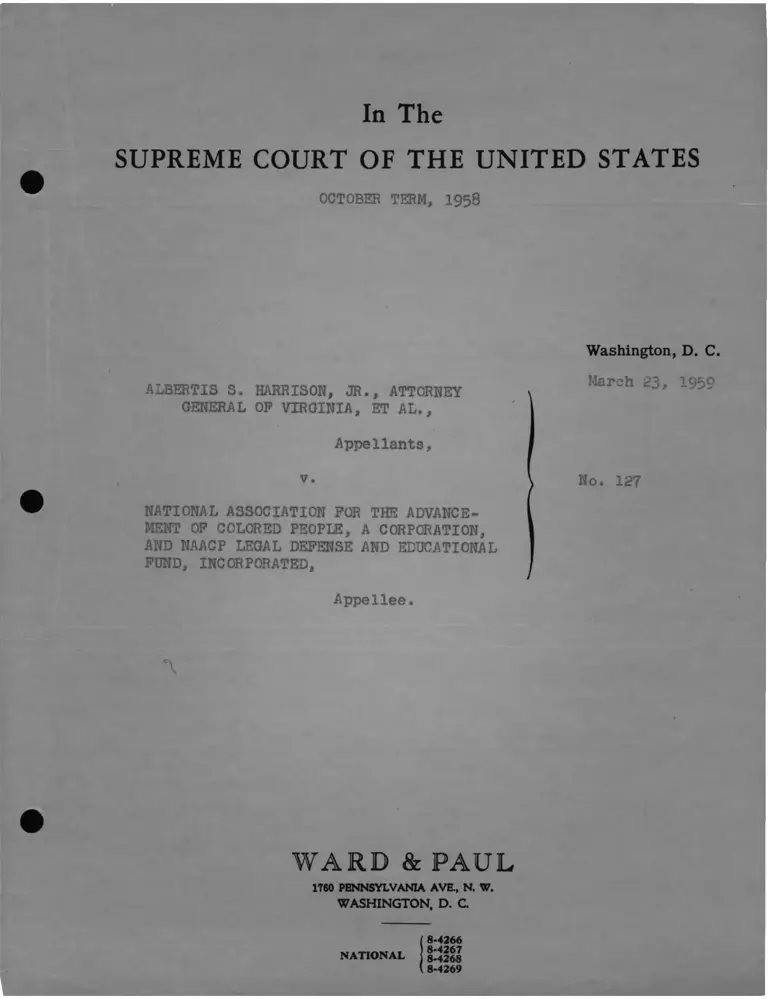
In The
SUPREME COURT OF THE UNITED STATES
OCTOBER TERM, 1958
ALBERTIS S. HARRISON, JR., ATTORNEY
GENERAL OP VIRGINIA, ET AL.,
Appellants,
v.
NATIONAL ASSOCIATION FOR THE ADVANCE
MENT OP COLORED PEOPLE, A CORPORATION,
AND NAACP LEGAL DEFENSE AND EDUCATIONAL
FUND, INCORPORATED,
Washington, D. C.
March 23, 195>9
No. 127
Appellee.
■ \
WARD & PAUL
1760 PENNSYLVANIA AVE., N. W.
WASHINGTON, D. C.
NATIONAL
8-4266
8-4267
8-4268
8-4269
A
C O N T E N T S
ARGUMENT ON BEHALF OF ALBERTIS S. HARRISON, JR . ,
ATTORNEY GENERAL OF VIRGINIA, ET AL.,
APPELLANTS
By Mr. J. Segar Gravatt 3
1
IN THE SUPREME COURT OF THE UNITED STATES
OCTOBER TERM, 1958
ALBERTIS S. HARRISON, JR., ATTORNEY
GENERAL OF VIRGINIA, ET AL.,
Appellants,
v. No. 127
NATIONAL ASSOCIATION FOR THE ADVANCE
MENT OF COLORED PEOPLE, A CORPORATION,
AND NAACP LEGAL DEFENSE AND EDUCATIONAL
FUND, INCORPORATED,
Appellee. :
Washington, D.C.
Monday, March 23> 1959
The above-entitled matter came on for oral argument
at 4:16 o'clock, p.m..
PRESENT:
The Chief Justice, Earl Warren, and Associate
Justices Black, Frankfurter, Douglas, Clark, Harlan,
Brennan, Whittaker, and Stewart.
APPEARANCES:
On behalf of Albertis S. Harrison, Jr., Attorney
General of Virginia, Et Al., Appellants:
J. Segar Gravatt, Blackstone, Virginia.
2
On behalf of National Association for the
Advancement of Colored People, Inc., Appellees:
Robert L. Carter, 20 West 40th Street,
New York, N. Y.
Oliver W. Kill, 118 E. Leigh Street,
Richmond, Virginia.
On behalf of NAACP Legal Defense and Educational
Fund, Inc., Appellees:
Thurgood Marshall, 10 Columbus Circle,
New York, N. Y.
Spotsviood W. Robinson, III, 623 North Third
Street, Richmond, Virginia.
3
The Chief Justice: No. 127, Albertis S. Harrison, Jr.,
Attorney General of Virginia, et al, Appellants, versus the
National Association for the Advancement of Colored People,
a Corporation, and NAACP Legal Defense and Educational Fund,
Incorporated.
The Clerk: Counsel are present.
The Chief Justice: Mr. Gravatt, you may proceed.
ARGUMENT ON BEHALF OF ALBERTIS S. HARRISON, JR., ATTORNEY
GENERAL OF VIRGINIA, ET AL.
By Mr. Gravatt:
Mr. Gravatt: Mr. Chief Justice, if Your Honors
please, this case come to this Court on a direct appeal from a
three judge statutory court sitting in the Eastern District
of Virginia, by virtue of Title 28, USC 1253.
The controversy here arises from a bill filed in an
equity proceeding by the National Association for Colored
People and an associate organization, the National Association
for Colored People Legal Defense Fund, in which they asked the
lower court to declare five Virginia statutes unconstitutional
upon the grounds that they violated the commerce clause of the
Constitution and rights of the complainant under the Fourteenth
and First Amendment.
The defendant filed a motion to dismiss the complaint.
Among the grounds stated is that one of the principal con
tentions which vie wish to make here — namely, that the court
4
should have withheld its extension of equity jurisdiction
and should have remanded the case, or held the case upon its
docket pending state construction of these statutes.
The matter was — the motion, of course, was over
ruled by the lower court, answers were filed, and evidence was
heard. The majority opinion, written by two Justices -- Judge
Soper and District Judge Hoffman — overheld three of the
statutes — Chap. 31 j 32 and 35 — to be plainly in violation
of the Constitution, to be without any ambiguity, and referred,
or retained the case upon the docket, and directed the
plaintiffs to apply to the state court for a construction
of the remaining two statutes, 33 and 3 6.
The statutes briefly -- these three statutes that
we have here under consideration fall into two classes,
Chapter 31 and Chapter 32 — what you would commonly character
ize as registration statutes, in that they require the registry
of the name of the corporation in this case and the supplying
of certain information therewith with the clerk of the
State Corporation Commission, provided the corporation or
association is engaged in certain activities defined in the
statute.
The other statute, which is Section Chapter 35
of the 1956 Acts of the Extra Session of the General Assembly,
is a statute which deals with the unauthorized practice of
law. It is quite closely akin to the other two statutes
5
which the court directed toe referred to the state courts for
a construction.
We shall argue here, if the Court please, two
questions. They are somewhat related to each other.
The first question is — should the lower court
have exercised, in the exercise of its discretion, retained
this case upon its docket, with a suggestion to the plaintiffs
that they apply to the state court for a construction of these
statutes.
I do not suppose that in fact the appellees in their
brief recognize the validity of that principle. They have
undertaken to develop an exception to it, on the toasis that
that will only toe done, that a federal equity court will only
sutomit a statute, and withhold its exercise of its equity
jurisdiction — will only do so when it is apparent to the
federal court that there is a reasonable toasis upon which the
statute in question could toe construed or interpreted in a
manner which would make it constitutional.
The problem which we present is a problem which has
been recognized toy this Court and toy judges and statesmen
through the years as toeing a delicate and an extremely serious
function, and an extremely serious matter.
This Court has repeatedly said that it is concerned
with one of the most delicate areas in which federal courts
are required to discharge their duties, namely, that area
in which they come in conflict with state powers and state
courts.
I do not suppose that anyone would question the
fact that the power to define crime, to define what acts are
punishable acts., is a power reserved to the states under the
Ninth and the Tenth amendment of the Constitution.
Of course, that power has to he exercised subject
always to the limitations imposed by the states in the Federal
Constitution, including the Fourteenth Amendment limitations
which are contended for here.
I do not suppose that anyone will question that
the final authority for the interpretation and the construction
of state statutes, under our system of government, lies in
the state courts and appropriately should be exercised there.
I further do not suppose that anyone would question the fact
that once such a statute is construed by the state courts,
once the state court has determined the scope, has determined
the meaning of its language, the area within which it operates,
the class or those persons to whom it will apply, that this
Court then has the final responsibility to determine whether,
as thus interpreted, or interpreted, the statute is in
conflict with those limitations imposed upon the states in
our Constitution.
Those principles, and the doctrine that has been
characterized in some of the decisions, and which seems to me
6
7
very aptly described as a doctrine of equitable abstention
from the assumption of power and of jurisdiction, which a
federal court has — that doctrine, if you please, is predicated
upon those principles which I have mentioned to you, which
find their origin in the very structure of the Constitution of
the United States. It is a doctrine that is exercised in
deference to the division of power ordained in the Constitution.
There is, however, another great and compelling
reason that supports and directs the discretion of a chancery
court in withholding its jurisdiction, and that is that this
Court, the function and the responsibility — as I apologize
for suggesting — has-a heavy and a great and an enduring
responsibility.
What is done here, in the construction of our
Federal Constitution, reaches on down the age3 whenever and
wherever it may be appropriate for it to be considered.
For that reason, this Court has always — it has
always been a maxim, a canon of the exercise of its power —
that It would avoid deciding a case upon a constitutional
issue if the case could be properly disposed of upon another
ground.
All of those considerations are not, if Your Honors
please, simply considerations of form. They are considerations
that reach to the very substance of our system of government.
They are considerations that are of the most compelling nature
8
when we come to consider the friction that may be generated
by the arbitrary exercise of federal power in an area that
primarily is the responsibility for the states to operate in.
And I am confident that a court of equity and that this Court
will always recognise that a chancery, sitting with such
great power to be exercised upon a state legislature and upon
all its people, will use that forebearance in applying it that
is dictated by the considerations and the constitutional
principles which I have very briefly referred bo.
This doctrine —
Justice Douglas: Does this law apply to Just
this organization, or does it apply to others?
Mr. Gravatt: It applies, so far as I know, sir
there e,re a great line of cases in which the court has
applied it in a great many different situations. I think
it ap'olies to this principle here, and I think it applies in
all areas.
Justice Douglas: Does it apply to the Virginia
State Bar Association?
Mr. Gravatt: Do you —
Justice Douglas. Chapters 31 and 32 -- do they
aoply to any organization but the NAACP?
Mr. Gravatt: provisions with respect to the Legal
Aid Society of the Bar Association.
Justice Douglas. Yes.
9
Mr. Gravatt. Yes, they are provisions that
apply to everybody that falls within them.
Justice Douglas. I guess we had better understand
each other.
The Chief Justice. We will recess now, Mr. Gravatt.
(Whereupon, at 4:30 p.m., the hearing was
recessed to reconvene at 12 o'clock noon, Tuesday,
March 24, 1959.)