Brown v. Board of Education Brief for Appellants in Nos. 1, 2 and 4 and for Respondents in No. 10 on Reargument
Public Court Documents
December 15, 1953
-
Brief Collection, LDF Court Filings. Brown v. Board of Education Brief for Appellants in Nos. 1, 2 and 4 and for Respondents in No. 10 on Reargument, 1953. 462767cf-b69a-ee11-be36-6045bdeb8873. LDF Archives, Thurgood Marshall Institute. https://ldfrecollection.org/archives/archives-search/archives-item/15f02044-93f9-4278-b0b5-2f6099cd16e9/brown-v-board-of-education-brief-for-appellants-in-nos-1-2-and-4-and-for-respondents-in-no-10-on-reargument. Accessed October 09, 2026.
Copied!
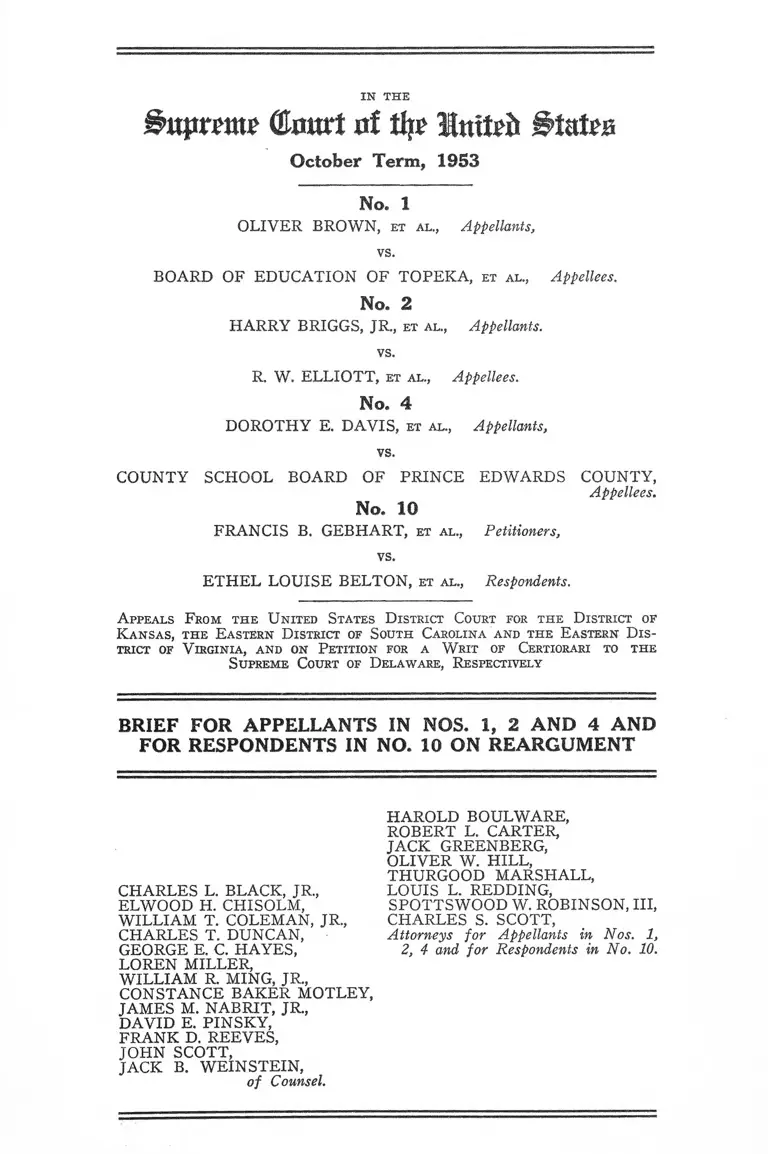
IN THE
xmt (Emtrt at % MmUb States
October Term, 1953
No. 1
OLIVER BROWN, et al ., Appellants,
vs.
BOARD OF EDUCATION OF TOPEKA, ex a l ., Appellees.
No. 2
HARRY BRIGGS, JR., et al,, Appellants.
vs.
R. W. ELLIOTT, et al ., Appellees.
No. 4
DOROTHY E. DAVIS, et al ., Appellants,
vs.
COUNTY SCHOOL BOARD OF PRINCE EDWARDS COUNTY,
Appellees.
No. 10
FRANCIS B. GEBHART, et al ., Petitioners,
vs.
ETHEL LOUISE BELTON, et al ., Respondents.
A ppeals F rom th e U nited States D istrict Court for th e D istrict of
K an sa s , the E astern D istrict of South Carolina and the E astern D is
trict of V irginia, and on Petition for a W rit of Certiorari to the
S upreme Court of D elaware, R espectively
BRIEF FOR APPELLANTS IN NOS. 1, 2 AND 4 AND
FOR RESPONDENTS IN NO. 10 ON REARGUMENT
CHARLES L. BLACK, JR.,
ELWOOD H. CHISOLM,
WILLIAM T. COLEMAN, JR.,
CHARLES T. DUNCAN,
GEORGE E. C. HAYES,
LOREN MILLER,
WILLIAM R. MING, JR.,
CONSTANCE BAKER MOTLEY,
JAMES M. NABRIT, JR.,
DAVID E. PINSKY,
FRANK D. REEVES,
JOHN SCOTT,
JACK B. WEINSTEIN,
of Counsel.
HAROLD BOULWARE,
ROBERT L. CARTER,
JACK GREENBERG,
OLIVER W. HILL,
THURGOOD MARSHALL,
LOUIS L. REDDING,
SPOTTSWOOD W. ROBINSON, III,
CHARLES S. SCOTT,
Attorneys for Appellants in Nos. 1,
2, 4 and for Respondents in No. 10.
F O R E W O R D
This is a reprint of the brief which was filed in the
United States Supreme Court on November 16, 1953, pur
suant to an order of that Court setting the school segrega
tion cases down for reargument. When the Court ordered
this reargument, it requested counsel to answer five ques
tions. Certain of these questions necessitated extensive
research into the history of the adoption and ratification
of the Fourteenth Amendment to determine whether the
Amendment was intended to abolish segregation in public
schools. Other questions, involving the power of the
Court to abolish segregation in education and the means
by which this could be effectively accomplished by judicial
mandate, also required intensive analysis. To this end,
the N.A.A.C.P. Legal Defense and Educational Fund, Inc.
set out to obtain the most reliable information available.
Research was divided into three sections: law, history
and sociology. The staff was fortunate in obtaining the
services of Dr. John A. Davis, now Associate Professor of
Government at the College of the City of New York, to
outline and direct the course of non-legal research.
Dr. Mabel Smythe was engaged as his chief assistant. Dr.
Albert Blum, historian, and Miss Julia Baxter assisted in
the research.
Basic monographs on the history of the adoption and
ratification of the Fourteenth Amendment were prepared
by Dr. Alfred H. Kelly, Professor of Constitutional His
tory at Wayne University, Howard Jay Graham, Law
Librarian of the Los Angeles County Bar Association, and
Dr. Horace M. Bond, President of Lincoln University,
Pennsylvania. Dr. Bond was assisted in his work by Dr.
Marion Wright, Professor of Education at Howard Uni
versity and Smith Haynes, graduate student at Columbia
University. Dr. C. Vann Woodward, Professor of Ameri
can History at the Johns Hopkins University and Dr. John
Hope Franklin, Professor of American History at Howard
University, wrote monographs on the history of recon
struction in the South and on the purposes and results of
segregation. Dr. Kenneth Clark, Associate Professor of
Psychology at the College of the City of New York, was
responsible, with the aid of Miss June Shagaloff, for ex
ploring methods used to bring about desegregation in many
situations.
We are also indebted to Professor Howard K. Beale,
Dr. Charles S. Johnson, Dr. Buell Gallagher, Dr. Charles
Wesley, Professor Robert K. Carr, Professor John Frank,
Professor Paul Freund, Dean George M. Johnson, Pro
fessor Walter Gellhorn, Dr. Charles S. Thompson, Pro
fessor David Haber, Dr. Milton Konvitz, Professor Robert
Cushman, Jr., U. S. Tate, David Feller, Dr. Harvey C.
Mansfield, Professor Rayford Logan, Professor Wallace
Sayre, Joseph Robison, Dr. Lillian Dabney and others
for assisting the lawyers of record in the formulation
of the basic approach to the questions propounded by
the Court and for specific criticism and advice on the
brief itself.
In addition, we wish to express our deep appreciation
to those lawyers and scholars who did research on the
history of the ratification of the Fourteenth Amendment
and on the history of segregation in public schools in each
of the 37 states which were in the Union at the time the
Fourteenth Amendment was adopted. We regret that the
list of lawyers who worked in the 37 states is too long to
permit us to name them individually.
This brief represents a pioneering effort and will remain
an important landmark in the development of the law.
While this brief could not have been finished without the
help and assistance indicated, our own staff assumes full
responsibility for any errors or omissions.
A r t h u r B. S pihgarn
President
N.A.A.C.P. Legal Defense and
Educational Fund, Inc.
December 15, 1953.
TABLE OF CONTENTS
Explanatory Statement .................................................. 2
No, 1
Opinion B elow ................................................................... 2
Jurisdiction ....................................................................... 2
Statement of tlie C ase ...................................................... 2
Specification of Errors .................................................. 3
No. 2
Opinions Below ............................................. 4
Jurisdiction ....................................................................... 4
Statement of the Case .................................................... 4
Specification of Errors .................... 6
No. 4
Opinion Below ................................................................. 6
Jurisdiction ....................................................................... 6
Statement of the Case .................................................... 7
Specification of E rro rs .................................................... 8
No. 10
Opinions Below ............................................................... 9
Jurisdiction ....................................................................... 9
Statement of the Case .................................................... 10
This Court’s Order ............................................. 13
Summary of Argum ent.................................................... 15
Argument ......................................................................... 21
PAGE
11
ARGUMENT
P art One
PAGE
I. Normal exercise of the judicial function calls for
a declaration that the state is without power to
enforce distinctions based upon race or color in
affording educational opportunities in the pub
lic schools................................................................. 21
II. The statutory and constitutional provisions in
volved in these cases cannot he validated under
any separate but equal concept............................. 31
A. Racial Segregation Cannot Be Squared With
the Rationale of the Early Cases Interpreting
the Reach of the Fourteenth Amendment . . . . 32
B. The First Time the Question Came Before the
Court, Racial Segregation In Transportation
Was Specifically Disapproved......................... 36
C. The Separate But Equal Doctrine Marked An
Unwarranted Departure From the Main
Stream of Constitutional Development and
Permits the Frustration of the Very Purposes
of The Fourteenth Amendment As Defined
by This Court .................................................... 38
D. The Separate But Equal Doctrine Was Con
ceived in Error ................................................. 40
1. The Dissenting Opinion of Justice Harlan
in Plessy v. Ferguson................................ 40
2. Custom, Usage and Tradition Rooted in the
Slave Tradition Cannot Be the Constitu
tional Yardstick for Measuring State Ac
tion Under the Fourteenth Amendment . . 42
3. Preservation of Public Peace Cannot Jus
tify Deprivation of Constitutional Rights 43
I ll
4. The Separate but Equal Doctrine Deprives
Negroes of That Protection Which the
Fourteenth Amendment Accords Under the
General Classification Test ....................... 45
E. The Separate But Equal Doctrine Has Not
Received Unqualified Approval in This Court 47
F. The Necessary Consequence of the Sweatt and
McLaurin Decisions is Repudiation of The
Separate But Equal Doctrine ......................... 48
III. Viewed in the light of history the separate but
equal doctrine has been an instrumentality of
defiant nullification of the Fourteenth Amend
ment .......................................................................... 50
A. The Status of the Negro, Slave and Free, Prior
to the Civil W a r ................................................ 50
B. The Post War Struggle .................................. 53
C. The Compromise of 1877 and the Abandon
ment of Reconstruction.................................... 56
D. Consequences of the 1877 Compromise........... 57
E. Nullification of the Rights Guaranteed by the
Fourteenth Amendment and the Reestablish
ment of the Negro’s Pre-Civil War Inferior
Status Fully Realized ...................................... 62
Conclusion to Part I ....................................................... 66
P art T wo
I. The Fourteenth Amendment was intended to de
stroy all caste and color legislation in the United
States, including racial segregation..................... 67
PAGE
IV
A. The Era Prior to the Civil War "Was Marked
By Determined Efforts to Secure Recognition
of the Principle of Complete and Real Equality
For All Men Within the Existing Constitu
PAGE
tional Framework of Our Government.......... 69
Equality Under Law ...................................... 70
B. The Movement For Complete Equality
Reached Its Successful Culmination in the
Civil War and the Fourteenth Amendment .. 75
C. The Principle of Absolute and Complete
Equality Began to Be Translated Into Fed
eral Law as Early as 1862 ............................. 77
D. From the Beginning the Thirty-Ninth Con
gress Was Determined to Eliminate Race
Distinctions From American L a w ................. 79
The Framers of the Fourteenth Amendment 93
E. The Fourteenth Amendment Was Intended to
Write into the Organic Law of the United
States the Principle of Absolute and Com
plete Equality in Broad Constitutional Lan
guage ................................................................. 103
F. The Republican Majority in the 39th Con
gress Was Determined to Prevent Future
Congresses from Diminishing Federal Pro
tection of These Rights .................................. 108
G. Congress Understood That While the Four
teenth Amendment Would Give Authority to
Congress to Enforce Its Provisions, the
Amendment in and of Itself Would Invali
date All Class Legislation by the States . . . . 114
Congress Intended to Destroy All Class
Distinction In L a w ............... ....................... 118
Y
H. The Treatment of Public Education or Segre
gation in Public Schools During the 39th
Congress Must Be Considered in the Light
of the Status of Public Education at That
time ................................................................ 120
I. During the Congressional Debates on Pro
posed Legislation Which Culminated in the
Civil Rights Act of 1875 Veterans of the
Thirty-Ninth Congress Adhered to Their
Conviction That the Fourteenth Amendment
Had Proscribed Segregation in Public Schools 126
II. There is convincing evidence that the State Legis
latures and conventions which ratified the Four
teenth Amendment contemplated and understood
that it prohibited State legislation which would
require racial segregation in public schools . . . . 139
A. The Eleven States Seeking Readmission
Understood that the Fourteenth Amendment
Stripped Them of Power to Maintain Segre
PAGE
gated Schools .................................................... 142
Arkansas ........................................................... 143
North Carolina, South Carolina, Louisiana,
Georgia, Alabama and F lorid a ................... 144
Texas ................................................................. 151
V irginia............................................................... 152
Mississippi ......................................................... 153
Tennessee ......................................................... 155
B. The Majority of the Twenty-two Union States
Ratifying the 14th Amendment Understood
that it Forbade Compulsory Segregation in
Public Schools .................................................. 157
West Virginia and M issouri........................... 158
The New England S tates................................ 159
The Middle Atlantic S tates............................. 164
The Western Reserve States ......................... 170
The Western States ........................................ 177
Y1
C. The Non-Batifying States Understood that
the Fourteenth Amendment Forbade Enforced
PAGE
Segregation in Public Schools.......................... 182
Delaware ........................................................... 182
Maryland ........................................................... 183
Kentucky ........................................................... 184
California ................................................... 185
Conclusions to Part I I ................................................... 186
P art T hree
1. This Court should declare invalid the constitu
tional and statutory provisions here involved
requiring segregation in public schools. After
careful consideration of all of the factors involved
in transition from segregated school systems to
unsegregated school systems, appellants know of
no reasons or considerations which would war
rant postponement of the enforcement of appel
lants’ rights by this Court in the exercise of its
equity powers , ...................................................... 190
A. The Fourteenth Amendment requires that a
decree he entered directing that appellants
he admitted forthwith to public schools with
out distinction as to race or c o lo r ................. 190
B. There is no equitable justification for post
ponement of appellants’ enjoyment of their
rights ................................................................. 191
C. Appellants are unable in good faith to sug
gest terms for a decree which will secure
effective gradual adjustment because no such
decree will protect appellants’ r igh ts ........... 195
Conclusion ....................................................................... 198
Supplement ....................................................................... 199
Table of Cases
Adamson v. California, 332 U. S. 4 6 ........................... 99
Alston v. School Board, 112 F. 2d 992 (CA 4th 1940),
cert, denied 311 U. S. 693 ...................................... 25
Ammons v. School Dist. No. 5, 7 R. I. 596 (1864) . . . . 159
Avery v. Georgia, 345 U. S. 559 ................................ 24
Barbier v. Connolly, 113 U. S. 2 7 ............................... 45
Barrows v. Jackson, — II. S. —, 97 L. ed. (Advance,
p. 961) ............................................ ........................... 22
Baskin v. Brown, 174 F. 2d 391 (CA 4th 1949)........ 25
Bell’s Gap R. R. Co. v. Pennsylvania, 134 U. S. 232 46
Berea College v. Kentucky, 211 U. S. 4 5 ................... 48
Bob-Lo Excursion Co. v. Michigan, 333 U. S. 28 . . . 25
Buchanan v. Warley, 245 U. S. 60 .........................16, 22, 44,
47,194
Bush v. Kentucky, 107 U. S. 1 1 0 ................................ 35
Carr v. Corning, 182 F. 2d 14 (C. A. D. C. 1950)___ 8
Cassell v. Texas, 339 IT. S. 282 .................................... 24
Chance v. Lambeth, 186 F. 2d 879 (CA 4th 1951),
cert, denied 341 U. S. 9 1 .......................................... 48
Chiles v. Chesapeake & Ohio Railway Co., 218 U. S.
71 ................................................................................ 42,48
Cities Service Gas Co. v. Peerless Oil & Gas Co.,
340 U. S. 1 7 9 ............................................................. 46
Civil Rights Cases, 109 IT. S. 3 .................................... 35
Clark v. Board of School Directors, 24 Iowa 266
(7868) ........................................................................150,182
Coger v. N. W. Union Packet Co., 37 Iowa 145 (1873) 182
Cory v. Carter, 48 Ind. 327 (1874) ............................. 173
Crandell v. State, 10 Conn. 339 (1834) ................... 207, 208
Crowell v. Benson, 285 U. S. 2 2 .................................... 48
Cumming v. County Board of Education, 175 U. S.
528 .............................................................................. 43
Dallas v. Fosdick, 50 How. Prac. (N. Y.) 249 (1869) 169
De Jonge v. Oregon, 299 U. S. 353 ............................. 125
District of Columbia v. John R. Thompson Co., 346
"tf- s - 100 ................................................................... 193
Y ll
PAGE
vm
Dove v. Ind. School Dist., 41 Iowa 689 (1875).......... 182
Edwards v. California, 314 U. S. 1 8 0 ......................... 23
Estep v. United States, 327 U. S. 114 ......................... 48
Ex Parte Endo, 323 U. S. 283 .................................... 24
Ex Parte Virginia, 100 U. S. 339 .......................... . 35
Foister v. Board of Supervisors, Civil Action No. 937
(E. D. La. 1952) unreported.................................... 49
Giozza v. Tiernan, 148 U. S. 657 ................................ 46
Gong Lum v. Rice, 275 U. S. 78 ............................ 47,48
Gray v. Board of Trustees of University of Tennes
see, 342 U. S. 517 ................................................... 48
Guinn v. United States, 238 U. S. 347 ..................... 25, 58
Henderson v. United States, 339 U. S. 816 ............. 23, 43, 48
Hill v. Texas, 316 U. S. 400 ........................................ 24
Hirabayashi v. United States, 320 U. S. 81 ......... 22, 23, 24
Illinois ex rel. McCollum v. Board of Education, 333
U. S. 203 ................................................................... 125
PAGE
Jones v. Better Business Bureau, 123 F. 2d 767, 769
(CA 10th 1941) ....................................................... 28
Jones v. VanZandt, 46 U. S. 2 1 5 ................................ 220
Korematsu v. United States, 323 U. S. 214 ........... 23, 24
Lane v. Wilson, 307 U. S. 268 .................................... 25
Lewis v. Henley, 2 Ind. 332 (1850) ............................. 172
McCardle v. Indianapolis Water Co., 272 U. S. 400 . . 125
McKissick v. Carmichael, 187 F. 2d 949 (CA 4th
1951), cert, denied 341 U. S. 951 ............................. 48, 49
McLaurin v. Oklahoma State Regents, 339 U. S.
637 ......................................................... 16,17,22,26,27,30,
31, 43, 47, 48,49
McPherson v. Blacker, 146 U. S. 1 ......................... 46
Marchant v. Pennsylvania R. Co., 153 U. S. 380 . . . . 46
Mayflower Farms v. Ten Eyck, 297 U. S. 266 ............. 16, 46
Miller v. Schoene, 276 U. S. 272 ................................ 125
Minneapolis & St. Louis Ry. Co. v. Beckwith, 129
U. S. 26 ....................................................................... 46
Missouri ex rel. Gaines v. Canada, 305 U. S. 337 . . . . 22, 47
IX
Mitchell v. Board of Regents of University of Mary
land, Docket No. 16, Folio 126 (Baltimore City
Court 1950) unreported............................................ 49
Monk v. City of Birmingham, 185 F. 2d 859 (CA 5th
1950), cert, denied 341 U. S. 940 ............................. 45
Moore v. Missouri, 159 U. S. 673 ................................. 46
Morgan v. Virginia, 328 U. S. 373 .........................25, 45, 48
Nancy Jackson v. Bullock, 12 Conn. 38 (1837).......... 220
Neal v. Delaware, 103 U. S. 370 ................................... 35
Nixon v. Condon, 286 U. S. 7 3 .................................. 24
Nixon v. Herndon, 273 U. S. 536 ............................... 46
Oyama v. California, 332 U. S. 633 .......................... 22, 24
Payne v. Board of Supervisors, Civil Action No. 894
(E. D. La. 1952) unreported................................... 49
People v. Easton, 13 Abb. Prac. N. S. (N. Y.) 159
(1872) ......................................................................... 169
People ex rel. King v. Gallagher, 92 N. Y. 438 (1883) 170
People ex rel. Workman v. Board of Education of
Detroit, 18 Mich. 400 (1869).................................... 175
Pierce v. Union Dist. School Trustees, 17 Vroom
(46 N. J. L.) 76 (1884) ............................................ 168
Pierre v. Louisiana, 306 U. S. 354 ............................... 24
PAGE
Plessy v. Ferguson, 163 U. S. 537 . . . 15,17, 31, 32, 35, 37, 38,
39, 40, 41, 42, 43, 45, 48,
61, 62, 65,118,183
Quaker City Cab Co. v. Pennsylvania, 277 U. S. 389.. 16, 46
Railroad Co. v. Brown, 17 Wall 445 ................. 36, 37, 39, 40
Railway Mail Assn. v. Corsi, 326 U. S. 88 ................. 26,170
Rice v. Elmore, 165 F. 2d 387 (CA 4th 1947), cert.
denied 333 U. S. 875 ................................................ 25
Roberts v. City of Boston, 5 Cush. (Mass.) 198 (1849) 71
Shelley v. Kraemer, 334 U. S. 1 .........................16, 21, 43, 75
Scott v. Sandford, 19 How. 393 ................. 41, 52, 75, 76, 79,
83, 98,117
Shepherd v. Florida, 341 U. S. 5 0 ............................... 24
Sipuel v. Board of Regents, 332 U. S. 631 ................. 47,190
X
PAGE
Skinner v. Oklahoma, 316 U. S. 535 .............................. 16, 46
Slaughter House Cases, 16 Wall. 36 ............. 19, 32, 39,133,
137,141,142
Smith v. Allwright, 321 U. S. 649 .................................. 25,43
Smith v. Cahoon, 283 U. S. 553 ...................................... 16, 46
Smith y . Directors of Ind. School Dist., 40 Iowa 518
(1875) .......................................................... .............. 182
South v. Peters, 339 U. S. 276 ...................................... 23
State y . Duffy, 7 Nev. 342 (1872) ...................... 181
State v. Board of Education, 2 Ohio Cir. C't. Rep. 557
(1887) .......................................................................... 172
State v. Grubbs, 85 Ind. 213 (1883) ............................... 173
State ex rel. Games v. McCann, 21 Ohio St. 198 (1872) 171
Steele v. Louisville & Nashville R. R. Co., 323 U. S.
192 ........................................................ 16,24
Strauder v. West Virginia, 100 U. S. 303 ............... 16, 33, 39,
119,142
Swanson v. University of Virginia, Civil Action No.
30 (W, D. Va. 1950) unreported................................ 48
Sweatt v. Painter, 339 U. S. 629 ........... 16,17, 26, 27, 30, 31,
43, 47, 48,125,190
Takahashi v. Fish and Game Commission, 334 U. S.
410 ............................................................................... 24
Terry v. Adams, 345 U. S. 461 .................................... 25, 58
Truax v. Raich, 239 U. S. 33 .................................... 16, 24, 46
Tunstall v. Brotherhood of Locomotive Firemen &
Enginemen, 323 U. S. 210......................................... 16, 24
United States v. Cruikshank, 92 U. S. 542 ................... 35
Van Camp v. Board of Education, 9 Ohio St. 406
(1859) ......................................................................... 171
Virginia v. Rives, 100 U. S. 313 .................................. 35
Ward v. Flood, 48 Cal. 36 (1874).................................. 185
West Chester & Phila. R. Co. v. Miles, 5 Smith (55
Pa.) 209 (1867) ......................................................... 164
West Virginia State Board of Education v. Barnette,
319 U. S. 624 ............................................................ 30
XI
Weyl v. Comm, of Int. Eev., 48 F. 2d 811, 812 (CA 2d
1931) .......................................................................... 28
Wilson v. Board of Supervisors of Louisiana State
University, 92 F. Supp. 986 (E. D. La. 1950),
aff’d 340 U. S. 909 ..................................................... 48
Wysinger v. Crookshank, 82 Cal. 588 (1890) .............. 185
Yesler v. Board of Harbor Line Commissioners, 146
U. S. 646 ..................................................................... 46
Yick Wo v. Hopkins, 118 U. S. 356 ............................. 22, 35
Youngstown Co. v. Sawyer, 343 U. S. 579 ................... 192
Constitutions, Statutes and Session Laws
Federal
Eev. Stat. § 1979 (1875), 8 U. S. C. § 4 3 ................... 124
28 U. S. C., § 1253 ....................................................... 2, 6
28 U. S. C., §1257(3) ................................................. 9
28 U. S. C., § 2101(b) .................................................. 2,6
28 U. S. C., § 2284 ....................................................... 3, 5
28 U. S. C. § 863 (1946) .............................................. 196
12 Stat. 376 (1862) ...................................................... 77
12 Stat. 407 (1862) ....................................................... 77
12 Stat. 805 (1863) ....................................................... 78
13 Stat. 536, 537 (1865) ................................................ 78
14 Stat. 358 (1866) ....................................................... 139
14 Stat. 364 (1866) ..................................................... 157
14 Stat. 391 (1867) ....................................................... 177
14 Stat. 428 (1867) ................................................’ ’ .141,142
15 Stat. 72 (1868) ....................................................... 143’ 144
15 Stat. 73 (1868) ....................................................... 144,’ 147
16 Stat. 62 (1870) ......................................................... ’ 153
16 Stat. 67 (1870) ....................................................... 154
16 Stat. 80 (1870) ....................................................... 151
16 Stat. 363 (1870) ....................................................... 151
PAGE
Statutes and Constitutions
State
Ala. Const. 1867, Art. X I .......................................... .. 149
Ala. Laws 1868, App., Acts Ala. Bd. Educ.................. 150
Ark. Acts 1866-67, p. 100 .............................................. 142
Ark. Acts 1873, p. 423 .................................................. 144
Ark. Const. 1868, Art. IX, § 1 ............... .................... 143
Ark. Dig. Stats., c. 120, § 5513 (1874)......................... 144
Ark. Laws (1873) ......................................................... 56
Cal. Stats. 1866, p. 363 .................................................. 185
Cal. Stats. 1873-74, p. 9 7 .............................................. 185
Cal. Stats. 1880, p. 4 8 ................................................... 185
Conn. Acts 1866-68, p. 206 ............................................ 159
Del. Const. 1897, Art. X, § 1 ........................................ 11
Del. Const. 1897, Art. X, § 2 ........................................ 183
13 Del. Laws 256 (1867) .............................................. 183
Del. Laws 1871-73, pp. 686-87 ...................................... 183
Del. Laws 1875, pp. 82-83 ............................................ 183
Del. Laws 1875-77, c. 1 9 4 .............................................. 183
Del. Laws 1881, c. 362 ................................................. 183
Del. Rev. Code, Par. 261 (1935) .................................. 11
Del. Rev. Stats., c. 42, § 12 (1874) .............................. 183
Fla. Const. 1868, Art. VIII, § 1 .................................. 144
Fla. Const. 1885, Art. VII, § 2 .................................... 145
Fla. Laws 1869 ............................................................. 144
Fla. Laws 1873, c. 1947 ................................................ 145
Ga. Const. 1868, Art. V I .............................................. 150
Ga. Const. 1877, Art. VIII, § 1 .................................... 151
Ga. Laws 1870, pp. 56-57 ..............................................56,151
Iowa Const. 1857, Art. I X ..........................................149,182
Iowa Laws 1865-66, p. 158 ..........................................149,182
111. Const. 1870, Art. VIII, § 1 ...................................... 174
111. Stats. 1858, p. 460 .......... ...................................... 173
Ind. Laws 1869, p. 4 1 ...................................... . 173
Xll
PAGE
XIII
Ind. Laws 1877, p. 1 2 4 ............. ................................. 173
Ind. Rev. Stats. (1843) ................................................ 172
Kan. Laws 1862, c. 46, Art. 4, §§ 3, 1 8 ....................... 179
Kan. Law 1864, c. 67, § 4 ............................................ 179
Kan. Law. 1865, e. 46, § 1 ............................................ 179
Kan. Laws 1867, c. 125, § 1 ...................................... 179
Kan. Laws 1874, c. 49 § 1 ............................................ 179
Kan. Laws 1876, p. 238 .............................................. 179
Kan. Laws 1879, c. 81, § 1 ............................................ 180
Kan. Gen. Stats., Art. V, § 75; c. 19, Art. Y, § 57, c. 92,
§ 1 (1868) ................................................................... 179
Kan. Stats., c. 72-1724 (1949) .................................... 2
Kan. Rev. Stats., § 21-2424 (1935) ............................... 179
Kan. Rev. Stats., § 27-1724 ...................................... 180
Ky. Const. 1891, § 187 ................................................ 184
Ky. Stats., c. 18 (1873) ................................................ 184
Ky. Stats., e. 18 (1881) .............................................. 184
Ky. Laws 1865-66, 38-39, 49-50, 68-69 ......................... 184
Ky. Laws 1869, c. 1634 ................................................. 184
Ky. Laws 1904, pp. 181-82............................................ 184
Ky. Laws 1869-70, pp. 113-127................................ 184
Ky. Laws 1871-72, c. 112 ............................................ 184
La. Acts 1869, p. 37 ..................................................... 149
La. Const. 1868, tit. VII, Art. 1 3 5 ............................. 147
La. Const. 1868, tit. I, Art. 2 ........................................ 147
La. Const. 1898, Art. 248 .............................................. 149
La. Laws 1871, pp. 208-10 ................................ ........ 149
La. Laws 1875, pp. 50-52 .............................................. 149
Mass. Acts 1845 ........................................................... 71
Mass. Acts & Res. 1854-55, c. 256, § 1, p, 650 ..........72,160
Mass. Acts & Res. 1864-65, pp. 674-75 ......................... 160
Mass. Acts & Res. 1867, pp. 789, 820 ..................... 161
Mass. Acts & Res. 1867, p. 787 ........... ......................... 162
Md. Laws 1865, c. 160, tit. i - iv .................................... 184
Md. Rev. Code, §§47, 60, 119 (1861-67 Supp.) .......... 184
Md. Laws 1868, c. 407 ................................................... 184
PAGE
XIV
Md. Laws 1870, c. 311 ........... ................................... 184
Md. Eev. Code, tit. xvii, §§ 95, 98 (1878)..................... 184
Md. Laws 1872, c. 377 .......................................... . 184
Mich. Acts 1867, Act. 34, § 2 8 .................................... 175
Mich. Acts 1869, Act 77, § 32 ................................... 175
Mich. Acts 1883, Act 23, p. 1 6 .................. 175
Mich. Acts 1885, Act 130, § 1 ................................... 175
Mich. Comp. Laws, H 7220, 11759 (1897) ................. 175
Mich. Const. 1835, Art II, § 1 .................................... 174
Mich. Const. 1850, Art VII, § 1, Art XVIII, $ 11 . . . . 174
Mich. Laws 42 (1867) .................................................... 175
Minn. Laws 1862, c. 1, § 33 ........................................ 180
Minn. Laws 1864, c. 4, § 1 ............................................ 180
Minn. Stats., c. 15, § 74 (1873) .................................... 180
Miss. Const. 1868, Art V I I I ........................................ 153
Miss. Const. 1890, Art IX, § 2 .............................. 155
Miss. Laws 1878, p. 103 .............................................56,155
Mo. Const. 1875, Art IX ............................................ 158
Mo. Laws 1864, p. 126................................................... 158
Mo. Laws 1868, p. 1 7 0 ................. 158
Mo. Laws 1869, p. 8 6 .................................................... 158
N. C. Const. 1868, Art. IX, §§ 2, 1 7 ............................. 145
N. C. Const. 1872, Art. IX, § 2 ...................................... 146
N. C. Laws 1867, c. LXXXIV, § 5 0 ............................. 146
N. C. Laws 1868-69 ....................................................... 146
Nebr. Comp. Laws 1855-65, pp. 92, 234, 560, 642,
(1886) ................. 178
2 Nebr. Comp. Laws 1866-77, pp. 351, 451, 453
(1887) ........................................................................178,179
Nev. Comp. Laws (1929) ............................................ 181
Nev. Laws 1864-65, p. 426 .............................................. 180
N. H. Const. 1792, § L X X X II I .................................... 163
N. J. Const. 1844, Art. IV, § 7(6) ............................... 167
N. J. Laws 1850, pp. 63-64 .......................... 167
N. J. Laws 1874, p. 135 ................................................ 168
N. J. Laws 1881, p. 1 8 6 ................................................ 168
PAGE
XV
N. J. Rev. Stats., c. 3 (1847) ........................................ 167
N. Mex. Stats. 1949, Mar. 17, c. 168, § 1 9 ................... 196
N. Y. Const. 1821, Art. V I I .......................................... 169
N. Y. Const. 1846, Art. I X ............................................ 169
N. Y. Const. 1868, Art. I X .................................... 169
N. Y. Laws 1850, c. 143................................................. 169
N. Y. Laws 1852, c. 291 .................. 169
N. Y. Laws 1864, c. 555 ................................................. 169
N. Y. Laws 1873, c. 186, §§ 1, 3 ...................... 170
Ohio Laws 1828-29, p. 7 3 ............................. ............. 171
Ohio Laws 1847-48, pp. 81-83...................................... 171
Ohio Laws 1848-49, pp. 17-18................. 171
Ohio Laws 1852, p. 441 ................................................. 171
Ohio Laws 1878, p. 513.................................................. 172
Ohio Laws 1887, p. 34 ............................... 172
Ore. Laws 1868, p. 114 .................................................. 181
Ore. Laws 1868, Joint Resolutions and Memorials 13 181
Pa. Laws 1854, No. 617, § 2 4 ........................................ 164
Pa. Const. 1873, Art X, § 1 ........................................ 166
Pa. Laws 1867, pp. 38-39, 1334 .................................... 166
Pa. Laws 1881, p. 76 ................................................... 166
R. I. Laws 1866, c. 609 .................................................. 160
S. C. Acts 1868-69, pp. 203-204 .................................... 148
S. C. Const. 1868, Art XX, 4, 1 0 ............................ 147
S. C. Const. 1868, Art I, § 7 ........................................ 147
S. C. Const. 1895, Art XI, § 5 ........................................ 27
S. C. Const. 1895, Art XI, §7 .................................... 4,149
S. C. Code, § 5377 (1942) ............................................ 4
S. C. Code, tit. 31, c. 122-23 (1935) ............................. 27
S. C. Code, tit. 31, c. 122, §§ 5321, 5323, 5325 (1935) .. 28
Tenn. Acts 1853-54, c. 81 ............................................ 155
Tenn. Acts 1865-66, cc. 15, 18, 40 ................................ 155
Tenn. Const. 1834 (As Amended, 1865) ...................... 155
PAGE
XVI
Term. Const. 1870, Art XI, § 1 2 ................................ 157
Tenn. Laws 1867, c. 27, § 1 7 ....................................... 157
Term. Laws 1870, c. 33, § 4 ........................................ 157
Tex. Const. 1871, Art I, § 1 ........................................ 151
Tex. Const. 1871, Art IX, §§1-4 ............................. 151
Tex. Const. 1876, Art VII, § 7 ................................. 152
6 Tex. Laws 1866-71, p. 288 ....................................... 152
8 Tex. Laws 1873-79, cc. CXX, § 5 4 ............................. 152
Ya. Acts 1869-70, c. 259, § 47 .............................. 153
Va. Const. 1868, Art VIII, § 3 .................................... 152
Va. Const. 1902, Art IX, § 1 4 0 ................................ 7, 8,153
Ya. Code, tit. 22, c. 12, Art 1, § 22-221 (1950) .......... 7, 8
Va. Laws 1831 .................................... ......................... 52
Vt. Const. 1777, c. II, § X X X I X ................................. 163
Vt. Const. 1786, c. II, § X X X V I I I ............................. 163
Vt. Const. 1793, c. II, § 41 ........................................ 163
Wis. Const. 1848, Art 10, § 3 ........................................ 176
Wis. Rev. Stats., tit. V II (1849) ............................. 176
W. Va. Const. 1872, Art XII, § 8 ................... . 158
W. Va. Laws 1865, p. 5 4 ................................................ 158
W. Va. Laws 1867, c. 9 8 ................................................ 158
W. Va. Laws 1871, p. 206 .............................................. 158
Debates, Records and Reports o f State Legislatures
and Constitutional Conventions
Alabama Constitutional Convention 1901, Official
Proceedings, vol. I, I I ................................................ 60
Ark. Sen. J., 17th Sess. 19-21 (1869)........................... 143
Biog. Dir. Am. Cong., H. R. Doc. No. 607, 81st Cong.
2nd Sess., 1229 (1950) .............................................. 226
Brevier Legislative Reports 44, 45, 79 (Ind. 1867) . . . 172
Brevier Legislative Reports 80, 88, 89, 90 ................ 173
Cal. Ass. J., 17th Sess. 611 (1867-68) ......................... 185
Cal. Sen. J., 17th Sess. 611, 676 (1867-68) .................. 185
Conn. House J. 410 (1866)....... 159
Conn. House J. 595 (1868)............................................ 159
PAGE
Conn. Sen. J. 374 (1866)................. .............................. 159
Conn. Sen. J. 247-48 (1868).......................................... 159
Debates of the California Constitutional Convention
of 1873 (1880) ........................................................... 185
Documents of the Convention of the State of New
York, 1867-68, Doc. No. 15 (1868) ...................... 170
Del. House J. 88 (1867)................................................ 183
Del. Sen. J. 76 (1867) ................................................... 183
Da. House J. 88, 307, 1065 (1870) ............................ 151,183
Ga. Sen. J., Pt. II 289 (1870) ...................................... 151
Iowa House J. 132 (1868) ............................................ 181
Iowa Sen. J. 265 (1868) ........................................... 181
111. House J. 40, 154 (1867) .......................................... 174
111. Sen. J. 40, 76 (1867).............................. ................ 174
Ind. Doc. J. Part I 21 (1867)........................................ 172
Ind. House J. 100-101 (1867) ...................................... 172
Ind. House J. 184 (1867) ............................................ 173
Ind. Sen. J. 79 (1867)................................................... 172
Journal of the Constitutional Convention of Georgia
151, 69, 479, 558, 1867-1868 ...................................... 150
Journal of the Louisiana Constitutional Convention
1898 ............................................................................. 60
Journal of the Mississippi Constitutional Convention
of 1890 ................................................................... 59,60,154
Journal of the Constitutional Convention of the State
of Illinois, Convened at Springfield, December 13,
1869 (1869) ............................................................ 174
Journal of the South Carolina Convention 1895 ........ 60
Journal of the Texas Constitutional Convention, 1875 56
Journal of the Virginia Constitutional Convention
1867-68 (1868) ..........................................................152,153
Journal of the Virginia Constitutional Convention
1901-1902 ..................................................................... 59
Kan. Sen. J. 43, 76,128 (1867)...................................... 179
Kan. House J. 62, 79 (1867) ........................................ 179
Ky. Sen. J. 63 (1867)..................................................... 184
Ky. House J. 60 (1867) ............................................... 184
xvii
PAGE
XV111
Mass. House Doc. No. 149, 23, 24, 25 (1867)............... 161
Mass. Leg. Doe., Sen. Doc. No. 25 (1867) ................... 162
Md. Sen. J. 808 (1867) .................................................. 183
Md. House J. 1141 (1867) ................. .......................... 183
Mich. House J. 181 (1867)............................................ 175
Mich. Sen. J. 125,162 (1867)........................................ 175
Minn. Exec. Doc. 25, 26 (1866) .................................. 180
Minn. House J. 26 (1866) ............................................ 180
Minn. Sen. J. 22, 23 (1866) .......................................... 180
Minutes of the Assembly 309, 743 (N. J. 1868).......... 168
Minutes of the Assembly, Extra Session 8 (N. J.
1866) .......................................................................... 167
Nebr. House J., 12th Terr. Sess. 99,105 (1867).......... 178
Nebr. House J. 148 (1867) .......................................... 178
Nebr. Sen. J. 174 (1867)................................................ 178
Nev. Ass. J. 25 (1867) ............... .................................. 180
Nev. Sen. J. 9, 47 (1867) .................................... . 180
N. H. House J. 137,174 (1866) ..................................... 162
N. H. House J. 176, 231-33 (1866) ............................... 163
N. H. Sen. J. 70, 94 (1866)............................................ 163
N. J. Sen. J. 198, 249, 356 (1868)................................ 168
N. J. Sen. J., Extra Sess. 14 (1866)............................. 167
N. Y. Ass. J. 13, 77 (1867) ........................................ 169
N. Y. Sen. J. 6, 33 (1867) .......................................... 169
Official Journal of the Constitutional Convention of
the State of Alabama 1867-1868, 237, 242 (1869) .. 149
Official Journal of the Proceedings for Framing a
Constitution for Louisiana, 1867-1868 (1868) . . . . 147
Ohio Exec. Doc. Part I 282 (1867) ............................. 171
Ohio House J. 13 (1867) ............................................ 171
Ohio Sen. J. 9 (1867) ................................................... 171
Ore. House J. 273 (1868) .......................................... 181
Ore. Sen. J. 25, 34-36 (1866) .................................... 181
Ore. Sen. J. 271-272 (1868) ........................................ 181
2 Pa. Leg. Rec. app, III, XVI, X X II (1867) . . . . . . 165
2 Pa. Leg. Rec. app. LXXXIV (1867)......... .............. 166
Pa. Sen. J. 16 (1867) ................................................. 164
PAGE
Pa. Sen. J. (1881) ....................................................... 167
Proceedings and Debates of the Constitutional Con
vention of the State of New York 1867-68 (1868) 169
Proceedings of the South Carolina Constitutional
Convention of 1868 Held at Charleston, S. C., Be
ginning January 14, and ending March 17, 1868,
654-900 (1868) ........................................................... 147
Report of the Proceedings and Debates of the Consti
tutional Convention, State of Virginia, Richmond,
June 12, 1901-June 26, 1902 (1906) ......................... 63
Report of Committee on Education, R. I. Pub. Doc.
No. 4 (1896) ............................................................... 160
Report of the Committee on Education, Mass. House
Doc. No. 167 (1855) .................................................73,160
2 Reports Made to the General Assembly at Its
Twenty-Fifth Session (111. 1866) ......................... 173
S. C. House J. Spec. Sess. 51 (1868) ......................... 148
Tenn. House J., called Sess. 24, 26, 38 (1866) .......... 156
Tenn. Sen. J. called Sess. 41, 42 (1866) ................. 156
Va. House J. 84 (1831-1832) .................................... 52
Vt. House J. 33, 139 (1866) ........................................ 164
Vt. Sen. J. 28, 75 (1866) .............................................. 164
Wis. Ass. J. 618 (1863) .............................................. 176
Wis. Ass. J. 96, 98, 32, 33, 224-226, 393 (1867).......... 176
Wis. House J. 33 (1867) ............................................ 176
Wis. Sen. J. 119, 149 (1867) ...................................... 176
Congressional Debates and Reports
3 Cong. Deb. 555 (1826)................................................ 210
Cong. Globe, 34th Cong., 1st Sess. App. (1856) 124,
295-296, 553-557, 644 ..................................................... 229
Cong. Globe, 34th Cong., 3rd Sess. App. 135-140
(1857) ............................ 230
Cong. Globe, 35th Cong., 1st Sess. 402 (1858) .......... 230
Cong. Globe, 35th Cong., 2nd Sess. 981-985 (1859) . . . 234
xix
PAGE
XX
PAGE
77
77
Cong. Globe, 37th Cong., 2nd Sess. 1639 (1862)
Cong. Globe, 37th Cong., 2nd Sess. 1642 (1862)
Cong. Globe, 38th Cong., 1st Sess. (1864):
553, 817 ................................................................... 78
1156......................................................................... 98
1158 .............................................. 78
3132, 3133 ................................................................ 78
Cong. Globe, 39th Cong., 1st Sess. (1865-66):
2 ............................................................................... 7,80
39-40 ...................................................... 79
69.. ............................. 81
74 ............................................................................ 94
75 ............................................................................ 94
183 ........................................................................... 88
217............................................................................ 142
240 ......................................... 118
372 .......................................................................... 99
474 .......................................................................... 83
475 ............................................................................83,210
500 ff.......................................................................... 84
500 .......................................................................... 84
504 .......................................................................... 85
541............................................................................ 82
570 ..................................................... 85
630 ........................................................................... 87
813............................................................................ 104
1063 ................................................... 94
1121 ................................................................ . . . . 86,102
1171 ......................................................................... 86
1270 ........................................................................ 218
1291.......................................................................... 87
1291, 1293, 2461-2462 ............................................ 99
1294 ................. 87
1835 .......................................................................... 89
1836 ........................................................................ 89
XX I
Cong. Globe, 39th Cong., 1st Sess.:
2459, 2462, 2498, 2506, 2896 .................................108,113
2459, 2462, 2498, 2502 ............................................ 112
2455 ............................................................ 114
2537 ......................................................................... 113
2766 ......................................................................... 115
2940 ............................................... 116
2961 ................................................. 116
2896 ........................................................................ 97
3148 ......................................................................... 94
4275-4276 .................................... 101
Cong. Globe, 39th Cong., 1st Sess. App. (1866):
71 ............................................................................. 82
134 .......................................................................... 103,105
1094 ........................................................................ 106
1095 ............................................................ 106
2538 ........................................................................ 103
Cong. Globe, 39th Cong., 2nd Sess. 472 (1867).......... 141
Cong. Globe, 40th Cong., 1st Sess. 2462 (1868).......... 97
Cong. Globe, 40th Cong., 2nd Sess. 2748 (1868) . . . .100,101
Cong. Globe, 42nd Cong., 2nd Sess. (1871):
244 .......................................................................... 127
384 .......................................................................... 127
760, 764 ................................................................. 127,128
913, 919, 929 ..........................................................128,129
1582 ........................................................................ 129
3181 ....................................................... 129
3189, 3190 ............................................................... 130
3191, 3192............................................................... 131
3195 ........................................................................ 130
3256 ........................................................................ 130
3258 ........................................................................ 130
3264-65 ................................................................... 131
3266 ......................................................................... 131
3268 ......................................................................... 131
Cong. Globe, 42nd Cong., 2nd Sess. (1871):
3270
PAGE
131
XXII
2 Cong. Rec. (1873-74):
318 .................................................... 132
412 ff............................................... 133
2, 383 ff................................................................... 134
3451-3455, 4116, 4173 .............................................. 135
4089, 4154, 4159, 4167 ............................................ 137
4151, 4153-54 ......................................................... 136
4171, 4176 ...................................... 138
4167 ................................ 100
5 Cong. Rec. 979, 980 (1875)...................................... 139
H. R. Rep. No. 691, 24th Cong., 1st Sess. (1836)....... 211
H. R. Rep. No. 80, 27th Cong., 3rd Sess. (1843)....... 210
Report of the Joint Committee on Reconstruction,
39th Cong., 1st Sess. Pt. IY, 135 (1866) ................. 123
Other Authorities
Address of the Conservative Members of the Late
State Convention to the Voters of Virginia (1868) 153
Annual Proceedings and Reports, American Anti-
Slavery Society, Vols. 1-6 (1833-1839) ....206,207,213
Annual Report of the State Superintendent of Schools
(N. J. 1868) .............................................................. 167
Annual Report of the State Superintendent of Public
Instruction (N. Y. 1866) ........................................ 169
Barnes, The Anti-Slavery Impulse, 1830-1844 (1933)
205, 211, 221
Bartlett, From Slave to Citizen (unpub. ms., pub. ex
pected in Dec. 1953) ................................................ 159
Becker, The Declaration of Independence (1926) . . . . 201
Birney, James Gr., Birney and His Times (1890) . . . . 205
Birney, James G., Narrative of the Late Riotous
Proceedings Against the Liberty of the Press in
Cincinnatti (1836) .................................................... 213
Blose and Jaracz, Biennial Survey of Education in the
United States (1949-50) (1952) ........................... 64
Boston Daily Advertiser, January 5, 1867 ................. 161
PAGE
XX111
Boston Daily Advertiser, March 12, 1867; March 14,
1867; March 21, 1867 ................................................ 162
Boudin, Truth and Fiction About the Fourteenth
Amendment, 16 N. Y. U. L. Q. Rev. (1938) ..........93, 200
Bowers, The Tragic Era (1929) .................................94,100
3 Brennan, Biographical Encyclopedia of Ohio (1884) 227
Brownlee, New Day Ascending (1946) ..................... 55
Bruce, The Plantation Negro as a Free Man: Obser
vations on his Character, Conditions, and Prospects
in Virginia (1889) ........................................................ 60
Burgess, The Middle Period (1897) ........................... 210
Cable, The Negro Question (1890) ............................. 55
Calhoun, The Works of John C. Calhoun (Cralle ed.
1854-1855) ................................................. 203
Carleton, The Conservative South—A Political Myth,
22 Va. Q. Rev. 179 (1946) ........................................ 62
Carroll, The Negro A Beast (1908) ............................. 60
Carroll, The Tempter of Eve, or the Criminality of
Man’s Social, Political and Religious Equality With
the Negro, and the Amalgamation to Which These
Crimes Inevitably Lead (1902) ................................. 60
Cartwright, Diseases and Peculiarities of the Negro
Race, 11 DeBow’s Rev. 64 (1851) ......................... 51
Cartwright, Diseases and Peculiarities of the Negro
Race, 2 DeBow, The Industrial Resources, etc., of
the Southern and Western States (1852) ............. 51
Cartwright, Essays, Being Inductions Drawn From
the Baconian Philosophy Proving the Truth of the
Bible and the Justice and Benevolence of the
Decree Dooming Canaan to be a Servant of Serv
ants (1843) ............................................................... 51
Chadbourne, A History of Education in Maine (1936) 160
Channing, History of the United States (1921) . . . . 52
Charleston Daily News, July 10, 1868 .................... 148
Charlotte Western Democrat, March 24, 1868; April
17, 1868 ...................................................................... 146
PAGE
XXIV
Chase, Speech in the Case of the Colored Woman,
Matilda Who Was Brought Before the Court of
Common Pleas of Hamilton Co., Ohio, by Writ of
Habeas Corpus, March 11, 1837 (1837) . . . . . . . . 206
Christensen, The Grand Old Man of Oregon: The Life
of George H. Williams (1939) ................................ 96
Cloud, Education in California (1952) ..................... 185
Comment, A New Trend in Private Colleges, 6 New
South 1 (1951) ........................................................... 49
Comment, Some Progress in Ehmination of Discrimi
nation in Higher Education, 19 J. Neg. Ed. 4 (1950) 49
Comment, The Courts and Racial Integration in Edu
cation, 21 J. Neg. Ed. 3 (1952) ............................. 49
Comment, 22 J. Neg. Ed. 95 (1953)............................. 193
Commercial, March 30, 1866 ........................................ 89
Conkling, Life and Letters of Roscoe Conkling (1869) 100
Corwin, National Power and State Interposition 1787-
1861, 10 Mich. L. Rev. 535 (1912) ......................... 211
Corwin, The ‘ Higher Law’ Background of American
Constitutional Law, 42 Harv. L. Rev. 149, 365
(1928).......................................................................... 201
Coulter, The South During Reconstruction (1947) 54
Craven, The Coming of the Civil War (1943).......... 212
2 Crosskey, Politics and the Constitution in the His
tory of the United States (1953)............................ 200
Cubberly, A Brief History of Education (1920) . . . . 120
Cubberly, Public Education in the United States
(1919) .......................................................................... 122
Dabney, Universal Education in the South (1936) 148,153
Daily Arkansas Gazette, March 15, 1868, March 19,
1868, April 2, 1868 .................................................... 143
Daily Arksanas Gazette, April 10, 1868 ................... . 144
Daily State Journal, February 20, 1870 ................ 151
Daily Wisconsin Union, February 7, 1867 ................ 177
DeBow, The Interest in Slavery of the Southern Non-
Slaveholder (1860) ................................................... 123
Des Moines Iowa State Register, January 29, 1868;
February 19, 1868 ................................................... 182
PAGE
XXV
Dew, Review of the Debates in the Virginia Legisla
ture of 1831-32, The Pro-Slavery Argument 442
(1853).......................................................................... 52
Diary and Correspondence of Salmon P. Chase, 2
Ann. Rep. Am. Hist. Assn. 188 (1902) ................. 73
1 Diet. Am. Biog 389 (1928) .................................... 227
2 Diet. Am. Biog. 278 (1929) .................................... 99
2 Diet. Am. Biog. 374 (1929) .................................... 226
2 Diet. Am. Biog. 489 (1929) ................................... 227
6 Diet. Am. Biog. 348 (1931) ................................... 227
6 Diet. Am. Biog. 349 (1931) ...................................... 95
7 Diet. Am. Biog. 631 (1931) ...................................... 95
7 Diet. Am. Biog. 632 (1931) .................................... 95
7 Diet. Am. Biog. 260 (1931) ...................................... 226
8 Diet. Am. Biog. 310 (1932) .................................. 96
10 Diet. Am. Biog. 113 (1933)..................................... 98
11 Diet. Am. Biog. 52 (1933) .................................... 133, 227
11 Diet. Am. Biog. 389 1933) .................................... 227
12 Diet. Am. Biog. 240 (1933) .................................... 226
13 Diet. Am. Biog. 198 (1934) ................................ 227
17 Diet. Am. Biog. 620 (1935) .............. ............ ............ . 226
17 Diet. Am. Biog. 270 (1935) .................................... 226
18 Diet. Am. Biog. 208 (1936) .................................... 227
19 Diet. Am. Biog. 303 (1936) .................................... 226
19 Diet. Am. Biog. 504 (1936) .................................... 102
20 Diet. Am. Biog. 322 (1936) .................................... 227
Dubuque Weekly Herald, January 30, 1867 ............. 182
Dumond, The Antislavery Origins of the Civil War
(1938) ....................................................................... 212,221
Eaton, Special Report to the United States Commis
sioner of Education, Report of the U. S. Commr.
of Educ. to the Secy, of the Int. (1871) ................. 144
Eaton, Freedom of Thought in the Old South (1940) 211
Edwards and Richey, The School in the American
Social Order (1947) ........................................*.. .121,122
Fairman, Does the Fourteenth Amendment Incorpo
rate the Bill of Rights ? The Original Understand
ing, 2 Stan. L. Rev. 5 (1949)
PAGE
200
XXY1
Fay, The History of Education in Louisiana, U. S.
Bureau of Education, Circular No. 1 (1898) ........ 149
Fayetteville News, April 14, 1868; June 2, 1868 . . . . 146
2 Fessenden, Life and Public Services of William. Pitt
Fessenden (1931) .................................................... 95
Flack, The Adoption of the Fourteenth Amendment
(1908) .................................................................. 90,138,185
Flake’s Daily Bulletin, March 3,1870; March 13,1870 152
Fleming, Documentary History of Reconstruction,
1865-1906 (1906) ........................................... 79
Frank and Munro, The Original Understanding of
“ Equal Protection of the Laws” , 50 Col. L. Rev.
131 (1950) .................................................93,96,97,98,99,
100, 101, 200
Franklin, From Slavery to Freedom: A History of
American Negroes (1947) .................................... 51
Franklin, The Free Negro in North Carolina, 1790-
1860 (1943) .......................... 52
Franklin, The Enslavement of Free Negroes in North
Carolina, 29 J. Neg. Hist. 401 (1944) ................. 52
Garner, Reconstruction in Mississippi (1901) .......... 154
Goodell, View of American Constitutional Law in Its
Bearing Upon American Slavery (1844) ............... 221
Graham, The “ Conspiracy Theory” of the Four
teenth Amendment:
47 Yale L. J. 371 (1938)........................................ 99, 200
48 Yale L. J. 171 (1938)....................................... 200
Graham, The Early Antislavery Backgrounds of the
Fourteenth Amendment, 1950 Wis. L. Rev. 479,
610 ......................................................... 99,199,201,202,203
213, 214, 218, 228
Greene and Woodson, The Negro Wage Earner
(1930) ......................................................................... 52
Greensboro Times, April 2, 1868; April 16, 1868 ____ 146
Hamer, Great Britain, The United States and the
Negro Seaman Acts, 1822-1848, 1 J. So. Hist. 1
(1935) ................................................................. 210
Hamilton, Property According to Locke, 41 Yale
L. J. 864 (1932)
PAGE
201
XXY11
Harper’s Memoir on Slavery, The Pro-Slavery
Argument 26-98 (1835) ............................................ 51
Helper, The Impending Crisis of the South (1863).. 53
Herbert, et ah, Why the Solid South? Or Recon
struction and Its Results (1890) ............................. 60
Jenkins, Pro-Slavery Thought in the Old South
(1935) ...............................................................51,52,53,211
Johnson, The Ideology of White Supremacy, 1876-
1910 in Essays in Southern History Presented to
Joseph Gregoire deRoulhae Hamilton 124 (Green
ed. 1949) ...................................................... 50,51,59,61,64
Johnson, The Negro in American Civilization
(1930) ...................................................................... 51,53,54
Jordan, Official Convention Manual (1874)................. 167
Julian, The Life of Joshua R. Giddings (1892)........... 224
Kelly and Harbison, The American Constitution, Its
Origin and Development (1948)............................... 93
Kendrick, Journal of the Joint Committee of Fifteen
on Reconstruction (1914) ............... 92, 95, 96, 97, 99,101,
102,107,109, 200, 225
Kennebec Journal, January 22,1867 ................... 160
Key, Southern Politics in the State and Nation (1949) 58
Kirwan, Revolt of the Rednecks (1951)................. 59, 60, 63
Knapp, New Jersey Politics During the Period of
Civil War and Reconstruction (1924)..................... 168
Knight, Influence of Reconstruction on Education
(1913) ........................................................................ 145
Knight, Public Education in the South (1922)..........55,144
Lee and Kramer, Racial Inclusion in Church-Related
Colleges in the South, 22 J. Neg. Ed. 22 (1953) . . . 49
Letters of James G. Birney, 1831-1857, 2 Yols.
(Dumond, ed. 1938) .........................................205,213,214,
221, 226
Letters of Theodore Dwight Weld, Angelina Grimke
Weld and Sarah Grimke (1822-1844), 2 Yols.
(Barnes and Dumond eds. 1934)................... 205, 207, 211,
220, 226, 227
Lewellen, Political Ideas of James W. Grimes, 42
Iowa Hist. & Pol. 339 (1944)
PAGE
95
XXV111
Lewinson, Bace, Class and Party (1932)................... 62
Locke, Second Treatise on Government (1698)........ 201
Logan, The Negro in American Life and Thought:
The Nadir 1877-1901 (To be published by the Dial
Press early in 1954) ..................... ......................... 61
McCarron, Trial of Prudence Crandall, 12 Conn.
Mag. 225 (1908) ........................................ 208
McLaughlin, Constitutional History of the United
States (1935) ........................................................... 210
McLaughlin, The Court, The Corporation and Conk-
ling, 46 Am. Hist. Bev. 45 (1940) ..................... .. 200
McPherson, Political History of United States Dur
ing Beconstruction (1880) .................................... 79
McPherson’s Scrapbook, The Civil Eights B il l .......... 89
Mellen, An Argument on the Unconstitutionality of
Slavery (1841) ........................................................... 221
Messages and Proclamation of the Governors of
Nebraska, collected in Publications of the Nebraska
Historical Society (1942) ........... 178
Moon, The Balance of Power—The Negro Vote (1948) 62
2 Moore, Digest of International Law 358 (1906) .. 220
Moore, Notes on the History of Slavery in Massa
chusetts (1866) ........................................................ 202,203
Morse, The Development of Free Schools in the
United States as Illustrated by Connecticut and
Michigan (1918) ....................................................... 159
Myrdal, An American Dilemma (1944) ................. 203
Nashville Dispatch, July 12,1866 ................................ 156
Nashville Dispatch, July 25, 1866 ............................. 157
Nason, Life and Public Services of Henry Wilson
(1876) ........................................................................ 71
National Intelligencer, April 16, 1866; May 16, 1866 89
Nebraska City News, August 26, 1867; September 4,
1867 .............................................................................. 178
Nevins, The Ordeal of the Union (1949) ............... 212,221
Newark Daily Advertiser, October 25, 1866 ............... 168
New Haven Evening Begister, June 17, 1868 .......... 159
PAGE
XXIX
89
193
PAGE
N. Y. Herald, March 29, 1866; April 10, 1866 ..........
New York Times, August 19, 1953 .............................
Noble, A History of Public Schools in North Carolina
(1930) ..................................................................... 145,146
Note, 56 Harv. L. Rev. 1313 (1943) ........................... 196
Note, Grade School Segregation: The Latest Attack
on Racial Discrimination, 61 Yale L. J. 730 (1951) 194
Nott, Two Lectures on the Natural History of the
Caucasian and Negro Races (1866) ..................... 51
Nye, Fettered Freedom (1949) ........... .. .204, 208, 212, 221
Ohio Antislavery Society, Anniversary Proc., Vols.
1-5 (1836-1840) ......................................................... 206
Olcott, Two Lectures on the Subject of Slavery and
Abolition (1838) ....................................................... 206
Omaha Weekly Republican, January 25,1867; Febru
ary 8,1.867 ............................................... 178
Oregonian, The, September 14, 1866; September 21,
1866 ............................................................................ 181
Orr, History of Education in Georgia (1950) ........150,151
Our National Charters (Goodell ed. 1863) ............. 222
Page, The Negro: The Southerners’ Problem (1904) 60
Philanthropist, January 13, 1837; January 20, 1837;
January 27, 1837; March 10, 1837 .........................216, 217
Phillips, American Negro Slavery, Documentary His
tory of American Industrial Society-Plantation
and Frontier Documents (1910) ............................. 53
Porter, A History of Suffrage in the United States
(1918) ........................................................................ 52
Pound, Appellate Procedure in Civil Cases (1941) .. 196
President’s Commission on Higher Education, Higher
Education For American Democracy (1947) ___ 196
Proceedings of the Ohio Anti-Slavery Convention
Held at Putnam, April 22-24,1835 (1835).............. 209
Pro-Slavery Argument, as Maintained by the Most
Distinguished Writers of the Southern States
(1853) 203
Randle, Characteristics of the Southern Negro (1910) 60
Report of the Arguments of Counsel in the Case of
Prudence Crandall, Plff. in error vs. State of Con
necticut, Before the Supreme Court of Errors, at
Their Session at Brooklyn, July Term 1834 .......... 208
Report of the Indiana Department of Public Instruc
tion (1867-68) ........................................................... 163
Report of the United States Commissioner of Educa
tion, 1867-68 (1868).................................................... 156
Reynolds, Portland Public Schools, 1875, 33 Ore.
Hist. Q. 344 (1932) ............................................... 181
Richmond Enquirer, March 31,1868 ............................ 152
Rowland, A Mississippi View of Relations in the
South, A Paper Read Before the Alumni Associa
tion of the University of Mississippi, June 3, 1902
(1903) ......................................................................... 60
Salter, Life of James W. Grimes (1876)..................... 95
Sewell, The Selling of Joseph (1700)........................... 202
Schaff'ter, The Iowa “ Civil Rights A ct” , 14 Iowa L.
Rev. 63 (1928) ........................................................... 182
Shugg, Negro Voting in the Ante-Bellum South, 21
J. Neg. Hist. 357 (1936) .......................................... 52
Simkins, Pitchfork Ben Tillman (1944) .......................59, 60
Simkins, The Tillman Movement in South Carolina
(1926) ........................................................................ 53
Simms, “ The Morals of Slavery” , The Pro-Slavery
Argument (1835) ...................................................... 51
Sixth Biennial Report of the Superintendent of Public
Instructions of the State of Illinois, 1865-66 ___ 173
Smith, Appeals of the Privy Council From American
Plantations (1950) .................................................... 196
Smith, The Liberty and Free Soil Parties in the
Northwest (1897) ........................................... .....223 ,224
Spain, The Political Theory of John C. Calhoun
(1951) 203
Special Report of the Commissioner of Education,
Legal Status of the Colored Population in Respect
to Schools and Education (1871)............................. 176
x x x
PAGE
XXXI
Stanwood, History of the Presidency (1904) .. .223, 224, 225
Staples, Reconstruction in Arkansas (1923).............. 143
State Documents on Federal Relations: The States
and the United States (Ames ed. 1904) ................. 210
Stephenson, Race Distinctions in American Law
(1910) .......................................................................... 56
Stiener, History of Slavery in Connecticut (1893).. 208
Stone, Studies in the American Race Problem (1908) 60
2 Sumner, Work of Charles Sumner (1875)............... 71
Sydnor, Development of Southern Sectionalism 1819-
1848 (1948) ....................................................... 211
tenRroek, The Antislavery Origins of the Fourteenth
Amendment (1951) .................................... .68, 76, 200, 222
Thomas, Theodore Weld (1950) ................................ 205
2 Thorpe, The Federal and State Constitutions,
Colonial Charters, and Other Organic Laws
(1909) ........................................................................ 150,203
Tiffany, A Treatise on the ITnconstitutionality of
American Slavery (1849) ........................................ 221
Trenton Daily True American, November 3, 1866 . . . 168
Trenton State Gazette, November 3, 1866 ................. 168
Tuckerman, William Jay and the Constitutional
Movement for the Abolition of Slavery (1893) . . . . 210
Yance, Human Factors in Cotton Culture (1926) . . . 53
Van Evrie, Negroes and Negro Slavery (1861) . . . . 51
Van Evrie, Negroes and Negro “ Slavery” ; The
First an Inferior Race—The Latter Its Normal
Condition (1853) ........................ 51
Van Evrie, Subgenation: The Theory of the Normal
Relation of the Races (1864) .................................. 51
Von Holst, Constitutional History 1828-1846 (1881) 208
Warden, Life of Chase (1874) .................................... 224
Warner, New Haven Negroes (1940) ......................... 159
Warsoff, Equality and the Law (1938)....................... 200
Weeks, History of Negro Suffrage in the South, 9
Pol. Sc. Q. 671 (1894)................................................ 52
Weld, Slavery As It Is (1839).................................... 205
PAGE
xxxu
PAGE
Weld, The Bible Against Slavery (1837)................... 205
Weld, The Power of Congress Over Slavery in the
District of Columbia (1838) .................................... 205
Weston, The Progress of Slavery in the United
States (1859) ............................................................. 53
1 Wigmore, Evidence (3d ed. 1940) ......................... 196
William, Six Years in the United States Senate,
Daily Oregonian, Dec. 3, 10, 1905 ........................... 96
Wilmington Morning Star, March 27, 1868; March
28, 1868 ....................................................................... 146
3 Wilson, History of the Rise and Fall of the Slave
Power in America (1877) ........................................ 98, 210
Wiltsie, John C. Calhoun, Nullifier (1949) ............... 211
Wisconsin State Journal, February 7, 1867 ............. 177
Woodburn, The Life of Thaddeus Stevens (1913) . . . 94
Woodward, Origins of the New South (1951)___58, 65,123
Woodward, Reunion and Reaction: The Compromise
of 1877 and the End of Reconstruction (1951) . . . . 57
2 Works of Charles Sumner (1875)............................. 71
W. P. A. Adult Education Project, History of Educa
tion in Portland (1937) ............................................ 181
IN TH E
Qlmtrt af tin Btixtia
October Term, 1953
----- ---------------- 0------------------ -—-
No. 1
Oliver B r o w n , e t al., A p p e lla n ts ,
vs.
B oard of E ducation of T opeka , e t al., A p p e lle e s .
No. 2
H arry B riggs, J r ., et al., A p p e lla n ts ,
vs.
R . W . E l lio tt , e t al., A p p e lle e s .
No. 4
D orothy E . D avis, e t al., A p p e lla n ts ,
vs.
C o u n ty S chool B oard of P rince E dward C o u n t y ,
V irgin ia , e t al., A p p e lle e s .
No. 10
F rancis B . G erh art , et al., P e t it io n e r s ,
vs.
E t h e l L ouise B elto n , e t al., R esp on d en ts .
A ppeals F rom t h e U n ited S tates D istrict C ourts for
t h e D istrict of K ansas , th e E astern D istrict of
S o u th Carolina and t h e E astern D istrict of V irgin ia ,
and on P etitio n for a W r it of Certiorari to th e
S u prem e C ourt of D elaw are , R espectively .
•------------------ o---------- _____
BRIEF FOR APPELLANTS IN NOS. 1, 2 AND 4 AND
FOR RESPONDENTS IN NO. 10 ON REARGUMENT
2
Explanatory Statement
One brief is being filed in these four cases. They funda
mentally involve the same questions and issues. As an aid
to the Court, we are restating helow a full history of each
case.
NO. 1
Opinion Below
The opinion of the statutory three-judge District Court
for the District of Kansas (E. 238-244) is reported at 98
F. Supp. 797.
Jurisdiction
The judgment of the court helow was entered on August
3,1951 (E. 247). On October 1,1951, appellants filed a peti
tion for appeal (E. 248), and an order allowing the appeal
was entered (E. 250). Prohable jurisdiction was noted on
June 9, 1952 (E. 254). Jurisdiction of this Court rests on
Title 28, United States Code, §§ 1253 and 2101(b).
Statement of the Case
Appellants are Negro students eligible to attend and
attending elementary schools in Topeka, Kansas, and their
parents (B. 3-4). Appellees are state officers empowered
to maintain and operate the public schools of Topeka,
Kansas (E. 4-5). On March 22, 1951, appellants com
menced this class action against appellees to restrain them
from enforcing and executing that part of Chapter 72-
1724, General Statutes of Kansas, 1949, which permitted
racial segregation in public elementary schools, on the
ground that it violated the Fourteenth Amendment by de
priving the infant appellants of equal educational oppor
tunities (E. 2-7). and for a judgment declaring that the
3
practice of appellees under said statute of maintaining
and operating racially segregated elementary schools is
in violation of the Fourteenth Amendment.
Appellees admitted in their answer that they acted pur
suant to the statute and that, solely because of their color,
the infant appellants were not eligible to attend any of
the elementary schools maintained exclusively for white
students (E. 12). The Attorney General of the State of
Kansas filed a separate answer specifically to defend the
constitutional validity of the statute (E. 14).
The court below was convened in accordance with Title
28, United States Code, § 2284, and, on June 25-26, a trial
on the merits was held (E. 63 e t s e q .) . On August 3,1951, the
court below filed its opinion (E. 238-244), findings of fact
(E. 244-246) and conclusions of law (E. 246-247) and en
tered a final judgment denying the injunctive relief sought
(E. 247).
Specification of Errors
The court below erred:
1. In refusing to grant appellants’ application for a
permanent injunction to restrain appellees from acting
pursuant to the statute under which they are maintaining
separate public elementary schools for Negro children,
solely because of their race and color.
2. In refusing to hold that the State of Kansas is
without authority to promulgate the statute because it
enforces a classification based upon race and color which
is violative of the Constitution of the United States.
3. In refusing to enter judgment in favor of appellants
after finding that enforced attendance at racially segre
gated elementary schools was detrimental and deprived
them of educational opportunities equal to those available
to white children.
4
NO. 2
Opinions Below
The majority and dissenting opinions of the statutory
three-judge District Court for the Eastern District of
South Carolina on the first hearing (R. 176-209) are re
ported in 98 F. Supp. 529-548. The opinion on the second
hearing (R. 301-306) is reported in 103 F. Supp. 920-923.
Jurisdiction
The judgment of the court below was entered on March
13, 1952 (R. 306). A petition for appeal was filed below
and allowed on May 10, 1952 (R. 309). Probable jurisdic
tion was noted on June 9, 1952 (R. 316). Jurisdiction of
this Court rests on Title 28, United States Code, §§ 1253
and 2101(b).
Statement of the Case
Appellants are Negro children who reside in and are
eligible to attend the public schools of School District No.
22, Clarendon County, South Carolina, and their respec
tive parents and guardians (R. 4-5). Appellees are the
public school officials of said district who, as officers of the
state, maintain and operate the public schools of that dis
trict (R. 5-6). On December 22, 1950, appellants com
menced this class action against appellees to enjoin en
forcement of Article XI, Section 7, of the Constitution of
South Carolina and Section 5377 of the Code of Laws of
South Carolina of 1942, which require the segregation of
races in public schools, on the ground that they deny to
appellants the equal protection of the laws secured by
the Fourteenth Amendment, and for a judgment declaring
that said laws violate the Fourteenth Amendment and are
invalid (R. 2-11).
5
Appellees in their answer admitted adherence to the
said constitutional and statutory provisions requiring
racial segregation in public schools and asserted that such
provisions were a reasonable exercise of the police powers
of the state and, therefore, were valid (R. 13-17).
A three-judge District Court was convened, pursuant
to Title 28, United States Code, §§2284, and on July
25,1951, a trial on the merits was held (R. 30 et s e q .) . On
June 23, 1951, the court below filed its opinion (R. 176)
and entered a final decree (R. 209): (1) upholding the
constitutional validity of the contested state constitutional
and statutory provisions; (2) denying the injunctive relief
which was sought; (3) requiring appellees to furnish to
appellants educational facilities equal to those furnished
to white students; and (4) requiring appellees within six
months to file a report of action taken toward that end.
An appeal from this judgment was allowed by this
Court on July 20, 1951. The report required by the de
cree of the court below was filed on December 21, 1951, and
subsequently forwarded to this Court. On January 28,
1952, this Court vacated the judgment of the court below
and remanded the case for the purpose of obtaining the
views of the court below on the additional facts in the rec
ord and to give it the opportunity to take such action as
it might deem appropriate in light of the report. 342 U. S.
350. Mr. Justice Black and Mr. Justice Douglas dis
sented on the ground that the additional facts in the report
were “ wholly irrelevant to the constitutional questions
presented by the appeal to this Court” . 342 U. S. 350.
Pursuant to the mandate of this Court, a second trial
was held in the court below on March 3, 1953 (R. 271), at
which time the appellees filed an additional report show-
ing progress made since the filing of the original report
(R. 273). On March 13, 1952, the court below filed its
opinion (R. 301) and entered a final decree (R. 306) again
upholding the validity of the contested constitutional and
statutory provisions, denying the injunctive relief re
6
quested and requiring appellees to afford to appellants
educational facilities equal to those afforded to white stu
dents.
Specification of Errors
The court below erred:
1. In refusing to enjoin the enforcement of the laws
of South Carolina requiring racial segregation in the public
schools of Clarendon County on the ground that these laws
violate rights secured under the equal protection clause of
the Fourteenth Amendment.
2. In refusing to grant to appellants immediate and
effective relief against the unconstitutional practice of ex
cluding appellants from an opportunity to share the public
school facilities of Clarendon County on an equal basis
with other students without regard to race or color.
3. In predicating its decision on the doctrine of P le s s y
v. F e r g u s o n and in disregarding the rationale of S w ea tt
v. P a in te r and M cL a u rin v. B o a rd o f R eg en ts .
NO. 4
Opinion Below
The opinion of the statutory three-judge District Court
for the Eastern District of Virginia (R. 617-623) is reported
at 103 F. Supp. 337-341.
Jurisdiction
The judgment of the court below was entered on March
7,1952 (R. 623). A petition for appeal was filed below and
allowed on May 5, 1952 (R. 625, 630, 683). Probable juris
diction was noted on October 8, 1952. —IT. S. —, 97
L. ed. (Advance p. 27). Jurisdiction of this Court rests
on Title 28, United States Code, §<§ 1253 and 2101(b).
7
Statement of the Case
Appellants, high school students residing in Prince
Edward County, Virginia, and their parents and guardians,
brought a class action against appellees, the County School
Board and the Division Superintendent of Schools on May
23, 1951. The complaint (it. 5-30) alleged that said appel
lees maintained separate public secondary schools for
Negro and white children pursuant to Article IX, Section
140 of the Constitution of Virginia, and Title 22, Chapter
12, Article 1, section 22-221, of the Code of Virginia of
1950; that the Negro school was inferior and unequal to
the white schools; and that it was impossible for the infant
appellants to secure educational opportunities or facilities
equal to those afforded white children similarly situated
as long as said appellees enforce said laws or pursued a
policy of racial segregation. It sought a judgment declara
tory of the invalidity of said laws as a denial of rights se
cured by the due process and equal protection clauses of
the Fourteenth Amendment, and an injunction restraining
said appellees from enforcing said laws and from making
any distinction based on race or color among children
attending the secondary schools of the County.
Appellees admitted maintenance of said schools, enforce
ment of said laws, and inequalities as to physical plant and
equipment, but denied that the segregation violated the
Constitution (R. 32-36). Appellee, the Commonwealth of
Virginia, intervened (R. 37) and made the same admissions
and defense (R. 37-39).
On March 7, 1952, a three-judge District Court found
the Negro school inferior in plant, facilities, curricula and
means of transportation (R. 622-623) and ordered appel
lees forthwith to provide “ substantially” equal curricula
and transportation facilities and to “ proceed with all rea
sonable diligence and dispatch to remove” the existing
inequality “ by building, furnishing and providing a high
school building and facilities for Negro students” (R. 624).
It refused to enjoin enforcement of the constitutional and
8
statutory segregation provisions on the grounds: (1) that
appellants’ evidence as to the effects of educational segre
gation did not overbalance appellees ’, and that it accepted
as “ apt and able precedent” B r ig g s v. E llio t t , 98 F. Supp.
529 (E. D. S. C. 1951) and C a rr v. C orn in g , 182 F. 2d 14
(C. A. D. 0. 1950) which “ refused to decree that segrega
tion be abolished incontinently” (R. 619); (2) that nulli
fication of the segregation provisions was unwarranted in
view of evidence that racial segregation was not based on
prejudice or caprice but, rather, was “ one of the ways of
life in Virginia” (R. 620); (3) that segregation has begot
ten greater opportunities for the Negro (R. 621); (4) that
elimination of segregation would lessen interest in and
financial support of public schools (R. 621); and (5) that,
finding “ no hurt or harm to either race,” it was not for
the court “ to adjudge the policy as right or wrong” (R.
621-622).
Specification of Errors
The court below erred:
1. In refusing to enjoin the enforcement of Article
IX, Section 140 of the Constitution of Virginia, and Title
22, Chapter 12, Article 1, Section 22-221, of the Code of
Virginia of 1950, upon the grounds that these laws violate
rights secured by the due process and equal protection
clauses of the Fourteenth Amendment to the Constitution
of the United States.
2. In refusing to forthwith restrain appellees from
using race as a factor in determining the assignment of
public secondary educational facilities in Prince Edward
County, Virginia, after it had found that appellants are
denied equality of buildings, facilities, curricula and means
of transportation in violation of the due process and equal
protection clauses of the Fourteenth Amendment.
3. In refusing to hold that appellants are entitled to
equality in all aspects of the public secondary educational
9
process, in addition to equality in physical facilities and
curricula.
4. In issuing a decree ordering appellees to equalize
secondary school facilities in the County where such decree
cannot be effectively enforced without involving the court
in the daily operation and supervision of schools.
NO. 10
Opinions Below
The opinion of the Chancellor of the State of Delaware
(A. 338) is reported at 87 A. (2d) 862. The opinion of the
Supreme Court of Delaware (R. 37) is reported at 91 A.
(2d) 137.*
Jurisdiction
The judgment of the court below was entered on August
28, 1952 (R. 37). On November 13, 1952 petition for writ
of certiorari was filed herein. On November 20, 1952,
respondents waived the filing of a brief in opposition to
the petition for writ of certiorari and moved that, if cer
tiorari were granted, the argument be advanced and heard
immediately following argument in Nos. 8, 101 and 191.
On November 24, 1952, the petition for writ of certiorari
and motion to advance were granted. — U. S. — ; 97 L. ed.
(Advance, p. 124). Jurisdiction of this Court rests upon
Title 28, United States Code, § 1257(3).
* The record in this case consists of five separate parts: appendix
to petitioners’ brief in the court below, the supplement thereto, appen
dix to respondents’ brief in the court below, the supplement thereto,
and the record o f proceedings in the Supreme Court of Delaware.
These w ill be referred to in respondents’ brief as fo llow s:
Appendix to petitioners’ brief below w ill be indicated by A ; the
supplement to the petitioners’ appendix below w ill be referred to as
SA; respondents’ appendix below w ill be referred to as R A ; the
supplement to respondents’ appendix below w ill be referred to as
R S A ; the record of proceedings in the Supreme Court of Delaware
w ill be referred to as R.
10
Statement of the Case
No. 10 arises from two separate class actions filed in
the Court of Chancery of the State of Delaware by Negro
school children and their guardians seeking admittance
of the children to two public schools maintained by peti
tioners exclusively for white children in New Castle County,
Delaware. In the courts below, plaintiffs prevailed, and
they and members of their class are now attending the
schools to which they sought admission, an application
for stay of final order having been denied. (Brief of
Respondents, No. 448, October Term, 1952, pp. 25-27).
Thus, in this case, unlike the other school segregation cases
now under consideration, plaintiffs are respondents in this
Court. Nevertheless, they file their brief at this time along
with appellants in Numbers 1, 2 and 4, because, on the
fundamental issues, they take the same position as do those
appellants, and because they believe that by so filing they
will facilitate the Court’s consideration of the matters at
bar.
The complaint (A 3-13) in one of the two cases from
which No. 10 arises, alleged that respondents residing in
the Claymont Special School District were refused admit
tance to the Claymont High School maintained by peti
tioner-members of the State Board of Education and mem
bers of the Board of Education of the Claymont Special
School District solely because of respondents’ color. Be
cause of this, these respondents were compelled to attend
Howard High School (RA 47), a public school for Negroes
only, in Wilmington, Delaware. Howard High School is
operated and controlled by the Corporate Board of Public
Education in Wilmington, not a party to this case (A 314-
15, 352; R 57, RA 203). The second complaint (A 14-30)
out of which No. 10 arises alleged that respondent was
excluded from Hockessin School No. 29, a public elementary
school maintained for white children only, by petitioner-
members of the State Board of Education and petitioner-
11
members of the Board of School Trustees of Hockessin
School No. 29. Respondent and the class she represented at
the time of the complaint, attended Hockessin School No.
107, maintained solely for Negroes by the State Board of
Education. Respondents in both complaints asserted that
the aforesaid state-imposed racial segregation required by
Par. 2631, Revised Code of Delaware, 1935, and Article X,
Section 1 of the Constitution of Delaware: (1) compelled
them to attend schools substantially inferior to those for
white children to which admittance was sought; and (2)
injured their mental health, impeded their mental and per
sonality development and made inferior their educational
opportunity as compared with that offered by the state to
white children similarly situated. Such treatment, respond
ents asserted, is prohibited by the equal protection clause
of the Fourteenth Amendment to the Constitution of the
United States.
Petitioners’ answers (A 31-33, A 34-37) defended the
exclusion: (1) upon mandatory constitutional and statu
tory provisions of the State of Delaware which require
separate public schools for white and colored children; and
(2) upon the fact that the educational opportunities offered
respondents were equal to those offered white children
similarly situated.
The two cases were consolidated and tried before the
Chancellor. In an opinion (A 348-356; 87 A. (2d) 862)
filed on April 1, 1952, the Chancellor found as a fact that
in “ our Delaware society” segregation in education prac
ticed by petitioners “ itself results in Negro children, as a
class, receiving educational opportunities which are sub
stantially inferior to those available to white children
otherwise similarly situated.” However, the Chancel
lor denied respondents’ prayers for a judgment on this
ground and refused to declare that the Delaware constitu
tional and statutory provisions violated respondents ’ right
to equal protection. But the Chancellor did award respond
ents the relief which they requested because other in
12
equalities were found to exist. These included, in the high
school, teacher training, pupil-teacher ratio, extra-curricu
lar activities, physical plant and esthetic considerations,
and time and distance involved in travel. As to the ele
mentary schools in question, the court found the Negro
facilities inferior in building and site, esthetic considera
tions, teacher preparation and transportation facilities. A
more detailed exposition of the facts upon which these find
ings were based is set forth in respondents’ Brief in No.
448, October Term, 1952, pp. 27-44.
The Chancellor, as stated above, ordered that respond
ents be granted immediate relief in the only way that it
was then available, that is, by admission to the superior
facilities. On August 28, 1952, the Supreme Court of Dela
ware affirmed. 91 A. (2d) 137. Its findings on some of the
facts were somewhat different than the Chancellor’s but,
on the whole, it agreed with him. Upholding the Chancel
lor’s determination that the requested relief could not be
granted because of the harmful psychological effect of
racial segregation, it did not otherwise review his factual
findings in this regard. Denying petitioners’ plea for time
to equalize the facilities in question, the Supreme Court
held that in the high school case: (1) a decree ordering
petitioners to equalize the facilities in question could have
no effect on the legal entity having control of the Wilming
ton public schools which was not a party to the cause; and
(2) that the court did not see how it could supervise and
control the expenditure of state funds in a matter com
mitted to the administrative discretion of school authori
ties. Finally, the court held that it could not issue a decree
which would, in effect, deny to plaintiffs what it had held
they rightfully deserved. As to the elementary school,
the court also noted that defendants had not assumed the
burden of showing to what extent remedial legislation
had improved or could improve conditions in the future.
Alluding to its antecedent discussion of the question of
13
relief for high school respondents, it affirmed the Chancel
lor’s finding on this issue also.
Stay of the order was denied by the Chancellor and by
the Supreme Court of Delaware (Brief of Respondents,
No. 448, October Term, 1952, pp. 25-27) and respondents
and members of their class are now enjoying their second
year of equal educational opportunities under the decree.
This Court’s Order
These four cases were argued and submitted to the Court
on December 9-11, 1952. Thereafter, on June 8, 1953, this
Court entered its order for reargument, as follows, — U. S.
— ; 97 L. ed. (Advance p. 956):
“ E a ch o f th ese ca ses is o rd ered r e s to r e d to the
d o ck et and is a ss ign ed f o r rea rg u m en t on M on d a y ,
O cto b er 12, n ex t. In th eir b r ie fs and on ora l a rg u
m en t cou n sel a re r eq u es ted to d iscu ss p a rticu la r ly
th e fo llo w in g q u estion s in s o fa r as th ey a re re lev a n t
to th e r e s p e c t iv e ca s e s :
“ 1. W h a t ev id en ce is th ere that the C o n g ress w hich
su b m itted and th e S ta te leg is la tu res and co n v en
tion s w hich ra tified th e F o u r te e n th A m en d m en t co n
tem p la ted o r did n o t con tem p la te , u n d ersto o d or
did n o t u n d ersta n d , tha t it w ou ld abolish s e g r e g a
tion in p u b lic s ch o o ls ? 1
“ 2. I f n e ith er the C o n g ress in su b m ittin g n o r the
S ta tes in ra ti fy in g the F o u r te e n th A m en d m en t un
d er s to o d that com p lia n ce w ith i t w ou ld req u ire the
im m ed ia te a b o lition o f s eg reg a tio n in p u b lic sch oo ls ,
w as it n ev e r th e le s s the u n d erstan d in g o f th e fra m ers
o f th e A m en d m en t
“ (a ) th a t fu tu r e C o n g resses m ight, in the e x e rc is e
o f th e ir p o w e r u n d er_ S ec. 5 o f th e A m en d m en t,
abolish such seg reg a tio n , or
( b ) that it w ou ld be w ith in the ju d ic ia l p o w er , in
ligh t o f fu tu r e con d ition s, to con s tru e the A m en d
m en t as abolish in g such s e g reg a tio n o f its ow n
f o r c e ?
14
“ 3. O n the a ssu m p tion that the a n sw ers to q u es
tion s 2 (a ) and (b ) do n o t d isp ose o f th e is su e , is it
w ith in the ju d icia l p o w er , in con s tru in g th e A m en d
m en t, to abolish s e g r eg a tio n in p u b lic s c h o o ls f
“ 4. A ssu m in g it is d ecid ed that s e g r e g a tio n in pu b lic
sch oo ls v io la tes the F o u r te e n th A m en d m en t
“ ( a ) w ou ld a d ec ree n ec essa r ily fo llo w p ro v id in g
that, w ith in th e lim its s e t b y n orm al g eo g ra p h ic
sch o o l d is tr ic tin g , N e g r o ch ild ren shou ld fo r th
w ith be ad m itted to sch oo ls o f th e ir ch oice , o r
“ ( b ) m a y th is C ou rt, in the e x e r c is e o f its eq u ity
p o w ers , p erm it an e f fe c t iv e grad u a l a d ju stm en t to
be b rou g h t abou t fr o m ex is tin g s e g r eg a te d s y s
tem s to a s y s tem n o t based on co lo r d is tin c tio n s?
“ 5. O n th e a ssu m p tion on w hich q u estion s 4 ( a ) and
( b ) a re based , and assu m in g fu r th e r that th is C ou rt
w ill e x e r c is e its eq u ity p o w er s to th e end d escr ib ed
in q u estion 4 ( b ) ,
“ ( a ) shou ld th is C ou rt fo rm u la te d eta iled d ecrees
in th ese ca s e s ;
“ ( b ) i f so w hat sp ecific issu es should the d ecrees
rea ch ;
“ ( c ) should this C ou rt a p p o in t a sp ec ia l m a ster
to h ea r ev id en ce w ith a v iew to recom m en d in g
sp ecific term s f o r su ch d e c r e e s ;
“ ( d ) shou ld th is C ou rt rem an d to the cou r ts o f
firs t in sta n ce ivith d irec tio n s to fra m e d ec ree s in
th ese ca ses , and i f so , w h at g en era l d irection s
sh ou ld th e d ec ree s o f th is C ou rt in clu d e and w hat
p ro c ed u r es sh ou ld th e co u r ts o f first in sta n ce f o l
low in a rr iv in g at th e sp ecific te rm s o f m o re d e
ta iled d e c r e e s ?
“ T h e A t to r n e y G en era l o f th e U n ited S ta tes is in
v ited to take p a r t in th e ora l a rgu m en t and to file an
additional b r ie f i f he so d e s ir e s .”
On August 4,1953, upon motion of the Attorney General
of the United States and without objection by the parties,
15
this Court entered its order postponing the date assigned
for reargument of these cases until December 7, 1953.
Summary of Argument
These cases consolidated for argument before this Court
present in different factual contexts essentially the same
ultimate legal questions.
The substantive question common to all is whether a
state can, consistently with the Constitution, exclude chil
dren, solely on the ground that they are Negroes, from
public schools which otherwise they would be qualified to
attend. It is the thesis of this brief, submitted on behalf
of the excluded children, that the answer to the question is
in the negative: the Fourteenth Amendment prevents states
from according differential treatment to American children
on the basis of their color or race. Both the legal precedents
and the judicial theories, discussed in Part I hereof, and the
evidence concerning the intent of the framers of the Four
teenth Amendment and the understanding of the Congress
and the ratifying states, developed in Part II hereof, sup
port this proposition.
Denying this thesis, the school authorities, relying in
part on language originating in this Court’s opinion in
P le s s y v. F erg u so n , 163 U. S. 537, urge that exclusion of
Negroes, qua Negroes, from designated public schools is
permissible when the excluded children are afforded admit
tance to other schools especially reserved for Negroes,
qua Negroes, if such schools are equal.
The procedural question common to all the cases is the
role to be played, and the time-table to be followed, by this
Court and the lower courts in directing an end to the
challenged exclusion, in the event that this Court deter
mines, with respect to the substantive question, that exclu
sion of Negroes, qua Negroes, from public schools contra
venes the Constitution.
16
The importance to our American democracy of the sub
stantive question can hardly be overstated. The question
is whether a nation founded on the proposition that “ all
men are created equal” is honoring its commitments to
grant “ due process of law” and “ the equal protection of
the laws” to all within its borders when it, or one of its
constituent states, confers or denies benefits on the basis
of color or race.
1. Distinctions drawn by state authorities on the basis
of color or race violate the Fourteenth Amendment. S h el
le y v. K r a e m e r , 334 U. S. 1; B u ch an an v. W a r le y , 245 U. S.
60. This has been held to he true even as to the conduct of
public educational institutions. S w ea tt v. P a in ter , 339 U. S.
629; M cL a u rin v. O klahom a S ta te R e g e n ts , 339 U. S. 637.
Whatever other purposes the Fourteenth Amendment may
have had, it is indisputable that its primary purpose was
to complete the emancipation provided by the Thirteenth
Amendment by ensuring to the Negro equality before the
law. The S la u g h ter -H o u se C a ses, 16 Wall. 36; S tra u d er
v. W e s t V irg in ia , 100 U. S. 303.
2. Even if the Fourteenth Amendment did not p e r s e
invalidate racial distinctions as a matter of law, the racial
segregation challenged in the instant cases would run afoul
of the conventional test established for application of the
equal protection clause because the racial classifications
here have no reasonable relation to any valid legislative
purpose. See Q u aker C ity Cab C o. v. P en n sy lv a n ia , 277
U. S. 389; T ru a x v. R a ich , 239 U. S. 33; S m ith v. G aboon ,
283 U. S. 553; M a y flo w er F a rm s v. T en E y c k , 297 U. S. 266;
S k in n er v. O klahom a, 316 U. S. 535. See also T u n sta ll v.
B r o th e rh o o d o f L o co m o tiv e F ir em en , 323 U. S. 210; S te e le
v. L o u isv ille & N a sh v ille R . R . C o., 323 U. S. 192.
3. Appraisal of the facts requires rejection of the
contention of the school authorities. The educational
detriment involved in racially constricting a student’s
associations has already been recognized by this Court.
17
S w ea tt v. P a in ter , 339 U. S. 629; M cL cm rin v. O klahom a
S ta te R eg e n ts , 339 U. S. 637.
4. The argument that the requirements of the Four
teenth Amendment are met by providing alternative schools
rests, finally, on reiteration of the separate but equal doc
trine enunciated in P le s s y v. F erg u so n .
Were these ordinary cases, it might be enough to say
that the P le s s y case can be distinguished—that it involved
only segregation in transportation. But these are not ordi
nary cases, and in deference to their importance it seems
more fitting to meet the P le s s y doctrine head-on and to
declare that doctrine erroneous.
Candor requires recognition that the plain purpose and
effect of segregated education is to perpetuate an inferior
status for Negroes which is America’s sorry heritage from
slavery. But the primary purpose of the Fourteenth
Amendment was to deprive the states of all power to per
petuate such a caste system.
5. The first and second of the five questions propounded
by this Court requested enlightment as to whether the
Congress which submitted, and the state legislatures and
conventions which ratified, the Fourteenth Amendment con
templated or understood that it would prohibit segregation
in public schools, either of its own force or through sub
sequent legislative or judicial action. The evidence, both
in Congress and in the legislatures of the ratifying states,
reflects the substantial intent of the Amendment’s pro
ponents and the substantial understanding of its opponents
that the Fourteenth Amendment would, of its own force,
proscribe all forms of state-imposed racial distinctions, thus
necessarily including all racial segregation in public educa
tion.
The Fourteenth Amendment was actually the culmina
tion of the determined efforts of the Radical Republican
majority in Congress to incorporate into our fundamental
law the well-defined equalitarian principle of complete
18
equality for all without regard to race or color. The debates
in the 39th Congress and succeeding Congresses clearly
reveal the intention that the Fourteenth Amendment would
work a revolutionary change in our state-federal relation
ship by denying to the states the power to distinguish on
the basis of race.
The Civil Eights Bill of 1866, as originally proposed,
possessed scope sufficiently broad in the opinion of many
Congressmen to entirely destroy all state legislation based
on race. A great majority of the Eepuhlican Eadicals—
who later formulated the Fourteenth Amendment—under
stood and intended that the Bill would prohibit segregated
schools. Opponents of the measure shared this under
standing. The scope of this legislation was narrowed be
cause it was known that the Fourteenth Amendment was in
process of preparation and would itself have scope exceed
ing that of the original draft of the Civil Eights Bill.
6. The evidence makes clear that it was the intent of
the proponents of the Fourteenth Amendment, and the sub
stantial understanding of its opponents, that it would, of
its own force, prohibit all state action predicated upon
race or color. The intention of the framers with respect
to any specific example of caste state action—in the instant
cases, segregated education—cannot be determined solely
on the basis of a tabulation of contemporaneous statements
mentioning the specific practice. The framers were formu
lating a constitutional provision setting broad standards for
determination of the relationship of the state to the indi
vidual. In the nature of things they could not list all the
specific categories of existing and prospective state activity
which were to come within the constitutional prohibitions.
The broad general purpose of the Amendment—obliteration
of race and color distinctions—is clearly established by the
evidence. So far as there was consideration of the Amend
ment’s impact upon the undeveloped educational systems
then existing, both proponents and opponents of the Amend
19
ment understood that it would proscribe all racial segrega
tion in public education.
7. While the Amendment conferred upon Congress the
power to enforce its prohibitions, members of the 39th
Congress and those of subsequent Congresses made it clear
that the framers understood and intended that the Four
teenth Amendment was self-executing and particularly
pointed out that the federal judiciary had authority to
enforce its prohibitions without Congressional implementa
tion.
8. The evidence as to the understanding of the states
is equally convincing. Each of the eleven states that had
seceded from the Union ratified the Amendment, and con
currently eliminated racial distinctions from its laws, and
adopted a constitution free of requirement or specific
authorization of segregated schools. Many rejected pro
posals for segregated schools, and none enacted a school
segregation law until after readmission. The significance
of these facts is manifest from the consideration that ten
of these states, which were required, as a condition of
readmission, to ratify the Amendment and to modify their
constitutions and laws in conformity therewith, considered
that the Amendment required them to remove all racial
distinctions from their existing and prospective laws, in
cluding those pertaining to public education.
Twenty-two of the twenty-six Union states also ratified
the Amendment. Although unfettered by congressional
surveillance, the overwhelming majority of the Union states
acted with an understanding that it prohibited racially
segregated schools and necessitated conformity of their
school laws to secure consistency with that understanding.
9. In short, the historical evidence fully sustains this
Court’s conclusion in the S la u g h ter H o u ses C ases, 16 Wall.
36, 81, that the Fourteenth Amendment was designed to
take from the states all power to enforce caste or class
distinctions.
2 0
10. The Court in its fourth and fifth questions assumes
that segregation is declared unconstitutional and inquires
as to whether relief should be granted immediately or
gradually. Appellants, recognizing the possibility of delay
of a purely administrative character, do not ask for the
impossible. No cogent reasons justifying further exercise
of equitable discretion, however, have as yet been produced.
It has been indirectly suggested in the briefs and oral
argument of appellees that some such reasons exist. Two
plans were suggested by the United States in its Brief as
A m icu s C u riae. We have analyzed each of these plans
as well as appellees’ briefs and oral argument and find
nothing there of sufficient merit on which this Court, in the
exercise of its equity power, could predicate a decree per
mitting an effective gradual adjustment from segregated
to non-segregated school systems. Nor have we been able
to find any other reasons or plans sufficient to warrant the
exercise of such equitable discretion in these cases. There
fore, in the present posture of these cases, appellants are
unable to suggest any compelling reasons for this Court
to postpone relief.
21
ARGUMENT
PART ONE
The question of judicial power to abolish segregated
schools is basic to the issues involved in these cases and for
that reason we have undertaken to analyze it at the outset
before dealing with the other matters raised by the Court,
although formally this means that the first section of this
brief comprehends Question No. 3:
On th e a ssu m p tion that th e a n sw ers to q u estion
2 ( a ) and ( b ) do n o t d isp o se o f th e is su e , is it w ith in
the ju d ic ia l p o w er , in con s tru in g th e A m en d m en t, to
abolish s e g r eg a tio n in p u b lic s c h o o ls f
I.
Normal exercise of the judicial function calls for
a declaration that the state is without power to enforce
distinctions based upon race or color in affording edu
cational opportunities in the public schools.
This Court in a long line of decisions has made it plain
that the Fourteenth Amendment prohibits a state from mak
ing racial distinctions in the exercise of governmental
power. Time and again this Court has held that if a state’s
power has been exercised in such a way as to deprive a
Negro of a right which he wmuld have freely enjoyed if he
had been white, then that state’s action violated the
Fourteenth Amendment.
In S h elley v. K r a e m e r , 334 U. S. 1, for example, an
unanimous Court held that the States of Missouri and
Michigan had violated the 14th Amendment when their
courts ruled that a Negro could not own real property whose
ownership it was admitted the state law would have pro
tected him in, had he been white. This, despite the fact
22
that the state court was doing no more than enforcing a
private agreement running with the land. The sole basis
for the decision, then, was that the Fourteenth Amendment
compels the states to be color blind in exercising their power
and authority.
B u ch an an v. W a r le y , 245 U. S. 60, was an earlier decision
to the same effect. There, this Court invalidated a Louis
ville, Kentucky, ordinance which required racial residential
segregation. Though it applied to Negro and white alike,
the Court rightly recognized that the ordinance was an
exercise of the state’s power based on race and race alone.
This, the Court ruled, was a violation of the Fourteenth
Amendment. To the same effect is B a rro w s v. J a ckson ,
■—- U. S. —, 97 L. ed. Advance p. 961). And see O yam a v.
C a liforn ia , 332 U. S. 633.
This Court has applied the same rigorous requirement
to the exercise of the state’s power in providing public
education. Beginning with M isso u r i e x rel. G ain es v.
Canada, 305 TJ. S. 337, this Court has uniformly ruled
that the Fourteenth Amendment prohibits a state from
using race or color as the determinant of the quantum,
quality or type of education and the place at which educa
tion is to be afforded. Most recently, this Court in
M cL a u rin v. O klahom a S ta te R eg en ts , 339 U. S. 637, held
that rules which made distinctions among students in the
same school solely on the basis of color were forbidden
by the Fourteenth Amendment. Thus, this Court has
made it plain that no state may use color or race as
the axis upon which the state’s power turns, and the con
duct of the public education system has not been excepted
from this ban.
This judicial recognition that race is an irrational basis
for governmental action under our Constitution has been
manifested in many decisions and opinions of this Court.
In T ick W o v. H op k in s , 118 U. S. 356, this Court struck
down local administrative action which differentiated
between whites and Chinese. In H ira b a ya sh i v. U n ited
S ta tes , 320 IT. S. 81, 100, Chief Justice Stone, in a majority
23
opinion, 'characterized racial distinctions as “ odious to a
free people” . In K o rem a ts u v. U n ited S ta tes , 323 U. S. 214,
216, the Court viewed racial restrictions as “ immediately
suspect” . Mr. Justice Jackson, concurring in E d w a rd s
v. C a liforn ia , 314 U. S. 180, 185, referred to race and color
as “ constitutionally an irrelevance” . Mr. Justice Douglas,
dissenting in S ou th v. P e te r s , 339 U. S. 276, 278, considered
discriminations based upon race, creed, or color “ beyond
the pale” . In an unanimous opinion in H en d erso n v.
U n ited S ta tes , 339 U. S. 816, 825, the Court, while not reach
ing the constitutional question raised, described signs, par
titions and curtains segregating Negroes in railroad dining
cars as emphasizing “ the artificiality of a difference in
treatment which serves only to call attention to a racial
classification of passengers holding identical tickets and
using the same public dining facility” . Every member of
the present Court has from time to time subscribed to this
view of race as an irrational premise for government action.
The restrictions placed upon persons of Japanese origin
on the West Coast during World War II were sustained in
H ira b a y a sh i v. U n ited S ta tes , su pra , and in K o rem a ts u v.
U n ited S ta tes , su p ra , as emergency war measures taken by
the national government in a dire national peril of the
gravest nature. The military decision was upheld as with
in an implied war power, and the Court was unwilling to
interfere with measures considered necessary to the safety
of the nation by those primarily responsible for its security.
Yet, in upholding these orders, the Court made some of the
most sweeping condemnations of governmentally imposed
racial and color distinctions ever announced by our judi
ciary. And while departure from accepted standards of
governmental conduct was sustained in order to remove
persons of Japanese origin from areas where sabotage and
espionage might have worked havoc with the national war
effort, once this removal was accomplished and individual
loyalty determined, further restrictions based upon race or
24
color could no longer be countenanced. E x P a r te E n d o ,
323 U. S. 283.
T u n sta ll v. B r o th e rh o o d o f L o co m o tiv e F ir e m e n &
E n g in em en , 323 U. S. 210, and S tee le v. L o u isv ille & N a sh
v ille B . R . C o., 323 U. S. 192, while not deciding the con
stitutional question, left no doubt that the Fifth Amendment
had stripped the national government of power to enforce
the racial discrimination assailed.
These decisions serve to underscore the constitutional
prohibition against Congressional action grounded upon
color except in so far as it may have temporary justifica
tion to meet an overwhelming national emergency such as
that which led to decisions in the H ira b a y a sh i and K o r e -
m atsu cases.
The power of states is even more rigidly circumscribed.
For there is grave doubt that their acts can be sustained
under the exception made in the H ira b a y a sh i and K o rem a ts u
cases with respect to the national government. See O yam a
v. C a liforn ia , 332 U. S. 633. The Fourteenth Amendment
has been defined as a broad prohibition against state enforce
ment of differentiations and discrimination based upon race
or color. State action restricting the right of Negroes to
vote has been struck down as a violation of the Fourteenth
Amendment. N ix o n v. C on d on , 286 TJ. S. 73. Similarly, the
Court has refused to sanction the systematic exclusion of
Negroes from the petit or grand jury, H ill v. T ex a s , 316
U. S. 400; P ie r r e v. L ou isia n a , 306 U. S. 354; their repre
sentation on juries on a token or proportional basis, C a ssell
v. T ex a s , 339 U. S. 282; S h ep h erd v. F lo r id a , 341 U. S. 50;
or any method in the selection of juries susceptible of racial
discrimination in practice. A v e r y v. G eorg ia , 345 U. S. 559.
Legislation depriving persons of particular races of an
opportunity to pursue a gainful occupation has been held a
denial of equal protection. T ru a x v. R aich , 239 U. S. 33;
T akah ash i v. F ish and G am es C om m ission , 334 U. S. 410.
It is now well settled that a state may not make racial dif
25
ferences among its employees the basis for salary differen
tiations. A ls to n v. S ch o o l B oa rd , 112 F. 2d 992 (CA 4th
1940), cer t, d en ied , 311 U. S. 693.
Indeed, abhorrence of race as a premise for govern
mental action pervades a wide realm of judicial opinion
dealing with other constitutional provisions. Sweeping
decisions have enforced the right of Negroes to make effec
tive use of the electoral process consistent with the require
ments of the Fifteenth Amendment. G uinn v. U n ited S ta tes ,
238 U. S. 347; L a n e v. W ilso n , 307 U. S. 268 ; S m ith v. A ll-
w rig h t, 321 U. S. 649; T e r r y v. A d a m s, 345 U. S. 461.
It should be added parenthetically that these decisions
are not mere p ro fo r m a applications of the self-evident
requirements of the Fifteenth Amendment. On the con
trary, the concept of state action has been utilized in a
dynamic and expanding fashion as the Court has sought to
reach any method or subterfuge with which the state has
attempted to avoid its obligation under that constitutional
amendment. S m ith v. A llw rig M , su p r a ; T e r r y v. A d a m s,
su pra . See R ice v. E lm o re , 165 F. 2d 387 (CA 4th 1947),
cer t, d en ied , 333 U. S. 875 and B a sk in v. B ro w n , 174 F. 2d
391 (CA 4th 1949), cases holding state non-action violative
of the Fifteenth Amendment, the principle of which was
expressly approved in T e r r y v. A d a m s.
State laws requiring racial segregation in interstate
commerce have been declared an invalid invasion of com
merce power reserved to the Congress. M o rg a n v. V irg in ia ,
328 U. S. 373. But where a state sought to enforce against
a carrier engaged in foreign commerce its local non-segrega
tion policy, the state law was upheld. The Court con
sidered it inconceivable that the Congress in the exercise
of its plenary power over commerce would take any action
in conflict with the local nondiscriminatory regulations im
posed. B o b -L o E x c u rs io n C o. v. M ich igan , 333 U. S. 28.
These two cases considered together strikingly exemplify
this Court’s position that fundamental national policy is
26
offended by a requirement of segregation, but implemented
by its prohibition.
The contention by a labor union that a state civil rights
law which prohibited racial discrimination in union mem
bership offended the Fourteenth Amendment was dismissed
because such a position “ would be a distortion of the policy
manifested in that amendment which was adopted to pre
vent state legislation designed to perpetuate discrimination
on the basis of race and color” . R a ilw a y M ail A sso c ia tio n
v. C o r si, 326 U. S. 88, 94.
Thus, the Court has all but universally made short shrift
of attempts to use governmental power to enforce racial
distinctions. Yet, where such power has prohibited racial
discrimination, it has been sustained even where it has been
urged that the state is acting in derogation of other consti
tutional rights or protected interests.
At the graduate and professional school level, closest
to the cases here, racial distinctions as applied have been
struck down. M cL a u rin v. O klahom a S ta te R eg e n ts , 339
U. S. 637; S w ea tt v. P a in ter , 339 U. S. 629. In those cases the
educational process was viewed as a totality. The faculty of
the school, the prestige of the institution, the fact that segre
gation deprived the Negro applicant of the benefits which
he might secure in attending school with representatives of
the state’s dominant racial majority, the value judgment of
the community with respect to the segregated school, and
the impact of segregation on the individual were among the
factors considered by the Court in determining that equal
educational opportunities were not available. Those cases,
we submit, control disposition of the cases here.
Since segregation was found to impair and inhibit an
adult’s ability to study in the M cL a u rin case, it seems clear
that such segregation has even more far reaching adverse
consequences on the mental development of the children in
volved here.
Sweatt’s isolation from the dominant racial majority in a
segregated law school was held to deprive him of an effec-
27
live opportunity to learn the law. The basic function of the
public school is to instruct each succeeding generation in
the fundamental traditions of our democracy. The child
can best come to believe in and respect these traditions by
learning them in a setting in which they are in practical
operation. But to be taught that our society is founded
upon a concept of equality in a public school from which
those racial groups are excluded which hold pre-eminence
in every field in his community makes it all but impossible
for such teachings to take root. Segregation here is detri
mental to the Negro child in his effort to develop into a use
ful and productive citizen in a democracy.
The S w ea tt and M cL a u rin cases teach that the Court will
consider the educational process in its entirety, including,
apart from the measurable physical facilities, whatever
factors have been shown to have educational significance.
This rule cannot be peculiar to any level of public educa
tion. Public elementary and high school education is no
less a governmental function than graduate and professional
education in state institutions. Moreover, just as Sweatt
and McLaurin were denied certain benefits characteristic
of graduate and professional education, it is apparent from
the records of these cases that Negroes are denied educa
tional benefits which the state itself asserts are the funda
mental objectives of public elementary and high school
education.
South Carolina, like the other states in this country, has
accepted the obligation of furnishing the extensive benefits
of public education. Article XI, section 5, of the Constitu
tion of South Carolina, declares: “ The General Assembly
shall provide for a liberal system of free public schools for
all children between the ages of six and twenty-one years” .
Some 410 pages of the Code of Laws of South Carolina deal
with “ education” . Title 31, Chapters 122-23, S. C. Code,
pp. 387-795 (1935). Provision is made for the entire state-
supported system of public schools, its administration and
28
organization, from the kindergarten through the university.
Pupils and teachers, school buildings, minimum standards
of school construction, and specifications requiring certain
general courses of instruction are dealt with in detail. In
addition to requiring that the three “ R ’s” must be taught,
the law compels instruction in “ morals and good behaviour”
and in the “ principles” and “ essentials of the United States
Constitution, including the study of and devotion to Ameri
can institutions” . Title 31, Chapter 122, sections 5321,
5323, 5325, S. C. Code (1935). The other states involved
here are attempting to promote the same objectives.
These states thus recognize the accepted broad pur
poses of general public education in a democratic society.
There is no question that furnishing public education is now
an accepted governmental function. There are compelling
reasons for a democratic government’s assuming the bur
den of educating its children, of increasing its citizens’
usefulness, efficiency and ability to govern.
In a democracy citizens from every group, no matter
what their social or economic status or their religious or
ethnic origins, are expected to participate widely in the
making of important public decisions. The public school,
even more than the family, the church, business institutions,
political and social groups and other institutions, has be
come an effective agency for giving to all people that broad
background of attitudes and skills required to enable them
to function effectively as participants in a democracy. Thus,
“ education” comprehends the entire process of developing
and training the mental, physical and moral powers and
capabilities of human beings. See W e y l v. C om m , o f In t.
R ev ., 48 F. 2d 811, 812 (CA 2d 1931); J o n es v. B e t t e r B u s i
n e s s B u rea u , 123 F. 2d 767, 769 (CA 10th 1941).
The records in the instant cases emphasize the extent to
which the state has deprived Negroes of these fundamental
educational benefits by separating them from the rest of the
school population. In the case of B r ig g s v. E llio tt (No.
2), expert witnesses testified that compulsory racial
29
segregation in elementary and high schools inflicts consid
erable personal injury on the Negro pupils which endures
as long as these students remain in the segregated school.
These witnesses testified that compulsory racial segrega
tion in the public schools of South Carolina injures the
Negro students by: (1) impairing their ability to learn
(E. 140, 161); (2) deterring the development of their per
sonalities (E. 86, 89); (3) depriving them of equal status
in the school community (B. 89, 141, 145); (4) destroying
their self-respect (E. 140,148); (5) denying them full oppor
tunity for democratic social development (E. 98, 99, 103) ;
(6) subjecting them to the prejudices of others (E. 133) and
stamping them with a badge of inferiority (E. 148).
Similar testimony was introduced in each of the other
three cases here involved, and that testimony was undis
puted in the case of B r ig g s v. E llio tt (No. 2 ); B ro w n v.
B o a rd o f E d u ca tion o f T o p ek a , et al. (No. 1 ); G ebh art v.
B e lto n (No. 10). In D a v is v. C ou n ty S ch o o l B oa rd
(No. 4), while witnesses for the appellees disputed
portions of the testimony of appellants’ expert witnesses,
four of appellees’ witnesses admitted that racial segrega
tion has harmful effects and another recognized that such
segregation could be injurious.
In the G ebh a rt case (No. 10) the Chancellor filed an
opinion in which he set forth a finding of fact, based
on the undisputed oral testimony of experts in education,
sociology, psychology, psychiatry and anthropology (A. 340-
341) that in “ our Delaware society” , segregation in educa
tion practiced by petitioners as agents of the state “ itself
results in the Negro children, as a class, receiving educa
tional opportunities which are substantially inferior to
those available to white children otherwise similarly
situated” .
And the court below in the B ro w n case (No. 1) made the
following Finding of Fact (E. 245-246):
“ Segregation of white and colored children in public
schools has a detrimental effect upon the colored chil-
30
dren. The impact is greater when it has the sanction
of the law; for the policy of separating the races is
usually interpreted as denoting the inferiority of
the negro group. A sense of inferiority affects the
motivation of a child to learn. Segregation with the
sanction of law, therefore, has a tendency to retard
the educational and mental development of negro
children and to deprive them of some of the benefits
they would receive in a racially integrated school
system.”
The testimony of the expert witnesses in the cases now
nnder consideration, the Opinion of the Chancellor in the
Delaware case and the Finding of Fact by the lower court
in the Kansas case are amply supported by scientific studies
of recognized experts. A compilation of these materials
was assembled and filed as an Appendix to the briefs in
these cases on the first hearing. The observation of Mr.
Justice Jackson in W e s t V irg in ia S ta te B o a rd o f E d u ca tion
v. B a r n e tte , 319 U. S. 624, 636 that public school children,
being educated for citizenship, must be scrupulously pro
tected in their constitutional rights, “ if we are not to
strangle the free mind at its source and teach youth to dis
count important principles of our government as mere plati
tudes” , while made in somewhat different context, appro
priately describes the high public interest which these cases
involve.
In sum, the statutes and constitutional provisions as
sailed in these cases must fall because they are contrary to
this Court’s basic premise that, as a matter of law, race is
not an allowable basis of differentiation in governmental
action; they are inconsistent with the broad prohibition of
the Fifth and Fourteenth Amendments as defined by this
Court; they are clearly within that bategory of racism in
state action specifically prohibited by the M cL a u rin and
S w ea tt decisions.
31
I I .
The statutory and constitutional provisions involved
in these cases cannot be validated under any separate
but equal concept.
The basic principles referred to in Point I above, we
submit, control these cases, and except for the mistaken
belief that the doctrine of P le s s y v. F erg u so n , 163 U. S. 537,
is a correct expression of the meaning of the Fourteenth
Amendment, these cases would present no difficult problem.
This Court announced the separate but equal doctrine in
a transportation case, and proponents of segregation have
relied upon it repeatedly as a justification for racial segre
gation as if “ separate but equal” had become in Jiaec v erb a
an amendment to the Fourteenth Amendment, itself. Under
that anomalous doctrine, it is said that racial differentia
tions in the enjoyment of rights protected by the Fourteenth
Amendment are permitted as long as the segregated facili
ties provided for Negroes are substantially equal to those
provided for other racial groups. In each case in this Court
where a state scheme of racism has been deemed susceptible
of rationalization under the separate but equal formula, it
has been urged as a defense.
A careful reading of the cases, however, reveals that this
doctrine has received only very limited and restricted appli
cation in the actual decisions of this Court, and even that
support has been eroded by more recent decisions. See par
ticularly M cL a u rin v. O klahom a S ta te R e g e n ts ; S w ea tt v.
P a in ter . Whatever appeal the separate but equal doctrine
might have had, it stands mirrored today as the faulty con
ception of an era dominated by provincialism, by intense
emotionalism in race relations caused by local and tempo
rary conditions and by the preaching of a doctrine of racial
superiority that contradicted the basic concept upon which
our society was founded. Twentieth century America,
fighting racism at home and abroad, has rejected the race
32
views of P le s s y v. F e r g u s o n because we have come to the
realization that such views obviously tend to preserve not
the strength but the weaknesses of our heritage.
A. Racial Segregation Cannot Be Squared With
the Rationale of the Early Cases Interpreting
the Reach of the Fourteenth Amendment.
In the S la u g h ter H o u s e C a ses , 16 Wall. 36—the first case
decided under the Fourteenth Amendment—the Court,
drawing on its knowledge of an almost contemporaneous
event, recognized that the Fourteenth Amendment secured
to Negroes full citizenship rights and prohibited any state
action discriminating against them as a class on account of
their race. Thus, addressing itself to the intent of the
Thirteenth, Fourteenth and Fifteenth Amendments, the
Court said at pages 71 and 72:
“ We repeat, then, in the light of this recapitu
lation of events, almost too recent to be called his
tory, but which are familiar to us all; and on the
most casual examination of the language of these
amendments, no one can fail to be impressed with
the one pervading purpose found in them all, lying
at the foundation of each, and without which none
of them would have been even suggested; we mean
the freedom of the slave race, the security and firm
establishment of that freedom, and the protection
of the newly made freeman and citizen from the
oppressions of those who had formerly exercised un
limited dominion over him. It is true that only the
15th Amendment, in terms, mentions the negro by
speaking of his color and his slavery. But it is just
as true that each of the other articles was addressed
to the grievances of that race, and designed to
remedy them as the fifteenth.”
The real purpose of the equal protection clause was dis
cussed in these terms at page 81:
“ In the light of the history of these amendments,
and the pervading purpose of them, which we have
33
already discussed, it is not difficult to give a meaning
to this clause. T h e ex is ten ce o f law s in the s ta tes
w h ere th e n ew ly em an cipa ted n eg ro es resid ed , w hich
d iscrim in a ted w ith g ro s s in ju s tice and h ard sh ip
aga in st th em as a class, tvas th e ev il to he rem ed ied
by this clau se, and by it such law s a re fo r b id d en .”
(Emphasis supplied).
So convinced was the Court that the overriding purpose
of the Fourteenth Amendment was to protect the Negro
against discrimination that it declared further at page 81:
“ We doubt very much whether any action of a state
not directed by way of discrimination against the
negroes as a class, or on account of their race, will
ever be held to come within the purview of this pro
vision. It is so clearly a provision for that race and
that emergency, that a strong case would be neces
sary for its application to any other.”
In S tra u d er v. W e s t V irg in ia , 100 U. S. 303, the Court,
on page 306, viewed the Fourteenth Amendment in the same
light and stated that its enactment was aimed to secure for
the Negro all the civil rights enjoyed by white persons:
“ It was in view of these considerations the 14th
Amendment was framed and adopted. I t w as d e
sign ed to a ssu re to the co lo red ra ce the en jo y m en t
o f all the civ il r ig h ts that u n d er the law a re en jo y e d
by w h ite p erso n s , and to give to that race the pro
tection of the General Government, in that enjoy
ment, whenever it should be denied by the States.
It not only gave citizenship and the privileges of
citizenship to persons of color, but it d en ied to any
S ta te the p o w e r to w ith h old fr o m th em th e equal p r o
te c tio n o f th e law s, and authorized Congress to en
force its provisions by appropriate legislation.”
(Emphasis supplied).
Clearly recognizing the need to construe the Amend
ment liberally in order to protect the Negro, the Court noted
at page 307:
34
“ If this is the spirit and meaning of the Amend
ment, whether it means more or not, it is to be con
strued liberally, to carry out the purposes of its
framers. It ordains that no State shall make or
enforce any laws which shall abridge the privileges
or immunities of citizens of the United States (evi
dently referring to the newly made citizens, who,
being citizens of the United States, are declared to
be also citizens of the State in which they reside).”
It was explicitly stated at pages 307, 308 that the Amend
ment prevented laws from distinguishing between colored
and white persons:
“ What is this but declaring th a t the law in the
S ta tes shall be th e sam e fo r th e black as f o r the
w h ite ; that all persons, whether colored or white,
shall stand equal before the laws of the States and,
in regard to the colored race, for whose protection
the Amendment was primarily designed, that no dis
crimination shall be made against them by law be
cause of their color! The words of the Amendment,
it is true, are prohibitory, but they contain a neces
sary implication of a positive immunity, or right,
most valuable to the colored race—the right to ex
emption from unfriendly legislation against them
distinctly as colored; exemption from legal dis
criminations, implying inferiority in civil society,
lessening the security of their enjoyment of the
rights which others enjoy, and discriminations
which are steps towards reducing them to the condi
tion of a subject race.” (Emphasis supplied).
Any distinction based upon race was understood as con
stituting a badge of inferiority, at page 308:
“ The very fact that colored people are singled out
and expressly denied by a statute all right to partici
pate in the administration of the law, as jurors, be
cause of their color, though they are citizens and may
be in other respects fully qualified, is practically a
brand upon them, affixed by the law; an assertion of
their inferiority, and a stimulant to that race preju
35
dice which is an impediment to securing to indi
viduals of the race that equal justice which the law
aims to secure to all others.”
There was no doubt that this new constitutional provi
sion had changed the relationship between the federal gov
ernment and the states so that the federal courts could and
should now protect these new rights. At page 309 the Court
said:
‘ ‘ The framers of the constitutional Amendment must
have known full well the existence of such prejudice
and its likelihood to continue against the manumitted
slaves and their race, and that knowledge was, doubt
less, a motive that led to the Amendment. By their
manumission and citizenship the colored race became
entitled to the equal protection of the laws of the
States in which they resided; and the apprehension
that, through prejudice, they might be denied that
equal protection, that is, that there might be dis
crimination against them, was the inducement to
bestow upon the National Government the power to
enforce the provision that no State shall deny to
them the equal protection of the laws. Without the
apprehended existence of prejudice that portion of
the Amendment would have been unnecessary, and
it might have been left to the States to extend equal
ity of protection.”
That law must not distinguish between colored and
white persons was the thesis of all the early cases. U n ited
S ta tes v. C ruikshank, 92 U. S. 542, 554, 555; V irg in ia v.
R iv es , 100 U. S. 313; Ex P a r te V irg in ia , 100 U. S. 339; N ea l
v. D ela w a re , 103 U. S. 370, 386 ; B u sh v. K en tu c k y , 107 U. S.
110; C ivil R ig h ts C a ses, 109 U. S. 3, 36, 43. As early as
T ick W o v. H op k in s , 118 U. S. 356, it became settled doc
trine that the Fourteenth Amendment was a broad prohibi
tion against state enforcement of racial differentiations or
discrimination—a prohibition totally at war with any sepa
rate but equal notion. There can be no doubt, we submit,
that, had the state regulation approved in P le s s y v. Fergiir-
36
so n been before the Court that rendered the initial interpre
tations of the Fourteenth Amendment, the regulation would
have been held a violation of the Federal Constitution.
B. The First Time the Question Came Before the
Court, Racial Segregation In Transportation
Was Specifically Disapproved.
In R a ilroa d C o. v. B ro w n , 17 Wall. 445, the first case
involving the validity of segregation to reach this Court
after the adoption of the Fourteenth Amendment, segrega
tion was struck down as an unlawful discrimination. While
the Fourteenth Amendment was not before the Court, the
decision in the B ro w n case was in line with the spirit of the
new status that the Negro had gained under the Thirteenth,
Fourteenth and Fifteenth Amendments.
The problem before the Court concerned the validity of
the carrier’s rules and regulations that sought to segregate
its passengers because of race. The pertinent facts are
described by the Court as follows at page 451:
“ In the enforcement of this regulation, the de
fendant in error, a person of color, having entered a
car appropriated to white ladies, was requested to
leave it and take a seat in another car used for col
ored persons. This she refused to do, and this re
fusal resulted in her ejectment by force and with
insult from the car she had first entered.”
The Court characterized the railroad’s defense, that its
practice of providing separate accommodations for Negroes
was valid, as an ingenious attempt at evasion, at page 452:
“ The plaintiff in error contends that it has liter
ally obeyed the direction, because it has never ex
cluded this class of persons from the cars, but on
the contrary, has always provided accommodations
for them.
“ This is an ingenious attempt to evade a compli
ance with the obvious meaning of the requirement.
It is true the words taken literally might bear the
37
interpretation put upon them by the plaintiff in
error, but evidently Congress did not use them in
any such limited sense. There was no occasion,
in legislating for a railroad corporation, to annex a
condition to a grant of power, that the company
should allow colored persons to ride in its cars. This
right had never been refused, nor could there have
been in the mind of anyone an apprehension that
such a state of things would ever occur, for self-
interest would clearly induce the carrier—South as
well as North—to transport, if paid for it, all per
sons whether white or black, who should desire trans
portation.”
The Court stressed with particularity the fact that the dis
crimination prohibited was discrimination in the use of the
cars, at pages 452-453:
“ It was the discrimination in the use of the cars
on account of color, where slavery obtained, which
was the subject of discussion at the time, and not
the fact that the colored race could not ride in the
cars at all. Congress, in the belief that this dis
crimination was unjust, acted. It told this company,
in substance, that it could extend its road in the
District as desired, but that this discrimination must
cease, and the colored and white race, in the use of
the cars, be placed on an equality. This condition it
had the right to impose, and in the temper of Con
gress at the time, it is manifest the grant could not
have been made without it.”
The regulation that was struck down in the B ro w n case
sought to accomplish exactly what was achieved under a
state statute upheld subsequently in P le s s y v. F erg u so n —
the segregation of Negro and white passengers. It is clear,
therefore, that in this earlier decision the Court considered
segregation p e r se discrimination and a denial of equality.
38
C. The Separate But Equal Doctrine Marked An
Unwarranted Departure From the Main Stream
of Constitutional Development and Permits the
Frustration of the Very Purposes of The Four
teenth Amendment As Defined by This Court.
In P le s s y v. F erg u so n , this Court for the first time gave
approval to state imposed racial distinctions as consistent
with the purposes and meaning of the Fourteenth Amend
ment. The Court described the aims and purposes of the
Fourteenth Amendment in the same manner as had the
earlier cases, at page 543:
“ • • . i ts main purpose was to establish the citizen
ship of the negro; to give definitions of citizenship
of the United States and of the states, and to protect
from the hostile legislation of the states the privi
leges and immunities of citizens of the United States,
as distinguished from those of citizens of the states.”
But these defined aims and purposes were now considered
consistent with the imposition of legal distinctions based
upon race. The Court said at 544, 551-552:
“ The object of the amendment was undoubtedly
to enforce the absolute equality of the two races be
fore the law, but in the nature of things it could not
have been intended to abolish distinctions based upon
color, or to enforce social, as distinguished from
political, equality, or a commingling of the two races
upon terms unsatisfactory to either.
# # *
Legislation is powerless to eradicate racial instincts
or to abolish distinctions based upon physical dif
ferences, and the attempt to do so can only result in
accentuating the difficulties of the present situation.
I f the civil and political rights of both races be equal,
one cannot be inferior to the other civilly or politi
cally. If one race be inferior to the other socially,
the Constitution of the United States cannot put
them upon the same plane.”
39
And reasonableness of the regulation was found in
established social usage, custom and tradition, at page 550:
‘ ‘ So far, then, as a conflict with the 14th Amend
ment is concerned, the case reduces itself to the ques
tion whether the statute of Louisiana is a reason
able regulation and with respect to this there must
necessarily be a large discretion on the part of the
legislature. In determining the question of reason
ableness it is at liberty to act with reference to the
established usages, customs, and traditions of the
people, and with a view to the promotion of their
comfort, and the preservation of the public peace
and good order.”
In P le s sy , through distortion of the concept of “ social”
rights as distinguished from “ civil” rights, the right to
civil equality as one of the purposes of the Fourteenth
Amendment was given a restricted meaning wholly at vari
ance with that of the earlier cases and the intent of the
framers as defined by this Court. Indeed, civil rights, as
defined by that Court, seem merely to encompass those
rights attendant upon use of the legal process and protec
tion against complete exclusion pursuant to state mandate.
Bace for the first time since the adoption of the Fourteenth
Amendment was sanctioned as a constitutionally valid basis
for state action, and reasonableness for the racial distinc
tions approved was found in the social customs, usages and
traditions of a people only thirty-one years removed from
a slave society.
Under this rationale the Court sought to square its
approval of racial segregation with the S la u g h ter H o u se
C ases, S tra u d er v. W e s t V irg in ia and the other precedents.
It is clear, however, that the early cases interpreted the
Fourteenth Amendment as encompassing that same cate
gory of rights which were involved in P le s s y v. F e r g u s o n —•
the right to be free of a racial differentiation imposed by
the state in the exercise of any civil right. And the Court’s
attempt to distinguish R a ilroa d C o. v. B row n , as a case of
40
exclusion, was the very argument that has been specifically
rejected in the B r o w n case as a sophisticated effort to avoid
the obvious implications of the Congressional requirement.
Thus, the separate but equal doctrine is a rejection of the
precedents and constitutes a break in the development of
constitutional law under which the Fourteenth Amendment
has been interpreted as a fundamental interdiction against
state imposed differentiations and discriminations based
upon color.
D. The Separate But Equal Doctrine Was
Conceived in Error.
The separate but equal doctrine of P le s s y v. F erg u so n ,
we submit, has aided and supported efforts to nullify the
Fourteenth Amendment’s undoubted purpose—equal status
for Negroes—as defined again and again by this Court. The
fallacious and pernicious implications of the doctrine were
evident to Justice Harlan and are set out in his dissenting
opinion. It is clear today that the fact that racial segrega
tion accords with custom and usage or is considered needful
for the preservation of public peace and good order does
not suffice to give constitutional validity to the state’s action.
What the doctrine has in fact accomplished is to deprive
Negroes of the protection of the approved test of reason
able classifications which is available to everyone else who
challenges legislative categories or distinctions of whatever
kind.
1. T h e D issen tin g O p in io n of J u stice H aklan in
P lessy v . F erguson .
Justice Harlan recognized and set down for history the
purpose of segregation and the implications of the separate
but equal doctrine and evidenced prophetic insight concern
ing the inevitable bonsequences of the Court’s approval of
racial segregation. He said at page 557: “ The thing to
accomplish was, under the guise of giving equal accommoda-
41
tions for whites and blacks to compel the latter to keep to
themselves while traveling in railroad passenger coaches.”
He realized at page 560, moreover, that the approved
regulations supported the inferior caste thesis of S co tt v.
S a n d ford , 19 How. 393, supposedly eradicated by the Civil
War Amendments: “ But it seems that we have yet, in
some of the states, a dominant race, a superior class of
citizens, which assumes to regulate the enjoyment of civil
rights, common to all citizens, on the basis of race.” And
at page 562: “ We boast of the freedom enjoyed by our
people above all other people. But it is difficult to reconcile
that boast with a state of the law which, practically, puts
the brand of servitude and degradation upon a large class
of our fellow citizens, our equals before the law.”
While the majority opinion sought to rationalize its
holding on the basis of the state’s judgment that separation
of races was conducive to public peace and order, Justice
Harlan knew all too well that the seeds for continuing racial
animosities had been planted. He said at pages 560-561:
‘ ‘ The sure guaranty of peace and security of each
race is the clear, distinct, unconditional recognition
by our governments, national and state, of every
right that inheres in civil freedom, and of equality
before the law of all citizens of the United States
without regard to race. State enactments, regulat
ing the enjoyment of civil rights, upon the basis of
race, and cunningly devised to defeat legitimate re
sults of the war, under the pretense of recognizing
equality of rights, can have no other result than to
render permanent peace impossible and to keep alive
a conflict of races, the continuance of which must do
harm to all concerned.”
“ Our Constitution” , said Justice Harlan at 559, “ is color
blind, and neither knows nor tolerates classes among citi
zens. ” It is the dissenting opinion of Justice Harlan, rather
than the majority opinion in P le s s y v. F erg u so n , that is in
keeping with the scope and meaning of the Fourteenth
Amendment as consistently defined by this Court both
before and after P le s s y v. F erg u so n .
42
2. C u sto m , U sage an d T radition B ooted in th e
S lave T radition Ca n n o t Be t h e C o n stitu
tio n al Y ardstick for M easuring S tate A ction
U nder t h e F o u rteen th A m e n d m e n t .
The analysis by Justice Harlan of the bases for the
majority opinion in P le s s y v. F e r g u s o n was adopted by this
Court in C h iles v. C h esa p ea k e <& O hio R a ilroa d C om pan y,
218 U. S. 71, 77, 78. There this Court cited P le s s y v. F e r
g u so n as authority for sustaining the validity of legislative
distinctions based upon race and color alone.
The importance of this case is its clear recognition and
understanding that in P le s s y v. F er g u s o n this Court ap
proved the enforcement of racial distinctions as reasonable
because they are in accordance with established social usage,
custom and tradition. The Court said at pages 77, 78:
“ It is true the power of a legislature to recognize
a racial distinction was the subject considered, but
if the test of reasonableness in legislation be, as
it was declared to be, ‘ the established usages,
customs and traditions of the people, ’ and the
‘ promotion of their comfort and the preservation of
the public peace and good order,’ this must also be
the test of reasonableness of the regulations of a
carrier, made for like purposes and to secure like re
sults.”
But the very purpose of the Thirteenth, Fourteenth and
Fifteenth Amendments was to effectuate a complete break
with governmental action based on the established usages,
customs and traditions of the slave era, to revolutionize the
legal relationship between Negroes and whites, to destroy
the inferior status of the Negro and to place him upon a
plane of complete equality with the white man. As we will
demonstrate, post Civil War reestablishment of ante-bellum
custom and usage, climaxed by the decision in P le s s y v. F e r
gu son , reflected a constant effort to return the Negro to his
pre-Thirteenth, Fourteenth Amendment inferior status.
43
When the Court employed the old usages, customs and tra
ditions as the basis for determining the reasonableness of
segregation statutes designed to resubjugate the Negro to
an inferior status, it nullified the acknowledged intention of
the framers of the Amendment, and made a travesty of the
equal protection clause of the Fourteenth Amendment.
Here, again, the P le s s y v. F e r g u s o n decision is out of
line with the modern holdings of this Court, for in a variety
of cases involving the rights of Negroes it has constantly
refused to regard custom and usage, however widespread,
as determinative of reasonableness. This was true in S m ith
v. A llw rig h t, of a deeply entrenched custom and usage of
excluding Negroes from voting in the primaries. It was
true in S h elley v. K r a e m e r , of a long standing custom ex
cluding Negroes from the use and ownership of real prop
erty on the basis of race. In H en d erso n v. U n ited S ta tes ,
a discriminatory practice of many years was held to violate
the Interstate Commerce Act. In the S w ea tt and M cL a u rin
decisions, the Court broke a southern tradition of state-
enforced racial distinctions in graduate and professional
education—a custom almost as old as graduate and pro
fessional education itself.
In each instance the custom and usage had persisted for
generations and its durability was cited as grounds for its
validity. If this were the only test, ours indeed would be
come a stagnant society. Even if there be some situations in
which custom, usage and tradition may be considered in
testing the reasonableness of governmental action, customs,
traditions and usages rooted in slavery cannot be worthy
of the constitutional sanction of this Court.
3. P reservation of P u blic P eace Ca n n o t J u stify
D eprivation of C o n stitu tio n al R ig h ts .
The fallacy underlying P le s s y v. F erg u so n of justifying
racially-diseriminatory statutes as essential to the public
peace and good order has been completely exposed by
44
Frederick W. Lehmann, a former Solicitor General of the
United States, and Wells H. Blodgett in their Brief as am ici
cu ria e in B u ch an an v. W a r le y , 245 U. S. 60. Their state
ments warrant repetition here:
“ The implication of the title of the ordinance is,
that unless the white and colored people live in sepa
rate blocks, ill feeling will be engendered between
them and conflicts will result and so it is assumed that
a segregation of the races is necessary for the
preservation of the public peace and the promotion
of the general welfare. There is evidence in the rec
ord that prior to the enactment of the ordinance
there were instances of colored people moving into
white blocks and efforts by the white people to drive
them out by violence. So to preserve the peace, the
ordinance was enacted not to repress the lawless vio
lence, but to give the sanction of the law to the mo
tives which inspired it and to make the purpose of it
lawful.
“ The population of Louisville numbers two hun
dred and fifty thousand, of whom about one-fifth are
colored. The ordinance, almost upon its face, and
clearly by the evidence submitted and the arguments
offered in support of it is a discriminating enactment
by the dominant majority against a minority who
are held to be an inferior people. It cannot be justi
fied by the re’citals of the title, even if they are true.
Many things may rouse a man’s prejudice or stir
him to anger, but he is not always to be humored in
his wrath. The question may arise, ‘ Dost thou well
to be angry?’ ” ( B r ie f A m ic i C u riae, pp. 2 and 3).
Accepting this view, the Court in B u ch an an v. W a r le y
rejected the argument that a state could deny constitutional
rights with impunity in its efforts to maintain the public
peace:
“ It is urged that this proposed segregation will
promote the public peace by preventing race con
flicts. Desirable as this is, and important as is the
preservation of the public peace, this aim cannot be
45
accomplished by laws or ordinances which deny
rights created or protected bv the Federal Constitu
tion” (245 U. S. 60, 81).
Accord, M o rg a n v. V irg in ia , su p r a ; M o n k v, C ity o f B ir
m ingham , 185 F. 2d 859 (CA 5th 1950), c e r t , d en ied , 341
U. S. 940.
Thus, the bases upon which the separate but equal doc
trine was approved in the P le s s y v. F er g u s o n case have all
been uprooted by subsequent decisions of this Court. All
that remains is the naked doctrine itself, unsupported by
reason, contrary to the intent of the framers, and out of
tune with present notions of constitutional rights. Repu
diation of the doctrine itself, we submit, is long overdue.
4. T h e S eparate bu t E qual D octrine D eprives
N egroes oe T h a t P rotection W h ic h t h e
F o u rteen th A m e n d m e n t A ccords U nder t h e
G en eral C lassification T est .
One of the ironies of the separate but equal doctrine of
P le s s y v. F er g u s o n is that under it, the Fourteenth Amend
ment, the primary purpose of which was the protection of
Negroes, is construed as encompassing a narrower area of
protection for Negroes than for other persons under the
general classification test.
Early in its history, the Fourteenth Amendment was
construed as reaching not only state action based upon race
and color, but also as prohibiting all unreasonable classi
fications and distinctions even though not racial in char
acter. B a r b ie r v. C on n olly , 113 U. S. 27, seems to be the
earliest case to adopt this concept of the Amendment. There
the Court said on page 31:
“ The Fourteenth Amendment . . . undoubtedly
intended, not only that there should be no arbitrary
deprivation of life or liberty or arbitrary spoliation
of property but that equal protection and security
should be given to all under like circumstances in the
enjoyment of their personal and civil rights.”
46
Accord: M in n ea p olis <& S t. L o u is B y . C o. v. B eck w ith ,
129 U. S. 26, 28, 29; B e l l ’ s G ap B . B . C o. v. P en n sy lv a n ia ,
134 U. S. 232, 237; M c P h e rso n v. B la ck er , 146 U. S. 1, 39;
Y e s te r v. B o a rd o f H a r b o r L in e C o m m ission ers , 146 U. S.
646, 655; G iozza v. T iern a n , 148 U. S. 657, 662; M a rch a n t v.
P en n sy lv a n ia B . C o., 153 U. S. 380, 390; M o o r e v. M issou ri,
159 U. S. 673, 678.
In effectuating the protection afforded by this secondary
purpose, the Court has required the classification or distinc
tion used be based upon some real or substantial difference
pertinent to a valid legislative objective. E .g ., Q u aker
C ity Cab C o. v. P en n sy lv a n ia , 277 U. S. 389; T ru a x v. B atch ,
239 U. S. 33; S m ith v. C ah oon , 283 U. S. 553; M a y flo w er
F a rm s v. T e n E y c k , 297 U. S. 266; S k in n er v. O klahom a, 316
U. S. 535. See also C ities S erv ic e G as C o. v. P e e r le s s Oil &
G as C o., 340 U. S. 179, 186.
Justice Holmes in N ix o n v. H ern d o n , 273 U. S. 536, 541,
recognized and restated a long established and well settled
judicial proposition when he described the Fourteenth
Amendment’s prohibition against unreasonable legislative
classification as less rigidly proscriptive of state action than
the Amendment’s prohibition of color differentiation.
There he concluded:
“ States may do a good deal of classifying that it is
difficult to believe rational, but there are limits, and
it is too clear for extended argument that color can
not be made the basis of a statutory classification
affecting the right set up in this case.”
But the separate but equal doctrine substitutes race for
reasonableness as the constitutional test of classification.
We submit, it would be a distortion of the purposes and
intendment of the Fourteenth Amendment to deny to those
persons for whose benefit that provision was primarily in
tended the same measure of protection afforded by a rule
of construction evolved to reach the Amendment’s sub
sidiary and secondary objectives. We urge this Court to
47
examine the segregation statutes in these cases to deter
mine whether the statutes seek to serve a permissible legis
lative objective; and, if any permissible objective is found,
whether color differentiation has pertinence to it. So ex
amined, the constitutional provisions and statutes involved
here disclose unmistakably their constitutional infirmity.
E. The Separate But Equal Doctrine Has Not
Received Unqualified Approval in This Court.
Even while the separate but equal doctrine was evolv
ing, this Court imposed limitations upon its applications.
In B u ch an an v. W a rley , the Court, after reviewing the
limited acceptance which the doctrine had received, con
cluded that its extension to approve state enforced segrega
tion in housing was not permissible.
Ten years later in G on g L u m v. B ic e , 275 U. S. 78, 85,
86, without any intervening development in the doctrine
in this Court, sweeping language was used which gave the
erroneous impression that this Court already had extended
the application of the doctrine to the field of education.
And in M isso u r i e x rel. G a in es v. Canada, 305 U. S. 337,
the doctrine is mentioned in passing as if its application to
public education were well established. But, what Justice
Day was careful to point out in B u ch an an v. W a rley , was
true then and is true now—the separate but equal doctrine
has never been extended by this Court beyond the field
of transportation in any case where such extension was
contested.
While the doctrine itself has not been specifically
repudiated as a valid constitutional yardstick in the field
of public education, in cases in which this Court has had
to determine whether the state had performed its con
stitutional obligation to provide equal educational oppor
tunities—the question presented here—the separate but
equal doctrine has never been used by this Court to sustain
the validity of the state’s separate school laws. M issou r i
e x rel. G aines v. C a n ad a ; S ip u el v. B o a rd o f R eg e n ts , 332
U. S. 631; S w ea tt v. P a in te r ; M cL a u rin v. O klahom a S ta te
R eg en ts .
48
Earlier educational cases, not concerned with equality,
did not apply the doctrine. In G um m ing v. C o u n ty B o a rd
o f E d u ca tion , 175 U. S. 528, the question was explicitly
beyond the scope of the decision rendered. In B e rea
C o lleg e v. K en tu c k y , 211U. S. 45, the question was reserved.
In G on g L u m v. B ic e , the separate but equal doctrine was
not put in issue. Instead of challenging the validity of
the Mississippi school segregation laws, the Chinese child
merely objected to being classified as a Negro for public
school purposes.
Even in the field of transportation, subsequent decisions
have sapped the doctrine of vitality. H en d erso n v. U n ited
S ta tes in effect overruled C h iles v. C h esa p ea k e & O hio
R a ilw a y C o., 218 U. S. 71. See C h an ce v. L a m b eth , 186
F. 2d 879 (CA 4th 1951), cer t, d en ied , 341 U. S. 91. M o rg a n
v. V irg in ia places persons traveling in interstate com
merce beyond the thrust of state segregation statutes.
Thus, the reach of the separate but equal doctrine approved
in the P le s s y case has now been so severely restricted and
narrowed in scope that, it may be appropriately said of
P le s s y v. F erg u so n , as it was said of C row ell v. B en son ,
285 U. S. 22, ‘ ‘ one had supposed that the doctrine had earned
a deserved repose.” E s te p v. U n ited S ta tes , 327 IT. S.
114, 142 (concurring opinion).
F. The Necessary Consequence of the Sweatt and
McLaurin Decisions is Repudiation of the Sepa
rate But Equal Doctrine.
While S w ea tt v. P a in te r and M cL a u rin v. O klahom a
S ta te R eg e n ts were not in terms rejections of the separate
but equal doctrine, their application in effect destroyed the
practice of segregation with respect to state graduate and
professional schools. W ils o n v. B o a rd o f S u p er v is o r s , 92
F. Supp. 986 (E. D. La. 1950), a f f ’d, 340 U. S. 909; G ra y
v. B o a rd o f T ru s te e s o f U n iv ers ity o f T en n ess ee , 342 U. S.
517; M c K iss ick v. C arm ichael, 187 F. 2d 949 (CA 4th 1951),
cert, d en ied , 341 IT. S. 951; S w a n son v. U n iv er s ity o f V ir
g in ia , Civil Action #30 (W. D. Va. 1950) unreported;
49
P a y n e v. B o a rd o f S u p er v is o rs , Civil Action #894 (E. D,
La. 1952) unreported; F o is t e r v. B o a rd o f S u p erv iso rs ,
Civil Action #937 (E. D. La. 1952) unreported; M itch ell
v. B o a rd o f R eg e n ts o f U n iv ers ity o f M a ryla n d , Docket
#16, Folio 126 (Baltimore City Court 1950) unreported.1
In the S w ea tt case, the Court stated that, with members
of the state’s dominant racial group excluded from the
segregated law school which the state sought to require
Sweatt to attend, “ we cannot conclude that the education
offered petitioner is substantially equal to that he would
receive if admitted to the University of Texas.” If this
consideration is one of the controlling factors in determin
ing substantial equality at the law school level, it is impos
sible for any segregated law school to be an equal law
school. And pursuant to that decision one of the oldest
and best state-supported segregated law schools in the
country was found unequal and Negro applicants were
ordered admitted to the University of North Carolina.
M cK iss ick v. C arm ichael. Thus, substantial equality in
professional education is “ substantially equal” only if
there is no racial segregation.
In the M cL a u rin case, the racial distinctions imposed in
an effort to comply with the state’s segregation laws were
held to impair and inhibit ability to study, to exchange
views with other students and, in general, to learn one’s * 19
1 Negroes are now attending state graduate and professional
schools in West V irginia, Maryland, Arkansas, Delaware, Okla
homa, Kentucky, Texas, M issouri, North Carolina, Virginia, and
Louisiana. See (Editorial Comment), T he Courts and R acial
Integration in Education, 21 J. N eg. Educ. 3 (1952).
Negroes are also now attending private universities and colleges in
Missouri, Georgia, Kentucky, Louisiana, Texas, Maryland, West
Virginia, North Carolina, D istrict of Columbia, and V irginia. See
T he Courts and R acial I ntegration in Education, 21 J.
N eg. Educ. 3 (1952); Some P rogress in E lim ination of D is
crimination in H igher Education in the U nited States,
19 J. N eg. Educ. 4-5 (1950); Lee and K ramer, R acial I nclu
sion in C hurch-R elated Colleges in the South , 22 J. N eg.
Educ. 22 (1953); A N ew T rend in Private Colleges, 6 N ew
South 1 (1951).
50
profession. The state, therefore, was required to remove
all restrictions and to treat McLanrin the same way as
other students are treated. Consequently these decisions
are a repudiation of the separate but equal doctrine.
I I I .
Viewed in the light of history the separate but
equal doctrine has been an instrumentality of defiant
nullification of the Fourteenth Amendment.
The history of segregation laws reveals that their main
purpose was to organize the community upon the basis of
a superior white and an inferior Negro caste. These laws
were conceived in a belief in the inherent inferiority of
Negroes, a concept taken from slavery. Inevitably, segre
gation in its operation and effect has meant inequality
consistent only with the belief that the people segregated
are inferior and not worthy, or capable, of enjoying the
facilities set apart for the dominant group.
Segregation originated as a part of an effort to build
a social order in which the Negro would be placed in a
status as close as possible to that he had held before the
Civil War. The separate but equal doctrine furnished a
base from which those who sought to nullify the Thirteenth,
Fourteenth and Fifteenth Amendments were permitted to
operate in relative security. While this must have been
apparent at the end of the last century, the doctrine has
become beclouded with so much fiction that it becomes
important to consider the matter in historical context to
restore a proper view of its meaning and import.
A. The Status of the Negro, Slave and Free,
Prior to the Civil War.
One of the basic assumptions of the slave system was the
Negro’s inherent inferiority.2 As the invention of the
2 For an illum inating discussion of these assumptions, see John
son, T he Ideology of W hite Supremacy, 1876-1910, in E ssays
in Southern H istory P resented to Joseph Gregoire deR oulhac
H am ilton , Green ed., 124-156 (1949).
51
cotton, gin rendered slavery essential to the maintenance
of the plantation economy in the South, a body of pseudo
scientific thought developed in passionate defense of
slavery, premised on the Negro’s unfitness for freedom
and equality.3 Thus, the Negro’s inferiority with respect
to brain capacity, lung activity and countless other physio
logical attributes was purportedly established by some of
the South’s most respected scientists.4 In all relation
ships between the two races the Negro’s place was that
of an inferior, for it was claimed that any other relation
ship status would automatically degrade the white man.5
This concept of the Negro as an inferior fit only for
slavery was complicated by the presence of several hundred
thousand Negroes who, although not slaves, could not be
described as free men.6 In order that they would not
3 Jen k in s , P ro-Slavery T hought in the O ld South 243
(1935); Johnson, T he N egro in A merican Civilization 5-15
(1930).
4 See V an Evrie, N egroes and N egro Slavery 120 ff, 122
ff, 214 ff (1861); Cartwright, D iseases and P eculiarities of
the N egro R ace, 2 D eBow, T he I ndustrial R esources, etc.,
of the Southern and W estern States 315-329 (1852);
N ott, T wo L ectures O n the N atural H istory of the Cau
casian and N egro Races (1866); V an Evrie, N egroes and N egro
“ Slavery” ; T he F irst A n I nferior R ace— T he Latter Its
N ormal Condition (1853); V an Evrie, Subgenation : T he
T heory of the N ormal R elation of the R aces (1864) ; Cart
wright, D iseases and P eculiarities of the N egro R aces,
9 D eBow ’s R eview 64-69 (1851); Cartwright, E ssays, B eing
I nductions D rawn F rom the Baconian P hilosophy P rov
ing the T ruth of the B ible and the Justice and B enevolence
of the D ecree D ooming Canaan to Be A Servant of Servants
(1843).
5 Jen k in s , P ro-S lavery T hought I n the O ld South 242
ff (1935); T he P ro-S lavery A rgument, especially H arper’s
M emoir on Slavery, pp. 26-98; and Sim m s , T he M orals of
Slavery, pp. 175-275 (1835); Johnson, T he Ideology of W hite
Supremacy, o p . cit. supra , n. 2 at 135.
6 See F ran k lin , F rom Slavery to F reedom : A H istory of
A merican N egroes 213-238 (1947).
52
constitute a threat to the slave regime, free Negroes were
denied the full rights and privileges of citizens. They
enjoyed no equality in the courts, their right to assemble
was denied, their movements were proscribed, and educa
tion was withheld.7 Their plight, in consequence of these
proscriptions, invited the unfavorable comparison of them
with slaves and confirmed the views of many that Negroes
could not profit by freedom. They were regarded by the
white society as the “ very drones and pests of society,”
pariahs of the land, and an incubus on the body politic.8
Even this Court, in S co tt v. S a n ford , recognized this sub
stantial body of opinion to the effect that free Negroes had
no rights that a white man was bound to respect.
The few privileges that free Negroes enjoyed were
being constantly whittled away in the early nineteenth
century. By 1836, free Negroes were denied the ballot in
every southern state and in many states outside the South.9
In some states, they were denied residence on penalty of
enslavement; and in some, they were banned from the
mechanical trades because of the economic pressure upon
the white artisans.10 Before the outbreak of the Civil
War, the movement to reenslave free Negroes was under
way in several states in the South.11
7 Fran k lin , T he F ree N egro in N orth Carolina, 1790-1860
59-120 (1943).
8 D ew , R eview of the D ebates I n the V irginia L egisla
ture of 1831-1832, T he P ro-S lavery A rgument, 422 ff (1853) ;
Jen k in s , op . cit. supra , n. 5, 246.
9 W eeks, H istory of N egro S uffrage in the South , 9
P ol. S ci. Q. 671-703 (1894); P orter, A H istory of Suffrage
in the U nited States 87 ff (1918); S hugg, N egro V oting in
the A nte-B ellum South , 21 J. Neg. H ist. 357-364 (1936).
10 V a. H ouse J. 84 (1831-1832); V a. L aws 1831, p. 107; Ch a n -
nin g , H istory of the U nited States 136-137 (1921) ; Greene
and W oodson, T he N egro W age E arner 15 ff (1930).
11 F ran k lin , T he E nslavement of F ree-N egroes in N orth
Carolina, 29 J. N eg. H ist. 401-428 (1944).
53
This ante-bellum view of the inferiority of the Negro
persisted after the Civil War among those who already
regarded the newly freed slaves as simply augmenting
the group of free Negroes who had been regarded as “ the
most ignorant . . . vicious, improverished, and degraded
population of this country.” 12
B. The Post War Struggle.
The slave system had supported and sustained a planta
tion economy under which 1,000 families received approxi
mately $50,000,000 a year with the remaining 600,000
families receiving about $60,000,000 per annum. The per
fection of that economy meant the ruthless destruction
of the small independent white farmer who was either
bought out or driven back to the poorer lands—the slave
holders controlled the destiny of both the slave and the
poor whites.13 Slaves were not only farmers and unskilled
laborers but were trained by their masters as skilled
artisans. Thus, slave labor was in formidable competition
with white labor at every level, and the latter was the more
expendable for it did not represent property and invest
ment. Only a few white supervisory persons were needed
to insure the successful operation of the plantation system.
After the Civil War, the independent white farmer
entered into cotton cultivation and took over the lands
of the now impracticable large plantations. Within a few
years the independent farmer was engaged in 40% of the
cotton cultivation, and by 1910 this percentage had risen
to 67%.14 To the poor white Southerner the new Negro,
12 See Jen k in s , o p . cit. supra , n. 5, 246.
13 W eston, T he P rogress of Slavery (18 59 ); H elper, T he
I mpending Crisis of the South (1 8 6 3 ); Johnson, T he N egro
in A merican Civilization , o p . cit. supra , n. 2 ; P hillips, A mer
ican N egro Slavery, D ocumentary H istory of A merican
I ndustrial Society-P lantation and F rontier D ocuments
(1910-11).
14 V ance, H um an Factors in Cotton Cultivation (19 26 );
S im k in s , T he T illm an M ovement in South Carolina (1926).
54
as a skilled farmer and artisan in a free competitive
economy, loomed as an even greater economic menace than
he had been under the slave system. They became firm
advocates of the Negro’s subjugation to insure their own
e'conomic well being.15
The plantation aristocracy sought to regain their
economic and political pre-eminence by rebuilding the pre
war social structure on the philosophy of the Negro’s
inferiority. This group found that they could build a
new economic structure based upon a depressed labor
market of poor whites and Negroes. Thus, to the aristo
cracy, too, the Negro’s subjugation was an economic advan
tage.
The mutual concern of these two groups of white
Southerners for the subjugation of the Negro gave them a
common basis for unity in irreconcilable resistance to the
revolutionary change in the Negro’s status which the Civil
War Amendments were designed to effect. Their attitude
towards the Fourteenth Amendment is best described by a
Mississippi editor who said that the southern states were
not prepared “ to become parties to their own degrada
tion. ’ ’ 16 There were white southerners, however, as there
always had been, who sought to build a society which would
respect and dignify the rights of the Freedmen. But this
group was in the minority and southern sentiment in bitter
opposition to Negro equality prevailed. Accordingly, as
a temporary expedient, even as an army of occupa
tion has been necessary recently in Germany and Japan to
prevent lawlessness by irreconcilables and the recrudes-
cense of totalitarianism, so Union forces were needed dur
ing Reconstruction to maintain order and to make possible
the development of a more democratic way of life in the
states recently in rebellion.
15 For discussion of this whole development see Johnson , T he
N egro in A merican Civilization (1930).
16 Coulter, T he South D uring R econstruction 434 (1947).
55
Tlie Thirteenth, Fourteenth and Fifteenth Amendments
and the Reconstruction effort, implemented by those in
the South who were coming’ to accept the new concept of
the Negro as a free man on full terms of equality, could
have led to a society free of racism. The possibility of the
extensive establishment and expansion of mixed schools
was real at this stage. It was discussed in every southern
state, and in most states serious consideration was given to
the proposal to establish them.17
17 K n ight , P ublic Education in the South 320 (1922).
See also Part II infra, at pages 142-157.
There were interracial colleges, academies, and tributary gram
mar schools in the South established and maintained largely by phil
anthropic societies and individuals from the North. Although they
were predominantly Negro institutions, in the Reconstruction period
and later, institutions such as F isk University in Nashville, Ten
nessee, and Talladega College in Alabama usually had some white
students. In the last quarter of the nineteenth century most of the
teachers in these institutions were white. For accounts of co-racial
education at Joppa Institute and Nat School in Alabama, Piedmont
College in Georgia, Saluda Institute in North Carolina and in other
southern schools, see Brownlee, N ew Day A scending 98-110
(1946).
The effect of these institutions in keeping alive the possibility of
Negroes and whites living and learning together on the basis of com
plete equality was pointed out by one of the South’s most distin
guished men of letters, George W . Cable. “ In these institutions,”
he said:
“ . . . there is a complete ignoring of those race distinctions in
the enjoyment of common public rights so religiously enforced
on every side beyond their borders; and yet none of those
unnamable disasters have come to or from them which the advo
cates of these onerous public distinctions and separations
predict and dread. On scores of Southern hilltops these schools
stand out almost totally without companions or competitors
in their peculiar field, so many refutations, visible and com
plete, of the idea that any interest requires the colored Am er
ican citizen to be limited in any of the civ il rights that would
be his without question if the same man were white.”
Cable, T he N egro Q uestion 19 (1890).
56
C. The Compromise of 1877 and the Abandonment
of Reconstruction.
The return to power of the southern irreconcilables was
finally made possible by rapprochement between northern
and southern economic interests culminating in the com
promise of 1877. In the North, control of the Republican
Party passed to those who believed that the protection and
expansion of their economic power could best be served by
political conciliation of the southern irreconcilables, rather
than by unswerving insistence upon human equality and the
rights guaranteed by the post war Amendments. In the
1870’s those forces that held fast to the notion of the
Negro’s preordained inferiority returned to power in state
after state, and it is significant that one of the first measures
adopted was to require segregated schools on a permanent
basis in disregard of the Fourteenth Amendment.18
In 1877, out of the exigencies of a close and contested
election, came a bargain between the Republican Party
and the southern leaders of the Democratic Party which
assured President Hayes’ election, led to the withdrawal
of federal troops from the non-redeemed states and left the
South free to solve the Negro problem without apparent
18 Georgia, where the reconstruction government was especially
short-lived, passed a law in 1870 making it mandatory for district
school officials to “make all necessary arrangements for the instruc
tion of the white and colored youth . . . in separate schools. They shall
provide the same facilities for each . . . but the children of the white
and colored races shall not be taught together in any sub-district of the
state.” Ga. Laws 1870, p. 56. As soon as they were redeemed, the other
southern states enacted sim ilar legislation providing for segregated
schools and gradually the states incorporated the provision into their
constitutions. See, for example, A rk. Laws 1873, p. 423; T he
Journal of the T exas Constitutional Convention 1875, pp.
608-616; M iss. Laws 1878, p. 103; Stephenson, R ace D istinctions
in A merican L aw 170-176 (1908). When South Carolina and
Lousiana conservatives secured control of their governments in
1877, they immediately repealed the laws providing for mixed schools
and established separate institutions for white and colored youth.
57
fear of federal intervention. This agreement preserved
the pragmatic and material ends of Reconstruction at the
expense of the enforcement of not only the Fourteenth
Amendment but the Fifteenth Amendment as well.19 For
it brought in its wake peonage and disfranchisement as well
as segregation and other denials of equal protection.
Although there is grave danger in oversimplification of the
complexities of history, on reflection it seems clear that
more profoundly than constitutional amendments and wordy
statutes, the Compromise of 1877 shaped the future of four
million freedmen and their progeny for generations to
come. For the road to freedom and equality, which had
seemed sure and open in 1868, was now to be securely
blocked and barred by a maze of restrictions and limitations
proclaimed as essential to a way of life.
D. Consequences of the 1877 Compromise.
Once the South was left to its own devices, the militant
irreconcilables quickly seized or consolidated power. Laws
and practices designed to achieve rigid segregation and the
disfranchisement of the Negro came on in increasing
numbers and harshness.
19 The explanation for this reversal of national policy in 1877 and
the abandonment of an experiment that had enlisted national support
and deeply aroused the emotions and hopes has been sought in many
quarters. The most commonly accepted and often repeated story
is that authorized spokesmen of Hayes met representatives of the
Southern Democrats at the Wormley House in Washington in late
February, 1877, and promised the withdrawal of troops and aban
donment of the Negro in return for the support of southern Con
gressmen for Hayes against the Democratic candidate Samuel J.
Tilden in the contested Presidential election. Recent investi
gation has demonstrated that the so-called “Worm ley House Bar
gain” , though offered by southern participants as the explanation, is
not the fu ll relevation of the complex and elaborate maneuvering
which finally led to the agreement. See W oodward, R eunion and
R eaction : T he Compromise of 1877 and the E nd of R econ
struction (1951) for an elaborate and detailed explanation of the
compromise agreement.
58
The policy of the southern states was to destroy the
political power of the Negro so that he could never seriously
challenge the order that was being established. By the
poll tax, the Grandfather Clause, the white primary, gerry
mandering, the complicated election procedures, and by
unabated intimidation and threats of violence, the Negro
was stripped of effective political participation.20
The final blow to the political respectability of the
Negro came with disfranchisement in the final decade
of the Nineteenth Century and the early years of the
present century when the discriminatory provisions were
written into the state constitutions.21 That problem the
Court dealt with during the next forty years from Guinn
v. U n ited S ta te s , 238 U. S. 347 to T e r r y v. A d a m s, 345 U. S.
461.
A movement to repeal the Fourteenth and Fifteenth
Amendments shows the extremity to which the irrecon-
cilables were willing to go to make certain that the Negro
remained in an inferior position. At the Mississippi Con
stitutional Convention of 1890, a special committee studied
the matter and concluded that “ the white people only are
capable of conducting and maintaining the government”
and that the Negro race, “ even if its people were educated,
being wholly unequal to such responsibility,” should be ex
cluded from the franchise. It, therefore, resolved that the
“ true and only efficient remedy for the great and important
difficulties” that would ensue from Negro participation lay
20 In 1890, Judge J. Chrisman of M ississippi could say that
there had not been a fu ll vote and a fa ir count in his state since 1875,
that they had preserved the ascendancy of the whites by revolutionary
methods. In plain words, he continued, “We have been stuffing the
ballot boxes, committing perjury and here and there in the State
carrying the elections by fraud and violence until the whole machinery
for election was about to rot down.” Quoted in W oodward, O rigins
of the N ew South 58 (1951).
21 K ey, Southern P olitics in State and N ation 539-550
(19 49 ); W oodward, O rigins of the New South 205, 263 (1951).
59
in the “ repeal of the Fifteenth Amendment . . . whereby
such restrictions and limitations may be pnt upon Negro
suffrage as may be necessary and proper for the mainten
ance of good and stable government . . . ” 22
A delegate to the Virginia Constitutional Convention of
1901-1902 submitted a resolution calling for a repeal of the
Fifteenth Amendment because it is wrong, “ in that it pro
ceeds on the theory that the two races are equally competent
of free government.” 23 Senator Edward Carmack of Ten
nessee gave notice in 1903 that he would bring in a bill to
repeal the Amendments.24 The movement, though unsuc
cessful, clearly illustrates the temper of the white South.
Having consigned the Negro to a permanently inferior
caste status, racist spokesmen, with unabashed boldness,
set forth views regarding the Negro’s unassimilability and
uneducability even more pernicious than those held by the
old South. Ben Tillman, the leader of South Carolina,
declared that a Negro should not have the same treatment
as a white man, “ for the simple reason that God Almighty
made him colored and did not make him white.” He
lamented the end of slavery which reversed the process of
improving the Negro and “ inoculated him with the virus of
22 Journal of the M ississippi Constitutional Convention,
1890, 303-304. Tillm an, Vardaman, and other Southern leaders fre
quently called for the repeal of the Amendments. Tillm an believed
“ that such a formal declaration of surrender in the struggle to give the
Negro political and civ il equality would confirm the black man in his
inferior position and pave the way for greater harmony between the
races.” S im k in s , P itchfork B en T illm an 395 (1944). Varda
man called for repeal as a recognition that the Negro “was physically,
mentally, morally, racially, and eternally inferior to the white man.”
See K irw an , R evolt of the R ednecks (1951).
23 Journal of the V irginia Constitutional Convention,
1901-1902, pp. 47-48.
24 Johnson , T he Ideology of W hite Supremacy, op. cit.
supra, n. 2, 136 ff.
60
equality.” 25 26 These views were expressed many times in
the disfranchising conventions toward the end of the
century.26 Nor were the politicians alone in uttering such
views about the Negro. Drawing on the theory of evolu
tion as expressed by Darwin and the theory of progress
developed by Spencer, persons of scholarly pretension
speeded the work of justifying an inferior status for the
Negro.27 Alfred H. Stone, having the reputation of a
widely respected scholar in Mississippi, declared that the
“ Negro was an inferior type of man with predominantly
African customs and character traits whom no amount of
education or improvement of environmental conditions
could ever elevate to as high a scale in the human species
as the white man.” As late as 1910, E. H. Randle in his
25 S im k in s , P itchfork Ben T illm an 395, 399 (1944).
Tillm an’s M ississippi counterpart, J. K . Vardaman, was equally
vigorous in denouncing the Negro. He described the Negro as an
“ industrial stumbling block, a political ulcer, a social scab, ‘a lazy,
lying, lustful animal which no conceivable amount of training can
transform into a tolerable citizen.’ ” Quoted in K irw an , op. cit.
supra, n. 22, at 146.
26 See, for example, Alabama Constitutional Convention, 1901,
Official Proceedings, Vol. I, p. 12, Vol. II, pp. 2710-2711, 2713,
2719, 2782, 2785-2786, 2793; Journal of the South Carolina Con
vention, 1895, pp. 443-472; Journal of the M ississippi Constitutional
Convention, 1890, pp. 10, 303, 701-702; Journal of the Louisiana
Constitutional Convention, 1898, pp. 9-10.
27 See R owland, A M ississippi V iew of R elations in the
South , A Paper (1903); H erbert, et ah, W hy the Solid So u th ?
O r R econstruction and Its R esults (1890); Bruce, T he
P lantation N egro A s A Freeman : O bservations O n H is Char
acter, Condition and Prospects I n V irginia (1889); Stone,
Studies in the A merican R ace Problem (1908); Carroll, T he
N egro A Beast (1908); Carroll, T he T empter of Eve, O r the
Crim in ality of M an ’s Social, Political, and R eligious E qual
ity W ith the N egro, and the A malgamation to W hich T hese
Crimes I nevitably L ead 286 ff (1902); Page, T he N egro: T he
Southerner’s Problem 126 ff (1904); R andle, Characteristics
of the Southern N egro 51 ff (1910).
61
C h a ra cter is tic s o f th e S o u th ern N eg r o declared that “ the
first important thing to remember in judging the Negro
was that his mental capacity was inferior to that of the
white man.” 28
Such was the real philosophy behind the late 19th
Century segregation laws—an essential part of the whole
racist complex. Controlling economic and political in
terests in the South were convinced that the Negro’s sub
jugation was essential to their survival, and the Court in
P le s s y v. F e r g u s o n had ruled that such subjugation through
public authority was sanctioned by the Constitution. This
is the overriding vice of P le s s y v. F erg u so n . For without
the sanction of P le s s y v. F er g u s o n , archaic and provincial
notions of racial superiority could not have injured and
disfigured an entire region for so long a time. The full
force and effect of the protection afforded by the Four
teenth Amendment was effectively blunted by the vigorous
efforts of the proponents of the concept that the Negro
was inferior. This nullification was effectuated in all
aspects of Negro life in the South, particularly in the field
of education, by the exercise of state power.
As the invention of the cotton gin stilled the voices of
Southern Abolitionists, P le s s y v. F e r g u s o n chilled the de
velopment in the South of opinion conducive to the accep
tance of Negroes on the basis of equality because those
of the white South desiring to afford Negroes the
equalitarian status which the Civil War Amendments had
hoped to achieve were barred by state law from acting in
accordance with their beliefs. In this connection, it is
significant that the Populist movement flourished for a
28 Quoted in Johnson, Ideology of W hite Supremacy, op. cit.,
supra, n. 2, p. 151. That the South was not alone in these views
is clearly shown by Logan’s study of the Northern press between 1877
and 1901. See L ogan, T he N egro in A merican L ife and
T ho u g h t : T he N adir 1877-1901, cc. 9-10 (unpub. ms., to be pub.
early in 1954 by the D ial Press).
62
short period during the 1890’s and threatened to take over
political control of the South through a coalition of the
poor Negro and poor white farmers.29 This movement was
completely smashed and since P ie s s y v. F e r g u s o n no similar
phenomenon has taken hold.
Without the “ constitutional” sanction which P le s s y v.
F e r g u s o n affords, racial segregation could not have become
entrenched in the South, and individuals and local communi
ties would have been free to maintain public school systems
in conformity with the underlying purposes of the Four
teenth Amendment by providing education without racial
distinctions. The doctrine of P le s s y v. F e r g u s o n was
essential to the successful maintenance of a racial caste
system in the United States. Efforts toward the elimina
tion of race discrimination are jeopardized as long as the
separate but equal doctrine endures. But for this doctrine
we could more confidently assert that ours is a demo
cratic society based upon a belief in individual equality.
E. Nullification of the Rights Guaranteed by the
Fourteenth Amendment and the Reestablish
ment of the Negro’s Pre-Civil War Inferior
Status Fully Realized.
Before the end of the century, even without repeal of
the Fourteenth and Fifteenth Amendments, those forces
committed to a perpetuation of the slave concept of the
Negro had realized their goal. They had defied the federal
government, threatened the white defenders of equal rights,
had used intimidation and violence against the Negro and
had effectively smashed a political movement designed to
unite the Negro and the poor whites. Provisions requir-
29 S ee C a r l e t o n , T h e C o n s e r v a t iv e S o u t h — A P o l it ic a l
M y t h , 22 V a . Q . R e v . 179-192 (1946); L e w i n s o n , R a c e , C l a s s
a n d P a r t y (1932); M o o n , T h e B a l a n c e o f P o w e r — T h e N egro
V o t e , c. 4 (1948).
63
mg segregated schools were written into state constitutions
and statutes. Negroes had been driven from participation
in political affairs, and a veritable maze of Jim Crow laws
had been erected to “ keep the Negro in his place” (of
inferiority), all with impunity. There was no longer any
need to pretend either that Negroes were getting an educa
tion equal to the whites or were entitled to it.
In the Constitutional Convention of Virginia, 1901-1902,
Senator Carter Glass, in explaining a resolution requiring
that state funds be used to maintain primary schools for
four months before being used for establishment of higher
grades, explained that “ white people of the black sections
of Virginia should be permitted to tax themselves, and
after a certain point had been passed which would safe
guard the poorer classes of those communities, divert that
fund to the exclusive use of white children. . . . ” 80
Senator Vardaman thought it was folly to make such
pretenses. In Mississippi there were too many people to
educate and not enough money to go around, he felt. The
state, he insisted, should not spend as much on the educa
tion of Negroes as it was doing. “ There is no use multiply
ing words about it,” he said in 1899, “ the negro will not
be permitted to rise above the station he now fills. ’ ’ Money
spent on his education was, therefore, a “ positive unkind
ness” to him. “ It simply renders him unfit for the work
which the white man has prescribed and which he will be
forced to perform.” 30 31 Vardanian’s scholarly compatriot,
Dunbar Rowland, seconded these views in 1902, when he
said that “ thoughtful men in the South were beginning to
lose faith in the power of education which had been hereto
fore given to uplift the negro,” and to complain of the
30 R e p o r t o f t h e P r o c e e d in g s a n d D e b a t e s o f t h e C o n s t it u
t io n a l C o n v e n t i o n , State of V irginia, Richmond, June 12, 1901-
June 26, 1902, p. 1677 (1906).
31 K i r w a n , o p . c it . su p ra , n. 22, at 145-146.
64
burden thus placed upon tbe people of the South in their
poverty.32
The views of Tillman, Vardanian, Stone, Rowland, Glass
and others were largely a justification for what had been
done by the time they uttered them. The South had suc
ceeded in setting up the machinery by which it was hoped
to retain the Negro in an inferior status. Through separate,
inferior schools, through an elaborate system of humiliating
Jim Crow, and through effective disfranchisement of the
Negro, the exclusive enjoyment of first-class citizenship had
now become the sole possession of white persons.
And, finally, the Negro was effectively restored to an
inferior position through laws and through practices, now
dignified as “ custom and tradition.” Moreover, this rela
tionship—of an inferior Negro and superior white status—
established through laws, practice, custom and tradition,
was even more rigidly enforced than in the ante-bellum
era. As one historian has aptly stated:
“ Whether by state law or local law, or by the
more pervasive coercion of sovereign white opinion,
‘ the Negro’s place’ was gradually defined—in the
courts, schools, and libraries, in parks, theaters,
hotels, and residential districts, in hospitals, insane 82
82 J o h n s o n , I d e o l o g y o f W h i t e S u p r e m a c y , o p . c it . su p ra ,
n. 2, at 153. That this pattern is not an antiquated doctrine but a
modern view may be seen in the current expenditure per pupil in
average daily attendance 1949-1950: In Alabama, $130.09 was spent
for whites against $92.69 for Negroes; in Arkansas $123.60 for
whites and $73.03 for Negroes; in Florida $196.42 for whites, $136.71
for Negroes; in Georgia, $145.15 for whites and $79.73 for Negroes;
in Maryland, $217.41 for whites and $198.76 for Negroes; in M issis
sippi, $122.93 for whites and $32.55 for Negroes; in North Carolina,
$148.21 for whites and $122.90 for Negroes; in South Carolina,
$154.62 for whites and $79.82 for Negroes; in the D istrict of Colum
bia, $289.68 for whites and $220.74 for Negroes. B l o se a n d
J a r a c z , B i e n n i a l S u r v e y o f E d u c a t io n i n t h e U n it e d S t a t e s ,
1948-50, T a b l e 43, “ S t a t is t ic s o f S t a t e S c h o o l S y s t e m s , 1949-
50” ( 1952).
65
asylums—everywhere including on sidewalks and in
cemeteries. When complete, the new codes of White
Supremacy were vastly more complex than the ante
bellum slave codes or the Black Codes of 1865-1866,
and, if anything, they were stronger and more rigidly
enforced.” 33
This is the historic background against which the validity
of the separate but equal doctrine must be tested. History
reveals it as a part of an overriding purpose to defeat the
aims of the Thirteenth, Fourteenth and Fifteenth Amend
ments. Segregation was designed to insure inequality—to
discriminate on account of race and color—and the separate
but equal doctrine accommodated the Constitution to that
purpose. Separate but equal is a legal fiction. There never
was and never will be any separate equality. Our Consti
tution cannot be used to sustain ideologies and practices
which we as a people abhor.
That the Constitution is color blind is our dedicated
belief. We submit that this Court cannot sustain these
school segregation laws under any separate but equal con
cept unless it is willing to accept as truths the racist
notions of the perpetuators of segregation and to repeat
the tragic error of the Plessy court supporting those who
would nullify the Fourteenth Amendment and the basic tenet
of our way of life which it incorporates. We respect
fully suggest that it is the obligation of this Court to
correct that error by holding that these laws and consti
tutional provisions which seek to condition educational
opportunities on the basis of race and color are historic
aberrations and are inconsistent with the federal Constitu
tion and cannot stand. The separate but equal doctrine
of P le s s y v. F erg u so n should now be overruled.
83 W o o d w a r d , O r ig in s o f t h e N e w S o u t h 212 (1951).
66
CONCLUSION TO PART ONE
In short, our answer to Question No. 3 proposed by the
Court is that it is within the judicial power, whatever the
evidence concerning Questions 2(a) and (b) may disclose,
to hold that segregated schools violate the Fourteenth
Amendment, and for the reasons hereinabove stated that
such power should now be exercised.
W herefore, it is respectfully submitted that constitu
tional provisions and statutes involved in these cases are
invalid and should be struck down.
67
PART TWO
This portion of the brief is directed to questions one
and two propounded by the Court:
“ 1. W h a t ev id en ce is th ere that th e C o n g ress w hich
su b m itted and th e S ta te leg is la tu res and con v en tion s
w hich ra tified the F o u r te e n th A m en d m en t co n tem
p la ted o r did n o t con tem p la te , u n d ersto o d o r did n o t
u n d erstan d , that it w ou ld abolish s e g r eg a tio n in p u b
lic s c h o o ls f
“ 2. I f n e ith er the C o n g ress in su b m ittin g n o r the
S ta tes in ra ti fy in g th e F o u r te e n th A m en d m en t
u n d ersto o d that com p lia n ce w ith it w ou ld req u ire the
im m ed ia te a bolition o f s e g r eg a tio n in p u b lic sch oo ls ,
w as it n ev er th e le s s th e u n d ersta n d in g o f th e fra m ers
o f th e A m en d m en t
“ (a ) tha t fu tu r e C o n g ress es m igh t, in th e e x e r c is e
o f th e ir p o w er u n d er S ec . 5 o f the A m en d m en t, a b ol
ish su ch s eg reg a tio n , or
“ ( b ) tha t it w ou ld be w ith in th e ju d ic ia l p o w er , in
ligh t o f fu tu r e con d ition s, to co n s tru e the A m en d
m en t as abolish in g such s e g reg a tio n o f its ow n
f o r c e ? ”
I.
The Fourteenth Amendment was intended to de
stroy all caste and color legislation in the United States,
including racial segregation.
Research by political scientists and historians, special
ists on the period between 1820 and 1900, and other experts
in the field, as well as independent research by attorneys in
these cases, convinces us that: (1) there is ample evidence
that the Congress which submitted and the states which rati
fied the Fourteenth Amendment contemplated and under
stood that the Amendment would deprive the states of the
power to impose any racial distinctions in determining when,
6 8
where, and how its citizens would enjoy the various civil
rights afforded by the states; (2) in so far as views of
undeveloped public education in the 1860’s can be applied
to universal compulsory education in the 1950’s, the right
to public school education was one of the civil rights with
respect to which the states were deprived of the power to
impose racial distinctions; (3) while the framers of the
Fourteenth Amendment clearly intended that Congress
should have the power to enforce the provisions of the
Amendment, they also clearly intended that the Amend
ment would be prohibitory on the states without Con
gressional action.
The historic background of the Fourteenth Amendment
and the legislative history of its adoption show clearly that
the framers intended that the Amendment would deprive
the states of power to make any racial distinction in the
enjoyment of civil rights. It is also clear that the statutes
involved in these cases impose racial distinctions which
the framers of the Amendment and others concerned with
its adoption understood to be beyond the power of a state
to enforce.
The framers of the Fourteenth Amendment were men
who came to the 39th Congress with a well defined back
ground of Abolitionist doctrine dedicated to the equali-
tarian principles of real and complete equality for all men.
Congressional debates during this period must be read
with an understanding of this background along with the
actual legal and political status of the Negro at the end of
the Civil War. This background gives an understanding
of the determination of the framers of the Fourteenth
Amendment to change the inferior legal and political status
of Negroes and to give them the full protection of the
Federal Government in the enjoyment of complete and
real equality in all civil rights.34
34 tenBroek, T h e A n t is l a v e r y O r ig in s o f t h e F o u r t e e n t h
A m e n d m e n t 185, 186 (1951).
69
A. The Era Prior to the Civil War Was Marked
By Determined Efforts to Secure Recognition of
the Principle o f Complete and Real Equality
For All Men Within the Existing Constitutional
Framework of Our Government.
The men who wrote the Fourteenth Amendment were
themselves products of a gigantic antislavery crusade
which, in turn, was an expression of the great humanitarian
reform movement of the Age of Enlightenment. This
philosophy upon which the Abolitionists had taken their
stand had been adequately summed up in Jefferson’s basic
proposition “ that all men are created equal” and “ are
endowed by their Creator with certain unalienable Bights. ’ ’
To this philosophy they adhered with an almost fanatic
devotion and an unswerving determination to obliterate
any obstructions which stood in the way of its fulfillment.
In their drive toward this goal, it may be that they thrust
aside some then accepted notions of law and, indeed, that
they attempted to give to the Declaration of Independence a
substance which might have surprised its draftsmen. No
matter, the crucial point is that their revolutionary drive
was successful and that it was climaxed in the Amendment
here under discussion.
The first Section of the Fourteenth Amendment is the
legal capstone of the revolutionary drive of the Abolition
ists to reach the goal of true equality. It was in this spirit
that they wrote the Fourteenth Amendment and it is in the
light of this revolutionary idealism that the questions pro
pounded by this Court can best be answered.
In the beginning, the basic and immediate concern of
the Abolitionists was necessarily slavery itself. The total
question of removing all other discriminatory relationships
after the abolition of slavery was at first a matter for the
future. As a consequence, the philosophy of equality was
in a state of continuous development from 1830 through
the time of the passage of the Fourteenth Amendment.
However, the ultimate objective was always clearly in
mind—absolute and complete equality for all Americans.
70
During the pre-Civil War decades, the antislavery move
ment here and there began to develop special meaning and
significance in the legal concept of “ privileges and im
munities,” the concept of “ due process” and the most
important concept of all for these cases, “ equal protection
of the laws.” In the immediately succeeding sections, we
shall show how the development of these ideas culminated
in a firm intention to obliterate all class distinction as a
part of the destruction of a caste society in America.
The development of each of these conceptions was often
ragged and uneven with much overlapping: what was
“ equal protection” to one was “ due process” or “ privilege
and immunity” to another. However, regardless of the
phrase used, the basic tenet of all was the uniform belief
that Negroes were citizens and, as citizens, freedom from
discrimination was their right. To them “ discrimination”
included all forms of racial distinctions.
E q u ality U nder L a w
One tool developed to secure full standing for Negroes
was the concept of equal protection of the laws. It was
one thing, and a very important one, to declare as a
political abstraction that “ all men are created equal,”
and quite another to attach concrete rights to this state
of equality. The Declaration of Independence did the
former. The latter was Charles Sumner’s outstanding
contribution to American law.
The great abstraction of the Declaration of Independ
ence was the central rallying point for the Abolitionists.
When slavery was the evil to be attacked, no more was
needed. But, as some of the New England states became
progressively more committed to abolition, the focus of
interest shifted from slavery itself to the status and rights
of the free Negro. In the Massachusetts legislature in
the 1840’s, Henry Wilson, manufacturer, Abolitionist,
and later United States Senator and Vice President, led
71
the fight against discrimination, with “ equality” as his
rallying cry.35 One Wilson measure adopted by the
Massachusetts Legislature in 1845 gave the right to recover
damages to any person “ unlawfully excluded” from the
Massachusetts public schools.36
Boston thereafter established a segregated school for
Negro children, the legality of which was challenged in
R o b e r ts v. C ity o f B o s to n , 5 Cush. (Mass.) 198 (1849).
Charles Sumner, who later was to play such an important
role in the Congress that formulated the Fourteenth Amend
ment, was counsel for Roberts. His oral argument, which
the Abolitionists widely circulated, is one of the landmarks
in the crystallization of the equalitarian concept.
This case was technically an action for damages under
the Wilson Act. However, Sumner attacked segregation
in public schools on the broader ground that segregation
violated the Massachusetts Constitution which provided:
“ All men are created free and equal” , and it was from this
base that he launched his attack.
“ Of Equality I shall speak, not as a sentiment,
but as a principle___ * * * Thus it is with ail moral
and political ideas. First appearing as a sentiment,
they awake a noble impulse, filling the soul with gener
ous sympathy, and encouraging to congenital effort.
Slowly recognized, they finally pass into a formula,
to be acted upon, to be applied, to be defended in
the concerns of life, as principles.” 37
“ Equality before the law” 38 was the formula he employed.
He traced the equalitarian theory from the eighteenth
35 For an account of W ilson’s struggles against anti-miscegena
tion laws, against jim-crow transportation and jim-crow education,
see N a s o n , L if e o f H e n r y W il s o n 48 et seq. (1876).
86 Massachusetts Act 1845, § 214.
372 W orks o f Charles Sumner 330, 335-336 (1875). The
entire argument is reprinted at 327 et seq.
38 Id. at 327, 330-331.
72
century French philosophers through the French Revolu
tion into the language of the French Revolutionary Con
stitution of 1791,39 the Constitution of February 1793,40
the Constitution of June 1793 41 and the Charter of Louis
Phillipe.42 Equality before the law, i.e., equality of rights,
was the real meaning of the Massachusetts constitutional
provision. Before it “ all , . . distinctions disappear” :
“ He may be poor, weak, humble, or black—he
may be Caucasian, Jewish, Indian or Ethiopian race
—he may be of French, German, English or Irish
extraction; but before the Constitution of Massa
chusetts all these distinctions disappear. He is not
poor, weak, humble, or black; nor is he French,
German, English or Irish; he is a MAN, the equal of
all his fellowmen. ” 43
Hence, he urged, separate schools are illegal.
The Massachusetts court rejected Sumner’s argument
and refused to grant relief. Subsequent thereto, in 1853,
the Legislature of Massachusetts, after careful considera
tion of the problem involving hearings and reports, amended
the Wilson statute by providing, among other things, that
in determining the qualifications of school children in public
schools in Massachusetts “ no distinction was to be made on
account of the race, color or religious opinions of the
appellant or scholar.” 44
The Committee on Education of the House of Repre
sentatives in its report recommending adoption of this bill
carefully considered the arguments for and against the
measure and concluded:
89 “Men are born and continue free and equal in their rights.”
Id. at 337.
40 “The law ought to be equal for all.” Id. at 338.
41 “A ll men are equal by nature and before the law.” Id. at 339.
42 “Frenchmen are equal before the law. . . .” Ibid.
i3 Id. at 341-342.
44 General Laws of Mass. c. 256, § 1 (1855).
73
“ Your committee believe, in the words of another,
that ‘ The only security we can have for a healthy
and efficient system of public instruction rests in the
deep interest and vigilant care with which the more
intelligent watch over the welfare of the schools.
This only will secure competent teachers, indefatig
able exertion, and a high standard of excellence; and
where the colored children are mingled up with the
mass of their more favored fellows, they will par
take of the advantages of this watchful oversight.
Shut out and separated, they are sure to be neglected
and to experience all the evils of an isolated and
despised class. One of the great merits of our
system of public instruction is the fusion of all classes
which it produces. From a childhood which shares
the same bench and sports there can hardly arise a
manhood of aristocratic prejudice or separate castes
and classes. Our common-school system suits our
institutions, promotes the feeling of brotherhood, and
the habit of republican equality. To debar the colored
race from these advantages, even if we still secured
to them equal educational results, is a sore injustice
and wrong, and is taking the surest means of per
petuating a prejudice that should be depreciated and
discountenanced by all intelligent and Christian
men.” 45
Thus, the argument and theories advanced by Sumner,
although rejected by the Supreme Court of Massachusetts,
finally became incorporated into the law of the State of
Massachusetts. More important, however, is the fact that
the argument of Sumner was widely distiibuted throughout
the country during the period immediately preceding the
consideration of the Fourteenth Amendment.46 As a con
sequence it became a fundamental article of faith among
45 Report of Committee on Education to House of Representatives,
Commonwealth of Massachusetts, March 17, 1855.
46 Among those active in distributing the argument was S a l m o n
P . Chase. D i a r y a n d C o r r e s p o n d e n c e o f S a l m o n P. C h a s e ,
Chase to Sumner, Dec. 14,1849, in 2 Ann. Rep. Am. H ist. Ass’n. 188
(1902).
74
the Eadical Republicans that from a constitutional stand
point racial segregation was incompatible with constitu
tional guarantees of equal protection.47
The analysis of the available materials covering the
period from 1830 to 1860, while important to this point, is
too voluminous to be included in the argument at this point.
We have, therefore, placed this analysis in a supplement
at the end of the brief. The analysis of these materials
compels the following historical conclusions:
1. To the Abolitionists, equality was an absolute—not
a relative—concept which comprehended that no legal recog
nition be given to racial distinctions of any kind. The
notion that any state could require racial segregation was
totally incompatible with this doctrine.
2. The phrases—“ privileges and immunities,” “ equal
protection,” and “ due process” -—that were to appear in the
Amendment had come to have a specific significance to
opponents of slavery in the United States. Proponents of
slavery knew and understood what that significance was,
even as they disagreed with these theories. Members of
the Congress that proposed the Amendment, shared this
knowledge.
3. These radical Abolitionists, who had been in the
minority prior to the Civil War, gained control of the Re
publican party in Congress during the course of the war
and thus emerged in a dominant position in the Congress
which was to write the Fourteenth Amendment. Ten of
the members of the Joint Committee of Fifteen were men
who had definite antislavery backgrounds and two others
had likewise opposed slavery.
47 See, for example, Sumner resolution offered Congress on
December 4, 1865 which called for “ The organization of an educa
tional system for the equal benefit of all without distinction of color
or race.” Cong. Globe, 39th Cong., 1st Sess. 2 (1865-1866).
75
4. When the Joint Committee of Fifteen translated into
constitutional provisions the eqnalitarian concepts held and
widely bruited about in the struggle against slavery, it used
the traditional phrases that had all become freighted with
equalitarian meaning in its widest sense: “ equal protec
tion” , “ privileges and immunities” and “ due process.”
In these respects history buttresses and gives particular
content to the recent admonition of this Court that
“ [wjhatever else the framers sought to achieve, it is clear
that the matter of primary concern was the establishment of
equality in the enjoyment of basic civil and political rights
and the preservation of those rights from discriminatory
action on the part of the States based on considerations of
race and color.” S helley' v. K r a e m e r , 334 U. S. 1, 23.
Despite the high principles and dedication of the leaders
of the Abolitionist movement, their program ran into re
peated roadblocks from both individual groups and state
machinery. The movement was not only blocked in so far
as the abolition of slavery itself was concerned, but was
met by an ever increasing tendency on the part of all the
southern states and some northern states to gradually
cut down on the rights of free Negroes and to bring their
status nearer and nearer to that of slaves. This counter-
movement culminated in the decision of the Supreme Court
in the B r e d S co tt case ( S co tt v. S a n d ford , 19 How. 393)
that no person of the “ African race, whether free or not”
could enjoy, under the Constitution of the United States,
any right or protection whatsoever. All Negroes were
thereby left, by the principles of that case, to the absolute,
unrestrained power of the several states.
B. The Movement For Complete Equality Reached
Its Successful Culmination in the Civil War and
the Fourteenth Amendment.
The onset of the Civil War marked the turning point of
the Abolitionists’ drive to achieve absolute equality for all
Americans. The first great success came on January 1,
76
1863, when President Lincoln’s Emancipation Proclamation
freed all slaves in those areas in insurrection against the
United States. Obviously this was far from a complete
victory. The doctrines enunciated by Chief Justice Taney
in the D r e d S co tt case were still unqualified and remained
as a part of the “ constitutional law” of the time.
In February, 1865, the Abolitionist-dominated 38th
Congress adopted and submitted to the states what was
to become the Thirteenth Amendment to the Constitution.
However, the Radical Republicans in Congress were in
tensely aware that the abolition of slavery constituted only
a partial attainment of their goal of complete political and
legal equality for Negroes. They had already determined
as early as the spring and summer of 1862 to strike at the
objective of federal statutory and constitutional guarantees
for Negro equality. As yet, however, their thinking had
not succeeded in distilling clearly a series of specifically
defined legal and political objectives which they proposed
to write into federal law and Constitution.
It should be observed in passing that their reason for
this obviously was not necessarily pure Abolitionist ideal
ism. They were in part motivated by hard practical con
siderations of Republican Party ascendency, and the fear
that a restored South, in which Negroes were not given
complete legal and political equality, would fall into the
hands of a pre-war conservative white political leadership
which would threaten the national political control of the
Radical Republicans themselves. Thus their idealistic,
social philosophy and their hard practical considerations
of party interest dovetailed very nicely.48
It was to require the events of 1865-66, most notably
the attempt to restore political rule in the South and the
attempt to impose an inferior non-citizenship status upon
the Negro in the restored southern states, to make clear to
48tenBroek, T h e A n t i s l a v e r y O r ig in s o f t h e F o u r t e e n t h
A m e n d m e n t 117-119 (1951).
77
the Radical Republicans their new constitutional objectives
and the means they would seek to obtain it.
C. The Principle of Absolute and Complete Equal
ity Began to Be Translated Into Federal Law
as Early as 1862.
In 1862 Congress addressed itself to an immediate prob
lem over which it had authority. In debating the bill which
was to abolish slavery in the District of Columbia, Repre
sentative Bingham said: “ The great privilege and immun
ity of an American citizen to be respected everywhere in
this land, and especially in this District, is that they shall not
be deprived of life, liberty, or property without due process
of law” .49 Representative Fessenden concluded: “ If I
do not mistake, it is quite apparent that when this bill
shall be put on its final passage it will proclaim liberty to
the slaves within this District. These men—for God created
them men, though man has used them as goods and chat
tels—slaves—these men and women and children will, when
the President of the United States signs this bill, be trans
lated . . . [to a] condition in which they are invested with the
rights of freemen, upon which none can trespass with im
punity; since over the person of the free black as well as the
free white man there is thrown the broad shield of the
nation’s majesty.” 50 The bill was enacted into law.51
Simultaneously Congress discontinued the application
of the Black Codes of Maryland and Virginia to the Dis
trict of Columbia.52
Between the time of the Emancipation Proclamation in
1863 and the formulation of the Fourteenth Amendment,
Congress took several forward steps to secure complete
equality for the class so recently freed. These steps came
in the form of particular solutions to particular problems.
49 Cong. Globe, 37th Cong., 2d Sess. 1639 (1862).
50 Id. at 1642.
51 12 Stat. 376 (1862).
52 12 Stat. 407 (1862).
78
To this Congress (38th), the most immediate problem was
one which fell under their glance daily, the problem of
transportation in the District of Columbia. Congressional
treatment of this problem is of significance because it re
veals the early determination of the Radical Republicans
to prohibit racial segregation.
In 1863, Congress amended the charter of the Alexan
dria and Washington Railroad to eliminate the practice of
putting white and Negro passengers in separate parts of
the street cars.53 When, in 1864, the Washington and
Georgetown Railroad Company attempted to put colored
passengers in cars separate from those of the white pas
sengers, Senator Sumner denounced the practice in the
Senate and set forth on his crusade to prohibit all racial
distinctions by first eliminating street car segregation in
the District.54 In 1865, he carried to passage a law appli
cable to all District carriers that “ no person shall be ex
cluded from any car on account of color.” 55
The debate on the street car bills covered the entire issue
of segregation in transportation. Those who supported
prohibition of segregation did so on the ground that any
such separation was a denial of equality itself. Senator
Wilson denounced the “ Jim Crow car,” declaring it to be
“ in defiance of decency.” 56 Senator Sumner persuaded
his brethen to accept the Massachusetts view, saying that
in Massachusetts, “ the rights of every colored person are
placed on an equality with those of white persons. They
have the same right with white persons to ride in every
public conveyance in the Commonwealth.” 57 Thus, when
Congress in 1866 framed the Fourteenth Amendment, it
did so against a background of Congressional determination
that segregation in transportation was unequal, unjust, and
was “ in defiance of decency.”
53 12 Stat. 805 (1863).
54 Cong. Globe, 38th Cong., 1st Sess. 553, 817 (1864).
55 13 Stat. 536, 537 (1865).
58 Cong. Globe, 38th Cong., 1st Sess. 3132, 3133 (1864).
57 Id. at 1158.
79
D. From the Beginning the Thirty-Ninth Congress
Was Determined to Eliminate Race Distinctions
From American Law.
The 39th Congress which was to propose the Four
teenth Amendment convened in December 1865 with the
realization that, although slavery had been abolished, the
overall objective, the complete legal and political equality
for all men had not been realized. This was dramatically
emphasized by the infamous Black Codes being enacted
throughout the southern states. These Black Codes had
the single purpose of providing additional legislative sanc
tion to maintain the inferior status for all Negroes which had
been judicially decreed in the opinion in the case of S co tt
v. S cm dford , 19 How. 393.
The Black Codes, while they grudgingly admitted that
Negroes were no longer slaves, nonetheless used the states’
power to impose and maintain essentially the same in
ferior, servile position which Negroes had occupied prior
to the abolition of slavery. These codes thus followed the
legal pattern of the ante-bellum slave codes. Like their
slavery forerunners, these codes compelled Negroes to
work for arbitrarily limited pay; restricted their mobility;
forbade them, among other things, to carry firearms; for
bade their testimony in a court against any white man; and
highly significant here, contained innumerable provisions
for segregation on carriers and in public places. In at least
three states these codes prohibited Negroes from attending
the public schools provided for white children.58
58 See the summary in Senator W ilson’s speech before Congress,
Cong. Globe, 39th Cong., 1st Sess. 39-40, 589 (1866) ; 1 F l e m i n g ,
D o c u m e n t a r y H is t o r y o f R e c o n s t r u c t io n 273-312 (1906);
M c P h e r s o n , T h e P o l it ic a l H is t o r y o f t h e U n it e d S t a t e s
D u r i n g t h e P e r io d o f R e c o n s t r u c t io n 29-44 (1880).
80
It was this inferior caste position which the Radical
Republicans in Congress were determined to destroy. They
were equally determined that by federal statutory or con
stitutional means, or both, Congress would not only invali
date the existing Black Codes but would proscribe any and
all future attempts to enforce governmentally-imposed
caste distinctions.
Congress was well aware of the fact that to take this
step involved a veritable revolution in federal-state rela
tions. A number of Senators and Representatives in the
39th Congress, by speech and resolution, made it eminently
clear that they aimed at nothing less than the total destruc
tion of all hierarchy, oligarchy and class rule in the south
ern states. One of the more notable resolutions of this kind
was that of Senator Charles Sumner, introduced on Decem
ber 4,1865, at the opening of the session. This resolution as
serted that no state formerly declared to be in rebellion was
to be allowed to resume its relation to the Union until “ the
complete reestablishment of loyalty . . . ” and:
“ The complete suppression of all oligarchical pre
tensions, and the complete enfranchisement of all
citizens, so that there shall be no denial of rights on
account of color or race; but justice shall be impar
tial, and all shall be equal before the law.”
Another requirement of Sumner’s resolution called for:
“ The organization of an educational system for
the equal benefit of all without distinction of color or
race.” 69
Sumner thus recognized the close relationship between
the destruction of the southern ruling class and the elimina
tion of segregation in the educational system.
Representative Jehu Baker of Illinois introduced a simi
lar resolution in the House of Representatives, which read
in part as follows: 59
59 Cong. Globe, 39th Cong., 1st Sess. 2 (1865-1866).
81
“ Whereas class rule and aristocratic principles
of government have burdened well nigh all Europe
with enormous public debts and standing armies,
which press as a grievous incubus on the people,
absorbing their substance, impeding their culture,
and impairing their happiness; and whereas the class
rule and aristocratic element of slaveholding which
found a place in our Republic has proved itself, in
like manner, hurtful to our people . . . Therefore,
“ R e s o lv e d , (as the sense of this House,) That
once for all we should have done with class rule and
aristocracy as a privileged power before the law in
this nation, no matter where or in what form they
may appear; and that, in restoring the normal rela
tions of the States lately in rebellion, it is the high
and sacred duty of the Representatives of the people
to proceed upon the true, as distinguished from the
false, democratic principle, and to realize and secure
the largest^ attainable liberty to the whole people of
the Republic, irrespective of class or race.” 60
There were numerous other resolutions and speeches ex
pressing similar sentiments. All of the resolutions were
referred to the Joint Committee on Reconstruction and are
a part of the background of that committee’s work in the
framing of the Fourteenth Amendment.
These expressions of principle were started toward
statutory fruition by Senator Trumbull’s bill to enlarge
the powers of the Freedmen’s Bureau. The debates which
followed the introduction of his Senate Bill No. 60 are of par
ticular interest because they make it clear that a large num
ber of the Radical Republicans regarded the destruction
of segregation in the school districts of the southern states
as a highly desirable legislative objective. What followed
amounted to a forthright assault on the idea that there
could be racial segregation in the public schools.
60 Cong. Globe, 39th Cong. 1st Sess. 69 (1865-1866).
82
Representative Hubbard of Connecticut expressed the
broad pattern of thinking of which this bill was a part:
“ The words, caste, race, color, ever unknown to
the Constitution, . . . are still potent for evil on
the lips of men whose minds are swayed by preju
dice or blinded by passion, and the freedmen need
the protection of this bill.
“ The era is dawning when it will be a reproach
to talk in scorn about the distinctions of race or
color. Our country is, and must be, cosmo
politan. . . .
“ It is in vain that we talk about race, caste, or
color. . . . ” 61
Likewise, Representative Rousseau of Kentucky stated:
“ . . . Here are four school-houses taken posses
sion of, and unless they mix up white children with
black, the white children can have no chance in these
schools for instruction. And so it is wherever this
Freedmen’s Bureau operates.” 62
Representative Dawson of Pennsylvania recognized
that the supporters of the bill:
“ . . . hold that the white and black race are
equal. . . . Their children are to attend the same
schools with white children, and to sit side by side
with them. . . . ” 63
Of more importance was S.61 “ A Bill to Protect All
Persons in the United States in Their Civil Rights and
Furnish the Means of Vindication.” This bill, though in
troduced through Senator Trumbull in his capacity as
Chairman of the Judiciary Committee, was in fact a meas
ure sponsored by the entire Radical Republican majority.
61 Id. at 630.
62 Id. at App. 71.
63 Id. at 541.
83
The bill forbade any “ discrimination in civil rights or
immunities” among “ the people of the United States on
account of race, color, or previous condition of slavery” .
It provided that all persons should have “ full and equal
benefits of all laws” for the security of their persons and
their property.
In a lengthy speech, Senator Trumbull defended the
wisdom and constitutionality of this bill in detail. The
Thirteenth Amendment, he argued, made the bill both con
stitutional and necessary.
‘ ‘ Then, sir, I take it that any statute which is not
equal to all, and which deprives any citizen of civil
rights which are secured to other citizens, is an un
just encroachment upon his liberty; and is, in fact,
a badge of servitude which, by the Constitution, is
prohibited. ’ ,64
Senator Trumbull’s argument precipitated a lengthy de
bate on the constitutional issues. Opponents of the meas
ure, conceding that Congress had the power under the Thir
teenth Amendment to assure freedom of Negroes, denied
that Congress had the power to endow Negroes with citizen
ship and civil rights. To sustain their position they pointed
to the fact that Negroes who were freed prior to the Eman
cipation Proclamation were not treated as citizens and
under the authority of the D red S co tt case could not be
citizens.64 65 66
In reply, Trumbull advanced the additional constitu
tional argument that, once slavery was abolished, the natu
ralization clause of the Constitution provided Congress with
the power to endow Negroes with the citizenship the D red
S co tt case had held they could not otherwise enjoy. Trum
bull thus adopted the position of Chief Justice Taney in
64 Id. at 474.
65 See statements of Senators Van W inkle of West V irg in ia
and Saulsbury of Delaware. Id. at 475 ff.
84
the B r e d S co tt ease that the power to confer citizenship was
vested in the federal, not the state government.
Another major area of controversy with respect to the
bill was as to its scope. Time and again the Democrats and
the more conservative Republicans in the Senate asserted
that the bill would invalidate every state law which pro
vided for racial segregation, or provided a different rule
for persons of different races.66 For example, there was
the charge of Senator Cowan, a Republican of Pennsylvania,
who said:
“ Now, as I understand the meaning . . . of this
bill, it is that there shall be no discrimination made
between the inhabitants of the several States of this
Union, none in any way. In Pennsylvania, for the
greater convenience of the people, and for the
greater convenience, I may say, of both classes of
the people, in certain districts the Legislature has
provided schools for colored children, has discrimi
nated as between the two classes of children. We put
the African bhildren in this school-house and the
white children over in that school-house, and edu
cate them there as we best can. Is this amendment
to the Constitution of the United States abolishing
slavery to break up that system which Pennsylvania
has adopted for the education of her white and col
ored children? Are the school directors who carry
out that law and who make this distinction between
these classes of children to be punished for a viola
tion of this statute of the United States? To me it
is monstrous.” 67
Senator Howard in reply gave the Conservatives no
comfort:
“ I do not understand the bill which is now before
us to contemplate anything else but this, that in re
spect to all civil rights . . . there is to be hereafter
66 Id. at 500 ff.
67 Id. at 500.
85
no distinction between the white race and the black
race. It is to secure to these men whom we have made
free the ordinary rights of a freeman and nothing
else. . . . There is no invasion of the legitimate
rights of the States. ’ ’ 68
But, perhaps the best answer of all to these assertions
of the sweeping character of the bill was given by Senator
Morrill of Vermont, a member of the Joint Committee of
Fifteen:
“ The Senator from Kentucky tells us that the
proposition [federal guarantee of civil rights] is
revolutionary, . . . I admit that this species of legis
lation is absolutely revoluntionary. But are we not
in the midst of revolution? Is the Senator from Ken
tucky utterly oblivious to the grand results of four
years of war?” 69
It is highly significant that Senator Morrill was not only
a member of the Joint Committee of Fifteen, even then en
gaged in drafting the Fourteenth Amendment, but that he
later was to insist that the Fourteenth Amendment pro
hibited separate but equal provisions in state school legis
lation.
After two full days of debate, the Senate passed the
Trumbull bill by a vote of 33 to 12.
The only rational inference to be drawn from the legis
lative history of the Trumbull bill in the Senate is that the
great majority of that body was determined to bar the
states from using their power to impose or maintain racial
distinctions. The same majority was of the opinion that the
federal government had constitutional authority so to de
limit such action by the state.
In the House, the Conservatives pointed out force
fully that the text of the bill presented would destroy all
68 Id. at 504.
69 Id. at 570.
8 6
limitations on federal power over state legislation and
would likewise destroy all state legislative and judicial
provisions making distinctions against Negroes. Repre
sentative Rogers observed:
“ In the State of Pennsylvania there is a dis
crimination made between the schools for white
children and the schools for black. The laws there
provide that certain schools shall be set apart for
black persons, and certain schools shall be set apart
for white persons. Now, if this Congress has a right,
by such a bill as this, to enter the soveriegn domain
of a State . . . then, by parity of reasoning, it has a
right to enter the domain of that State and inflict
upon the people there, without their consent, the right
of the negro to enjoy the elective franchise. . . . ” 70
In a somewhat disingenous attempt to deal with the
argument of the Conservatives, Representative Wilson of
Iowa, chairman of the House Judiciary Committee, argued
vaguely that the bill would not have the effect of destroying
all legislation discriminating on the basis of race.71 Never
theless Wilson broadly defined the term civil rights as used
in the bill as being ‘ ‘ the natural rights of man. ’ ’ Moreover,
he observed that “ immunities” secured “ to citizens of the
United States equality in the exemptions of the law.” 72
At this point, Representative Bingham of Ohio, who had
become converted to the Conservatives’ constitutional power
argument, made a notable address to the House. While
admitting that perhaps Congress was at that time without
constitutional authority to enact so sweeping a bill, he said
it was nevertheless true that the bill as it stood was as
sweeping as was charged by the Conservatives.
Representative Bingham then made it preeminently clear
that he entirely approved of the sweeping objectives of the
70 Id. at 1121.
71 Id. at 1117.
72 Ibid.
87
bill as it came from the Senate. His willingness to accept any
modification of the bill was so le ly on the grounds of an
overwhelming present constitutional objection which he
himself was even then in the process of curing with a pro
posal for a constitutional amendment. He said:
“ If civil rights has this extent, what, then, is pro
posed by the provision of the first section? Simply
to strike down by congressional enactment _ every
State constitution which makes a discrimination on
account of race or color in any of the civil rights
of the citizen. I might say here, without the least
fear of contradiction, that there is scarcely a State
in this Union which does not, by its Constitution or by
its statute laws, make some discrimination on account
of race or color between citizens of the United States
in respect of civil rights. ’ ,73
Bingham then insisted that he believed that all discrimina
tory legislation should be wiped out by amending the Con
stitution.
‘ 4 The law in every State should be just; it should
be no respecter of persons. It is otherwise now, and
it has been otherwise for many years in many of the
States of the Union. I should remedy that not by an
arbitrary assumption of power, but by amending the
Constitution of the United States, expressly pro
hibiting the States from any such abuse of power in
the future.” 73 74
Bingham’s prestige as a leader of the Radical Repub
lican majority obliged Wilson to accept the Ohioan’s inter
pretation. Consequently, the bill was returned to the Judi
ciary Committee and amended to eliminate the sweeping
phrase 4 4 there shall be no discrimination in civil rights
and immunities. ’ ’ Wilson no doubt comforted himself with
the fact that even as amended the language of the bill was
73 Id. at 1291.
74 Id. at 1294.
8 8
still revolutionary. At any rate, the Conservatives were still
convinced that the bill invalidated state racial segregation
laws. With considerable force, they argued that the phrase
“ the inhabitants of every state” . . . shall have the rights
to full and equal benefits of all laws and proceedings for
the “ security of persons and property . . . ” was properly
to be broadly interpreted. In fact, Senator Davis of Ken
tucky had this to say:
“ . . . [Tjhis measure proscribes all discrimina
tions against negroes in favor of white persons that
may be made anywhere in the United States by any
‘ ordinance, regulation, or custom,’ as well as by ‘ law
or statute. ’ . . .
But there are civil rights, immunities, and
privileges ‘which ordinances, regulations, and cus
toms’ confer upon white persons everywhere in
the United States, and withhold from negroes.
On ships and steamboats the most comfortable and
handsomely furnished cabins and state-rooms, the
first tables, and other privileges; in public hotels
the most luxuriously appointed parlors, chambers,
and saloons, the most sumptuous tables, and baths; in
churches not only the most softly cushioned pews, but
the most eligible sections of the edifices; on railroads,
national, local, and street, not only seats, but whole
cars, are assigned to white persons to the exclusion
of negroes and mulattoes. All these discriminations
in the entire society of the United States are estab
lished by ordinances, regulations, and customs. This
bill proposes to break down and sweep them all away
and to consummate their destruction, and bring the
two races upon the same great plane of perfect equal
ity, declares all persons who enforce those distinc
tions to be criminals against the United States, and
subjects them to punishment by fine and imprison
ment. . . . ” 7B
Significantly, there was no attempt to reply to this interpre
tation of the amended bill. 75
75 Id. at App. 183.
89
The bill in its amended form was adopted by Congress
and vetoed by President Johnson.
Representative Lawrence, who spoke in favor of over
riding President Johnson’s veto said:
“ This section does not limit the enjoyment of
privileges to such as may be accorded only to citizens
of ‘ some class,’ or ‘ some race,’ or ‘ of the least
favored class, ’ or ‘ of the most favored class, ’ or of a
particular complexion, for these distinctions were
never contemplated or recognized as possible in fun
damental civil rights, which are alike necessary and
important to all citizens, and to make inequalities in
which is rank injustice. ’ ’76
He also said:
“ . . . distinctions created by nature of sex, age,
insanity, etc., are recognized as modifying conditions
and privileges, but mere race or color, as among citi
zens never can [be].” 77
Numerous newspapers also thought the bill destroyed
all segregation in schools, theatres, churches, public vehicles
and the like.78 Flack said of the bill:
“ Many [Congressmen] believed that the negro
would be entitled to sit on juries, to attend the
same schools, etc., since, if the States undertook
to legislate on those matters, it might be claimed
that he was denied the equal rights and privileges
accorded to white men. It does not appear that all
of these contentions were specifically contradicted.
* * *
76 Id. at 1836.
77 Id. at 1835.
78 New Yo rk Herald, March 29 and A p ril 10, 1866: Commercial
March 30, 1866; National Intelligencer, A p ril 16, 1866 and May
16, 1866. There were a number of suits against local segre
gation laws banning Negroes from theatres, omnibuses, etc.,
McPherson’s Scrap Book, The C ivil Rights B ill, pp. 110 ff. None
of these suits appear to have involved school segregation laws.
90
It would seem reasonable to suppose that if the hill
should prove to be constitutional that these rights
could not be legally denied them.” 79
* # *
“ . . . many of the leading papers of the
country, including some of the principal Republican
papers, regarded the Civil Rights Bill as a limitation
of the powers of the States, and as a step towards
centralization, in that it interfered with the regula
tion of local affairs which had hitherto been regu
lated by state and local authorities or by custom.
This opinion was held in the North as well as in the
South. There also seems to have been a general
impression among the press that negroes would, by
the provisions of the bill, be admitted, on the same
terms and conditions as the white people, to schools,
theaters, hotels, churches, railway cars, steamboats,
etc.” 80
* # #
“ What the papers gave as their opinion must
necessarily have been the opinion of large numbers
of people. There is much evidence to substantiate
this conclusion, for almost immediately after the
passage of the bill over the President’s veto, efforts
were made by the negroes to secure these rights. ’ ’ 81
The following generalizations are pertinent to the rela
tionship of the Civil Rights Act (S. 61 as amended) to the
problem of segregation in schools and the Fourteenth
Amendment:
1. As originally drafted, the Act contained a
phrase “ there shall be no discrimination in civil
rights and immunities among the inhabitants of any
state . . . ” This was so broad in scope that most
Senators and Representatives believed that it would
have the effect of destroying entirely all state legis-
79 F l a c k , T h e A d o p t io n o f t h e F o u r t e e n t h A m e n d m e n t
40 (1908).
80 Id. at 45.
81 Ibid.
91
tion which, distinguished or classified in any manner
on the basis of race. School segregation laws, sta
tutes establishing unequal penalties in criminal codes,
laws banning Negroes from, juries, all alike would
have become invalid as against the federal statute.
2. A great majority of the Republicans—the men
who formulated the Fourteenth Amendment'—had no
objection to a bill which went this far. Men like
Rogers, Kerr and Cowan objected to the bill on the
ground that it would end all caste legislation, in
cluding segregated schools, and this was the view of
the Senate. None of the bill’s supporters in the
House, except Wilson, denied that the bill had that
effect.
3. The Bingham amendment was finally adopted
in the House which struck out the “ no discrimina
tion” clause, simply because a majority of the mem
bers of the House believed that so sweeping a
measure could not be justified under the Constitution
as it stood. They accepted Bingham’s argument that
the proper remedy for removing racial distinctions
and classifications in the states was a new amend
ment to the Constitution.
4. The logic of the Bingham constitutional objec
tions aside, the persuasiveness of his technical objec
tion to the Trumbull bill was immeasurably enhanced
by the fact that several days before his motion to
amend the Civil Rights Bill, Bingham had in fact
proposed to the House, on behalf of the Joint Com
mittee, a constitutional amendment by the terms of
which his constitutional objections to the Trumbull
bill were obviated. That measure, H. R. 63, with
some significant changes intended to underscore the
prohibition on state governmental action with the
92
addition of tlie citizenship clause became the Four
teenth Amendment.82
5. The law as finally enacted enumerated certain
rights which Trumbull and other Radicals had felt
were inseparably connected with the status of free
dom. However, there is no evidence that even after
the modification of the bill, the enumeration in the
bill was considered to exclude rights not mentioned.
Kerr, Rogers, Cowan, Grimes and other conserva
tives still insisted that the bill, even in its final
form, banned segregation laws. The phrase “ the in
habitants of every race . . . shall have the right . . .
to full and equal benefit of all laws and proceedings
for the security of persons and property” still stood
in the bill and was susceptible of broad interpreta
tion.
6. Finally, it may be observed that a majority
of both Houses of Congress were ready to go beyond
the provisions of the Civil Rights Act. Congress
men as diverse in their views as John A. Bingham
and Henry J. Raymond, a moderate Republican and
editor of the New York Times, united in proposing
a constitutional amendment which would remove
doubts as to the ability of Congress to destroy all
state legislation discriminating and segregating on
the basis of race. The forthcoming amendment, at
all odds, was to set at rest all doubts as to the power
of Congress to abolish all state laws making any
racial distinctions or classifications.
82 “The Congress shall have power to make all laws which
shall be necessary and proper to secure to the citizens of each state
all privileges and immunities of citizens in the several states (Art. 4,
Sec. 2) ; and to all persons in the several States equal protection in
the rights of life, liberty and property (5th Amendment).” T h e
J o u r n a l o f t h e J o i n t C o m m it t e e o f F if t e e n o n R e c o n s t r u c
t i o n , 61 (Kendrick ed. 1914).
93
T he F ramers of the F ourteenth A mendment
While Congress was engaged in the passage of the Civil
Rights Act, a powerful congressional committee was even
then wrestling with the problem of drafting a constitutional
amendment which they hoped would definitely destroy all
class and caste legislation in the United States. This
committee was the now famous Joint Committee of Fifteen,
which the two houses of Congress had established by Joint
Resolution in December, 1865, to “ inquire into the condi
tions of the states which formed the so-called Confederate
States of America and report whether any or all of them
were entitled to representation in Congress.” It is ex
tremely important for the purpose of this brief to observe
that the Joint Committee of Fifteen was altogether under
the domination of a group of Radical Republicans who were
products of the great Abolitionist tradition, the equalitarian-
ism which has been set forth earlier in this brief.
Section 1 of the Fourteenth Amendment, and particularly
the equal protection clause, is pecularily the product of this
group, plus Senators Sumner, Wilson and Trumbull.83
Co-chairmen of the Commitee were Representative Thad-
deus Stevens of Pennsylvania and Senator William P.
Fessenden of Maine.
Stevens was virtually dictator of the House. It was his
dedicated belief that the Negro must be immediately ele
vated to a position of unconditional, legal, economic, poli
tical and social equality; and to this end he was determined
to destroy every legal and political barrier that stood in
83 K e l l y a n d H a r b is o n , T h e A m e r ic a n C o n s t it u t i o n , I t s
O r ig in a n d D e v e l o p m e n t 460-463 (1948) ; B o u d in , T r u t h a n d
F ic t io n A b o u t t h e F o u r t e e n t h A m e n d m e n t , 16 N. Y . U. L . Q.
R e v . 19 (1938); F r a n k a n d M u n r o , T h e O r ig in a l U n d e r s t a n d
i n g o f “ E q u a l P r o t e c t io n o f t h e L a w s ” , SO C o l . L. R e v . 131,
141 (1950).
94
the way of his goal.84 Obviously, any constitutional amend
ment affecting the Negro would very heavily reflect his
point of view.
Stevens believed that the law could not permit any dis
tinctions between men because of their race. It was his
understanding of Bingham’s original draft of the Four
teenth Amendment that: “ . . . where any State makes a dis
tinction in the same law between different classes of
individuals, CongTess shall have power to correct such dis
crimination and inequality . . .” 85 He believed that it was
up to Congress to repudiate “ . . . the whole doctrine of the
legal superiority of families or races,” 85a and that under
the Amendment, “ . . .n o distinction would be tolerated in
this purified Republic but what arose from merit and con
duct. ’ ’ 86
Senator Fessenden undoubtedly held moderate views on
the Reconstruction and these views probably accounted
for his selection as Co-Chairman of the Joint Committee.
Although Fessenden hoped that the Republican Party would
work successfully with President Johnson, he broke with
Johnson on the Civil Rights Act which he supported with
conviction. He was a staunch champion of the Fourteenth
Amendment. Fessenden believed that all distinctions in
civil rights based upon race must be swept away, and he
84 See for example, Stevens’ speech attacking the “ doctrine of the
legal superiority of families or races” and denouncing the idea that
“this is a white man’s government.” Cong. Globe, 39th Cong., 1st
Sess. 75 (1865). “ Sir,” he said on this occasion, “ this doctrine of a
white man’s Government is as atrocious as the infamous sentiment that
damned the late Chief Justice to everlasting fame; and, I fear, to ever
lasting fire.” See also sim ilar observations on Stevens in B o w e r s ,
T h e T r a g ic E r a (1929) and W o o d b u r n , T h e L i f e o f T h a d d e u s
S t e v e n s (1913).
85 Cong. Globe, 39th Cong., 1st Sess. 1063 (1866).
85a Id. at 74.
86 Id. at 3148.
95
was in favor of excluding the southern states from any
representation in Congress until this end was assured.
His son reports that the essence of his views was “ all
civil and political distinctions on account of race or color
[would] be inoperative and void-----” 87 88
Senator James W. Grimes, Republican of Iowa, was a
Moderate and a close friend of Fessenden.89 While
he was governor of Iowa, prior to his election to the Senate,
the state constitution was revised to provide schools free
and open to all children.90 He insisted upon free schools
open to all,91 and Lewellen, who analyzed Grimes’ poli
tical ideas, concluded that—
“ Special legislation, whether for individual or class,
was opposed by Grimes as contrary ‘ to the true
theory of a Republican government’ and as the
‘ source of great corruption.’ Although he sympa
thized with the newly freed Negroes after the Civil
War, he opposed any attempt to make them wards
of the Federal government. They had been made
citizens and had been given the right to vote; there
was no reason in the world why a law should be
passed ‘ applicable to colored people’ and not to
white people. While his ideas on the Negro ques
tion were colored by his radical opinions on the
slavery question his opposition to race legislation
would probably have been practically as firm upon
any other subject.” 92
Senator Ira Harris of New York, one of the least vocal
members of the Committee of Fifteen, was a close friend
87 K endrick, o p . cit. supra n. 82, at 1/2-177; 6 D ictionary of
A merican B iography 349-350 (1931).
88 2 Fessenden, L ife and P ublic Services of W illiam P itt
Fessenden 36 (1931).
89 K e n d r i c k , o p . cit. supra n. 82, at 190-191.
90 7 D i c t i o n a r y o f A m e r ic a n B io g r a p h y 632 (1931).
91 I b id . ; Salter, L ife of James W . Grimes, c . 3 (1876).
92 L ewellen , P olitical Ideas of James W . Grimes 42 Iowa
H ist. & P ol. 339, 347 (1944).
96
of Charles Sumner,93 and “ acted with the radicals in all
matters pertaining to reconstruction. ’ ’ 94 His explicit views
on segregation are unascertained.95 He was, however, so
closely allied to the insiders on the Committee who con
sidered race and color an indefensible basis for making legal
distinctions,96 that it is safe to conclude that he espoused,
or at least acquiesced in, this viewpoint.
Senator George H. Williams, an Oregon Republican and
former Douglas Democrat, claimed authorship of the First
Reconstruction Act of 1867, originally called the Military
Reconstruction Bill, which he introduced in the Senate on
February 4, 1867.97 In commenting upon this bill he said:
“ I will say that in preparing this bill, I had no desire
to oppress or injure the people of the South, but my
sole purpose was to provide a system by which all
classes would be protected in life, liberty, and prop
erty. . . .” 98
His views on segregation are also unascertained.99 It should
be noted, however, that there is no record of his ever lending
his voice or his votes to any law providing segregation based
upon race or color.
Senator Jacob H. Howard of Michigan was clearly in
the vanguard of that group which worked to secure full
93 8 D i c t i o n a r y o f A m e r i c a n B io g r a p h y 310 (1932).
94 K e n d r i c k , op. cit. supra n. 82, at 195.
95 Frank and M unro, T he O riginal U nderstanding of
E qual P rotection of the L aw s, 50 Col. L. R ev. 131, 142 (1950).
96 Ibid.
97 K e n d r ic k , op. cit. supra n. 82, at 191; W illiam s, S ix Years in
the United States Senate, Daily Oregonian, Dec. 3, 10, 1905.
98 Christensen, T he Grand O ld M an of O regon: T he L ife
of George H. W illiams 26 (1939).
99 Frank and M unro, op. cit. supra n. 83, at 142.
97
equality for Negroes.100 He was clear and definite in his
interpretation of the Civil Eights Act of 1866 and the
Fourteenth Amendment. He said after the passage of the
former that “ in respect of all civil rights, there is to be
hereafter no distinction between the white race and the black
race.” 101 In explaining the intention of the Joint Com
mittee during discussion of the joint resolution to propose
what was to become the Fourteenth Amendment, he said:
“ He desired to put this question of citizenship and
the rights of citizens and freedmen under the civil
rights bill beyond the legislative power of such
gentlemen as [Senator Doolittle of Wisconsin] who
would pull the whole system up by the roots and
destroy it, and expose the freedmen again to the
oppressions of their old masters.” 102 103
In another speech, while acting for Senator Fessenden
as floor leader for the Amendment, Howard interpreted
Section 1 as follows:
1‘ The last two clauses of first section . . . disable a
state from depriving . . . any person . . . of life,
liberty or property without due process of law, or
from denying to him the equal protection of the
laws of the state. This abolishes all class legislation
and does away with the injustice of subjecting one
caste of persons to a code not applicable to another
. . . Ought not the time to be now passed when one
measure of justice is to be meted out to a member
of one caste while another and a different measure
is meted out to the member of another caste, both
castes being alike citizens of the United States.
103
The evidence conclusively establishes that Howard’s
interpretation of the equal protection clause precluded any
100 K e n d r i c k , op. cit. supra n. 82, at 192.
101 F r a n k a n d M u n r o , op. cit. supra n. 83, at 140.
102 Cong. Globe, 39th Cong., 1st Sess. 2896 (1866).
103 Id. at 2766.
98
use whatever of color as a basis for legal distinctions.104
Senator Reverdy Johnson, Democrat of Maryland, was
attorney for the defense in B r e d S co tt v. S a n d fo rd .105
George I. Curtis, one of Scott’s attorneys, credited Johnson
with being the major influence in shaping the decision.106
Where segregation was concerned, Johnson was not entirely
consistent or predictable.
In 1864 he supported the motion of Senator Charles
Sumner that the Metropolitan Railroad end the segregation
of persons of color.107 During the debate upon Sumner’s
motion, Johnson said:
‘ ‘ It may be convenient, because it meets with the
public wish or with the public taste of both classes,
the white and the black, that there should be cars in
which the white men and ladies are to travel, desig
nated for that purpose, and cars in which the black
men and black women are to travel, designated for
that purpose. But that is a matter to be decided as
between these two classes. There is no more right
to exclude a black man from a car designated for
the transportation of white persons than there is a
right to refuse to transport in a car designated for
black persons white men; and I do not suppose that
anybody will contend . . . that there exists any power
in the company to exclude white men from a car
because the company have appropriated that car
for the general transportation of black passengers.108
Two years later, Johnson said:
“ ■ • • as slavery has been abolished in the several
States, those who were before slaves are now citizens
of the United States, standing.. . upon the same condi
104 F r a n k a n d M u n r o , o p . c i t . su p ra n. 83, at 142.
105 19 How. 393.
10810 D i c t i o n a r y o f A m e r i c a n B iography 113 (1933).
107 W il s o n , H is t o r y o f t h e R is e a n d F a l l o f t h e S l a v e
P o w e r i n A m e r ic a 507 (1877).
108 Cong. Globe, 38th Cong., 1st Sess. 1156 (1864).
99
tion, therefore, with the white citizens. If there is
an authority in the Constitution to provide for the
black citizen, it cannot be because he is black; it must
be because he is a citizen; and that reason [is]
equally applicable to the white man as to the black
man. . . .” 109
Thus it appears that he understood that the granting of
citizenship rights to Negroes meant that racial distinctions
could no longer be imposed by law.
Representative John A. Bingham of Ohio, a member of
the committee who has been described as the “ Madison of
the first section of the Fourteenth Amendment” 110 and un
doubtedly its author, was a strong and fervent Abolitionist,
classified with those whose views of equal protection “ pre
cluded any use whatsoever of color as a basis of legal dis
tinctions.” 111
While the Fourteenth Amendment was pending, Repre
sentative Bingham took the view that state constitutions
which barred segregated schools were “ in accordance with
the spirit and letter of the Constitution of the United States
.. . [if] the utterance of Jefferson ever meant anything . . .
it meant precisely that when he declared for equal and
exact justice. . . .” 112
Representative George Boutwell of Massachusetts, was a
hard, practical politician rather than an idealist. He was how
109 Cong. Globe, 39th Cong., 1st Sess. 372-374 (1865-1866).
110 Dissent of M r. Justice Black in Adamson v. California, 332
U. S. 46, 74.
111 F r a n k a n d M u n r o , T h e O r ig in a l U n d e r s t a n d in g o f
E q u a l P r o t e c t io n o f t h e L a w s , 50 C o l . L . R e v . at 151. See
G r a h a m , T h e “ C o n s p ir a c y T h e o r y ” o f t h e F o u r t e e n t h A m e n d
m e n t , 47 Y a l e L . J . 371, 400-401 (1938); G r a h a m , T h e
E a r l y A n t is l a v e r y B a c k g r o u n d s o f t h e F o u r t e e n t h A m e n d
m e n t , 1950 W is. L . R e v . 479 at 492; Cong. Globe, 39th Cong.,
1st Sess. 1291, 1293, 2461-2462 (1866). Fo r other sketches of
Bingham see 2 D ic t i o n a r y o f A m e r ic a n B io g r a p h y 278 (1929)
and K e n d r i c k , op. cit. supra n. 82 at 183.
112 Cong. Globe, 40th Cong., 1st Sess. 2462 (1868).
100
ever, no less extreme in his demands for Negro civil rights
and Negro suffrage than men like Stevens and Sumner. In
dicative of his views is his vote on May 22, 1874 against the
Sargent amendment to the Civil Rights Act of 1875, which
would have permitted separate but equal schools.113 During
Reconstruction, Alabama was “ flooded with the radical
speeches of Morton and Boutwell in favor of mixed
schools. ’ ’ 114 He was among those whose interpretation of
“ equal protection” would not admit color as a basis for
legal distinctions.115
Representative Roscoe Conkling, a New York Repub
lican, was thought to have taken his views on Reconstruction
from Stevens.116 He was called by some a protege of
Stevens; at any rate, they worked as partners on much
reconstruction legislation.117 In 1868, when the readmis
sion of Arkansas was being discussed, he voted against the
Henderson Amendment to the bill which would have per
mitted the state to establish segregated schools.118 In 1872
he favored the supplementary civil rights bill and voted
against the Thurman amendment which would have struck
out a clause permitting colored persons to enter “ any place
of public amusement or entertainment.” 119 He was in the
Senate majority which on May 22, 1874, voted down the
Sargent amendment to the Civil Rights Bill, an amendment
which would have permitted separate but equal schools.120
Conkling must be classified as one of those who agreed
to no legal classifications or distinctions based upon color.121
113 2 Cong. Rec. 4167 (1874).
114 B o w e r s , T h e T r ag ic E r a 427 (1929).
115 F rank and M unro, op. cit. supra n. 83, at 142.
116 K e n d r ic k , op. cit. supra n. 82, at 186.
117 C h i d s e y , T h e G e n t l e m a n f r o m N e w Y o r k 34-35 (1935).
118 Cong. Globe, 40th Cong., 2nd Sess. 2748 (1868).
119 C o n k l i n g , L i f e a n d L e t t e r s o f R o sc o e C o n k l i n g 432
(1869).
120 2 Cong. Rec. 4167 (1874).
121 F r a n k a n d M u n r o , op. cit. supra n. 83, at 142.
101
Representative Henry T. Blow, a Missouri Republican,
first supported the views of Thaddeus Stevens in the Joint
Committee and then in the second session gave his support
to Bingham.122 In either case, he acted with those who
favored a broad and sweeping denial of the right of the
states to make legal classifications on the basis of race or
color. Blow came to Congress with a strong antislavery
background and took the position that color discrimination
could not be defended, as a matter of course.123
Representative Justin S. Morrill of Vermont is char
acterized as “ an extreme radical” , one “ regularly on the
side of radicalism” . It is said of him that “ the only part
taken by him in Reconstruction was to attend the meetings
of the Committee and cast his vote.” 124 However, he was
among those voting against the “ white” clause in the
Nebraska constitution when the bill to admit that state to
the union was under consideration.125 He voted against
the Henderson amendment to permit segregated schools
in the bill to readmit Arkansas.126 He voted against the
Sargent Amendment to allow separate but equal schools,
during the debates on the bill that became the Civil Rights
Act of 1875.127 Morrill thus belongs in the group of those
who did not consider color a reasonable ground for legal
distinctions.128
Representative Elihu Washburne of Illinois was a
staunch member of the House Radical bloc, and a pro
nounced enemy of the more moderate Reconstruction poli
cies of President Johnson. He supported both the Civil
122 K e n d r i c k , o p . cit. supra n. 82, at 194.
123 F r a n k a n d M ij n r o , o p . cit. supra n. 83, at 142.
124 K e n d r i c k , o p . cit. supra n. 82, at 140, 193.
125 Cong. Globe, 39th Cong., 1st Sess. 4275-4276 (1866).
126 Cong. Globe, 40th Cong., 2nd Sess. 2748 (1868).
127 2 Cong. Rec. 4167 (1874).
128 F r a n k a n d M u n r o , op. cit. supra n. 83, at 142.
f
102
Rights Act and the Fourteenth Amendment and his remarks
make it clear that he favored a revolution in the southern
social order.129
The two Democratic members of the Joint Committee
from the House were both enemies of the Civil Rights Act
and the Fourteenth Amendment. Representative Henry
Grider of Kentucky was without influence in the drafting of
the Fourteenth Amendment by the Joint Committee.130
However, remarks of Representative Andrew Jackson
Rogers of New Jersey, in opposition to these measures,
are significant indication of contemporary understanding of
their reach and thrust. Thus, in speaking of the Civil Rights
Bill, Rogers said:
“ In the State of Pennsylvania there is a discrimina
tion made between the schools for white children and
the schools for black. The laws there provide that cer
tain schools shall be set apart for black persons, and
certain schools shall be set apart for white persons.
Now, if this Congress has a right, by such a bill as
this, to enter the sovereign domain of a State and
interfere with these statutes . . . , then . . . it has a
right to . . . , inflict upon the people . . . the right of
the negro to [vote]. . . . ” 131
Similarly, in speaking of Trumbull’s proposed draft of
Section 1 of the Fourteenth Amendment on February 26,
1866, he said:
“ . . . Under this amendment, Congress would have
power to compel the State to provide for white chil
dren and black children to attend the same school,
upon the principle that all the people . . . shall have
12 9 19 D i c t i o n a r y o f A m e r i c a n B io g r a p h y 504 (1936); see
a lso K e n d r i c k , op. cit. supra n. 82, at 194.
130 K e n d r i c k , op. cit. supra n. 82, at 196. Grider is not even
listed in the D i c t i o n a r y o f A m e r i c a n B i o g r a p h y . He died before
the second session of the 39th Congress. K e n d r i c k , op. cit. supra
n. 82, at 197.
131 Cong. Globe., 39th Cong., 1st Sess. 1121 (1866).
103
equal protection in all the rights of life, liberty, and
property, and all the privileges and immunities of
citizens. . . . ” 132
Again, in denouncing the final draft of Section 1, he de
clared :
“ This section of the joint resolution is no more nor
less than an attempt to embody in the Constitution
of the United States that outrageous and miserable
civil rights bill. . . . ”
“ . . . I hold [the amendment] will prevent any State
from refusing to allow anything to anybody.” 133
E. The Fourteenth Amendment Was Intended to
Write into the Organic Law of the United
States the Principle of Absolute and Complete
Equality in Broad Constitutional Language.
While the Civil Eights Act of 1866 was moving through
the two Houses of Congress, the Joint Committee of Fifteen
was engaged in the task of drafting a constitutional amend
ment as a part of a program for the “ readmission” of the
southern states to the Union. When the Committee began
its meetings in January 1866, several of its members
introduced proposals for constitutional amendments guar
anteeing civil rights to the freedmen. After a series of
drafting experiments, Representative Bingham, on Febru
ary 3, proposed the following:
“ The Congress shall have power to make all laws
which shall be necessary and proper to secure to
the citizens of each State all privileges and inn
munities of citizens in the several States (Art.
4, Sec. 2 ); and to all persons in the several
States equal protection in the rights of life, liberty
and property (5th Amendment).” 134
™ Id. at App. 134 (1866).
133 Id. at 2538.
134 Th is proposal w ith some changes was destined to become
eventually the second portion of Section 1 of the Fourteenth Amend
ment. K e n d r i c k , op. cit. supra n. 82, at 61.
104
The Joint Committee found this proposal satisfactory
and accordingly on February 13th introduced it in the
House as H. R. 63.135
By now the dedicated purpose of the Radical Republicans
based in part upon the ante-war equalitarian principles as
opposed to caste and class legislation had to be crystallized
in a Fourteenth Amendment. Necessarily, the drafters of
this amendment and those who participated in the debates
on the Amendment recognized that constitutional amend
ments are properly worded in the broadest and most compre
hensive language possible.
It must be borne in mind that Representative Bingham,
and those who supported his position on the amendment to
the Civil Rights Bill of 1866, had already demonstrated
that the constitutional amendment under consideration
would be at least as comprehensive in its scope and effect
as the original sweeping language of the Trumbull Civil
Rights Bill b e fo r e it was amended in the House, and that
it would be far broader than the scope of the bill as finally
enacted into law. On this point, Bingham repeatedly made
his intentions clear, both in his discussion on the power
limitations on the Civil Rights Bill itself and in his defense
of his early drafts of the proposed constitutional amend
ment.
Representative Rogers immediately attacked the pro
posed constitutional amendment (H. R. 63) as “ more
dangerous to the liberties of the people and the founda
tions of the government” than any proposal for amending
the Constitution heretofore advanced. This amendment,
he said, would destroy all state legislation distinguishing
Negroes on the basis of race. Laws against racial inter
marriage, laws applying special punishments to Negroes
for certain crimes, and laws imposing segregation, including
school segregation laws, alike would become unconstitu
tional. He said:
135 Cong. Globe, 39th' Cong., 1st Sess. 813 (1865-1866).
105
“ Who gave the Senate the constitutional power
to pass that hill guarantying equal rights to all, if
it is necessary to amend the organic law in the manner
proposed by this joint resolution? . . . It provides
that all persons in the several States shall have equal
protection in the right of life, liberty, and property.
Now, it is claimed by gentlemen upon the other side
of the House that Negroes are citizens of the United
States. Suppose that in the State of New J®rs®y
Negroes are citizens, as they are claimed to be by
the other side of the House, and they change their
residence to the State of South Carolina, if this
amendment be passed Congress can pass under it a
law compelling South Carolina to grant to Negroes
every right accorded to white people there; and as
white men there have the right to marry white
women, Negroes, under this amendment, would be
entitled to the same right; and thus miscegenation and
mixture of the races could be authorized in any State,
as all citizens under this amendment are entitled to
the same privileges and immunities, and the same pro
tection in life, liberty, and property.
# # *
“ In the State of Pennsylvania there are laws
which make a distinction with regard to the school
ing of white children and the schooling of black
children. It is provided that certain schools shall
be designated and set apart for white children, and
certain other schools designated and set apart for
black children. Under this amendment, Congress
would have power to compel the State to provide for
white children and black children to attend the same
school, upon the principle that all the people . _. .
shall have equal protection in all the rights of life,
liberty, and property, and all the privileges and im
munities of citizens in the several States. 136
Representative Bingham, who was contemporaneously
amending the original Trumbull Civil Rights Bill because
its broad anti-discrimination provisions lacked constitu-
i3« Cong. Globe, 39th Cong., 1st Sess., App. 134 (1865-1866).
106
tioixal foundation, naturally did not dispute Representative
Rogers’ appraisal of the wide scope of H. R. 63. On the
contrary, Representative Bingham two days later indi
cated his concurrence in that appraisal in the course of a
colloquy with Representative Hale.
Representative Hale inquired of Representative Bing
ham whether his proposed constitutional amendment did
not “ confer upon Congress a general power of legislation
for the purpose of securing to all persons in the several
states protection of life, liberty and property, subject only
to the qualification that the protection shall be equal.’ ’
And Representative Bingham replied, “ I believe it
does . . . ”
In order to nail down the precise source of the proposed
grant of power, Representative Hale then asked Repre
sentative Bingham to “ point me to that clause or part . . .
which contains the doctrine he here announces?” To which
the answer was, “ The words ‘ equal protection’, contain it,
and nothing else.” 137
The House at the end of February was preoccupied with
debating Reconstruction generally as well as the Civil
Rights Bill, and it showed itself in no hurry to take up Bing
ham’s proposal, especially since it was obvious that a more
comprehensive measure would soon be forthcoming from
the Joint Committee. Following the debate on February
28, the House postponed further consideration of the pro
posed amendment until mid-April.138 In fact, “ H. R. 63”
was not to be heard from in that form again. Yet its protec
tive scope presently passed into the more extensive pro
posal which the Joint Committee brought forward at the
end of April and which became, after some changes, the
Amendment which Congress finally submitted to the states.
During most of March and April, the Joint Committee
paid little attention to the question of civil rights.
187 Id. at 1094.
138 Id. at 1095
107
It was concerned, for a time, with the question of the admis
sion of Tennessee; then, for a time, it appears to have been
inactive. Not until late April did it resume sessions look
ing forward to the drafting of a comprehensive constitu
tional amendment on Beconstruction. On April 21, Stevens
offered to the committee a draft of a proposed constitu
tional amendment, covering civil rights, representation,
Negro suffrage and the repudiation of the “ rebel” debt.
This proposal became the frame upon which the Four
teenth Amendment was constructed. Most significant from
our point of view was section 1:
“ No discrimination shall be made by any state,
nor by the United States, as to the civil rights of per
sons because of race, color, or previous condition of
servitude. ’ ’ 139
Section 2 provided that on and after July 4, 1876, no dis
crimination should be made between persons in the rights
of suffrage on account of race, color, or previous condition
of servitude. Section 3 provided that until that time, no
class of persons against whom a state imposed suffrage dis
crimination because of race, color or previous condition of
servitude should be included in the state s basis of repre
sentation. Section 4 invalidated the 44rebel” debt. Section
5, which passed substantially intact into the I ourteenth
Amendment, provided that Congress was to have the power
to enforce the provisions of the amendment by appropriate
legislation.140
Section 1 was to pass through several critical changes m
the next few days. Almost at once, Senator Bingham moved
to have the following provision added to section 1.
“ . . . nor shall any state deny to any person within
its jurisdiction the equal protection of the laws, nor
take private property for public use without just
compensation.” 141
139 K e n d r i c k , op. cit. supra n. 82, at 83.
n o Ibid.
Id. at 85.
108
It will be noticed that Bingham’s suggestion had within it
the substance of the equal protection clause of the Four
teenth Amendment. After some discussion, the committee
voted this suggestion down, seven to five.
Other changes followed. After some further discussion,
Bingham moved that the following be added as a new sec
tion of the amendment:
“ No state shall make or enforce any law which
shall abridge the privileges or immunities of citizens
of the United States; nor shall any state deprive any
person of life, liberty or property without due process
of law; nor deny to any person within its jurisdic
tion the equal protection of the laws.” 142
This was substantially Bingham’s earlier amendment, sub
mitted to Congress in February as H. R. 63 with the addi
tion of the equal protection clause. One significant differ
ence lay in the fact that Bingham’s new section did not con
fer power upon Congress to legislate; instead, it made
privileges and immunities, due process and equal pro
tection constitutional guarantees against state interference.
F. The Republican Majority in the 39th Congress
Was Determined to Prevent Future Con
gresses from Diminishing Federal Protection
of These Rights.
There were two rather obvious reasons for Senator Bing
ham’s last two amendments. First, a number of committee
members had earlier expressed some concern over the
phraseology of H. R. 63 because it allowed Congress to
refuse to enforce the guarantees if it saw fit. The Radical
Republicans were openly fearful lest later and more con
servative Congresses destroy their work.143 But direct
142 Id. at 87.
143 See speeches of Representatives Garfield, Broomall, Eldridge,
and Stevens and Senator Howard, Cong. Globe, 39th Cong., 1st Sess.
2459, 2462, 2498, 2506, 2896 (1865-1866).
109
constitutional guarantees would be beyond the power of
Congress to impair or destroy. Second, Bingbam was
acting with tbe knowledge that section 5 of the proposed
amendment already granted Congress full power to legis
late to enforce the guarantees of the amendment. In other
words, the Radical Republicans had no thought of stripping
Congress of the power to enforce the amendment by ade
quate legislation. They put the guarantees themselves
beyond the reach of a hostile Congress.144
The Committee at once adopted Representative Bing
ham’s suggested addition by a vote of ten to two.145 Four
days later, however, on April 25, the Committee on Williams ’
motion, struck out Bingham’s latest suggested revision, only
Stevens, Bingham, Morrill, Rogers and Blow voting to
retain it.146 On April 28, in the final stages of committee
discussion, Bingham moved to strike out section 1, reading
“ no discrimination shall be made . . . ’ ’ and insert his
proposal of April 21 in its place. Although the Committee
had voted only three days earlier to kill Bingham’s pro
posal entirely, it now passed his new motion.147 Thus,
Bingham’s proposal ultimately became section 1 of the
amendment which the Committee now submitted to Cong
ress. As such, and with the addition of the citizenship
clause adopted from the Civil Rights Act of 1866, it was
to pass into the Fourteenth Amendment as finally accepted
by Congress.
On April 30, Representative Stevens introduced the text
of the Committee’s proposed amendment in the House of
Representatives. As presented, the amendment differed in
two particulars from the Fourteenth Amendment as finally
adopted: the first section as yet did not contain the citizen
144 gee for example Stevens’s explanations on the reasons for re
enforcing the C iv il Rights Act by constitutional guarantees. Id. at
2459.
145 K endrick, op. cit. supra n. 82, at 87.
Id. at 98.
147 M a t 106.
110
ship clause; and the third section carried a clause for the
complete disfranchisement of Confederate supporters until
1870. An accompanying resolution proposed to make suc
cessful ratification of the amendment, together with ratifica
tion by the several southern states, a condition precedent
to the readmission of the southern states to representation
in Congress.148
On May 8, Stevens opened debate in the House on the
proposed amendment. In a sharp speech he emphasized
the legislative power of Congress under the proposed amend
ment :
“ I can hardly believe that any person can be
found who will not admit that every one of these
provisions [in the first section] is just. They are
all asserted, in some form or other, in our d e c u a b a -
t io s t or organic law. But the Constitution limits
only the action of Congress, and is not a limitation
on the States. This amendment supplies that defect,
and allows Congress to correct the unjust legislation
of the States, so far that the law which operates upon
one man shall operate equ a lly upon all. Whatever
law punishes a white man for a crime, shall punish
the black man precisely in the same way and to the
same degree. Whatever law protects the white man
shall afford ‘ equal’ protection to the black man.” 141
The amendment, he added, was made necessary by the
“ oppressive codes” which had become law in the southern
states. “ Unless the Constitution should restrain them,
those States will all, I fear, keep up this discrimination and
crush to death the hated freedmen.” 150
Finally, he stated that the purpose of section 1 was to
place the Civil Bights Act beyond the reach of a hostile
Congress:
148 Cong. Globe, 39th Cong., 1st Sess. 2459 (1866).
149 Ibid, (italics in original).
150 Ibid.
I l l
“ Some answer, ‘Your civil rights bill secures
the same things.’ That is partly true, hut a law is
repealable by a majority. And I need hardly say
that the first time that the South with their copper
head allies obtain the command of Congress it will
be repealed . . . This amendment once adopted cannot
be annulled without two-thirds of Congress. That
they will hardly get.” 151
There was general agreement among subsequent
speakers that one of the purposes of section 1 of the Amend
ment was to reinforce the Civil Rights Act. Enemies of the
proposed amendment charged that Radical Republicans,
having forced through what was an unconstitutional statute,
were now attempting to clear up the constitutional issue
by writing the statute into the supreme law.152 *
The Radical Republicans refused to admit that they
were attempting to cover up the passage of an unconstitu
tional statute. Instead, they insisted that one of the pur
poses of the present proposed amendment was to place
the guarantees of the Civil Rights Act beyond attack by
future Congresses unfriendly to the rights of the freedman.
“ The Civil Rights Bill is now part of the law of this land,”
said Representative James A. Garfield of Ohio in defending
the amendment. ‘ ‘ But every gentleman knows it will cease to
Ibid.
152 Representative W illiam Finck of Ohio asserted, for example,
that “all I have to say about this section is, that if it is necessary to
adopt it . . . then the civ il rights bill, which the President vetoed, was
passed without authority and was clearly unconstitutional.” Id. at
2461. Representative Benjamin Boyer of Pennsylvania, another
enemy of the amendment, after observing that the first section em
bodies the principles of the civ il rights bill, twitted the Republicans
for seeking to rectify their own constitutional error and attacked the
present amendment as “objectionable, also, in its phraseology, being
open to ambiguity and admitting the conflicting constructions. Id. at
2467. Representative Charles Eldridge of W isconsin asked iron i
cally, “W hat necessity is there, then, for this amendment if that b ill
was constitutional at the time of its passage ? Id. at 2506.
112
be a part of the law whenever the sad moment arrives when
that gentleman’s party comes into power . . . For this
reason, and not because I believe the civil rights bill to
be unconstitutional, I am glad to see that first section
here.” 153 Representative John Broomall of Ohio, making
the same point, said, “ I f we are already safe with the civil
rights bill, it will do no harm to become the more effectually
so, and to prevent a mere majority from repealing the law
and thus thwarting the will of the loyal people.” Broomall
pointed out, also, that no less a friend of the Negro than Rep
resentative John A. Bingham, had entertained grave doubts
as to the constitutionality of the measure, and thought a con
stitutional amendment necessary. He disagreed, Broomall
said, with Bingham’s doubts, but he was not so sure of
himself that he felt justified “ in refusing to place the power
to enact the law unmistakably in the Constitution.” 154
Probably other moderate Republicans agreed with
Representative Henry J. Raymond of New York who had
voted against the Civil Rights bill because he “ regarded
it as very doubtful, to say the least, whether Congress,
under the existing Constitution had any power to enact
such a law___” But he nonetheless had heartily favored the
principles and objectives of the bill, and because he still
favored “ securing an equality of rights to all citizens” he
would vote “ very cheerfully” for the present amendment.155
There was little discussion during the debate in the
House of the scope of the civil rights which would be pro
tected by the proposed amendment, apparently because
both sides realized that debate on the original Civil Rights
Bill had exhausted the issue. The indefatigable Rogers,
fighting to the last against any attempt to guarantee rights
for the Negro, repeatedly reminded Congress that the
amendment would sweep the entire range of civil rights
Id. at 2462.
Id. at 2498.
155 Id. at 2502.
113
under the protection of the Federal Government and so
work a revolution in the constitutional system.156
Although it was not necessary to answer Rogers, Bing
ham reminded Congress:
“ The necessity for the first section of this amend
ment to the Constitution, Mr. Speaker, is one of the
lessons that have been taught to your committee and
taught to all the people of this country by the history
of the past four years of terrific conflict—that his
tory in which God is, and in which He teaches the pro-
foundest lessons to men and nations. There was a
want hitherto, and there remains a want now, in the
Constitution of our country, which the proposed
amendment will supply. What is that? It is the
power in the people, the whole people of the United
States, by express authority of the Constitution
to do that by congressional enactment which hitherto
they have not had the power to do, and have never
even attempted to do; that is, to protect by national
law the privileges and immunities of all the citizens of
the Republic and the inborn rights of every person
within its jurisdiction whenever the same shall be
abridged or denied by the unconstitutional acts of
any State.
Allow me, Mr. Speaker, in passing, to say that
this amendment takes from no State any right
that ever pertained to it. No State ever had the
right, under the forms of law or otherwise, to
deny to any freeman the equal protection of the laws
or to abridge the privileges or immunities of any
citizen of the Republic, although many of them have
assumed and exercised the power, and that without
remedy.” 157 * 167
156 Id. at 2537-2538.
167 Id. at 2542.
114
G. Congress Understood That While the Four
teenth Amendment Would Give Authority to
Congress to Enforce Its Provisions, the
Amendment in and of Itself Would Invalidate
All Class Legislation by the States.
On May 10, the House passed the Amendment without
modification by a vote of 128 to 37. The measure then went
to the Senate.158
On the same day, Senator Howard opened the debate
in the Senate. Speaking for the Joint Committee because
of Senator Fessenden’s illness, Howard gave a broad inter
pretation of the first section of the proposed amendment. He
emphasized the scope of legislative power wliich Con
gress would possess in the enforcement of the Amendment.
“ . . . How will it be done under the present amend
ment? As I have remarked, they are not [at present]
powers granted to Congress, and therefore it is
necessary, if they are to be effectuated and enforced,
as they assuredly ought to be, that additional power
be given to Congress to that end. This is done by the
fifth section of this amendment which declares that
‘ the Congress shall have power to enforce by appro
priate legislation the provisions of this article.’
Here is a direct affirmative delegation of power to
Congress to carry out all the principles of all these
guarantees, a power not found in the Constitu
tion.” * 169
Senator Howard’s interpretation of the legislative
power of Congress under the proposed amendment makes
it obvious that the Joint Committee, in separating the guar
antees of civil rights from the congressional power to legis
late thereon, had not at all intended to weaken the legislative
capacity of Congress to enforce the rights conferred by the
Amendment. The guarantees, however, no longer depended
upon congressional fiat alone for their effectiveness as they
158 Id. at 2545.
169 Id. at 2766.
115
had in Bingham’s proposed civil rights amendment of Janu
ary (H. R. 63). But in Howard’s view and that of the
Committee, this meant merely that future Congresses could
not destroy the rights conferred.
Senator Howard then passed to an equally expansive
interpretation of the due process and equal protection
clauses of the amendment:
“ The last two clauses of the first section of the
amendment disabled a State from depriving not
merely a citizen of the United States, but any person,
whoever he may be, of life, liberty, or property
without due process of law or from denying to him
the equal protection of the laws of the State. T h is
a b olish es all class leg is la tion in the S ta tes and d oes
aw a y w ith th e in ju s tice o f su b jec tin g one ca s te o f
p erso n s to a cod e n o t app licab le to a n o th er . It pro
hibits the hanging of a black man for a crime for
which the white man is not to be hanged. It pro
tects the black man in his fundamental rights as a
citizen with the same shield which it throws over
the white man.” 160 (Italics added.)
The only class of rights, Howard added, which were not
conferred by the first section of the Amendment was “ the
right of suffrage.” Howard concluded this analysis by
asserting that the entire first section, taken in conjunction
with the legislative power of Congress conferred in section
five, was of epoch-making importance:
“ . . . I look upon the first section, taken in con
nection with the fifth, as very important. It will, if
adopted by the States, forever disable everyone of
them from passing laws trenching upon those funda
mental rights and privileges which pertain to citizens
of the United States, and to all persons who may hap
pen to be within their jurisdiction. It establishes
equality before the law, and it gives to the humblest,
the poorest, the most despised of the race the same
rights and the same protection before the law as it
ie° Id. at 2766
116
gives to the most powerful, the most wealthy, or the
most haughty. That, sir, is republican govern
ment, as I understand it, and the only one which can
claim the praise of a just Government.” 161
Thus, Senator Howard understood that due process and
equal protection would sweep away entirely “ all class
legislation” in the states. By implication, he subscribed to
a “ substantive interpretation” of due process of law, thus
making’ due process a limitation upon state governments to
subvert civil liberties.
No Senator thereafter challenged these sweeping claims
for the efficacy of the civil rights portion of Section 1.
Howard’s allies subscribed enthusiastically to his interpre
tation. Senator Luke Poland of Vermont, a staunch Radi
cal Republican, regarded the amendment as necessary to
set to rest all questions of congressional competence in
enacting the civil rig'hts bill:
“ . . . Congress has already shown its desire and
intention to uproot and destroy all such partial State
legislation in the passage of what is called the civil
rights bill. The power of Congress to do this has
been doubted and denied by persons entitled to high
consideration. It certainly seems desirable that no
doubt should be left existing as to the power of Con
gress to enforce principles lying at the very founda
tion of all republican government if they be denied
or violated by the States. . . . ” 162
Certainly the Conservatives in the Senate agreed alto
gether with Senator Howard and the other Senate Republi
cans about the sweeping impact which the prospective
amendment would have upon state caste legislation. Senator
Thomas Hendricks of Indiana, in condemning the legisla
tive power to enforce the amendment which Congress would
161 Id. at 2766.
162 Id. at 2961.
117
acquire from the operation of section 5, said that these
words had
“ . . . such force and scope of meaning as that Con
gress might invade the jurisdiction of the States,
rob them of their reserved rights, and crown the
Federal Government with absolute and despotic
power. As construed this provision is most danger
ous.” 163
The prospective amendment moved forward rapidly in
the Senate, with comparatively little debate. The Radical
Republicans were confident of their objectives. The con
servative Republicans and Democrats despaired of arrest
ing the tide of events. One significant change occurred on
May 30 when Howard brought forward the citizenship
clause of the Civil Rights Act and successfully moved it as
an amendment to section 1. Few Republicans doubted that
Congress already had the power to legislate upon the ques
tion of citizenship. However, the new provision cleared up
a serious hiatus in the original Constitution by settling in
unequivocal fashion the definition of national and state
citizenship. Needless to say, the new provision, like its
predecessor in the Civil Rights Act, specifically endowed
Negroes with citizenship and reversed the dictum of the
B r ed S co tt case that no Negro could be a citizen of the
United States.
The Radical Republicans were well aware that by endow
ing the Negro with citizenship, they strengthened his claim
to the entire scope of civil rights. Bingham had mentioned
as much in debate in the House, while Representative Ray
mond of New York had added that once the Negro became
a citizen, it would not be possible in a republican govern
ment to deny him any right or to impose upon him any re
striction, even including that of suffrage. The force of this
stratagem did not escape the Conservatives in the Senate.
163 Id. at 2940.
118
Senator Garrett Davis of Kentucky had this to say of the
citizenship provision of the amendment:
_ “ The real and only object of the first provision of
this section, which the Senate has added to it, is
to make Negroes citizens, to prop the civil rights
bill, and give them a more plausible, if not a valid,
claim to its provisions, and to press them forward
to a full community of civil and political rights with
the white race, for which its authors are struggling
and mean to continue to struggle.” 164
The Senate passed the amendment in June, 33 to 11. Cong
ress formally proposed the amendment on June 13 and it
was submitted to the states.
Congress I ntended to Destroy A ll Class D istinctions
I n L aw
What, then, may one conclude concerning the intent
of Congress with regard to segregation in the framing of
the amendment?
Both Senator Howard and Representative Stevens made
it definitely clear that the scope of the rights guaranteed
by the amendment was much greater than that embraced
in the Civil Rights Act.
It is evident that the members of the Joint Committee
intended to place all civil rights within the protection of
the Federal Government and to deny the states any power
to interfere with those rights on the basis of color. The
scope of the concept of liberties entertained by the Com
mittee was very broad. The breadth of this concept was
recognized by this Court in all of its decisions up to
P le s s y v. F erg u so n .
In adopting the Civil Rights Act of 1866, Congress had
enumerated the rights protected. This was done because
Bingham and others doubted that Congress had the power
to take all civil liberties under federal protection. Un
164 Id. at App. 240.
.119
restricted by this consideration in drafting a constitutional
provision, Congress used broad comprehensive language
to define the standards necessary to guarantee complete
federal protection. This was promptly recognized by this
Court in one of the earliest decisions construing the Amend
ment when it was held; “ The 14th Amendment makes no
effort to enumerate the rights it designs to protect. It
speaks in general terms, and those are as comprehensive
as possible.” S tra u d er v. W e s t V irg in ia , 100 U. S. 303,
310.
Did Congress specifically intend to ban state laws impos
ing segregation by race? And more specifically, did it
intend to prohibit segregation in school systems, even where
a state provided a separate but equal system for Negroes?
To begin with it must be recognized that the ‘ ‘ separate but
equal” doctrine was yet to be born. The whole tenor of
the dominant argument in Congress was at odds with any
governmentally enforced racial segregation as a constitu
tionally permissible state practice.
Senator Howard, among others, asserted categorically
that the effect of the due process and equal protection
clauses of the Fourteenth Amendment would be to sweep
away entirely all caste legislation in the United States.
Certainly a number of Conservatives, notably Representa
tive Rogers of New Jersey, a member of the Joint Com
mittee, and Senator Davis of Kentucky, were convinced that
the effect of the Amendment would be to prohibit entirely
all laws classifying or segregating on the basis of race.
They believed, and stated, that school laws providing sepa
rate systems for whites and Negroes of the kind which
existed in Pennsylvania, Ohio and in several of the Johnson-
Reconstructed southern states would be made illegal by
the Amendment.
It is notable that while there were some assurances
extended by Radical Republicans to the Moderates
and Conservatives as to the scope of the Civil Rights Act of
1866 in this regard, there were no such assurances in the
debates on the Fourteenth Amendment.
120
The Republican majority realized full well that it could
not envisage all possible future applications of the amend
ment to protect civil rights. By separating section 1 of
the amendment, which provides an absolute federal con
stitutional guarantee for those rights, from section 5, which
endows Congress with legislative capacity to protect such
rights, the framers of the amendment assured continued
protection of these rights, by making it possible to win en
forcement of them in the courts and eliminated the power of
Congress alone to diminish them.
H. The Treatment of Public Education or Segre
gation in Public Schools During the 39th Con
gress Must Be Considered in the Light of the
Status of Public Education at That Time.
Although today, compulsory free public education is uni
versally regarded as a basic, appropriate governmental
function, there was no such unanimity existing at the time
the Fourteenth Amendment was adopted. Arrayed against
those who then visualized education as vital to effective
government, there were many who still regarded education
as a purely private function.
While it has already been shown that the conception of
equal protection of the laws and due process of law, devel
oped by the Abolitionists before the Civil War, was so broad
that it would necessarily cover such educational segregation
as is now before this Court, compulsory public education at
that time was the exception rather than the rule. The con
ception of universal compulsory free education was not
established throughout the states in 1866. The struggle
for such education went on through most of the 19th century
and, even where accepted in principle in some of the states,
it sometimes was not fully put into practice.
Prior to the first quarter of the nineteenth century child
hood education was considered an individual private re
sponsibility.185 The period 1830-1860 was one of marked
185 C u b b e r l y , A B r ie f H is t o r y o f E d u c a t io n , cc. X X V -
X X V I (1920).
121
educational advancement. It has commonly been termed
as the era of the Common School Revival, a movement to
extend and improve facilities for general education. This
movement flourished in New England under the leadership
of Horace Mann, Henry Barnard and others. There was a
definite tendency throughout the country to shift from
private to public support of education and this trend ex
tended to normal schools and facilities for secondary and
higher education. Many states, urged on by educational
leaders, publicists and statesmen, began making legislative
provisions for public education.
On the other hand, these gains have been commonly ex
aggerated and in some respects misinterpreted. The laws
were by no means always carried into effect and the recom
mendations of the reformers were, in most instances, ac
cepted with great hesitancy.168 Another authority after
appraising public education during the period just prior to
the Civil War made the following generalizations:
“ Practically all the states were making substan
tial progress in the development of systems of public
education. (2) At the close of the period no single
state can be said to have been providing any large
percentage of its children and youth with schools
well-supported and well-taught. (3) The facilities
for secondary education were by no means as ex
tensive as has commonly been reported. (4) Re
gional differences in educational development have
been exaggerated; and (5) where sectional^ differ
ences in school support and attendance did exist they
appear to have been due more to differentials in
urban and rural development than to differences
in social attitudes and philosophies.” 167
In general, it should be noted that in New England and
in New York the main problem during this period was to
168 E d w a r d s a n d R i c h e y , T h e S c h o o l i n t h e S o c ia l O r d e r
421 (1947).
18? Id. at 423.
122
improve the educational systems which had already been
established and to secure additional support for them. In the
Middle Atlantic states the major problem was to establish
systems of public schools and to provide effective public
education. In the West, the prevailing political and social
philosophy required that at least some degree of education
be provided to as large an element of the population as
possible.
Public education was much slower in getting under way
in the South. In most of the southern states, despite some
promising beginnings, an educational system was not created
until after the close of the Civil War. One historian con
cluded :
“ . . . although the ‘ common school awakening’
which took place in the Northern States after Horace
Mann began his work in Massachusetts (1837) was
felt in some of the Southern States as well, and
although some very commendable beginnings had
been made in a few of these States before 1860, the
establishment of state educational systems in the
South was in reality the work of the period follow
ing the close of the Civil War. The coming of this
conflict, evident for a decade before the storm broke,
tended to postpone further educational develop
ment.” 168
Public education in the South made progress only after it
became acceptable as being compatible with its ideal of a
white aristocracy.169
Among the factors responsible for this condition were
the aristocratic attitude which held that it was not neces
168 C u b b e r l y , P u b l ic E d u c a t io n i n t h e U n it e d S t a t e s 251
(1919).
169 E d w a r d s a n d R i c h e y , o p . c it . su p ra n. 166, at 434.
123
sary to educate tlie masses, the reluctance of the people to
tax themselves for educational purposes, the marked indi
vidualism of the people, horn of isolation, and the im
perfect state of social and political institutions. Most
southerners saw little or no relation between education and
life. Consequently, the view prevailed that those who could
afford education could indulge themselves in securing it
and those who could not afford it lost little, if anything.
This southern attitude was aptly summed up fifteen years
after the close of the war by the statement of Virginia’s
Governor F. W. M. Holliday that public schools were “ a
luxury . . . to be paid for like any other luxury, by the
people who wish their benefits. ’ ’ 170 Education in the South
was not so much a process of individual and community im
provement as it was an experience that carried with it a
presumption of social equality for those who shared it,
a view hardly compatible with any notion of universal
education which included persons of diverse social and
ethnic backgrounds.
Between 1840 and 1860, public education began to
advance in the South but its benefits were denied Negroes.
It is significant that racist and other types of intolerant
legislation increased markedly during this period. While
education could be extended to all whites who, for political
purposes, belonged to one big happy family, there was
nothing in such a conception that suggested that Negroes
should be included.171 The editor of the authoritative ante
bellum organ of southern opinion, D e B o w ’s R ev iew , sum
med up the matter of education for Negroes during slavery
as follows: “ Under the institution of slavery we used to
teach them everything nearly except to read. ” 172
The framers of the Fourteenth Amendment were familiar
with public education, therefore, only as a developing con
170 Quoted in W o o d w a r d , O r ig in s o f t h e N e w S o u t h 61
(1951).
171 D eB o w , T h e I n t e r e s t i n S l a v e r y o f t h e S o u t h e r n
N o n - S l a v e h o l d e r 3-12 (1860).
172 R e p o r t o f t h e J o i n t C o m m it t e e o n R e c o n s t r u c t io n , 39th
C ong., 1st Sess., P t. I V , 135 (1 8 6 6 ) .
124
cept. We have already demonstrated that they were
determined to eliminate all governmentally imposed racial
distinctions—sophisticated as well as simple minded—and
expressed their views in the broadest and most conclusive
terms. The intentions they expressed were definitely broad
enough to proscribe state imposed racial distinctions in
public education as they knew it, and the language which
they used in the Fourteenth Amendment was broad enough
to forever bar racial distinctions in whatever public educa
tional system the states might later develop.
Furthermore, the framers intended that Congress would
have the power under section 5 to provide additional sanc
tions, civil and criminal, against persons who attempted
to enforce states statutes made invalid by section 1 of the
Amendment. As stated above, Representative Bingham pur
posely revised an earlier draft of the Amendment so that the
prohibitions of section 1 would be self-executing against
state statutes repugnant thereto and would be beyond the
threat of hostile Congressional action seeking to repeal civil
rights legislation. In other words, the judicial power to
enforce the prohibitory effect of section 1 was not made
dependent upon Congressional action.
Thus, the exercise of this Court’s judicial power does
not await precise Congressional legislation. This Court
has repeatedly declared invalid state statutes which con
flicted with section 1 of the Fourteenth Amendment, even
though Congress had not acted.173 For example, there
173 O f course, T itle 8 provides a rem edy in law o r equity against
any person acting under co lo r o f State law w h o deprives anyone w ithin
the ju risd iction o f the U n ited States o f rights secured b y the Federal
Constitution o r laws. It p r o v id e s : “ E very person w h o, under co lor
o f any statute, ordinance, regulation, custom , o r usage, o f any State
o r T erritory , subjects, o r causes to be subjected , any citizen o f the
U n ited States o r other person w ithin the ju risd iction thereof to the
deprivation o f any rights, privileges, o r im m unities secured b y the
Constitution and law s, shall be liable to the party in ju red in an action
at law, suit in equity, o r other p roper proceed in g fo r redress.”
8 U . S. C . § 43.
125
is no federal statute to the effect that a state which permits
released time for religious instructions is acting in a way
prohibited by the Fourteenth Amendment. This Court,
nevertheless, held that such state action conflicted with
section 1 of the Fourteenth Amendment and directed the
trial court to enjoin the continuance of the proscribed state
action. Illin o is e x re l. M cC ollu m v. B o a rd o f E d u ca tion ,
333 IT. S. 203.
Similarly, this Court has acted to redress violations
of constitutional rights, even in the absence of specific
Congressional statute, in a long series of cases involving
the rights of freedom of expression and freedom of worship
under the Fourteenth Amendment. See e.g ., D e J o n g e v.
O reg on , 299 U. S. 353. And this Court has often vindicated
the constitutional rights of members of minority groups
in the area of public education in the absence of any Con
gressional statute. S w ea tt v. P a in ter , supra .
Indeed, this rule has been applied in all areas in which
the prohibitory effect of section 1 has been employed by
the Court. E .g ., M iller v. S ch oen e, 276 U. S. 272; M cC a rd le
v. In d ia n a p olis W a te r C o., 272 IT. S. 400. To now hold
Congressional action a condition precedent to judicial action
would be to stultify the provisions in the Federal Constitu
tion protecting the rights of minorities. In effect, this
Court would be holding that action by a state against an
unpopular minority which the Constitution prohibits
cannot be judicially restrained unless the unpopular
minority convinces a large majority (the whole country as
represented in Congress) that a forum in which to ask
relief should be provided for the precise protection they
seek.
126
I. During the Congressional Debates on Pro
posed Legislation Which Culminated in the
Civil Rights Act of 1875 Veterans of the
Thirty-Ninth Congress Adhered to Their Con
viction That the Fourteenth Amendment Had
Proscribed Segregation in Public Schools.
At various times during the 1870’s, Congress considered
bills for implementing the Fourteenth Amendment as well
as the Civil Eights Act of 1866. Debate on these measures
was on occasion extremely significant, since it gave members
of Congress an opportunity to express themselves as to
the meaning and scope of the Amendment. These observa
tions were the more significant in that perhaps two-fifths
of the members of both Houses in the early seventies were
veterans of the Thirty-ninth Congress which had formu
lated the Amendment. Moreover, the impact of the Amend
ment upon segregated schools had by this time moved into
the public consciousness so that Congressmen now had an
opportunity to say specifically what they thought about the
validity under the Amendment of state statutes imposing
segregation upon public school systems.
The second session of the Forty-second Congress, which
convened in December, 1871, soon found itself involved in
a fairly extended discussion of the effect of the Fourteenth
Amendment upon racial segregation, particularly in school
systems. Early in the session the Senate took under con
sideration an amnesty bill to restore the political rights of
ex-Confederate officials in accordance with the provisions
of section 3 of the Amendment. On December 20, Senator
Sumner of Massachusetts, now a veteran champion of the
rights of the Negro, moved the following as an amendment
to the measure under consideration:
“ Section—That all citizens of the United States,
without distinction of race, color, or previous condi
tion of servitude, are entitled to the equal and
impartial enjoyment of any accommodation, advan
tage, facility, or privilege furnished by common
carriers, whether on land or water; by inn-keepers;
127
by licensed owners, managers, or lessees of theaters
or other places of public amusement; by trustees,
commissioners, superintendents, teachers, _ or other
officers of common schools and other public institu
tions of learning, the same being supported or
authorized by law. . . and this right shall not be
denied or abridged on any pretense of race, color, or
previous condition of servitude. ’ ’ 174
Here was a provision, which if adopted would commit
Congress to the proposition that under the Fourteenth
Amendment it could do away entirely with state school
statutes providing for segregated school systems. Sumner
attacked school segregation at length. The public school,
he asserted, “ must be open to all or its designation is a
misnomer and a mockery. It is not a school for whites
or a school for blacks, but a school for all; in other words
a common school for all. ’ ’ Segregation he called an ‘ ‘ odius
discrimination” and an “ ill-disguised violation of the prin
ciple of Equality.” 175
In the debate that followed, it was apparent that a
large majority of the Republicans in the Senate were con
vinced that Congress quite appropriately might enact such
legislation in accordance with section 5 of the Fourteenth
Amendment.
Senator Carpenter of Wisconsin, one of the best consti
tutional lawyers in the Upper House, was doubtful of the
constitutionality of Sumner’s measure insofar as it applied
to churches. But he had no doubt on the authority of Con
gress to guarantee the right of all persons, regardless of
race or color, to attend public schools, to use transporta
tion facilities, and the like, and he offered a resolution of his
own to this end.176 Even the conservative Kentuckian Gar
rett Davis admitted that there was no question of congres
sional competence under the Amendment to guarantee these
174 Cong. Globe, 42nd Cong., 2nd Sess. 244 (1871).
175 Id. at 383-384.
176 Id. at 760.
128
rights as against state action, though he challenged the
validity of any statute protecting rights against private
discrimination.177 And Senator Stevenson of Kentucky,
another strong enemy of mixed schools, confined his attack
to discussion of the evil involved in an attempt to “ coerce
social equality between the races in public schools, in hotels,
in theatres. .. he spoke not at all of constitutional objec
tions.178
The real objection to Sumner’s measure, however, was
not the constitutionality of the measure itself, but the
incongruity of its attachment as a rider to an amnesty bill,
which required a two-thirds majority of both Houses of
Congress. Nonetheless, the Senate, after extended debate,
adopted Sumner ’s amendment, including the provision ban
ning segregated schools, by a vote of 28-28, the ballot
of the Vice President breaking the tie.179 The amnesty
measure itself later failed to obtain the necessary two-
thirds majority of the Senate.
The impressive Senate support in favor of a bill which
would have banned segregation in state school systems
alarmed Conservatives in both Houses, who now began to
advance, very deliberately, the idea that “ separate but
equal” facilities would be constitutional under the limita
tions of the equal protection clause of the Fourteenth
Amendment. In the House, a few days after the defeat
of the amnesty bill, Representative Frank Hereford of West
Virginia offered the following resolution as an expression
of conservative sentiment:
11 B e it r e so lv ed , That it would be contrary to the
Constitution and a tyrannical usurpation of power
for Congress to force mixed schools upon the States,
and equally unconstitutional and tyrannical for Con
177 Id. at 764.
178 Id. at 913.
179 Id. at 919. The Senate vote on the amnesty b ill was 33 to 19
in favor of the measure. Id. at 929.
129
gress to pass any law interfering with churches,
public carriers, or inn-keepers, such subjects of legis
lation belonging of right to the States respectively.”
There was no debate on the Hereford resolution, which was
put to an immediate vote and defeated, 85 to 61, 94 not vot
ing.180
Later in the session, there was still further debate in
the Senate concerning segregated schools. With a second
amnesty bill up for consideration, Sumner on May 8 again
moved an amendment providing:
“ That no citizen of the United States shall, by reason
of race, color, or previous condition of servitude, be
excepted or excluded from the full and equal enjoy
ment of any accommodation, advantage, facility, or
privilege furnished by inn-keepers; by common car
riers . . . or . . . by trustees, commissioners, superin
tendents, teachers, and other officers of common
schools and other public institutions of learning, the
same being supported by moneys derived from, gen
eral taxation, or authorized by law. . . . ” 181
This proposal led to sharp debate and decided differences
of opinion among the Republican majority. Senator Trum
bull of Illinois, who was the author of the Civil Rights Act
of 1866 and who had become decidedly more conservative in
his political outlook since the early Reconstruction era,
now insisted that the right to attend public schools was in
any event not a civil right, so that Congress could not
legislate on the subject under the Fourteenth Amendment.
But Senator George Edmunds of Vermont, already known
as a distinguished constitutional lawyer and who had en
tered the Senate in 1866 in time to participate in the debates
on the Fourteenth Amendment, dissented sharply, insisting
that the right to attend tax-supported, public schools was
a civil right and therefore subject to regulation by Con
180 Id. at 1582.
181 Id. at 3181.
130
gress.182 183 Senator Morton taking the same view, insisted
that “ if the right to participate in these schools is to be
governed by color, I say that it is a fraud upon those who
pay the taxes.” And he added that where there are public
schools supported by common taxation upon everybody,
white and black, then there is a civil rights that there shall
be equal participation in those schools.
Observing that the Ohio Supreme Court had but lately
held constitutional a state statute providing for segregation
in public schools, he argued that Congress was entirely
competent under the Fourteenth Amendment to prohibit
segregated schools.
Senator Arthur Boreman of West Virginia also took it
as a matter of course that Congress had the power under
the amendment to prohibit separate but equal facilities in
school systems; he thought that Congress ought not to
force the issue at present:
‘ ‘ The time will come when . . . these distinctions will
pass away in all the States, when school laws will
be passed without this question appearing upon the
face of those laws; but it is not so now, and for the
present I am willing to allow the laws of the State to
remain as they are where they provide schools for
both classes.” 188
At the close of the debate, the proponents of segregated
school systems tried unsuccessfully to modify the Sumner
measure to eliminate the requirement for mixed school
systems. Senator Orris Ferry of Connecticut first moved
to strike out entirely the provisions of the Sumner amend
ment which related to public school systems. This motion
the Senate defeated 26 to 25.184 Senator Francis P. Blair
of Missouri then offered another amendment to allow “ local
182 Id. at 3190.
183 Id. at 3195.
184 Id. at 3256, 3258.
131
option” elections within the states on the question of mixed
versus segregated schools. Sumner, Edmunds and Howe
all strongly condemned this proposal, which the border and
southern Senators as strongly commended. The Blair
amendment in turn met defeat, 23 to 30.185 Finally, an
amendment to strike out the first five sections of the Sumner
measure, thereby completely destroying its effect, was de
feated 29 to 29, with the Vice President casting a deciding
negative vote.186 The Senate then formally adopted the
Sumner amendment to the amnesty bill, 28 to 28, with the
Vice President voting in the affirmative.187
The conclusion seems inescapable that as of 1872 a
substantial majority of the Republican Senators and per
haps half of the Senate at large believed that the prohi
bitions of the Fourteenth Amendment extended to segre
gated schools.
The authority of the judiciary to act in this field was
specifically recognized and not disputed.188 A significant
number of the Senators in question, among them Edmunds,
Howe, Sumner, Conkling, and Morrill, had been in Congress
during the debates on the adoption of the Amendment, while
Conkling and Morrill had been members of the Joint Com
mittee. And Vice President Henry Wilson, who several
times cast a deciding vote in favor of prohibiting segre
gated schools not only had been in Congress during the
debates on the Amendment but had also authored one of
the early civil rights bills of the Thirty-ninth Congress.
The first session of the Forty-third Congress, which
opened in December, 1873, saw extended discussion of the
issue of segregated schools in both Houses. On December
185 Id. at 3262.
186 Id. at 3264-3265.
187 Id. at 3268. The amnesty b ill itself subsequently received
a favorable vote of 32 to 22, thereby failing to receive the necessary
two-thirds majority. Id. at 3270
188 Id. at 3192.
132
18, Representative Benjamin F. Butler of Massachusetts,
chairman of the House Judiciary Committee and long one
of the most outspoken leaders of the Radical faction of
the Republican party, introduced the following measure
from his committee:
“ . . . whoever, being a corporation or natural person
and owner, or in charge of any public inn, or of
any place of public amusement or entertainment
for which a license from any legal authority is
required, or of any line of stage-coaches, railroad,
or other means of public carriage of passengers
or freight, or of any cemetery or other benevolent
institution, or any public school supported in
whole or in part at public expense or by endow
ment for public use, shall make any distinction
as to admission or accommodation therein of any
citizen of the United States because of race, color, or
previous condition of servitude, shall, on conviction
thereof, be fined not less than $100 nor more than
$5000 for each offense. . . . ” 189
This measure inspired a somewhat bitter two-day debate
early in January, 1874, during which the power of Con
gress to prohibit segregated schools received more atten
tion than any other single issue involved. The most ex
tended defense of the constitutionality of Butler’s measure
was made by Representative William Lawrence of Ohio,
who began with the flat assertion that “ Congress has the
constitutional power to pass this bill. ’ ’ Denying that civil
rights were any longer in the exclusive care of the states, he
asserted that since the passage of the Fourteenth Amend
ment, “ if a state permits any inequality in rights to be
created or meted out by citizens or corporations enjoying
its protection, it denied the equal protection of laws.” He
then launched into an extended historical analysis of the
debates in the Thirty-ninth Congress before and during
the passage of the Amendment. He recalled Bingham’s
189 2 C o n g . R e c . 318 (1873-1874).
133
statement in opposition to the original extreme language
of the Civil Eights bill, in which the Ohioan had said that
the proper remedy for state violation of civil rights was to
be achieved not by an “ arbitrary assumption of power,”
but “ by amending the Constitution of the United States
expressly prohibiting the States from any such abuse of
power in the future.” He quoted Stevens’ and How
ard’s speeches introducing the Amendment in Congress to
show the broad purpose which they had represented to be
the objectives of the Joint Committee. In some irony, he
quoted various conservatives in the House, among them
Finck, Boyer and Shanklin, who had asserted again and
again that the Amendment would place all civil rights within
the protective custody of the federal government.190 Law
rence’s speech was the more impressive in that he was a
veteran of the Thirty-ninth Congress who had actively sup
ported both the Civil Eights Act and the passage of the
Fourteenth Amendment. Moreover, he was held in great re
spect in Congress as an able jurist and constitutional law
yer.191
The most extended argument in opposition to Lawrence
was advanced by Eepresentative Eoger Q. Mills of Texas,
who presented the contention that civil rights, in spite of
the Fourteenth Amendment, were still entrusted entirely
to the care of the states. Congress, he thought, had no
right to touch the public school system of the several states.
“ The States,” he said, “ have . . . [an] unquestioned right
. . . to establish universities, colleges, academies, and com
mon schools, and govern them according to their own pleas
ure.” He relied upon the narrow interpretation of the
“ privileges or immunities” clause of the Fourteenth
Amendment recently advanced by the Supreme Court in
the S la u g h ter H o u s e C a ses as a new argument in support of
190 Id. at 412 ff.
191 11 D i c t i o n a r y , op. cit. supra n. 129, at 52. He was later
the author of the statute creating the Department of Justice.
134
his contention. And he finished with the warning, not en
tirely unheard in the twentieth century, that if Congress
passed any such measure as the Butler bill, “ the Legisla
tures of every State where the white people have control
will repeal the common-school laws.” 192 At the end of de
bate, Butler’s bill was recommitted on the motion of its
sponsor, and was not heard of again during the session.
More significant events were occurring in the Senate. On
December 2, Sumner had once more presented his now well-
known civil rights measure, this time as an independent
Senate bill instead of a proposed amendment to an amnesty
resolution.193 This bill finally came up for debate in late
April and May, although Sumner himself had died in
March. Conkling of New York, Boutwell of Massachusetts,
Howe of Wisconsin, Edmunds of Vermont, and Freling-
huysen of New Jersey all gave it very effective support
in debate.194
In a strong speech, Senator Frelinghuysen pointed out
that a variety of conflicting state decisions had introduced
some confusion into the question of whether or not state
statutes setting up segregated school systems were con
stitutional under the Amendment. The present measure,
he thought, would destroy “ injurious agitation” on that
subject. There could be no question of the constitutional
power of Congress to enact the bill; the “ privileges or
immunities” and “ the equal protection” clauses, in par
ticular, were especially germane to congressional power.
And he pointed out that if the present bill became law, it
would still be possible to pursue an informal voluntary
segregation by the consent of both parents and school
boards, where for a time that seemed advisable. But he
added that segregated school systems established by law
192 2 Cong. Rec. 383 ff. (1873-1874).
193 Id. at 2.
194 Boutwell and Conkling, it w ill be recalled, had both served as
members of the Joint Committee.
135
were in complete violation of the whole spirit of the Amend
ment; separate schools for colored people were inevitably
inferior to those for whites. “ Sir” , he said in conclusion,
“ if we did not intend to make the colored race full
citizens . . . we should have left them slaves.” 195
Senator Edmunds used both constitutional and prag
matic arguments in support of the bill. “ What the Con
stitution authorizes us to do is to enforce equality,” he
said, ‘ ‘ and . . . not half-equality, for there is no such thing
as half-equality. It is entire equality or none at all.” And
segregated schools imposed inequality on Negroes. He
quoted figures from Georgia school statistics, to demon
strate that although forty-three percent of the children in
that state were colored, there were nonetheless only 356
schools for colored children as against 1379 for whites. In
the light of this kind of evidence, he thought, the duty of
Congress was clear.196
Senator Boutwell declared that “ opening the public
schools of this country to every class and condition of
people without distinction of race and color, is security . . .
that . . . the rising . . . generations will advance to manhood
with the fixed purpose of maintaining these principles [of
the Republic]. ’ ’ Like Edmunds, he argued that segregation
made either adequate or equal facilities impossible; there
was not enough money in the South to support two school
systems.197
Senator Howe asserted that “ . . . I am of the opinion
that the authority of Congress to issue these commands, to
enact this bill into law, is as clear, as indisputable as its
authority to lay taxes or do any other one thing referred to
in the Constitution.” Like Frelinghuysen he thought that
voluntary segregation might exist in some places for a time
without violating the amendment. “ Open two school houses
195 Id. at 3451-3455.
196 Id. at 4173.
197 Id. at 4116.
136
wherever you please;” he said, and “ furnish in them equal
accommodations and equal instruction, and the whites will
for a time go by themselves, and the colored children will
go by themselves for the same reason, because each will
feel more at home by themselves than at present either can
feel with the other. . . . ” But legally segregated schools, he
thought would not in fact be equal, and it was the duty of
Congress to prohibit them.198
Senator Pease of Mississippi shortly before the bill was
passed speaking in favor of the bill said in unequivocal
terms:
“ The main objection that has been brought for
ward by the opponents of this bill is the objection
growing out of mixed schools. . . . There has been a
great revolution in public sentiment in the South
during the last three or four years, and I believe
that to-day a majority of the southern people are in
favor of supporting, maintaining, and fostering a
system of common education . . . I believe that the
people of the South so fully recognize this, that if
this measure shall become a law, there is not a State
south of Mason and Dixon’s line that will abolish
its school system. . . .
*' * * I say that whenever a State shall legislate
that the races shall be separated, and that legislation
is based upon color or race, there is a distinction
made; it is a distinction the intent of which is to
foster a concomitant of slavery and to degrade him.
The colored man understands and appreciates his
former condition; and when laws are passed that say
that ‘because you are a black man you shall have a
separate school,’ he looks upon that, and justly, as
tending to degrade him. There is no equality in that.
“ • • • because when this question is settled I
want every college and every institution of learning
in this broad land to be open to every citizen, that
there shall be no discrimination.” 199
198 Id. at 4151.
199 Id. at 4153-4154.
137
The opponents of the Sumner bill meantime had become
aware of the epoch-making significance of the Supreme
Court’s decision in the S la u g h ter H o u se C a ses , and they
leaned very heavily upon Justice Miller’s opinion during
the debate. Thurman of Ohio analysed the S la u g h ter H o u se
C a ses at length to prove his former contention that the
main body of civil rights was still in the custody of the
states and that the present bill was unconstitutional.200
Senator Henry Cooper of Tennessee, after citing Justice
Miller’s opinion to make the same constitutional point,
asked the Republican majority, “ . . . what good are you to
accomplish thus by forcing the mixture of the races in
schools'?” 201 And Senator Saulsbury of Delaware, who,
in 1866 had insisted that if Congress enacted the
Fourteenth Amendment it would work an entire revolution
in state-federal relations, now argued flatly that the Sumner
bill was unconstitutional under Justice Miller’s interpreta
tion of the limited scope of the “ privileges or immunities”
clause of the Amendment.202
However, the Senate majority remained firm in its in
tention to pass the bill with the ban on segregated schools.
At the close of debate, Senator Aaron Sargent of Cali
fornia presented an amendment that “ nothing herein con
tained shall be construed to prohibit any State or school
district from providing separate schools for persons of
different sex or color, where such separate schools are
equal in all respects to others of the same grade estab
lished by such authority, and supported by an equal p ro rata
expenditure of school funds.” This amendment the Senate
promptly defeated, 21 to 26.203 Senator McCreery then
moved an amendment providing that “ nothing herein con
tained shall be so construed as to apply to schools already
200 Id. at 4089.
201 Id. at 4154.
202 Id. at 4159.
203 Id. at 4167.
138
established.” This, too, met defeat, mustering but eleven
“ ayes” in its support.204 Immediately after this, the Sen
ate, on May 22, passed the Sumner bill, by a vote of 29 to 16,
and sent it to the House.205 * *
Again the conclusion with respect to congressional in
tent as regards segregated schools seems fairly clear: a
majority of the Senate in the Forty-third Congress, under
control of leaders, a number of whom had supported the
passage of the Fourteenth Amendment eight years earlier,
thought Congress had the constitutional power to ban segre
gated schools and that it would be good national policy to
do so.208
Congress adjourned before the House could take action
on the Sumner bill, so that the measure- carried over to the
second session of the Congress, beginning in December,
1874. And now occurred a curious anticlimax with respect
to the prohibition of segregated schools; Congress speedily
enacted what virtually amounted to the Sumner bill of 1874
into law, but with the provision banning segregated schools
eliminated from the bill.
The critical action occurred in the House of Representa
tives, where Butler on December 16 introduced what
amounted to a somewhat modified draft of the measure
passed by the Senate the previous spring. The constitu
tional debates produced little that was new. It was ap
parent that Congress by virtue of Section 5 had the consti
tutional power to take all civil liberties under its protec
tion. Representative Robert Hale of New York, a veteran
of the Thirty-ninth Congress, twitted Finck of Ohio for his
fallible memory in forgetting so conveniently that in 1866,
204 Id. at 4171.
205 Id. at 4176.
208 Flack long ago reached a sim ilar conclusion, that the great
majority in Congress who voted for Sumner’s b ill “ fu lly believed
they had the power to pass it.” “ O f all the evidence,” he said, “only
a very minor part of it against this conclusion.” F l a c k , op. cit.
supra n. 79, at 271.
139
lie had solemnly warned that the impending amendment
would place all civil rights under federal protection.207
Whatever may be said about the quantum or quality
of Congressional debates on one side or the other no one
can deny that the 39th Congress opened with a determina
tion on the part of the Radical Republican majority to de
prive the states of all power to maintain racial distinc
tions in governmental functions. No one can gainsay that
this determination permeated the 39th Congress and con
tinued through the passage adoption of the Fourteenth
Amendment. The debates and all of the related materials
show conclusively that the Fourteenth Amendment effec
tively gave constitutional sanction to the principle that
states are thereby deprived of all power to enforce racial
distinctions in governmental functions including public
schools.
II
There is convincing evidence that the State Legis
latures and conventions which ratified the Fourteenth
Amendment contemplated and understood that it
prohibited State legislation which would require racial
segregation in public schools.
The Fourteenth Amendment was submitted to the states
for consideration on June 16, 1866. 14 Stat. 358. It was
deliberated by thirty-seven states and ratified by thirty-
three.208 We urge that the evidence with respect to the
207 3 Cong. Rec. 979, 980 (1875).
208 The ratifying states included twenty free or non-slaveholding
states (Connecticut, New Hampshire, New Jersey, Oregon, Vermont,
New York, Ohio, Illinois, Kansas, Maine, Nevada, Indiana, M inne
sota, Rhode Island, W isconsin, Pennsylvania, Michigan, Massachu
setts, Nebraska and Iowa), two former slave-holding but loyal states
(West V irg in ia and M issouri), and the eleven former slaveholding
states which had seceded (Alabama, Arkansas, Florida, Georgia,
Louisiana, M ississippi, North Carolina, South Carolina, Tennessee,
Texas and V irg in ia). Delaware, Kentucky and Maryland, three
former slave-holding but non-seceding states, expressly rejected the
Amendment. California, probably because the control of its legisla
ture differed in each house, was unable to take any definitive action.
140
states’ understanding indicates that three-fourths of the
states understood and contemplated the Amendment to
forbid legislation compelling the assignment of white and
Negro youth to separate schools.
The evidence which compels this conclusion is adduced
from governors’ messages, reports of the legislative com
mittees on federal relations and entries in the journals
of the legislatures. At that time, the legislatures, almost
without exception, kept no verbatim record of debates and
speeches; and the journals merely noted motions and votes.
There are, however, newspaper summaries of some speeches
and proceedings. But much of the evidence from these
sources is inadequate.
More significant is the modifications which the states
made in their schools laws. For if it was understood
in the legislatures, which considered the proposed Amend
ment, that ratification would perforce forbid compulsory
segregated schools, it seems certain that the legislatures
would have apprehended its effect upon the state’s consti
tutional or statutory provisions for public schools. If, for
example, a state required or authorized segregated schools
under existing law, presumably the legislature would not
knowingly adopt the Amendment without giving some
thought to its implications. After adoption, it would be
expected that measures would be taken to conform the
school laws to the new constitutional mandate. If, how
ever, a state’s school laws and practices already conformed
to the understanding that the Fourteenth Amendment for
bade segregated schools, it is probable that its legislature
would not have objected to the Amendment on this question
and would afterwards either retain or reinforce its school
laws. On the other hand, if there was an authorization or re
quirement of segregation in a state’s school laws, and, after
ratification, the legislature took no action to end this dis
parity, undoubtedly it would appear that this state did not
understand the Amendment to have the effect which Appel
lants urge. Yet, if a state under these same conditions had
141
rejected the Amendment, it would suggest that the Amend
ment’s impact upon the school segregation law was a con
trolling factor. We submit, the new constitutional and
statutory provisions enacted with respect to public schools
during the critical period, i.e., from 1866, the year the
Amendment was submitted, until several years following
adoption, constitute strong evidence on the question of
the understanding of the Amendment in the state legis
latures.
Then, too, we note that the Fourteenth Amendment
was designed particularly as a limitation upon the late
Confederate States. S la u g h ter H o u se C a ses , 16 Wall. 36.
Each of them, except Tennessee, was required to endorse
the Amendment and the price of readmission also required
each to demonstrate that it “ modified its constitution and
laws in conformity therewith.” 14 Stat. 428 (Act of March
2,1867). In this connection, Representative Boutwell signi
ficantly declared: 209
“ We are engaged in the great work of reconstructing
this Government, and I suppose if we are committed
to anything, it is this: that in the ten States not now
represented there shall hereafter be no distinction
on account of race or color.”
These new constitutions, and the proposals and debates of
the conventions which framed them, then are of utmost
significance. Certainly, they had to measure up to the
requirements of the Fourteenth Amendment and, there
fore, their educational provisions apparently reflect the
understanding of the draftsmen as to the Amendment’s effect
upon compulsory public school segregation. Similarly,
since the constitutions of these states, were subject to
the scrutiny of Congress, an additional insight into the
understanding of Congress is provided. For it would
hardly be possible to maintain that Congress contemplated
209 Cong. Globe, 39th Cong., 2nd Sess. 472 (1867).
142
the Fourteenth Amendment as a prohibition on compulsory
segregated schools if it had approved a constitution having
a provision inconsistent with this proposition.
We now turn to the legislative history of the Fourteenth
Amendment in the states. The proceedings in the several
states shall be taken up in turn. Because of the geographic
origin of certain of the instant cases and the significance
of the contemporary understanding and contemplation of
the effect of the Amendment upon Southern institutions,
we will first treat the evidence from the states whose
readmission to the Union was conditioned upon their con
formity with the Amendment.
A. The Eleven States Seeking Readmission
Understood that the Fourteenth Amendment
Stripped Them of Power to Maintain Segre
gated Schools.
Subsequent to the proclamation of the Thirteenth
Amendment the South sought to define the relations between
the new freedmen and white men in a manner which retained
most of the taint of the former master-slave relationship.
The ante-bellum constitutions remained inviolate although
prohibitions against slavery were added. Laws were passed
which restricted Negroes in their freedom of movement,
employment, and opportunities for learning. S la u g h ter
H o u se C a ses , 16 Wall. 36, 71-72; S tra u d er v. W e s t V irg in ia ,
100 U. S. 303, 306-307. In Arkansas 210 and Florida,211 the
so-called Black Codes required separate schools for the
children of the two races.
After March 2, 1867, the date of the First Reconstruc
tion Act, 14 Stat. 428, the South was obliged to redefine
the status of the freedmen in conformity with their under
standing of the Fourteenth Amendment. New constitu
tions were adopted which without exception were free of
210 Ark. Acts 1866-67 p. 100.
211 Cong. Globe, 39th Cong., 1st Sess. 217 (1866).
143
any requirement or specific authorization of segregated
schools. It is also significant that in almost all of these
constitutional conventions and legislatures, the issue
of segregated schools was specifically raised and rejected.
And no law compelling segregated schools was enacted in
any state until after it had been readmitted.
A rkansas
The first of these states to be readmitted was Arkansas.
15 Stat. 72 (Act of June 22, 1868). The constitution which
it submitted to Congress had not one reference to race;
the education article merely obligated the general assembly
to “ establish and maintain a system of free schools for
all persons” of school age.212 It is reported that this article
was adopted to nullify the segregated school law passed by
the legislature earlier in 1867.213 Its adoption had been
generally opposed in the Convention on the ground that it
would “ establish schools in which there would be ‘ indis
criminate social intercourse between whites and blacks.’ ” 214 215
The electorate was warned that this constitution would
“ force children into mixed schools.” 216 But the new consti
tution was adopted and proclaimed law on April 1, 1868.216
The general assembly convened on April 3, and ratified
the Fourteenth Amendment on April 6, 1868.217 It then
proceeded to repeal the former school statute and a new
school law was proposed whereby taxes were to be assessed
to support a system of common schools for the education
of all children. This law was interpreted as establishing
“ a system of schools where the two races are blended
together. ” 218 And it was attacked because it granted white
212 A r k . C o n s t . 1868, Art. IX , § 1.
213 Staples, R econstruction i n A rkansas 28 (1923).
214 Id. at 247.
215 Daily Arkansas Gazette, March 19, 1868; Id., March 15, 1868.
216 Id., A p ril 2, 1868.
217 A rk. Sen. J., 17th Sess. 19-21 (1869).
218 Ibid.
144
parents “ no option to their children . . . but to send them to
the negro schools . . . unless, as is now rarely the case, they
are able to give their children education in other schools. ’ ’ 219
These provisions for public schools were included in
the legislative record which Arkansas submitted to the
scrutiny of Congress. Whereupon, Arkansas was re-ad
mitted on June 22, 1868. 15 Stat. 72. One month later,
but after readmission, the legislature amended the public
school statute and directed the Board of Education to
“ make the necessary provisions for establishing separate
schools for white and colored children and youths. . . .” 220
N o r t h C a r o l i n a , S o u t h C a r o l i n a , L o u i s i a n a ,
G e o r g i a , A l a b a m a a n d F l o r i d a .
The North Carolina, South Carolina, Louisiana, Georgia,
Alabama and Florida modifications in their constitutions
and laws were approved by Congress in the Omnibus Act
of June 25, 1868 and Congress authorized readmittance
effective on the date each ratified the Amendment. 15 Stat.
73. The constitution which Florida offered for congres
sional review imposed a specific duty on the state to provide
“ for the education of all children residing within its borders
without distinction or preference.” 221 The legislature
ratified the Amendment on June 9, 1868 and when it next
convened passed a law to maintain “ a uniform system of
instruction, free to all youth of six to twenty-one years.” 222
It is agreed that this law was not designed to foster
segregated schools and by its operation “ mixed schools
were authorized or required. ’ ’ 223
219 Daily Arkansas Gazette, A p ril 10, 1868.
220 A ct of Ju ly 23, 1868 as amended by Ark. Acts 1873, p. 423.
See Ark. Dig. Stats., c. 120 § 5513 (1874).
221 F l a . C o n s t . 1868, Art. V I II § 1.
222 Fla. Laws 1869, A ct of Jan. 30, 1869.
223 K night, P ublic E ducation in the South 306 (19 22 );
Eaton, “ Special R eport to the U nited States Commissioner
o f Education” , R ep. U. S. Commr. Educ. to Secy. I nt . 127
(1871).
145
Several years later the Florida Legislature passed a
sweeping law which forbade any racial distinction in the
full and equal enjoyment of public schools, conveyances,
accommodations and amusements.224 The first compulsory
school segregation provision did not appear until over
twenty years after readmission.225
In the North Carolina Constitution of 1868, the educa
tion article called for the general assembly to maintain
“ a general and uniform system of public schools, wherein
tuition shall be free of charge to all the children of the
State between the ages of six and sixteen. ’ ’ 226 Further
more, the general assembly was “ empowered to enact that
every child of sufficient mental and physical ability, shall
attend the public schools” unless otherwise educated.227
It is reported that the Constitutional Convention refused
by a vote of 86 to 11 to adopt a section which provided
that “ The General Assembly shall provide separate and
distinct schools for the black children of the state, from
those provided for white children.” 228 The adopted article
also survived amendments which would have permitted
separate schools “ for any class of the population” provid
ing each class shared equally in the school fund.229 Some
proponents of the education article said that it did not force
racial commingling but they frankly admitted that it did
not prevent it and contended that separate schools, if
established, should only develop out of the mutual agree
ment of parents rather than through legislation.230 Avail-
224 Fla. Laws 1873, c. 1947.
225 F l a . C o n s t . 1885, Art. X II § 2.
220 N. C. Const. 1868, Art. IX § 2.
227 Id., § 17.
228 Motion o f M r. Durham reported in K n i g h t , I n f l u e n c e o f
R e c o n s t r u c t io n o n E d u c a t io n 22 (1913).
229 Motions of Messrs. Graham and Tourgee reported in Id. at 22.
230 N o b l e , A H is t o r y o f P u b l ic S c h o o l s i n N o r t h C a r o l in a
340-41 (1930).
146
able contemporary comment upon the education article of
the 1868 constitution uniformly agreed that it either author
ized or required mixed schools.231
The 1868 Constitution, with this education article, was
submitted to Congress and treated as being in conformity
with the Amendment. North Carolina’s readmission was
thus assured contingent upon its ratification of the Four
teenth Amendment.
The state legislature convened on July 1, 1868 and rati
fied the Amendment on July 4th.232 Three days later the
lower house adopted a resolution providing for the estab
lishment of separate schools, but it failed to win support in
the upper house which successfully carried a resolution
instructing the Board of Education to prepare a code for
the maintenance of the system of free public schools con
templated in the constitution.233 Significantly, this measure
made no reference to race. It was enrolled on July 28,
1868.234
At the next regular session after readmission, the legis
lature passed a school law which required separate
schools.235 However doubtful the validity of this law was to
some as late as 1870,236 the state constitution as amended in
1872, settled the issue by specifically requiring racial sepa
ration in education.237
231 W ilm ington Morning Star, March 27, 1868; id., March 28,
1868, p. 2; Charlotte Western Democrat, March 24, 1868; id., A p ril
17, 1868, p. 2; Greensboro Times, A p ril 2, 1868, p. 3; id., A p ril 16,
1868, p. 1; Fayetteville News, A p ril 14, 1868, p. 2; id., June 2,
1868, p. 1 .
232 N. C. Laws 1867, ch. C L X X X IV , Sec. 50.
233 N o b l e , op. cit. supra n. 230, at 297, 299.
234 See L is t of Public Acts and Resolutions Passed by the General
Assembly of North Carolina, Spec. Sess. of July, 1868.
235 N. C. Laws 1868-69, c. C L X X X IV , § 50.
236 N o b l e , op. cit. supra n. 230, at 325.
237 Art. IX , § 2.
147
South Carolina and Louisiana both ratified the Amend
ment on July 9, 1868 and were readmitted as of that date
pursuant to the Omnibus Act. 15 Stat. 73. The educational
articles in their 1868 constitutions w~ere of the same cloth.
The Louisiana article flatly said: “ There shall be no sepa
rate schools or institutions of learning" established exclu
sively for any race by the State of Louisiana.” 238 South
Carolina’s constitution provided that: “ All the public
schools, colleges and universities of this State, supported
in whole or in part by the public school fund, shall be free
and open to all the children and youths of the State, without
regard to race or color.” 239 In addition to this, the South
Carolina Constitution required the legislature to pass a
compulsory school law after it organized facilities for the
education of all children.240 The 1868 constitutions of both
states also declared that all citizens, without regard to
race or color, were entitled to equal civil and political
rights.241
The proponents of the education articles in the Loui
siana and South Carolina conventions defended the provi
sions prohibiting segregation by force of law in public
schools as an incident of equal justice or equal benefits
in return for equal burdens; and they overwhelmingly con
sidered compulsory segregation to be a hostile distinction
based on race and previous condition.242 The chairman of
the Education Committee of the South Carolina Convention,
defending the proposed education article, explained: 243
238 L a . C o n s t . 1868, T itle V II, Art. 135.
239 S. C. C o n s t . 1868, Art. X X § 10.
240 Id., §4.
241 Id., Art. I, § 7; L a . C o n s t . 1868, T itle I, A rt 2.
242 Proceedings of the South Carolina Constitutional Convention
of 1868, Held at Charleston, S. C., Beginning January 14th and
Ending March 17th, 1868, pp. 654-900 (1868) ; O fficial Journal of
the Proceedings for Fram ing a Constitution for Louisiana, 1867-1868,
passim (1868).
243 Proceedings, op. cit. supra n. 242, at 899.
148
“ The whole measure of Reconstruction is antag
onistic to the wishes of the people of the State, and
this section is a legitimate portion of that scheme.
It secures to every man in this State full political
and civil equality, and I hope members will not
commit so suicidal an act as to oppose the adoption
of this section.”
Continuing, he explained :244
“ W e on ly com p el p a ren ts to sen d th e ir ch ild ren
to so m e sch ool, n o t that th ey shall sen d th em w ith
th e co lo red ch ild ren ; w e s im p ly g iv e th ose co lo red
ch ild ren w ho d es ire to g o to w h ite sch oo ls , the p r iv i
leg e to do s o . ” (Emphasis supplied.)
After the Louisiana and South Carolina constitutions
were approved by Congress, the South Carolina Legisla
ture, in a special session, ratified the Amendment and tem
porarily organized the school system in conformity with
the education article, despite Governor Scott’s plea for a
law which would require racial separation in schools as a
preventive against “ educational miscegenation.” 245 At
the next regular session, the school system was permanently
organized, and a law was passed forbidding officials of the
state university to “ make any distinction in the admission
of students or management of the university on account of
race, color or creed.” 246
The Louisiana legislature acted with similar celerity
and consistency. It assembled on June 29, 1868, ratified
the Amendment on July 9, 1868 and enacted laws conform
ing to the constitutional mandate against segregated
schools.247 At its next session, it supplemented the school
244 Id. at 690.
245 S. C. House J., Spec. Sess., p. 51 et seq. (1868). See Charles
ton Daily News, Ju ly 10, 1868.
246 S. C. Acts 1868-69, pp. 203-204.
247 D a b n e y , U n iv e r s a l E d u c a t io n i n t h e S o u t h 370 (1936).
149
laws by imposing penal and civil sanctions against any
teacher refusing to accept a pupil of either race.248 Subse
quent laws forbade racial distinctions at a state institution
for the instruction of the blind, prohibited racial separation
on common carriers, and provided that there should be no
racial discrimination in admission, management and disci
pline at an agricultural and mechanical college.249
More than a quarter-century elapsed before South Caro
lina and Louisiana in 1895 and 1898, respectively, changed
these laws to require racial segregation in public educa
tion.250
The Alabama Constitutional Convention assembled on
November 4,1867, but the education article was not adopted
until December 5th, the final day of the session. What
emerged was borrowed directly from the Iowa Constitution
of 1857, in most particulars, plus the language of a statute
passed by the 1865-66 Iowa legislature to specifically bar
segregation in schools.251 This anti-segregation article sur
vived two attempts to introduce provisos specifically re
quiring the establishment of separate schools.252
Congress found that Alabama had conformed its con
stitution with the Amendment and considered the state
qualified for readmission as soon as it ratified the Four
teenth Amendment. On July 13th, 1868, the General As
sembly fulfilled the final requirement. Thereafter, on
August 11th, the State Board of Education, acting under
the legislative powers conferred upon it in the constitution,
248 Fay , “ T he H istory of Education in L ouisiana” , 1 U. S.
Bu. Educ. Cir. No. 1, p. 101 (1898).
249 La. Acts 1869, p. 37; La. Laws 1871, pp. 208-10; La. Laws
1875, pp. 50-52.
250 S. C. Const. 1895, Art. X I § 7 ; L a . Const. 1898, Art. 248.
251 Compare A l a . C o n s t . 1867, Art. X I with I o w a C o n s t . 1857,
Art. IX and Iowa Laws 1865-66, p. 158.
252 O fficial Journal of the Constitutional Convention of the State
of Alabama 1867-68, pp. 237, 242 (1869).
150
passed a regulation which made it unlawful “ to unite in
one school both colored and white children, unless it be by
the unanimous consent of the parents and guardians of such
children . . . ” 253 But the significant point again is that
this was done only after readmission.
Georgia, like most of the South, had no public school
system prior to Reconstruction. In fact, no reference to
public schools appears in either the ante-bellum Georgia
Constitution or the Constitution of 1865, which was sub
stantially a reenactment of the former.254
The Constitutional Convention of 1867-68, however,
rewrote the basic state document and the committee on
education reported a proposal to establish a thorough
system of public education “ without partiality or distinc
tion. ’ ’ 255 During the drafting and consideration of the
proposed education article, several efforts to include pro
visions requiring segregated schools were defeated.256 The
Convention adopted an article which directed the General
Assembly to “ provide a thorough system of general educa
tion to be forever free to all children of the State . . . ” .257
After this constitution was approved by Congress, the
legislature ratified the Fourteenth Amendment on July
21, 1868 and Georgia apparently qualified for readmission.
But the General Assembly forcibly expelled its Negro
complement at this session on the ground that their color
253 Ala. Laws 1868, App., Acts Ala. Bd. of Educ. It would
appear that had this law been tested, application of the rule applicable
to borrowed statutes would have invalidated it inasmuch as a sim ilar
statute in Iowa had been struck down on the basis of a less stringent
constitutional provision. Clark v. Board of School Directors, 24
Iowa 266 (1868).
264 2 Thorpe, Federal and State Constitutions 765 et seq. (1909).
255 Journal of the Constitutional Convention of Georgia, 1867-68,
p. 151 (1868).
256 Id., at 69, 151, 479, 558. See O r r , H is t o r y o f E d u c a t io n
i n G e o r g ia 187 (1950).
257 G a . C o n s t . 1868, Art. V I.
151
made them ineligible to hold office. This action prompted
Congress to refuse to seat the Georgia congressional
delegation.268 The General Assembly then reconvened on
January 10, 1870, re-seated its Negro members, ratified the
Fourteenth Amendment again, and expunged the word
“ white” from all state laws.258 259 The conduct of this legis
lature satisfied Congress and Georgia was readmitted to
the Union on July 15, 1870. 16 Stat, 363.
Three months later, on October 13, 1870, the state
legislature passed a public school act which in section 32
established a system of segregated schools.260 The state
constitution was amended in 1877 and validated this legisla
tion by an express requirement for racial separation in
public schools.261 262 *
T e x a s .
In Texas a Constitutional Convention met in June 1868
to frame the constitution under which it was subsequently
readmitted. Drafted to secure the approval of Congress,282
it required the legislature to maintain “ a system of public
free schools, for the gratuitous instruction of all the
inhabitants of this State of school age.” 268 This constitu
tion was accepted at the elections in 1869, and the legislature,
without discussion, ratified the three Civil War Amend
ments on February 18, 1870.264 Texas was readmitted on
March 30, 1870, 16 Stat. 80, and the legislature drafted
a public school law which provided that local hoards of
258 O rr, op. cit. supra n. 256, at 195-196.
259 Ga. Sen. J. Pt. II, p. 289 (1870); Ga. House T. pp. 307, 1065
(1870).
260 Ga. Laws 1870, p. 57.
261 G a . C o n s t . 1877, Art. V III § 1.
262 T e x . C o n s t . 1871, Art. I § 1.
268 Id. Art. IX §§ 1-4.
264 Daily State Journal, February 20, 1870.
152
education, “ when in their opinion the harmony and success
of the schools require it, . . . m ay make any separation of
the students or schools necessary to secure success in
operation . . . ’ ’.26B Contemporary opinion was that this
grant of discretion to school boards was a restrained effort
to achieve racial separation without offending Congress
and that the Fourteenth Amendment forbade the require
ment of separate schools although it did not compel mixed
■schools.265 266 It was not until 1876, when Texas adopted a
new constitution, that racial separation in schools was
expressly required by law.267
V i r g i n i a .
Virginia submitted to Congress a constitution which
contained no reference to race or racial separation in public
schools.268 In the Constitutional Convention, the issue of
segregation was introduced when the report of the commit
tee on education was being considered. First, an amendment
was proposed to provide “ that in no case shall white and col
ored children be taught in the same school.” 269 This amend
ment was defeated.270 Subsequently, a proposal to add an
independent section providing for the establishment of
segregated schools met a like fate.271 A provision was also
submitted to require that public schools be open to all
classes without distinction and that the legislature he denied
the power to make any law which would admit of any
265 6 Tex. Laws 1866-71, p. 288. (Emphasis added.)
266 Flake’s Daily Bulletin, March 3, 1870; Id. March 13, 1870.
267 T e x . C o n s t . 1876, Art. V II §7; 8 T e x . Laws 1873-79
C X X § 54.
268 V a . C o n s t . 1868, Art. V III § 3.
289 J o u r n a l o f t h e V i r g i n i a C o n s t it u t i o n a l C o n v e n t i o n ,
1867-68, p. 299 (1868).
270 Id. at 300; Richmond Enquirer, March 31, 1868.
271 Journal, op cit. supra n. 269, at 301.
153
invidious distinctions.272 This proposal and a substitute to
the same effect were also defeated.273 Opponents of the
proposals to prohibit segregated schools explained the
failure of passage, not on the grounds of fundamental
objection, but because it was feared that the adoption of
such an article in the constitution would doom its chance
of ratification.274 Thus, an article merely directing the
general assembly to provide for a uniform system of public
free schools was adopted “ rather than risk having the Con
gress or Union Leagues force an obnoxious law on them. ’ ’ 275
After the election of 1869, at which the constitution was
adopted, the General Assembly convened and ratified the
Fourteenth Amendment on October 8, 1869. This session
passed no school laws and the establishment of the public
school system was deferred until after readmission. Full
statehood status was regained on January 26,1870. 16 Stat.
62. Six months later, on June 11th, the General Assembly
established a “ uniform system of schools” in which sepa
rate schools were required.276 A specific constitutional
mandate for segregated277 schools, however, did not appear
until 1902.
M i s s i s s i p p i .
Mississippi followed the general pattern of the former
seceded states. The Constitutional Convention of 1868,
adopted an education article which made no mention of
race or racial separation.278 At least two unsuccessful
272 Id., at 333.
273 Id., at 335-40.
274 A d d r e ss o f t h e C o n s e r v a t iv e M e m b e r s o f t h e L a t e
S t a t e C o n v e n t io n t o t h e V o te r s o f V i r g i n i a (1868).
275 D a b n e y , U n iv e r s a l E d u c a t io n i n t h e S o u t h 143-44
(1936).
278 Va. Acts 1869-70, c. 259 § 47, p. 402.
277 V a . C o n s t . 1902, Art. IX § 140.
278 M iss. C o n s t . 1868, A rt. V III.
154
attempts were also made in the Convention to require
segregated schools.279
While the convention journal does not specifically indi
cate that the Fourteenth Amendment was raised as an
objection to segregated schools, the convention had passed
a resolution which declared that:
“ • . . the paramount political object . . . is the
restoration or reconstruction of our government
upon a truly loyal and national basis, or a basis
which will secure liberty and equality before the law,
to all men, regardless of race, color or previous
conditions.” 280
The convention also framed a Bill of Rights which required
all public conveyances to accord all persons the same
rights,281 and it refused to adopt an article forbidding inter
marriage.282
The next legislature convened in January, 1870, ratified
the Fourteenth and Fifteenth Amendments, repealed all
laws relative to Negroes in the Code of 1857, as amended
by the Black Code of 1865, and indicated that it intended
to remove all laws “ which in any manner recognize any
natural difference or distinction between citizens and in
habitants of the state.” 283
The Constitution and actions of the legislature proved
acceptable to Congress, and Mississippi was restored to the
Union on February 23, 1870. 16 Stat. 77. It was not until
1878 that Mississippi passed a law requiring segregated
279 J o u r n a l o f t h e M i s s is s ip p i C o n s t it u t i o n a l C o n v e n t io n
o f 1868, pp. 316-18, 479-80 (1868).
280 I d . at 123.
281 I d . at 47; Miss. C o n s t . 1868, Art I, §24.
282 Journal of the M ississippi Constitutional Convention
of 1868, pp. 199, 212 (1868).
283 G a r n e r , R e c o n s t r u c t io n i n M i s s is s ip p i 285 (1901).
155
schools ;284 and it was still later when the Constitution was
altered to reiterate this requirement.285
T e n n e s s e e .
Tennessee, although a member state in the late Con
federacy, was not subjected to the requirements of the
First Reconstruction Act, inasmuch as it had promptly
ratified the Fourteenth Amendment and had been read
mitted prior to the passage of that Act. Nevertheless,
this state likewise reentered the Union with compulsory
racial segregation absent from its constitution and statutory
provisions on public schools. Readmission was under the
Constitution of 1834, inasmuch as the Constitutional Con
vention of 1865 merely amended it to abrogate slavery and
authorize the general assembly to determine the qualifica
tions of the exercise of the elective franchise.286 The
education article in this constitution merely required the
legislature to encourage and support common schools “ for
the benefit of all the people” in the state.287 The first law
providing for tax supported schools, on its face, also made
no racial distinction.288 289 The next law, however, prohibited
compulsory integrated schools.280 Contemporary federal
284 Miss. Laws 1878, p. 103.
285 M iss. Const. 1890, Art. IX , § 2.
286 T en n . Const. 1834 as amended by §§ 1 and 9 of “ Schedule”
ratified February 22, 1865. In conformity with the Schedule’s di
rective the legislature enacted that Negroes could exercise and pursue
all types of employment and business under the laws applicable to
white persons, Tenn. Acts. 1865-66, c. 15; that Negroes were compe
tent witnesses, Id., c. 18; and that persons of color henceforth had
the same rights in courts, contracts and property as white persons
except that Negroes could not serve on juries and that this act “ shall
not be construed as to require the education of white and colored
children in the same school.” Id., c. 40, § 4.
287 T en n . Const. 1834, Art. X I § 10.
288 Tenn. Acts. 1853-54, c. 81.
289 Tenn. Acts 1865-66, c. 40, § 4.
156
authorities noted that ante-bellum practice apparently had
restricted the benefits of the school system to white children;
but approved these provisions because, in sum, they pro
vided a sufficient guarantee for the support and enjoyment
of common schools for the equal benefit of all the people
without distinction on the basis of race or color.290
The Governor convened the legislature in special session
on July 4, 1866 to consider the Fourteenth Amendment. In
urging its adoption, he summarized Section 1, and said
that its practical effect was to protect the civil rights of
Negroes and to “ prevent unjust and oppressive discrimina
tion” in the exercise of these citizenship rights.291 A joint
resolution to ratify was introduced in the upper house;
and a resolution to amend it with a proviso that the pro
posed Amendment should not be construed to confer upon
a person of color rights to vote, to hold office, to sit on juries
or to intermarry with whites or to “ prevent any state from
enacting and enforcing such laws” was voted down.292 Then
the Senate approved the joint resolution and the House
concurred.293
After ratification, a group in the lower house formally
protested its confirmation of the Amendment on the ground
that it invaded state rights “ and obliterates all distinctions
in regard to races, except Indians not taxed.” 294 A similar
protest was filed in the upper house.295 Such of the debates
as were reported in the press indicate that the legislators
understood the Amendment to force absolute equality 296 and
that under the inhibitions of Section 1 “ distinctions in
290 Rep. U. S. Commr. Educ. 1867-68, 101 (18 ).
291 Tenn. House ] . , Called Sess. 3, 26-27 (1866) ; Tenn. Sen. J.,
Called Sess. 8 (1866).
292 Tenn. Sen. J., Called Sess. 26 (1866).
293 Id. at p. 24; Tenn. House J., Called Sess. 24 (1866).
294 Tenn. House J., Called Sess. 38 (1866).
298 Tenn. Sen. J., Called Sess. 41-42 (1866).
296 Nashville Dispatch, Ju ly 12, 1866.
157
schools cannot be made, and the same privileges the one has
cannot he denied the other. . . 297
Tennessee was readmitted July 24, 1866. 15 Stat. 708-
711. After readmission, a school law was passed on March
5, 1867 whereby boards of education were “ authorized and
required to establish. . . special schools for colored children,
when the whole number by enumeration exceeds twenty-
five.” 298 It also provided for the discontinuance of these
separate schools when the enrollment fell below fifteen.
The law, however, did not forbid non-segreg’ated schools.
But it was repealed in 1869 and replaced with a require
ment that racial separation in schools be observed without
exception.299 Finally, the constitution was amended in 1870
to secure the same result.300
In summary, therefore, as to these eleven states the
evidence clearly reveals that the Fourteenth Amendment
was understood as prohibiting color distinctions in public
schools.
B. The Majority of the Twenty-two Union States
Ratifying the 14th Amendment Understood that
it Forbade Compulsory Segregation in Public
Schools.
Other than the states already treated, twenty-six Union
States considered the Amendment. Twenty-two of them
ratified it. The evidence adduced here is of a somewhat less
uniform character than that from the states which formed
the late Confederacy for the simple reason that the legis
latures in the North were unfettered by any congressional
surveillance, and they did not experience the imperative
necessity of re-examining their constitutions and laws at
the time the proposed Fourteenth Amendment was con-
297 Id., Ju ly 25, 1866.
298 Tenn. Laws 1867, c. 27, § 17.
299 Tenn. Laws 1870, c. 33, § 4.
300 T e n n . C o n s t . 1870, Art. X I, § 12.
158
sidered by them. Thus, it is to be expected that some of
these legislatures deferred attuning their school laws with
the keynote of the Amendment until several years after it
had become the law of the land. In other states, the legis
latures adjusted their school laws almost simultaneously
with their ratification of the Amendment. Still others,
because existing laws and practices conformed with their
basic understanding with respect to the impact of the
Amendment, were not required to act. In the end, never
theless, we submit that the overwhelming majority of the
Union States ratified or did not ratify the Fourteenth
Amendment with an understanding or contemplation that it
commanded them to refrain from compelling segregated
schools and obliged them to conform their school laws to
assure consistency with such an understanding.
W est V irginia and M issouri.
West Virginia, a state created during the Civil War
when forty western counties refused to follow Virginia
down the road to secession, and Missouri, a former slave-
holding state comprised the small minority of states which
ratified the Fourteenth Amendment and perpetuated laws
requiring segregated schools without any subsequent enact
ment consistent with a discernment that such laws and the
Amendment were incompatible.
Both states required separate schools for the two races
prior to the submission of the Amendment.801 These laws
were continued after the Amendment was proclaimed as
ratified; 802 and both states subsequently strengthened the
requirement of separate schools in the 1870’s by amending
their constitutions to specifically proscribe racial integra
tion in public schools.803 301 302 303
301 W . Va. Laws 1865, p. 54; Mo. Laws 1864, p. 126.
302 W . Va. Laws 1867, c. 98; W . Va. Laws 1871, p. 206; Mo.
Laws 1868, p. 170; Mo. Laws 1869, p. 86.
303 W . V a . C o n s t . 1872, A rt. X II, § 8 ; Mo. C o n s t . 1875,
Art. I X .
159
T he New E ngland States.
Segregated schools also existed in some of the strongly
abolitionist New England states prior to their consideration
and ratification of the Amendment. But their reaction
to the prohibitions of Section 1 was directly contrary to
the course taken in West Virginia and Missouri.
In Connecticut, prior to the adoption of the Amendment,
racial segregation was not required by state law but segre
gated schools were required in some cities and communities,
e.g., in Hartford pursuant to an ordinance enacted in 1867
and in New Haven by administrative regulation.304 On
Augnst 1, 1868, four days after the Amendment was pro
claimed, however, the legislature expressly forbade sepa
rate schools.305 Interestingly, during the course of debate
on this bill, amendments which would have required segre
gation or permitted separate “ equal” schools were intro
duced and rejected.306
Similarly, racial separation in schools was never re
quired by the constitution or laws of Rhode Island, but
segregated schools existed at least in Providence, Newport
and Bristol.307 Here, too, the same legislature which
804 M o r se , T h e D e v e l o p m e n t o f F r e e S c h o o l s i n t h e U n it e d
S t a t e s a s I l l u s t r a t e d b y C o n n e c t ic u t a n d M i c h i g a n 127, 144,
192 (1918); W a r n e r , N e w H a v e n N egro es 34, 71-72 (1940).
305 Conn. Acts 1866-68, p. 206. See Conn. House J. 410
(1866); Conn. Sen. J. 374 (1866).
806 Conn. Sen. J. 247-48 (1868); Conn. House J. 595 (1868).
See New Haven Evening Register, June 17, 1868.
807 B a r t l e t t , F r o m S l a v e t o C i t i z e n , c. 6 passim, (unpub.
ms., pub. expected in Dec. 1953). See Ammons v. School Dist.
No. 5, 7 R. I. 596 (1864).
160
ratified the Amendment enacted a law prohibiting racial
segregation in public schools.303 * * * * 308
In Maine, there was no racial separation in public schools
prior to the adoption of the Amendment.309 However, the
leading supporter of ratification extolled in the broadest
terms its equality provisions and indicated that the pro
ponents expected it to compel in the other states the same
equality in civil and political rights as existed in Maine,
itself.310
Massachusetts too, had already made unlawful any
racial segregation in schools prior to the submission of the
Amendment.311 Thus, since Massachusetts had already
considered state required racial segregation completely
inconsistent with a system of laws and government which
treats all persons alike irrespective of color,312 there was
303 R. I. Laws 1866, c. 609.
The Committee on Education recommended passage of this act,
saying: “The great events of the time are, also, all in favor of the
elevation of the colored man. They are all tending to merge the
distinctions of race and of class in the common brotherhood of
humanity. They have already declared the Negro and the white
man to be equal before the law; and the privileges here asked for by
these petitioners, are simply a necessary result of this recognized
equality.” It went on to say, “W e have no right to withhold it from
him in any case” , and asked, “W ith what consistency can we demand
that these colored people shall be equal before the law in other states
or the territories, while we, ourselves, deprive them of one of their
most important civ il rights?” Report of Committee on Education,
Pub. Doc. No. 4 (1896).
309 See C h a d b o u r n e , A H is t o r y o f E d u c a t io n i n M a i n e
(1936).
310 Speech of Senator Crosby in the Maine Senate, January 16,
1867, reported in Kennebec Journal, January 22, 1867, p. 1.
311 Mass. Acts & Res. 1854-1855, p. 650; Mass. Acts & Res.
1864-1865, pp. 674-75.
312 This was precisely the fundamental proposition underlying
the enactment of the Act of 1855 prohibiting racial segregation in
public schools. Report of the Committee on Education, Mass.
House Doc. No. 167, March 17, 1855.
161
no subsequent legislative action interpretative of the impact
of the Amendment on segregation.
The deliberations of the legislature on the proposed
Amendment opened with its reference to the body by the
governor. He recommended ratification and his speech
indicates that he understood Section 1 of the Amendment
to be a reinforcement of the Civil Rights Act of 1866 and
observed: “ Whatever reasons existed at the time for the
enactment of that bill, apply to the incorporation of its
provisions into the state law.” 313 Surprisingly, strong
opposition to ratification developed. A majority of the
joint committee recommended rejection on the ground that
the proposed Amendment neither specifically guaranteed
Negro suffrage nor added anything to what was already
in the constitution “ possibly excepting the last clause” of
Section 1. Of this, is concluded: 314
‘ ‘ The denial by any state to any person within its
jurisdiction, of the equal protection of the laws, would
be a flagrant perversion of the guarantees of personal
rights. . . . [But] such denial would be equally
possible and probable hereafter, in spite of an
indefinite reiteration of these guarantees by new
amendments. ’ ’
The minority reported that: 315
‘ ‘ Without entering into any argument upon the merits
of the amendment, they would express the opinion
that its ratification is extremely important in the
present condition of national affairs.”
When these reports were presented in the lower house
of the legislature, a motion was passed to substitute the
813 Mass. Acts and Res. 1867, pp. 789, 820; Boston Daily Adver
tiser, January 5, 1867, Sat. Supp.
314 Mass. House Doc. 149, pp. 23-24 (1867).
315 Id., at 25.
162
minority report.316 Suffrage had claimed much of the
strident debate on the motion. But a speech of one of the
last members to speak for the motion was reported as
follows: 317
“ To the first article of this amendment, there had
been no objection brought by those who favored
rejection. . . . The speaker felt that this was a most
important article; by it the question of equal rights
was taken from the supreme courts of the States
and given to the Supreme Court of the United States
for decision; the adoption of the article was the
greatest movement that the country had made toward
centralization, and was a serious and most important
step. This was taken solely for the reason of obtain
ing protection for the colored people of the South;
the white men who do not need this article and do
not like it, sacrifice some of their rights for the pur
pose of aiding the blacks.”
The upper house considered the motion several days later,
re-echoed the theme of the speeches previously made in
the lower house, and voted for ratification.318
The New Hampshire legislature took up the proposed
Amendment in June of 1866. The governor’s message
urged ratification but its brief comment was not reveal
ing.319 The majority report of the house committee with
respect to the Amendment merely offered a resolution to
modify.320 But the minority reported a number of reasons
316 Boston Daily Advertiser, March 13, 1867, p. 2; Ibid., March
14, 1867, p. 1.
317 Id., March 14, 1867, p. 1 (Speech of Richard Henry Dana,
Jr.).
318 Mass. Acts and Res. 1867, p. 787; Mass. Leg. Doc. Sen. Doc.
No. 25 (1867) ; Boston Daily Advertiser, March 21, 1867, p. 1.
319 N. H . House J. 137 (1866).
320 Ibid., p. 174.
163
for rejection which, in te r alia, criticized section 1 on the
grounds of ambiguity and furthermore: 321
“ Because said amendment is a dangerous in
fringement upon the rights and independence of
all the states, north as well as south, assuming as it
does, control their legislation in matters purely local
in their character, and impose disabilities upon them
for regulating, in their own way [such matters].”
The same set of objections was presented by a minority of
the special committee of the upper house.322 Both chambers
voted for ratification, however, within a month after the
Amendment was offered to the state.323
Laws governing public schools in New Hampshire appear
to have never been qualified on the basis of race or color
at any time after its organic law obligated the legislature
to stimulate public education.324 Similarly, Vermont seems
to have no history of segregated schools. Neither did its
laws sanction such a policy.325 When the legislature con
vened in 1866, the Governor’s opening message discussed
the proposed Fourteenth Amendment at some length. He
urged that it be ratified to secure ‘ ‘ equal rights and impar
tial liberty” , otherwise a small number of whites in the
South and the entire colored race would be left unprotected.
In concluding, he said Vermont welcomed “ such a re
organization of the rebellious communities, as would have
given the people, white and black, the equal civil and
political rights secured to the people of the State, by our
Bill of Bights and Constitution, and under which peace,
321 Id. at 176.
322 N. H . Sen. J. 70 (1866).
323 Id. at 94, N. H . House J. 231-33 (1866).
324 N. H . C o n s t . 1792, § L X X X II I .
328 V t . C o n s t . 1777, c. II, § X X X IX ; V t . C o n s t . 1786, c. II,
§ X X X V I I I ; V t . C o n s t . 1793, c. II, §41. See Report of the In
diana Department of Public Instruction 23-28 (1867-68).
164
order, civilization, ed u ca tion , contentment, Christianity and
liberty have shed their benign and blessed influence alike
upon every home and household in our beloved Common
wealth.” 326 Thereupon, both houses routinely voted for
ratification.327
T h e Middle A tlantic States.
Three Mid-Atlantic States, New York, New Jersey and
Pennsylvania ratified the Amendment. The Pennsylvania
evidence is in some detail because it was one of the few
states to preserve the full discussions and debates of its
legislature. Furthermore, its statutes, previous to the
adoption of the Amendment, authorized segregation in
schools; 328 and public carriers had regulations which ex
cluded or segregated Negroes. See W e s t C h es te r <& P h ila .
R . C o. v. M iles , 5 Smith (55 Pa.) 209 (1867).
On January 2,1867, the Governor transmitted the Four
teenth Amendment to the Legislature. He called for its
adoption primarily upon political grounds but strenuously
urged that every citizen of the United States had certain
rights that no state had a right to abridge and the proposed
Amendment, asserted “ these vital principles in an authori
tative manner, and this is done in the first clause of the
proposed amendments [sic].” 329
The resolution recommending ratification was intro
duced in the Pennsylvania Senate by its floor leader. He
urged that one of the reasons why it had to be adopted
was because Mississippi had enacted a law requiring segre
gation on railroads and the Amendment was necessary to
326 Vt. Sen. J. 28 (1866); Vt. House J. 33 (1866). (Emphasis
added.)
327 Vt. House J. 139 (1866); Vt. Sen. J. 75 (1866).
328 Act of M ay 8, 1854, Pa. L . 617 § 24.
329 Pa. Sen. J. 16 (1867).
165
overcome all state legislation of this character.330 In sum
mary of his concept of the purpose of section 1, he said:
‘ ‘ The South must be fenced in by a system of positive,
strong, just legislation. The lack of this has wrought
her present ruin; her future renovation can come
only through pure and equitable law; law restraining
the vicious and protecting the innocent, making all
castes and colors equal before its solemn bar, that,
sir, is the sin e qua n o n . . . . ”
The pith of the speeches of both the proponents and
opponents of ratification are as follows:
Senator Bingham, a leading supporter of the resolution,
noted that “ it has been only a question of time how soon
all legal distinctions will be wiped out.” 331 * 333
Another announced, “ I shall vote for it with satisfaction
for my own conscience and gratitude to Congress for
squarely meeting the universal demand of the loyal states
to destroy all legal caste within our borders. ’ ,S32
The leading opponent of ratification interpreted the
Amendment as follows:338
“ By the first section it is intended to destroy every
distinction founded upon a difference in the caste,
nationality, race or color of persons . . . which has
found its way into the laws of the Federal or State
Governments which regulate the civil relations or
rights of the people. No law shall be made or exe
cuted which does not secure equal rights to all.
In all m a tters o f c iv il leg is la tion and a d m in istra tion
th ere shall he p e r fe c t eq u a lity in th e ad va n ta ges and
secu r itie s g u a ra n teed hy each s ta te to e v e r y o n e h ere
d ecla red a c itizen , w ith ou t d istin ction o f ra ce o r co lo r ,
every one being equally entitled to demand from the
830 2 Pa. Leg. Rec., app., p. I l l (1867).
331 Id. at X V I.
832 Id. at X X I I (speech of Senator Taylor).
333 Id. at X L I (speech of M r. Jenks).
166
state and state authorities full security in the enjoy
ment of such advantages and securities.” (Emphasis
supplied).
The legislature ratified the Amendment on January
17, 1867.334
About two weeks later, on February 5th, a bill was intro
duced making it unlawful for public conveyances to ex
clude or segregate Negroes.335 In introducing this bill, its
sponsor announced that the doctrine of equality before the
law required the passage of this bill. Both he and another
supporter of the bill pointed out that these practices were
pursuant to carrier regulations and policies and had to be
eradicated by legislative action. It was also pointed out
that the bill did not effect social equality because that is
regulated solely by the personal tastes of each individual.336
The bill was overwhelmingly enacted into law the following
month.337
The school law authorizing separate schools was not
specifically repealed until 1881 when the legislature made it
unlawful for any school official to make any distinction on
account of race or color in students attending or seeking to
attend any public school.338
It appears, however, that when the state constitution
was amended in 1873, the 1854 school law was viewed as
having been brought into conformity with the adoption of
a provision for a school system “ wherein all children of
this Commonwealth above the age of six years shall be
educated. . . . ” 339 The Secretary of State, official reporter
334 Pa. Laws 1867, 1334.
335 2 Pa. Leg. Rec., app. p. L X X X IV (1867).
336 Id. at pp. L X X X IV et seq. (Remarks of Senators Lowery and
Brown.)
337 A ct of March 22, 1867, Pa. Laws 1867, pp. 38-39.
338 Act of June 8, 1881, Pa. L . 76, § 1, Pa. Laws 1881, p. 76.
339 P a . Const. 1873, A rt. X , § 1.
167
of the Convention, states particular attention was paid to
“ that part which confers authority on the subject of educa
tion.” And he noted that the new article was formulated
to conform with the policy of protest against all racial
discrimination and, specifically, to remove the “ equivocal
and indivious provision.” 840 These purposes are further
borne out when the sponsor of the 1881 bill stated: 841
“ In proposing the repeal of the act of 1854, which
in terms would be prohibited by the present State
and Federal Constitutions, it seems a matter of sur
prise that an act so directly in conflict with the Four
teenth and Fifteenth Amendments of the Constitu
tion of the United States should have been permitted
to have remained in the statute book until this time.”
New Jersey, as early as 1844, enacted general legisla
tion for the establishment and support of a public school
system “ for the equal benefit of all persons. . . . ” 842 In
1850, special legislation was enacted which enabled Morris
Township to establish a separate colored school district if
the local town meeting voted to do so.843 The state super
intendent of schools construed this act and concluded that
it in combination with the earlier law of 1844 permitted any
local school system to maintain separate schools provided
both schools offered the same advantages and no child was
excluded.340 341 342 343 344
The New Jersey Legislature convened in a special ses
sion and hastily ratified the Amendment on September 11,
1866.345 The dispatch with which this was done was made
340 J o r d a n , O f f i c i a l C o n v e n t io n M a n u a l 44 (1874).
341 Pa. Sen. J. (entry dated May 26, 1881).
342 N. J. C o n s t . 1844, Art. IV § 7(6); N. J. R e v . S t a t s ., c . 3
(1847).
343 N. J. Laws 1850, pp. 63-64.
344 A n n u a l R e p o r t o f t h e S t a t e S u p e r in t e n d e n t o f S c h o o l s
41-42, (1868).
345 N. J. Sen. J., Extra Sess., 1866, p . 14; M i n u t e s o f t h e
A s s e m b l y , Extra Sess., 1866, p. 8.
168
a focal issue in the following elections. The Republicans
broadly defended the Amendment as “ forbidding class
legislation, or the subjecting of one class of people to
burdens that are not equally laid upon all. ’ ’ 346 The Demo
crats more specifically contended that their candidates op
posed the Amendment because they were “ against Negro
suffrage and the attempt to mix negroes with workingmen ’s
children in public schools.” 347 When the Republicans
captured the governorship and elected a radical congres
sional delegation, the Democrats captured the state legis
lature and immediately proceeded to rescind New Jersey’s
ratification.348
When the Republicans recaptured control of the legisla
ture in 1870 the school law was amended to require “ a
thorough and effective system of public schools for the
instruction of all children. . . . ’ ’ 349 And this was later
reinforced by an enactment which made it unlawful to
exclude any child from any public school on account of
color.350 As a result of this law, separate schools soon
disappeared except in a few counties where Negro citizens
generally accepted them. When Negroes chose not to ac
cept these segregated schools the school authorities were
required to admit them to the white schools pursuant to
the prohibition of the 1881 school law.351
New York, like the other Middle-Atlantic states, had
ante-bellum constitutions which merely authorized the legis
346 Newark Daily Advertiser, October 25, 1866; Trenton State
Gazette, November 3, 1866.
347 Trenton Daily True American, November 3, 1866.
348 N. J. Sen. J. 198, 249, 356 (1868); Minutes of the Assembly;
309, 743 (1868). See K n a p p , N e w J e r s e y P o l it ic s D u r in g t h e
P e r io d o f C iv i l W a r a n d R e c o n s t r u c t io n 167 (1924).
349 N. J. Laws 1874, p. 135.
350 N. J. Laws 1881, p. 186.
351 See Pierce v. Union Dist. School Trustees, 17 Yroom (46
N. J. L.) 76 (1884).
169
lature to establish a common, school fund.352 353 * * There was
never any general legislation on the subject of racial sepa
ration in schools sharing in the common school fund. The
legislature, however, granted charters to Brooklyn, Canan
daigua, Buffalo and Albany which permitted these cities to
maintain segregated schools as early as 1850.363 The Com
mon School Act of 1864 was in the same vein. It only per
mitted school boards in certain political subdivisions to
establish and maintain segregated schools “ when the in
habitants of any school district shall so determine, by resolu
tion at any annual meeting called for that purpose, establish
a separate school or separate schools for the instruction
of such colored children. . . . ” 854 Communities exercising
the option under this law comprised the exception rather
than the rule.365
Shortly after New York ratified the Amendment,356 a
constitutional convention was held and it adopted a new
constitution which provided for free instruction of all per
sons of school age.357 The convention approved a committee
report which contained a ringing declaration that Negroes
352 N. Y . C o n s t . 1821, Art. V II; N. Y . C o n s t . 1846, Art. IX .
353 N. Y . Laws 1850, c. 143; N. Y . Laws 1852, c. 291. See Dallas
v. Fosdick, 50 How. Prac. 249 (1869); People v. Easton, 13 Abb.
Prac. N. S. 159 (1872).
364 N. Y . Laws 1864, c. 555.
358 A n n u a l R e p o r t o f t h e S t a t e S u p e r in t e n d e n t o f P u b l ic
I n s t r u c t io n 131, 159, 163, 166, 170, 233, 323 (1866).
356 N. Y . Sen. J. 33 (1867); N. Y . Ass. J. 77 (1867). The
Governor’s message upon transmission of the Amendment leaves little
doubt that he considered it as a “moderate proposition” containing
“ just the conditions for safety and justice indispensible to a perma
nent settlement.” N. Y . Sen. J. 6 (1867) ; N. Y . Ass. J. 13 (1867).
357 N. Y . C o n s t . 1868, A rt IX . See P r o c e e d in g s a n d D e b a t e s
o f t h e C o n s t it u t i o n a l C o n v e n t io n o f t h e S t a t e o f N e w Y o r k
1867-68 (1868).
170
should have full equality in the enjoyment of all civil and
political rights and privileges.358
Subsequently, in 1873, the legislature passed an “ Act
to Provide for the Protection of Citizens in Their Civil
and Public Rights.” 359 360 The Act made it unlawful for any
person to exclude any other person on the ground of race
or color from the equal enjoyment of any place of public
accommodation, place of public amusement, public convey
ance, 11 com m on sch oo ls and pu b lic in s tru ctio n [sic] of
learning.. . . ” (emphasis supplied). It also annulled the use
of the word “ white” or any other discriminatory term in
all existing laws, statutes, ordinances and regulations.860
The New York Court of Appeals did not give vitality to
this act in the case of P e o p le e x rel. K in g v. G allagh er, 92
N. Y. 438 (1883). But cf. R a ilw a y M ail A sso c ia t io n v. C orsi,
326 U. S. 88.
T he W estern R eserve States.
The five states in the Western Reserve all ratified the
Fourteenth Amendment. Each of them had rather well
established public school systems prior to the Civil War.
In Ohio, the first public school legislation expressly denied
358 “ First. Strike out all discriminations based on color. Slavery,
the vital source and only plausible ground of such invidious discrim i
nation, being dead, not only in this State, but throughout the Union,
as it is soon to be, we trust, throughout this hemisphere, we can
imagine no tolerable excuse for perpetuating the existing proscription.
Whites and blacks are required to render like obedience to our laws,
and are punished in like measure for their violation. Whites and
blacks are indiscriminately drafted and held to service to fill our
State’s quotas in a war whereby the Republic was saved from dis
ruption. W e trust that we are henceforth to deal with men according
to their conduct, without regard to their color. If so, the fact should
be embodied in the Const.” D o c u m e n t s o f t h e C o n v e n t io n of
t h e S t a t e o f N e w Y o r k , 1867-68, Doc. No. 15 (1868).
sm N. Y . Laws 1873, c. 186 § 1.
360 Id., §3.
171
Negroes the benefit of free schools.381 Twenty years later,
in 1847, this act was amended to permit the maintenance of
separate schools for colored children if the residents of a
school district objected to their admission into the white
schools.862 At its next session, the legislature repealed the
provision in an earlier law that had prohibited the applica
tion of taxes paid by white residents toward the support of
colored schools.383 And in 1853 the school law was revised
to require the allocation of public school funds in proportion
to the number of children of school age regardless of
color.361 * * 364
Separate schools, however, were still maintained except
in Cleveland, Oberlin and other northern cities despite the
general feeling that this act had relaxed the stringent re
strictions of the antecedent laws. Furthermore, the State
Supreme Court held this law not to entitle colored chil
dren, as of right, to admission into white schools. V an
C am p v. B o a rd o f E d u ca tion , 9 Ohio St. 406 (1859).
After ratification of the Amendment,365 * * * the legislature
did not immediately modify the schools laws. In fact, it did
nothing until after the Ohio Supreme Court upheld com
pulsory segregated schools in S ta te e x rel. G a m es v.
M cC an n , 21 Ohio St. 198 (1872). Then the legislature
enacted a statute which permitted rather than required seg
361 Ohio Laws 1828-29, p. 73.
882 Ohio Laws 1847-48, pp. 81-83.
863 Ohio Laws 1848-49, pp. 17-18.
864 Ohio Laws 1852, p. 441.
866 Ohio Sen. J. 9 (1867); Ohio House J. 13 (1867). The
Amendment was ratified within two days of its submission to the
legislature by the Governor. He observed that the Amendment had
four provisions; the first of which was “ the grant of power to the
National Government to protect the citizens of the whole country
. . . should any state attempt to oppress classes or individuals, or
deprive them of equal protection of the laws . . .” Ohio Exec. Doc,,
Part I, 282 (1867).
172
regated schools.368 Later, it denied local school authorities
the power to exercise their discretion in the premises.367
By this act, all public schools were opened to all children
without distinction on account of race or color. S ta te v.
B o a rd o f E d u ca tion , 2 Ohio Cir. Ct. Rep. 557 (1887).
Indiana’s pre-Fourteenth Amendment school law pro
vided for the support of public schools but exempted “ all
Negroes and mulattoes” from the assessment.368 This law
was interpreted as excluding colored children from public
schools wherever the parents of white children objected.
L ew is v. H e n le y , 2 Ind. 332 (1850).
On January 11, 1867, Governor Morton submitted the
Fourteenth Amendment to the legislature. His message
urged ratification but suggested that schools should be pro
vided for Negroes and that they be educated in separate
schools to relieve any friction which could arise if they were
required to be admitted to white schools.389 A resolution to
ratify the Amendment was introduced on the same day and
referred to a joint committee. Five days later the resolu
tion was reported out favorably with a recommendation of
prompt ratification.* 370 A minority report was made which
objected to the Amendment primarily because it conferred
civil and political equality upon Negroes, including the same
rights that were then enjoyed by the white race.371
The resolution was adopted on the same day in the
Senate.372 No speeches were made in support of the resolu
tion in this chamber but two senators spoke at length against
it.373 In the House, the main contention of the opponents
was that the Amendment would impose Negro equality,374
868 Ohio Laws 1878, p. 513.
387 Ohio Laws 1887, p. 34.
388 Ind. Rev. Stats. 314 (1843).
389 Ind. Doc. J., Part I, p. 21 (1867).
370 Ind. House J. 101 (1867).
371 Id. at 102.
372 Ind. Sen. J. 79 (1867).
873 Brevier, Legislative Reports 44-45 (1867).
374 Id . at 79.
173
seat Negroes on juries, grant them suffrage and admit them
into the white schools.375 The proponents only denied that
the Amendment conferred suffrage.376 And the lower
chamber adopted the resolution on January 23, 1867.377
Two years after ratification of the Fourteenth Amend
ment, the legislature revised its law to require the organi
zation of separate schools.378 The act also authorized the
maintenance of non-segregated schools in areas where
there were insufficient Negro children residing within a rea
sonable distance to justify a separate school. In 1874, the
compulsory segregation section of this law was declared
valid in the case of C o r y v. C a rter , 48 Ind. 327 (1874).
The legislature, however, revised the school laws at its
next session to permit (n o t r e q u ir e ) segregated schools.379
The revised law, furthermore, required that colored chil
dren he admitted to the regular schools if a separate school
was not maintained. This provision was applied in sus
taining mixed schools in S ta te v. G rubbs, 85 Ind. 213 (1883).
Illinois statutes never specifically required separate
schools. But the ante-bellum school statute provided that
school districts with Negro populations should allow these
residents a portion of the school fund equal to the amount
of taxes collected from them.380 As construed by the state
superintendent of schools, this law was applied to require
segregated schools.381
The Illinois legislature received the governor’s message
endorsing ratification of the Fourteenth Amendment on
37» Id. at 80, 88-89, 90.
376 Id. at 90.
377 Ind. House J. 184 (1867).
378 Ind. Laws 1869, p. 41.
379 Ind. Laws 1877, p. 124.
380 111. Stats. 1858, p. 460.
381 S i x t h B i e n n i a l R e p o r t o f t h e S u p e r in t e n d e n t o f
P u b l ic I n s t r u c t io n o f t h e S t a t e o f I l l i n o i s , 1865-66, pp. 27-
29; 2 R e p o r t s M a d e t o t h e G e n e r a l A s s e m b l y a t it s T w e n t y -
F i f t h S e s s io n , pp. 35-37.
174
January 7, 1867. Both chambers then ratified it on the
same day with virtually no discussion or debate.382 About
one year later, in December 1869, Illinois called a constitu
tional convention. It adopted the present organic law which
provides for a free public school system for the education
of “ all children” .383 This provision stems from a resolu
tion in which the convention directed the Education Com
mittee to submit an article which would call for the estab
lishment of a public school system for the education of
every “ susceptible child:—without regard to color or previ
ous condition” .384 Furthermore, the convention rejected
two resolutions which would have directed the establish
ment of a compulsory segregated school system.385
Of all the states of the Western Reserve, Michigan was
most deeply affected by the tide of abolitionism which
swept this section during the pre-war years. By its Con
stitution of 1850 the word “ white” was eliminated from the
section establishing voting qualifications 386 and slavery was
declared intolerable.387 Neither this constitution nor the
general law of the state recognized any racial distinctions
in the enjoyment of public education. But as early as 1842
and as late as 1866, special statutes were passed granting
school boards in certain of the larger cities discretionary
power to regulate the apportionment of school funds and
distribution of pupils among the several schools under their
382 111. House J. 40, 154 (1867); 111. Sen. J. 40, 76 (1867).
383 III. C o n s t . 1870, Art. V III, § 1.
384 J o u r n a l o f t h e C o n s t it u t i o n a l C o n v e n t io n o f t h e
S t a t e o f I l l i n o i s , Convened at Springfield, December 13, 1869
p. 234.
385 Id. at 429-431, 860-861.
386 Compare M ich . Const. 1850, A rt. V I I , § 1 with M ich .
Const. 1835, A rt. I I , § 1.
387 A rt. X V I I I , § 11.
175
jurisdiction. Pursuant to this authority some school boards,
e.g., in Detroit and Jackson, established separate schools.388
The Amendment was submitted to the legislature on
January 6, 1867. On January 12th, a resolution was adopted
in the Senate instructing the Committee on Public Instruc
tion to report out a bill “ to prevent the exclusion of chil
dren from the primary or graded or other public schools
of this state on account of race or color.” And four days
later the general school law was amended to provide that
“ all residents of any district shall have an equal right to
attend any school therein.. . . ” 389 The Fourteenth Amend
ment was subsequently ratified on February 16, 1867.390
The legislative record of Michigan during the next sev
eral years is replete with more blows against segregation
and other distinctions based on race or color. In 1869, insur
ance companies were prohibited from making any distinc
tion between white and Negro insureds.391 The ban against
interracial marriages was removed in 1883.392 Then in
1885, the civil rights law was enacted prohibiting racial
separation on public conveyances, in places of public accom
modation, recreation, and amusement.393
888 See People ex rel. Workman v. Board of Education of Detroit,
18 M ich. 400 (1869) for reference to these special statutes and notice
of separate schools in these two cities. Since the decision in this
case, there have been no segregated schools maintained by state
authorities.
388 1 M ich. Laws 42 (1867); M ich. Acts 1867, Act 34 §28.
390 The journals of the Michigan legislature indicate that both
houses promptly ratified the Amendment without reference to a
committee. M ich. Sen. J. 125, 162 (1867); M ich. House T. 181
(1867).
391 M ich. Acts 1869, Act 77 § 32. See M ich. Comp. Laws
§7220 (1897).
392 Mich. Acts 1883, Act 23, p. 16.
393 M ich. Acts 1885, Act 130 § 1. See Mich. Comp. Laws
§ 11759 (1897).
176
Wisconsin, since 1848, provided for a public school
system free to all children.394 Moreover, during the crucial
years, its Negro population was insignificant—less than
two-tenths of one percent,395 Thus, it seems obvious why
segregation in schools or elsewhere never merited the atten
tion of the legislature at the time of its ratification of the
Amendment or thereafter.396
The Wisconsin legislature met on January 3, 1867 and
was addressed by the Governor. His speech suggests that
in his thinking the Fourteenth Amendment which he asked
them to ratify was designed to apply solely to the South
and required that “ they must assent to the proposed amend
ment with all of its guarantees, securing to all men equality
before the law. . . . ” 397 A joint resolution was introduced
to ratify the Amendment and referred to a committee of
three, two of whom reported a recommendation to adopt.
The report filed by the minority member condemned the
Amendment at some length. “ The apparent object,” to
him, was to allow Congress to enfranchise Negroes, legis
late generally on civil rights, “ give to the federal govern
ment the supervision of all the social and domestic rela
tions of the citizen of the state and to subordinate state
governments to federal power.” 398
894 W is. C o n s t . 1848, Art. X , §3; W is. R e v . S t a t s . T itle V II
(1849).
395 L e g a l S t a t u s o f t h e C o lo r e d P o p u l a t io n i n R e s p e c t t o
S c h o o l s a n d E d u c a t io n , S p e c ia l R e p o r t o f t h e C o m m is s io n e r
o f E d u c a t io n , 400 (1871).
398 W is. Sen. J. 119, 149 (1867); W is. Ass. J. 224-226, 393
(1867). The entire series of Journals covering the W ar and Recon
struction years shows but a single reference to color in connection
with education. Th is was a proposal to amend an 1863 b ill so as to
lim it certain educational privileges to children of “white parentage” .
The amendment failed and the matter was never revived. W is,
Ass. J. 618 (1863).
397 W is. Sen. J. 32 (1867); W is. House J. 33 (1867).
398 Id. at 96, 98 et seq. (Report filed by Sen. Garrett T. Thorne).
177
It appears that this understanding of the Amendment
was not disputed. Rather, one supporter of the Amend
ment is reported as stating: “ If the states refuse to legis
late as to give all men equal civil rights and equal protec
tion before the laws, then, sir, there should he supervisory
power to make them do that, and a consolidation of that
kind will be a benefit instead of an injury.399 And, another
answered: 400
“ We therefore need such a provision in the Constitu
tion so that if the South discriminates against the
blacks the United States courts can protect them. I
know it is objected that this is an enlargement of the
power of the United States Supreme Court. But it
is a power given on the side of liberty—power to pro
tect and not power to oppress. For the appeal will
come up to this court from the aggrieved individual
against the aggressing state. . . . ”
T he W estern States.
Of the states west of the Mississippi which ratified the
Amendment, Nebraska is quite significant because it was
admitted to the Union during the life of the 39th Congress
and conditions were imposed upon its admission which
demonstrate that the Congress which prepared the Amend
ment intended to eradicate all distinctions based upon race.
Nebraska won statehood without having ratified the
Amendment. But the enabling Act provided that it shall
take effect with the fundamental and perpetual condition
that there shall be no abridgement or “ denial of the exer
cise of the elective franchise, o r o f a n y o th er righ t, to any
person by reason of race or color. . . . ” Act of February
9,1867, ch. 36, sec. 3,14 Stat. 391 (emphasis supplied). The
Act, furthermore, required Nebraska to publicly proclaim
899 Wisconsin State Journal, Feb. 7, 1867 (Reporting speech of
Assemblyman C. B. Thomas).
400Daily W isconsin Union, Feb. 7, 1867 (Reporting speech of
Assemblyman H . C. Hobart).
178
this fundamental condition “ as a part of the organic law
of the state.”
While the enabling Act was still being considered by
Congress, the territorial legislature forthwith passed a ‘ ‘ Bill
to remove all distinctions on account of race or color in our
public schools” 401 since the existing school law restricting
the enumeration of pupils to white youths 402 had hereto
fore been administratively construed to exclude colored
children from the public schools. This bill failed to enter
the statute books for lack of gubernatorial endorsement.403
The same session of the legislature by an appropriate
resolution recognized the enabling A ct’s “ fundamental con
dition” on February 20, 1867 and on March 1st Nebraska
was proclaimed the 37th state. Two months later, a special
session of the legislature was called to ratify the Amend
ment and to enact legislation to “ render Nebraska second
to no other state in the facilities offered to all her children,
irrespective of sex or condition. . . . ” 404 The Amendment
was ratified in June, 1867,405 406 and the school law was amended
to require the enumeration of “ all the children” in the
school census.408 The new school law did not in specific
language prohibit segregation, but colored children entered
the public schools on a non-segregated basis at the next
school term in September, 1867.407
Another school law was enacted in 1869 which provided
an increase in the taxes for the support of public schools
401 Neb. House J., 12th Terr. Sess. 99, 105 (1867). See Omaha
Weekly Republican, January 25, 1867, p. 2; Id., February 8, 1867.
402 Neb. Comp. Laws 1855-65, pp. 92, 234, 560, 642 (1886).
4°3 M essages a n d P r o c l a m a t io n s o f t h e G o v e r n o r s of N e b
raska. Collected i n P u b l ic a t io n s o f t h e N e b r a s k a S t a t e
H istorical Society, 249 (1942).
404 Id. at 274.
405 Neb. House J. 148 (1867); Neb. Sen. J. 174 (1867).
406 2 Neb. Comp. Laws 1866-77, p. 351 (1887).
407 See Nebraska City News, August 26, 1867, p. 3; Id., Sep
tember 4, 1867, p. 3.
179
“ affording the advantages of a free education to all
youth; ” 408 and thereafter no school law has contained any
language describing the system of public schools operated
by the state.
Prior to its ratification of the Amendment, Kansas, a
loyal border state, had adopted a policy of permissive segre
gation whereby boards of education were authorized, but
not required, to establish separate schools.409 The legisla
ture ratified the Amendment on January 16, 1867,410 and
changed the school law on February 26th by an act which
made it illegal for “ any” school board to refuse to admit
“ any” child.411 In 1868, it reenacted the earlier permissive
school segregation law.412 Subsequently, an 1876 revision
of the school laws omitted any authorization for segrega
tion in cities of the first class and specifically forbade segre
gated schools in cities of the second class.413 The same
session also passed a civil rights act which is still the law
and proscribes any distinction on account of race or color
in “ any state university, college, or other school of public
instruction” or in any licensed place of public accommoda
tion or amusement, or on any means of public carriage.414
In 1879, the legislature reenacted the law permitting racial
408 2 Neb. Comp. Laws 1866-77, pp. 451, 453 (1887).
409 Kan. Laws 1862, c. 46, Art. 4 §§ 3, 18; Kan. Laws 1864, c. 67,
§ 4; Kan. Laws 1865, c. 46, § 1.
410 The Amendment was ratified without reference to a committee
within three days after it was submitted to the legislature. Kan.
Sen. J. 43, 76, 128 (1867) ; Kan. House J. 62, 79 (1867).
411 Kan. Laws 1867, c. 125, § 1; Kan. Gen. S t a t s ., c. 92, § 1
(1868). The punitive feature of this statute directed county super
intendents to withhold school funds from any offending schools.
412 Kan. Gen. Stats., c. 18, Art. V § 75, c. 19, Art. V § 57 (1868).
418 Kan. Laws 1876, 238.
414 Kan. Laws 1874, c. 49, § 1. See K an . Rev. S t a t s . § 21-
2424 (1935).
180
separation in schools but limited it to cities of the first
class.415
Minnesota ratified the Fourteenth Amendment on Janu
ary 16, 1867.416 Its legislature was not obliged to contem
plate whether the Amendment nullified segregated schools
because such practices had been made a penal offense in
1864.417 However, in submitting the Amendment to the
legislature, the governor urged that its adoption was neces
sary because of the failure of the former seceding states
“ to reorganize their civil government on the basis of equal
. . . rights, without distinction of color. . . , ” 418 In 1873,
the legislature rephrased the school law so as to specifically
prohibit segregated schools.419
In Nevada, the school law in existence prior to its con
sideration of the Amendment excluded Negroes from public
schools and prescribed a penalty against any school which
opened its doors to such persons.420 However, the statute
provided that school authorities might, if they deemed it
advisable, establish a separate school for colored children
and maintain it out of the general school fund. While the
legislature took no affirmative action after it ratified the
Amendment on January 22, 1867,421 it similarly remained
415 Kan. Laws 1879, c. 81, § 1. Th is is the current law in Kan
sas. K a n . R e v . S t a t s . § 27-1724 (1935).
416 The governor laid the proposed Amendment before the legis
lature with the observation that it would secure equal civ il rights
to all citizens and both houses voted at once to ratify the Amendment
without further reference. M inn. Exec. Doc. 26 (1866); Minn.
House J. 26 (1866); M inn. Sen. J. 22, 23 (1866).
417 M inn. Laws 1864, c. 4, § 1, amending M inn. Laws 1862,
c. 1, § 33.
418 M inn. Exec. Docs. 25 (1866).
419 M inn. Stats., ch. 15 § 74 (1873).
42° y[ev_ Laws 1864-65, p. 426.
421 The governor presented the Amendment to the legislature
with an admonition that they were expected to ratify it and the ratifi
cation was accomplished three days later. The journals indicate
virtually no opposition or advocacy of the Amendment. Nev. Sen. J.
9, 47 (1867); Nev. Ass. J. 25 (1867).
181
inactive after the decision in S ta te v. D u ffy , 7 Nev. 342
(1872), which vitiated the first section of the school law.
There is no subsequent reference to the subject of separate
schools in the statute books and the segregatory statute
itself was dropped from subsequent compilations of laws.422
The Oregon evidence is singularly meager. There were
no laws requiring or permitting racial separation in schools
either prior or subsequent to ratification of the Amendment
on September 9, 1866. What the ratifying legislature un
derstood as to the force of the Amendment and the signifi
cance of the abortive attempt to withdraw its ratification
in 1868 on this subject is unavailable from the bare nota
tions contained in the legislative journals.423 The contem
porary newspapers are also barren of information on this
point.424 What evidence there is, indicates that separate
schools did exist at least in Portland as late as 1867 and
that they were discontinued in 1871.425
Almost two years after the Amendment was submitted
to the states, Iowa ratified on April 3, 1868.426 Neither the
state constitution nor laws required or in any manner au
422 See N ev. C om p. L aw s (1 9 2 9 ) .
423 O re. Sen. J. 25, 34-36 (1 8 6 6 ) ; Id., at 271-272 (1 8 6 8 ) ; O re.
H ou se J. 273 (1868 ); O re. L aw s 1868, 114; Id., “ Joint R esolu
tions and M em oria ls” 13.
424 T h e O regonian, the state’s leading newspaper, purportedly
carried all the legislative happenings in full. See T h e O regonian,
Septem ber 14, 1866. N on e o f its 1866 issues indicate m ore than
that the legislature considered the A m endm ent dealt w ith “ equality”
and that the prim ary controversy was w ith respect to suffrage.
Ibid., Septem ber 21, 1866.
425 See R eynolds, P ortland P ublic Schools, 1875, 33 O re.
H ist. Q. 344 (19 32 ); W . P. A. A dult Education Project,
H istory of Education in P ortland 34 (1937).
426 R atification was alm ost perfunctorily effected. Iow a Sen. J.
265 (1 8 6 8 ) Iow a H ou se J. 132 (1 8 6 8 ) .
182
thorized racial separation in schools at that time.427 In
stances of exclusion and segregation were being quickly
remedied without recourse to the courts.428 Where the
courts were called upon, local practices of segregation in
schools were never sustained as lawful. C lark v. S ch ool
D ire c to r s , 24 Iowa 266 (1868); S m ith v. D ire c to r s o f In d e
p en d en t S ch oo l D ist., 40 Iowa 518 (1875); D o v e v. In d e
p en d en t S ch oo l D ist., 41 Iowa 689 (1875). The state
supreme court also forbade segregation by a common car
rier in its dining facilities, predicating its decision squarely
upon the Fourteenth Amendment. C o g er v. N . W . U nion
P a ck e t C o., 37 Iowa 145 (1873).
In sum, the legislatures in all of the Union States which
ratified the Fourteenth Amendment, except three, under
stood and contemplated that the Amendment proscribed
State laws compelling segregation in public schools.
C. The Non-Ratifying States Understood that the
Fourteenth Amendment Forbade Enforced
Segregation in Public Schools.
D e l a w a b e
Four states did not ratify the Amendment, three spe
cifically withholding endorsement and the other being un
able to arrive at any definitive position. Delaware, in the
anomalous position of a former slave state which sided with
the Union, rejected it on February 7, 1867 with a resolution
which declared that “ this General Assembly believes the
adoption of the said proposed amendment to the Constitu
tion would have a tendency to destroy the rights of the
States in their Sovereign capacity as states, would be an
attempt to establish an equality not sanctioned by the laws
427 I o w a C o n s t . 1857, A rt. I X , § 12 ; Iow a L aw s 1866, p. 158,
rein forcing the A cts o f 1860 and 1862 w hich required the instruction
o f all ch ildren w ithout regard to race. S c h a f f t e r , T h e I o w a
C iv i l R ig h t s A c t , 14 I o w a L . R e v . 63, 64-65 (1 9 2 8 ) .
428 D ubuque W eek ly H erald , January 30, 1867, p. 2 ; D es M oines
Iow a State R egister, January 29, 1868, p. 1 ; Id., F ebruary 19,
1868, p. 1.
183
of nature or God. . . . ” 429 Again, in 1873, the state legis
lators denounced
“ . . . al l other measures intended or calculated to
equalize or amalgamate the Negro race with the white
race, politically or socially, and especially do they
proclaim unceasing opposition to making Negroes
eligible to public office, to sit on juries, and to their
admission into public schools where white children
attend, and to the admission on terms of equality with
white people in the churches, public conveyances,
places of amusement or hotels, and to any measure
designed or having the effect to promote the equality
of the Negro with the white man in any of the rela
tions of life, or which may possibly conduce to such
result,” 430
Then, shortly thereafter, the General Assembly in a series
of discriminatory statutes demonstrated that it fully under
stood that equality before the law demanded non-segrega
tion. It passed laws permitting segregation in schools,431
places of public accommodation, places of public amuse
ment and on public carriers.432 * Delaware, however, de
ferred sanctioning compulsory racial separation in public
schools until after this Court handed down the P le s s y deci-
sion.483
M a r y l a n d .
Maryland was also a loyal former slave-holding state.
It rejected the Amendment on March 23, 1867.434 The
429 13 Del. L aw s 256. See Del. Sen. J. 76 (1 8 6 7 ) ; Del. H ou se
J. 88 (1 8 6 7 ) fo r speech o f G overn or Saulsbury recom m ending
rejection on the grou nd that it was a flagrant invasion o f state
rights.
439 Del. L aw s 1871-73, pp. 686-87.
431 D e l . R e v . S t a t s , c. 42 § 12 (1 8 7 4 ) ; D el. L aw s 1875, pp. 82-
8 3 ; Del. L aw s 1881, c. 362.
432 Del. L aw s 1875-77, c. 194.
483 D e l . C o n s t . 1897, A rt. X , § 2.
434 M d. Sen. J. 808 (1 8 6 7 ) ; M d. H ou se J. 1141 (1 8 6 7 ) .
184
establishment of universal free public education here coin
cided with the Reconstruction Period. Although Maryland
has always maintained a dual school system, it has never
enacted a law specifically forbidding racial integration in
its public schools. Rather, separate and parallel provi
sions were made for the education of white and colored chil
dren.435
K entucky.
The third of the states which rejected the Amendment
was Kentucky, a state with a slaveholding background and
generally sympathetic with the South with regard to the
status of Negroes although it did not secede. It was the
first to refuse ratification: its rejection was enrolled on
January 10, 1867.436 While Negroes were denied or
severely limited in the enjoyment of many citizenship rights
at that time, including exclusion from juries,437 the legisla
ture was silent on the specific question of compulsory segre
gated schools.438 Like its Maryland brothers, it passed
two discrete series of laws, one for the benefit of white
children and the other for colored children. But no definite
compulsory education statute was enacted until 1904439
although the constitution had been previously amended so
as to support such legislation.440
435 M d. L aw s 1865, c. 160, tit. i - iv ; M d . R ev. C ode §§ 47, 60, 119
(1 8 6 1 -67 S u p p . ) ; M d . L aw s 1868, c. 4 0 7 ; M d . L aw s 1870, c. 3 1 1 ;
M d . L aw s 1872, c. 3 7 7 ; M d . R ev. C ode, tit. x v ii §§ 95, 98 (1 8 7 8 ) .
436K y . H ou se J. 60 (1 8 6 7 ) ; K y . Sen. J. 63 (1 8 6 7 ) .
437K y . L aw s 1865-66, pp. 38-39, 49-50, 68-69.
438 K y . L aw s 1869, c. 1634 ; 1 K y . L aw s 1869-70, pp. 113-127 ;
K y . L aw s 1871-72, ch . 112; K y . S t a t s ., c . 18 (1 8 7 3 ) ; K y . G e n .
S t a t s ., c . 18, pp. 371 et seq. (1 8 8 1 ) .
439 K y . L aw s 1904, pp. 181-82.
440 K y . C o n s t . 1891, § 187.
185
Califobnta.
California was the only state whose legislature con
sidered the Amendment and yet did not reach an official
stand on the matter.441 Before the Fourteenth Amend
ment was proclaimed the law of the land, the legislature in
1866, relaxed the pattern of compulsory segregation when
the school law was revised to permit Negro children to enter
“ white” schools, provided a majority of the white parents
did not object.442 This provision survived changes made in
the school laws in 1870 and 1872; and, in 1874, a hill to
eliminate segregated schools led to the adoption of a law
which required the admission of colored children “ into
schools for white children” if separate schools were not
provided.443 Later in this same year the state supreme
court upheld segregated schools despite the petitioner’s
claim that this practice violated the Amendment. W a rd v.
F lo o d , 48 Cal. 36 (1874). The legislature then revised the
school laws and eliminated the provisions which had been
held to require separate schools for Negro children.444
441 T h e Com m ittee on F ederal R elations in the A ssem bly and
Senate, respectively, recom m ended rejection and ratification o f the
A m endm ent and no further action w as taken. Cal. A ss. J., 17th
Sess., p. 611 (1 8 6 7 -6 8 ) ; Cal. Sen. J „ 17th Sess., p. 676 (1 8 6 7 -6 8 ) ,
p. 676. See F lack, T he A doption of the F ourteenth A mend
ment 207 (1 9 0 8 ) .
442 Cal. Stats. 1866, p. 363. Purusant to this statute a num ber
o f “ w hite” schools adm itted colored children w ithout untow ard inci
dent. Cloud, Education in California 44 (1 9 5 2 ) .
4« Cal. Stats. 1873-74, p. 97.
444 Cal. Stats. 1880, p. 48. See W y sin g er v. Crookshank, 82 Cal.
588 (1 8 9 0 ) . T h e laws segregating Chinese children rem ained on the
books probably because it was the general im pression that on ly dis
crim inatory laws aim ed at N egroes w ere forb idden by the F ou r
teenth A m endm ent. Debates o f the C alifornia Constitutional C on
vention o f 1873, pp. 631, 642, 649 (1 8 8 0 ) .
186
The evidence from the non-ratifying states also indi
cates that their legislatures understood or contemplated
that the Fourteenth Amendment forbade legislation which
enforced the separation of white and colored children in
public schools.
CONCLUSIONS TO PART II
There is, therefore, considerable evidence and, we sub
mit, conclusive evidence that the Congress which submitted
and the state legislatures and conventions which consid
ered the Fourteenth Amendment contemplated and under
stood that it would proscribe all racial distinctions in law
including segregation in public schools. A part of this
evidence consists of the political, social and legal theories
which formed the background of the men who framed the
Fourteenth Amendment and the Radical Republican ma
jority in Congress at that time.
Congressional debates following the Civil War must be
read and understood in the light of the equalitarian prin
ciples of absolute and complete equality for all Americans
as exemplified throughout the Abolitionist movement prior
to the Civil War.
Many of the members of Congress, in debating the bill
which became the Civil Rights Act of 1875, made it clear
in no uncertain terms that it was generally understood in
the 39th Congress that the Fourteenth Amendment was
intended to prohibit all racial distinctions, including segre
gation in public school systems.
Running throughout the 39th Congress was a determi
nation of the Radical Republican majority to transform
these equalitarian principles into federal statutory and
constitutional law. They realized that these high prin
ciples could not be achieved without effective federal legis
lation. The infamous Black Codes were demonstrative
proof that the southern states were determined to prevent
the newly freed Negroes from escaping from an inferior
187
status even after the Thirteenth Amendment. The Radical
Republican majority realized that in the status of American
law at that time, the only way to achieve fulfillment of their
determination to remove caste and racial distinctions from
our law would be for them to effect a revolutionary change
in the federal-state relationship.
After many drafting experiments, the Committee of
Fifteen introduced in Congress the proposed amendment
to the Constitution which was to become the Fourteenth
Amendment. The broad and comprehensive scope of the
bill was clearly set forth by Senator Howard, Chairman
of the Judiciary Committee. An appraisal of the Con
gressional debates during the period the Fourteenth
Amendment was being considered show conclusively that
in so far as section 1 was concerned, there could be no
doubt that it was intended to not only destroy the validity
of the existing Black Codes, but also to deprive the states
of power to enact any future legislation which would be
based upon class or ca s te distinctions. It is likewise clear
that the Fourteenth Amendment was intended to be even
more comprehensive than the scope of the original bill
which, subsequently weakened by amendment, became the
Civil Rights Act of 1866.
Throughout the debates in the 39th Congress and sub
sequent Congresses, the framers of the Amendment, the
Radical Republican majority in Congress, over and over
again, made it clear that: (1) future Congresses might in
the exercise of their power under section 5 take whatever
action they might deem necessary to enforce the Amend
ment; (2) that one of the purposes of the Amendment was
to take away from future Congresses the power to diminish
the rights intended to be protected by the Amendment;
and (3) they at all times made it clear that the Amendment
was meant to be self-executing and that the judiciary would
have the authority to enforce the provisions of the Amend
ment without further implementation by Congress. All of
188
the decisions of this Court, without exception, have recog
nized this principle.
Other Congressional debates, including those on the
readmission of certain states, the amnesty bills and other
legislation give further evidence of the intent of Congress
in regard to the broad scope of the Fourteenth Amend
ment. The debates in Congress on legislation which was
later to become the Civil Eights Act of 1875 made it clear
that efforts of states to set up segregated school systems
violated the Fourteenth Amendment. These debates were
more specific on the question of segregation in public educa
tion because some states were already beginning to violate
the Fourteenth Amendment by setting up segregated sys
tems.
A study of the statements and actions of those responsi
ble for state ratification of the Amendment remove any
doubt as to their understanding that the Fourteenth Amend
ment was intended to prohibit state imposed racial segre
gation in public schools.
After addressing ourselves to questions 1 and 2 pro
pounded by this Court, we find that the evidence not only
supports but also compels the conclusions reached in Part
One hereof. Wherefore, we respectfully submit, this Court
should decide that the constitutional provisions and statutes
involved in these cases are in violation of the Fourteenth
Amendment and therefore unconstitutional.
189
PART THREE
This portion is directed to questions four and five of
the Court’s Order:
4. A ssu m in g it is d ecid ed that s e g r eg a tio n in
p u b lic sch oo ls v io la tes the F o u r te e n th A m en d m en t,
(a ) w ou ld a d ecree n ec essa r ily fo l lo w p ro v id
in g that, w ith in the lim its s e t b y n o r m a l g eo g ra p h ic
sch oo l d is tr ic tin g , N eg r o ch ild ren should fo r th
w ith be a d m itted to sch oo ls o f th e ir ch oice, o r
( b ) m a y this C ou rt, in the e x e r c is e o f its eq u ity
p o w ers , p erm it an e f fe c tiv e grad u al a d ju stm en t to
be b rou gh t about fr o m ex is tin g s e g r eg a te d sy s tem s
to a sy s tem n o t based on co lo r d istin ction s f
5. O n th e a ssu m p tion on w h ich q u estion s 4 ( a )
and ( b ) a re based , and assum ing fu r th e r that this
C ou rt w ill e x e r c is e its eq u ity p o w ers to the end d e
scr ib ed in q u estion 4 ( b ) ,
(a ) shou ld th is C ou rt fo rm u la te d eta iled d e
cr ees in th ese ca s e s ;
(b ) i f so w h at sp ecific is su es shou ld the d ecrees
rea ch ;
( c ) sh ou ld this C ou rt ap p oin t a sp ecia l m a ster
to h ea r ev id en ce w ith a v iew to recom m en d in g s p e
cific term s f o r su ch d e c r e e s ;
(d ) shou ld th is C ou rt rem an d to the cou r ts o f
first in sta n ce w ith d irection s to fra m e d ecrees in
th ese ca ses , and i f so , w hat g en era l d irection s
shou ld th e d ecrees o f th is C ou rt in clu d e and w h at
p ro c ed u res shou ld th e cou r ts o f first in sta n ce fo l
low in a rr iv in g a t th e sp ecific term s o f m o re d e
ta iled d e c r e e s f
190
I.
This Court should declare invalid the constitutional
and statutory provisions here involved requiring segre
gation in public schools. A fter careful consideration
of ail of the factors involved in transition from segre
gated school systems to unsegregated school systems,
appellants know of no reasons or considerations which
would warrant postponement of the enforcement of
appellants’ rights by this Court in the exercise of its
equity powers.
The questions raised involve consideration of the pro
priety of postponing relief in these cases, should the Court
declare segregation in public schools impermissible under
the Constitution. The basic difficulty presented is in tbe
correlation between a grant of effective relief and tempo
rary postponement. After carefully addressing ourselves
to the problem, we find that difficulty insurmountable.
A. The Fourteenth Amendment requires tha t a
decree be entered directing that appe llan ts be
admitted forthwith to public schools w ithou t
distinction as to race or color.
“ It is fundamental that these cases concern rights which
are personal and present” . S w ea tt v. P a in ter , 339 U. S. 629,
635; see also S ip u el v. B o a rd o f R eg e n ts , 332 U. S. 631, 633.
These rights are personal because each appellant 445 is as
serting his individual constitutional right to grow up in our
democratic society without the impress of state-imposed
racial segregation in the public schools. They are present
because they will be irretrievably lost if their enjoyment is
put off. The rights of the adult students in the S ipu el,
S w ea tt, and M cL a u rin cases required, this Court held, vin
dication forthwith. A fo r t io r i , this is true of the rights of
10,
445 As used herein “appellant” includes the respondents in No.
191
children to a public education that they must obtain, if at
all while they are children. It follows that appellants are
entitled to be admitted forthwith to public schools without
distinction as to race and color.
B. There is no equitable justification for postpone
ment of appellants’ enjoyment of their rights.
Even if the Court should decide that enforcement of in
dividual and personal constitutional rights may be post
poned, consideration of the relevant factors discloses no
equitable basis for delaying enforcement of appellants’
rights.
Appellants have no desire to set precise bounds to the
reserve discretion of equity. They concede that, as a court
of chancery, this Court has power in a proper case to mold
its relief to individual circumstances in ways and to an ex
tent which it is now unnecessary to define with entire pre
cision. But the rights established by these appellants are
far outside the classes as to which, whether for denial or
delay, a “ balance of convenience” has been or ought to be
struck.
These infant appellants are asserting the most im
portant secular claims that can be put forward by children,
the claim to their full measure of the chance to learn and
grow, and the inseparably connected but even more im
portant claim to be treated as entire citizens of the society
into which they have been born. We have discovered no
case in which such rights, once established, have been post
poned by a cautious calculation of conveniences. The
nuisance cases, the sewage cases, the cases of the over
hanging cornices, need not be distinguished. They distin
guish themselves.
The Fourteenth Amendment can hardly have been in
tended for enforcement at a pace geared down to the mores
of the very states whose action it was designed to limit.
The balance between the customs of the states and the per
sonal rights of these appellants has been struck by that
192
Amendment. “ [A] court of equity is not justified in ignor
ing that pronouncement under the guise of exercising equi
table jurisdiction.” Y o u n g sto w n Go. v. S a w y er , 343 U. S.
579, 610 (concurring opinion).
Affirming the decree of one of the few judges still carry
ing the traditional title and power of Chancellor, the highest
Court of Delaware epitomized equity in one of the cases now
before this bar when it declared in G eb h a rt v. B elto n , 91 A.
2d 137,149 that
“ To require the plaintiffs to wait another year
under present conditions would be in effect partially
to deny them that to which we have held they are
entitled.”
Appellants, in the main, are obliged to speculate as to
factors which might be urged to justify postponement of
the enforcement of their rights. Hitherto, appellees have
offered no justification for any such postponement. Instead
they have sought to maintain a position which is, essen
tially, that a state may continue governmentally enforced
racism so long as the state government wills it.
In deciding whether sufficient reason exists for post
poning the enjoyment of appellants’ rights, this Court is
not resolving an issue which depends upon a mere pre
ponderance of the evidence. It needs no citation of author
ity to establish that the defendant in equity who asks the
chancellor to go slow in upholding the vital rights of chil
dren accruing to them under the Constitution, must make
out an affirmative case of crushing conviction to sustain his
plea for delay.
The problem of effective gradual adjustment cannot
fairly arise in three of the five cases consolidated for argu
ment. In the Kansas case, there was a frank concession on
oral argument that elimination of segregation would not
have serious consequences. In Delaware, court-compelled
desegregation in this very case has already been accom
plished. The case from the District of Columbia is here
193
on a dismissal of the complaint on motion. In the oral argu
ment the counsel for respondents implied that he fore
saw no difficulties in enforcing a decree which would abolish
segregation. Surely it would be curious as well as a gra
tuitous assumption that such a change cannot be expedi
tiously handled in this nation’s capital. Cf. D is tr ic t o f
C olu m bia v. J oh n B . T h om p son C o., 346 U. S. 100.
We can, however, put out of the case what is not in dis
pute. We concede that there may well be delays of a purely
administrative nature involved in bringing about desegrega
tion. Any injunction requires time for compliance and we
do not ask the impossible. We strongly urge, however,
that no reason has been suggested and none has been dis
covered by us that would warrant denying appellants their
full rights beyond the beginning of the next school year.
But we do not understand that the “ effective gradual
adjustment” mentioned in this Court’s fourth and fifth
questions referred to such conceded necessities. We pro
ceed then, to consider possible grounds that might be put
forth as reasons for added delay, or for the postponement
of relief to appellants.
It has been suggested that desegregation may bring
about unemployment for Negro teachers. (Appellees’
Brief in D a v is v. C ou n ty S ch oo l B oa rd , p. 31; T ra n scr ip t o f
A rg u m en t in the same case, p. 71) If this is more than a
remote possibility, it undoubtedly can be offset by good faith
efforts on the part of the responsible school boards.446 On
the other hand, if appellees’ suggestion is based upon an
unexpressed intention of discriminating against Negro
teachers by wholesale firings, it is not even worthy of
notice in a court of equity.
446 In view of the nationwide shortage of teachers, it is doubt
ful that any unemployment would be more than transitory. See
e.g., New Yo rk Times, August 19, 1953, 31:8 ( S. M . Bouthardt puts
elementary teachers shortage at 116,000; August 24, 1953, 21:1
(Comm. Thurston and N E A on shortage) ; 22 J. Neg. Ed. 95 (1953).
194
It has been bruited about that certain of the states in
volved in this litigation will cease to support and perhaps
even abolish their public school systems, if segregation is
outlawed. (D a v is v. C ou n ty S ch oo l B oa rd , T ra n scr ip t o f
A rg u m en t, pp. 69-70; G eh h art v. B elto n , T ra n scr ip t o f A r g u
m en t, p. 17; B r ig g s v. E lio tt , R eco r d on A p p ea l, p. 113.)
We submit that such action is not permissible. C f. R ic e v.
E lm o re , 165 F. 2d 387 (CA 4th 1947), cert, d en ied , 333 U. S.
875. Any such reckless threats cannot be relevant to a con
sideration of effective “ gradual adjustment” ; they are
based upon opposition to desegregation in any way, at any
time.
Finally, there are hints and forebodings of trouble to
come, ranging from hostility and deteriorated relations to
actual violence. (Appellees’ brief in B r ig g s v. E lio tt ,
p. 267; Appellees’ brief in D a v is v. C ou n ty S ch oo l B oa rd ,
p. 17) Obviously this Court will not be deterred by threats
of unlawful action. B u ch an an v. W a rley , 245 U. S. 60, 81.
Moreover, there are powerful reasons to confirm the be
lief that immediate desegregation will not have the un
toward consequences anticipated. The states in question
are inhabited in the main by law-abiding people who up to
now have relied upon what they believe—erroneously, as
we have demonstrated—to be the law. It cannot be pre
sumed that they will not obey the law as expounded by this
Court. Such evidence as there is lends no support to de
fendants’ forebodings. Note, G rad e S ch oo l S eg r e g a tio n :
T h e L a te s t A tta ch on R acia l D iscrim in a tion , 61 Yale L. J.
730, 739, 743 (1952).
A higher public interest than any yet urged by appellees
is the need for the enforcement of constitutional rights
fought for and won about a century ago. Public interest
requires that racial distinctions proscribed by our Constitu
tion be given the fullest protection. Survival of our coun
try in the present international situation is inevitably tied
to resolution of this domestic issue.
195
The greatest strength of our democracy grows out of its
people working together as equals. Our public schools are
“ [d]esigned to serve as perhaps the most powerful agency
for promoting cohesion among a heterogeneous democratic
people___” Mr. Justice Frankfurter, concurring in Illin o is
ex rel. M cC ollu m v. B o a rd o f E d u ca tion , 333 U. S. 206, 216-
217.
C. Appellants are unable, in good fa ith , to su g
gest terms for a decree which will secure e ffe c
tive grad u al adjustment because n o such d ecree
will protect appellants’ rights.
Question 5 assumes that the Court, having decided that
segregation in public schools violates the Fourteenth
Amendment, will, nevertheless, in the exercise of its equity
powers, permit an effective gradual adjustment from seg
regated schools to systems not operated on the basis of
color distinctions. This necessarily assumes further that
reasons might he produced to justify consideration of post
ponement of the enforcement of the present and personal
rights here involved. As we have pointed out immediately
hereinbefore we are unable to identify any such reason.
Appellants obviously are aware of the existence of
segregated school systems throughout the South similar
to those presently before this Court. Similarly, appel
lants realize that the thrust of decisions in these cases
may appear to present complex problems of adjustment
because segregated schools have existed for nearly a cen
tury in many areas of this country. Generalizations, how
ever, as to the scope and character of the complexities
which might arise from immediate enforcement of appel
lants ’ rights would he unwarranted. This is demonstrated
in part by the fact that even in the five cases joined for
hearing, there appears to he no uniformity in the extent
of the task of adjustment, from segregated to non-segre-
gated schools.
196
Necessarily, consideration of the specific issues which
decrees should reach on the basis of the assumptions of
Question 5 likewise requires the assumption that reasons
will he adduced to warrant consideration of postponement
of enforcement of appellants’ rights.447
Though no cogent reasons were offered to support them,
twTo suggestions of methods of postponement of relief to
appellants were made to this Court in the original brief for
the United States. The first of these was ‘ ‘ integration on a
grade basis, ’ ’ i.e., to integrate the first grades immediately,
and to continue such integration until completed as to all
grades in the elementary schools (Brief, pp. 30-31). The
second was integration “ on a school-by school” basis
(Brief, p. 31).
The first suggestion is intolerable. It would mean the
flat denial of the right of every appellant in these cases.
The second plan is likewise impossible to defend because it
would mean the deliberate denial of the rights of many of
the plaintiffs. If desegregation is possible in some schools
in a district, why not in all? Must some appellants’ rights
be denied altogether so that others may be more conve
niently protected?
447 It follows that there is no need for this Court to appoint a
Master. Since repeal in 1948 of the 1805 statute, 28 U. S. C.. § 863
(1946), forbidding the introduction of new evidence at an appellate
level, there would appear to be no reason why such master could
not be appointed. Certainly respected authorities have recom
mended the practice o f appellate courts’ taking evidence. See 1 W ig-
more, Evidence 41 (3d ed., 1940); P ound, A ppellate Pro
cedure in Civil Cases pp. 303, 387 (1941); Note, 56 H arv. L.
R ev. 1313 (1943), and in other times and jurisdictions it has been
respected practice. See S m ith , A ppeals of the P rivy Council
from A merican P lantations 310 (1950); Rules of the Supreme
Court of Judicature, Order 58, Rules 1, 2; cf. New Mexico, Stat.
1949, c. 168, § 19. However, taking of evidence by a Master is un
doubtedly a departure from normal practice on appeal and it may
result in loss of time to the prejudice of plaintiffs’ rights.
197
Whether any given, plan for gradual adjustment would
be effective would depend on the showing of reasons valid
in equity for postponement of enforcement of appellants’
rights. In accordance with instructions of this Court we
have addressed ourselves to all of the plans for gradual
adjustment which we have been able to find. None would
be effective. We recognize that the appellees, as school
officials and state officers, might offer reasons for seeking
postponement of the effect of decrees in these cases. There
fore, we submit, affirmative answers to questions 4(b) and 5
can come only from appellees since they alone can adduce
reasons for postponement of enforcement of appellants’
rights.
In the absence of any such reasons the only specific issue
which appellants can recommend to the Court that the de
crees should reach is the substantive one presented here,
namely, that appellees should be required in the future to
discharge their obligations as state officers without draw
ing distinctions based on race and color. Once this is done
not only the local communities involved in these several
cases, but communities throughout the South, would be left
free to work out individual plans for conforming to the then
established precedent free from the statutory requirement
of rigid racial segregation.
In the very nature of the judicial process once a right
is judicially declared proposals for postponement of the
remedy must originate with the party desiring that post
ponement.
We submit that it would be customary procedure for the
appellees to first produce whatever reasons they might urge
to justify postponement of relief. Appellants then would
be in a position to advise the Court of their views with re
spect to the matter.
Conclusion
Under the applicable decisions of this Court the state
constitutional and statutory provisions herein involved are
clearly unconstitutional. Moreover, the historical evidence
surrounding the adoption, submission and ratification of the
Fourteenth Amendment compels the conclusion that it was
the intent, understanding and contemplation that the
Amendment proscribed all state imposed racial restrictions.
The Negro children in these cases are arbitrarily excluded
from state public schools set apart for the dominant white
groups. Such a practice can only be continued on a theory
that Negroes, qua Negroes, are inferior to all other Ameri
cans. The constitutional and statutory provisions herein
challenged cannot be upheld without a clear determination
that Negroes are inferior and, therefore, must be segre
gated from other human beings. Certainly, such a ruling
would destroy the intent and purpose of the Fourteenth
Amendment and the very equalitarian basis of our Govern
ment.
W herefore , it is respectfully submitted that the judg
ments in cases No. 1, 2 and 4 should be reversed and
the judgment in No. 10 should be affirmed on the grounds
that the constitutional and statutory provisions involved
in each of the cases violate the Fourteenth Amendment.
HAROLD BOULWARE.
ROBERT L. CARTER,
JACK GREENBERG,
OLIVER W. HILL,
THURGOOD MARSHALL,
LOUIS L. REDDING,
SPOTTSWOOD W. ROBINSON, III,
CHARLES S. SCOTT,
Attorneys for Appellants in Nos. 1,
2, 4 and for Respondents in No. 10.
CHARLES L. BLACK, JR,
ELWOOD H. CHISOLM,
WILLIAM T. COLEMAN, JR.,
CHARLES T. DUNCAN,
GEORGE E. C. HAYES,
LOREN MILLER,
WILLIAM R. MING, JR,
CONSTANCE BAKER MOTLEY,
JAMES M. NABRIT, JR,
DAVID E. PINSKY,
FRANK D. REEVES,
JOHN SCOTT,
JACK B. WEINSTEIN,
of Counsel.
199
S U P P L E M E N T
An Analysis of the Political, Social, and Legal Theories
Underlying the Fourteenth Amendm ent
The first Section of the Fourteenth Amendment did not
spring full blown from the brow of any individual pro
ponent. Primitive natural rights theories and earlier con
stitutional forms were the origins of its equal protection-
due process-privileges and immunities trilogy. The occasion
for the metamorphosis of moral premises to full-fledged
constitutional status was the attack on the American sys
tem of slavery. During the long antislavery crusade, the
trilogy became a form of shorthand for, and the spearhead
of, the whole of the argument against distinctions and
caste based on race.
Section One of the Fourteenth Amendment thus marks
the “ constitutionalization” of an ethico-moral argument.
The really decisive shifts occurred before the Civil War,
and the synthesis was made, not by lawyers or judges, but
by laymen. Doctrines originally worked out and propa
gated by a dissident minority became, by 1866, the dominant
constitutional theory of the country.
In both language and form, Section One was the distilla
tion of basic constitutional and legal theories long under
stood and voiced by leaders in a Congress upon which
history had cast both the opportunity and the obligation
to amend the Constitution to regulate relationships pro
foundly altered by the abolition of slavery.1 None can
doubt that the thrust of the Amendment was equalitarian
and that it was adopted to wipe out the racial inequalities
that were the legacies of that system. But beyond this, the
majestic generalities of the Section can be seen to have
1 Graham, The Early Antislavery Backgrounds of the Fourteenth
Amendment, 1950 W is. L. R e v . 479-507, 610-661, hereinafter cited
Early Antislavery Backgrounds.
2 0 0
evolved naturally and logically in the minds of the anti
slavery generation.2
At the outset we point out that we do not set forth the
arguments of pamphleteers, or even of lawyers or con
gressmen, to justify the validity of their constitutional
theories. We do not say that these theories were univer
sally held, or deny that they were vigorously challenged.
Nor do we urge that the pre-Civil War Constitution con
tained the sweeping guarantees that the Abolitionists
claimed for Negroes. These are beside our present point.
What we do undertake in this section is illumination of the
constitutional language—the moral and ethical opinions
that were the matrix of the Amendment, the development
under terriffic counter-pressures of the principal texts and
forms, the meaning of “ equal protection” and “ due
process” as understood and contemplated by those who
wrote those phrases into the Amendment.
2 B asic m onographs and articles on the Fourteenth A m endm ent
and its m a jor clauses a re : 2 Crosskey, P olitics and the Con
stitution in the H istory of the U nited States cc. 31-32 ( 1 9 5 3 ) ;
Flack , T he A doption of the F ourteenth A mendment ( 1 9 0 8 ) ;
T he Journals of the Joint Committee of F ifteen on R econ
struction (K en d rick ed. 1 9 1 4 ) ; tenBroek, T he A ntislavery
O rigins of the F ourteenth A mendment (1 9 5 1 ) hereinafter cited
A ntislavery O rigin s ; W arsoff, E quality and the L aw ( 1 9 3 8 ) ;
B oudin , Truth and Fiction A bou t the Fourteenth Am endm ent, 16
N . Y. U . L . Q. R ev. 19 (1 9 3 8 ) ; Fairm an, D oes the Fourteenth
Am endm ent Incorporate the Bill o f R igh tsf The Original Under
standing, 2 Stan . L . R ev. 5 (1 9 4 9 ) ; F rank and M u n ro , The Original
Understanding of “ Equal Protection of the Laws,” 50 Col. L . Rev.
131 (1 9 5 0 ) ; Graham , The “ Conspiracy Theory” of the Fourteenth
Am endm ent, 47 Y ale L . J. 371, 48 Y ale L . J. 171 (1 9 3 8 ) ; M c
L aughlin , The Court, The Corporation, and Conkling, 46 A m . H ist.
Rev. 45 (1 9 4 0 ) .
2 0 1
1. The Declaration of The “Self-Evident Truths”
The roots of our American equalitarian ideal estend deep
into the history of the western world. Philosophers of
the seventeenth and eighteenth centuries produced an in
tellectual climate in which the equality of man was a cen
tral concept. Their beliefs rested upon the basic proposi
tion that all men were endowed with certain natural rights,
some of which were surrendered under the so-called 14 social
contract.” The state, in return, guaranteed individual
rights, and owed protection equally to all men. Thus, gov
ernments existed, not to give, but to protect rights; and alle
giance and protection were reciprocal. For his allegiance,
the citizen was guaranteed his rights and the equal pro
tection of the law.3
This doctrine was the core of the first great statement
of American principles. To Jefferson and the other drafts
men of the Declaration of Independence, it was 4 4 self-
evident” that “ all men are created equal,” and “ are
endowed by their Creator with certain unalienable Rights,”
among which are “ Life, Liberty and the pursuit of Happi
ness,” and that “ to secure these rights, Governments are
instituted among Men, deriving their just powers from
the consent of the governed. ’ ’ 4
3 L ocke, Second T reatise on Government c. 2 (1698). See
also Becker, T he D eclaration of Independence (1926); Sm it h ,
A merican P hilosophy of E quality (1927); W right, A merican
I nterpretations of N atural Law (1931); Corwin, The “ H igher
Law” Background o f Am erican Constitutional Law, 42 H arv. L. R ev.
149, 365 (1928); Graham, Early Antislavery Backgrounds, supra
note 1, at 610-611; Hamilton, P roperty According to Locke, 41
Y ale L. J. 864 (1932).
4 It is interesting to note in this context that Jefferson’s original
draft of the Declaration, accepted by Franklin and Adams, the other
members of the sub-committee responsible for the drafting, contained
severe strictures on the K ing because of the slave trade. See Becker,
op. cit. supra note 3, at 212-213.
302
Abhorrence of arbitrariness—the central element of due
process—and the ideal of a general and equal law—the
core of eqnal protection—both were implicit in the Lockean-
Jeffersonian premises. Slavery—with its theories of racial
damnation, racial inferiority, and racial discrimination—
was inherently repugnant to the American creed and the
Christian ethic. This fact was being rapidly and increas
ingly sensed. As men sensed it, they had to fit it into the
only political theory they knew: Governments existed, not
to give, but to p r o te c t human rights; allegiance and pro
tection were reciprocal—i.e., ou gh t to be r e c ip r o ca l; rights
and duties were correlative—i.e., had to be co r re la tiv e if
Americans ever were to live with their consciences and to
justify their declared political faith.
Long before the Revolution, Quakers and Puritans
attacked slavery as a violation of the social compact and
Christian ethic.5 After 1776, Jefferson’s “ self-evident
truths” put a cutting edge on all such pleas—made them
the broadswords in every attack. Idealists demanded that
America live up to her Declaration. “ All men” must
mean all men. “ Unalienable Rights . . . of Life, Liberty
and the pursuit of Happiness” must be given its full
human, not merely a restricted racial, application. Race
and color were arbitrary, insubstantial bases for accord
or denial of natural, human rights. Sensitive leaders soon
found themselves confronted with what Gunnar Myrdal
5 German Quakers of Pennsylvania had argued as early as 1688,
“ Though they are black, we cannot conceive there is more liberty to
have them slaves [than] . . . to have other white ones. . . . W e
should do to all men like as we w ill be done ourselves, making no
difference of what descent or colour they are. . . . Here is liberty
of conscience, which is right and reasonable; here ought to be likewise
liberty of body. . . . ” M oore, Notes on the H istory of Slavery
in M assachusetts 75 (1866). In 1700, in his antislavery tract,
T he Selling of Joseph, the great Puritan elder, Judge Samuel
Sewall, declared, “A ll men, as they are . . . Sons of Adam, are co-heirs,
and have equal R ight unto Liberty.” Id. at 83-87. See also Graham,
Early Antislavery Backgrounds, supra note 1, at 614-615.
203
treated recently as A n A m erica n D ilem m a .6 Having
pledged their “ Lives . . . Fortunes, and sacred Honor” to
the causes of liberty and freedom, either Americans endeav
ored to live up to their creed or stultified themselves before
the world.
After the Revolution, the “ self-evident truths” and the
provisions of the state Bills of Rights were employed as
weapons against slavery and against racial distinctions.7
Down through the Civil War, moreover, the “ self-evident
truths” constituted precisely what Jefferson declared them
to be—political axioms—except in the South after the
invention of the cotton gin.8 They were on every tongue
as rhetorical shorthand, and were popularly regarded as
the marrow of the Constitution itself. In justifying one
8 2 vols. (1944).
7 In 1783, Chief Justice Cushing, pointing to the “ A ll men are
born free and equal” clause of the Massachusetts B ill of Rights,
declared that “ . . . slavery is inconsistent w ith our conduct and
Constitution, and there can be no such thing as perpetual servitude
of a rational creature.” M oore, op. cit. supra note 5, at 209-221.
Four years later, Congress passed the Northwest Ordinance outlaw
ing slavery in the territories. 2 T horpe, T he F ederal and State
Constitutions, Colonial Charters, and O ther O rganic L aws
957-962 (1909). Vermont effected abolition by constitutional clause;
other northern states by prospective legislative action. Graham, Early
Antislavery Backgrounds, supra note 1, at 617.
8 W hile early southern leaders in V irg in ia accepted Jeffersonian
concepts of natural rights, contract, and equality, later leaders and
theorists defended the slave society on the basis of Greek concepts.
Man had no rights save those created by the state. Men were inher
ently unequal, and the end of the state was not equality but justice.
Each man would have status in accordance with his ability. Such
theorists posited the inherent inferiority of the Negro. Their theory
was broad enough to justify slavery for any man, irrespective of race
or color. See T he Pro-Slavery A rgument, A s M aintained by
the M ost D istinguished W riters of the Southern States
(1853). See also 1 T he W orks of John C. Calhoun 393-394, 6
id. at 182-183 (Cralle ed. 1854-1855); Spain , T he P olitical
T heory of John C. Calhoun c. 8 (1951).
204
revolution, Jefferson no less than Locke had laid the
groundwork for another. The dominating premise that
governments were instituted for protection and that they
derived their just powers from the consent of the governed
had begun to make slavery, and with it race distinctions,
untenable. What slowly took shape was an ethical inter
pretation of American origins and destiny.
2. The Moral Suasion Campaign and Its Rejection
The Age of Enlightenment of the seventeenth and
eighteenth centuries gave birth to a world-wide antislavery
movement. A wave of humanitarianism, embracing quests
for abolition of slavery, suffrage for women, and penal,
land, and other reforms, swept across the United States
of the early nineteenth century. Because of its dramatic
qualities, the American antislavery movement assumed
even larger proportions and eventually overshadowed the
other phases.9 Like them, it was based fundamentally on
Judeo-Christian ethic and was formulated in terms of
equalitarianism and natural rights.
The early antislavery movement was a campaign of
moral suasion. Rational men appealed to other rational
men to square precept with practice. Proponents of
equality, who were by that definition opponents of slavery,
sought to persuade slaveholders of the error of enslaving
other men, i.e., of denying equality to those held as slaves.
That campaign bore early fruit in Virginia, in the uplands
of the Carolinas, and even in the deeper South. The appeal
to the South ultimately broke on the hard rock of economic
self-interest after invention of the cotton gin. Geogra
phy and migrations tended further to sectionalize the
institution. Quakers and Scotch-Irish yeomen from Vir
ginia and the Carolinas, unable to arrest spread of a labor
system they detested, and others from the deeper South,
fled en m asse, settling generally in Ohio and Indiana. There
9 Nye, F ettered F reedom 2, 10-11, 217-218, and passim (1949).
205
they were joined by staunch Puritan and Calvinist stocks
from New York and New England. Thus, the antislavery
movement became sectionalized with important centers in
Ohio, western New York, and Pennsylvania.
Spearheading the movement was the American Anti-
Slavery Society, founded in 1833 and headed by the
wealthy Tappan brothers. Recruited and led by Theodore
Weld,10 a brilliant orator and organizer, and by his co
leader, James G. Birney,11 a converted Alabama slave
holder and lawyer, whole communities were abolitionized
in the years 1835-1837. Appeals were aimed at influential
leaders; lawyers in particular were sought out and re
cruited by the score.
This appeal was an ethico-moral-religious-natural rights
argument. It was addressed by the revivalists to their
countrymen as patriots, Christians, and “ free moral
agents.” “ The law of nature d e a r ly tea ch es th e natura l
republican equality of all mankind. N a tu re revolts at
human slavery. . . . The Law of God renders all Natural
Rights inalienable. . . . Governments and laws are estab
10 See T homas, T heodore W eld (1950); L etters of T heodore
D wight W eld, A ngelina Grimke W eld and S arah Grim k e ,
1822-1844, 2 vols. (Barnes and Dumond ed. 1934) cited hereinafter as
W eld-G rimke L etters. See also Barnes, T he A nti-S lavery
I mpulse, 1830-1844 (1933). W eld was a tireless speaker and pam
phleteer who turned out documents that became guide posts in the
antislavery movement: Slavery as It I s (1839); T he P ower of
Congress O ver the D istrict of Columbia (1838); T he B ible
A gainst Slavery (1837). Such persons as W illiam Jay, John
Quincy Adams and Senator Robert C. W inthrop relied on W eld for
legal research. See 2 W eld-Grimke L etters 748, 956-958. The
evangelical character of the antislavery movement helps account for
the flood of arguments that poured from it. It was even organized
on an analogy drawn from early Christian evangelists with its Seventy
and its Council of Twelve.
11 See B irney , James G. B irney and H is T imes (1890);
Letters of James G. B irney, 1831-1857, 2 vols. (Dumond ed. 1938) ,
referred to hereinafter as B irney L etters,
206
lished, not to give, but to protect . . . rights.” 12 Negroes,
they continued, were “ not naturally inferior.” They sim
ply had been degraded by slavery. They were persons,
endowed by God with all the attributes of personality.
Their enslavement could no more be justified than could
chattelization of men with red hair. Slavery rested on a
capricious, discredited classification.13 It simply was insti
tutionalized false imprisonment. White men were pro
tected against enslavement and against false imprison
ment. “ What abolitionists demand as naked justice is
that the benefit and protection of these just laws be extended
to all human being alike . . . without regard to color or any
other physical peculiarities.” 14
Eacial discrimination, in short, was repugnant both as
a breach of equality and as a breach of protection. Because
it was a breach of protection, it also was a breach of
equality; and because it was a breach of equality, it was
thereby an even greater breach of protection. This was
the outcome of Americans’ triple-barreled major premise
which posited the purpose of all government to be the
protection of inalienable rights bestowed upon all men by
their Creator. Once that compound premise was granted—
and in the generations since 1776 virtually all Americans
12 O lcott, T wo L ectures on the Subject of Slavery and
A bolition 24-29 (1838).
13 The idea that race and color were arbitrary, capricious stand
ards on which to base denial of human rights was im plicit in all anti
slavery attacks on discrimination and prejudice. Yet it was when the
constitutional-legal attack began to reinforce the religious one that
such arguments became explicit, and the concept of an arbitrary classi
fication developed. Lawyers like Ellsworth, Goddard, Birney (Philan
thropist, Dec. 9, 1836, p. 3, cols. 4-5), Gerrit Smith (see A merican
A n ti-Slavery Society, 3 A nnual R eports 16-17 (1836)) and
Salmon P. Chase (S peech . . . in the Case of the Colored
W om an , M atilda . . . 32 (1837)) helped to formulate the concept
and linked it with the principles of equality, affirmative protection,
and national citizenship.
14 O lcott, op. cit. supra note 12, at 44.
207
outside the South had sp o k en as if they granted it—the
abolitionists’ conclusions were unassailable. The heart of
it was that these basic ideals of liberty, equality, and pro
tection were deemed to be paramount by reason of their
place in the Declaration and determinative by reason of
the place of the Declaration in American life and history.
The issue had to be resolved within the framework of
the constitutional system. Appeals to ethico-moral con
cepts and to natural rights were g'ood enough to argue as to
wrhat ought to be. Reality was something else again. Con
stitutional reality was that the status of inhabitants of
the United States, white or Negro, was fixed by the Consti
tution. Social reality was that the great mass of Negroes
were slaves.
Inevitably, then, the first skirmishes as to the rights
claimed for Negroes had to be fought out in the case of
free Negroes.15 16 The targets here were northern black
laws—the laws in Ohio and Connecticut; the techniques
were persuasion, conversion, and demonstration. It was
in the course of this campaign that what presently became
the constitutional trinity of the antislavery movement
received its decisive synthesis.
The first comprehensive brystallization of antislavery
constitutional theory occurred in 1834 in the arguments of
W. W. Ellsworth and Calvin Goddard, two of the out
standing lawyers and statesmen of Connecticut, on the
appeal18 of the conviction of Prudence Crandall for viola
15 For characteristic references to plans for bettering the lot of
the free Negro, see 1 W eld-Grimke L etters, op. cit. supra note 10,
at 132-135, 262; A merican A nti-S lavery Society, 4 A nnual
R eports 32-35, 105-111 (1837), 5 A nnual R eports 127 (1838).
For evidence of how large the condition of the free Negroes, and
plans for their betterment, figured in the early A . A . S. S. strategy,
see The Condition of F ree P eople of Color in the United 'States,
The Anti-slavery Exam iner #13a (1839), apparently written by
Judge W illiam Jay, reprinted in his M iscellaneous W orks 371-
395 (1853).
16 Crandall v. State, 10 Conn. 339 (1834).
208
tion of an ordinance forbidding the education of non
resident colored persons without the consent of the civil
authorities.17 They reveal this theory as based on broad
natural rights premises and on an ethical interpretation
of American origins and history. Four ideals were central
and interrelated: the ideal of human equality, the ideal of
a general and equal law, the ideal of reciprocal protection
and allegiance, and the ideal of reason and substantially
as the true bases for the necessary discriminations and
classifications by government. Race as a standard breached
every one of these ideals, as did color. What was attacked
was denial of human equality and denial of protection
of the laws—denials inherent in any racial discrimination
backed by public authority. Slavery was the arch evil in
this respect, and the primary one, both because of the
magnitude of its denials and deprivations and abridgments,
and because these necessarily established a whole pattern
of discrimination based upon race and color alone. It was
this pattern of public discrimination that was combatted
no less than slavery. It had to be combatted because it was
deemed a part of slavery.
Although neither slavery nor segregated schools was
the issue in the case, the Ellsworth-Goddard argument is
one of the classic statements of the social and ethical case
for equality of opportunity irrespective of race. It gave
immense impetus to the emerging concept of American
nationality and citizenship. Fully reported and widely cir
17 R eport of the A rguments of Counsel in the Case of
Prudence Crandall, P lff. in Error, vs. State of Connecticut,
Before the Supreme Court of E rrors, at T heir Session at
Brooklyn, July T erm , 1834. The arguments are printed in con
densed form in the official report, Crandall v. State, supra note 16,
at 349-353 (1834). See also Jay , M iscellaneous W ritings on
Slavery 34-51 (1853); Stiener, H istory of Slavery in Conn .
45-52 (1893); V on H olst, Constitutional H istory 1828-1846
98, 99 (1881); McCarron, Trial o f Prudence Crandall, 12 Conn .
M ag. 225-232 (1908); N ye, op. cit. supra note 9, at 83.
209
culated as a tract, it soon became one of the fountainheads
of antislavery constitutional theory. It figured prominently
in Abolitionist writings throughout the ‘ thirties. In the
spring of 1835, Judge William Jay, Abolitionist son of the
first Chief Justice and one of the founders and vice-
presidents of the American Anti-Slavery Society, devoted
fifteen pages of his In q u ir y in to the C h a ra cter and T en
d en cy o f th e C o lon isa tion and A n ti-S la v er y S o c ie tie s 18 to
a slashing attack on the trial court’s decision.
The due process element of our modern trilogy was
introduced in the course of a determined attack made in
1835 by the Weld-Birney group upon Ohio’s black laws.
Enacted in 1807, these laws embodied prohibtions against
Negro immigration, employment, education, and testimony.
A report18 19 prepared at Weld’s direction by a committee of
the newly formed Ohio Anti-Slavery Society appealed to
the American and Christian conscience. Notwithstanding
the affirmative duty of all government to “ promote the
happiness and secure the rights and liberties of man, ’ ’ and
despite the fact that American government was predicated
on the “ broad and universal principle of equal and unalien
able rights,” these statutes had singled out a “ weak and
defenseless class of citizens—a class convicted of no crime
—no natural inferiority,” and had invidiously demanded
their exclusion from “ the rights and privileges of citizen
ship.” This, it was argued, the Constitution forbade.
“ Our Constitution does not say, A ll m en of a cer ta in co lo r
are entitled to certain rights, and are born free and inde
pendent. . . . The expression is unlimited. . . . A ll men are
so born, and have the u n alien able rights of life and liberty
—the pursuit of happiness, and the acquisition and pos
session of wealth.”
18 Reprinted in Tay , M iscellaneous W ritings on Slavery 36
(1853).
19 P roceedings of the O hio A n ti-S lavery Convention H eld
at P utnam 17-36 (A p ril 22-24, 1835).
210
These were the doctrinal cornerstones.20 They were the
heart of the ethico-moral-historical-natural rights argument
which the American Anti-Slavery Society broadcast in the
mid- and late-'thirties. They were broadcast particularly
throughout Ohio, western New York and Pennsylvania,
20 It is not implied that these arguments were without antecedents.
Earlier (1819-21) in the controversy over M issouri’s admission, the
provision in its Constitution prohibiting immigration of free Negroes
prompted antislavery arguments based on the republican form of
government and comity clauses. See Burgess, T he M iddle P eriod,
1817-58 c. 4 (1897) ; M cL aughlin , Constitutional H istory of
the U nited States c. 29 (1935) ; W ilson, R ise and Fall of the
Slave P ower cc. 11-12 (1872), especially at 154.
Later, the Horton episode, and the protracted controversy over
southern seamen’s laws whereunder northern and British free Negro
seamen were confined to quarters or jailed while in southern ports,
gave further impetus to theories of national or American citizenship.
The former was a cause celebre of 1826-1827 involving a statute of
the D istrict of Columbia which authorized sale for ja il fees of sus
pected fugitive slaves. Horton, a free Negro of New York, who had
been arrested and threatened with sale, was saved by timely aid of
Abolitionist friends who capitalized the incident. See Jay , M iscel
laneous W ritings on Slavery 48, 238-242 (1853); T uckerman ,
W illiam Jay and the Constitutional M ovement for A bolition
of Slavery 31-33 (1893); 3 Cong. D eb. 555 (1826). Regarding
the seamen’s controversy, see Hamer, Great Britain, the United
States and the N egro Seamen A cts, 1822-1848, 1 J. of So. H ist. 1-28
(1935) ; H . R. R ep. N o. 80, 27th Cong., 3rd Sess. (1843).
Later, in 1844, the Hoar incident occurred, in which Judge Samuel
Hoar of Massachusetts, proceeding to Charleston to defend impris
oned Negro seamen, was expelled from South Carolina by legislative
resolution. See Hamer, supra, and the elaborate documentation in
State D ocuments on F ederal R elations: T he States and the
U nited States 237-238 (Ames ed. 1904).
The Hoar expulsion and the numerous laws, both North and
South, excluding free Negroes and mulattoes, were cited repeatedly
in the debates of the ’fifties and in 1866. See, for example, Cong.
Globe, 39th Cong., 1st Sess. 475 (1866) (Remarks of Sen. Trum
bull).
211
Rhode Island, and Massachusetts.21 Weld was the director
and master strategist; Birney, the forensic quartermaster
and attorney general. The “ Twelve” and the “ Seventy”
were the chosen instruments. These were the two dedicated
hand-picked groups of trained teachers, ministers, divinity
students, self-named after the early Christian Apostles.
Their revivals converted thousands before funds ran out
and southern antagonism crippled the movement. Numer
ous anti-slavery newspapers and coordinated pamphlet and
petition campaigns were reinforcing media.
The trouble, of course, was that northerners were still
largely indifferent to or unreaehed by this program, while
the South rejected it almost without a hearing. Coincidence
played a great part here. Alarmed lest educated Negroes
foment slave insurrections, the South further tightened its
controls.22 Fortuitously, the Vesey and Turner uprisings
had seemed to offer frightening confirmation of fears in this
regard. Meanwhile, cotton profits and politics had begun
to rationalize slavery as “ a positive good.” The insidious
belief spread that the South must insulate herself, safe
guard her “ peculiar institutions,” and remove them even
from discussion and criticism.23 24 In the Pinckney Report of
1836,24 pro-slave theorists sought to implement these con
victions. To reinforce Calhoun’s defensive doctrines of
concurrent majority and state interposition, and in a de
21 See especially Barnes, op. cit. supra note 10, cc. 2, 3, 4, and
W eld-Grimke L etters and B irney L etters, op. cit. supra notes
10, 11.
22 See Eaton, Freedom o f T hought i n the O ld South c. 5
(1940) and statutes there cited; Sydnor, Development o f South
e r n Sectionalism 1819-1848 (1948).
23 See Jen k in s , Proslavery T hought in t h e O ld South
(1935) ; and the histories of Eaton and Sydnor, op. cit. supra note
22; and W iltsie, John C. Calhoun , N ullifier, 1828-1839 c. 20,
esp. 283-286 (1949) ; cf. Corwin, National P ow er and State Interposi
tion, 1787-1861, 10 M ic h . L. R ev. 535 (1912).
24 H . R. R ep . N o. 691, 24th Cong., 1st Sess. (1836).
212
termined attempt to protect slavery in the Federal District
from possible interference or abolition by Congress under
its sweeping powers over the District and territories,
Pinckney and his colleagnes in the Honse employed the due
process clause of the Fifth Amendment and “ the principles
of natural justice and of the social compact.” 25
3. The Political Action Campaign
A. Systemization
Thus, the antislavery campaign was set back, its piece
meal conversion and demonstration program was frustrated
at the outset by barriers that held slavery to be a positive
good—untouchable even where Congress had full powers
over it. Antislavery men were denied the use of the mails.
Their antislavery petitions were throttled by Congressional
“ gags” . They were forced to defend even their own rights
to speak and write and proselytize. In consequence, the anti
slavery leaders had to reorient their whole movement and
strategy.26
This reorientation, greatly accelerated by the Pinckney
Report, was marked by rapid “ constitutionalization” of
the higher law argument. There was a shift from an over
whelming faith in moral suasion to a reluctant resort to
political action, from efforts to convince Americans of the
expediency and justice of freeing their slaves, to a search
for constitutional power to free them.27
These tendencies may be traced today in the pages of
the W eld -G rim k e and B ir n ey L e t te r s , in a vast pamphlet
literature, in annual reports of the state and national
25 Id . at 14.
26 D u m o n d , T h e A n t is l a v e r y O r ig in s o f t h e C iv i l W a r
(1938) ; Nye, op. cit. supra note 9.
27 D u m o n d , op. cit. supra note 26, especially cc. 5-6; T. C. S m i t h ,
T h e L ib e r t y a n d F r e e S o il P a r t ie s i n t h e N o r t h w e s t (1897);
N y e , op. cit. supra note 9. C f. C r a v e n , T h e C o m in g of t h e C iv il
W a r (1943) ; N e v in s , O r d e a l o f t h e U n i o n (1947).
213
societies,28 but most satisfactorily in the columns of Birney’s
P h ila n th ro p is t,29 Calhoun and “ positive good” theorists
had fashioned a constitutional system that promised abso
lute protection for slavery and ignored the constitutional
reference to slaves as “ persons,” referring to them when
ever possible as “ property.” These theorists also employed
the “ compact” and “ compromises” of 1787 as a device
that removed slavery from the reach not merely of state
and federal legislatures but from adverse discussion and
criticism.
Birney and his colleagues now formulated a counter
system, one which exalted liberty and exploited the found
ing fathers’ use of “ persons.” Denying all limiting force
to the “ compact” or “ compromises,” this group hailed
the spirit of the Declaration, of the Constitution, and
American institutions generally. They seized on the lead
ing provisions of the state and federal bills of rights as
affirmative guarantees of the freedom of the slaves.30
28 Read straight through the six A n n u a l P r o c . a n d R e p . of
A m e r ic a n A n t is l a v e r y S o c ie t y (1833-1839) and the five A n n i
v e r s a r y P r o c . o f t h e O h io A n t is l a v e r y S o c ie t y (1836-1840).
They reveal the shift from confident evangelism to determined self-
defense and political action. Not until after the Pinckney report ( supra
note 24), the “Gags” denying antislavery petitions, and the refusal
of the South to countenance discussion of the issue, does one find
serious interest in political movements and tactics. The T h ir d
A n n u a l R e p o r t o f t h e A . A . S. S. (M ay 10, 1836) signed by
E lizu r W right is thus the turning point and a catalog of the factors
that had reoriented opinion. By the S i x t h A n n u a l R e p o r t o f t h e
A . A . S. S. (1839), the “ imperative necessity of political action”
caused W right to devote much of his space to convincing the still
hesitant and divided membership.
29 Birney’s career as an editor can be followed in the B ir n e y
L e t t e r s , op. cit. supra note 11 (see index entries “ Philanthropist” ),
and in his pamphlet N a r r a t iv e o f t h e L a t e R io t o u s P r o c e e d in g s
A g a in s t t h e L ib e r t y o f t h e P r e ss i n C i n c i n n a t i (1836).
30 Sometimes Abolitionists, in desperation, appealed to a higher
law beyond the Constitution, but this was not a consistent argument
or one possible w ithin the legal framework.
214
In his earlier writings,31 Birney’s ethical interpreta
tion of American origins and history was essentially that
of the C randall argument and the Ohio Anti-Slavery Society
reports. The natural rights creed of the Declaration, the
universality of guarantees of the state hills of rights,
the Signers’ and the Fathers’ known aversion to slavery,
the “ color blindness” of the Articles of Confederation, the
outright prohibition of slavery in the territories by the
Northwest Ordinance, and above all, the silence, the
euphemisms, the circumlocutions of the Constitution—
these were the recurrent and expanding points. Not merely
slavery, but all p u b lic ra ce d iscrim in a tion was ethically
and morally wrong. It was so because it was a denial of
the rights and protections that governments were estab
lished to secure.
After the Pinckney Report, however, and especially
after the growing mob action against Abolitionists began
to make it clear that state bills of rights were not self
executing but rested on local enforcement, Birney re
examined his position. Everywhere there was this anomaly:
the great natural and fundamental rights of conscience,
inquiry and communication, secured on p a p e r in every
constitution, nevertheless were denied and abridged daily
for want of sanctions. All men by nature “ possessed”
these indispensable rights; all constitutions “ declared”
and “ secured” them. It was the bounden duty of all
governments “ created for the purposes of protection” to
safeguard and enforce them. Yet the hard fact was that
state and local governments were flagrantly, increasingly
derelict. Nothing, southerners argued, could be done about
it.
Challenged in this manner, Birney and his aides shifted
their ground. They advanced from the old position that
31 B i r n e y L e t t e r s , op. cit. supra note 11. For a fuller and docu
mented summary, see Graham, Early Antislavery Backgrounds, supra
note 1, at 638-650.
215
the Federal Constitution was neutral—“ or at least not
pro-slavery” —to the stand that the document was anti
slavery. Constitutionalization of the natural rights agru-
ment proceeded at a much more rapid pace. No longer was
the fight waged merely defensively in behalf of the right
to proselytize, or counter-defensively to support sweeping
Federal powers over the District and territories; more and
more the antislavery forces took the offensive against
slavery itself.32
Thus, by December 1836, the Abolitionists ’ argument was
reerystallizing around three major propositions:
F ir s t , the great natural and fundamental rights of life,
liberty, and property, long deemed inherent and inalien
able, were now held to be secured by both state and national
constitutions.
S econ d , notwithstanding this double security, and in
disregard of the obligation of governments to extend pro
tection in return for allegiance, these rights were being
violated with impunity both on national soil and in the
states, (a) by the fact of slavery itself, (b) by mob action
directed against those working for abolition, (c) by flagrant
discriminations against free Negroes and mulattoes.
T h ird , race and color—“ grades and shades” —when
ever and wherever employed as criteria and determinants
of fundamental rights, violated both the letter and spirit of
American institutions; race p e r se was not only an ignoble
standard; it was an irrational and unsubstantial one.
The problems of implementing this theory, Birney
worked out in several series of articles during 1837.
Rescrutinizing the document, he began to make the same
rigorous use of the Federal Bill of Rights that previously
32 See Graham, Early Antislavery Backgrounds, supra note 1, at
650-653.
216
he and others had made of Ohio’s. Ultimately, he focused
on the due process clause employed in Pinckney’s Report :33
“ The Constitution contains provisions which, if
literally carried out, would extinguish the entire
system of slavery. It guarantees to every state in
the union a republican form of government, Art. IV,
Sec. 4th. A majority of the people of South Carolina
are slaves; can she be said properly to have a
republican form of government! It says, that ‘ the
right of the people to be secure in their p erso n s ,
houses, papers and effects . . . against unreasonable
searches and se izu res , shall not be violated.’ Slaves,
Sir, are men, constitute a portion of the people:
Is that no ‘ unreasonable seizure,’ by which the man
is deprived of all his earnings [effects!]—by which
in fact he is robbed of his own person? Is the
perpetual privation of liberty ‘ no unreasonable
seizure’ ? Suppose this provision of the Constitu
tion were literally and universally enforced; how
long would it be before there would not be a single
s la ve to mar the prospect of American liberty?
Again, ‘ no person shall be held to answer for a
capital or otherwise infamous crime unless on the
presentment or indictment of a grand jury, except
in cases arising in the land or naval forces, [sic]
nor shall any person be compelled in any case to wit
ness against himself; nor be deprived of life, liberty
or property without due process of law.’ Art. V
Amendments.
“ Are slaves ever honored with indictment by a
grand jury? Are they never compelled ‘ to witness
against themselves’ ? never tortured until they lie
against their own lives ? never deprived of life with
out ‘ due process of law’ ? By what ‘ due process of
law’ is it, that two millions of ‘ persons’ are deprived
every year of the millions of dollars produced by
their labor? By what due process of law is it that
33 Philanthropist, Jan. 13, 1837, p. 2. Birney continued his
“Reply to Judge L ” in the Jan. 20 and 27, 1837 numbers, and in the
former demonstrated his forensic powers by brilliant caricature of
the South’s efforts to suppress discussion of slavery.
217
56,000 ‘ persons,’ the annual increase of the slave
population, are annually deprived of their ‘ liberty’ ?
Such questions may seem impertinent, to Mr. L.,
but when he shall feel that the slave is a ‘ person,’
in very deed, and has rights, as inalienable as his
own, he will acknowledge their propriety. Again
‘ In all criminal prosecutions, the accused shall enjoy
the right to a speedy and public trial, by an im
partial jury . . . and to be informed of the nature
and cause of the accusation; to be confronted with
the witnesses against him; to have compulsory pro
cess for obtaining witnesses in his favor; and to
have the assistance of Counsel for his defense. ’ Art.
VI of the Amendments. Take all the above provisions
in connection with that clause under Art. VI, which
declares that ‘ This Constitution and the laws of the
United States which shall be made in pursuance
thereof’ etc., ‘ shall be the supreme law of the land,
and the judges in every state shall be bound thereby,
anything in the Constitution or laws of any state to
the contrary notwithstanding’—and then carry them
out to their full extent, and how long would it be
ere slavery would be utterly prostrated? I do not
say they were inserted with a specific view toward
this end, but I do say, that so long as they shall stand,
the Constitution of these U[nited] States will be
a perpetual rebuke to the selfishness and injustice of
the whole policy of the slaveholder. The provisions
embody principles which are at entire enmity with
the spirit and practice of slavery. How an instru
ment, containing such principles, can be tortured to
express a sa n ction to slavery, I am yet to learn.” 34 35 * *
Reassimilation of the old theory into the Bill of Rights
now proceeded rapidly.38 The various clauses restraining
the powers of Congress began to be popularly regarded as
so u rces of Congressional power. The initial premise in
34 Ibid.
35 Resolutions and petitions still were the chief media in evolving
this system of constitutional shorthand. Sim ilarity of the revivalists’
lectures from place to place, their widespread circulation of the Philan
thropist and printed tracts, Birney’s own speaking tours, all con
tributed to resulting stereotypes.
218
this regard was that the provisions of the Bill of Rights
were not r ig h ts , they were g u a ra n tees , and guarantees
customarily presumed the intent and capacity, as well as
the duty, to make them good.36 An open letter 37 to his
Congressman from an unnamed Abolitionist in Batavia 38
reveals the hold and spread and reach of these ideas:
“ The very Constitution of the United States is
attempted to be distorted and made an ally of
domestic slavery. That Constitution was established,
not by the citizen s or v o te r s , but by ‘ th e p e o p l e ’ of
the United States to secure the blessings of lib e r ty
and establish ju s tic e . The Union . . . was formed
for the same great purposes, . . . yet we have been
told that petitioning for l ib e r ty endangers this
Union, that the partnership will be dissolved by
extending to all the very right it was intended to
secure.
“ Slavery in the District of Columbia violates the
most important and sacred principles of the Consti
tution. . . . I speak not of the mere le tte r , but of the
p r in cip les . . . —of the r igh ts it guarantees, of the
fo r m , in which the guarantee is expressed. The 5th
Amendment declares ‘ no person shall be deprived
of life, l ib e r ty or property without due process of
law.’ This petition informs you free men in the
District . . . have been first imprisoned, and then
sold for their jail fees. [Suppose, he continued, this
had happened to American seamen in a foreign port].
Would not Congress upon petition enquire into the
fact and redress the wrong if it existed? Would
not you, Sir, be one of the foremost in repelling the
insult to our seamen and punishing the aggressor?
Would you not consider it your d u ty—your official
duty to do so? And yet you have no power to dis
36 For a striking statement of this theory in 1866 see C o n g . G l o b e ,
39th Cong., 1st Sess. 1270 (Rep. Thayer, later a distinguished Ph ila
delphia judge).
87 Graham, Early Antislavery Backgrounds, supra note 1, at 655.
38 Perhaps John Joliffe, a local antislavery lawyer, who was a
close friend of Birney. See Graham, Early Antislavery Backgrounds,
supra note 1, at 655, n. 256.
219
criminate in the object of your protection—a colored
sailor is entitled to the p r o te c t io n of his country’s
laws, and Constitution, and flag, and honor, as well
as a white one,—he is as much entitled to that pro
tection in Washington city beneath the flag of his
country and while he reposes under the tower of the
Capitol as he is at Q ualla B a lloo or Halifax, or any
where on the face of the earth. And all should be
protected with equal and exact justice, whether sail
ors or laborers—citizens or soldiers: if so, you are
bound to enquire into the alleged abuses, and if they
exist to redress them.”
Thus, by October, 1837, the date of Birney’s retirement
as editor of the Philanthropist, the motivating premise of
Abolitionism already was coming to be this: Americans ’
basic civil rights were truly national, but in practice their
basic civil liberty was not. By acts in support and in tolera
tion of slavery and by failure to protect the friends of the
enslaved race, the states and the federal government all
abridged, and all allowed to be abridged, the dearest privi
leges and immunities of citizenship. Humanitarianism had
attempted to soften race prejudice and meet this challenge
squarely but had been frustrated. Failure left no alternative
but political action and the instinctive answer that govern
ment had the power to do what the governed had the job to
do. The answer to denied power and to defective power was
the concept of an inherent power derived from the stand
ing duty to protect. The gist of it was that because
allegiance and protection were reciprocal—i.e., ought to be
reciprocal—because the government protected its citizens
abroad without discrimination, and because the text of the
Federal Bill of Bights gave no warrant for discrimination,
Congress was duty bound n ot to discriminate. It must do
“ equal and exact justice” irrespective of race. It had no
other choice. It lacked power to discriminate between those
persons who were equally entitled to protection. It was
duty bound also to remove such discrimination as existed.
Implicitly, and morally, these same obligations rested on
220
the states; yet respect for the constitutional division of
power here introduced conflict. Few were yet ready for
the extreme proposition that Congress might co n s titu tio n
a lly abolish slavery in the s ta tes . The original form, as
shown by the Batavian communication, was more often
that Congress was duty bound to hear petitions to abolish
slavery, or that slavery had been abolished in federal
territory by the force of the Preamble and Declaration.
Because the great natural rights were now also national
constitutional rights, they began to generate and carry
with them— ev en in to th e s ta te s—the power for their en
forcement.
B. Popularization
Four routes and media of political action “ constitu
tionalizing” the antislavery argument are to be noted.
First were the countless petitions, resolutions, declara
tions, letters, editorials, speeches, and sermons broadcast
by the original antislavery proponents and converts—
uniformly men and women of influence and position whose
idealism was extraordinary and undoubted. One has to
read only the W eld -G rim k e and the B i r n e y 89 L e tte r s , or the 39 * * * * * * 46
39 The legal and constitutional argument in the B ir n e y L e t t e r s
is remarkable both in range and interest. Note especially the due
process arguments at 293, 647, 805-806, 835; the declaration that
colored people are “citizens” at 815, and “persons” at 658 and 835;
the exceptionally strong references to “natural equality of men” at 272;
the composite synthesis of all these elements in the Declaration of
1848 drafted by W illiam Goodell at 1048-1057; the various references
to major law cases at 386-387 (Nancy Jackson v. Bulloch, 12 Conn.
38 (1837)), at page 658, 667-670 (Birney’s arguments in The Creole,
2 Moore, Digest of International Law 358-361 (1906), for which
W eld did much of the research), at 758 (Jones v. Van Zandt,
46 U . S. 215 (1846)) in which Salmon P. Chase was of coun
sel). By contrast, the legal argument in the W e ld - G r i m k e L e t t e r s
is more limited, but see page 798 for the letter of Ebenezer Chaplin,
an Athol, Massachusetts physician, to Weld, dated October 1, 1839,
urging greater emphasis on the unconstitutionality of slavery and less
on its cruelties, and specifically mentioning the Declaration of Inde
pendence, the common law, the Ordinance of 1787, the Preamble, and
the due process clause of the F ifth Amendment.
221
monographs of Barnes,40 Dninond41 and Nye42—and
Nevins’ great history43—to realize the appeal of these
peoples’ character and of their example and argument.
Moreover, many of them were southerners, and of the
proudest type who practiced what they preached—Birney
alone freeing slaves to the value of thousands of dollars,44
and the Gr bribe sisters doing likewise with those they in
herited. Every antislavery society was a hand of disciples,
workers, petitioners, writers, and “ free moral agents”
committed to the spread of doctrine that had immense
intrinsic appeal.
In consequence, simply as an incident of the intense re
vival campaigns, the equal protection-due process-privileges
and immunities theory became the core of thousands of
abolitionist petitions, resolutions, and lectures. Now one,
now another of the elements was accented, depending on
the need and circumstances, but in an astonishing number
of cases two or three parts of the trilogy were used. The
whole thus became, even before 1840, a form of popular
constitutional shorthand.
After that date even stronger forces enter the picture.
First, were the compilers and synthesizers—pamphleteers
and journalists like Tiffany45 46 and Goodell48 and Mellen47
40 Op. cit. supra note 10.
41 Op. cit. supra note 26.
42 Op. cit. supra note 9.
43 T he O rdeal o f the U nion , 2 vols. (1947).
44 1 B i r n e y L e t t e r s , op. cit. supra note 11, at 52, 494, 498, 500-
501.
45 T i f f a n y , A T r e a t is e o n t h e U n c o n s t it u t i o n a l it y of
A m e r i c a n S l a v e r y (1849).
46 G o o d e l l , V i e w s o f A m e r ic a n C o n s t it u t i o n a l L a w i n it s
B e a r in g U p o n A m e r ic a n S l a v e r y (1844).
47 M e l l e n , A n A r g u m e n t o n t h e U n c o n s t it u t i o n a l it y of
S l a v e r y . . . (1841).
222
who wrote the articles and treatises on the “ Unconstitution
ality of Slavery” which Dr. tenBroek analyzes so well.48
Others annotated copies of O ur N a tion a l C h a r ters49 setting
down after each clause or phrase of the Constitution and
the Declaration (much as Birney had done in his early
articles) antislavery arguments and doctrines gleaned
‘ ‘ both from reason and authority. ’ ’ Such materials, broad
cast by the thousand, reprinted, condensed and para
phrased, were themselves powerful disseminators.
It was the minority party platform that gave anti
slavery theory its most concise, effective statement.
Drafted generally by Salmon P. Chase or Joshua R. Grid-
dings, these documents, first of the Liberty and Free Soil
parties in the ’forties, then of the Free Democracy and
Republican parties in the ’fifties, and in 1860, all made
use, in slightly varying combination, of the cardinal
articles of faith: human equality, protection, and equal
protection from the Declaration, and due process both as
a restraint and a source of congressional power. Such
consistent repetition testifies both to the nature and extent
of previous distillations and to the power and significance
of current ones:
1. Liberty Party Platform (adopted in 1843 for the 1844
campaign):
“ R e s o lv e d , That the fundamental truth of the
Declaration of Independence, that all men are en
dowed by their Creator with certain unalienable
rights, among which are life, liberty, and the pur
suit of happiness, was made the fundamental law
of our national government by that amendment of
the Constitution which declares that no person shall
48 t e n B r o e k , A n t is l a v e r y O r ig in s , op. cit. supra note 2 , c. 3
and pp. 86 -9 1 .
49 (Goodell ed. 18631.
223
be deprived of life, liberty, or property without due
process of law.” 50
2. Free Soil Party Platform, 1848:
“ R eso lv ed , That our fathers ordained the Con
stitution of the United States in order, among other
great national objects, to establish justice, promote
the general welfare, and secure the blessings of
liberty, but expressly denied to the federal govern
ment, which they created, all constitutional power
to deprive any person of life, liberty, or property
without due legal process.
“ R eso lv e d , that, in the judgment of this conven
tion, Congress has no more power to make a slave
than to make a king; no more power to institute or
establish slavery than to institute or establish a
monarchy. No such power can be found among
those specifically conferred by the Constitution, or
derived by any just implication from them.” 51
3. Free Democracy Platform, 1852:
“ 1. That governments deriving their just pow
ers from the consent of the governed are instituted
among men to secure to all those unalienable rights
of life, liberty, and the pursuit of happiness with
which they are endowed by their Creator, and of
which none can be deprived by valid legislation, ex
cept for crime.
“ 4. That the Constitution of the United States,
ordained to form a more perfect Union, to establish
justice, and secure the blessings of liberty, expressly
50 The fu ll platform is in S t a n w o o d , H is t o r y o f t h e P r e s i
d e n c y 216-220 (1904). In addition to the plank quoted, it contains
numerous references to “equality of the rights among men,” “the
principle of equal rights with all its practical consequences and appli
cations,” the “higher law” and “moral law,” and the sacredness of
rights of speech, press and petition.
51 Id. at 240. This platform was drafted by Salmon P. Chase.
See S m ith , T he L iberty and Free Soil Parties in the N orth
west 140 (1897).
224
denies to the general government all power to de
prive any person of life, liberty, or property with
out due process of law; and, therefore, the govern
ment, having no more power to make a slave than
to make a king, and no more power to establish
slavery than to establish a monarchy, should at once
proceed to relieve itself from all responsibility for
the existence of slavery wherever it possesses con
stitutional power to legislate for its extinction. ’ ,62
4. Republican Party Platform, 1856:
“ R eso lv e d , That with our republican fathers we
hold it he a self-evident truth, that all men are en
dowed with the unalienable rights to life, liberty, and
the pursuit of happiness, and that the primary object
and ulterior designs of our federal government
were to secure these rights to all persons within its
exclusive jurisdiction; that, as our republican
fathers, when they had abolished slavery in all our
national territory, ordained that no person should
be deprived of life, liberty, or property without due
process of law, it becomes our duty to maintain this
provision of the Constitution against all attempts
to violate it for the purpose of establishing slavery
in any Territory of the United States, by positive
legislation prohibiting its existence or extension
therein; that we deny the authority of Congress, of
a territorial legislature, of any individual or asso
ciation of individuals, to give legal existence to
slavery in any Territory of the United States, while
the present Constitution shall be maintained.” 52 53
5. Republican Party Platform, 1860:
“ 8. That the normal condition of all the terri
tory of the United States is that of freedom; that
52 Stanwood, op. cit. supra note 50, 253-254. This platform was
drafted by Salmon P. Chase (see W arden, L ife of C hase 338
(1874)) and Joshua R. Giddings (see Sm it h , op. cit. supra note
51, 247-248).
53 Stanwood, op. cit. supra note 50, at 271. Th is platform was
drafted by Joshua R. Giddings. Julian , T he L ife of Joshua R.
G iddings 335-336 (1892).
225
as our republican fathers, when they had abolished
slavery in all our national territory, ordained that
no person should be deprived of life, liberty, or prop
erty without due process of law, it becomes our
duty, by legislation whenever such legislation is
necessary, to maintain this provision of the Con
stitution against all attempts to violate it; and we
deny the authority of Congress, of a territorial legis
lature, or of any individual, to give legal existence
to slavery in any Territory of the United States.
“ 14. That the Republican party is opposed to
any change in our naturalization laws, or any state
legislation by which the rights of citizenship hitherto
accorded to immigrants from foreign lands shall be
abridged or impaired; and in favor of giving a full
and efficient protection to the rights of all classes of
citizens, whether native or naturalized, both at home
and abroad.” 54
True, these were party platforms, but these were the
platforms of parties to which leaders in the Congress that
would frame the Fourteenth Amendment had given their
allegiance.55 *
Many Congressmen whose names later loomed large
in the formulation of and debates on the Thirteenth and
Fourteenth Amendments and the Civil Rights Acts were
men of anti-slavery backgrounds66 which, it will be re
called, had sought out community leaders, particularly
54 S t a n w o o d , op. cit. supra note 50, at 293.
55 See infra pp. 27-36, and notes 56-69.
58 Among them the following members of the Joint Committee on
Reconstruction: George H. W illiam s, Oregon; Henry W . Grimes,
Iowa; W illiam P itt Fessenden, Maine; Henry T. Blow, M issouri;
John A. Bingham, Ohio; George S. Boutwell, Massachusetts; Justin
S. M orrill, Vermont; Roscoe Conkling, New York; E lihu B. Wash-
burne, Illinois; and Thaddeus Stevens, Pennsylvania. Two others,
Jacob M . Howard of M ichigan and Ira Harris of New York, invari
ably voted with the so-called Radicals. See K endrick op. cit. supra
note 2, at 155-195.
226
lawyers.57 Even in the ’forties, antislavery Whigs, Liberty
Party-Free Soilers, and later, members of the Free Democ
racy, converted by the Weld-Birney group, began to enter
Congress: men like Joshua R. Giddings,58 E. S. Hamlin,59
the Wade brothers,60 Horace Mann,61 Philomen Bliss,62
A. P. Granger,63 Thaddeus Stevens,64 Gerrit Smith,65
57 Among W eld’s converts were Reps. Edward Wade, and Ph ile
mon Bliss, and John H. Paine, Liberty Party leader. See 1 W eld-
Grimke L etters, op. cit. supra note 10, at 236-240.
58 1795-1864; represented Ohio’s Ashtabula and Jefferson Coun
ties (Western Reserve) in House, 25th-34th Congresses, 1838-1859;
with John Quincy Adams one of the original antislavery leaders in
the House. 7 D ict. A m . B iog. 260 (1931).
59 1808-1894; represented Lora in County district in 28th Cong.
1844-45; one of the political lieutenants of Salmon P. Chase in the
’fifties. See 2 Birney L etters, op. cit. supra note 11, at 1025.
60 Edward Wade, 1803-1862, elected as a Free Soiler from Cleve
land, 1853-55, and as a Republican, 1855-61; Ben Wade, 1800-1878,
law partner of Giddings, and Radical Senator, 1851-1869. See 2
Birney L etters, op. cit. supra note 11, at 710. 19 D ict. A m .
B iog. 303 (1936).
61 1796-1859; one of the organizers of the American public school
system; elected as a W hig to succeed J. Q. Adams, Mass, district; re
elected as Free Soiler, served 1848-53; President, Antioch College,
1852-59. 12 D ict. A m . B iog. 240 (1933).
62 1813-1889; Ohio C ircuit Judge, 1848-51; elected as a Republi
can from Elyria-Oberlin district, Ohio, served 1855-59; Chief Justice
of Dakota Territory, 1861; Assoc. Justice M issouri Supreme Court,
1868-72; Dean of Univ. of M issouri Law School, 1872-1889. 2 D ict.
A m . B iog. 374 (1929).
63 1789-1866; antislavery W hig from Syracuse, N. Y . ; served
1855-59. B iog. D ir. A m . Cong., H . R. D oc. No. 607, 81st Cong.,
2d Sess. 1229 (1950).
64 1792-1868; elected as a W hig from Lancaster, Pa. district, 1849-
53; as a Republican, 1859-68; Radical Republican leader in the
House. 17 D ict. A m . B iog. 620 (1935).
65 1797-1874; elected from Peterboro, N. Y . district, one of the
regions converted by W eld; served 1853-1854, resigned. 17 D ict.
A m . B iog. 270 (1935).
227
William Lawrence,66 James M. Ashley67 * (who introduced
the Thirteenth Amendment in the House), Samuel Gallo
way88 (a former member of the “ Seventy” ) and John A.
Bingham.69 All were either associates, converts, or
disciples of the Weld-Birney group; and after 1854, all
were Republicans.
In addition to the western group of antislavery leaders,
there was an equally strong and determined group with its
focus in New England. From this group emerged Charles
Sumner, Wendell Phillips, and Henry Wilson. Sumner
later became one of the most intransigent leaders of the
Republican party during and after the Civil War.70 Wilson
was also in Congress during the Reconstruction period;
and became Vice-President and voted with the Radicals on
important tie votes.71 Other New Englanders who served
in Congress, and were members of the Joint Committee on
Reconstruction, include William Pitt Fessenden of Maine,
Justin Morrill of Vermont, and George S. Boutwell of
Massachusetts.72
66 1819-1899; grad. Franklin College, New Athens, Ohio, 1838;
Cincinnati Law School, 1840; Supreme Court Reporter, 1851; Judge,
1857-64; elected as a Republican, served 1865-71, 1873-77. 11 D ict.
A m . B iog. 52 (1933).
67 1824-1896; elected as a Republican from Scioto County, 1859-
69. See 1 W eld-Grimke L etters, op. cit. supra note 10, at 333.
1 D ict. A m . Biog. 389 (1928).
88 1811-1872, elected as a Republican from Columbus, 1855-57.
See W eld-Grim ke L etters, op. cit. supra note 10, at 228.
69 For eight terms (1855-63, 1865-73) Bingham represented the
21st Ohio District, composed of Harrison, Jefferson, Carroll and
Columbiana Counties, including the Quaker settlements along Short
Creek and the Ohio. See 3 Brennan , B iographical E ncyclopedia
. . . o f O hio 691 (1884).
70 18 D ict. A m . B iog. 208 (1936).
71 20 D ict. A m . B iog. 322 (1936).
72 Fessenden was the son of General Samuel Fessenden, the lead
ing Abolitionist of Maine, who was one of the national vice-presidents
of the American Anti-Slavery Society, 6 D ict. A m . B iog. 348
(1931); on M orrill, see 13 D ict. A m . B iog. 198 (1934) ; on Bout-
well, see 2 D ict. A m . B iog. 489 (1929).
228
Because Bingham is known to have drafted Sections
One and Five of the Fourteenth Amendment, his speeches
are of special interest. From 1855-63 and from 1865-73, he
represented the Twenty-first Ohio District, which included
the Cadiz-Mt. Pleasant Quaker settlements, antislavery
strongholds. Furthermore, as a youth he had attended
Franklin College at New Athens in 1837-38. At that date
Franklin was second only to Oberlin as an antislavery
stronghold;73 the Weld-Birney crusade was at its height.
Indeed, in Birney’s Philanthropist, 1836-37, we find various
antislavery petitions and resolutions from the Cadiz and
Mt. Pleasant societies.74 These are couched in the very
phraseology for which Bingham in 1856-66 manifested his
decisive preference.
Four of Bingham’s speeches are of particular signifi
cance :
I. In his maiden speech in the House, March 6, 1856,
attacking laws recently passed by the Kansas pro-slavery
legislature which declared it a felony even to agitate against
slavery, Bingham argued:
“ These infamous statutes . . . [contravene] the
Constitution of the United States. . . . [A]ny ter
ritorial enactment which makes it a felony for a
citizen of the United States, within the territory of
the United States ‘ to know, to argue and to utter
freely’, according to conscience is absolutely void.
. . . [A] felony to utter there, in the hearing of a
slave, upon American soil, beneath the American
flag . . . the words of the Declaration ‘All men are
born free and equal, and endowed by their Creator
with the inalienable rights of life and liberty;’ . . .
[A] felony to utter . . . those other words. . . .
‘We, the people of the United States, in order to
73 See Graham, Early Antislavery Backgrounds, op. cit. supra note
1, at 624, n. 150.
74 For an example see Philanthropist, Mar. 10, 1837, p. 3, col. 4.
229
establish justice,’ the attribute of God, and ‘ to se
cure liberty,’ the imperishable right of man, do
‘ ordain this Constitution’. . . . It is too la te to
make it a felony to utter the self-evident truth that
life and liberty belong of right to every man. . . .
This pretended legislation . . . violates the Constitu
tion in this—that it abridges the freedom of speech
and of the press, and deprives persons of liberty
without due process of law, or any process but that of
brute force, while the Constitution provides that
Congress shall make no law abridging the freedom
of speech or of the press; and it expressly pre
scribes that ‘ no person shall be deprived of life,
liberty, or property without due process of law.” 75
II. On January 13, 1857, Bingham spoke in support
of Congress’ power over slavery in the territory and at
tacked President Buchanan’s recent defense of the Kansas-
Nebraska Act of 1854 repealing the Missouri Compromise.
After a long analysis of the provisions of the Federal Bill
of Rights, of the Northwest Ordinance, the enabling acts
and constitutions of the states carved from the Ohio Terri
tory—emphasizing especially the Federal due process
clause and the “ all men are born equally free and inde
pendent” clauses of the state constitution, he said:
‘ ‘ The Constitution is based upon e q u a l i t y of the
human race. . . . A State formed under the Con
stitution and pursuant to its spirit, must rest upon
this great principle of e q u a l i t y . Its primal object
must be to protect each human being within its juris
diction in the free and full enjoyment of his natural
rights. . . .
75 C o n g . G lobe , 34th Cong., 1st Sess. app. 124 (1 8 5 6 ) . Three
other antislavery Republicans representing constituencies converted
in the W eld-Birney crusade also used all the old rhetoric and theory
including due process: Rep. Granger (N . Y .) id. at 295-296; Reps.
Edward Wade (id. at 1076-1081) and Philemon Bliss (id. at 553-
557), both Ohioans and among W eld’s early converts. See also the
speech of Rep. Schuyler Colfax (Ind.), id. at 644.
230
“ It must be apparent that the absolute equality
of all, and the equal protection of each, are prin
ciples of our Constitution, which ought to be observed
and enforced in the organization and admission of
new States. The Constitution provides . . . that no
p er so n shall be deprived of life, liberty, or property,
without due process of law. It makes no distinc
tion either on account of complexion or birth—it
secures these rights to all persons within its exclu
sive jurisdiction. This is equality. It protects not
only life and liberty, but also property, the product
of labor. It contemplates that no man shall be
wrongfully deprived of the fruit of his toil any more
than of his life.” 76
III. On January 25, 1858, attacking “ The Lecompton
Conspiracy” —the proposed pro-slave constitution of Kan
sas declaring that only “ All fr e em e n , when they form a
compact, are equal in rights,” —and absolutely barring free
Negroes from the state, Bingham declared:
“ The [Federal] Constitution . . . declares upon
its face that no person, whether white or black, shall
be deprived of life, liberty, or property, but by due
process of law; and that it was ordained by the
people to establish justice! . . . [By sanctioning
these provisions] we are asked to say, that the self-
evident truth of the Declaration, ‘ that a l l m e n a r e
c r e a t e d e q u a l ’ is a self-evident lie. . . . We are
to say . . . to certain human beings in the Territory of
Kansas, though you were born in this Territory,
and born of free parents, though you are human
beings, and no chattel, yet you are not free to live
here . . .; you must be disseized of your freehold
liberties and privileges, without the judgment of
your peers and without the protection of law. Though
born here, you shall not, under any circumstances,
be permitted to live here. ’ ’ 77
76 C o n g . G l o b e , 34th Cong., 3rd Sess. app. 135-140 (1857).
77 C o n g . G l o b e , 35th Cong., 1st Sess. 402 (1858).
231
IV. On February 11, 1859, Bingham attacked the ad
mission of Oregon because its constitution forbade immi
gration of free Negroes and contained other discrimina
tions against them:
“ [T]his constitution . . . is repugnant to the
Federal Constitution, and violative of the r ig h ts o f
citizen s o f the U n ited S ta tes . . . .
“ Who a re c itizen s o f th e U n ited S ta te s f They
are those, and those only, who owe allegiance to the
Government of the United States; not the base alle
giance imposed upon the Saxon by the Conqueror
. . . ; but the allegiance which requires the citizen
not only to obey, but to support and defend, if need
be with his life, the Constitution of his country.
All free persons born and domiciled within the juris
diction of the United States; all aliens by act of
naturalization, under the laws of the United States.”
“ The people of the several States” , who according to
the Constitution are to choose the representatives in Con
gress, and to whom political powers were reserved by the
Tenth Amendment, were to Bingham “ the same commu
nity, or body politic, called by the Preamble . . . ‘ the
people of the United States’ ” . Moreover, certain “ dis
tinctive political rights” —for example the right to choose
representatives and officers of the United States, to hold
such offices, etc.-—were conferred only on “ citizens of the
United States.”
“ . . . I invite attention to the significant fact that
natural or inherent rights, which belong to all men
irrespective of all conventional regulations, are by
this Constitution guaranteed by the broad and com
prehensive word ‘ person,’ as contradistinguished
from the limited term citizen—as in the fifth article
of amendments, guarding those sa cred r ig h ts which
a re as u n iv ersa l and in d estru c tib le as the human
race, that ‘ no person shall be deprived of life,
liberty, or property, but by due process of law, nor
shall private property be taken without just com-
232
pensatioii. ’ And this guarantee a p p lies to all citi
zens within the United States.”
Against infringement of “ these wise and beneficent
guarantees of political rights to the citizens of the United
States as such, and of natural rights to all persons, whether
citizens or strangers,” stood the supremacy clause.
“ There, sir, is the limitation upon State sover
eignty-simple, clear, and strong. No State may
r ig h tfu lly , by Constitution or statute law, impair
any of these guarantied rights, either political or
natural. They may not r ig h tfu lly or la w fu lly de
clare that the strong citizens may deprive the weak
citizens of their rights, natural or political. . . .
“ . . . This provision [excluding free Negroes and
mulattoes] seems to me . . . injustice and oppres
sion incarnate. This provision, sir, excludes from
the State of Oregon eight hundred thousand of the
native-born citizens of the other States, who are,
therefore, citizen s o f the U n ited S ta tes . I grant you
that a State may restrict the exercise of the elective
franchise to certain classes of citizens of the United
States, to the exclusion of others; but I deny that
any State may exclude a law abiding citizen of the
United States from coming within its territory, or
abiding therein, or acquiring and enjoying property
therein, or from the enjoyment therein of the ‘ privi
leges and immunities’ of a citizen o f the U n ited
S ta tes . What says the Constitution:
“ ‘ The citizens of each State shall be entitled
to all privileges and immunities of citizens in
the several States.
Art. 4, Section 2.’
“ Here is no qualification. . . . The citizens of
each State, all the citizens of each State, b ein g c iti
zen s o f th e U n ited S ta tes , shall be entitled to ‘ all
privileges and immunities of citizens of the several
States.’ Not to the rights and immunities of the
several States; not to those constitutional rights
and immunities which result exclusively from State
233
authority or State legislation; but to ‘ all privileges
and immunities’ of citizens of the United States in
the several States. T h e re is an ellip s is in th e lan
g u a g e em p loyed in the C o n stitu tion , but its m eaning
is s e lf-e v id en t that it is ‘ th e p r iv ileg e s and im m u
n ities o f c itizen s o f the United States . . that it
guaranties. . . .
“ . . . [S]ir, I maintain that the persons thus ex
cluded from the State by this section of the Oregon
Constitution, are citizens by birth of the several
States, and therefore a re c itizen s o f th e U nited
S ta tes , and as such are entitled to all the privileges
and immunities of citizens of the United States,
amongst which a re the rights of life and liberty and
property, and their due protection in the enjoyment
thereof by law; . . . .
“ Who, sir, are citizens of the United States?
First, all free persons born and domiciled within
the United States—not all free white persons, but
all free persons. You will search in vain, in the
Constitution of the United States, for that word
w h ite ; it is not there. You will look in vain for it
in that first form of national Government—the
Articles of Confederation; it is not there. The omis
sion of this word—this phrase of caste—from our
national charter, was not accidental, but inten
tional. . . .
“ . . . This Government rests upon the absolute
equality of natural rights amongst men. . . .
“ . . . Who . . . will be bold enough to deny that all
persons are equally entitled to the enjoyment of
the rights of life and liberty and property; and that
no one should be deprived of life or liberty, but as
punishment for crime; nor of his property, against
his consent and without due compensation? . . .
“ T h e eq u a lity o f all to the right to live; to the
righ t to k n o w ; to argue and to utter, according to
conscience; to work and enjoy the product of their
toil, is the rock on which that Constitution rests—
. . . . The charm of that Constitution lies in the great
democratic idea which it embodies, that all m en,
234
b e fo r e th e law , a re equal in r e s p e c t o f th ose r ig h ts
o f p e r so n w hich G od g iv e s and no m an o r S ta te m ay
r ig h tfu lly ta ke aw ay, except as a forfeiture for
crime. Before your Constitution, sir, as it is , as I
trust it ever will be, all men are sacred, whether
white or black. . . . ” 78
Several points must here be emphasized. It will be noted
that Bingham disavows the color line as a basis for citizen
ship of the United States; that he regards Milton’s rights
of communication and conscience, including the r ig h t to
know , to ed u cation , as one of the great fundamental natu
ral ‘ ‘ rights of person which God gives and no man or sta te
may r ig h tfu lly take away,” and which hence are “ em
bodied” also within, and secured by, “ the great democratic
idea that all men before the law are equal.” In short, the
concept and guarantee of the equal protection of the laws
is already “ embodied” in the Federal Constitution as of
1859; this same concept, moreover, embraces 11 th e eq u a lity
o f all . . . to th e r igh t to k n o w ” ; and above all, there is no
color line in the Constitution, even of 1859.
Conclusions
From this consideration of the historical background
against which the Fourteenth Amendment was written,
submitted by Congress, and ratified by the requisite num
ber of states, these important facts develop:
1. To the opponents of slavery, equality was an abso
lute, not a relative, concept which comprehended that no
legal recognition be given to racial distinctions of any
kind. Their theories were formulated with reference to
the free Negro as well as to slavery—that great reservoir
of prejudice and evil that fed the whole system of racial
distinctions and caste. The notion that any state could
78 C o n g . G l o b e , 35th Cong., 2nd Sess. 981-985 (1859) (emphasis
added throughout).
235
impose such, distinctions was totally incompatible with anti
slavery doctrine.
2. These proponents of absolute equalitarianism
emerged victorious in the Civil War and controlled the
Congress that wrote the Fourteenth Amendment. Ten of
the fifteen members of the Joint Committee on Beconstruc-
tion were men who had antislavery backgrounds.
3. The phrases—“ privileges and immunities,” “ equal
protection,” and “ due process” —that were to appear in
the Amendment had come to have specific significance to
opponents of slavery. Proponents of slavery, even as they
disagreed, knew and understood what that significance was.
Members of the Congress that formulated and submitted
the Amendment shared that knowledge and understanding.
When they translated the antislavery concepts into con
stitutional provisions, they employed these by now tradi
tional phrases that had become freighted with equalitarian
meaning in its widest sense.
Supreme Printing Co., I nc., 114 W orth Street, N. Y. 13, BE ek m a n 3-2320
ĉ f§|gM9