Manego v. Orleans Board of Trade Brief for Plaintiff-Appellant
Public Court Documents
January 1, 1984
-
Brief Collection, LDF Court Filings. Manego v. Orleans Board of Trade Brief for Plaintiff-Appellant, 1984. c2f878de-bc9a-ee11-be36-6045bdeb8873. LDF Archives, Thurgood Marshall Institute. https://ldfrecollection.org/archives/archives-search/archives-item/16b5050f-cfc7-481f-8059-1c3ea4dbc648/manego-v-orleans-board-of-trade-brief-for-plaintiff-appellant. Accessed October 06, 2026.
Copied!
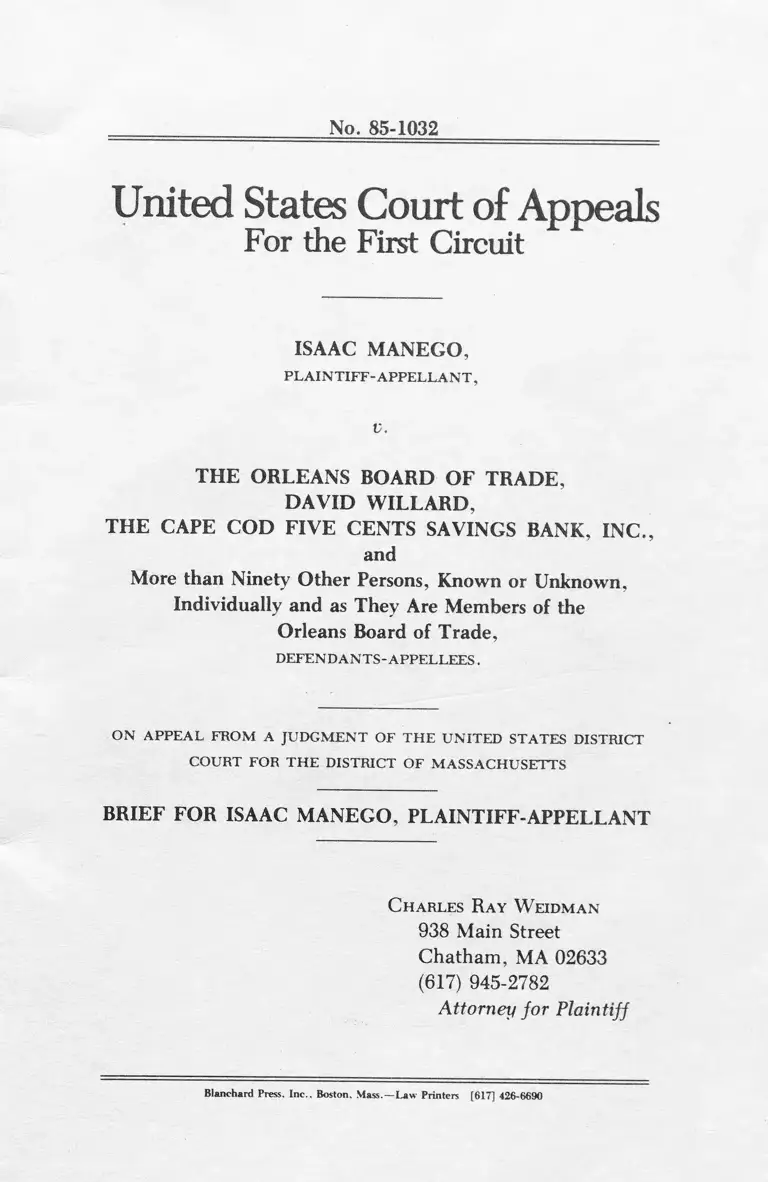
No. 85-1032
United States Court of Appeals
For the First Circuit
ISAAC MANEGO,
PLAINTIFF-APPELLANT,
V.
THE ORLEANS BOARD OF TRADE,
DAVID WILLARD,
THE CAPE COD FIVE CENTS SAVINGS BANK, INC.,
and
More than Ninety Other Persons, Known or Unknown,
Individually and as They Are Members of the
Orleans Board of Trade,
DEFENDANTS-APPELLEES.
ON APPEAL FROM A JUDGMENT OF THE UNITED STATES DISTRICT
COURT FOR THE DISTRICT OF MASSACHUSETTS
BRIEF FOR ISAAC MANEGO, PLAINTIFF-APPELLANT
C h a r l e s R a y W eid m a n
938 Main Street
Chatham, MA 02633
(617) 945-2782
Attorney fo r Plaintiff
Blanchard Press. Inc.. Boston, Mass. —Law Printers [617] 426-6690
TABLE OF CONTENTS
Page
Table of Authorities................................................................ i
Statement of the Issues to be Presented................................ 1
Statement of the Case.............................................................. 2
Argument................................................................................... 5
I. Res Judicata............................................................ 5
II. Application of Rule 56 ........................................... 14
III. Co-conspirators Liability for Sham Actions. . . 21
IV. Application of the Noerr-Pennington Doctrine. 27
Conclusion.................................................................................. 32
T a b l e o f C it a t io n s
Cases
A dickesv. S. H. Kress and Co., 398 U.S. 144, 176, (1970)
90 S.Ct. 1598.................................................................. 14,28
Alexander v. National Farmers Organization, 687 F.2d
1173 (8th Cir., 1982)..................... ....................................... 24
American Tobacco Co. v. U.S. 328 U.S. 781, 810 (1946)
66 S.Ct. 1125......................................................................... 25
Bradford v. Richards II Mass. App. 595; 417 N.E. 2d
1234, (1981)........................................................................... 10
Clipper Express v. Rocky Mountain Motor Tariff Bureau,
690 F.2d 1240 (9th Cir., 1982).................................... 21,26
Coastal States Marketing, Inc., v. Hunt, 694 F.2d 1358,
1369 (5th Cir., 1983)............................................................ 23
Commercial Box & Lum ber Co., Inc, v. UniRoyal, Inc. 623
F.2d 371, 374 (5th Cir., 1980)........................................... 8, 11
Cromwell v. County o f Sac, 94 U.S. 351, 352 (1876)...............5
11 Table of Contents
E.J. Delaney Corporation v. Bonne Bell, Inc., 525 F,2d
296 (10th Cir., 1975).............................................................. 9
E.G. Duke ir Co., v. Foerster, 521 F.2d 1277 (3d Cir.,
1975)........................................................................................ 28
Dyer v. MacDougall, 201 F.2d 265 (2d Cir., 1952)........... 18
Eastern States Retail Lum ber Dealers Association v. U.S.,
234 U.S. 600 (1914); 34 S.Ct. 951.................................... 8
Energy Conservation, Inc. v. Heliodyne, Inc., 698 F.2d,
386 (9th Cir., 1983).............................................................. 21
Federal Prescription Service v. American Pharmaceutical
Assn., 663 F.2d 255 (D.C. Cir., 1981) Cert. Denied,
455 U.S. 928 (1982) 102 S.Ct. 1293..................... 29, 30, 32
Ferguson v. Omnimedia, Inc., 469 F.2d 194 (1st Cir.,
1972)................................................................................... 8, 28
First National Bank o f Arizona v. Cities Service Co., 391
U.S. 253, 88 S.Ct. 1575 (1968)........................................... 20
Isaacs'. Schwartz, 706F .2d 15, 17 (1st Cir., 1983). . . 5, 7, 8
Kellerman v. Askew, 541 F.2d 1089 (5th Cir., 1976)........ 17
Kilgoar v. Colbert County Board o f Education, 578 F.2d
1033, 1035 (9th Cir., 1978)................................................. 11
Lovely v. Laliberte, 498 F.2d 1261, 1262, (1st Cir.,
1974)...................................................................................... 5 ,6
Manego v. Cape Cod Five Cents Savings Bank et al, 692
F,2d 174 (1st Cir., 1982)................................................. 5,11
Manego v. Orleans Board o f Trade et al, § 83-0045 (D.C.
Mass., Jan. 7, 1983).................................. 6 , 7 , 8 , 1 1 , 1 4 , 1 7
Manpower, Inc. v. Foley, 212 U.S.P.Q. 445 (D Mass. CA
No. 78-2713 N.A.), Dec. 5, 1980...................................... 23
Ness v. Marshall, 660 F.2d 517, 519 (3d Cir., 1981) . . . . . 17
Pennington v. United Mine Workers o f America, 325 F.2d
804, 811 (6th Cir., 1963) 381 U.S. 657 (1956) quoted in
Von Kalinowski, Anti-Trust Laws & Regulations, Vol 2,
Sec. 9, 14, [4]........................................... 17
Poller v. Columbia Broadcasting System, 368 U.S. 464 82
S.Ct. 486 (1962)............................................... 14 , 19 , 28 , 29
Page
Table of Contents iii
Page
Phelps Dodge Refining Corp. v. FTC, 139 F.2d 393 (2d
Cir.. 1943)............................................................................. 30
Sartor v. Arkansas Construction Corp., 321 U.S. 620
(1944) 64 S.Ct. 724, 729....................................................... 18
Scooper Dooper, Inc. v. Kraftco Corp., 494 F.2d 840 (3d
Cir., 1974)............................................................................. 6
Trucking Unlimited v. California Motor Transport Co.,
432 F.2d 755 (9th Cir., 1970) aff. 404 U.S. 506, 92
S.Ct. 609............................................................................... 21
U.S. v. The Haytian Republic, 154 U.S. 118, 129;
14 S.Ct. 992 (1894).............................................................. 10
U.S. v. U.S. Gypsum Co., 438 U.S. 422 (1978) 98 S.Ct.
2864 ........................................................................................ 25
Zell v. American Seating Co., 138 F.2d 641 (2d Cir.,
Statutes
15 USC §1 (Sherman Anti-Trust Act).................................... 3
Federal Rules of Civil Procedure:
Rule 56 ...................................................................... 14,18,21
Rule 56(e)...................................................................... 14, 15
Miscellaneous
Bauman, “A Rationale fo r Summary Judgm ent,” 33 Ind.
L .J. 467 (1958) 481, 484............................................... 19,20
31 Frd 648, Advisory Committee Note to Rule 56(e)........ 18
18 J. Moore’s, Federal Practice, 0.410 [1]................... 7, 10
Von Kalinowski, Anti-Trust Laws and Regulations, (1983)
Vol. 1, S.3.02(l)(3)a. Vol. 2, §9, 14 [4]..................... 17, 25
18 J. Wright, Miller & Cooper Federal Practice and Pro
cedure, § § 4406-4407 at 52, 63-64 ............................ 7 , 8 , 9
J. Wright, Miller, Kane, Federal Practice and Procedure,
Vol. 10A, Sec. 2727, § 2732........................................ 14, 17
Restatement (Second) of Judgments § 24, Comment “a” 5, 9
United States Court of Appeals
For the First Circuit
No. 85-1032
ISAAC MANEGO,
PLAINTIFF-APPELLANT,
V.
THE ORLEANS BOARD OF TRADE,
DAVID WILLARD,
THE CAPE COD FIVE CENTS SAVINGS BANK, INC.,
AND
M o re t h a n N in e t y O t h e r P er so n s , K n o w n or U n k n o w n ,
I n d iv id u a l l y a n d as T h e y A r e M e m b er s o f t h e
O r l e a n s B oard o f T r a d e ,
d e fe n d a n t s - a p p e l l e e s .
o n a p p e a l fr o m a ju d g m e n t o f t h e u n it e d st a t es d istrict
COURT FOR THE DISTRICT OF MASSACHUSETTS
BRIEF FOR ISAAC MANEGO, PLAINTIFF-APPELLANT
STATEMENT OF ISSUES
PRESENTED FOR REVIEW
1. Did the court err in barring action against David
Willard and the Cape Cod Five Cents Savings Bank on the
grounds of res judicata, if they engaged in a different con
spiracy with different parties to violate the Sherman Act, than
in the conspiracy alleged in the prior Civil Rights suit?
2
2. Did the court err in its application of Rule 56 of the
FRCP (Summary Judgment) in shifting the burden to Plain
tiff, where questions of conspiracy and state of mind are
involved?
3. Did the court err in concluding the Board of Trade is
not chargeable with the “sham” actions of its alleged co-
conspirator Cape Cod Five Cents Savings Bank?
4. Did the court err in concluding that the actions of the
Board of Trade are protected activities under the Noerr-
Pennington Doctrine (First Amendment right of free speech
and petition): especially in view of the presence and participa
tion of a majority of the town selectmen (Board of Trade
members Norgeot and Nickerson) at meetings of the Board of
Trade at which the Board of Trade’s opposition to plaintiffs
license application was discussed and unanimously voted,
prior to the selectmen’s hearing on the matter?
STATEMENT OF THE CASE
Plaintiff-Appellant has brought a series of independent
actions against various defendants, some of whom are defen
dants in this action, arising out of the participation of these
defendants in several allegedly unlawful and concerted activi
ties, which had the purpose to prevent plaintiff from
establishing and operating a disco business in the Town of
Orleans, Massachusetts.
The first action sought a writ in the nature of mandamus
from the Superior Court in Barnstable alleging that an Orleans
Selectmen’s decision to deny plaintiff an entertainment license
was arbitrary and capricious, because it was based on racial
hostility evident in the community against Plaintiff, a black
man. (R. 157). Summary judgment for defendants was
granted without memorandum on August 18, 1979. (R. 170,
374).
The second action was a civil rights complaint brought July
1, 1980, (R, 10) in the U.S. District Court for the District of
3
Massachusetts under Federal Civil rights laws; namely, 42
USC § 1981; 42 USC § 1983; 28 USC § 1331; 42 USC § 1985,
§ 1986 and § 1988. The suit named as defendants, the Cape
Cod Five Cents Savings Bank, Inc.; George P. Marble, David
B. Willard; T-Bears, Inc., d/b/a Lower Cape Sports Area,
Paul M. Thibert; and Gaston L. Norgeot, Herbert F. Wilcox,
Thomas B. Nickerson, individually and as they are members of
the Board of Selectmen of the Town of Orleans on April 13,
1982. Summary judgment was granted to all defendants,
which judgment was taken on appeal by plaintiff to the First
Circuit on October 28, 1982. (R. 142). The First Circuit
affirmed the District Court’s judgment, Manego v. Cape Cod
Five Cents Savings Bank, Inc.. 692 F .2d 174 (IstCir. 1982). In
the memorandum accompanying this judgment the First Cir
cuit Court stated, “had petitioner in this case provided suffi
cient facts to create a material issue as to whether the denial of
this license was because of his race, we w ould, as did the Court
in Adickes, look unfavorably on a refusal by the Lower Court
to allow him to pursue his claim that the denial w as the result
of conspiracy.”
Thereupon, plaintiff filed on January 7, 1983, the case at
bar in the U.S. District Court for the District of
Massachusetts, (R. 177) pursuant to the Sherman Antitrust
Act, 15 U.S.C. § 1 alleging that the Orleans Board of Trade
unlawfully conspired with the Cape Cod Five Cents Savings
Bank and David Willard, in restraint of trade to prevent plain
tiff from establishing and operating a disco business in the
Town of Orleans. On November 27, 1984, the U.S. District
Court again granted summary judgment to defendant, from
which this appeal is taken. (R. 557, 558).
In the case at bar, plaintiff furnished to the Court below,
depositions, answers to interrogatories, affidavits, and other
documents purporting to show that the Board of Trade did
meet on January 9, 1979, and under the direction of its Presi
dent, David Willard, thoroughly discussed and voted unani
4
mously to oppose plaintiffs application for an entertainment
license (R. 129); that the interests of the Bank, the Lower
Cape Sports Center, and the Board of Trade were interlocked
through the status of David Willard, who at the time was
simultaneously Manager of the Bank, General Manager of the
Sports Center, and President of the Orleans Board of Trade
(R. 12); that Selectmen Gaston Norgeot and Thomas Nicker
son who were also members of the Board of Trade (R. 434)
were actually present at the Board of Trade Meeting held on
January 9, 1979; that Selectman Thomas Nickerson was again
present at the Board of Trade meeting held on February 13,
1979 (R. 461), and reported on the scheduled hearing of the
Board of Selectmen to be held on the following night,
February 14, 1979, on Plaintiffs application for an entertain
ment license (R. 464, 465); that plaintiffs application was
denied at that hearing (R. 168); that the Lower Cape Sports
Center subsequently sought and obtained from the Board of
Selectmen a new entertainment license in order to expand its
program into live music and dancing, and roller disco (R. 171,
172); and that in May 1979, the bank brought and then
withdrew on July 3, 1979, a sham lawsuit it had brought
against plaintiff and the Orleans Board of Appeals to enjoin
plaintiff from proceeding with the completion of his building
and to revoke his Building Permit. (R. 20).
5
ARGUMENT
I. RES JUDICATA
D id t h e c o u r t err in ba rr in g a c t io n a g a in s t D avid
W illa r d a n d C a p e C od F iv e C e n t s Sa vin gs B a n k o n grounds
OF RES JUDICATA, IF THEY ENGAGED IN A DIFFERENT CONSPIRACY
WITH DIFFERENT PARTIES TO VIOLATE THE SHERMAN ACT, THAN
THE CONSPIRACY ALLEGED IN THE PRIOR ClVIL RIGHTS SUIT?
The court erred in barring the instant action against David
Willard and the Cape Cod Five Cents Savings Bank on the
ground o f res judicata where the causes o f action were not the
same.
The District court in the decision below found that the
actions against David Willard (“Willard ) and the Cape Cod
Five Cents Savings Bank (“The Bank”) were barred on the
ground of res judicata. That finding was based on the inter
pretation of the case at bar and Manego v. Cape Cod Five
Cents Savings Bank et al., 692 F.2d 174 (1st Cir. 1982) as set
ting forth the same cause of action. That interpretation is not
only factually questionable, but based on a legal standard
which results in injustice for cases such as the one at the bar.
It has been long undisputed that for the doctrine of res
judicata to apply, the subsequent case must be based on the
same cause of action as in the original case, e.g., Cromwell v.
County o f Sac, 94 U.S. 351, 352 (1876). The District Court’s
decision with regard to res judicata relies heavily on a broad
definition of “cause of action which it names the trans
actional” approach.
The transactional approach to a cause of action, or claim, is
to view the claim as coinciding with the factual transaction.
Restatement (Second) § 24, Comment “a,” or “series of trans
actions”, Isaac v. Schwartz, 706 F.2d 15, 17 (1st Cir., 1983)
from which it sprang, regardless of the number or variety of
legal theories which might arise from it. The Appeals Court in
Lovely v. LaLiberte, 498 F.2d 126 (1st Cir., 1974) uses the
6
phrase “operative nucleus of fact” to mean transaction in this
sense. The District Court below, utilizing this standard, found
that the instant action against Willard and the Bank was
barred.
First of all, if one were to accept the “transactional
approach” without question, it is doubtful whether it applies
so as to bar the instant action. In support of its application to
the case at bar, the District Court states:
“The present complaint differs only in that it names addi
tional defendants (The Board of Trade), and alleges that
the Bank planned to offer entertainment of (sic) its
facility similar to that which Plaintiff Manego would
have provided at his disco.”
Manego v. Orleans Board o f Trade et al., No. 83-0045
(D.C. Mass., Jan. 7, 1983) (R. 537). Not only are the above
differences in the “operative nucleus of fact” discrepancies
between the instant and prior action, but they are hardly in
substantial.
By adding the Board of Trade and all of its members as
defendants, the Plaintiff/Appellant identifies a new and dif
ferent conspiracy from the one alleged in the prior action.
(R. 96). With the description of the intent of the Bank to pro
vide an entertainment facility comparable to Manego’s pro
posed disco in his complaint in the instant action, Manego pro
vides evidence for an entirely distinct, factual basis for that
second, and different conspiracy—a conspiracy to restrain
trade.
The Court dismisses the above as insignificant, i.e., it con
siders the two cases as deriving from the same “operative
nucleus of fact.” Actually, the additions and changes to
Manego’s allegations from the prior action to the present one
are among the most important facts supporting his case. As
they are “controlling” facts, it is not appropriate that res
judicata apply to bar the instant action. Scooper-Dooper, Inc.
v. Kraftco Corporation , 494 F.2d 840 (3rd Cir., 1974).
7
It is important to note that the two cases from the First Cir
cuit cited bv the District Court to support its use of the trans
actional approach, Lovely v. LaLiherte, 498 F.2d 1262,
supra, and Isaac v. Schwartz, 706 F.2d 15, supra, are both
distinguishable on their facts from the instant matter. Both
cases involve a first and second suit in which the parties are
identical. That is not so here. Further, the first and second
suits of both cases concern the identical fact situations: an
eviction from a mobile home park and a failure to readmit a
law student, respectively. In Lovely and in Isaac only the
theories of recovery changed. Here, although many of the
facts are the same, the “operative nucleus of fact” has
undergone a marked alteration.
Thus, it can be seen that, if the transactional approach is
accepted as the appropriate standard by which to judge the
case at bar, it offers, at most, doubtful justification for the
application of the doctrine of res judicata.
The question which must be addressed at this point is
whether the broad “transactional approach” ought to be
applied to the instant claim. It is acknowledged by the District
Court that “(t)he exact contours of claim preclusion (res
judicata) are a subject of much discussion and disagreement.”
Manego v. The Orleans Board o f Trade et al. See 18 J. Wright,
Miller & Cooper, Federal Practice and Procedure
§§ 4406-4407 at 52, 63, 64 and 18 J. Moore’s Federal Practice,
H 0.410(1).
In other words, the transactional approach is simply one
approach among many in an area of ongoing conceptual
development. What constitutes a “claim” or “cause of action”
is not easily definable and has yet to be carved in stone by any
court or legal scholar.
The transactional definition of a claim is expansive; it in
cludes within one cause of action what formerly, or under a
different approach, would be two or more causes of action.
8
When it errs, it errs on the side of over-inclusiveness. Thus, it
might bar an action which deserved to be heard.
The weakness of the transactional approach is that it fails to
account for the uniqueness of cases. For example, a plaintiff
may have a valid reason for filing separate suits from the same
or similar factual background. Compelling maximum joinder
of claims to prevent res judicata would be unfair to such plain
tiffs. 18 J. Wright, Miller & Cooper, supra §§ 4407 at 52. The
court in Commercial Box ir Lum ber Co., Inc. v. Uniroyal,
Inc., 623 F.2d 371 (5th Cir., 1980) acknowledged just such a
valid reason. It noted that the Plaintiff could have combined
its two actions, both based on the same purchase contract, but
was not required to.
Another aspect of the unfairness of the transactional
approach is illustrated by the instant action, where the case
concerns a conspiracy. It is common knowledge that more
often than otherwise, direct evidence of a conspiracy is not
readily available. Eastern States Retail Lum ber Dealers
Association v. U.S., 234 U.S. 600; 34 S.Ct. 951 (1914),
Ferguson v. Omnimedia, Inc.. 469 F.2d 194 (1st Cir., 1972).
However, under the transactional approach, a court will look
at the first lawsuit filed, see a common “nucleus of fact”—
absent a few essential details—with the second lawsuit—and
declare the underlying claims to be the same. That is,
whatever claims were not litigated in the first action, both
could have and should have been litigated at that stage. See
Manego v. Orleans Board o f Trade et ah, supra at (R. 539,
542) and Isaac Schwartz, supra at 17:
“The issue is not whether the plaintiff in fact argued his
claims in the (first) proceedings, but whether he could
have.”
The transactional approach does not take into account the
special problems of conspiracy. To wit, much of the time the
Plaintiff could not have brought the second claim any sooner
9
than he did. Except for hearsay, the evidence, “those few
essential details,” simply was not there. The approach the
District Court has taken with the instant case has focused on
and found similar discrete parts of the alleged conspiracy
rather than the phenomenon as a whole. This does the Plain
tiff/Appellant’s case an injustice for:
“The character and effect of a conspiracy is not to be
judged by viewing its separate parts, but only by looking
at it as a whole.”
E. ]. Delaney Corp. v. Bonne Bell, Inc.. 525 F.2d 296 (10th
Cir., 1975).
The unfairness and inappropriateness of the transactional
approach to the case at bar, as a conspiracy case, is w'ell articu
lated in 18 J. Wright, Miller & Cooper, supra, §§ 4407, at
63-64. While discussing the possibilities for defining “claim” or
“cause of action,” the authors write:
“Each area of substantive law' has its own distinctive
implications for expectations, reliance and repose. Each
area generates its own special problems of practice in
pretrial and trial settings. These differences of the real
world and the lawyer’s wmrld must be sought out and
accounted for in the process of prescribing the dimensions
of the claims or causes of action spawned by the substan
tive principles.”
The transactional definition of “cause of action” does not
take into account the special problems of a conspiracy case. It
is, therefore, not appropriate for such an action, such as the
case at bar.
Although the Restatement (Second) of Judgments § 24,
Comment “a” asserts that the transactional definition is the
“present trend,” and it is followed in certain First Circuit deci
sions, it is not the only approach available. The alternative is
to decide on a case by case basis whether the claims are the
10
same. This would alleviate the unfairness of the transactional
definition in unusual cases. For if the transactional definition
were applied universally,
• then a judgment upon one cause of action would be
conclusive as to every other cause of action at the time,
although not embraced in a suit, and although the parties
were not obliged to join it therein. This would destroy the
right of parties to sue separately upon distinct causes of
action and would be subversive of the entire theory of the
thing judged.”
U.S. v. The Haitian Republic, 154 U.S. 118, 129, 14 S.Ct. 992
(1894).
Other courts have applied narrower definitions to “cause of
action” in the interests of fairness, and this has served to point
out the as yet unresolved nature of the debate.
“There are many cases that hold that a number of separate
claims or causes of action can arise from essentially the
same set of facts. The cases that adumbrate the distinc
tion between a single claim based on different theories,
and separate claims arising from the same nucleus of
operative act are not easy to reconcile.” 18 Moore’s
Federal Practice, Par. 0.410(1).
The Masachusetts Appeals Court indicated that a common
transaction alone might not be sufficient to unify two claims in
Bradford v. Richards, 11 Mass. App. 595; 417 N.E.2d 1234
(1981). There, although the court found common facts under
lying the two actions, it declined to find that the causes of
action were the same. In a thorough discussion of the doctrine
of Res Judicata in Massachusetts, the Appeals Court offered a
lengthy list of example cases where that doctrine applied. Not
one of the cases listed was a conspiracy case.
11
Commercial Box, supra, cited Kilgoar v. Colbert County
Board o j Education, 578 F.2d 1033 (5th Cir., 1978) for the
proposition:
“Plaintiffs are not barred from presenting any ground for
relief arising out of conduct not complained of in the
prior lawsuits.”
Id. at 1035.
However, in Kilgoar the conduct complained of occurred
subsequent to the first lawsuit, whereas in Commercial Box,
the wrongful conduct occurred both prior to and during the
first action. Thus, it can be seen that the case-by-case
approach to the definition of a single “cause of action” is also
in the process of developing.
It is this clear that the District Court determination that the
two actions, Manego v. Cape Cod Five Cents Savings Bank,
supra, and Manego v. The Orleans Board o j Trade et al.-,
supra, were based on the same cause of action is founded on a
legal standard that is both factually inapplicable and legally
unjust to the case at bar. Res Judicata does not apply to the
instant action against Willard and the Bank.
The Fifth Circuit has also indicated a willingness to examine
each case carefully rather than apply the broad transactional
definition regardless of circumstance. In Commercial Box ir
Lum ber Co., Inc. v. Uniroyal, Inc., 623 F.2d 371 (5th Cir.,
1980), the Appeals Court refused to apply res judicata, despite
the fact that the two actions were based on the same purchase
contract. The first section was for loss caused by Uniroyal’s
change in destination of its order, the second for Uniroyal’s
wrongful deduction of discounts from the same contract. The
court recognized that the Plaintiff had a valid reason for
bringing two separate actions. Id. at 374, fn. 2, supra:
12
“and Not only were these issues not raised, but they are
in no way germane or related to the challenge made in
the first suit. The issue in the present case is based upon a
different cause of action than that alleged in the first
lawsuit. Likewise, the matter involved in the present case
is not one that could have been established in the first
case in light of that case’s legal and factual bases.”
(Emphasis added).
Id. at 394.
This is clearly the case here: given the legal and factual
bases for the second legal or instant action, the matter could
not be established in the first case. Thus, res judicata should
not apply.
The court below also misreads Plaintiffs reasons for his
delay in filing his antitrust action (R. 542).
Plaintiff does not claim that the delay was the result of his
lack of knowledge of the Bank’s plans to develop its Sports
Center’s entertainment facilities, but, rather because of the
Plaintiffs lack of probative evidence about the alleged con
spiratorial meeting of the Board of Trade under the direction
of Bank Manager cum Sports Center’ General Manager cum
Board of Trade President David Willard, at which meeting
two Orleans Selectmen / Board of Trade members were
present.
Prior to the admission of facts concerning said meeting, as
set forth in David Willard’s affidavit served on Plaintiff only
one business day before the dispositive hearing on Plaintiffs
civil rights case on April 12, 1982 (R. 237, 243), Plaintiff had
only hearsay knowledge of such a meeting (R. 82, 83, 84).
Even so, the court below points out that under the liberal
federal rules of discovery and amendment, Plaintiff might
have amended his civil rights complaint to add an anti-trust
count prior to judgment of appeal, if only he had done more
discovery (R. 542).
13
Plaintiffs response is that where newly discovered facts give
rise to allegations of a new and independent cause of action re
quiring new parties to be added, such as a violation of Sec
tion 1 of the Sherman Act, and upon which event the Plaintiff
is deemed to have the right and standing to amend his com
plaint, then Plaintiff also has acquired the right and standing
to file a new independent action. That, indeed, was the choice
made by the Plaintiff in this case.
Plaintiff argues that the court below is in error when it
attempts to extend the res judicata doctrine beyond issues
which “were raised” or “could have been raised to issues
which “might have been raised” if more discovery had been
pursued, the right questions asked and answered and pro
bative documents sought and produced.
Finally, the Board of Trade and its members are necessary
defendants in Plaintiffs antitrust action. Its members repre
sent the very co-conspirators who were essential to Plaintiff s
allegations of conspiracy among businessmen to restrain trade
and thus constitute far more than a “mere addition of new
defendants in a subsequent action.” (R. 542). Plaintiff neither
raised nor could have successfully raised the antitrust issue in
his prior civil rights complaint, because he had no probative
evidence to support such an allegation, but only hearsay
knowledge.
The attempt by the court below to expand the application of
res judicata doctrine to issues which might have been raised if
more evidence had been produced, constructs an unfairly long
and slippery slope for Plaintiff to climb, especially in a con
spiracy case such as found here.
14
II. APPLICATION OF RULE 56
D id t h e c o u r t err in its a p p l ic a t io n o f R u l e 5 6 o f t h e
FRCP (s u m m a r y ju d g m e n t ) in s h if t in g t h e bu r d en to P l a i n
t i f f WHERE QUESTIONS OF CONSPIRACY AND STATE OF MIND ARE
INVOLVED?
The lower court erred in its application o f FRCP 56 by fin
ding its own facts and shifting the burden to plaintiff, ichere
questions o f conspiracy and credibility were involved.
In the District Court decision below, the court concedes
that conspiracy and antitrust claims are generally inappro
priate for summary judgment. Adickes v. S. H. Kress and C o.,
398 U.S. 144, 176 (1970) 90 S.Ct. 1598, Poller v. Columbia
Broadcasting System, 368 U.S. 464 (1962), 82 S.Ct. 486. It
then goes on to state that the case at bar falls within an excep
tion to that rule. That is: “(W)here a moving party in an anti
trust conspiracy case has shown that the facts relied upon in
the opposing party’s allegations are not susceptible to the inter
pretation which he sought to give them, Rule 56 (e) puts the
burden on the opposing party to produce evidence in support
of his allegations.” Manego v. Orleans Board o f Trade et al,
|83-0045 (R, 552). While the court accurately described Rule
56 (e), its application to the instant case was clearly erroneous.
The burden should never have shifted to the Plaintiff.
In order to reach Rule 56 (e), the District Court had to find
that the moving party had met its burden under the rule. It is
well settled that the party moving for summary judgment has
the burden of demonstrating that the Rule 56 test: “there is no
genuine issue as to any material fact” is satisfied. J. Wright,
Miller & Kane, Federal Practice and Procedure, Civil 2d,
§ 2727; Adickes v. S. H. Kress and Co., supra at 1608. The
court found that this burden was met by relying on the affi
davits of the moving party.
15
Ordinarily a court’s reliance on affidavits is enough to shift
the burden between parties under Rule 56 (e). However,
where the case concerns state of mind and credibility, as it
does in an antitrust action, and the affidavits are strictly self-
serving when provided and sworn to only by movants
themselves, then reliance becomes highly questionable.
Indeed such affidavits exhibit many of the same earmarks of
probative weakness as would the sworn denials of the prover
bial inhabitants of the henhouse that “there ain’t nobody in
here but us chickens.”
The Board of Selectmen stated that they voted to deny
Plaintiffs entertainment license due to traffic and noise prob
lems. (R. 168,228). Plaintiff argues that the circumstantial
evidence does not support their version of events. (R. 500,
501).
Plaintiff s proposed site was situated right next to the town
dump in a sparsely settled area, 1000 ft. from the nearest
residential home, and was going to be soundproofed. The
Traffic Study prepared by Sherman Reed, also a member of
the Board of Trade, which had already voted to unanimously
oppose Plaintiff’s disco, based his Committee’s estimation of a
traffic problem on the fact that young people, who would
patronize a disco, are prone to use drugs and alcohol. (R. 173).
This finding had no basis in fact, since Plaintiff’s liquor license
had already been denied and abandoned and Plaintiff indi
cated to the Selectmen that he was willing to operate without
it. (R. 153, 499). The Traffic Study Committee also found that
problems could be created by the increased traffic due to the
Plaintiff s operation of the disco. (R. 173, 175). Their findings
were made notwithstanding the fact that 25 new businesses
have been licensed and developed in close proximity to Plain
tiffs site, after the denial of Plaintiff’s entertainment license.
These businesses include a plastics company, two dog kennels,
two landscaping businesses, a car wash, a printing company, a
fish processing company, a boat manufacturer, and 15 storage
garages. (R. 500, 501).
16
In addition, the roller disco and ballroom dancing offered
by the Center would have produced noise (music) at night in
much the same way Mr. Manego’s disco would have.
The characterization of the grant of the entertainment
license to the Center, a few months after Plaintiff’s application
had been denied, as a renewal of an existing license is specious
to say the least. The new license was not a mere renewal. In
addition to ice skating, it was for roller skating, music and
dancing, neither of which activities had ever been before
offered at the Center. (R. 171, 172). The Center had to com
pletely renovate the floor in order to make music, dancing and
roller skating possible, (R. 353, 513), despite the obvious con
tradictions in the affidavit of Selectman Wilcox, who states
that he voted to “reissue” an amusement license to the new
owner of an “existing business,” the Lower Cape Sports
Center. This, he says, was not a license to open a disco, but
only to maintain an ice skating business. (R. 228, 334).
The Center had just been sold and the license had expired
three months before. Rather than maintain an existing failing
business, a new expanded business was proposed, a great sum
of money was invested; all of that energy and money was ex
pended to make the floor compatible to dancing and roller
skating. (R. 513). This would have placed Mr. Manego and
the Center in a highly competitive position. The fact that no
alcohol was served or that the ballroom-dancing program, and
for that matter the roller-disco program, failed to draw
customers and was discontinued, is irrelevant.
Mr. Manego’s disco was also going to be alcohol-free which
would have allowed him to cater to the same groups that the
Bank catered to at the Center. (R. 499). As Plaintiff remarked
in his first deposition: “Dancing is dancing. (R. 95). We may
disco in one place and roller-disco in the next, but it is all one
and the same.”
The District Court held that Plaintiff failed to contradict
Defendant’s assertion that the subsequent grant of the license
17
to the Sports Center was a legitimate exercise of the
Selectmen’s licensing authority. Plaintiff argues that the cir
cumstantial evidence gives credence to his allegation that the
grant was a subsequent act in furtherance of the conspiratorial
scheme in restraint of trade.
Here, there are obvious questions of credibility and intent.
It is well-settled law that where intent is an element of the
cause of action—generally to be inferred from the facts and
conduct of the parties: “courts should not draw factual in
ferences in favor of the moving party and should not resolve
any genuine issue of credibility.” Ness v. Marshall, 660 F.2d
517, 519 (3rd Cir. 1981).
The existence of conspiracy may be sufficiently strong, to
raise a factual question for the jury even though there is no
direct evidence that a conspiracy existed. Pennington v.
United Mine Workers o f America, 325 F.2d 804, 811 (6th Cir.
1963) reviewed on other grounds: 381, U.S. 657 (1956), cited
in Von Kalinowski, Antitrust Laws and Trade Regulations,
Vol. 2. § 9, 14, [4], In antitrust cases questions of motive or in
tent, credibility and conspiracy frequently prevent Summary
Judgment from being entered, since these issues involve sub
jective questions regarding state of mind that can only be
decided after a full trial. J. Wright, Miller, Kane, Federal
Practice and Procedure, Vol. 10A, § 2732.
In any event, upon reviewing all the evidence before it, the
court below found the “facts” of the case by summarizing the
affidavits of the movants. Manego v. Orleans Board o f Trade
et al. (R. 546). The factual allegations of the movants which
differ from those of the Plaintiff amount to no more than mere
denials of the latter. Id ., that is, they all state that they never
engaged in those acts which would have created a conspiracy
to prevent the Plaintiff from establishing a business in their
town. A party moving for Summary Judgment cannot sustain
his burden by denying the allegations in his opponent’s
pleadings. Kellerman v. Askew, 541 F.2d 1089 (5th Cir.,
18
1976). By choosing to believe the account of the movants
rather than that of the Plaintiff, the Court overstepped its
authority under FRCP 56.
In a motion for Summary Judgment, “if a fact asserted by
the plaintiff is contradicted by the defendant, the facts as
stated by the plaintiff are to be taken as true.” Zell v.
American Seating Co., 138 F.2d 641 (2nd Cir,, 1943). The
lower court here did the opposite. Further, “if defendant’s
evidence creates issues of credibility, the case must go to trial
and not be resolved at the Summary Judgment level.” Sartor v.
Arkansas Construction Corp., (1944) 44 S.Ct. 724, 729; 321
U.S. 620; D yerv. MacDougall, 201 F.2d 265 (2nd Cir., 1952).
The District Court’s treatment of the credibility of the
parties deserves close scrutiny. First of all, after citing the
“facts” as set forth in the movants’ affidavits, the Court states:
“These are denials of conspiracy from a Selectman, the Presi
dent of the Board of Trade, and an Officer and an employee of
the Bank.” (R. 547). The Court here seems to imply that these
denials are therefore credible because of the social rank of the
affiants, all defendants in the suit.
Because the Court is basing its findings on the denials of the
movants, the credibility of the respective parties becomes the
paramount question. A defendant’s rank within a community
or place of employment is hardly an adequate basis on which
to judge credibility. Instead, a court generally needs to ex
amine the individual’s demeanor and/or performance under
cross examination at trial. This is confirmed in the Advisory
Committee Note to the 1962 Amendment to Rule 56 (e), 31
F.R.D. 648:
“Where an issue as to a material fact cannot be resolved
without observation of the demeanor of witnesses in
order to evaluate their credibility, summary judgment is
not appropriate.”
19
Whether the movants engaged in activities which amounted to
a conspiracy against the Plaintiff, which they deny is, of
course, a “material fact.”
Secondly the Court appears to demean the Plaintiffs version
of the facts, due to the Plaintiffs ignorance of what transpired
among the various alleged co-conspirators. (R. 548). This
ignorance is, rather than a reason to disbelieve the Plaintiff,
the reason to deny the motion for summary judgment and
move the case to trial.
As so unequivocally held in Poller v. CBS 368 U.S. 464
(1962), 82 S.Ct. 468, summary judgment should be used
“sparingly” in antitrust actions where “the proof is largely in
the hands of the alleged conspirators.” It is inherent in a con
spiracy case that the plaintiff is not going to have access to
many of the facts he needs to prove; the conspirators
themselves have exclusive control over that information.
Because of this difficulty of proof, plaintiffs in conspiracy
actions often must rely, at least initially, on circumstantial
evidence.
Admittedly, plaintiff in the case at bar is relying primarily
on circumstantial evidence. The District Court reviewed both
this evidence and the evidence presented by the defendants,
the alleged conspirators, and chose to believe the latter. It can
not be doubted that the Court found the movants’ materials
more probative because of their first-hand knowledge. This
however, is the nature of the conspiracy: those charged have
the best knowledge of the facts of their alleged wrongdoing.
It is the court’s role then to regard the movants’ evidence
with a healthy suspicion. Bauman, “A Rationale fo r Summary
Ju dgm en t/’ 33 Ind. L.J, 467 (1958) at 481.
“Moreover, if the moving party’s proof is less convincing,
as in cases where he relies on his own testimony or has
exclusive knowledge of the transaction, the burden of
providing evidence may not shift to the opponent.”
20
Thus, it appears that the District Court declined to consider
the credibility of the movants to be a serious issue, despite the
fact that they were and still are in exclusive control of the facts
needed to prove Plaintiffs case. They are motivated by self-
interest in seeking to have the suit against them dropped, and
the court does not have the ability to observe them in an adver
sarial trial setting. None of the usual protections are in place
for the administration of justice, and all of the reasons arise to
be wary of the truth of the movants’ allegations. Nonetheless,
the District Court believed them sufficiently to deprive the
Plaintiff of his day in Court.
The lower court cited First National Bank o f Arizona v.
Cities Service Co. 391 U.S. 253, 88 S.Ct. 1575 (1968) in sup
port of its shifting the burden to Plaintiff. In that case, the
court found an “absence of any significant probative evidence
tending to support the complaint.” Id. at 1593. Such a situa
tion is clearly distinguishable from the instant matter. Here
the Plaintiff has shown a series of facts which not only “tend
to” but, in fact, directly support the allegations in his com
plaint.
By shifting the burden to Plaintiff in the case at bar, the
District Court is setting a dangerous precedent for future anti
trust and conspiracy actions. Its decision could in effect
guarantee failure at the summary judgment level whenever a
plaintiff brings such a case supported only or primarily by cir
cumstantial evidence. Yet, by its very nature, the plaintiffs
knowledge of the matter may be limited to the circumstantial,
and the movants’ evidence may be incapable of being con
troverted at summary judgment.
The motion for summary judgment presents a great tempta
tion for judges to usurp the role of the jury. Such is the reason
why, in its origins, motions for summary judgment were
limited to cases involving bills of exchange, promissory notes
and checks. Bauman, supra, at 473. In these cases, only incon
trovertible documentary evidence could be used in support of
21
the motion. It would be unfortunate indeed if the lower
court’s decision in the instant action initiated a trend towards
a looser application of a procedure with such great potential to
harm plaintiffs in our justice system.
The District Court exceeded its authority under FRCP 56 in
shifting the burden to plaintiff where the movants’ evidence
consisted of self-serving statements of questionable credibility.
III. CO-CONSPIRATORS LIABILITY
FOR SHAM ACTIONS
D id t h e C o u r t err in c o n c lu d in g t h e B oard o f T rad e is
NOT CHARGEABLE WITH THE ‘SHAM’ ACTIONS OF ITS ALLEGED CO
CONSPIRATOR C a p e C od F iv e C e n t s Sa vin g s B a n k ?
THE SHAM EXCEPTION ; BASELESS SUITS
The District Court failed to examine and to apply to the
Defendant Orleans Board of Trade the baseless suit exception
to the Moerr-Pennington Doctrine first enunciated in Truck
ing Unlimited v. California Motor Transport Company, 432
F.2d 755 (9th Cir., 1970) off. 404 U.S. 506, 92 S.Ct. 609
which prohibits “baseless repetitive claims” designed to
discourage and ultimately to prevent the plaintiffs from invok
ing the processes of the administrative agencies and courts. Id.
at 1512. The court, however, agreed with the plaintiff that
subsequent developments have held that a single unit is suffi
cient to invoke the sham exception, e.g., Clipper Express v.
Rocky Mountain Motor Tariff Board, 690 F.2d 1240 (9th Cir.,
1982), Energy Conservation, Inc. v. Heliodyne, Inc.. 698 F.2d
386 (9th Cir., 1983).
Basing its reasoning on Clipper Express, the Energy Court
found that the baseless claim was used for an unlawful pur
pose, i.e., to “competitively harm the plaintiff.” Id. at 389.
The Court stated that “these allegations may be sufficient to
state a claim of abuse of judicial process on the grounds that
the lawsuit was initiated for an unlawful purpose and the
22
defendants committed specific acts outside the judicial process
in furtherance of that purpose.” Id.
As the Plaintiff argued below, the lawsuit brought by the
Defendant Bank to revoke Manego’s legitimately issued
building permit was “clearly instituted for an unlawful pur
pose.” On March 8, 1979 the Orleans Building Inspector issued
a building permit to Plaintiff for construction of his proposed
disco. Shortly thereafter, Plaintiff hired a building contractor,
Roger Hulick, and began construction of a building on his
land. At about the same time Mr. Hulick was advised by an
agent for Nickerson Lumber Company, Charles Darling, that
the Cape Cod Five Cents Savings Bank had requested the firm
to cease delivery of materials to Mr. Manego. (R. 125). Mr.
Hulick also began to receive warnings from Defendant Cape
Cod Five Cents Savings Bank concerning arrears on his per
sonal loan at the Bank. (R. 125). (The fact that Mr. Darling
now denies he ever made such a statement to Mr. Hulick does
not diminish the importance of the allegation. It raises a
matter of credibility which in keeping with tradition of our
judicial system becomes the province of the trier of fact).
In April 1979, reacting to the issuance of the building per
mit to Plaintiff, the Bank appealed the Building Inspector’s
action to the Orleans Zoning Board of Appeals. (R. 201). The
Board, on May 23, 1979, confirmed the granting of the Plain
tiffs building permit. Defendant Bank then caused to be filed
in Barnstable Superior Court a suit to enjoin the Plaintiff from
proceeding with the construction of his building and to revoke
the action of the Orleans Board of Appeals in granting the
Plaintiffs building permit. (R. 201). This baseless action was
withdrawn on July 3, 1979 when the Bank transferred owner
ship of the Sports Center to the former employee, Paul
Thibert. (R. 201).
The Court went on to state the fact that the suit was subse
quently dropped after the Bank’s sale of the Sports Center did
not support an inference that the object of the suit was
23
unlawful. Moreover, the Court noted that the “sham” was
allegedly perpetuated by the Bank, not the Board of Trade.
(R. 550). Therefore, the Court reasoned, absent evidence that
the Board of Trade conspired with the Bank concerning the
suit, it was irrelevant to the issue of the Board’s immunity
under Noerr and its progeny. The Court then ruled that the
Plaintiff neither offered much evidence nor alleged that a con
spiracy existed with regard to the suit.
What is at issue is the Bank’s sham administrative and
judicial actions to revoke Plaintiff’s duly-issued building per
mit and enjoin construction of his competitive enterprise. In
Manpower, Inc. v. Foley, 212 U.S.P.Q. 445 (D. Mass. C.A.
No. 78-2713-MA Dec. 5, 1980) the court found that:
“the fact that (plaintiff) has prevailed on its claims in this
action, at a minimum, created a presumption that the
action was brought in a good faith effort to vindicate
(plaintiffs) legal rights.”
Id. at 449.
Here the Defendant Bank failed in its administrative actions
and is therefore, not entitled to the presumption that the
actions were bona fide. Conversely, the presumption then
becomes that their actions, as a result of this failure, were
motivated by bad faith, as it was stated in Coastal States
Market, Inc. v. Hunt, 694 F.2d 1358, 1369 (5th Cir., 1983),
“The number of lawsuits filed without success is itself cir
cumstantial evidence of sham.”
The Bank’s withdrawal from the suit in Barnstable Superior
Court after they had divested themselves of a direct economic
interest in the Sports Center, the application for and receipt of
an entertainment license authorizing music and dancing, in
addition to skating, does support an inference of sham.
(R. 201). In Coastal States the Fifth Circuit held that where
24
the Hunt Brothers, who were engaged in a dispute with Libya
over rights to exploit an oilfield, were engaged in litigation,
parties who were accepting delivery of said oil and who subse
quently dropped the suits after settlement with Libya, then
the fact that the suits were dropped was circumstantial
evidence of sham. The presumption was rebutted, however,
when this Court adjudicated that there was a bona fide legal
question of ownership, the existence of which was illuminated
by other evidence. Id. at 1369.
In Alexander v. National Farmers Organization, 687 F.2d
1173 (8th Cir. 1982), certain milk cooperatives attempted to
drive out of business a new arrival which they viewed as a
competitor. The Coops threatened litigation and in some cases
sued others who had consented to buy National Farmers
Organization (NFO) milk. Beatrice, when served with a com
plaint by the Coops which alleged that Beatrice was a co
conspirator with NFO in an antitrust conspiracy to eliminate
“responsible cooperatives” like Mid-Am, terminated its agree
ment to purchase NFO milk. The Court stated the fact that:
“Mid-Am voluntarily dismissed Beatrice as a defendant
after Beatrice had stopped purchasing NFO milk speaks
volumes.”
The Defendant Bank’s withdrawal of the suit after it had ex
changed its direct economic interest for a security interest and
later, through the procurement of a “renewed” license, en
abling its former employee to endeavor to get the arena out of
the red, is analogous.
In all three instances, litigation, administrative action or the
threat of litigation was voluntarily dismissed after liquidation
of the Defendant’s economic issue of interest. (In Alexander
and Coastal States this type of activity, unexplained, was
prima facie circumstantial evidence of predatory sham).
The sham actions of the Defendant Bank are clearly im
putable to the Defendant Board of Trade. Contrary to the
25
District Court’s finding, Plaintiff had alleged a conspiracy be
tween the Bank and the Board of Trade Members (including
two members who also constituted a majority of the Board of
Selectmen).
Plaintiff has alleged that at a meeting of the Board of Trade,
the Defendants entered into a conspiracy to block Plaintiff
from building and operating his proposed disco. A conspiracy
is defined as an agreement by two or more persons, evidenced
by either word or conduct to do an unlawful act, or to use
unlawful means to do an unlawful act: Von Kalinowski, Anti
trust Laws and Trade Regulations, Vol. 1, Sec. 3.02[1] (1983):
“where the circumstances are such as to warrant a jury in
finding that the conspirators had a unity of purpose or a
common design and understanding, or a meeting of
minds in an unlawful arrangement, the conclusion that a
conspiracy is established is justified.’’
American Tobacco Company v. U.S., 328 U.S. 781, 810
(1946).
It is well-settled law that the action of one conspirator is im
puted to all of the members of the conspiracy who fail to
timely disassociate themselves from the conspiracy. Antitrust
defendants may rebut proof of concerted action by demon
strating that the alleged combination or conspiracy was aban
doned. Von Kalinowski, supra, at Sec. 3.02(3)[a] in U.S. v.
Gypsum Company, 438 U.S. 422 (1978). The Supreme Court
has articulated a standard for establishing abandonment or
withdrawal from a conspiracy. The defendants may prove
withdrawal by showing “affirmative acts inconsistent with the
object of the conspiracy and communicated in a manner
reasonably calculated to reach co-conspirators.” Id. at 464.
The Defendants are otherwise liable jointly and severally
for the actions taken in furtherance of the objective of the con
spiracy by their co-conspirators, the Bank. There is no
26
evidence that the Board of Trade withdrew from the con
spiracy, either before or after the Bank initiated the sham—
administrative and legislative suits against the issuance of
Manego’s building permit. The fact that Defendant Willard
acted in his capacity as President of the Board and Agent and
Orleans Branch Manager for the Bank further thickens the
plot. (R. 199). The District Court, therefore, was incorrect in
finding that the sham actions of the Bank did not affect Defen
dant Board of Trade’s ability to rely on Noerr-Pennington as a
defense.
THE SHAM EXCEPTION: MEANINGFUL ACCESS
The District Court held that Plaintiff failed to prove his
argument that he was deprived of meaningful access to the
licensing process because the activities of the Defendants made
the Selectmen’s hearing a sham, or that Defendants’ actions
were anything other than a genuine attempt to influence
governmental action. (R. 551).
In Clipper Express the Court found a valid “sham ’ excep
tion when the alleged conspirators deprive the “competitor of
meaningful access” to the agencies and the Courts:
“Such a purpose or intent if shown, would be to
discourage and ultimately prevent the respondents for in
voking the processes of the administrative agencies and
courts and thus fall within the exception to Noerr. ”
Id. at 1259.
The Plaintiff has argued above that the Board of Trade
Meeting and the Defendants subsequent behavior is probative
of conspiracy as a matter of law; that the law is clear on the
matter of the baseless suits filed by the Defendant Bank and
that unless a conspirator withdraws from the conspiracy, all
action taken in furtherance of the conspiratorial objective are
27
imputable to all conspirators. Furthermore, the Board of
Selectmen, members of the alleged conspiracy, by attending
and participating in the Board of Trade meeting, sat in pre
judgment on the merits of an entertainment license they were
already compromised to defeat. Later, the Board of Trade
went through the motions of transmitting a letter to the Select
men voicing opposition to the disco, which opposition had
already been made known to them privately when they
formed the conspiracy. Another Board of Trade member,
Sherman Reed, Head of the Selectmen’s own appointed traffic
study committee, also opposed the operation of Plaintiffs
disco because of the “traffic hazard” it would create. It was on
his report the Selectmen claim to rely as grounds for their
denial of Plaintiffs entertainment license. (R. 173).
For all of these reasons, the Court below erred in concluding
that the Board of Trade is not chargeable with the sham
actions of its co-conspirator, Cape Cod Five Cents Savings
Bank.
IV. APPLICATION OF THE
NOERR-PENNINGTON DOCTRINE
D id t h e C o u r t err in c o n c lu d in g t h a t t h e a c t io n s o f t h e
B oard o f T ra d e a r e pr o t ec t ed a c t iv it ie s u n d er t h e Noerr-
Pennington Doctrine. ( F irst A m e n d m e n t rig h t o f fr e e
s p e e c h a n d p e t it io n ) , ESPECIALLY IN VIEW' OF t h e p r e s e n c e a n d
PARTICIPATION OF A MAJORITY OF THE TOWN SELECTMEN (BOARD
o f T rad e m e m b e r s N org eo t a n d N ic k er so n ) a t m eet in g s o f
t h e B oard o f T rad e a t w h ic h t h e B oard o f T ra d e’s o p p o s i
t io n to P l a i n t if f ’s l ic e n s e a p p l ic a t io n w a s d iscussed a n d
u n a n im o u s l y v o t ed , prio r to t h e Se l e c t m e n ’s H ea r in g on
t h e m a t t e r ?
The District Court erred in applying the Noerr-Pennington
exception in Plaintiffs anti-trust action. It is the Plaintiffs
contention that the public officials’ status of co-conspirators,
28
and Defendants’ sham law-suits as applied from the facts of
this case, take the Defendants’ actions out from under Noerr’s
protection. The District Court below acknowledges the public
official co-conspirator exception issue:
“Alternatively, the plaintiff invokes the “conspiracy” ex
ception of Noerr-Pennington which applies where
government officials participate with private individuals
in a scheme to restrain trade.” E. G. Duke v. Foerster,
521 F.2d 1277 (3rd Cir., 1975).
In support of this contention, the Plaintiff relies upon the fact
that two of the three members of the Board of Trade were
present at the meeting when Mr. Manego’s proposal was dis
cussed, and that other businesses were subsequently licensed in
the same area. (R. 552).
But contrary to the evidence and the case law, the Court
below refused to apply the exception and granted Summary
Judgment to the Defendant Orleans Board of Trade due to the
“lack” of a genuine issue for trial. (R. 552). The Court con
ceded that Summary Judgment is inappropriate in cases in
volving conspiracy claims because the existence or non
existence of a conspiracy is essentially a factual issue to be
decided by the jury. Adickes v. S.H. Kress, supra at 176. As
the Plaintiff stated in the District Court, conspiracy is very dif
ficult to prove. Those who could provide the best evidence are
those who generally will not “talk” because of their own in
volvement. Ferguson v. Omnimedia, Inc. 469 F.2d 194 (1st
C ir., 1972). In a small town of interlocking business and social
relationships, the above difficulty is aggravated.
The court also acknowledges Plaintiff s argument that Sum
mary Judgment may be inappropriate in antitrust cases where
“motive and intent” play leading roles. Poller v. Columbia
Broadcasting System 368 U.S. 464, 82 S.Ct. 486 (1962).
29
The court in Poller went on to say:
1. “ . . . the proof is largely in the hands of the alleged
conspirators, and hostile witnesses thicken the plot. It is
only when the witnesses are present and subject to cross
examination that their credibility lend the weight to be
given their testimony. Trial by affidavit is no substitute
for trial by jury which so long has been the hallmark of
‘even-handed justice.’ ”
The court, however, cited exception to the general rule,
stating that:
“Where a moving party in an anti-trust conspiracy case
has shown that the facts relied upon in the opposing
party’s allegations are not susceptible to the interpre
tation which he sought to give them, Rule 3b (e) puts the
burden on the opposing party to produce evidence in sup
port of his allegation.”
The Court below went on to say that, without express
evidence of a conspiracy involving the Orleans Selectmen, the
Plaintiff would be precluded from advancing the inference of
conspiracy based on their presence at the Board of Trade
Meeting, as a result of the ruling in Federal Prescription
Service v. American Pharmaceutical Ass’n 663 F.2d 255 (D.C.
Cir., 1981) cert, denied, 455 U.S. 928 (1982) 102 S.Ct. 1293,
that “mere membership” is not sufficient to prove conspiracy;
nor would Plaintiff be allowed to buttress his conspiracy
allegation by citing the fact of a subsequent grant of an enter
tainment license to the Sports Center, which was explained
away by the Selectmen as an exercise of “legitimate licensing
authority.” The facts of the case and controlling law could not
disagree more. More than “mere membership” was involved
here.
30
The District Court erred in applying Federal Prescription to
this case as controlling precedent. The District Court and the
Defendant’s reliance on this case, which is distinguishable on
the facts, created a miscarriage of justice by way of the fallacy
of argument by false analog}'.
The pertinent facts in Federal Prescription were as follows:
The regulatory officials were members of state pharmacy
boards, and also members of a national pharmacists associa
tion which was engaged in a program of lobbying before the
state boards to oppose licensing of mail-order pharmacies. The
court held that evidence of overlapping membership is not
probative of conspiracy. The court went on to hold that “mere
membership” (names on a roster) in associations, are not
enough to establish participation in a conspiracy with other
members of those associations and yet another association. The
fact that the case concerned mere membership and nothing
more can be deduced by noting that the plaintiff mail-order
pharmacies were forced to advance the tenuous argument of
“membership notification,” claiming that the national associa
tion was responsible for the actions to the state boards. The
court noted, relying on the membership notification case,
Phelps-Dodge Refining Corp. v. FTC, 139 F.2d 393 (2d Cir.,
1943) that liability is imposed upon members of an association
who knowingly acquiesce in unlawful conduct. The court then
declined to apply the membership notification theory, holding
the National Association liable for the conduct of the
individual state branch. The court stated that:
“absent evidence that the state branch was apparently
authorized by the national association, there could be no
finding of conspiracy. . ”
The court could find no evidence of this apparent authority to
be gleaned from mere membership but stated that it would be
a different matter if, among other possibilities, the national
31
association officers met in an unlawful fashion with state
board members. Id. at 264-265. The court did not expand on
what would be the indicia of a “meeting in unlawful fashion.”
It requires no quantum leap in logic, however, to assume that
a meeting with the regulatory officials/members with the
express purpose of restraining trade would be an unlawful
meeting and a clear violation of Section 1 of the Sherman Anti-
Trust Act.
In the present action we have neither a mere “membership
problem,” nor a case of overlapping membership. We do not
have a situation wherein “membership notification” is even
remotely applicable, except as it may impact upon those
members of the Board of Trade who were not present at the
conspiratorial meeting with the Bank in the person of its
agent, Defendant Branch Manager/Board of Trade, President
Willard and Board of Trade members, including two Orleans
Selectmen.
This is not a “mere membership” case. The “membership”
was coupled with knowledge, notification, presence and par
ticipation of the members of the Board of Selectmen who were
at the meeting. Contrary to the Court’s statement that “they
may have attended,” (R. 548), or Mr. Willard’s statement that
he did not “recall” if they attended, the record is clear.
According to the Board of Trade’s own minutes of its meeting,
the Selectmen Norgeot and Nickerson were there. (R. 461).
They were there even though they had yet to hold their own
official public hearing on the matter. They were there when a
vote was taken after Mr. Willard introduced the subject of Mr.
Manego’s disco. They were there when the subject was dis
cussed in a “wide ranging and thorough manner.” (R. 237).
They were there when the decision to “unanimously” oppose
the Plaintiff’s disco was taken.
There is also nothing in the record to justify granting the
Selectmen the benefit of a doubt as to whether they actually
participated in the vote. There were no abstentions of record
32
during the voting. One of the Selectmen returned one month
later to report to his fellow members on the Board of Trade the
status of the Manego case and informed them of the next
public hearing to be held the following evening. (R-464,465)
The District Court erred when it stated there was no
remaining genuine issue of fact to infer conspiracy primarily as
a result of its unwillingness to give probative weight to the
Selectmen’s membership in the Board of Trade and their
presence at the Board of Trade meeting. As argued above,
Federal Prescription does not apply. If Federal Prescription
does not apply then self-serving statements by Defendants
merely represent their preferred alternative interpretation of a
set of circumstances which Plaintiff alleges actually added up
to a probative inference of conspiracy, unprotected by the
Noerr-Pennington Doctrine.
CONCLUSION
For all of the reasons stated hereinabove, Plaintiff respect
fully submits that the judgment of the court below granting
summary judgment to the Defendants, should be reversed.
C h a r l e s R a y W eid m a n
938 Main Street
Chatham, MA 02633
(617) 945-2782
Attorney fo r Plaintiff