Douglas v. Southern California Independent Living Center Brief Amici Curiae
Public Court Documents
August 1, 2011
-
Brief Collection, LDF Court Filings. Douglas v. Southern California Independent Living Center Brief Amici Curiae, 2011. 58e7161f-b09a-ee11-be36-6045bdeb8873. LDF Archives, Thurgood Marshall Institute. https://ldfrecollection.org/archives/archives-search/archives-item/189a958c-a63e-4cf7-a96e-c71e95b4b257/douglas-v-southern-california-independent-living-center-brief-amici-curiae. Accessed September 25, 2026.
Copied!
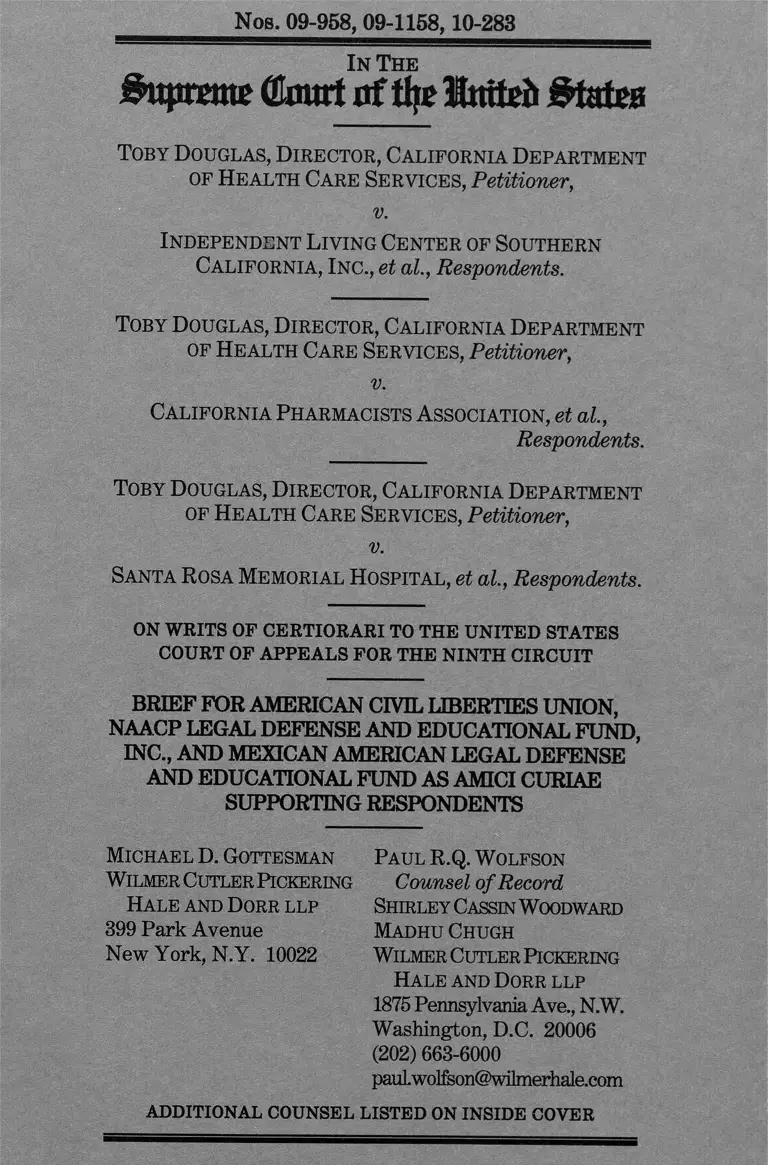
Nos. 09-958, 09-1158,10-288
In The
#uprajtt (four! af tip Itttteii &fettos
T o b y D o u g l a s , D i r e c t o r , C a l i f o r n i a D e p a r t m e n t
o f H e a l t h C a r e Se r v i c e s , Petitioner,
v.
I n d e p e n d e n t L i v in g C e n t e r o f S o u t h e r n
C a l i f o r n i a , I n c ., et al., Respondents.
T o b y D o u g l a s , D ir e c t o r , C a l i f o r n i a D e p a r t m e n t
o f H e a l t h C a r e S e r v i c e s , Petitioner,
v.
C a l i f o r n i a P h a r m a c is t s A s s o c ia t io n , et al.,
Respondents.
T o b y D o u g l a s , D ir e c t o r , C a l i f o r n i a D e p a r t m e n t
o f H e a l t h C a r e S e r v i c e s , Petitioner,
v.
Sa n t a R o s a M e m o r ia l H o s p it a l , et al., Respondents.
on writs of certiorari to the united states
court of appeals for the ninth circuit
BRIEF FOR AMERICAN CIVIL LIBERTIES UNION,
NAACP LEGAL DEFENSE AND EDUCATIONAL FUND,
INC., AND MEXICAN AMERICAN LEGAL DEFENSE
AND EDUCATIONAL FUND AS AMICI CURIAE
SUPPORTING RESPONDENTS
M ic h a e l D. G o t t e s m a n P a u l R .Q . W o lfso n
W ilm er C u tle r P ickerin g Counsel o f Record
H a l e a n d D o r r l l p Sh ir l e y Cassin W oodw ard
399 Park Avenue M a d h u C h u g h
New York, N.Y. 10022 W ilm er C u tle r P ickering
H a l e a n d D o r r l l p
1875 Pennsylvania Ave., N.W.
Washington, D.C. 20006
(202) 663-6000
pauLwolfeon@wilmerhale.com
additional counsel listed on inside cover
mailto:pauLwolfeon@wilmerhale.com
St e v e n R . Sh a p ir o
A m e r ic a n C iv il L iberties
F o u n d a t io n
125 Broad Street
New York, N Y 10025
V ic t o r V ir a m o n t e s
M e x ic a n A m e r ic a n
L e g a l D e f e n s e a n d
E d u c a t io n a l F u n d
634 S. Spring Street
11th Floor
Los Angeles, CA 90014
J ohn P a y t o n
D ir e c t o r -C o u n sel
NAACP L eg al D efen se a n d
E d u c a t io n a l F u n d , In c .
99 Hudson Street, Suite 1600
New York, N Y 10013
J o sh u a C iv in
NAACP L egal D efen se a n d
E d u c a t io n a l F u n d , In c .
14441 Street, N.W.
Washington, D.C. 20005
TABLE OF CONTENTS
TABLE OF AUTHORITIES........................................ iii
INTEREST OF AMICI CURIAE..................................1
SUMMARY OF ARGUMENT....................................... 2
ARGUMENT................................................................... 4
I. T h e C o u r t s ’ L o n g s t a n d in g A u t h o r it y
To E n f o r c e T h e C o n s t it u t io n
T h r o u g h D i r e c t A c t io n s H a s B e e n
P a r t i c u l a r l y C r i t ic a l F o r C i v il
R ig h t s A n d C i v i l L i b e r t i e s .................................4
A. Civil Rights Claims Have Long Been
Enforceable Through Direct Actions................ 5
B. Constitutional Claims Outside The
Civil Rights Context Have Also Long
Been Enforceable Through Direct Ac
tions.....................................................................11
C. The Supremacy Clause As Well May
Be Enforced Through Direct Equitable
Actions................................................................14
II. P r e c l u d in g D ir e c t R ig h t s O f A c t io n
U n d e r T h e S u p r e m a c y C l a u s e W o u l d
H a v e B r o a d A n d H a r m f u l C o n s e
q u e n c e s F o r M a i n t a i n i n g T h e S u
p r e m a c y O f F e d e r a l L a w .................................. 22
A. Minorities, Immigrants, and Low-
Income Individuals Continue To De
pend On Direct Actions Under The Su
premacy Clause To Challenge Invalid
State And Local Laws...................................... 23
Page
11
Page
B. Precluding Rights Of Action Under
The Supremacy Clause Would Under
mine Important Federal Interests................. 26
CONCLUSION.............................................................. 30
TABLE OF CONTENTS— Continued
Ill
TABLE OF AUTHORITIES
CASES
Allen v. Baltimore & Ohio Railroad Co.,
114 U.S.311 (1884).................................................. 12
Allied Structural Steel Co. v. Spannaus,
438 U.S. 234(1978).................................................. 12
Arka?isas Department o f Health & Human
Services v. Ahlborn, 547 U.S. 268 (2006)....15,16, 29
Asakura v. City o f Seattle, 265 U.S. 332 (1924)...........16
Bell v. Hood, 327 U.S. 678 (1946).................................... 9
Bivens v. Six Unknown Named Agents o f Fed
eral Bureau o f Narcotics, 403 U.S. 388
(1971)......................................................................... 10
Bolling v. Sharpe, 347 U.S. 497 (1954)................... 2, 6, 7
Bond v. United States, 131 S. Ct. 2355 (2011)..........5,14
Brown v. Board of Education, 347 U.S. 483
(1954)........................................................................... 7
Buquer v. City o f Indianapolis, No. ll-ev-708,
2011 WL 2532935 (S.D. Ind. June 24, 2011)........... 24
Camion v. University o f Chicago, 441 U.S. 677
(1979)......................................................................... 28
Carlson v. Gr'een, 446 U.S. 14 (1980).............................10
Chamber o f Commerce v. Edmundson,
594 F.3d 742 (10th Cir. 2010).................................. 23
Chamber o f Commerce v. Whiting, 131 S. Ct.
1968 (2011)................................................................ 23
Chambers v. Florida, 309 U.S. 227 (1940)...................... 6
Page(s)
IV
Chicago Burlington & Quincy Railroad Co. v.
City of Chicago, 166 U.S. 226 (1897)...................... 12
Comacho v. Texas Workforce Commission,
408 F.3d 229 (5th Cir. 2005).....................................25
Correctional Services Corp. v. Malesko,
534 U.S. 61 (2001)..................................................... 10
Crosby v. City of Gastonia, 635 F.3d 634 (4th
Cir. 2011).... 12
Crosby v. National Foreign Trade Council,
530 U.S. 363 (2000)................................16,18,20
Cuomo v. Clearing House Ass’n, L.L.C., 129 S.
Ct. 2710 (2009)........................................................... 16
Dennis v. Higgins, 498 U.S. 439 (1991)........................ 12
District o f Columbia v. Carter, 409 U.S. 418
(1973)........................................................................... 6
Ex Parte Young, 209 U.S. 123 (1908)............... 12,13,15
Florida Lime & Avocado Growers, Inc. v.
Paul, 373 U.S. 132 (1963).........................................16
Foster v. Love, 522 U.S. 67 (1997).................................16
Free Enterprise Fund v. Public Co. Account
ing Oversight Board, 130 S. Ct. 3138 (2010)...........14
Georgia Latino Alliance for Human Rights v.
Deal, No. ll-cv-1804, 2011 WL 2520752
(N.D. Ga. June 27,2011).......................................... 24
Golden State Transit Corp. v. City o f Los An
geles, 493 U.S. 103 (1989).............
Green v. Mansour, 474 U.S. 64 (1985)
TABLE OF AUTHORITIES— Continued
Page(s)
17
13
V
Page(s)
Guinn v. United States, 238 U.S. 347 (1915)................8
Hays v. Port o f Seattle, 251 U.S. 233 (1920).................12
Haywood v. Drown, 129 S. Ct. 2108 (2009).................. 21
Hines v. Davidowitz, 312 U.S. 52 (1941)...........16, 20, 30
Howlett ex rel. Howlett v. Rose, 496 U.S. 356
(1990)......................................................................... 21
Kemp v. Chicago Housing Authority, No. 10-
cv-3347, 2010 WL 2927417 (N.D. 111. July
21,2010)..............................................................24, 25
Lankford v. Sherman, 451 F.3d 496 (8th Cir.
2006)....................................................... 25
League o f United Latin American Citizens v.
Wilson, 997 F. Supp. 1244 (C.D. Cal. 1997)........... 24
Lorillard Tobacco Co. v. Reilly, 533 U.S. 525
(2001)......................................................................... 16
Maine v. Thiboutot, 448 U.S. 1 (1980)........................... 16
Marbury v. Madison, 5 U.S. (1 Cranch) 137
(1803)....................................................................... 4,5
McLaurin v. Oklahoma State Regents for
Higher Education, 339 U.S. 637 (1950).................... 7
Monroe v. Pape, 365 U.S. 167 (1961)...............................6
New York v. United States, 505 U.S. 144 (1992)...........14
Osborn v. Bank o f U?iited States, 22 U.S.
(9 Wheat.) 738(1824).......................................... 11,15
Patsy v. Board of Regents of Florida, 457 U.S.
496(1982)................. ......................................
TABLE OF AUTHORITIES— Continued
20
VI
TABLE OF AUTHORITIES— Continued
Page(s)
Pharmaceutical Research & Manufacturers
of America v. Walsh, 538 U.S. 644
(2003)....................................................... 15,16,19,26
Pierce v. Society of Sisters, 268 U.S. 510 (1925).........2, 9
Printz v. United States, 521 U.S. 898 (1997)................14
Raich v. Truax, 219 F. 273 (D. Ariz. 1915).................. 11
Rowe v. New Hampshire Motor Transport
Ass’n, 552 U.S. 364 (2008).......................................16
Scott v. Donald, 165 U.S. 107 (1897)............................. 12
Shaw v. Delta Air Lines, Inc., 463 U.S. 85
(1983)..........................................................................16
Society of Sisters v. Pierce, 296 F. 928 (D. Or.
1924)............................................................................ 9
South Carolina v. Baker, 485 U.S. 505 (1988)..............14
South Dakota v. Dole, 483 U.S. 203 (1987)................... 14
Terrace v. Thompson, 263 U.S. 197 (1923)................. 8, 9
Terry v. Adams, 345 U.S. 461 (1953).......................... 2, 8
Testa v. Katt, 330 U.S. 386 (1947)..................................21
Toll v. Moreno, 458 U.S. 1 (1982)...................................30
Truax v. Raich, 239 U.S. 33 (1915)............................. 2, 8
United States v. City o f Philadelphia, 644 F.2d
187 (3d Cir. 1980)......................................................29
United States v. Locke, 529 U.S. 89 (2000).................... 16
Vicksburg Waterworks Co. v. Mayor & Aider-
men of Vicksburg, 185 U.S. 65 (1902)...............12, 21
Vll
Villas at Parkside Partners v. City o f Farmers
Branch, 496 F. Supp. 2d 757 (N.D. Tex.
2007) ........................................................................ 24
Villas at Parkside Partners v. City o f Farmers
Branch, 577 F. Supp. 2d 858 (N.D. Tex.
2008) ........................................................................ 24
Watters v. Wachovia Bank, N.A., 550 U.S. 1
(2007)......................................................................... 16
Webster v. Doe, 486 U.S. 592 (1988)..................................5
Youngstown Sheet & Tube Co. v. Sawyer,
343 U.S. 579 (1952)................................................... 14
DOCKETED CASES
Complaint, United States v. Alabama, 11-cv-
02746 (N.D. Ala. Aug. 1, 2011)................................18
Complaint, United States v. Arizona, 10-cv-
01413 (D. Ariz. July 6, 2010)..........................
TABLE OF AUTHORITIES— Continued
Page(s)
18
vm
Page(s)
CONSTITUTIONAL AND STATUTORY PROVISIONS
TABLE OF AUTHORITIES— Continued
U.S. Const.
art. I, §8, cl. 1..........................................15,22,23,26
art. I, §8, cl. 3..................................... 3,12,13,19,20
art. I, §10, cl. 1........................................ 2,11,12,19
art. II, § 2, cl. 2 ........................................................ 14
art. I l l ....................................................................... 29
art. VI, cl. 2.......................................................passim
amend. 1.....................................................................19
amend. V ......................................................................6
amend. X I .................................................................. 13
amend. X IV ............................... 8, 9,11,12,13,19, 29
amend. X V .............................................................8,19
42 U.S.C. § 1983......................................................passim
Act of Dec. 29, 1979, Pub. L. No. 96-170,
93 Stat. 1284................................................................6
OTHER AUTHORITIES
Bandes, Susan, Reinventing Bivens: The Self-
Executing Constitution, 68 S. Cal. L. Rev.
289 (1995).....................................................................7
Berzon, Honorable Marsha S., Securing Fragile
Foundations: Affirmative Constitutional
Adjudication in Federal Courts, 84 N.Y.U.
L. Rev. 681 (2009).......................................................7
Blac-kmun, Harry A., Section 1983 and Federal
Protection o f Individual Rights— Will the
Statute Remain Alive or Fade Away?,
60 N.Y.U. L. Rev. 1 (1985)....................................... 7
IX
The Federalist Papers
No. 33 (Hamilton)..................................................... 14
No. 78 (Hamilton)....................................................... 5
Hart & Wechsler’s The Federal Courts & The
Federal Syste?n (Fallon, Richard H. et al.
eds., 6th ed. 2009)..................................................... 16
Hills, Roderick M., Dissecting the State: The
Use of Federal Law to Free State and Lo
cal Officials from State Legislatures’ Con
trol, 97 Mich. L. Rev. 1201 (1999)............................28
Key, Lisa E., Private Enforcement of Federal
Funding Conditions Under § 1983: The
Supreme Court’s Failure to Adhere to the
Doctrine o f Separation o f Powers, 29 U.C.
Davis L. Rev. 283 (1996).......................................... 27
Mank, Bradford C., Suing Under § 1983: The
Future After Gonzaga University v. Doe,
39 Hous. L. Rev. 1417 (2003)................................... 27
Perkins, Jane, Medicaid: Past Successes and
Future Challenges, 12 Health Matrix 7
(2002).........................................................................27
Sloss, David, Constitutional Remedies For
Statutory Actiofis, 89 Iowa L. Rev. 355
(2004).............................................................16, 20, 29
Smolla, Rodney A., Federal Civil Rights Acts
(3d ed. 2011)................................................................ 7
TABLE OF AUTHORITIES— Continued
Page(s)
X
Page(s)
Stephenson, Matthew C., Public Regulation o f
Private Enforcement: The Case for E x
panding the Role o f Administrative Agen
TABLE OF AUTHORITIES— Continued
cies, 91 Va. L. Rev. 93 (2005)..................................29
Wright, Charles Alan et ah, Federal Practice
and Procedure (3d ed. 2008)...................................13
INTEREST OF AMICI CURIAE1
The American Civil Liberties Union (“ACLU”) is a
nationwide, nonprofit, nonpartisan organization with
over 500,000 members, dedicated to the principles of
liberty and equality embodied in the Constitution and
our nation’s civil rights laws. Founded in 1920, the
ACLU has vigorously defended civil liberties for over
ninety years, working daily in courts, legislatures and
communities to defend and preserve the individual
rights and liberties that the Constitution and laws of
the United States guarantee everyone in this country.
The ACLU has appeared before this Court in numer
ous civil rights cases, both as direct counsel and as
amicus curiae.
The NAACP Legal Defense & Educational Fund,
Inc. (“LDF”) is a non-profit legal organization estab
lished to assist African Americans and other people of
color in securing their civil and constitutional rights.
For more than six decades, LDF attorneys have repre
sented parties and appeared as amicus curiae in litiga
tion before the Supreme Court and other federal courts
on matters of race discrimination, including through the
type of direct constitutional enforcement actions at is
sue in this case.
The Mexican American Legal Defense and Educa
tion Fund (“MALDEF”) is a national civil rights or
ganization established in 1968. Its principal objective is
The parties have consented to the filing of this brief. Pursu
ant to Rule 37.3(a), written consents to the filing of this brief are
on file with the Clerk of the Court. No counsel for a party au
thored this brief in whole or in part, and no person, other than the
amici curiae, their members, or their counsel made any monetary
contribution to the preparation or submission of this brief.
2
to promote the civil rights of Latinos living in the
United States through litigation, advocacy and educa
tion. MALDEF has represented Latino and minority
interests in civil rights cases in the federal courts
throughout the nation, including the Supreme Court.
MALDEF’s mission includes a commitment to protect
the rights of immigrant Latinos in the United States,
and MALDEF has asserted preemption theories in
federal court to further this commitment.
SUMMARY OF ARGUMENT
I. Enforcement of the Constitution is not depend
ent on affirmative action by the political branches of
government. Rather, from this Nation’s earliest times
to the present, the federal courts have consistently ex
ercised their equitable powers to compel compliance
with the Constitution, without suggesting the necessity
for a statutory vehicle, such as 42 U.S.C. § 1983, for
such authority. Those equitable powers have been, and
continue to be, particularly important for minorities,
immigrants, low-income individuals, and others whom
our majoritarian political processes are often unwilling
or unable to protect against constitutional violations.
Indeed, direct actions brought to enforce compliance
with the Constitution have resulted in many of this
Court’s most important civil-rights and civil-liberties
decisions, including Bolling v. Sharpe, 347 U.S. 497
(1954), Terry v. Adams, 345 U.S. 461 (1953), Truax v.
Raich, 239 U.S. 33 (1915), and Pierce v. Society o f Sis
ters, 268 U.S. 510 (1925); in none of those cases did the
Court suggest that it was acting under § 1983 or an
other statutory vehicle. That history is consistent with
the many cases in which this Court enforced other pro
visions of the Constitution, such as the Contracts
Clause and Commerce Clause, as well as structural
principles of federalism and separation of powers.
3
Such direct actions are also available to enforce a
claim of preemption under the Supremacy Clause, see
U.S. Cert. Amicus Br. 15-18, including where the pre
emption is based on a statute enacted under Congress’s
spending power. This Court has entertained and sus
tained many preemption claims in that context, recog
nizing the appropriateness of direct actions to vindicate
the supremacy of federal law. Petitioner suggests that
such direct actions should not be allowed, or drastically
restricted to narrow contexts, but that rule would seri
ously undermine federal law. In many contexts, a di
rect action is the only way in which the supremacy of
federal law could be established. Requiring litigants
asserting a Supremacy Clause claim to wait for a state-
court action would be grossly inefficient and could re
sult in federal law being undermined by invalid state
laws.
II. Direct actions remain critical to vindicate the
supremacy of federal law. This is especially true for
racial minorities, immigrants, and low-income individu
als, who in many circumstances have difficulty obtain
ing access to, or support from, the federal political
branches, and who often depend on a judicial remedy to
prevent enforcement of state laws that conflict with
federal laws. In contexts as diverse as immigration,
housing, and public assistance, direct actions remain
the only effective avenue to ensure the supremacy of
federal law. Eliminating that avenue would seriously
undermine federal law, because other avenues of en
forcement of federal law—such as termination of fed
eral funding or enforcement actions brought by the
United States—are highly impractical and offer little or
no hope for successful enforcement on behalf of indi
viduals directly harmed by states’ illegal conduct. Ab
sent direct actions brought to establish the supremacy
4
of federal law by those most directly affected by pre
empted state laws, there could well be no meaningful
remedy for state noncompliance with the Constitution’s
fundamental safeguards.
ARGUMENT
I. T h e C o u r t s ’ Lo n g s t a n d in g A u t h o r it y T o E n
f o r c e T h e C o n s titu tio n T h r o u g h D ir e c t A ctio n s
H a s B e e n P a r tic u l a r l y C r itic a l F o r C ivil R ig h ts
A n d C ivil L ib e r t ie s
This Court has long recognized that the strictures
of the Constitution may be enforced through direct ac
tions for equitable relief, regardless whether Congress
has enacted legislation specifically establishing a cause
of action for such relief. So long as the court has sub
ject-matter jurisdiction over the claim, separate legisla
tion establishing a cause of action has never been nec
essary for a plaintiff to obtain forward-looking relief
from unconstitutional conduct. Rather, the traditional
equitable authority of the courts has always been
deemed sufficient to provide such a remedy. The Court
has adhered to this principle in many contexts—
whether the constitutional claim was brought against
federal, state, or local officials; whether the claim was
brought to enforce individual constitutional rights or to
enforce structural principles in the Constitution; and
whether or not the claim was brought to preclude an
anticipated enforcement action.
The courts’ inherent equitable authority to compel
compliance with the Constitution is implicit in the
structure of the Constitution itself, and in the Constitu
tion’s status as the supreme law of the land. See Santa
Rosa Br. 13-18. As the Court recognized in Marbury v.
Madison, 5 U.S. (1 Cranch) 137 (1803), judicial review is
necessary as a check against the aggrandizement of
5
power by the political branches. These structural prin
ciples not only protect each branch from intrusion by
the others, but they also protect individuals from the
abuse of governmental power. See Bond v. United
States, 131 S. Ct. 2355,2363-2364 (2011). Thus, as Chief
Justice Marshall explained, “ [t]he very essence of civil
liberty” is “the right of every individual to claim the
protection of the laws, whenever he receives an injury.”
5 U.S. (1 Cranch) at 163. Although legislation may
channel the way in which constitutional claims are en
tertained by the courts, the courts have long under
stood that the right to compel compliance with the Con
stitution is not contingent on the assent of the political
branches. See Webster v. Doe, 486 U.S. 592, 603 (1988)
(stressing that a ‘“serious constitutional question”’
would arise if the political branches attempted to pre
clude any judicial forum for constitutional claims by
failing to make statutory allowance for such claims); see
also Federalist No. 78 (Hamilton) (“[T]he courts were
designed to be an intermediate body between the peo
ple and the legislature, in order ... to keep the latter
within the limits assigned to their authority.”).
A. Civil Rights Claims Have Long Been Enforce
able Through Direct Actions
The ability to enforce rights directly under the
Constitution has been particularly important for mi
norities, immigrants, low-income individuals, and other
persons who have faced systemic barriers in our ma-
joritarian political process and thus have often de
pended on the federal courts to secure their rights
when Congress and the Executive Branch have been
6
unable or unwilling to do so.2 Some of this Court’s (and
this country’s) most significant steps toward achieving
equality and liberty have resulted from plaintiffs’ en
forcement of their rights directly under the Constitu
tion. And that was particularly true in the long period
before this Court’s decision in Monroe v. Pape, 365 U.S.
167 (1961), revived 42 U.S.C. § 1983 as a vehicle for en
forcement of constitutional rights.
Many landmark civil rights decisions resulted from
direct actions to enforce the Constitution. One such
case, Bolling v. Sharpe, 347 U.S. 497 (1954), is a key
stone of this Court’s desegregation precedent. The
Bolling plaintiffs challenged racial segregation in the
public schools of the District of Columbia under the
Due Process Clause of the Fifth Amendment. The
Court ruled unanimously for the plaintiffs, holding that
racial segregation in the District’s public schools vio
lated the Fifth Amendment. The Court nowhere sug
gested that the plaintiffs’ ability to be heard on their
due process claim depended on their being able to point
to a statutory cause of action, such as § 1983.3
2 See Chambers v. Florida, 309 U.S. 227, 241 (1940) (“Under
our constitutional system, courts stand against any winds that
blow as havens of refuge for those who might otherwise suffer be
cause they are helpless, weak, outnumbered, or because they are
non-conforming victims of prejudice and public excitement.”).
3 Indeed, at the time, it was an open question whether § 1983
applied to the District of Columbia. The Court did not address the
question until District of Columbia v. Carter, 409 U.S. 418 (1973),
which held that § 1983 did not apply to persons acting under color
of D.C. law. Congress later amended § 1983 to apply to such per
sons. Act of Dec. 29,1979, Pub. L. No. 96-170, § 1, 93 Stat. 1284.
7
Desegregation in higher education was advanced
through another direct constitutional action, McLaurin
v. Oklahoma State Regents for Higher Educ., 339 U.S.
637 (1950). After the University of Oklahoma denied
the plaintiff admission to graduate school on the basis
of his race, McLaurin sued for injunctive relief, alleging
that the state law prohibiting integrated schools de
prived him of equal protection. The district court
agreed. The Oklahoma legislature then amended the
statute, allowing the university to admit the plaintiff
but restricting him to segregated facilities. The plain
tiff returned to the district court to seek injunctive re
lief, which the district court denied. The Supreme
Court reversed, holding that the amended state law
permitting segregated facilities deprived McLaurin of
his right to equal protection. Id. at 642. The Court no
where suggested that McLaurin’s ability to bring his
constitutional claim depended on a statutory cause of
action.4
4 Another landmark desegregation case, Brown v. Board of
Education, 347 U.S. 483 (1954)—which also did not mention the
predecessor statute to § 1983—can be seen as a direct constitu
tional action as well, although commentators disagree on how to
characterize that case. Compare Berzon, Securing Fragile Foun
dations: Affirmative Constitutional Adjudication in Federal
Courts, 84 N.Y.U. L. Rev. 681, 685-686 (2009) (characterizing
Brown as a direct constitutional action) and Bandes, Reinventing
Bivens/ The Self-Executing Constitution, 68 S. Cal. L. Rev. 289,
355 (1995) (same), with Blackmun, Section 1983 and Federal Pro
tection of Individual Rights—Will the Statute Remain Alive or
Fade Away?, 60 N.Y.U. L. Rev. 1, 1-2, 19 (1985) (characterizing
Brown as a § 1983 suit) and Smolla, Federal Civil Rights Acts
§ 14:2, at 391-392 (3d ed. 2011) (same). Regardless, Bolling dem
onstrates that there is a direct right of action under the Constitu
tion to challenge the legality of racial segregation in public schools.
In an equally important decision for minority vot
ing rights, the Court in Terry v. Adams, 345 U.S. 461
(1953), sustained a constitutional challenge by black
citizens to one of a series of schemes to maintain
whites-only primary elections in Texas. Having aban
doned their claim for damages, the Terry plaintiffs
rested their equitable claims directly on the Fourteenth
and Fifteenth Amendments. Id. at 478 nn.2 & 3 (Clark,
J. concurring). The Court struck down the discrimina
tory primary as unconstitutional. Id. at 470; see also id.
at 467 n.2 (plurality opinion) (noting that the Fifteenth
Amendment is ‘“self-executing”’). In so ruling, the
Court relied on its earlier decision in Guinn v. United
States, 238 U.S. 347 (1915), which invalidated grandfa
ther clauses under the Fifteenth Amendment, even
though Congress had not enacted specific legislation
reaching primary elections, based on “the self
executing power of the 15th Amendment,” id. at 368.
Several of this Court’s pathmarking decisions es
tablishing the rights of noncitizens also reached the
Court by way of direct action. For example, in Truax
v. Raich, 239 U.S. 33 (1915), this Court held that an
Arizona statute prohibiting the employment of nonciti
zens violated their rights to equal protection under the
Fourteenth Amendment. The Court did not suggest
the case was before it under a statutory cause of action
such as § 1983, but rather stressed that the plaintiff had
invoked the equitable power of the district court to re
strain unconstitutional action. Similarly, in Terrace v.
Thompson, 263 U.S. 197 (1923), the Court, although re
jecting an immigrant’s constitutional claim on the mer
its, stressed that the power to compel compliance with
the Constitution rested on the courts’ traditional equi
table powers, noting that equity jurisdiction will be ex
ercised to enjoin unconstitutional state laws “wherever
9
it is essential in order effectually to protect property
rights and the rights of persons against injuries other
wise irremediable.” Id. at 214.
Similarly, one of this Court’s leading decisions on
the meaning of “liberty” within the Due Process
Clause, Pierce v. Society o f Sisters, 268 U.S. 510 (1925),
arrived at the Court by way of a direct action brought
to enforce the Fourteenth Amendment and to prevent
Oregon officials from implementing a state compulsory
education law that would have forced all children to at
tend public schools. See id. at 530. The Court nowhere
referred to a statutory cause of action under which the
claim for equitable relief was brought. The district
court where the case was originally brought observed
that “ [t]he question as to equitable jurisdiction is a sim
ple one, and it may be affirmed that, without contro
versy, the jurisdiction of equity to give relief against
the violation or infringement of a constitutional right,
privilege, or immunity, threatened or active, to the det
riment or injury of a complainant, is inherent, unless
such party has a plain, speedy, and adequate remedy at
law.” Society of Sisters v. Pierce, 296 F. 928, 931 (D.
Or. 1924) (emphasis added).
This theme—that the courts have inherent author
ity to restrain violations of the Constitution, so long as
they have subject-matter jurisdiction—runs through
out the Court’s decisions and has never been seriously
questioned. In Bell v. Hood, 327 U.S. 678, 684 (1946)
(footnote omitted), the Court observed that “it is estab
lished practice for this Court to sustain the jurisdiction
of federal courts to issue injunctions to protect rights
safeguarded by the Constitution and to restrain indi
vidual state officers from doing what the 14th Amend
ment forbids the State to do”—without any mention of
a statutory vehicle such as § 1983. And although Jus
10
tices of this Court have debated whether damages
should be available to remedy past constitutional viola
tions in the absence of a statutory cause of action, see
Bivens v. Six Unknown Named Agents o f Federal Bu
reau of Narcotics, 403 U.S. 388 (1971); Correctional
Services Corp. v. Malesko, 534 U.S. 61, 75 (2001)
(Scalia, J., concurring), the Court has never questioned
courts’ inherent authority to enjoin threatened or ongo
ing constitutional violations. See, e.g., Carlson v.
Green, 446 U.S. 14, 42 (1980) (Rehnquist, J., dissenting)
(criticizing direct constitutional actions for damages,
but acknowledging tradition of direct constitutional ac
tions for equitable relief, and noting that “ [t]he broad
power of federal courts to grant equitable relief for
constitutional violations has long been established”).
Moreover, contrary to petitioner’s assertion (Pet.
Br. 43-44), the Court has entertained such direct ac
tions to enforce the Constitution regardless whether
that claim was brought to prevent a threatened en
forcement action and might have been raised in defense
to such an action. See infra pp. 18-22; U.S. Cert.
Amicus Br. 17-18 (acknowledging that “not all of this
Court’s” preemption cases involved claims raised in de
fense to enforcement actions). Indeed, where the plain
tiff could not bring the claim defensively to an enforce
ment action, the case for exercise of the courts’ equity
power is particularly compelling because the plaintiff
could well have no other way to vindicate his constitu
tional rights. In the desegregation and voting rights
cases discussed above, for example, there was no clear
way that the plaintiffs seeking to vindicate their consti
tutional rights could have obtained a ruling on the mer
its of their claims except through affirmative litigation.
And in Truax, the district court observed that the non
citizen’s constitutional claim presented an appropriate
11
case for the exercise of equity power because under the
challenged Arizona statute only employers, not (non
citizen) employees, were subject to criminal prosecu
tion; thus the noncitizen employee would have had no
other forum for his claim to be heard. See Raich v.
Truax, 219 F. 273, 283-284 (D. Ariz. 1915). If a plaintiff
seeking to enforce the Constitution has no other forum
in which to raise his claim, that provides a stronger—
not a weaker—rationale for the courts to entertain a
direct equitable action.
B. Constitutional Claims Outside The Civil
Rights Context Have Also Long Been En
forceable Through Direct Actions
These civil rights cases are in keeping with histori
cal tradition, in which this Court has long recognized
direct actions to enforce constitutional provisions, re
gardless whether Congress has provided a specific
statutory vehicle for enforcement of the Constitution.
One of the earliest examples is Osborn v. Bank of
United States, 22 U.S. (9 Wheat.) 738 (1824). This
Court resolved the Bank of the United States’ suit
against the Ohio Auditor for collecting a state tax that
conflicted with the federal statute that created the
Bank. Although no statute created a cause of action for
the Bank, this Court found that the dispute warranted
the “interference of a Court,” and it held the Ohio law
unconstitutional on the ground that it was “repugnant
to a law of the United States” and therefore void under
the Supremacy Clause. Id. at 838, 868.
In the years after Osborn, and with increasing fre
quency after Congress provided for federal-question
jurisdiction in 1875, courts routinely entertained suits
to enforce directly a broad range of constitutional pro
visions, including the Contracts Clause, the Fourteenth
12
Amendment’s Due Process Clause, and the dormant
Commerce Clause. See, e.g., Hays v. Port o f Seattle,
251 U.S. 233 (1920) (Due Process Clause and Contracts
Clause); Vicksburg Waterworks Co. v. Mayor & A l
dermen of Vicksburg, 185 U.S. 65 (1902) (Contracts
Clause); Chicago Burlington & Quincy R.R. Co. v. City
of Chi., 166 U.S. 226 (1897) (Due Process Clause); Scott
v. Donald, 165 U.S. 107 (1897) (Commerce Clause); A l
len v. Baltimore & Ohio R.R. Co., 114 U.S. 311 (1884)
(Contracts Clause). Particularly noteworthy are the
direct actions for equitable relief brought to enforce the
Contracts Clause, because it still is not settled in this
Court whether claims under the Contracts Clause may
be brought under § 1983. See Dennis v. Higgins, 498
U.S. 439, 456-457 (1991) (Kennedy, J., dissenting);
Crosby v. City o f Gastonia, 635 F.3d 634, 640-641 (4th
Cir. 2011) (noting issue), petition for cert, filed, No. 10-
1479 (U.S. June 8, 2011). Nonetheless, the Court ex
plained in Vicksburg Waterworks that the Contracts
Clause claim was properly before it because “the case
presented by the bill is within the meaning of the Con
stitution of the United States and within the jurisdic
tion of the circuit court as presenting a Federal ques
tion”—without suggesting that a statutory cause of ac
tion was also necessary. 185 U.S. at 82. The Court
more recently upheld a Contracts Clause claim in such
a direct-action posture in Allied Structural Steel Co. v.
Spannaus, 438 U.S. 234 (1978), without discussing
whether the claim might have been brought under
§ 1983.
One of the most notable of these cases was Ex
Parte Young, 209 U.S. 123 (1908). After the Minnesota
Attorney General signaled his intention to enforce a
state law limiting the rates that railroads could charge,
a group of railroad shareholders sued him to enjoin en
13
forcement of that law, arguing that it violated the
Commerce Clause and Due Process Clause of the Four
teenth Amendment. The Court concluded that the
Eleventh Amendment does not bar suits against state
officers to enjoin violations of the Constitution or fed
eral law. Id. at 159-160. The Court also concluded that
the federal courts had jurisdiction because the case
raised “Federal questions” directly under the Constitu
tion. Id. at 143-145. The Court thus viewed the Consti
tution—paired with the federal-question jurisdiction
statute—as providing the basis of the plaintiffs’ right to
sue a state officer to enjoin an alleged constitutional
violation. As this Court has observed, “the availability
of prospective relief of the sort awarded in Ex parte
Young gives life to the Supremacy Clause. Remedies
designed to end a continuing violation of federal law are
necessary to vindicate the federal interest in assuring
the supremacy of that law.” Green v. Mansour, 474
U.S. 64, 68 (1985). Indeed, scholars have concluded that
“the best explanation of Ex parte Young and its prog
eny is that the Supremacy Clause creates an implied
right of action for injunctive relief against state officers
who are threatening to violate the federal Constitution
and laws.”5
Also demonstrating this principle are the numerous
cases in which this Court has resolved structural con
stitutional claims brought against the federal govern
ment without suggesting that a statutory cause of ac
tion was necessary for those claims to be before the
courts, and where there was no evident alternative fo
rum for those claims to be heard (such as under the
5 Wright et ah, Federal Practice and Procedure § 3566, at 292
(3d ed. 2008).
14
Administrative Procedure Act or in defense to an en
forcement action). See Printz v. United States, 521 U.S.
898 (1997); New York v. United States, 505 U.S. 144
(1992); South Carolina v. Baker, 485 U.S. 505 (1988);
South Dakota v. Dole, 483 U.S. 203 (1987); Youngstown
Sheet & Tube Co. v. Sawyer, 343 U.S. 579 (1952); see
also Free Enterprise Fund v. Public Co. Accounting
Oversight Bd., 130 S. Ct. 3138, 3151 & n.2 (2010) (ruling
that Appointments Clause claim was properly before
the courts, despite the absence of a statutory cause of
action).6
C. The Supremacy Clause As Well May Be En
forced Through Direct Equitable Actions
Given the courts’ historical willingness to entertain
direct actions to enforce the Constitution, it would be
surprising to learn that the Supremacy Clause, alone
among the Constitution’s provisions, could not be so en
forced. As the Framers explained, the Supremacy
Clause is fundamental to the Constitution, for if the
laws of the United States “were not to be supreme,”
then “they would amount to nothing.” Federalist No.
33 (Hamilton). The Supremacy Clause thus “flows im
mediately and necessarily from the institution of a fed
eral government.” Id.; see also Santa Rosa Br. 30-31.
In keeping with historical tradition, direct actions un
der the Supremacy Clause have played an important
In its most recent Term, this Court reiterated that it will
entertain individuals’ challenges based on federal structural con
stitutional principles. See Bond, 131 S. Ct. at 2363-2364 (“The in
dividual, in a proper case, can assert injury from governmental
action taken in excess of the authority that federalism defines.”);
see also id. at 2365 (“The structural principles secured by the
separation of powers protect the individual as well.” ).
15
role in vindicating the supremacy of federal law, as
Osborn and Ex parte Young illustrate.
This Court has implicitly recognized a right of ac
tion under the Supremacy Clause to enjoin preempted
state law in many contexts—including cases where the
preempting federal law was enacted pursuant to Con
gress’s Spending Clause powers, and where state par
ticipation in the federal program was voluntary.7 By
routinely resolving such claims on the merits, without
regard to whether a federal statute confers a right of
action, this Court has established not only that federal
courts have subject-matter jurisdiction over claims to
enjoin preempted state law but that there is a right of
action under the Supremacy Clause for such claims.
See U.S. Cert. Amicus Br. 15-18 (recognizing that the
Court has often decided preemption claims on their
merits, implicitly assuming that a cause of action exists
under the Supremacy Clause to challenge preempted
state law). It is particularly noteworthy that the Court
entertained such Supremacy Clause claims without ref
7 See, e.g., Arkansas Dep’t of Health & Human Servs. v. Ahl-
bom, 547 U.S. 268 (2006) (federal Medicaid law preempts state
statute imposing liens on tort settlement proceeds). In Pharma
ceutical Research & Manufacturers of America v. Walsh, 538 U.S.
644 (2003) (“PhRMA”), seven Justices (four in the plurality and
three in dissent) reached and resolved the merits of plaintiffs
claim that the challenged state law was preempted by the federal
Medicaid statute. See id. at 649-670 (plurality opinion) (finding on
the merits that state law was not preempted); id. at 684 (O’Connor,
J., concurring in part and dissenting in part) (finding on the merits
that the state law was preempted). By so doing, seven Justices
implicitly concluded both that the Court had the authority to re
solve the case under federal-question jurisdiction and that the
plaintiff had a claim to injunctive relief under the Supremacy
Clause. See id. at 668 (plurality opinion).
16
erence to a statutory cause of action long before Maine
v. Thiboutot, 448 U.S. 1 (1980), established that § 1983
may be used to vindicate federal statutory—in addition
to federal constitutional—rights against state interfer
ence. See, e.g., Florida Lime & Avocado Growers, Inc.
v. Paul, 373 U.S. 132 (1963); Hines v. Davidowitz, 312
U.S. 52 (1941); Asakura v. City o f Seattle, 265 U.S. 332
(1924). That tradition continues unbroken to this day.8
In short, “the rule that there is an implied right of
action to enjoin state or local regulation that is pre
empted by a federal statutory or constitutional provi
g
See, e.g., Cuomo v. Clearing House Ass’n, L.L.C., 129 S. Ct.
2710 (2009) (regulations promulgated under National Bank Act
preempt enforcement of executive subpoenas from state Attorney
General); Rowe v. New Hampshire Motor Transp. Ass’n, 552 U.S.
364 (2008) (Federal Aviation Administration Authorization Act
preempts state requirements related to the transport of tobacco
products); Ahlborn, 547 U.S. 268 (federal Medicaid law preempts
state statute imposing liens on tort settlement proceeds); Watters
v. Wachovia Bank, N.A., 550 U.S. 1 (2007) (National Bank Act pre
empts state supervision of mortgage-lending activities by national
bank affiliates); PhRMA, 538 U.S. at 649-670 (plurality opinion)
(Medicaid Act did not preempt state prescription-drug rebate law);
Lorillard Tobacco Co. v. Reilly, 533 U.S. 525 (2001) (Federal Ciga
rette Labeling and Advertising Act preempts state regulations on
cigarette advertising); Crosby v. National Foreign Trade Council,
530 U.S. 363 (2000) (federal Burma statute preempts state statute
barring state procurement from companies that do business with
Burma); United States v. Locke, 529 U.S. 89 (2000) (various federal
statutes preempt state regulations concerning, inter alia, the de
sign and operation of oil tankers); Foster v. Love, 522 U.S. 67
(1997) (federal election statute preempts Louisiana’s “open pri
mary” statute); Shaw v. Delta Air Lines, Inc., 463 U.S. 85 (1983)
(ERISA preempts portions of state benefits law); see also Sloss,
Constitutional Remedies for Statutory Actions, 89 Iowa L. Rev.
355, 365-400 (2004) (canvassing this Court’s case law on preemp
tion claims).
17
sion—and that such an action falls within federal
question jurisdiction—is well established.” Hart &
Wechsler’s The Federal Courts & The Federal System
807 (Fallon et al. eds., 6th ed. 2009) (collecting cases).
This Court’s decision in Golden State Transit Corp.
v. City o f Los Angeles, 493 U.S. 103 (1989), is consistent
with this analysis. That decision makes clear that
§ 1983 does not provide a home for all preemption
claims (but may be used only to vindicate federal
“rights”), see id. at 107, but it nowhere suggests that
preemption claims may not be directly asserted merely
because § 1983 does not provide a vehicle to do so. That
the Supremacy Clause itself “does not create rights en
forceable under § 1983,” id. (emphasis added) means
only that certain preemption claims may not be brought
under § 1983, not that such claims may not be brought
at all. Indeed, the dissent in Golden State Transit,
which would have denied the award of money damages
under § 1983, made that very point, explaining that de
nying relief under § 1983 “would not leave the company
without a remedy” because “§ 1983 does not provide
the exclusive relief that the federal courts have to of
fer,” and that the plaintiffs could seek an injunction on
preemption grounds. Id. at 119 (Kennedy, J., dissent
ing).9
9 Section 1983 is not duplicative of the right of action for in
junctive relief under the Supremacy Clause. By enacting § 1983,
Congress expanded the kinds of state action that private litigants
could challenge and the remedies they could seek beyond those
available in suits directly under the Constitution. See Cal. Phar
macists Br. 35-39; Dominguez Br. 29-34; Santa Rosa Br. 27-28.
That § 1983 has been an important mechanism to secure constitu
tional rights by providing damages remedies against state and lo
cal officials does not mean that § 1983 is the only avenue through
which unconstitutional state action can be challenged.
18
Although petitioner and his amici have acknowl
edged that the federal courts have previously enter
tained direct actions to enforce the Constitution (in
cluding the Supremacy Clause), they have suggested
that, where Congress has not provided a vehicle such
as § 1983 for such claims to be entertained, then those
claims should be remitted to state courts, under what
ever procedures the States might have provided for
them to be heard—or that, at most, the federal courts
should entertain such direct actions only when they are
brought to prevent the threatened imminent enforce
ment of an unconstitutional or preempted state law.
See Pet. Br. 43-44; National Governors Ass’n et al.
Amicus Br. 22-26; U.S. Merits Amicus Br. 19-22.10
Those suggestions should be rejected for several rea
sons.
First, those arguments are inconsistent with this
Court’s uniform precedent. This Court has entertained
and sustained many direct equitable actions under the
Constitution, including the Supremacy Clause, and also
including preemption claims based on a federal spend
ing statute, even when there was no evident enforce
ment action to which the federal claim might be raised
as a defense. For example, in Crosby v. National For
eign Trade Council, 530 U.S. 363 (2000), the challenged
10 The United States has taken the position elsewhere that
the Supremacy Clause provides a direct cause of action that is not
limited to asserting a defense to a state enforcement action. See
Compl., United States v. Arizona, 10-cv-01413 (D. Ariz. July 6,
2010) (filed by the United States as plaintiff challenging Arizona
immigration law, seeking declaratory and injunctive relief and as
serting “Violation of the Supremacy Clause” as its first cause of
action); Compl., United States v. Alabama, ll-ev-02746 (N.D. Ala.
Aug. 1,2011) (similar, in challenge to Alabama law).
19
Massachusetts law barred government procurement of
goods and services from companies doing business with
Burma. See id. at 366-367. There was no “enforce
ment” action in which the companies could raise pre
emption as a defense; the plaintiffs simply could no
longer get government contracts. This Court held that
the state law was preempted, necessarily presuming
that there was a right of action under the Supremacy
Clause that could be asserted directly and not merely in
defense of an enforcement action. Id. at 367; see also
PhRMA, 538 U.S. at 649-670 (plurality opinion); id. at
684 (O’Connor, J., concurring in part and dissenting in
part) (seven Justices resolving Medicaid-based preemp
tion claim on the merits where that claim was raised
affirmatively and not in defense to an enforcement ac
tion); supra pp. 10-11 (noting other examples of direct
constitutional claims being entertained where they
could not have been raised as defenses to enforcement
actions).
Second, a rule requiring preemption claims to be
advanced defensively only, while allowing claims based
on a violation of constitutional rights to go forward in
federal court under § 1983, would be extraordinarily
inefficient and would undermine the effective vindica
tion of federal law. Litigants frequently pursue both
preemption theories and other constitutional claims.
This Court’s cases teem with examples: businesses
commonly pursue both preemption claims and claims
under the Commerce, Contracts, or Due Process
Clauses; immigrants pursue both preemption claims
and claims under the Equal Protection Clause and First
Amendment; racial minorities pursue both statutory
claims and claims under the Fourteenth and Fifteenth
Amendments. Very often, courts turn to the preemp
tion claim first in order to avoid reaching difficult con
20
stitutional questions. See, e.g., Crosby, 530 U.S. 363
(holding state procurement statute preempted by fed
eral Burma statute, and thereby avoiding dormant For
eign Commerce Clause claim); Hines, 312 U.S. 52 (hold
ing Pennsylvania registration law for noncitizens pre
empted by federal legislation enacted while the case
was before the Supreme Court, and thus avoiding equal
protection claim).
If litigants could not pursue both preemption
claims (directly) and other constitutional claims (under
§ 1983) in a single action for equitable relief, but were
required to pursue preemption theories not cognizable
under § 1983 only in state court, then they would be
forced either to divide their federal claims between fed
eral and state courts—which could well be barred by
rules against splitting causes of action—or to forgo the
federal forum for their § 1983 claims—which would be
contrary to the strong congressional policy in favor of
affording a federal forum for such claims. See, e.g.,
Patsy v. Board of Regents o f Fla., 457 U.S. 496 (1982).
The far more efficient and sensible rule, as well as the
one more consistent with this Court’s decisions, is to
allow equitable claims based on all provisions of the
Constitution, including the Supremacy Clause, to be
entertained in affirmative litigation through an action
directly under the Constitution.
In addition, the rule proposed by petitioner and its
amici would not adequately assure the supremacy of
federal law. Many Supremacy Clause claims cannot be
raised defensively at all, because there is no enforce
ment action in which they can be raised; in such circum
stances, an affirmative direct action under the Consti
tution is the only way in which the supremacy of fed
eral law could be established. See Sloss, Constitutional
Remedies for Statutory Actions, 89 Iowa L. Rev. 355,
21
406 (2004) (discussing such claims). And even when a
litigant might be able to assert his federal claim in de
fense of state enforcement actions or in defense to state
common law claims, his ability to establish the suprem
acy of federal law should not be dependent on the ven
ues that state law has happened to make available.11
Indeed, this Court has long recognized that “it is one of
the most valuable features of equity jurisdiction, to an
ticipate and prevent a threatened injury.” Vicksburg
Waterworks, 185 U.S. at 82.
The history of the civil rights movement in this
country well illustrates the need to enforce federal
rights in the federal courts, without reliance on legisla
tive grace or the vagaries of state law. Had § 1983
never been enacted, it could hardly be the case that
state laws providing for segregated schools, white pri
maries, and restrictions on immigrants could have gone
unchallenged. Plaintiffs could challenge, and did chal
lenge, such unconstitutional state laws directly under
the Supremacy Clause. And nothing in the Supremacy
Clause suggests that it may not also be used directly to
challenge state laws because they conflict with a fed
eral law, and not (or not just) the federal Constitution.
The Supremacy Clause itself provides that both the
Constitution “and the Laws of the United States which
shall be made in Pursuance thereof ... shall be the su
preme Law of the Land.” U.S. Const, art. VI (emphasis
added).
11 Cf. Haywood v. Drown, 129 S. Ct. 2108 (2009) (state courts
cannot refuse to entertain certain classes of federal claims);
Howlett ex rel. Howlett v. Rose, 496 U.S. 356 (1990) (state court
cannot apply state sovereign-immunity principles to refuse adjudi
cation of federal law claim); Testa v. Katt, 330 U.S. 386 (1947)
(state courts cannot discriminate against federal claims).
22
Finally, nothing in the Supremacy Clause or this
Court’s precedent indicates that statutes enacted pur
suant to Congress’s Spending Clause power should be
treated any differently than statutes enacted pursuant
to other sources of congressional power, i.e., that direct
causes of action may not be brought to vindicate the
federal structural interest in the supremacy of Spend
ing Clause statutes. Indeed, numerous Spending
Clause statutes—including Title VI of the Civil Rights
Act of 1964, Title IX of the Education Amendments of
1972, and the Individuals with Disabilities Education
Act—are critical in preventing discrimination and pro
tecting civil liberties, and many others—such as Medi
caid and the Supplemental Nutrition Assistance Pro
gram (previously called the Food Stamp Program)—
provide a critical safety net on which low-income indi
viduals rely for survival. II.
II. Precluding Direct Rights Of Action Under The
Supremacy Clause Would Have Broad And
Harmful Consequences For Maintaining The Su
premacy Of Federal Law
An action under the Supremacy Clause provides an
important—and sometimes the only—avenue to vindi
cate the supremacy of federal law. Barring a right of
action under the Supremacy Clause could effectively
foreclose this critical avenue for persons, especially mi
norities, immigrants, and low-income individuals, who
depend on federal law and who would otherwise be sub
ject to invalid state and local laws.
23
A. Minorities, Immigrants, And Low-Income In
dividuals Continue To Depend On Direct Ac
tions Under The Supremacy Clause To Chal
lenge Invalid State And Local Laws
Racial minorities, immigrants, and low-income in
dividuals continue to rely directly on the Supremacy
Clause to challenge invalid state and local laws in many
important areas, including immigration, fair housing,
public assistance, and health care. Many of those cases
have involved legislation enacted under Congress’s
Spending Clause power, and the courts have routinely
adjudicated and sometimes invalidated state laws that
conflicted with the federal legislation.
For example, several plaintiffs in recent years have
used the Supremacy Clause to challenge the increasing-
number of state laws that seek to restrict immigrants’
rights, including immigrants’ employment opportuni
ties. In Chamber o f Commerce v. Edmondson, 594
F.3d 742 (10th Cir. 2010), plaintiffs claimed that provi
sions of the Oklahoma Taxpayer and Citizen Protection
Act of 2007, which created new employee verification
rules and imposed sanctions on employers that alleg
edly hire undocumented immigrants, conflicted with
federal immigration law, which sets forth a comprehen
sive scheme prohibiting the employment of such indi
viduals. The Tenth Circuit, which upheld in part a pre
liminary injunction against enforcement of the state
law, explained that a “party may bring a claim under
the Supremacy Clause that a local enactment is pre
empted even if the federal law at issue does not create
a private right of action.” Id. at 756 n.13 (internal quo
tation marks omitted); see also Chamber o f Commerce
v. Whiting, 131 S. Ct. 1968 (2011) (adjudicating preemp
tion challenge to Arizona law providing for the revoca
tion or suspension of licenses in certain circumstances
24
of state employers who knowingly hire undocumented
immigrants, but finding no preemption).
Numerous other courts similarly have addressed
preemption challenges, under the Supremacy Clause, to
state and local laws that affect immigrants’ access to
housing and other vital services. See Georgia Latino
Alliance for Human Rights v. Deal, No. ll-cv-1804,
2011 WL 2520752, at *6 (N.D. Ga. June 27, 2011) (find
ing independent jurisdictional grounds under the Su
premacy Clause to allow a preemption challenge
against Georgia’s Illegal Immigration and Enforcement
Act of 2011 and entering preliminary injunction); Bu-
quer v. City o f Indianapolis, No. ll-cv-708, 2011 WL
2532935, at *2 (S.D. Ind. June 24, 2011) (considering a
Supremacy Clause challenge to an Indiana law that al
lows, inter alia, law enforcement officers to make a
warrantless arrest of an immigrant under certain con
ditions and entering preliminary injunction); Villas at
Parkside Partners v. City o f Farmers Branch, 496 F.
Supp. 2d 757, 777 (N.D. Tex. 2007) (considering a Su
premacy Clause challenge to city ordinance that essen
tially “created its own classification scheme for deter
mining which noncitizens may rent an apartment” in
the city and entering preliminary injunction), perma
nent injunction entered, 577 F. Supp. 2d 858, 879
(2008); League o f United Latin Am. Citizens v. Wilson,
997 F. Supp. 1244 (C.D. Cal. 1997) (finding preempted
most provisions of a state law that, inter alia, re
stricted immigrants’ access to health care, social ser
vices, and education).
Low-income individuals have likewise invoked the
Supremacy Clause to ensure compliance with federal
housing laws. In Kemp v. Chicago Housing Authority,
No. 10-cv-3347, 2010 WL 2927417 (N.D. 111. July 21,
2010), a single mother of two argued that municipal
25
rules unlawfully allowed the Chicago Housing Author
ity to terminate her public housing assistance in cir
cumstances other than those specified and limited by
the United States Housing Act of 1937. Kemp sought
to enjoin the local law as preempted under the Suprem
acy Clause. Although the court ultimately did not
grant relief because of the Anti-Injunction Act, it con
cluded that the Supremacy Clause “create[s] rights en
forceable in equity proceedings in federal court,” and
that it could therefore exercise jurisdiction over
Kemp’s preemption claim. Id. at *3 (internal quotation
marks omitted).
Persons receiving public assistance have also in
voked the Supremacy Clause to challenge state laws
that terminate medical or other benefits in contraven
tion of federal law. For example, in Comacho v. Texas
Workforce Commission, 408 F.3d 229 (5th Cir. 2005),
the court invalidated under the Supremacy Clause
state regulations that expanded the circumstances, be
yond those allowed by federal law, under which Medi
caid benefits could be cut off for low-income adults re
ceiving assistance under the federal Temporary Assis
tance to Needy Families program.
Finally, the Eighth Circuit in Lankford v.
Sherman, 451 F.3d 496 (8th Cir. 2006), relied directly
on the Supremacy Clause to preliminarily enjoin a Mis
souri regulation that limited Medicaid coverage of du
rable medical equipment to certain populations, making
most Medicaid recipients in Missouri ineligible to re
ceive such items even if medically necessary. Id. at 509.
The court found that the regulation conflicted with
Medicaid’s requirements and goals and therefore was
likely preempted under the Supremacy Clause. Id. at
513 (holding that plaintiffs had “established a likelihood
26
of success on the merits of their preemption claim” for
obtaining a preliminary injunction).
The Supremacy Clause right of action therefore
remains critically important to minorities, immigrants,
and low-income persons in our society who rely on it for
vindication of federal law. The availability of that di
rect action ensures that state and local governments
cannot undermine federal law by enacting statutes and
regulations that deviate from federal requirements but
would, absent a Supremacy Clause action, be effec
tively insulated from judicial review.
B. Precluding Rights Of Action Under The Su
premacy Clause Would Undermine Important
Federal Interests
Precluding a right of action under the Supremacy
Clause would leave important rights and interests ef
fectively unprotected. Not only will the rights of indi
vidual litigants seeking to invalidate unconstitutional
state laws be harmed, but important federal supremacy
interests could go unprotected as well.
First, precluding rights of action under the Su
premacy Clause would leave few, if any, effective reme
dies to force state compliance with many federal laws
that are intended to benefit minorities, immigrants, and
low-income persons in our society. In the context of
laws enacted under Congress’s Spending Clause power,
the termination of federal funding may sometimes be
theoretically available to remedy the State’s failure to
comply with its obligations under the Medicaid Act or
other Spending Clause laws, see PhRMA, 538 U.S. at
675 (Scalia, J., concurring in the judgment), but that
remedy is so rare and drastic as to be effectively un
available as a meaningful enforcement tool. As com
mentators have explained, both political considerations
27
and procedural hurdles make withdrawal of federal
funding an illusory remedy. See, e.g., Mank, Suing Un
der § 1983: The Future After Gonzaga University v.
Doe, 39 Hous. L. Rev. 1417, 1431-1432 (2003) (“ [A]s a
practical matter, federal agencies rarely invoke the
draconian remedy of terminating funding to a state
found to have violated the [federal] conditions because
there are often lengthy procedural hurdles that allow a
state to challenge any proposed termination of funding,
and members of Congress from that state will usually
oppose termination of funding.”); Perkins, Medicaid:
Past Successes and Future Challenges, 12 Health Ma
trix 7, 32 (2002) (“ [T]he Medicaid Act provides for the
Federal Medicaid oversight agency to withdraw federal
funding if a State is not complying with the approved
State Medicaid plan; however,... this is a harsh remedy
that has rarely, if ever, been followed through to its
conclusion.”); Key, Private Enforcement o f Federal
Funding Conditions Under § 1983: The Supreme
Court's Failure to Adhere to the Doctrine o f Separation
of Powers, 29 U.C. Davis L. Rev. 283, 292-293 (1996)
(“ [OJften the agency’s only enforcement mechanism is a
cutoff of federal funds for the program[,| ... [which] is
rarely, if ever, invoked.”).12
Moreover, termination of federal funding would in
many circumstances be counterproductive and contrary
to Congress’s intent that the funding program be im
plemented to provide a wide benefit. Indeed, persons
12 As respondents point out (Cal. Pharmacists Br. 2-3, 17),
this case shows how difficult it can be for the Executive Branch to
enforce the supremacy of federal law by itself; even after the re
sponsible federal agency disapproved state rate cuts as inconsis
tent with federal law, the State continued to implement its invalid
legislation.
28
who receive crucial benefits and services from federal
programs usually do not want federal funding to be
terminated. Terminating federal funding would not
protect the interests of those injured by the State’s
noncompliance with federal law; rather, it would harm
the very people Congress intended to benefit. See
Cannon v. University o f Chi., 441 U.S. 677, 704-705
(1979) (explaining that “termination of federal financial
support for institutions engaged in discriminatory prac
tices ... is ... severe” and “may not provide an appro
priate means of accomplishing” the purposes of the
statute); see also Hills, Dissecting the State: The Use of
Federal Law to Free State and Local Officials from
State Legislatures’ Control, 97 Mich. L. Rev. 1201,
1227-1228 (1999) (“ [T]he sanction of withdrawing fed
eral funds from noncomplying state or local officials is
usually too drastic for the federal government to use
with any frequency: withdrawal of funds wall injure the
very clients that the federal government wishes to
serve.”).
The more effective way to vindicate the objectives
of federal law is to allow for the important role that
private parties play in enforcing the supremacy of fed
eral statutes. As the United States previously argued
in this case, “those programs in which the drastic
measure of withholding all or a major portion of federal
funding is the only available remedy would be generally
less effective than a system that also permits awards of
injunctive relief in private actions in appropriate cir
cumstances.” See U.S. Cert. Amicus Br. 19. In such
circumstances, an injunction would force a State to
comply with the federal provision at issue without
harming the intended beneficiaries of the federal pro
gram.
29
Nor would it be appropriate to force individuals
who depend on federal law to rely exclusively on the
federal government to bring affirmative litigation to
enforce compliance with the Supremacy Clause. Pri
vate rights of action are necessary because the gov
ernment lacks the resources to police preemption dis
putes between States and private parties. See Sloss,
Constitutional Remedies For Statutory Actions, 89
Iowa L. Rev. at 404. Private rights of action “increase
the social resources devoted to law enforcement, thus
complementing government enforcement efforts.” Ste
phenson, Public Regulation of Private Enforcement:
The Case for Expanding the Role o f Administrative
Agencies, 91 Va. L. Rev. 93, 108 (2005); see also Ahl-
bom, 547 U.S. at 291. In short, absent a right of action
under the Supremacy Clause there could well be no
meaningful remedy at all for state noncompliance.13
A private right of action under the Supremacy
Clause serves other important values as well. The Su
premacy Clause supports the structural guarantee of
13' Indeed, it is not entirely clear that the federal government
would always be authorized to sue to compel enforcement of fed
eral law. Private plaintiffs directly affected by state laws have
Article III standing to sue to enjoin their enforcement; the federal
government might not. And if private plaintiffs did not have a di
rect right of action to sue under the Supremacy Clause, it might
well be questioned whether the United States could sue without
its own statutory cause of action. Cf. United States v. City of Phi-
la., 644 F.2d 187 (3d Cir. 1980) (holding that United States may not
sue local governments for injunction against violation of Four
teenth Amendment, absent statutory authority to sue). The Court
need not resolve those issues in this case, but at a minimum there
would be no assurance that enforcement by the United States
would necessarily be available if private lawsuits were not permit
ted.
30
federalism—namely, that federal law will remain para
mount. And that interest can only be effectively vindi
cated by ensuring that preempted state laws are in
validated—a goal that, for the reasons described above,
can best be achieved through a private right of action.
In addition, a private right of action, by allowing robust
enforcement for preemption claims, fosters uniformity
and predictability in the application of both federal and
state law.14 Thus, in order to realize the Constitution’s
fundamental promise that federal law will remain
paramount over invalid state and local laws, it is essen
tial that this Court continue—as it has done for nearly
two hundred years—to allow litigants to bring preemp
tion challenges directly under the Supremacy Clause.
CONCLUSION
The judgments of the court of appeals should be af
firmed.
14 Preemption claims in immigration and other areas of law
have also been critical to preserving the federal government’s
paramount role in foreign policy. See, e.g., Hines, 312 U.S. at 63
(“Our system of government is such that the interest of the cities,
counties and states, no less than the interest of the people of the
whole nation, imperatively requires that federal power in the field
affecting foreign relations be left entirely free from local interfer
ence.”); id. at 66-67; Toll v. Moreno, 458 U.S. 1,10-13 (1982).
31
Respectfully submitted.
M ic h a e l D. G o tte sm a n
W ilm er C u tler P ickering
H a l e a n d D o r r l l p
399 Park Avenue
New York, N.Y. 10022
St e v e n R . Sh a p ir o
A m erican C iv il L iberties
F o u n d a t io n
125 Broad Street
New York, N.Y. 10025
V ic to r V ir a m o n t e s
M e x ic a n A m e r ic a n
L e g a l D e f e n s e a n d
E d u c a t io n a l F u n d
634 S. Spring Street
11th Floor
Los Angeles, CA 90014
P a u l R .Q . W o lfso n
Counsel of Record
Sh ir l e y Cassin W oodward
M a d h u C h u gi-i
W ilm er C u tler P ickering
H a l e a n d D o r r l l p
1875 Pennsylvania Ave., N.W.
Washington, D.C. 20006
(202) 663-6000
paul.wolfson@wihnerhale.com
J ohn P a y to n
D ir e c t o r -C o u n se l
NAACP L egal D efen se an d
E d u c a t io n a l F u n d , I n c .
99 Hudson Street, Suite 1600
New York, N.Y. 10013
J osh u a C iv in
NAACP L egal D efen se and
E d u c a tio n a l F u n d , In c .
1444 I Street, N.W.
Washington, D.C. 20005
A u g u s t 2011
mailto:paul.wolfson@wihnerhale.com