Boynton v. Virginia Brief for Petitioner
Public Court Documents
January 1, 1960
-
Brief Collection, LDF Court Filings. Boynton v. Virginia Brief for Petitioner, 1960. 0e57a4a2-ca9a-ee11-be36-6045bdeb8873. LDF Archives, Thurgood Marshall Institute. https://ldfrecollection.org/archives/archives-search/archives-item/2221f8a5-2431-4deb-a17f-4e24f5444675/boynton-v-virginia-brief-for-petitioner. Accessed October 06, 2026.
Copied!
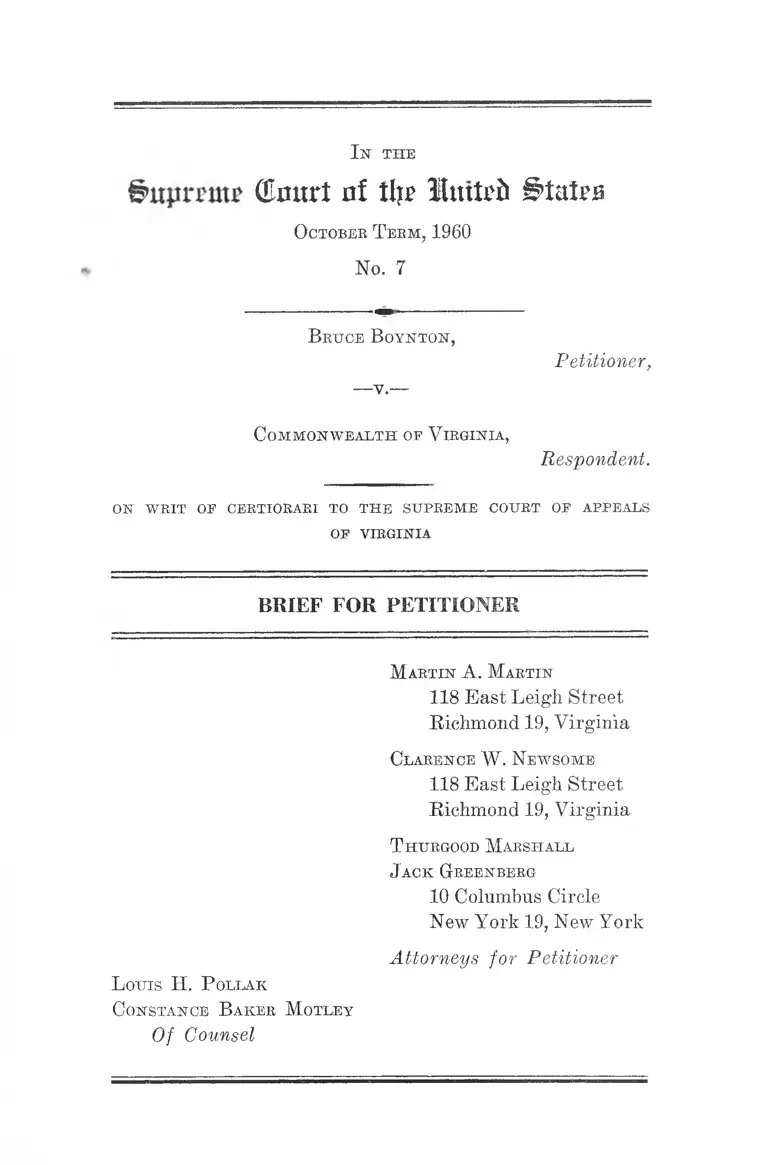
I n the
(Eourt nf tl|p luttTfc S ta irs
October T erm, 1960
No. 7
Bruce Boynton,
Petitioner,
—v.—
Commonwealth op Virginia,
Respondent.
ON WRIT OP CERTIORARI TO THE SUPREME COURT OP APPEALS
OP VIRGINIA
BRIEF FOR PETITIONER
Martin A. Martin
118 East Leigh Street
Richmond 19, Virginia
Clarence W. Newsome
118 East Leigh Street
Richmond 19, Virginia
T hurgood Marshall
J ack Greenberg
10 Columbus Circle
New York 19, New York
Attorneys for Petitioner
Louis H. P ollak
Constance B aker Motley
Of Counsel
TABLE OF CONTENTS
PAGE
Opinions Below ......-.................................................. 1
Jurisdiction ............................................................... - 1
Questions Presented ......... ........................................ 2
Constitutional and Statutory Provisions Involved .... 2
Statement ...................................................... —.......... 3
Summary of Argument........ ...................................... 5
Argument ................................................— ........ 6
Introductory ............................................. -......... 6
The statute involved .................................- .... 6
Issues presented by the statute as applied .... 8
I. The decisions below conflict with principles estab
lished by decisions of this Court by denying peti
tioner, a Negro, a meal in the course of a regu
larly scheduled stop at the restaurant terminal
of an interstate motor carrier and by convicting
him of trespass for seeking nonsegregated dining
facilities within the terminal .................... .... ..... 14
II. Petitioner’s criminal conviction which served
only to enforce the racial regulation of the bus
terminal restaurant conflicts with principles
established by decisions of this Court, and there
by violates the Fourteenth Amendment ............ 22
Conclusion ............................................ -.................. - 26
ii
T able oe Cases
page
Barrows v. Jackson, 346 U.S. 249 .............................. 11
Bibb v. Navajo Freight Lines, 359 U.S. 520 .... ......... 15
Bob~Lo Excursion Co. v. Michigan, 333 U.S. 28 ...... 21
Bolling v. Sharpe, 347 U.S. 497 ................................ 21
Boman v. Birmingham Transit Co., No. 18187, July
12, 1960, Fifth Circuit ......................................... 12,18, 24
Boykin v. State, 40 Fla. 484, 24 So. 141 (1898) .......... 8
Breard v. Alexandria, 341 U.S. 622 .......................... 10, 25
Chance v. Lambeth, 186 F.2d 879 (4th Cir. 1951),
cert, den., 341 U.S. 941 ....... ............... ................ . 12,17
Commonwealth v. Israel, 31 Va. (4 Leigh) 675 (Va.
Gen. Ct., 1833) ...... ................................................... 7
Commonwealth v. Richardson, 313 Mass. 632, 48 N.E.
2d 678 (1943) ........................................................... 8
Re Debs, 158 U.S. 564 ................................................ 16
Dye v. Commonwealth, 48 Va. (7 Grat.) 662 (Va.
Gen. Ct., 1851) .......................................................... 7
Falkingham v. Fregon, 25 V.L.R. 211, 21 A.L.T. 123
(1899) ...... 9
Freeman v. Retail Clerks Union, Washington Su
perior Court, 45 Lab. Rel. Ref. Man. 2334 (1959) .... 12
Greenaway v. Hunt and Weggery [1922] N.Z.L.R.
53 [1921], G.L.R. 673 .............................................. 9
Gripps v. Gripps, 20 Tas. L.R. 47 (1924) .................. . 9
Hall v. Commonwealth, 188 Va. 72, 49 S.E.2d 369
(1948), app. dism. 335 U.S. 875 ............................ 6
Hall v. DeCuir, 95 U.S. 485 ......................................... 16
Henderson v. Commonwealth, 49 Va. (8 Grat.) 708
(Va. Gen. Ct., 1852) ................................................ 7
Ill
PAGE
Henderson v. United States, 339 U.S. 816 - ............15,19, 20
James v. Butler, 25 N.Z.L.R.C.A. 653 (1906) .......... 9
Jones v. United States,-----U.S.------ (1960) .......... 13
Keys v. Carolina Coacli Co., 64 M.C.C. 769 (1955) .... 20
Kirsehenbaum v. Walling, 316 U.S. 517..................... 16
Marsh v. Alabama, 326 U.S. 501............................10,12, 24
Martin v. Struthers, 319 U.S. 141.............................. 10
Maryland v. Williams, 44 Lab. Eel. Kef. Man. 2357
(1959) .............. .......-..................-......-...... ....-......... 11
Miller v. Harless, 153 Va. 228, 149 S.E. 619 (1929) .... 7
Mitchell v. United States, 313 U.S. 8 0 .............. 19
Morgan v. Virginia, 328 U.S. 373 ............... 14,15,19, 20, 21
Murphey v. State, 115 Ga. 201, 41 S.E. 685 (1902) .... 8
Myers v. State, 190 Ind. 269, 130 N.E. 116 (1921) ..... 8, 9
N.L.R.B. v. American Pearl Button Co., 149 F.2d
258 (8th Cir. 1945) ....... .................... -.................... H
N.L.R.B. v. Fansteel Metal Corp., 306 U.S. 240 (1948) 12, 25
N.Y. N.H. & H. R. Co. v. Nothnagle, 346 U.S. 128...... 16
People v. Barisi, 193 Mise. 934, 86 N.Y.S.2d 277
(1948) .........................-........... • ...............-.......... 12
People v. Miller, 344 111. App. 574, 101 N.E.2d 874
(1951) ...... ............. .............. .......... -........................ 9
People v. Stevens, 109 N.Y. 159, 16 N.E. 53 (1888) .... 8
R. v. Blake, et al., 3 Burr. 1731, 47 E.R. 1070 (1765) 9
R. v. Phiri (4) S.A. 708 (T) (1954) ........................... 9
R. v. Storr, 3 Burr. 1698, 97 E.R. 1053 (1765) .......... 7, 9
R. v. Wilson, 8 Term Rep. 357, 101 E.R. 1432 (King
ston Assizes, 1799) .................................................. 9
Republic Aviation, Inc. v. N.L.R.B., 324 U.S. 793 ..... 11, 25
IV
PAGE
Rex v. Storr, 3 Burr. R. 1698 ..................................... 7
Rice v. Santa Fe Elevator Corp., 331 TJ.S. 218 ...... 16
Ryan v. Stanford, 15 N.Z.L.R.C.A. 390 (1897) ........ 9
Secretary of Agriculture v. Central Roig Refining
Co., 338 U.S. 604 ..................................................... 21
Shelley v. Kraemer, 334 U.S. 1 .................................. 11, 22
Southern Pacific Co. v. Arizona, 325 U.S. 761.......... 14,19
Sprout v. South Bend, 277 U.S. 163............................ 16
Stafford v. Wallace, 258 U.S. 495 .............................. 15
State v. Clyburn, 247 N.C. 455, 101 S.E.2d 295 (1958) 9
State v. Cockfield, 15 Rich. (49 S.C.L.) 53 (1867) ..... 9
State v. Larason, 72 Ohio L. Abs. 211, 143 N.E.2d 502
(1956) ...................................................................... 9
United States v. Yellow Cab Co., 332 U.S. 218, 228 16
United Steelworkers v. N.L.R.B., 243 F.2d 593 (D.C.
Cir. 1956) (reversed on other grounds) 357 U.S.
357 ........................................................................... 11,25
Whiteside v. Southern Bus Lines, 177 F.2d 949 (6th
Cir. 1949) ................................................................ 12,17
Wiggins v. State, 119 Ga. 216, 46 S.E. 86 (1903) ...... 8
Williams v. Howard Johnson Restaurant, 268 F.2d
845 (4th Cir., 1959) ............................................ 23
Wise v. Commonwealth, 98 Va. 837, 36 S.E. 479
(1900) ...................................................................... 7
United States Statutes and Constitutional P kovisions
United States Constitution, Article I, Sec. 8, cl. 3 ..... 2, 8,
12,13
United States Constitution, Fourteenth Amendment 2
28 U.S.C. Sec. 1257(3) ................................................ 2
V
PAGE
49 U.S.C. See. 3(1) ...................................................... 19
49 U.S.C. See. 303(19) ................................................ 20
49 U.S.C. Sec. 316(d) ......... ...................................... 5,19
State Statutes
Alabama Code 1940, Title 14, See. 426 ..................... 9
Alaska Laws Annot., 1958, Sec. 65-5-112................... 9
Arkansas Rev. Stats., 1959, Secs. 71-1801, 1802, 1803 9
California, West’s Code Annot., 1958, Tit. 14, Sec. 602 8
Connecticut, Gen. Stats. Rev., 1958, Sec. 53-103 ........ 9
Delaware Code Annot., 1953, Tit. 11, Sec. 871.......... 9
District of Columbia Code Annot., 1956, Sec. 22-3102 9
Florida, West’s Stats. Annot., 1948, Tit. 44, See.
821.01 .......................... ....................................'......... 8
Georgia Annot. Code, 1959, Sec. 26-3002 ................... 8
Hawaii Rev. Laws, 1955, Sec. 312-1................ 9
Illinois Rev. Stats., 1959, Tit. 38, Sec. 565 ................. 8
Indiana, Burns Stats. Annot., 1956, Tit. 10, Sec. 4506 8
Kentucky Rev. Stats., 1959, Sec. 433-380 ................. 8
Maine Rev. Stats., 1959, c. 131, Sec. 39....................... 8
Maryland Annot. Code, 1957, Art. 27, Sec. 577 .......... 8
Massachusetts, Michie’s Annot. Laws, C. 266, Sec. 120 8
Michigan Stats. Annot., 1954, Sec. 28-820(1) .......... 9
Minnesota Stats. Annot., 1947, Sec. 621.57 ............... 9
Mississippi Annot. Code, 1942, Tit. 11, Sec. 2411...... 8
VI
PAGE
Nebraska Rev. Stats., 1957, Tit. 28, Sec. 589 .............. 8
Nevada Rev. Stats., 1957, Sec. 207.200 ...................... 9
New Hampshire Rev. Stats. Annot., 1955, Sec. 572:50 9
New Jersey Annot. Stats., 1957, Tit. 2A, Sec. 170-31 8
New York, McKinney Laws, Art. 182, Sec. 2036 ....... 8
North Carolina Gen. Stats., Tit. 14, Sec. 134.............. 9
Ohio, Page’s Rev. Code Annot., Sec. 2902.21 .............. 8
Oklahoma, West’s Stats. Annot., 1958, Tit. 21, Sec.
1353 .................... ..................................................... 8
Oregon Rev. Stats., Sec. 164.460 ................................ 9
South Carolina Code of Laws, 1959, See. 16-386 ...... 9
Virginia Code Sec. 18-225 ............................. ..... ......1, 2,4, 8
Washington Rev. Code, 1957, Sec. 8.83.060 ............... 9
West Virginia Code, 1955, Sec. 5974 .......................... 8
Wyoming, Michie’s Stats. Annot,, 1957, Sec. 6-226 .... 9
Statutes oe Commonwealth Countries
Natives (Urban Areas) Consolidation Act of 1945,
Sec. 9, para. 9, as provided by Sec. 29, para, e of
Native Laws Amendment Act No. 36 of 1957
(South Africa) ........................................................ 9
New Zealand, Police Offences Amendment Act (No.
2) No. 43 of 1952, Sec. 3 ........................................... 9
Prevention of Illegal Squatting Act, No. 52 of 1951,
Sec. 1 (South Africa) ............................................ 9
72 South Af. L.J. 125 (1955)....................................... 9
V ll
PAGE
Tasmania, Trespass to Lands Act, 1862 — ............... 9
Victoria, Australia, Police Offences Act, No. 6337 of
1958, Sec. 20 ...................... 9
Otheb A uthorities
63 C.J.S. 1075 ............................................................ 7
72 South Af. L.J. 125 (1955) ................................... 9
H.B. 1112, Act No. 497, 1960 General Assembly of
Georgia .................................................................... 8
Hitchcock’s Mass Transportation Directory (1959-60
ed.) 205, 242 ............................................................. 22
Op. Atty. Gen. of Florida 649, 1953-54 ..................... 8
I n the
Cfkmrt nt tip IniPit States
October T erm, 1960
No. 7
Bruce B oynton,
Petitioner,
—y.—
Commonwealth of Virginia,
Respondent.
on writ of certiorari to the supreme court of appeals
OF VIRGINIA
BRIEF FOR PETITIONER
Opinions Below
No opinion was rendered in this case by the Supreme
Court of Appeals of Virginia when it denied the petitioner
a writ of error to the judgment of the Hustings Court of the
City of Richmond on the 19th day of June, 1959. No opinion
was rendered by the Hustings Court of the City of Rich
mond on the 20th day of February, 1959, when it found
petitioner guilty of a violation of §18-225 of the Code of
Virginia, 1950, as amended.
Jurisdiction
The judgment of the Supreme Court of Appeals of
Virginia was rendered on the 19th day of June, 1959 and
2
stay of execution and enforcement of the judgment of said
Court was granted on the 24th day of July, 1959 staying
the execution and enforcement of same until the 17th day of
September, 1959, unless the case would before that time be
docketed in this Court in which event enforcement of said
judgment should be stayed until the final determination of
this case by this Court. On February 23, 1960, this Court
granted a petition for writ of certiorari from the Supreme
Court of Appeals of the Commonwealth of Virginia. The
jurisdiction of this Court rests on 28 U.S.C. §1257(3).
Questions Presented
1.
Whether the criminal conviction of plaintiff, an inter
state traveler, for refusing to leave an interstate bus ter
minal restaurant where he sought refreshment at a regu
larly scheduled stop in the course of his interstate journey
and was barred solely because of his race, is invalid as a
burden on interestate commerce in violation of Article I,
§8, Clause 3 of the United States Constitution.
2 .
Whether said conviction violates the due process and
equal protection clauses of the 14th Amendment to the Con
stitution of the United States.
Constitutional and Statutory Provisions Involved
This case involves:
Article I, §8, and the due process and equal protection
clauses of the XIV Amendment of the Constitution of the
United States.
§18-225 of the Code of Virginia of 1950. This statutory
provision is set forth in the Statement, infra, p. 4.
3
Statement
At 10:40 P. M. on December 20th, 1958, Bruce Boynton,
petitioner, stepped off a Trailways bus from Washington,
D. C., at the Trailways Bus Terminal in Richmond, Va., for
a forty minute layover. Petitioner, a Negro student at the
Howard University School of Law in Washington, was hun
gry and anxious to get something to eat before reboarding
the bus to continue on to his home in Selma, Alabama, by
way of Montgomery (R. 27-28).
He first looked into a small restaurant and noticed that
it was crowded with colored patrons. Since his time was
limited, he went on to another restaurant within the ter
minal, which was practically empty, adjacent to the 'wait
ing room (R. 28). He entered and sat on a vacant stool
at the counter. A white waitress immediately approached
and informed him that she had orders not to serve people of
his race. She advised him to use the colored facilities.
Petitioner explained that he would like to be served before
his bus, which was scheduled to leave shortly, departed. To
insure quick service he ordered a prepared sandwich and a
cup of tea. But the waitress disregarded his order, de
parted for a while and returned to repeat that it was cus
tomary not to serve Negroes in that particular restaurant
(R. 29).
Petitioner asked to speak to someone who could wait on
him, pointing out that he was an interstate passenger with
a cross-country ticket purchased in Washington, D. C. (R.
29). At this point the assistant manager intervened “to
explain to him the situation” (R. 21) and to demand that
petitioner leave. Petitioner refused to move. The assistant
manager’s response was to have petitioner arrested (R. 21,
29). Petitioner’s baggage was removed from the bus on
which he had expected to continue his journey, and peti-
4
tioner himself was taken away in a patrol wagon, charged
with a violation of §18-225 of the Code of Virginia of 1950
as amended, which provides:
“If any person shall without authority of law go
upon or remain upon the lands or premises of another
after having been forbidden to do so by the owners,
lessee, custodian or other person lawfully in charge
of such land, or after having been forbidden to do so
by sign, or signs posted on the premises at a place
or places where they may be reasonably seen, he shall
be deemed guilty of a misdemeanor, and upon convic
tion thereof shall be punished by a fine of not more
than $100.00 or by confinement in jail not exceeding
thirty days, or by both such fine and imprisonment.”
The bus terminal was owned and operated by Trailways
Bus Terminal, Inc. (R. 9-17). The restaurants therein were
built into the terminal upon its construction and leased
by Trailways to Bus Terminal Restaurant of Richmond,
Inc. (R. 9-17). The lease gave exclusive authority to the
lessee to operate restaurants in the terminal, required that
they be conducted in a sanitary manner, that sufficient food
and personnel be provided to take care of the patrons, that
prices be just and reasonable, that equipment be installed
and maintained to meet the approval of Trailways, that
lessee’s employees be neat and clean and furnish service
in keeping with service furnished in an up-to-date, modern
bus terminal; prohibited the sale of alcoholic beverages on
the premises; and permitted cancellation of the lease upon
the violation of any of its conditions (R. 9-17).
Petitioner was convicted in the Police Court of the City
of Richmond and fined $10.00, which conviction was ap
pealed to the Hustings Court of the City of Richmond
5
which affirmed (E. 31).1 Petition for writ of error to the
Supreme Court of Appeals was rejected, the effect of which
was to affirm the judgment of the Hustings Court (E. 32).
The affirmance by the Supreme Court of Appeals of Vir
ginia, appears in the Eecord at p. 32. In the Elustings Court
of the City of Eichmond petitioner objected to the criminal
prosecution on the grounds that it contravened his rights
under the Commerce Clause of the United States Constitu
tion (Article 1, Section 8) and the Interstate Commerce Act
(Title 49 U.S.C., Section 316(d)) and that he was thereby
denied due process and equal protection of the laws secured
by the Fourteenth Amendment to the United States Con
stitution (E. 6-7). Said objections were renewed by notice of
appeal and assignment of error to the Supreme Court of
Appeals of Virginia (E. 5). These defenses, however, as
aforesaid, were rejected at all stages of the litigation with
out opinion. On February 23, 1960 this Court granted
petitioner’s petition for writ of certiorari to the Supreme
Court of Appeals of Virginia.
Summary of Argument
The arrest and conviction of petitioner burdened inter
state commerce. That the terminal in question is stationary
does not exempt the burden there effected from the gen
eral rule. Even if petitioner’s arrest and conviction for
insisting upon nonsegregated dining service might some
how be viewed as “private action,” the Commerce Clause
also forbids privately imposed burdens on interstate com-
1 Petitioner, at the time of arrest, was a law student at Howard Uni
versity. Since then he has been graduated, and on February 16, 1960, took
the Alabama bar examination. While others wdio took the examination with
him already have been admitted to the bar, petitioner’s status has not yet
been declared. He is under an investigation, he has been informed, which
concerns this conviction.
6
merce. But the arrest and conviction here supply requisite
state action should that be required. Congress has ex
pressed no specific intent concerning an arrest and con
viction like petitioner’s, but should congressional intent
be found in the Motor Carriers Act, that Act, read in a
context of relevant constitutional law, indicates intent that
this burden not be permitted.
Judicial enforcement of private racial discrimination
violates the 14th Amendment. This has been made clear,
among other places, in cases of arrest for exercise of con
stitutional rights in public places although possessory in
terest to these places actually may lie with private indi
viduals, or corporations. Petitioner’s conviction is not a
reasonable exercise of police power necessary to maintain
law and order. In fact, petitioner’s act would not have been
criminal at common law, in almost all of the other states of
the Union, in England, or in the Commonwealth countries,
except South Africa where similar law is directed solely at
Natives.
Argument
Introductory
The statute involved
Virginia’s police, in the circumstances related above, by
application of a trespass statute, have halted petitioner’s
interstate journey, forced him to disembark and remove his
baggage from the interstate bus which carried him from
Washington, D. C. en route to his home in Alabama, and
have brought him before the Virginia courts which have
adjudged him guilty of crime. The statute is set forth
supra, p. 4.
This statute apparently has been interpreted by the
Virginia courts but once. Hall v. Commonwealth, 188 Va.
7
72, 49 S.E. 2d 369 (1948), app. dism. 335 U.S. 875, upheld
its applicability to Jehovah’s Witnesses who persisted in go
ing past the receptionist of a private apartment house into
its corridors to solicit tenants, contrary to regulations, con
curred in by tenants and management, which required in
vitation of a tenant for permission to enter the hallways.
The Supreme Court of Virginia, holding the regulation
“valid and reasonable,” 188 Va. at 90, 49 S,E.2d at 378,
ruled that state and federal constitutional rights of free
speech, press, and assembly had not been denied.
There are other Virginia trespass cases, involving similar,
earlier statutory law, and statements of the common law of
Virginia, which help further place this statute in a con
text of the State’s law. The general rule seems to be, as at
English common law, that an intrusion made under claim
of right, which may give rise to civil suit, is not a misde
meanor. Wise v. Commonwealth, 98 Va. 837, 36 S.E. 479
(1900); Dye v. Commonwealth, 48 Va. (7 Grat.) 662 (Va.
Gen. Ct., 1851); and that before criminal liability attaches
there must be a breach of the peace, Henderson v. Common
wealth, 49 Va. (8 Grat.) 708 (Va. Gen. Ct., 1852) ;2 Com
monwealth v. Israel, 31 Va. (4 Leigh) 675 (Va. Gen. Ct.,
1833); Miller v. Harless, 153 Va. 228, 149 S. E. 619 (1929).3
2 See Henderson v. Commonwealth, 49 Va. (8 Grat.) 708, 710 (Va. Gen.
Ct., 1852) : “I t is abundantly clear that the mere breaking and entering the
close of another, though in contemplation of law a trespass committed vi et
armis, is only a civil injury to be redressed by action; and cannot be treated as
a misdemeanor to be vindicated by indictment or public prosecution. But when
it is attended by circumstances constituting a breach of the peace, such as
entering the dwelling house with offensive weapons, in a manner to cause
terror and alarm to the family and inmates of the house, the trespass is
heightened into a public offense, and becomes the subject of a criminal prose
cution.” Citing Hex v. Storr, 3 Burr. 1698. See statement of the general
rule in 63 C.J.S. 1075, to the same effect.
3 In many states there apparently are no statutes under which Boynton
would have been convicted for trespass: See Arizona, Colorado, Idaho, Iowa,
Kansas, Louisiana, Missouri, Montana, New Mexico, North Dakota, Pennsyl-
8
But, as indicated above, such holdings have not been em
ployed by Virginia in its sole interpretation of §18-225.
Issues Presented by the Statute as Applied
Petitioner raises two principal constitutional defenses,
the Commerce Clause (Article I, §8, cl. 3), and the Equal
Protection and Due Process Clauses (Fourteenth Amend
ment), against the asserted power of Virginia to convict
him under this statute in the circumstances of his interstate
vania, Rhode Island, South Dakota, Tennessee, Texas, Utah, Vermont, and
Wisconsin. Cf. the following states where statutes probably would not be
applicable to Boynton’s acts: California, West’s Code Annot., 1955, Tit. 14,
Sec. 602, para. 1 (entering and occupying structures) ; Kentucky, Rev. Stats.,
1959, Sec. 433.380 (trespass hindering conduct of commerce) ; Maine, Rev.
Stats., 1959, c. 131, Sec. 39 (willful entry on land commercially used, but
referring to land without buildings); Maryland, Annot. Code, 1957, Art. 27,
Sec. 577 (wanton entry after warning involving high degree of criminal
in ten t); Mississippi, Annot. Code, 1942, Tit. 11, Sec. 2411 (remaining on
inclosed land of another after warning) ; Nebraska Rev. Stats., 1956, Tit. 28,
Sec. 589 (refusal to depart from enclosure after request) ; New Jersey, Annot.
Stats., 1951, Tit. 2A, Sec. 170-31 (trespass on lands; totally rural context);
Oklahoma, West’s Stats. Annot., 1958, Tit. 21, Sec. 1353 (intrusion on lot
or piece of land; not in sense of buildings) ; and West Virginia, Code, 1955,
See. 5974 (entry upon inclosed lands after being forbidden).
In other states where perhaps applicable trespass laws do exist, it is ques
tionable whether under existing interpretations he would have been convicted,
for clearly he was in the Trailways Terminal under a elaim of right, which
ordinarily exempts the intrusion from the category of criminal trespass. There
are no reported eases in these states which would differentiate between a claim
of constitutional or other federal right and one of traditional “property”
right. Such differentiation would, of course, raise constitutional questions of
equal protection. See Florida, West’s Stats. Annot., 1944, Tit. 44, Sec. 821.01
as interpreted in Boykin v. State, 40 Fla. 484, 24 So. 141 (1898) and 1953-54
Op. Atty. Gen. 649. In Georgia, until recently the law was stated by: Georgia,
Annot. Code, 1959, Sec. 26-3002 as interpreted in Murphey v. State, 115 Ga.
201, 41 S.E. 685 (1902) and Wiggins v. State, 119 Ga. 216, 46 S.E. 86 (1903);
this now has been superseded by H.B. 1112, Act No. 497, 1960 General As
sembly (trespass after refusal to leave) ; Indiana, Burns Stats. Annot., 1956,
Tit. 10, Sec. 4506 as interpreted in Myers v. State, 190 Ind. 269, 130 N.E.
116 (1921) ; Massachusetts, Michie’s Annot. Laws, C. 266, Sec. 120 as inter
preted in Commonwealth v. Richardson, 313 Mass. 632, 48 N.E.2d 678 (1943) ;
New York, McKinney Laws, Art. 182, Sec. 2036 as interpreted in People v.
Stevens, 109 N.Y. 159, 16 N.E. 53 (1888); Ohio, Page’s Rev. Code Annot.,
9
journey related above. This conflict manifests once more
the recurring theme which juxtaposes in the courts claims
of federally protected personal liberty against state en-
See. 2902.21 as interpreted in State v. Larason, 72 Ohio L. Abs. 211, 143
N.E.2d 502 (1956); and Wyoming, Michie’s Stats. Annot., 1957, Sec. 6-226
applying Indiana cases, see Myers v. State, supra, sinee derived from Indiana
statute.
Cf. Alabama, Code, 1940, Title 14, Sec. 426 and “legal eause or good excuse”
and Illinois Rev. Stats., 1959, Tit. 38, Sec. 565 as interpreted in People v.
Miller, 344 111. App. 574, 101 N.E.2d 874 (1951). In several states the prob
lem of the defense of claim of right has not received judicial consideration; as
to these states it may be argued that the common law defense of bona fide,
reasonable claim of right would be upheld if asserted. See Alaska, Laws
Annot., 1958, Sec. 65-5-112; Connecticut, Gen. Stats. Rev., 1958, See. 53-103;
District of Columbia, Code Annot., 1956, Sec. 22-3102; Hawaii, Rev. Laws,
1955, See. 312-1; Michigan, Stats. Annot., 1954, See. 28.820(1); Minnesota,
Stats. Annot., 1947, See. 621.57; Nevada, Rev. Stats., 1957, Sec. 207.200;
New Hampshire, Rev. Stats. Annot., 1955, Sec. 572:50; Oregon, Rev. Stats.,
Sec. 164.460; and Washington, Rev. Code, 1957, Sec. 9.83.060.
In the following states Boynton would probably have been found guilty:
Arkansas, Rev. Stats., 1959, Secs. 71-1801, 1802, 1803 (emergency acts designed
specifically to counteract sit-in situations) ; Delaware, Code Annot., 1953, Tit.
11, Sec. 871 (elaim of ownership only defense) ; North Carolina, Gen. Stats.,
Tit. 14, Sec. 134 as interpreted in State v. Clyburn, 247 N.C. 455, 101 S.E.2d
295 (1958); and South Carolina, Code of Laws, 1959, Sec. 16-386 (originally
directed at Negroes after Civil War, see State v. Cochfield, 15 Rich. (49
S.C.L.) 53 (1867)).
In England and the Common-wealth countries, Boynton’s deed would not
have been a crime; see cases requiring breach of peace or use of actual force
to make trespass indictable, B. v. Storr, 3 Burr. 1698, 97 E.R. 1053 (1765);
B. v. Blake et al., 3 Burr. 1731, 47 E.R. 1070 (1765) ; and B. v. Wilson, 8
Term Rep. 357, 101 E.R. 1432 (Kingston Assizes, 1799); except in South
Africa where the relevant statute specifically is directed at the Natives. See
Natives (Urban Areas) Consolidation Act of 1945, See. 9, para. 9, as pro
vided by Sec. 29, para, e of Native Laws Amendment Act, No. 36 of 1957.
Cf. also Prevention of Illegal Squatting Act, No. 52 of 1951, Sec. 1 with
interpretation thereof in B. v. Phiri (4) S.A. 708 (T) (1954) and commentary
thereon in 72 South Af. L.J. 125 (1955). The only other Commonwealth
countries in which Boynton might have been tried probably would have
acquitted him on the basis of his defense of entry under a bona fide claim
of right. See New Zealand, Police Offences Amendment Act (No. 2) No. 43
of 1952, Sec. 3 as interpreted in By an v. Stanford, 15 N.Z.L.R.C.A. 390 (1897),
James v. Butler, 25 N.Z.L.R.C.A. 653 (1906) and Greenaway v. Hunt and
Weggery [1922] N.Z.L.R. 53 [1921], G.L.R. 673; Victoria, Australia, Police
Offences Act, No. 6337 of 1958, Sec. 20 as interpreted in Falkingham v.
Fregon, 25 V.L.R. 211, 21 A.L.T. 123 (1899) ; and Tasmania, Trespass to
Lands Act, 1862, as interpreted in Gripps v. Gripps, 20 Tas. L.R. 47 (1924).
10
foreement of alleged private property right, by criminal
law or otherwise. Or, to rephrase the matter, the problem
is one of how far certain claimed private property rights
extend. Such controversy, in recent years, has arisen in
various forms.
Where Jehovah’s Witnesses were convicted of trespass
for having distributed literature on the premises of a
company-owned town contrary to the wishes of the town’s
management, Marsh v. Alabama, 326 U.S. 501, Mr. Justice
Black, for the Court, wrote that “ [t]he more an owner, for
his advantage, opens up his property for use by the public
in general, the more do his rights become circumscribed
by the statutory and constitutional right of those who use it.
. . . ” at p. 506 and “ [wjhen we balance the Constitutional
rights of owners of property against those of the people
to enjoy freedom of press and religion, as we must here, we
remain mindful of the fact that the latter occupy a pre
ferred position,” at p. 509. Conviction was reversed. In
Martin v. Struthers, 319 U.S. 141, this Court held uncon
stitutional an ordinance which made unlawful ringing
doorbells of residences for the purpose of distributing hand
bills, upon considering the free speech values involved—-
“ [d]oor to door distribution of circulars is essential to the
poorly financed causes of little people,” at p. 146—and that
the ordinance precluded individual private householders
from deciding whether they desired to receive the message.
But in effecting “an adjustment of constitutional rights in
the light of the particular living conditions of the time and
place”, Breard v. Alexandria, 341 U.S. 622, 626, the Court,
assessing a conviction for door-to-door commercial solicita
tion involving various popular magazines, contrary to a
“Green Biver” ordinance, concluded that the community
“speak[ing] for the citizens,” 341 U.S. 644, might convict
for crime in the nature of trespass. The decision turned
11
upon balance of the “conveniences between some house
holders’ desire for privacy and the publisher’s right to dis
tribute publications in the precise way that those soliciting
for him think brings the best results.” 341 U.S. at 644. Be
cause, among other things, “ [subscription may be made by
anyone interested in receiving the magazines without the
annoyances of house to house canvassing,” ibid., the judg
ment was affirmed.
The ordinarily unchallenged right of real property
owners to fasten covenants on their land has been circum
scribed to the extent that the Fourteenth Amendment pro
hibits enforcing of racial restrictive covenants by injunc
tion, Shelley v. Kraemer, 334 U.S. 1, or damages, Barroivs
v. Jackson, 346 U.S. 249.
A like collision between federal rights, this time conferred
by the National Labor Relations Act, and rights in real
property defined by state law, also has called for reconcilia
tion in this Court. Republic Aviation, Inc. v. N. L. R. R.,
324 U.S. 793, upheld the validity of National Labor Re
lations Board rulings that, lacking special circumstances
that might make such rules necessary, employer regulations
forbidding all union solicitation on company property re
gardless of whether the workers were on their own or com
pany time, constituted unfair labor practices. In assessing
the regulations, Justice Reed balanced the employer’s right
to maintain discipline wTith the employees’ right to organize;
no weight was given to the employer’s property right, men
tioned solely at 324 U.S. 802, note 8.4 Similarly a Baltimore
City Court, State of Maryland v. Williams, 44 Lab. Rel. Ref.
4 See also N.L.B.B. v. American Pearl Button Co., 149 F.2d 258 (8th
Cir., 1945) ; United Steelworkers v. N.L.B.B., 243 F.2d 593, 598 (D.C. Cir.,
1956) (reversed on other grounds) 357 U.S. 357. (“Our attention has not
been called to any case under the Wagner Act or its successor in which it
has been held that an employer can prohibit either solicitation or distribution
of literature by employees simply because the premises are company property.
12
Man. 2357, 2361 (1959) has on Fourteenth Amendment and
Labor Management Relations Act grounds, decided that
pickets may patrol property within a privately owned shop
ping center.5
The Commerce Clause too has been interposed by the
courts between private proprietors of interstate carriers
and passengers who resisted racial segregation on those
carriers by rule of the management. Whiteside v. Southern
Bus Lines, 177 F.2d 949 (6th Cir., 1949); Chance v. Lam
beth, 186 F.2d 879 (4th Cir., 1951), cert, den., 341 U.S.
941. And the Fourteenth Amendment forbids police to ar
rest those who violate an intrastate carrier’s private racial
seating regulation, where to violate management’s seating
rule is a crime. The statute did not mention race. Boman
v. Birmingham Transit Co., No. 18187, July 12, 1960, Fifth
Circuit.
In such eases the approach of the courts has been infused
with an awareness, as Mr. Justice Frankfurter wrote, con
curring in Marsh v. Alabama, 326 U.S. 501, 510, that “when
decisions by State courts involving local matters are so
interwoven with the decision of the question of Constitu
tional rights that the one necessarily involves the other,
Employees are lawfully within the plant, and nonworking time is their own
time. I f Section 7 activities are to be prohibited, something more than mere
ownership and control must be shown.”)
Compare N.L.B.B. v. Fansteel Metal Corp., 306 U.S. 240, 252 (employees
seized plant; discharge held valid: “high-handed proceeding without shadow
of legal right”) .
5 See also People v. Barisi, 193 Misc. 934, 86 N.Y.S.2d 277, 279 (1948)
(picketing within Pennsylvania Station not trespass; owners have opened it
to public and their property rights are 'circumscribed, by the constitutional
rights of those who use it.’ ”) ; Freeman v. Retail Clerics Union, Washington
Superior Court, 45 Lab. Eel. Eef. Man. 2334 (1959) (shopping center owner
denied relief against picketers on his property; relying on Fourteenth Amend
ment).
13
State determination of local questions cannot control the
Federal Constitutional right.” 6
Therefore, here, the essential right of the management of
the Trailways Terminal restaurant to enforce segregation
of interstate passengers by means of the full force of the
Commonwealth of Virginia, asserted through its police and
courts, must be weighed against the claim of petitioner, an
interstate traveler, to freedom of movement without being
hobbled by racial distinction in the course of an interstate
journey (Article 1, §8), and his further claim to be free of
arrest and conviction in the Virginia courts in the enforce
ment of such racial rules (Fourteenth Amendment). Peti
tioner submits that under our Constitution this conflict can
be resolved only in the interest of freedom of movement
among the states and freedom from criminal conviction
in the state courts to enforce racial discrimination.
6 For a related conclusion in a different constitutional context see, Jones
v. United States, U.S. ------, ------ (1960) (“ . . . it is unnecessary and
ill-advised to impart into the law surrounding the constitutional right to be
free from unreasonable searches and seizures subtle distinctions, developed
and refined by the common law in evolving the body of private property law
which, more than almost any other branch of law, has been shaped by dis
tinctions whose validity is largely historical. . . . Distinctions such as those
between ‘lessee,’ ‘licensee,’ ‘invitee’ and ‘guest,’ often only of gossamer strength,
ought not to be determinative in fashioning procedures ultimately referable
to constitutional safeguards.” 4 D.ed.2d 697 at 705.
14
I.
The decisions below conflict with principles estab
lished by decisions of this Court by denying petitioner,
a Negro, a meal in the course of a regularly scheduled
stop at the restaurant terminal of an interstate motor
carrier and by convicting him of trespass for seeking
nonsegregated dining facilities within the terminal.
In this context we approach petitioner’s first contention
that his arrest and conviction disrupted his interstate jour
ney in a manner violative of Article I, §8, cl. 3:
[“E]ver since Gibbons v. Ogden, 9 Wheat. (US) 1, 6
L.ed. 23, the states have not been deemed to have au
thority to impede substantially the free flow of com
merce from state to state, or to regulate those phases
of the national commerce which, because of the need
of national uniformity, demand that their regulation,
if any, be prescribed by a single authority . . . ”
wrote Chief Justice Stone in Southern Pacific Co. v.
Arizona, 325 U.S. 761, 767.
In that case the Arizona Train Limit Law, which limited
the size of trains to fourteen passenger or seventy freight
ears was held violative of the Commerce Clause. The law
required that interstate rail transport be disrupted in
Arizona to adjust the length of trains to that state’s de
mand. The “state interest [was] outweighed by the in
terest of the nation in an adequate economical and efficient
railway transportation service, which must prevail.” 325
U.S. at 783-84. Of a piece with the Southern Pacific de
cision, and more intimately related to the suit at bar, was
Morgan v. Virginia, 328 U.S. 373, which held unconstitu
tional, under the Commerce Clause, Virginia’s segregated
seating statute as applied to an interstate bus passenger.
15
“On such interstate journeys, the enforcement of the re
quirements for reseating would be disturbing.” 328 U.S.
at 381. “ . . . [S]eating arrangements for the different
races in interstate motor travel require a single, uniform
rule to promote and protect national travel.” Id. at 386.
And the disturbing effect of segregated seating in dining
service was recognized by this Court in Henderson v. United
States, 339 U.S. 816, 825, which, while dealing with the
Interstate Commerce Act, condemned racial segregation in
railroad dining cars as “emphasiz[ing] the artificiality of
the difference in treatment which serves only to call at
tention to a racial classification of passengers holding
identical tickets and using the same public dining facility.”
Only last year, the vigor of the Morgan and Southern
Pacific cases was reaffirmed in Bibb v. Navajo Freight
Lines, 359 U.S. 520, which cited both with approval at pp.
526 and 528, and concluded that Illinois’s mud-flap regula
tion was a burden on interstate commerce: “state regula
tions that run afoul of the policy of free trade reflected in
the Commerce Clause must . . . bow.” 359 U.S. at 529.
The Richmond Trailways Terminal is, of course, itself,
a stationary accommodation. But clearly it is now settled
that a facility need not be in motion to come under the
Commerce Clause. An interstate bus terminal restaurant,
built as an integral part of the terminal structure, is as
much a part of interstate commerce, as, for example, a stock-
yard for the care and feeding of cattle during a pause in
their interstate movement. See Stafford v. Wallace, 258
U.S. 495, 519, in which Chief Justice Taft wrote that
“this court declined to defeat this purpose [of the Com
merce Clause] in respect of such a stream, and take it
out of complete national regulation by a nice and
technical inquiry into the non-interstate character of
some of its necessary incidents and facilities when
16
considered alone and without reference to their associa
tion with the movement of which they were an essen
tial but subordinate part.”
Indeed, Hall v. DeCuir, 95 U.S. 485, struck down a stat
ute forbidding racial distinctions on a steamboat even
though the situation at bar involved an intrastate trip.
The law, it was held, interfered with interstate voyages.
Pursuant to this view the Court has held that “ . . .
warehouses engaged in the storage of grain for interstate
or foreign commerce are in the federal domain . . . ,”
Rice v. Santa Fe Elevator Corp., 331 U.S. 218, 229; and
that a transaction with a redcap during a stop at a railroad
station is within the same jurisdiction, N.Y. N.H. & H. R.
Co. v. Nothnagle, 346 U.S. 128, 130.7 Petitioner submits,
therefore, that in determining the standards which the ter
minal and the restaurant, which was an integral part of it,
must meet under the Commerce Clause, the same rules must
apply, for purposes of this case, as would be applied to a
moving bus.
It has been argued that the Commerce Clause does not
reach rules of carriers which have no origin in state law.
A like argument was made in Re Debs, 158 U.S. 564, 581.
To this, the opinion of the Court replied:
“It is curious to note the fact that in a large propor
tion of the cases in respect to interstate commerce
brought to this court the question presented was of
the validity of state legislation in its bearings upon
interstate commerce, and the uniform course of decision
7 See also United States v. Yellow Cab Co., 332 U.S. 218, 228. Sprout v.
South Bend, 277 U.S. 163, 168. And see also Kirschenbaum v. Walling, 316
U.S. 517 (commerce power, expressed in the Fair Labor Standards Act, as
interpreted in that case, reached employees of a loft building whose tenants
were principally engaged in interstate commerce). All of these are oases
which hold that the commerce power extends sufficiently far to uphold federal
regulation of activities, which themselves, actually do not move among the
States.
17
has been to declare that it is not within the competency
of a state to legislate in such a manner as to obstruct
interstate commerce. If a state with its recognized
powers of sovereignty is impotent to obstruct inter
state commerce, can it be that any mere voluntary as
sociation of individuals within the limits of that state
has a power which the state itself does not possess!”
Here, however, we have, in addition, police arrest and
•court conviction. Concerning such circumstances, in a
background of racial discrimination in interstate travel,
two Courts of Appeals have held the racial restriction un
constitutional. The Fourth Circuit has written:
“Under the company’s regulations, the three coaches first
in line were designed for Negro passengers and the
next two for white passengers . . . ” (Emphasis sup
plied. )
“At Richmond, the trainmen segregated the passengers
. . . The regulations of the company upon which the
decision of the case turns were issued to the train
men . . . ” (Emphasis supplied.)
“It is true that the regulation of the carrier was not
enacted by state authority, although the power of the
state is customarily involved to enforce it, but we
know of no principle of law which requires the courts
to strike down a state statute which interferes with in
terstate commerce but to uphold a railroad regulation
which is infected with the same vice.”
Chance v. Lambeth, 186 F.2d 879, 880, 883 (4th Cir., 1951),
cert, denied 341 U.S. 941, Parker, Soper, Dobie, JJ.
And, in Whiteside v. Southern Bus Lines, 177 F.2d 949,
953 (6th Cir., 1949), the Sixth Circuit held, per Hicks,
Simons and McAllister, JJ., that
18
“appellant here boarded an interstate conveyance in Il
linois which has neither statute, decision or custom
sanctioning or requiring segregation based upon race
or color. The requirement [of the carrier] that she
change her seat with all her accompanying impedi
menta the moment she crossed the Kentucky line, was
a breach of the uniformity which under the Morgan
case, is a test of the burden placed upon interstate
commerce.
“It must also be observed that acts burdening inter
state commerce are not, like those inhibited in the
Fourteenth Amendment, limited to state action. Bur
dens may result from the activities of private persons
as the great mass of federal criminal legislation vali
dated under the authority of the Commerce Clause,
discloses. But, if state action is a prerequisite to
the invalidity of the regulation here considered as it
was applied to the appellant, state action is clearly
to be perceived in the ejection of the appellant by a
state police officer.” 8
Here we have similar elements which compel a con
clusion that halting Boynton’s journey violated the Com
merce Clause: A racial impediment to reasonably secur-
8 To the extent that requisite state involvement is supplied by police
enforcement of an intrastate carrier segregation regulation, the F ifth Circuit,
in passing on a Fourteenth Amendment contention recently has arrived at a
similar result. Boman v. Birmingham Transit Co., No. 18187, July 12, 1960,
F ifth Circuit, Tuttle and Wisdom, JJ. (Cameron, J., dissenting), held that “so
long as such an ordinance [committing seating arrangements to the driver]
was in force, the acts of the Bus Company in requiring racially segregated
seating were state acts and were thus violative of the appellant’s constitutional
rights. . . . ” (Emphasis supplied.)
“Of course, the simple company rule that Negro passengers must sit in back
and white passengers must sit in front, while an unnecessary affront to a large
group of its patrons would not effect a denial of [Fourteenth Amendment]
constitutional rights if not enforced by force or by threat of arrest and
criminal action.”
19
ing meal service in the manner of white passengers in the
course of an interstate journey, in an interstate terminal
restaurant constructed and maintained for the purpose
of facilitating interstate commerce; an interruption of the
interstate journey, complete and decisive; and, should state
involvement be required for application of the Commerce
Clause, invocation of state statute to enforce the racial
rule and the full intervention of Virginia police and courts
to uphold it.
In Southern Pacific v. Arizona, 325 U.S. 761, 768, Chief
Justice Stone, writing of the limitations which the Com
merce Clause places upon activities which burden inter
state commerce, stated—“fwjhether or not this long recog
nized distribution of powers between the national and the
state governments is predicated upon the implication of
the commerce clause itself [citations omitted]; or upon the
presumed intention of Congress, where Congress has not
spoken [citations omitted], the result is the same.”
Congress certainly has not spoken explicitly on the ques
tion of whether racial segregation in an interstate bus ter
minal, enforced by state arrest and conviction in the courts,
burdens interstate commerce. Morgan v. Virginia, supra,
has held that Congress has not spoken on the closely re
lated issue of racial segregation on interstate buses, 328
U.S. 373, at p. 386 (“ . . . there is no federal act dealing
with the separation of races in interstate transportation.
. . .). While certain provisions of the Motor Carriers Act
(49 U.S.C. §316(d)) are analogous to the Interstate Com
merce Act provision (49 U.S.C. §3(1)) by which this Court
struck down dining car, Henderson v. United States, 339
U.S. 816 and Pullman car segregation, Mitchell v. United
States, 313 U.S. 80, Morgan may be taken as a determina
tion that congressional intent on the precise question of
race discrimination in interstate bus travel is at least not
20
sufficiently express to conclude this case by itself. As in
Morgan, this Court here, petitioner submits, should strike
down the burden on commerce in the absence of contrary
indications of intent from Congress.
The Court, however, by letter to counsel for Respondent
has inquired concerning “the intercorporate relationship
between the Trailways Bus Company and the Trailways
Bus Terminal, Inc., set forth in any documents of which
the Virginia courts can take judicial notice.” Appendix
A to Respondents’ Brief in Opposition, p. 12. To Peti
tioner, this perhaps indicates interest by the Court in the
question of congressional intention as it may have been
expressed in the Motor Carriers Act. Title 49, §303(19) of
that Act provides that its terms apply to services and trans
portation, which includes “facilities and property operated
or controlled by any such carrier,” and §316 (d) of the Act
contains an “undue preferences” and “prejudices” provi
sion like that which this Court treated in Henderson, supra,
when dealing with rail travel. These Motor Carriers Act
provisions have been construed in Keys v. Carolina Coach
Co., 64 M.C.C. 769 (1955), as imposing upon bus carriers
requirements concerning race like those the Interstate Com
merce Act places on railroads. Under these circumstances
it might be argued that the Motor Carriers Act expresses
congressional intention concerning the discrimination in
volved in this case. That Act, so interpreted, might apply
here, specifically, if the Richmond Trailways Terminal
were “operated” or “controlled” by a carrier.
Petitioner submits that, if Morgan does not conclude the
issue, whether the Trailways Bus Company and the Trail-
ways Bus Terminal are sufficiently related to place the
Terminal explicitly under the Motor Carriers Act, or not,
the result is the same, for the intention of Congress, as it
21
treats the problem of this ease, mast be regarded as the
same for either situation.
Should the first condition obtain (he., the Terminal is
“operated or controlled” by a carrier), obviously the ex
pressed intention of Congress is that such racial impedi
ment is impermissible if there is to be an unburdened flow
of commerce among the states. Should the second condition
obtain (he., the terminal is not operated or controlled by
a carrier), it cannot be assumed that Congress meant to
remit all of the interstate terminal’s multifarious acts, as
regulated by the myriad provisions of the Motor Carriers
Act, no matter how burdensome to interstate commerce,
to the unfettered discretion of the terminal management
or state law enforcing that discretion. Bob-Lo Excursion
Co. v. Michigan, 333 U.S. 28, which sustained a state anti-
discrimination law as applied to foreign commerce, when
contrasted to Morgan, supra, demonstrates the importance
attached to keeping the channels of movement among the
states free from racial impediments. Therefore, validation
of segregation in these channels is not merely to be as
sumed. Surely, if Congress intended to commit to state
law the matter of racial segregation, enforced by state laws
in the midst of an interstate bus journey, this intention
would have been pronounced quite explicitly. But such a
pronouncement would raise serious Fifth Amendment ques
tions (see Morgan v. Virginia, 328 IT.S. 373, 380—“Con
gress, within the limits of the Fifth Amendment has au
thority to burden commerce” ; Secretary of Agriculture v.
Central Roig Refining Company, 338 U.S. 604, 616—“not
even resort to the Commerce Clause can defy the standards
of due process” ; and see Bolling v. Sharpe, 347 U.S. 497).
However, there is no evidence of such intention and none
should be imputed to Congress, especially in the light of
the constitutional questions this would raise. Therefore,
even in the case of an interstate terminal not “operated
22
or controlled” by a carrier, a racial burden like that in
flicted on Boynton by the Commonwealth of Virginia, un
constitutionally burdens commerce.
In any event, the terminal in question is owned by Trail-
ways Bus Terminal, Inc., whose officers and directors, in
1959, with one exception, were all also officers or directors
of either Carolina Coach Company or Virginia Stage Lines,
both interstate carriers.9 Petitioner is depositing certified
copies of the relevant corporate charters and annual reports
with this Court.
While the Virginia Attorney General has concluded that
the Virginia courts would not take judicial notice of these
charters (Brief in Opposition, p. 4), petitioner assumes
that the Attorney General would not deny the validity of
these documents. In either event, the result, petitioner
submits, is the same.
II.
Petitioner’s criminal conviction which served only to
enforce the racial regulation of the bus terminal restau
rant conflicts with principles established by decisions
of this Court, and thereby violates the Fourteenth
Amendment.
Beyond question, petitioner was arrested by the police
and convicted by the courts, pursuant to state statute, to
enforce the racial segregation demanded by the Trailways
Terminal restaurant. Petitioner contends that this pun
ishment violates Fourteenth Amendment rights in that
it amounts to governmental enforcement of racial segrega
tion. See, e.g., Shelley v. Kraemer, 334 U.S. 1, 18, in which
the issue was whether judicial enforcement of privately
9 Hitchcock's Mass Transportation Directory (1959-60 ed.), 205 (Carolina
Coach Co.) ; 242 (Virginia Stage Lines) indicates clearly the interstate
character of these carriers.
23
arrived at racial restrictive covenants violated the Four
teenth Amendment. There the Court held that judicial
enforcement of racial discrimination violates the Four
teenth Amendment:
The short of the matter is that from the time of
the adoption of the Fourteenth Amendment until the
present, it has been the consistent ruling of this Court
that the action of the States to which the Amendment
has reference, includes action of state courts and
state judicial officials. Although, in construing the
terms of the Fourteenth Amendment, differences have
from time to time been expressed as to whether par
ticular types of state action may be said to offend the
Amendment’s prohibitory provisions, it has never been
suggested that state court action is immunized from
the operation of those provisions simply because the
act is that of the judicial branch of the state govern
ment.
The only contention advanced by respondents in response
to this aspect of the petition for writ of certiorari seems to
argue that because the discrimination originated in a
“private” directive, i.e., that of the restaurant management,
Bruce Boynton’s criminal conviction is not that sort of
state action which the Fourteenth Amendment interdicts.
Respondent relies on the theory expressed in Williams v.
Howard Johnson’s Restaurant, 268 F.2d 845 (4th Cir.,
1959). Apart from the fact that that restaurant was hardly
so integral a part of commerce as the one involved in this
case, and that petitioner here had no reasonable alternative,
but had to finish a meal quickly in the terminal and resume
his bus trip, petitioner, here, seeks not relief against the
restaurant, but immunity from conviction by the State and
its attendant consequences, especially for one who is a
law student.
24
Marsh v. Alabama, 326 TJ.S. 501, 505-06, stated a funda
mental rule that:
. . . the corporation’s property interests [do not]
settle the question. The State urges in effect that
the corporation’s right to control the inhabitants of
Chickasaw is coextensive with the right of a home-
owner to regulate the conduct of his guests. We can
not accept that contention. Ownership does not always
mean absolute dominion. The more an owner, for
his advantage, opens up his property for use by the
public in general, the more do his rights become cir
cumscribed by the statutory and constitutional rights
of those who use it.
The terminal restaurant was open to that portion of
the interstate traveling public of which petitioner was a
part. Indeed, it exists principally, and was built into the
terminal, to serve bus riders who travel on interstate buses
that make stops in Richmond. It fairly may be stated that
petitioner and other travelers did not seek out the terminal;
rather, they were carried into it by interstate buses for re
freshment without which interstate bus travel would be
impossible or highly inconvenient. Reasoning like that
employed in Marsh has struck down trespass prosecutions
for picketing in Pennsylvania Station, New York; for
picketing in a Maryland shopping center, and for similar
conduct in a Washington State shopping center.10 These
decisions, for similar reasons, should apply here.
Boman v. Birmingham Transit Co., supra, p. 12, also
interdicts, under the Fourteenth Amendment, state criminal
prosecution in support of privately declared racial regula
tion on local buses, even though the statute in question it-
10 See n. 5, supra.
25
self made no mention of race. While some reliance there is
placed on the fact that the buses were franchised, it is not
so much the documents of franchise but the exclusivity
which they evidenced that controls, petitioner submits. Un
der the circumstances of this case we have similar exclu
sivity.
Any weighing of reasonable alternative action that might
have been taken by petitioner, cf. Breard v. Alexandria, 341
U.S. 622, 644 (magazines may sell subscriptions without
door-to-door solicitation); Republic Aviation v. N.L.R.B.,
324 U.S. 793, 801, note 6 (employees denied full freedom of
association in “the very time and place uniquely appropri
ate”), shows that his only choice was to remain hungry or
submit to racial segregation, inconvenience, and humilia
tion.
The inquiry in a case such as this, therefore, does not
begin and end with a determination of where the legal title
or possessory interest lies. As in the National Labor Rela
tions Act cases, discussed supra, pp. 10-11, the question is
one involving other factors as well. Here, as in United
Steelworkers v. N.L.R.B., 243 F.2d 593, 598, petitioner was
“lawfully within” the terminal. He behaved himself well.
There was no disorder, nor was there any breach of the
peace. He believed, with reason, that he had a right to the
service he sought. There was no reasonable alternative
action for him to take.
It cannot be argued seriously that to uphold petitioner’s
conviction is necessary and reasonable for the maintenance
of law and order, and that, therefore, the statute in question,
as applied to petitioner in these circumstances, does not
violate the Constitution.11 The common law never pro-
11 Compare N.L.B.B. v. Fansteel Metal Corp., 306 U.S. at 253. (“To jus
tify such conduct because of the existence of a labor dispute or of an unfair
labor practice would be to put a premium on resort to force instead of legal
remedies and to subvert the principles of law and order which lie at the
foundations of society.”)
26
scribed as trespass conduct such as petitioner’s—i.e., con
duct which did not cause breach of the peace and which was
taken under a claim of right. Most other states, as footnote
3, indicates, would not have punished petitioner’s conduct,
either because those states have no statute covering “tres
pass” after refusal to depart from premises such as the
terminal, or because they recognize “claim of right” as a
defense, or because, in view of common law and general in
terpretations of this type of statute, it reasonably may be
assumed that they would recognize a peacefully asserted
bona fide claim of right. Neither does England or the
Commonwealth countries punish conduct such as Boynton’s,
except, instructively, South Africa, where a statute, directed
against Natives makes criminal deeds like petitioner’s.
This Court, petitioner submits, should not uphold as a
crime, petitioner’s peacefully asserted, reasonable claim to
equality in the course of a journey in interstate commerce.
Virginia’s action has no foundation in reason, other than
to uphold race discrimination. The judgment below denies
equal protection of the laws.
CONCLUSION
Wherefore, for the foregoing reasons, the judgment
below should be reversed.
Respectfully submitted,
Martin A. Martin
Clarence W. Newsome
T httrgood Marshall
J ack Greenberg
Attorneys for Petitioner
Louis H. P ollak
Constance Baker Motley
Of Counsel