Rhodes v City of Little Rock Arkansas Abstract and Brief for Appellants
Public Court Documents
January 31, 1967
44 pages
-
Brief Collection, LDF Court Filings. Rhodes v City of Little Rock Arkansas Abstract and Brief for Appellants, 1967. 18585a1f-c29a-ee11-be36-6045bdeb8873. LDF Archives, Thurgood Marshall Institute. https://ldfrecollection.org/archives/archives-search/archives-item/2598254a-314b-44c6-8794-a3722ae6b900/rhodes-v-city-of-little-rock-arkansas-abstract-and-brief-for-appellants. Accessed September 29, 2026.
Copied!
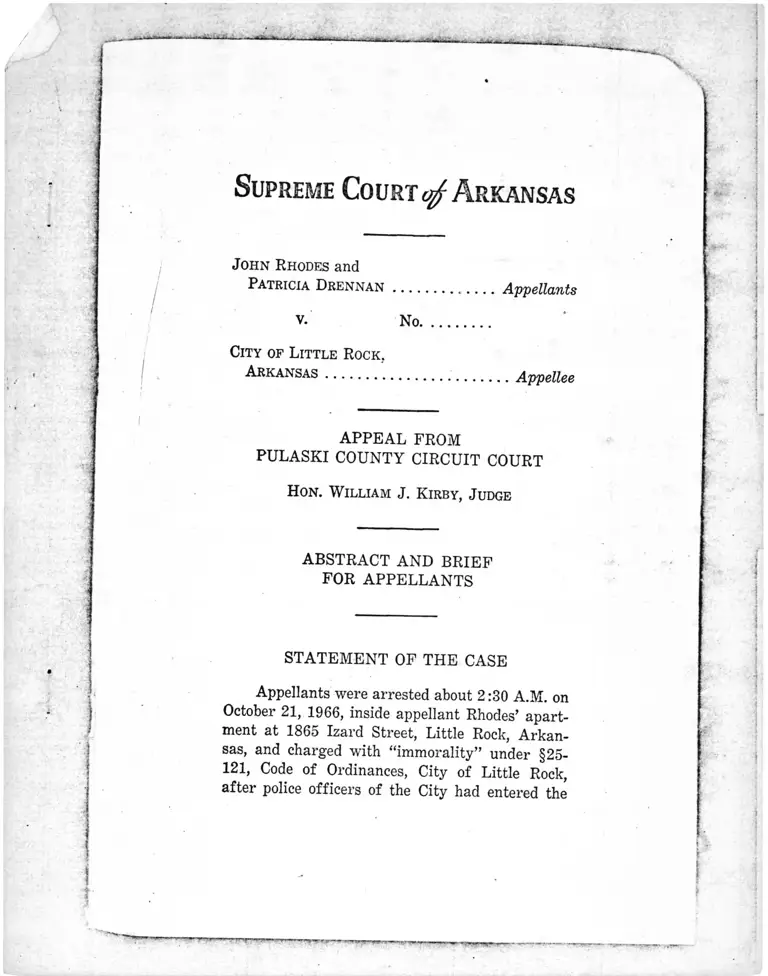
Supreme Court ̂ A rkansas
John Rhodes and
Patricia Dr e n n a n ................ ...........Appellants
V. No...................
City of Little Rock.
A r k a n s a s .................................. ............... Appellee
APPEAL FROM
PULASKI COUNTY CIRCUIT COURT
Hon. W illiam J. K irby, Judge
ABSTRACT AND BRIEF
FOR APPELLANTS
STATEMENT OF THE CASE
Appellants were arrested about 2 :30 A.M. on
October 21, 1966, inside appellant Rhodes’ apart
ment at I 860 Izard Street, Little Rock, Arkan
sas, and charged with “ immorality” under §25-
121, Code o f Ordinances, City of Little Rock,
after police officers of the City had entered the
apartment without a search or an arrest war
rant.
A fter pleading not guilty to the charges
against them, appellants were tried on that same
day, before Hon. John L. Sullivan, Judge of the
Municipal Court of Little Rock, found guilty, and
sentenced to thirty days’ imprisonment and a fine
of $200 plus $3 costs. On appeal to the Circuit
Court of Pulaski County, motions to quash and to
dismiss, and to declare said ordinance unconstitu
tional, were overruled. Appellants were tried
before Hon. William J. Kirby and a jury on Jan
uary 31, 1967, were found guilty, and each was
sentenced to thirty days’ imprisonment and a fine
of $100 plus $24.65 costs. Motion for New Trial
was overruled February 28, 1967.
— - — 6 - —
.... . - — - ----- ■>! * ----
\
POINTS RELIED UPON
I
The Ordinance Which Petitioners Were Convicted
of Violating is so Vague and Sweeping as to
Violate the Due Process Clause of the Four
teenth Amendment to the United States
Constitution.
H
Appellants’ Convictions Deny Them Due Process
of Law, Guaranteed by the F o u r t e e n t h
Amendment Because There is no Evidence in
this Record of an Essential Element of the
Offense and Because the Verdict is Against
the Weight of the Evidence.
Ill
Appellants Were Denied Their Rights Under the
Fourth and Fourteenth Amendments to the
United States Constitution Because their
Arrest Was the Product of an Antecedent
Unreasonable Search and Because the Ar
resting Officers Were Improperly Permitted
to Testify as to their Visual Observations
During a S u b s e q u e n t Unconstitutional
Search.
IV
Little Rock City Code of Ordinances %25-121 is an
Ex Post Facto Law Forbidden by the Arkan
sas Constitution.
It1 Is
i
II
----
iflaafi a IMM lu x * - -
\
. 4
ABSTRACT
PLEA AND ARRAIGNMENT
(R.12)
Pulaski Circuit Court, First Division
September Term, 1966
Monday, December 12, 1966
City of Little R o c k ................................Plaintiff
V. No. 66392 Immorality
Patricia Ann D ren n an ........................Defendant
This day comes the City of Little Rock by
Perry Whitmore, Assistant City Attorney, and
comes the defendant in proper person and by her
attorney, John Walker, and defendant is called
to the bar of the Court and informed of the nature
of the charge filed herein, enters her plea of not
guilty thereto, and by agreement the case is
passed to January 31, 1967, for a jury trial.
--------- r ------------ -
I
PLEA AND ARRAIGNMENT
(R.13)
Pulaski Circuit Court, First Division
September Term, 1966
Wednesday, December 14, 1966
City of Little R o c k ...................................Plaintiff
v. No. 66393 Immorality
John L. Rhodes ..................................... Defendant
This day comes the City o f Little Rock by
Perry Whitmore, Assistant City Attorney, and
comes the defendant in proper person and by his
attorney, John Walker, and defendant is called
to the bar of the Court and informed of the na
ture of the charge filed herein, enters his plea of
not guilty thereto, and by agreement the case is
passed to January 31, 1967, for a jury trial.
MOTION TO DISMISS
. (R.14-15)
Defendants, by their attorney, John Walker,
hereby move that the charges against them be
dismissed, and as grounds therefor, state the fol
lowing :
1. The alleged arrest of the defendants was [
invalid because (1 ) no warrant of arrest was is-
6
sued nor delivered to any peace officer prior to
the alleged arrest; (2 ) the defendants commit
ted no public offense in the presence of any peace
officer; and (3 ) no peace officer had any reason
able ground to believe that either defendant or
both of them had committed a felony; and there
fore, the alleged arrest of defendants was in vio
lation of Ark. Stat. Anno. Sec. 43-403 (Repl.
1964).
2. The alleged arrest of the defendants took
place within the apartment of defendant John
Rhodes, while the charges against the defendants
are brought under Little Rock Ordinance No. 25-
121, concerning “ immorality” in a public place.
Defendants may not now be tried for a violation
o f another ordinance. Cole v. Arkansas, 333
U.S. 196 (1948).
3. All evidence gained from the illegal
entry by peace officers into defendant Rhodes’
apartment, including visual observations of the
police officers, Johnson v. United States, 333 U.S.
10 (1948), cannot be admitted into evidence.
U.S. Constitution Amend. 4, 14; Mapp v. Ohio,
367 U.S. 643 (1961).
Wherefore, defendants respectfully pray this
Honorable Court to dismiss the charges against
them and quash the information herein.
Respectfully submitted,
/ s / John W. Walker
h
Filed: Jan. 31, 1967
MOTION TO QUASH INFORMATION AND TO DECLARE
MUNICIPAL ORDINANCE UNCONSTITUTIONAL
(R.16)
Defendants by their attorney, John W.
Walker, hereby move the Court to Quash the In
formation herein and to declare the Municipal
Ordinance of the City of Little Rock, Arkansas
under which they were arrested, Sec. 25-121, to
be unconstitutional on the ground that said ordin
ance is too broad, too vague and too indefinite to
be objectively applied in that it fails to specify
and otherwise give notice to defendants of the
conduct or acts proscribed.
Wherefore, defendants respectfully pray this
Honorable Court to Quash the Information here
in and to Declare the Ordinance under which
they were arrested to be unconstitutional.
Respectfully submitted,
/ s / John W. Walker
Filed: Jan. 31, 1967
1—̂
s
ABSTRACT OF TESTIMONY
(Given at trial in the Pulaski County Circuit
Court, January 31, 1967 (R .45-83).)
Officer John Terry (R .45 -63 ):
I am a detective sergeant, Special Detail,
Little Rock Police Department (R .45). On
October 21, 1966, after having previously re
ceived complaints, I went to 1865 Izard Street
about 2:30 a.m. There are two separate build
ings there— a house with an apartment in the
rear (R .46). I knocked on the door of the ga
rage apartment but received no answer. I could
see someone looking at me through the Venetian
blinds. I went to the window and shined my
flashlight through the blinds; I could see a white
. female and a colored male in bed. I identified
myself as “ Sergeant Terry with the Police De
partment” and told them to open the door. After
a minute or two I told the colored male he was
under arrest and again told him to open the door.
A minute or two after that I pushed open the
door and went inside. He was out of bed (R.
47). I lifted the covers of the bed and saw that
Pat Drennan had on a brassiere and pants. I
gave her the rest of her clothes and she dressed.
I asked if they were married. Rhodes said he
was married to a Ruby Rhodes, 1800 Thayer
Street (R .48). Drennan said she was married
9
to Frank Drennan. Neither commented on the
other’s answer (R .49). I had been assigned to
this case for a week or so. I could have obtained
an arrest warrant— I had plenty o f time— but I
did not have one (R .50). I had no reason to
believe that Rhodes and Drennan were commit
ting a felony, or anything but immorality. A
neighbor, Charles Bussey, made an oral complaint
to me at his residence (R .51). I don’t know
whether his complaint to the Chief of Police was
in writing or not. I saw them together in bed
and assumed they were nude (R .52). I shined
my flashlight through the Venetian blinds, which
were not totally closed; I could get a clear view of
the bedroom (R .53). At that time I had not
told anybody that they were under arrest (R .54).
When I saw someone looking at me through the
blinds, I did not know who it was (R .56). When
the door was not opened, I pushed it open; it was
locked (R .57). I had to use force to open the
door (R .58). My understanding is that any
time any offense is committed in my presence, I
have the right to make an arrest (R .60). They
were not armed (R .61). I did not notice that
either one had been drinking; they did not use
obscene language in my presence. This was not
what I would call a public place. I had known
Drennan for several years (R .62).
10
Officer W illiam D. Gibson (T .63-73):
I am a detective with the Vice Squad. I was
with Officer Terry on the night in question. We
had received complaints about ‘ an incident oc
curring at this address” . We knocked on the
door, saw a blind being opened, and shined a
flashlight in the window. We observed two
people in bed together in a state o f undress, and
asked them to open the door (R .64). Sergeant
Terry pushed the door open. Rhodes and Dren-
nan were inside. Sergeant Terry told them they
were under arrest and we took them to the Police
Department (R .65). The building was a resi
dence, located in a residential area (R .67). I
had not seen the defendants talking together
earlier that day;-1 had never seen them before.
I had never seen Rhodes invite Drennan to his
apartment (R .69). I had never seen either
person attempt to entice the other to the apart
ment. I did not see them enter the apartment
together (R .70). At the police station we told
them what they were charged with but we did
not advise them of their right to counsel or to re
main silent. We took no statement from them
(R .71). We had to use force to get in the apart
ment; the door was locked. We had no search
warrant or arrest warrant (R .72).
THE CITY’S REQUESTED INSTRUCTION NO. 1
(R.75-76)
It is hereby declared to be a misdemeanor for
any person to participate in any public place in
any obscene or lascivious conduct, or to engage
in any conduct calculated or inclined to promote
or encourage immorality, or to invite or entice any
person or persons upon any street, alley, road or
public place, park or square in Little Rock, to
accompany, go with or follow him or her to any
place for immoral purposes, and it shall be un
lawful for any person to invite, entice, or address
any person from any door, window, porch or
portico of any house or building, 'to enter any
house or go with, accompany or follow him or her
to any place whatever for immoral purposes.
The term “ public place” is defined to mean
any place in which the public as a class is invited,
allowed or permitted to enter, and includes the
public streets, alleys, sidewalks and thorough
fares, as well as theaters, restaurants, hotels, as
well as other places. The term “ public place”
is to be interpreted liberally.
Any person found guilty of violating the pro
visions of this section shall, upon conviction, be
fined in any sum not less than ten dollars, nor
more than two hundred and fifty dollars, or im-
12
prisoned for not less than five days nor more
than thirty days, or both fined and imprisoned.
The Court gave the City’s Requested Instruc
tion No. 1.
The defendant objected to the action of the
Court in giving the City’s Requested Instruction
No. 1, and at the time asked that their excep
tions be noted of record, which was accordingly
done.
THE DEFENDANTS’ REQUESTED INSTRUCTION
NO. 1
(R.80)
You are instructed that an element of the
offense of immorality, as used in Section 25-121
of the Code of Ordinances of the City of Little
Rock, is that the offense of immorality be per
formed in a public place, as defined in the said
ordinance.
The Court refused to give the Defendants’
Requested Instruction No. 1.
CHARGE TO JURY
(R.81-83)
THE COURT*.
Ladies and Gentlemen, I am going to give you
the law in this case. It is not particularly com-
j|^K n r J— 1 •
V
13
plicated and the instructions are not long. It
is my duty to give you the law and it is your duty
to apply that law to the facts as you find them
from the evidence that is developed here from the
witness stand and bring me in a verdict m ac
cordance with both the law and the evidence.
(A t this time, the Court read to the
jury the Instructions indicated as given,
above, after which the closing arguments
were made to the jury on behalf of the City
and the defendants, after which the fol
lowing proceedings occurred.)
THE court:
Ladies and Gentlemen, I will now give you
the forms of your verdict. I f you feel like John
Rhodes is guilty of immorality, you will say:
“ We, the jury, find the defendant guilty of im
morality, as charged in the information, and fix
punishment at a fine of . . . . . . . dollars, or . . .
days imprisonment, or a fine o f ............. 0 ars
and . . . . days imprisonment.” That is any
thing not less than ten dollars nor more than two
hundred fifty dollars, or imprisonment not less
than five nor more than thirty days, or both sue
fine and imprisonment.
If you feel like he is not guilty, or you have
a reasonable doubt of his guilt on the whole case,
l i
-m .------------ ’
you will say : “ We, the jury, find the defendant
not guilty.”
Likewise, in the case o f Patricia Drennan,
if you believe she is guilty of immorality, you
will say: “ We, the jury, find the defendant
guilty o f immorality, as charged in the informa
tion, and fix her punishment at a fine o f .............
dollars o r .........days imprisonment, or a fine of
............. dollars a n d ........... days imprisonment.”
That is not less than ten or more than two hun
dred fifty dollars, and not less than five nor more
than thirty days, or both a fine and imprison
ment.
I f you feel like she is not guilty, or have a
reasonable doubt of her guilt on the whole case,
you will say: “ We, the jury, find the defendant
not guilty.”
These verdicts must be signed by one of you
ladies or gentlemen as foreman and must be unan
imous. You may retire and consider your ver
dict.
14
■ |ir; . -- ------■«*■.■■■■».». d ft . . . . . . ..M
15
TRIAL VERDICT AND JUDGMENT
(R.17-18)
Pulaski Circuit Court, First Division, September
Term, 1966
Tuesday, January 31, 1967
City of Little Rock Plaintiff,
No. 66392 & 63393 Immorality
Patricia Ann Drennan and
John L. Rhodes, Defendants
This day comes the City of Little Rock by
Perry Whitmore, Assistant City Attorney, and
come the defendants in proper persons and by
their attorney, John Walker, and by agreement
the cases are consolidated for trial, and defend
ants’ Motion to Dismiss is filed, heard and over
ruled, the defendants’ Motion to Quash is filed,
heard and overruled, and defendants exceptions
are saved, and both defendants having previously
entered a plea of not guilty, parties announce
ready for trial, thereupon comes twelve qualified
electors of Pulaski County, viz: E. B. Hearn,
Rev. Curtis Rideout, J. E. Cochran, Soloman
Johnson, Mrs. R. E. Bibby, A. T. Miller, Mrs.
Gladys Buckles, B. D. Henry, L. V. Bettis, Charles
Wade, Mrs. Haco Boyd and Alfred Treadway,
who are emapneled and sworn as a trial jury in
N
16
these cases, and after hearing the testimony of
the witnesses, the instructions of the Court and
the arguments of counsel, the jury doth retire to
consider arriving at a verdict for each defendant,
and after deliberating thereon, the jury doth re
turn into open court with the following verdicts:
“ We, the jury, find the defendant, Patricia Ann
Drennan, guilty of Immorality, as charged, and
fix her punishment at a fine of $100.00 and 30
days imprisonment. Mrs. Gladys Buckles,
Foreman.” “ We, the Jury find the defendant,
John L. Rhodes, quilty of Immorality, as charged,
and fix his punishment at a fine of $100.00 and
30 days imprisonment. Mrs. Gladys Buckles,
Foreman.” Whereupon, the Court doth dis
charge the jury from these cases, and each de
fendant is given fifteen days in which to file a
Motion for New Trial and committed to jail in
lieu o f $1,000.00 bond.
MOTION FOR NEW TRIAL
(R.31-34)
Comes the defendants, John Rhodes, a Negro
male, and Patricia Drennan, a white female, and
hereby move the court to set aside the verdicts
of the jury herein and to grant them a new trial
of this cause, and in support of same state as
follows:
1. That Little Rock Municipal Ordinance
Sec. 25-121, under which defendants were ar
rested, tried and convicted, violates the due pro
cess clause to the Fourteenth Amendment to the
United States Constitution in that said ordinance
is too broad, too vague, and too indefinite or un
certain to give defendants notice of the acts
and/or conduct prescribed thereunder.
2. That the arrest of the defendants by the
police was invalid because it was made without
warrant and without “ probable cause” ; and be
cause the sole basis of the arrest was the race of
the parties involved, and thus in violation of the
equal protection and due process clauses of the
Fourth and Fourteenth Amendments to the
United States Constitution.
3. That the entry,' and manner of same,
into defendant Rhodes’ apartment by the arrest
ing officers and the search and seizure therein,
without a warrant, was illegal and thus in vio
lation of the Fourth and Fourteenth Amendments
to the United States Constitution.
4. That the visual observations of the ar
resting officers were improperly admitted into
evidence in violation of the Fourth and Fourteenth
Amendments to the United States Constitution.
5. That defendants were not advised of .
their rights to counsel, nor afforded the oppor
tunity to retain counsel at their trial in the Mu-
17
\
18
nicipal Court of Little Rock, Arkansas; and were
thus deprived of rights secured to them by the
Sixth and Fourteenth Amendments to the United
States Constitution.
6. That defendants were prosecuted on the
basis of a “ personal arrest’’ and thereby de
prived of due process of law under the Four
teenth Amendment to the United States Consti
tution.
7. That the defendants were not properly
apprised of the charges against them because
there was no indictment, information, or warrant
filed against them in violation of their rights as
secured by the due process clauses of the Fifth
and Fourteenth Amendments to the United States
Constitution.
8. That there was no evidence to support
defendants’ convictions in violation of the due
process clause of the Fourteenth Amendment to
the Constitution of the United States.
9. That the prosecutions under said mu
nicipal ordinance infringed upon and violated de
fendants’ rights of privacy and association guar
anteed to them by the due process clause of the
Fourteenth Amendment to the United States Con
stitution.
10. That the verdicts of the jury are con
trary to law.
------- ' '
X
11. That the verdicts of the jury are con
trary to the evidence.
12. That the verdicts of the jury are against
the weight of evidence.
13. That it was error for the trial court
to deny defendants’ motion to declare the Little
Rock Municipal Ordinance Sec. 25-121 unconsti
tutional.
14. That it was error for the court to re
fuse defendants’ requested instruction No. 1,
which reads: “ You are instructed that an
element of the offense of immorality, as used in
Section 25-121 of the Code of Ordinances of the
City of Little Rock, is that the offense of im
morality be performed in a public place, as de
fined in the said ordinance.”
15. That it was error for the trial court to
refuse defendants’ requested instruction No.
2, which reads: “ You are instructed that the
word ‘immorality,’ as used in Section 25-121 of
the Code of Ordinances of the City of Little Rock,
Arkansas, does not include an act of sexual inter
course not sanctioned by marriage vows.”
Wherefore, defendants respectfully pray that
the court set the verdict of the jury herein aside
19
and that they be granted a new trial in this
cause.
Respectfully submitted,
s / John W. Walker
Jack Greenberg
Michael Meltsner
Attorneys for Defendants
ORDER ON MOTION FOR NEW TRIAL
(R.35)
In the Circuit Court of
Pulaski County, Arkansas
Third Division
September Term, 1966 No. 66392 and 66393
City of Little Rock, Arkansas
V.
John Rhodes and Patricia Drennan
ORDER
Came on defendants’ Motion for a New Trial
for a hearing before this Court at 10:00 a.m.,
February 28, 1967, defendants being represented
by their attorney, Mr. John W. Walker, and the
plaintiff being represented by Mr. Perry V. Whit-
20
i . i . ... . . ------- ■ '•> '.—a t .
21
more, and after a hearing on said Motion, the
Court doth Find, Order, Adjudge, and Decree.
That defendants’ Motion for a New Trial is
denied.
/ s / Wm. J. Kirby
Circuit Judge
Dated: February 28, 1967
MOTION FOR NEW TRIAL OVERRULED
(R.36)
Pulaski Circuit Court, First Division
September Term, 1966
Tuesday, February 28, 1967
City- of Little Rock, A rkan sas............... Plaintiff
V. Nos. 66392 and 66393
Patricia Ann Drennan and
John L. Rhodes
This day comes the City of Little Rock by
Perry Whitmore Assistant City Attorney, and
come the defendants in proper persons and by
their attorney, John Walker, and defendants’ Mo
tion for New Trial is heard and overruled, and
defendants exceptions are saved and an appeal is
prayed and granted and the defendants are given
forty-five days in which to get up and file their
Bill of Exceptions.
T '#«<■ t. w « r .r r -
--- -------------------- ... ■ i . * . a . « ift» W ir ____
22
ARGUMENT
I
The Ordinance Which Petitioners Were Convicted
of Violating is so Vague and Sweeping as to
Violate the Due Process Clause of the Four
teenth Amendment to the United States
Constitution.
Petitioners were convicted of violating §25-
121 of the Code of Ordinances, City of Little Rock,
which provides as follows:
“ It is hereby declared to he a misde
meanor for any person to participate in any
public place in any obscene or lascivious
conduct, or to engage in any conduct cal
culated or inclined to promote or encourage
immorality, or to invite or entice any per
son or persons upon any street, alley, road
or public place, park or square in Little
Rock, to accompany, go with or follow him
or her to any place for immoral purposes,
and it shall be unlawful for any person to
invite, entice, or address any person from
any door, window, porch or portico of any
house or building, to enter any house or go
with, accompany or follow him or her to
any place whatever for. immoral purposes.
------ ------------ ....... ' ------------ i l l f i . i r l l . i m V -------1 ,
23
The term ‘public place is defined to
mean any place in which the public as a
class is invited, allowed or permitted to
enter, and includes the public streets, al
leys, sidewalks and thoroughfares, as well
as theaters, restaurants, hotels, as well as
other places. The term ‘public place’ is
to be interpreted liberally.
Any person found guilty o f violating
the provisions of this section shall, upon
conviction, be fined in any sum not less
than ten dollars, nor more than two hun
dred and fifty dollars, or imprisoned for
not less than five days nor more than
thirty days, or both fined and imprisoned.”
On its face, this section attempts to make
criminal four separate kinds of conduct:
(1 ) obscene or lascivious conduct in a pub
lic place;
(2 ) conduct in a public place calculated or
inclined to promote or encourage immorality;
(3 ) enticing or inviting, in a public place,
any person to follow or accompany one to any
place for immoral purposes;
(JKiuie SmiSBfb* J»T«.. M’M-l ■ 11 iMMUjlff
f r o r
!
f
j-
24
(4 ) inviting or enticing from a house, win
dow or porch, etc., to enter or accompany one to
any place for immoral purposes.
i Althoueh the ordinance seems to include within its pro-
“p0HhC:t’ No indictment was ever returned against appel-
= f r « S 3« 3 ^ p
Wp „ rp unable to agree with this disposition of the case.
The ̂ verdict “ against the appellant was a general one-JEt
?pect ^ lpanL say under whkh dause of the statute the impossible to say unoei these clauses, which
s s l i s s s ^ i
not convicted under that clause . ith the state court,
f h i f t h f verdict S be sustained if any one of the clauses
S lhe statute were found to be valid, the necessary con
clusion from the manner * * £ * < * « £ *
cannot be upheld
A statute which upon
lively construed, is 30 v^ e f t£is opportunity is repugnant
punishment of the fair use oi l w the 14th Amendment.
discloses may"have'rested upon ’that clause exclusively, must
be set aside.
_ of ctate 378 U.S. 500, 515-16 (1964).Cf. Aptheker v. Secretary of State,
■
I
25
The ordinance is phrased in broad terms not
defined therein, nor in any related sections of the
City Code. While the core of the law is “ im
morality,” a word of considerable breath whose
meaning is open to considerable disparity of views
(Cf. Ex parte Jackson, 45 Ark. 158, 164 (1885),
South Carolina v. Katzenbach, 383 U.S. 301, 312,
313 (1966), no specific substantive content is
given the word in the ordinance or in any other
sections of the City Code.
The language of the ordinance which speci
fies what kinds of conduct are so related to “ im
morality” as to be made criminal by this law is
similarly broad and without explanation or modi
fication : e.g., “ calculated or inclined to promote
or encourage.” This ordinance presents those
who would attempt to conduct themselves within
the permissible confines of the law with a dilem
ma, because they are unable to choose a course of
action with any fair assurance that they are not
violating the ordinance.
The very application of this ordinance, de
signed to punish solicitation and prostitution (see
II infra), to the facts of this case affords the
clearest demonstration of its overbreadth. The
ordinance concerns public conduct; yet appellants
were convicted and sentenced to imprisonment on
the basis of conduct which even the arresting of-
-a—
■ . - ... - .......„ ----- -.r-.
26
ficer did not believe occurred in a public place (R.
62 ).2 Since the trial court upheld the constitu
tionality of the ordinance by overruling the Mo
tion to Quash (R.42) and the Motion for New
Trial (R .36), the convictions must be reversed.
This is a law which, because it “ forbids . . .
the doing of an act in terms so vague that men
of common intelligence must necessarily guess
at its meaning and differ as to its application,
violates the first essential of due process.”
Connally V. General Const. Co., 269 U.S. 385,
391 (1926). “ . . . No one may be required at
peril o f life, liberty or property to speculate as
to the meaning of penal statutes. All are en
titled to be informed as to what the state com
mands or forbids . . . ” Lanzetta v. New Jersey,
306 U.S. 451, 453 (1938); see also Winters v.
New York, 333 U.S. 507, 515 (1948); Gamer
v. Louisiana, 368 U.S. 157, 185, 207 (1961)
(concurring opinion). Where a law incorpo
rates only the general substantive standard of
morality or immorality, it necessarily affords
but minimal notice of its proscriptions. Musser
V. Utah, 333 U. S. 95, 96-97 (1948).
^Although the ordinance contains a purported definition of
“public place,” that “definition” merely creates an explicit re
quirement of broad construction, in derogation of the usual
rule that penal laws are to be strictly construed, and demon
strates that the ordinance was purposefully drafted as loosly
as possible.
27
But this ordinance is not defective solely be
cause it defines criminal conduct with insuffic
ient clarity so that its scope may be misunder
stood by those anxious to avoid its sanctions. The
unpredictability of its application infects the
judicial process as well. “ [SJince the broadness
o f the law creates an unclear, variable standard
o f guilt for the fact-finder, . . . the possibilities
o f an evenhanded application of law and of ef
fective judicial review are substantially de
creased/’ Lewis, The Sit-In Cases: Great Ex
pectations, [1963] Supreme Court Review 101,
110. In effect, this ordinance ‘ ‘licenses the jury
to create its own standard in each case,” Herndon
V. Lowry, 301 U.S. 242, 263 (1937); Musser v.
Utah, supra; see Ex parte Jackson, supra, 45
Ark. at 164.
The Supreme Court of the United States has
recently passed upon a state statute which pro
vided the jury with no standards in the imposi
tion o f sanctions save its own discretion. A
Pennsylvania statute3 allowed juries to assess
court costs against acquitted misdemeanor de
fendants. The Court held the statute to be un
constitutional, because it
contains no standards at all. nor does
it place any conditions of any kind upon
3Pa. Stat. Ann., Tit. 19 Sec. 1222.
28
the jury ’s power to impose costs. . . . Cer
tainly one of the basic purposes of the Due
Process Clause has always been to protect
a person against having the Government
impose burdens upon him except in ac
cordance with the valid laws of the land.
. . . It would be difficult, if not im
possible for a person to prepare a defense
against such general abstract charges as
“ misconduct,” or “ reprehensible conduct.”
I f used in a statute which imposed for
feitures, punishments, or judgments for
costs, such loose and unlimiting terms
would certainly cause the statute to fail
to measure up to the requirements of the
Due Process Clause. (emphasis in orig
inal) Giaccio v. Pennsylvania, 382 U.S.
399, 403, 404 (1966).
The teaching of Giaccio is that penal laws
may not, consistent with the Due Process clause,
- remit to the unbridled discretion of court or jury
the decision to impose sanctions, much less the
determination of criminality. §25-121 of the
_ . Little Rock Code of Ordinances does just that.
These objections are the more forceful be
cause this ordinance sweeps within its broad pro
hibition freedom of association which is protected
against infringement by the State. See Note,
___ The Void-for-Vagueness Doctrine in the Supreme
: Court, 109 U. Pa. L. Rev. 67 (1960). The or
dinance is directed not at overt acts harmful in
themselves, but at incidents of a relationship be-
29
tween persons which becomes illegal only by the
application of a totally subjective standard. For
example, the line between what is protected as
sociation and what is invitation or enticement to
immorality depends upon the subjective compre
hension of a police officer about the ultimate in
tent of the parties in speaking to one another.
/ In this manner, the definition of the actions which
may be punished is effectively relegated to the
police, and ultimately to the courts, for ad hoc
determination after the fact in every case. A
law with such a potential for selective enforce
ment, NAACP v. Button, 371 U.S. 415, 435
(1963), inevitably creates a “ chilling effect upon
the exercise of First Amendment rights,” Dom-
browski v. Pfister, 380 U.S. 479, 487 (1965), of
speech and association. The circumstances of
this case illustrate graphically the extent to
which personal privacy, Griswold v. Connecticut,
381 U.S. 479 (1965), may be invaded under this
law. For these reasons, the principle that penal
;laws may not be vague must, if anything, be
enforced even more stringently.
II
Appellants’ Convictions Deny Them Due Process
of Law, Guaranteed by the F o u r t e e n t h
Amendment Because There is no Evidence in
this Record of an Essential Element of the
Offense and Because the Verdict is Against
the Weight of the Evidence.
§25-121, Code of Ordinances of the City of
Little Rock, was plainly designed to punish solici
tation and prositution. One of its essential ele
ments is that some act— obscene or lascivious con
duct, enticement or solicitation, etc. occur on a
public street or in a public place.4 Any other con
struction of the ordinance would raise grave ques
tions of infringement of constitutionally protected
rights of association and privacy recognized in
Griswold V. Connecticut, 381 U.S. 479 (1965).
See Roberts V. Clement, 252 F. Supp. 835, 848
(E D. Tenn. 1966) (concurring opinion) (anti-
nudism statute).
Yet there is no evidence on this record that
either or both of the appellants performed any
proscribed act in a public place. To the con
trary, the arresting officers testified that they
-did not arrest appellants in a public place (R.62,
67) and that they had not seen the appellants
talk to one another or invite or entice one another
to the apartment (R.69-70). The conduct de
scribed by the officers took place entirely within
a private residence, not bordering a public street,
behind a locked door, at 2:30 A.M.
— TiTThis regard,
Requested Instruction No. 1 (R.80).
*̂**̂
*—
***■
iLi
diV
i M
* ■■n
iim
. —
-
- -|
m
i l
'iI'h
n
n n
rr“
lt?
na
>
■W
M
m
tt
m
,k
t
■
. J l * « * l . i .1
31
“ Under the words of the ordinance itself,
i f the evidence fails to prove all . . . elements of
this [immorality] charge, the conviction is not
supported by the evidence, in which event it does
not comport with due process of law.” Thomp
son w. City of Louisville, 362 U.S. 199, 204 (1960)
(emphasis supplied).
The convictions must be reversed for failure
to prove a public act, Shuttlesworth v. Birming
ham, 382 U.S. 87 (1965); Barr v. City of
Columbia, 378 U.S. 146 (1964); Fields v. Fair-
field, 375 U.S. 248 (1963); Taylor v. Louisiana,
370 U.S. 154 (1962 ); Garner V. Louisiana, 368
U.S. 157 (1961); Thompson v. City of Louisville,
supra, and because the verdicts were against the
weight of the evidence Ark. Stat. Ann. §§43-2203,
2725 (Repl. 1964).
in
Appellants Were Denied Their Rights Under the
Fourth and Fourteenth Amendments to the
United States Constitution Because their
Arrest Was the Product of an Antecedent
Unreasonable Search and Because the Ar
resting Officers Were Improperly Permitted
to Testify as to their Visual Observations
During a S u b s e q u e n t Unconstitutional
Search.
The shocking police misconduct shows on the
face o f this record requires a reversal of appel-
ji
I
!i
*
!
'i
I
1
:
i
<
i
- —
-
'•
-i
'--
---
---
---
.
,•„
, |,„,„
,
„
m i M in _ m , i. ■ a n ___ - - - - -
n ! Jr
-'/ T
y o
. i
) \ | 1! I
t 1j i. i
32
lants’ convictions. Rochin V. California, 342
U.S. 165 (1952). An unreasonable, unwar
ranted and unconstitutional invasion of privacy
and property cannot legitimize a subsequent un
lawful arrest; nor may that arrest in turn justify
a later search, without overstepping the bounds
of due process. See Johnson v. United Spates,
333 U.S. 10 (1948).
The arresting officers testified that they
were investigating a complaint previously re
ceived (R.46, 5 1 ); yet they chose to make their
investigation at a patently unreasonable houi
2:30 a.m. (R .46). They had plenty of time to
obtain a warrant (R .5 0 ); yet they failed to do
so but entered appellant Rhodes’ apartment un
lawfully, having neither a search nor an arrest
warrant (R .72). This fact alone is sufficient
to invalidate the searches o f appellant Rhodes’
home and to require a reversal here. See Agnel-
lo V. United States, 269 U.S. 20, 33 (1925). The
officers did not make their investigation on the
public streets or on public property. Appellant’s
o-arage apartment was at the rear of a house in
a residential area (R .4 6 ); thus, in walking to the
door of the apartment (R.47) the officers weie
already trespassing. “ Whatever quibbles there
may be as to where the curtilage begins and ends,
clear it is that standing on a man’s premises and
looking in his bedroom window is a violation of
*
t
ff
t
J ........ urMt i m n ifMi r r in t i » ' i i ^ f a . l , i . H M . ' i ,
33
his ‘right to be let alone’ as guaranteed by the
Fourth Amendment.” Brock V. United States,
223 F. 2d 681, 685 (5th Cir. 1955). It is clear
that the ground surrounding Rhodes’ apartment
was protected against police intrusions The
following definition of curtilage appears in
corpus juris:
In its most comprehensive and proper
legal signification it includes all that
space of ground and buildings thereon
which is usually enclosed within the gen
eral fence, immediately surrounding a
principal messuage, outbuildings, and
yard closely adjoining to a dwelling house.
(25 C.J.S. 82).
The principle has also received widespread
judicial recognition. E.g., Rosencranz v. United
States, 356 F. 2d 310, 313 (1st Cir. 1966)
(b a rn ); Kroska v. United States, 51 F. 2d 330
(8th Cir. 1931) (farm yard ); Whitley V. United
States, 237 F. 2d 787 (D.C. Cir. 1956) (porch).
The circumstances of Brock, supra, are simi
lar to the instant case. There, officers observed
a still located a quarter of a mile from the house
in question. An agent knocked at the door of
the house, received no answer, and then looked in
a bedroom window where he saw the defendant.
The agent awakened the defendant and ques
tioned him through the window while defendant
was still somnolent. The United States Court
34
of Appeals for the Fifth Circuit held it error to
admit the statements made by the defendant be
cause “ the agents, when they appeared outside
Brock’s bedroom window, were in violation of his
rights under the Fourth Amendment.” (223 F.
2d at 685.)
Equally relevant is the opinion of the United
States Supreme Court in Taylor v. United States,
286 U.S. 1 (1932):
During the night, November 19th,
1930, a squad (six or more) of prohibition
agents while returning to Baltimore City
discussed premises 5100 Curtis Avenue, of
which there had been complaints over a
period of about a year.” Having decided
to investigate they went at once to the ga
rage at that address, arriving there about
2:io a.m. The garage— a small metal
building— is on the corner of a city lot and
adjacent to the dwelling m which petition
er Taylor resided. The two houses are
parts of the same premises.
As the agents approached the garage
they got the odor of whiskey coming from
within. Aided by a searchlight they
looked through a small opening and saw
many cardboard cases which they thought
probably contained jars of liquor. There
upon they broke the fastening upon a door,
entered and found one hundred twnety-two
cases of whiskey. . . .
Although over a considerable period
numerous complaints concerning the use of
35
these premises had been received, the agents
had made no effort to obtain a warrant for
making a search. They had abundant op
portunity so to do and to proceed in an
orderly way even after the odor had em
phasized their suspicions; there was no
probability of material change in the sit
uation during the time necessary to secure
such warrant. Moreover, a short period
of watching would have prevented any
such possibility.
We think, in any view, the action of the
agents was inexcusable and the seizure un
reasonable. The evidence was obtained
unlaivfully and should have been suppressed.
(286 U.S. at 5-6) (italics supplied).
Evidence, including visual observations, ob
tained as a result of such a trespass, should have
been excluded. Silverman v. United States, 365
U.S. 505 (1961); Silverthome Lumber Co. v.
United States, 251 U.S. 385 (1920); McGinnis v.
United States, 227 F. 2d 598 (1st Cir. 1955);
Williams v. United States, 263 F. 2d 487 (D.C.
Cir. 1959).
Thus, the officers should not have been per
mitted to testify concerning their observations
in the window of Rhodes’ apartment. Those ob
servations likewise cannot support the arrest o f
appellants for the arrest may not be validated
by either the antecedent unconstitutional search
from the window, Taylor V. United States, 286
U.S. 1 (1932), or the subsequent forceful entry
36
and search of the apartment. Johnson V. United
States, 333 U.S. 10 (1948); cf. Chapman v.
United States, 365 U.S. 610 (1961). Further,
the conduct of the officers in this case does not
fall within their statutory authority to arrest
without a warrant. Ark. Stat. Ann §43-403
(Repl. 1964).
Since the arrest does not meet constitutional
or statutory standards, there was no justification
for breaking down the door to the apartment and
searching the premises. It was error to allow
the officers to testify concerning their visual ob
servations inside the apartment, Silverthorne
Lumber Co. V. United States, supra; Johnson v.
United States, supra. Appelants’ constitutional
rights can be vindicated only by a new trial free
of the taint of such unconstitutionally obtained
evidence. Mapp v. Ohio, 367 U.S. 643 (1961 );
Kerr v. California, 374 U.S. 23 (1963).
rv
Little Rock City Code of Ordinances §25-121 is an
Ex Post Facto Laiv Forbidden by the Arkan-
\
sas Constitution.
The principle laid down by this Court in Ex
parte Jackson, 45 Ark. 158 (1885) controls this
case and requires that appellants’ convictions be
reversed and the prosecutions dismissed.
II
X
....
...
...
...
...
...
...
...
...
...
...
...
.m
m
m
\*
««
un
ns
"."
"
....
...
...
..m
um
/ - j ii i r f i i Ta f * i i i v ^ m .i. mil . .— _______ if * ■ « J ,.—■ ̂_ ___
37
§25-121 of the Code of Ordinances, City of
Little Rock, declares it to be a misdemeanor to
“ engage in any conduct calculated or inclined to
promote or encourage immorality,” and to per
form certain acts “ for immoral purposes.” How
ever, the ordinance nowhere suggests any ob
jective standard for interpreting the terms “ im
moral” and “ immorality.” Nor did the trial
court’s instructions give the jury any guide to be
applied in determining the meaning of the words.
Thus the jury was unaware of the proper stand
ards it should employ in deciding whether any
crime had in fact been committed.
The ultimate question of appellants’ guilt
or innocence was left to be decided according to
“ the moral idiosyncrasies of the individuals who
compose [d] the court and jury,” Ex parte Jack-
son, 45 Ark. at 164. Jackson was a prosecution
for the crime of committing an act injurious to
public morals. The statute was struck down
by this Court because it was ex post facto:
We cannot conceive how a crime can,
on any sound principle, be defined in so
vague a fashion. Criminality depends,
under it, upon the moral idiosyncrasies of
the individuals who compose the court and
jury. The standard of crime would be
ever varying, and the courts would con
stantly be appealed to as the instruments
of moral reform, changing with all fluctu
ations o f moral sentiment. The law is
i . n > - y i - j t i i n n n i ■ n t f - f i * > '« i i f . - n ■ — n M r i ' . i ■ d r a - a t M n i n . - f t t i t o - A i • i ^ ■ a l t l i
38
simply null. The constitution, which for
bids ex post factor laws, could not tolerate
a law which would make an act a crime,
or not, according to the moral sentiment
which might happen to prevail with the
judge and jury after the act had been com
mitted.
Ark. Const. (1874), Art. 2 §17 provides that
“ No bill of attainder, ex post facto law or law
impairing the obligation of contracts shall ever
be passed . . . . ” Appellants submit that §25-
121 of the Little Rock Code of Ordinances is in
distinguishable from the law struck down in
Jackson.' Indeed, the vices of this ordinance are
greater, since the acts here need not be injuiious
to public morals” but merely “promote or en
courage immorality.” This ordinance is clearly
beyond the power of the Legislature, or the gov
erning body of any municipality, if the worthy
principle enunciated by this Court in Ex parte
Jackson, supra, is respected. Since the trial
court took a different view in refusing to quash
and declare the ordinance unconstitutional (R.
16) the judgments of conviction should be re
versed with instructions to dismiss the prosecu
tions.
" scf Musser v. Utah, 333 U.S. 95 (1948), on remand, State
Musser U8 Utah 537, 223 P. 2d 193 (1950).
.«,. ----- "** — ,V _. --- ,
39
CONCLUSION
Wherefore, for all the foregoing reasons, ap
pellants respectfully submit that the judgments
o f the trial court should be reversed and dis
missed.
Respectfully submitted,
John W. W alker
1304-B Wright Avenue
Little Rock, Arkansas 72206
Jack Greenberg
James M. Nabrit, III
M ichael Meltsner
10 Columbus Circle
New York, New York 10019
Attorneys for Appellants
... --- - • ( ! « p -----fa -
Supreme Court ̂ A rkansas
John Rhodes and
Patricia Dr e n n a n ........................... Appellants
v. No.................
City of Little Rock,
A r k a n s a s ........................................... .. Appellee
APPEAL FROM
PULASKI COUNTY CIRCUIT COURT
Hon. W illiam J. K irby, Judge
REPLY BRIEF FOR APPELLANTS
The Appellee’s Brief fails to respond directly
to the serious issues in this case or to Appellants’
arguments as set forth in their brief.
The defendants below were tried for an
alleged violation of Section 25-121 of the Little
Rock Code of Ordinances, and the trial judge read
the entire Ordinance to the jury as part of his
charge (R„75-76)'. The City o f Little Rock
may not confine constitutional scrutiny o f this
2
Ordinance by now stating the theory of the prose
cution to have been that Appellants were guilty
of violating only a particular part of the Ordi
nance (Brief for Appellee, p. 5). Stromberg
V. California, 283 U. S. 359 (1931); Cole V. Ar
kansas, 333 U.S. 196 (1948).
Appellee’s construction of the Ordinance is
self-contradictory. It first seeks to read the law
“ in its entirety” to discover a common denomi
nator of “unacceptable sexual behavior” and then
emphasizes the “ particular part of the Ordinance
violated” to rebut Appellants’ claim that the
Ordinance proscribes only public conduct. Ap
pellants submit that this is not “ rational inter
pretation.” 1
The unconstitutionality of a law purporting
to punish “ immorality” is clear, and while Ap
pellee has drawn this Court’s attention to cases
from other jurisdictions which have found suf
ficiently definite penal laws employing other
terms, Appellee has made no attempt to distin-
1 Appellee relies upon Beasley v. Parnell, 177 Ark. 912, 9
S.W. 2d 11 (1928). However, the statute in that case contained
no separate indication of legislative intent, while such intent is
made clear in this Ordinance by the inclusion of a paragraph
defining “public place” immediately following the paragraph-
ing setting out the criminal acts. The very title of the Ordi-
nance is revealing: Public places; immoral conduct within,
penalty (R.43). Appellants do not contend, as Appellee ap
parently believes, that this Court should read the word or as
the word “and.” Rather, the legislative intent to interdict only
public conduct is otherwise clear from the language of the
Ordinance, and proof of public misbehavior is an integral part
of any prosecution under this Ordinance.
aguish this Court’s condemnation of such
statute:
3
The standard of crime would be ever
varying, and the courts would constantly
be appealed to as the instruments of moral
reform, changing with all the fluctations
o f moral sentiment. The law is simply
null. The constitution, which forbids ex
post facto laws, could not tolerate a law
which would make an act a crime, or not,
according to the moral sentiment which
might happen to prevail with the judge
and jury after the act had been committed.
(Ex parte Jackson, 45 Ark. 158, 164
(1885 )).
Nor has Appellee sufficiently answered the
claim that the Ordinance is unconstitutionally
vague, for as pointed out in Appellants’ Brief and
as emphasized by this Court in Ex parte Jackson,
supra, the overbreadth of the Ordinance not only
causes problems of adequate notice but also leads
to unpredictable and capricious judicial applica
tion.
Finally, Appellee also mistakes the nature of
Appellants’ Fourth Amendment claims. Appel
lee as much as admits the illegality of the arrest
but argues that such an illegal arrest does not re
quire suppression of evidence previously ob
tained.2 The evidence here is in consequence
2 Appellee cites Perkins v. City of Little Rock to support
this proposition. There, however, the evidence consisted of
voluntary statements made after arrest, not before it.
■
'•
—
"■*
'--
---
---
t
r
"M
i'V
i-n
.
........... - ........ - — ...— __— . —....— .— ..... - It 11------------------------- ---
of the nighttime peeping of the officers through
the window of the apartment. Appellants con
cede the right of an officer, under Arkansas law,
to arrest when a misdemeanor is committed in
his presence. What Appellants cannot agree is
that the term ‘ ‘presence” includes the totally war
rantless, unauthorized peering into the window
o f a private apartment at 2 :30 A.M. by officers
standing within the curtilage of the property.
Such police action constitutes a violation o f the
constitutional rights to privacy which cannot
justify any prosecution based on what was ob
served. However great the harm of “ immoral”
conduct, to sanction such peeping-tom police
tactics would inflict a far greater injury upon
society and upon individual rights and the
sanctity of the home.
o
CONCLUSION
Wherefore, for all the foregoing reasons, ap
pellants respectfully submit that the judgments
of the trial court should be reversed and dis
missed.
Respectfully submitted,
John W. W alker
1304-B Wright Avenue
Little Rock, Arkansas 72206
Jack Greenberg
James M. Nabrit, III
Michael Meltsner
10 Columbus Circle
New York, New York 10019
Attorneys for Appellants