Jenkins v. Herring Respondents' Brief in Opposition to Petition for Writ of Certiorari
Public Court Documents
October 6, 1997
-
Brief Collection, LDF Court Filings. Jenkins v. Herring Respondents' Brief in Opposition to Petition for Writ of Certiorari, 1997. 31bc94b3-b59a-ee11-be36-6045bdeb8873. LDF Archives, Thurgood Marshall Institute. https://ldfrecollection.org/archives/archives-search/archives-item/2b9ae651-752b-4322-85b1-0585f305479d/jenkins-v-herring-respondents-brief-in-opposition-to-petition-for-writ-of-certiorari. Accessed October 05, 2026.
Copied!
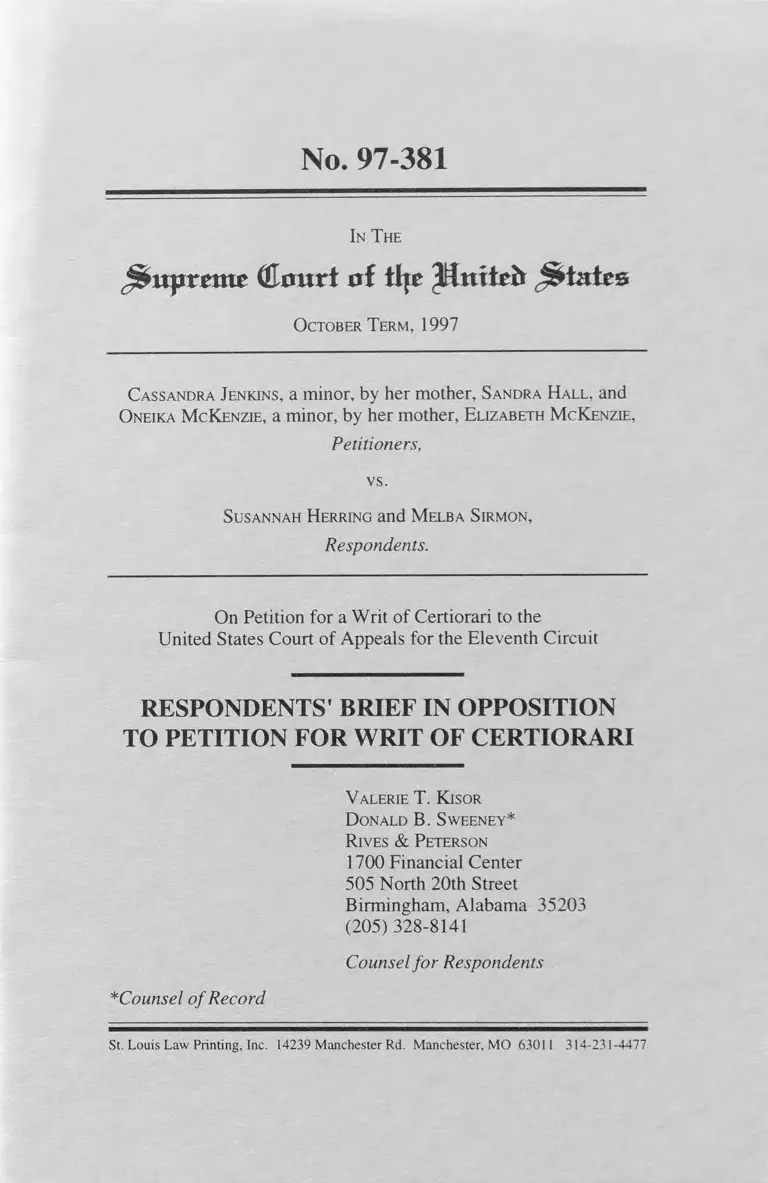
No. 97-381
In The
j3S>upreme Court of tljt Puttri* Stairs
October T erm, 1997
Cassandra Jenkins, a minor, by her mother, Sandra Hall, and
Oneika McKenzie, a minor, by her mother, Elizabeth M cKenzie,
Petitioners,
vs.
Susannah Herring and M elba Sirmon,
Respondents.
On Petition for a W rit of C ertiorari to the
United States Court o f Appeals for the Eleventh Circuit
RESPONDENTS’ BRIEF IN OPPOSITION
TO PETITION FOR WRIT OF CERTIORARI
*Counsel o f Record
Valerie T. Kisor
Donald B. Sweeney*
R ives & Peterson
1700 Financial C enter
505 North 20th Street
Birm ingham , A labam a 35203
(205) 328-8141
Counsel fo r Respondents
St. Louis Law Printing, Inc. 14239 Manchester Rd. Manchester, MO 63011 314-231-4477
QUESTIONS PRESENTED
1. Whether the standard employed by the Eleventh Circuit
Court of Appeals in determining whether the law is clearly
established for qualified immunity purposes conflicts with deci
sions of this Court and other courts of appeals?
2. Whether the circuit court’s holding that New Jersey v.
T.L.O., 469 U.S. 325,105 S.Ct. 733, 83 L.Ed.2d 720 (1985), did
not clearly proscribe the actions of Herring and Sirmon such that
they should be stripped of qualified immunity conflicts with
decisions of this Court and other courts of appeals?
— Ill
TABLE OF CONTENTS
Page
QUESTIONS PRESENTED....................... .................. i
TABLE OF CONTENTS ................................................ iii
TABLE OF AUTHORITIES......................................... vi
RESPONDENTS’ BRIEF IN OPPOSITION TO PETI
TION FOR A WRIT OF CERTIORARI .............. 1
CONSTITUTIONAL AND STATUTORY PROVI
SIONS INVOLVED............................................... 1
STATEMENT OF THE CASE.............................. 1
I. The Alleged Search................................... l
II. Board Findings and Findings of the Office for
Civil R ights..................................................... 3
III. Procedural History.......................................... 3
REASONS FOR DENYING THE PETITION FOR
WRIT OF CERTIORARI....................................... 7
I. THE ELEVENTH CIRCUIT COURT OF
APPEALS’ STANDARD FOR DETERMIN
ING WHETHER THE LAW IS CLEARLY
ESTABLISHED FOR QUALIFIED IMMU
NITY PURPOSES DOES NOT CONFLICT
WITH DECISIONS OF THIS COURT. FUR
THER, THOUGH THERE IS SOME CON
FLICT AMONG THE CIRCUITS AS TO
THE RELEVANCE OF NON-BINDING
PRECEDENT IN DETERMINING
WHETHER THE LAW WAS CLEARLY ES
TABLISHED, THE ELEVENTH CIRCUIT’S
HOLDING IS NOT IN CONFLICT WITH
THAT OF SEVEN OTHER CIRCUITS.......
A. The Eleventh Circuit Court of Appeals’
standard for determining whether the law
is clearly established for qualified immu
nity purposes does not conflict with this
Court’s decision in U.S. v. Lanier.........
B. The Eleventh Circuit Court of Appeals’
standard for determining whether the law
is clearly established comports with this
Court’s decisions concerning qualified
immunity................................................. .
C. Though there is some conflict among the
circuits as to the relevance of NON-BIND
ING precedent in determining whether
the law was clearly established, the Elev
enth Circuit’s holding is not in conflict
with that of seven other circuits.............
D. To the extent the petitioners seek to have
this Court speak to the merits of this case,
such is not properly before this Court...
II. THE COURT OF APPEALS’ HOLDING
THAT NEW JERSEY V. T.L.O. DID NOT
CLEARLY PROSCRIBE THE ACTIONS OF
HERRING AND SIRMON SUCH THAT
THEY SHOULD BE STRIPPED OF QUALI
FIED IMMUNITY DOES NOT CONFLICT
WITH DECISIONS OF THIS COURT AND
OTHER COURTS OF APPEALS.................
V---
A. The decision of the Eleventh Circuit Court
of Appeals does not conflict with New
Jersey v. T.L.0......................................... 18
B. The Eleventh Circuit’s decision does not
conflict with decisions of the Sixth and
Seventh Circuits or the Supreme Court of
West Virginia.......................................... 22
CONCLUSION................................................................ 25
---VI
TABLE OF AUTHORITIES
Page(s)
Cases:
Adams v. St. Lucie County Sheriffs Dept., 962 F.2d
1563 (11th Cir. 1992) (Edmondson, J. dissenting)
(adopted en banc 998 F.2d 923 (11th Cir. 1993) .. 14
Anderson v. Creighton, 483 U.S. 635 (1987)...............passim
Bonitz v. Fair, 804 F.2d 164 (1st Cir. 1986), overruled
in part on other grounds, Unwin v. Campbell, 863
F.2d 124 (1988).......... ............................................ 16
Cornfield v. Consolidated School District No. 230, 991
F.2d 1316 (7th Cir. 1993)........................................ passim
Courson v. McMillan, 939 F.2d 1479 (11th Cir.
1991)......................................................................... 11,15
Doe v. Renfrew, 631 F.2d 91 (7th Cir. 1980) (per
curiam), cert, denied, 451 U.S. 1022 (1981)..........passim
Hamilton v. Cannon, 80 F.3d 1525 (11th Cir. 1996)... 11
Harlow v. Fitzgerald, 457 U.S. 800 (1982)...................7,11,12
Lassiter v. Alabama A&M Univ., 28 F.3d 1146 (11th
Cir. 1994) (en banc) .............................................. 10,14
Mitchell v. Forsyth, 472 U.S. 511 (1985)..................... passim
New Jersey v. T.L.O., 469 U.S. 325 (1985).................. passim
Procunier v. Navarette, 434 U.S. 555 (1978)............... 11
State exrel. Galfardv. Mark Anthony B., 433 S.E.2d41
(W.Va. 1993)........................................................... 23,24
United States v. Lanier, 117 S.Ct. 1219 (1997)...............passim
VernoniaSchoolDistrict47Jv. Acton, 515 U.S.___, 115
S.Ct. 2386(1995).................................................... 21
W illiams v. Ellington, 936 F.2d 881 (6th Cir.
1991)........................................................................21,23,24
Statutory Provisions:
17U.S.C. § 2 4 2 ............ 8,11
42 U.S.C. § 1983................................................ passim
RESPONDENTS’ BRIEF IN OPPOSITION
TO PETITION FOR A WRIT OF CERTIORARI
Respondents Susannah Herring and Melba Sirmon respect
fully request that the Petition for a Writ of Certiorari to review
the judgment and opinion of the United States Court of Appeals
for the Eleventh Circuit be denied.
CONSTITUTIONAL AND
STATUTORY PROVISIONS INVOLVED
The questions raised by the Petition for Writ of Certiorari
involve qualified immunity under 42 U.S.C. § 1983. The
underlying claims asserted in the complaint are based on the
Fourth Amendment.
STATEMENT OF THE CASE
I. The Alleged Search
In 1992, petitioners Cassandra Jenkins and Oneika McKenzie
were second grade students in the Talladega City School Dis
trict. (Pet. App. 3A) Near the end of the school day on May 1,
1992, a classmate of Jenkins and McKenzie informed their
teacher, Hilda Fannin, that seven dollars was missing from her
purse. (Id.) Fannin asked her class if anyone knew where the
money might be found. Another of Jenkins’ and McKenzie’s
classmates told Fannin that Jenkins had taken the money and
placed it in McKenzie’s backpack. (Pet. App. 3A) Fannin
searched McKenzie’s backpack, but did not find the money.
(Pet. App. 3A)
Two more students accused Jenkins and McKenzie of the
theft. (Id.) While Fannin was questioning McKenzie and Jenkins
in the hallway, each accused the other of taking the money. (Id.)
Jenkins and McKenzie then jointly accused another student,
Anthony Jamerson, of the theft. (Pet. App. 40A)
2
While Fannin was questioning the students in the hallway,
respondent Susannah Herring approached. (Pet. App. 40A)
Herring told Fannin that the students might have hidden the
money in their socks or their shoes and instructed them to remove
their shoes and socks. (Pet. App. 3A) When no money was
found, Fannin informed Pierring that McKenzie had repeatedly
asked and had been given permission to go to the restroom after
the regular restroom break. (Pet. App. 63 A)
Respondent Melba Sirmon, the guidance counselor, entered
the hallway and accompanied Herring, Jenkins and McKenzie to
the girls’ restroom. (Pet. App. 3 A) In the restroom, Herring told
Jenkins and McKenzie that they needed to check their clothes.
(Pet. App. 40A) Jenkins and McKenzie entered separate stalls
and locked the doors behind them. (Pet. App. 41 A) Jenkins and
McKenzie offered conflicting testimony as to the actions taken
in the restroom. (Pet. App. 41A) Jenkins testified that Herring
asked her and McKenzie to go into separate stalls and come out
with their panties down. (Pet. App. 3A) Jenkins testified that
she and McKenzie came out of the stalls with their panties
around their ankles, then returned to the stalls and pulled their
panties up.1 McKenzie testified that neither she nor Jenkins ever
exited the stalls with their panties down.1 2 (Pet. App. 3 A)
Herring and Sirmon took Jenkins, McKenzie and Jamerson to
the office of the principal, Crawford Nelson.3 (Pet. App. 4A)
When Nelson asked the students to reveal the location of the
money, Jamerson told Nelson that the money was located behind
a file cabinet in their classroom. (Id.) A search behind the file
cabinet failed to uncover the money. (Id.)
1 On one occasion, Jenkins testified that she was required to remove her
dress in Sirmon’s office.
2 Both Jenkins and McKenzie kept their dresses on while they were in the
restroom.
3 Herring and Sirmon assert that this was the only visit to Nelson’s office
on May 1, 1992.
3
Jenkins and McKenzie allege that Herring and Sirmon took
them back to the girls’ restroom a second time. (Id.) A parent of
another student testified that she stepped into the restroom and
saw the girls, one in her panties and the other wearing a slip.
Testimony offered by Jenkins and McKenzie is inconsistent with
that of the parent who alleges she saw the girls in the restroom.
Jenkins testified in her deposition that no one came into the
restroom while she was in there with her dress off. (R3-74-Exl-
77) McKenzie testified that she did not see anyone walk by the
restroom while she was in there. (R3-74-Ex2-57)
II. Board Findings and Findings of the Office for Civil
Rights
After an investigation, the Talladega City Board of Education
resolved to consider the cancellation of Herring’s employment
contract and suspended her pending action on the recommended
termination. (Pet. App. 42A) After considering evidence sub
mitted at Herring’s termination hearing, the Board concluded
that Jenkins and McKenzie had not been strip searched, but that
Herring and Sirmon had exercised questionable judgment in
handling the investigation. (Pet’r. C.A. App. 44-47, 55-58)
In September of 1992, the Office for Civil Rights investigated
Jenkins’ and McKenzie’s allegations that they had been strip
searched. In its Letter of Findings, OCR concluded that the
evidence did not substantiate that Jenkins and McKenzie had
been strip searched. (Pet’r C.A. App. 138-145) First Brief in
Support of Motion for Summary Judgment, Evidentiary Attach
ments, pp.30- 37)
III. Procedural History
The parents of Jenkins and McKenzie filed a complaint on
their behalf against the Talladega City Board of Education and
nine individual defendants, including Herring and Sirmon. The
complaint alleged that Jenkins and McKenzie had been strip
— 4 —
searched in violation of their Fourth and Fourteenth Amendment
Rights and sought damages pursuant to 42 U.S.C. § 1983.4
Herring and Sirmon moved for summary judgment on the
basis of qualified immunity. Though the district court initially
denied Herring and Sirmon qualified immunity (R2-27), the
court subsequently reconsidered its decision. (R2-39) Accord
ing to the district court:
The law was not clearly established in the Eleventh Circuit
with regard to the conduct at issue. There is no “bright line.”
There is no reasonable inference that these defendants were
plainly incompetent or that they knowingly violated clearly
established law. This court concludes that it over credited
Doev. Renfrow, 631 F.2d91 (7th Cir. 1980), and a Supreme
Court footnote.5
(R2-39) The district court granted summary judgment in favor
of Herring and Sirmon on the basis of qualified immunity (R2-
40).
A panel of the Eleventh Circuit Court of Appeals, over Judge
Birch’s strong dissent, reversed the district court and held that
Fourth Amendment law was sufficiently clear in 1992 to put
Herring and Sirmon on notice that their actions were unconsti
tutional. (Pet. App. 45A)
In his dissent, Judge Birch stressed his belief that, on May 1,
1992, “there was no binding, clearly established law that these
school teachers violated in conducting the challenged strip
4 The district court’s dismissal of Jenkins’ and McKenzie’s several other
claims was upheld by the court of appeals. (Pet. App. 4A) Jenkins and
McKenzie do not seek review of those claims in this Court. (Pet. App. 4, n.3)
5 The district court, in its reference to Cornfield, v. Consolidated High
School Distr. #230, 991 F.2d 1316 (7th Cir. 1993), suggested that Doe v.
Renfrow had not clearly established the law at the time of the events giving
rise to this action.
— 5 —
searches.” (Pet. App. 73A) Judge Birch disagreed with the
majority’s reliance on New Jersey v. T.L.O., 469 U.S. 325, 105
S.Ct. 733, 83 L.Ed.2d 720 (1985), “because T.L.O. is not
factually similar to the strip searches that we review and cannot
be clearly established law to resolve this case....” (Pet. App. 75 A)
The Eleventh Circuit Court of Appeals decided to rehear the
case en banc and vacated the previous panel’s opinion. (Pet. App.
84A-85A) The en banc court held that Herring and Sirmon are
entitled to qualified immunity because on May 1, 1992:
[T]he law pertaining to the application of the Fourth Amend
ment to the search of students at school had not been
developed in a concrete, factually similar context to the
extent that educators were on notice that their conduct was
constitutionally impermissible.
(Pet. App. 21 A) The en banc court of appeals rejected the
argument advanced by Jenkins and McKenzie that, on May 1,
1992, New Jersey v. T.L.O., 469 U.S. 325, 105 S.Ct. 733,’ 83
L.Ed.2d 720 (1985), so clearly defined the law regarding the
constitutionally permissible scope of a search of students that
Herring and Sirmon were on notice that their conduct violated
Jenkins’ and McKenzie’s rights under the Fourth Amendment.
(Pet. App. 5A-6A) The court noted that Jenkins and McKenzie
did not contest that “under the facts of this case, T.L. O. is the sole
precedent that potentially could have clearly established the law
for purposes of qualified immunity analysis.” (Pet. App. 6A, n. 1)
In concluding that T.L.O. did not clearly establish the law on
student searches such that Herring and Sirmon were on notice
that their conduct was constitutionally impermissible, the en
banc court emphasized the general nature of the “reasonableness
under all the circumstances” standard set forth in T.L.O. (Pet.
App. 16A) The court noted that, although T.L.O. identifies
factors to consider in defining the permissible scope of a school
search, “there is no illustration, indication, or hint as to how the
6
enumerated factors might come into play when other concrete
circumstances are faced by school personnel.” (Pet. App. 9A-
10A) The enbanc court also noted the absence of “practical, fact
based application” of the T.L.O. standard to facts materially
similar to those of the search in this case: “School officials
cannot be required to construe general, legal formulations that
have not once been applied to a specific set of facts by any
binding judicial authority.” (Pet. App. 14A-16A) (Emphasis
added.)
Finally, the en banc court opined that the absence from T.L. O.
of a narrowly defined reasonableness test appears deliberate and
“further suggests that T.L.O, did not attempt to establish clearly
the contours of a Fourth Amendment right as applied to the wide
variety of possible school settings different from those involved
in T.L.O." (Pet. App. 20A) The court held that T.L.O. did not
clearly establish the law on student searches:
Faced with a series of abstractions, on the one hand, and a
declaration of seeming deference to the judgments of school
officials, on the other, it is difficult to discern how T.L.O.
could be interpreted to compel the conclusion that these
defendants — or, more accurately, all reasonable educators
standing in defendants’ place — should have known that
their conduct violated a clearly established constitutional
right.
(Pet. App. 20A)
Judge Kravitch, joined by Chief Judge Flatchett and Judge
Barkett, dissented. The dissent concluded that, despite T.L.O.' s
general test, and in the absence of prior, factually similar cases,
T.L.O. nonetheless would have made it obvious to Herring and
Sirmon that their actions were unconstitutional. (Pet. App. 21 A)
— 7
REASONS FOR DENYING
THE PETITION FOR WRIT OF CERTIORARI
I. THE ELEVENTH CIRCUIT COURT OF APPEALS ’
STANDARD FOR DETERMINING WHETHER THE
LAW IS CLEARLY ESTABLISHED FOR QUALI
FIED IMMUNITY PURPOSES DOES NOT CON
FLICT WITH DECISIONS OF THIS COURT. FUR
THER, THOUGH THERE IS SOME CONFLICT
AMONG THE CIRCUITS AS TO THE RELEVANCE
OF NON-BINDING PRECEDENT IN DETERMIN
ING WHETHER THE LAW WAS CLEARLY ES
TABLISHED, THE ELEVENTH CIRCUIT’S HOLD
ING IS NOT IN CONFLICT WITH THAT OF SEVEN
OTHER CIRCUITS.
A. The Eleventh Circuit Court of Appeals’ standard
for determining whether the law is clearly estab
lished for qualified immunity purposes does not
conflict with this Court’s decision in U.S. v. Lanier.
The petitioners assert that the court of appeals employed “an
overly expansive interpretation of qualified immunity” in con
cluding that the law pertaining to student searches had not been
developed in a concrete, factually similar context so as to put
educators on notice that their conduct was constitutionally im
permissible. (Pet. App. 12) The petitioners argue that the level
of factual specificity required by the Eleventh Circuit in deter
mining whether the law was clearly established was rejected by
this Court in United States v. Lanier, 117 S.Ct. 1219 (1997).6
6 The petitioners also assert that the level of factual specificity required by
the Eleventh Circuit is inconsistent with this Court’s holding in Anderson v.
Creighton, 483 U.S. 635 (1987). (Pet. App. 12) The respondents submit that
the Eleventh Circuit’s principles of qualified immunity fully comport with,
and are based on, those set forth by this Court in Harlow v. Fitzgerald, 457
U.S. 800 (1982); Mitchell v. Forsyth, 472 U.S. 511 (1985); and Anderson v.
Creighton, 483 U.S. 635 (1987). See infra Point I.B.
Lanier involved a challenge to a criminal conviction under 18
U.S.C. §242, the criminal law counterpart to 42 U.S.C. §1983.
73F.3d 1380. In Lanier, ajudge’s conduct in sexually assaulting
several women was alleged to give rise to a criminal civil rights
violation. (Id.) In an en banc decision, the Sixth Circuit reversed
the judge’s criminal conviction, concluding that 18 U.S.C. §242
did not provide adequate notice that sexual assault by a state
actor fell within the scope of constitutionally prohibited conduct.
Lanier, 73 F.3d 1380,1384 (6th Cir. 1996) (en banc). The Sixth
Circuit held that “a generally phrased constitutional right” has
been “made specific” only if a prior decision of the Supreme
Court has declared the right, and then only when the Supreme
Court has applied its ruling in a case with facts “fundamentally
similar to those being prosecuted.” 73 F.3d at 1393.
This Court granted certiorari “to review the standard for
determining whether particular conduct falls within the range of
criminal liability under §242.” Lanier,___U.S.____ ,____ , 117
S.Ct. 1219,1224. In Lanier, the Court rejected the glosses added
by the Sixth Circuit, specifically, that a prior decision of the
Supreme Court must have declared a right and that the Supreme
Court must have applied its ruling declaring such right in a case
with facts fundamentally similar to the case at issue. The Court
also concluded that the “made specific” standard is essentially
the same as the clearly established standard employed in quali
fied immunity cases rather than the heightened standard set forth
by the court of appeals.. Lanier, ___ U.S. a t____ , 117 S.Ct. at
1227-28.
The petitioners assert that the standard employed by the
Eleventh Circuit Court of Appeals in determining whether the
law was clearly established for qualified immunity purposes is
“essentially identical” to the “made specific” standard set forth
by the Sixth Circuit Court of Appeals in Lanier. This assertion
is plainly false. The Eleventh Circuit does not require, in order
that the law be clearly established, that a prior decision of the
9
Supreme Court have declared the right at issue and that the
Supreme Court have applied its ruling on such right in a case with
facts fundamentally similar to the case before the court. The
Eleventh Circuit simply does not employ this heightened stan
dard. Because the Eleventh Circuit does not employ the standard
rejected by this Court in Lanier, there can be no conflict between
the Eleventh Circuit and Lanier in this regard.
The petitioners also argue that the Eleventh Circuit’s require
ment that, for the law to be clearly established, prior law must
have been developed in a concrete and factually defined context,
conflicts with this Court’s holding in Lanier. (Pet. App. 13)
Lanier, in equating the “made specific” standard and the “clearly
established” standard, stated that criminal liability may be im
posed for deprivation of a constitutional right “if, but only if, in
light of preexisting law, the unlawfulness under the Constitution
is apparent.” Lanier,___U.S. a t____ , 117 S.Ct. at 1227-28.
This statement is consistent with this Court’s decisions in the
qualified immunity context. See Anderson v. Creighton, 483
U.S. 635,97 L.Ed.2d 523,107 S.Ct. 3034 (1987). The Eleventh
Circuit’s standard for determining whether the law is clearly
established for qualified immunity purposes, based on this
Court’s qualified immunity decisions, in no way differs from the
standard set forth in Lanier. As such, there is no conflict.
To the extent the petitioners argue that this Court’s commen
tary in Lanier regarding general propositions of law displaces
this Court’s rulings in its qualified immunity decisions, such
argument also fails. In Lanier, the Court stated:
General statements of the law are not inherently incapable
of giving fair and clear warning, and, in other instances, a
general constitutional rule already identified in the deci
sional law may apply with obvious clarity to the specific
conduct in question, even though ‘the very action in ques
tion has [not] previously been held unlawful.’
— 10
Lanier,___U.S. at _____, 117 S.Ct. at 1227. The Eleventh
Circuit Court of Appeals’ standard for determining whether the
law is clearly established for qualified immunity purposes is not
inconsistent with these comments.
The Eleventh Circuit’s standard for determining whether the
law is clearly established, based on this Court’s decisions in the
qualified immunity context, does not require that the very action
in question previously have been held unlawful. Lanier, 117
S.Ct. 1219, 1227. The Eleventh Circuit’s standard is commen
surate with this Court’s holding in Anderson v. Creighton, which
requires:
The right the official is alleged to have violated must have
been “clearly established” in a more particularized, and
hence more relevant, sense: the contours of the right must
be sufficiently clear that a reasonable official would under
stand that what he was doing violates the right. This is not
to say that an official action is protected by qualified
immunity unless the very action in question has previously
been held unlawful . . . but it is to say that in light of
preexisting law, the unlawfulness must be apparent.
Anderson v. Creighton, 483 U.S. 635, 640. See Lassiter v.
Alabama A&M Univ., 28 F.3d 1146 (11th Cir. 1994) (enbanc).
The Eleventh Circuit’s requirement that prior case law must
be “particularized” and must make the unlawfulness of the
conduct at issue apparent fully comports with this Court’s
decision in Anderson. The principles set forth in Anderson are
the very principles addressed in Lanier. As such, it cannot be said
that the en banc court’s qualified immunity standard is contrary
to the spirit or the letter of Lanier.”1
1 As this Court noted in Lanier, “In some circumstances, as when an earlier
case expressly leaves open whether a general rule applies to the particular
type of conduct at issue, a very high degree of prior factual particularity may
(Footnote 7 continued on next page)
— 11
The petitioners also attempt to fashion a conflict with this
Court ’ s decision in Lanier by asserting that the Eleventh Circuit ’ s
approach to assessing whether the law is clearly established is
“in tension” with this Court’s approach as set forth in Lanier.
(Pet. App. 15) Contrary to the argument advanced by petitioners,
the Eleventh Circuit’s holding that “the law can be ‘clearly
established’ for qualified immunity purposes only by decisions
of the U.S. Supreme Court, Eleventh Circuit Court of Appeals,
or the highest court of the state” (Pet. App. 14A, n,4) (citing
Hamilton v. Cannon, 80 F.3d 1525, 1532, n .7 (llthC ir. 1996);
Coursonv. McMillan, 939 F.2d 1479,1497-1498, n.32(l 1th Cir.
1991) does not conflict with this Court’s holding in Lanier.
The petitioners argue that Lanier rejects a rule, such as that
employed by the Eleventh Circuit, prohibiting consideration of
decisions of other courts of appeals or other courts in determin
ing whether the law has been clearly established. In Lanier, this
Court specifically rejected the Sixth Circuit’s holding that only
Supreme Court precedent could “make specific” the law for
purposes of 18 U.S.C. §242 and that no other decisions could be
considered. Lanier did not address the extent to which decisions
of other courts must, should, or may be considered in determin
ing whether the law has been clearly established.* 8 (Pet. App. n.4)
(Footnote 7 continued)
be necessary.” Lanier,___U.S. a t____ , 117 S.Ct. at 1227 (citing Mitchell v.
Forsyth, 472 U.S. 411 (1985)). Such is precisely the case the en banc court
was confronted with in considering the permissible scope of student searches
under New Jersey v. T.L.O. The “reasonableness under the circumstances”
standard set forth in T.L.O. expressly left open the question whether a search
of a student accused of stealing money would violate the Constitution. As
such, the Eleventh Circuit sought a higher degree of prior factual particularity.
8 In Harlow, this court did not address “the circumstances under which ‘the
state of the law’ should be ‘evaluated’ by reference to the opinions of this
Court, of the Courts of Appeals, or of the local District Court.” Harlow v.
Fitzgerald, 457 U.S. 818, n.32 (quotingProcunierv. Navarette, 434 U.S. 565,
55 L.Ed.2d 24, 98 S.Ct. 855 (1978))
12
Further, the Lanier Court did not conclude that there was any
impropriety in considering only the decisions of the circuit or the
highest court of the state in which the relevant events took place.
(Pet. App. n.4) As such, there is no tension between the en banc
court’s holding as to the precedent it will consider and the
precedent addressed in Lanier.
Because the Eleventh Circuit Court of Appeals’ en banc
holding does not conflict with Lanier, there is no basis for the
granting of certiorari on this issue.
B. The Eleventh Circuit Court of Appeals’ standard
for determining whether the law is clearly estab
lished comports with this Court’s decisions con
cerning qualified immunity.
The petitioners assert that the Eleventh Circuit’s standard for
determining whether the law is clearly established in the quali
fied immunity context “seriously misconstrues this Court’s
qualified immunity decisions.” (Pet. App. 11) The petitioners
submit that the Eleventh Circuit requirement that case law
“establish the right in concrete, factually defined circumstances
that are materially similar to the case at hand” is improper. (Pet.
App. 11) The en banc court’s holding fully comports with this
Court’s qualified immunity decisions.
In Harlow v. Fitzgerald, this Court held:
[I]f the law at the time was not clearly established, an
official could not reasonably be expected to anticipate
subsequent legal developments, nor could he fairly be said
to “know” that the law forbade conduct not previously
identified as unlawful.
475 U.S. 800, 818 (1982) (Emphasis added.)
In Mitchell v. Forsyth, 472 U.S. 511, 105 S.Ct. 2806, 86
L.Ed.2d 411 (1985), this Court emphasized that the Harlow
court “refashioned” the doctrine of qualified immunity such that
13
immunity would be an entitlement to government officials
“where the legal norms the officials are alleged to have violated
were not clearly established at the time.” 472 U.S. 526 Accord
ing to this Court, the question of qualified immunity is a truly
legal one: whether the legal norms allegedly violated were
clearly established at the time of the challenged actions or
whether the law clearly proscribed the actions at issue. 472 U.S.
528 (Emphasis added.)
This Court, in Anderson v. Creighton, addressed the degree of
factual specificity necessary to clearly establish the law:
The operation of this standard, however, depends substan
tially upon the level of generality at which the relevant
“legal rule” is to be identified. For example, the right to due
process of law is quite clearly established by the Due
Process Clause, and thus there is a sense in which any action
that violates the Clause (no matter how unclear it may be
that the particular action is a violation) violates a clearly
established right. Much the same could be said of any other
constitutional or statutory violation. But if the test of
“clearly established law” were to be applied at this level of
generality, it would bear no relationship to the “objective
legal reasonableness” that is the touchstone of Harlow.
Plaintiffs would be able to convert the rule of qualified
immunity that our cases plainly establish into a rule of
virtually unqualified liability simply by alleging violation
of extremely abstract rights. Harlow would be transformed
from a guarantee of immunity into a rule of pleading.
Anderson at 639. Anderson made clear that “the right the official
is alleged to have violated must have been “clearly established”
in a more particularized, and hence more relevant, sense.” 483
U.S. at 640. (Emphasis added.) As this Court stated in Anderson,
“[T]he contours of the right must be sufficiently clear that a
reasonable official would understand that what he was doing
violates the right.” Id. While Anderson does not require that “the
14
very action in question” be previously held unlawful, “in the
light of pre-existing law, the unlawfulness must be apparent.” Id.
The principles of qualified immunity set forth by the Eleventh
Circuit Court of Appeals in Lassiter v. A&M Univ., 28 F.3d 1146
(11th Cir. 1994) (en banc) and Adams v. St. Lucie County
Sheriff’s Dept., 962 F.2d 1563 (11th Cir. 1992) (Edmondson, J.
dissenting) (adopted en banc 998 F.2d 923 (11 th Cir. 1993)) (per
curium) fully comport with and are based on those principles
espoused by this Court. In Lassiter, the Eleventh Circuit, citing
Anderson v. Creighton, stated:
For the law to be clearly established to the point that
qualified immunity does not apply, the law must have
earlier been developed in such a concrete and factually
defined context to make it obvious to all reasonable govern
ment actors, in the defendant’s place, that ‘what he is doing
violates federal law.
Lassiter v. Alabama A&M Univ., at 3116 (citing Anderson v.
Creighton, 483 U.S. 635,640,107 S.Ct. 3034,3039,97 L.Ed.2d
523 (1987). The court of appeals in Lassiter emphasized that,
“[W]hen considering whether the law applicable to certain facts
is clearly established, the facts of the cases relied upon as
precedent are important.” Lassiter at 3116. Though the
Eleventh Circuit does not require the facts to be identical to the
facts of the case before it, the Court does require that the facts be
“materially similar.” Id.
The principles employed by the Eleventh Circuit Court of
Appeals in determining the availability of qualified immunity
fully comport with this Court’s decisions in the qualified immu
nity context. The Eleventh Circuit’s qualified immunity stan
dard does not require “a level of factual specificity in the
articulation of a constitutional right that this Court has rejected.”
Based on the foregoing, it is evident that the Eleventh Circuit
Court of Appeals’ standard for determining whether the law is
clearly established fully comports with this Court’s decisions
— 15
concerning qualified immunity. As such, there is no basis for the
granting of certiorari on this issue.
C. Though there is some conflict among the circuits as
to the relevance of NON-BINDING precedent in
determining whether the law was clearly estab
lished, the Eleventh Circuit’s holding is not in
conflict with that of seven other circuits.
The petitioners argue that the Eleventh Circuit’s holding with
regard to the relevance of non-bmding authority in determining
whether the law is clearly established conflicts with decisions of
seven other circuits in that the Eleventh Circuit precludes the
consideration of NON-BINDING precedent as relevant author
ity. According to the petitioners, the Second, Fifth and Eleventh
Circuits hold that only binding precedent should be consulted.
(Pet. App. 16) This argument necessarily fails because the
Eleventh Circuit does consult non-binding precedent in the
qualified immunity context. Except in matters concerning state
law, decisions of the highest court of the state where a case arises
are not binding on the Eleventh Circuit Court of Appeals.
Nonetheless, in Courson v. McMillan, 939 F.2d 1479,1497-98,
n.32 (11th Cir. 1991), the Eleventh Circuit included these state
court decisions among those decisions relevant to its clearly
established law analysis. As such, the Eleventh Circuit’s hold
ing does not conflict with the decisions of seven other circuits.9
9 There is a question as to whether petitioners’ arguments in this respect are
properly raised here. As the en banc court concluded,
The parties agree that, at the time the events giving rise to this action
occurred, T.L.O. was the only case that had addressed with any
specificity the Fourth Amendment implications of school searches. As
a result, it is uncontested that, under the facts of this case, T.L. O. is the
sole precedent that potentially could have clearly established the law
for purposes of qualified immunity analysis.
(Pet. App. 6A, n .l)
16
Though the petitioners argue that there is a “sharp and genuine
circuit conflict” on the issue of relevant decisions, they fail to
establish that the application of different standards among the
circuits has made any significant difference in the outcome of
relevant decisions. The petitioners assert that, as of May 1992,
the decisions from other jurisdictions concerning school searches,
taken together, made clear the petitioners’ rights in this case.
(Pet. App. 18) According to the petitioners, “Under the standard
of virtually any other Circuit but the Eleventh, Second, and Fifth,
respondents in this case would not have been entitled to qualified
immunity.” Id. This assertion is both speculative and un
founded.
The petitioners argue that had the Eleventh Circuit considered
non-binding precedent as relevant, respondents in this case
would not have been granted qualified immunity. Id. As stated
above, the Eleventh Circuit does consider NON-BINDING
precedent as relevant in the qualified immunity context. None
theless, the Eleventh Circuit’s consideration of non-binding
precedent would not necessarily result in a denial of qualified
immunity to the respondents. Further, the same might be true of
the First Circuit. In Bonitz v. Fair. 804 F.2d 164 (1st Cir. 1986),
the First Circuit held that it was not limited to Supreme Court
cases in determining whether the law was clearly established.
Bonitz at 171, n.8. The Court noted that it can consider opinions
of the courts of appeals and of the local District Court. Id. Given
the First Circuit’s preclusion of certain non-binding precedent,
namely, state law, it does not follow that under this Court of
Appeals’ standard “respondents in this case would not have been
entitled to qualified immunity.” Further, while a decision might
be relevant to a court’s qualified immunity analysis, such deci
sion will not necessarily clearly establish the law.10 Because the
petitioners are unable to establish that the Eleventh Circuit is in
10 For example, a non-binding decision might not be factually similar to the
case before a court.
— 17 —
conflict with seven others, and because they are unable to show
that the application of different standards among the circuits has
had a si gnificant impact on resultant cases, the issuance of a writ
of certiorari is not warranted.
D. To the extent the petitioners seek to have this Court
speak to the merits of this case, such is not properly
before this Court.
The petitioners submit that clarification of the qualified im
munity standards at issue is “of substantial importance to the
enforceability of constitutional rights.” (Pet. App. 19) The
respondents submit that such argument is not appropriately
before this Court.
Qualified immunity is “conceptually distinct” from the merits
of the petitioners’ claims that their rights have been violated.
Mitchell v. Forsyth, A ll U.S. 511,86 L.Ed. 411,105 S.Ct. 2806.
Because the only question before the Eleventh Circuit was the
qualified immunity issue, not the merits of the case, presentation
of an argument on the merits is improper.11 11
11 Even if this argument were properly before the Court (that courts will
seldom reach the question of whether conduct was unconstitutional), the
respondents submit that the petitioners’ assertion is not persuasive. Public
officials sued in their individual capacities may fail to raise the defense of
qualified immunity, a board of education might be named the sole defendant
in a lawsuit, school personnel might be sued in their official capacities only,
and trial judges might refuse to certify qualified immunity questions for
immediate appeal.
18 —
II. THE EN BANC COURT OF APPEALS’ HOLDING
THAT NEW JERSEY V. T.L.O. DID NOT CLEARLY
PROSCRIBE THE ACTIONS OF HERRING AND
SIRMON SUCH THAT THEY SHOULD BE
STRIPPED OF QUALIFIED IMMUNITY DOES NOT
CONFLICT WITH DECISIONS OF THIS COURT
AND OTHER COURTS OF APPEALS.
A. The en banc decision of the Eleventh Circuit Court
of Appeals does not conflict with New Jersey v.
T.L.O.
The en banc court of appeals held that on May 1, 1992, “The
law pertaining to the application of the Fourth Amendment to the
search of students at school had not been developed in a concrete,
factually similar context to the extent that educators were on
notice that their conduct was constitutionally impermissible.”
(Pet. App. 21 A) The en banc court rejected the argument, raised
here by petitioners, that New Jersey v. T.L. O. clearly defined the
law regarding the constitutionally permissible scope of student
searches such that the respondents were on notice that their
conduct violated petitioners’ rights. (Pet. App. 5A-6A)12
It is important to note at the outset that the facts in T.L.O. are
not remotely factually similar to those faced by the en banc court.
T.L. O. involved juvenile proceedings relating to evidence gleaned
on a search of T.L.O. ’s purse by school officials. T.L.O., a high
school student, was accused of violating a school rule prohibit
ing smoking in the restroom. The case at hand involves the
alleged strip search of two elementary school students accused
of stealing seven dollars. The facts of T.L.O. are too different
from the case at hand to have put the respondents on notice that
their actions were unlawful.
12 The Eleventh Circuit noted in its opinion that petitioners did not contest
that “under the facts of this case, T.L.O. is the sole precedent that potentially
could have clearly established the law for purposes of qualified immunity
analysis.” (Pet. App. 6A, n.l)
19 -
In T.L.O., this Court held that the Fourth Amendment’s
prohibition on unreasonable searches and seizures applies to
searches conducted by school officials. 469 U.S. 325 at 333.
This Court made clear, however, that its application was some
what diluted in that certain of the restrictions usually applicable
to searches conducted by public officials would be eased. Spe
cifically, the Court ruled that school officials would not be
required to obtain warrants in order to search students, nor would
they be required to base searches on probable cause. Id. at 340-
341. This Court reasoned that the legality of the student search
should depend on the “reasonableness under all the circum
stances” of the search. Id. at 341.
The T.L.O. court set forth a test for determining the reason
ableness of a search:
[F]irst, one must consider whether the . . . action was
justified at its inception; second, one must determine whether
the search as actually conducted was reasonably related in
scope to the circumstances which justified the interference
in the first place.
Id. at 341. A search is “justified at its inception” where a school
official has reasonable grounds for suspecting that the search
will turn up evidence that the student has violated or is violating
the law or school rules. Id. at 341-42. A search is permissible
in scope where the measures adopted are reasonably related to
the objectives of the search and are not too intrusive in light of
the age and sex of the student and the nature of the infraction. Id.
at 342.
In concluding that T.L.O. did not clearly establish the law on
student searches such that Herring and Sirmon were on notice
that their conduct was constitutionally impermissible, the en
banc court emphasized the general nature of the “reasonableness
under all the circumstances” standard set forth in T.L.O. (Pet.
App. 16A) Although T.L.O. identifies factors to consider in
20
defining the permissible scope of a school search, “there is no
illustration, indication, or hint as to how the enumerated factors
might come into play when other concrete circumstances are
faced by school personnel.” (Pet. App. 9A-10A) The en banc
court also noted the absence of “practical, fact based applica
tion” of the T.L. O. standard to facts materially similar to those of
the search in the present case.
The absence from T.L.O. of a narrowly defined reasonable
ness test appears deliberate and “further suggests that T.L. O. did
not attempt to establish clearly the contours of a Fourth Amend
ment right as applied to the wide variety of possible school
settings different from those involved in T.L. O.” (Pet. App. 20A)
T.L.O. did not clearly establish the law on student searches:
Faced with a series of abstractions, on the one hand, and a
declaration of seeming deference to the judgments of school
officials, on the other, it is difficult to discern how T.L.O.
could be interpreted to compel the conclusion that these
defendants — or, more accurately, all reasonable educators
standing in defendants’ place — should have known that
their conduct violated a clearly established constitutional
right.
(Pet. App. 20A) Justice Stevens speaks to this in his dissent in
T.L.O.'.
The court’s effort to establish a standard that is, at once,
clear enough to allow searches to be upheld in nearly every
case, and flexible enough to prohibit obviously unreason
able intrusions of young adults privacy, only creates uncer
tainty in the extent of its resolve to prohibit the latter.
469 U.S. 325 at 381. Stevens, J. concurring in part and dissenting
in part. Justice Brennan also referred to the reasonableness
standard as “unclear” and “unguided balancing test” and “amor
phous balancing test” and a “cursory and short sighted test.”
— 21
T.L.O. at 363-370 (Brennan, J. concurring in part and dissenting
in part.) Justice Brennan predicted that “the reasonableness
under all the circumstances test will leave teachers and admin
istrators uncertain as to their authority and will encourage
excessive fact-based litigation.” Id. at 367.
The reasonableness under all the circumstances test set forth
in T.L.O. is nothing more than an abstract, general proposition
which provides absolutely no instruction to school officials as to
the permissible scope of student searches. T.L.O.'s application
of this standard does nothing more than given an example of
what might constitute a reasonable search in the school setting.
Finally, it is relevant that other circuits have also concluded
that T.L.O. did not clearly establish Fourth Amendment law on
student searches. In Williams v. Ellington, 936 F.2d 881 (6th Cir.
1991), the Sixth Circuit commented that “the reasonableness
standard articulated in New Jersey v. T.L.O. has left courts later
confronted with the issue either reluctant or unable to define
what type of official conduct would be subject to a 42 U.S.C.
§1983 cause of action.” In 1993, the Seventh Circuit— the same
court that decided Doe v. Renfrow, 631 F.2d 991 (7th Cir. 1980),
cert, denied, 451U.S. 1022 (1981), commented on “the nebulous
standards governing student searches.” Cornfield by Lewis v.
Consolidated School District No. 230, 991 F.2d 1316,1327 (7th
Cir. 1993). Further, if T.L.O. had clearly established the law on
all student searches, there would have been no need for the
Supreme Court to decide in 1995, in Vemonia School District
47J v.. Acton, 515 U.S. . 115 S.Ct. 2386 (1995) that a school
district’s policy authorizing urinalysis drug testing of student
athletes did not violate the Fourth Amendment.
In its en banc decision, the Eleventh Circuit, pursuant to the
qualified immunity principles espoused by this Court, con
cluded that T.L.O. did not clearly establish the law on student
searches such that the respondents should be stripped of quali
22 —
fied immunity. The court’s finding that the law was not clearly
established does not conflict with T.L. O. because the facts in the
cases are completely different. Further, the general nature of the
reasonableness under all the circumstances standard set forth in
T.L.O., coupled with a complete lack of factual similarity,
precludes a finding of clearly established law. While T.L.O.
identifies factors an official is to consider in defining the scope
of a student search, T.L. O. does not demonstrate how said factors
might come into play in different circumstances. Because the
Eleventh Circuit was appropriate in its determination that T.L. O.
did not clearly establish the law, and because this determination
cannot be said to constitute a conflict, none can be said to exist
between the Eleventh Circuit and this Court. It follows that there
is no basis for the granting of certiorari on this issue.
B. The Eleventh Circuit’s decision does not conflict
with decisions of the Sixth and Seventh Circuits or
the Supreme Court of West Virginia.
The petitioners argue that decisions from the Sixth and Sev
enth Circuits and the Supreme Court of West Virginia conflict
with the en banc decision in that decisions of these courts
recognize a clearly established right of students not to be strip
searched for minor infractions. (Pet. App. 27-28) This argument
fails for several reasons.
First, none of the decisions cited by the petitioners are even
remotely factually similar to the present case. In Doe v. Renfrew"
after the entire student body was subjected to drug detecting
canines and a dog alerted to her, one of the plaintiffs was
searched by school officials. 631 F.2d 91-92 (7th Cir. 1980). In
Cornfield v. Consolidated High School Distr. No. 230., a sixteen 13
13 Doe v. Renfrow, a 1980 case, cannot be said to have clearly established
the law on student searches. This case was decided five years before T.L.O.,
at which time there was a question as to whether the Fourth Amendment
applied to student searches at all.
23
year old student was suspected of crotching drugs. Despite the
refusal of the student’s parent to consent to a strip search, two
male school officials conducted the search. 991 F.2d 1316,1319
(7th Cir. 1993) In Williams v. Ellington, a female high school
student suspected of using drugs was subjected to a strip search
by a female school official. 936 F.2d 881, 883 (6th Cir. 1991)
Finally, in State ex rel. Galford v. Mark Anthony B.. a fourteen
year old male accused of theft was subjected to a search. 433
S.E.2d 41, 42-43 (W.Va. 1993) In Galford, no one implicated
the student in the theft — the school social worker happened
upon information that the student had been in the classroom
where the money was stolen. Id. at 42.
While the petitioners assert that these decisions recognize a
clearly established right of students not to be strip searched for
minor infractions, such is not the case. The strip search in Doe
was struck down because it was executed without any individu
alized suspicion and without reasonable cause. Doe at 92. See
Cornfield v. Consolidated at 1324. (“Our sharp condemnation of
the conduct of the school officials in [Doe] stems from the fact
that the strip search of Doe was executed without any individu
alized suspicion and without reasonable cause.”) The strip
search in Cornfield was deemed reasonable in that it was justi
fied at its inception because there were enough personal obser
vations to create a reasonable suspicion that the student was
crotching drugs. The search was permissible in scope because,
although the student was sixteen and more self-conscious, two
males performed the search, and the search was conducted in the
boy’s locker room where no one saw him and there was no
touching.14 Cornfield at 1323. The search of the high school
14 The court in Cornfield commented that a school board would not be held
accountable for a failure to train its employees with respect to student
searches. According to the court, “Given the nebulous standards governing
student searches, school districts and school district administrators cannot be
held accountable on this ground because the particular constitutional duty at
issue is not clear.” Cornfield at 1327.
24
female suspected of using drugs by a female school official at
issue in Williams was upheld as reasonable. In Williams, the
court looked to the school’s search policy, which provided:
[A] pupil’s person will not be searched unless there is a
reasonable suspicion that the pupil is concealing evi
dence of an illegal ac t . . . . When a pupil’s person is
searched, the person conducting the search shall be the
same sex as the pupil; and a witness of the same sex
shall be present during the search.
Id.15 In Galford, the search of a fourteen year old male suspected
of theft, where no one implicated the student, was deemed
unreasonable.16
The above cases cannot be said to have put the respondents on
notice that their actions on May 1, 1992, violated the Constitu
tion. Only Doe and Williams had been decided in May 1992, and
neither involved a search of an elementary school student sus
pected of theft. To the extent the petitioners argue the above
cases should have compelled the Eleventh Circuit to conclude
the respondents’ actions were unconstitutional, such argument
15 The Williams court noted:
[A] diligent but unsuccessful search for additional guidance from the
designated jurisdictional pool leads us to a troubling conclusion: the
reasonableness standard articulated in New Jersey v. T.L.O. has left
courts later confronted with the issue either reluctant or unable to define
what type of official conduct would be subject to a 42 U.S.C. §1983
cause of action.
Williams at 886. The Williams court also emphasized the T.L.O. court’s
attention to protecting the right of school officials to make discretionary
decisions. Id.
16 In Galford, the Supreme Court of West Virginia commented that “the
United States Supreme Court has never decided a case which involved a strip
search of students, nor did the T.L.O. court indicate whether its reasonable
ness standard would apply to strip searches of students.” Galford at 45.
25
necessarily fails because not one of the above cases is even
remotely factually similar to the present case. The Eleventh
Circuit reached a conclusion based on the facts before it and the
law in existence in May of 1992. Such does not represent a
conflict with the Sixth and Seventh Circuits or the Supreme
Court of West Virginia. As such, there is no basis for the granting
of certiorari on this issue.
CONCLUSION
Based upon the foregoing, respondents Susannah Herring and
Melba Sirmon respectfully request that the Petition for a Writ of
Certiorari be denied.
Respectfully submitted,
VALERIE T. KISOR
DONALD B. SWEENEY*
RIVES & PETERSON
1700 Financial Center
505 North 20th Street
Birmingham, AL 35203
(205) 328-8141
Counsel fo r Respondents
* Counsel o f Record
Dated: October 6, 1997