Craven v. Carmical Petitioner's Reply to Respondent's Brief in Opposition to Petition for Writ of Certiorari
Public Court Documents
October 4, 1972
-
Brief Collection, LDF Court Filings. Craven v. Carmical Petitioner's Reply to Respondent's Brief in Opposition to Petition for Writ of Certiorari, 1972. 66282197-ae9a-ee11-be37-00224827e97b. LDF Archives, Thurgood Marshall Institute. https://ldfrecollection.org/archives/archives-search/archives-item/3fa41ab1-fd88-4bf9-af81-7cc6bc1f1a12/craven-v-carmical-petitioners-reply-to-respondents-brief-in-opposition-to-petition-for-writ-of-certiorari. Accessed October 09, 2026.
Copied!
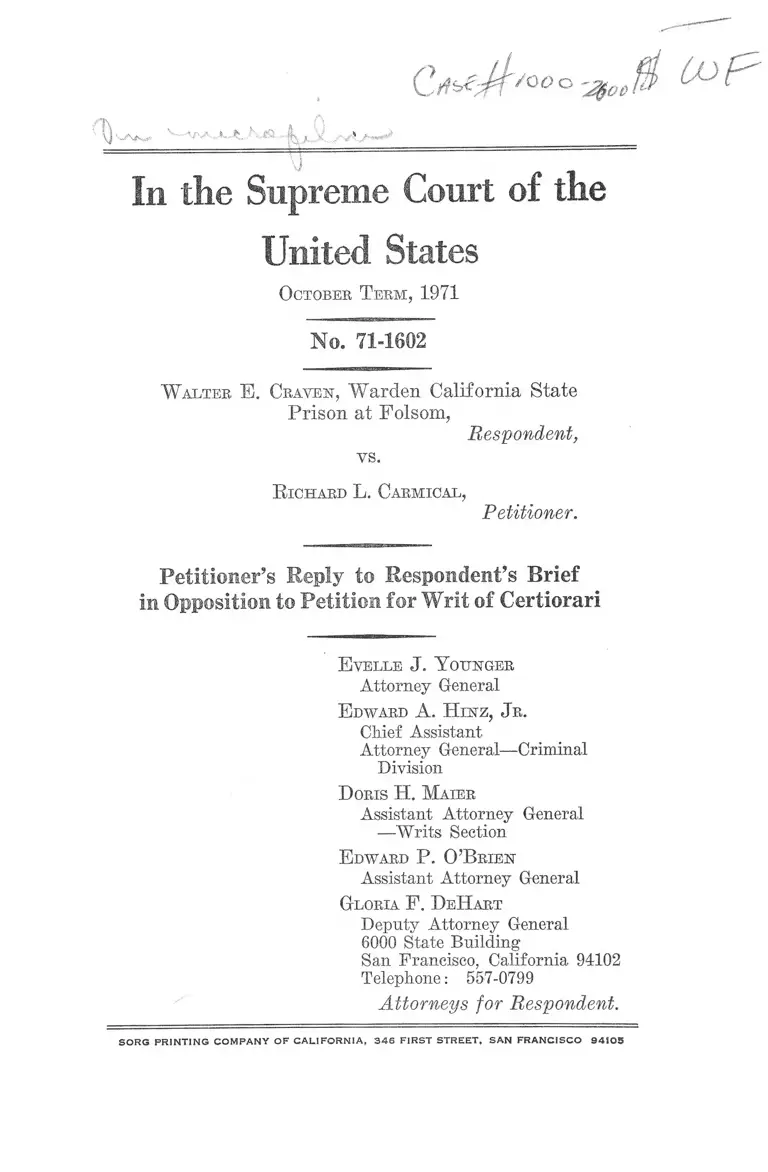
In the Supreme Court of the
United States
October T erm, 1971
No. 71-1602
V ....^ ....^ >-* 5 ■ /■ - /» J h ~ « >
W alter E. Craven, Warden California State
Prison at Folsom,
Respondent,
vs.
R ichard L. Cabmical,
Petitioner.
Petitioner’s Reply to Respondent’s Brief
in Opposition to Petition for Writ of Certiorari
E velle J. Y ounger
Attorney General
E dward A. H inz, J r.
Chief Assistant
Attorney General— Criminal
Division
D oris H. Maier
Assistant Attorney General
— Writs Section
E dward P. O’Brien
Assistant Attorney General
Gloria F. D eHart
Deputy Attorney General
6000 State Building
San Francisco, California 91102
Telephone: 557-0799
Attorneys for Respondent.
S O R G P R IN T IN G C O M P A N Y O F C A L IF O R N IA , 3 4 6 F IR S T S T R E E T , S A N F R A N C IS C O 9 4 I O S
SUBJECT INDEX
Page
Preliminary Statement...................................................... 1
I. Review of Certiorari Is Appropriate at This Time 1
II. The Question of When Deliberate By-Pass of a
Valid State Procedural Rule Precludes Habeas
Corpus Relief Is an Important One Which Should
Be Considered and Decided by This Court.........- 3
III. The Decision Below Incorrectly Applied the
Standards Established by This Court............... — 6
Conclusion.....................................................-.................... H
TABLE OF AUTHORITIES CITED
Cases
Pages
Carter v. Jury Commission, 396 U.S. 320 (1970) ....... 9
Donaldson v. California, 404 U.S. 968 (1971) .............. 8
Fay v. New York, 332 U.S. 261 (1947) ..................... 7
Fay v. Noia, 372 U.S. 391 (1963) ............................... 4
Gaston County v. United States, 395 U.S. 285 (1969) 7, 8, 9
Griggs v. Duke Power Company, 401 U.S. 424 (1971)..7, 8,10
Hill v. Texas, 316 U.S. 400 (1942) ................................. 5
Humphrey v. Cady, 405 U.S. 504 (1972) ........... ........ 4
Jefferson v. Hackney, 32 L.Ed. 285 (1972) ................ 8,10
Johnson v. Zerbst, 304 U.S. 458 (1938) .................... . 4
Lattimore v. Craven, 453 F.2d 1249 (9th Cir. 1972)..... 2
McMann v. Richardson, 397 U.S. 759 (1970) ........... . 4
People v. Jones, 25 Cal.App.3d 776, 102 Cal.Rptr. 277
(1972)............................................................................ 3
Peters v. Kiff, 33 L.Ed.2d 83 (1972) ......................... . 4, 5
People v. Newton, 8 Cal.App.3d 359, 87 Cal.Rptr. 394
(1970).... 6
People v. Sylvester, 3 Crim. 6488 (Sacramento) ............ 3
Turner v. Fouche, 396 U.S. 346 (1970) ........... 9
Statutes
Title VII, Civil Rights Act of 1964:
Section 703(a) ............................................................. 8
Section 703(h) ............................................................. 8,9
In the Supreme Court of the
United States
October T erm, 1971
No. 71-1602
W alter E. Craven, Warden California State
Prison at Folsom,
Respondent,
vs.
R ichard L. Carmical,
Petitioner.
Petitioner’s Reply to Respondent’s Brief
in Opposition to Petition for W rit of Certiorari
PRELIMINARY STATEMENT
Respondent’s Brief in Opposition to the Petition for
Writ of Certiorari, in addition to presenting argument on
the issues raised in the petition sets forth in an “ Introduc
tion” arguments which he asserts militate against granting
the petition. We respond first to the contentions raised in
this introduction, and then to the arguments made.
I
REVIEW BY CERTIORARI IS APPROPRIATE AT THIS TIME
Respondent advances three points alleged to militate
against the granting of the petition: 1) that the ease was
remanded for a hearing to prove or disprove the facts
alleged; 2) that the “clear thinking” test at issue is no
longer in use in Alameda County and accordingly does not
present an important problem in the administration of
2 :
justice; and 3) that the state’s claim as to the impact of the
decision is wholly speculative. We disagree with respond
ent’s characterization of the case and submit that review at
this time will prevent the development of significant prob
lems in the administration of justice and the needless waste
of time in the increasingly crowded state and federal
courts.
It is of course true that the facts as developed at a hear
ing in the District Court on remand may prove to be dif
ferent than those alleged in the petition. However, if, as
the District Court found and as petitioner has urged in
this Court, the facts alleged in the petition do not demon
strate that the jury panel was unconstitutionally selected,
return of this case for an evidentiary hearing would result
in a totally unwarranted waste of limited judicial resources.
Moreover, if the facts developed at a hearing do in fact dis
prove the allegations of the petition, the states comprising
the Ninth Circuit are left with a decision which establishes
what is in our view a totally erroneous statement of the
law and its application to the jury selection process, or at
least, with conflicting statements of the applicable standard.
Compare Lattimore v. Craven, 453 F.2d 1249,1251 (9th Cir.
1972).
Respondent has claimed that the case has no significance
because the test at issue was discontinued in 1968, and the
state’s claim of retrials in the hundreds is speculative. We
submit that the potential impact of this interpretation of
the criteria for jury selection is enormous because it may
require not only retrials in Alameda County, but is totally
retroactive and applicable throughout the Ninth Circuit.
We do not know how many counties in California or states
in the Ninth Circuit utilize “ intelligence” tests. However,
challenges to such tests on the basis of disproportionate
representation have been made in Los Angeles County, the
most populous in California, and in Sacramento County.1
Finally, the case in its present posture raises a signi
ficant issue of deliberate by-pass—the extent to which
federal courts should inquire into the motives and knowl
edge of counsel years after the event where there is no
question of the fairness of the trial or the justice of the
result.
We submit that this case raises issues of significance
which should be determined by this Court at this time, and
that further proceedings in this case, and in the others
which will inevitably be filed should certiorari be denied,
will unnecessarily burden both state and federal judicial
systems.
3
II
THE QUESTION OF WHEN DELIBERATE BY-PASS OF A VALID
STATE PROCEDURAL RULE PRECLUDES HABEAS CORPUS
RELIEF IS AN IMPORTANT ONE WHICH SHOULD BE CON
SIDERED AND DECIDED BY THIS COURT
In his state court trial, respondent Carmical raised no
question concerning the racial composition of the jury
panel from which the jury which tried him was selected.
For the reasons stated in our petition, we take the position
that Carmical’s failure to challenge the panel before trial
in accordance with state procedure precludes granting
relief on federal habeas corpus, without further inquiry
into counsel’s or respondent’s reasons, at least in cases
where there is no credible claim of incompetence of counsel.
Respondent in opposing the petition for writ of certiorari
on this question asserts that the decision below Avas correct
because the state did not “ fulfill its burden of demonstrat
1. See, Donaldson v. California, 404 U.S. 968 (1971) ; People
v. Jones, 25 Cal.App.3d 776, 102 Cal.Rptr. 277 (1972); People v.
Sylvester, 3 Crim. 6488 (Sacramento).
4
ing an affirmative, intelligent waiver of known constitu
tional rights . . . citing Johnson v. Zerbst, 304 U.S. 458
(1938), and Fay v. Noia, 372 U.S. 391 (1963), and two
recent cases decided by this Court: Humphrey v. Cady, 405
U.S. 504 (1972); Peters v. Kiff, 33 L.Ed.2d 83 (1972).
(Brief at 7-8.)
In Humphrey v. Cady, the defendant had raised constitu
tional questions concerning the Sex Crimes Act in the state
court proceedings, but the defendant’s counsel failed to
file a brief on the questions as requested by the trial judge.
When counsel failed to act, the court concluded that the
state petition was sufficient to support the order continuing
confinement. No appeal was taken from the order. The
District Court concluded that the failure of counsel to file
a brief amounted to a deliberate strategic decision to
abandon the constitutional claims and barred federal
relief. On these facts, this Court held that a hearing was
necessary to determine the reason for counsel’s failure to
file a brief and the extent of the defendant’s participation.
This Court noted that a defendant is not necessarily bound
by counsel’s decision.
We submit that in the instant case different circum
stances require a different result, and that despite the use
of the “knowing and intelligent waiver” standard in
Humphrey, failure properly to challenge a jury should pre
clude federal habeas corpus relief without further inquiry
as to the reasons.
This Court’s use of the “knowing and intelligent waiver”
standard in Humphrey cannot logically or even usefully
be extended to all trial decisions which involve constitu
tional rights;2 both the burden on the courts and the
2. Inquiry into motivation must end somewhere. Cf., McMann
v. Richardson, 397 U.S. 759, 768-69 (1970). In McMann, this Court
held that a counseled defendant was not entitled to a hearing on
his allegation that his plea of guilty was motivated by a coerced
potential for disrupting the administration of justice are
too great. Are we, for instance, to have a federal judicial
inquiry into the motives and knowledge of counsel who fail
to cross-examine a witness or who do not call a possible
witness? Are we to conduct, years later, a federal court
hearing to determine whether a defendant made a “knowing
and intelligent waiver” of his right to testify or his right
not to testify ?
Respondent points out that in Peters v. Kiff, supra, this
Court upheld a habeas petitioner’s claim of systematic
racial exclusion even though the claim was not raised at
trial. We note that the opinions constituting a majority in
that case did not discuss the issue of deliberate by-pass, so
apparently it was not raised as an issue in the case. It was
pointed out in the dissenting opinion, however, that Hill v.
Texas, 316 U.S. 400 (1942) on which Mr. Justice White’s
concurring opinion relied, was expressly limited to cases
where timely objection had been made. 33 L.Ed.2d at 99
(fn). Since the question was not ruled on, the case does not
preclude consideration of the question here. Moreover, in
Peters, the Court was establishing a new rule of standing
which at least provided a reason for reaching the issue
despite the doctrine of deliberate by-pass. In the instant
case, respondent insists that the rule applied by the Court
of Appeal is not a new rule; thus, there is no reason for
setting aside valid state procedural rules.8 3
confession. This Court considered his plea a “ plain by-pass” of
state remedies in regard to testing the confession and commented
that whether it was intelligent depended on whether he was so
incompetently advised by his counsel he should be afforded another
chance. There has been no claim of incompetent counsel here.
3. It is our position that the Court of Appeal incorrectly inter
preted the existing law while purporting to follow it, thus, in effect
establishing a new rule. If this Court does establish a different
standard, it should be prospective only, in accordance with Peters.
As pointed out in our petition, no legitimate interest of
a criminal defendant is protected by permitting collateral
attack on federal habeas corpus where he has failed to
raise the issue at the proper point in the trial process. The
state, however, has a compelling interest in the finality of
trials which have been fairly conducted with a jury satis
factory at the time. We submit that the reasons which
dictate the use of the “knowing and intelligent waiver”
standard in appropriate cases do not apply here and no
legitimate interest of the defendant is protected by apply
ing it.
6
I l l
THE DECISION BELOW INCORRECTLY APPLIED THE
STANDARDS ESTABLISHED BY THIS COURT
Respondent urges that the decision below is not in con
flict with decisions of this Court and that the state’s posi
tion that the case improperly applied decisions of this
Court is based on a semantic quibble over the word “ objec
tive” (Brief at 9-10).
The state does not contest the proposition that the statis
tics presented by Carmical below were sufficient to make
out a prima facie case of jury discrimination based on the
cases decided by this Court.4 However, these statistics were
not the only information presented to the court. The peti
tion showed that the disproportion was due to an objective
test of 25 questions which was given to all prospective
jurors. While respondent’s brief states that “ the test was
culturally biased so that blacks would fail it in greater
4. We note, however, that the “ statistics” presented to the
District Court and to this Court (Brief at 5) also showed that of
47 jurors chosen from the two selected districts in 1966, the year
of Carmical ’» trial, 6 were Negroes, a percentage of 12.8. As of
1968 Nevroes constituted 12.4 of the county population. See,
People v.N ewton, 8 Cal.App.3d 359, 389, 87 Cal.Bptr. 394, 414
(1970).
proportions than whites” (Brief at 11), this is not supported
by any allegation in the petition. In his testimony and affi
davit, the psychologist concluded that the test must measure
something other than average intelligence because it was
difficult to come to the conclusion that such a high per
centage of non-whites were below average. The possible
reason given was that some questions (20, 21 and 25) had a
“ cultural bias” and could account for the difference. It was
the opinion of the psychologist that the test was made up
without considering cultural differences. Thus, there is
nothing to support the statement that the test was biased
“ so that” blacks would fail it. The test was before the courts
below and is before this Court. It is obviously racially
neutral. Even if it is “ culturally biased,” whatever that
may mean, that does not make it unconstitutional. Any jury
panel must deal with problems and issues couched in. the
language and values of the prevailing culture. There is no
constitutional requirement that tests to screen jurors must
be so phrased that proportional percentages of various
groups are chosen. Indeed, this Court has held directly to
the contrary. See, Fay v. New York, 332 U.S. 261 (1947).
We also note that respondent’s and the psychologist’s other
criticisms of the test—that it was too short, that the pass
ing grade was too high, and that a time notice should have
been given—apply equally to everyone taking the test.
While these factors may have made the selection process
imperfect, again, it was completely “ racially neutral.”
Respondent urges that the decision below
“comes squarely within the rationale of Griggs v.
Duke Power Company, 401 U.S. 424 (1971), and
Gaston County v. United States, 395 U.S. 285 (1969),
holding invalid tests or other selection methods that
serve no valid purpose and that have a racially dis
criminatory impact, regardless of the intent behind
their use.” (Brief at 11.)
7
He then urges that the test for jury discrimination should
be no less stringent than for job discrimination, citing, to
buttress this conclusion, Jefferson v. Hackney, 32 L.Ed. 285
(1972). Neither Origgs nor Gaston applies to this case, and
Jefferson provides support for the state’s position herein.
In Griggs, this Court indicated that it granted review
“ to resolve the question whether an employer is
prohibited by the Civil Rights Act of 1964, Title VII,
from requiring a high school education or passing of a
standardized general intelligence test as a condition
of employment in or transfer to jobs when (a) neither
standard is shown to be significantly related to success
ful job performance, (b) both requirements operate to
disqualify Negroes at a substantially higher rate than
white applicants, and (c) the jobs in question formerly
had been filled only by white employees as part of a
longstanding practice of giving preference to whites.”
Section 703(a) of the Civil Rights Act provides inter alia
that it shall be an unlawful practice for an employer to
classify his employees in ways to adversely affect his status
because of Ms race, color, religion, sex or national origin.
Section 703(h) provides that is is not unlawful to give or
act on the results of a professionally developed ability test
provided the test “ is not designed, intended or used to dis
criminate because of race, color, religion, sex or national
origin.”
The Court in Griggs was concerned solely with interpret
ing the meaning of the Act. The Court noted that the objec
tive of Congress was to achieve equality of job opportuni
ties and remove past barriers:
“Under the Act, practices, procedures or tests neutral
on their face, and even neutral in terms of intent can
not be maintained if they operate to ‘freeze’ the status
quo of prior discriminatory employment practices
What is required by Congress is the removal of arti-
8
fieial, arbitrary, and unnecessary barriers to employ
ment when the barriers operate invidiously to dis
criminate on the basis of racial or other impermissible
classification . . . . The Act proscribes not only overt
discrimination but also practices that are fair in form
but discriminatory in operation. The touchstone is
business necessity. If an employment practice which
operates to exclude Negroes cannot be shown to be
related to job performance, the practice is ‘prohibited.’
Id. at 4319.
The Court then went on to discuss the meaning of section
703(h) authorizing test not “ designed, intended or used to
discriminate . . (Emphasis added by Court). The Court
noted that the Equal Employment Opportunity Commis
sion, with enforcement responsibility, had issued guidelines
interpreting this section to permit only the use of job
related tests. The Court then reviewed the legislative his
tory of the Act and concluded that the guidelines expressed
the will of Congress. Id. at 4320-21.
Thus, the decision is based entirely on statutory con
struction and not on constitutional requirements. We sub
mit that such a decision interpreting a statute and related
to the entirely different problems of employment is entirely
inapplicable to the instant ease. There is no constitutional
violation in a jury selection process unless intentional dis
crimination on grounds of race is shown. The Griggs ease
does not change in any way the position of the Court
expressed in Carter v. Jury Commission, 396 U.S. 320
(1970) and Turner v. Fouche, 396 U.S. 346 (1970).
Gaston involved the interpretation of the Voting Eights
Act of 1965 which suspended the use of any test or device
as a prerequisite to registering to vote in a jurisdiction in
which less than 50% of the voters were registered. The
burden was on the jurisdiction to rebut the presumption of
9
discrimination. The court concluded that it was appropriate
to consider whether a test had the effect of denying the
right to vote because the jurisdiction had maintained sepa
rate and inferior schools.
Respondent cites Jefferson in support of his argument
on the basis that this Court distinguished Griggs not on
grounds of statutory interpretation but on grounds that
the Griggs test had no legitimate purpose while the Texas
statute in Jefferson served a reasonable supportable pur
pose of the state. Thus, his argument continues, the present
case is within Griggs because the clear-thinking test served
no legitimate function (brief at 11, note 8). Respondent
not only misapprehends Jefferson, but misstates the “ facts”
in the instant case.
First, there is nothing in the record before this Court
to establish by allegation or otherwise that the test in
question served “no legitimate function whatever.” The
function of the test was to select jurors of ordinary intelli
gence pursuant to California statutes. That it did this less
than perfectly does not make it constitutionally deficient.
Second, in Jefferson, this Court declined to find invidious
discrimination in the unequal reduction of benefits among
AID classes merely because there was a larger percentage of
Negroes and Mexican Americans in the class with the
greatest reduction, where there was no intent to discrimi
nate in establishing the reductions. "While Jefferson in
volved the distribution of benefits and the interpretation
of the Social Security Act and thus had no necessary appli
cability to the jury discrimination problem, it does stand
for the proposition that disparity in racial percentages
absent a showing of intentional discrimination does not
constitute a violation of equal protection.
We submit that the use of the test at issue here, even if
it was imperfect, did not violate constitutional standards
1 0
and that the decision of the court below was clearly erro
neous and in conflict with decisions of this Court.
CONCLUSION
For the above reasons, we respectfully submit that the
petition for Writ of Certiorari be granted.
Dated: October 4, 1972
1 1
E velle J. Y ounger
Attorney General
E dward A. H inz, Jr.
Chief Assistant
Attorney General— Criminal
Division
D oris H. Maier
Assistant Attorney General
—"Writs Section
E dward P. O’Brien
Assistant Attorney General
Gloria F. D eH art
Deputy Attorney General
Attorneys for Respondent.