Bratcher v. Akron Area Board of Realtors Supplemental Brief for the United States as Amicus Curiae
Public Court Documents
March 10, 1967
-
Brief Collection, LDF Court Filings. Bratcher v. Akron Area Board of Realtors Supplemental Brief for the United States as Amicus Curiae, 1967. 49399732-b69a-ee11-be36-6045bdeb8873. LDF Archives, Thurgood Marshall Institute. https://ldfrecollection.org/archives/archives-search/archives-item/40ea477b-7d49-4430-8516-857cf7dc825c/bratcher-v-akron-area-board-of-realtors-supplemental-brief-for-the-united-states-as-amicus-curiae. Accessed September 18, 2026.
Copied!
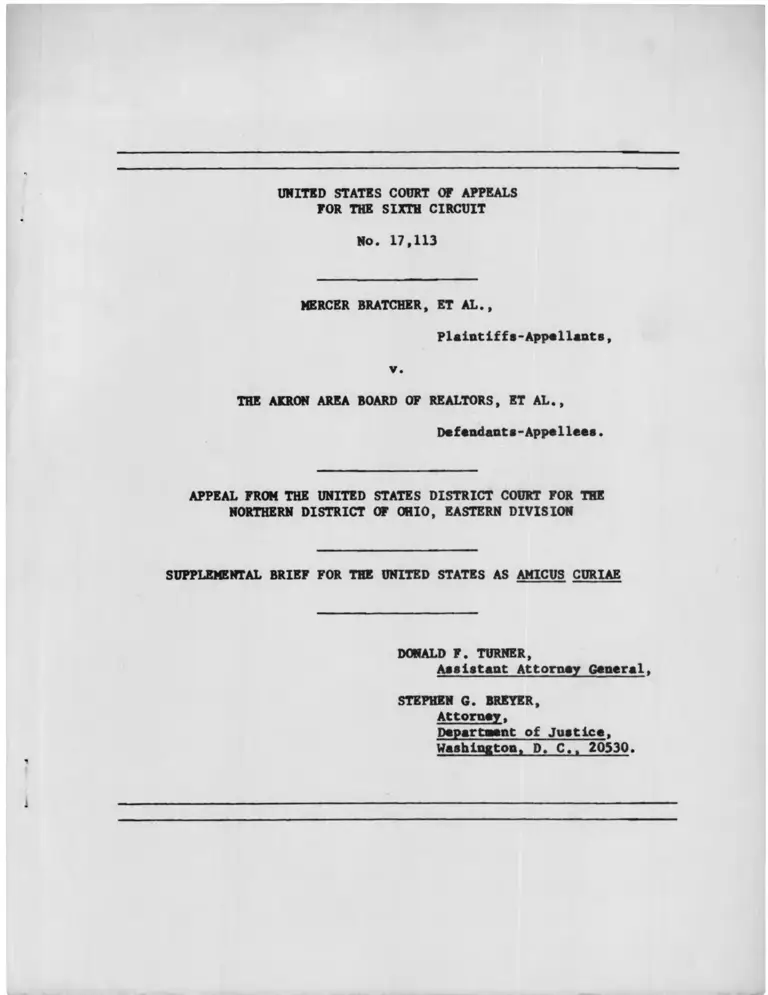
UNITED STATES COURT OF APPEALS
FOR THE SIXTH CIRCUIT
No. 17,113
MERCER BRATCHER, ET AL.,
Plaintiffs-Appallants,
v.
THE AKRON AREA BOARD OF REALTORS, ET AL.,
Dafandants-Appalleas.
APPEAL FROM THE UNITED STATES DISTRICT COURT FOR THE
NORTHERN DISTRICT OF OHIO, EASTERN DIVISION
SUPPLEMENTAL BRIEF FOR THE UNITED STATES AS AMICUS CURIAE
DONALD F. TURNER,
Assistant Attornay General,
STEPHEN G. BREYER,
Attornay.
Daparftnt of justice,
Washington, D. C., 20530.
I N D E X
Page
Interest of the United States .................................... 1
Supplemental brief for the United States as amicus curiae . . . . 2
CITATIONS
Cases:
Apex Hosiery Co. v. Leader, 310 U.S. 469 ................... 6
Atlantic City Electric Co. v. General Electric Co.. 226 F.
Supp. 5 9 .............................................. 5
Bookout v. Shine Chain Theaters, Inc.. 253 F. 2d 292 . . . . 9
Brown Shoe Co. v. United States. 370 U.S. 294 ............. 6
Centonni v. T. Smith & Son. 216 F. Supp. 330 ............... 9
Chattanooga Foundry & Pipe Works v. City of Atlanta. 203 U.S.
390 ..................................................... 4, 7
Comaonwealth Edison v. AllIs-Chalmers Mfg. Co. 335 F. 2d 203 7, 8
Conference of Studio Unions v. Loew's Inc.. 193 F. 2d 51 . . 9
Continental Ore Co. v. Union Carbide & Carbon Corp., 370 U.S.
690 ..................................................... 10
Feddersen Motors, Inc, v. Ward. 180 F. 2d 5 1 9 ............. 6
Georgia v. Evans. 316 U.S. 1 5 9 .............................. 4, 7
Gomberg v. Midvale Co.. 157 F. Supp. 1 3 2 ................... 9
Hanover Shoe Inc. v. United Shoe Machinery Corp.. 185 F.
Supp. 826, affirmed 281 F. 2d 481, cert, denied 364 U.S.
9 0 1 ..................................................... 7, 8
Leh v. General Petroleum Corp.. 382 U.S. 5 4 ............... 5
Louisiana Petroleum Retail Dealers, Inc, v. Texas Co.. 148
F. Supp. 334 .......................................... 3
Mandeville Is1And Farms, Inc, v. American Crystal Sugar Co..
334 U.S. 2 1 9 .......................................... 4, 7
Minnesota Mining & Manufacturing Co. v. New Jersey Wood
Finishing Co.. 381 U.S. 3 1 1 ............................ 5
Nagler v. Admiral Corp.. 248 F. 2d 3 1 9 ...................... 11
Noerr Motor Freight. Inc, v. Eastern Railroad Presidents
Conference. 113 F. Supp. 737 ......................... 11
Package Closure Corp. v. Sealright Co.. 141 F. 2d 972 . . . 11
Radovich v. National Football League. 352 U.S. 445 ........ 5, 10
Cases [Continued]: Page
Rossi v. McCloskey & Co., 149 F. Supp. 638 ................. 9
Schulman v. Burlington Industries, Inc., 255 F. Supp. 847 . 9, 10
Snow Crest Beverages. Inc, v. Recipe Foods. Inc.. 147 F. Supp.
907 ........................................................ 9
South Carolina Council of Milk Producers. Inc, v. Newton, 360
F. 2d 4 1 4 ................................................. 9
State of Illinois v. Brunswick Corp., 32 F.R.D. 453 . . . . 8
State of Missouri v. Stupp Bros. Bridge & Iron Co., 248 F.
Supp. 1 6 9 ................................................. 7
Streiffer v. Seafarers Seachest Corp., 162 F. Supp. 602 . . 7
Thomsen v. Kayser, 243 U.S. 6 6 .................................. 4, 7
United States v. Borden Co., 347 U.S. 5 1 4 ...................... 3, 8
Statutes:
Clayton Act, 15 U.S.C. 15, et seq.j
Section 4 ............................................... 3, 5, 6
Section 1 6 ............................................ 2, 5, 6
Miscellaneous:
Clark: "The Treble Damage Bonanza: New Doctrines of Damages
in Private Antitrust Suits," 52 Mich. L. Rev. 363 . . . 8
Note, 64 Columb. L. Rev. 570 ( 1 9 6 4 ) ....................... 6
u n i t e d sta tes c o u r t of a p p eals
FOR THE SIXTH CIRCUIT
Ho. 17,113
MERCER BRATCHER, ET AL., APPELLANTS
v.
THE AKRON AREA BOARD OF REALTORS, ET AL., APPELLEES
ON APPEAL FROM THE UNITED STATES DISTRICT COURT
FOR THE NORTHERN DISTRICT OF OHIO, EASTERN DIVISION
SUPPLEMENTAL BRIEF FOR THE UNITED STATES AS AMICUS CURIAE
INTEREST OF THE UNITED STATES
Th« United States wishes to file this suppleaental brief aaicus
curias in support of appellants because it believes that the arguments
aada In Defendants' Brief are erroneous and believes that their
acceptance by this Court would interefere with efficient antitrust law
enforceaant.
_1/ "Defendants' Brief" refers to the Brief on Behalf of All Defendant
Appellees Except First National Bank of Akron and Herberlch-Hall-Harter Inc.
SUPPLEMENTAL BRIEF FOR THE UNITED STATES AS AMICUS CURIAE
Appellants have brought this suit on behalf of (1) Negroes wishing
to buy or rent houses in white neighborhoods in Akron, (2) white hone
owners who wish to sell or rent such houses to Negroes, and (3) Negro
real estate dealers who wish to belong to the Akron Area Board of Realtors.
The Conplaint charges that nambers of the defendant board of realtors
have agreed not to sell houses in white neighborhoods to Negro custoawrs
and to exclude Negro real estate dealers fron their board. Defendants
claim that none of the three gremps of persons that plaintiffs represent
has standing to sue. The Government submits that— to the contrary— all
three groups have standing.
Appellants are bringing this suit, which asks for an injunction,
_2/
under Section 16 of the Clayton Act, 15 U.S.C. 26. They have standing
to sue if they meet the requirements of that section by alleging facts
which show (1) that they personally are "threatened" with "loss or damage,"
(2) that the activity threatening them violates the antitrust laws, and
(3) that they are entitled to an injunction under traditional principles
2/ Section 16 provides in relevant part: "Any person . . . shall be
entitled to sue for and have injunctive relief . . . against threatened
loss or damage by a violation of the antitrust laws . . . when and under
the same conditions and principles as injunctive relief against threatened
conduct that will cause loss or damage is granted by courts of equity . . .
15 U.S.C. 26.
2
of equity. United Stefa v. Borden Co., 347 U.S. 514, 518; Louisiana
Petroleum Retail Dealer*, Inc. v. Texaa Co.. 148 F. Supp. 334, 336
(W.D. La. 1956). Defendants argue that the appellants must also satisfy
3/the requirements of Section 4 of the Clayton Act, 15 U.S.C. 15,—
(applicable to treble damage plaintiffs) by alleging facts which show
an injury to appellants "business or property."
Appellants' complaint satisfies all these requirements. First,
it charges that defendants' conspiracy threatened plaintiffs with
personal "loss or damage" to their "business or property." It claims
that defendants' conspiracy injures the business of plaintiff real
estate brokers by denying them the "benefits of membership on the
Board, thereby restraining [their] . . . sale and rental of real prop
erty." (Complaint VII C). It claisw that the conspiracy— in preventing
willing homeowners from selling property in white neighborhoods to
Negroes— directly injures other Negro plaintiffs by artificially re
stricting where they can live (Complaint VII, E, F), and it injures
their property by forcing them "to pay more money than white persons
for equivalent housing" (Complaint VII 6). And, it claims that the
3/ Section 4 provides in relevant part: "Any person who shall be
injured in his business or property by reason of anything forbidden
in the antitrust laws may sue therefor . . . and shall recover three
fold the damages by him sustained . . . ." 15 U.S.C. 15.
3
conspiracy injura* cha proparty of whita plaintiffs by dapriving than
of "tha opportunity to sail or rant real proparty nora . . . profitably"
(Conplaint VII H). A conspiracy that forcas a buyar to pay higher prices
or a sailer to sell at lower prices injures tha "property" of tha buyar
and of the sellar. Chattanooga Foundry & Pipe Works v. City of Atlanta,
203 U.S. 390; Mandeville Island Farna, Inc, v. Anarlean Crystal Sugar Co..
334 U.S. 219; Georgia v. Evans, 316 U.S. 159; Thonsen v. Kaysar, 243 U.S.
66.
Second, the conplaint alleges facts which, if proved, would show
that defendants' conspiracy violates tha antitrust laws. Our argunent
to this affect is sat out in Brief for tha United States as Anicus Curiae,
pp. 17-22, to which we refer the Court. Third, if defendants prove the
facts alleged in their conplaint, they will have shown that they are
entitled to an injunction under ordinary principles of equity, because
they will have shown a substantial serious personal injury caused by
defendants' illegal conduct, because an injunction will not prove
inequitably burdensone to defendants, and, since the conspiracy is a
continuing one and since damages for at least some of the injury that
it causes plaintiffs may be hard to assess in monetary terms, because
plaintiffs' remedy at law is inadequate.
4
We do not mean to suggest by this discussion that we accept defen
dants' argument that plaintiffs in an action brought under Section 16
nust also sect Section 4's requirement of showing an injury to "business
or property"--particularly if the words "business or property" are inter
preted restrictively. While it may make sense in damage actions to limit
the type of harm for which money can be recovered to injuries to business
or property— injuries the dollar value of which can be more or less readily
ascertained--there is no reason to limit the type of harm that will jus
tify the issuance of an injunction to injuries that can be easily labeled
with a price tag. Moreover, the fact of a strong Congressional policy
favoring private antitrust actions, "one of the surest weapons for effec
tive enforcement of the antitrust laws," Minnesota Mining & Manufacturing
Co. v. New Jersey Wood Finishing Co., 381 U.S, 311, 318; Atlantic City
Electric Co., v. General Electric Co., 226 F. Supp. 59, 71 (S.D.N.Y.1964),
indicates that the courts should not engraft the restrictive requirements of
Section 4 on to Section 16. In fact, the Supreme Court has expressly warned
that the courts "should not add requirements to burden the private litigant
beyond what is specifically set forth by Congress." Radovich v. National
Football League, 352 U.S. 445, 454. And that Court has indicated that
"niggardly construction[s]" of statutes governing treble damage actions should
be avoided. Leh v. General Petroleum Corp., 382 U.S. 54, 59. See also Note,
5
64 Coluab. L. Rev., 570 (1964). But, in any event, wa submit that
even if this Court dacidas that plaintiffs oust aaat Section 4'a
requirements, thair complaint is adaquata, for it allagas facts suff
icient to satisfy tha raquiraaants of both Section 16 and Section 4.
Defendants argue, however, that Negroes wishing to buy or rent
houses in Akron's white neighborhoods and white homeowners wishing to
sell or rent those houses to Negroes lack standing to sue because they
are ultimate consumers and are not "businessman-competitors" of defen
dant real estate dealers (Defendants' Brief, pp. 33-35). But there
is no requirement that private plaintiffs be either businessmen or
competitors of antitrust defendants. Indeed, the antitrust laws,
which primarily protect "competition, not competitors," Brown Shoe
Co. v. United States, 370 U.S. 294, 344, are basically designed to
prohibit practices "which tend to raise prices or otherwise take from
buyers or consumers the advantages which accrue to them from free com
petition in the markets." Feddersen Motors, Inc, v. Ward, 180 F. 2d
519, 521 (10th Cir. 1950). [Emphasis added.] The SupresM Court and
lower courts have said over again that the Sherman Act protects "pur
chasers and consumers," Apex Hosiery Co. v. Leader, 310 U.S. 469, 498;
6
Mandeville Island Farms Co. v. American Crystal Sugar Co., supra at
236; Streiffer v. Seafarers Seachest Corp., 162 F. Supp. 602, 607
(E.D. La. 1958). And, they have said this for good reason, as many
hardcore antitrust violations, such as price fixing, will not hurt
the conspirators' competitors (indeed they may be enriched) but will
injure only consumers. Thus, it is not surprising that courts have
uniformly held that the antitrust laws give a private right of action
to purchasers of the goods and services involved in the restraint,
whether those purchasers are businessmen, e .£., Thomsen v. Kayser,
supra; Commonwealth Edison v. Allis-Chalmers Mfg. Co., 335 F. 2d 203
(7th Cir. 1964); Hanover Shoe, Inc, v. United Shoe Machinery Corp.,
185 F. Supp. 826 (M.D. Pa.), affirmed 281 F. 2d 481 (3rd Cir.),
cert, denied, 364 U.S. 901 (1960), or whether they are ultimate con
sumers. Chattanooga Foundry & Pipe Works v. City of Atlanta, supra,
(Holmes, J.: "[The City of Atlanta was] injured in its property, at
least, if not in its business of furnishing water, by being led to
pay more than the worth of the pipe" 203 U.S. at 396); Georgia v.
Evans, supra (Frankfurter, J.: "[Congress would not want to have
deprived] a State,as purchaser of commodities . . . , of the civil
remedy of treble damages which is available to other purchasers who
suffer through violation of the Act" 316 U.S. at 162); State of
Missouri v. Stupp Bros. Bridge & Iron Co., 248 F. Supp. 169 (W.D. Mo.
1965) ( state, as consumer of highways, sues highway equipment manufacturer);
7
Stitt of Illinois v» Brunswick Corp., 32 F.R.D. 453 (N.D. 111. 1963)
(stats, raprasanting school districts, suas makers of blaachar seats
sold to the school districts). Cf. Hanover Shoe, Inc. v. United Shoe
Machinery Corp., supra, at 831. See also Clark,"The Treble Damage
Bonanza: New Doctrines of Damages in Private Antitrust Suits," 52
_ 4 /
Mich. L. Rev., 363, 404 (1954).
In fact, because of the importance of private actions as an aid
to the enforcement of the antitrust laws, sea United States v. Borden
Co., supra, courts have held that purchasers who are middleman may
bring private actions against suppliers engaged in a price fixing con
spiracy even though price increases were passed on to the ultimate
consumer. E .£., Commonwealth Edison Co. v. Allis-Chalmers Mfg. Co.,
supra. It would be anomalous in the extresm to allow an antitrust
remedy to these middlesmn while denying it to ultimate consumers when
they bear the full brunt of an illegal conspiracy. Mora importantly,
to deny ultimata consumers an antitrust remedy would deprive the
government of any aid that private antitrust actions might give it in
preventing regional conspiracies at a retail level— conspiracies that
may not involve sufficient amounts of commerce to warrant investing the
government's enforcement resources. In sum, we can find no good reason
4/ Suits by ultimata consumers are infrequent because normally the
amount that could ba recovered would not justify the cost of suit.
8
for denylog plaintiff* in this casa standing to sue. Plaintiffs are
direct customers for the services, provided by defendant real estate
brokers. If, as plaintiffs claim, those services have been illegally
restricted, the restriction has injured them directly
Defendants also claim that the plaintiff real estate brokers lack
standing to sue because "they are not the persons who were intended to
be the victims of the alleged conspiracy" (Defendants' Brief, p. 40).
5/ The cases cited by defendants are not in point for they involve
suits (1) by a supplier to a company injured by an antitrust violation
(Snow Crest Beverages, Inc, v. Recip* Foods, Inc., 147 F. Supp. 907
(D. Mass. 1956)); (2) by employees of injured companies (Conference of
Studio Unions v. Loew's. Inc.. 193 F. 2d 51 (9th Cir. 1951)); Centonni
v. T. Smith & Son, 216 F. Supp. 330 (K.D. La. 1963); Rossi v. McCloskey
& Co., 149 F. Supp. 638 (E.D. Pa. 1957); and (3) by shareholders of
injured companies (Gomberg v. Midvale Co., 157 F. Supp. 132 (E.D. Pa.
1955)); Bookout v. Shine Chain Theaters, Inc., 253 F. 2d 292 (2d Cir.
1958). Even if the restrictive philosophy implicit in such opinions is
correct--* question not entirely free from doubt, see South Carolina
Council of Milk Producers, Inc, v. Newton, 360 F. 2d 414 (4th Cir. 1966);
Schulman v. Burlington Industries, Inc., 255 F. Supp. 847 (S.D.N.Y. 1966),
--they all involve plaintiffs who are not the direct victims of an anti
trust conspiracy but whose injuries follow incidentially from the injury
caused another. In each of these cases there exists a primary victim
free to bring a private suit. In the instant case, however, Negroes
seeking houses and white persons offering to sell them are the direct
customers of the service allegedly restricted, and Negro real estate
dealers are defendants' direct competitors. They are thus the direct
and primary victims of any illegal restriction. If they cannot sue to
obtain redress, no on* (except the government) can.
[Note: Insofar as the "employee" cases cited above involve employees
not working for an allegedly injured company, they may not state a
cans* of action under the entitrust laws because of the labor exemp
tion. See, Conference of Studio Union* v. Loew's Inc., supra.]
9
The complaint charges, however, that defendants "combined and conspired"
to exclude "Negro real estate brokers from the advantages and opportun
ities associated with membership in the defendant Board" (Complaint
VI C 8). And, it adds that as a result of the conspiracy, "Negro real
estate brokers have been denied benefits of membership on the Board
thereby restraining the sale and rental of real properties by such
brokers" (Conplaint, VIII C). It is difficult to see how that complaint
could have alleged more clearly that plaintiff real estate brokers were
intended direct victims of an illegal conspiracy. "It does not matter
that defendants under the allegations may be conspiring to produce the
restraints hurting plaintiffs only as part of an over-all scheme to
reach still bigger game. A conspiracy in antitrust law, as elsewhere,
may have a variety of objects and victims. Continental Ore Co. v. Union
Carbide & Carbon Corp.. 370 U.S. 690, 698-699." Schulman v. Burlington
Industries, Inc.. 255 F. Supp. 847, 851 (S.D.N.T. 1966). In fact, the
Supreme Court has specifically held that a victim of an illegal boycott
may bring a private antitrust action even though the ultimate purpose of
the boycott may not have been to injure him. Radovich v . National Foot
ball League, supra. Negro real estate brokers in this case qualify as
antitrust plaintiffs, for whatever the ultimate purpose of the alleged
illegal agraement to exclude them from the real estate board, such an
agreement by its very nature, had to be aimed at them and had to harm
them directly. See Schulman v. Burlington Industries. Inc., supra.
10
There is, thus, no nssd to give plaintiffs complaint that libaral
latituda in intarpratation to which it is antitlad, sae Noerr Motor
Freight, Inc, v. Kastarn Railroad Prasidants Confaranca, 113 F. Supp.
737, 742 (E.D. Penn. 1953); Package Closure Corp. v. Saalright Co.,
141 F. 2d 972, 979 (2d Cir. 1944); Maglar v. Admiral Corp., 248 F. 2d
319 (2d Cir. 1957), in order to sae that it alleges that defendants'
conspiracy in part directly aimed at and injured plaintiff real estate
brokers.
In sum, plaintiffs in this case represent direct customers for
the services of real estate brokers— services which defendants allegedly
illegally restrained. They also represent direct competitors. These
two groups of people, custoswrs and competitors, are the most important
of all those who are protected by the antitrust laws. They, if anyone,
were meant by Congress to have a private right of action to prevent
violations of the antitrust laws which injure them. And by giving such
persons private rights of action, Congress has provided an important
aid to the enforcement of the antitrust laws. Congress clearly did not
intend to leave antitrust enforcement of the type envisaged here entirely
in the hands of the Government. For these reasons, we submit, plaintiffs
do not lack standing to sue.
DONALD F. TURNER,
Assistant Attorney General,
STEPHEN G. BREYER,
Attorney.
MARCH 1967
CERTIFICATE OF SERVICE
1 hereby certify that 1 have this day caused the foregoing
Supplemental Brief Amicus Curiae to be served upon all parties
by causing a copy thereof to be mailed, postage prepaid and prop
erly addressed, to each of the following:
Jack Greenberg, Esquire
10 Columbus Circle
New York, New York
Sidney D. L. Jackson, Jr., Esquire
Baker, Hostetler & Patterson
1965 Union Commerce Building
Cleveland, Ohio
Ivan L. Smith, Esquire
O'Neil & Smith
16 South Broadway
Akron, Ohio 44308
C. Blake McDowell, Jr., Esquire
Brouse, McDowell, May, Bierce & Wortman
500 First National Tower
Akron, Ohio 43308
V /K
Stephen G. Breyer
Attorney
MARCH 1 0t 1967