Sassower v Field Amicus Curae
Public Court Documents
December 10, 1991
15 pages
-
Brief Collection, LDF Court Filings. Sassower v Field Amicus Curae, 1991. cc5b739e-c39a-ee11-be37-00224827e97b. LDF Archives, Thurgood Marshall Institute. https://ldfrecollection.org/archives/archives-search/archives-item/48522081-d6b2-46c4-9756-24ca034b734d/sassower-v-field-amicus-curae. Accessed September 15, 2026.
Copied!
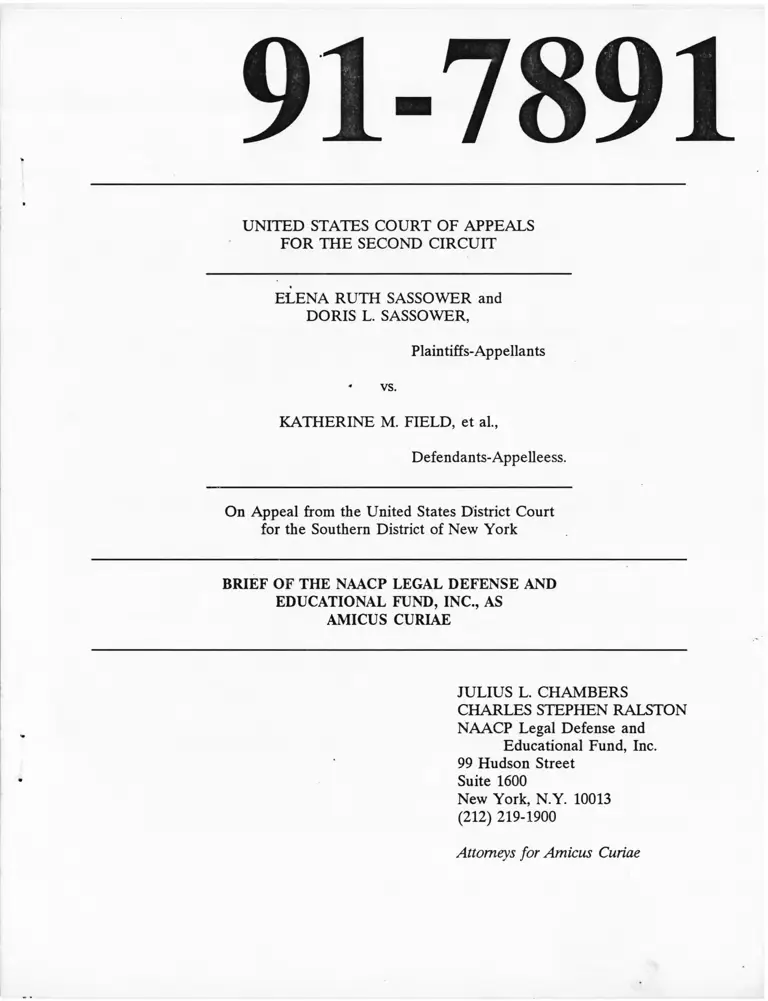
    91-7891
UNITED STATES COURT OF APPEALS

FOR THE SECOND CIRCUIT

ELENA RUTH SASSOWER and
DORIS L. SASSOWER,

Plaintiffs-Appellants

♦ vs.

KATHERINE M. FIELD, et al.,

Defendants- Appelleess.

On Appeal from the United States District Court
for the Southern District of New York

BRIEF OF THE NAACP LEGAL DEFENSE AND
EDUCATIONAL FUND, INC., AS

AMICUS CURIAE

JULIUS L. CHAMBERS
CHARLES STEPHEN RALSTON
NAACP Legal Defense and

Educational Fund, Inc.
99 Hudson Street
Suite 1600
New York, N.Y. 10013
(212) 219-1900

Attorneys for Amicus Curiae


INTEREST OF AMICUS CURIAE ..................................................................................  1

STATEMENT OF THE ISSU ES.........................................................................................  2

STATEMENT OF THE C A S E ............................................................................................  2

ARGUMENT ......................................................................................................................... 3

In troduction .................................................................................................................. 3

I. AN AWARD OF FEES WAS NOT PROPER UNDER
CHRISTIANSBURG ........................................... .............. . ..........................  4
1. There was clearly established a prima facie case of

discrimination.........................................................................................  5
2. There were other indicia of intentional discrimination.........................  5
3. The inadequacy of proffered defenses.......................................................  6
4. The ultimate question was the credibility of the defendants................. 7

II. FEES WERE NOT APPROPRIATE UNDER RULE 11,
28 U.S.C. § 1927, OR THE INHERENT POWER OF THE COURT . 8
A. Rule 11......................................................................................................... 9
B. Fees Were Not Permissible under 28 U.S.C. § 1927.......................... 10
C. Fees Under the General Power of the Court......................................  10

CONCLUSION ....................................................................................................................... 11

CERTIFICATE OF S E R V IC E ............................................................................................  12

TABLE OF CONTENTS


TABLE OF AUTHORITIES

Cases: Pages:

Alyeska Pipeline Service Co. v. Wilderness Society,
421 U.S. 240 (1975).........................................................................................  10

Carrion v. Yeshiva University,
535 F.2d 722 (2d Cir. 1976)......................................................................................... 8

Castaneda v. Partida, 430 U.S. 482 (1977) ...........................................................................7

Christiansburg Garment Co. v. EEOC,
434 U.S. 412 (1978)....................................................................................passim

Connecticut v. Teal, 457 U.S. 440 (1982) ................................................................................. 7

Furnco Construction Corp. v. Waters,
438 U.S. 567 (1978).......................................................................................................... 7

McDonnell Douglas Corp. v. Green,
411 U.S. 792 (1973)...................................................................................................  5, 7

Metropolitan Housing Development Corp. v. Village of Arlington Heights,
429 U.S. 252 (1977).......................................................................................................... 5

Robinson v. 12 Lofts Realty, Inc.,
610 F.2d 1032 (2d Cir. 1 9 7 9 )..................................................................................  5, 6

Sassower v. Field, 752 F.Supp. 1182 (S.D.N.Y. 1990).....................................................  5, 8

U.S. Postal Service Bd. of Govs. v. Aikens,
460 U.S. 711 (1983).......................................................................................................... 8

Statutes: Pages:

28 U.S.C. § 1927 ...........................................................................................................................8

42 U.S.C. § 1988 ........................................................................................................................... 9

42 U.S.C. § 3613(c)...................................................................................................................... 3

Rule 11, F.R. Civ. Proc.................................................................................................. 8-10, 12

Other Authorities: Pages:

H. Rep. No. 94-1558 (94th Cong., 2d Sess., 1976)...............................................................9

H.Rep. No. 100-711 (100th Cong., 2d Sess., 1988)...............................................................9

S. Rep. No. 94-1011 (94th Cong., 2d Sess., 1976) ................................................................9

li


NO. 91-7891

UNITED STATES COURT OF APPEALS
FOR THE SECOND CIRCUIT

ELENA RUTH SASSOWER and
DORIS L. SASSOWER,

Plaintiffs-Appellants

vs.

KATHERINE M. FIELD, et al.,

Defendants-Appellees.

On Appeal from the United States District Court
for the Southern District of New York

BRIEF OF THE NAACP LEGAL DEFENSE AND
EDUCATIONAL FUND, INC., AS

AMICUS CURIAE

INTEREST OF AMICUS CURIAE*

The NAACP Legal Defense and Educational Fund, Inc., is a non-profit corporation

formed to assist African Americans to secure their constitutional and civil rights by means

of litigation. For many years, attorneys of the Legal Defense Fund have represented

parties in litigation before the United States Supreme Court and the federal courts of

appeals and district courts involving a variety of civil rights issues. Of particular concern

are issues concerning the award of attorneys’ fees under the various civil rights statutes, and

the use of sanctions against civil rights plaintiffs. Thus, the Legal Defense Fund has

*A11 parties have consented to the filing of this Brief pursuant to Rule 29, F.R. App.
Proc.


appeared as counsel* 1 and as amicus curiae2 in most of the leading civil rights attorneys’

fees cases.

As we explain below, this case presents a vitally important issue to the continuing

vitality of the civil rights statutes — whether plaintiffs in such a case can be subject to a

massive award of attorneys’ fees when their case had sufficient merit to survive a motion

for summary judgment and to be presented to a jury for a decision on the merits. It is

amicus’ position that the result reached by the court below is contrary to the clear intent

of Congress when it passed the fees acts and would deter all civil rights plaintiffs regardless

of the merits of their claims.

STATEMENT OF THE ISSUES

Amicus relies on the Statement of the Issues as stated by Plaintiffs-Appellants.

STATEMENT OF THE CASE

Amicus does not present a separate Statement of the Case, but will discuss relevant

aspects of the case in its Argument.

lE.g., Newman v. Piggie Park Enterprises, Inc., 390 U.S. 400 (1968); Bradley v. School Bd.
of City of Richmond, 416 U.S. 696 (1974); and Hutto v. Finney, 437 U.S. 678 (1978).

lE.g, Christiansburg Garment Co. v. EEOC, 434 U.S. 412 (1978) and Hensley v.
Eckerhart, 461 U.S. 424 (1983).

2


ARGUMENT

Introduction

The district court’s award was based primarily on the attorneys’ fees provision of the

Fair Housing Act of 1968, as amended,42 U.S.C. § 3613(c); under that provision, as with

other civil rights fees statutes, an award may be made to defendants only upon a showing

that the plaintiffs’ action was meritless because it was "frivolous, unreasonable, or without

foundation," and not simply because the plaintiffs ultimately lost. Christiansburg Garment

Co. v. EEOC, 434 U.S. 412, 421 (1978).3 The Supreme Court went on to caution that:

[I]t is important that a district court resist the understandable temptation to
engage in post hoc reasoning by concluding that because a plaintiff did not
ultimately prevail, his action must have been unreasonable or without
foundation. This kind of hindsight logic could discourage all but the most
airtight claims, for seldom can a prospective plaintiff be sure of ultimate
success. No matter how honest one’s belief that he has been the victim of
discrimination, no matter how meritorious one’s claim may appear at the
outset, the course of litigation is rarely predictable. Decisive facts may not
emerge until discovery or trial.

434 U.S. at 421-22.

Amicus urges that:

1. The rigorous standard of Christiansburg was not met in this case;

2. The Christiansburg standard applies so that a fee award was not proper under any

of the alternative bases used by the district court.

3Amicus notes that plaintiffs take the position that the amendment to the Housing Act
fee provision that permitted defendants to recover fees under the Christiansburg standard
should not apply to this case, since the action was commenced prior to the effective date
of the amendment. In our brief we assume for the sake of argument only that the
amendment does apply, since in our view fees may not be awarded under any
circumstances. We would note that to apply the amendment to a case commenced before
its effective date raises serious questions in light of Congress’ intent in enacting the original
fees provision to encourage the bringing of fair housing cases without the deterrent effect
of potential liability for a prevailing defendants’ counsel fees.

3


AN AWARD OF FEES WAS NOT PROPER UNDER CHRISTIANSBURG

As noted above, the standard under Christiansburg is a rigorous one in light of

Congress’ overall purpose to encourage private attorneys-general to bring the litigation

necessary to enforce the public policy embodied in the civil rights laws. Thus, fees may be

awarded against a plaintiff only where it is clear that the action was meritless, frivolous, and

without foundation from the beginning, or if it became so at some point in the litigation

and, nevertheless, the plaintiff continued to pursue the case. In the present case, the

district court granted fees for all time spent after the effective date of the amendment to

the fees act that allowed fees to defendants in fair housing cases. The court made no

specific finding that plaintiffs should have known at that point in time that their case was

"wholly without merit;" thus, the implication is that the court decided that the case was

meritless and known to be so from its initiation. Amicus urges that there was simply no

basis for such a holding but that, to the contrary, there was sufficient basis for the case to

go to the jury.

Virtually all intentional discrimination cases share certain characteristics in terms of

the locus of evidence and actual knowledge of the motives of the charged party. First,

virtually all relevant evidence, particularly documentary, is in the possession of the

defendant. Secondly, whether non-discriminatory reasons given for the challenged action

are the real ones, whether there are both discriminatory and non-discriminatory reasons,

and whether the non-discriminatory reasons are pretextual, are primarily issues of credibility

that must ultimately be determined by the fact-finder. Thus, the ultimate determination

on the merits of a claim of intentional discrimination must, in virtually every instance, await

trial. It necessarily follows that, barring a showing that plaintiffs possess actual knowledge

that their claims of discrimination are without any foundation, it can only be the hindsight

cautioned against by the Supreme Court that could lead to the conclusion that a case with

enough substance to go to a jury could be the basis of a fee award against the plaintiffs.

I.

4


If, in other words, there is enough in the case to defeat a motion to dismiss, a motion for

summary judgment, and a motion for directed verdict because a prima facie case has been

established, it is improper to award fees under Christiansburg.

The present case falls squarely within this rule for a number of reasons.

1. There was clearly established a prima facie case o f discrimination.

The standards governing the establishment of a prima facie case of discrimination

in a fair housing case were set down in Robinson v. 12 Lofts Realty, Inc., 610 F.2d 1032 (2d

Cir. 1979). That case also involved the sale of a cooperative apartment, and is instructive

not only as to the elements of a prima facie case, but with regard to proof of intentional

discrimination in general. In the present case, the district court, in denying defendants’

motion for summary judgment, held that under Robinson, plaintiffs had established a prima

facie case in that they had shown that: (1) they were members of a protected class; (2) they

had applied for and were qualified to purchase the apartment; (3) that they were rejected;

and (4) that the apartment remained available. Sassower v. Field, 752 F.Supp. 1182

(S.D.N.Y. 1990). This conclusion was clearly correct.

2. There were other indicia o f intentional discrimination.

As Robinson further noted, other factors besides the four elements borrowed from

McDonnell Douglas Corp. v. Green, 411 U.S. 792 (1973) can go to prove intentional

discrimination. The Court cited in particular Metropolitan Housing Development Corp. v.

Village o f Arlington Heights, 429 U.S. 252 (1977), and its holding that an important factor

in assessing whether discrimination played a role in a decision was "departures from the

normal procedural sequence." 429 U.S. at 267, cited at 610 F.2d at 1038. Here, the

plaintiffs had substantial evidence that the co-op’s established guidelines for evaluating a

request to purchase were not followed in their case. Another piece of probative evidence

was the testimony at deposition by Mr. William Iolonardi, a member of the co-op board,

that he had an intense personal dislike of plaintiff Elena Sassower. (Transcript of Iolonardi

Deposition, pp. 294-95.) Whatever the basis of that dislike, and Mr. Iolonardi was unable

5


to articulate one at the deposition, his testimony, along with the rest of the available

evidence, could certainly lead to the inference that its underlying basis was prejudice that

resulted in unlawful discrimination. Given the lack of clearly articulated and objective

standards by which the decision to reject plaintiffs was made, it was certainly plausible that

such discrimination infected the process as a whole. Certainly, under the standards set out

at length in Robinson, an adequate and probing inquiry was fully warranted. 610 F.2d at

1040-42.4

3. The inadequacy o f proffered defenses.

In assessing fees, the district court pointed to certain alleged facts that it claimed

should have alerted plaintiffs that their case was without merit. First, other single women

had been accepted as purchasers; second, other Jews lived in the building; and third, the

sponsors of the co-op were Jewish. However, none of these facts necessarily meant that

plaintiffs’ claims were without foundation. With regard to the presence of members of

plaintiffs’ protected class in the building, the mere fact that a defendant has not

discriminated against all members of a protected class, does not necessarily mean that it

has not discriminated against others. Particularly well known in fair housing cases in the

New York Metropolitan area is the existence of upper-limit quotas against Jews and racial

minorities in buildings; by allowing a few members of these groups in, landlords and owners

hope to be able to mount a defense against claims by others.

Here, defendants did not come forth with any statistical data or purchase and rental

applications from which it could be determined the actual number of Jews and single

women purchasers. Moreover, as the Supreme Court has explicitly held, even if statistical

evidence showed that a workforce (or here, occupants of housing) was properly

4Particularly noteworthy is the fact that in Robinson one of the reasons advanced was
similarly subjective "animosity" towards the would-be purchaser. The Court noted that "the
courts have generally viewed subjective explanations with considerable skepticism" since
'H[a]ny defendant can respond to a discriminatory effect with a claim of some subjective
preference or prerogative and, if such assertions are accepted, prevail in virtually every
case.’" 610 F.2d at 1040. (Emphasis in the original.)

6


representative of the eligible population, that showing would only be one "not wholly

irrelevant" factor in a defendants’ attempt to rebut a prima facie case. Furnco Construction

Corp. v. Waters, 438 U.S. 567, 580 (1978). It could not be a conclusive defense to plaintiffs’

claim since the right to be free of discrimination is an individual one. See Connecticut v.

Teal, 457 U.S. 440, 453-54 (1982). It should also be noted that plaintiffs were not able to

develop highly relevant evidence through which they could demonstrate whether these

defenses were pretextual, viz., the application forms and other statistical data to establish,

for example, whether Jews and/or single women were rejected at the same rate and on the

same bases as other groups.5

Finally, with regard to the fact that the sponsors of the co-op were Jewish, the

sponsors were not involved in or passed on plaintiffs’ application. Most importantly, all of

the voting members of the co-op’s board of directors who decided who would or would not

be allowed to purchase were not Jewish.6

4. The ultimate question was the credibility o f the defendants.

Given the prima facie case and the other circumstantial evidence from which

discrimination could have been inferred, it is clear that the case would ultimately come

down to whether the fact-finder believed that the reasons advanced by the defendants were

in fact the real reasons, or were simply pretexts designed to mask discriminatory motives.

Indeed, the district court itself recognized this fact when it denied defendants’ motion for

summary judgment. In its order it stated:

It is apparent that the plaintiffs’ claims against the Lake Street defendants
cannot be resolved on summary judgment, the plaintiffs have stated the

5As the Supreme Court held in McDonnell Douglas Corp. v. Green, 411 U.S. 792, 804-05
(1973) comparisons between the treatment of plaintiffs and persons not in their class and
statistical evidence showing the general policy and practices are highly relevant in judging
whether proffered explanations are pretexts for discrimination.

6The district court apparently concluded that the fact that the co-op’s sponsors were of
the same group as plaintiffs constituted a defense to the prima facie case. That
presumption was wrong as a matter of law. See Castaneda v. Partida, 430 U.S. 482, 499
(1977).

7


elements of a prima facie case of housing discrimination and the defendants
have articulated nondiscriminatory reasons for their actions. The question
of pretext, however, is one that must be decided by a jury. The parties
bitterly dispute many material facts and the conflicting versions can only be
resolved by a jury.

Sassower v. Field, 752 F.Supp. at 1189-90.

The question of pretext turns on the credibility to be given to defendants’ witnesses

and involves determining the defendants’ state of mind. As the Supreme Court has

cautioned:

All courts have recognized that the question facing triers of fact in
discrimination cases is both sensitive and difficult. . . . There will seldom be
"eyewitness" testimony as to the [defendant’s] mental processes.

U.S. Postal Service Bd. of Govs. v. Aikens, 460 U.S. 711, 716 (1983). Here, the state of

defendants’ minds was not established until the verdict of the jury; to hold plaintiffs’

responsible for forecasting what that verdict would be is, again, to indulge in precisely the

hindsight warned against by the Supreme Court.

In short, amicus urges that Christiansburg does not permit the assessment of fees

against plaintiffs in a civil rights action where there is sufficient evidence to require the

finder of fact to decide the case based on the credibility to be given to the reasons

advanced by the defendants to meet a prima facie case.7

II.
FEES WERE NOT APPROPRIATE UNDER RULE 11,

28 U.S.C. § 1927, OR THE INHERENT POWER OF THE COURT

The district court also rested its award of fees on a number of alternative bases.

Amicus urges that, given the overriding Congressional purpose expressed in the fees acts,

the award can be upheld on those bases either.

7Thus, this case does not permit fees under the theory of Carrion v. Yeshiva University,
535 F.2d 722, 728 (2d Cir. 1976), where the district court based a fee award on the
plaintiff’s lack of credibility.

8


A. Rule 11.

Although the district court acknowledged that Rule 11, F.R. of Civ. Proc.> cannot

serve as a fee-shifting device, it then proceeded to use it as such by holding that plaintiffs

violated Rule 11 when they signed the original complaint. The court based its holding that

the case was baseless ab initio on the factors discussed above relating to Jews and single

women being in the building and Jews being the sponsors. However, for the reasons stated

above, those facts simply do not establish that the action was baseless.

Most important, we urge that Rule 11 can not be used to override the application

of the Christiansburg standard in a civil rights case but that, in judging whether an action

is without merit when filed, the latter must govern. Congress has consistently reaffirmed

that a rigorous showing must be made in order to assess fees against a civil rights plaintiff.

Indeed, it is noteworthy that in a fair housing case, the amendment to permit defendants

to recover fees was enacted in 1988, after the amendment to Rule 11 in 1983. Nothing in

the legislative history of the amendment even remotely suggests that Christiansburg is not

to govern. The House Report states that "the same definition of prevailing party as used

in the Civil Rights Attorneys Fees Act [42 U.S.C. § 1988] is to be used in this Act."8 The

Fees Act, in turn, embodies the requirement that defendants can receive fees only if the

action was clearly frivolous9, and is governed by Christiansburg.

In sum, where, as here, fees are not awardable under Christiansburg, they may not

be awarded by using Rule 11 as a fee-shifting device10.

8H.Rep. No. 100-711 (100th Cong., 2d Sess., 1988), p. 23.

9S. Rep. No. 94-1011 (94th Cong., 2d Sess., 1976), p. 5; H. Rep. No. 94-1558 (94th
Cong., 2d Sess., 1976), p. 7.

10This is not to suggest that sanctions under Rule 11 cannot be awarded in a civil rights
case under appropriate circumstances. Thus, if a particular paper is found to have been
signed in violation of the rule, sanctions can be awarded as to that paper even though the
case as a whole is not subject to a fee award under Christiansburg. What is not permissible
is to use Rule 11 to trump the Christiansburg standard by applying the rule to the filing of
the complaint and everything that occurs after that act.

9


B. Fees Were Not Permissible under 28 U.S.C. § 1927.

Once again, amicus urges that the specific provisions of the fee provision of the Fair

Housing Act govern as against the more general provision of 28 U.S.C. § 1927. As with

the case of Rule 11, although in a particular case specific acts may be found to be

sanctionable under § 1927, it cannot be used as a general fee-shifting provision. This is

true in all civil rights cases, but particularly in Fair Housing cases where the 1988

amendment permitting fees to prevailing defendants under Christiansburg was enacted after

the amendment to § 1927 in 1980 that permits attorneys fees to be awarded as part of the

costs of multiplying litigation vexatiously. Here, the district court seems to have intended

§ 1927 fees to be an alternative to Fair Housing Act fees since it did not specify the

particularly hours and expenses compensated by the § 1927 award, but merely designated

round figures as sanctions.

C. Fees Under the General Power of the Court.

As the Supreme Court has repeatedly made clear, federal courts do not possess

general authority to award fees to prevailing parties. Alyeska Pipeline Service Co. v.

Wilderness Society, 421 U.S. 240 (1975). Thus, fee awards under an "inherent" power are

limited to those cases where an action has been brought or prosecuted in bad faith, or

maliciously and wantonly. Christiansburg, 434 U.S. at 417. That standard, however, is

more rigorous than the Christiansburg one (id. at 419), so that it necessarily follows that

since, for the reasons set out above, fees are not awardable under Christiansburg they are

not awardable under the inherent power of the court.

10


CONCLUSION

Cases involving claims of intentional discrimination often, in amicus’ experience,

become emotionally charged on both sides. Plaintiffs are aggrieved by what they believe

to be unconscionable conduct; defendants are aggrieved by what they believe to be

accusations of unlawful or even immoral conduct. The ultimate resolution of such cases

will depend on divining the mental state of the defendant, a task that can, in the last

analysis, only be carried out by the fact finder. In assessing claims for fees on behalf of

prevailing defendants after a full trial on the merits, courts must be diligent in avoiding

hindsight and second guessing, and penalizing plaintiffs for what a person not directly

affected by the controversy may react to as overzealousness. The enforcement of the civil

rights acts and the vindication of the national policy against invidious discrimination in all

its forms depends on the zealous advocacy by plaintiffs acting as "private attorneys-general."

The assessment of large attorneys’ fees against plaintiffs when they lose will only result in

all civil rights plaintiffs being deterred from seeking their day in court and the consequent

undermining of the enforcement of the civil rights laws.

For the foregoing reasons, amicus urges that the decision of the court below should

be reversed.

CHARLES STEPHEN RALSTON
NAACP Legal Defense and

Educational Fund, Inc.
99 Hudson Street
Suite 1600
New York, N.Y. 10013
(212) 219-1900

Attorneys for Amicus Curiae

Dated: New York, N.Y.
December 10, 1991

11


CERTIFICATE OF SERVICE

I hereby certify that I have this date served counsel for all parties in this action with

true and correct copies of the foregoing Brief of the NAACP Legal Defense and

Educational Fund, Inc., as Amicus Curiae by placing the same in the United States mail,

first class postage prepaid, addressed as follows:

Doris L. Sassower, Esq.
Elena Ruth Sassower
283 Soundview Ave.
White Plains, N.Y. 10606

Steven L. Sonkin, Esq.
Marshall, Conway & Wright, P.C.
116 John Street
New York, N.Y. 10038

/Y v
Done this day of December, 1991.

Lawrence J. Glynn, Esq.
Two William Street
White Plains, N.Y. 10601

Dennis T. Bernstein
Apicella, Bernstein & Milano
111 Lake Avenue
Tuckahoe, N.Y. 10707

12