Thurgood Marshall Legal Society and Black Pre-Law Association v Hopwood Petition for Writ of Certiorari
Public Court Documents
April 30, 1996
42 pages
-
Brief Collection, LDF Court Filings. Thurgood Marshall Legal Society and Black Pre-Law Association v Hopwood Petition for Writ of Certiorari, 1996. 56826c1a-bd9a-ee11-be36-6045bdeb8873. LDF Archives, Thurgood Marshall Institute. https://ldfrecollection.org/archives/archives-search/archives-item/4c4da0a4-9c22-44ca-a4a2-0be3cba43cc3/thurgood-marshall-legal-society-and-black-pre-law-association-v-hopwood-petition-for-writ-of-certiorari. Accessed September 19, 2026.
Copied!
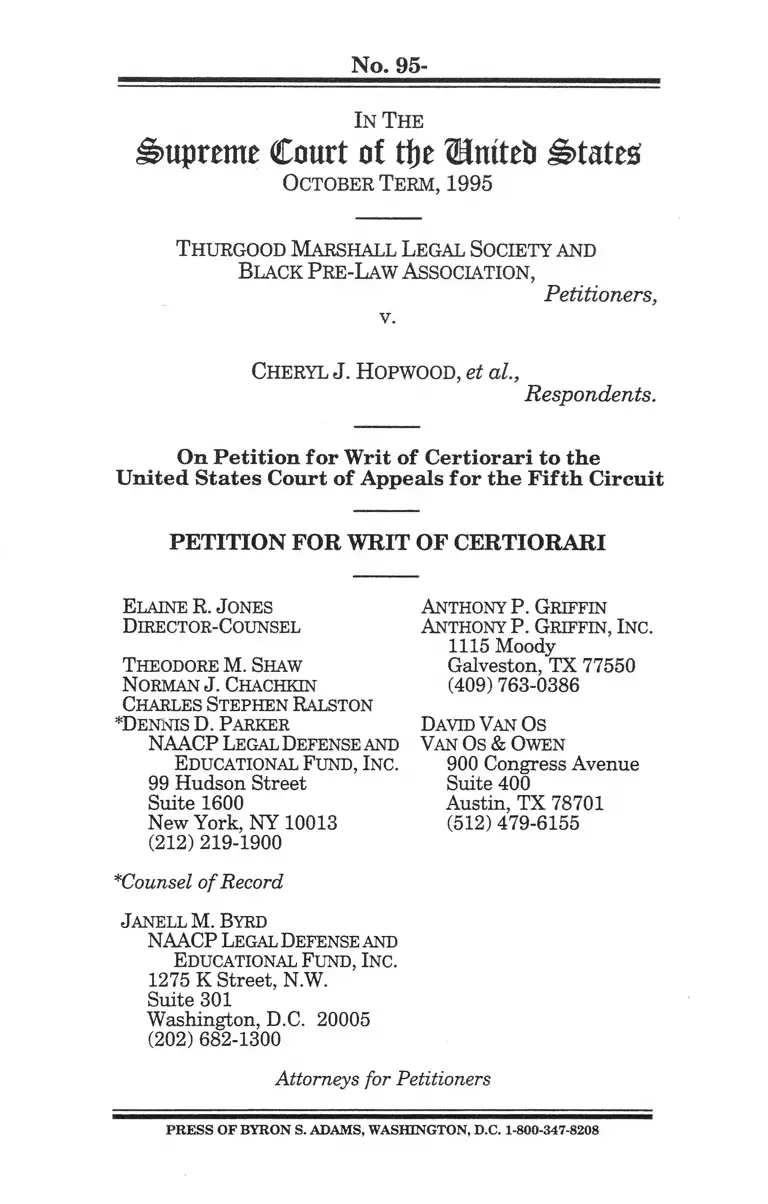
    No. 95-

In The

Supreme Court of tfje Ifmteb States?
October Term, 1995

Thurgood Marshall Legal Society and
Black Pre-Law Association,

Petitioners,
v.

Cheryl J. H opwood, et a l,
Respondents.

On Petition for Writ of Certiorari to the
United States Court of Appeals for the F ifth Circuit

PETITION FOR WRIT OF CERTIORARI

E laine R. J ones Anthony  P . Gr iffin
Directo r-Counsel  Anthony  P . Gr if f in , In c .

1115 Moody
T h eodore  M. Shaw  Galveston, TX 77550
N orman J. Chachkin  (409) 763-0386
Charles St e ph e n  Ralston

*De n n is  D. P arker  David Van  O s
NAACP Legal Defen se  and Van Os & Ow en

E ducational F u n d , In c .
99 Hudson Street
Suite 1600
New York, NY 10013
(212) 219-1900

*Counsel of Record

J anell  M. Byrd
NAACP Legal Defen se  and

E ducational F u n d , In c .
1275 K Street, N.W.
Suite 301
Washington, D.C. 20005
(202) 682-1300

Attorneys for Petitioners

900 Congress Avenue
Suite 400
Austin, TX 78701
(512)479-6155

PRESS OF BYRON S. ADAMS, WASHINGTON, D.C. 1-800-347-8208


1

QUESTIONS PRESENTED
1. Should this Court grant certiorari to resolve a conflict
among the Circuits as to the standard to determine whether
a party may intervene as a matter of right under Rule 24(a),
Fed. R. Civ. Proc., when the party on whose side the
intervenor seeks to join is a governmental agency?

2. Were petitioner organizations of African-American
students improperly prevented from protecting their
members’ constitutional and statutory rights to seek
admission to the University of Texas Law School free of
racial discrimination when the courts below refused to allow
them to intervene in this lawsuit -  in which white plaintiffs
seek to bar any consideration of race in the Law School’s
admissions process -  even though Petitioners sought to offer
evidence and present defenses which the other parties to the
case refused to advance, and which Petitioners contend
establish the need for the Law School to take race into
account in making admissions decisions in order to mitigate
the continued effects of its own (and other Texas
governmental entities’) prior, intentional racial
discrimination and in order to neutralize the racially
discriminatory impact of other admissions criteria utilized by
the Law School?
3. Did the courts below err in finding that a State whose
higher educational system continues to be subject to the
mandate of the federal executive agency enforcing Title VI
of the 1964 Civil Rights Act (42 U.S.C. § 2000d) requiring
that it dismantle the remaining vestiges of its prior dual
structure, could and would adequately represent the interests
of African-American students who were the intended victims
of the discriminatory practices which pervaded and underlay
that dual structure?

4. Did the court below so far depart from the accepted
and usual course of judicial proceedings in applying the "law
of the case" doctrine to issues that patently were not decided


11

in prior proceedings (and which the panel itself
characterized as having been, at best, "implicitly decided") as
to warrant correction by this Court in the exercise of its
supervisory authority?


PARTIES TO THE PROCEEDING

The parties to the litigation are:

Petitioners (Proposed Intervenors):
Thurgood Marshall Legal Society
Black Pre-Law Association

Plaintiffs (Respondents):
Cheryl J. Hopwood
Douglas W. Carvell
Kenneth R. Elliot
David A. Rogers

Defendants (Respondents):

The State of Texas
The University of Texas Board of Regents
Bernard Rapoport, Ellen C. Temple, Lowell H. Leberman,
Jr., Robert J. Cruikshank, Thomas O. Hicks, Zan W.
Holmes, Jr., Tom Loeffler, Martha E. Smiley, and Mario
Ramirez, members of the University of Texas Board of
Regents
The University of Texas at Austin
Robert M. Behrdahl, President of the University of Texas at
Austin
Mark Yudof, Dean of the University of Texas Law School
Stanley Johanson, Professor of Law at the University of
Texas School of Law

iii


IV

TABLE OF CONTENTS

QUESTIONS PRESENTED ........................................  i

PARTIES TO THE PROCEEDING ...........................  iii

OPINIONS BELOW ............. .......... .......................... . 1

JURISDICTION . .................................................    1

CONSTITUTIONAL AND STATUTORY
PROVISIONS INVOLVED ...............     1

STATEMENT OF THE CASE .................................. . 2
A. Proceedings Below ........................................  2
B. Statement of F ac ts ........................................  9

REASONS FOR GRANTING THE WRIT
INTRODUCTION......................  15

I. Certiorari should be granted to
resolve a conflict among the Circuits
as to whether the standard for
intervention as of right on the side of
a governmental agency is more
stringent than the standard
established by Trbovich v. United
Mine Workers...........................................  17

II. This Court should review the denial
of intervention in this case, which
involves race conscious admissions in
higher education and the continuing
vitality of Bakke, from which the
panel improperly departed, and
which should not be resolved without
the evidence that Petitioners sought
to present as Intervenors........................  19


V

III. This Court should review the denial
of Petitioners’ motions for
intervention because the bases upon
which the court below affirmed the
trial court’s denials conflict with
relevant decisions of this Court and
depart from accepted standards of
judicial conduct. . .................................. 25

CONCLUSION ............................................................ 30


VI

TABLE OF AUTHORITIES

Cases: Pages:

Adams v. Richardson,
351 F. Supp. 636, 356 F. Supp. 92 (D.D.C.),
modified and ajf’d unanimously en banc
480 F.2d 1159 (D.C. Cir. 1973), dismissed sub
nom. Women’s Equity Action League v. Cavazos,
906 F.2d 742 (D.C. Cir. 1990) ....................  12, 13

Association Against Discrimination in Employment v.
City of Bridgeport,
594 F.2d 306 (2d Cir. 1979) cert, denied 455
U.S. 988 (1982) .................... .. .................. .. . 24

Borders v. Rippy,
247 F.2d 268 (5th Cir. 1957).............................  14

Bowen v. United States,
422 U.S. 916 (1975) ........................................  21

Brody by and Through Sugzdinis v. Spang,
957 F.2d 1108 (3rd Cir. 1992) ......................... 18

Bush v. Vitema,
740 F.2d 350 (5th Cir. 1984)...............................  4

Conservation Law Foundation v. Mosbacher,
966 F.2d 39 (1st Cir. 1992) ........................... .. 19

County Court of Ulster County v. Allen,
442 U.S. 140 (1979) ........................................  21

Dimond v. District of Columbia,
792 F.2d 179 (D.C. Cir. 1986) ......................... 18


Environmental Defense Fund, Inc. v. Higginson,
631 F.2d 738 (D.C.Cir. 1979)........................... 18

Flax v. Potts,
204 F. Supp. 458 (N.D. Tex. 1962), aff’d, 313
F.2d 284 (5th Cir. 1963).................................... 14

Groves v. Alabama State Board of Education,
776 F. Supp. 1518 (M.D. Ala. 1991)................ 23

Hopwood v. Texas
861 F. Supp. 551 (W.D. Tex. 1994)....................  1

Houston Independent School District v. Ross,
282 F.2d 95 (5th Cir. 1960) ........................ .. . 14

Kirkland v. New York Dept, of Correction Services,
628 F.2d 796 (2d Cir. 1980), cert, denied. 450
U.S. 980 (1981) ............................................... 24

Knight v. Alabama,
14 F.3d 1534 (11th Cir. 1994)..........................  25

LULAC v. Clements,
999 F.2d 831 (5th Cir. 1993), cert, denied, 114
S. Ct. 878 (1994)..............................................  14

Larry P. v. Riles,
793 F.2d 969 (9th Cir. 1984).............................  23

Martin v. Wilks,
490 U.S. 755 (1989) .................. ...................... 29

vii
Pages:

Meek v. Dade County,
985 F.2d 1471 19


Mille Lacs Band of Indians v. Minnesota,
989 F.2d 994 (8th Cir. 1993)........................ .. , 18

Regents of the University of California v. Bakke,
438 U.S. 265 (1978) ............................... .. . passim

Rodriguez de Ouijas v. Shearson/American Express,
Inc., 490 U.S. 477 (1989) ............................... .. 21

Sagebrush Rebellion, Inc. v. Watt,
713 F.2d 525 (9th Cir. 1983)........................ .. . 18

Sanguine, Ltd. v. United States Department of the
Interior, 736 F.2d 1416 (10th Cir. 1984) . 18

Smuck v. Hobson,
408 F.2d 175 (D.C. Cir. 1969) .................... 29

Stallworth v. Monsanto Co.,
558 F.2d 257 (5th Cir. 1977).............................  29

Sweatt v. Painter,
339 U.S. 629 (1950) .................... .. 10, 11, 17

Three Affiliated Tribes v. World Engineering,
467 U.S. 138 (1984) ........................................  21

Trbovich v. United Mine Workers,
404 U.S. 528 (1972) ............. ............... 17, 18, 26

United States v. Fordice,
505 U.S, 717 (1992) ........................  6, 13, 24, 25

vin

Pages:

United States v. Hooker Chemicals & Plastics,
749 F.2d 968 (2nd Cir. 1984) ............. 18


IX

Pages:

United States v. New York,
820 F.2d 554 (2nd Cir. 1987) ........................... 18

United States v. Oregon,
839 F.2d 635 (9th cir. 1988)........................  18, 19

United States v. State of Texas,
321 F. Supp. 1043, 330 F. Supp. 235 (E.D. Tex.
1970), aff’d with modifications, 447 F.2d 441
(5th Cir. 1971), cert, denied,
404 U.S. 1016 (1972)............................... .. 14

United States v. Stringfellow,
783 F.2d 821 (9th Cir. 1986), vacated
remanded on other grounds sub nom.,
Stringfellow v. Concerned Neighbors in Action,
480 U.S. 370 (1987) ........................................  18

United States v. Texas Eastern Transmission
Corporation,
923 F.2d 410 (5th Cir. 1991) ........................  29

United States v. Texas Education Agency (Austin),
467 F.2d 848 (5th Cir. 1972)............................. 14

Venegas v. Skaggs,
867 F.2d 527 (9th Cir.) aff’d 495 U.S. 82
(1989)................................................................  29

Walton v. Alexander,
20 F.3d 1350 (5th Cir. 1994) ...........................  21

Washington Electric Company v. Massachusetts
Municipal Electric Company,
922 F.2d 92 (2d Cir. 1990)...............................  29


Wygant v. Jackson Board of Education,
476 U.S. 267 (1986)   22

Statutes: Pages:

Fed. R. Civ. P. 24 (a) .................................. 2, 18, 26, 29

Fed. R. Civ. P. 24(a) .............................................  3, 4, 17

Fed. R. Civ. P. 24(b) .................................................  3, 5

Tex. Const, art. VII, §7 (1925, repealed 1969) ...........  10

28 U.S.C. § 1254(1) ........................................................  1

42 U.S.C. §§ 1981 and 1983 ........................................... 2

42 U.S.C. § 2000d .....................................................passim

34 C.F.R. § 100.3(b)(2) ...............................................  23

Pages:


OPINIONS BELOW
The opinion of the United States Court of Appeals

for the Fifth Circuit was filed on March 18, 1996, is
reported at 78 F.3rd 932 (5th Cir. 1996) and is reprinted in
the Appendix at la-93a.

The May 11,1994 opinion of the United States Court
of Appeals for the Fifth Circuit affirming the initial denial
of intervention is reported at 21 F.3d 603 (5th Cir. 1994)
(per curiam) and appears at 94a-100a. The August 19, 1994
opinion of the United States District Court for the Western
District of Texas declaring unconstitutional the admission
process used at the University of Texas Law School is
reported at 861 F. Supp. 551 (W.D. Tex. 1994) and can be
found in the appendix at 101a-187a. On January 24, 1994,
the District Court denied the Petitioners’ first motion for
intervention the unpublished decision of the district court is
contained in the appendix at 190a-195a. An unpublished
order entered on July 15, 1994 by the District Court for the
Western District of Texas denying Petitioners' second motion
for intervention appears at 188a-189a. On March 18, 1992,
Petitioners' suggestion for rehearing en banc was denied.
This denial can be found at 196a-198a. The Fifth Circuit on
April 23, 1996 issued two opinions of seven of the sixteen
judges dissenting from the Court of Appeal’s failure to grant
rehearing en banc in this case and the consolidated case on
the merits both of which appear at 196a-210a.

JURISDICTION
The jurisdiction of this Court is invoked pursuant to

28 U.S.C. § 1254(1). The judgment of the United States
Court of Appeals was filed on March 18, 1996. The Order
denying the petition for rehearing was entered April 4,1996.

CONSTITUTIONAL AND STATUTORY PROVISIONS
INVOLVED

This case involves the Fourteenth Amendment to the United
States Constitution which provides, in relevant part:


2

All persons bom or naturalized in the United States,
and subject to the jurisdiction thereof, are citizens of
the United States and the State wherein they reside.
No state shall . . . deny any person within its
jurisdiction the equal protection of the laws.

The case also involves Title VI of the Civil Rights Act of
1964, 42 U.S.C. § 2000d, which states:

No person in the United States shall, on the ground
of race, color or national origin, be excluded from
participation in, be denied the benefits of, or be
subjected to discrimination under any program or
activity receiving Federal financial assistance.

The case also involves Fed. R.Civ. P. 24 (a), which states, in
relevant part:

Intervention of Right. Upon timely application
anyone should be permitted to intervene in an action
. . .  (2) when the applicant claims an interest relating
to the property or transaction which is the subject of
the action and the applicant is so situated that the
disposition of the action may as a practical matter
impair or impede the applicant’s ability to protect
that interest, unless the applicant’s interest is
adequately represented by existing parties.

STATEMENT OF THE CASE
A. Proceedings Below

This suit was initiated by the filing of two complaints
on September 29, 1992 and April 23, 1993 by two separate
groups of white plaintiffs who had unsuccessfully applied for
admission to the University of Texas Law School
(hereinafter "the Law School") for the school year beginning
in 1992. Plaintiffs claimed that the consideration of race by
the Law School as part of a remedial policy of affirmative
action in admissions violated the Fourteenth Amendment to
the United States Constitution; 42 U.S.C. §§ 1981 and 1983;


3

and Title VI of the Civil Rights Act of 1964, 42 U.S.C. §§
2000d et seq.

The district court bifurcated the procedural and
merits issues and allowed the commencement of discovery
related solely to issues of standing and ripeness. The State
of Texas filed a motion for summary judgment on
procedural grounds on August 13, 1993 which the District
Court denied on October 28, 1993. On November 17, 1993,
the Court authorized the beginning of merits discovery.

On January 5, 1994, less than two months after the
beginning of discovery and nearly three months before its
scheduled completion, Petitioners first moved to intervene
in the case. Petitioners are two organizations of African-
American students. The first, the Black Pre-Law
Association (hereinafter "the BPLA") of the University of
Texas at Austin, consists of undergraduate students
interested in attending law school, including at the
University of Texas. Each year, a number of BPLA’s
student members have applied for admission to the Law
School.

The second organization, the Thurgood Marshall
Legal Society ("TMLS") is an association of students at the
Law School dedicated to advancing legal education for
African-Americans and serving the legal and other needs of
African-Americans.

Petitioners sought intervention as a matter of right
under Fed. R. Civ. P. 24(a), as well as permissive
intervention pursuant to Fed. R. Civ. P. 24(b). They alleged
that the State could not adequately represent their interests
because of 1) the long history of the State’s discrimination
against African-Americans; 2) the State’s need to balance
the defense of the affirmative action program against other
interests such as fiscal responsibility, administrative concerns
and public opinion (which would necessarily constrain the
defense of affirmative action); and 3) the fact that the


4

Petitioners were in a better position to present evidence of
recent discrimination. 97a.

In its order denying intervention as of right, 90a, the
District Court, citing the Fed. R. Civ. P. and Bush v. Vitema,
740 F.2d 350 (5th Cir. 1984), relied upon a presumption that
the State could be counted upon to adequately defend its
own affirmative action program, and dismissed as speculative
the Petitioners’ concerns that the State would not fully
represent their interest in the upcoming hearing.

The district court also denied permissive intervention
on the ground that adding Petitioners to the case "would
needlessly increase cost and delay disposition of the
litigation." 194a.

On appeal, the Fifth Circuit upheld the denial of
intervention as of right, articulating both the general
presumption of adequate representation by existing parties
cited by the District Court and a more stringent presumption
applicable to cases involving state parties and governmental
agencies:

where the party whose representation is said to be
inadequate is a governmental agency, a much
stronger showing of inadequacy is required . . . .  In
a suit involving a matter of sovereign interests, the
State is presumed to represent the interests of its
citizens.

97a-98a (citations omitted).
The Fifth Circuit ruled that these presumptions had

not been overcome because Petitioners had demonstrated
neither that the State would not strongly defend its
affirmative action program nor that the Petitioners had a
separate defense of the affirmative action plan that the State
would not present at hearing. In reaching these
conclusions, the Court relied explicitly upon its expectation
that the State would present at the forthcoming trial


5

evidence that Petitioners felt was necessary to protect their
interests:

Although the BPLA and TMLS may have ready
access to more evidence than the State, we see no
reason they cannot provide this evidence to the State.
The BPLA and the TMLS have been authorized to
act as amicus and we see no indication that the State
would not welcome their assistance.

98a.1

At the ensuing trial, the district court limited
Petitioners’ role to that of amici curiae and afforded them
no opportunity to introduce evidence or argue before the
court. Following the direction of the Fifth Circuit,
Petitioners provided the State of Texas with evidence
showing that the Texas Index, a statistical measure
combining undergraduate grade-point average and LSAT
scores used in sorting applicants to the Law School, could
not reliably predict law school performance of first-year
African-American students and offered the State the
testimony of an expert qualified to present evidence that
race-conscious admissions to the Law School were necessary
to avoid the discrimination and potential Title VI liability
that would result from reliance on the Texas Index
exclusively.2 The state declined to introduce the evidence
or the testimony of the expert witness, presented no
evidence concerning the validity of the Texas Index and

1Noting that the Fifth Circuit had never reversed a lower court’s
decision on Rule 24(b) permissive intervention, the Court found that the
district court had not abused its discretion in denying petitioners' motion
to intervene. 99a-100a.

2One need not presume animus on the part of the state to
understand why such evidence would be awkward for the state to
introduce.


6

raised no argument that race-conscious measures were
required to mitigate the discriminatory effect of its use.

At the conclusion of trial, Petitioners submitted a
post-trial amicus brief supporting the constitutionality of the
Law School’s admission policy. In the brief, Petitioners
again argued (relying upon the declaration of the expert
witness proffered to the State) that rather than being an
unjustified preference for African-American students, the
challenged race-conscious admission process was legally
required to ameliorate the discriminatory impact of the
Texas Index.

Plaintiffs moved to strike portions of Petitioners’
post-trial amicus brief including the declaration. Although
the district court denied the motion to strike, it indicated
that it would consider only the evidence introduced at trial
by the parties.

On July 12, 1994, before the district court had
announced its judgment on the merits, Petitioners moved
again to intervene for the limited purpose of introducing
evidence supporting the independent defenses that the State
failed to raise. The district court denied that motion without
opinion on July 15, 1994. 188a-189a.

On August 19, 1994, the district court entered
judgment on the merits for plaintiffs, holding that while
certain types of race-conscious admissions are
constitutionally justified at the Law School, the 1992
admissions policy under which the plaintiffs were considered
and rejected was not "narrowly tailored" and was therefore
unlawful. The court awarded plaintiffs nominal damages but
declined to order that they be admitted or to enjoin
defendants from any consideration of race in the admissions
process. Although the district court recognized that
formerly dual systems of higher education are "under an
affirmative duty to eliminate every vestige of racial
segregation and discrimination" pursuant to United States v.


7

Fordice, 505 U.S. 717 (1992), 151a, the court did not
consider or address the separate defenses advanced by the
Petitioners or hold that affirmative action by the Law School
is necessary to avoid unlawful discrimination, as urged by the
Petitioners.

Petitioners appealed from this second denial of
intervention and plaintiffs appealed the district court's
judgment on the merits. Petitioners argued that the district
court had failed to recognize the significance of the State of
Texas's unwillingness to raise the defense of its admission
programs which the petitioners had proffered in the course
of trial. Petitioners contended that the court's failure to
allow limited intervention at the conclusion of trial based
upon the fact that the State's conduct of its defense showed
unequivocally that Petitioners' and the State's interests and
defenses were divergent was error. As a result, Petitioners
alleged that they were denied the opportunity to contribute
evidence and defenses that would have compelled the court
to acknowledge the remedial basis for the Law School's
admission program and therefor effectively protect their
interest in assuring the continued presence of African-
American students to the Law School.

A panel of the Fifth Circuit affirmed the post-trial
denial of intervention without addressing Petitioners' claim
that the State's failure at trial to present the evidence which
would have compelled the use of race-conscious admissions
at the Law School constituted undeniable proof that
Petitioners’ interests were not in fact adequately
represented.

Instead, the panel upheld the district court based on
the doctrine of “law of the case”, finding that the panel
hearing the appeal of the first denial of intervention had
“implicitly” addressed the legal questions raised in the
second intervention motion -  even though that motion was
not made until after the completion of trial and after it had
become clear that the first panel’s expectation that the State


would advance arguments urged by the plaintiffs was not to
be realized.

At the same time, the Fifth Circuit reversed the
district court regarding the merits case, holding in sweeping
terms that the law school may not use race as a factor in
admissions and dismissing out of hand the use of race to
achieve diversity in an academic setting as well as all
arguments that the use of race-conscious admissions was
necessary to address the present effects of past
discrimination.

Petitioners then suggested rehearing en banc on the
issue of denial of intervention.3 On April 9,1996, the Court
denied rehearing en banc and announced the forthcoming
release of a dissent from the denial. On April 23, 1996, the
two dissenting opinions from the denial of rehearing in both
of the consolidated cases were released. The first, written by
Chief Judge Politz and joined by six additional judges,
faulted the Court for denying rehearing of a panel decision
which the dissenters felt "departed from the normal
considerations of judicial restraint" by addressing issues that
had not been properly raised in the case below and by
effectively overruling this Court's decision in Bakke. Judge
Stewart wrote separately to emphasize the historical irony of
the Circuit’s failure to grant rehearing and to condemn
Petitioners’ exclusion from the lawsuit through the denial of

3The State did not seek rehearing. In their suggestion for rehearing,
as they do now, while acknowledging their inability to seek rehearing in
the merits case because they were not parties, having been denied
intervention, Petitioners stated their belief that the issues decided in the
consolidated merits appeal were of extraordinary public importance and
had an impact on the interests of all African Americans, including those
represented by Petitioners .Petitioners nonetheless stated their belief that
rehearing would be warranted due to the importance of the issues raised
as well as the apparent conflict between the panel's decision and the
holding of this Court in Regents of the University o f California v. Bakke,
438 U.S. 265, 307 (1978).


9

intervention: "[a]s to the request to intervene, what class of
persons is more qualified to adduce the evidence of the
present effect of past discrimination than current and
prospective black law students?" 209a.

B. Statement of Facts

The significance of the Fifth Circuit’s exclusion of
African-American pre-law and law students from
participation in a case that could result in the
implementation of an admission process that effectively (and
unjustifiably) excludes African-American and Mexican
American students from attendance at the University of
Texas Law School can only be understood within the context
of historical and current discrimination affecting students
and applicants to the Law School and the continuing
obligation of the Law School to remedy prior discrimination.
For that reason, the facts of the merits appeal are in some
measure inextricable from issues raised by the Petitioners.
Accordingly, Petitioners submit that this Court should grant
certiorari on the question of denial of intervention as well as
on the merits, see Petition No. 95-1773, and the facts
relevant to both are discussed briefly below.4

Petitioners recognize that, as non-parties, they cannot themselves
seek review of the merits ruling, but they urge this Court to grant the
Petition filed by the State of Texas with this Court on April 30, 1996.
The decision of the Fifth Circuit prohibiting the consideration of race in
the admissions process at the University of Texas conflicts with relevant
precedents of this Court including Regents o f the University of California
v. Bakke and for the reasons given by the State and the dissenters from
the denial of rehearing en banc, warrant review by this Court:

[t]he radical implications of this opinion, with its
sweeping dicta, will literally change the face of public
educational institutions throughout Texas, the other
states of this circuit, and this nation. A case of such
monumental import demands the attention of more
than a divided panel.

200a.
As discussed below, Petitioners believe that fairness dictates not


10

There is no dispute that the State of Texas was
responsible for creating and maintaining a system of higher
education rife with discrimination:

Texas’ system of higher education has a history of
state-sanctioned discrimination. Discrimination
against blacks in the state system of higher education
is well documented in history books, case law, and
the State’s legislative history.

106a.

From the mid-1800’s until this Court’s decision in
Sweatt v. Painter, 339 U.S. 629 (1950), the Law School
operated with official admissions policies and practices that
expressly excluded persons of African descent. The Texas
Constitution and state statutory provisions restricted the
school to white students, Tex. Const, art. VII, §7 (1925,
repealed 1969), and at the time Heman Sweatt applied for
admission to the Law School in 1946, no law school in the
state of Texas admitted African-Americans. 106a. The
State’s response to Sweatt’s exposure of the complete
absence of legal education for African-Americans was
inadequate: "The State hastily created a makeshift law
school that had no permanent staff, no library staff, no
facilities, and was not accredited. 106a-107a, citing Sweatt v.
Painter, 339 U.S. at 632.

This Court’s unanimous decision requiring that the
University of Texas admit Mr. Sweatt did not halt the
flagrant discrimination to which he and other minority
students were subjected. As the district court found, the end
of explicit racial prohibitions did not root out deeply

only a review of the merits appeal but also the inclusion of Petitioners
both to assure that no decision of such import is made without a
complete record and to assure participation in the process by those who
had suffered most from prior discrimination and who stand to lose the
most by an adverse ruling in the matter.


11

entrenched discrimination at the Law School: "Sweatt left
the law school in 1951 without graduating after being
subjected to racial slurs from students and professors, cross
burnings, and tire slashings." 107a.

The district court found that the University of Texas
continued discriminatory policies for decades after the
Sweatt decision. In the 1950s and 60s, the Texas Board of
Regents prohibited blacks from living in or even visiting
white dormitories and assigned Mexican-American students
to segregated housing. 107a. In the 1960s, Mexican-
Americans and African-Americans were also excluded from
membership in most University-sponsored organizations. Id.

Continuing discrimination was not limited to
treatment accorded minorities upon their admission to the
Law School. The record indicated that barriers to admission
in the law school remained in place long after the Sweatt
decision. Notwithstanding the minimal standards for
admission that were in place until 1965, the number of
African-American students admitted was extremely small.
112a.

Although the Law School tried to increase minority
representation in the student body in the late 1960s through
participation in the Council on Legal Education Opportunity
(CLEO,) a program that provided summer training at
participating law schools for minority graduates of various
universities, the Law School’s involvement was short-lived,
as were any gains in minority participation. During the 1971-
72 admission cycle, after the Law School ended its
participation in the CLEO program, the Law School
admitted no African-Americans . 114a.

The first serious effort to remedy segregation at the
Law School came as a result of an action brought against the
United States Department of Health, Education and Welfare
("HEW"), the predecessor to the United States Department
of Education. In 1970, a class of African-American students


12

in 17 Southern and border states, including Texas, sued
HEW asserting that the federal government’s funding of
state systems of higher education that discriminated against
African-Americans by operating segregated institutions
violated Title VI of the Civil Rights Act of 1964 and the
U.S. Constitution. Adams v. Richardson, 351 F.Supp. 636
(D.D.C. 1972), 356 F.Supp. 92 (D.D.C.), modified and affid
unanimously en banc, 480 F.2d 1159 (D.C. Cir. 1973),
dismissed sub nom. Women’s Equity Action League v.
Cavazos, 906 F.2d 742 (D.C. Cir. 1990). The district court
ordered the federal government to enforce Title VI in higher
education.

In 1980, the Adams plaintiffs sought further relief
with respect to the higher education systems in Texas and
other states. In 1981 the Office for Civil Rights of the
United States Department of Education ("OCR") found that
Texas had "failed to eliminate the vestiges of its former de
jure racially dual system of public higher education, a system
which segregated blacks and whites." 109a.

In 1982, the Assistant Secretary of Education
informed the State defendants that existing plans, which
included a commitment to the goal of equal educational
opportunity and student body desegregation for both blacks
and Hispanics, were insufficient to eliminate the vestiges of
past discrimination. The plan’s goals for the enrollment of
African-American and Hispanic students fell short of the
State’s earlier commitment to seek enrollment of those
groups in proportion to their representation among
graduates of the State’s undergraduate institutions. 104a-
110a referring to Letter of Assistant Secretary of Education
Clarence Thomas, D-284. The defendants responded with
a revised plan, which OCR rejected, in part because it did
not set targets for increasing minority enrollment for each
institution. Id.

On March 23, 1983, the district court ordered OCR
to commence formal enforcement proceedings against Texas


13

within 45 days, unless OCR concluded that Texas had
submitted a desegregation plan in full conformity with
governing law. 110a. After the 1983 Adams Order, Texas
submitted an amended plan to OCR in which it committed
itself to improved measures to meet enrollment goals for
black and Hispanic students in its professional schools.
Under this plan, defendants agreed "to consider each
candidate’s entire record and [to] admit black and Hispanic
students who demonstrate potential for success but who do
not necessarily meet all traditional admission requirements."
110a. The plan was subject to monitoring for compliance
until 1988. 111a.

In 1987, OCR contacted state higher education
authorities informing them that a final evaluation would
have to be conducted prior to the expiration of the plan the
following year in order to determine if the State met its
obligations. 111a. Having itself determined that the goals
and objectives of the plan had not been met, the State
voluntarily developed a successor plan. Id. As of the time
of the district court’s ruling in this case, OCR had not
completed its evaluation of Texas’ compliance with Title VI.
112a. In January 1994, the Department of Education
notified Governor Richards that OCR was continuing to
oversee Texas’ efforts to eliminate all vestiges of de jure
segregation and that it would be reviewing the Texas system
in light of United States v. Fordice, 505 U.S. 717 (1992).

In addition to its findings about the continuing
vestiges of discrimination in the Law School, the district
court made findings that placed the Law School within the
context of education statewide.5 As is true in the area of
higher education, Texas has a long and lingering history of
discrimination at the elementary and secondary school levels:

5Since state law requires that enrollment at the Law School must
consist of 85% Texas residents, the majority of law students attended
Texas schools at earlier stages of their academic careers. 128a-129a.


14

"[t]he history of official discrimination in primary and
secondary education in Texas is well documented in history
books, case law and the record of this trial." 104a. See also
LULAC v. Clements, 999 F.2d 831 (5th Cir. 1993, cert,
denied, 114 S. Ct. 878 (1994)(recognizing that the long
history of discrimination against African-Americans and
Hispanics in all areas of public life is beyond dispute).
Indeed, the State of Texas and virtually every major school
system within it have been found by a court to have
operated a racially dual system of education. See e.g.
Houston Independent School District v. Ross, 282 F.2d 95, 96
(5th Cir. 1960); Borders v. Rippy, 247 F.2d 268 (5th Cir.
1957)(Dallas); United States v. Texas Education Agency
(Austin), 467 F.2d 848 (5th Cir. 1972); Flax v. Potts, 204
F.Supp. 458 (N.D. Tex. 1962), aff’d, 313 F.2d 284 (5th Cir.
1963) (Ft. Worth); United States v. State of Texas, 321 F.
Supp. 1043, 330 F. Supp. 235 (E.D. Tex. 1970), affd with
modifications, 447 F.2d 441 (5th Cir. 1971), cert, denied, 404
U.S. 1016 (1972) (statewide relief).

Many of these districts have not been determined to
have eliminated (to the extent practicable) all vestiges of the
dual systems under which they once operated. The trial
court expressly found that, as of May 1994, "the problem of
segregated schools is not a relic of the past" as reflected in
the fact that desegregation lawsuits remained pending
against more than forty Texas school districts. 105a.

The court also found that persistent racial hostility at
the Law School had perpetuated the perception that the Law
School was intended for white students. 153a.

After weighing the examples of persistent vestiges of
discrimination including those cited above, the district court
found that "[t]he defendants have shown it is not possible to
achieve a diverse student body without an affirmative action
program that seeks to admit and enroll minority candidates."
156a. Dramatic proof of the need for affirmative action
could be seen in the effect that elimination of race-conscious


15

relief would have on the racial composition of the student
body at the Law School. The court made an evidentiary
finding that "[h]ad the law school based its 1992 admissions
solely on the applicants’ [Texas Index scores] without regard
to race or ethnicity, the entering class would have included,
at most, nine blacks and eighteen Mexican Americans." 150a.

In addition to the evidence of the present effects of
past discrimination considered by the court, the Petitioners
sought to intervene twice to present evidence which showed
that admissions practices currently in use had a
discriminatory impact on African-American students.
Petitioners identified and made known to State defendants
an expert witness who was qualified to present evidence that
race-conscious admissions to the Law School were necessary
to avoid the unlawful racial discrimination (in violation of
Title VI) that would result from application of the same
Texas Index requirements to white and African-American
students. This evidence was never properly before any of
the courts below because of the State’s refusal to present
this defense and the lower courts’ refusal to allow Petitioners
to intervene to present this and other defenses.

REASONS FOR GRANTING THE WRIT

INTRODUCTION
In holding that the University of Texas Law School

may not consider race as a factor in making admissions
decisions, the Fifth Circuit Court of Appeals disregarded this
Court’s decisions while excluding evidence that provided
ample justification for the use of race-conscious criteria in
admissions. The Court’s errors of deciding issues not fully
presented by the case before it, of failing to recognize the
significance of continuing effects of the State’s prior
unconstitutional conduct, and of rejecting the holding in
Regents of the University o f California v. Bakke, 438 U.S. 265
(1978), that the goal of diversity in higher education is a
sufficient justification for considering race as a factor when


16

making admissions decisions, were compounded by its
affirmance of the district court's denial of intervention to the
Thurgood Marshall Legal Society and the Black Pre-Law
Association, organizations which represent African-American
students who attend the University of Texas Law School
and the University of Texas.

The Fifth Circuit's decision to exclude the Petitioners
from this litigation should be reviewed by this Court not only
because it impedes their ability effectively to protect their
interest in preserving an admission program that counters,
rather than perpetuates, the effects of discrimination of
which they were historical victims but also because the effect
of the denial of intervention was to preclude the
introduction of evidence that would have amply justified the
use of race-conscious measures — evidence the State refused
to present and which only the Petitioners were prepared and
willing to proffer at trial.

Constitutional questions as far-reaching as those
raised in this case should be decided carefully after rigorous
examination of all of the potential defenses and with
consideration of all of the varying interests involved. Such
rigor was absent in the decision below. Decisions made on
a perfunctory basis are undesirable in any case. In this case,
the effects were particularly serious. The failure to permit
the parties who have the most to lose from a prohibition
against race-conscious admissions to enter the case and the
court's unwillingness to consider competent evidence that
affirmative action was not only justified but compelled by the
existence of present discrimination against African-
Americans is particularly grave given Texas' long history of
denying equal educational opportunity to the class of which
Petitioners are members.

African-Americans increasingly find themselves
reduced to the status of observers of Federal Court
proceedings that result in loss of hard-fought achievements
of earlier cases brought by their predecessors. The loss of


17

those achievements is felt even more harshly when, as here,
African-Americans denied the opportunity to intervene are
compelled to watch while the defense of their interests is
placed entirely in the hands of entities which have for
generations fought to deny them equal rights and which even
today decline to use the most effective weapons in the
arsenal of available defenses. The very same law school
which was the subject of this Court’s landmark decision in
Sweatt v. Painter, which first opened the doors to legal
education for African-Americans seeking to attend in Texas,
has failed to adequately represent the interests of African-
American students. This Court should review the panel’s
decision and take corrective action.

I. Certiorari should be granted to resolve a conflict
among the Circuits as to whether the standard for
intervention as of right on the side of a
governmental agency is more stringent than the
standard established by Trbovich v. United Mine
Workers.

The court of appeals noted that the standard for
intervention as a matter of right under Rule 24(a), Fed.
Rules of Civ. Proc., ordinarily imposes a minimal burden on
the movant, citing this Court’s decision in Trbovich v. United
Mine Workers, 404 U.S. 528, 538 n. 10 (1972), holding that
the requirement "is satisfied if the applicant shows that
representation of his interest ‘may be’ inadequate." 97a.
The court below denied intervention to petitioners, however,
by applying a "much stronger showing of inadequacy"
because the party in question is a government agency, on the
ground that in "a suit involving a matter of sovereign
interest, the State is presumed to represent the interests of
all of its citizens." 97a-98a.

There is substantial conflict and confusion among the
courts of appeals as to whether the minimal Trbovich
standard, or the Fifth Circuit’s "much stronger" standard
governs where the party whose representation is claimed to


18

be inadequate is a governmental agency. This is an
important and recurring issue in the lower federal courts,
and the conflict among them should be resolved by this
Court.

The Second and Third Circuits have applied
substantially the same parens patriae presumption as the one
applied by the Fifth Circuit here. See Brody by and Through
Sugzdinis v. Spang, 957 F.2d 1108, 1122 (3rd Cir. 1992);
United States v. Hooker Chemicals & Plastics, 749 F.2d 968,
987 (2nd Cir. 1984); but cf, United States v. New York, 820
F.2d 554, 558 (2nd Cir. 1987)(parens patriae presumption
applies only when state acts as the sovereign representative
of all of its people, not applicable when state sued in its
capacity as an employer under Title VII of the Civil Rights
Act of 1964).

On the other hand, the Ninth and Tenth Circuits
have applied the Trbovich standard consistently in cases
where the party whose representation is claimed to be
inadequate is a governmental agency. See Sagebrush
Rebellion, Inc. v. Watt, 713 F.2d 525, 528 (9th Cir. 1983);
United States v. Stringfellow, 783 F.2d 821, 827 (9th Cir.
1986), opinion vacated and remanded on other grounds sub
nom., Stringfellow v. Concerned Neighbors in Action, 480 U.S.
370 (1987); United States v. Oregon, 839 F.2d 635, 637-38
(9th cir. 1988); Sanguine, Ltd. v. United States Department of
the Interior, 736 F.2d 1416, 1419 (10th Cir. 1984).

Still other Circuits have taken different positions in
different cases. Thus, the Court of Appeals for the District
of Columbia Circuit followed the parens patriae rule in
Environmental Defense Fund, Inc. v. Higginson, 631 F.2d 738
(D.C.Cir. 1979), but has permitted liberal intervention,
holding that Rule 24 (a) is satisfied when it can be said that
the applicant intervenor has an interest different from the
governmental agency Dimond v. District of Columbia, 792
F.2d 179 (D.C. Cir. 1986); accord, Mille Lacs Band of
Indians v. Minnesota, 989 F.2d 994, 1000-1002 (8th Cir.


19

1993)(announcing parens patriae rule, but following Dimond
in liberally finding inadequacy of representation); Meek v.
Dade County, 985 F.2d 1471, n.77-78 (11th Cir.
1993)(presumption of adequacy of representation dissipates
upon any showing of divergence of interests). See generally
Conservation Law Foundation v. Mosbacher, 966 F.2d 39, 41-
43 (1st Cir. 1992)(noting the split among the other circuits
while finding government representation inadequate in case
at bar).

In short, it is clear that under the standard of the
Ninth Circuit, for example, Petitioners would have been
permitted to intervene, since the State of Texas would not
and did not "make all the arguments the applicants would
make." United States v. Oregon, 839 F.2d at 638. The same
result would have obtained in the Tenth Circuit and, most
probably, in the District of Columbia, Eighth, and Eleventh
Circuits as well. As we will now discuss, the issues raised by
this case, and the arguments and evidence that would have
been made by the Petitioners had they been granted party
status through intervention exemplify the ways in which
erroneous decisions respecting intervention can affect a
court’s judgment on the merits and underscore the need for
this Court to state the correct standard.

II. This Court should review the denial of
intervention in this case which involves race
conscious admissions in higher education and
the continuing vitality of Bakke from which
the panel improperly departed, and which
should not be resolved without the evidence
that Petitioners sought to present as
Intervenors.
The Fifth Circuit's decision on the companion merits

appeal was far ranging and broad in its scope:

In summary, we hold that the University of Texas
School of Law may not use race as a factor in


20

deciding which applicants to admit in order to
achieve a diverse student body, to combat the
perceived effects of a hostile environment at the law
school, to alleviate the law school's poor reputation
in the minority community, or to eliminate any
present effects of past discrimination by actors other
than the law school.

76a-77a.

This single sentence not only sums up a holding
purporting to relate to infirmities of the selection process
used by the Law School in 1992 but also effectively
articulates a fundamental departure from and narrowing of
the permissible use of race in admissions in higher
education. As recognized by the judges dissenting from the
denial of en banc consideration,”[t]he radical implications of
this opinion, with its sweeping dicta, will literally change the
face of public educational institutions throughout Texas, the
other states of this circuit, and this nation.” 200a. That the
panel saw fit to disregard and effectively to overrule this
Court's decision in Regents of the University of California v.
Bakke, 438 U.S. 265 (1978) permitting the consideration of
race for purposes of obtaining a diverse student body, is
itself sufficiently problematic. That it did so in a case which
did not require a large-scale re-examination of what
constitutes a compelling interest justifying the consideration
of race as a factor in admissions in higher education adds
injury to the initial insult.

This judicial overreaching is particularly egregious
because, in addition to the reasons cited in the dissents, had
any of the lower courts granted Petitioners' intervention
motions, an additional, narrower basis for deciding the issue
of the constitutionality of race-conscious admissions would
have been before the court.

Both the concurring opinion of the three-judge panel
and the dissents from denial of rehearing en banc, faulted


21

the panel and the entire court for violating basic restrictions
on judicial authority. As a preliminary matter, "[t]he
Supreme Court has left no doubt that as a constitutionally
inferior court [the Fifth Circuit is] to follow faithfully a
directly controlling Supreme Court precedent unless and
until the Supreme Court itself determines to overrule it.”
201a, citing Rodriguez de Ouijas v, ShearsonjAmerican
Express, Inc., 490 U.S. 477 (1989).

In addition to the constraints imposed upon Courts
of Appeals by decisions of the United States Supreme Court,
judicial restraint counsels against deciding constitutional
issues not necessary to the disposition of individual cases, a
principal that the court below has recognized in other
contexts but refused to apply in this case:

[I]t is settled that courts have a “strong duty to avoid
constitutional issues that need not be resolved in
order to determine the rights of the parties to the
case under consideration.” County Court o f Ulster
County v. Allen, 442 U.S. 140, 154 (1979). This
responsibility to avoid unnecessary constitutional
adjudication is a fundamental rule of judicial
restraint. Three Affiliated Tribes v. World Engineering,
467 U.S. 138, 157 (1984). All this, of course, applies
not only to the Supreme Court but to lower courts as
well. See Bowen v. United States, 422 U.S. 916
(1975).

Walton v. Alexander, 20 F.3d 1350, 1356 (5th Cir. 1994).

The Fifth Circuit violated both the charge to follow
Supreme Court precedent and the prohibition against
deciding unnecessary constitutional issues by treating this
Court's decision in Bakke as no longer binding and issuing
a blanket prohibition against the consideration of race in
admission to the Law School:

Rather than following this universally recognized
canon, adhering to our established rules, and


22

applying Supreme Court precedent, the panel charted
a path into terra incognita. Judicial self-restraint was
the first casualty . . . .  The teachings proscribing the
consideration of constitutional issues unnecessary to
the decision soon followed. With these two
limitations adroitly set aside, the panel majority
apparently considered itself positioned to overrule
Bakke.

205a.

The exclusion of Petitioners, and of the arguments
and evidence that they sought to introduce is particularly
ironic given the fact that those arguments and evidence
would have expressly addressed the panel’s concern that
there was insufficient showing of a factual basis for the Law
School’s belief that it had a remedial justification for its
racial classifications. 43a, citing Wygant v. Jackson Board of
Education, 476 U.S. 267, 277-78 (1986).

Petitioners sought to intervene precisely for the
purpose of providing such remedial justification. They
initially suggested to defendants that the Texas Index
measure is invalid as to African-Americans and that its use
in the admissions process had a discriminatory effect on
African-Americans. As soon as it became clear that the
State would not use this defense, Petitioners sought to
introduce it themselves through a declaration prepared by
Dr. Martin Shapiro. In his declaration, Dr. Shapiro summed
up the results of his examination of the evaluation of
statistics about the Law School’s entering classes of 1986,
1987 and 1988 that were in the trial record:

Specifically, I have concluded (1) that regression
analysis results obtained by the Law School
Admission Services [Plaintiffs Exhibits 136 and 137]
conclusively demonstrate that the selection criteria
which the Law School has used to evaluate African-
American applicants were invalid, (2) that the Texas


23

Index should not have been used as an initial sorting
criterion for African-American applicants, but (3)
that the practice of reducing the numerical values of
the Texas Index required of African-American
applications had, at least some, ameliorative effect
upon the invalid application of the Texas Index.

Shapiro Declaration at 117.
Shapiro further concluded that "[t]he best, most valid,

[admissions] procedure would have been to eliminate the use
of the Texas Index as an initial sorting criterion for the
African-American applicants and to proceed directly to the
more extensive evaluation and review of the applications."
Shapiro Declaration at 1135. Failing that, however, lowering
the Texas Index values used to sort African-American
applications -- the course actually taken by the Law School
— "at least partially ameliorated the invalid preclusive effect
of the Texas Index" by disfavoring fewer blacks under a
measure that was invalid for them as a group. Id. at 1137.

In contrast, Dr. Shapiro found that "the least valid
procedure would have been to sort initially all applicants by
applying the same required Texas Index values to both
White and African-American applicants" id. at 11 38
(emphasis added) -- the alternative sought by plaintiffs. The
result of this process would be to eliminate unlawfully
"almost all African-American applicants, generally, and to
eliminate many or all of the most qualified African-
American applicants." Shapiro Declaration at 11 18.

The use of invalid measures that have a
discriminatory effect on African-Americans is unlawful. See
34 C.F.R § 100.3(b)(2)(1993) (U.S. Department of
Education regulations implementing Title VI); Larry P. v.
Riles, 793 F.2d 969 (9th Cir. 1984)(use of non-validated IQ
tests with discriminatory effect on black children to place
students in classes for the educable mentally retarded
violates Title VI); Groves v. Alabama State Board of


24

Education, 776 F. Supp. 1518 (M.D. Ala. 1991) (enjoining,
under Title VI, state board of education from using
minimum ACT score as requirement for admission to
undergraduate teacher training program); see also United
States v. Fordice, 505 U.S. at 718-719,(expressing serious
doubts about the constitutionality of Mississippi’s continued
use of ACT cut-scores for admission to its white colleges).

Compliance with anti-discrimination law requires
eliminating or diminishing reliance on invalid, discriminatory
measures as to those groups that are disproportionately
excluded. See Kirkland v. New York Dept, of Correction
Services, 628 F.2d 796 (2d Cir. 1980), cert, denied, 450 U.S.
980 (1981) (Title VII decision affirming trial court’s addition
of 250 points to the raw scores of group adversely impacted
by invalid examination); Association Against Discrimination
in Employment v. City of Bridgeport, 594 F.2d 306 (2d Cir.
1979) cert, denied 455 U.S. 988 (1982)(Title VII decision
suggesting lowering the cut-off score for minority test takers
as suitable remedy for an invalid test with a discriminatory
effect).

Evidence of the continuing discriminatory effect of
the Texas Index complements the extensive record of OCR
findings of persistent vestiges of discrimination and
demonstrates the unequivocal existence of present effects of
discrimination. In light of the totality of the evidence, the
challenged admission process was not a racial preference but
rather a necessary and lawful response to the invalidity of
applying this measure to African-American and Mexican-
American applicants.

The failure of any of the courts below to address this
evidence at any level creates an inadequate foundation for
the broad-reaching decision rendered by the Fifth Circuit.
This Court should grant certiorari on both the merits
petition and this petition to assure that in reaching its
decisions on issues that will have a dramatic impact on both
institutions of higher learning and African-Americans, the


25

Court has the benefit of the full presentation of relevant
evidence which is obtained only through adequate
representation of important interests and argument on
behalf of all parties.
III. This Court should review the denial of

Petitioners’ motions for intervention because
the bases upon which the court below
affirmed the trial court’s denials conflict with
relevant decisions of this Court and depart
from accepted standards of judicial conduct.
Despite the strong interest Petitioners have in the

outcome of this matter, and the fact that they would have
brought to the litigation relevant evidence rejected and
disregarded by the party which the Court entrusted to
defend and represent their interests, the courts below have
repeatedly denied them intervention. This denial is
inconsistent with the ruling of this Court and prevailing
decisions in other circuits.

On no occasion has a court held in this case that
Petitioners’ bid for intervention as of right should fail
because it was untimely, or because Petitioners lacked an
interest relating to the subject of the ongoing litigation or
did not face the prospect of suffering an impairment or
impediment to their ability to represent their interests.
Petitioners, African-Americans who are present and
prospective students of the Law School, have an undeniable
interest in assuring continued opportunities for non-
discriminatory admission and retention. See United States v.
Fordice, 505 U.S. 717, 723 (1992) (recognizing role of private
plaintiffs in vindicating their interest in elimination of
vestiges of discrimination in prior dual university system);
Knight v. Alabama, 14 F.3d 1534, 1540 (11th Cir.
1994)(recognizing interest identified in Fordice). The Fifth
Circuit’s prohibition on the consideration of race in
admissions notwithstanding (a) the past history of
discrimination against African-Americans at the Law School


26

and throughout the state educational system, (b) the
discriminatory impact of the use of the Texas Index and (c)
the desirability of maintaining diversity coupled with the
virtual certainty that strict use of the Texas Index without
considering race would greatly reduce the number of
African-Americans admitted to the Law School each provide
ample proof of the extent to which Petitioners’ interests
were subject to impairment.

The Fifth Circuit sought to justify the denial of
intervention by determining that the existing parties were
able adequately to represent the Petitioners’ interests. This
finding is contrary to prevailing law and counter to the facts
of this case.

This Court has held that an applicant for intervention
can satisfy the requirements of Fed. R. Civ. P. 24 (a)(2) by
demonstrating that representation by the existing parties may
be inadequate and that the burden of making that showing
is minimal. Trbovich v. United Mine Workers, 404 U.S. 528,
538 n.10 (1972) (reversing denial of union member’s motion
for leave to intervene in suit brought by Secretary of Labor
pursuant to complaint by that member).

The district court denied the first motion for
intervention by employing a standard more stringent than
that articulated by this Court in Trbovich. Petitioners raised
the possibility of conflict in the State’s defense of its
affirmative action program, noting that the State represented
a multiplicity of interests of its numerous citizens, some of
whom likely would not share Petitioners’ concern for the
maintenance of race-conscious admissions, and that the State
was potentially liable for acts of discrimination against
African-Americans and might thus be less than vigorous in
raising defenses that might expose it to liability. Petitioners
also made clear their intention to raise questions about the
discriminatory effect of the use of the Texas Index as an
admissions sorting device. Despite these clearly articulated
reasons for believing that the State would not adequately


27

represent the interests of African-American students, the
district court rejected the potential conflict as being
speculative. 193a.

Relying on a number of cases in which the state
appeared in either a regulatory, enforcement or parens
patriae capacity, the Fifth Circuit applied a much stronger
"state government" presumption of adequacy. 96a.

This presumption was applied in a way which made
intervention virtually impossible. Even though there were
clearly articulated conflicts in the State’s interests in
sustaining both its affirmative action plan and its other Law
School admissions criteria and even though the State was
not only appearing in its parens patriae capacity but also as
an entity that had constructed and maintained a dual system
of education which discriminated on the basis of race and
continued to employ practices in admission to the Law
School which had a disproportionate impact on African-
Americans, the Court below found the presumption of
adequate representation was not rebutted.

The second ground for upholding the denial of
intervention created a similarly difficult barrier to
Petitioners’ participation. The Fifth Circuit effectively relied
upon a presumption of altruism on the State’s part:

Although the BPLA and the TMLS may have ready
access to more evidence than the State, we see no
reason they cannot provide this evidence to the State.
The BPLA and the TMLS have been authorized to
act as amicus and we see no indication that the State
would not welcome their assistance.

98a.
By so holding, the Fifth Circuit effectively

transformed the legal standard from one under which a
potential intervenor must make a minimal showing that
existing parties may not adequately represent the


28

intervenor’s interest to one under which a movant is
required to show that existing parties will categorically refuse
to assert a specific defense or introduce specific evidence.
Short of obtaining an affidavit or pleading indicating hostile
intentions, it is difficult to imagine how such a burden might
be met.

The error of enforcing these heightened standards
was highlighted by subsequent events in the proceeding.
After the State’s presentation at trial made clear that the
State would not offer Petitioners’ defense and evidence and
that the Petitioners’ interests would be impaired, both the
district court and the Fifth Circuit still denied intervention.
Neither court addressed the fact that Petitioners’ defenses
and evidence had undeniably been excluded from the
proceedings as a result of the denial of intervention. The
district court order contains no discussion whatsoever of the
facts. 188a-189a. By its misplaced reliance on the "law of the
case” doctrine, the second panel of the Fifth Circuit
successfully evaded the impact of its earlier decision.6 Thus,
although Petitioners were proven correct in their belief that
the State would not adequately represent their interests,
their claims were never properly addressed.

Nor can Petitioners find consolation in the fact that
the Fifth Circuit held out the possibility of a new Title VI
action directed at the discriminatory effect of the Texas
Index. This invitation serves only to emphasize how the
courts below subverted the very purposes of the Federal
Rules of Civil Procedure by denying intervention. Although
it is true that Petitioners could file a new complaint,
disposition would have to await the completion of a lengthy
and costly new round of litigation on the identical issues

6The assertion by the court below that the first panel "implicitly"
passed upon the adequacy of Petitioners’ Texas Index claims as a basis
for intervention if the evidence were not presented by the State is
patently wrong.


29

raised in the instant case.7 This clearly frustrates the goal
of judicial economy and fairness which inform Fed. R. Civ.
P. 24, whose purpose is "to foster economy of judicial
administration and to protect non-parties from having their
interests adversely affected by litigation conducted without
their participation." Stallworth v. Monsanto Co., 558 F.2d
257, 265 (5th Cir. 1977); United States v. Texas Eastern
Transmission Corporation, 923 F.2d 410, 412 (5th Cir. 1991)
(quoting Smuck v. Hobson, 408 F.2d 175, 179 (D.C. Cir.
1969) (en banc))', Washington Electric Company v.
Massachusetts Municipal Electric Company, 922 F.2d 92 (2d
Cir. 1990); Venegas v. Skaggs, 867 F.2d 527, 530 (9th Cir.)
ajfd  495 U.S. 82 (1989).

The effects of the decisions denying intervention in
this action on the ability of African-American Petitioners to
protect their interests in being free of discrimination in
seeking admissions to the Law School are only exacerbated
by the manifest unfairness of excluding the class of victims
of prior constitutional and statutoiy discrimination from
proceedings which will have an impact on the very programs
designed to remedy prior violations against African-
Americans. The unseemly prospect of relegating Petitioners
to the role of sideline observers to proceedings that may
affect their own future educational opportunities requires

7In fact, the suggested new action would more successfully create a
Gordian knot than assure the vindication of all potential interests. Were
Petitioners to be successful in an attack alleging the discriminatory effect
of the Texas Index either through the judgment of a court or agency or
consent judgment with the State, any remedy would be subject to attack
by plaintiffs or any similarly situated non-minority Law School applicant.
See Martin v. Wilks, 490 U.S. 755 (1989). Assuming that the same
standard of intervention applied to white movants for intervention as was
used for Petitioners, their sole means of recourse would be the initiation
of a new action against the State, from which Petitioners again would
presumably be excluded. With no reasonable end in sight to these
needlessly restricted hearings, the effect on the fair and efficient
functioning of the judicial process would be grave.


30

the grant of certiorari in this case.

CONCLUSION
For the foregoing reasons, Petitioners Thurgood

Marshall Legal Society and Black Pre-Law Association
respectfully pray that a Writ of Certiorari be issued to
review the judgment of the United States Court of Appeals
for the Fifth Circuit in this matter.

Respectfully submitted,

Elaine R. Jones
Director Counsel

Theodore M. Shaw
Norman J. Chachkin
Charles Stephen Ralston

* Dennis D. Parker
NAACP Legal Defense and

Educational Fund, Inc.
99 Hudson Street
Suite 1600
New York, NY 10013
(212) 219-1900

* Counsel o f Record

Anthony P. Griffin
Anthony P. Griffin, Inc.

1115 Moody
Galveston, TX 77550
(409) 763-0386

David Van Os
Van Os & Owen

900 Congress Avenue
Suite 400
Austin, TX 78701
(512) 479-6155

Janell M. Byrd
NAACP Legal Defense and

Educational Fund, Inc.
1275 K Street, N.W. Suite 301
Washington, DC 20005
(202) 682-1300

Attorneys for Petitioners