Miller v. International Paper Company Brief for Appellants
Public Court Documents
May 1, 1968
This item is featured in:

-
Brief Collection, LDF Court Filings. Miller v. International Paper Company Brief for Appellants, 1968. 233c12a6-bd9a-ee11-be36-6045bdeb8873. LDF Archives, Thurgood Marshall Institute. https://ldfrecollection.org/archives/archives-search/archives-item/51df2036-2049-4cc8-959f-23c8c6036885/miller-v-international-paper-company-brief-for-appellants. Accessed September 19, 2026.
Copied!
̂ . . »l> 1 1 ..'j
\
1
:
j
i
i
t
\
0
C-cjl ' T x*^Ml_.
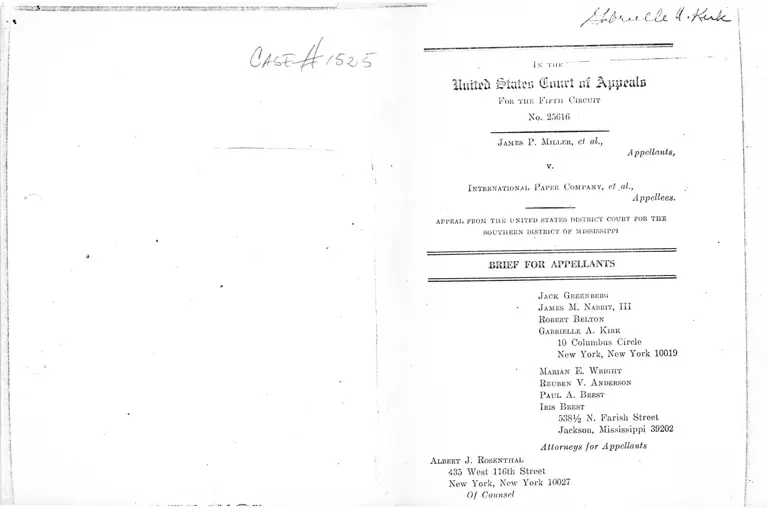
1 N TIII'.
iluiU'u Staler. (Umu*t vd Amalfi
F or t u b F ifth C ircu it
No. 25016
J am es P . Mi leer , et al.,
v.
Appellants,
I n tern ation al . P aper C o m p a n y , et al.,
Appellees.
appeal from t h e u n ited states district court for t h e
SOUTHERN DISTRICT OF MISSISSIPPI
BRIEF FOR APPELLANTS
J ack G reenberg
J am es M. N abrit , III
R obert B elton
G abrif.lle A . K ir k
10 Columbus Circle
New York, New York 10019
M arian E. W rig h t
R euben V. A nderson
P a u l A . B rest
I ris B rest
538V2 N. Parish Street
Jackson, Mississippi 39202
Attorneys for Appellants
A lbert J . R o sen th al
435 West HGth Street
New York, New York 10027
Of Counsel
\
I N D E X
Statement of the Case ..................................................... 1
Specification of Errors ..................................................... 3
A rg u m en t :
L The District Court erred in dismissing the ac
tion as untimely ................. ................................. 3
A. Notice from EEOC is a prerequisite to a
civil suit under Title VII .............................. 5
13. Appellants did not lose their right to bring
a civil action because EEOC failed to notify
them within 30 (or 60) days after they filed
their charges ................................................... 9
II. The District Court erred in holding that this
action could not be maintained as a class action 15
A. A class action is maintainable under Title
V I I ......................... 17
B. Named plaintiffs may represent a class the
members of which have not pursued the ad
ministrative remedies of Title V I I .............. 20
III. The District Court erred in assessing appel
lants for $250 attorneys fees and costs, pay
able to appellee International Paper Company 25
C onclusion ................................... 29
Certificate of Service ............... 30
PAGE
11
A ppen d ix :
Order in Lea v. Cone Mills .................................. . la
Order in Robinson v. Lorillard .............................. 3a
PAGE
T able of Oases
Anthony v. Brooks, 65 LRRM 3074 (N.D. Ga. 1967) ....7,19
Bowe v. Colgate-Palmolive Co., 272 F. Supp. 332 (S.D.
Ind. 1967) ........................................................................ 19
Choate v. Caterpillar Tractor Co., 274 F. Supp. 776
(S.D. 111. 1967) .............................................................. 7
Cunningham v. Litton Industries, 66 LRM 2697 (C.D.
■ Cal. 1967) .........' ............................................................. 7
■\
Dent v. St. Louis-San Francisco Ry. Co., 265 F. Supp.
56 (N.D. Ala. 1967) ............................................... on, 7, lOn
Evenson v. Northwest Airlines, Inc., 268 F. Supp. 29
(E.D. Va. 1967) ........................................................ 5n, lOn
Griggs v. Duke Power Co., 67 LRRM 2616 (M.D. N.C.
1967) ..............................................................................19,22
Hall v. Werthan Bag Corp., 251 F. Supp. 184 (M.D.
Tcnn. 1966) .................................................14,18,19, 21, 22
Hicks v. Crown-Zellerbach Corp., No. 16638 (E.D. La.
June 13, 1967) .........................................................19,21,24
International Chemical Workers Union v. Planters
Manufacturing Co., 259 F. Supp. 365 (N.D. Miss.
1966) ...................... .................................................... -•••• 8
Jenkins v. United Gas Corp., 261 F. Supp. 762 (E.D.
Tex. 1966) ...................... ™
PAOE
iii
Lance v. Plummer, 353 F.2d 585 (5th Cir. 1965), cert.
den., 384 U.S. 929 (1966) ............................................. 19
Lea, et al.'v. Cone Mills Corp., No. C-176-D-66 (M.D.
N.C. June 27, 1967) ....................................................... 22
Mondy v. Crown-Zellerbach Corp., 271 F. Supp. 258
(E.D. La. 1967) .................................................5n, 6, 9, 21n
Moody v. Albemarle Paper Co., 271 F. Supp. 27 (E.D.
N.C. 1967) .......................................................... 5n, 7,19, 22
Quarles v. Philip Morris, Inc., 271 F. Supp. 842 (E.D.
Va. 1967 .................................. ................................... lOn, 21
Quarles v. Philip Morris, Inc., 67 LRRM 2098 (E.D.
Va. 1968) ......................... :.... :......................................19,21
Reese v. Atlantic Steel Co., 67 LRRM 2475 (N.D. Ga.
1967) ..............................................................................7,10n
Robinson v. P. Lorillard Co., Case No. C-141-G-66
(M.D. N.C. January 26, 1967) ......................... :......... 19
Skidmore v. Swift & Company, 323 U.S. 134 (1944) .... 8
Udall v. Tallman, 380 U.S. 1 (1965) .............................. 8 '
United States v. Jefferson County Board of Education,
372 F.2d 836 (1966), aff’d en banc 380 F.2d 896 (5th
Cir. 1967) ....................................................■-.................. 8
Ward v. Firestone Tire & Rubber Co., 260 F. Supp. 579
(W.D, Tenn. 1966) .....................................................7, lOn
S tatutes
42 U.S.C. §2000e-5(a) ............
Civil Rights Act of 1964 ........ .
29 C.F.R. §1601.25(a) and (b)
.............. -..... U3
............... 3,17,19
3n, 5n,10,lOn,14
IV
Federal Rules of Civil Procedure, Rule 18(a) ............. 15n
Federal Rules of Civil Procedure, Rules 23(a) and
23(b)(2) ........................................................................17,18
PAGE
Federal Rules of Civil Procedure, Rule 30(a) .............. 27
O th e r A u th o rities
Advisory Committee Note to amended Rule 23, 86 Sup.
Ct. No. 11, Yellow Supp. at 34 (1966) (reprinted in
28 U.S.C.A., F.R.C.P. 17-33, following Rule 23) ....... 19
Berg, Equal Employment Opportunity under the Civil
Rights Act of 1964, 31 Brooklyn L. Rev. 81 (1964) .... 8
CCH Employment Practices Guide 17,252 .................. 20
Commission Decision 11/23/65 ....................................... 7
31 Fed. Reg. 14255 (Nov. 4, 196j6) .................................. 13
110 Cong. Rec. 2805 (daily ed. 2/10/64) ...................... 11
110 Cong. Rec. 12295 (1964) ........................................... 5n
1 Davis, Administrative Law Treatise, Sec. 5.06 (1958) 8
EEOC, First Annual Report ......................................... 24
General Counsel Opinion 10/25/65 ................................ 5n
Hill, Twenty Years of State Eair Employment Practice
Commissions: A Critical Analysis with Recommen
dations, 14 Buffalo L. Rev. 22 (1964) .................... . 12n
Norgren and Hill, Toward Fair Employment (1964) .... 12n
Opinion Letter 11/17/65 .................................................5n, 7
Opinion Letter 2/3/66 ..................................................... 20
In t h e
Shiite ( ta r t nf Appeals
F or t h e F if t h C ircu it
No. 25616
J am es P . M il l e r , et al.,
Appellants,
v.
I n tern atio n al P aper C o m p a n y , et al.,
Appellees.
APPEAL FROM TH E UNITED-STATES DISTRICT COURT FOR TH E
SOUTHERN DISTRICT OF M ISSISSIPPI
BRIEF FOR APPELLANTS
Statement of the Case
This is an appeal from the order of November 20, 1967,
of the United States District Court for the Southern Dis
trict of Mississippi, entering summary judgment for ap
pellees in an employment discrimination action brought
under Title VII of the Civil Rights Act of 1964, 78 Stat.
253, 42 U.S.C. §2000e et seq. (hereinafter sometimes re
ferred to as “Title V II” ).
In December, 1966, appellants filed charges of discrim
ination with the Equal Opportunity Employment Com
mission (hereinafter referred to as “EEOC” or the “ Com
mission” ), naming as respondents the International Paper
2
Company and the unions which represent the company’s
employees at its Moss Point, Mississippi plant (R. GO-
65).1 On May 12, 1967, pursuant to the request of ap
pellants’ counsel, EEOC wrote to appellants informing
them of their right “within thirty (30) days of receipt of
this letter to institute civil action in the appropriate Fed
eral District Court” (R. 65-73). On “June'9, 1967, appel
lants filed this action against the appellees (R. 1-15).
On August 3, 1967, and August 4, 1967, the unions
(R. 42-44) and company (R. 46-47), respectively, filed
motions to dismiss pursuant to Rule 12 of the Federal
Rules of Civil Procedure. The district court, per Judge
William Harold Cox, treated the motion to dismiss as a
motion for summary judgment and granted the motion,
holding that the action was untimely filed because it_.was
^brought more than sixty (60) days after the charges of
discrimination were filed with the EEOC, and that the
suit could not be maintained as -a class action. The dis- ~
trict court also assessed appellants with costs and attor
neys fees in the amount of $250 for their failure to appear
at depositions noticed by the unions on Saturday, July 8,
1967.
On November 29, 1967, appellants filed a notice of ap
peal and a motion for a stay of the execution of the
judgment pending the deposition of the appeal.
1 United Papermakers and Paperworkers, AFL-CIO ; Local No.
203 of United Papermakers and Paperworkers, AFL-CIO ; Singing
River Local No; 384 of the United Papermakers and Paperworkers,
AFL-CIO ; International Brotherhood of Pulp, Sulphite, and Paper
Mill Workers, AFL-CIO; Local No. 379 of International Brother
hood of Pulp, Sulphite and Paper Mill Workers, AFL-CIO; Inter
national Brotherhood of Electrical Workers, AFL-CIO and Local
No. 181G of International Brotherhood of Electrical Workers, AFL-
CIO.
i
Specification of Errors
1. The district court erred in holding that this suit was
not timely filed.
2. The district court erred in holding that the appellants
could not maintain a class action pursuant to Title VII
of the Civil Rights Act of 1964.
3. The district court erred in assessing appellants with-
costs and attorneys’ fees payable to the International Paper
Company for their failure to appear at the depositions on
Saturday, June 8, 1967.
The District Court erred in dismissing the action as
untimely.
In December, 1966, pursuant to Section 706(a) of the
Civil Rights Act of 1964, 42 U.S.C. §2000e-5(a), appellants
filed charges of discrimination against appellees with the
Equal Employment Opportunity Commission.
After the expiration of more than sixty (60) days,
pursuant to 29 C.F.R. §1601.25a(b),2 appellants demanded
2 29 C.F.R. §3601.25a(a) and (b) provides;
a) The time for processing all cases is extended to sixty days
except insofar as proceedings may be earlier terminated pur
suant to §1601.19.
b) Notwithstanding the provisions of subsection (a) hereof,
the Commission shall not issue a notice pursuant to §1601.25
prior to a determination under §1601.19 or, where reasonable
cause lias been found, prior to efforts at conciliation with re
spondent, except that the charging party or the respondent
may upon the expiration o7 sixty days after'the filing of the
charge or at any time thereafteigdcnnnid in writing that such
___ notice issue, and the Commission’sliall prompt I)’ issue” .such-
~~ notice to all parties,,
I
4
that the Commission issue notice to the parties advising
appellants of their right to tile suit in federal court. As
a result of this demand, the Commission informed appel
lants in letters dated May 12, 1967, three months after
the end of the sixty (GO)-day period (after the filing of
charges with EEOC), that they may “within thirty (30)
days of receipt of this letter institute a civil action in
the appropriate federal district court” (R. 65-73). This
was the first and only notice that appellants received ad
vising them of their right to file suit. On June 9, 1967,
within thirty (30) days of receipt of this notification,
appellants filed this action in the United States District
Court for the Southern District of Mississippi.
The district court granted summary judgment for the
appellees because the action had not been “ timely filed”
within the requirements of Section 706(e) of Title VII.
In reaching this decision, the court relied on two seemingly
inconsistent arguments: First, notice from EEOC is not 0 ,
a prerequisite to a civil action under Title VII and appel
lants erred in failing to sue within the time limits pre
scribed by its opinion, notwithstanding the absence of
notice.3 4 Second, although notice is a prerequisite, the Com- (T
mission’s failure to notify appellants of their right to sue
within this time period precludes this suit." Neither view
can be sustained by the language or purpose of the Act
and both views are contrary to the decisions construing
the language of the Act.
3 In footnote 2 of the opinion, the court below seems to so hold
(JR.. 57).
4 “ The charge had to be filed first and it was mandatory that the
Commission in this case notify the aggrieved person immediately
if it were unable to obtain voluntary compliance with the act so
as to entitle the offending [sic] party to file a suit” (R. 58).
5
A. Notice from EEOC is a prerequisite to a civii suit
under Title VII.
In a footnote, which is nearly all of the opinion on this
point, the district court hold that thirty (30) days after
the charges were filed with EEOC each aggrieved party
was entitled to bring suit within the next thirty (30) days,
whether or not he has received notice from the Commis
sion (R. 57).5
“ It, appears that the district court erroneously held that the
waiting period was only thirty (30) days (R. 57, ii. 2). Although
Section 706(e) speaks of an initial waiting period of thirty (30)
days, in unequivocal language it also grants to the EEOC the power
to extend that period by an additional thirty days:
(e) If within thirty days after a charge is filed with the Com
mission (except that such period may be extended to not more
than sixty days upon a determination by the Commission that
further efforts to secure voluntary compliance are warranted),
the Commission has been unable to obtain voluntary com
pliance with this title, the Commission shall so notify the
person aggrieved and the civil action may, within thirty days
thereafter, be brought against the respondent named in the
charge. . . . (Emphasis supplied.)
Early in its history, the Commission began to take the full sixty
dayrs in all cases, and on October 28, 1966, it embodied this practice
in its formal regulations:
(a) The time for processing all cases is extended to sixty days
except insofar as proceedings may be earlier terminated pur
suant to section 1601.19. 29 C.F.R. §1601.25a(a).
Every court which has considered the remedial scheme of Title
VII has accepted the Commission’s practice, and the courts have
unanimously considered the mandatory waiting period to be sixty
(60) days. See, c.g., Mondy v. Crown-Zcllerbach Corp., 271 E.
Supp. 258, 261 (E.D. La. 1967); Moody v. Albemarle Paper Co.,
2/1 P. Supp. 27, 29 (E.D. N.C. 1967); Evenson v. Northwest Air
lines, Inc., 268 P. Supp. 29, 31 (E.D. Va. 1967); Bent v. St. Louis-
San Francisco By. Co., 265-P. Supp. 56, 58 (N.D. Ala. 1967); see
also 110 Cong. Rce. 12295 (1964) (Remarks of Senator Humphrey).
In practice, the Commission has generally taken much more than
sixty (60) days, and in any event has not sent its notice to the
aggrieved party until a reasonable time after the sixty (60) days
had elapsed. See Commission Decision 11/23/65; General Counsel
Opinion 10/25/65; Opinion Letter 11/17/65. In Bent, supra, the
6
The applicable language of Section 706(e) provides:
. . . the Commission shall so notify the person ag-
grived and a civil action may, within thirty days
thereafter, be brought against the respondent named
in the charge. . . . (Emphasis added.)
y The district court completely disregarded the clear lan
guage of Section 706(e) and the extensive precedents
construing this language which points out that notice
must issue and a suit be brought within 30 days “ there
after” and left the notice requirement with no real pur
pose within the statute’s remedial scheme. Why indeed
did Congress so clearly require that notification issue prior
to the bringing of a civil suit by a charging party if the
charging party may file suit before receiving such notice ?
J To counsel’s knowledge, with only one exception, every
court considering the scope of Section 706(e) has held
that notice from the Commission is a prerequisite to com
mencement of civil litigation. In Mondy v. Zellerbach
Cory., 271 F. Supp. 258, 261 (E.D. La. 1967), in direct
response to the argument made by the court below, it
was held:
[If an aggrieved party filed suit] without first re
ceiving the statutory notice, he would be met with
the objection that he was suing prematurely, since
42 U.S.C.A. Section 2000e-5(e) says that he may bring
court characterized the sixty (60)-clay limit as directory, rather
than mandatory, upon the Commission, and all of these cases may
be regarded as inferentially so holding.
This error is, fundamentally, irrelevant to disposition of this
appeal, however; for under the rationale of the district court’s
holding that the aggrieved party must file suit within thirty (30)
days after the close of the thirty (30)-day waiting period, appel
lants' suit would be untimely even granting a sixty (60)-day
waiting period.
7
a civil action after being notified by the Commission
of its failure to obtain voluntary compliance. There
fore, he would have to wait until he received the
statutory notice from the EEOC.
Accord: Dent v. St. Louis-San Francisco Ry. Co., 265
F. Supp. 56 (N.D. Ala. 1967); Ward v. Firestone Tire do
Rubber Co., 260 F. Supp. 579 (W.D. Tenn. 1966) (dicta);
Moody v. Atbermarle Paper Co., 271 F. Supp. 27 (E.D.
N.C. 1967); Anthony v. Rrooks, 65 LRRM 3074 (N.D. Ga..
1967); Reese v. Atlantic Steel Co., 67 LRRM 2475 (N.D.
Ga. 1967); Choate v. Caterpillar Tractor Co., 274 F. Supp.
776 (S.D. 111. 1967). Cunningham v. Litton Industries, —■ ^^*<4
66 LRRM 2697 (C.D. Cal. 1967), holding contrary, sug
gests no understandable basis for its conclusion, and ap
pellants respectfully submit that it is incorrect. (On ap
peal to the United States Court of Appeals for the Ninth
Circuit.)
Indeed, from the inception of its administration of
Title VII, EEOC has recognized that notice is a pre
requisite to a private civil action. Several months after ^
the effective date of the Title (July 2, 1965), the General
Counsel stated unequivocally the Commission’s interpre
tation of Section 706(e) :
The 30-day period for filing of suits under Section
706(e) does not commence automatically upon the
expiration of the statutory period during which the
Commission is authorized to obtain voluntary com
pliance; notice by the Commission under Section 706(e)
is an integral part of the plaintiff’s cause of action,
consequently, the period within which to file a civil
action does not commence until notice from the Com
mission has been received by the person aggrieved.
Commission Decision, 11/23/65; CC Opin. 10/25/65;
Opin. Hr., 11/17/65.
8
Because this interpretation constitutes a contemporaneous
and consistent interpretation of a statute by the agency
charged with its administration, it is entitled to great
respect by the courts. As early as 1827, the Supreme Court
acknowledged that administrative constructions are highly
persuasive guides to statutory interpretation:
In the construction of a doubtful and ambiguous law,
the contemporaneous construction of those who were
called upon to act under the law, and were appointed
to carry its provisions into effect, is entitled to very
great respect. Edwards’ Lessee v. Darby, 12 Wheat.
206, 210 (1827).
Recent cases havg reiterated this approach to statutory
construction. See 1 Davis, Administrative Law Treatise
Sec. 5.06 (1958), and cases cited; Udall v. Tollman, 380
U.S. 1 (1965) ; Skidmore v. Swift & Company, 323 U.S.
134, 139-40 (1944); United States v. Jefferson County
Board of Education, 372 F.2d 836, 851 (1966), aff’d en
banc 380 F.2d 896, 902 (5th Cir. 1967); see, Berg, Equal
Employment Opportunity under the Civil Rights Act of
1964, 31 Brooklyn L. Rev. 81-82, n. 35 (1964). In Inter
national Chemical Workers Union v. Planters Manufac
turing Co., 259 F. Supp. 365, 366 (N.D. Miss. 1966) Chief
Judge Clayton, then sitting on the Court of the Northern
District of Mississippi, applied this principle of statutory
construction to uphold the EEOC’s interpretation of the
phrase “aggrieved person” in Title V II :
It has long been settled that the practical inter
pretation of a statute by the executive agency charged
with its administration or enforcement, although not
conclusive on the courts is entitled to the highest
respect. . . . Not only is the Commission’s interpre
tation of the phrase “aggrieved person” that of the
9
agency responsible for administering (lie Act; it is
also a contemporaneous construction of the statute
by those responsible “ for setting its machinery in mo
tion” and for guaranteeing the efficient working of
the statute’s machinery while it is “ still untried and
new.”
B. Appellants did not lose their right to bring a civil
action because EEOC failed to notify them within
30 (or 60) days after they bled their charges.
The district court offered the following alternative
ground for its conclusion that the suit was barred:
The charge had to be filed first and it was mandatory
that the Commission in this case notify the .aggrieved
person immediately if it were unable to obtain volun
tary compliance with the act so as to entitle the
offending (sic) party to file a suit (R. 57-58).
The court thus seemed to recognize that notice is necessary
“to entitle” plaintiffs to file a suit, but apparently main
tained that the Commission’s failure to issue “ timely”
notice barred appellants from filing suit.
Other courts considering this issue have recognized the
inconsistency and unfairness of such a holding. In Mondy
v. Croivn-Zcllcrbach Corp., 271 F. Supp. 258, 261 (E.D.
La. 1967), EEOC issued notice to the plaintiffs more than
five months after they had fded the charges. The court
held that plaintiffs were not thereby barred from bringing
suit, writing:
Surely, Congress could not have intended for an
aggrieved party to be denied his remedy under Title
VII because of the failure of the EEOC to notify him
within sixty days. We feel that the proper inter
10
pretation of 42 U.S.C.A. Section 2000e-5(e) is that a
charging party must file suit within thirty days after
receipt of the statutory notice from the EEOC regard
less of the delay before such notice is given to him.
The unfairness of prejudicing a charging party’s right
of suit because of acts or omissions of EEOC over which
he has no control is manifest.6
In declaring that it was “mandatory” that the Com
mission issue notice, the district court may have been
suggesting, however, that since appellants were entitled
to demand that notice be sent any time after the sixty
(60)-day period had run, their failure to make such a
demand acted as a waiver of their right to bring suit.
Appellants agree that 29 C.F.R. §1001.25a(b) grants to ag
grieved parties the right to demand notice immediately
after the mandatory waiting period has run, and to file
6 In another context— in regard to whether the right to sue under
Title VII should be denied because EEOC had not engaged in con
ciliation efforts prior to suit— a number of courts have recognized
this unfairness, in upholding the right to sue. “ To require more
would be to deny a complainant the right to seek redress in the
courts, resulting wholly from circumstances beyond her control.”
Evenson v. Northwest Airlines, Inc., 268 F. Supp. 29, 31 (E.D. Va.
1967). Also in Mondy, supra, at 263:
But 42 U.S.C.A. §2000e-5(e) sets out only two requirements
for an aggrieved party before he can sue: (1) he must file a
charge with the E.E.O.C., and (2) he must receive the statu
tory notice from the E.E.O.C. that it has been unable to obtain
voluntary compliance. There is nothing more that a person
can do, and this Court will not ask that he be responsible for
the Commission’s failure to conciliate, as that body’s inaction
is beyond the control of the charging party.
Accord: Reese v. Atlantic Steel Co., supra; Quarles v. Philip Mor
ris, Inc., 271 F. Supp. 842, 846-7 (E.D. Va. 1967) ; Ward v. Fire
stone Tire and Rubber Co., 250 F. Supp. 579, 580 (W.D. Tenn.
1966) (dicta). Contra: Dent v. St. Louis-San Francisco Railway,
supra (presently on appeal to this Court).
-r
suit. But that section does not require them to demand
notice within sixty (60) days or be barred from filing suit.
As originally passed in the House, Title VII gave EEOC
pow er-to- isstie 'cease-and-desist orders to be enforced
in the federal courts, ll.lt. 7152, 110 Cong. Rec. 2805
(daily ed. 2/10/64). When the Senate modified these
procedures to give the EEOC only informal conciliatory
powers, it compensated by assuring aggrieved parties a
right to a day in court. Section 706(e) was designed to
insure that the right to sue could not be obstructed by
delays in Commission action. As Senator Javits ex
plained in reference to the effect the Commission’s failure
to find reasonable cause had upon charging party’s right
to sue:
“ Mr. President, this provision gives the Commission
time in which to find that there exists a pattern or
practice, and it also gives the Commission time to
notify the complainant whether it lias or has not been
successful in bringing about conciliation.
# • #
“But, Mr. President, that is not a condition precedent
to the action of taking a defendant into court. A com
plainant has an absolute right to go into court, and
this provision does not effect that right at all.” 110
Cong. Rec. 14191 (June 17, 1964).
The experience under older state Fair Employment
Practice legislation made it clear that conciliation is often
a slow, complex and cumbersome process/ In fashioning
7 “One administrative weakness observable in virtually all exist
ing commissions is the tendency, in dealing with exceptionally
resistance nonconipliers, to prolong conciliation efforts over unduly
long periods, in preference to involving the public hearing and
cease-and-desist order procedures. The commissions have exhibited
this tendency most frequently in eases involving related compliance
1 2
Title VII, Congress was aware that if it placed the in
formal procedures which it had created under a rigid
timetable, the usefulness of the Title would be destroyed.
Xot only would most conciliations be cut short before,
or just as, they reached a fruitful stage, but the character
of the entire procedure would be drastically affected.
Frank and productive discussions would be prevented,
because both parties would know that litigation was in
evitable, and the conciliation stage would serve only as
an empty prelude to resolution of the dispute in court.
Thus, the parties would often be propelled into court
before cither so desired. Congress intended no such minor
role for conciliation, and it took important steps to insure
that it did not take place in the shadow of the courtroom.
For example, it expressly provided that nothing said or
don'e during the informal negotiations may be used in a
subsequent proceeding (Section 706(a)).
The Equal Employment Opportunity Commission has
confronted the difficulties raised by the complex and lengthy
negotiations which it must undertake, and it has devised
procedures to deal with them. To this end, Section
I601.25a(b) of its regulations provides that notice under
Section 706(e) will not automatically issue after sixty (60)
cases. The reluctance of the commissions to invoke the mandatory
and legal-sanction features of the FEP laws appears to stem from
a desire to create and preserve a public image of the governmental
anti-discrimination effort as primarily a persuasive process, by
keeping the evidence of coercion at a minimum level. It seems ap
parent, however, that the net effect of the propensity to stretch out
the conciliation process is to reduce the commissions’ over-all effec
tiveness, mainly because it encourages determined noncompliers to
continue flouting the law, but also because it consumes a dispro
portionate amount of the commissions’ time and resources.”
Xorgrcn and Hill, Toward Fair Employment (1964), at p. 270.
See also Hill, Twenty Years of State Fair Employment Practice
Commissions: .1 Critical Analysis With Recommendations, 14 Buf
falo L. ltcv. 22 (1064).
13 —
days if there has not yet been a finding as to reasonable
cause or an effort at conciliation, even though this might
take considerably longer than the sixty (60)-day waiting
period.
The effect of this regulation is to allow the conciliation
process to continue so long as all parties prefer it to the
public forum; it thus encourages conciliation as an effec
tive procedure when conditions are ripe for a successful
settlement. At the same time, it preserves the aggrieved
parties’ right to sue when they feel that only a court can
offer adequate relief. This purpose was made clear at
the time that the Commission announced its rule:
The Commission believes that in general the purposes
of Title VII are better served by delaying the notifica
tion under Section 706(e) until the proceedings before
the Commission have been completed. However, we
recognize that there may be circumstances under which
either the charging party or the respondent may de
sire that the right to bring ah action accrue as promptly
as possible upon the expiration of the 60-day period,
and where such a desire is clearly manifested, we
believe it consistent with the statutory scheme that
notification issue irrespective of the status of the
case before the Commission. Accordingly, this amend
ment is intended to state clearly the circumstances
under which the Commission will issue notification of
its failure to achieve voluntary compliance pursuant
to Section 706(e) of the Act. 31 Fed. Keg. 14255
(Nov. 4, 1966).
Moreover, the regulation is careful not to leave the re
spondent at the mercy o f the charging parly. If the re
spondent believes that conciliation will lie unfruitful, or
desires to have his reputation vindicated quickly and
14
publicly after sixty (60) days have passed, lie need only
demand that notice issue. Under the Commission’s rule
neither party is at the peril of excessive delay or useless
negotiations, but fruitful negotiations are not abruptly
and wastefully brought to an end when both sides wish
them to continue. The Commission’s regulation gives life
to both parts of what one court has termed Title V II’s
“ split personality.” 1I all v. Werthan Bag Corp., 251 F.
Supp. 184, 187 (M.D. Tenn. 1966).
If appellees were burdened by this delay, if they desired
an immediate resolution of the charges against them,
they had only to request that notice be sent to the plain
tiffs. The Commission’s procedure under 29 C.F.R.
§1601.25a(b) was open to appellees in this case, and sixty
_(60) days after the charges were tiled they could have
^requested EEOC to notify appellants of their right to
̂ sue. ' Appellees chose not to invoke this privilege, per
haps because they believed that the private and informal
proceedings would bear fruit. Whatever the reason, ap
pellees are in no position now to object to appellants’
purported lack of timeliness.
For the foregoing reasons appellants respectfully submit
that the district court erred in holding that their suit
was untimely filed.
15
II.
The District Court erred in holding that this action
could not he maintained as a class action.
Appellants’ charges of discrimination (E. 60) fdcd with
EEOC alleged that appellees had discriminated against
“ Complainants and Negroes generally” by grouping them
in segregated lines of progression with the lowest job
ranks and pay scales, by denying them promotions on
the basis oi race; by making them take unrelated ex
aminations as a condition to promotion and advancement;
by paying them less than whites doing the same jobs
(R. 62), and by denying them access to the apprenticeship
program (R. 63). Accordingly, the complaint (It. 1) filed
on June 9, 1967, was a class action, on behalf of appellants
and other Negro persons similarly situated who were
employed or might be employed by International Paper
Company, Southern Kraft Division, Moss Point, Mis
sissippi (paragraph IV), averring that appellees dis-
crimnated against appellants and this class generally, and
seeking class relief.8
The district court held that the suit could not be main
tained as a class action, stating:
The action is instituted by and on behalf o f named
plaintiffs and other unnamed male Negroes said to
be too numerous to mention under Civil Rule 23.
For the reasons hereinafter more specifically as
signed, it is clear to this Court Ijgat a class action
cannot he instituted and maintained under the proce
dural provisions ot this enactment by any anonymous
.inn
■ 'I .
■I V.ll i -• J > ■ • I -1 f i • * I . Inf nit h
fr l • . < . I.1 f . • ? * , ’ 'itf ■ f 1 t.r
f Ilf . (,.<ft • •
16
group of people. Specifically, no person is entitled
y to the benefits of the act who has not strictly com
plied with the conditions precedent to the right to
institute a suit of this kind in a federal court. Section
2000e-5(a) (1) makes it abundantly clear that an ag
grieved person must first file a charge with the
Equal Employment Opportunity Commission, and that
such person claiming to be aggrieved shall within
a given time institute a suit in a United States Dis
trict Court to redress his grievance, if such action
is to be instituted. This suit is purely statutory.
It is a creature of statute and Congress as creator
of such right of action has strictly and sharply de
fined its method of enjoyment. No class action may
V' be maintained in a situation of this kind where it must
* be shown that each plaintiff has exhausted his ad
ministrative remedies, and has brought the consequent
action within the time provided by statute. The ques
tions of law and fact are thus not common to the
entire class and the claims and defenses of the repre
sentative parties are not the same and are not en
tirely typical of the other claims and defenses as
required by Civil Rule 23(a). The purpose and effect
of a class action is incompatible with the require
ments of this statutory scheme as a condition precedent
to the right of enjoyment of its benefits. It is ac
cordingly the considered view of this Court that this
suit cannot be maintained as a class action (R. 55-56).
It is not clear whether the district court held that no
class action whatsoever may be brought under Title VII,
or whether it held that in such an action the class repre
sented by named plaintiffs must bo limited to persons who
have previously exhausted their administrative remedies;
accordingly, appellants discuss these issues separately.
17
A. A class action is maintainable under Title VII.
The uncontroverted averments of the complaint bring it
squarely within the requirements of Rules 23(a) and
,_23.Cb)-(2) of'the Federal Rules of Civil Procedure:
23(a)(1). The class of Negro employees (and prospec
tive employees) of the Moss Point plant of the Inter
national Paper Company is plainly so numerous that
joinder of all members is impracticable.9
23(a)(2). The right to relief for all members of the
class originates in Title VII of the Civil Rights Act of
1964 ;10 the class as a whole is injured by the appellees’
general policies of racial discrimination in the institution
and application of tests, promotion and seniority systems.11
23(a)(3). Appellants’ claims arise out of appellees’
general policies of discrimination in testing, promotion,
and seniority.12
23(a)(4). Appellants’ averment that they fairly and
adequately protect the interest of the entire class13 has
not been controverted by appellees.
23(b)(2). The appellees’ general policies and conduct of
discriminating in testing, promotion, and seniority are
based on the fact that the persons discriminated against
are employed and potentional employees of the Negro
race, and it is in terms of this race that the class is defined.14
9 Complaint, III. The number of employees at the Moss Point
plant is not in evidence; however, the complaint avers that there
arc over 100. IV (A ).
10 Complaint, I.
“ Complaint, V I (A ) , VII.
15 Complaint, V 1. VII.
“ Complaint, VII
“ * "omplniut 111
18
The relief sought, inter alia, is an injunction prohibiting
discrimination against appellants and the entire class.
As the court stated in Ilall v. Wertlian Bag, supra,
at 186: “ [Rjacial discrimination is by definition a class
discrimination. If it exists, it applies throughout the
class.” Class actions are the most appropriate device
for persons challenging and seeking broad injunctive relief
against racial discrimination. The most appropriate sec
tion of Rule 23 of the Federal Rules of Civil Procedure
for the maintenance of his class action is (b)(2). Indeed,
this action is the model which (b )(2) was designed to
include. The comment of the advisory committee which
prepared the new Rule 23 makes this crystal clear.
Subdivision (b )(2). This subdivision is intended to
* reach situations where a party has taken action or
refused to take action with respect to a class, and
final relief of an injunctive nature or of a correspond
ing declaratory nature, settling the legality of the
behavior with respect to the class as a whole, is
appropriate. Declaratory relief ‘corresponds’ to in
junctive relief when as a practical matter it affords
injunctive relief or serves as a basis for later in
junctive relief. The subdivision does not extend to
cases in which the appropriate final relief relates ex
clusively or predominantly to money damages.
Action or inaction is directed to a class within the
meaning of this subdivision even if it has taken
effect or is threatened only as to one or a few members
of the class, provided it is based on grounds which
have general application to the class.
Illustrative are various actions in the civil-rights field
where a party is charged with discriminating unlaw
fully against a class, usually one whose members are
19
incapable of specific enumeration. (Advisory Com
mittee Note to amended Rule 23, 86 Sup. Ct. No. 11,
Yellow Supp. at 34 (1966) (reprinted in 28 U.S.C.A.,
F.R.C.R, ,17-33, following Rule 23). (Emphasis
added.))
The Fifth Circuit Court of Appeals in Lance v. Plummer,
353 F.2d 585 (5th Cir. 1965), cert, denied. 384 U.S. 929
(1966), a case interpreting Title II of (he Civil Rights
Act of 1964, has ruled that a class action may be main
tained in actions arising under that Title. Title II (dealing
with public accommodations) authorizes in Section 204(a)
a private action by a. “person aggrieved” by unlawful dis
crimination. Title VII is virtually identical in this respect
to Title II, including the use of the same term “ person . . .
aggrieved” . The Fifth Circuit stated:
“ We do not find this argument persuasive. . . . We
conclude that Congress did not intend to do away with
the right of named persons to proceed by a class action
for enforcement of the rights contained in Title II of
the Civil Rights Act.” 353 F.2d at 591.
*
To counsel’s knowledge, every court that has considered
the question has held that a class action can be maintained
under Title VII. Hall, v. Wertlian Bag Carp., supra;
Hicks v. Crown-Zellerbach Corp., No. 16638 (E.D. La.
June 13, 1967); Moody v. Albemarle Paper Co., 271 F.
Supp. 27 (E.D. N.C. 1967); Robinson v. / ’. Larillard Co.,
Case No.'C-141-0-66 (M.D. N.C. January 26, 1967); An
thony v. Brooks, 65 LRKM 3074 (N.l). kti. 1967); Brians
v. Puke Power Co.. 67 LRKM 2616 (M.D. VC. 1967);
Quarles v. Phihji Monis. toe,, 67 1,1,'|»M 2",,M ( )•; D. \’n
ODD). v r „ l , r o , 273 r Kuril 332
̂S ! * 1 ? »j ] ) I*i J • tt 11»> 9 v / » 9 ,{ 1 /.i * (' t ‘S; j
2 0
that a class action could be maintained under Title VII,
but held that the case before him was, on its facts, in
appropriate for the class action procedure.
Nothing in the text of Title VII or its legislative history
speaks against class actions, and, indeed, the Equal Em
ployment Opportunity Commission in an Opinion Letter
(February 3, 1906) explicitly provides:
“ A person claiming to be aggrieved who brings suit
under Section 706(e) of Title VII may maintain a
class action, pursuant to the provisions of Rule 23(a),
Federal Rules of Civil Procedure. Other employees
of the employer may intervene as parties plaintiff,
notwithstanding the fact that they did not file a charge.”
CCI1 Employment Practices Guide 17,252, p. 7371.
Constructions and interpretations by agencies charged with
the administration of federal statutes are entitled to great
weight. See the discussion in argument I, supra, pp. 8-9.
B. Named plaintiffs may represent a class the members
of which have not pursued the administrative reme
dies of Title VII.
To hold that a class action can be maintained under
Title VII, but that each member of the class must have ex
hausted the administrative remedies provided by Title
VII, is to hold, for all practical purposes, that a class action
cannot be maintained under Title VII. The class which ap
pellants represent is partly composed of Negro persons
similarly situated who may be employed by the appellee
company in the future and an injunction is sought enjoining
the appellees from discriminating against appellants and
members of the class in the future. The persons who may
21
be employed and who may be subjected to racial discrimina
tion are not yet sufficiently defined so as to enable each
of them to file charges with EEOC. Tims, the basic and
significant question before this Court must be whether a
class action can be maintained by persons (such as the
appellants herein) who have exhausted flic administrative
remedies, on their own behalf and on behalf of others
similarly situated but who themselves have not pursued
the administrative remedies of Title VII.
At least five district courts have recognized that, in
class actions under Title VII, the class may be composed of
persons who have not filed charges with EEOC.16 In Hall
v. Werthan Bag Corp., supra at 188 the court stated:
What this court conceives to be the true purpose of
this requirement would not be served by restricting the
class for whose benefit this action may be maintained
to only those Negro employees or would-be employees
of the defendant who have resorted to the Commission,
that is, to Robert Hall alone, for he is admittedly the
only such person who has exhausted Commission pro
cedure.
The identical conclusion was reached by Judge Ileebe in
Hicks v. Crown-Zellerbacli, supra. There, Judge Ileebe
permitted a class action to be maintained and permitted
a plaintiff who had filed a charge with EEOC to represent
all employees in the Box Plant, even though no other em
ployee had filed a charge with EEOC. In Quarles v. Philip
Morris Co., supra, a class action was maintained by (wo
Negio plaintiffs. One plaintiff alleged (hat he was denied
a transfer lie sought because of his race and color. The
i ( / v . i t „ / V ( ' m i n i / < V, r i , 1 " T ) J.' S i i t u i
f . . . . - . . , . . . ’ • ' . ' 11 V
2 2
second plaintiff alleged that the company paid him a lower
wage rate for a job comparable to jobs performed by white
employees who were paid at a higher rate of pay. The
court allowed a class action to be maintained and permitted
plaintiffs to represent and to introduce evidence concerning
Negro persons who were discriminated against in hiring
and in promotion. In holding that a class action could be
maintained, Judge Butzner stated: “ [T]he effect of the
court’s ruling was to hold that each member of the class
was not required to pursue administrative relief for the
correction of the same employment practices.” at 2099.
Implicit in the decisions in both Lea, et al. v. Cone Mills
Corp., No. C-176-D-66 (M.D. N.C. June 27, 1967), and
Griggs v. 'Duke Power Co., supra, is a finding that a class
-> action may be maintained in behalf of persons who them
selves have not filed charges with EEOC. In Moody v.
Albemarle Paper Company, supra at 29, the court held
that: “ [A] 11 potential parties in a class action seeking relief
under the act [Title VII] are not required to have all
joined in as a group or class in the prior written complaint
to the Commission.” The court indicated it was following
the rationale of Hall in this respect. If it is not a pre
requisite for a named plaintiff to have filed a charge with
EEOC, most certainly, it should not be a prerequisite for
a member of the class represented by the plaintiff.
The statute and legislative history do not speak directly
to the issue, but, as the court in Hall v. Wertlian Bag Corp.,
supra, at 186-187, noted, they are suggestive:
Section 706(i), for example, provides for a form of
supervision by the Commission over matters arising
as a result of a court’s order entered in a Title VII
proceeding which suggests that Congress contemplated
a scope of relief reaching beyond the limited interests
- 2 3
of the single “person aggrieved.” Likewise, Section
706(g) provides that a court “ may enjoin the respon
dent from engaging in such unlawful employment
practice, and order such affirmative action as may be
appropriate, which may include reinstatement or hiring
of employees, with or without back pay * * * .” And as
one commentator has observed, “This language is sub
stantially unchanged from that in Section 707(e) of
the Ilouse-passed bill, and in the context of that bill
it clearly meant that the court should enjoin the sub
sequent commission of unlawful employment practices
in as broad terms as would have been proper for a
cease-and-desist order under the NLBA.”
[There is] a dichotomy in the philosophy underlying
the enforcement provisions of Title V II: emphasis
is placed primarily on protection of persons subject to
discrimination rather than on protection of the public
interest, but for the protection of persons subject
to discrimination, Congress apparently envisioned a
rather broad scope of relief similar to that which would
be necessary for the protection of the public interest.
A privately instituted class action is unique in its
adaptability to Title V II’s split personality.
The administrative.remedies provided by Title VII serve
the function of notifying the respondent of the charges
made against him, and giving him, the complaining party,
and the EEOC the opportunity to work out the grievances
through conciliation, in private, with the hope that mutual
agreement can be achieved. But conciliation goes beyond the
particular grievance of the complaining party:
The Commission’s conciliation program was based on
a two-fold objective; firstly, to obtain prompt and
appropriate relief for the charging party, and secondly,
lo seek a remedy for the underlying problem o f dis-
24
crimination. A charge of job discrimination is fre
quently a symptom of wide-spread disease. By its
very nature, discrimination is often not personal but
generalized, often not an act of individual malice but
more an element of a pattern of customary conduct.
This discrimination may be limited Jo a small depart
ment, or extend to an entire industry or region. EEOC
conciliation approaches the individual complaint on
the grounds that it may lead to improving the employ
ment status for every individual who has felt the
press of discrimination.
The foundation upon which the Commission’s con
ciliation is based, as well as its starting point, is the
finding that reasonable cause exists for the discrimina-
0 tion charge. The question of whether there has been
discrimination or not is, then, not posed by the concilia
tor ; he works on the solution of the specific problem
of discrimination, as well as the underlying problems
related to it. EEOC, First Annual Report, p. 17.
Where, as in the present case, the issues raised on behalf
of the class—the plant-wide practice of discrimination in
testing, promotion, and seniority—were raised by the
parties in the charge of discrimination to the EEOC, their
subsequent suit cannot properly be limited to personal
relief. As Judge Heebe held in Hides v. Crown Zellerbach
Corp., supra, at 6-7:
Once the administrative remedy has been fairly ex
hausted by one person as to an issue, we see absolutely
no need, and in fact only wasted effort, in requiiing
that before the Court act broadly as to that issue,
every person affected thereby initiate and prosecute
a complaint which will not be successful. Nor requiring
[sic] these certainly purposeless administrative pro-
l
cccdings deprive the employer of nothing—he cannot
be heard to say that lie might have decided to bow
to the persuasive powers of the Commission of other
complainants had been filed, for the opportunity to
voluntarily comply was not only presented once and
refused, but remains always open during the pendency
of the judicial proceedings.
For the foregoing reasons, appellants submit that a
class action may be maintained under Title VII and the
class may be composed of persons similarly situated who
themselves have not filed charges with EEOC.
III.
The District Court erred in assessing appellants for
$250 attorneys fees and costs, payable to appellee Inter
national Paper Company.
The district court ordered that appellants be assessed
with all costs, including “ a reasonable attorney’s fee to
defendant, International Paper Company, in the amount of
$250.00, for failure of plaintiffs to appear at a deposition
on July 8, 1967” (R. 75).16 The facts relevant to the im
position of this penalty are as follows.
On June 28, 1967, the appellee unions filed a Notice to
Take Deposition Upon Oral Examination of all appellants,
the depositions to begin “ on Wednesday, July 5, 1967, begin
ning at 2:00 P.M. on said day, and continuing thereafter
from day to day as the depositions may be adjourned and
until the depositions of each of said Plaintiffs named herein
shall have been completed. . . .” (R. 25). Depositions began
" I n its (It, fiH) mid jiidi’ iiif-iit (It 751. I fir dr.triVf
« rrrn iipou** !v st.’i t r s fh / i f / t j*|h ||mfM•. f<» ur /if n
'I-ruriri j "
26
on July 5, and continued on Thursday and Friday, July 6
and 7. The unions called appellant J. P. Miller as their
first witness on July 5, and continued their examination of
Miller on Thursday and Friday, completing it at 6:25 P.M.
Friday afternoon (R. 39).
At the resumption of depositions on Friday afternoon
(R. 37), and again at the close of depositions that day (R.
3S, 40), appellants’ counsel informed counsel for appellees
that they would be unable to continue the depositions on
Saturday. Miss Kirk, one of the counsel for appellants, had
other, urgent business that could not be delayed (R. 51).
Mrs. Brest, the other counsel, also had urgent business, and
she fell ill with a kidney infection on Friday and was re
quired to remain in bed for several days thereafter (R. 53).
•> Counsel for appellants had attempted to arrange for
another attorney to take over, but without success (R. 53).
They stated that they were “willing to proceed after the
weekend” or at any other convenient time (R. 40). Appel
lees would not agree to postponing resumption of the depo
sitions to a later date. Rather, Mr. Pyles, counsel for the
appellee unions, “announced and insisted”
to everybody that I will be here in the morning at
9:00 A.M. to continue the taking of these depositions
and I assure you that if I and the Court Reporter are
the only ones here, I shall ask the plaintiffs to show
cause. I intend to put the witnesses on the stand and
examine them (R. 39).
Counsel for the Company stated that they would also be
present. Appellants’ counsel made it clear that they could
not appear on Saturday, and in appellees’ presence, in
structed the appellants-deponents not to appear since their
counsel could not be present (R. 40-41).
27
True to their word, appellees had a court reporter pres
ent on Saturday (R. 20-21). On July 20, 1967, the appellee
company filed a motion to dismiss, and for costs, expenses,
and attorneys fees, based upon appellants’ failure to at-
~tend the depositions on Saturday, July 8 (R. 21-22); July
20, 1967, appellee unions filed a motion to dismiss on the
same grounds (R. 26-30). The district court declined to
dismiss the action, but assessed appellants with a $250
penal ty.
Rule 30(a) of the Federal Rules of Civil Procedure re
quires that a notice of deposition “ state the time . . . for
taking the depositions.” The appellee unions noted deposi
tions to “ continue from day to day” until depositions of all
of appellants had been completed. Appellants do not object
per se to the use of the intentionally indefinite phrase
“ from day to day” , but contend that if it is to be used
in lieu of specific dates, it must be construed in the context
of ordinary business practice. Appellants respectfully sub
mit that the court may take judicial notice that Saturday,
though not an official holiday, is also not an ordinary busi
ness day for attorneys. This is not to say that lawyers do
not work on Saturdays (and sometimes on Sundays as
well), but the work is usually internal—“catching up” on
the week’s business—and lawyers’ offices, like the courts,
are usually closed for regular business on Saturday. Ab
sent some agreement among counsel, or the unopposed ex
plicit specification of Saturday in a notice of deposition,
“from day to day” cannot properly be construed to include
Saturday. ^
Of course there may be special circumstances, such as
the inability of counsel to take depositions on weekdays,
oi the necessity of immediate discovery for emergency
disposition of the matter in suit, which make weekends
appropriate days for 111«• taking of d ep osition ", tbit there
28
were no special circumstances in the case at bar. Appellees
were in no hurry. Indeed, although appellees planned to
take the depositions of all of appellants (R. 25), by the
afternoon of Friday, July 7, the appellee unions had com
pleted their examination of only the first of the five appel
lants (R. 53; deposition of J. P. Miller (not transcribed));
neither the appellee company nor appellants had yet ex
amined him; and appellees were not planning to resume
s/ taking of depositions on Monday, but rather were planning
to recess the taking of the depositions for approximately
three weeks (R. 40, 53).
Until Friday afternoon, July 7, appellants had no rea
son to expect that appellees would insist on continuing
the taking of 'depositions on Saturday. Appellees argued
a to the district court below that appellants should, at that
point, have moved for a protective order pursuant to
Rule 30(b) of the Federal Rules. But it would have been
virtually impossible to file papers, or even to find one
of the two judges in the Southern District of Mississippi
for presentation of an oral motion, on Friday afternoon.
Indeed, had appellants adjourned the Friday afternoon
depositions for this purpose, appellees would legitimately
have complained to the court of the time and expense,
since Mr. Adams had come from Mobile for the deposi
tions, and since the unions had hired, and had present,
a court reporter.
Even assuming, arguendo, the appellants’ counsel acted
impropSSly in failing to proceed with the depositions on
Saturday, the award of $250 counsel fee to the appellee
International Paper Company was excessive and improper.
Appellants unequivocally stated at the close of the Friday
session that neither counsel nor appellants themselves
would lie present Saturday. Appellees’ expenses in hiring
a court reporter to appear on Saturday, and in appearing
.
" |
I
20 — --------------------------------------------------------------
themselves, wore foolish and wasteful—not only did ap
pellees fail to mitigate damages; what expenses they in
curred were entirely of their own making. Finally, as
suming that appellants were liable to pay attorneys fees
to anyone, it was certainly not, as the court ordered, to
the International Paper Company, which neither noticed
the depositions nor filed any document joining in the notice
filed by the appellee unions. The unions did not move for
damages or attorneys fees.
CONCLUSION
For all the foregoing reasons, the order of the district
court dismissing the action as untimely filed, holding that
it cannot be maintained as a class action, and assessing
appellants with $250 in costs and attorneys fees, should
be reversed.
Respectfully submitted,
J ack G reenberg
J am es M . N abrit , III
R obert B elton
G abrielle A . K irk
10 Columbus Circle
New York, New York 10019
M arian E. W righ t
(Reu ben V. A nderson
, P a u l A . B rest
I ris B rest
538V2 N. Parish Street
Jackson, - Mississippi 39202
Attorneys for Appellants
A lbert J. Rosenthal
135 W est llfith SI reel
New York, New York 10027
30
Certificate of Service
This is to certify that the undersigned, one of Appel
lants’ attorneys, on this date, May — , 1968, has served
two copies of the foregoing Brief for Appellants on
Honorable C. W. Ford, Post Office Box 100, Pascagoula,
Mississippi; Honorable Robert F. Adams, Post Office Box
1958, Mobile, Alabama; Honorable Warren Woods, 1735
K Street, N.W., Washington, D.C. 20006; Honorable Ben
Wyle, 2 Park Avenue, New York, New York 10016; Sher
man an<l Dunn, 1200 East 15th Street, N.W, Washington,
D.C. and Honorable Dixon L. Pyles, 507 Last Pearl Stieet,
Jackson, Missisisippi/by United States air mail, postage
prepaid.
................................
l A ^ A t t o r n e y for Appellants
T - r
r > r d/.nrd .v.’ -i-, ----------vv' ;
, V x . » C I t Ai ' Co.<r ir-"- ■ y L / ’
i
1\ .
i|
I
j
i
I
i
i
Order in Lea v. Cone Mills
I n the United States D istrict Court
F or the M iddle District of North Carolina
(j REENSBORO D IVISIO N
C i v i l A c t i o n No. C-176-D-66
S hirley Lea, R omona P innix and A nnie T innin ,
Plaintiffs,
v.
Cone M ills Corporation, a corporation,
Defendant.
Order
This cause coining on to bo heard before the undersigned
upon motion of defendant to dismiss and for a determina
tion whether this cause may be prosecuted as a class action
and upon motion of plaintiffs to strike defendant’s demand
for trial by jury and to inspect the record of part of de
fendant’s answers to plaintiffs’ interrogatories 22, 24, 26
and 51, which were ordered filed under seal with the Clerk
of Court, and it appearing to the Court upon the pleadings,
exhibits, briefs and arguments of counsel for both parties
that the defendant’s motion to dismiss and motion for deter
mination by the Court that this is not a proper class action
should be denied. It further appears to the Court that
plaintiffs’ motion to inspect the record of answers to in
to, rotatories ordered to be filed under seal should be denied
and that the ( our! should defer ruling upon plaintiffs’
motion to strike demand for jury trial until final pre trial
ronf.-r.
In.
2a
Order in Lea v. Cone Mills
It is , therefore , ordered, adjudged and decreed :
1. That defendant’s motion to dismiss be and the same
is hereby denied.
2. That this is a proper class action and may be prose
cuted as such pursuant to Rule 23(a), (b)(2) of the Federal
Rules of Civil Procedure. The Court finding that this is
a proper class action under Rule (b) (2), no notice to mem
bers of the class need be given at this time.
Pursuant to Rule 23(c) the Court finds that the class
here involved are all Negroes who are or who might be
aifected by any racially discriminatory policies or prac
tices of defendant, should the Court find any such practices,
'at defendant’s Eno Plant in Hillsborough, North Carolina.
This ruling is conditional and may be amended, modified
or altered at any time prior to. final determination of this
cause on the merits.
3. That plaintiffs’ motion to inspect the answers of
defendant to plaintiffs’ interrogatories 22, 24, 26 and 51
which were ordered filed under seal with the Clerk of Court
be and the same is hereby denied.
4. That ruling by the Court on plaintiffs’ motion to
strike defendant’s demand for jury trial be deferred pend
ing the final pre-trial conference of this case.
This 27th day of June, 1967.
E ugene A. G ordan
J udge, U n ited S tates D istrict Court
Approved as to form:
Counsel for Defendant
Counsel for Plaintiffs
3 a
In t h e U n ited S tates D istrict C ourt
F or t h e M iddle D istrict of N orth C arolina
.Greenshoro D ivision
Case No. C-141-G-66
Order in Robinson v. Lorillard
D oroth y P. R obin son , et al.,
vs
Plaintiff,
P. L orillard Co m p a n y ,
Defendant.
M em oran du m
This matter was scheduled for hearing in the United
States Courtroom, Greensboro, North Carolina, on January
19, 1967, on all pending motions and objections to inter
rogatories. J. Levonne Chambers, Esquire, Robert Belton,
Esquiie, and Sammie Chess, Esquire, appeared as counsel
for the plaintiff; Thornton II. Brooks, Esquire, Robert G.
Sanders, Esquire, and Larry Thomas Black, Esquire, ap
peared as counsel for the defendant; Frank Schwelb, Es
quire, and Miss Monica Gallagher appeared as counsel for
the intervenor.
lhc luling of the Court on the various motions and ob
jections is as follows;
T]lf> objection filed October 10, 1906, by (be defendant
Tobacco Workers International ITiion AFL (TO, to Inter
rogator v 13, winch interrogatory, among other'*, win filed
4a
2. The motion, filed November 23, 1966, of the plaintiff
to require further answers of P. Lorillard Company to
Interrogatories 18-25 inclusive so as to have the answers
include the period between July 2, 1964, to September 23,
1966, the Interrogatories having been filed September 29,
1966, is allowed, limited, however, to answers concerning
the Greensboro Plant, and the motion is denied as to Inter
rogatory 36.
3. The motion of the defendants filed November 8, 1966,
by the Tobacco Workers International Union AFL-CIO,
and Tobacco .Workers International Union AFL-CIO,
Local 317, to dismiss under Rule 12 of the Federal Rules of
Civil Procedure is denied.
4. The motion of the defendant P. Lorillard Company,
filed November 1, 1966, to dismiss under Rule 12 of the
Federal Rules of Civil Procedure is denied.
5. With respect to the motion of the defendants Tobacco
Workers International Union, AFL-CIO, and Tobacco
Workers International Union, AFL-CIO, Local 317, motion
that the Court determine whether the action may be prose
cuted as a class action pursuant to Rule 23, et seq. of the
Federal Rules of Civil Procedure, it is the considered
judgment of the Court that this case is properly a class
action and in category a Rule 23 (a) (b) (2) action. Accord
ingly, counsel for the plaintiff will prepare and present to
the Court a proposed Order, first presenting same to
counsel for the defendant, in order that objections, if any,
may first be made by the defendants. The proposed Order
will state that it is conditional and subject to alteration or
Order in Robinson v. Lorillard
5a - —
amendment at any time prior to the final decision on the
merits.
Also, counsel for the plaintiff will prepare and present to
the Court an Order incorporating in all respects the ruling
of the Court on the respective motions and objections, first
presenting a copy of same to counsel for the defendants and
the intervenors.
I, Graham Erlacher, Official Reporter of the United States
District Court for the Middle District of North Carolina,
do hereby certify that the foregoing is a true transcript
from my notes of the entires made in the above-entitled
Case No. C-141-G-66,. before and by Judge Eugene A.
Gordon on January 19, 1967, in Greensboro, North Caro
lina; and I do hereby further certify that a copy of this
transcript was mailed to each of the below-named attorneys
on January 26, 1967.
Given under my hand this 26th day of January, 1967.
G rah am E rlach er
Official Reporter
cc.: J. Levonne Chambers, Esq.
Robert Belton, Esq.
Sammie Chess, Esq.
Thornton R. Brooks, Esq.
Robert G. Sanders, Esq.
Larry Thomas Black, Esq.
Frank Schwclb, Esq.
Miss Monica Gallagher
Order in Robinson v. Lorillard