Lutheran Church-Missouri Synod v. Federal Communications Commission Brief for Appellant
Public Court Documents
September 8, 1997
-
Brief Collection, LDF Court Filings. Lutheran Church-Missouri Synod v. Federal Communications Commission Brief for Appellant, 1997. cabff81c-bc9a-ee11-be36-6045bdeb8873. LDF Archives, Thurgood Marshall Institute. https://ldfrecollection.org/archives/archives-search/archives-item/5868ccb7-c329-4f3c-8b62-9acdfdcd57f7/lutheran-church-missouri-synod-v-federal-communications-commission-brief-for-appellant. Accessed October 06, 2026.
Copied!
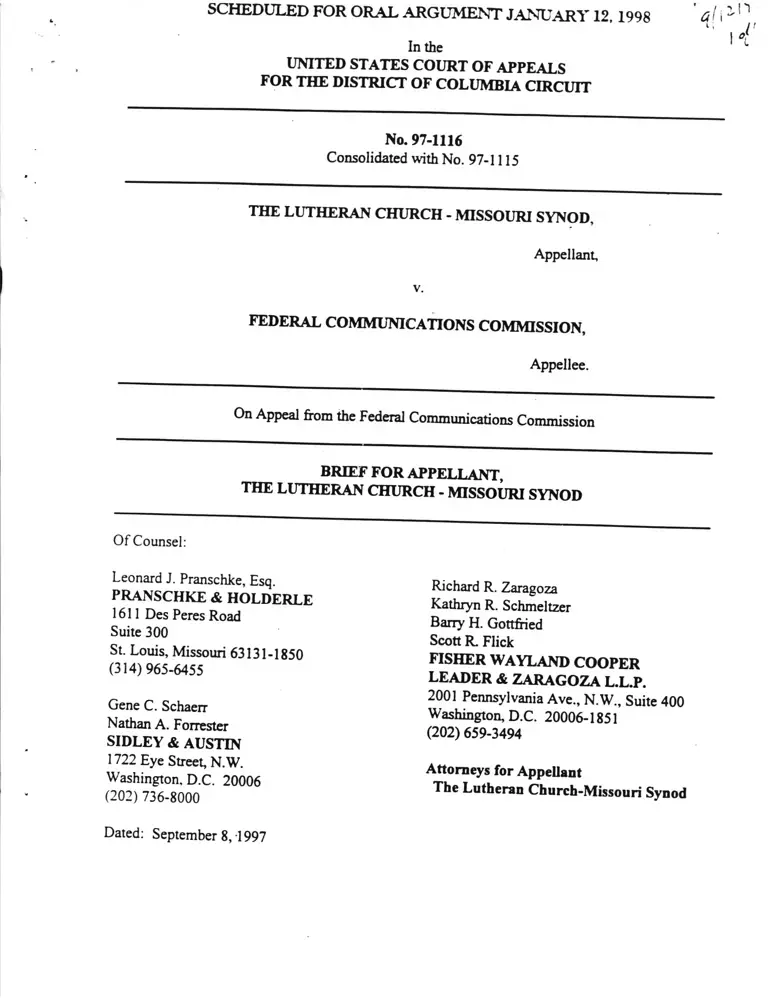
SCHEDULED FOR ORAL ARGUMENT JANUARY 12, 1998 ' a! i 1 n1 i /
UNITED STATES COURT OF APPEALS
FOR THE DISTRICT OF COLUMBIA CIRCUIT
No. 97-1116
Consolidated with No. 97-1115
THE LUTHERAN CHURCH - MISSOURI SYNOD,
FEDERAL COMMUNICATIONS COMMISSION,
On Appeal from the Federal Communications Commission
b r ie f f o r a p p e l l a n t
THE LUTHERAN CHURCH - MISSOURI SYNOD
In the
Appellant,
v.
Appellee.
Of Counsel:
Leonard J. Pranschke, Esq.
PRANSCHKE & HOLDERLE
1611 Des Peres Road
Suite 300
St. Louis, Missouri 63131-1850
(314) 965-6455
Richard R. Zaragoza
Kathryn R. Schmeltzer
Barry H. Gottfried
Scott R. Flick
FISHER WAYLAND COOPER
LEADER & ZARAGOZA L.L.P.
2001 Pennsylvania Ave., N.W., Suite 400
Washington, D.C. 20006-1851
(202) 659-3494
Gene C. Schaerr
Nathan A. Forrester
SIDLEY & AUSTIN
1722 Eye Street, N.W. Attorneys for Appellant
The Lutheran Church-Missouri SynodWashington. D.C. 20006
(202) 736-8000
Dated: September 8, 1997
SCHEDULED FOR ORAL ARGUMENT JANUARY 12.1998
In the
UNITED STATES COURT OF APPEALS
FOR THE DISTRICT OF COLUMBIA CIRCUIT
No. 97-1116
Consolidated With No 97-1115
THE LUTHERAN CHURCH - MISSOURI SYNOD.
Appellant.
v.
FEDERAL COMMUNICATIONS COMMISSION.
Appellee.
On Appeal From the Federal Communications Commission
BRIEF FOR APPELLANT,
THE LUTHERAN CHURCH - MISSOURI SYNOD
CERTIFICATE AS TO PARTIES. RULINGS. AND RELATED CASES
The Lutheran Church-Missouri Synod (the "Church"), the appellant in Case No. 97-
1116. pursuant to Rule 28(a)(l) of this Court, hereby submits this certificate of counsel as to
parties, rulings and related cases:
A. PARTIES AND AMICI
1. The following are all parties who have appeared before the Federal
Communications Commission in the previous phases of this proceeding. MM Docket No. 94-10:
• The Lutheran Church-Missouri Synod:
Mass Media Bureau of the Federal Communications Commission: and
Missouri State Conference of Branches of the NAACP. St. Louis Branch of
the NAACP. and St. Louis Countv Branch of the NAACP.
The Church certifies that the following are all persons who are parties, intervenors or amici
in the consolidated cases in this Court:
• The Lutheran Church-Missouri Synod;
• Office of the General Counsel. Federal Communications Commission;
• Missouri State Conference of Branches of the NAACP. St. Louis Branch of
the NAACP. and St. Louis County Branch of the NAACP;
• American Center for Law and Justice (amicus on behalf of the Church);
• Center for Individual Rights (amicus on behalf of the Church): and
• National Religious Broadcasters (amicus on behalf of the Church).
2. The Church has the following affiliates (as defined in Rule 26.1(a) of the Court)
which have issued debt securities to the public:
• Lutheran Church Extension Fund - Missouri Synod;
• Califomia-Nevada-Hawaii District Church Extension Fund:
• The Central Illinois District Church Extension Fund:
• The Church Extension Board of the Michigan District of The Lutheran
Church - Missouri-Svnod:
• The Ohio District Lutheran Church Extension Fund. Inc.; and
• The Church Extension Funds of the following entities:
* Iowa District East of The Lutheran Church - Missouri Synod;
* Iowa District West of The Lutheran Church - Missouri Synod;
, South Dakota District of The Lutheran Church - Missouri Synod;
* Southern District of The Lutheran Church - Missouri Synod; and
, Texas District of The Lutheran Church - Missouri Synod.
The general nature and purpose of all of these Church extension funds is to lend funds to
congregations of the Church and to other eligible synodical borrowers. Loans are made for site
acquisition, construction and renovation of facilities for worship, education and other purposes that
serve to further the religious, educational and charitable purposes of the Church. Funds for the
loans are obtained by the regular issuance of general obligation notes by the above-listed entities.
The notes are secured and are issued to Church congregations, individual members of the Church,
and to other synodical investors.
B. RULINGS UNDER REVIEW
The ruling under review in this case is The Lutheran Church/Missouri Svnod
(Memorandum Opinion and Order). 12 FCC Red 2152 (1997). released January 31.1997.
C. RELATED CASES
The case on review has not previously been before this Court or any other court. The
Church is unaware of any other related cases currently pending in this Court or in any other court
other than the consolidated case. Missouri State Conference of Branches of the NAACP. Case No.
1115.
Respectfully Submitted.
Barry H. Gottfried
Scon R. Flick
FISHER WAYLAND COOPER LEADER
& ZARAGOZA L.L.P.
2001 Pennsylvania Ave.. N.W.. Suite 400
Washington. D.C. 20006-1851
(202) 659-3494
Attorneys for Appellant,
The Lutheran Church -Missouri Synod
Dated: September 8. 1997
I A D L L U f L U l ' l 1 1 a
TABLE OF AUTHORITIES...................................................................................................... iii
STATEMENT OF JURISDICTION..............................................................................................2
STATEMENT OF THE ISSUES........................ 2
STATEMENT OF THE C A SE ......................................................................................................3
A. The Commission’s Decision ..................................................................................3
B. The Origin of the Broadcast EEO Rule and the FCC's
King’s Garden Ruling ............................................................................................4
C. The Church and Its Stations.................................................................................. 9
D. The Petition to Deny. Hearing Designation Order and Hearing .......................... 10
E. The Equal Employment Opportunity Issues ........................................................ 13
F. The Misrepresentation/Lack of Candor Issue ...................................................... 17
SUMMARY OF ARGUMENT....................................................................................................18
ARGUMENT............................................................................................................................... 20
I. By Second-Guessing the Church's Judgment as to Which Jobs at the
Radio Stations Are Important to its Religious Mission, the FCC Violates
Both the Religious Freedom Restoration Act and the First Amendment ........................21
A. The MO&O violates RFRA..................................................................................22
B. The MO&O also violates the Free Exercise Clause ............................................28
C. The MO&O also violates the Establishment C lause............................................31
II. By Forbidding the Church to Use a Religious Criterion In Hiring
Personnel for Certain Positions at the Radio Stations, the FCC
Discriminates Against Religious Broadcasters In Violation of Both
the Free Speech and Free Exercise Clauses of the First Amendment................ ............32
III. The FCC’s Application of Its EEO Rule to The Church Violates
the Equal Protection Clause of the Fifth Amendment.................................................... 35
- i -
IV. The FCC Acted Arbitrarily and Capriciously. And Therefore
Unlawfully, In Applying Its King’s Garden Ruling to the Church
Without Adequately Examining the Ruling's Underlying Prem ises................................. 38
V. The FCC Acted Arbitrarily and Capriciously. And Thus Unlawfully.
In Concluding that the Church Lacked Candor Based on a Legal
Argument o f Its Counsel ...........................................................................................................40
RELIEF SOUGHT AND CONCLUSION ......................................................................................... 43
STATUTORY ADDENDUM .................................................................................. 45
- ii -
TABLE UK AUTHORITIES
CASES
* Adarand Constructors. Inc, v. Pena. 115 S.Ct. 2097 ('1995') ..................................... 35.37
* Rechtel v. FCC. 10 F.3d 875 (D.C. Cir. 1993) .................................................. 21. 39. 40
Bilingual Bicultural Coalition of Mass Media. Inc, v. FCC.
595 F.2d621(D.C. Cir. 1978) ........................................................................................ 38
Calleio v. Resolution Trust Corp.. 17 F.3d 1497 (D.C. Cir. 1994)............................ 20. 21
Cantwell v. Connecticut. 310 U.S. 296 (19401 ................................................................30
* Church of the Lukumi Babalu Ave. Inc, v. Citv of Hialeah. 508 U.S. 520 (19931......... 34
Citv of Boeme v. P.F. Flores. 117 S.Ct. 2157 H 997)......................................................27
* Corporation of the Presiding Bishop of the Church of Jesus Christ of
Latter-Dav Saints v. Amos. 483 U.S. 327 (1987) .............. ....................................passim
FF.OC y. Catholic Uniy. of America. 83 F.3d 455 (D.C. Cir. 1996) . . . . 22. 28. 29. 31. 32
Employment Div.. Dep't of Human Resources of Oregon y. Smith.
494 U.S. 872, reh'g denied. 496 U.S. 913 (1990).................................. 22. 28. 29. 30. 33
Everson v. Board of Educ. of Ewing. 330 U.S. 1. reh'g denied.
330 U.S. 855 (1947)........................................................................................................ 34
FCC v. League of Women Voters of California. 468 U.S. 364 (1984).......................... 30
Florida State Conference of Branches of the NAACP v. FCC. 24 F.3d 271
(D.C. Cir. 1994)....................................... ...................................................................... 42
Fowler v. Rhode Island. 345 U.S. 67 (1953).................................................................. 23
Hopwood v. State of Texas. 78 F.3d 932 (5th Cir.). reh'g denied.
84 F.3d 720. cert, denied. 116 S.Ct. 2581 (1996) ................................................ -..25.37
Hsu v. Roslvn Union Free Sch. Dist. No. 3. 85 F.3d 839 (2d Cir.).
cert, denied. 117 S.Ct. 608 (1996).................................................................................. 31
* Cases and materials marked with an asterisk are those principally relied upon.
- iii -
nearon v. si. nicnoias lainearai or ine Russian urtnoaox inurch in
North America. 344 U.S. 94 (1952).................................................... 29
*
King's Garden. Inc, v. FCC. 498 F.2d 51 (1974) ......................................
Lamb's Chapel v. Center Moriches Sch. Dist.. 113 S. Ct. 2141 (1993)----
Lemon v. Kurtzman. 403 U.S. 602, reh'p denied. 404 U.S. 876 (1971) . . .
Little v. Wuerl. 929 F.2d 944 (3d Cir. 1991) ............................................
Mack v. O’Leary. 80 F.3d 1175 (7th Cir. 1996), reh'g denied.
1997 U.S. App. LEXIS 540 (January 8. 1997) ..........................................
Melodv Music. Inc, v. FCC. 345 F.2d 730 (D.C. Cir. 1965)......................
Miller v. Johnson. 115 S.Ct. 2475 (1995)..................................................
NAACP v. Federal Power Comm'n. 425 U.S. 662 (19761 ........................
National Org. for Women v. FCC. 555 F.2d 1002 (D.C. Cir. 1977)..........
NLRB v. Catholic Bishop of Chicago. 440 U.S. 490 (1979)........................
Porter v. Califano. 592 F.2d 770 (5th Cir. 1979)..........................................
Presbvterian Church v. Marv Elizabeth Blue Hull Presbyterian Church.
393 U.S. 440 (1969)......................................................................................
Rayburn v. General Conference of Seyenth-Dav Adventists. 772 F.2d 1164
(4th Cir. 19851. cert, denied. 478 U.S. 1020 (1986))...................................
passim
. . . . 34
. . . 31
29.32
.. .28
. . .43
37
. 5
38
32
20
23
32
Rosenberger v. Rector and Visitors of Univ. of Virginia..
115 S.Ct. 2510 (1995) .............................................................................................. 33.34
Sable Communications of California Inc. v. FCC. 492 U.S. 115 U989) ...................... 34
Texas v. Johnson. 491 U.S. 397 (1989).......................................................................... 35
Thomas v. Review Bd. of the Ind. Employment Sec. Div.. 450 U.S. 707 (1981).......... 23
Turner Broadcasting System. Inc, v. FCC. 114 S. Ct. 2445, reh'g denied.
512 U.S. 1278 (1994)................................................................................................ 33, 34
* Cases and materials marked with an asterisk are those principally relied upon.
- iv -
whw Enterprises, me. v. H i . O i i-.4d l u j (D.c. Ur. 1985) .................................. 40
Wisconsin v. Yoder. 406 U.S. 205 (1972)...................................................................... 30
Young v. Crystal Evangelical Free Church. 82 F.3d 1407 (8th Cir.).
reh'g denied. 89 F.3d 494 (1996).............................................................................. 21. 28
FCC CASES
Abacus Broadcasting Corp.. 8 FCC Red 5110 (Rev. Bd. 1993) ..................................... 40
Character Policy Statement. 102 F.C.C. 2d 1179 (1986)................................................ 40
Discriminatory Employment Practices bv King's Garden. Inc..
34 F.C.C. 2d 937 (1972) ........................................................................................ 6.7.38
Eagle Radio. Inc.. 9 FCC Red 836 (1994), recon, denied. FCC 95-434
(released January' 19, 1996)............................................................................................ 11
Fox River Broadcasting. Inc.. 93 F.C.C. 2d 127 H983) ................................................ 40
* Fox Television Stations. Inc.. 10 FCC Red 8452 (1995). recon, denied.
3 CR 526 (1996)............................................................................................17. 40. 42. 43
King's Garden. Inc.. 38 F.C.C. 2d 337 (1972).............................................................. 3. 7
National Religious Broadcasters. Inc.. 43 F.C.C. 2d 451 (19731 .............................. 8.23
Nondiscrimination in Employment Practices. 60 F.C.C. 2d 226 (1976),
set aside on other grounds sub, nom.. Office of Communication of the
United Church of Christ v. FCC. 560 F.2d 529 (2d Cir. 1977).................................... 5. 6
Notice of Proposed Rule Making in Streamlining Broadcast EEO Rule
and Policies. 11 FCC Red 5154 (1996)........................................................................ 5. 6
Nondiscrimination Employment Practices of Broadcast Licensees.
13 F.C.C. 2d 766(1968) ........................................................................................ 4.5.36
Nondiscrimination Employment Practices of Broadcast Licensees.
18 F.C.C. 2d 240 (1969) .................................................................................................. 4
* Cases and materials marked with an asterisk are those principally relied upon.
* Rov M. Speer. 3 CR 363 (1996) .................................................................................... 42
Statement of Policy of Minority Ownership of Broadcasting Facilities.
68 F.C.C. 2d 979 (1978). as revised. 92 F.C.C. 2d 849 (1982)...................................... 11
STATUTES
5 U.S.C. § 553(b) (1994)................................................................................................ 39
5 U.S.C. § 706(1994) .............................................................................................. 20.21
42 U.S.C. §§ 2000 et sea. (1988 & Supp. V 1993)...................................................... 4. 6
* 42 U.S.C. §§ 2000bb et seq. (Supp. V 1993)............................................................ 20. 28
42 U.S.C. § 2000bb-l(b) (Supp. V. 1993)...................................................................... 28
* 42 U.S.C. § 2000e-l (1972) ....................................................................................passim
47 U.S.C. § 402(b) (1988 & Supp. V 1993) .................................................................... 2
47 C.F.R. § 73.2080 (1996).................................................................................... 3, 5. 33
MISCELLANEOUS
Equal Employment Opportunity Act of 1972. Public Law 92-261. 86 Stat. 103 ............ 7
H.R. REP. No. 103-88. 103d Cong.. 1st Sess. 9 (1993) ................................................ 28
S. REP No. 103-111. 103d Cong.. 1st Sess. 13-14 (1993). reprinted in
1993 U.S.C.C.A.N. 1892 . . . . T...................................................................................... 28
United States Constitution, art. 1. § 8. cl. 18 .................................................................. 28
* United States Constitution, amend. I .........................................................................passim
* United States Constitution, amend. V .......................................................................passim
* Cases and materials marked with an asterisk are those principally relied upon.
vi -
SCHEDULED FOR ORAL ARGUMENT JANUARY 12, 1998
In the
UNITED STATES COURT OF APPEALS
FOR THE DISTRICT OF COLUMBIA CIRCUIT
No. 97-1116
Consolidated with No. 97-1115
THE LUTHERAN CHURCH - MISSOURI SYNOD,
Appellant,
v.
FEDERAL COMMUNICATIONS COMMISSION,
Appellee.
ON APPEAL FROM THE
FEDERAL COMMUNICATIONS COMMISSION
BRIEF FOR APPELLANT,
THE LUTHERAN CHURCH - MISSOURI SYNOD
STATEMENT OF JURISDICTION
This Court has jurisdiction over this appeal by the Lutheran Church-Missouri Synod (the
“Church”) pursuant to Section 402(b) of the Communications Act of 1934. as amended. 47
U.S.C. § 402(b) (1988 & Supp. V 1993). The Church filed a timely appeal on March 3. 1997
from the decision of the Federal Communications Commission (the “FCC" or the
“Commission”), released on January 31. 1997. granting the Church's license renewal
applications for radio stations KFUO(AM) and KFUO-FM. Clayton. Missouri (“KFUO" or the
“Stations” when referred to jointly), but concluding that certain EEO related violations had
occurred that warranted the imposition of EEO reporting requirements and assessing a $25,000
forfeiture. The Lutheran Church/Missouri Svnod ('Memorandum Opinion and Orderl. 12 FCC Red
2152 (1997) (the “MO&Q”V J.A.__ .
STATEMENT OF THE ISSUES
1. Did the MO&O violate the Religious Freedom Restoration Act and the Church's
rights under the Free Exercise and Establishment Clauses of the First Amendment by arrogating
to the Government the right to determine which job functions at the Church's Stations need
religious hiring preferences?
2. Did the MO&O discriminate against religious broadcasters in violation of the Free
Speech and Free Exercise Clauses of the First Amendment'?
3. Did the FCC's application of its affirmative action requirements to the Church
violate the Fifth Amendment by prohibiting the Church from using religious preferences while
requiring the Church to be conscious of race in its employment actions?
. i .
4. Did the FCC act arbitrarily and capriciously in failing to reexamine the premises
of its 25 year old ruling limiting the use of religious hiring preferences by religious
organizations?
5. Was the MO&O arbitrary and capricious in holding that a forfeiture should be
imposed on the Church because former counsel's use of the word “required" rather than
“preferred’' in an argument allegedly “lacked candor”?
STATEMENT OF THE CASE
A. The Commission's Decision
In the MO&O. the FCC renewed the Church's licenses for KFUO. but concluded that the
Church had violated the FCCs Equal Employment Opportunity (“EEO”) Rule. 47 C.F.R.
§ 73.2080 (1997) (the “EEO Rule"), imposed "EEO reporting" requirements, and assessed a
$25,000 forfeiture for a purported lack of candor. The Commission found that KFUO had not
engaged in any discrimination and that KFUO's statistical record of employment did not raise
any inference of discrimination. MO&O r 17. KFUO had written antidiscrimination and
affirmative action policies (ID !̂r 42-43) and had sought minority applicants and hired
minorities by using a variety of religious and secular referral sources. ID 76. 79, 82. 88. 91,
120. 126. 130. Nonetheless, the Commission ruled that there were EEO violations because the
Church had given preferential hiring treatment to individuals with knowledge of Lutheran
doctrine for positions at KFUO that the Government deemed were not reasonably connected with
espousal of the Church's religious views over the air. thereby violating the FCCs ruling in
King s Garden. Inc.. 38 F.C.C. 2d 339 (1972). aff d. King's Garden. Inc, v. FCC. 498 F.2d 51
H974) (“King’s Garden”! MQ&Q T I9-14.
The Commission also concluded that the Church violated the FCC's affirmative action
requirements for two and one-half years of the seven year license period because KFUO solicited
the assistance of likely sources of minority referrals on an “irregular" basis and had not engaged
in continual “self-evaluation” of the success of its minority recruitment policies as compared to
the availability of minorities in the labor market. See MO&O 5, 29. In addition, the
Commission fined the Church $25,000 for a purported “lack of candor" in a statement describing
its recruiting policies embedded in a legal argument. MO&O ^21. The Church appeals from the
FCC’s rulings that it violated any valid EEO requirement and that it lacked candor, from the
EEO reporting requirements and from the forfeiture.
B. The Origin of the Broadcast EEO Rule and the FCC’s King's Garden Ruling
In 1964. Congress delegated regulatory authority over discrimination in employment to
the Equal Employment Opportunity Commission under Title VII of the Civil Rights Act of 1964,
42 U.S.C. §§ 2000 et seq. 11988 & Supp. V 1993) (“Title VH’’). Four years later, the FCC
adopted a Memorandum Opinion and Order and Notice of Proposed Rulemaking announcing that
the National policy against discrimination embodied in Title VII is fully applicable to
broadcasting. Nondiscrimination Employment Practices of Broadcast Licensees. 13 F.C.C. 2d
766 (1968). The first EEO Rule was adopted in 1969. Nondiscrimination Employment Practices
of Broadcast Licensees. 18 F.C.C. 2d 240 (1969).
The impetus for the Commission's action in 1968 was the “serious racial crisis” then
confronting the Nation. Nondiscrimination Employment Practices of Broadcast Licensees. 13
F.C.C. 2d at 774. The Commission reasoned, “we simply do not see how the Commission could
- 4 -
make the public interest finding as to a broadcast applicant who is deliberately pursuing or
preparing to pursue a policy of discrimination -- of violating the National policy." 1 .̂ at 769.
The FCC did not mention “program diversity" as a justification until 1976. when it asserted that
its EEO Rule served to ensure that licensees' programming “fairly reflects the tastes and
viewpoints of minority groups." quoting dicta from a footnote in the Supreme Court's opinion in
NAACP v. Federal Power Comm'n. 425 U.S. 662. 670 n.7 (1976); Nondiscrimination in
Employment Practices (Broadcast). 60 F.C.C. 2d 226. 229 (1976), set aside on other grounds sub
nom.. Office of Communication of the United Church of Christ v. FCC. 560 F.2d 529 (1977)
(“Broadcast Discrimination"-).
Following further amendments, the FCC's current EEO Rule. 47 C.F.R. § 73.2080.
provides in pertinent part: (a) “Equal opportunity in employment shall be afforded by all
licensees . . . of commercially or noncommercially operated AM. FM . . . broadcast stations .. .
to all qualified persons, and no person shall be discriminated against in employment by such
stations because of race, color, religion, national origin, or sex"; and (b) “Each broadcast station
shall establish, maintain, and earn' out a positive continuing program of specific practices
designed to ensure equal opportunity in even aspect of station employment policy and practice."
47 C.F.R. § 73.2080 (a), (b) (1996).
Under this EEO Rule, the FCC requires any broadcast station that employs five or more
full-time employees to develop a written "model'' EEO plan. The station must recruit candidates
from minority groups for each job opening from a number of minority recruitment sources.
Sanctions are levied for unsatisfactory efforts to recruit from minority referral sources or to
advertise in minority publications. See Notice of Proposed Rule Making in Streamlining
- 5 -
Broadcast EEO Rule and Policies. 11 FCC Red 5154. 5160 (1996) (“Streamlining"). The
broadcaster must “recruit. . . [so as to] enhance access by minorities and women to employment
opportunities in broadcasting... Icf at 5158.
The FCC subjects a station's EEO efforts to intensive scrutiny if it fails to meet certain
“processing guidelines based on employment statistics." See Broadcasting Nondiscrimination.
60 F.C.C. 2d at 236-39. Under the FCC's guidelines, stations with 11 or more full-time
employees are subject to intensive scrutiny if the proportion of minority representation is not at
least 50% of that of the “relevant” labor force for both overall and upper level job categories.
Streamlining. 11 FCC Red at 5160.
The FCC's initial ruling concerning the bearing of its EEO Rule on religious
organizations was made in response to a 1971 letter of complaint alleging that King's Garden.
Inc. (“King's Garden”), a Christian religious organization and radio licensee, had discriminated
against a prospective employee by asking whether he was a Christian. Discriminatory
Employment Practices bv King's Garden. Inc.. 34 F.C.C. 2d 937 (1972). In response. King's
Garden referred to Title VII. which at the time exempted religious corporations "with respect to
the employment of individuals of a particular religion to perform work connected with the
carrying on by such corporation . . . of its religious activities . . . ." 42 U.S.C. § 2000e-l (This
amendment was codified as § 702 of Title VII. Pub. L. No. 92-261. 86 Stat. 103. 42 U.S.C. §
2000e- 1(a) (1972). and is hereinafter referred to as "Section 702.”)
The Commission issued a letter ruling that King's Garden's hiring action discriminated
on the basis of religion in violation of the FCC’s EEO Rule because the job at issue was not
related to the licensee's religious mission. The Commission said: “In keeping with the
- 6 -
exemptions . . . [in] the Civil Rights Act of 1964. the Commission believes that those persons
hired to espouse a particular religious philosophy over the air should be exempt from the
nondiscrimination rules.” Discriminatory Employment Practices bv King's Garden. Inc.. 34
F.C.C. 2d at 938. In fact, however, the Commission's ruling was not “in keeping" with the Civil
Rights Act of 1964 -- two months earlier, on March 24. 1972. the Equal Employment
Opportunity Act of 1972 had been approved. Public Law 92-261. 86 Stat. 103, and had amended
Title VII to permit religious discrimination by religious organizations in hiring any person "to
perform work connected with its activities.” not just religious activities. 42 U.S.C. § 2000e-l
(1972)4
King's Garden sought reconsideration, referring to the actual Section 702 that had been
enacted shortly before the FCC's ruling, and filed a petition for rulemaking to amend the
Commission's EEO Rule to exempt religious organizations consistent with Title VII. The
Commission concluded that King's Garden was not relieved of its obligation to comply with the
letter ruling because of the change in Title VII. but added that religious licensees' obligations
would be changed if King's Garden's proposals were adopted in the rulemaking proceeding. The
Commission promised to consider the petition for rulemaking at a later time. King's Garden. 38
F.C.C. 2d at 337.
Section 702 provides:
The subchapter shall not apply . . . to a religious corporation,
association, educational institution, or society with respect to the
employment of individuals of a particular religion to perform work
connected with the carrying on by such corporation, association,
educational institution, or society of its activities.
- 7 -
In February 1973, the National Religious Broadcasters requested a declaratory ruling as
to the applicability of King's Garden to various employee categories. The Commission stated
that writers and research assistants hired for the preparation of programs espousing a licensee's
religious views and those hired to answer religious questions on a call-in program would be
exempt from the nondiscrimination rules, but that announcers, as a general category, would not
be exempt. Acknowledging that the area involved First Amendment rights, the Commission
indicated that it preferred to have religious stations present specific factual settings before issuing
rulings. National Religious Broadcasters. Inc.. 43 F.C.C. 2d 451.452 (1973) (“NRB").
In 1974, this Court rejected King's Garden's facial challenge to the FCCs refusal to
exempt religious licensees from the FCC's strictures against religious discrimination. £ge King's
Garden. 498 F.2d 51. Opining that Section 702 was “of very doubtful constitutionality.” the
Court upheld the Commission's letter ruling providing for a limited religious exemption for
religious organizations. However, the Court observed that “[t]he Commission has set itself the
difficult task of drawing lines between the secular and religious aspects of the broadcasting
operations of its sectarian licensees.” and cautioned that future application of King's Garden
would require continuing judicial scrutiny. Id. at 61. The Court noted that King's Garden “had
requested institution of rulemaking proceedings on the Commission's exemption policy" and
held that the issue of application of the exemption ruling was not before it. isL at 53 n .l.*
King's Garden's May 1972 rulemaking was never docketed, much less concluded, according to
*■ Chief Judge Bazelon disagreed with the Court's decision that the FCC could impose
employment requirements in direct conflict with the standards established by Congress in
Section 702. but joined in the decision because he believed Section 702 was
unconstitutional and not binding on the FCC. King's Garden. 498 F.2d at 61.
- 8 -
the Commission’s records.
C. The Church and Its Stations
The 117-year history of the Church's work with African Americans demonstrates an
aggressive attitude against racism and a longstanding commitment to outreach toward African
Americans. II) t 36. For example, in 1953. the Church formed the Lutheran Human Relations
Association of America to make efforts to eliminate segregation and discrimination, and in 1977
the Church created the Commission on Black Ministry to expand the Church’s African American
membership. H) 37. The Church has approximately 50.000 African American members (out
of a total of 2.6 million) and has 86 African American pastors. H) 38. Since 1975. the national
Church leadership has included an African American vice president. ID % 39.
The Church, either directly or through its Concordia Seminar}’, has owned and operated
Station KFUO(AM) since 1924. and KFUO-FM since 1948. KFUO's personnel are employees
of the Church. See Church Ex. 4. att. 6. The Stations both operate out of the same studios on the
campus of the Church's Concordia Seminar}’ and share many support personnel. ID 7; Church
Ex. 4. att. 6.
KFUO(AM). which operates noncommercial!} , has the distinction of being the world's
oldest religious broadcast facility. It was the first daily station to air and continuously maintain a
religious format. KFUO-FM is the only full-time classical music station in the St. Louis market.
It broadcasts sacred as well as non-liturgical classical music and some religious programming.
ID c 7. The FM station operated noncommercial!} from its inception until March 1983. when
the Church found it necessary to accept commercial advertising on the FM station because
voluntary contributions and bequests, which had been the source of revenue for both Stations,
- 9 -
were insufficient. II) 1 17. In the Church's view, both Stations are dedicated to the task of
carrying out in their way the Church's Great Commission from Christ — to preach the Gospel to
every creature and to nurture and serve people in a variety of ways. ID 8.
KFUO has had a long and close relationship with Concordia Seminary. Seminary
students and the Seminary itself contributed funds for the construction of KFUO(AM) and for its
initial operation. The Seminary' has permitted KFUO to remain on its campus, first in St. Louis
and later in Clayton. Missouri, on a rent-free basis. Seminary faculty members and students have
performed as talent on KFUO and have worked as announcers on KFUO as part of a “work-
study" program, usually on a part-time basis. ID Tfl[ 9-11.23-29. Through KFUO's operations,
seminarians “were reminded of the importance of radio in their total ministry to the needs of the
people in their community." ID ^ 26. KFUO has been “part of the campus family and part of a
campus community." ID ^ 29.
The Church's KFUO had a spotless FCC record over a seventy year period. Neither the
FCC nor its predecessor agency had ever cited KFUO for any violations of FCC rules or policies.
ID % 18.
D. The Petition to Deny. Hearimz Designation Order and Hearing
On September 29. 1989. KFUO filed license renewal applications based on the license
term beginning February' 1. 1983 and ending February 1. 1990 (the “License Term"). On
January 2. 1990. the Missouri State Conference of Branches of the NAACP and various local
NAACP branches (collectively, the “NAACP') filed a petition to deny the license renewals of
several Missouri radio stations, including KFUO. Although KFUO showed minority employees
during the two week payroll period reflected in each annual employment report for the License
- 10 -
Term except 1987 and 1988. the NAACP argued that the Church did not comply with the FCC's
EEO Rule based on an analysis of the minority employees at KFUO shown on the annual reports
as compared with the percentage of minorities in the St. Louis MSA labor force. Pet. to Deny 3.
Between 1990 and late 1992. the Commission's staff sent the Church several letters
requesting recruitment and hiring data. In a response, the Church's then counsel. Arnold &
Porter, explained that the Stations' formats “required" that nearly all upper-level positions be
filled with persons with theological or classical music expertise or training. ID 1 152. The staff
then asked the Church to explain what aspects of particular positions required theological
training. MM Bur. Ex. 13 at 1.
On February 1. 1994, the Commission designated the Church's license renewal
applications for an evidentiary hearing.2 The hearing designation order (“HDO’") faulted a legal
argument made by counsel at Arnold & Porter based on the use of statistics concerning
minorities with Lutheran training and knowledge of classical music because, in the
Commission's view, the argument “appearjedj to evidence a preconceived notion about the
The same day. the Commission also announced several actions "reaffirming" its
commitment to its EEO Rule, including the release of a number of orders imposing more
substantial fines than had previously been imposed for alleged EEO violations. News
Release #41580. See, e.g.. Eagle Radio. Inc.. 9 FCC Red 836 (1994), recon, denied. FCC
95-434 (released January 19. 1996). However, only the Church's renewal applications, at
the request of the NAACP. w'ere designated for hearing. The Church had two options: go
to hearing or sell its Stations at a “fire sale" price to a minority group and avoid the
hearing. The Commission will not allow a licensee whose licenses have been designated
for hearing to sell its stations except under the FCC s “minority distress sale" policy
\ which creates the opportunity for minority-controlled entities to purchase such stations at
75% or less of fair market value. When there is such a sale, there is no hearing.
Statement of Policy of Minority Ownership of Broadcasting Facilities. 68 F.C.C. 2d 979
(1978), as revised. 92 F.C.C. 2d 849 (1982).
suitability of minorities to perform certain jobs." The Commission alleged that “Lutheran
training" and “classical music expertise" were "vague, unascertainable criteria" which “had a
direct adverse impact on Blacks .. . HDO % 26. In addition, the HDO alleged that the
Church's arrangement with Concordia Seminary to employ seminary students and their spouses,
at KFUO violated the EEO Rule, hi
The Church's license renewals were designated for hearing to determine whether the
Church had complied with the FCC's affirmative action requirements and to determine whether
the Church had made misrepresentations of fact or lacked candor. The misrepresentation/lack of
candor issue was designated primarily because there was a discrepancy in the Church's responses
concerning the number of total hires (full and part-time) during the 12 months preceding the
filing of the renewal applications. HDO ^ 27. Both the burden of proceeding and the burden of
proof were placed upon the Church. HDO 334
During the evidentiary hearing. Church witnesses were questioned by the FCC's counsel
concerning KFUO's employment practices and the reasons for hiring personnel who were
familiar with the Church's teachings, including as follows:
Q. Let me call your attention to your Exhibit 4. p.7. There you
indicated it was helpful for certain secretaries to be familiar
with the Lutheran Church because part of their job was to
contact pastors to enlist volunteers for share-a-thons. As 1
understood your testimony yesterday, the secretary's
principal role was in scheduling ministers for these share-a-
thons and for other programs that the church had. Is that
At the NAACP's request and over opposition by both the Church and FCC trial staff, the
Administrative Law Judge subsequently expanded the issue to determine whether the
Church had engaged in discrimination. The Church had the burden of proving that it did
not discriminate. MO&O of Mar. 25. 1994.
correct?
A. Certain secretaries, yes.
Q. Did the scheduling of these ministers require the secretaries
to have familiarity with Lutheran doctrine?
A. It was helpful if they were familiar with the calendars of the
Lutheran Church and the. and the biblical teachings of the
Lutheran Church.
Q. Well, why if all they were doing was scheduling ministers
or other Lutherans to appear on programs did they have to
themselves have knowledge of the Lutheran calendar?
And —
A. Because the ministers that come to the radio station to
speak or to do a Bible study or to appear on a worship
program want to know what church day they'll be
addressing, what part of the Bible they will be addressing
and --
The Church's counsel objected that this inquiry raised constitutional concerns under the First
Amendment. Tr. 734-737.
E. The Equal Employment Opportunity Issues
Based on the hearing record, the FCC Administrative Law Judge (“ALJ") found that the
Church was and is committed to nondiscrimination and has had a long history of fighting racial
discrimination and of continuous outreach toward African Americans. ID ^195. The ALJ
found:
The findings establish^ that no individual was discriminated
against by the Stations because of race, color, religion, national
origin, or sex. There is not one scintilla of evidence in the record
to indicate that any adverse discriminatory act ever occurred, or
that any individual ever even made an allegation of racial or other
discrimination regarding the Stations' employment practices.
- 13 -
m H94.
On appeal, the Commission's Review Board affirmed the holding that the Church had not
engaged in discrimination. Rev. Bd. Dec. fflf 14-17. Upon review, the Commission affirmed the
holdings of the ALJ and the Review Board that the Church had not discriminated and the
statistical record did not raise any inference of discrimination. MO&O 17.
The ALJ's Initial Decision also acknowledged that during the License Term. KFUO
recruited for minorities in several ways, including through its existing minority employees and
through Lutheran sources such as local parish networks and a magazine targeted to Church
members, including 50,000 African Americans. ID Tflf 76. 79. 82, 88. 91. 120, 126. 130. Of
KFUO's full-time hires, 58.1% were female and 16.3% w'ere minority. H) 1 68. During the
License Term, the St. Louis MSA labor market included 43.2% females and 15.6% minorities.
ID ^ 12 n.9. Thus. KFUO hired at a rate of 104.5% of minority "parity.”
For the period from February 1. 1983 through August 3. 1987. the Judge concluded that
the Church's overall affirmative action efforts were "flawed" but in substantial compliance with
the Commission's EEO Rule. While acknowledging that KFUO used various recruiting
techniques such as referrals from an African American employee, newspaper advertisements, the
Broadcast Center in St. Louis and Lutheran sources, the Judge criticized the facts that the major
source of African American employees during this period was one of the Stations' African 'N
American employees and that referral sources specifically targeted to minorities had not been
used for every vacancy. IQ 205. 209-10.
- 14 -
The ALJ held that from August 3. 1987 through January 31. 1990. the Church's efforts
were inadequate to meet the Commission's newly revised EEO standards. The Judge reached this
conclusion by holding, first, that the Church violated the ruling in King's Garden by giving
preferential hiring treatment to individuals with knowledge of Lutheran doctrine, and to active
members of Christian or Church congregations, for positions for which the Church believed such
preferences were desirable to serve the Church's mission, in Ifi! 200-204. The ALJ
acknowledged that the Church believed that many of the job functions at its Stations require a
knowledge of Lutheran doctrine and philosophies. H) 50. However, the Judge deemed that
certain of the job functions for which KFUO had such a preference were not reasonably
connected with the espousal of the Church's religious views and penalized the Church for using
religious preferences for positions such as receptionist, secretary, engineer, and business
manager.^ ID ^200-05.
In addition, the ALJ ruled that KFUO failed to implement a "consistent" or "systematic"
EEO affirmative action program adequate to meet the FCC's standards, as revised effective
August 1987. ID *1217. The Judge acknowledged that in the year prior to filing their renewal
applications the Stations placed advertisements in the St. Louis Post Dispatch, sent letters to 10
local universities and personnel agencies requesting minority and female referrals, and sought
referrals from the Lutheran Employment Project of St. Louis, a clearinghouse run by various
Lutheran churches for employment of minority group members. Indeed. KFUO hired a minority
applicant through the Lutheran Employment Project. JD cr 88. 91. 120. 126. Nonetheless, the
- In fact, the Stations did not recruit for or hire an engineer during the License Term.
Church Ex. 4. att. 6.
- 15 -
ALJ ruled that the Church's efforts were too "irregular" (U) ^ 220) and that KFUO failed to
evaluate its employment profile and success in attracting minority applicants and interviewees
against minority availability in the MSA labor force, thereby violating the FCC's affirmative
action requirements. ID fflj 220. 221. Based on these rulings, the ALJ granted the Church's
license renewal applications for full license terms, but required the Church to file four detailed
EEO reports to the FCC at six month intervals concerning the Church's affirmative action efforts
for both full and part-time positions. ID ^ 282.
On appeal, the Review Board stated that it lacked authority to modify the holding in
King's Garden, and thus did not rule on the Church's constitutional or statutory arguments. Rev.
Bd. Dec. ]j 37. The Board affirmed the Judge's ruling that the Stations were not in substantial
compliance with the Commission's EEO requirements during the latter part of the License Term,
and imposed the same EEO conditions as the ALJ but changed the renewal grants to a shorter
term ending January 1. 1997. one month prior to the next scheduled expiration date. Rev. Bd.
Dec. Tj 14. 34.-
Upon review, the full Commission rejected the Church's First Amendment. Fifth
Amendment and statutory challenges to the King's Garden decision, reaffirmed that ruling and
applied it to the Church. The Commission emphasized that its EEO requirements are not
founded on Title Vll and ”[t]he EEO rule is not intended to replicate federal and state
antidiscrimination laws but rather to advance the Commission's unique program diversity-related
The Board Chairman appended "Additional Views" to the Decision in which he quoted
various Biblical passages in suggesting that the parties should "settle their differences.”
Rev. Bd. Dec. 8.
- 16-
mandate.” MO&O \ 10. The Commission also affirmed the holding that the Church's
X--------
recruitment program was “inadequate” for the last portion of the License Term. Although the
Commission modified the Review Board Decision by granting the Church full term license
renewals, the Commission imposed annual EEO monitoring reports for three years covering all
full-time and part-time hires. MO&O 1flj 27-29.
F. The Misrepresentation/Lack of Candor Issue
The ALJ found, based on the record evidence, that the discrepancy in the Church's
filings concerning the total number of employees hired that had led to the misrepresentation issue
was the result of an innocent misunderstanding and was not a misrepresentation. ID 224-229.
However, the Judge held that the Church “lacked candor" by (a) using the word "required" rather
than "preferred" in a legal argument advanced by counsel at Arnold & Porter concerning the
need for classical music knowledge on the part of FM sales personnel; and (b) stating in its
renewal applications that the Church "actively" sought minority and female referrals. ID 1fll 234.
251. While noting that the Church's witnesses were credible and testified truthfully and that the
misconduct was an aberration, the Judge imposed a S50.000 forfeiture for these two supposed
incidents of “lack of candor." ID ^261.
The Review Board did not accept the ALJ's conclusion that the Church lacked candor by
stating in a pleading that knowledge of classical music was a "requirement" for the position of
FM salesperson. The Review Board stated that "because the critical word was embedded in and
essential to a pre-conceived legal argument contrived by counsel, a laymen [s/c] may not have
fully appreciated the significance of its use." Rev. Bd. Dec. ^ 27 (citing Fox Television
Stations. Inc.. 10 FCC Red 8452. 8501 n.68 (1995), recon, denied. 3 CR 526 (1996) (“Fox
- 17-
Television”')'). However, the Board affirmed the ALJ's holding that the Church lacked candor in
describing its recruitment efforts as "active" because it did not engage in recruitment efforts for
all of its hiring vacancies. Rev. Bd. Dec. 21. Although the Board narrowed the ALJ's lack of
candor ruling, it did not reduce the $50,000 forfeiture. Rev. Bd. Dec. 39.
The Commission overruled the Review Board in connection with both purported
incidents of “lack of candor.” First, it held that the applicable statute of limitations barred any
sanction for the Church's statement that it “actively” sought minorities and women. MO&O
t 26. Second, the Commission resurrected the ALJ's finding that the Church “lacked candor" in
using the word “require” despite the Review Board's conclusion that it was embedded in a legal
argument suggested by counsel. MO&O c 22. The Commission's MO&O reduced the
forfeiture for the one instance of “lack of candor" to $25,000. MO&O f 30.
SUMMARY OF ARGUMENT
In the MO&O. the FCC ruled that the Church violated the Commission's EEO Rule by
giving preferential treatment to individuals with Lutheran knowledge for job positions that the
Government deemed were not reasonably connected with espousal of the Church's religious
views over the air. This ruling violates both the Religious Freedom Restoration Act and the Free
Exercise Clause of the First Amendment by substantially burdening the Church's religiously
motivated communicative conduct. The ruling burdens, for example, the Church's ability to
define itself as a community, to assign its stafl with flexibility, and to train its seminarians on
whose campus the Stations are located without the need for Government approval. The FCC
cannot show that it has narrowly tailored its ruling and the burdens imposed on the Church to
- 18 -
serve any compelling governmental interest.
The FCC apparently bases its decision to limit the Church's discretion to prefer those
with Lutheran knowledge, including minorities, on the desire to promote “programming
diversity.” But even assuming for the sake of argument that this Court were to agree that this is a
compelling interest, the FCC is wrong when it suggests that the only alternatives are either
imposition of its EEO Rule or an absence of minority recruitment by religious organizations.
Indeed, the record shows that KFUO sought out Lutheran minorities during the period at issue in
this case. Thus, there is no inconsistency between the Church’s religious freedom expressed in
its hiring practices at KFUO and the FCC's diversity goals. In fact, a broad religious exemption
modeled on Section 702 of Title VII is more likely to increase programming diversity by
permitting religious organizations to keep a unified sense of mission and thus to add a unique
perspective to the programming universe.
The FCC's ruling also violates the Establishment Clause of the First Amendment by
excessively entangling the Government in a continuing process of testing and evaluating
religious matters. Moreover, the ruling discriminates against religious broadcasters on the basis
of their viewpoints in violation of the Free Speech and Free Exercise Clauses of the First
Amendment because it prohibits discrimination only on the basis of religious viewpoints and not
on the basis of other viewpoints or categories of speech.
If it is the FCC's position that a religious exemption modeled on Section 702 is
inconsistent with the premise of the Commission s EEO Rule, the FCC's application of its EEO
Rule to the Church also violates the Equal Protection Clause of the Fifth Amendment. The FCC
cannot show that there is a compelling state interest in refusing to allow the Church to prefer
- 19-
applicants with Lutheran knowledge while forcing the Church to be race conscious at every step
in its employment decisions. In addition, the FCC's ruling is arbitrary and capricious because it
applies the King's Garden “policy” limiting the right of religious organizations to prefer
candidates with religious knowledge, adopted in a 1972 letter ruling, without reexamining the
basic propositions undergirding the ruling.
The Commission cannot justify its “lack of candor" ruling and an associated forfeiture
based on the word “required” rather than “preferred” in an argument framed by the Church's
former counsel. Counsel believed that the argument was legitimate whether or not the Church
had an absolute requirement. Thus, there was no motive to use the word “require" instead of
“prefer" and no intent to deceive, the sine qua non of lack of candor under longstanding
Commission precedent.
ARGUMENT
The Church's claims under the First and Fifth Amendments of the United States
Constitution present questions of law that the Court reviews de novo. 5 U.S.C. § 706 (2)(B)
(1994). Indeed,
[independent judicial judgment is especially appropriate in the
First Amendment area. Judicial deference to agency fact-finding
and decision-making is generally premised on the existence of
agency expertise in a particular specialized or technical area. But
in general, courts, not agencies, are expert on the First
Amendment.
Porter v. Califano. 592 F.2d 770. 780 n.15 (5th Cir. 1979). The Court also reviews de novo,
without deference to the FCC's interpretation, the Church's claims under the Religious Freedom
Restoration Act. 42 U.S.C. §§ 2000bb. et seq. (Supp. V 1993) (“RFRA”); see Calleio v.
- 2 0 -
Resolution Trust Corp.. 17 F.3d 1497. 1501 n.4 (D.C. Cir. 1994). The subsidiary issues as to
whether the FCC’s actions “substantially burden" the Church, and whether the Government has a
compelling reason for imposing these burdens, are also questions of law which the Court reviews
de novo. Young v. Crystal Evangelical Free Church. 82 F.3d 1407. 1418-19 (8th Cir.). reh'g.
denied. 89 F.3d 494 (1996) (“Young").
If the Court rejects the Church's constitutional challenges and its claim under RFRA. the
Court reviews the Commission's decision applying the King's Garden ruling against the Church
in order to determine whether continued application of that ruling was arbitrary and capricious.
Bechtel v. FCC. 10 F.3d 875 (D.C. Cir. 1993) (“Bechtel H'T.
In reviewing the FCC's conclusion that the Church “lacked candor." and the
Commission's imposition of a forfeiture imposed on that basis, the Court determines whether the
the rulings were arbitrary and capricious. 5 U.S.C. § 706 (2)(A) (1994).
I. By Second-Guessing the Church’s Judgment as to Which Jobs at the
Radio Stations Are Important to its Religious Mission, the FCC Violates
Both the Religious Freedom Restoration Act and the First Amendment
The MO&O penalized the Church by ruling that it violated the EEO Rule and requiring
EEO monitoring reports based on the FCC's conclusion that the Church “improperly" gave
preferential hiring treatment to individuals with know ledge of Lutheran doctrine for job positions
which the Commission deemed w ere "not reasonably connected with espousal of the Church's
religious views" over-the-air. MO&O *!rcM4. The FCC's arrogation to itself of the Church's
right to determine which job functions required religious qualifications in order to best serve the
Church's mission is unlawful under both RFRA and the First Amendment. First, the MO&O
allows -- indeed, requires — the FCC to second-guess the Church's judgments as to which jobs
are important to its religious mission. It is well established that such second-guessing by a
government agency is itself a substantial burden on religion. £se Corporation of the Presiding
Bishop of the Church of Jesus Christ of Latter-Dav Saints v. Amos. 483 U.S. 327. 340-46
(1987) ('“Amos”). The FCCs action is unlawful under R ^ A because it is not narrowly tailored
to further a compelling government interest, much less the least restrictive means of doing so.
Second, the MO&O is the kind of government action that remains subject to "strict scrutiny"
under the Free Exercise Clause, even after the Supreme Court's decision in Employment Div..
Dep't of Human Resources of Oregon v. Smith. 494 U.S. 872. reh'g denied. 496 U.S. 913 (1990)
(“Smith”). The MO&O cannot survive strict scrutiny. Third, by causing excessive government
entanglement in the Church's internal management, the MO&O violated the Establishment
Clause of the FirsxAmendment. See EEOC v Catholic Univ. of America. 83 F.3d 455. 467
(D.C. Cir. 1996) (“'Catholic University"-).
A. The MO&O violates RFRA
There can be no dispute that the FCCs MO&O imposes a substantial burden on the
Church's religious practice. As noted already, evangelization and teaching of the Gospel are
fundamental duties of the Lutheran faith. ID r 8. Operating a radio station is a very important
means of achieving those goals, as is hiring station personnel who share those goals and have the
requisite knowledge of Lutheran doctrine. The Church has explained, sincerely and in good
faith, why it deems these personnel important to its ability to achieve its religious mission. The
FCC may not. as a government entity, second-guess that explanation without injecting itself into
the unconstitutional role of evaluating the correctness of a claimant's professed religious beliefs.
Thomas v. Review Bd. of the Indiana Employment Sec. Piv.. 450 U.S. 707. 713-16 (1981)
(impermissible for courts to reject religious freedom claim by Jehovah's Witness because other
Jehovah’s Witnesses did not share his sincere religious belief that working in a weapons factor}
was wrong); Fowler v. Rhode Island. 345 U.S. 67. 70 (1953) (no business of courts to determine
what are the legitimate practices of a particular religious group); see also Presbyterian Church \ .
Marv Elizabeth Blue Hull Presbvterian Church. 393 U.S. 440. 450 (1969) (rejecting departure-
from-doctrine standard for review of church property disputes because it ”require[d] the civil
court to determine matters at the very core of a religion -- the interpretation of particular church
doctrines and the importance of those doctrines to the religion”).
Yet. pursuant to its EEO policy, the FCC engages in precisely this sort of intrusive
second-guessing. The Commission scrutinizes the specific duties of every job function to
determine whether it agrees that particular positions should be exempt. The Commission refuses
to exempt even announcers on religious stations as a general category. NRB. 43 F.C.C. 2d at
452.
The FCC's second-guessing is a substantial burden on the Church's exercise of religion
because it necessarily affects the way the Church carries out its religious mission. As Justice
White, writing for the majority in Amos, put it:
[I]t is a significant burden on a religious organization to require it. on pain
of substantial liability, to predict which of its activities a secular court will
consider religious. The line is hardly a bright one. and an organization
might understandably be concerned that a judge would not understand its
religious tenets and sense of mission. Fear of potential liability might
affect the way an organization carried out what it understood to be its
religious mission.
Amos. 483 U.S. at 336 (citation omitted). Justice White's comments about courts and judges
apply with equal, if not greater, force to agencies and their staff. Similarly, in his concurrence in
Amos. Justice Brennan prophesied that substantial burdens would result from agency second-
guessing of church decisions as to which personnel were important or “integral" to its religious
mission:
[T]his prospect of government intrusion raises concern that a religious
organization may be chilled in its free exercise activity. While a church
may regard the conduct of certain functions as integral to its mission, a
court may disagree. A religious organization therefore would have an
incentive to characterize as religious only those activities about which
there likely would be no dispute, even if it genuinely believed that
religious commitment was important in performing other tasks as well. As
a result, the community's process of self-definition would be shaped in
part by the prospects of litigation.
Amos. 483 U.S. at 343-44 (Brennan. J.. concurring).
This case amply illustrates and substantiates the fears expressed in Amos. The FCC staff
asked the Church to explain what aspects of particular positions required theological training.
MM Bur. Ex. 13 at 1. Both FCC trial counsel and the ALJ engaged in constitutionally unsavory
questioning of a Church witness about whether it was helpful for certain station personnel to
have knowledge of the Lutheran calendar, an inquiry that delved into theological matters. Tr.
734-37. The Church's counsel reported to the FCC that the invasive questioning had concrete
effects on the Church's free exercise activities, causing the Church to discontinue its decades old
on-air internship program for Seminary students for fear of inviting continuing government
intrusion. MO&O 8 n.6. Under the FCCs ruling, religious organizations are forced to
artificially compartmentalize their stations into religious and non-religious departments, thereby
losing both the necessary flexibility to assign different functions to various employees in
managing stations (an especially difficult loss for small stations such as KFUO). For example,
the FCC's ruling constricts the station employees qualified to assist with listener phone-in
religious counseling conducted by a religious station in conjunction with one of its programs,
thereby limiting the creativity' and diversity' of the station's programming. The ruling also limits
the employees who are available to be effective fund raisers in the religious community. See Tr.
500 (testimony about the need for Church employees to have Lutheran knowledge to help in
fundraising). Such compartmentalization also prevents the Church from bringing seminarians
into full or part-time entry level positions with an eye towards grooming them for positions in
management.
The EEO monitoring reports imposed by the FCC in the MO&O will also burden the
Church by requiring it to determine whether each position at KFUO is “related to the espousal of
religious views over-the-air" and therefore exempt, to seek FCC approval of each such
determination, and then to make work assignments at the small stations in accordance with the
artificial distinction. The Church will also need to return to the FCC for approval every time
there is a change in job descriptions to ensure that it is not penalized again. For all these reasons,
the FCC's bald assertion in the MO&O that its application of a case-bv-case exemption does not
"substantially burden" religious activity is untenable.
The MO&O is not narrowly tailored to serve a compelling government interest, much
less the least restrictive alternative for achieving such an interest. To be sure, the FCC purports
to enforce its EEO Rule in order to improve programming diversity. MO&O ^ 11. But even if
such diversity were determined to constitute a compelling interest, but see Hopwood v. State of
Texas. 78 F.3d 932. 944-48 (5th Cir.). reh'g denied. 84 F.3d 720, cert, denied. 116 S.Ct. 2581
(1996). the FCC has not explained why restricting the hiring practices of religious broadcasters
-25 -
like the Church is narrowly tailored to serve this goal, much less do so in the least restrictive
manner. If anything, the FCC's limitations on religious organizations are likely to have an
opposite effect, for they prevent religious broadcasters from hiring personnel who fully share
their sense of religious mission. The policy is thus likely to dilute the strength of each individual
station's religious message, thereby encouraging homogeneity, rather than diversity, among
religious owned stations across the frequency spectrum. Conversely, permitting religious
broadcasters to hire personnel who share their religious outlooks is likely to increase
programming diversity, by permitting them to keep a unified sense of organizational mission
without fear of governmental interference, and thus to add a unique perspective to the
programming universe. Amos. 483 U.S. at 342 (noting benefits of respecting autonomy of
churches).
Nor can the FCC justify its MO&O as the least restrictive means of eliminating religious
discrimination -- an interest the agency disclaims in any event. MO&O ^ 11. The primary piece
of federal legislation that governs the problem of religious discrimination — Section 702 of Title
VII — expressly allows religious institutions to hire only personnel who share its religious
mission, no matter what the job position. Unlike the FCC’s policy . Section 702 is not limited to
positions that Congress, the courts or an agenc> deem to be "essential'' to the employer's
religious mission. In Amos, for instance — the case in which the Supreme Court upheld Section
702 against Establishment Clause challenge - the employee in question worked as a building
engineer in a gymnasium owned by the Mormon Church, a position far less “essential'' to the
Mormon Church's religious mission than are the positions of business manager and secretary of
the radio stations in this case. If Congress deems the blanket exemption of Section 702 sufficient
- 2 6 -
to fulfill its compelling interest in eradicating religious discrimination, then the FCC is in no
position to claim that its more intrusive EEO policy is the least restrictive means of achieving
that same interest.
Most of all. the FCC cannot justify- its restrictions on the Church's hiring practices as the
least restrictive means of eliminating racial discrimination or encouraging minority recruitment
by the Church. The FCC did not find that the Church had ever discriminated on the basis of race.
To the contrary , the ALJ praised the Church for its commitment to racial equality and for
seeking to hire minority Lutheran employees throughout the License Term. 112 ^ 36-65.
Lutherans can belong to any racial or ethnic group. Thus, if greater minority representation were
truly the FCC's aim. the FCC could simply ensure that the Church did not discriminate against
minorities in admission to its membership, permitting it to hire minorities within its ranks, rather
than restrict the Church's right to require that K.FUO personnel, of whatever race or ethnicity, be
familiar with its doctrine and practices.
Under RFRA. which plainly applies to FCC decisions.: a government body may not
In Citv of Boeme v. P.F Flores. 117 S.Ct. 2157. (1997) (“City of Boeme''). the Supreme
Court did hold that Congress lacked authority to promulgate RFRA under § 5 of the
Fourteenth Amendment and hence that RFRA was unconstitutional as applied to state
governments. The Court did not hold, however, that Congress had exceeded its
constitutional powers in applying RFRA to federal agencies and to federal laws or
rulings. The Court premised us ruling in Citv of Boeme on Congress's lack of authority
to impose burdens upon the states and specifically to impose upon the states an
interpretation of the Constitution contrary to the interpretation adopted by the Supreme
Court. Id at 2164-67: see also id. at 2162 ("Congress relied on its Fourteenth
Amendment enforcement power in enacting the most far reaching and substantial of
RFRA's provisions, those which impose requirements on the States.”); isL at 2164 (“The
design of the Amendment and the text of § 5 are inconsistent with the suggestion that
Congress has the power to decree the substance of the Fourteenth Amendment's
(continued...)
“substantially burden" a person's exercise of religion even if the burden results from a rule of
general applicability, unless that burden “(1) is in furtherance of a compelling government
interest; and (2) is the least restrictive means of furthering that compelling governmental
interest." 42 U.S.C. § 2000bb-l(b) (Supp. V 1993). For the reasons explained above, the FCC
cannot satisfy either of these conditions. See Young. 82 F.3d at 1418-19 (rejecting the district
court's order under RFRA because it "meaningfully curtail[ed] a religious practice of more than
minimal significance in a way that [wa]s not merely incidental.’*); see also Mack v. O 'I.ean. 80
F.3d 1175 (7th Cir. 1996). reh'g denied. 1997 U.S. App. LEXIS 540 (January 8. 1997) (under
RFRA. adherents to a religion are substantially burdened w'hen forced to refrain from religiously
motivated conduct).
B. The MO&O also violates the Free Exercise Clause
For similar reasons, the MO&O also violates the Free Exercise Clause. To be sure. Smith
holds that strict scrutiny does not necessarily apply to all government action that substantially
burdens religion. Smith. 494 U.S. at 883-87. But strict scrutiny docs apply here for at least two
independent reasons.
First, the MO&O unquestionably interferes with the Church's management of its internal
affairs. In Catholic Universin. this Court determined that Smith did not abrogate the
(...continued)
restrictions on States."). This reasoning does not extend to federal rulings such as the
MO&O. Congress applied RFRA to the federal government pursuant to a different
constitutional source -- its substantive Article 1 powers coupled with its broad authority
under the Necessary and Proper Clause. U.S. Const., art. 1. cl. 18. $££ S. Rep. No. 103-
111. 103d Cong.. 1st Sess. 13-14 (1993). reprinted in 1993 U.S.C.C.A.N. 1892. 1903;
H.R. Rep. No. 103-88. 103d Cong.. 1 st Sess. 9 (1993). RFRA thus remains applicable to
this case and requires reversal of the MO&O.
-28-
longstanding rule that any sort of government intrusion into a church's ministenal hiring
decisions was subject to strict scrutiny. Sge Catholic. 83 F.3d at 460-63: accord KedrofT v St.
Nicholas Cathedral of the Russian Orthodox Church in North America. 344 U.S. 94. 116 (1952)
(the Free Exercise Clause protects the power of religious organizations “to decide for themselves,
free from state interference, matters of church government as well as those of faith and
doctrine.”) As this Court explained in Catholic University, "the burden on free exercise that is
addressed by the ministerial exception is of a fundamentally different character from that at issue
in Smith. . . . The ministerial exception is not invoked to protect the freedom of an individual to
observe a particular command or practice of his church. Rather, it is designed to protect the
freedom of the church to select those who will cam- out its religious mission.” Catholic
University. 83 F.3d at 462. This Court ultimately decided that the University's decision to fire a
nun who taught at the University was shielded from judicial review by the Free Exercise Clause.
Accord Little v Wuerl. 929 F.2d 944 (3d Cir. 1991) (upholding a Catholic school's dismissal of
a Protestant teacher, because a secular court should not second-guess the school's determination
that the teacher was unfit to advance its mission).
Similarly, in Amos, the Supreme Court upheld the constitutionality of the Section 702
exemption, while reserving the question of whether the exemption was required by the First
Amendment. The Court specifically recognized the link between the Church's right of religious
community protected by the First Amendment and the process of religious "self-definition"
facilitated by the Church's autonomy in determining the job functions that need religious
training:
For many individuals, religious activity derives meaning in large
measure from participation in a larger religious communin’. Such
a community represents an ongoing tradition of shared beliefs, an
organic entity not reducible to a mere aggregation of individuals.
Determining that certain activities are in furtherance of an
organization's religious mission, and that only those committed to
that mission should conduct them, is thus a means by which a
religious community defines itself. Solicitude for a church's
ability to do so reflects that furtherance of the autonomy of
religious organizations often furthers individual religious freedom
as well.
Amos. 483 U.S. at 342 (citation omitted). Amos thus confirms what is clearly established in
Catholic University, namely, that government action remains subject to strict scrutiny, even after
Smith, if it interferes with a religious entity's management of its internal affairs.
Second, the MO&O's second-guessing of the Church's judgments burdens the Church's
exercise of constitutional rights in addition to its rights under the Free Exercise Clause. This is
thus a "hybrid situation" of the son discussed in Smith. In that discussion, the Supreme Coun
made clear that the First Amendment still "bars application of a neutral, generally applicable law
to religiously motivated action" that enjoys other constitutional protections, such as freedom of
speech, in addition to freedom of religion. Smith. 494 I ’.S. at 881 (citing, inter alia. Cantwell v
Connecticut. 310 L'.S. 296. 304-07 (1940)) (freedom of religion plus freedom of speech);
Wisconsin v Yoder. 406 L’.S. 205 (1972) (freedom of religion plus freedom of parents to direct
the education of their children).
The MO&O intrudes on a number of constitutional protections en joyed by the Church.
The Church's operation of KFUO is communicative activity that is protected by the Free Speech
Clause of the First Amendment. FCC v Leacue of Women Voters of California. 468 U.S. 364.
378 (1984). By disrupting the Church's personnel decisions, the MO&O also interferes with the
- 3 0 -
Church's right to free association for expressive purposes, as well as its right nor to associate -
both of which are implicit in the First Amendment. $££ Amos. 483 U.S. at 342; Hsu v. Rostvn
Union Free Sch. Dist. No. 3. 85 F.3d 839. 858 (2d Cir.) cert, denied. 117 S.Ct. 608 (1996)
(describing First Amendment right to free expressive association and right not to associate). All
of these effects stem from the FCC's second-guessing of the Church's decisions regarding which
jobs are important to the fulfillment of its religious mission.
Because the MO&O is subject to strict scrutiny under the Free Exercise Clause, and
because the FCC cannot justify its decision under that standard, the FCC’s action is
unconstitutional and should be vacated. This Court need not follow its 1974 decision in King's
Garden which rejected an attack only to the facial constitutionality of the FCC's exemption, and
in which this Court did not consider a challenge based on the burdens caused by the intrusive
questioning and second-guessing of church decisions described in Amos and evidenced by this
case.
C. The MO&O also violates the Establishment Clause
The FCC's process of second-guessing the Church's judgments also causes excessive
governmental entanglement with religion and thus violates the Establishment Clause. See
Catholic University 83 F.3d at 465-66; see also Lemon \ Kurtzman. 403 U.S. 602. 612-13.
reh g denied. 404 U.S. 876 (1971) (establishing three-pan test for determining whether a law
violates the Establishment Clause, including the requirement that it not foster an excessive
government entanglement with religion).
As noted above, both FCC trial counsel and the AL.l engaged in questioning of a Church
witness that delved into theological matters. Tr. 734-37. The "searching case-bv-case analysis”
- 31 -
of whether job positions at KFUO are sufficiently religious that occurred here - and which
Justice Brennan predicted would necessarily occur from a partial exemption — produces
“excessive government entanglement.” Amos. 483 U.S. at 343-44; see also NLRB v. Catholic
Bishon of Chicago. 440 U.S. at 490. 502 (1979) (noting that process of resolving NLRB charges
raised Establishment Clause concerns because it "necessarily involve[d] inquiry into the good
faith of the position asserted by the clergy-administrators and its relationship to the . . . religious
mission.”).
Furthermore, the EEO reporting requirements imposed by the FCC will now force the
Church to identify', explain and seek Government approval for every job function, or
modification of such a function, that the Church believes warrants a religious exemption. This
process of testing and evaluating religious matters in an effort to second-guess the Church's good
faith judgments is precisely the sort of "protracted legal process [that] pit[s] church and state as
adversary" that violates the Establishment Clause. Catholic University. 83 F.3d at 465. (quoting
Ravbum v General Conference of Seventh-Dav Adventists. 772 F.2d 1164. 1171 (4th Cir. 1985)
cert, denied. 478 U.S. 1020 (1986)); see also Little v Wuerl. 929 F.2d at 948-49 (asserting that a
prohibition against religious discrimination on a parish's employment action would be suspect
under the Establishment Clause).
II. By Forbidding the Church to Use a Religious Criterion In Hiring
Personnel for Certain Positions at the Radio Stations, the FCC
Discriminates Against Religious Broadcasters In Violation of Both
the Free Speech and Free Exercise Clauses of the First Amendment
It is well settled that a government action that discriminates on the basis of the speaker's
viewpoint -- religious or otherwise -- is subject to the most exacting scrutiny under the First
Amendment. Turner Broadcasting Svstem. Inc, v. FCC. 114 S. Ct. 2445. 2458-59, reh'g denied.
512 U.S. 1278 (1994) (“Turner"): see Rosenberuer v. Rector and Visitors of Univ. of Virginia.
115 S.Ct. 2510 (1995) (religious speech): see also Smith. 494 U.S. 872 (religious speech). In its
MO&O. the FCC has unlawfully discriminated against the Church as a speaker. The Church, as
the owner and operator of KFUO. is a speaker w-ith a unique viewpoint. For decades, it has
sought, as an independent source of value-laden programming, to add to the diverse mix of
programming choices serving the public. The FCCs ruling that the Church may not prefer
recruits who have knowledge of Lutheran doctrine — for example may not prefer an African
American Lutheran over an African American non-Lutheran -- constitutes a form of viewpoint
discrimination which is unconstitutional under both the Free Speech and Free Exercise Clauses
of the First Amendment.-
It is undisputed that the EEO Rule, to the extent it reaches matters other than immutable
characteristics such as race, prohibits discrimination only on the basis of “religion" and not on
the basis of other viewpoints or categories of speech. 47 C.F.R. § 73.2080(a) (1996). Assuming
no pretext for racial or other unlawful discrimination is involved, does the FCC intend to also
second guess those stations which choose to hire from among their recruits personnel (e.g.. a
station manager, business manager or secretan ) who are knowledgeable or even enthusiastic
about sports, news or rock-and-roll'1 Would the FCC penalize a station that broadcasts political
talk shows and prefers to hire applicants w ho have some kind of political knowledge or interest?
In short, within the realm of viewpoint, belief , or ideology, the FCC has chosen to discriminate
2 King's Garden did not address this constitutional challenge to the FCC's EEO Rule and is
therefore not controlling on the issues discussed here.
- 33 -
against only religious viewpoints, at least as to those positions at religious organizations that the
Commission deems not reasonably connected with espousal of the Church's religious view over
the air.
Because the FCCs EEO policy regulates broadcasters differently based on the nature of
their viewpoint, the policy is a prime example of content-based regulation. As noted above, it is
a staple feature of free speech jurisprudence that the government may not discriminate among
speakers on the basis of the content of their speech, unless the government shows that the
discrimination is the least restrictive means of fulfilling a compelling governmental interest.
Turner. IM S. Ct. at 2458-59 (1994): Sable Communications of California Inc, v. FCC. 492
U.S. 1 15. 126 (1989). The same rule applies, obviously, to discrimination against religious
speech. Indeed, the Supreme Court has held that discrimination against religious speech in
general is viewpoint discrimination, even if all religious views are treated the same. Rosenberger
v. Rector and Visitors of Univ. of Virginia.. 115 S.Ct. 2510 (1995): Lamb's Chapel v. Center
Moriches Sch. Dist.. 113 S. Ct. 2141 (1993). The FCC's discrimination in this case, therefore, is
unquestionably subject to the compelling interesLieast restrictive alternative test. And for the
reasons described in Section I. the FCC's MO&O cannot survive this strict scrutiny.
The discrimination against religious speech in the MO&O violates both the Free Exercise
Clause and Establishment Clause of the First Amendment. Both of these Clauses subject any
government discrimination against religion to the most exacting scrutiny. See, e.g.. Church of
the Lukumi Babalu Ave. Inc, v. Cnv of Hialeah. 508 U.S. 520. 531-32 (1993) (Free Exercise
Clause): Everson v. Board of Educ. of Ewing. 330 U.S. 1. 15-16, reh'y denied. 330 U.S. 855
(1947) (Establishment Clause). As noted, the FCC singles out religious broadcasters for
- 34 -
treatment that it does not impose upon broadcasters who do not identify with a particular
religious faith. The FCC's MO&O thus discnminates against religion and must withstand strict
scrutiny for this reason as well. By the same analysis as in Section I. it does not.
III. The FCC’s Application of Its EEO Rule to The Church Violates
the Equal Protection Clause of the Fifth Amendment_________
If it is the FCC's position that a religious exemption modeled on Section 702 is
inconsistent with the premise of the Commission's EEO Rule, the FCC's application of its EEO
Rule to the Church then violates the Equal Protection Clause of the Fifth Amendment. Adarand
Constructors. Inc, v. Pena. 115 S.Ct. 2097 (1995) (“Adarand"). The Church and K.FUO have
demonstrated their commitment to nondiscrimination on the ground of race and gender. II)
*,r 36-37. The Church seeks members from all races and has its own affirmative action policy
that applies to KFUO. ID cc 42-43. The Church believes that its own policies are not in any
way inconsistent with the FCC's goal of ensuring “diversity" — there are many African American
Lutherans (ID cr 38). and the Church's efforts to enlist individuals with knowledge of Lutheran
doctrine includes efforts to enlist Lutheran minorities. The FCC's MO&O seems to hold,
however, that the Church's religious preferences are inconsistent with the FCC's affirmative
action requirements under its EEO Rule. Under these circumstances, the Church believes that
the Court should consider the legality of those requirements. The Church must reject any
attempt by the Government to impose on it specific employment steps that are based on racial
classifications insofar as those steps impede its ability to use religious preferences in hiring. Cf.
Texas v. Johnson. 491 U.S. 397. 418 (1989) ("It is not the State's ends, but its means, to which
we object.").
In Adarand. the Court held that under the Fifth Amendment the use of racial
classifications by the federal government must meet strict scrutiny, such classifications must
serve a compelling governmental interest and must be narrowly tailored to further that interest.
The FCC's application of its EEO Rule to the Church is not justified under this standard,
particularly when weighed against the Church's First Amendment right to prefer applicants with
knowledge of Lutheran doctrine. In rejecting this challenge, the FCC claimed that its EEO Rule
and the MO&O “do not use racial classifications." do not require that any person be hired or be
given a racial preference, and therefore do not result in a deprivation of any constitutional right
on the basis of race. MO&O r 13. But the NAACP attacked the Church because its minority
hiring was not at "panty" with the minority labor force (Pet. to Deny at 3) and the FCC required
the Church to defend its record on the basis of this numerical showing.
Moreover, the FCC penalized the Church for failing to be race-conscious at every step in
its hiring process for every vacancy during the period August 1987 through January 1990. IQ Ti
220-22. The Church was faulted because it preferred applicants with knowledge of Lutheran
doctrine, and accordingly used Lutheran referral sources lor applicants, rather than using referral
sources that were “likely sources” of minorities. ID *ir 200-01.220. The Church was penalized
because it failed to "self-assess” b\ keeping records of precisely how many minorities each
referral source produced, how many minorities were in each applicant pool, how many minorities
were interv iewed for each job. and how man\ minorities were hired as w-ell as for failing to
compare the results of its analyses to the availability of minorities in the St. Louis MSA labor
market. See Nondiscrimination Employment Practices of Broadcast Licensees. 13 F.C.C. 2d 766
(1968). It is difficult to imagine a decision that would require the Church to be more race
- 36 -
conscious at even' step in its employment process. This is precisely the son of use of racial
classifications that the Supreme Coun held in Adarand must be justified by a compelling state
interest. The “central mandate" of the Equal Protection Clause is "racial neutrality in
governmental decisionmaking." Miller v. Johnson. 115 S.Ct. 2475. 2482 (1995). "Laws
classifying citizens on the basis of race cannot be upheld unless they are narrowly tailored to
achieving a compelling state interest." kf
The FCC cannot show that there is a compelling state interest in refusing to allow the
Church to prefer applicants with Lutheran knowledge and instead forcing the Church to be race
conscious in all of its employment decisions. In these circumstances, the need to "promote
programming diversity." does not constitute a compelling interest. See Hopwood \ . State of
Tex.. 78 F.3d at 944-48. Moreover, for the reasons given above, the FCC's EEO requirements
are not narrowly tailored to promote “program diversity " There is no reason that the EEO Rule
could not be narrowly tailored to contain an exemption similar to Section 702 while still
promoting "program diversity." The EEO Rule is also not narrowly tailored because it is not
appropriately limited to last no longer than the supposed effects it is allegedly designed to
eliminate. Adarand. 115 S.Ct. at 2117-18. In any case, the FCC has not shown that the EEO
Rule, much less the Commission's refusal to exempt religious organizations from the
prohibitions on religious discrimination. actualK leads to "programming diversity." Certainly
the FCC has never established that its ruling requiring the Church to be race conscious is
justified when weighed against the Church's First Amendment right to use religious job
preferences.
- 37 -
IV. The FCC Acted Arbitrarily and Capriciously, And Therefore
Unlawfully, In Applying Its King’s Garden Ruling to the Church
Without Adequately Examining the Ruling’s Underlying Premise
Between the early 1970's and the MO&O. the Commission never reexamined the
premises of its 1972 letter ruling that only persons hired to espouse a particular religious
philosophy over the air should be exempt from the religious nondiscrimination rules. See
Discriminatory Employment Practices bv King's Garden. Inc.. 34 F.C.C. 2d at 938. In the
MO&O. the Commission reaffirmed its King's Garden "policy" based on a naked allegation --
without anv evidentiary showing or support -- that its refusal to exempt religious organizations
from the prohibitions on religious discrimination fostered "diversity of programming." MO&O \
14.
The FCC does not. however, have an "undifferentiated mandate to enforce the
antidiscrimination laws." Bilingual Bicultural Coalition of Mass Media. Inc, v. FCC. 595 F.2d
621. 628 (D.C. Cir. 1978). Rather, in the Commission's own view, its role is confined to
regulating employment practices only "to the extent those practices affect the obligation of the
licensee to provide programming that ' fairly reflects the tastes and the viewpoints ot minority
groups' and to the extent those practices raise questions about the character qualifications of the
licensee." Id. (quoting National Ore for Women v FCC. 555 F.2d 1002. 1017 (D.C. Cir. 1977))
(citations omitted). The FCC has never established an evidentiary record that shows that its
interference with the associational and religious educational liberties of religious organizations
through its King's Garden ruling somehow leads to "programming diversity.' This sort of
adherence to an old ruling without any show ing by the Commission that the premises of that
ruling are still valid is precisely the practice that this Court rejected as arbitrary and capricious in
- 38 -
Bechtel II. and which the Court should reject again here. Because policy statements are exempt
from the Administrative Procedure Act’s notice-and-comment requirements (5 U.S.C. § 553(b)
(1994)). “the agency must always stand ready 'to hear new argument’ and to ‘reexamine the
basic propositions' undergirding the policy.’’ Bechtel II. 10 F.3d at 873.
The Commission's continued use of the King’s Garden case to circumscribe the rights of
religious broadcasters cannot be reconciled with important changes in the law. and the
Commission has long been duty-bound to reexamine the foundation for its ruling in King's
Garden. Since 1972. the King's Garden ruling has been in tension, to say the least, with the
Congressional policy set forth in Section 702 of Title VII. which permits religious entities to use
religious knowledge as a qualification for all their activities. Even assuming that the
Commission believed it was justified in not reviewing King's Garden in the early 1970's, it was
incumbent upon the Commission to review King's Garden in light of the Supreme Court decision
in Amos, which definitively held that Section 702 was constitutional. Indeed, as shown in
Section I. supra, both the opinion for the Court and Justice Brennan's concurrence in Amos
predicted that a case-by-case religious exemption would cause precisely the sorts of interference
with religious practice and entanglement with religion that were graphically evidenced in this
case. Vet the FCC for unexplained reasons nev er reevaluated its rule in the light of Amos. Its
failure to do so requires reversal of the MO&() See Bechtel II. 10 F.3d at 886-87.
- 3 9 -
V. The FCC Acted Arbitrarily and Capriciously, And Thus Unlawfully,
In Concluding that the Church Lacked Candor Based on a Legal
Argument of Its Counsel_____________________________________
The Commission's conclusion that the Church “lacked candor" is both false and arbitrary
and capricious. It cannot be sustained. This ruling and the consequent imposition of a $25,000
forfeiture stems from former counsel's argument in predesignation pleadings that knowledge of
classical music was a "requirement" for the position of salesperson at KFUO-FM. 12 154-
155. According to the ALJ. the Church "preferred" or had a "preference" rather than a
"requirement" for such knowledge and should have said so. 12 % 251.
There was no motive to use the word "required" rather than "preferred" in order to make
the argument. The lawyer who framed the Church's argument. Marcia Cranberg of Arnold &.
Porter, testified that she still believed the argument she had made was “legitimate." even if the
Church did not have an absolute requirement for classical music knowledge. 12 r 161.
Commission precedent holds that this makes it "highly unlikely" that a licensee has an intent to
deceive. Fox Television. 10 FCC Red at 8486-90. (affirming finding of lack of motive). It is
crucial that, under well established Commission case precedent, the sine (/ua non of lack of
candor is fraudulent intent. Abacus Broadcasting Corp. 8 FCC Red 5110. 5112 (Rev. Bd. 1993).
see also Character Policy Statement. 102 F.C.C' 2d 1179. 1 196 (1986) (subsequent history
omitted): Fox River Broadcasting. Inc.. 93 F.C.C. 2d 127. 129(1983). The Judge concluded that
all of the Church officials who appeared at the hearing testified truthfully. J2 c 259. The Church
had no intent to deceive and the Commission's judgment to the contrary is arbitrary, capricious
and at odds with both agency and judicial precedent. See WHW Enterprises. Inc v. FCC. 753
F.2d 1132 (D.C. Cir. 1985) (reversing FCC conclusion concerning candor).
- 4 0 -
As mentioned above. Ms. Cranberg testified during the hearing. The Judge accepted her
testimony that in drafting the pleadings, "she used as synonyms the terms ‘knowledge of
classical music.’ 'classical music training.’ ‘expertise in classical music.' and a ’working
knowledge of classical music."' and that "all of the terms meant that persons hired for the
relevant positions had to have a fairly significant knowledge of classical music." The Judge also
found that counsel had testified that the statement that "knowledge of classical music was a
'requirement' was probably an overstatement:" she "wish[ed]" she had used another word:" and
she stated she had not intended to mislead the Commission by using the word "requirement."
Counsel testified that she was using a method of analysis that she believed the FCC had
specifically endorsed in an earlier ruling, and it was a method that Arnold &. Porter had
previously used before the Commission on behalf of another classical music station in
Philadelphia. ID cc 155-159. Moreover, the Judge found that the Church's Operations
Manager. Dennis Stortz. testified that “the need for classical music knowledge for various
positions, including salespersons, did not in any way affect the Stations' willingness to recruit
individuals of any race” and "no minority applicant was ever rejected for any position at K.FUO-
FM because he or she lacked knowledge of classical music.” ID r 149. As noted above, the
Judge concluded that all of the Church officials who appeared at the hearing, including Mr.
Stortz. testified truthfully. ID c 259
The Commission's Review Board was correct when it declined to accept the ALJ's
conclusion that the use of the word "required" rather than "preferred" in an argument by counsel
constituted a “lack of candor." Citing Fox Television, the Review Board determined that “the
critical word was embedded in and essential to a pre-conceived legal argument contrived by
-41 -
counsel." and a layman might not fully appreciate the significance of the use of the term
“"requirement" as opposed to the term "preferred." Rev. Bd. Dec. r 27. Indeed, it is not just a
“layman" who might fail to appreciate the "significance" -- the Arnold & Porter lawyer who
made the argument, hardly a layperson, testified that she believed the argument remained
legitimate. ID 1i 161.
The terminology in pleadings prepared by counsel did not evidence a lack of candor.
The Church "was only submitting an explanation to meet the inference of discrimination that
petitioners sought to draw from the statistics." Florida State Conference of Branches of the
NAACP v. FCC. 24 F.3d 271. 274 (D.C. Cir. 1994) (citation omitted) (“Florida"). The word
"preferred" could have been used to effectively make the same argument as the Church's counsel
formulated using the word "required." ID c 161. As in Florida, there was no evidence of
intentional discrimination by the Church, yet in contrast to Florida, the Commission commenced
an evidentiary hearing against the Church.
The Commission's conclusion and associated forfeiture cannot be reconciled with its
decisions in other cases. The Church did not know that the argument of counsel could have been
viewed as lacking candor. In Fox Television, the Commission refused to conclude that Fox
misrepresented facts or lacked candor concerning the extent of its alien ownership where Fox had
relied on counsel, stating: "We do not think it appropriate to find a lack of candor where a
licensee has not second guessed its own attorneys, as long as the advice rendered appears
reasonable and is relied on in good faith. We do not wish to create an environment in which
licensees are discouraged from seeking and following the advice of legal counsel." Fox
Television. 10 FCC Red at 8501 n.68. See also Rov M. Sneer. 3 CR 363. 382 (1996) (Silver
King’s characterizations of its activities did not raise an inference of misrepresentation or lack of
candor). Both Fox Television and Speer involved sophisticated, large group owners of broadcast
stations and the Commission resolved allegations of misrepresentation/lack of candor without
even designating hearings. The Commission cannot distinguish the Church's statements from
those in Fox Television and Speer, and its ruling of “lack of candor" by the Church must
therefore be reversed as arbitrary and capricious. See Melodv Music. Inc, v. FCC. 345 F.2d 730
(D.C. Cir. 1965) (similarly situated applicants must be treated similarly).
The Commission has certainly not pointed to any case justifying a finding of “lack of
candor" or a S25.000 forfeiture based on a quibble about the use of one word rather than another
in an argument advanced by counsel. The Church did not have any intent to deceive for the
reasons stated by the Commission's Review Board. Accordingly, the FCC's lack of candor
ruling must be reversed and the forfeiture vacated.
RELIEF SOUGHT AND CONCLUSION
For all the above reasons, the Court is respectfully requested to:
1. Hold that the FCC's application of its ruling in King's Garden to the Church
violated the Constitution and RFRA. and reverse and vacate the FCC's ruling that the Church
acted unlawfully in preferring applicants for employment on religious grounds:
2. Reverse and vacate the FCC's ruling that the Church's minority recruitment
efforts for the period from August 3.1987 through ,ianuar> 31. 1990 violated the FCC's EEO
Rule:
3. Reverse and vacate the EEO reporting requirements imposed by the FCC; and
- 43 -
4. Reverse and vacate the FCC's ruling that the Church lacked candor when its
counsel used the word “required" rather than “preferred" in a legal argument generated by
counsel and the associated S25.000 forfeiture assessed against the Church.
Of Counsel:
Leonard J. Pranschke
PRANSCHKE & HOLDERLE, L.C.
1611 Des Peres Road. Suite 300
St. Louis. MO 63131-1850
(314) 965-6455
Gene C. Schaerr
Nathan A. Forrester
SIDLEY & AUSTIN
1722 Eye Street. N.W.
Washington. D.C. 20006
(202) 736-8000
Respectfully submitted.
Barry H. Gottfried
Scott R. Flick
FISHER WAYLAND COOPER LEADER
& ZARAGOZA L.L.P.
2001 Pennsylvania Ave.. N.W. Suite 400
Washington. D.C. 20006-1851
(202) 659-3494
Attorneys for Appellant
The Lutheran Church-Missouri Synod
Dated: September 8. 1997
- 44 -
U.s. Constitution
A m e n d m e n t I
Congress gball m ake no law respecting an establishment of
religion, or prohibiting the free exercise th ereo f: or abridging the
freedom of speech, or of the press; or the right of the people
peaceably to assemble, and to petition the Government for a redress
of grievances.
I'.S. Constitution
A m e n d m e n t V
No person shall be held to answer for a capital, or otherwise
infam ous crime, unless on a presentment or indictment of a Grand
Ju rjj except in cases arising in the land or naval forces, or in the
M ilitia, when in actual service in time o f W ar or public danger:
nor shall any person be subject for the same offence to be twice
put in jeopardy of life or lim b ; nor shall be compelled in am
criminal case to be a w itness against him self, nor be deprived of
life, liberty, or property, w ithout due process of law; nor shall
private property be taken for public use, without just compensation.
L'.S. Const. Article I, Section 8, Clause 18
To make all Laws which shall be necessary and proper for
carrying into Execution the foregoing Powers and all other
Powers vested by this Constitution in the Government of the
United States, or in any Department or Officer thereof.
42 U.S.C. §§2000bb et aI.(Supp. V 1993)
CHAPTER 21H—RELIGIOUS FREEDOM
RESTORATION
Ser
2000bb Congressional f indings and declara tion
of purposes,
ia i F indings
(bi Purposes.
2000bb-l. F re e exercise of religion protected,
ta i In general
lb ' Exception,
tci Judic ia l relief
2000bb-2. Definit ions.
2000bb-3. Applicabili ty
(ai In general
< b ) R u le of construct ion .
tci Religious belief unaffected.
2000bb-4 E stab l i sh m en t clause unaffected.
Chapter R eferred to in Other Sections
This c h a p te r is re ferred to in section 1988 of this
title: tit le 5 section 504.
S 2000bb. Congressional findings and declaration of
purposes
i ai Findings
The Congress finds that—
(1) the framers of the Constitution, recog
nizing free exercise of religion as an unaliena
ble right, secured its protection in the First
Amendment to the Constitution:
(2 laws "neutral" toward religion may
burden religious exercise as surely as laws in
tended to interfere with religious exercise:
<3' governments should not substantially
burden religious exercise without compelling
justification:
(4> in Employment Division v. Smith. 494
U.S 872 (1990i the Supreme Court virtually
eliminated the requirement that the govern
ment justify buraens on religious exercise im
posed bv laws neutral towara religion: and
(5) the compelling interest test as set forth
in prior Federal court rulings is a workable
test for striking sensible balances between re
ligious liberty and competing prior govern
mental interests
i b ' P u rp o se *
The purposes of this chapter are—
(l i to restore the compelling interesMest as
set forth m Sherbert v Vemer. 374 U.S 398
(1963 and Wisconsin v Yoder. 406 U.S 205
(1972' and to guarantee its application in all
cases where free exercise of religion is sub
staritially burdened: and
<2' to provide a claim or defense to persons
whose religious exercise is substantially bur
dened by government.
.Pub. L. 103-141. 5 2. Nov 16. 1993. 107 Slat.
1488.'
R eferences in T ext
This ch ap ter reierred to in suDsec #0 1 was in the
orig ins. th is Ac: m eaning Puo L. 103-141 Nov 16
1993 l o t S la t 1488 w hich is classified principally to
this chapter For co m p le te c lassif ication ol this Act to
the Code see Short T it le n ote Deiow and Tables
U 2 L’.S.C. §§2000bb et al. (Supp. V 1993)
Short Titli
Section 1 of Pub. L . 103-141 provides t h a t ' • T h is Ac:
(enacting this c h ap te r an a am ending section 1988 of
th is t it le ana section 504 of T it le 5. G overnm en t O rg a
nization and Emploveesl m av be cited as th e R e li
gious FYeeoom R esto ra t ion Act of 1993 '
S JOOtlbb— 1. Free exercise o f religion prelected
t a i in general
Government shall not substantially burden a
person s exercise of religion even if the burden
results from a rule of general applicability,
except as provided in subsection (b) of this sec
tion.
(bi Exception
Government may substantially burden a per
son s exercise of religion only if it demonstrates
that application of the burden to the person—
G > is in furtherance of a compelling govern
mental interest: and
(21 is the leas: restrictive means of further
ing that compelling governmental interest.
(cl Jud ic ia l relief
A person whose religious exercise has been
burdened in violation of this section may assert
that violation as a claim or defense m a judicial
proceeding and obtain appropriate relief
against z government. Standing to assert a
claim or defense under this section shall be gov
erned by the general rules of standing under ar
ticle III of the Constitution
fPub. L 103-141. 5 3. Nov. 16. 1993. 107 Slat
1488.
ft 2000bb-3. Definitions
As used in this chapter—
G '• the term "government' includes a
branch, aepariment. agency, instrumentality,
and official tor other person acting under
color of lawi of the United States, a State, or
a subdivision of a State;
(2i the term "State" includes the District of
Columbia, the Commonwealth of Puerto
Rico, and each territory and possession of the
United States:
(3) the term demonstrates" means meets
the burdens of going forward with the evi
dence and of persuasion, and
<4) the term exercise of religion" means
the exercise of religion under the First
Amendment to the Constitution
(Pub. L 103-141. 5 5. Nov 16 1993 107 Stat
1489. )
§ 2000bb-3. A pplicability
• a) In general
This chapter applies to all Federal and State
lav and the implementation of that law.
whether statutory or otherwise, and whether
adopted before or after November 16. 1993.
<bi Rule of construct ion
Federal statutory law adopted after Novem
ber 16. 1993. is subject to this chapter unless
such law explicitly excludes such application by
reference to this chapter.
ic> Religious belief unaffected
Nothing in this chapter shall be construed to
authorize any government tc burden anv reli
gious belief.
(Pub. L. 103-141. 5 6 Not 16 1993 107 Stat
1489.)
§ tiOOObb—1. Estab l ishm ent clause unaffected
Nothing m this chapter shall be construed to
affect, interpret, or in anv wav address that
portion of the First Amendment prohibiting
laws respecting the establishment of religion
(referred to in this section as the "Establish
ment Clause"). Granting government funding,
benefits, or exemptions, to the extent permissi
ble under the Establishment Clause, shall not
constitute a violation of this chapter. As used m
this section, the term "granting". used with re
spect to government funding, benefits, or ex
emptions. does not include the denial of govern
ment funding, benefits, or exemptions.
(Pub. L. 103-141. 5 7. Not. 16. 1993. 107 Stat
1489.)
42 C.S.C. §2000e-l (1988 & Supp. V 1993)
§2000e-l. Applicability to foreign and religious em
ploym ent
ta i Inapplicability or subchapter to certain aliens and
em ployees of religious entities
This subchapter shall not apply to an em
ployer with respect to the employment of aliens
outside any State, or to a religious corporation,
association, educational institution, or society
uitn respect to the employment of individuals
of a particular religion to perform work con
nected with the carrying on by such corpora
tion. association, educational institution, or so
ciety of its activities.
• b ■ Com pliance with statute as violative o f foreign
law
It shall not be unlawful under section 2000e-2
or 2000e-3 of this title for an employer tor a
corporation controlled by an employer), labor
organization, employment agency, or joint
laoor-management committee controlling ap
prenticeship or other training or retraining (in
cluding On-the-job training programs) to take
any action otherwise prohibited by such sec
tion. with respect to an employee in a work
place in a foreign country if compliance with
such section would cause such emplover (or
suer, corporation), such organization, such
agency, or such committee to violate the law of
the foreign country in which suen workplace is
located.
ic Contro l of corpora t ion inco rpora ted in foreign
c o u n tn
. 1 If an employer controls a corporation
whose place of incorporation is a foreign coun
try any practice prohibited by section 2000e-2
or 2000e-3 of this title engaged in by such cor
poration snail be presumed to oe engaged in by
suer, empiover.
;2: Sections 2000e-2 and 2000e-3 of this title
shall not apply with respect to the foreign oper
ations of an employer that is a foreign person
not controlled by an American employer.
>3 For purposes of this subsection, the deter
mination of whetner an emplover controls a
corporation shall be based on—
Ai the interrelation of operations.
■ B ) the common management.
■C' the centralized control oi labor rela
tions. and
'Di tne common ownersmp or financial con
trol.
-ne emplover and tne corporal ion
iAs amended Pub. L. 102-166. title I ‘ 109(b)(1).
Not. 21. 1991. 105 Slat. 1077 •
Amendments
1991 — Pup. L 102-166 designated exis ting provisions
as suost". iai and added suosecs. id - and ic
Eftective D ate of 1991 amendment
A m endm ent oy P ud L. 102-166 inappucaDle to con
duct occurring oefore Not 21. 1991. see section 109(0
of Puo L. 102-166 set out as a note under section
2000e of th is title
47 C.F.R. §73.2080 (1996)
{72L2080 Equal em ploym ent o p p o rtu
nities.
(a) General EEO policy. E qual oppor
tu n i ty in em ploym ent sh a ll be afforded
by a ll licensees or p e rm ittee s of com
m erc ia lly or noncom m ercia lly oper
a ted AM. FM. TV. or in te rn a tio n a l
b roadcast s ta tio n s (as defined in th is
p a rt) to a ll qualified persons, an d no
person sha ll be d isc rim in a ted a g a in s t
in em ploym ent by such s ta t io n s be
cause of race, color, re lig ion , n a tio n a l
o rig in , or sex.
(b) EEO program. Each b roadcast s ta
tio n shall estab lish , m a in ta in , and
ca rry ou t a positive co n tin u in g pro
g ram of specific p rac tices designed to
ensure equal o p p o rtu n ity in every as
p ec t of s ta tio n em ploym ent policy and
p rac tice . Under th e te rm s of i ts pro
g ram . a s ta tio n shall:
(1) Define th e re sp o n sib ility of each
level of m anagem ent to ensu re a posi
tiv e app lica tion and vigorous en fo rce
m e n t of i ts policy of equal o p p o rtu n ity ,
an d es tab lish a procedure to review and
co n tro l m anageria l and superv iso ry
perform ance:
(2) Inform its em ployees and recog
nised em ployee o rgan izations of the
positive equal em p loym en t oppor
tu n i ty policy and program and en lis t
th e ir cooperation:
(3) C om m unicate i ts equal em ploy
m e n t o p p o rtun ity policy and program
and Its em ploym ent needs to sources of
qualified ap p lican ts w ith o u t reg a rd to
race , color, relig ion , n a tio n a l o rig in , or
sex. and so lic it th e ir rec ru itm en t a s
s is tan ce on a con tin u in g basis:
(4) C onduct a con tinu ing program tc
exclude a ll unlaw ful form s of prejudice
o r d isc rim in a tio n based upon race,
color, relig ion , n a tio n a l origin, or sex
from i ts personnel policies and p rac
tic e s and w ork ing conditions: and
(5) C onduct a con tinu ing review of
job s tru c tu re and em ploym ent p rac
tic e s an d adopt positive rec ru itm en t,
job design, and o th e r m easures needed
to en su re genuine eq u a lity of oppor
tu n i ty to p a r tic ip a te fu lly in all orga
n isa tio n a l un its , occupations, and lev
els of responsib ility .
(c) EEO program requirements. A
b ro ad cast s ta tio n 's equal em ploym ent
o p p o rtu n ity program should reason
ab ly address itse lf to the specific areas
s e t fo rth below, to th e e x ten t possible.
and to th e e x ten t th a t they are appro
p ria te in te rm s of th e s ta tio n 's size, lo
ca tio n . etc.:
(1) D issem inate its equal opportun ity
program to job ap p lican ts and em ploy
ees. F o r exam ple, th is requirem ent
m ay be m e t by:
(I) P o stin g no tices in the s ta tio n 's of
fice and o ther places of em ploym ent,
in form ing em ployees, and applican ts
for em ploym ent, of th e ir equal em ploy
m e n t o p p o rtun ity righ ts. Where i t Is
app rop ria te , such equal em ploym ent
o p p o rtu n ity no tices should be posted in
languages o ther th a n English:
(II) P lac ing a notice in bold type on
th e em ploym ent app lica tion inform ing
prospective em ployees th a t d iscrim ina
tio n because of race, color, religion,
n a tio n a l origin, or sex is prohibited:
f i l l ) S eeking the cooperation of labor
unions, if represen ted a t the s ta tio n , in
th e im p lem en ta tion of its EEO pro
gram and the inclusion of non-dls-
c n m ln a tlo n provisions in union con
trac ts :
(lv) U tiliz ing m edia for recru itm en t
purposes in a m anner th a t will contain
no ind ication , e ith e r explicit or im
p lic it. of a preference for one sex over
an o th e r and th a t can be reasonably ex
pected to reach m in o rities and women.
(3) Use m in o rity organizations, orga
n iza tions for women, media, edu
ca tio n a l In s titu tio n s , and o ther poten
t ia l sources of m ino rity and female ap
p lican ts. to supply referra ls whenever
47 C.F.R. §73.2080 (1996)
M
-^>1
A
job vacancies a re ava ilab le In Its oper
a tio n . F or exam ple, th is req u irem en t
m ay be m e t by: _ .
(I) P lac ing em p loym en t advertise
m en ts in m ed ia th a t have s ig n ifican t
c irc u la tio n am ong m in o ritie s resid ing
and/or w ork ing in th e re c ru itin g area;
(II) R e c ru itin g th rough achoola and
colleges, inc lud ing th o se lo ca ted in the
s ta t io n 's local a rea , w ith s ign ifican t
m in o rity -g ro u p en ro llm en ts;
(III) C on tac ting , b o th o rally and in
w ritin g , m in o rity an d hum an re la tio n s
o rgan izations, leaders, and spokesm en
and spokesw om en to encourage referra l
of qualified m in o rity o r fem ale appli
can ts;
(iv) E ncourag ing c u rre n t em ployees
to re fe r m in o rity or fem ale app lican ts;
(v) M aking know n to re c ru itm e n t
sources in th e em p loyer’s im m edia te
a re a th a t qualified m in o rity m em bers
and fem ales a re being sough t for con
sid e ra tio n w henever you h ire and th a t
all c a n d id a tes w ill be considered on a
n o n d isc rim ln a to ry basis.
(3) E v a lu a te i ts em ploym ent profile
and Job tu rn o v e r a g a in s t th e av a ilab il
ity of m in o ritie s and women in i ts re
c ru itm e n t a re a . F o r exam ple, th is re
q u irem en t m ay be m e t by:
(1) C om paring th e com position of the
re le v a n t labo r a re a w ith com position of
the s ta t io n 's w orkforce;
f 11) W here th e re is un d errep resen ta
tio n of e i th e r m in o ritie s and/or women,
exam in ing the com pany 's personnel
policies and p rac tice s to assu re th a t
they do n o t in a d v e rten tly screen o u t
any group and ta k e ap p ro p ria te ac tion
w here necessary . D ata on rep rese n ta
tio n V m in o ritie s and women In the
ava ilab le labo r force are generally
ava ilab le on a m e tro p o lita n s ta tis t ic a l
a re a (MSA) or co un ty basis.
(4) U n d ertak e to offer p rom otions of
qualified m in o ritie s and women m a
n o n d isc rim ln a to ry fashion to positions
of g re a te r responsib ility . F or exam ple,
th is req u irem en t m ay be m e t by:
(1) In s tru c tin g those who m ake deci
sions on p lacem en t and prom otion th a t
qualified m in o rity em ployees and fe
m ales a re to be considered w ith o u t dis
c rim in a tio n . and th a t job areas in
w hich th e re 1s l i t t le o r no m in o rity or
fem ale rep re se n ta tio n should be re
viewed:
(11) G iving qualified m in o rity and fe
m ale em ployees equal oppo rtu n ity for
positions w hich lead to h igher posi
tio n s . in qu iring as to th e in te re s t and
sk ills of a ll lower paid em ployees w ith
resp ec t to an y of th e h igher paid posi
tions.
(6) A nalyze Its effo rts to rec ru it , hire.
and p rom ote m in o ritie s and women and
address an y d ifficu lties encountered in
im p lem en ting i ts equal em ploym ent
oppor tu n i ty progra m. F or exam ple.
th is req u irem en t m ay be m e t by:
(I) A voiding use of se lec tion te ch
n iques o r te s ts th a t have th e effect of
d iscr im in a tin g aga in s t qualified m inor
i ty g roups o r fem ales;
(II) Reviewing se n io rity p rac tices to
ensu re t h a t such p rac tices are non-
d lacrim lna to ry ;
(I II) R vsm ining ra te s of pay and
fringe benefits for em ployees having
th e sam e duties, and e lim in a tin g any
in e q u itie s based upon race or sex d is
c rim in a tio n .
(d) Mid-term remew for television broad
cast stations. The Com m ission will con
d u c t a m id -te rm review of th e em ploy
m e n t p rac tices of each b roadcast te le
vision s ta tio n a t two and one half
y ea rs follow ing th e s ta tio n 's m ost re
ce n t license ex p ira tio n date as speci
fied in {73.1020. T he Com m ission will
use th e em p loym en t profile in fo rm a
tio n provided on the f irs t two Form
395-B rep o rts su b m itte d following such
license ex p ira tio n date to determ ine
w hether te lev ision s ta tio n 's em ploy
m e n t profiles as com pared to the app li
cable labor force d a ta , are in com pli
ance w ith the C om m ission 's processing
c r ite r ia . T elevision broadcast s ta tio n s
w hich em ploym ent profiles fall below
th e processing c r ite r ia will receive a
le t te r no ting any necessary im prove
m e n ts iden tified as a re su lt of the re
view.
(52 FR 30684. July 16. 1967. as amended at 68
FR 43349. Aug. 9. 19801
CERTIFICATION OF COUNSEL
Pursuant to Circuit Rule 28 (d) (1). the undersigned counsel hereby certifies that the Brief
of Appellant Lutheran Church-Missouri Synod in Case No. 97-1116 contains no more than the
number of words allowed by the Court's rules for an appellant's brief, i^.12.500 words. For
purposes of this certification, counsel has relied on a word count reported by his word processing
CERTIFICATE OF SERVICE
I. Barry H. Gottfried, a member of the Bar of this Court, do hereby certify that true and
correct copies of the foregoing Brief for Petitioner. The Lutheran Church - Missouri Synod were
served on this 8th day of September. 1997. upon the following via first class, postage prepaid
U.S. mail:
Daniel M. Armstrong. Esq. Lawrence W. Secrest III. Esq.
David Silberman. Esq. Wiley Rein & Fielding
Office of the General Counsel 1776 K Street. N.W.
Federal Communications Commission Washington. D.C. 20006
1919 M Street. N.W.. Room 602
Washington. D.C. 20554
David Honig. Esq
3636 16th Street. N.W.
Suite B-366
Washington. D.C. 20010
Michael P. McDonald. Esq.
Center for Individual Rights
1233 20th Street. N.W.
Suite 300
Washington. D.C. 20036
Mark Troobnick. Esq.
American Center for Law & Justice
1000 Thomas Jefferson St.. N.W.
Washington. D.C. 20007