NAACP Legal Defense Gets $15,000 from Field Foundation
Press Release
April 27, 1955
-
Press Releases, Loose Pages. NAACP Legal Defense Gets $15,000 from Field Foundation, 1955. 427e0209-bc92-ee11-be37-00224827e97b. LDF Archives, Thurgood Marshall Institute. https://ldfrecollection.org/archives/archives-search/archives-item/6800b43a-4868-448f-9e1b-780ac76f37e2/naacp-legal-defense-gets-15-000-from-field-foundation. Accessed October 06, 2026.
Copied!
    PRESS RELEASE @ bd

NAACP LEGAL DEFENSE AND EDUCATIONAL FUND
107 WEST 43 STREET + NEW YORK 36, N. Y. © JUdson 6-8397

ARTHUR B. SPINGARN o> THURGOOD MARSHALL
President Director and Counsel

WALTER WHITE ROBERT L. CARTER
Secretary Assistant Counsel

ALLAN KNIGHT CHALMERS ARNOLD De MILLE
Treesurer . Press Relations

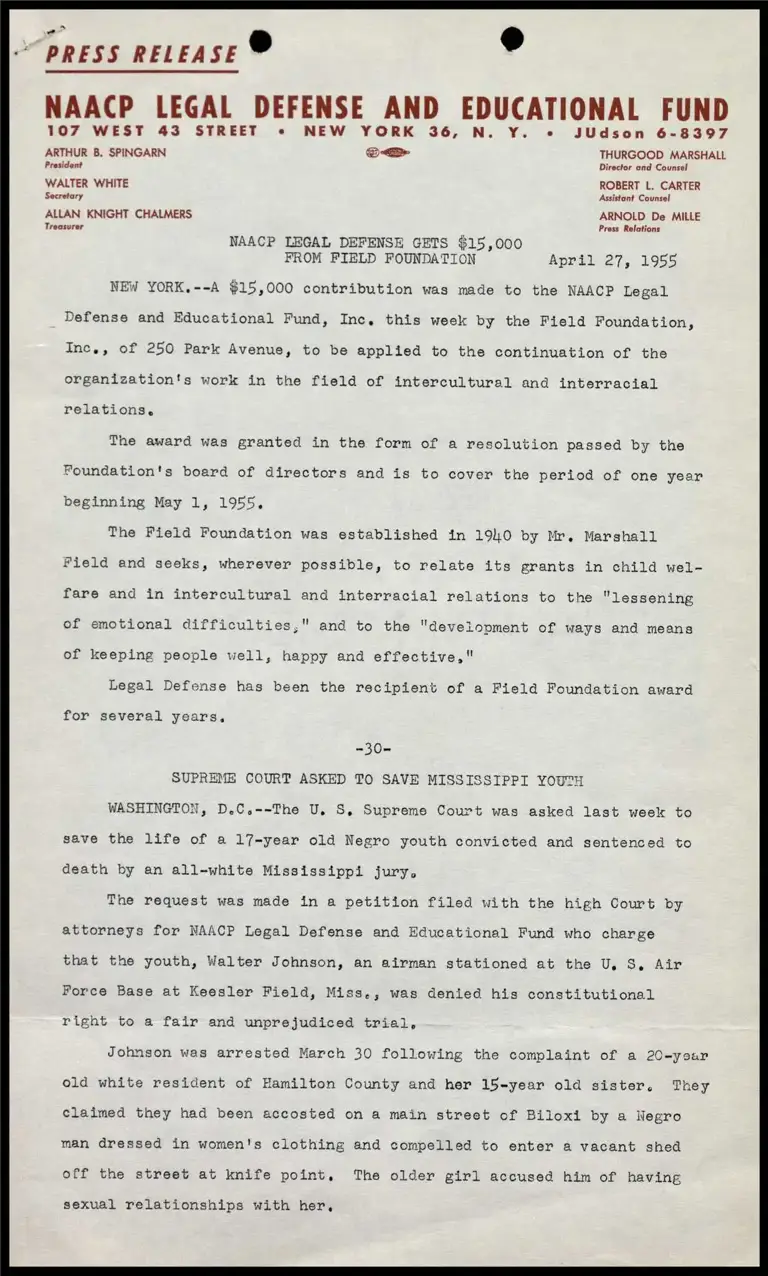
NAACP LEGAL DEFENSE GETS $15,000
FROM FIELD FOUNDATION April 27, 1955

NEW YORK.--A $15,000 contribution was made to the NAACP Legal

Defense and Educational Fund, Inc, this week by the Field Foundation,

Inc., of 250 Park Avenue, to be applied to the continuation of the

organization's work in the field of intercultural and interracial

relations.

The award was granted in the form of a resolution passed by the

Foundation's board of directors and is to cover the period of one year

beginning May 1, 1955.

The Field Foundation was established in 190 by Mr. Marshall

Field and seeks, wherever possible, to relate its grants in child wel-

fare and in intercultural and interracial relations to the "lessening

of emotional difficulties," and to the "development of ways and means

of keeping people well, happy and effective,"

Legal Defense has been the recipient of a Field Foundation award

for several years,

-30-

SUPREME COURT ASKED TO SAVE MISSISSIPPI YOUTH

WASHINGTON, D.C,--The U. S, Supreme Court was asked last week to

save the life of a 17-year old Negro youth convicted and sentenced to

death by an all-white Mississippi jury.

The request was made in a petition filed with the high Court by

attorneys for NAACP Legal Defense and Educational Fund who charge

that the youth, Walter Johnson, an airman stationed at the U. S$, Air

Force Base at Keesler Field, Miss., was denied his constitutional

right to a fair and unprejudiced trial,

Johnson was arrested March 30 following the complaint of a 20-yoar

old white resident of Hamilton County and her 15-year old sister, They

claimed they had been accosted on a main street of Biloxi by a Negro

man dressed in women's clothing and compelled to enter a vacant shed

off the street at knife point, The older girl accused him of having

sexual relationships with her,


Shortly after the alleged attack, an alarm was sent out. Johnson

-2-

was stopped as he was returning to the base at Keesler Field carrying

a bundle of women's clothing under his arm, Upon close examination,

he was discovered wearing women's underwear, He was arrested and con-

fessed to committing the act,

Upon later examination at the U. §. Veterans Hospital in Gulford,

Miss., he was found to be mentally i11 and "not conscious of right or

wrong." However, he was tried and convicted for the crime of rape

without recommendation of mercy, The penalty for rape in Mississippi

is death.

An appeal was made on January 3, 1955 to the Mississippi Supreme

Court asking for a new trial on the grounds that Johnson had not re-

ceived a fair and just trial. The motion was denied.

In their petition to the U. S. Supreme Court today, NAACP Legal

Defense attorneys ask that the high Court reverse the Mississippi

Supreme Court's denial and order a new trial for the Negro airman on

the grounds that he was convicted by a jury from which members of his

race were systematically excluded.

"It has been the clear and consistent rule of the court that a

conviction of a Negro upon an indictment handed down by a grand jury

from which Negroes are systematically excluded violates the Fourteenth

Amendment to the Constitution of the United States. This proposition

has been repeatedly reaffirmed," the lawyers state,

They also point out that only two Negroes have qualified for jury

duty in Harrison County in 35 years, despite the county's 13,21 non-

white population.

The costs of Johnson's mental examination and expert testimony on

his mental state in the Mississippi courts was paid for by two white

residents of Mississippi who felt that the Negro youth is "mentally

sick and morally and legally irresponsible" for his act, "No white

man has ever suffered death for rape in Mississippi," they say.

Johnson was defended in the lower court by a court-appointed

attorney who admitted that he had not tried a capital case in 25 years

and does not regard himself a criminal lawyer.

In appealing to the Mississippi Supreme Court for a new trial,

the lawyers handling the case contended that if the District Attorney

had not been so determined on the death penalty, and the state not


Soe ae

given the jury the understanding that it was demanding and expecting

the death penalty, the sentence might have been different,

"It is doubtful if there could possibly be a more intense and

passionate prejudice than that of a Southern white man against a Negro,

any Negro, sane or insane, who violates the person of a white woman:

we understand (and perhaps we even share) that invincible prejudice;

it is easy to inflame, as it certainly was in this case--just as a

lighted match thrown into an open tank of gasoline," the Mississippi

lawyers argued,

", . » white citizens who are really as much concerned to save the

good and fair name of Mississippi from what they honestly believe

would become and be a scandal and a disgrace, as they are to save the

life of a 17 year old sex-crazy Negro boy. Killing the boy off is an

easy thing to do--perhaps he would be better off, but the State of

Mississippi could 111 afford to take the easy way out. The problem is

not that simple, although it may seem thet simple to the average juror,"

NAACP Legal Defense and Educational Fund was asked to intervene

in the case following the Mississippi Supreme Court denial of the mo-

tion for a new trial, The attorneys are Thurgood Marshall and Jack

Greenberg, of New York.

=30-

APPEAL HILLSBORO SCHOOL SEGREGATION CASE

CINCINNATI, Apr. 27.--The Hillsboro school segregation case

landed in the federal court again today with attorneys for NAACP Legal

Defense and Educational Fund. asking the court of appeals to reverse a

federal district judge's action in refusing to enjoin the Hillsboro

Echool Board from continuing to maintain the Lincoln School as a

school for Negro children only.

In a brief filed today with the U. S. Court of Appeals for the

Sixth Circuit Legal Defense attorneys for the Negro children raise the

question whether the district judge, in refusing to issue a permanent

injunction enjoining the Hillsboro School Board from enforcing a

polley of racial segregation, could bow to conveniences rather than

weigh the facts and consider the law,

The appeal developed out of an order of the U. S, District Court

of February 16, 195), denying the request for a permanent injunction,

The injunction was sought after Negro children had enrolled and

attended classes in two previously all-white schools. After enrollment


Pay

@ @
he

the board, using the subterfuge of school zone lines, forced the

Negro students to withdraw and have since sought to require them to

enroll in the Lincoln School on the ground that they live in the

Lincoln school zone,

The decision of the district court judge which in effect com-

pels the Negro children to return to the segregated school, Legal

Defense attorneys argue, does not only deprive the children of their

constitutional rights and inflict irreparable injury on them, but

also permits the school board to break the federal law and the law

of the State of Ohio,

The brief notes that when the Supreme Court announced its

decision in May 1954, "every American elementary school pupil ac-

quired a federal right against all state authority, legislative,

judicial and administrative, not to be segregated solely because of

' and that prior to this decision their race in the public schools,’

students attending school in Ohio had a right not to be segregated

under the law of the state since 1887,

With respect to the Supreme Court's decision of May 17, 195),

the brief states:

"This decision all courts must follow as the supreme law of the

land, although an entirely distinct and separate question arises in

the five cases before the Supreme Court as to how an adjustment to a

non-segregated system is to be made from an existing segregated

system under circumstances peculiar to each of those cases, There-

fore, since the U,. S. Supreme Court has declared the law, the court

below should have followed it with respect to the school attendance

zones established »by appellees in this case in September 195) which

were intended to be, and which in fact are, a new strategom for

achieving racial segregation in the public schools."

The attorneys contend that the judge gave consideration to com-

munity hostility against minority groups and allowed it to take

precedence over the law.

Legal Defense attorneys for the Negroes are Thurgood Marshall

and Constance Baker Motley of New York and Russell L. Carter and

James H, McGhee of Dayton, Ohio.

=305