Peters v. Warden Brief of Respondent
Public Court Documents
February 11, 1972
-
Brief Collection, LDF Court Filings. Peters v. Warden Brief of Respondent, 1972. 13e1ee0d-c19a-ee11-be36-6045bdeb8873. LDF Archives, Thurgood Marshall Institute. https://ldfrecollection.org/archives/archives-search/archives-item/6d2d393f-fd2e-4133-b8c9-4c407f0ee9a4/peters-v-warden-brief-of-respondent. Accessed October 05, 2026.
Copied!
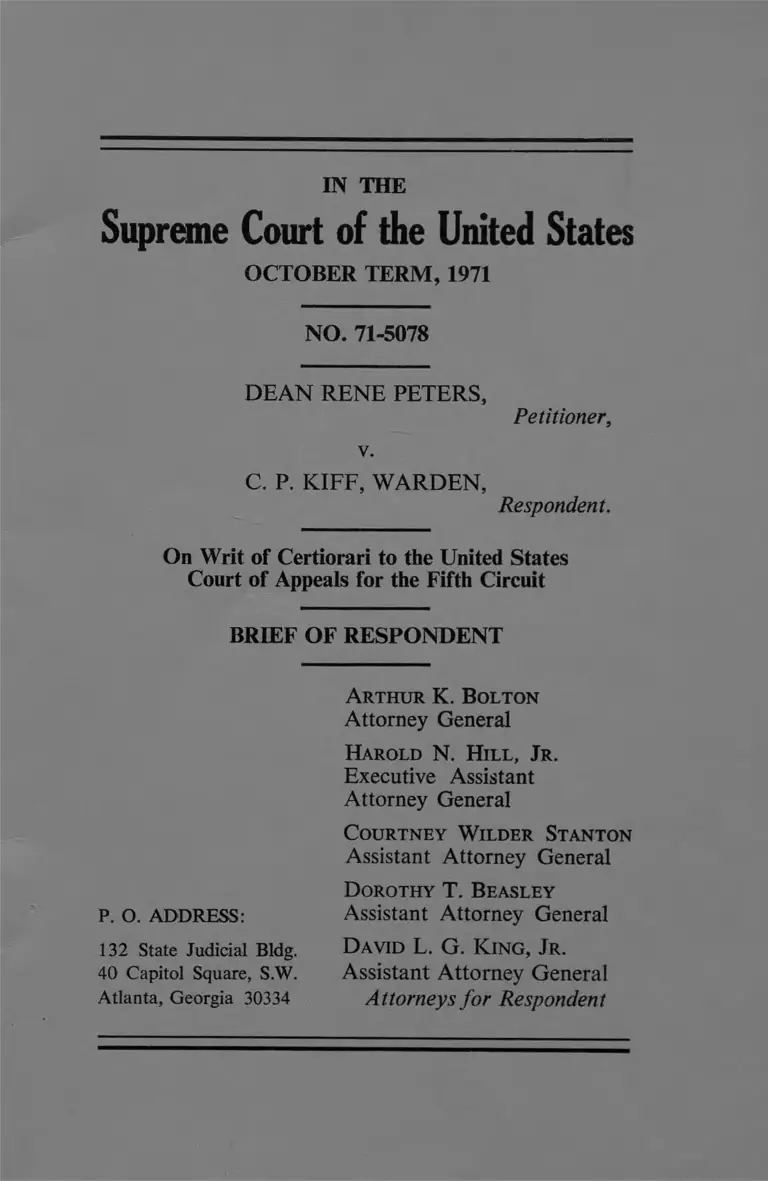
IN THE
Supreme Court of the United States
OCTOBER TERM, 1971
NO. 71-5078
DEAN RENE PETERS,
Petitioner,
C. P. KIFF, WARDEN,
Respondent.
On Writ of Certiorari to the United States
Court of Appeals for the Fifth Circuit
BRIEF OF RESPONDENT
P. O. ADDRESS:
132 State Judicial Bldg.
40 Capitol Square, S.W.
Atlanta, Georgia 30334
A rthur K. B olton
Attorney General
Harold N . H il l , Jr .
Executive Assistant
Attorney General
C our tn ey W ilder Stanto n
Assistant Attorney General
D orothy T. B easley
Assistant Attorney General
D avid L. G . K in g , Jr .
Assistant Attorney General
Attorneys fo r Respondent
1
TABLE OF CONTENTS
Page
STATEMENT OF THE QUESTION .......... 1
SUMMARY OF ARGUMENT ................ 2
ARGUMENT:
I. The alleged exclusion of mem
bers of the Negro race from
the grand jury which indicted
a member of the Caucasian race
does not constitute a denial
of equal protection of the laws
to the white defendant without
a showing of facts which might
show discrimination against
him............................. 4
A. A white man is not treated un
equally when Negroes are exclu
ded from his grand jury; there
fore, the first prerequisite to
establishing an unconstitution
al denial of equal protection
of the laws is absent in this
case 4
IX
TABLE OF CONTENTS-Cont.
Page
B. Unless a person belongs to
the excluded class, he must
establish that the absence
of the particular class from
his grand jury somehow effected
the impartiality of the grand
jury determination............. 11
C. Decisions of this Court, con
struing federal statutes and
their application to federal
juries, do not dispense with
the requirement of class
membership or prejudice when
constitutional questions are
raised as to state proceed
ings............................ 18
II. The issue concerning retro
activity is not properly be
fore this Court for review. . . 23
CONCLUSION 25
TABLE OF CASES
Allen v. State, 110 Ga. App. 56
(1964). ................. 8, 9, 13
Bailey v. Henslee, 287 F.2d 936
(8 th Cir. 1961)................. ]_5
Ballard v. United States, 329 U.S.
187 (1946).................... 18
Beck v. Washington, 359 U.S. 541
(1962)......................... 16
Billingsley v. Clayton, 320 F.2d
13 (5th Cir. 1966), cert.
denied, 385 U.S. 841 (1966) . . ]_5
Blauvelt v. Holman, 237 F. Supp
385 (M.D. Ala. 1954).............p7
Bokulich v. Jury Comm'n., 298 F.
Supp. 181 (N.D. Ala. 1968)
aff*d. 394 U.S. 97 (1969) . .12, 13
Brown v. New Jersey, 175 U.S. 172
(1899) 15
IV
Carter v. Greene County, 396
TABLE OF CASES-Cont.
Page
U.S. 320 (1970).............. 5, 6
Cash v. Smith, 226 Ga. 318
(1970)........................... 21
Fay v. New York, 332 U.S. 261
(1946). . . 8, 9, 10, 12, 15, 19, 18
Fleming v. Kelly, 438 F.2d 1147
(5th Cir. 1971), judgment
reinstated 438 F.2d 1147
(5th Cir. 1971)................ 17
George v. United States, 196
F .2d 445 (9th Cir. 1952) . . . . 17
Glasser v. United States, 315
U.S. 60 (1941).................. 18
Griffin v. State, 183 Ga. 775
(1937)........................... 21
Hernandez v, Texas, 347 U.S. 475
(1953)............................. 8
King v. Cook, 297 F. Supp. 99
(N.D. Miss. 1969) . . . . . 17
V
McNabb v. United States, 318
U.S. 332, 87 Led 819, 63
SCt 608 (1942)................ 20
Mosely v. Smith, 404 F.2d 346
(5th Cir. 1968).............. 17
Murphy v. Holman, 242 F. Supp.
480 (M.D. Ala. 1965).......... 17
Namet v. United States, 373 U.S.
179, 190 (1963).............. 5
Rabinowitz v. United States, 366
F . 2d 34 (5thCir. 1966)............14
Reynolds v. Reynolds, 217 Ga. 234
(1961)........................... 21
Salisbury v. Grimes. 406 F.2d 50
(5th Cir. 1969) . . 11, 16, 17, 20
Simmons v. State, 226 Ga. 110
(1970)......................... 21
Smith v. Brough, 248 F. Supp. 435
(D.C. Md. 1965), aff'd. 362
F.2d 763 (4th Cir. 1966).13, 15, 17
State v. Madison, 213 A.2d 880
(Md. 1965) .
TABLE OF CASES-Cont.
Page
13
vi
TABLE OF CASES-Cont.
Page
Strauder v. West Virginia, 100
U.S. 303 (1879).... 5, 6, 7, 12
Thiel v. Southern Pac. Co., 328
U.S. 217 (1945)............ 18, 19
Truax v. Corrigan. 257 U.S. 312
(1921) ......................... 6
United States ex rel. Darcy v.
Handy, 351 U.S. 454 (1955) . . . 16
United States v. Valentine, 288
F. Supp. 957 (D.P.R. 1968) . 11, 17,
20
Woodruff v. Breazeale, 291 F.
Supp. 130 (N.D. Miss. 1967),
aff' d. 401 F . 2d 997 (1968) . H, 17
Whitus v. Georgia, 385 U.S. 545
(1967) 24
V l l
STATUTORY PROVISIONS
Page
18 U.S.C. § 243 . . . ............ 12
Ga. Laws 1967, p. 251 [Ga. Code
Ann. § 59-106 (1971 Supp.)]. . . 21
United States Supreme Court Rules,
Rule 23(c)(1).................. 5
IN THE
SUPREME COURT OF THE UNITED STATES
1971 Term
NO. 71-5078
DEAN RENE PETERS,
Petitioner,
v.
C. P. KIFF, WARDEN,
Respondent.
On Writ of Certiorari to the United
States Court of Appeals
For the Fifth Circuit
BRIEF FOR RESPONDENT
STATEMENT OF THE QUESTION
Is a member of the Caucasian race, who
claims no identity with the Negro race and
no discrimination resulting against him,
2
entitled in a habeas corpus proceeding to
have an otherwise valid State conviction
set aside on the basis that an alleged
exclusion of members of the Negro race
from the grand jury which indicted him,
denied him equal protection of the laws?
[Neither part (b) of Petitioner's first
question as presented in his Brief (page 4),
nor his second question are involved in
this review.]
SUMMARY OF ARGUMENT
When a black man is indicted by a
jury from which members of the Negro race
have been systematically excluded, he is
placed in a position of inequality which
is condemned by the equal protection
clause of the Fourteenth Amendment. In
such cases the law recognizes and pre
sumes that race prejudice infects the
determination of the grand jury and,
therefore, finds that the defendant has
not been afforded the impartial and fair
consideration to which he is entitled.
But the same inequality does not exist
as to a white man indicted by the same
body; in addition, the presumption of
bias or partiality cannot be recognized
under these same circumstances. A white
man, such as Dean Rene Peters, must
identify himself with the excluded class
in order to employ the evidentiary bene
fits of the presumption of partiality.
3
Without this, he is not in an unequal
position as to other defendants and is
not denied equal protection of the law.
The question of retroactivity is
not involved in this case. If a rule is
framed in this case which would find a
denial of equal protection to a white
man when black men are excluded from
grand jury service, then the present
Petitioner would be given the benefit
of the rule.
4
ARGUMENT
I.
THE ALLEGED EXCLUSION OF MEM
BERS OF THE NEGRO RACE FROM
THE GRAND JURY WHICH INDICTED
A MEMBER OF THE CAUCASIAN RACE
DOES NOT CONSTITUTE A DENIAL
OF EQUAL PROTECTION OF THE LAWS
TO THE WHITE DEFENDANT WITHOUT
A SHOWING OF FACTS WHICH MIGHT
OTHERWISE IDENTIFY HIM WITH THE
EXCLUDED CLASS OR WHICH MIGHT
SHOW DISCRIMINATION AGAINST HIM.
A. A white man is not treated un
equally when Negroes are excluded
from his grand iurv; therefore,
the first prerequisite to estab
lishing an unconstitutional
denial of equal protection of the
laws is absent in this case.
Dean Rene Peters has appealed to this
Court seeking a correction of the Fifth
Circuit's determination that he, as a mem
ber of the Caucasian race and as an indi
vidual with no identifiable ties with the
Negro community or to persons of the
Negro race, was not denied equal protec
tion of the laws as guaranteed under the
Fourteenth Amendment to the United States
Constitution when he was indicted by a
jury from which Negroes had allegedly been
intentionally excluded. (A. 20-21).
5
The court below ruled that equal pro
tection was not denied. Due process con
siderations were not discussed in the
court's opinion nor ruled on. Petitioner
here makes no complaint about the decision
of the court below in this regard and,
therefore, cannot now newly inject due
process arguments. The case on certiorari
is limited to a review of the equal pro
tection claim. Further, it is limited
to a review only as it applies to the
grand jury, which is the extent of the
question as framed by Petitioner in his
petition to this Court. Namet v. United
States, 373 U.S. 179, 190 (1963); Rules
of the Supreme Court, Rule 23(1)(c).
This Court has consistently, since
the adoption of the Fourteenth Amendment,
condemned the practice of intentional
exclusion, on the basis of race, of any
person otherwise qualified to serve as a
juror, from such participation. Compare
Strauder v. West Virginia, 100 U.S. 303
(1879), with Carter v. Greene County,
396 U.S. 320 (1970). In the administra
tion of otherwise constitutional statutes
controlling the selection of jurors, all
citizens within the jurisdiction of a
particular state are entitled to equal
consideration and treatment in the actual
application of those statutes. When this
Court has considered equal protection
challenges on the administration of a
6
state's jury selection system, the tradi
tional proceeding in which the issue has
arisen has been an individual defendant's
challenge on a state criminal conviction.
See Carter v. Greene County, supra at 329.
There is, then, a wealth of precedent from
which to examine and determine the neces
sary prerequisites in establishing that a
given criminal conviction is constitutional
ly defective on the basis that the indi
vidual involved has been denied equal pro
tection of the laws.
Concisely, when the Fourteenth Amend
ment prohibits any state from depriving
any person within its jurisdiction of the
equal protection of the laws, it commands
that all persons, similarly situated,
shall be treated in a like manner. Truax
v. Corrigan, 257 U.S. 312, 328 (1921).
The general purpose of this protection is
to prevent "undue favor and individual or
class privilege, on the one hand, and a
hostile discrimination or the oppression
of inequality, on the other." Truax v.
Corrigan, supra, at 332-3. In the context
of the particular type of unequal treat
ment alleged to have existed in Peters'
original criminal proceeding, the equal
protection clause is adapted to ensure
that a black man not be indicted or tried
by juries from which the latter's race
has been intentionally excluded. Strauder
v. West Virginia, 100 U.S. 303, 307 (1879).
7
To place a man on trial before and under
a system from which members of his race
have been intentionally excluded places
him in an initial position of inequality
which is condemned under the relevant con
stitutional protection:
"It is well known that preju
dices often exist against par
ticular classes in a community,
which sway the judgment of jurors,
and which, therefore, operate in
some cases to deny to persons of
those classes the full enjoyment
of that protection which others
enjoy." Strauder v. West Virginia,
100 U.S. 303, 309 (1879) [emphasis
added]
Charging a black man with the same
crime as a white man is charged with, and
subjecting him to the same penalty, takes
on a fatal denial of equal protection of
the laws when members of the black man's
own race are intentionally excluded from
the charging and trying juries. Similarly
situated white persons are simply treated
more favorably in such situations,and it
is this prejudicial disparity in treatment
that cannot allow a black man's conviction
to stand under the Constitution.
It does not follow, however, that a
white man is denied equal protection of the
8
laws when members of the black race are
allegedly excluded from the jury which
determines the possible existence of proba
ble cause to bring a man to trial. In this
context, class membership is not a consti
tutional requirement which defeats an
otherwise valid claim under the Fourteenth
Amendment, see Fay v. New York, 332 U.S.
261, 287 (1946), but rather it is a require
ment which keeps the equal protection claim
from ever being established in the first
place. If and when a particular exclusion
of a given class from the jury system is
determined to be impermissible under the
Fourteenth Amendment, equal protection
deprivations are established, but only as
to the person against whom such intentional
or unintentional discriminations are direc
ted. See Hernandez v. Texas, 347 U.S. 475,
478 (1953).
The position taken by Petitioner Peters
that he as well as any defendant indicted
by juries from which Negroes have been in
tentionally excluded is entitled to have
his conviction set aside is founded to a
large degree on language extracted from
the opinion of the Georgia Court of Appeals
in Allen v. State, 110 Ga. App. 56, 62
(1964). In turn, the Allen opinion relies
on language quoted from the dissenting
opinion in Fay v. New York, 332 U.S. 261,
298 (1946):
9
"The equal protection clause
of the Fourteenth Amendment pro
hibits a state from convicting
any person by use of a jury
which is not impartially drawn
frcm a cross-section of the com
munity . "
What the Allen court failed to either recog
nize or distinguish, is that the equal pro
tection claim that the dissenting opinion
in Fay v. New York, supra, argued had been
established, was founded on the fact that
Fay had been tried by a special jury while
the majority of defendants in New York had
been tried by general juries. In other
words, Fay had a basis upon which to base
a denial of equal protection because there
existed, by operation of the laws in his
state, two distinct classes of defendants;
as the court pointed out;
"But we are dealing here with
a very subtle and sophisticated
form of discrimination which
does not lend itself to easy
or precise proof. The proof
here is adequate enough to
demonstrate that this panel,
like every discriminatorily
selected 'blue ribbon' panel,
suffers from a constitutional
infirmity. That infirmity is
the denial of equal protection
10
to those who are tried by a
jury drawn from a 'blue ribbon'
panel. Such a panel is nar
rower and different from that
used in forming other juries
to try the vast majority of
other accused persons. To
the extent of that difference,
therefore, the persons tried
by 'blue ribbon' juries receive
unequal protection." Fay v.
New York, 332 U.S. 261, 299
(1946).
When claiming a denial of equal protection
of the laws, the necessity of establishing
a dual system in which the complaining
party is a member of the class of indivi
duals against whom the unlawful discrimina
tion operates is very much an element of
the claim.
11
B. Unless a person belongs to
the excluded class, he must
establish that the absence
of the particular class from
his grand jury somehow ef-
fected the impartiality of
the grand jury determination.
The identity aspect of the consti
tutional denial asserted in this pro
ceeding is one that is viable and neces
sary. Unlawful discriminations created
by statutes or acts of state officials
do not operate to injure those in whose
favor those discriminations are made.
See generally Salisbury v. Grimes, 406
F.2d 50, 51 (5th Cir. 1969) (holding
that a showing of bias or prejudice is
necessary to raise a question of consti
tutional dimensions, and stating speci
fically that there can be no racial
prejudice between members of the same);
Woodruff v. Breazeale, 291 F.Supp. 130,
132 (N.D. Miss. 1967), aff'd. 401 F.2d
997 (1968); United States v. Valentine,
288 F.Supp. 957 (D.P.R. 1968). In the
traditional jury discrimination case
brought and initiated by an individual
who is a member of the unlawfully ex
cluded class, the element of personal
prejudice or harm in the equal protec
tion cause of action is a requirement.
However, in such a case the element is
12
simply presumed to exist as a matter of
law. Strauder v. Virginia, 100 U.S. 303
309 (1879). This same presumption
exists in the reasoning behind the pro
visions of 18 U.S.C. § 243, which de
clares it a crime for any persons to
discriminate in the selection of jurors
on the basis of race. But that same
presumption simply does not exist when
an individual not otherwise identified
with the excluded class seeks to show a
denial, as to him, of the equal protec
tion of the laws. In his case, the
judicially cognizable facts which support
presumption are simply absent. A white
man, asserting that the exclusion of
black men on his grand jury denied him
equal protection of the law must "comply
with the exacting requirements of prov
ing clearly that in his own case the
procedure has gone so far afield that
its results are a denial of equal pro
tection or due process." Fay v . New
York, supra at 284.
Compliance with this requirement is
evidenced in the recent case of Bokulich
v. Jury Commission of Green County, 298
F.Supp. 181 (N.D. Ala. 1968), aff'd.
394 U.S. 97 (1969).
Claiming that trial by a jury from
which Negroes have been systematically
excluded would prejudice him in his de-
13
fense and otherwise deny him equal pro
tection of law, Bokulich established his
identity with the excluded class by
showing that although he was white, he
was also a civil rights worker associated
with the Southern Christian Leadership
Conference. The Court properly noted
that while the case in which the com
plaining party is of the same racial
group as that alleged to be excluded is
a clear instance of potential violation
of equal protection, such a situation
does not set the outer limits of the
guarantee or the right to complain of the
violation. Bokulich v. Jury Comm'n,
supra, at 185 n. 2. This, of course, was
the situation in Allen v. State, 110 Ga.
App. 56, 62 (1964~i 17 See also
1/ There appears to be only one de
cision favoring a party claiming
constitutional deprivations on the
basis of a class exclusion from the
jury selection process who was not
actually identified with the group.
State v. Madison, 213 A.2d 880
(Md. 1965). Upon review of the
identical question by a federal
court, the reasoning of the State
court on the federal question was
rejected. Smith v. Brough
248 F.Supp. 435, 440-2 (D.C. Md.
1965), aff'd. 362 F.2d 763 (4th
Cir. 1966).
14
Rabinowitz v. United States, 366 F.2d
34, 37 (5th Cir. 1966) ("standing" was
not raised as an issue, however, since
the official shortcoming found in the
case was based specifically on the fail
ure to properly implement federal sta
tutes — "We do not legislate for
Congress; we do effectuate that policy
which Congress through its legislation
has directed us to implement.")
The requirement of prejudice or
class identity to establish the equal
protection claim should be maintained
as an integral part of any person's
case, particularly in a post-conviction
proceeding where the issue was not raised
at the original trial and the state did
not have the opportunity to cure the
error, if any:
"The question whether there
was a violation of a defen
dant 1s rights under the Four
teenth Amendment should turn
on whether the facts and cir
cumstances show some preju
dice or likelihood of preju
dice as a result of the
exclusion. If the facts and
circumstances show merely a
bare possibility of prejudice,
or no prejudice at all, it is
doubtful whether a deprivation
15
of due process or equal pro
tection of the laws has been
shown." Smith v, Brough,
248 F.Supp. 435, 442 (D.C.
Md. 1965), aff'd. 362 F.2d
763 (4th Cir. 1966).
Even when the constitutional claim
raised in an individual case concerns the
due process clause of the Fourteenth
Amendment, the requirement of harm in the
individual case has been maintained.
See Fay v. New York, supra, at 287.
(The court invoked the identity or
prejudice requirement at the point in
the opinion where the question of whether
or not Fay had been denied due process
of law was being considered; the conclu
sion had already been reached that the
dual jury system in New York did not
deny individuals equal protection of the
laws.)
The fundamental right involved in
this proceeding is Peters' right to a
just and fair determination by an un
biased, unprejudiced and impartial grand
jury. See Brown v. New Jersey, 175 U.S.
172, 175 (1899); Billingsley v, Clayton,
320 F.2d 13, 15, cert, den. 385 U.S. 841
(1966); Bailey v. Henslee, 287 F.2d 936,
941 (8th Cir. 1961). Without more, it
is difficult to see how a white man such
as Peters could have been denied an im
16
partial judgment, per se, as a result of
the exclusion of members not of his own
race. In order to claim that this im
partiality was somehow effected, identi
fiable prejudice should be shown, and is
in fact required if a claim of constitu
tional dimensions is to be raised:
"Bereft of the racial argu
ment, the appellant has neither
alleged nor shown any bias
or prejudice in the grand
jury which indicted him.
He has thus failed to raise
a question of constitutional
dimensions." Salisbury v.
Grimes, 406 F.2d 50, 51 (5th
Cir. 1969).
Peters claims that his trial was
essentially unfair, but he does not raise
one fact which would indicate that the grand
jurors who considered his guilt were
somehow partial or biased. This he is
required to do, not as a matter of specu
lation but as a matter of demonstrable
reality. See United States ex rel,
Darcy v. Handy, 351 U.S. 454, 462 (1955);
Beck v. Washington, 359 U.S. 541, 558
(1962).
The requirement of prejudice,
then, is an integral and necessary
portion of Peters' case, if he is to
17
succeed. That he is white does not
itself defeat his case, but he is re
quired to make some showing that would
indicate that the exclusion of blacks
in his case adversely affected the im
partial consideration of the grand jury.
Without more, a white man is not denied
equal protection of the laws by the
exclusion alleged to exist in this partic
ular case. Fleming- v. Kelly. 438 F.2d
1147 (5th Cir. 1971), judgment reinstated
438 F.2d 1147 (5th Cir. 1971); Salisbury
v. Grimes, 406 F.2d 50, 51 (5th Cir.
1969); Mosely v. Smith, 404 F.2d 346,
347 (5th Cir. 1968); King v. Cook, 297
F.Supp. 99, 103 (N.D. Miss. 1969);
Murphy v. Holman, 242 F.Supp. 4P^ 482
(M.D. Ala. 1965); Blauvelt v. He...man,
237 F.Supp. 385 (M.D. Ala. 1954);
Woodruff v. Breazeale, 291 F.Supp 130
(N.D. Miss. 1967), aff'd. 401 F.2d 997
(1968); see also Smith v. Brough, 248
F.Supp. 435, 440-2 (D. Md. 1965), aff'd.
362 F.2d 763 (1966); George v. United
States, 196 F.2d 445, 452 (9th Cir.
1952); United States v. Valentine, 288
F.Supp. 957, 969-70 (D.P.R. 1968).
18
C . Decisions of this Court, con
struing federal statutes and
their application to federal
juries, do not dispense with
the requirement of class
membership or prejudice when
constitutional Questions are
raised as to state proceed
ings .
Petitioner Peters asserts that cases
decided by this Court have effectively
rejected the rule that either class identi
ty or, in its broader context, prejudice
are required when a particular jury system
is challenged on constitutional grounds.
Ballard v. United States, 329 U.S. 187
(1946), Thiel v. Southern Pac. Co., 328
U.S. 217 (1945), and Glasser v. United
States, 315 U.S. 60 (1941) do not have
this effect. In the first place, each
case was considered in Fay v. New York, 332
U.S. 261, 287-8 (1946), and the court there
refused to accept the position being pressed
by Peters here. The Fay court recognized
the identity requirement, but, in the
alternative, determined that the particular
type of exclusions involved did not affect
to any identifiable degree the impartiality
of the jurors which tried the case. Fay v.
New York, supra, at 287 and 292-3. This
was required, for unlike the situation in
Ballard, Thiel and Glasser, the court in
Fay was considering questions of constitu
tional dimensions and not the application
19
and obligation imposed by Congressional
statutes on federal criminal procedure.
That some identifiable effect on the impar
tiality of jurors is required in order to
raise a constitutional question is evidenced
by the following:
"No significant difference in
viewpoint between those alleged
ly excluded and those permitted
to serve has been proved and
nothing in our experience per
mits us to assume it. It would
require large assumptions to say
that one's present economic sta
tus, in a society as fluid as
ours, determines his outlook in
the trial of cases in general or
of this one in particular. * * *
But we are not ready to assume
that these differences of func
tion degenerate into a hostility
such that one cannot expect jus
tice at the hands of occupations
and groups other than his own."
Fay v. New York, supra, at 292.
As for the class requirement or the require
ment of prejudice when questions of consti
tutional dimensions are considered, Thiel
v. Southern Pac. Co., supra, at 225, speci
fically infers that they are mandatory
prerequisites in such cases:
20
"The trial court should have
granted petitioner's motion to
strike the panel. That conclu
sion requires us to reverse the
judgment below in the exercise
of our power of supervision over
the administration of justice in
the Federal Courts. See McNabb
v. United States, 318 US 332, 340,
87 L ed 819, 823, 63 S Ct 608.
On that basis it becomes unneces
sary to determine whether the
petitioner was in any way preju
diced by the wrongful exclusion
or whether he was one of the
excluded class." [emphasis added]
While it is clear then that such legal chal
lenges to the proper administration of sta
tutes by government officials do not require
identity or showing of prejudice, constitu
tional challenges do. See Salisbury v .
Grimes, 406 F.2d 50, 51-2 (5th Cir. 1969);
United States v. Valentine, 288 FJSupp. 957,
969-70 (D.P.R. 1968)(stating that a liti
gant raising a constitutional challenge
must establish his right to such has been
prejudiced by the exclusion of which he
complains, but a litigant invoking the
supervisory jurisdiction must establish
only a departure from the scheme of jury
21
selection, which Congress adopted.— =/
Dean Rene Peters, not being a member of
the excluded class, must make some show
ing which would enable a court to presume
that race prejudice infected the minds
of the grand jurors in his case. Without
2/ Ga. Laws 1967, p. 251 [Ga. Code Ann.
§ 59-106 (1971 Supp.)] now requires
that jury ccmmissioners select a
fairly representative cross-section
of the intelligent and upright citi
zens of the county from the official
registered•voters' list which was
used in the last preceding general
election. There is no apparent
reason why a timely challenge by
any party litigant to the array of
grand or traverse jurors on the
basis that the commissioners had
not fulfilled their legal duty
under this section could not be
made. See Simmons v. State, 226 Ga.
100, 112 (1970); cf. Reynolds v.
Reynolds, 217 Ga. 234, 263 (1961);
Griffin v. State, 183 Ga. 775, 777
(1937). When a constitutional
challenge is made, however, the
requirement of identity or prejudice
is maintained. Cash v. Smith, 226
Ga. 318 (1970).
22
this, the alleged exclusionary practice
would not deny him equal protection of the
laws as guaranteed by the Fourteenth Amend
ment.
23
II.
THE ISSUE CONCERNING RETRO
ACTIVITY IS NOT PROPERLY BE
FORE THIS COURT FOR REVIEW.
As with the first question pre
sented to this Court in Petitioner's
brief, the second one raises some dif
ficulty in relation to the proceedings
below, the petition for certiorari, and
case in general. First, there has never
been any issue as to whether or not,
if a court recognized correctness of
the claim raised, Peters could receive
the benefit of that decision in his case.
The Respondent has never argued that
even if Petitioner were correct, some
rule of retroactivity would yet pre
vent his being granted relief. Also,
the original petition for certiorari
merely listed the question as to
possible retroactive application of a
rule this Court might establish in
this case (Petition, p. 3), but the
point was not argued or briefed in the
application. Without the point being
raised in the proceedings below and
without the point being pursued in the
petition for certiorari in this Court,
it is simply not a proper question for
consideration.
24
If Petitioner Peters seeks the bene
fit of a rule establishing the right of
any person, regardless of his identity,
to challenge his conviction on the basis
that Negroes were intentionally excluded
from the indicting grand jury, then it
is quite unclear how a question of retro
activity concerns Peters, or what rule he
believes should be "retrospectively" ap
plied to his 1966 indictment. Reference
is made in Petitioner's brief to Whitus
v. Georgia, 385 U.S. 545 (1967), but the
issue in that case has no bearing on the
question now being considered.
On the other hand, if this case
establishes a new rule, there would be
little doubt that the benefit of the
rule would be applied to Peters; if
this were not so, there would be no case
or controversy in the first place. A
question of retrospective or prospective
application of the "Peters rule", what
ever it might be, is not appropriately
pursued by him because the outcome would
not affect him. It does not, at least,
constitute one of the issues on the
merits, as he has sought to make it.
25
CONCLUSION
For the foregoing reasons, the
judgment of the Court of Appeals for
the Fifth Circuit should be affirmed.
Respectfully submitted,
ARTHUR K. BOLTON
Attorney General
HAROLD N. HILL, JR.
Executive Assistant
Attorney General
COURTNEY WILDER STANTON
Assistant Attorney General
DOROTHY T. BEASLEY
Assistant Attorney General
DAVID L. G. KING, JR.
Assistant Attorney General
ATTORNEYS FOR RESPONDENT
CERTIFICATE OF SERVICE
I, Dorothy T. Beasley, Attorney of
Record for the Respondent herein, and a
member of the Bar of the Supreme Court of
the United States, hereby certify that in
accordance with the Rules of the Supreme
Court of the United States, I served the
foregoing Brief for Respondent on the Peti
tioner by depositing copies of the same in
a United States mailbox, with first class
postage prepaid, addressed to counsel of
record at their post office addresses:
EDWARD T. M. GARLAND
Garland & Garland
229 Candler Building
Atlanta, Georgia 30303
JACK GREENBERG
JAMES M. NABRIT, III
CHARLES STEPHEN RALSTON
10 Columbus Circle
New York, New York 10019
This 11th day of February, 1972.
DOROTHY T. BEASLEY