Orleans Parish School Board v. Bush Court Opinion
Public Court Documents
March 1, 1957
-
Brief Collection, LDF Court Filings. Orleans Parish School Board v. Bush Court Opinion, 1957. eb80f96f-c09a-ee11-be36-6045bdeb8873. LDF Archives, Thurgood Marshall Institute. https://ldfrecollection.org/archives/archives-search/archives-item/77df81c6-9b39-4cf6-84b0-4fd2a87c895d/orleans-parish-school-board-v-bush-court-opinion. Accessed October 06, 2026.
Copied!
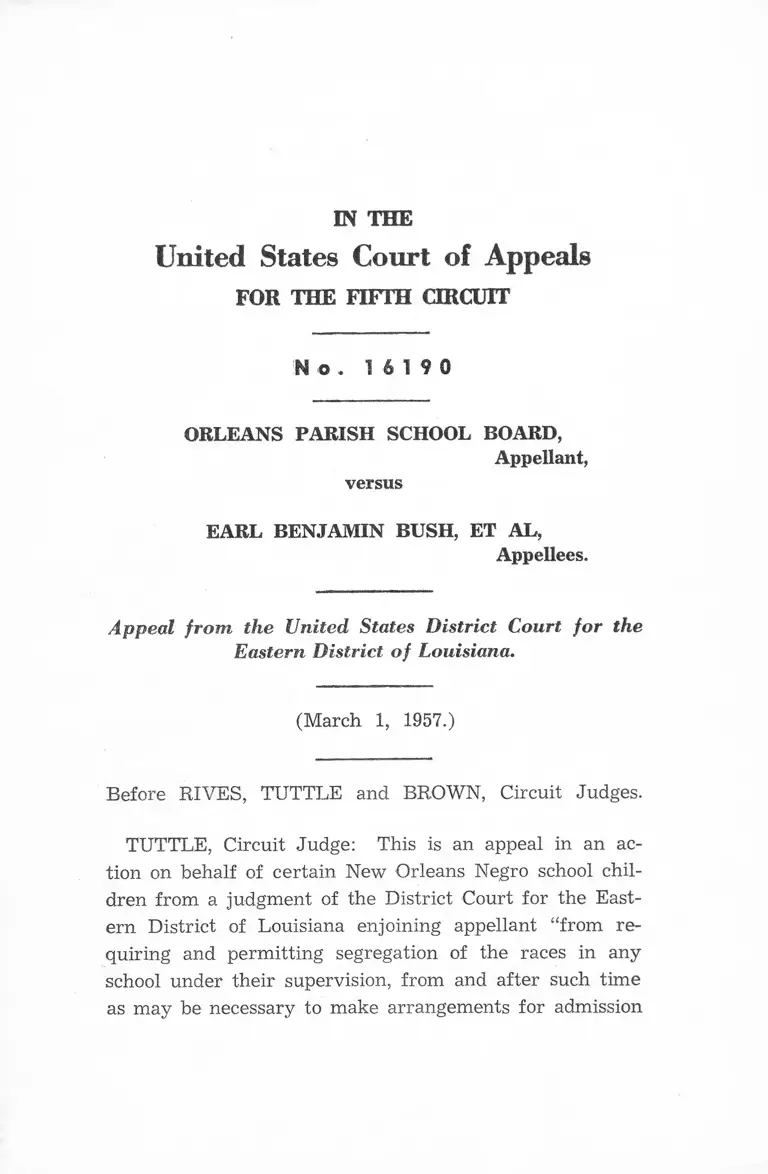
IN THE
United States Court of Appeals
FOR THE FIFTH CIRCUIT
N o . 1 6 1 9 0
ORLEANS PARISH SCHOOL BOARD,
Appellant,
versus
EARL BENJAMIN BUSH, ET AL,
Appellees.
Appeal from the United States District Court for the
Eastern District o f Louisiana.
(March 1, 1957.)
Before RIVES, TUTTLE and BROWN, Circuit Judges.
TUTTLE, Circuit Judge: This is an appeal in an ac
tion on behalf of certain New Orleans Negro school chil
dren from a judgment of the District Court for the East
ern District of Louisiana enjoining appellant “from re
quiring and permitting segregation of the races in any
school under their supervision, from and after such time
as may be necessary to make arrangements for admission
2 Orleans Parish School Board v. Bush, et al.
of children to such schools on a racially non-discrimina-
tory basis with all deliberate speed as required by the
decision of the Supreme Court in Brown, et al v. Board
of Education of Topeka, et al, 349 U.S. 294.”
The principal grounds of appellant’s attack on the va
lidity of this order are: (1) This was a suit against
the State of Louisiana and is prohibited by the XI Amend
ment to the Constitution; (2) The complaint failed to
state a claim on which relief could be granted; (3) The
court erred in holding that the provisions of Art. XII,
§1 of the Louisiana Constitution requiring separate schools
for white and colored children and that all of Louisiana
Act 555 and Section 1 of 556 of 1954 requiring segregation
and assignment of pupils respectively in public schools
were invalid; (4) The proof on behalf of plaintiffs
and countershowing by defendant did not warrant the
issuance of a temporary injunction. These points as
well as subsidiary questions will be discussed after a
brief statement of the factual background.
On November 12, 1951, appellees petitioned the School
Board “to end at once the practice and custom of dis
criminating against Negro students solely on account of
their race and color and admit these Negro children and
all others similarly situated to the public schools of Orleans
Parish which have heretofore and are now restricted to
the enrollment of white children.” This petition was
denied by official action of the Board on November 26,
1951.1 On February 19, 1952, an appeal was taken to
1 This action was taken several years before the adoption of
the pupil assignment law with its provisions for administra
tive relief, which will be discussed later.
the State Board of Education; no reply having been re
ceived, appellees again, on August 14th, requested action
on their petition; on August 27th a reply was received
over the signature of the Secretary of the State Board,
which while not categorically denying the petition stated:
“The Board feels that many of the items included are
wholly within the jurisdiction of the Board.”2 On Sep
tember 5, 1952, the original complaint in this action was
filed. It alleged great disparities between the physical
plant and the content of the curricula of Negro and white
schools, and also alleged discrimination because of segre
gation per se. It alleged that the Board was pursuing
a policy and custom of maintaining separate schools for
white and Negro children under the provisions of Art.
XII, Sec. 1 of the Louisiana Constitution. It sought a
declaratory judgment on the questions, among others,
(a) “whether the policy, custom, practice and usage of
defendants . . . in denying on account of race or color
to infant plaintiffs and others similarly situated . . .
educational opportunities, advantages and facilities . . .
equal to the educational opportunities, advantages and
facilities afforded and available to white children . . .
is unconstitutional and void as being a denial of the
equal protection of the laws guaranteed under the Four
teenth Amendment to the Constitution of the United
States;” (b) “whether Article XII Sec. 1 of the Constitu
tion of 1921 of the State of Louisiana which prohibits
infant plaintiffs from attending the only public schools
of Orleans Parish where educational opportunities, ad
2 The petition had pointed out many alleged inequalities be
tween the facilities in the white and Negro schools. In any
event this is either a rejection of the request or a statement
that the Parish Board had final jurisdiction.
Orleans Parish School Board v. Bush, et al. 3
vantages and facilities equal to those afforded all other
qualified pupils . . . are available and force them to
attend secondary schools in Orleans Parish solely be
cause of race and color is unconstitutional and void as
a violation of the Fourteenth Amendment of the Con
stitution of the United States.” It also prayed a judg
ment declaring that the separate schools provision of Ar
ticle XII Sec. 1 of the Louisiana Constitution is a denial
of the equal protection clause of the Fourteenth Amend
ment and is therefore unconstitutional and void, and for
a permanent injunction enjoining defendant Board from
following such provision as being in contravention of
rights guaranteed under the United States Constitution.
By stipulation proceedings on this complaint were sus
pended on account of the pendency of the school Segre
gation cases3 in the Supreme Court of the United States.
After the first opinion in the Brown case the State
Legislature of Louisiana proposed and the people adopted
an amendment to Art. XII Sec. 1 of the State Constitu
tion which had already provided, in effect, that all public
elementary and secondary schools should be operated
separately for white and colored children by adding that
“This provision is made in the exercise of the state police
power to promote and protect public health, morals, better
education and the peace and good order in the State,
and not because of race. The Legislature shall enact
laws to enforce the state police power in this regard.”
The Legislature then promptly enacted Acts 1954, No. 555
and 556. Section 1 of 555 merely repeated the constitu
8 Brown v. Board of Education of Topeka, Kans., 347 U.S.
483 and related cases.
4 Orleans Parish School Board v. Bush, et al.
Orleans Parish School Board v. Bush, et al. 5
tional requirement of separate schools. Section 2, 3 and
4 provide for penalties to be imposed on local boards and
an individual failing to observe the requirements as
to separate schools in Section 1. Section 5 is a separ
ability clause.4 Act 556, adopted at the same time, is the
pupil assignment statute. It provides for assignment of
each pupil each year by the parish superintendent to a
4 Act 555 in full is as follows:
“Separate operation required
“All public elementary and secondary schools in the
state of Louisiana shall be operated separately for white and
colored children. This provision is made in the exercise of
the State police power to promote and protect public health,
morals, better education and the peace and good order in the
state and not because of race. Acts 1954, No. 555, Section 1.
“Non-recognition of schools violating Sub-part
“The State Board of Education shall not approve any
public schools which may violate the provisions of this
Sub-part nor shall any of the state colleges or university
recognize any certificate of graduation from such public
school which may violate the provisions of this Sub-part
as entitling the holder thereof to admission. Acts 1954,
No. 555, Section 2.
“ Schools violating Sub-part to be deprived of supplies and
funds
“No free school books or other school supplies shall be
furnished, nor shall any state funds for the operation of
school lunch programs, or any other school funds be fur
nished or given to any public elementary or secondary school
which may violate the provisions of this Sub-part as above.
Acts 1954, No. 555, Section 3.
“Penalty for violations
“Any person, firm or corporation violating any of the
provisions of this Sub-part shall be deemed guilty of a mis
demeanor and upon conviction therefor by a court of com
petent jurisdiction for each such violation shall be fined not
less than five hundred dollars nor more than one thousand
dollars, or sentenced to imprisonment in the parish jail not
less than ninety days nor more than six months, or both,
fined and imprisoned as above, at the discretion of the court.
Acts 1954, No. 555, Section 4.
“In case any part of this Act shall be held to be un
constitutional, this shall not have the effect of invalidating
any part of it that is constitutional, and the part or parts
not affected by such ruling shall continue in full force and
effect. This Act shall be liberally construed to protect and
preserve the State Police Power as provided in this Act.”
Acts of 1954, No. 555, Section 5.
Orleans Parish School Board v. Bush, et al.
particular school, and, without providing any standards
other than those of Act 555 for separation of the races,
provides for an appeal to the local board and then to
the State Board and thereafter to the state district court.5
8 Act 556, Sec. 1, in full is as follows:
“ASSIGNMENT OF CHILDREN TO PARTICULAR
SCHOOLS BY PARISH SUPERINTENDENT; HEAR
INGS; REVIEW BOARD; APPEAL
“Each parish superintendent of schools, throughout this
state, shall, each year, determine the particular public school
within each parish to be attended by each school child
applying for admission to public schools. No school child
shall be entitled to be enrolled or to enter into a public school
until he has been assigned thereto in accordance with the
provisions of this Section. In the event of dissatisfaction
with the school assignment made by the superintendent, the
parents or next of kin to the child affected, within ten days
from the date of assignment may apply to the school super
intendent for a hearing to have said child assigned to some
other public school in the parish, in which case the super
intendent shall grant a hearing, and within thirty days after
the conclusion of said hearing, the superintendent shall hand
down a decision in writing either sustaining his school as
signment in question or changing the same. The action of
the parish superintendent shall be reviewable by the parish
school board upon application of any person paying ad
valorem taxes for the support and maintenance of the public
schools or on the application of any other party in interest.
Any such application for review shall be filed with the
parish sehool board within thirty days from the day the
action complained of was taken and within sixty days
thereafter, said parish school board shall hold a hearing at
which evidence shall be taken down and transcribed, the
cost thereof to be paid for by the party making said ap
plication prior to submission of the matter to the school
board. The school board shall have the right to require ap
plicant to furnish bond for costs within a reasonable sum,
properly secured, prior to the holding of said hearing. The
parish school board shall consider the evidence so adduced
and as soon as practicable render its decision in writing.
Any person, having applied for and secured a hearing by
the parish school board who feels aggrieved by the ruling
of said board shall have the right to apply to the district
court of the domicile of the said board and the right to ap
peal from the judgment of the district court to the ap
propriate court of appeal, provided, however, that such right
to apply to the district court shall not exist until said party
shall have complied with the provisions hereof, and shall
have exhausted the administrative remedies provided for
herein.
Orleans Parish School Board v. Bush, et al. 7
Following the enactment of these laws, appellees peti
tioned the school board to take immediate steps to re
organize the schools under its jurisdiction on a nondis-
criminatory basis. No reply was made to this or to a
subsequent petition, but the board engaged counsel to
“defend, as special attorney for the Board, both in the
trial court and in the Courts of Appeal” the action then
pending.* 6 Soon thereafter appellees filed a first amended
complaint setting up the provisions of the amended con
stitution and the newly enacted statutes, a prayer for
declaratory relief holding them invalid and renewing
their prayer for preliminary and permanent injunction
against the enforcement by the board of the provisions of
the new laws.
The defendant board filed its motion to dismiss and
the state of Louisiana prayed the right to intervene solely
for the purpose of filing a motion to dismiss the suit as
being one against the State. No order appears to have
“Each school board throughout the state shall have
authority to adopt rules and regulations governing the hear
ing and appeals provided for herein.
“Wherever reference is made to parish superintendent
of schools or school boards the same shall apply to those
in the cities of Monroe, Bogalusa and Lake Charles. Added
Acts 1954, No. 556, §1.”
6 The resolution stated it to be the policy of the board to
maintain its policy of segregation by the language in the
following “Whereas” clauses:
“WHEREAS a class action has been instituted in the United
States District Court for the Eastern District of Louisiana
by Earl Benjamin Bush and others against the Orleans
Parish School Board and its superintendent demanding a pre
liminary and ultimately a permanent injunction against the
segregation of the races in the public schools of New Or
leans ;
“WHEREAS it is not only to the manifest interest of this
Board and in accord with its expressed policy, but also in
furtherance of the public welfare of this community that this
suit and any others that might be instituted with the same
objective be vigorously, aggressively, and capably defended;”
been entered allowing this intervention and the State is
not appearing as a party on this appeal, although a brief
has been tendered on behalf of the State as amicus curiae.
Its petition for leave to file hereby granted and its brief
has been considered by the Court.
NATURE OF THE SUIT
We consider first whether there is any merit in appel
lant’s contention that this is in fact a suit brought by
citizens of the State of Louisiana against the State. Of
course such a suit is prohibited by the principle of sov
ereign immunity and by analogy to the Eleventh Amend
ment to the Constitution of the United States. Hans v.
Louisiana, 134 U.S. 1.
It would seem hardly worth our considering this con
tention in light of the fact that all of the School Segre
gation Cases were actions of the same type as the one
before us (suits against a state official or board operating
under State authority) were it not for the fact that both
the appellant and the Attorney General of the State urge
it so strongly upon us. The burden of their argument
is that this is a suit to compel state action, which under
a long line of cases, including Great Northern Life In
surance Company v. Reed, 322 U.S. 47, and Ford Motor
Company v. Treasury Depo,rtment, 323 U.S. 459, falls
within the prohibition whether nominally against the State
or against state officials. But this suit does not seek to
compel state action. It seeks to prevent action by state
officials which they are taking because of the require
ments of a state constitution and laws challenged by the
8 Orleans Parish School Board v. Bush, et al.
Orleans Parish School Board v. Bush, et al. 9
plaintiffs as being in violation of their rights under the
Federal Constitution. If in fact the laws under which
the board here purports to act are invalid, then the board
is acting without authority from the State and the State
is in nowise involved. That a federal court can entertain
a suit where such a situation is alleged has long been
recognized. In Ex parte Young, 209 U.S. 123, the Supreme
Court said in such a case as this:
“ . . . . It is contended that the complainants
do not complain and they care nothing about any
action which Mr. Young might take or bring as
an ordinary individual, but that he was com
plained of as an officer, to whose discretion is
confided the use of the name of the State of Min
nesota so far as litigation is concerned, and that
when or how he shall use it is a matter resting
in his discretion and cannot be controlled by any
court.
“The answer to all this is the same as made in
every case where an official claims to be acting
under the authority of the State. The act to be
enforced is alleged to be unconstitutional, and if
it be so, the use of the name of the State to en
force an unconstitutional act to the injury of
complainants is a proceeding without the author
ity of and one which does not affect the State
in its sovereign or governmental capacity. It is
simply an illegal act upon the part of a State
official in attempting by the use of the name of
the State to enforce a legislative enactment which
is void because unconstitutional. If the act which
the state Attorney General seeks to enforce be
a violation of the Fereral Constitution, the officer
in proceeding under such enactment comes into
10 Orleans Parish School Board v. Bush, et al.
conflict with the superior authority of that Con
stitution, and he is in that case stripped of his of
ficial or representative character and is sub
jected in his person to the consequences of his
individual conduct. The State has no power to
impart to him any immunity from responsibility
to the supreme authority of the United States.”
Central of Georgia Railroad v. Redwine, 342 U.S. 299,
relied on by the trial court, is the most recent pronounce
ment of the Supreme Court to the same effect. See also
School Board of the City of Charlottesville v. Allen (4
Cir.), . . . .F. 2d . . . . (dec. Dec. 31, 1956), where the Court
of Appeals for the Fourth Circuit held a suit such as this
not to be one against the State of Virginia.
There is no merit in the claim of appellant that the
court was without jurisdiction to try this case as being a
suit against the state. The substance of this suit is that
the school board is unconstitutionally forcing them to
attend schools that are segregated according to race
and their prayer is that the board be enjoined from con
tinuing to do so. If plaintiffs are right in their conten
tion, then they can obtain complete relief from this de
fendant, because any sanctions compelling it to continue
its illegal conduct falls when the Court determines that
such sanctions are illegal.
EXHAUSTION OF ADMINISTRATIVE REMEDIES
The second ground of appellant’s motion to dismiss
was its contention that the complaint fails to state a claim
on which relief can be granted. The first basis for this
Orleans Parish School Board v. Bush, et al. 11
attack is that, assuming all the allegations as to uncon
stitutional acts by the defendant to be true, the plaintiffs
have not pursued their administrative remedies for re
lief before filing of their suit. In asserting this conten
tion appellant seems to overlook completely the fact that
when this suit was filed there was no pupil assignment
law on the statute books. So far as has been called to
our attention the plaintiffs did all they were required
to do administratively in 1951 to seek relief from the con
dition of which they were complaining, i.e. inequality
and discrimination between the facilities of white and
colored schools and the discrimination resulting per se
from the operation of a segregated school system. They
applied to the defendant for relief and appealed its ad
verse decision to the state board which remanded them
to the local board. Where else they could go adminis
tratively is nowhere suggested by appellant, which argues
the entire matter as though there had then been a pupil
assignment statute on the books.
But assuming that the trial court and we should view
this question in the light of conditions after the passage
of the 1954 acts, which, however, we do not decide, there
is still no merit in appellant’s argument. /Appellees were
not seeking specific assignment to particular schools.
They, as Negro students, were seeking an end to a local
school board rule that required segregation of all Negro
students from all white students. As patrons of the
Orleans Parish school system they are undoubtedly en
titled to have the district court pass on their right to
seek relief. Jackson v. Rawdon (5 Cir.), 235 F. 2d 93,
cert, den., 352 U.S. 925, and see School Board of the City
of Charlottesville v. Allen, supra.
\
12 Orleans Parish School Board v. Bush, et al.
Moreover, so long as assignments could be made under
the Louisiana constitution and statutes only on a basis
of separate schools for white and colored children to re
mit each of these minor plaintiffs and thousands of others
similarly situated to thousands of administrative hearings
before the board for relief that they contend the Supreme
Court has held them entitled to, would, as the trial judge
said, “be a vain and useless gesture, unworthy of a court
of equity, . . . a travesty in which this court will not
participate.” See Adkins v. Newport News School Board,
(D.C.E.D.Va.), decided 1/11/57, 25 L.W. 2317. /
PROOF OF ACTUAL OR IMMEDIATE IRREPARABLE
INJURY
A further basis for appellant’s claim that the suit should
be dismissed was that there was no showing of actual or
immediate irreparable injury. It may well be argued to
the contrary that, assuming that plaintiffs are being denied
their constitutional right to equality with members of
the white race in their educational opportunities, every
day that passes counts as an irremediable loss to the school
child thus discriminated against. The simplest answer to
this contention, however, is in the limited action of the
court, which was well within what was prayed for by
appellees. It declared the rights of the parties as they
prayed and restrained the board from “requiring and per
mitting segregation of the races in any school under their
supervision, from and after such time as may be necessary
to make arrangements for admission of children to such
schools on a racially nondiscriminatory basis with all
deliberate speed as required by the decision of the Su
Orleans Parish School Board v. Bush, et al. 13
preme Court in Brown v. Board of Education of Topeka,
supra.”
Such an order, while in the form of a preliminary in
junction, contained no immediately compulsive features
so far as relieving the plaintiffs of day by day injury
was concerned. Inasmuch as they do not complain of
the failure of the court to afford them immediate relief
it seems to us that there is little ground for the board
to do so on this particular ground.
CONSTITUTIONALITY OF LOUISIANA
CONSTITUTION AND LAWS
We have heretofore dealt with contentions advanced
by appellant which it says entitle it to a dismissal of the
action whether or not the plaintiffs are being denied their
constitutional rights. We now come to the question
whether under the statutes of Louisiana enacted pursuant
to the amendment to that State’s constitution the legal
position of the parties here differs from that which the
litigants occupied in the School Segregation case, supra.
Obviously if nothing new or different has been added the
plaintiffs are entitled to a declaratory judgment declar
ing their right “ to have the school board, acting promptly,
and completely uninfluenced by private and public opinion
as to the desirability of desegregation in the community,
proceed with deliberate speed consistent with admin
istration” to abolish segregation in the Orleans parish
school system. (Jackson v. Rawdon, supra, at 235 F. 2d 96).
The new circumstance to which appellant points is
the amendment to the Louisiana constitution which, in
14 Orleans Parish School Board v. Bush, et al.
effect, provides that there shall continue to be racially
separate schools, which separation is stated for the first
time to be “in the exercise of the state police power to
promote and protect public health, morals, better educa
tion and the peace and good order in the State, and not
because of race.” There is also the new pupil assignment
law which we have already discussed.
Appellant nowhere in its brief undertakes to explain
the process of reasoning by which it seeks to have this
Court conclude that racial segregation in the schools is
any less segregation “because of race” merely because
the stated basis of adhering to the policy is in the exer
cise of the State’s police power. Nor does the brief filed
by the Attorney General of Louisiana discuss the issue.
However, the affidavits introduced on the hearing for
preliminary injunction make clear what the briefs do not.
They deal with the alleged disparity between the two
races as to intelligence ratings, school progress, incidence
of certain diseases, and percentage of illegitimate births,
in all of which statistical studies one race shows up to
poor advantage. This represents an effort to justify a
classification of students by race on the grounds that one
race possesses a higher percentage of undesirable traits,
attributes or conditions. Strangely enough there seems
never to have been any effort to classify the students of
the Orleans Parish according to the degree to which they
possess these traits. That is, there seems to have been
no attempt to deny schooling to, or to segregate from
other children, those of illegitimate birth or having so
cial diseases or having below average intelligence quo
tients or learning ability because of those particular facts.
Orleans Parish School Board v. Bush, et al. 15
Whereas any reasonable classification of students accord
ing to their proficiency or health traits might well be
considered legitimate within the normal constitutional
requirements of equal protection of the laws it is unthink
able that an arbitrary classification by race because of
a more frequent identification of one race than another
with certain undesirable qualities would be such reason
able classification.
The use of the term police power works no magic in
itself. Undeniably the States retain an extremely broad
police power. This power, however, as everyone knows,
is itself limited by the protective shield of the Federal
Constitution. Thus, for instance, municipal zoning laws
passed to require racially segregated residential zoning
have been struck down under the Fourteenth Amendment.
In Buchanan v. Warley, 245 U.S. 60, the Supreme Court
said at page 74:
“ The authority of the State to pass laws in the
exercise of the police power, having for their ob
ject the promotion of the public health, safety
and welfare is very broad as has been affirmed
in numerous and recent decisions of this court.
Furthermore, the exercise of this power, embrac
ing nearly all legislation of a local character, is
not to be interfered with by the courts where it
is within the scope of legislative authority and
the means adopted reasonably tend to accomplish
a lawful purpose. But it is equally well estab
lished that the police power, broad as it is, can
not justify the passage of a law or ordinance
which runs counter to the limitations of the
Federal Constitution; that principle has been
16 Orleans Parish School Board v. Bush, et al.
so frequently affirmed in this court that we need
not stop to cite the cases.”
To the same effect see the Georgia case of Carey v. City
of Atlanta, 143 Ga. 192.
Probably the most clear cut answer to this effort by
the State of Louisiana to continue the pattern of segre
gated schools in spite of the clear and unequivocal pro
nouncement of the Supreme Court in the School Seg
regation cases7 is that this is precisely what was express
ly forbidden by those decisions. Whatever may have
been thought heretofore as to the reasonableness of classi
fying public school pupils by race for the purpose of re
quiring attendance at separate schools, it is now per
fectly clear that such classification is no longer permis
sible, whether such classification is sought to be made
from sentiment, tradition, caprice, or in exercise of the
State’s police power.
From what we have said the conclusion is obvious that
the state constitutional provisions as to maintaining sep
7 “We conclude that in the field of public education the
doctrine of ‘separate but equal’ has no place. Separate
educational facilities are inherently unequal. Therefore, we
hold that the plaintiffs and others similarly situated for
whom the actions have been brought are, by reason of the
segregation complained of, deprived of the equal protection
of the laws guaranteed by the Fourteenth Amendment. This
disposition makes unnecessary any discussion whether such
segregation also violates the Due Process Clause of the
Fourteenth Amendment.”
Brown v. Board of Education, 347 U.S. 483, at 495.
“These cases were decided on May 17, 1954. The opinion of
that date, declaring the fundamental principle that racial
discrimination in public education is unconstitutional, are in
corporated herein by reference. All provisions of federal,
state, or local law requiring or permitting such discrimina
tion must yield to this principle. There remains for con
sideration the manner in which relief is to be accorded.”
Brown v. Board of Education, 349 U.S. 294, at 298.
arate schools for white and colored children is in direct
conflict with the equal protection clause of the Four
teenth Amendment and is void and of no effect. The
same is true of the statute designed to implement this
constitutional requirement, Act 555, of 1954.
We next come to the Pupil Assignment Law. Although
we have already expressed the view that this statute
did not have the effect of preventing the commence
ment and maintenance of this action, the role it might
have in the future disposition of the case by the trial
court makes it appropriate for us to answer appellant’s
contention that that court erred in holding it invalid.
Whatever might be the holding as to the validity of
an administrative pupil assignment statute containing
reasonably certain or ascertainable standards to guide
the official conduct of the superintendent of the local
school board and to afford the basis for an effective ap
peal from arbitrary action, Act 556 is not such a statute.
The plaintiffs, seeking to assert their right to attend
non-segregated schools as guaranteed them under the Con
stitution, would be remitted to an administrative official
guided by no defined standards in the exercise of his
discretion.8 In such circumstances no number of hear
ings or appeals would avail them anything because it
would be impossible for them to bring forward any proof
bearing on whether they possessed those attributes, quali
fications, or characteristics that would bring them with
in the group of students permitted to attend the partic
8 Cf. Carsen v. Warlick (4 Cir.), . . . . F. 2d 25 U.S.L.W.
2252 (Nov. 14, 1956); the North Carolina Pupil Enrollment
Act there involved was held by the court to contain ade
quate standards.
Orleans Parish School Board v. Bush, et al. 17
18 Orleans Parish School Board v. Bush, et al.
ular school or schools. Attempts by statute to give any
official the power to assign students to schools arbitrarily
according to whim or caprice are legally impermissible,
especially if considered in light of the history of assign
ments made in a manner that has now been held to be
unconstitutional and of the recently readopted require
ment of the state constitution reaffirming such uncon
stitutional standards, which is reinforced by the heavy
sanctions against any official permitting a departure there
from contained in a companion statute. Such a statute
is unconstitutional either because it has on its face the
effect of depriving appellees of their liberty or property
without due process of law or as having implied as its
only basis for assignments the prohibited standard of
race. See Yick Wo v. Hopkins, 118 U.S. 356, and Davis
v. Schnell (S.D. Ala., 3 judge court), 81 F. Supp. 872,
aff’d, 336 U.S. 933. Thus we need not determine whether
the enactment of this law contemporaneously with Act
555 and closely following the readoption of the racially
separate schools provision of the state constitution, under
circumstances that make it plain to all that the Assign
ment Act too was a further effort to stave off the effect
of the Supreme Court’s school decision, is sufficient of
itself to condemn it as part of the illegal legislative plan
comprehended in Act 555, although this is precisely the
type of determination on which the three judge court in
Davis v. Schnell, supra, based its decision striking down
an amendment to the Alabama constitution.9 Nor is it
necessary for us to pass on the possible validity of a
statute that would merely grant to school officials the
9 See also Adkins v. Newport News School Board (E.D.Va.),
25 U.S.L.W. 2316 (Jan. 11, 1957).
Orleans Parish School Board v. Bush, et al. 19
power to promulgate rules of attendance, zoning of school
population, transfers and the like, so long as all such rules
are applied in a manner as to affect all pupils without
regard to their race, and are not used as a mere screen
to perpetuate compulsorily segregated schools contrary
to the court’s order.10
There remains the complant of the appellant that this
is not truly a class action. What we have heretofore
said with respect to the nature of the relief sought makes
it clear that there is no merit in this contention. Here
is a well-defined class whose rights are sought to be
vindicated. We think that our decisions in Lucy v. Adams
(5 Cir.), 228 F. 2d 619, cert. den. 351 U.S. 931, and Board
of Supervisors o/ L.S.TJ. v. Tureaud (5 Cir.), 225 F. 2d
434 (aff’d en banc) 228 F. 2d 895, cert. den. 351 U.S. 924,
by clearest implication reject appellant’s contention that
in such a situation the named plaintiffs may not bring a
class action on behalf of themselves and all others similar
ly situated. See also Carter v. School Board of Arlington
County, Va. (4 Cir.), 182 F. 2d 531, and Frazier v. Board
of Trustees of the University of North Carolina, 134 F.
Supp. 589, aff’d per curiam 350 U.S. 979.
Moreover, it is worthy of note that the series of cases
generally known as the School Segregation cases11 them
selves were all class actions in the same sense as is the
one before us.
In sum, therefore, we find no basis for the appellant’s
attack on the order entered by the trial court. The able
10 s ee city of Charlottesville v. Allen, supra, and Carsen v.
Warlick, supra.
11 Brown v. Board of Education of Topeka, Kansas, supra.
20 Orleans Parish School Board v. Bush, et al.
and experienced trial judge gave full recognition to the
administrative difficulties attendant upon changing the
schools of the Parish of Orleans, including as it does,
the schools of the City of New Orleans, from the estab
lished pattern of segregation on account of race. A l
though requiring immediate acceptance of the principle
of non-segregated schools he allowed the Board time to put
it into effect. Clearly implying that arrangements should
be started at once, he nevertheless fixed the date after
which there were to be no further distinction based on
race at “such time as may be necessary to make arrange
ments for admission of children to such schools on a ra
cially non-discriminatory basis with all deliberate speed
as required by the decision of the Supreme Court in
Brown v. Board of Education.”
It is evident from the tone and content of the trial
court’s order and the willing acquiescence in the delay
by the aggrieved pupils that a good faith acceptance by
the school board of the underlying principle of equality
of education for all children with no classification by race
might well warrant the allowance by the trial court of
time for such reasonable steps in the process of deseg
regation as appears to be helpful in avoiding unseemly
confusion and turmoil. Nevertheless whether there is
such acceptance by the Board or not, the duty of the
court is plain. The vindication of rights guaranteed by
the Constitution can not be conditioned upon the absence
of practical difficulties. However undesirable it may be
for courts to invoke Federal power to stay action under
state authority, it was precisely to require such inter
position that the Fourteenth Amendment was adopted by
Orleans Parish School Board v. Bush, et al. 21
the people of the United States. Its adoption implies that
there are matters of fundamental justice that the citizens
of the United States consider so essentially an ingredient
of human rights as to require a restraint on action on
behalf of any state that appears to ignore them.
The orders of the trial court are
AFFIRMED.
A True Copy:
Teste:
Clerk of the United States Court of
Appeals for the Fifth Circuit.
*
{