Satterwhite v TX Motion to Leave and Amicus Curiae
Public Court Documents
October 1, 1986
45 pages
-
Brief Collection, LDF Court Filings. Satterwhite v TX Motion to Leave and Amicus Curiae, 1986. bd6894bc-c39a-ee11-be37-00224827e97b. LDF Archives, Thurgood Marshall Institute. https://ldfrecollection.org/archives/archives-search/archives-item/85181c65-e809-4dc8-bb0e-e796b0f17b83/satterwhite-v-tx-motion-to-leave-and-amicus-curiae. Accessed September 15, 2026.
Copied!
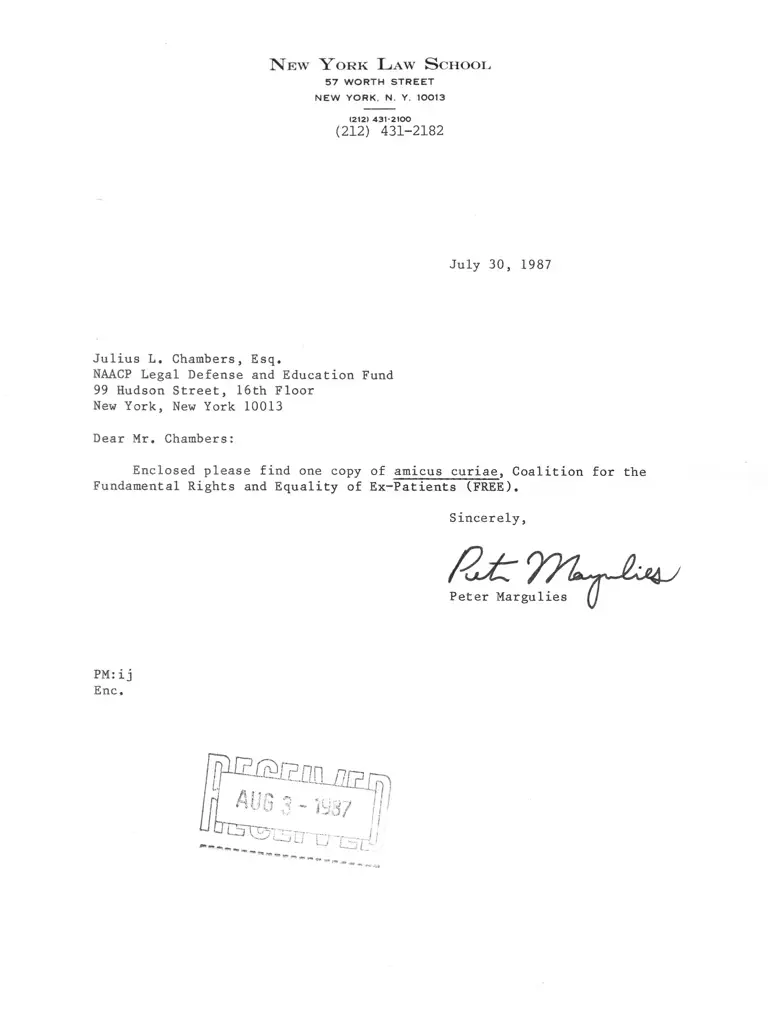
N e w Y o r k L a w S c h o o l
5 7 W O R T H S T R E E T
N E W Y O R K , N . Y. 10013
(2121 431-2100
(212) 431-2182
July 30, 1987
Julius L. Chambers, Esq.
NAACP Legal Defense and Education Fund
99 Hudson Street, 16th Floor
New York, New York 10013
Dear Mr. Chambers:
Enclosed please find one copy of amicus curiae, Coalition for the
Fundamental Rights and Equality of Ex-Patients (FREE).
Sincerely,
PM:ij
Enc
NO. 86-6284
In The
Supreme Court of tfje ®mteb States
October Term, 1986
JOHN T. SATTERWHITE,
Petitioner,
vs.
THE STATE OF TEXAS,
Respondent.
ON WRIT OF CERTIORARI
TO THE TEXAS COURT OF CRIMINAL APPEALS
MOTION FOR LEAVE TO FILE BRIEF OUT OF TIME
AND BRIEF AMICUS CURIAE OF THE COALITION
FOR THE FUNDAMENTAL RIGHTS AND EQUALITY
OF EX-PATIENTS IN SUPPORT OF PETITIONER
J. Benedict Centifanti, Law Clerk MICHAEL L. PERLIN
On the Brief Director, Federal
Litigation Clinic
PETER MARGULIES *
Managing Attorney
New York Law School
57 Worth Street
New York, NY 10013
(212) 431-2183
*Counsel of Record
THE COPY CENTER, INC. 615 Chestnut Street Philadelphia, PA 19106 (215)928-1900
Motion to File Brief Amicus
Curiae Out of Time by the
Coalition for the Fundamental
Rights and Equality of
Ex-Patients in Support of
Petitioner____________________
The Coalition for the Fundamental
Rights and Equality of Ex-patients
("Coalition for the FREE") respectfully
submits this motion to request permission
to file its proposed brief amicus curiae
out of time.
Counsel for the petitioner have
consented to the filing of this Motion
and the related Brief amicus curiae and
their consent will be filed with the
Court. Counsel for the State has
declined to consent.
The Coalition seeks this leave to
file out of time due to a combination of
circumstances. Beginning shortly after
this petition for certiorari in this case
-x-
was granted by this Court, counsel for
the Coalition made reasonable efforts to
contact counsel for petitioner by
telephone. Due to conflicting summer
schedules and other commitments of
counsel, final arrangements for consents
and due dates were not concluded until
the week of July 20, 1987. Acting in
good faith, counsel for the Coalition
mistakenly relied on a proposed extended
filing date of July 28, 1987. Counsel
only became aware of the actual filing
date of July 24, 1987 after contacting
counsel for the State on Monday, July 27,
1987.
The Coalition seeks this Court's
pemission to file late in this case
because of the particular interest of its
members in this matter. The
organizational members of the Coalition
-IX-
for the Fundamental Rights and Equality
1/
of Ex-patients (hereinafter the
"Coalition for the FREE") are all groups
whose primary interests and activities
concern the promotion of public
understanding of mental health issues and
the protection of the rights of the
mentally ill and of present and former
mental patients. Members and clients of
these organizations include many former
patients, their families and friends, as
well as advocates for the mentally ill.
1/ The
for the
NATIONAL
participants in the Coalition
FREE are as follows:
MENTAL HEALTH ASSOCIATION;
NATIONAL MENTAL HEALTH CONSUMERS
ASSOCIATION; SHARE OF DAYTONA BEACH,
FLORIDA, INC. ; THE MENTAL PATIENT'S
ASSOCIATION OF NEW JERSEY; MISSOURI
MENTAL HEALTH CONSUMERS' ASSOCIATION; THE
MONTANA MENTAL HEALTH CONSUMERS ADVOCACY
PROJECT; and THE MENTAL PATIENTS'
ASSOCIATION OF PHIADELPHIA
(A more complete description of
the members of the Coalition is included
at page 1 of the Brief amicus curiae
attached hereto).
-ill-
the Court willIn this case,
hear arguments specifically on the
applicability of the Fifth Amendment to
psychiatric interviews and on the
effectiveness of waiver of Miranda
rights. Many of the members of the
Coalition— and/or clients of
members— have been involved in court
proceedings which implicated these or
closely-related questions. Whatever this
Court decides in this case will
undoubtedly affect the outcome of similar
cases in the future and will also likely
impact on all proceedings involving the
criminal law, psychiatric testimony and
Miranda rights, including cases in the
state courts.2/ Therefore, amici
curiae now wish to share their
specialized knowledge and insights with
this Court and the parties in this case.
-iv-
Amici curiae believe that no
other party or amici here will make
available to the Court these arguments
regarding the proper role of psychiatric
testimony, Miranda rights and waiver, the
right to counsel in these contexts, and
the current research and commentary on
these issues. Because of their
demonstrated concern about the proper
uses of psychiatric testimony and their
involvement in similar proceedings,
amici curiae believe that they have a
clear interest in this case, and can
offer a significant alternate viewpoint
on these issues to this Court.
Michael L. Perlin
Director, Federal
Litigation Clinic
Peter Margulies*
Managing Attorney
New York Law School
57 Worth Street
New York, NY 10013
(212) 431-2133
*Counsel of Record
-v-
Question Presented
Was petitioner denied effective
assistance of counsel, a fair and
impartial trial, equal protection of the
law, due process of law and his right to
be free from cruel and unusual punishment
guaranteed by the Fifth, Sixth, Eighth
and Fourteenth Amendments to the United
States Constitution because the Trial
Court allowed witness, James Grigson,
M.D. to testify to evidence obtained in
violation of Article I, Section 10 of the
Texas Constitution and in violation of
the Fifth, Sixth and Fourteenth
Amendments of the Constitution of the
United States?
-vi-
TABLE OF CONTENTS
Page
I. STATEMENT OF INTEREST OF
AMICUS CURIAE...........................1
II. SUMMARY OF ARGUMENT....................8
III . ARGUMENT............................ 9
A. The Decision Below Is
Inconsistent with Estelle
v. Smith, 451 U.S. 454
(1981) Because Petitioner
Was Not Adequately Warned
Regarding the Potential
Use of the Psychiatric
Interview in Sentencing
Proceedings........................ 9
B. The Failure to Notify
Petitioner's Counsel in
Advance of Dr. Grigson's
Interview Violated the
Sixth Amendment's Guaran
tee of Effective Assis
tance of Counsel................. 20
IV. CONCLUSION............................32
- V l l -
TABLE OF CASES
Ake v. Oklahoma,. 470 U.S. 68,
105 S.Ct., 1007 84 L.Ed. 2d 53 (1985).... 5
Allen v. Illinois, 106 S.Ct. 2988 (1986). .5
Anderson v. State, 135 Ariz. 578, 663
P.2d 570 (1980) .......
Barefoot v. Estelle, 463 U.S. 880, 103
S.Ct. 3383, 77 L.Ed. 2d 1090 (1983)
Page
578, 6 63
880, 103
) . . .
387, 97
Ct. 515
.4, 5
Brewer v, Williams, 430 U __
S.Ct. 1232, 51 L.Ed. 2d 424 (1977)....... 30
Colorado v. Connelly, 10
(1986) _ ....
Estelle v. Smith, 451 U.S. 454, 101 S.Ct.
1866 , 68 L.Ed. 2d 359 (1981)......... passim
Ford v. Strickland, 106 S.Ct. 2595 (1986)..16
Miranda v. Arizona, 348 U.S. 436, 86
S.Ct. 1602, 16 L.Ed 2d 694 (1966)..... passim
Moran v. Burbine, 106 S.Ct. 1135 (1986)
............ 12, 16, 31
Nethery v. State, 692 S.W. 2d 686 (Tex.
Ct. Crim. App.) (1985)................... 27
People v. Medina, ___ Col.
961 (1985) ......
_, 705 P. 2d
'..........19
Rivers v. Katz, 67 N.Y. 2d 483, 504
N.Y.S. 2d 74 (Ct. App. 1986)............ 19
Rogers v. Commissioner, 396 Mass. 489,
-viii-
458 N.E. 2d 308 (1983) 19
Satterwhite v. State of Texas, No. 67,220
slip opinion (Tex. Ct. Crim. App., Sept.
17, 1986) ................... 11
Smith v. Estelle, 602 F.2d 694 (5th Cir.
1979) ................... 12
Smith v. Murray, 106 S.Ct. 2661 (1986)..5, 6
Strickland v. Washington, 466 U.S. 668,
104 S.Ct. 2052, 80 L.Ed. 2d 674 (1984),
reh. den. 467 U.S. 1267, 104 s.Ct. 3562,
&2 L. Ed. 2d 864 (1984)......... .......... 27
United States v. Chronic, 466 U.S. 648,
104 S.Ct. 2039, 75 L.Ed 2d 430 (1984).... 28
United States Department of the Treasury,
Bureau of Alcohol, Tobacco and Firearms
v. Galioto, 106 S.Ct. 2683 (1983)..... iq
Statutes
The Insanity Defense Reform Act of 1984,
Pub.L. No. 98-472, 98 Stat. 2057 (1984)___ 6
Other Authorities
Brief amicus curiae for
Psychiatric Assocition in
Estelle
the American
Barefoot v.
____10, 22, 27
Brief amicus curiae for the American
Psychiatric Association in Estelle v.
Smith ....................
Carroll, "Insanity Defense Reform," 114
-ix-
Mil. L.R. 183 (1986) 6
Ewing, " 'Doctor Death' and the Case for
an Ethical Ban on Psychiatric and
Psychological Predictions of
Dangerousness in Capital Sentencing
Cases," 8 Am. J.L. & Med. 407 (1983).... 27
Note, "Ake v. Oklahoma: An Interloper in
the Brave New World of the 1984 Insanity
Defense Reform Act Challenges Federal
Rule of Evidence 704(b)," 55 Miss L.J.
287 (1983) ...................... 6
Perlin, "Dulling the Ake in Barefoot' s
Achilles Heel", 3 N.Y.L.S, Hum. Rts. Ann.
91 (1985) ....................... 27
Slobogin, "Dangerousness and Expertise,"
133 U.Pa.L.R. 97 (1984)..............13, 22
"The Supreme Court, 1980 Term," 95 Harv.
L.R. 91 (1981) .25
"The Supreme Court, 1982 Term," 97 Harv.
L. R. 70 (1983) ....................... 27
Taylor, "Dallas' Doctor of Doom," Nat'1.
L.J. Nov. 24, 1980 at 1, col. 2......... 27
"They Call Him Dr. Death", Time, June 1,
1981 at 64 27
White, "Waiver and the Death Penalty:
The Implications of Estelle v. Smith," 72
J. of Crim. L. & Criminol. 1522 (1981)
......... 13, 17, 24, 29
-x-
I. STATEMENT OF INTEREST OF AMICUS CURIAE
This brief amicus curiae is being
filed in support of the Petitioner.
Counsel for the petitioner have consented
to the filing of this Brief and their
consent will be filed with the Court.
Counsel for the State has declined to
consent.
Amici curiae, the organizational
members of the Coalition for the
Fundamental Rights and Equality of
1/Ex-patients (hereinafter the
"Coalition for the FREE") are all groups
1/ The participants in the Coalition
for the FREE are as follows:
NATIONAL MENTAL HEALTH ASSOCIATION
The National Mental Health
Association ("NMHA") is the nation's
oldest and largest non-governmental,
citizens' voluntary organization
concerned with mental illnesses and
mental health. Founded in 1909 by
Clifford Beers, a man who suffered from a
serious mental illness, the Association
has historically led efforts on behalf of
mentally ill people in institutions and
the community. The NMHA has grown into a
1
whose primary interests and activities
concern the promotion • of public
understanding of mental health issues and
(footnote continued)
network of 650 chapters and state
divisions working across the United
States. It is composed of volunteers who
are mostly non-mental health
professionals. Some are family members
whose loved ones have been affected by
mental illness; others are former
patients. All are committed to advocacy
for the improved care and treatment of
mentally ill people, the promotion of
mental health and the prevention of
mental illnesses.
NATIONAL MENTAL HEALTH CONSUMERS'
ASSOCIATION
The National Mental Health Consumers'
Association was organized in Baltimore,
Maryland in June, 1985, as a national
representative voice for mental health
consumers and charged with developing
national forums so that the concerns of
mental health consumers can be heard.
SHARE OF DAYTONA BEACH, FLORIDA, INC.
SHARE of Daytona Beach, Florida,
Inc., organized in Daytona Beach in
January, 1980, was incorporated in
November, 1985 as a non-profit
corporation in the State of Florida.
SHARE'S primary thrust is the rights of
mental patients and former mental
patients.
2
the protection of the rights of the
mentally ill and of present and former
mental patients. Members and clients of
(footnote continued)
THE MENTAL PATIENT'S ASSOCIATION
OF NEW JERSEY
The Mental Patient's Association of
New Jersey was established in May, 1984
in Asbury Park, New Jersey and is a
statewide network of individuals and
self-help organizations devoted to the
development of self-help and advocacy
groups and the protection of the
interests and rights of mental health
consumers.
MISSOURI MENTAL HEALTH CONSUMERS'
ASSOCIATION
The Missouri Mental Health Consumers'
Association was formed by former mental
patients in St. Louis in 1986 in order to
promote the rights and interests of
mental health consumers in Missouri. One
of the principal interests of MMHCA is in
affecting public policy decisions
involving mental health issues from the
consumer perspective.
THE MONTANA MENTAL HEALTH CONSUMERS'
ADVOCACY PROJECT
The Montana Mental Health Consumers'
Advocacy Project, an unincorporated
association formed in November, 1983, in
Billings, Montana, is an ex-mental
patient self-help and political action
group, organized for the purposes of
fighting discrimination and stigma and
influencing legislation for the rights of
mental patients.
3
these organizations include many former
patients, their families and friends, as
well as advocates for the mentally ill.
This case, like others in which the
Coalition and/or its members have filed
recent amicus briefs in this Court,
involves issues of the relationship
between the mental health field and the
legal system, specifically here
concerning the proper role and activities
of psychiatrists in the area of criminal
2/law.
(footnote continued)
THE MENTAL PATIENTS' ASSOCIATION OF
PHIADELPHIA
The Association was formed in
Philadelphia in 1985 in an effort to
organize mental health consumers to
oppose all efforts to erode the rights
and freedoms of those who have been
hospitalized for psychiatric illness and
to call for an end to discriination
against the psychiatrically disabled in
any form.
2/
The Coalition for the FREE
and/or its members have filed amicus
briefs in several recent cases before
this Court. See, e.g., the Coalition's
amici briefs in United States Department
4
In this case, the Court will
hear arguments specifically on the
applicability of the Fifth Amendment to
psychiatric interviews and on the
effectiveness of waiver of Miranda
rights. Many of the members of the
Coalition— and/or clients of
members— have been involved in court
proceedings which implicated these or
closely-related questions. Whatever this
Court decides in this case will
undoubtedly affect the outcome of similar
cases in the future and will also likely
impact on all proceedings involving the
criminal law, psychiatric testimony and
Miranda rights, including cases in the
2/state courts. Therefore, amici
(footnote continued)
of the Treasury, Bureau of Alcohol,
Tobacco and Firearms v. Galioto, 106 S.
Ct. 2683 (1986) and Colorado v."Connelly,
107 S. Ct. 515 (1986).
3/ This Court's recent caseload
reflects the increasing concern about
these and related issues. See, in
5
curiae now wish to share their
specialized knowledge and insights with
this Court and the parties in this
case.
Amici
party or
available
regarding
testimony,
curiae believe
amici in this
to the Court
the proper rol
Miranda rights
that no other
case will make
these arguments
of psychiatric
and waiver, the
(footnote continued)
addition to this case, Colorado v.
Connelly, 107 S.Ct. 515 (1986); Smith v.
Murray, 106 S.Ct. 2661 (1986); Allen v.
Illinois, 106 S.Ct. 2988 (1986); and Ake
v. Oklahoma, 470 U.S. 68, 105 S.Ct. 1007,
84 L.Ed. 2d 53 (1985). Smith v. Murray,
above, in particular, clearly
foreshadowed this case. See Smith v.
Murray, 106 S.Ct. at 2664 regarding the
absence of any warnings as required under
Estelle v. Smith, 451 U.S. 454 (1981).
In addition to these cases, there is one
other development in this area of the law
which may also be currently influencing
the role of psychiatry in this context:
The Insanity Defense Reform Act of 1984,
Pub. L. No. 98-472, 98 Stat. 2057
(1984) . See, e.g ., Note "Ake v.
Oklahoma: An Interloper in the Brave New
World of the 1984 Insanity Defense Reform
Act Challenges Federal Rule of Evidence
704(b)" 55 Miss. L♦J . 287, 315 (1985).
See also, Carroll, "Insanity Defense
Reform," 114 Mil. L. R. 183 (1986)
6
right to counsel in these contexts, and
the current research and commentary on
these issues. Because of their
demonstrated concern about the proper
uses of psychiatric testimony and their
involvement in similar proceedings,
amici curiae believe that they have a
clear interest in this case, and can
offer a significant alternate viewpoint
on these issues to this Court.
7
II. SUMMARY OF ARGUMENT
The ruling below in this case by the
Texas Court of Criminal Appeals is
inconsistent with this Court's decision
in Estelle v. Smith, 451 U.S. 454, 101
S.Ct. 1866, 68 L.Ed. 2d 359 (1981)
because petitioner was not given an
adequate warning about the specific
purposes for the psychiatric interview
either by the expert witnesss or by
having the assistance of his counsel with
notice in advance of the interview. The
potential use of the psychiatric
testimony in the capital sentencing phase
of his criminal proceedings had to be
expressly stated to petitioner by the
expert in order to satisfy both Estelle
and Miranda v. Arizona, 348 U.S.436, 86
S.Ct. 1602, 16 L.Ed. 2d 694 (1966). (Pt.
Ill A) Notwithstanding the allegedly
8
unobjected-to
failure
testimony- of another
expert, the failure to notify
petitioner's counsel in advance of the
interview by Dr. Grigson violated
petitioner's Sixth Amendment right to
effective assistance of counsel,
especially given the professional
background and experience of this
particular expert and the ambiguous and
contradictory warning given petitioner by
that expert alone. (Pt. Ill B.)
III. ARGUMENT
A. The Decision Below Is
Inconsistent with Estelle v.
Smith, 451 U.S. 454 (1981)
Because Petitioner Was Not
Adequately Warned Regarding the
Possible Use of the Psychiatric
Interview In Sentencing
Proceedings ____________ ____
In Estelle v. Smith, 451 U.S. 454
(1981) this court has already
definitively established guidelines for
9
permitting the use— -and prohibiting the
abuses— of psychiatric testimony such as
4/
that involved in this case. In that
case, this court stated:
3ecause respondent did not
voluntarily consent to the
pretrial psychiatric examination
after being informed of his
right to remain silent and the
possible use of his statements,
the State could not rely on what
he said to Dr. Grigson to
4/There should be no question
about amicus' longstanding opposition to
the use of such psychiatric testimony in
the first instance because of the
well-known fallibility of psychiatric
predictions of dangerousness. See, e.g.,
the Brief amicus curiae of the Coalition
for the Free in United States Department
of Treasury, Bureau of Alcohol, Tobacco
and Firearms v, Galioto, above at p. 14
regarding the "false positive rates of
experts' predictions of dangerousness."
See also, 3rief amicus curiae for the
American Psychiatric Association in
Barefoot v. Estelle, 463 U.S. 880, 103
S.Ct. 3383, 77 L.Ed. 2d 1090 (1983) at p.
12: "The unreliability of psychiatric
predictions of long-term future
dangerousness is by now an established
fact within the [psychiatric]
profession," citing numerous studies in
support thereof at p. 13, n. 8.
10
establish his future
dangerousness. If, upon being
adeqauately warned, respondent
had intimated he would not
answer Dr. Grigson's questions,
the validly ordered competency
examination nevertheless could
have proceeded upon the
condition that the results would
be applied solely for that
purpose. In such circumstances,
the proper conduct and use of
competency and sanity
examination are not frustrated
but the State must make its case
on future dangerousness in some
other way.
Estelle v. Smith 451
U.S. above at 468-69
(emphasis added)
Here, however, there clearly was no
such "adequate" warning to petitioner by
anyone of the "possible use" of the
psychiatric interview in the sentencing
phase. Indeed, here petitioner was
positively misled about its possible use
by Dr. Grigson's remarks that the
interview "could be harmful or it could
be helpful depending upon what the
findings would be." Satterwhite v. State
of Texas, No. 67, 220, slip opinion
(Texas Ct. of Crim. App., Sept. 17,
11
1986), at p. 25. (hereinafter
"Opinion"). Interestingly, the lower
court in Estelle had foreseen this
approach in that opinion where no
warnings had been given:
If the state is entitled to compel a
defendant to submit to an
examination, it can, in an effort to
gain the defendant's cooperation,
mislead him or indeed lie to him
about the significance of the
examination; it can take advantage of
his ignorance or lack of
understanding. It can coerce him in
any way that does not make his
statements less useful to the
interrogating psychiatrist.
Psychological pressure, sharp
practices, and deceit are likely to
be, in effect, the means of
compelling examinations. These
tactics are inherently
discriminatory. Smith v. Estelle,
602 F . 2d 694, 707-8 (5th Cir. 1979).
Similarly, in Moran v. Burbine, 106
S. Ct. 1135, at 1158, (1986) Justice
Stevens' dissenting opinion notes as
follows:
In this case it would be perfectly
clear that Burbine's waiver was
invalid if, for example, Detective
Ferranti had "treatened, tricked, or
cajoled" Burbine in their private
12
pre-confession meeting— perhaps by-
misdescribing the statements obtained
from DiOrio and Sparks— even though,
under the Court's truncated analysis
of the issue, Burbine fully
understood his rights. Petitioner's
case here is even more clear
regarding the misleading nature of
the warnings given to him.
Because of these concerns, as others
5/
have commented, the Court's decision
in Estelle would seem to require— as a
bare minimum— a specific disclosure about
the possible use of the interview at
sentencing.
Yet here, even the State's own
examination shows that Dr. Grigson's
"warning" fails to meet that standard.
Q. And prior to the examination
did you given [sic] any type of
admonitions to him in the way of
warnings?
1/ See e.g., White, "Waiver and the
Death Penalty: The Implications of
Estelle v. Smith," 72 J. of Crim. L. &
Criminol. 1522, 1534-37 (1981)
(hereinafter "White"); and Slobogin,
"Dangerousness and Expertise," 133
<J. Pa. L. R. 97, 167 (1984) (hereinafter
"Slobogin").
13
A. Yes, sir. I did. I
explained to him on both
occasions the purposes of the
examination in terms of the
three questions, that I was
primarily doing the evaluation
in order to determine the
question of competency, the
question of sanity or insanity
and the question of whether or
not he presented a continuing
threat to society, whether or
not there was a question as to
propensity of violence,
dangerousness. Respondent's
Brief in Opposition, pp. 5-6
(hereinafter "RBO")
Dr. Grigson then went on to tell
petitioner about a federal judge's
decision that permitted defendants to
decline to be interviewed. (Id.)
Clearly, all of this highly technical
language and disclosure is rendered
totally meaningless without one's being
given the context of the "possible use"
of this evidence at sentencing.
As then Chief Justice Burger noted in
Estelle concerning the parallel issue of
the right to counsel regarding this
context:
14
...(R )espondent was denied the
assistance of his attorneys in
making the significant decision
of whether to submit to the
examination and to what end the
psychiatrist's findings could be
employed.
Estelle v. Smith, 451
U.S. above, at 471
(emphasis added)
In petitioner's case, the failure to
notify counsel about the interview— in
addition to raising the Sixth Amendment
issues discussed below— further
underscores the lack of "adequate
warning" given here regarding its
"possible use'.' The defendant in a capital
case needs to know what is really at
issue before he can properly evaluate
whether or not to waive his right to
decline to give permission for a
psychiatric interview that indeed "could
be harmful or...could be helpful" to his
1/very life. There can be no effective
waiver of Miranda rights where the
defendant's interests are not
15
"red-flagged" in a more candid manner
than Dr. Grigson's approach did here.
Recently in Moran v. Burbine, 106 S.Ct.
above, at 1141 (1986) this Court
expressed the standards for waiver in
this way:
[T]he waiver must have been made with
a full awareness both of the nature
of the right being abandoned and the
consequences of the decision to
abandon it. (emphasis added)
Clearly, petitioner here did not have
such a "full awareness" of the
"consequences" of waiving his right not
to be interviewed in this context.
— See White, n. 5 above, at 1537: "If the
defendant's statement is to be used against him
in the penalty phase of a capital trial, then
knowledge that the statement may be used for
this purpose should be essential to a valid wai
ver under Miranda. A capital defendant who
lacks such knowledge will not be aware of the
true nature of the adversary interests involved."
Cf. Ford v. Strickland, 106 S.Ct. 2595 (1986).
16
An additional factor here is the
inherently compulsory nature of
interviews in this setting. This Court's
decision in Estelle did not
over-emphasize the custodial nature of
pre-trial psychiatric interviews— and
7/
perhaps purposely so. In the absence
of any warning to Smith, or any awareness
at all of his rights, the custodial
atmosphere in Estelle was a marginal
issue at best. However, given some
"warning" here— -however ineffective or
inadequate— the coercive atmosphere of
the custodial interview again becomes
relevant.
- See White, n. 5 above, at 1532: "[T]he
Court did not focus upon the potentially co
ercive atmosphere involved, but rather upon
the defendant's lack of awareness of the in
criminatory dangers."
17
For all we know, Satterwhite may
have mistakenly thought that his attorney
had already approved of this interview
because of the earlier one and therefore
may have been afraid to "refuse" to
follow such non-existent advice.
In its amicus brief in Estelle, the
American Psychiatric Associatioon
expressed its view using an
all-too-prophetic phrase:
[A] defendant should not be
compelled to participate in a
psychiatric examination on issues
concerning the penalty phase.
It should be emphasized that
recognition of a right to refuse
participation in psychiatric
examinations that could lead to
testimony for capital sentencing
purposes would not distort the "fair
state-individual balance" that
underlies the Fifth Amendment
privilege.
...[T]he defendant should not be
required to guess that he may refuse
to participate in the psychiatric
examination.
Brief amicus curiae for the
18
American Psychiatric Association
in Estelle v. Smith above, at
pp. 27-28 (emphasis added)
The effectiveness of any "right to
refuse" in the area of treatment depends
on full disclosure of side-effects as
well as potential benefits. Possible
life-threatening effects are clearly
included in the warnings given in this
£/
psychiatric context. Similarly,
here, there can be no effective "right to
refuse" without a corresponding specific
disclosure of risks and benefits to the
defendant, particularly on the potential
impact of the psychiatric interview on
sentencing in capital cases.
8/ Cf., on
and "informed
procedures in
cases, Anderson
663 P .2d 570 (1980)
Col. ____, 705 P .2d 961 (1985)
Commissioner, 396 Mass. 489,
(1983) and Rivers v. Katz
504 N .Y .S.2d 74 (Ct. App.
the "right
consent"
psychotropic
v. State, 135
People v
308
483,
to refuse"
disclosure
druggi ng
Ariz. 578,
. Medina,—
; Rogers v.
458 N.E.2d
, 67 N .Y .2d
1986) .
19
B. The Failure to Notify
Petitioner's Counsel In Advance
o f Dr. Grigson's Interview
Violated the Sixth Amendment's
Guarantee of Effective
Assistance of Counsel
The court below conceded that the
failure to notify petitioner's counsel of
Dr. Grigson's interview was error.
We therefore conclude that Dr.
Grigson's testimony was improperly
admitted into evidence in violation
of appellant's Sixth Amendment right
to assistance of counsel.
See Opinion, p. 21.
The court concluded, however, that
this error was rendered harmless because
of the allegedly unobjected-to admission
of Dr. Schroeder's psychological report
on the same issue— the dangerousness of
. . 2/petitioner. Opinion, pp. 21-22 And,
for its part, the State now claims that
the sequence of the two motions for
2/
But see, as to
Petition for Certiorari,
objections by petitioner's
this issue, the
p. 10 regarding
counsel.
20
interviews and the first actual interview
operated altogether as a kind of
"constructive" notice to petitioner's
counsel who thereby had "reasonable
opportunity" to alert petitioner to his
"right to refuse" Dr. Grigson's request,
or at least to limit the use of the
interview. RBO, p. 9. In the first
place, this argument clearly fails the
standard of Estelle requiring actual
notice. Estelle v. Smith, 451 U.S. above
at 471.
Moreover, all that really needs to be
said about the sequence of these two
interviews is that there are obviously
great differences in degree(s) and kind
between Dr. Grigson and Dr. Schroeder,
whatever their testimonial
21
similarities. Without unduly be
laboring the effects on the jury of their
respective medical versus psychological
expertise, there can be little question
that at least the prosecutor thought the
distinction was worth mentioning— and
emphasizing— in his summation. See,
Petition for Certiorari, at p. 13:
1 0 /
_10/ Earlier in its Brief amicus curiae
in Barefoot v. Estelle, 463 U.S. above,
at p. 16, the American Psychiatric
Association made a similar distinction:
While adding little, if anything, to
the factual evidence concerning the
risk of future dangerousness,
psychiatric opinions on this subject
substantially prejudice the
defendant....(P )sychiatric testimony
is likely to be given great weight by
a jury simply because it is, or
purports to be, a statement of
professional opinion. A psychiatrist
comes into the courtroom wearing a
mantle of expertise that inevitably
enhances the credibility, and
therefore, the impact of the
testimony.
See also, Slobogin, n. 5 above, at p.
147, n. 182 as to the effects of such
"expert" testimony on judicial
decision-making.
22
The prosecution argued to the
jury reminding them that Dr.
Grigson is [a] "Dallas
Psychiatrist and Medical Doctor
as compared to a mere
psychologist employed by Bexar
County.["] See also, Dissenting
Opinion, pp.2-3.
For all we know, even Satterwhite himself
may have thought that a psychiatrist's
interview was more "scientific" or
medically therapeutic than the "mere"
psychologist's tests he had already taken
and therefore was more willing to be
cooperative with Dr. Grigson in the
absence of any advice from counsel
regarding the dangers of the psychiatric
interview in particular.
The real issue here is a very narrow
one— can the government do through its
psychiatric "agent", Dr. Grigson, what it
may not do directly through its attorneys
and other investigators? There can be no
question as to the nature of the
psychiatrist's role here:
23
That [defendant] was questioned
by a psychiatrist designated by
the trial court to conduct a
neutral competency examination,
rather than by a police officer,
government informant, [or]
prosecuting attorney is
immaterial.
Estelle v. Smith, 451
11
U.S. at 467. /
In addition, here, there also can be
little doubt of counsel's likely reaction
to notice that Dr. Grigson was going to
11/ White, n. 5 above, at p. 1533,
among others, has also noted this issue:
"There is no reason to suppose
that the defendant in Smith
viewed the examining
psychiatrist as anything other
than a government psychiatrist.
Thus, based on its holding, the
Court's language could be read
to include only people known by
defendant to be government
agents. (emphasis added.)
24
conduct an interview of their client for
12/
any purpose. Moreover, there can be
little doubt that counsel would also
react far differently to notice that Dr.
Grigson was planning to interview the
defendant, as opposed even to any other
13/
psychiatrist 0£ psychologist.
12/
See the Petition for
Certiorari, at p. 9:
...Dr. James P. Grigson, is
well-known to every practitioner
in capital cases. It is this
very same "expert witness' that
has testified in several
punishment phases of criminal
proceedings in capital cases
which has been noted in Smith v.
Estelle....
See also, White, n. 5 above, at p. 1544,
regarding the relevance of the known
"propensities of the particular
psychiatrist involved."
13/ Dr. Grigson's "national"
reputation in this context is beyond
arqument. See, e.g., "The Supreme Court,
1980 Term," 95 Harv. L.R. 91, at 123
(1981):
The state's attorney [in Estelle
v. Smith, above] consulted a Dr.
Grigson— known in some circles
as "the killer shrink" because
of his work for prosecutors in
25
The point here is that within the
stricture of their ethical- obligation to
avoid "professionally unreasonable"
conduct, Messrs. Wood and Takas could
not possibly have failed to counsel
petitioner specifically regarding Dr.
Grigson's known propensities had they but
(footnote continued)
capital cases....(citing Bloom,
"Doctor for the Prosecution",
Am. Law. Nov. 1979, at 25).
And, further, at p. 123, n. 9.
Dr. Grigson's work had induced
at least one scholar to conclude
that he operated "at the brink
of quakery." Dix, "The Death
Penalty, ’Dangerousness',
Psychiatric Testimony and
Professional Ethics," 5 Am. J .
Crim. L. 151, 172 (1977). And
regarding Dr. Grigson's
testimony in Smith, one Texas
appellant judge wrote that he
was 'unable to find that much of
the testimony offered was from
this side of the twilight zone.'
Id. at 165 (quoting a dissent of
Texas Criminal Appeals Judge
Odom, which was withdrawn before
publication in light of Jurek v.
Texas, 428 U.S. 262 (1971)
(plurality opinion)
26
14/
been informed of the interview. See
Strickland v. Washington, 466 U.S. 668,
(footnote continued)
See, for more on the same
material, "The Supreme Court, 1982 Term,"
97 Harv. L♦R. 70, 123 at n. 11 (1983).
See also, Perlin, "Dulling the Ake in
Barefoot1s Achilles Heel," 3 N.Y.L.S.
Hum. Rts. Ann. 91, 103 n. 63 (1985);
Nethery v. State, 692 S.W.2d 686, 708
(Tex. Ct. Crim. App. 1985) (Dr. Grigson
has testified by his own count in 120
capital cases and "in every - capital
murder case in which he had testified
about future dangerousness he had
testified in the affirmative,") and
Ewing, "'Doctor Death' and the Case for
an Ethical Ban on Psychiatric and
Psychological Predictions of
Dangerousness in Capital Sentencing
Procedures," 8 Am. J. L. & Med. 407, 410
(1983) (As of 1983, the jury had returned
the death sentence in 69 of the 70
capital cases in which Dr. Grigson had
testified up to that time.); "They Call
Him Dr. Death," Time, June 1, 1981 at 64;
and Taylor, "Dallas' Doctor of Doom,"
Nat'1. L. J., Nov. 24, 1980 at 1 ed. 2.
~ IV
Even the American Psychiatric
Association has taken pains to distance
itself from this particular expert. See,
Brief amicus curiae of the A.P.A. in
Barefoot v. Estelle, above at p. 24:
Dr. Grigson also gave his own
criteria for determining whether or
not someone has an 'antisocial
personality disorder.'
27
691, 104 S .Ct. 2052, 2066, 80 L. Ed
674 (1984), reh. den. 467 U.S. 1267,
S.Ct. 3562, 82 L.Ed. 2d 864 (1984
See also, United States v. Chronic, 466
U.S. 648, 104 S.Ct. 2039, 75 L.Ed 2d 430
(1984). Nothing that the State now
argues regarding "constructive" notice to
counsel or reasonable opportunity for
counsel to warn petitioner based on the
Schroeder interview could possibly excuse
petitioner's counsel from their
obligation to warn petitioner about the
(footnote continued)
Further, at p. 24, n. 19:
In Estelle v. Smith, supra, for
example, Dr^ Gr igson concluded that
defendant was "a severe sociopath"
even though his only prior criminal
conviction had been for possession of
marijuana. 101 S.Ct. at 1870, n. 4,
1871.
And finally, at p.25:
In sum, the inadequate procedures
used in this case allow a
psychiatrist to masquerade his
personal preferences as "medical"
views, without providing a meaningful
basis for rebutting his conclusions.
28
reputation of Dr. Grigson in particular11/had they only been so notified.
Finally, there can be no real
question here regarding the petitioner's
need for counsel at this "critical stage"
of the proceedings. As even the Texas
Court of Criminal Appeals conceded:
As in Estelle v. Smith, appellant had
already been indicted when this
examination took place. Thus, his
right to assistance of counsel had
attached. Kirby v. Illinois, supra.
While attachment of that right does
not mean that appellant had a
constitutional right to have counsel
actually present during examination,
Estelle v. Smith, supra, it does mean
that appellant's attorneys should
have been informed that an
examination, which would encompass
the issue of future dangerousness,
was to take place. Additionally, the
attachment of this right meant that
appellant could have consulted with
his attorney prior to the
examination. There is nothing to
15/
See White, n. 5 above, at 1542
regarding the obvious requirement that
counsel meet with his client to discuss
the proposed psychiatric interview vel
non.
29
indicate that appellant gave a
knowing intelligent, and voluntary
waiver of his right to counsel, and a
waiver will not be presumed from a
silent record.
Opinion, p. 21. See also,
Brewer v. Williams , 430 U.S. 387, 97
S.Ct. 1232, 51 L.Ed. 2d 424 (1977)
Then Associate Justice Rehnquist
specifically noted this requirement in
his concurring opinion in Estelle V .
Smith, above at 475: "Counsel was
entitled to be made aware of Dr.
Grigson's activities involving his client
and to advise and prepare his client
accordingly." Thus, even if there is a
disagreement about extending Miranda to
these interviews— and we acknowledge that
there may be based on the Justice's
16/
concurring opinion in Estelle — the
16/
See then Associate Justice
Rehnquist's concurring opinion in Estelle
v. Smith, above, at p. 475. See also in
this regard, White, n. 5 above/ at p.
1532.
30
petitioner's Sixth Amendment right to
counsel clearly had attached in any event
under the Estelle v. Smith holdings even
as most narrowly interpreted.
It hardly seems necessary to mention
in closing that this Court's recent
opinion in Moran v. Burbine can be
readily distinguished from this case
because in Moran the right to counsel had
not yet attached when the waiver and
police "deception" of the attorney
occurred. See Moran v. Burbine, 106
S.Ct. above at 1138, 1142. Here, on the
contrary, the right to counsel had
clearly attached when the disputed
interview by Dr. Grigson took place.
31
CONCLUSION
On the basis of the foregoing
arguments and authorities, amicus curiae
respectfully urges this Court to reverse
and remand this case to the Texas Court
of Criminal Appeals.
Michael L. Perlin
Director, Federal
Litigation Clinic
Peter Margulies*
Managing Attorney
New York Law School
57 Worth Street
New York, NY 10013
(212) 431-2183
♦Counsel of Record
32