In Re: Pedro Archuleta Grand Jury Subpoena Decision
Public Court Documents
August 26, 1977
-
Brief Collection, LDF Court Filings. In Re: Pedro Archuleta Grand Jury Subpoena Decision, 1977. b143aa5d-ac9a-ee11-be37-00224827e97b. LDF Archives, Thurgood Marshall Institute. https://ldfrecollection.org/archives/archives-search/archives-item/8653d770-4165-480a-bb4a-da28bc55df9f/in-re-pedro-archuleta-grand-jury-subpoena-decision. Accessed September 18, 2026.
Copied!
NA&CP Legal Defense PtfflA
10 Columbus Circle
Hew York, N. Y. 10019
LI BRARY
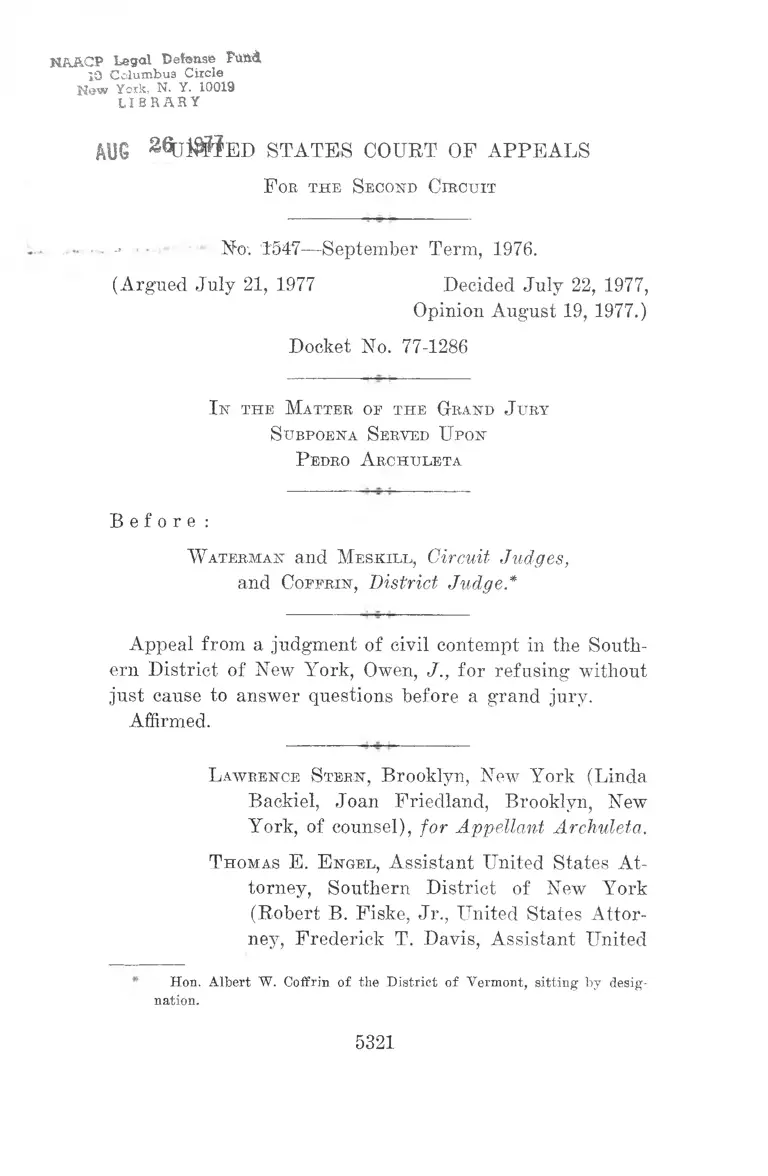
MiG 3 % M 'I e D s t a t e s c o u r t o f a p p e a l s
F or t h e S econd C ir c u it
-> No; T547—September Term, 1976.
(Argued July 21, 1977 Decided July 22, 1977,
Opinion August 19, 1977.)
Docket No. 77-1286
I n t h e M atter of t h e Grand J ury
S ubpo en a S erved U po n
P edro A rch u leta
B e f o r e :
W aterm an a n d M e s k il l , Circuit Judges,
a n d C o ffr in , District Judge.*
Appeal from a judgment of civil contempt in the South
ern District of New York, Owen, J., for refusing without
just cause to answer questions before a grand jury.
Affirmed.
L aw rence S t e r n , Brooklyn, New York (Linda
Backiel, Joan Friedland, Brooklyn, New
York, of counsel), for Appellant Archuleta,
T hom as E . E n g el , Assistant United States At
torney, Southern District of New York
(Robert B. Fiske, Jr., United States Attor
ney, Frederick T. Davis, Assistant United
Hon. Albert W. Coffrin of the District of Vermont, sitting by desig
nation.
5321
States Attorney, Southern District of New
York, of counsel), for the United States of
America.
Meskill , Circuit Judge:
Pedro Archuleta, the appellant here, was found to be in
civil contempt for refusing to answer questions put to him
by a grand jury empanelled in the Southern District of
New York. The order of contempt, issued by Judge Owen,
remanded Archuleta until he purged himself of his con
tempt or until the term of the grand jury expires. 28 U.S.C.
§ 1826(a). Because of the time limitation of 28 U.S.C.
§ 1826(b), we affirmed the order of the district court on
July 22, 1977 this opinion explains the basis of our de
cision.
On January 24, 1975, a bomb exploded in Fraunces Tav
ern, a restaurant in New York City. Four people were
killed, and fifty-three were injured. A group known as
Fuerzas Armadas de Liberacion National Puertorriquena,
or “FALN,” which seeks independence for Puerto Rico,
claimed responsibility for this act of terrorism. A number
of subsequent bombings have been traced to the FALN.
In April, 1975, a grand jury was empanelled in the
Southern District of New York to investigate these bomb
ings. The term of that grand jury expired in October,
1976. A second grand jury, empanelled to investigate the
same crimes, is now sitting.
In November, 1976, a “bomb factory” was discovered in
an apartment in Chicago, owned by one Carlos Torres.
Evidence was found there linking Torres, who is now a
1 28 U.S.C. § 1826(b) provides:
Any appeal from an order of confinement under this section shall
be disposed of as soon as practicable, but not later than thirty
days from the filing of such appeal.
5322
fugitive, to the FALN. Searchers also found a letter from
a church in San Antonio, Texas, to Maria Cueto, the Execu
tive Director of The National Commission on Hispanic Af
fairs of The Protestant Episcopal Church. Miss Cueto and
her secretary, Eaisa Nemikin were called before the grand
jury, and refused to testify concerning the whereabouts of
Torres, after being ordered to do so. See In re Wood, 430
F.Supp. 41 (S.D.N.Y. 1977). They were held in civil con
tempt by the district court, and were remanded until they
testified. This Court affirmed the judgment of contempt,
In re Cueto, 554 F.2d 14 (2d Cir. 1977), and they are pres
ently incarcerated.
Shortly after our decision in Cueto, supra, a grand jury
subpoena was served upon the appellant. He had been a
member of The National Commission on Hispanic A ffairs;
he had also been named in various newspaper accounts as
a possible supplier of dynamite to the FALN. Motions to
quash the subpoena were denied by Judge Lasker. Before
the grand jury, he was asked the following questions:
(1) Did you provide dynamite to anyone you knew to
be in a group called the FALN at any time prior
to January 24, 1975?
(2) Do you know the source of dynamite explosives
used at the bombing of Fraunces Tavern?
(3) Do you know anyone who is responsible for the
bombing at Fraunces Tavern?
(4) In early 1968 did you yourself steal any dynamite
from the Heron Dam Project site near Parkview,
New Mexico?
Archuleta invoked his Fifth Amendment immunity, and
refused to testify. The prosecution then applied for, and
obtained, from Judge Brieant, an order of immunity.
5323
Judge Brieant also entered a protective order designed
to avoid public disclosure of the grand jury proceedings.
Thereafter, Archuleta refused a second time to answer
these four questions. After the foreman had expressly
directed him to answer, the questions were asked a third
time. Bather than responding, appellant made a series of
political speeches explaining his refusal to testify. After
polling the jury to determine that they all felt the ques
tions to be “reasonably necessary and proper,” Judge
Brieant directed appellant to testify. When Archuleta
persisted in his contumacious conduct, he was held in con
tempt on June 30, 1977, by Judge Bichard Owen, and re
manded, pursuant to 28 II.S.C. § 1826.
I.
Appellant’s first contention is that the grand jury had no
evidentiary basis upon which to call him. In Blair v. United
States, 250 U.S. 273 (1919), it was stated that a witness
before a grand jury i s :
bound not only to attend but to tell what he knows in
answer to questions framed for the purpose of bring
ing out the truth of the matter under inquiry.
He is not entitled to urge objections of incompetency
or irrelevancy, such as a party might raise, for this is
no concern of his.
Id. at 282. This has continued to be the rule. Becentlv,
Judge Friendly explained:
The safeguards built into the grand jury system, such
as enforced secrecy and use of court process rather
than the constable’s intruding hand as a means of
gathering evidence, severely limit the intrusions into
personal security which are likely to occur outside the
grand jury process. To be sure, on occasion, a grand
5324
jury may overstep bounds of propriety either at its
own or the prosecutor’s instance, and conduct an in
vestigation so sweeping in scope and undiscriminating
in character as to offend other basic constitutional pre
cepts. When this occurs courts are not without power
to a c t . . . . A part from such cases, when the grand jury
has engaged in neither a seizure nor a search, there is
no justification for a court’s imposing even so appar
ently modest a requirement as a showing of “reason
ableness”-—with the delay in the functioning of the
grand jury which that would inevitably entail.
United States v. Doe (Schwarts), 457 F.2d 895 (2d Cir.
1972), cert, denied, 410 U.S. 941 (1973). See Branzburg v.
Hayes, 408 U.S. 665, 701-02 (1972); Hale v. Henkel, 201
U.S. 43, 65 (1906).
The actions of the grand jury here are clearly justified.
The questions asked of Archuleta were narrowly focused
on criminal conduct which had occurred in the Southern
District. His common association with two fugitives sought
by the FB I in connection with a possibly related crime,2 as
well as the newspaper reports of his activities, wrnre fully
sufficient to justify the subpoena. See Branzburg v. Hayes,
supra, at 701-02; Costello v. United States, 350 U.S. 359,
362-63 (1956). Archuleta’s attempt to evade his duty as a
citizen on this ground is without merit.8
2 Arrest warrants for Torres and Oscar Lopez, charging possession of
explosives and unlawful flight, have been issued in Chicago.
Archuleta now complains that he was never asked a question about
the whereabouts of Torres. I t ill becomes a witness who contuma
ciously refused to testify to claim a deprivation of rights based on the
grand jury’s failure to question him further.
3 Archuleta also appears to claim that this grand jury is not interested
in finding the bombers responsible for four deaths, but is merely per
secuting him and those who share his political views. There being no
evidence to support this contention, we consider it groundless.
5325
II.
Archuleta’s second claim is that the questions asked him
in the grand jury were based on illegal electronic surveil
lance, and thus that the contempt order must be vacated
under Gelbard v. United States,, 408 U.S. 41 (1972). This
claim is also without merit.
The appellant made sweeping allegations of illegal wire
tapping before the district court. The evidence marshalled
in support of this was a recitation of difficulties in com
pleting calls, together with strange noises heard on com
pleted calls. There was also an affidavit, from one Mary
Lujan, stating that she had been asked by FB I agents if
she had telephoned Archuleta.
In response, the government produced affidavits from
the Assistant United States Attorney and FB I agents in
charge of the investigation of FALN bombings in New
York. These affiants stated that they were unaware of
any illegal electronic surveillance of Archuleta. A similar
set of affidavits was submitted from federal authorities in
Chicago, where an investigation into related crimes is
underway. Finally, the prosecutor submitted an affidavit
from the person in charge of the records of electronic sur
veillance maintained by the FB I in Washington stating
that a search of those records revealed no electronic sur
veillance of appellant. The appellant now challenges this
response as inadequate and argues that searches of state
and local records in New Mexico, Illinois and New York
were required before he could be held in contempt.
We doubt whether the appellant has made even the
preliminary showing necessary to require the government
to respond to his claim of illegal electronic surveillance.
Some mechanical troubles with a telephone, together with
knowledge of a call easily derived from long distance tele-
5326
phone records/ is such insubstantial evidence that in most
cases it puts no burden on the prosecutor to “affirm or
deny” the existence of wiretapping. See In re Grand Jury
(Vigil), 524 F.2d 209, 214 (10th Cir. 1975), cert, denied,
425 U.S. 927 (1976).
However, if, as the district court held, the showing
made was sufficient to trigger a governmental response,
the answer of the prosecutor was sufficient. As we recently
explained in United States v. Yanagita, 552 F.2d 940 (2d
Cir. 1977):
But even in a grand jury proceeding, upon the gov
ernment’s production of a valid warrant the witness
has been held not to be entitled to a full-blown hear
ing on the legality of the warrant prior to testifying
since “the traditional notion that the functioning of
the grand jury system should not be impeded or inter
rupted could prevail at that time over the witness’
interest . . . .” In re Persico, 491 F.2d 1156, 1160 (2d
Cir. 1974). See also Gelhard v. United States, supra,
408 IJ.S. at 70, 92 S.Ct. 2357 (White, J., concurring).
Similarly, where the questions asked of a grand
jury witness are narrow in scope, an affidavit by the
Assistant United States Attorney in charge of the
grand jury proceeding, as distinguished from an all
agency search, will suffice, since he would know if his
questions were derived from illegal surveillance.
“It must be remembered that any electronic sur
veillance by the government is relevant only if it
is somehow used in formulating questions that the
grand jury intends to ask. Thus, surveillance con
ducted by the government, the results of which were
not known to the agents investigating this case,
4 There is no claim that the FBI knew of the contents of the call.
5327
would not be relevant. . . . I think that the assistant
United States attorney handling a case and the FB I
agent in charge of the investigation of a case are
the two people most likely to know if the fruits of
any electronic surveillance were used to gain in
formation on which the grand jury would base its
questions. Thus, I think that the denial was suffi
cient.” United States v. Grusse, 515 F.2d 157, 159
(2d Cir. 1975) (Lumbard, J., concurring).
In addition, the duty of the government to respond
under % 3504 may vary with the specificity of the
claims raised by the witness. United States v. See,
505 F.2d 845, 856 (9th Cir. 1974), cert, denied, 420 U.S.
992, 95 S.Ct. 1428, 43 L.Ed. 2d 673 (1975); United
States v. Stevens, 510 F.2d 1101 (5th Cir. 1975).
Id. at 944. See Gelbard v. United States, 408 U.S. 41, 71
(1972) (White, J., concurring). (“Of course, where the
Government officially denies the fact of electronic surveil
lance of the witness, the matter is at an end and the witness
must answer.”) The standard set out in Tanagita was fully
complied with. The questions put to Archuleta were nar
rowly focused on specific criminal activity. I t was thus
relatively simple for the prosecutor to determine the evi
dentiary basis for the questions. In response to vague,
sweeping charges of wiretapping, the government re
sponded with specific, factual denials of illegal conduct.
Gelbard requires no more.6
5 After oral argument, Archuleta’s counsel submitted a letter to the
Court alleging that the Bureau of Alcohol, Tobacco and Firearms
("AFT”) was also investigating the FALN. He now demands that
appellant be released until an affidavit is secured from ATF denying
any illegal electronic surveillance.
Assuming, arguendo, that ATF has actively investigated this case,
our decision is not affected. Gelbard and Tanagita focus the investi
gation of "taint” on the particular questions put to the witness. Here,
5328
III.
Archuleta has also challenged the racial and ethnic com
position of the grand jury.6 All parties agree that this
grand jury was selected by procedures which complied with
the Ju ry Selection and Service Act of 1968, 28 U.S.C.
§ 1861 et seq. The vague, conclusory allegations of under
representation of Hispanics made by Archuleta do not even
make out a colorable claim of a constitutional violation,
let alone a substantial and prejudicial exclusion of mi
nority jurors. Absent such a showing, this jury, selected
in accordance with a valid law, is not subject to attack.7
United States v. Bennet, 539 F.2d 45, 55 (lOtli Cir. 1976),
cert, denied,----- U.S. ------- (197—).
the Assistant United States Attorney, who knows the source of his own
questions, denied any knowledge of electronic surveillance. This meets
the requirements of Gelbard and Tanagita in this ease.
6 Archuleta made the same challenge when called before a grand jury
in the Northern District of Illinois. The district court there rejected
the challenge on the merits.
7 The appellant concedes that he has no statutory standing to mount
this challenge under 28 U.S.G. § 1867. He relies exclusively on his con
stitutional challenge. The government vigorously urges that Archuleta
lacks any standing to raise this claim. In re Maury Santiago, 533 F.2d
727 (1st Oir. 1976), so held, citing United States v. Duncan, 456 F.2d
1401, 1403-04 (9th Cir.), vacated for reconsideration of other matters,
409 U.S. 814 (1972). See Blair v. United States, 250 U.S. 273, 282
(1919).
However, in United States ex rel. Chestnut v. Criminal Court, 442
F.2d 611 (2d Cir.), cert, denied, 404 U.S. 856 (1971), relied on by
Archuleta, a footnote indicated that a witness before a state grand
jury had standing to challenge its composition. Id. at 615 n.7. How
ever, that grand jury had the power to institute criminal contempt
charges, which it had done. Here, by contrast, we are dealing with a
civil contempt initiated by the United States Attorney. The Chestnut
court focused on these powers of the grand jury, which are unavailable
in federal practice. While we do not decide the issue, the footnote in
Chestnut appears to be a weak reed for any future challenge by a
witness to the grand jury array. Moreover, Chestnut resolved the sub
stantive issue against the eontemnor on the ground that the jury selec
tion procedure was fair, and created no prejudice, even if some groups
were under-represented.
5329
IY.
Archuleta’s final point of any substance is a claim that
his conduct is justified because of newspaper stories con
cerning the FALN, which have appeared during the in
vestigation of the bombings. Apparently, his theory is
that anything he might say in the grand jury might be
disclosed by the jurors or the prosecutor, who may have
“leaked” the material already published.8 His ostensible
concern is that some of this testimony would thus reach
the Chicago grand jurors who are also investigating FALN
bombings. Archuleta is a “target” of that grand jury
investigation.
I t is self-evident that no breach of grand jury secrecy
concerning Archuleta has occurred to date, since he has
refused to answer any questions. The government has
supplied affidavits denying that any breach of grand jury
secrecy was the basis for the articles mentioned. Nor is
there any reason to believe that the jurors or the prose
cutor will violate their oaths, and invade the secrecy of
the proceedings. Appellant’s speculation does not provide
a justification for his contumacious conduct. If such vio
lations do occur, the district court has adequate powers
to remedy the situation.
The remainder of Archuleta’s many claims, consisting
largely of wholly unwarranted attacks on various federal
judges and prosecutors, are not worthy of discussion. The
judgment of civil contempt is affirmed.
The Department of Justice is now investigating those disclosures.
We assume that they will take appropriate measures against those
responsible.
5330
480-8-22-77 . TJSCA—4221
MEIIEN PRESS INC., 445 GREENWICH ST„ NEW YORK, N. Y. 100)3, {212) 966-4177
<7§s||||sĵ *« 219