Application for Rehearing; Brief in Support of Rehearing
Public Court Documents
April 13, 1981
-
Case Files, Bozeman & Wilder Working Files. Application for Rehearing; Brief in Support of Rehearing, 1981. e3323bf9-ee92-ee11-be37-6045bdeb8873. LDF Archives, Thurgood Marshall Institute. https://ldfrecollection.org/archives/archives-search/archives-item/86b67cf6-5f2e-4657-a006-8433181d18a4/application-for-rehearing-brief-in-support-of-rehearing. Accessed September 18, 2026.
Copied!
    4ti'f t(( i-.(.\-/ /.^-; Lt.,1 ._..-i -i

IN THE COURT OP

MAGGIE BOZEI\IAN,

Appellant,

vs.

STATE OF ALABAMA,

Appellee.

CRIMINAL APPEALS OF ALABAMA

SECOND DIVISTON NO. 276

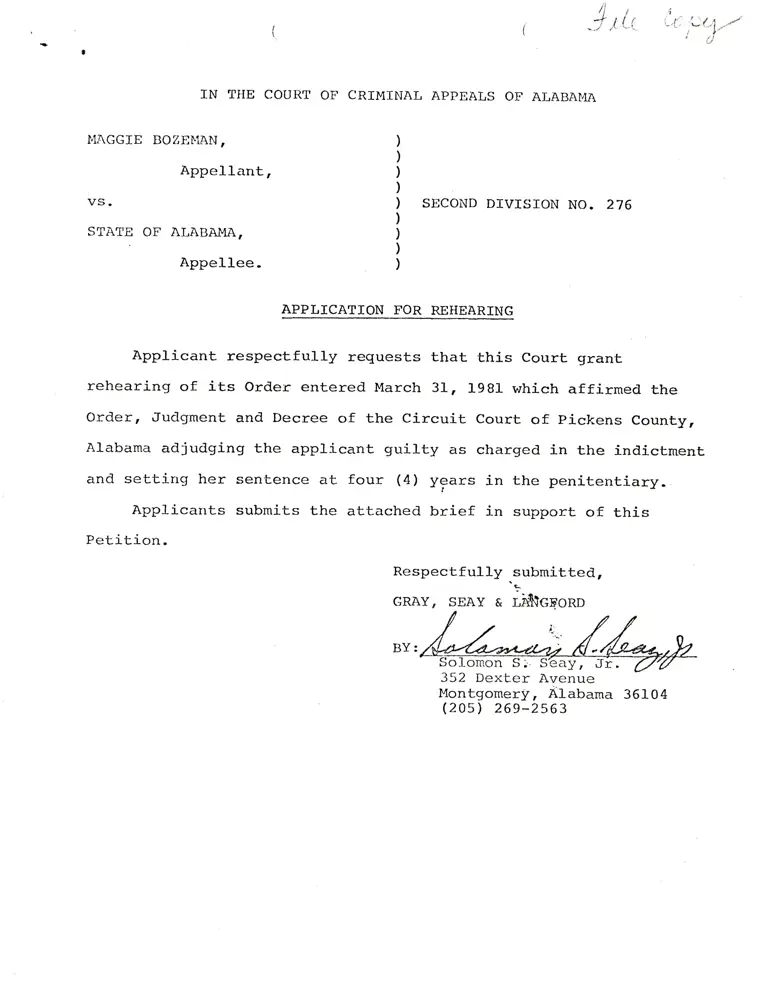
APPLTCATI,ON POR FEHEARING

Appricant respectfully requests that this court grant

rehearing of its Order entered March 3I, 1981 which affirmed the
Order, Judgment and Decree of the Circuit Court of pickens County,

Alabama adjudging the applicant guilty as charged in the indictment

and setting her sentence at four 14) ylars in the penitentiary.
Applicants submits the aLtached brief in support of this

PetiLion.

Respectf u1 Iy .submitted,
t.

GRAY, SEAY & L,$TGFORD

'v'<Yt7\4rvZ/, fV d. CL.'

omon S ; S'eay, Jr -

352 Dexter Avenue
MontgomerY, Alabama 36104
(2os) 269*2563


CERTTFICATE OF' SERVICE

I hereby certify that I have served a copy of the foregoing

Application for Rehearing upon the llonorable Charles Graddick,

Attorney General for the State of Alabama, 250 Ad.ministrative

Building, Montgornery, Alabama 35103 and the Honorable P. M.

Johnston, District Attorney for the 24th Judicial Circuit,

LzO 3rd Avenue, N.8., Aliceville, Alabama 35442, by placing a copy

of same in the United States lilail, postage prepaid,, on this 13th

day of April, 1981.

:1..
?.

-2-


IN THE COURT OF CRIMTNAL APPEALS OT' ALABAMA

I4AGGIE BOZEMAN,

Appellant,

vs.

STATE OF ALABAT4A,

)
)
)
)
) SECoND DIVISIoN No. 276
)
)
)
)Appe1lee.

BRIEF IN SUPPORT OF APPLICATTON FOR REHEARING

Appellant, Maggie Bozeman, respectfully requests this court
I

to grant her Application for Rehearing. while apperrant has

carefully reviewed the opinion of this Court, appellant respect-
fulIy disagrees with the Courtts finding that the record. failed

'qto reveal error prejudicial to appellant. To thg. qontrary,
appellant contends that prejudicial error does exiqt in the record,
rrrhich if sustained, witl deny appellant her cons.titutionally
protected rights. This case is the companion case,to the Julia R.

I,Iilder v. Sta_!g:_, 2nd Div. 262 Iu.S. (Ilarch 31, 19BI). Several of
the arguments presented in the Wilder Brief in Support of her

Application for Rehearing are identical to the argument for the

appellantrs Application for Rehearing. Therefore, reference will
be made to the Wilder brief where the argument to be set forth in
thr: ;r.ppe11arrt.rs brief is an iclentical argument.


THE STATUTE

I.

IS VAGUE, INDEFINITE AND
UNCERTAIN; AI.]D THEREFORE UNCONSTTTUTlONAL

This Court found that Section L7-23-1 of
1975, is constitutional. For the reasons set

Brief in Support of Application for Rehearing

appellant incorporates said section as if it
herein

Code of Alabarta,

forth in Wilder

under Section I.,

is ful1y set forth

II.

THE INDICTru mal

The Court found that the indictment

constitutionally valid. For the reasons

Brief in Support of her Application for

II., appellant incorporates siad section

forth herein.

in this case was

set forth in the Wildef

Rehearing under Section

as if it were fully set

tt" I
I

IIT.

THE EVIDENCE IN THIS CASB ]S ]NSUFFICIENT TO SUPPORT
E CONVICTION Or THE APPEL T OF THE OFFENSE CHARGED

This Court found that the evidence, although circumstantial
to a large degree, ancl confusing in several instances, was suffi-

cient to support the juryls verdict. For the reasons set forth

in the l,iilder Brief in Support of her Application for Rehearing

under Section fII., appellant incorporates siad section as if it

r,/ere fully set forth herein.

-2-


This Court adnrits that the eviclence in this case is mostly
circumstantial and confusing. A reasonable doubt as to appellantrs
guilt is raised by this circumstantial and confusing eviclence.
lvhere such a reasonable doubt exists, a verdict must be returned
for the defendant. rn reviewing the sufficiency of circumstantial
evidence, the test to be applied is whether the jury might reasonably
find the evidence excluded every reasonable hypothesis except that
of guilt. Dolvin v. stale, 391 so.2d 133, 137 (Ara., 1gB0); cuimbo

v. glate, 368 so.2d gTlt 974 (Ala. crim. App. , !g7g), cert.denied,
368 So.2d. 877. Considering that the evidence in this case $/as

indeed circumstantial and confusing, it is impracticar if not
impossible for a jury to find based on this circumstantial and

confusing evidence that the evidence excluded every reasonable
hypothesis except that of guilt. I

Confused (confusing) is d.efined. in trvebsterrs Third New Inter-
national Dictionary at page 477 as follor,rs: ,,To make uncrear
in mind or purpose." where the evid.ence is in*fact confusing

:1..
{_as is present in this case, the test set forth in dolv_in v. St.ate,
lf.

supra., and Cumbo, v._..State, s_gprar has not been rnet.'.'

The evidence of record is incleed insufficient. to support a

verdict of guilty. The verdict was therefore \./rong, unjust, and

patently against the weight of the evidence and the Court should

not affirm such a verdict.
It is respectfully submitted that the failure of this Court

to find that the evidence was insufficient to support the convic-
tion of the appellant of the offense charge<I was error and because

-3-


of the lack of such finding, the courtrs order was mistakenly

taken. Therefore, this Court should grant appellantts Application
for Rehearing, set aside the judgment affirrni-ng the conviction of
appellant, and enter a judgment in favor of appel-Iant consistent
with the reasons outlined. above.

rv.
TIIB PROSECUTORIS USE OF HIS PEREIVIPToRY CHALLENGES To

STRIKE E\IERY QUALTFIED MEMBER OF THE APPELLANTIS
RACE FROM THE JURY PANEL CONSTITUTED DENIAL OF

DUE PROCESS AIID EQUAL PROTECTION, ABSEIiIT
EXPLANATION ON NON-RACTAL GROUNDS

Appellant is fully cognizant that the Supreme Court of the
United States in Swain v.. A1abams., 380 U.S. 202, 85 S.Ct. 924,

13 L.Ed.2d 759, held that the fact that the prosecutor used,

his preemptory challenges to strike "rrJry quarified member of
the defendant!s race from the jury panel does not constitute a

denial of due process and equar protection, where there is no
'q

sufficient showing of a historical pattern of eixslgsion. we

would submit, however, that the rationale underlyin_g Swain,

supra, has perhaps become dated and is inapprop::.iate1y applied

to circurnstances which evidence a new sophisticated and ingenious

approach to discrirnination.

Srvain poses an insurmountabl-e burden in those cases where the

while onprosecutor selectively discriminates by reason of race,

other occasions doning the garb of irnpartiality.

A very well reasoned concurring opinion in the case

of Lor.risiana rr. Raymond Bames, 365 So.2d 1361, addresses

of State

itself

-4-


/
\

to this issue. There the court said:

. A presumption should exist during the selection
of the jury that individual peremptory challenges by
the prosecution are being properly used. Once it
becomes evident, however, that the prosecution has
used a disproportionate number of challenges against
members of one race or has eliminated a dispropro-
tionate number of members of a certain race considering
the proportionate number of that race included within
the venire after excuses, exceptions and removals for
cause, in my opinion, a prima facie case of d,iscrimina-
tion because of race has been established, and the
burden of proof should shift to the prosecutor to
show that his challenges were not exercised on the
basis of race. The state may sustain its burden by
offering evidence that its reasons for individual
challenges were not because of race. Although the
reasons need not be sufficient to ground a charlenge
for cause, they should appear to have been applied
consistently to simitarily situated jurors of other
groups and they should be reasonably relevant to theparticular trial or to non-racial characteristics-
In the case at bar, the prosecution used substantially all

of his strikes to eliminate all of the rblacks from the venire.
Absent explanation, a presumption of racial discrimination arises
and the conviction in this case ought to be set aside.

It is respectfully submitted that the failoure of the Court
trst.

+to find that the prosecutor committed reversible error in using
1.,

his peremptory challenges to strike every qualifiedl'member of

appellant's race from the jury was error. Thereior", this
1-

Court should grant appellantrs Application for Rehearing, set

aside the judgrnent confirming the conviction of appellant, and

enter a judgment in favor of appellant consistent with the

reasons outlined above.

-5-


SUI\4IqARY

It is respectfully submitted that this Brief in Support of
Appellantrs Application for Rehearing has demonstrated errors
of law committed by this court, in that this court found that
the statute uncler vrhich appellant is charged is constitutional;
that the indictment in this case is constitutional; that there

is sufficient evidence of record, to support the conviction of
the appellanL; and that appellantrs constitutional rights were

not violated. when the state used its peremptory strikes to
exclude all blacks from the jury panel. Therefore, after careful
review of the arguments presented, this Court should grant

appellantr s Application for Rehearing.

RespectfulJ-y submitted,
I

GRAY, SEAY & LANGFORD

i

CERTIFTCATE OF SERVICE

I hereby certify that I have served a copy of''the foregoing

Brief in Support of Application for Rehearing upon the llonorable

Charles A. Graddick, 250 Administrative Building, Montgromery, Alabama

36103, and the Honorable P. M. Johnston, District Attorney for the

24th Judicial Circuit, 120 3rd Avenue Northeast, Alicevil1e, Alabama

35442, by placing a copy of same in the United States Mai-l-, postage

prepaidr or this 13th day of Apri1, 1981.

oJ.omon S. Seay, Jr.
352 Dexter Avenue
I{ontgomeri}. }labama 35}04
(205) 269:2563