The Legislature of Louisiana v. Earl Benjamin Bush Motion to Affirm
Public Court Documents
December 21, 1960
-
Brief Collection, LDF Court Filings. The Legislature of Louisiana v. Earl Benjamin Bush Motion to Affirm, 1960. 634a4bc2-bb9a-ee11-be36-6045bdeb8873. LDF Archives, Thurgood Marshall Institute. https://ldfrecollection.org/archives/archives-search/archives-item/8955e0e5-d701-4ce4-9883-a8e1a55ce4bb/the-legislature-of-louisiana-v-earl-benjamin-bush-motion-to-affirm. Accessed October 03, 2026.
Copied!
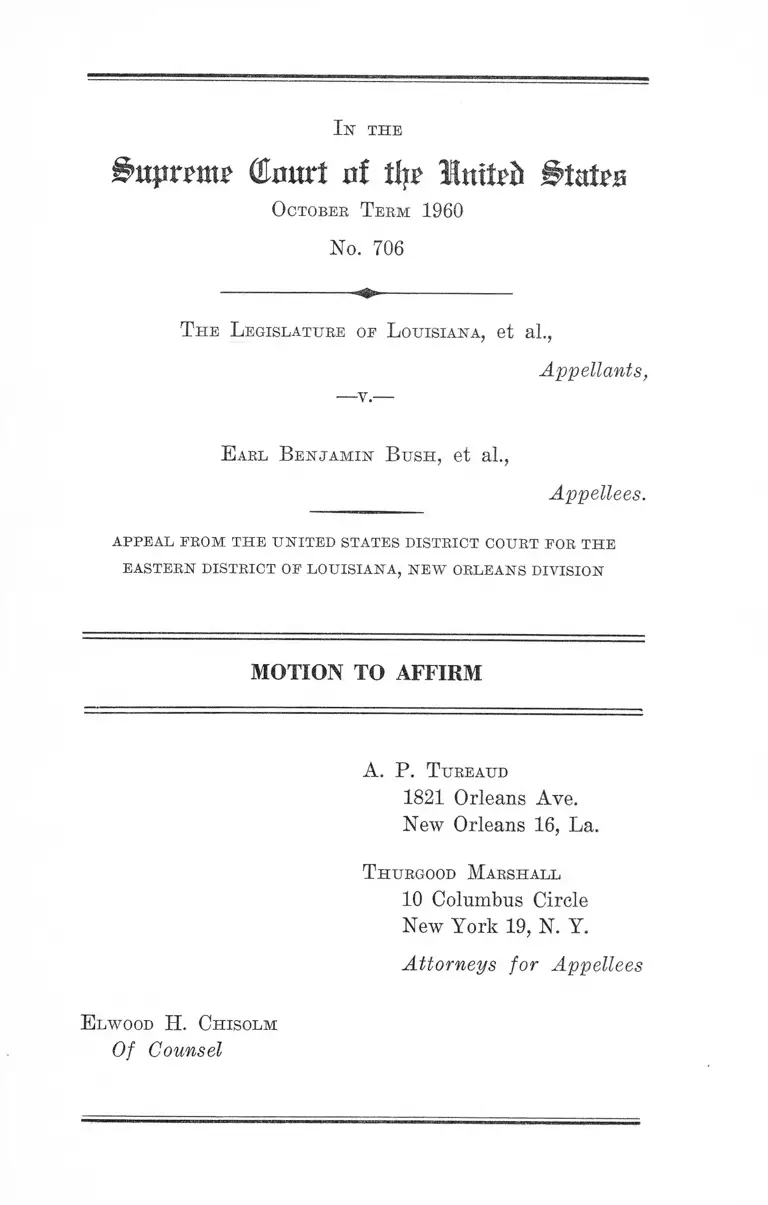
I n THE
ii’tfprm? OInurt nf tlf? UnttTft States
O ctober T eem 1960
No. 706
T h e L egislature oe L ouisiana, et al.,
Appellants,
E arl B e n ja m in B u sh , et al.,
Appellees.
a p p e a l p r o m t h e u n i t e d s t a t e s d i s t r i c t c o u r t f o r t h e
EASTERN DISTRICT OF L O U ISIA N A , N E W ORLEANS DIVISION
MOTION TO AFFIRM
A. P. T ureaud
1821 Orleans Ave.
New Orleans 16, La.
T hurgood M arshall
10 Columbus Circle
New York 19, N. Y.
Attorneys for Appellees
E lwood H . Chisolm
Of Counsel
I n t h e
Qlatirt of tlj£ Unttefc
O ctobee T eem 1960
No. 706
T he L egislature oe L ouisiana, et al.,
Appellants,
E ael B e n ja m in B u sh , et al.,
Appellees.
APPEAL FROM T H E U N IT E D STATES D ISTRICT COURT FOR TH E
EASTERN DISTRICT OF L O U ISIA N A , N E W ORLEANS DIVISION
MOTION TO AFFIRM
Appellees move to affirm the judgments below on the
ground that the questions presented are so unsubstantial
as not to need further argument.
Opinions Below
Neither the opinion filed November 30, 1960, nor the
one issued December 21, 1960, is reported. The former,
however, was printed by appellants (Appx. A, pp. 26-50)
and the latter is appended by appellees {infra, p. la et
seq.).
2
Questions Presented
For the purposes of this motion, appellees adopt the
“ Questions” as presented by appellants at pages 3-5 of
the Jurisdictional Statement.
Statement of the Case
Though it contains a description of the several proceed
ings and the rulings in the court below, the statement
of the case given by appellants at pages 5-12 of the Juris
dictional Statement omits many facts material to consid
eration of the questions presented and includes, partic
ularly in the last three paragraphs, much that is more argu
ment than exposition. Nevertheless, appellees will not
burden the Court with a counter-statement inasmuch as
the omissions are covered in the opinions below and the
statements on file here in Orleans Parish School Board
v. Bush, 5 L. ed. 2d 36; United States v. Louisiana, 5 L. ed.
2d 245; Orleans Parish School Board v. Bush, No. 589,
October Term 1960; Id., No. 612, October Term 1960.
Reasons for Granting the Motion
This latest appeal in the New Orleans school desegre
gation litigation brings into focus two attempts of the
Louisiana Legislature to “war against the Constitution.”
As such, the questions urged have been so plainly fore
closed by decisions of this Court and the court below so
manifestly decided them correctly that further argument
is unnecessary. See United States v. Louisiana, 5 L. ed. 2d
245; Orleans Parish School Board v. Bush, 5 L. ed. 2d 36;
Fauhus v. Aaron, 361 U.S. 197, affirming 173 F. Supp. 944
(E.D. Ark. 1959); Cooper v. Aaron, 358 U.S. 1, 16-19. See
3
also James v. Almond, 170 F. Supp. 331 (E.D. Va. 1959),
appeal dismissed 359 U.S. 1006; James v. Duckworth, 170
F. Supp. 342 (E.D. Va, 1959), affirmed 267 F. 2d 224 (4th
Cir. 1959), cert, denied 358 U.S. 829; Orleans Parish School
Board v. Bush, 242 F. 2d 156 (5th Cir. 1957), cert, denied
354 U.S. 921. Cf. Riggs v. Johnson, 6 Wall. 166, 195 ; United
States v. Peters, 5 Cranch. 115, 136.
Despite the vigor of those decisions, appellants earnestly
argue that three of the eight “ questions presented” are
so substantial as to require plenary consideration. They,
in turn, have been converted into the following claims : one,
“ that the district court was without jurisdiction or power
to enjoin the Legislature of Louisiana or to interfere with
the state’s control over its local affairs and the exercise of
its [police] power;” two, “ that the United States has no
right to appear as amicus curiae for the purpose of insti
tuting action for further relief;” and three, that “ the
suits of the Louisiana plaintiffs against the state, without
its consent, should be dismissed as in violation of the 11th
Amendment” (Juris. Statement, p. 20).
None of these claims, appellants submit, has such sub
stantiality that this case ought to be held for further
argument.
1. Whatever its merit in the abstract, the lack of merit
in the first claim is demonstrated at the outset by the legis
lation which these appellants were enjoined from enforcing.
By Act No. 17 of the First Extraordinary Session (Appel
lants’ Appx. D, p. 22) and its reenactment in Act No. 2
of the Second Extraordinary Session {Id., p. 55) plus the
laws and resolutions by which they implemented those
Acts (see, e.g., Id., pp. 39, 42, 45, 48, 52, 54), the Legisla
ture and its individual members reserved to itself and
undertook to exercise “ all administrative authority” for
4
the maintenance and operation of the New Orleans public
school system.
Therefore, as the District Court said (Appellants’ Appx.
A, pp. 31-32),
there is no merit in the claim of “ legislative immunity”
put forward on behalf of the committee of the Legis
lature and its members who are sought to be enjoined
from enforcing measures which grant them control of
the New Orleans public schools. The argument is
specious. There is no effort to restrain the Louisiana
Legislature as a whole, or any individual legislator,
in the performance of a legislative function. It is only
insofar as the lawmakers purport to act as admin
istrators of the local schools that they, as well as
others concerned, are sought to be restrained from
implementing measures which are alleged to violate
the Constitution. Having found a statute unconstitu
tional, it is elementary that a court has power to en
join all those charged with its execution. Normally,
these are officers of the executive branch, but when the
legislature itself seeks to act as executor of its own
laws, then, quite obviously, it is no longer legislating
and is no more immune from process than the admin
istrative officials it supersedes. As Chief Justice Mar
shall said in Marburg v. Madison, 5 U.S. (1 Cranch)
137, 170; “ It is not by the office of the person to whom
the writ is directed, but the nature of the thing to be
done, that the propriety or impropriety of issuing (an
injunction) is to be determined.”
See also the December 21, 1960 opinion of the court below
(Appellees’ Appx., at pp. la -lla ). Cf. Cooper v. Aaron,
358 U.S. 1, 1619; Ex parte Virginia, 100 U.S. 339, 346-347;
Virginia v. Rives, 100 U.S. 313, 318; Riggs v. Johnson,
5
6 Wall. 166, 195; United States v. Peters, 5 Cranch 115,
136.1
2. Appellants’ second claim, in effect, challenges the
jurisdiction of the District Court to entertain—and issue
an injunction upon—the amicus petition filed by the United
States in connection with the proceedings which culminated
in the opinion and judgment of December 21, 1960. Ap
pellees say that this contention also lacks merit.
The inherent authority of the District Court to call upon
the law officers of the United States for assistance to pro
tect the integrity of the judicial process and maintain
the due administration of justice is so settled as to require
no further argument. See, Universal Oil Co. v. Root Re
fining Co., 328 U.S. 575, 580, 581; Hazel-Atlas Glass Co.
v. Hartford Empire Co., 322 U.S. 238, 246; Faubus v.
United States, 254 F. 2d 797 (8th Cir. 1958), cert, denied
358 U.S. 829; Kasper v. Brittain, 245 F. 2d 97 (6th Cir.
1957). And see The Exchange, 7 Cranch 116, 118-119;
Northern Securities Co. v. United States, 191 U.S. 555, 556;
Howard v. Illinois Central R. Co., 207 U.S. 463, 490; A. B.
Dick Co. v. Marr, 197 F. 2d 498, 502, cert, denied 344 U.S.
905.
In addition, the District Court had authority to entertain
the amicus petition of the United States for an injunction
against appellants as an exercise of its ancillary jurisdic
tion to effectuate its orders and prevent them from being
frustrated. 28 U.S.C.A. §1651. See Local Loan Co. v.
Hunt, 292 U.S. 234, 239; Julian v. Central Trust Co., 193
U.S. 93, 112; Root v. Woolworth, 150 U.S. 401, 410-413;
Steelman v. All Continent Corp., 301 U.S. 278, 288-289;
1 For further enlightenment on the role of the Pennsylvania
legislature in this historic controversy, see Mr. Justice Douglas,
“ United States v. Peters, 5 Cranch 115,” 19 F.R.D. 185 passim.
6
Dugas v. American Surety Co., 300 U.S. 414, 428; Looney
v. Eastern Texas Railroad Co., 247 U.S. 214, 221.
Furthermore, the authority given the Attorney General
of the United States and United States Attorneys by
statutes such as 5 U.S.C.A. §§ 306, 309, 316, is obviously
not limited to cases in which the Government is a formal
party. See Booth v. Fletcher, 101 F. 2d 676, 681-682 (D.C.
Cir. 1938). See also Florida v. Georgia, 17 How. 478, 492-
495. For these statutes grant the Government’s law officers
broad power to initiate proceedings to safeguard national
interests. See United States v. California, 332 U.S. 19, 27;
Sanitary District of Chicago- v. United States, 266 U.S. 405,
425-426; Kern River Co. v. United States, 257 U.S. 147, 154-
155; United States v. San Jacinto Tin Co., 125 U.S. 273,
278-280, 284-285; United States v. Throckmorton, 98 U.S.
61, 70; Vitamin Technologists, Inc. v. Wisconsin Alumni
Research Foundation, 146 F. 2d 941, 946 (9th Cir. 1945).
Finally, the authority of the United States to intervene
as amicus curiae in this action is not limited by the fact
that it does not involve a property interest of the Govern
ment. See In re Dels, 158 U.S. 564, 584; United States v.
American Bell Telephone Co., 128 U.S. 315, 357-358, 367-
368; United States v. United States Fidelity d Guaranty
Co., 106 F. 2d 804, 807 (10th Cir. 1939), reversed on other
grounds 309 U.S. 506.
Accordingly, the right of the United States to appear as
amicus curiae in the proceedings below and the jurisdic
tion of the District Court to grant an injunction on its
petition are beyond dispute.2
2 Even if the cases looked the other way, appellants were not
prejudiced inasmuch as they concede that appellees “also filed a
petition for preliminary injunction against all defendants from
enforcing the provisions of the same Acts of the Legislature”
(Juris. Statement, p. 9). Such admission would also appear to
make a determination of this claim unnecessary.
7
3. The third claim pressed by appellants attempts to
resuscitate the Eleventh Amendment argument previously
held to be without merit in Orleans Parish School Board v.
Bush, 242 F. 2d 156, 160-161 (5th Cir. 1957), cert, denied
354 U.S. 921 and School Board of City of Charlottesville
v. Allen, 240 F. 2d 59, 62-63 (4th Cir. 1956).
Moreover, although appellants seem to be unaware of it,
the difference between using the injunctive power of fed
eral courts to direct the exercise of discretion by state
officers the situation where the Eleventh Amendment is
applicable—and using it to enjoin violation of constitu
tional rights under authority of state office—where, as
here, that Amendment does not apply—was definitively
settled in Ex parte Young, 209 U.S. 123. Therefore, the
District Court’s refusal to dismiss the complaints and peti
tions filed in the several proceedings brought up on this
appeal follows an unbroken course of decisions in this
Court for over fifty years. See, e.g., Lane v. Watts, 234
U.S. 525,̂ 540; Truax v. Raich, 239 U.S. 33; Sterling v.
Constantin, 287 U.S. 378, 393, and cases cited therein;
Georgia R. & Big. Co. v. Redwine, 342 U.S. 299, 303-306
and cases cited therein.
CONCLUSION
For the foregoing reasons the questions presented by
appellants are manifestly unsubstantial and this motion
to affirm should be granted.
Respectfully submitted,
A. P. T ureaitd
T hurgood M arshall
Attorneys for Appellees
E lwood H . Chisolm
Of Counsel
la
APPENDIX
UNITED STATES DISTRICT COURT
E astern D istrict or L ouisiana
N ew O rleans D ivision
No. 3630— Civil Action
E arl B e n ja m in B u sh , et al.,
Plaintiffs,
versus
Orleans P arish S chool B oard, et al.,
Defendants.
A. P. Tureaud
Attorney for Plaintiffs
M. Hepburn Many, United States Attorney
Attorney for United States of America, Amicus
Curiae
Samuel I. Rosenberg
Attorney for Orleans Parish School Board, Board
Members Lloyd Rittiner, Louis G. Riecke, Matthew
R. Sutherland and Theodore H. Shepherd, Jr., and
Dr. James P. Redmond, Superintendent of Orleans
Parish Schools
Jack P. F. Gremillion, Louisiana Attorney General
Michael E. Culligan, Assistant Attorney General
John E. Jackson, Jr., Assistant Attorney General
Weldon Cousins, Assistant Attorney General
Henry Roberts, Assistant Attorney General
Attorneys for Jack P. F. Gremillion as Louisiana
Attorney General, A. P. Tugwell as State Treas-
2a
urer, Shelby M. Jackson as State Superintendent
of Education, Members of the State Board of
Education, and Boy M. Theriot as State Comp
troller
Monroe & Lemann
J. Baburn Monroe
Attorneys for the Whitney National Bank of New
Orleans
Phelps, Dunbar, Marks, Claverie & Sims
Louis B. Claverie
Attorneys for the Hibernia National Bank in New
Orleans
Sehrt & Boyle
Clem H. Sehrt
Attorneys for the National ■ American Bank of
New Orleans
Jones, Walker, Waechter, Poitevent, Carr ere & Denegre
George Denegre
Attorneys for the National Bank of Commerce in
New Orleans
Alvin J. Liska, New Orleans City Attorney
Joseph Hurndon, Assistant City Attorney
Ernest L. Salatich, Assistant City Attorney
Attorneys for the City of New Orleans
W. Scott Wilkinson
Gibson Tucker, Jr.
Attorneys for Edward LeBreton and Seven Others
Constituting the Committee of Eight of the Legis
lature of Louisiana
B ives, Circuit Judge, and Christenberey and W righ t , Dis
trict Judges;
3a
In these proceedings, we consider again1 * * * * * the progress of
desegregation in the public schools of the Parish of Orleans
and the additional efforts made to interfere with that
achievement. Because of what has been said and done by
the government of Louisiana in all its branches, it becomes
necessary to restate the fundamental principles that gov
1 The Orleans Parish school desegregation controversy has been
in the federal courts for eight years.
In 1954, the state adopted a constitutional amendment and two
segregation statutes. The amendment and Act 555 purported to re
establish the existing state law requiring segregated schools. Act
556 provided for assignment of pupils by the school superintendent.
On February 15, 1956, this court held that both the amendment
and the two statutes were invalid. The court issued a decree en
joining the School Board, “ its agents, its servants, its employees,
their successors in office, and those in concert with them who shall
receive notice of this order” from requiring and permitting segre
gation in the New Orleans schools. Bush v. Orleans Parish School
Board, 138 F. Supp. 336, 337, aff’d, 242 F. 2d 156, cert, denied,
354 U.S. 921.
Not only was there no compliance with that order, but immedi
ately thereafter the Legislature produced a new package of laws,
in particular Act 319 (1956) which purported to “freeze” the
existing racial status of public schools in Orleans Parish and to
reserve to the Legislature the power of racial reclassification of
schools. On July 1, 1956, this court refused to accept the School
Board’s contention that Act 319 had relieved the Board of its
responsibility to obey the desegregation order. In the words of
the court, “any legal artifice, however cleverly contrived, which
would circumvent this ruling [of the Supreme Court, in Brown v.
Board of Education, 347 U.S. 483] and others predicated on it, is
unconstitutional on its face. Such an artifice is the statute in suit,”
Bush v. Orleans Parish School Board, 163 F. Supp. 701, aff’d, 268
F. 2d 78. See also, Lane v. Wilson, 307 U.S. 268.
Nevertheless, the Legislature continued to contrive circumventive
artifices.
In 1958 a third group of segregation laws was enacted, including
Act 256, which empowered the Governor to close any school under
court order to desegregate, as well as any other school in the system.
In the first court test of this law7 it was struck down as unconsti
tutional by this court on August 27, 1960. Bush v. Orleans Parish
School Board, 187 F. Supp. 42.
On July 15, 1959, the court ordered the New Orleans School
Board to present a plan for desegregation, Bush v. Orleans Parish
School Board, No. 3630, but there was no compliance. Therefore,
4a
ern this controversy. Under the circumstances, they can
not be declared too often or too emphatically. These prin
ciples are:
1. That equality of opportunity to education through
access to non-segregated public schools is a right secured
by the Constitution of the United States to all citizens
regardless of race or color against state interference.
Brown v. Board of Education, 347, U.S. 483.
2. That, accordingly, every citizen of the United States,
by virtue of his citizenship, is bound to respect this con-
on May 16, 1960, the court itself formulated a plan and ordered
desegregation to begin with the first grade level in the fall of 1960.
For the fourth time, in its 1960 session, the Legislature produced
a packet of segregation measures, this time to prevent compliance
with the order of May 16, 1960. Four of these 1960 measures—
Acts 333, 495, 496 and 542—and the three earlier acts referred to
above—Act 555 of 1954, Act 319 of 1956 and Act 256 of 1958—
were declared unconstitutional by a three judge court on August
27, 1960, in the combined cases of Bush v. Orleans Parish School
Board and Williams v. Davis, and their enforcement by “ the Honor
able Jimmie H. Davis, Governor of the State of Louisiana, and all
those persons acting in concert with him, or at his direction, in
cluding the defendant, James F. Redmond,” was enjoined. Bush
v. Orleans Parish School Board, 187 F. Supp. 42, 45. At the same
time, the effective date of the desegregation order was postponed
to November 14, 1960.
Again, at the First Extraordinary Session of 1960, the Louisiana
Legislature adopted a series of measures designed to thwart the
orders of this court. Even after integration was an accomplished
fact, the Legislature sought to defeat it. On November 30, 1960,
this court held Acts numbered 2, 10 through 14, and 16 through 23,
as well as House Concurrent Resolutions Nos, 10, 17, 18, 19 and 23,
unconstitutional. Bush v. Orleans Parish School Board, —— F.
Supp.------ (Nov. 30, 1960).
Undeterred, in its Second Extraordinary Session for 1960, the
Louisiana Legislature passed the measures here under considera
tion.
At this writing the Legislature has entered into an unprecedented
third special session, from which another “segregation package” is
presumably to be expected.
5a
stitutional right, and that all officers of the state, more
especially those who have taken an oath to uphold the
Constitution of the United States, including the governor,
the members of the state legislature, judges of the state
courts, and members of the local school boards, are under
constitutional mandate to take affirmative action to accord
the benefit of this right to all those within their jurisdiction.
U. S. Const., Art. VI, cl. 2, 3; Cooper v. Aaron, 358, U. S. 1.
3. That when, notwithstanding their oath so to do, the
officers of the state fail to obey the Constitution’s com
mand, it is the duty of the courts of the United States to
secure the enjoyment of this right to all who were deprived
of it by action of the state. Brown v. Board of Education,
349, U.S. 294, 299-301.
4. That the enjoyment of this constitutional right can
not be denied or abridged by the state, and that every law
or resolution of the legislature, every act of the executive,
and every decree of the state courts, which, no matter how
innocent on its face, seeks to subvert the enjoyment of this
right, whether directly through interposition schemes, or
indirectly through measures designed to circumvent the
orders of the courts of the United States issued in protec
tion of the right, are unconstitutional and null. Cooper v.
Aaron, supra; United States v.. Louisiana,------ U.S. ------
(Dec. 12, 1960), denying stay in United States v. Louisiana,
------ F.Supp.------- (Nov. 30,1960).
All this has been clear since 1954 when the Supreme
Court announced its decision in Brown v. Board of Educa
tion, 347 U.S. 483. Yet, Louisiana’s record since that time
has been one of stubborn resistance.2 With singular per
sistence, at every session since 1954, its Legislature has
continued to enact, and re-enact, measures directly in
2 See Note 1.
6a
tended to deny colored citizens the enjoyment of their
constitutional right, the most recent and the most flagrant
being the interposition declaration of the First Extraor
dinary Session of 1960 which purports to nullify the right
itself. In each instance, this court has patiently examined
the legislation and explained the reason why it could not
stand. The segregation packages enacted at the Regular
Sessions of 1954, 1956, 1958 and 1960, and at the First
Extraordinary Session of 1960, have all been considered
in detail.3 The basis of these rulings is obvious enough.
But, when this court, with what no one dare term undue
haste, finally set a date for the practical enjoyment of the
constitutional right already so long delayed, and invited
the School Board of Orleans Parish, where implementa
tion was to begin, to submit a plan of desegregation, a
new line of attack was initiated. Orleans Parish and its
School Board now became the prime target.
The Louisiana Legislature initially enacted measures to
deprive the Board of the power to comply with the orders
of the court. In consequence, the Orleans School Board
offered no suggestions and this court was compelled to
devise its own plan of desegregation, admittedly a modest
one involving initially only the first grade. On the plea
of the Board, the effective date for the partial desegrega
tion of the public schools of New Orleans was delayed two
months to November 14, 1960. At length, the Orleans
Parish School Board realized its clear duty and announced
its proposal to admit five Negro girls of first-grade age to
two formerly all-white schools. But for obeying the con
stitutional mandate and the orders of this court, the Board
brought on itself the official wrath of Louisiana. Despite
reiterated injunctions expressly prohibiting them from
“ interfering in any way with the administration of the
public schools for Orleans Parish by the Orleans Parish
3 See Note 1.
7a
School Board,” 4 the members of the Legislature, already
called into special, now apparently continuous, session,5
took every conceivable step to subvert the announced in
tention of the local School Board and defy the orders of
this court. Acts and resolutions were passed to abolish
the Orleans Parish School Board and transfer the admin
istration of the New Orleans schools to the Legislature,
and when the enforcement of these measures was restrained,
four members of the local Board were attempted to be
addressed out of office. As we noted in declaring these acts
and resolutions unconstitutional,6 they were of course part
of the general scheme to deny the constitutional rights
of the plaintiffs here. But, more than that, there was in this
legislation a deliberate defiance of the orders of this court
issued in protection of those rights. If for no other rea
son, the measures were void as illegal attempts to thwart
the valid orders of a federal court.
Against this background, it is nevertheless asserted that
the present acts and resolutions, Act 27 and House Con-.
4 See, e.g., Bush v. Orleans Parish School Board, 187 F. Supp.
42; id .,------ F. Supp.------- (Nov. 30, 1960).
5 At this writing, the legislators are in their third successive
special session.
6 Bush v. Orleans Parish School Board,------ F. Supp.------- (Nov.
30, 1960).
7 At the outset the defendants represented by the Attorney Gen
eral of Louisiana, citing Title 28, U. S. Code, Section 2284, moved
for a stay of these proceedings insofar as they relate to Act 2 of
the Second Extraordinary Session of 1960 on the ground that a
state court, in litigation challenging the constitutionality thereof,
has issued a temporary restraining order against its enforcement.
The action in the state court is a taxpayers’ suit seeking, not the
enforcement of, but an injunction against the enforcement of Act
2. Since 28 U. S. C. §2284 requires a stay in this court only where
the state court action in which the stay has been granted is a suit
to enforce the statute rather than to enjoin its enforcement, that
section appears inapplicable here.
If this be deemed a too technical reading of §2284, still that
section has no application here because the stay in state court
8a
current Resolutions 2, 23 and 28, are invulnerably insulated
from federal judicial review. Yet they are no different in
kind, or in purpose, from those just discussed. Again the
plain object of the measures is to frustrate the Orleans
Parish School Board in its effort to comply with this court’s
orders,8 and, again, the effect of the measures is to defy
this court’s injunction prohibiting interference with the
administration of the local schools by its own elected school
board.9 Thus, Act 2 of the Second Extraordinary Session
of 1960 expressly purports to vest primary control of the
New Orleans schools in the Legislature itself under the
very acts and resolutions already declared unconstitutional
enjoins the enforcement of only one section of the state statute in
question, the section which relates to the appointment of a school
board with only fiscal functions. It does not in any way enjoin the
meat of the statute, the section providing for the control and
operation of the Orleans Parish schools by the Louisiana Legis
lature rather than the Orleans Parish School Board. It is this
latter section which is of primary importance here. Since the state
court stay is not broad enough to protect the parties here in suit,
§2284 has no application. Dawson v. Kentucky Distilleries Co., 255
U.S. 288, 297. Moreover, and perhaps this should have been men
tioned first in order of importance, the state court stay, initially
granted at the district court level, has now been “hereby dissolved,
recalled and set aside” by the Supreme Court of Louisiana. George
L. Singelmann, et al. v. Jimmie H. Davis, et al., La. Sup. Ct., No.
45,477 (Dec. 15, 1960).
8 The Orleans Parish Board is more than an original defendant
in these proceedings. As noted, it is itself under a constitutional
duty, and court order, to implement the right in question, and,
may assert the right of its wards, the school children of Orleans
Parish. Moreover, it has a right to be free from interference in
complying with the orders of this court. Unquestionably, this right
is a federal right. It will be protected by this court to the full
extent of the law. See Brewer v. Hoxie School District No. 46,
8 Cir., 238 F. 2d 91.
9 The United States obviously has a vital interest in vindicating
the authority of the federal courts. It is therefore appropriate that
the Government, as amicus curiae, institute proceedings herein to
protect the court against illegal interference. Faubus v. United
States, 8 Cir., 254 F. 2d 797, 804-805.
9a
by this court, and, for fiscal matters, to create a new board.
House Concurrent Resolutions 2, 23 and 28 of the same
session attempt to deny the School Board control of its
own funds deposited in local banks and warn the banks
against honoring the Board’s checks. However local in
character Act 2 and Resolutions 2, 23 and 28 may appear,
since they would discriminate against Negro children
through interference with the orders of this court, they
are invalid. Gomillion v. Lightfoot, ------ U.S. ------ (Nov.
14, 1960); Cooper v. Aaron, 358 U. S. 1: Brown v. Board
of Education, 347 U.S. 483.
Before the court also is the application of the Orleans
Parish School Board for a temporary injunction requiring
certain banks in the City of New Orleans to honor its
checks drawn on its accounts in those banks. Because of
the resolutions warning the banks not to recognize the
Orleans Parish School Board as such, the banks, pending
court direction, have blocked the accounts and refused to
honor checks drawn on them by anyone. In addition, the
Board asks that the City of New Orleans, as the tax col
lector for the Board, be directed, by temporary injunction,
to remit to the Board the taxes so collected as required by
law.
In view of our holding herein that Act 2 and House Con
current Resolutions 2, 23 and 28 of the Second Extraor
dinary Session of the Louisiana Legislature of 1960 are
invalid, the Orleans Parish School Board, as the duly
constituted and elected authority to operate the public
schools of New Orleans, is the owner of the bank accounts
in question and the proper party to draw checks thereon.
By the same holding the City is required to remit to the
Board its tax monies.
Finally, the United States, amicus curiae, has moved for
a temporary restraining order against Act 5 of the Second
Extraordinary Session of 1960. This Act would make the
10a
Attorney General of Louisiana counsel for the Orleans
Parish School Board, replacing counsel named by the
Board. The Attorney General argues that certainly the
Legislature has the right to name counsel for a state hoard
which it created, certainly this is a local matter unaffected
hy any federal constitutional considerations.
Unquestionably, the appointment of counsel for the
Board is a local matter. I f the appointment is not part
of the legislative scheme of discrimination, it is insulated
from federal judicial review. Cooper v. Aaron, supra.
Let us see then what the purpose of Act 5 is, what its effect
would be. Gomillion v. Lightfoot, supra.
The Orleans Parish School Board is under the injunction
of this court to desegregate the public schools in the City
of New Orleans. After several years resistance, it is now
making a good faith effort to comply. In this effort it is
being harassed by the Louisiana Legislature which has
been sitting in successive extraordinary sessions solely
for this purpose. During these sessions, the Legislature,
in it determination to preserve racial segregation in the
Orleans Parish schools, has on four occasions sought to
wrest control of the schools from the Board and on one
occasion sought to address its majority out of office. The
Legislature has also brought financial chaos to the Board
through a series of statutes and resolutions denying the
Board control of its fisc, one resolution even warning the
banks not to honor the Board’s checks drawn on its own
accounts.
Against this harassment the Board, through its counsel,
has sought the protection and the aid of this court in carry
ing out its orders. In these present proceedings, for ex
ample, the Board, through its counsel, has sought the aid
of the court in unfreezing its bank accounts so that the
salary checks of its employees will be honored. The At
torney General, pursuant to Act 5, has sought to replace
11a
counsel for the Board, and without consulting his new
client, moved to withdraw the Board’s motion against the
banks. Thus the purpose of Act 5 becomes clear, if indeed
there was ever doubt. Its purpose is to require the Board,
in its effort to comply with the orders of this court, to use
the opposition’s lawyer to protect itself from the opposi
tion. Thus Act 5 is exposed as one of the Legislature’s less
sophisticated attempts to preserve racial discrimination in
the public schools of New Orleans.
The temporary injunction will issue as prayed for, as
will the temporary restraining order. Decree to be drawn
by the court.
/ s / R ichard T. R ives
Richard T. Rives, Judge
United States Court of Appeals
/ s / H erbert W. Christenberby
Herbert W. Christenberry, Chief Judge
United States District Court
/ s / J. S helly W right
J. Skelly Wright, Judge
United States District Court
New Orleans, Louisiana
December 21st, 1960
SUITE 1790
10 COLUMBUS
NEW YORK 19,