Correspondence from Patterson to Ebbot with Complaint and Articles
Correspondence
January 9, 1991
17 pages
-
Case Files, Matthews v. Kizer Hardbacks. Correspondence from Patterson to Ebbot with Complaint and Articles, 1991. de906f42-5d40-f011-b4cb-7c1e5267c7b6. LDF Archives, Thurgood Marshall Institute. https://ldfrecollection.org/archives/archives-search/archives-item/8ccd210b-ff3c-4747-8dfd-8ed76b038984/correspondence-from-patterson-to-ebbot-with-complaint-and-articles. Accessed October 09, 2026.
Copied!
    / / Regional Office

{%.] Suite 208
NAACP LEGAL DEFENSE 315 West Ninth Street
AND EDUCATIONAL FUND, INC. Los Angeles, CA 90015 (213) 624-2405 Fax: (213) 624-0075


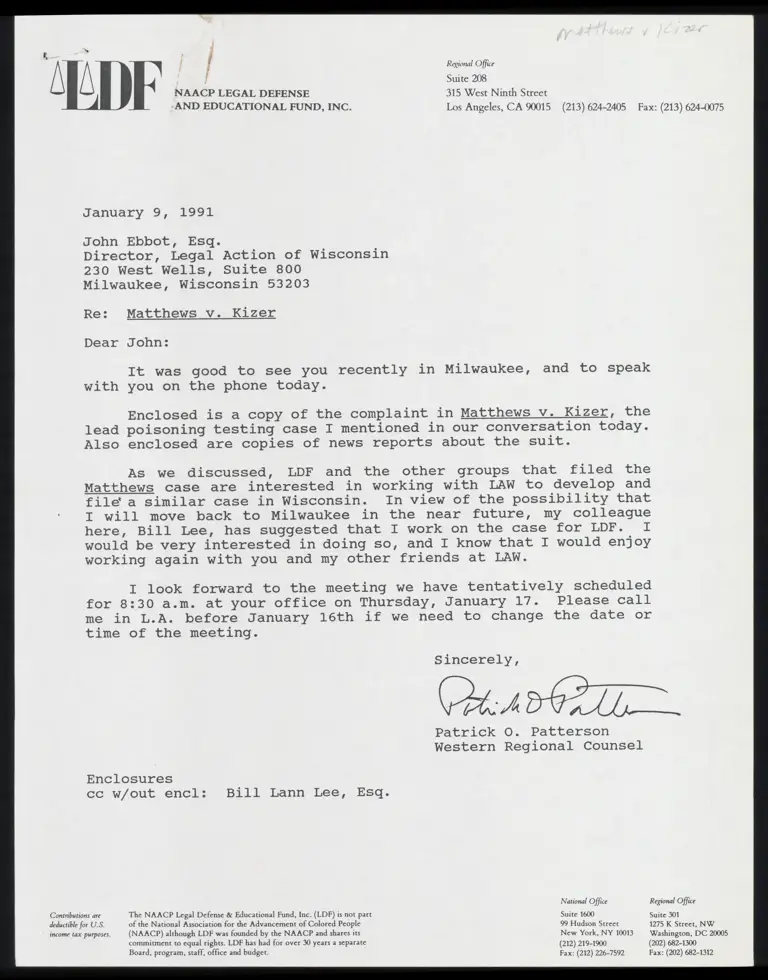
January 9, 1991

John Ebbot, Esd.
Director, Legal Action of Wisconsin
230 West Wells, Suite 800
Milwaukee, Wisconsin 53203

Re: Matthews v. Kizer


Dear John:

It was good to see you recently in Milwaukee, and to speak

with you on the phone today.

Enclosed is a copy of the complaint in Matthews v. Kizer, the

lead poisoning testing case I mentioned in our conversation today.

Also enclosed are copies of news reports about the suit.


As we discussed, LDF and the other groups that filed the

Matthews case are interested in working with LAW to develop and

file a similar case in Wisconsin. In view of the possibility that

I will move back to Milwaukee in the near future, my colleague

here, Bill Lee, has suggested that I work on the case for LDF. I

would be very interested in doing so, and I know that I would enjoy

working again with you and my other friends at LAW.


I look forward to the meeting we have tentatively scheduled

for 8:30 a.m. at your office on Thursday, January 17. Please call

me in L.A. before January 16th if we need to change the date or

time of the meeting.

Sincerely,

(Hh
Patrick O. Patterson
Western Regional Counsel

Enclosures
cc w/out encl: Bill Lann lee, Esq.

National Office Regional Office

Contributions are The NAACP Legal Defense & Educational Fund, Inc. (LDF) is not part Suite 1600 Suite 301

deductible for U.S. of the National Association for the Advancement of Colored People 99 Hudson Street 1275 K Street, NW

income tax purposes. (NAACP) although LDF was founded by the NAACP and shares its New York, NY 10013 Washington DC 20005
commitment to equal rights. LDF has had for over 30 years a separate (212) 219-1900 (202) 682-1300

Board, program, staff, office and budget. Fax: (212) 226-7592 Fax: (202) 682-1312


JOEL R. REYNOLDC

JACQUELINE WARREN

NATURAL RESOURCES DEFENSE COUNCIL

617 8S. 0live Street, Suite 1210

Los Angeles, CA 90014

(213) 892-1500

JANE PERKINS

NATIONAL HEALTH LAW PROGRAM

2639 S. La Cienega Blvd.

Los Angeles, CA 90034

(213) 204-6010

STEPHEN RONFELDT

SUSAN SPELLETICH

LEGAL AID SOCIETY OF ALAMEDA COUNTY

1440 Broadway, Suite 700

Oakland, CA 94612
(415) 451-9261

BILL LANN LEE

KEVIN S. REED

NAACP LEGAL DEFENSE AND EDUCATIONAL FUND, INC.

315 W. 9th Street, Suite 208

Los Angeles, CA 90015 EFS
(213) 624-2405 A 90 36 20
MARK D. ROSENBAUM

ACLU FOUNDATION OF SOUTHERN CALIFORNIA

633 South Shatto Place

Los Angeles, CA 90005

{213) 487-1720

Attorneys for Plaintiffs

(Additional counsel on following page)

UNITED STATES DISTRICT COURT

FOR THE NORTHERN DISTRICT OF CALIFORNIA

ERIKA MATTHEWS AND JALISA MATTHEWS,

by their guardian ad litem Lisa

Matthews, and PEOPLE UNITED FOR A

BETTER OAKLAND, On Behalf of

Themselves and All Others Similarly

Situated,

Civ. No.

CLASS ACTION


Vv. COMPLAINT

KENNETH KIZER, Director, California

Department of Health Services,

Defendant.

)
)
)
)
)
)
)

Plaintiffs, )

)
)
)
)
)
)
)
)


COMPLAINT


27

28

EDWARD M. CHEN

ACLU FOUNDATION OF NORTHERN CALIFORNIA

1663 Mission Street, Suite 460
San Francisco, CA 94103
(415) 621-2493

Attorneys for Plaintiffs


    COMPLAINT


27

28

I. INTRODUCTION


1. This action for declaratory and injunctive relief

challenges the failure of the California Department of Health

Services and its Director Kenneth Kizer ("Department") to comply

with mandatory federal Medicaid statutes and guidelines that

require the Department to detect and treat lead blood poisoning in

poor children.

2. Lead poisoning is one of the most serious and

widespread environmental diseases affecting children in the United

States. Over three million children -- one in six -- have levels

of lead in their blood high enough to cause significant impairment

to their neurologic development. Experts estimate that over 67%

of black inner-city children and almost 17% of all urban children

in the United States have been contaminated by excessive levels of

lead. According to the Department in 1989, 50,000 children :

ACR On could be found to have toxic blood lead levels if all

children at risk in California were screened.

3. These staggering levels of contamination are due to the

pervasive use of lead products in our society, in lead-based paint

and gasoline, leaded drinking-water pipes, printing inks and

pigments used in toys, fertilizers, and lead-soldered food cans.

Lead enters the body through the mouth or nose and, once there, is

a powerful toxin with long-term harmful effects. Lead's effects

may include decreased intelligence, loss of short-term memory,

underachievement in reading and spelling, impairment of visual-

motor functioning, impotence, sterility, spontaneous abortion,

anemia, convulsions, hypertension, kidney disease, and cancer.

[{/

COMPLAINT


Children and fetuses are especially vulnera. .e to these effects

because their neurologic systems are developing.

4, Because early lead toxicity is reversible, and patients

may be asymptomatic or only vaguely symptomatic, monitoring of

lead blood levels is critical. Measuring blood-lead content is

generally considered by experts to be the most accurate and

reliable measure of the level of exposure to lead. Once detected,

lead poisoning and related health defects can often be treated

and, in many cases, measures can be undertaken to detect and

eliminate the source of exposure.

5. The federal Medicaid Act ("Act") imposes a mandatory

duty upon the Department to ensure that blood lead levels are

measured in poor children and to provide necessary treatment.

Specifically, the Act requires the Department to include in its

Medicaid program early and periodic screening, diagnosis and

SF resthent ("EPSDT") for eligible children under age 21, see 42

U.S.C. §§ 1396a(a) (43), d(a) (4) (B), and 1396d(r), including lead

blood level assessments. 42 U.S.C. § 1396d(r). The Department is

also required to provide treatment for the effects of lead

poisoning discovered during the screen. 42 U.S.C. § 1396d(r).

6. The Department's Medicaid program, known as "Medi-

Cal," provides EPSDT screens through the Child Health and

Disability Prevention Program ("CHDP/EPSDT Program"). Cal. Welf.

& Inst. Code § 14132(v). That program, however, fails to provide

for or require lead blood assessments and treatment, in violation

of 42 U.S.C. $8 1396a(a){(43), 1396d4d(a) (4)(B), and 13964(r).

Accordingly, the Department has violated and continues to violate

its mandatory statutory duty to implement and administer the

COMPLAINT


27

28

CHDP/EPSDT Prog..m consistent with the prot sions of the Medicaid

Act cited above.

II. JURISDICTION AND VENUE


7. This is a civil action authorized by 42 U.S.C. § 1983

to redress the deprivation under color of state law of rights,


privileges, and immunities guaranteed by the Constitution of the

United States or by acts of Congress. This Court has jurisdiction

pursuant to 28 U.S.C. §§ 1331 and 1343(3) and (4).

8. This Court also has jurisdiction over plaintiffs’

action for declaratory relief pursuant to 28 U.S.C. § 2201 and

Fed. R. Civ. P. 57. Injunctive relief is authorized by 28 U.S.C.

§ 2202, 42 U.S.C. § 1983, and Fed. R. Civ. P. 65.

9. The defendant named herein resides in, maintains

offices in, or is responsible for enforcing the laws relevant to

this litigation in the Northern District of California.

5

III. PLAINTIFFS
5


10. Plaintiff Erika Matthews, who is two years old, and her

sister and plaintiff Jalisa Matthews, who 1s one year old, are

African-American California residents eligible for Medi-Cal

services. Plaintiffs Erika and Jalisa Matthews are entitled and

have attempted to obtain lead-blood assessments and, if necessary,

treatment through the CHDP/EPSDT Program but have been denied

either an assessment or treatment because of the Department's

failure to implement the Medicaid Act as described herein. They

appear in this action through their mother and guardian ad litem

Lisa Matthews.

11. Plaintiff People United for a Better Oakland ("PUEBLO")

is an unincorporated association comprised of low-income, minority
COMPLAINT


27

28


individuals who re concerned about health _ .oblems in California,

particularly the hazards of high lead exposure in children.

Approximately 90 percent of PUEBLO's members and their children

are Medi-Cal recipients, many of whom are eligible for CHDP/EPSDT

screens. PUEBLO's members and their children have attempted to

obtain, but have been denied, lead-blood assessments and/or

treatment through the Department's CHDP/EPSDT Program.

IV. DEFENDANT


12. Defendant Kenneth Kizer is the Director of Lhe

california Department of Health Services ("Department"), the state

agency responsible for administration of the Medi-Cal program.

Defendant Kizer's duties include supervision and control of the

Medi-Cal program, including the CHDP/EPSDT Program, so as to

secure full compliance with the governing laws. Under Defendant

Kizer's supervision, the Department has failed to implement a lead

bicod assessment and treatment program for Medi-Cal eligible

children in violation of 42 U.S.C. §§ 1396a(a) (43),

1396d (a) (4) (B), and 1396d(r). Defendant Kizer is sued in his

official capacity.

IV. CLASS ACTION ALLEGATIONS


13. Plaintiffs PUEBLO and Matthews bring this action on

their own behalves and, pursuant to Fed. R. Civ. P. 23(a) and

23(b) (2), on behalf of a class of all similarly situated children

in California who are or will be eligible for lead blood screening

and treatment of related health conditions through the Medi-Cal

CHDP/EPSDT Program but who have been denied such screening and/or

treatment because of the Department's failure to include mandatory

L1/

COMPLAINT


lead blood asses gents and necessary treatm t as part of the

CHDP/EPSDT Progran.

14. The requirements of Fed. R. Civ. P. 23 are met in that

the class is so numerous that joining all members is

impracticable. All the members of the class share common issues

of law and fact, in that Plaintiffs are or will be eligible to

receive lead blood screening and/or treatment for lead blood

toxicity through the Medi-Cal CHDP/EPSDT Program but cannot obtain

such services because of the Department's illegal operation of

such Program. The claims of the named Plaintiffs PUEBLO and

Matthews are typical of the claims of the class they represent,

and Plaintiffs will fairly and adequately protect the interests of

the class they represent. Named plaintiffs have no interest

antagonistic to or in conflict with the interests of the class.

Plaintiffs are represented by experienced counsel who will

adequately represent the interests of the class.

15. Defendant has acted and refused to act and continues to

do So on grounds generally applicable to the class that Plaintiffs

represent, thereby rendering appropriate injunctive and

declaratory relief for the class as a whole.

V. FACTUAL ALLEGATIONS


16. In 1965, Congress enacted Title XIX of the Social

Security Act, 42 U.S.C. §§ 1396-1396s, establishing a cooperative

federal-state medical assistance program designed to provide

necessary medical services to certain low income people. Commonly

known as "Medicaid," the program is administered by the states,

‘subject to mandatory federal statutory and administrative

guidelines. The federal requirements contained in the Medicaid

COMPLAINT


27

28


Act are binding un the states through the p visions of the Act

itself and under the Supremacy Clause of the United States

Constitution.

17. The State of California has elected to participate in

the Medicaid program and has established the California Medical

Assistance Program, commonly called "Medi-Cal," which provides

medical services to low income persons through, inter alia,


reimbursement of health care providers for such services.

18. Consistent with federal requirements, Medi-Cal must

provide certain mandatory health care services to eligible low-

income people. Among these mandatory services are "early and

periodic screening, diagnostic, and treatment [EPSDT] services .

. . for individuals who are eligible under the [state Medicaid]

plan and are under the age of 21." 42 U.S.C. § 1396d(a) (4) (B).

These EPSDT services are required by law to include "screening

Services . . . which shall at a minimum include laboratory tests

(including lead blood level assessment appropriate for age and

risk factors) . .'. .% 42 U.S.C. . § 1396d(r)(1). Screening

services must be provided at periodic intervals and "at such other

intervals, indicated as medically necessary . . . ." 1d. To

guarantee that screening services will be readily accessible to

eligible children, Congress has prohibited state Medicaid agencies

from imposing prior authorization requirements as a precondition

to the provision of EPSDT screening services under Medicaid.

omnibus Budget Reconciliation Act of 1989 (H.R. 3299): Report of

the House Budget Committee (Explanation of the Energy and Commerce

and Ways and Means Committees Affecting Medicare-Medicaid

1/1)

COMPLAINT


27

28


Programs) (Sept. «0, 1989), as reprinted by >dicare & Medicaid


Guide (CCH), Extra Edition No. 596 at 399 (Oct. 5, 1989).


19. EPSDT services must also include "necessary health

care, diagnostic services, treatment and other measures . . . to

correct or ameliorate defects and physical and mental illnesses

and conditions discovered by the screening services, whether or

not such services are covered under the State [Medicaid] plan."

42 U.S.C. § 1396d4(r) (5).

20. The Health Care Financing Administration ("HCFA") of

the United States Department of Health and Human Services 1s the

federal agency charged with administering the Medicaid program.

HCFA requires states to adhere to the guidelines contained in the

State Medicaid Manual. The State Medicaid Manual requires that


the states

[s]creen all Medicaid eligible children ages 1-5 for

oF lead poisoning. . . . Children with lead poisoning

require diagnosis and treatment which includes

periodic reevaluation and environmental evaluation to

jdentify the sources of lead.

HCFA, State Medicaid Manual § 5123.2D (July 1990) (Transmittal No.


4).

51. In California, lead blood assessments are not a

mandatory part of the CHDP/EPSDT screening provided. State

statute and regulation only require that testing for lead

poisoning occur "where appropriate," Cal. Health & Safety Code §

321.2; 17 Cal. Code Reg. § 6846(Db) (8), notwithstanding mandatory

federal requirements for children under age Six.

22. On information and belief, the Department does not

cover or otherwise reimburse health care providers for the costs

of interperiodic screens for lead blood poisoning as part of the

COMPLAINT


CHDP/EPSDT Prog. .a, 17 Cal. Code Reg. §§ 6t {4), (ee),

notwithstanding the foregoing federal requirements.

23. On information and belief, the Department requires

prior authorization for some lead blood assessments. Billing

instructions to providers participating in the CHDP/EPSDT Program

are contained in the PM 160 Instruction Form, effective April

1990, which states that lead blood assessments "should be done if

health history warrants or prior approval received from State."

24. On information and belief, the Department limits

treatment services to those covered by the state plan "subject to

any applicable Medi-Cal program limitations," 17 Cal. Code Reg. §

6852, notwithstanding federal requirements that treatment be

provided whether or not such services are covered by the state's

Medicaid plan.

FIRST CLAIM FOR RELIEF

(Medicaid Act Violations)


25. Paragraphs 1 though 24 are realleged and incorporated

herein by reference.

26. The Medicaid Act requires that Medi-Cal eligible

children receive lead blood assessments as part of periodic and

interperiodic EPSDT screens. Such screening services cannot be

subjected to prior authorization requirements. The Act further

requires that Medi-Cal eligible children obtain necessary medical

treatment for conditions caused by elevated blood levels

identified as a result of an EPSDT screen.

27. In violation of the Medicaid Act, 42 U.S.C. 8§§

1396a(a) (43), 1396a(d) (4) (B), and 1396d(r), implementing

regulations, 42 C.F.R. 441.56 et seq., and guidelines, HCFA State

COMPLAINT


Medicaid Manual 2352.3D (July 1990), the :fendant is failing to


ensure that Medi-Cal eligible children receive lead blood

assessments and treatment as part of the EPSDT program.

28. By violating the Act and guidelines, the defendant has

denied and will deny to plaintiff class the rights, privileges,

and immunities secured by the laws of the United States.

29. The above-mentioned violations of the Medicaid Act and

implementing guidelines have caused and will cause plaintiff class

to suffer irreparable injury in that they have been and will be

denied necessary and prompt EPSDT lead blood assessment,

screening, and follow-up treatment.

30. Plaintiffs have no adequate remedy at law to prevent

the continuing wrong and irreparable injury caused by the

defendant's policies.

SECOND CLAIM FOR RELIEF

(Violation of 42 U.S.C. § 1983)


31. Paragraphs 1 through 30 are realleged and incorporated

herein by reference.

32. Section 1983 of 42 U.S.C. provides that:

[e]very person who, under color of any

statute, ordinance, regulation, custom, or

usage of any State . . . subjects, or causes

to be subjected, any citizen of the United

States or other person within the

jurisdiction thereof to the deprivation of

any rights, privileges, or immunities

secured by the Constitution and laws, shall

be liable to the party injured in an action

at law, suit in equity, or other proper

proceeding for redress.

33. By failing properly to implement an EPSDT lead blood

assessment and treatment program in accordance with federal

statutes and regulations, the defendant, acting pursuant to

COMPLAINT


27

28


official polici.., procedures, regulations, and customs and under

color of law, has caused and will continue to cause plaintiffs to

be subjected to the deprivation of their rights under the

Constitution and laws of the United States, as described herein

under 42 U.S.C. § 1983.

THIRD CIATM FOR RELIEF

(Injunctive Relief)


34. Paragraphs 1 through 33 are realleged and incorporated

herein by reference.

35. Unless ordered by the Court to implement lead blood

screening and treatment which satisfies all minimum federal

requirements, the defendant will disregard and continue to

disregard his clear, mandatory, and ministerial legal duty to

administer the CHDP/EPSDT Program in a manner consistent with

applicable law.
+5

36. Unless ordered by the Court to implement lead blood

screening and treatment which satisfies all minimum federal

requirements, the defendant will continue to deprive plaintiffs of

the rights secured to them by the Constitution and laws of the

United States.

37. To prevent plaintiffs from suffering further

irreparable injury, as described in paragraph 3 hereof, for which

they have no plain, speedy; or adequate remedy at law, the

defendant must be enjoined to administer the CHDP/EPSDT lead blood

screening and treatment program in a manner which satisfies all

minimum federal statutes and guidelines.

{1

///

12.

COMPLAINT


FOURTH CLAIM FOR RELI.

(Declaratory Relief)


38. Paragraphs 1 through 37 are realleged and incorporated

herein by reference.

39. There is a dispute between plaintiffs and defendant

regarding the legal duties and responsibilities of defendant under

the aforesaid provisions of law, in that:

(a) Plaintiffs claim and contend that the defendant's

actions described above violate the aforesaid provisions of

law.

(b) Plaintiffs are informed and believe and thereupon

allege that the defendant contends in all respects to the

contrary.

40. A declaration of the correct interpretation of the

federal requirements set forth above is necessary and appropriate

‘
to determine the respective rights and duties hereto.

PRAYER FOR RELIEF


Wherefore, plaintiffs pray that this Court:

1. order that this action be maintained as a class action

pursuant to Fed. R. Civ. P. 23 with respect to the class

identified herein.

2. Preliminarily and permanently enjoin defendant, his

agents, successors, and employees from failing or refusing to

comply with the federal statutes and guidelines outlined above.

3. Preliminarily and permanently enjoin defendant, his

agents, successors, and employees from failing or refusing to make

needed EPSDT/CHDP lead blood screening and treatment immediately

available to plaintiffs and the class they represent.

13.

COMPLAINT


4. Decla.e that the defendant's act., onissions, policies,

practices, and procedures in failing to provide eligible persons

with the lead screening, diagnosis and treatment required by 42

U.S.C. §§ 1396a(a) (43), 1396d(a) (4) (B), and 1396d(r) violate the

Social Security Act.

5. Retain jurisdiction over this action to ensure the

defendant's compliance with the mandates of the federal Medicaid

Act.

6. Award plaintiffs their costs of suit, including out of

pocket expenses and reasonable attorneys' fees.

7. Award such other and further relief as this Court deems

just and proper.

Dated: December 20, 1990

Respectfully submitted,

NATURAL RESOURCES DEFENSE COUNCIL

< NATIONAL HEALTH LAW PROGRAM

LEGAL AID SOCIETY OF ALAMEDA COUNTY

NAACP LEGAL DEFENSE AND EDUCATIONAL FUND

ACLU FOUNDATION OF SOUTHERN CALIFORNIA

ACLU FOUNDATION OF NORTHERN CALIFORNIA


Jane Perkins

lo Plaintiffs

14.

COMPLAINT


   .OS ANGELES TIMES


®
»

A


Lawsuit Seeks
Tests for Lead
in Children
#1 Health: Action claims

state has not complied

with federal mandate

requiring free blood

checks for all low-income

youngsters under age 6.

By DAVE LESHER
TIMES STAFF WRITER

Saying that up to 50,000 Califor-
nia youths may unknowingly suf-
fer from lead poisoning, environ-
mental and civil rights groups
charged in a lawsuit Thursday that
state health officials have not pro-
vided mandatory tests for the con-
dition on low-income children, the
highest-risk group.

Attorneys for the California-
based groups said in a Los Angeles
news conference that the suit is the
first in the nation seeking to force
state health officials to comply
with a 1989 federal law that re-
quires free blood tests for lead
poisoning for all low-income chil-
dren under age 6.

The suit said lead poisoning from
paint, smog, water pipes and ce-
ramics is one of the most serious
environmental diseases affecting
America’s youth. Without treat-
ment, it can lead to decreased
intelligence, impaired motor func-
tions, kidney disease and cancer,
the suit says.

“This is an extraordinary case in
which the environmental health,
poverty and civil rights concerns
represented here all dictate one
result—that the state of California
cannot continue to ignore the slow
poisoning of our children by lead
contamination,” said Joel R. Reyn-
olds, attorney for the Natural Re-
sources Defense Council.

Connie Rice, representing the
NAACP Legal Defense and Educa-
tional Fund, added: “As with most
problems, minorities and the poor
bear the brunt of this problem, and
they are being needlessly contami-
nated while the state twiddles its
thumbs.”

The class-action lawsuit was
filed Thursday in U.S. District
Court in San Francisco against the
state Department of Health Ser-
vices and its director, Kenneth
Kizer. The plaintiffs include a pov-
erty rights group—People United
for a Better Oakland—and two
children ages 1 and 2 who are said
to be eligible for the lead testing.

The coalition of interest groups
joining to represent the plaintiffs
includes the Legal Aid Society, the
American Civil Liberties Union
and the National Health Law Pro-
gram as well as the NAACP and
natural resources council.

Please see LEAD, A39

TEER RA SP a

!


| LOS ANGELES TIMES


LEAD: Suit Asks Tests for Low-Income Children
Continued from A3

. A health department spokesman
said officials have not had time to
review the suit thoroughly. But
based on a “cursory look,” they
consider: themselves to be in com-
pliance, he said. :

\

Spokesman Norm Hartman said
department officials did not believe
they were required to test all
children, only those for whom a
doctor considered the test appro-
priate. He said the department
already is providing blood tests for
lead if they are medically indicat-
ed.

But the plaintiffs contend that
Congress added a requirement to
Medicaid statutes two years ago
that all low-income children under

age 6 be tested for lead poisoning
and that youths between 6 and 21
be tested if they are in a high-risk
category.

Sara Rosenbaum, spokeswoman
for the Children’s Defense Fund in
Washington, said federal regula-
tions have required those tests
since 1967, but in 1989 testing was
re-emphasized by Congress and
added to federal statutes. Still,
Rosenbaum said, less than a quar-
ter of the eligible children nation-
wide receive the tests.

Nationally, health officials esti-
mate that 3 million children—one
in six—could be suffering from lead
poisoning.

For that reason, Rice said, “We

”n
El

hope this suit will be a national
model for others who seek to
compel states to meet the desper-
ate health care needs of their
inner-city children.”
None of those involved in the

issue could name a state that was in
compliance. The testing is con-
sidered particularly important for |
low-income children because they
are more likely to live near indus-
trial centers or freeways where
unsafe levels of lead are common,
said Jane Perkins, an attorney with

. the National Health Law Program.
Rice said studies have found

excessive levels of lead in the blood
of 67% of black, inner-city chil-
dren. She said the contamination
rate for blacks is 33% higher than
for white children.

Lead in the bloodstream ‘ad-
versely. affects all people. But chil-
dren, especially toddlers, are the
most susceptible because of their
developing tissue, said Dr. Ira H.
Monoson in Santa Monica, former
chief medical officer for
Cal/OSHA.

Generally, health officials con-

~ sider lead levels of more than 15
micrograms per deciliter of blood
to be hazardous.

In early stages, lead poisoning is
treatable with calcium and vitamin
supplements, she said. At more
advanced stages, the condition re-
quires painful therapy, she said.

A state study this year on the


i

Z
ii

“2
KA 2%

5


dangers of lead poisoning in chil-
dren estimated that 2,500 youths
may be affected. That was enough
to cause Kizer to say, “There is
more of a problem than people
thought there was.”

He added, “The biggest problem
is the awareness, getting doctors to
test kids.”

Several federal agencies—in-
cluding the departments of Hous-
ing and Urban Development and
Health and Human Services—are
preparing a joint effort to address
the problem of lead poisoning in
children. Reports about the pro-
gram are expected to be released
soon.


Monroe Marriage Pact
Fetches $14,000 in Auction

LONDON —Marilyn Monroe's
marriage contract to American
playwright Arthur Miller fetched
more than $14,000 on Thursday,
Christie's auctioneers said.

The ketubah, a Jewish wedding
contract dated July 1, 1956, was
witnessed in New York by Lee
Strasberg, founder of New York's

Actors’ Studio. Monroe converted
to Judaism for the marriage, Mil-
ler’s second and her third. They
divorced in 1961, the year before

her death at 35.

— Reuters


LV X [4 {4
THE NEW YORK TIMES NATI


U.S. Lag Fi ound in Lead Poisoning Tests


By PHILIP J. HILTS
WASHINGTON, Dec. 21 — Only one-

third of the poor children in the country
are tested for lead poisoning, even
though such testing is required by a
1989 law, Federal officials said today.
Advocacy groups have fought for

years to obtain lead testing, and treat-
ment when necessary, for the 12 mil-
lion children who are poor and consid-
ered eligible for Medicaid.

“There has been a failure in most
states to carry out their obligation to
screen all poor children, and every
state in the union is failing when it
comes to following up with treatment,”
said Sara Rosenbaum, director of the
health division at the Children’s De-
fense Fund in Washington.

The situation has prompted a law-
suit, filed on Thursday in Federal Dis-
trict Court in San Francisco, seeking to
force California to begin more wide-
spread screening.

First State to Be Sued

This is the first lawsuit to try to fqrce
a state to comply with a 1989 amend-
ment to the Federal Medicaid law,
which required all states to.test poor
children’s blood for lead, as well as to


‘There has been a
failure in most

states to screen

all poor children.’


carry out other tests like those for vi-
sion and overall development, said
Jane Perkins of the National Health
Law Program, one of several organiza-
tions that have joined forces in the suit
against California. The law also re-
quires that those identified with prob-
lems must be treated, she said.

About 57 million homes in the United
States have lead paint in them, and 10
million of those have children under 7
years old at home. Lead poisoning in
children can cause severe nervous sys-
tem damage that can result in poor
performance in reading, mathematics
and other important tests. In the worst
cases, it can cause retardation or
death.

In their recent effort to assure wide-
spread screening around the country,


Maker Challenges Deal


On U.S. Weather Radar
The company making the Federal

Government's new weather radar sys-
tem has asked a review board to invali-
date the contract, in a move the Gov-
ernment and the company describe as
part of intense bargaining to raise the
price of the systems.

The system, termed Nexrad for Next:
Generation. Radar, uses new tech-
nology that Government officials say
will allow forecasters to be more accu-
rate and see further into the future.
The Government has agreed to buy 165
units — 115 for the National Weather
Service and 50 for the Department of
Defense and the Federal Aviation Ad-
ministration.

But a prototype of the radar per-
formed poorly in tests conducted last
year by the Air Force, and the program
has been hampered by delays and price
increases. ;

The manufacturer, Unisys, and the
Government have tried to correct the
problems, which include frequent
power lapses and incorrect measure-
ment of wind speed and direction.’ In
the process the contract price has
grown by millions of dollars, and the
construction schedule has been moved
back at least six months, although
Unisys says it still expects to finish
within a six-year timetable. j

A Better Look at the Weather

The system, if it works as planned,
would be an improvement on past
radars because it could track many
more radar beams at the same time
and in the process could study the
development and movement of
weather fronts in greater detail. The
new radar units are part of a $1 billion
modernization program of the National
Weather Service.

The contract, a copy of which was ob-
tained through a legally enforceable
request under the Freedom of Informa-
tion Act, documents the negotiated
delays and cost increases in a section
of amendments.

What began in 1987 as a $359 million
contract became a $418 million con-
tract later that year. In the last two
years, more than $20 million has been
added to the price for costs related to
developing the new technology.

The Government and Unisys are cur-
rently negotiating further price in-
creases, Government officials and a
Unisys spokesman said.

Company Files Complaint
At the cama time aca tactic tntrv tn

‘a development-type contract you have


ing ourselves to doing work that we
won't be paid for,” said William J.
Beckham, a spokesman for the unit of
the company that makes the radar sys-
tem.

The Goyernment has already paid
for 10 units and is planning to pay for
the other radar units as it goes along.
Though the complaint asks for the

contract to be invalidated, Mr. Beck-
ham said the company still wants to
construct the Government's weather
radar system. “What we are finding in
the course of things is that if you are in

to make changes and there are costs in-
volved,” Mr. Beckham said. “And who   pays the costs? That's the issue.”

Different Interpretations
The Government agreed that the:

basic disagreement over the contract i

was over costs. ;
‘““Like most contracts, it is capable of :

being interpreted in many ways," said
Gray Castle, the Deputy Under Secre-


Bargaining over a
project to update
the Weather

Service.


tary of Commerce, who oversees the
Weather Service. ‘And the way they in-
terpret it is that they should get more
money."

But he said he is confident that the
radar system will be produced. “We
need these radars and they need the
business,’ he said.

Hanging’ over the contract discus-
sions is the poor financial health of
Unisys, which reported a $356.8 million
deficit in the third quarter of this year
and did not pay a dividend to share-
holders.

The first radar unit was supposed to
have been delivered to Norman, Okla.,
in October, but the Government has de-
clined to accept delivery because of
problems with the computer software,

The delays are especially important
since the Weather Service has a radar
system that is decades behind the
times. The antiquated equipment has
proven unreliable and difficult to re-   pair because spare parts and workers

Federal Medicaid officials set a goal
for states to test a minimum of 80 per-
cent of the Medicaid-eligible children
within the next few years, said a Medic-
aid official who insisted that his name
not be used. Eventually, the goal is to
test all poor children at least once.

35% Get Early Screening

Now, however, overall compliance is
not good, the official said. Reports from
the states show that only 35 percent of
poor children are getting early screen-
ing tests, including the lead poisoning
test.

Younger children are doing better:
as of September, two-thirds of poor
children under 5 around the country
have been tested, he said, but only 13
percent of those from 6 to 20 have been
tested, he said. “The states are begin-
ning to do a lot better, and have im-
proved greatly in the past two years,”
he added.

Connie Rice of the NAACP Legal De-
fense and Educational Fund, another
party to the suit against California,
said: “Minorities and the poor bear the
brunt of this problem and they’re being
needlessly contaminated while the
state twiddles its thumbs. This prob-
lem is not limited to California, and we
hope this suit will be a national model
for others who seek to compel states to
meet the desperate health care needs
of their children.”

Plaintiffs in the California suit are
two children from Long Beach, Jalisa
Matthews, who is 1 year old, and her
sister, Erika, 2, who were both refused
testing by the state, said Joel R. Reyn-
olds, a lawyer for the Natural Re-
sources Defense Council, another
group taking part in the suit.

‘Slow Poisoning’ of Children

“The State Department of Health
Services cannot continue to ignore the
slow poisoning of our children,” he
said. “Congress has clearly given
states the duty to test and treat thou-
sands of children who may be victims
of lead poisoning. That duty must now
be enforced by the courts.”

A spokesman for the state health de-
partment, Norman S. Hartman, said,
“We believe we are in compliance with
the Federal standards as we see
them.” Mr. Hartman said the state had
been told by the Health Care Financing
Administration’s regional office that it
was in compliance.

He said that screening for lead poi-
soning was required, but that screening
might not require tests. Instead, a doc-
tor doing a child’s physical examina-
tion asks questions that elicit answers
indicating whether a child lives in a
house that poses high risk.

However, Medicaid officals said the
State of California was recently sent a
letter declaring that the state was out
of compliance with Federal law be-
cause it was not screening enough chil-
dren.

Mr. Hartman said the matter was
confused because ‘‘we seem to be get-
ting a red light from one department
and and green light from another.”

The Federal Government has begun
a new initiative on lead poisoning,
which will lower the threshold at which
lead in blood is considered hazardous.
This will increase the number of chil-
dren officially considered at risk from
several hundred thousand to four mil-
lion to six million.

“The administration now has got to
put their money where their mouth is,”
said Senator Harry M. Reid, Democrat
of Nevada. “This cleanup should have
begun 30 years ago.’”’ Mr. Reid and two
other Democratic Senators, Bill Brad-
ley of New Jersey and Joseph I. Lieber-
man of Connecticut, sponsored a bill
last year to ban more uses of lead in the
country. The measure failed to reach
the floor before the end of the last Con-
gress, but the Senators said they would
introduce it again this session.

Use of lead paint in houses is now
banned, but it is still used commercial-
ly. While leaded gasoline is not permit-
ted in most gas stations now, a billion
gallons is still sold each year in this
country for older automobiles, farm
equipment and other uses, Mr. Reid
said.