Romer v Evans Brief of Amici Curiae in Support of Respondents
Public Court Documents
January 1, 1995
37 pages
-
Brief Collection, LDF Court Filings. Romer v Evans Brief of Amici Curiae in Support of Respondents, 1995. fd0f0d99-c29a-ee11-be37-00224827e97b. LDF Archives, Thurgood Marshall Institute. https://ldfrecollection.org/archives/archives-search/archives-item/9ad2483f-5842-4df1-b94d-dd61941effc6/romer-v-evans-brief-of-amici-curiae-in-support-of-respondents. Accessed September 19, 2026.
Copied!
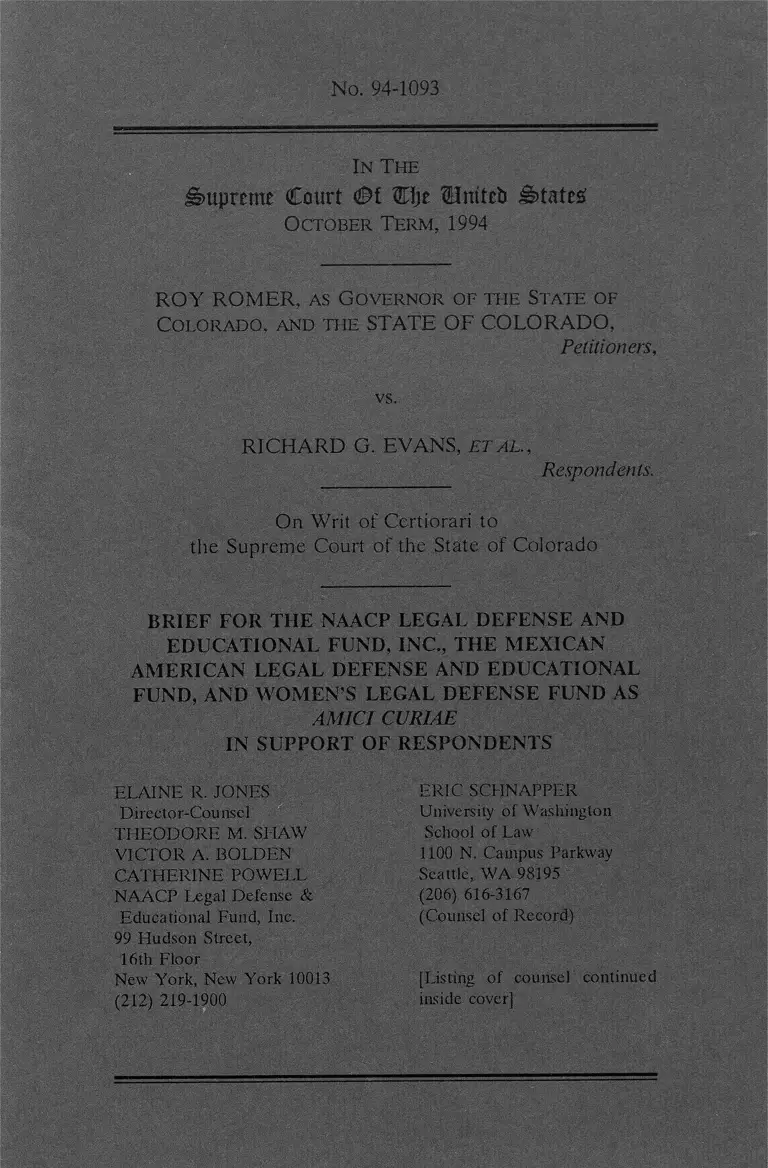
    No. 94-1093

In The

S u prem e C o u rt Cije Um 'tcb States?
October Term, 1994

ROY ROMER, as Governor of the State of
Colorado, and the STATE OF COLORADO,

Petitioners,

vs.

RICHARD G. EVANS, ETAL.,
Respondents.

On Writ of Certiorari to
the Supreme Court of the State of Colorado

BRIEF FOR THE NAACP LEGAL DEFENSE AND
EDUCATIONAL FUND, INC., THE MEXICAN

AMERICAN LEGAL DEFENSE AND EDUCATIONAL
FUND, AND WOMEN’S LEGAL DEFENSE FUND AS

AMICI CURIAE
IN SUPPORT OF RESPONDENTS

ELAINE R. JONES
Director-Cou nscl

THEODORE M. SHAW
VICTOR A. BOLDEN
CATHERINE POWELL
NAACP Legal Delense &
Educational Fund, Inc.

99 Hudson Street,
16th Floor

New York, New York 10013
(212) 219-1900

ERIC SCHNAPPER
University of Washington
School of Law
1100 N. Campus Parkway
Seattle, WA 98195
(206) 616-3167
(Counsel of Record)

[Listing of counsel continued
inside cover]


[Listing of counsel,
continued from front cover]

ANTONIA HERNANDEZ
Mexican American Legal Defense and Educational
Fund

634 South Spring Street
Los Angeles, CA 90014
(213) 629-2512

JUDITH L. LICHTMAN
DONNA R. LENHOFF
Women’s Legal Defense
Fund
1875 Connecticut Ave. N.W.
Washington, D.C. 20009
(202) 986-2600

Counsel lot Amici Curiae


TABLE OF CONTENTS

INTEREST OF AMICI ................................................................  1

SUMMARY OF ARGU M ENT.......................   3

ARGUM ENT................................................................................... 4

AMENDMENT 2 WAS ADOPTED FOR THE
CONSTITUTIONALLY IMPERMISSIBLE PURPOSE
OF PREVENTING GAY VOTERS FROM
PARTICIPATING EQUALLY IN THE POLITICAL
PROCESS ..............................     4

A. The Colorado State Courts Found that
Amendment 2 Was Adopted for the
Purpose of Preventing Gay Voters from
Participating Equally in the Political
Process.................................................................... 4

B. The Findings of the Court Below Are
Supported by Substantial Evidence....................  8

C. The Purpose Found by the Courts below
Is Constitutionally Impermissible........................  18

D. Amendment 2 Has the Effect of Denying
Gay Voters an Equal Opportunity to
Participate Effectively in the Political
Process.................................................................... 23

CONCLUSION 30


TABLE OF AUTHORITIES

Cases: Pages:

Batson v. Kentucky,
476 U.S. 79 (1986) . . . . . . . . . . . . . . . . . . . . . . . . . . .  2

Brown v. Board of Education,
347 U.S. 483 (1954) . . . . . . . . . . . . . . ----- . . . . . . . .  2

Buckley v Valeo,
424 U.S. 1 (1976) ................... .......................................... 23

Burns v. Richardson,
384 U.S. 73 (1966) ................... ......................... .. 19, 20

Carrington v. Rash,
380 U.S. 89 (1965) ....................................................... passim

Cipriano v. Houma,
395 U.S. 701 (1969) ......... .............................................. 19

Cooper v. Aaron,
358 U.S. 1 (1957) ............................................. .. 2

Crawford v. Los Angeles Board of Education,
458 U.S. 527 (1982) ..........................................    9, 10

Davis v Bandemer,
478 U.S. at 109 ............................... ..................  20, 21, 23

Davis v. Mann,
377 U.S. 678 (1964) . . . ....... ........... .. ........................... 20

Dunn v. Blumstein,
405 U.S. 330 (1972) .............. 19

Evans v. Cornman,
398 U.S. 419 (1970) ........................................................ 19

Gaffney v. Cummings,
412 U.S. 735 (1973) ................. 20, 21, 23

11


Pages:

Garza v. County of Los Angeles,
756 F. Supp. 1298 (C.D. Cal.), affd, 918 F.2d
763 (9th Cir. 1990), cert, denied, 498 U.S.
1028 (1990) ......................................................................... 2

Hunter v. Erickson,
393 U.S. 385 (1969) ........................................ .. 11

James v. Valtierra,
402 U.S. 137 (1971) ................................... .............  21, 22

Lane v. Wilson,
307 U.S. 268 (1939) ............................ ............................ 21

Lucas v. Forty-Fourth General Assembly,
377 U.S. 713 (1964) ......................................................... 25

McKennon v. Nashville Banner Publishing Co.,
___U .S .___ , 115 S. Ct. 879 (1995) .................................  2

Mobile v. Bolden,
446 U.S. 55 (1980) ...........................................................  20

Phillips v. Martin Marietta Co.,
400 U.S. 542 (1971) ................................... ....................... 2

Reitman v. Mulkey,
387 U.S. 369 (1967) ....................................................  9, 10

Richardson v. Ramirez,
418 U.S. 24 (1976) ....... ......................... ............. .. 21

Shelley v. Kraemer,
334 U.S. 1 (1948) ....................................... ....................... 2

Smith v. Allwright,
321 U.S. 649 (1944) .......................................... ................ 2

St. Francis v. Al-Khazraji,
481 U.S. 604 (1987) .......................................................... 2

Ill

Valtierra v. James,
313 F. Supp. 1 (N.D. Cal. 1970) . . 22


Pages:

Washington v. Seattle School Dist. No. 1,
458 U.S. 457 (1982) ..........................................   10

White v. Regester,
412 U.S. 755 (1975) .........     2

Constitutional Provisions: Pages:

U.S. Const, amend II . . . . . . . . . . . .  ...................  passim

Colo. Const, art. V § 1 ......... ............. ......................................... 24

Colo. Const, art. V § (2)  ......... ................................................... 25

Miscellaneous: Pages:

Bureau of the Census, Public Employment in 1991 (1992) . . . .  17

iv


In The

Supreme Court # t  CJje United States;
O c t o b e r  T e r m , 1994

No. 94-1093

ROY ROMER, as G o v e r n o r  o f  t h e  St a t e  o f
C o l o r a d o , a n d  t h e  STATE OF COLORADO,

Petitioners,

vs.

RICHARD G. EVANS, e t a l .,
Respondents,

On Writ of Certiorari to
the Supreme Court of the State of Colorado

BRIEF FOR THE NAACP LEGAL DEFENSE AND
EDUCATIONAL FUND, INC., THE MEXICAN

AMERICAN LEGAL DEFENSE AND EDUCATIONAL
FUND, AND WOMEN’S LEGAL DEFENSE FUND AS

AMICI CURIAE
IN SUPPORT OF RESPONDENTS

Interest of Amici

The NAACP Legal Defense and Educational Fund, Ine.
(LDF) is a public interest law firm founded in 1940,
dedicated to combatting bias and securing equal opportunity
for all A m ericans th rough  public education ,
antidiscrimination legislation and full and effective
enforcement of the civil rights laws. LDF has participated


2

as counsel of record or amicus curiae in important cases
before this Court involving discrimination on a variety of
levels, including race, Brown v. Board o f Education, 347 U.S.
483 (1954), ethnicity, St. Francis v. Al-Khazraji, 481 U.S. 604
(1987), gender, Phillips v. Martin Marietta Co., 400 U.S. 542
(1971), and age, McKennon v. Nashville Banner Publishing
C o .,___U .S .___ , 115 S.Ct. 879 (1995), consistently urging
the Court to recognize the real and destructive effects of
prejudice. LDF has also participated in a number of cases,
such as this one, regarding the scope of the Fourteenth
Amendment’s protection against subjugation, bias, and
arbitrariness. See e.g., Batson v. Kentucky, 476 U.S. 79
(1986); Cooper v. Aaron, 358 U.S. 1 (1957); Shelley v.
Kraemer, 334 U.S. 1 (1948); Smith v. Allwright, 321 U.S. 649
(1944).

The Mexican American Legal Defense and
Educational Fund (MALDEF) is a national nonprofit
organization whose principal objective is to protect and
promote the civil rights of Latinos in the United States. It
is particularly dedicated to securing such rights in political
access, immigration, education, employment, and language
rights. MALDEF has litigated many cases in order to
ensure equal access to the political process. Among those
are White v. Regester, 412 U.S. 755 (1975) (invalidating the
at-large election scheme for excluding Mexican Americans
and African Americans from effective participation in the
political process), Garza v. County o f Los Angeles, 756
F.Supp. 1298, (C.D. Cal.), aff’d, 918 F.2d 763 (9th Cir.
1990), cert, denied, 498 U.S. 1028 (invalidating district
boundaries as intentionally discriminatory against Latino
voters and diluting Latino voting strength). As a civil rights
organization, MALDEF has an interest in ensuring the
protection of the most fundamental right to participate in
the political process.

Founded in 1971, the Women’s Legal Defense Fund
(WLDF) is a national advocacy organization that works at


3

federal and state levels to promote policies that help women
achieve equal opportunity, quality health care, and economic
security for themselves and their families. Recognizing that
full gender equality cannot be achieved if discrimination on
the basis of sexual orientation is permissible, WLDF has
participated as amicus curiae in major lesbian and gay rights
cases and has assumed an active role in efforts to make
invidious discrimination on the basis of sexual orientation
unlawful.

SUMMARY OF ARGUMENT

Petitioners’ brief deals largely with the question of
whether the effect of Amendment 2, without more, is
sufficient to render that provision unconstitutional. The
decision of the court below, however, did not rest exclusively
on that impact. Rather, the Colorado courts also concluded
as a matter of fact that Amendment 2 was framed and
enacted for the purpose of thwarting equal participation in
the political process by gay voters. This finding is fully
supported by the record, and virtually compelled by the plain
language of Amendment 2. That finding was not made over
the objections of petitioners; to the contrary, here, as in
Carrington v. Rash, 380 U.S. 89 (1965), petitioners insisted
below that eviscerating the "factional" political influence of
"special interest" gay voters constituted a legitimate reason,
indeed a compelling state interest, justifying Amendment 2.

This avowed purpose of Amendment 2, we urge, is
constitutionally impermissible. The lower courts’ findings as
to the purpose of Amendment 2 provide a case-specific basis
for affirming the decision below, and render unnecessary a
resolution of the broader issue of whether the effect of
Amendment 2 would be sufficient itself to render that
provision constitutionally infirm.


4

ARGUMENT

AMENDMENT 2 WAS ADOPTED FOR THE
CONSTITUTIONALLY IMPERMISSIBLE
PURPOSE OF PREVENTING GAY VOTERS
FROM PARTICIPATING EQUALLY IN THE
POLITICAL PROCESS

A. The Colorado State Courts Found that
Amendment 2 Was Adopted for the Purpose
of Preventing Gay Voters from Participating
Equally in the Political Process.

In its 1993 decision, the Colorado Supreme Court
emphasized that the impact of Amendment 2 on gay voters
was deliberate:

Amendment 2 alters the political process so
that a targeted class is prohibited from
obtaining legislative, executive, and judicial
protection or redress from discrimination
...Amendment 2 singles out that class of
persons (namely, gay men, lesbians, and
bisexuals) who would benefit from laws
barring discrimination on the basis of
sexual orientation.

(Pet. App. D-25) (emphasis added).

In 1994 the Colorado Supreme Court reiterated this
finding:

Evans /...was based on the fact that
Amendment 2 sought to deny an
independently identifiable group’s right to
participate equally in the political profess....In
addition to denying the right of equal
participation in the political process to a


5

group based on sexual orientation,
Amendment 2 also is intended to deny the
same right to persons based on "homosexual,
lesbian, or bisexual... conduct, practices, or
relationships...." Amendment 2 targets this
class of person....(Pet. App. B-22) (emphasis
added)1 2.

The trial court noted that the petitioners had openly
defended Amendment 2 as a measure intended to thwart
what they regarded as the pernicious influence of gay voters.
Petitioners called as witnesses the leaders of Colorado for
Family Values, which had drafted and led the campaign for
Amendment 2. Those sponsors insisted that they had acted
on the belief that "militant gay aggression in this
state...endangers the state’s political functions." (Pet. App.
C-8).

Petitioners’ witnesses urged that this
Amendment protected Colorado’s political
functions from being overrun by such
groups....[T]he founder of CFV...testified that
Amendment 2 was a defensive measure to
fend off state-wide militant gay aggression.
The court’s notes contain his term "militant
gay aggression" no less than six times in his
direct testimony alone.

(Pet. App. C-6 to C-7).

Petitioners contended in the courts below that gay
voters exercised undue influence in the political process. In

1See also Pet. App. B-4 ("an attempt to impede the expression of
’a difference of opinion on a controversial political question’"). The
dissenting judge below agreed, describing the purpose of Amendment
2 as "prohibiting homosexuals, lesbians and bisexuals from enacting
certain legislation." (Pet. App. B-45).


6

the trial court, petitioners’ counsel argued:

[H ]om osexuals...have po litical pow er
disproportionately g rea ter than their
numbers....Homosexuals enjoy superior
lobbying, clout [and] voting turnout.2

In the Colorado Supreme Court, petitioners insisted that the
sponsors of Amendment 2 were gravely and legitimately
concerned that "the legislature was too vulnerable to the
formidable homosexual lobbying power here in Colorado"2 3
and that the "homosexual ’movement was going forward’ and
that local gains were ’just a piece of the puzzle’ which would
be used as ’leverage to approach state legislators....’"4
Having adduced evidence intended to substantiate those
concerns, petitioners argued below that gays are:

a politically powerful and relatively privileged
special interest....Homosexuals are immensely
p o w er fu l  in p r o p o r t i o n  t o t he i r
numbers....They enjoy inordinate access to
influential cultural institutions such as the
m e d i a  a n d  e n t e r t a i n m e n t
industries....[Hjomosexual advocates have
succeeded in dominating the terms of the
debate.5

Similar objections, of course, have been voiced in the past

2 Defendants’ Trial Brief, Case Nos. 92 CV 7233, P. 45 and n.55
(emphasis added).

3 Opening Brief for Defendants-Appellants, Case Nos. 94 SA 048
and 94 SA 128, p.4.

4 Id. at 5.

3 Id. at 30-31 and n.42 (emphasis added).


7

about the political and cultural influence of other groups of
Americans. Petitioners also contended that in Aspen,
Boulder and Denver-cities which had passed anti-
discrimination ordinances, in Denver and Boulder following
public referenda--"homosexuals and bisexuals are a dominant
force and wield the greatest political power."6

Counsel for petitioners repeatedly pressed in the
courts below justifications for Amendment 2 that were
entirely consistent with, and indeed more elaborate than the
finding of the state courts as to the purpose of the
Amendment. Petitioners insisted that one of the objectives
"sought" by Amendment 2 was to "prevenjtj government
from supporting the political objectives of a special interest
group,"7 i.e. gay voters. The Colorado Supreme Court
correctly characterized this as an argument which, by
branding gay voters as a somehow illegitimate "special
interest," sought to justify rigging the political process to
deny them an opportunity for effective political participation:

[Defendants offer no authority to support the
rather remarkable proposition that
government has a compelling interest in
seeing that the state does not support the
political objectives of a "special interest
group." The state exists for the very purpose

6 Id. at 34; see also Tr. 1497 (closing argument for state urging
that Amendment 2 will "prevent against stealth campaigns at the local
[level] by activists who would like to see sexual orientation in the
law").

7 Id. at 42-43; see also Trial Brief for Defendants, Case No. 92
CV 7223, p. 68 ("Amendment 2 prevents government from subsidizing
the political objectives of a special interest group."); Brief in Support
of Defendants’ Motion for Summary Judgment, Case No. 92 CV
7223, p. 17 ("Amendment 2 prevents government from subsidizing the
political objectives of a special interest group.").


8

of implementing the political objectives of the
governed....The fact that some political objectives are
promoted by "special interest groups" is utterly
inconsequential. Indeed, virtually any law could be
regarded as a benefit to a "special interest group."

(Pet. App. B-20). Similarly, petitioners argued below that
"Amendment 2...seeks to ensure that the deeply divisive
issue of homosexuality does not serve to fragment
Colorado’s body politic."8 The state Supreme Court, though
properly recognized that the method of avoiding factionalism
sought by Amendment 2 was intentionally to strip gay voters
of any practical ability to advance through the political
process their interests regarding the issues which the state
sought to brand as unduly controversial:

[W]e fail to see how the state, which is
charged with serving the will of the people,
can have any legitimate interest in preventing
one side of a controversial debate from
pressing its case before governmental bodies
simply because it would prefer to avoid
political controversy or "factionalism."

(Pet. App. B-21).

B. The Findings of the Court Below Are
Supported by Substantial Evidence.

Petitioners do not directly take issue with the findings
of the lower courts as to the actual purpose of Amendment

8 Trial Brief for Defendants, Case No. 92 CV 7223, pp. 60-61; see
also Brief in Support of Defendants’ Motion for Judgment on the
Pleadings, p. 8 ("Amendment 2...seeks to ensure that the deeply
divisive issue of homosexuality’s place in society does not serve to
fragment Colorado’s body politic.").


9

2. Any dispute regarding this fact-bound issue is clearly
outside the scope of the Question Presented.

Even if review of that issue had been sought in this
Court, there would be no reason to overturn the decision of
the Colorado Supreme Court. The purposes animating
Amendment 2 are, as petitioners themselves emphasized
below, "a quintessential^ factual question." (Tr. 96) In
Crawford v. Los Angeles Board o f Education, 458 U.S. 527
(1982), this Court deferred to the conclusions of the
California Supreme Court as to the motive behind the state
constitutional provision there at issue. 458 U.S. at 544 ("[I]n
this case,...involving the circumstances of passage and the
potential impact of a Proposition adopted at a statewide
election, we see no reason to differ with the conclusions of
the state appellate court."); see also Reitman v. Mulkey, 387
U.S. 369 (1967). Here, as in Crawford and Reitman, the
state appellate court was

"armed...with the knowledge of the facts and
circumstances concerning the passage and
potential impact" of the Proposition and
"familiar with the milieu in which that
provision would operate."

Crawford, 458 U.S. at 543, quoting Reitman, 387 U.S. at 378.

The findings of the Colorado Supreme Court in this
regard are fully supported by the record. The plain
language of Amendment 2 is more than sufficient by itself
to support, if not require, that finding. As the court below
correctly observed, Amendment 2, on its face, is expressly
targeted at a "class of persons," which the provision
delineates as those individuals whose "orientation, conduct,
practices, or relationships" are "homosexual, lesbian, or
bisexual." Amendment 2 does not seek to exclude from
consideration by state and local government all issues and
controversies regarding sexual orientation, but focuses


10

exclusively on the issue-discrimination against homosexuals—
which gay voters are particularly likely to press. Far from
compelling government neutrality on issues regarding sexual
orientation, Amendment 2 leaves the state and localities free
to respond with alacrity to the wishes of any voters who
favor government-imposed discrimination against gays.

With regard to the city ordinances prohibiting
discrimination based on "sexual orientation," Amendment 2
invalidates those local laws only insofar as they apply to
"homosexual, lesbian, or bisexual orientation". Thus
heterosexuals retain the protection of the Denver, Boulder
and Aspen ordinances, and heterosexual voters are free to
seek similar protections from the state legislature. In this
respect, Amendment 2 is on its face more extreme, for
example, than California’s 1964 Proposition 14, which
applied equally to minority and non-minority voters, and
which precluded the state from discriminating against
minorities as well as from protecting them.9 And, unlike
the provisions previously considered by this Court, which
were narrowly directed at a particular type of activity,10

9 See Reitman v. Midkey, 387 U.S. 369, 371 (quoting Proposition
14), 391 (dissenting opinion) ("neutral on its face"), 394 ("a neutral
provision restoring ...the sphere of free choice"); Crawford v. Los
Angeles Board of Education, 458 U.S. 527, 527 (1982) (upholding
provision which addressed racial issue "in neutral fashion");
Washington v. Seattle School Dist. No. 1, 458 U.S. 457, 494 (Powell J.
dissenting) (1982) ("[T]he State has adopted a policy of racial
neutrality in student assignments."), 495 (challenged provision is
"neutral on its face, and racially neutral as public policy").

10 See. e.g., Crawford v. Los Angeles Board of Education, 458 U.S.
527 (1982) (limitation on use of two specific remedies—busing and
pupil school assignment-to redress violations of state, but not federal,
constitution); Washington v. Seattle School Dist. No. 1, 458 U.S. 457
(limiting authority of local school officials, but not state officials or
state courts, to utilize busing to integrate schools), 488 (dissenting
opinion emphasizing subjects not covered by challenged provision),
490 (same), 496 (same), 497 n.12 (same).


11

Amendment 2 is broadly framed to encompass the entire
gamut of possible government action. Covering such
unrelated subjects as employment, housing, public
accommodations, and insurance, and applying with full force
to discrimination involving no assertion of privacy or
religious motivation, Amendment 2 is unintelligible as the
solution to any common problem other than the "problem"
perceived by the Amendment’s proponents of undue gay
political influence. The purpose of Amendment 2 is thus
even more apparent on its face than the motive which
Justice Harlan perceived behind the Akron charter provision
in Hunter v. Erickson, 393 U.S. 385, 393 (1969) (concurring
opinion).

Petitioners themselves proffered testimony from the
proponents of Amendment 2 in order to establish the
purpose of Amendment 2. Petitioners’ star witness was
Tony Marco, who had drafted Amendment 2 and founded
its sponsoring organization, Colorado for Family Values.
Counsel for petitioners argued in his opening statement:

You will...hear from Tony Marco who did
much thinking on this issue and was
instrumental in drafting Amendment 2 and
planning the strategy that led to its electoral
success. You will hear from [Marco and
other CFV officials] about why they did what
they did.

Mr. Marco candidly proclaimed that Amendment 2 was
framed to thwart effective use of the political process by gay
voters:

It was necessary because it was obvious that
the aggression of gay militants through the


12

legislature was not going to cease....[T]he
legislature is very vulnerable to all kinds of
lobbying...lobbying for which I discovered gay
militants were very well equipped and were
very well experienced. And so the only way
to ensure that this kind of activity would stop
would be through passage of a constitutional
amendment.11

The virtue of Amendment 2, Marco explained, was
that it would completely preclude gay voters from advancing
through the political process what he perceived to be their
common goals. "[We] f[ound] a way to stop this kind of
aggression with one single act." (Tr. 837). Amendment 2
was intentionally framed as broadly as possible to prevent
enactment of any measures which gay voters might support:

The fundamental principle behind the
drafting of the initiative language was quite
simply to take those factors which we felt that
gay militants had themselves said that they
desired, plus all of the factors that are
attendant on achievement of or awarding of

11 Tr. 839; id. at 837 (Amendment 2 framed to thwart the "broad
statewide agenda of the militant gay movement."); see id. at 846
("statewide aggression on the part of gay militants”); see also id. at
852 ("[W]e felt that the legislature was too vulnerable to the
formidable lobbying power of the gay militant contingent here in
Colorado.”), 859 ("[Wjhat we are dealing with in my opinion is one
of the most politically powerful organizations relative to the size of
its numbers."), 868 ("statewide militant gay aggression"), 869 (There
would be "irrational public policy, if gay militants had their way on
the State of Colorado.”).


13

protected class status, and simply say no to
those.12

Marco explained that it was necessary to prevent gay
voters from seeking government protection and assistance
because other voters seeking such government resources
"simply could not compete with gay militants’ ability to
lobby, to influence legislation, to promulgate its views
through print and through other media." (Tr. 866). As the
Colorado courts correctly recognized, Amendment 2 solved
this "problem" by intentionally excluding gay voters from
participation in that political competition to influence
government legislation and policy.

Documentary evidence demonstrated that prior to the
passage of Amendment 2 Marco had circulated flyers with
similar admonitions that "[rjecently Colorado homosexual,
lesbian and bisexual activists and their supporters have
launched a multi-pronged legislative offensive."13 Marco
had asserted that the tactics of these "gay extremists" "shows
a striking resemblance to, of all things, a Communist Party
directive quoted in the 1956 Report of the House of
Representatives Committee on Un-American Activities."14
Another flyer widely circulated by CFV in support of

12 Tr. 843; see also id. at 853 ("[B]y dealing with all of this in
essence in one full [sic] swoop, we simply closed the lid on the entire
issue.") (emphasis added).

13 PX 11, p. 1; see also PX 12, p. 1 ("In recent years, extremist
homosexual, lesbian and bisexual activists and their supporters have
launched a multi-pronged legislative offensive on national, state and
local government levels."); PX 21 ("The so-called ’gay rights
movement’ is gaining ground...here in Colorado."); PX 22, p.l
(tabloid circulated by CFV with "astonishing, fully-documented
reports of the actual goals of homosexual extremists").

14 PX 12, p. 46; see also id. at 46 (one gay rights group allegedly
"a truly fascist organization" which subscribed to "consciously
’subversive modes, drawn largely from..jWem Kampf.’").


14

Amendment 2 argued that gays exercised dangerously
excessive influence because they had the support of "the gay-
sympathetic media." (PX 20, p.2). At trial petitioners made
a major effort to prove this allegation. Witnesses called by
petitioners warned that gays had "an inordinate influence on
the media"13 * 15 and "receive disproportionate and largely
sympathetic attention from the print and electronic
media",16 an excessive influence which petitioners attributed
to the existence of "open gays and lesbians in many
newsrooms." (Tr. 1257). Petitioners also sought to establish
the existence of undue gay influence in Hollywood. (Tr.
1250).

In addition, petitioners attempted at trial to buttress
Marco’s argument that gays exercised excessive power in
three cities which had enacted gay rights ordinances—
Denver, Boulder and Aspen. In two of these cities—
Boulder17 and Denver18~the ordinances had been
approved by voters in public referenda. Thus, petitioners
offered testimony attacking the political views of the voters
themselves in those cities. The reason for Amendment 2,
according to petitioners’ expert witness, was that local
majorities in those cities were "inflamed" (Tr. 1003),
"completely reckless" (Tr. 1198), "felt very strongly and were
concentrated" (Tr. 1001), and had "propensities to abuse."
(Tr. 1224). The virtue of Amendment 2, he asserted, was

13 Tr. 1244; see also id. at 1245 ("access that would not be
accorded to other groups"), 1247 ("pro gay bias" on television;
networks "enormously biased.").

16 DX CC, pp. 26-27; see also DX 44, p. 2 ("[Homosexuals enjoy
support from every major news organization, whose coverage long
ago crossed the line into outright advocacy of homosexual causes.").

17 PX 39 (ordinance approved by vote of 7916 to 7621).

18PX 29 (ordinance approved by vote of 55,173 to 45,771).


15

that it shifted control over gay rights in those three cities out
of the hands of local voters who were "closely ideologically
involved in the question of gay rights," and conferred it
instead on a broader electorate with "different interests,"
whom he regarded as "the moderates . . . the centralists."
(Tr. 1002).

That Colorado’s highest officials actually sought at
trial to prove that its political processes were imperiled by a
conspiracy of gay extremists is quite extraordinary. The
modest changes that have occurred in the law regarding
sexual orientation, and the professional successes of some
gay people, would convince none but the paranoid that
Colorado or any other state is actually threatened by
"militant gay aggression." This argument bears an unsettling
resemblance to the canard voiced half a century ago that
Jews, who in fact then faced widespread and open
discrimination, were somehow covertly exercising control
over the nation’s policies. Not since the heyday of Jim Crow
have state officials attacked as a threat to the "body politic"
the enactment of minimal protections for an unpopular
group. The trial court understandably rejected these
outlandish claims. (Pet. App. C-8).

In this Court, petitioners, although not directly
attacking the findings of the Colorado Supreme Court, assert
that the actual purpose of Amendment 2 was to assure that
sufficient funds were available to enforce existing
prohibitions against discrimination on the bases of race,
gender and religion.19 This proffered explanation is utterly
implausible. The trial court concluded, to the contrary, that

19 "Amendment 2 is an appropriate means by which the people
sought to focus government’s limited resources upon those
circumstances most warranting attention." Pet. Br. 41. Although
petitioners suggest that there might be other rational bases for
Amendment 2, this is the only basis which petitioners assert was the
actual purpose of that provision.


16

applying anti-discrimination laws to sexual orientation would
have entailed little if any additional cost:

The facts don’t support defendants’ position
. . . .  [Ajctual experiences show that the
presence of a sexual orientation provision has
not increased costs or impaired the
enforcement of other civil rights statutes or
ordinance . . . .  [Tjhis court now finds
defendants’ offered evidence of lack of fiscal
ability unpersuasive in all respects.20

Amendment 2 does not provide that any nominal savings
must or even should be utilized to enforce other anti-
discrimination provisions, does not require that the state or
localities appropriate any funds at all for enforcing those
provisions, and leaves Colorado and its subdivisions free to
repeal completely any existing statutes or ordinances that
prohibit discrimination on the basis of race, gender or
religion. Petitioners acknowledged below that extension of
state anti-discrimination laws to sexual orientation would
require no more than a single additional employee at the
Colorado Civil Rights Division.21 It is quite unbelievable
that the sponsors of Amendment 2 would have solicited

20Pet. App. C-9 - C-10. Petitioners conceded below that
enforcement of the Denver ordinance, for example, had involved no
significant cost to the city. Opening Brief, Case Nos. 94 SA 048 and
94 SA 128 (Colo. S. Ct.) p. 29 ("[T]he Denver experience reflected
little fiscal impact.").

21 In the court below, the only argument advanced by petitioners
regarding the impact of a possible state ban on sexual orientation
discrimination was that in Wisconsin, a state substantially larger than
Colorado, "almost a full time position was required to handle the . .
. new civil rights filings each year precipitated by the sexual
orientation law." (Opening Brief, Case Nos. 94 SA 048 and 94 SA 128
(Colo. S. Ct.), p. 29.).


17

more than 50,000 petition signatures (PX 21), expended
hundreds of thousands of dollars (Tr. 747-48, 1046), and
waged a year long state wide campaign merely to prevent the
addition of a single worker to a state payroll that already
numbered more than 156,000.22

There is, moreover, no mention whatever of this
purported purpose in the flyers prepared by the proponents
of Amendment 2, hundreds of thousands of which were
circulated prior to the referendum. Rather, in language
similar to Marco’s testimony, the flyers called for preemptive
action "to STOP the ’gay’ activists,"23 warning darkly that
gay voter~"militant[s]" and "extremists"—were pursuing
"astonishing...goals"; "[w]hat they really want will shock and
alarm you." (PX 22, p. 1). The description of those alleged
goals included topics, such as "Target: Children" and
"Objective: Destroy the Family." (PX 22, pp. 2, 4). Much of
this literature was baldly framed to inculcate blind animus
toward gay voters by portraying them as an evil clique
unworthy to participate in any aspect of civilized society.
CFV insisted at length that central goals of gays included
legalizing, and engaging in, pedophilia,24 desecrating
churches, and assaulting members of the clergy. (PX 21).
The flyers were replete with luridly explicit descriptions of

12See Bureau of the Census, Public Employment in 1991 11 (1992).

23 PX 21 (capitalization in original).

24 PX 22, p. 2 ("[Pjedophilia (the sexual molestation of children)
is actually an accepted part of the homosexual community....Don’t let
gay militants double-talk hide their true intentions. Sexual
molestation of children is a large part of many homosexuals’
lifestyle....Say no to sexual perversion with children-vote YES on
Amendment 2!").


18

bizarre sexual practices.25 One bold-faced headline warned:
"Lesbians are now having babies conceived by homosexual
semen". (PX 21).

C. The Purpose Found by the Courts below
Is Constitutionally Impermissible.

In Carrington v. Rash, 380 U.S. 89 (1965), Texas
refused when registering voters to recognize as bona fide
residents any member of the armed forces who had not been
a Texas resident when he or she entered the service. The
state sought to justify this statute as a method of preventing
military personnel from dominating local elections. The
Court held that such a purpose was unconstitutional per se:

[T]he State’s first contention is that
the...provision is necessary to prevent the
danger of a "takeover" of the civilian
community resulting from concentrated voting
by large numbers of military personnel in
bases placed near Texas towns and cities. A
base commander, Texas suggests, who
opposes local police administration or
teaching policies in local schools, might
influence his men to vote in conformity with
his predilections. Local bond issues may fail,
and property taxes stagnate at low levels
because military personnel are unwilling to
i n v e s t  in t h e  f u t u r e  o f  t h e
area....But..."[fjencing out" from the franchise
a sector of the population because o f  the way
they may vote is constitu tionally
impermissible.

25 PX 21; PX 22, p. 4; see also PX 20 (CFV letter referring to
accompanying "Shocking brochure" with "graphic, disgusting facts"
that will "shock and repel").


19

380 U.S. at 93-94 (emphasis added); see also id. at 94 (right
to vote cannot be restricted "because of fear of the political
views of a particular group").

This holding in Carrington has been reiterated by this
Court on numerous occasions. In Cipriano v. Houma, 395
U.S. 701 (1969), the Court emphasized that it was
"constitutionally impermissible" to preclude non-landowners
from voting on the issuance of revenue bonds because their
interests, and thus likely voting behavior, were different than
those of property owners. 395 U.S. at 705-06. In Dunn v.
Blumstein, 405 U.S. 330 (1972), the state sought to justify a
one-year residence requirement for voters as a method of
assuring that new voters would share the interests of existing
residents. This Court held:

Tennessee’s hopes for voters with a "common
interest in all matters pertaining to [the
c o m m u n i t y ’ s]  g o v e r n m e n t  i s
impermissible"...."[Differences of opinion"
may not be the basis for excluding any group
or person from the franchise...."[T]he fact that
newly arrived [Tennesseans] may have a more
national outlook than longtime residents, or
even may retain a viewpoint characteristic of
the region from which they have come, is a
constitutionally impermissible reason for
depriving them of their chance to influence
the electoral vote of their new home state."

405 U.S. at 355-56 (footnote omitted); see also Evans v.
Common, 398 U.S. 419, 422-423 (1970).

This Court has also held that district lines that may
not be drawn for the avowed purpose of minimizing the
political influence of a targeted group. Bums v. Richardson,
384 U.S. 73 (1966), recognized that the Constitution would
not permit use of a district plan "designed to...minimize or


20

cancel out the voting strength of racial or political elements
of the voting population." Id. at 89 (emphasis added). In
Gaffney v. Cummings, 412 U.S. 735 (1973), the Court
reiterated that multimember districts would be
unconstitutional if "invidiously discriminatory because they
were employed to minimize or cancel out the voting strength
of racial or political elements of the population." 412 U.S. at
751 (emphasis added), quoting Fortson v. Dorsey, 379 U.S.
433, 439 (1965). In Mobile v. Bolden, 446 U.S. 55, 69, n.14
(1980), the Court stressed that the term "employed" in this
passage in Gaffney referred to "the existence of
discriminatory purpose." Gaffney also indicated that the
boundaries of particular legislative districts could not be
intentionally drawn "to minimize or eliminate the political
strength of any group or party." 412 U.S. at 754. Davis v.
Mann, 377 U.S. 678, 691 (1964), emphasized that a
districting scheme adopted for the purpose of discriminating
against "military and military-related personnel...is
constitutionally impermissible."

Most recently in Davis v. Bandemer, 478 U.S. 109
(1988), six members of the Court agreed that plaintiffs in a
gerrymandering case could prevail by demonstrating "both
intentional discrimination against an identifiable political
group and an actual discriminatory effect on that group."
478 U.S. at 127, (plurality opinion), 161 (Powell, J.,
concurring in part and dissenting in part). The Court
expressly rejected the contention that the constitutional
prohibition against invidious gerrymandering should be
limited to race claims. Compare 478 U.S. at 125-27
(plurality opinion) with 478 U.S. at 144-61 (dissenting
opinion).

In the instant case, Colorado unquestionably would
have violated the Constitution if, as in Carrington, the state
had concocted some voter registration requirement that
disproportionately screened out gays and did so with the
intent "to deny [them the] right to participate equally in the


21

political process." (Pet. App. B-22). The state would have
also acted unconstitutionally if it had mandated an invidious
gerrymander of city council districts in Aspen, Denver or
Boulder for the avowed purpose of "minimizing] or
cancel[ing] out the voting strength" of gay voters. Gaffney,
412 U.S. at 752. The result is no different here merely
because, in seeking to accomplish a similar discriminatory
result with an identical invidious purpose, Colorado has
chosen instead a different method of manipulating its
political process. The Fourteenth Amendment "nullifies
sophisticated as well as simple-minded modes of
discrimination." Lane v. Wilson, 307 U.S. 268, 275 (1939).

To be sure, the particular device at issue in this case
is different from the practices in Carrington and Davis v.
Bandemer. But the constitutional transgression in those
cases concerned the purpose of the government action, not
the specific manner in which the state had sought to further
the constitutionally impermissible goal. The Colorado
Supreme Court below concluded that the purpose of
Amendment 2 was to eviscerate the political power of gay
voters and organizations to bring about changes in state or
local laws with which the proponents of Amendment 2
happened to disagree. Such a deliberate scheme

to "withdraw all political influence from those
who are practically hostile" to the existing
order, strikes at the very heart of the
democratic process. A temporal majority
could use such a power to preserve inviolate
its view of the social order simply by
disenfranchising those with different views.

Richardson v. Ramirez, 418 U.S. 24, 83 (1976) (Marshall, J.,
dissenting).

Nothing in James v. Valtierra, 402 U.S. 137 (1971), is
to the contrary. There was no claim in that case that the


22

California constitutional provision there at issue had been
adopted for the purpose of preventing equal political
participation by the poor. On the contrary, both the District
Court opinion and the dissenters in this Court relied
exclusively on the effect of that provision26. The majority
stressed that under the circumstances in that case the
California provision mandating referenda to review the
creation of certain housing projects "demonstratejd] devotion
to democracy, not bias, discrimination, or prejudice." 402
U.S. at 141. Unlike Amendment 2, which was deliberately
framed to obstruct in the most sweeping manner every
conceivable anti-discrimination action, the California
provision did not apply to any of the myriad of non-housing
actions local officials might take to benefit the indigent, such
as providing Head Start programs, school lunches, remedial
education under Title I, etc. Even with regard to housing
for the poor, no referendum was required if local officials
chose to provide subsidies for indigent tenants in private
housing, to use zoning laws to require developers to include
units for low income tenants, or to forbid landlords from
discriminating against tenants receiving welfare. Nor did the
California measure require indigent voters to meet the often
onerous burdens necessary to initiate a referendum. In sum,
the provision in James was directed at a quite specific type
of housing project, not at interfering generally with effective
political participation by indigent voters.

26 402 U.S. at 145 (Marshall, J., dissenting) ("substantial
burden...on the poor); Valtierra v. James, 313 F. Supp. 1, 6 (N.D. Cal.
1970) ("[L]ack of bad motive has never been held to cure an
otherwise discriminatory scheme. Certainly Hunter does not demand
a demonstration of improper motivation.1').


23

D. Amendment 2 Has the Effect of Denying Gay
Voters an Equal Opportunity to Participate
Effectively in the Political Process.

A state law or constitutional provision is not
necessarily invalid solely because it was motivated by a
desire to reduce the political impact of a group of voters.
For example, a districting plan framed to eliminate a
disproportionate advantage previously enjoyed by one
political party, and which merely resulted in representation
that is "a rough approximation of the statewide political
strengths of the Democratic and Republican parties," would
pose no constitutional problem. Gaffney, 412 U.S. at 752.
Similarly, limits on campaign contributions, even though
directed at least in part at curbing disproportionate influence
or access by rich contributors, serve at most to equalize the
ability of contributors to advance favored candidates.
Buckley v Valeo, 424 U.S. 1, 25-26 (1976). In order to
violate Equal Protection, a scheme not only must be
animated by an intent to reduce the influence of an
identifiable group of voters, but also must have the effect of
"consistently degrading] a voter’s or a group of voters’
influence on the political process...." Davis v Bandemer, 478
U.S. at 109.

Amendment 2 is not a mere "gauntlet" or "hurdle;"
rather, Amendment 2 is a virtually insuperable barrier to the
adoption of any governmental measures protecting gays from
discrimination. In the court below petitioners correctly
characterized Amendment 2 as such a flat prohibition:

[T]he plain language of Amendment 2
itself...remove[s] state and local government
from  th e  issue  [o f gay r ight s]


24

altogether....Amendment 2 was about the
resolution of the debate...a final decision is
made on this divisive issue.27

Other lower court briefs submitted by petitioner were
equally emphatic in describing Amendment 2 as an absolute
and definitive bar.28

In this Court, however, petitioners seek to
recharacterize Amendment 2 as merely altering the process
for enacting gay rights legislation. Petitioners do not rely in
this regard on the actual language of Amendment 2, which
is on its face a flat prohibition, but instead tacitly invoke
Article V, section 1 of the Colorado Constitution, which
permits future amendments. Thus, petitioners reason,
Amendment 2 has not prohibited laws or ordinances against
sexual orientation discrimination, but merely established a
new process under which, as part of adopting any such
enactments, the constitution of Colorado would first have to
be amended by statewide referendum. But the hypothetical
possibility of subsequent constitutional amendments does not
convert an unequivocal constitutional prohibition into a
mere process for taking the forbidden action. In petitioners’
view the Establishment Clause of the First Amendment
would constitute, not a barrier to the creation of a national

27 Opening Brief, Case Nos. 94 SA 048 and 94 SA 128 (Colo. S.
Ct.), pp. 39, n.57, 45 (emphasis in original).

28 Opening Brief, Case No. 93 SA 017 (Colo. S. Ct.), pp. 5
("Amendment 2...barred special civil rights protections"), 12
("Amendment 2...prohibits" adoption of certain anti-discrimination
rules); Reply Brief, Case No. 93 SA 017 (Colo. S. Ct.), p. 7
("Amendment 2 prohibits adopting of specific civil rights protections);
Brief in Support of Defendant’s Motion to Dismiss, Case No. 92 CV
7223 (D. Ct. Denver), pp. 2 ("prohibits"), 5 ("prohibition"), 25
(Amendment 2 places civil rights protections for homosexuals
"beyond the competency of government officials.").


25

church, but merely a decision to let Congress, in consultation
with three-quarters of state legislatures, determine which
particular religious sect all Americans should be compelled
to join. In adopting Amendment 2, Colorado has erected
against adoption of anti-discrimination measures a barrier as
insurmountable as is possible to create in a democracy.
Three decades ago in Lucas v. Forty-Fourth General
Assembly, 377 U.S. 713 (1964), this Court rejected this same
argument that a provision of the Colorado constitution
diluting the votes of certain voters could be upheld merely
because Colorado voters retained the right to amend their
state’s constitution. 377 U.S. at 732, 733, 737.

Even if the possibility of further amending the
Colorado constitution is considered, the burden imposed by
Amendment 2 is too severe. In the wake of Amendment 2,
proponents of any protections against sexual orientation
discrimination bear the burden of obtaining the more than
54,000 signatures necessary to even obtain a public vote.29
If, for example, such a measure were sought by the people
of Aspen, the number of signatures needed would be 130
times the total number of voters in the town.30 Under
Amendment 2, the overwhelming majority of the voters
could be hundreds of miles from, for example, the town of
Aspen, and understandably unfamiliar with, if not indifferent
to, local problems. The critical reason for placing a barrier
to gay rights legislation in the Colorado Constitution,
petitioners themselves emphasized below, was to create an

29 Article V, section 1(2) of the Colorado Constitution requires
petition signatures equal to five percent of the votes cast in the most
recent election for secretary of state.

30 There are 4031 registered voters in the town of Aspen.


26

obstacle that could "not be easily displaced or
circumvented."31

As petitioners frankly acknowledge, Amendment 2
was framed and enacted for the avowed purpose of
overturning, and preventing further adoption of, measures
that prohibited discrimination by state and local government
officials in Colorado. (Pet. Br. 6). There were at least ten
such measures directed exclusively at preventing
governmental discrimination: (a) an executive order issued
by the governor prohibiting employment discrimination on
the basis of sexual orientation by any state agency,32 (b)
prohibitions issued by officials of, and applicable to
employment by, Boulder County (PX 118), the Denver
Police (PX 32), the Denver Public Library (PX 31), and the
City and County of Denver (PX 10), against sexual
orientation discrimination in government employment, (c) a
prohibition generally forbidding discrimination on the basis
of sexual orientation by Denver officials with regard to
government housing, contracting services, and credit (PX
36), (d) general prohibitions adopted by at least two state
colleges against sexual orientation discrimination in
employment or education (Pet. App. D-25), and (e)
directives issued by the Denver Police Department
forbidding police officers from engaging in harassment, or
making derogatory remarks in radio transmissions, with
regard to sexual orientation. (PX 33, PX 34). In addition,
the local ordinances forbidding discrimination on the basis

31 Opening Brief, Case Nos. 94 SA 048 and 94 SA 128, (Colo. S.
Ct.), p. 52.

32 PX 46. That prohibition is reflected in Colorado civil service
regulations. PX 47.


27

of sexual orientation often applied to governmental as well
as private entities.33

Amendment 2 invalidates these and any future
prohibitions against discrimination by employees of Colorado
or its political subdivisions. Amendment 2 was openly
advocated as a method of preventing elected officials from
interfering with discrimination by their subordinates.34 The
provision does so by directing in part that neither the state,
its agencies, nor its subdivisions

shall...adopt or enforce any...policy whereby
homosexual...orientation...shall constitute...the
basis of...any claim of...discrimination.

Measures such as the governor’s executive order forbidding
employment discrimination by his or her subordinates is just
such a "policy" clearly forbidden by the language of the
Amendment.

Amendment 2, in an unprecedented and quite bizarre
manner, obstructs the normal operation of the political
process and of state and local government. The purpose and
effect of the Amendment is to strip elected officials, and any
other supervisory officials down through the chain of
command, of any power to interfere with decisions by their
subordinates to engage in discrimination. The governor may
opt to make his own decisions in a non-discriminatory
manner, but he cannot direct "[tjhe head of each principal
department" to do the same. (Compare PX 44). The Denver
Chief of Police may avoid harassing anyone on the basis of

33 PX 37 (Boulder ordinance applies without limitation to all
employers); PX 48 (Aspen ordinance applies to "any...government
agency").

34 PX 22, p. 7 (urging vote for Amendment 2 in order to protect
"[gjovernment workers" who object to "hirjrng] gays" and "promoting]
homosexuals").


28

sexual orientation, but he cannot order "all Police
Department personnel" to refrain from such actions.
(Compare PX 33). The mayor of Denver may chose not to
personally discriminate in decisions regarding government
housing, services, contracting, etc., but he cannot require "all
department heads" to follow a similar course. (Compare PX
36).

Amendment 2 places each of the hundreds of
thousands of state and local government employees in
Colorado, insofar as they may wish to discriminate against
gays, outside the powers of any elected official and thus
beyond the reach of the political process. Petitioners argue
that a presumption of propriety should be accorded to
choices made by government officials "who are accountable
to" "those put in authority by the electoral process" (Pet. Br.
32 n. 22); but a core purpose of Amendment 2 is to
guarantee that state and local government employees in
Colorado will not be so accountable. Discrimination against
homosexuals in the exercise of governmental power is in
Colorado the constitutional right of every individual police
officer, school teacher, office supervisor, public housing
official, and college admissions clerk. Far from bringing
about uniformity, this near anarchical scheme means that
whether a gay applicant can obtain a government job, or be
admitted to a state college, turns solely on the whims and
biases of whichever official happens to be charged with
making that particular decision.

On repeated occasions this Court has emphasized
that individuals aggrieved by injury at the hands of
government officials must--in the absence of a clear
constitutional transgression-look to the political process for
redress. For gay victims of discrimination in Colorado
today, that is simply impossible. Gay applicants denied state
jobs on the basis of sexual orientation cannot obtain redress
from even a willing governor, and, if dissatisfied with a
hostile governor’s lack of response, cannot improve their
situation by voting into office a new governor sympathetic to
their plight. It is a mockery of democracy to assert of this


29

situation, as do petitioners (Pet. Br. 11, 26, 27), that gays
remain free to run for office or to vote for the candidates of
their choice. For gay voters aggrieved by sexual orientation
discrimination on the part of state or local government
employees, the political process has been deliberately
rendered an empty charade.


CONCLUSION

For the above reasons the judgment of the Colorado
Supreme Court should be affirmed.

Respectfully submitted,

ELAINE R. JONES
Director-Counsel

THEODORE M. SHAW
VICTOR A. BOLDEN
CATHERINE POWELL
NAACP LEGAL DEFENSE
Fund, Inc.
99 Hudson Street
16th Floor
New York, New York 10013
(212) 219-1900

ERIC SCHNAPPER
University of Washington
School of Law

1100 N. Campus Parkway
Seattle, WA 98195
(206) 616-3167
(Counsel of Record)

ANTONIA HERNANDEZ
Mexican American Legal
Defense and Educational
Fund

634 South Spring Street
Los Angeles, CA 90014
(213) 629-2512

JUDITH L. LICHTMAN
DONNA R. LENHOFF
Women’s Legal Defense
Fund

1875 Connecticut Ave. N.W.
Washington, D.C. 20009
(202) 986-2600

Counsel for Amici Curiae