Olivier v. Michigan State Board of Education Motion for Leave to Submit Brief and Brief Amicus Curiae in Support of Rehearing
Public Court Documents
April 14, 1975
-
Brief Collection, LDF Court Filings. Olivier v. Michigan State Board of Education Motion for Leave to Submit Brief and Brief Amicus Curiae in Support of Rehearing, 1975. 0ce24cef-c09a-ee11-be36-6045bdeb8873. LDF Archives, Thurgood Marshall Institute. https://ldfrecollection.org/archives/archives-search/archives-item/9c3ee1c0-09ea-4a5f-8875-c9355e0ca850/olivier-v-michigan-state-board-of-education-motion-for-leave-to-submit-brief-and-brief-amicus-curiae-in-support-of-rehearing. Accessed October 05, 2026.
Copied!
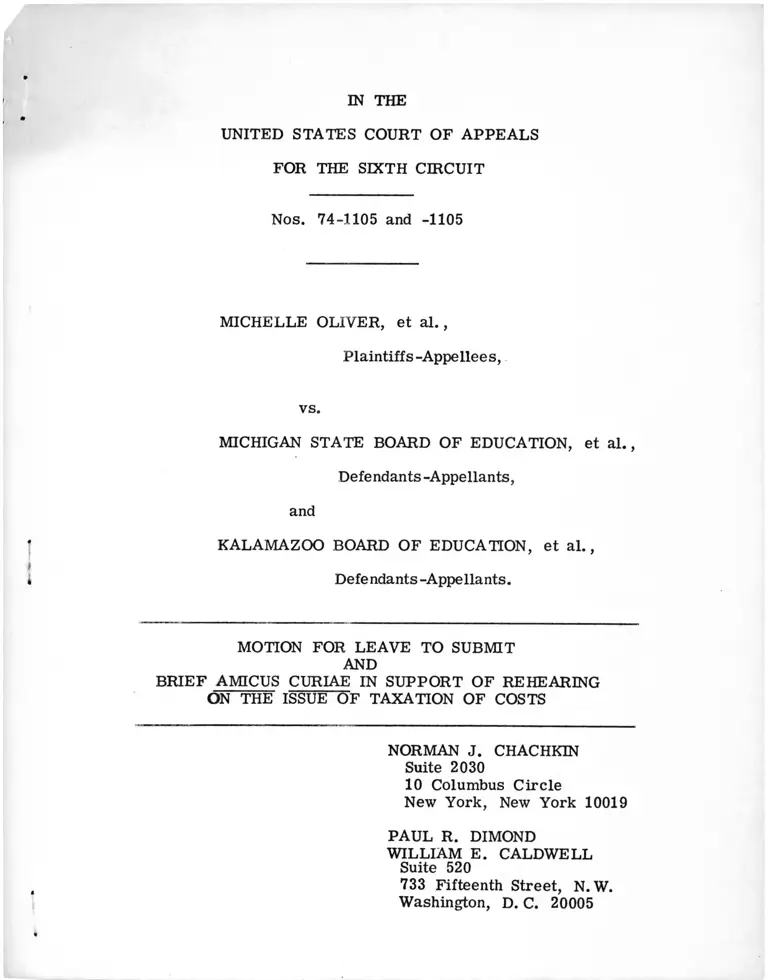
IN THE
m
UNITED STATES COURT OF APPEALS
FOR THE SIXTH CIRCUIT
Nos. 74-1105 and -1105
MICHELLE OLIVER, et a l . ,
Plaintiffs -Appellees,
vs.
MICHIGAN STATE BOARD OF EDUCATION, et a l . ,
Defendants -Appellants,
and
T KALAMAZOO BOARD OF EDUCATION, et a l . ,
i
t Defendants-Appellants.
MOTION FOR LEAVE TO SUBMIT
AND
BRIEF AMICUS CURIAE IN SUPPORT OF REHEARING
ON THE ISSUE OF TAXATION OF COSTS
NORMAN J. CHACHKIN
Suite 2030
10 Columbus Circle
New York, New York 10019
PAUL R. DIMOND
WILLIAM E. CALDWELL
Suite 520
733 Fifteenth Street, N. W.
Washington, D. C. 20005
IN THE
Nos, 74-1104 and -1105
/
UNITED STATES COURT OF APPEALS
FOR THE SIXTH CIRCUIT
MICHELLE OLIVER, et a l . ,
Plaintiffs-Appellees,
vs,
MICHIGAN STATE BOARD OF EDUCATION, et a l . ,
Defendants-Appellants,
and
KALAMAZOO BOARD OF EDUCATION, et a l . ,
Defendants -Appellants.
MOTION FOR LEAVE TO SUBMIT BRIEF
AMICUS CURIAE IN SUPPORT OF REHEARING
ON THE ISSUE OF TAXATION OF COSTS
WILLIAM E. CALDWELL, NORMAN J. CHACHKEN and PAUL R.
DIMOND, attorneys and Members of the Bar of this Court, respectfully
pray that this Court grant them leave to file the attached, short Brief
- i i -
Amicus Curiae in support of the Petition for Rehearing and Suggestion
1/
of Rehearing En Banc in the above-captioned matter. Amices purpose
in seeking to file this Brief is to bring to the Court’s attention the
unfortunate impact its Order on Motion to Tax Costs of March 12,
1975, will have upon the practising Bar in this Circuit. Submission
of an amicus brief in connection with a petition for reconsideration
of a procedural order is indeed an unusual step, but in our view,
the Court’s Order contains language which will, unless its implications
are corrected, establish an unjust and insupportable precedent governing
the procedures to be followed on appeals in this Circuit.
For more than five years each, proposed amici have been members
of the Bar of this Court and have prosecuted appeals with regularity;
we have appeared before all of the members of the Court. None of
us is counsel for any of the parties in the instant matter; while each
of us has been associated with some counsel for plaintiffs Oliver, et al.
in other cases, this amicus presentation has not been solicited or r e
quested by counsel for plaintiffs. Rather, having been apprised of the
Order on Motion to Tax Costs, we are concerned with its precedential
effect
WHEREFORE, for the foregoing reasons, undersigned respectfully
1/ While unusual, the filing of an amicus Brief by an individual member
of the Bar of this Court is not unknown. See Kelley v. Board of Educ.
of Nashville, Nos. 13748 and 13749 (Clerk’s letter-Order of March 20,
1357):
pray that this Court grant leave to file the appended Brief Amicus
Curiae in support of Rehearing.
Respectfully submitted,
WILLIAM E. CALDWELL
PAUL R. DIMOND
520 Woodward Bldg.
733 Fifteenth Street, N. W.
Washington, D. C. 20005
NORMAN J. CHACHKIN
Suite 2030
10 Columbus Circle
New York, New York 10019
Amici Curiae
IN THE
UNITED STATES COURT OF APPEALS
FOR THE SIXTH CIRCUIT
Nos. 74-1104 and -1105
MICHELLE OLIVER, et a l . ,
Plaintiffs-Appellees,
vs.
MICHIGAN STATE BOARD OF EDUCATION, et a l . ,
Defendants-Appellants,
and
KALAMAZOO BOARD OF EDUCATION, et a l . ,
Defendants -Appellants.
BRIEF AMICUS CURIAE IN SUPPORT OF
PETITION FOR REHEARING AND SUGGESTION OF
REHEARING EN BANC OF ORDER ON MOTION TO TAX COSTS
Interest of the Amici
This Brief is respectfully submitted by three members of the Bar
of this Court who have practiced before the Court on numerous occasions
-2-
during the past five years, to express their concern as practitioners
about the ruling in this case upon appellants’ Motion to Tax Costs.
As is more fully described in the body of this Brief, this Court’s Order
seems to announce a rule of procedure which cannot but result in greatly
increasing the complexity and confusion which will attend the appellate
process in this Circuit. Indeed, we submit that unless the language
of the Court's Order is modified, the practising Bar of the Circuit
will be forced to adopt one of a very few number of alternatives in
preparing their Briefs and Appendices in appeals to this Court, each
of which would needlessly delay or complicate such appeals. Based
upon the experience of amici with this Court, we believe that such a
result is unintended and unnecessary to accomplish any valid purposes
of the Order. Accordingly, amici have sought to share their views
with the Court since we understand that appellees have filed a Petition
for Rehearing and Suggestion of Rehearing J3n Banc.
The Factual Controversy
Amici are not, and have not sought to make themselves, intimately
2/
familiar with the underlying merits of the instant appeaE It is a school
2 / Although amici have been associated with some of counsel for appellees
in other matters, amici have not participated in the instant matter. Amici
were informed of this Court’s March 12, 1975 Order by one of counsel for
appellees but not asked to do anything in connection therewith. However,
amici were very concerned about the effect of the Court’s Order on appellate
practice in this Circuit, and upon their request were furnished copies of the
various pleadings and briefs filed by the parties to this appeal in connection
with the cost issue. After considerable discussion, amici themselves deter
mined to put their views before this Court.
desegregation case in which the District Court has twice (on prelim i
nary injunction and after a full trial) ruled in plaintiffs’ [appellees']
favor and been affirmed by this Court. 346 F. Supp. 766 (W. D. Mich.),
aff’d 448 F. 2d 635 (6th Cir. 1971); 368 F. Supp. 143 (W.D. Mich. 1973),
508 F. 2d 178 (6th Cir. 1974). The present controversy grows out
of the second appeal in the case.
As amici understand the setting of the matter, the appellants were
State and local school officials; pursuant to F. R. A. P. 30 their counsel
initially served a designation of the proposed contents of the Appendix,
for this appeal upon counsel for appellees [successful plaintiffs], along
with a statement of the issues appellants would present to this Court
for decision. Appellees’ counsel, upon concluding that additional portions
of the record should be conveniently accessible to Jill members of the
panel which would hear this matter, served a counter-designation. Ac
cording to this Court's Order, the combined result was a sixteen-volume
Appendix of 5054 pages.
After appellants lost on the merits before this Court, they filed
a Motion seeking to recover some of the costs they had incurred in
reproducing the Appendix, on the grounds that large portions of
appellees’ Counter-Designation under F. R. A. P. 30 were unnecessary
to the disposition of the case. Tbe Court granted that motion to the
extent of requiring plaintiffs-appellees to pay the State of Michigan
and the Kalamazoo School Board $32,000.00. Plaintiffs-appellees
petitioned for reconsideration.
- 4 -
Summary of Argument
As we explain below, this Court's Order, and the pleadings and
briefs of the parties addressed to the costs issue, indicate that waste
ful, inexcusable extravagancy by counsel for appellants was as much
or more the cause of the unusual, unnecessarily expensive Appendix
in this matter as any over-designation which may have been done by
counsel for appellees. Under these circumstances, in this school
desegregation case whose prosecution serves the public interest, we
believe that the ends of justice would be served by the Court’s re p ri
mand of counsel for both sides, (to the extent the Court determines
such action is warranted), without requiring that plaintiff students and
their parents be required to reimburse public officials for expenses
incurred on an appeal involving the unlawful conduct of those public
officers.
Should the Court conclude that some portion of the Appendix repro
duction costs should be borne by appellees, however, amici urge that
the rule which seems to be embodied in the Court’s March 12, 1975
Order--that any page of the Appendix not cited in a Brief is "unnecessary
within the meaning of F. R. A. P. 30—should be abandoned and withdrawn.
-5 -
ARGUMENT
I.
UNDER ALL THE CIRCUMSTANCES
OF THIS CASE, NO COSTS SHOULD
BE TAXED AGAINST APPELLEES
DESPITE THE LENGTH OF THE APPENDIX
Amici do not seek to question this Court’s determination that T'a
large portion [of the printed Appendix in this matter] was unnecessary."
We are not familiar with the underlying merits, and we have not under
taken to study the Appendix and the Briefs. We presume that appellees
will address themselves to that question in their Petition.
However, based upon a reading of the documents submitted by the
'j
parties in connection with the Motion to Tax costs filed by the appellants,
.(
we are of the opinion that the cost of reproducing the Appendix was
unnecessarily inflated by the appellants. Since this is a school desegre
gation action whose prosecution serves the public interest, we respect
fully suggest that the Court’s purposes would be better served by a
reprimand of counsel for both sides, than by taxing any portion of the
costs—let alone the sum of $32,000—against appellee schoolchildren
and their parents.
The Court's Order indicates that the Court was ’’astounded at
the amount of the bill of costs submitted by the printer and at some
of the items included therein ," a feeling which amici share. The Order
reflects that the printing charges as submitted averaged $21. 85 per
-6 -
page, a rate well above that commonly incurred in Cincinnati (and
elsewhere). A further breakdown and analysis of the itemized charges
indicates that, excluding the costs of expedited preparation, hotel
accommodations for staff, chartered aircraft, e tc ., the printing costs
totaled $21. 30 per page, a sum which is still ’’astounding. ”
Amici note, for example, that they customarily have reproduced
both Briefs and Appendices, in appeals in which they have participated
before this Court, by xerography or other inexpensive method as per
mitted by the Federal Rules of Appellate Procedure and the practice of
this Court. Amici have often recovered costs in connection with such
m atters, at the rate of $0.10 per page per copy. If reproduced by this
method, an Appendix of 5054 pages, including ten copies for filing with
the Court and five copies for service and for counsel, would cost some
$7,581, or slightly less than one-fifteenth the cost incurred by counsel
for appellants in this matter.
The Court has recognized the shocking rates at which charges
were incurred by counsel for appellants, by taxing costs against
appellees at just under the top ($10) per page rate available in
Cincinnati (3311 pages x $9. 66 per page). However, in light of the
fact that xerox or multilith reproduction could have saved the parties
more than $100,000.00, even that taxation seems excessive to amici.
There can hardly be any plausible justification for requiring
appellees to bear any part of the costs which resulted from the wilful
-7 -
//
election by counsel for appellants to employ the most expensive means
of reproduction. Although counsel seems to have attempted to justify
the extraordinary cost of reproduction by citing the need for speed
("From the date of . . . receipt [of appellees’ cross-designations] KBE
had 9 days to file the joint appendix," Brief in Support of Motion to
Tax Costs, at p. 1), this can hardly support counsel’s decision to em
ploy the slowest, and most expensive method of reproduction--letter-
press typesetting. Furthermore, if, as counsel suggests (ibid.), their
receipt of the cross-designations were inexplicably delayed a week in
the mails, it would have been a simple matter for counsel to have
sought the short extension of time necessary to permit completion
of the Appendix without the shockingly high charges obviously incurred
for the sake of expedition! Based upon our experience with the Clerk’s
Office of this Court (and irrespective of the individual who has filled
that position), we are confident that under the circumstances such an
extension would surely have been granted. Additionally, a short ex
tension would not have resulted in delaying the submission of the case,
since it need not have resulted in extending the due date for appellees’
brief; at worst, the latter could have been submitted with original
record citations, if necessary, to be supplemented by additional copies
of the brief in which citations to the Appendix were included.
Unfortunately, for all concerned (Court, counsel and parties), counsel
for appellants apparently did not explore this simple expedient of reducing
-8 -
the costs. Under these circumstances, the actions of counsel for
appellants produced as much extravagant waste as any over-designation
by counsel for appellees. We respectfully suggest that it is unduly
harsh to require appellees to pay $32,000 to the State of Michigan and
the Kalamazoo Board of Education, even if the Court concludes that
the performance of counsel for appellees in connection with the cross-
designation fell short of the high standards expected in this Circuit.
Since this is a school desegregation case benefiting the public
interest, in which plaintiffs-appellees perform the function of a "private
attorney-general, " see Incarcerated Men of Allen County v. Fair, 507
F. 2d 281 (8th Cir. 1974); cf. Monroe v. Board of Comm'rs of Jackson,
505 F. 2d 105 (6th Cir. 1974), we most respectfully suggest that the
Court’s purposes would be better served by reprimanding counsel than
by requiring the black schoolchildren and their parents who are the
appellees, to pay to the State of Michigan and the Kalamazoo Board of
Education, which both the district court and this Court found discriminated
against them for years, the enormous sum of $32,000. In any event,
believe that taxation of costs against appellee parents and school-
children at a rate of $9. 66 per page when the losing parties on appeal,
public agencies twice found guilty of unlawful conduct, elected not to utilize
an inexpensive method of printing or copying which would have cost but
$0. 10 per page, is unwarranted.
-9 -
n.
EVEN IF COSTS ARE TO BE TAXED AGAINST
APPELLEES, THE METHOD OF CALCULATION
CONTAINED IN THE MARCH 12, 1975 ORDER
IS ILLOGICAL AND UNFAIR
Should the Court conclude, nevertheless, that it would be appropriate
in this case to require that appellees reimburse appellants for some
portion of the costs of printing the Appendix, because the cross-designa
tion in this matter was excessive, we respectfully submit that the Court
should employ some other method of arriving at the amount to be taxed
than is embodied in the March 12 Order.
It appears from the Court's repeated references to the number of
pages not cited specifically in the Briefs by either side (pp. 4-6 of the
Order) that the Court arrived at its determination as to how much of
the cross-designation was unnecessary by simply counting the total num
ber of pages not so specifically cited. The Court states at page 5:
The result is that 810 pages of exhibits and 2511
pages of non-exhibit material, which neither of the
parties used, was included in the Appendix because
of the designations by the appellees.
The Order concludes at page 6:
We determine from the evidence that 3311 pages
of the Appendix designated for printing by plaintiffs-
appellees were unnecessary.
This total is but 10 pages less than the two figures given on page 5
of the Order, combined.
The inescapable conclusion is, therefore, that the Court has
-10-
/
adopted as a substantive rule the notion that anything included in the
Appendix which is not directly cited in a party’s Brief constitutes the
designation of unnecessary material within the meaning of F. R .A .P. 30.
Such a standard poses tremendous problems for practicing attorneys
in this Circuit, and cannot be justified logically.
The purpose of the Appendix is to permit the members of the Court
to understand and decide the issues presented for review in the context
in which they came before the lower court. In practice, this means
that the Appendix, while itself an abbreviated version of the entire
record on appeal, should be comprehensive enough to permit the members
of the court to grasp the contours of an entire case by studying it. Thus,
pleadings which do not relate to a specific issue on appeal but which
sketch the outlines of the case in which such issues arose, will often
be included in the Appendix, but not cited in the Briefs. Likewise,
portions of testimony will be reproduced for the purpose of allowing
members of the court to glean the context surrounding individual ques
tions and responses which are targeted by specific citation in the Briefs.
The rule embodied in this Court's Order of March 12, 1975 would
label as unnecessary, for example, several pages of questions and answers
whose purpose was the qualification of an expert witness before the
district court. It would not be unusual for counsel to cite in a Brief
only to those pages of the Appendix on which are set forth the important
conclusions and findings testified to by the expert witness; if the
-11-
qualifications of the witness were not put at issue in the district
court, counsel would be unlikely to cite them specifically in a Brief.
Yet, counsel would be foolish indeed if he did not insure that the quali
fying testimony appeared in the Appendix, so that it could be readily
available to any member of the court with questions about the background
of the witness supporting his testimony.
Even more unfair would be the taxation against a party of the
printing costs of a page which contained only the beginning of a question,
or the end of a thought carried over from another page, where the Brief
citation listed only the page with the major portion of the relevant te s ti
mony. Can counsel realistically be faulted for including such matters1
to avoid any possibility of an inference that he had used ellipsis to hide
something?
The rule announced in the March 12 Order, furthermore, is in
capable of rational application in the future. It can only result inI
the adoption by counsel of a variety of diversionary tactics aimed at
blunting the mechanical application of Rule 30 sanctions. Briefs will
be made longer by the inclusion of string citations; all page citations
will be followed by the words "et seq"; or Briefs will contain broad
statements about the evidence followed by citation to massive portions
of the Appendix. Faced with the draconian alternative announced in
the Court's March 12 Order, who could blame attorneys who adopted
these practices?
-12-
The one other alternative available would be the routine use of the
deferred Appendix method. This can only result in delaying the sub
mission and decision of important cases, and would create a significant
risk that members of this Court will be burdened far more often by
having to resort to the original record in the Clerk’s office than is now
the case.
We recognize that where the parties have obviously overdesignated,
it should not be the Court’s burden to perform the tasks which counsel
should have undertaken, by studying the Appendix and making a page-by-
page assessment of ’’necessity. ” The desire to avoid this problem may
have prompted announcement of the mechanical rule contained in the Order
of March 12. However, as we hope we have demonstrated above, that
rule is inherently unfair and illogical. We respectfully suggest that while
the Court need not painstakingly calculate the exact percentage of the
Appendix which was unnecessarily designated, neither should it resort to
an unthinking, mechanical computation. The traditions of a Court of
Equity should permit the judges to arrive at a fair estimate of the costs
to be taxed in this situation which avoids both these dangers.
-13-
CONCLUSION
WHEREFORE, amici respectfully suggest that the Order of
March 12, 1975 should be withdrawn and no costs taxed against
appellees in this matter; or in the alternative, that a new method
of fixing the amount to be taxed should be determined.
Respectfully submitted,
WILLIAM E. CALDWELL
Suite 520
733 Fifteenth Street, N.W.
Washington, D. C. 20005
NORMAN J. CHACHKIN
Suite 2030
10 Columbus Circle
New York, New York 10019
Amici Curiae
CERTIFICATE OF SERVICE
I hereby certify that two copies of the foregoing Motion and
Brief have been served upon counsel of record for all parties by
United States first-class mail, postage prepaid, this 14th day of
April, 1975, addressed as follows: Louis R. Lucas, Esq., 525
Commerce Title Building, Memphis, Tennessee 38103; Ford, Kriekard,
Staton & Allen, 1015 American National Bank Building, Kalamazoo,
Michigan 49006; Honorable Frank J. Kelley, Attorney General, 750
Law Building, 525 West Ottawa Street, Lansing, Michigan 48913.