Velde v. National Black Police Association, Inc. Brief in Opposition to Certiorari
Public Court Documents
April 6, 1984
-
Brief Collection, LDF Court Filings. Velde v. National Black Police Association, Inc. Brief in Opposition to Certiorari, 1984. 44404604-c89a-ee11-be36-6045bdeb8873. LDF Archives, Thurgood Marshall Institute. https://ldfrecollection.org/archives/archives-search/archives-item/9e8a83d9-8a8f-46f0-a401-4d680d84e9f0/velde-v-national-black-police-association-inc-brief-in-opposition-to-certiorari. Accessed October 06, 2026.
Copied!
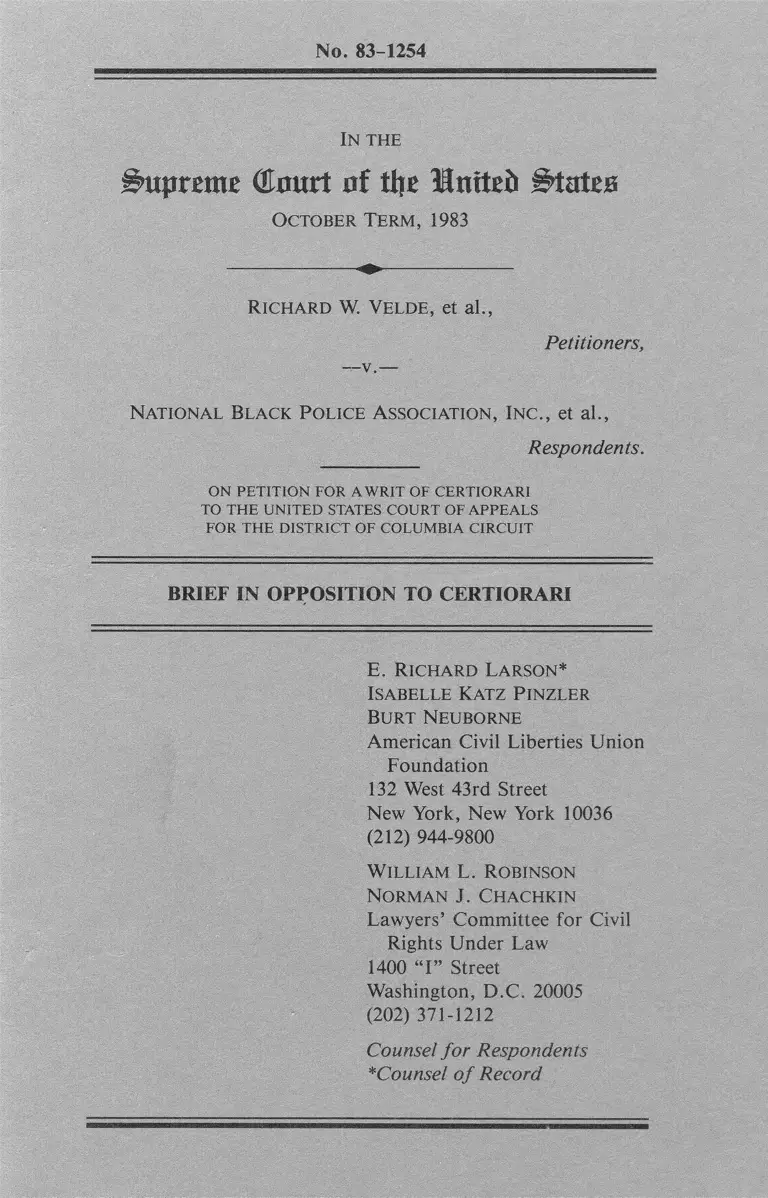
No. 83-1254
In the
Bnpvzmz Court of tljr Mnxtzb ^tatro
October Term , 1983
Richard W. Velde, et aL,
Petitioners,
National Black Police Association, Inc ., et al.,
Respondents.
ON PETITION FOR A WRIT OF CERTIORARI
TO THE UNITED STATES COURT OF APPEALS
FOR THE DISTRICT OF COLUMBIA CIRCUIT
BRIEF IN OPPOSITION TO CERTIORARI
E. Richard Larson*
Isabelle Katz P inzler
Burt Neuborne
American Civil Liberties Union
Foundation
132 West 43rd Street
New York, New York 10036
(212) 944-9800
William L. Robinson
Norman J. Chachkin
Lawyers’ Committee for Civil
Rights Under Law
1400 “I” Street
Washington, D.C. 20005
(202) 371-1212
Counsel fo r Respondents
*Counsel o f Record
QUESTIONS PRESENTED
Respondents — the National Black Police
Association and twelve discriminated-against
individuals — alleged in their complaint
that petitioners willfully and maliciously
refused to enforce any of their constitu
tional and statutory civil rights enforcement
obligations, including petitioners' constitu
tional and statutory obligation to terminate
federal grants to state and local police
departments which petitioners knew were
practicing discrimination. The questions
sought to be presented to this Court are:
1. Did respondents state a claim for
relief under the Fifth Amendment by alleging
that petitioners "willingfully and malicious
ly" provided funding to grantees known to be
discriminatory?
2. Are petitioners, who are alleged to
have "willfully and maliciously" provided
funding to grantees known to be dis
1
criminatory, entitled to qualified immunity
from any liability for damages on the ground
that their alleged conduct did not violate
any clearly established constitutional
rights?
3. Are petitioners, who adopted and
followed a policy of never terminating fund
ing to grantees known to be discriminatory,
entitled to absolute immunity on the ground
that they performed discretionary functions
analogous to those of a prosecutor?
4. May respondents seek damages for
petitioners' across-the-board refusal to
carry out their mandatory enforcement
obligations under § 518(c)(2) of the Crime
Control Act, as amended in 1973?
5. Do respondents, who alleged injury
and causation/redressability, have Art. Ill
standing to mantain this lawsuit?
TABLE OF CONTENTS
Page
QUESTIONS PRESENTED...... ................. i
STATEMENT. .............. .1
REASONS WHY THE WRIT SHOULD BE DENIED.....3
CONCLUSION........................... 22
TABLE OF AUTHORITIES
Cases
Butz v. Economou, 437 U.S. 478
(1978).................................. ..
Coit v. Green, 404 U.S. 997
(19 71) , sum_. af f 1 g sub nom
Green v." ConnalTy, '330 "F.
Supp. 1150 (D.D.C. 1971)................ 9
Cooper v. Aaron, 358 U.S. 1
(1958) ............ 8
Duke Power Co. v. Carolina
Environmental Study Group,
438 U.S . 59 (1978)...................... 18
Escambia County v. McMillan,
No. 82-1295 (U.S. March 27,
1984) ..................................... .
Gilmore v. Montgomery, 417
U.S. 5 56 ( 1974 )........
- i i i -
9, 18
Page :
Gomez v, Toledo, 446 U.S.
635 (1980).............................
Harlow v. Fitzgerald, 457
U.S . 800 (1982)... ........ . . .4 , 7 , 8 ,
Norwood v. Harrison, 413
U.S . 455 ( 1973) ........... ......... « *
Velde v. National Black
Police Association, 458
U.S. 591 (1982) ..... ....If 2, 4, 12,
Watt v. Energy Action Edu
cational Foundation, 454
U.S. 151 (1981)........................
. .6
10
18
20
.21
IV
STATEMENT
Most of petitioners' mischaracteriza-
tions of respondents' claims, and of the
prior proceedings in this case, were
addressed when this case was previously
before the Court. See Br. for Resps. at 1-
10 r Velde v. National Black Police Associa
tion, 458 U.S. 591 (1982) (No. 80-1074). A
few additional comments nonetheless are in
order here.
First, respondents nowhere alleged in
their complaint "that petitioners took many
steps to enforce [petitioners'] civil rights
obligations." Cert. Pet. at 7. To the
contrary, respondents repeatedly alleged in
their complaint that petitioners willfully
and maliciously refused to enforce any of
their constitutional and statutory civil
rights enforcement obligations including
their constitutional and statutory obligation
to terminate federal grants to state and
1
local police departments which petitioners
knew were practicing discrimination. J.A.
11-4 5
Second,
duplicated by
investigations
Branch and by
trial court's
discovery in
respondents'
respondents' allegations were
the findings of subsequent
conducted by the Executive
Congress JL/ And, despite the
denial to respondents of all
this case, J.A. 1-3 , 341-45 ,
allegations nevertheless were
1 "J.A." refers to the Joint Appendix filed when
this case was previously before this Court, see Velde
v. National Black Police Ass'n, 458 U.S. 591 (1982)
(No. 80-1074).
2. The congressional findings documenting peti
tioners' blatant disregard of their civil rights
enforcement obligations are summarized in the Br. for
Resps. at 1-10, la-24a, Velde v. National Black Police
Ass’n, 458 U.S. 591 (1982) (No. 80-1074).
Findings issued by the Civil Rights Commission
two months after this lawsuit was filed also closely
paralleled the allegations of the complaint. U. S.
Comm'n on Civil Rights, THE FEDERAL CIVIL RIGHTS
ENFORCEMENT EFFORT — 1974 (Vol. VI, To Extend Federal
Financial Assistance) 271-393, 773-77 (1975). The
Commission's report was filed with the district court
as an exhibit to respondents' motion for preliminary
injunction, and relevant portions of the report were
reprinted in the Appendix filed in the court of
appeals, C.A. App. 481-623.
2
well supported by documents in the record
which had been obtained from petitioners
under the Freedom of Information Act prior to
the filing of .this lawsuit.-^
Finally, although the proceedings in
this case admittedly have been lengthy, the
delay has harmed not petitioners but respon
dents . Moreover, respondents submit that
protraction has been caused by petitioners'
repeated raising of new and alternative,
insubstantial arguments which never were
ruled on by the trial court.
REASONS WHY THE WRIT SHOULD BE DENIED
Several of the questions presented by
petitioners here were presented to this Court
two Terms ago in this case, Velde v. National
3. Many of these FOIA documents were filed by res
pondents in in support of their motion for a preli
minary injunction and writ of mandamus, J.A. 46-233,
and in support of respondents' opposition to peti
tioners' motion to dismiss or for summary judgment,
J.A. 340-494.
- 3 -
Black Police Association, 458 U.S. 591 (1982)
(No. 80-1074) (Powell and Stevens, JJ., not
participating), see Cert. Pet. App. 34a. The
questions did not warrant rulings from this
Court, and the case instead was remanded on
the issue of qualified immunity "for further
consideration in light of Harlow v. Fitzge
rald, 457 U.S. 800 (1982)." Id.
Several of the other questions presented
by petitioners, now as before, were never
ruled on by the trial court and were not
decided by the court of appeals in either its
initial decision or in its remand decision.
Especially in light of this procedural
posture, there are no substantial questions
which merit plenary review.
1. Petitioners seek review of a ques-
tion never addressed by any of the lower
courts in this case: whether the comp 1 a i n t
states a claim under the Fifth Amendment.
- 4
Petitioners argue that respondents never
alleged "that petitioners acted with discri
minatory intent" and that the complaint
accordingly "does not state a claim under the
Constitution." Cert. Pet. at 12.
a. This question was never ad-
dressed by the trial court in this case, nor
was it add ressed by the court of appeals in
either of its two decisions below,. As sum-
marized by the court of appeals in its remand
decision:
The district court has not yet
[respondents'] corn-ruled whether
plaint states a claim upon which
relief can be granted. We did not
address this issue in our first
opinion, and the issue has not been
briefed for us. We therefore do
not view the issue as properly pre
sented for our decision in the
present posture of this case.
Cert. Pet. App. 7a note 27. For the same
reasons, the issue is not now properly pre
sented to this Court.-!/
4. Petitioners' insistence upon seeking review of a
question never decided below belies their purported
[cont'd. on next pg]
5
b. The question also is improper
ly presented as it is premised upon peti
tioners' extensive mischaracterization of the
explicit language of the complaint, which
alleges that petitioners' unconstitutional
actions were "willful and malicious." J.A.
44. The complaint not only contains an
explicit elaboration of the manner in which
petitioners were alleged to have been "acting
unconstitutionally and in excess of their
authority," see J.A. 41-43, but also includes
repeated references to petitioners' knowing
refusals to alter their discriminatory
policies and practices, see, e .g. , J.A. 21-
41. Respondents, through their unavailing
contacts with petitioners, had every reason
to believe that petitioners' unconstitutional
concern about the length of the proceedings in this
case, in which petitioners have succeeded in blocking
all proceedings in the trial court for more than eight
years. "[I]n any event, [the] question [now raised]
should be decided in the first instance by the" courts
below. Escambia County v. McMillian, No. 82-1295,
slip op. at 4 (U.S. March 27, 1984) (per curiam).
- 6
conduct was "willful and malicious, and so
they alleged. J.A. 44. No greater
specificity in pleading is required. Cf ♦
Gomez v. Toledo, 446 U.S. 635 (1980).
2 . Petitioners ask this Court to
review the question which the court of
appeals decided on remand in light of Harlow
v. Fitzgerald, 457 U.S . 800 (1982) : whether
petitioners had "'clearly established' . . .
constitutional duties to terminate federal
funds to local law enforcement agencies
allegedly known to be discriminating unlaw
fully on the basis of race and sex." Cert.
Pet. App. 2a. Based upon a long line of this
Court's decisions dating from 1958, the court
of appeals recognized that "it is a clearly
established principle of constitutional law
that the federal government may not fund
local agencies known to be unconstitutionally
discriminating," Cert. Pet. App. 20a, and
7
held that petitioners accordingly were not
entitled to qualified immunity on summary
judgment under Harlow. Petitioners, who do
not directly dispute that the governing con
stitutional principles had been clearly
established, have presented no substantial
issue here .
a. In Harlow, this Court held
that "government officials performing discre
tionary functions" are not entitled to quali
fied immunity where they are alleged to
violate "clearly established statutory or
constitutional rights of which a reasonable
person would have known." 457 U.S. at 818.
There can be no question here that clearly
established constitutional principles bar
government officials not only from engaging
in direct discrimination but also from
providing government "support" to discrimina-
t ion "through any arrangement, management,
funds or property." Cooper v. Aaron, 358
8
U.S. 1, 19 (1958). As Chief Justice Burger
unequivocally reiterated for the unanimous
Court in Norwood v. Harrison, 413 U.S. 455 ,
467 (1973), a government agency's "constitu
tional obligation requires it to steer clear
. . . of giving significant aid to institu
tions that practice racial or other invidious
discrimination." See also Gilmore v. Mont
gomery , 417 U.S. 556 (1974); Coit v . Green,
404 U.S. 997 (1971), sum, aff'g sub nom Green
v. Connally, 330 F. Supp. 1150 (D.D.C. 1971).
Petitioners, who not only served as law en
forcement officials but also were lawyers, do
not seriously dispute that the foregoing
decisions clearly established petitioners'
constitutional obiigat ions. Cert. Pet. at
17-19. The court of appeals' proper
application of these decisions through the
objective test in Harlow is unassailable /
5. Although petitioners complain that the court of
appeals' decision does not provide adequate guidance
to federal officials who seek to avoid liability,
[cont'd. on next pg]
9
b Qualified immunity is also
unavailable to petitioners as they did not
and cannot meet the threshold Harlow
requirement of exercising "discretionary
functions." 457 U.S. at 818. As the court
of appeals recognized in its first decision
below, in view of petitioners' mandatory
statutory duties under § 518(c)(2) of the
Crime Control Act, 42 U.S.C. § 3766(c)(2)
(Supp. V 1974), see infra at 11-13, peti
tioners had "virtually no discretion under
the relevant statute in deciding whether to
terminate LEAA funding to discriminatory
recipients." Cert. Pet. App. 39a. In fact,
the "mandatory language" of the statute, when
Cert. Pet. at 17-19, we fail to understand how federal
enforcement officials can mistake the meaning of the
court of appeals' decision or of the decisions of this
Court in the context of this case. Petitioners, after
all, were alleged to have willfully and maliciously
provided funding to known discriminators, and peti
tioners' own discriminatory actions were well docu
mented by findings made by Congress and by the U.S.
Commission on Civil Rights, see supra at 2 note 2, as
well as through FOIA materials in the record of this
case, see supra at 3 note 3.
10
read in conjunction with petitioners' "con
stitutional . . . duty not to allow federal
funds to be used in a discriminatory manner
by recipients, takes [petitioners'] civil
rights enforcement duties outside the realm
of discretion." Id. at 40a note 15; see also
id. at 13a-20a. This lack of discretion also
takes petitioners outside of the realm of
qualified immunity under Harlow.
3. Ignoring their nondiscretionary
statutory mandate, petitioners urge this
Court to review yet again whether all of the
petitioners should have been accorded abso
lute immunity based on this Court's allowance
of prosecutorial immunity in Butz v.
Economou, 4 38 U.S. 478, 515 (1978), to those
specific agency officials who enjoy "broad
discretion in deciding whether a [civil
penalty] proceeding should be brought and
what sanctions should be sought." Two Terms
ago in this case, this Court declined to
11
adopt petitioners' identical argument and
thereby declined to disturb the court of
appeals' rejection of that argument. Cert.
Pet. App. 34a. No substantial question is
presented here.
a. The nondiscretionary enforce
ment obligations imposed upon petitioners by
their governing statute, § 518(c)(2) of the
Crime Control Act, precluded petitioners from
claiming prosecutorial immunity. in enacting
§ 518(c)(2), Congress used language quite
different from that in other statutes such as
Title VI of the Civil Rights Act of 1964, and
instead mandated the use of fund termination
proceedings against grantees not in compli
ance with the statute's nondiscrimination
requirements _§/ By specifying that such pro-
6. As the court of appeals explained: "The broad
discretion over enforcement methods provided by Title
VI is in sharp contrast to the mandatory language of
the Crime Control Act." Cert. Pet. App. 13a.
The mandatory language of the Crime Control Act
and the circumstances which compelled Congress to
impose this uniquely stringent mandate are set forth
at considerable length in the court of appeals1 remand
[cont'd. on next pg]
12
ceedings must be brought against grantees
found to be discriminatory, Congress express
ly denied petitioners any "broad discretion
in deciding whether a proceeding should be
brought." 438 U.S. at 515. Petitioners
similarly had no discretion to decide "what
[civil penalty] sanctions should be sought,"
id ., since § 509 of their statute provided
only for the termination of the "federal
payments" which the noncomplying grantees
were not eligible for in the first place. As
the court of appeals succinctly concluded in
direct response to petitioners' argument:
"The purpose of shielding discretionary
prosecutorial decisions from fears of civil
liability has no place where, as here, agency
officials lack discretion." Cert. Pet. App.
39a; see also id. at 13a-20a.
decision, Cert. Pet. App. 13a-20a, and in its initial
decision, id. at 38a-40a. See also Br. for Resps. at
1-10, 16-29, la-24a, Velde v. National Black Police
Ass1n, 458 U.S. 591 (1982) (No. 80-1074).
13
b. The record here also bars
petitioners' claim of prosecutorial immunity
since the record establishes both that peti
tioners denied themselves all discretion and
that they in fact never exercised any prose
cutorial functions. First, and directly
contrary to their statutory mandate requiring
administrative action prior to pursuit of
judicial relief, petitioners strictly adhered
to an administrative regulation interpreted
by petitioner Richard Velde to "require LEAA
to pursue court action and not administrative
action to resolve matters of employment dis
crimination." J . A . 90. Second, in their
pre-Butz affidavits filed in the trial court,
none of the petitioners anywhere claimed to
have any prosecutorial functions much less
either the authority or the responsibility
for refusing to initiate administrative fund
termintion proceedings. J.A. 236-64.
Instead, petitioners uniformly described
themselves only as administrators. Id.
14
Under But 2 they accordingly are entitled to
no more than qualified immunity.
4. Petitioners next ask this Court to
review another question now raised for the
first time in this litigation: "whether
respondents may pursue a personal damages
remedy against petitioners on the basis of
the Crime Control Act alone." Cert. Pet. at
22-23 .
a. Since petitioners never moved
to dismiss respondents' complaint on this
ground, J.A. 234-35, and since this question
accordingly was never addressed by the trial
court or by the court of appeals in either of
its decisions, petitioners in effect seek an
advisory opinion from this Court on a matter
which has never been properly placed in
issue. If petitioners truly desire a ruling
on respondents' statutory cause of action,
petitioners on remand may file an appropriate
motion to dismiss with the trial court. The
15
issue simply is not properly presented here
in the posture of this case. See supra at 5-
6 & note 4.
b. Apart from their request for
review of a question never before raised in
this case, petitioners provide no legal sup
port for their view that respondents lack a
cause of action under the Crime Control
Act. To the contrary, respondents fully
satisfy each of the four criteria in Cort v.
Ash, 422 U.S. 66, 78 ( 1975). Additionally,
since Congress subsequently recognized the
pendency of this lawsuit, approved of such
actions, and preserved the implied right of
7 /action— when it amended § 518(c) of the
Crime Control Act in 1976, respondents' cause
of action is confirmed by the "contemporary
legal context" in which Congress
legislated. Cannon v. University of Chicago,
7. See H.R. Rep. No. 155, 94th Cong., 2d Sess. 11,
27 (1976); see also LEAA Hearings Before the Subcomm.
on Crime of the House Comm, on the Judiciary, 94 th
Cong., 2d Sess. 491-516 (1976).
16
441 U.S. 677 , 698-99 (1979) ; see generally
Merrill Lynch, Pierce, Fenner & Smith v.
Curran, 456 U.S. 353, 374-88 (1982).
5. Petitioners lastly seek review of
the holding below that respondents have Art.
Ill standing to maintain this action. Con
trary to petitioners' assertion, Cert. Pet.
at 9 note 8, there was no disagrement among
the appellate judges below that the allega
tions in the complaint were sufficient to
establish respondents' standing, Cert. Pet.
App. 2a note 3, 40a note 16, 42a-48a. Addi
tionally, although respondents' standing was
previously at issue before this Court — and
comprised the bulk of oral argument!/ — the
court of appeals' initial decision upholding
respondents' standing was not disturbed by
this Court. Cert. Pet. App. 34a. Peti-
8* See Oral Arg. Trans. 4-8, 18, 26-30, 34-35, 37,
41, 43-44.
17
t ioners advance no persuasive just if ications
for revisiting the question now,
a. As consistently alleged in
this case, respondents were injured by peti
tioners' refusals to carry out their consti
tutional and statutory civil rights obliga
tions and by petitioners' consequent funding
of grantees which were also discriminating
against respondents. See J.A. 18-41. As in
Norwood v. Harrison, 413 U.S. 455 (1973), the
alleged violations by petitioners caused the
injuries which respondents assert; and,
similarly, the relief sought by respondents
(injunctive relief and damages) would remedy
and compensate for the injuries caused by
petitioners' transgressions. Respondents
here — in a position no different from that
of the plaintiffs in Norwood and in Gilmore
v. Montgomery, 417 U.S. 556 (1974) — more
than adequately alleged the injury and causa-
tion/redressability necessary to establish
18
their standing. Duke Power Co. v. Carolina
Environmental Study Group, 438 U.S. 59, 72
( 1978) .
b. Even under petitioners' mis
taken view of this case (as one in which
respondents' only injury was caused not by
petitioners' own Norwood violations but
instead solely by the discrimination prac
ticed by petitioners' grantees, Cert. Pet. at
23-25) , respondents have also met the injury
and causation/redressability requirements of
Art. III. As Judge Tamm stated in his
separate opinion when the court of appeals
first considered this case, Cert. Pet. App.
42a-48a, respondents' complaint was adequate
to survive petitioners' motion to dismiss
since respondents had to be allowed discovery
to show that the actual or even threatened
termination of funding to petitioners' dis
criminatory grantees would effect nondis-
criminatory behavior by the grantees.
19
Even
without discovery in this case, not only is
the power of fund termination well docu
mented, see Br. for Resps. at 40-42, Velde v.
National Black Police Association, 458 U.S.
591 (1982) (No. 80-1074), but the actual
existence here of injury and causation/re-
dressabil ity is in fact established in the
record in this case with regard to petitioner
Joel Michelle Schumacher ,-2/ The standing of
9. Respondent Schumacher, who had been denied
employment by the New Orleans Police Department
because she was a female, alleged in the complaint
that she had "been discriminated against by the
[petitioners] through their provision of and refusal
to terminate their LEAA funding to the New Orleans
Police Department, despite the [petitioners'] know
ledge that the Department has discriminatorily denied
employment to [respondent] Schumacher." J.A. 34.
At the time the complaint was filed — in Septem
ber, 1975 — petitioners had never invoked or even
threatened to invoke the mandatory fund termination
proceedings against discriminatory grantees. J.A.
21. Subsequent to the filing of this lawsuit, how
ever , petitioners began to change their posture of
nonenforcement. One such instance, revealed in the
record in this case, establishes respondent Schu
macher's standing under petitioners' own narrow
theory.
Subsequent to the filing of this lawsuit, and
substantially after petitioners had found the New
Orleans Police Department to be illegally engaged in
sex discrimination, petitioner Herbert Rice advised
[cont'd. on next pg]
20
one respondent thus having been affirmatively
established beyond peradventure, respondents'
complaint may not now be dismissed. Watt v.
Energy Action Educational Foundation, 454
U.S. 151, 160 (1981 ) .
the Superintendent of Police that without the imme
diate elimination of the discrimination petitioners
"will be forced to initiate administrative proceedings
to terminate funding to your Department." Within
weeks, the Superintendent of Police responded to
petitioner Rice that the discrimination was being
eliminated solely because of the proposed "cancella
tion of all LEAA fundings to this Department," and in
fact "under duress, namely, the threatened cancella
tion of LEAA fundings to this Department." See
Attachments N.O.-9 and N.O.-IO appended to the State
ment of Reasons and Appendix filed in the district
court in support of Defendants' Motion to Dismiss or
for Summary Judgment.
21
CONCLUSION
No substantial issues warranting further
briefing or oral argument have been raised by-
petitioners. The writ of certiorari should
be denied.
Dated: April 6, 1984
Respectfully submitted,
E. RICHARD LARSON*
ISABELLE KATZ PINZLER
BURT NEUBORNE
American Civil Liberties
Union Foundation
132 West 43rd Street
New York, New York 10036
212/944-9800
WILLIAM L. ROBINSON
NORMAN J. CHACHKIN
Lawyers' Committee for Civil
Rights Under Lav/
1400 "I" Street
Washington, D.C. 20005
202/371-1212
Counsel for Respondents
*Counsel of Record
22
RECORD PRESS, INC., 157 Chambers St., N.Y. 10007 (212) 243-5775