Plaintiffs' Brief in Opposition to Motion to Dismiss
Public Court Documents
March 3, 1975
17 pages
-
Case Files, Milliken Hardbacks. Plaintiffs' Brief in Opposition to Motion to Dismiss, 1975. e4089444-54e9-ef11-a730-7c1e5247dfc0. LDF Archives, Thurgood Marshall Institute. https://ldfrecollection.org/archives/archives-search/archives-item/a6e31b2c-4082-4d07-a2c1-99e4a2e64cc9/plaintiffs-brief-in-opposition-to-motion-to-dismiss. Accessed October 07, 2026.
Copied!
#
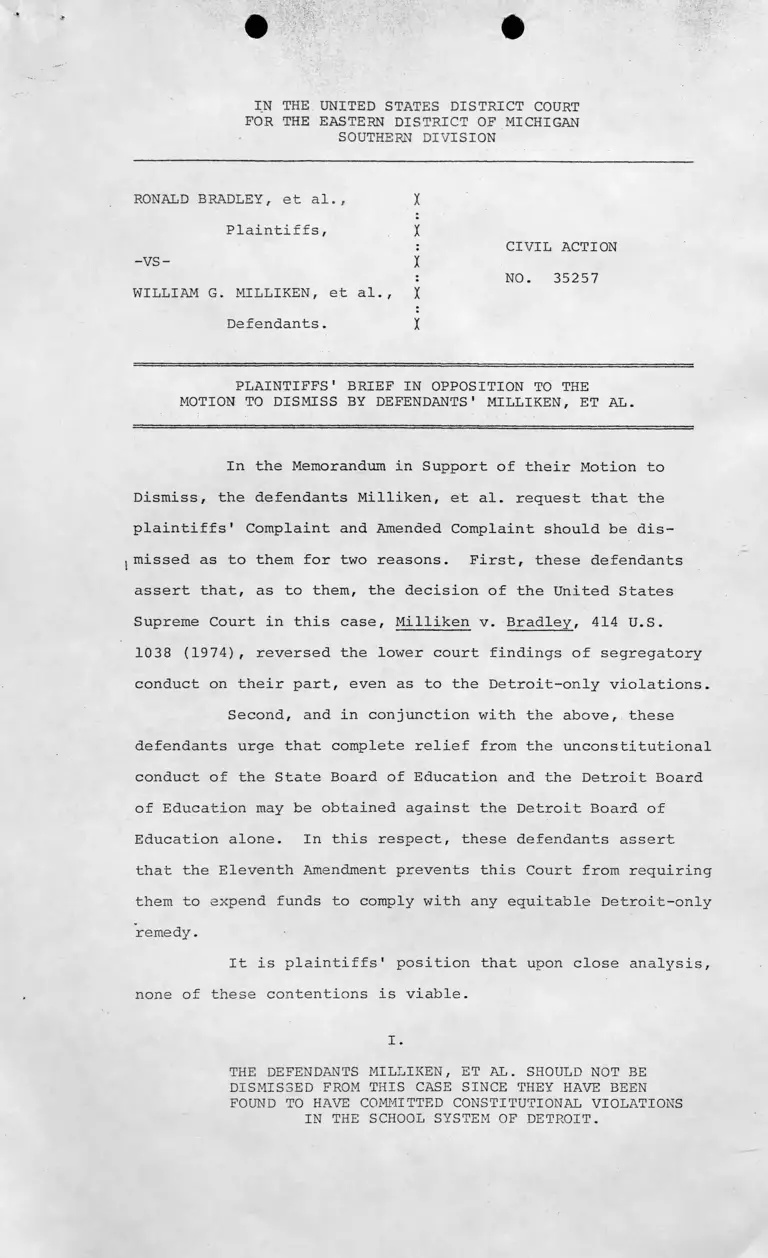
IN THE UNITED STATES DISTRICT COURT
FOR THE EASTERN DISTRICT OF MICHIGAN
SOUTHERN DIVISION
RONALD BRADLEY, et al., X
Plaintiffs,
»
X
• CIVIL ACTION
-VS- X
: NO. 35257
WILLIAM G. MILLIKEN, et al., X
Defendants.
•
X
PLAINTIFFS 1 BRIEF IN OPPOSITION TO THE
MOTION TO DISMISS BY DEFENDANTS' MILLIKEN, ET AL.
In the Memorandum in Support of their Motion to
Dismiss, the defendants Milliken, et al. request that the
plaintiffs' Complaint and Amended Complaint should be dis
missed as to them for two reasons. First, these defendants
assert that, as to them, the decision of the United States
Supreme Court in this case, Milliken v. Bradley, 414 U.S.
1038 (1974), reversed the lower court findings of segregatory
conduct on their part, even as to the Detroit-only violations.
Second, and in conjunction with the above, these
defendants urge that complete relief from the unconstitutional
conduct of the State Board of Education and the Detroit Board
of Education may be obtained against the Detroit Board of
Education alone. In this respect, these defendants assert
that the Eleventh Amendment prevents this Court from requiring
them to expend funds to comply with any equitable Detroit-only
remedy.
It is plaintiffs' position that upon close analysis,
none of these contentions is viable.
I.
THE DEFENDANTS MILLIKEN, ET AL. SHOULD NOT BE
DISMISSED FROM THIS CASE SINCE THEY HAVE BEEN
FOUND TO HAVE COMMITTED CONSTITUTIONAL VIOLATIONS
IN THE SCHOOL SYSTEM OF DETROIT.
• #
A.
The district court opinion found the following con
stitutional violation to have been committed by the State
defendants as to Detroit-only violations:
The State and its agencies, in addition
to their general responsibility for and
supervision of public education, have acted
directly to control and maintain the pattern
of segregation in the Detroit schools. The
State refused, until this session of the
legislature, to provide authorization or
funds for the transportation of pupils within
Detroit regardless of their poverty or distance
from the school to which they were assigned,
while providing in many neighboring, most white,
suburban districts the full range of state
supported transportation. This and other fi
nancial limitations, such as those on bonding
and the working of the state aid formula where
by suburban districts were able to make far
larger per pupil expenditures despite less tax
effort, have created and perpetuated systematic
educational inequalities.
The State, exercising what Michigan courts
have held to be in "plenary power" which includes
5 power "to use a statutory scheme, to create,
alter, reorganize or even dissolve a school dis
trict, despite any desire of the school district,
it's board, or the inhabitants thereof," acted
to reorganize the school district of the City of
Detroit.
The State acted through Act 48 to impede,
delay and minimize racial integration in Detroit
schools. The first sentence of Sec. 12 of the
Act was directly related to the April 7, 1970 de
segregation plan. The remainder of the section
sought to prescribe for each school in the eight
districts criterion of "free choice" (open enroll
ment) and "neighborhood schools" ("nearest school
priority acceptance"), which had as their purpose
and effect the maintenace of segregation.
In view of our findings of fact already noted,
we think it unnecessary to parse in detail the
activities of the local board and the state authori
ties in the area of school construction and the
furnishing of school facilities. It is our con
clusion that these activities were in keeping,
generally, with the discriminatory practices which
advanced or perpetuated racial segregation in
these schools.
Bradley v. Milliken, 338 F.Supp 582, 589 (1971).
These findings were repeated verbatim and affirmed
by the en banc opinion of the Sixth Circuit Court of Appeals.
Bradley v. Milliken, 484 F.2d 215, 238-39 (6th Cir. 1973).
2-
As the Sixth Circuit concluded:
The discriminatory practices on the
part of the Detroit School Board and the
State of Michigan revealed by this record
are significant, pervasive and causally re
lated to the substantial amount of segrega
tion found in the Detroit school system by
the District Judge. Bradley v. Milliken,
supra, at 241.
The Opinion of the United States Supreme Court
stated:
"[t]he District Court also found that
the State of Michigan had committed several
constituional violations with respect to
its general responsibility for and super
vision of public education." Milliken v.
Bradley, 414 U.S. 1038, 41 L.Ed.2d 1069,
1081 (1974). (Footnote omitted).
More significantly, the Supreme Court stated:
School districts in the State of Michigan
are instrumentalities of the State and sub
ordinate to its State Board of Education and
legislature. The Constitution of the State of
j Michigan, Art. VIII, §2, provides in relevant
part: "The legislature shall maintain and
support a system of free public elementary and
secondary schools as defined by law." Similarly,
the Michigan Supreme Court has stated that "the
school district is a state agency. Moreover, it
is of legislative creation...." Attorney General
v. Aoweey, 131 Mich. 639 , 644 , 92 NW 2 8 9', 290
(1902); "Education in Michigan belongs to the
State. It is no part of the local self-government
inherent in the township or municipality, except
so far as the legislature may choose to make it
such. The Constitution has turned the whole
subject over to the legislature...." Attorney
General v. Detroit Board of Education, 154 Mich.
584, 590, 118 NW 606, 609 (1908).
Milliken v. Bradley, ___ U.S. ____, 41 L.Ed.2d 1069 , 1081
n. 5 (1974).
The Supreme Court then catalogued the findings of
the Court of Appeals with respect to the States* violations.
See Milliken v. Bradley, ___ U.S. ____, 41 L.Ed.2d 1069 , 1085
n. 16 (1974). Only after these recitals and in the context of
considering the appropriateness of metropolitan relief, the
Supreme Court stated:
"[0]ur assumption, arguendo... that
state agencies did participate in the main
tenance of the Detroit system, should make
3
• #
it is clear that it is not on this point
that we part company." Milliken v.
Bradley, U.S. , 41 L.Ed.2d 1069,
1092 (197471
Thus, the Opinion of the Supreme Court does not
support the contention of the State defendants that the Court
reversed the findings of constitutional violations against
the defendants Milliken, et al. In fact, the Supreme Court
accepted the findings of the district court and the Sixth Cir
cuit with respect to the state involvement in the Detroit-only
violation.
The State defendants attempt to tie the logic of
their reasoning to speculation as to the Supreme Court's action
denying plaintiffs motion to require each party to bear its
own costs in that Court merely demonstrates the slender reed
on which their argument rests. Speculation of this sort is
perhaps as weak as speculation as to the Court's reasons for
,the denial of a petition for certiorari.
The State defendants' central role in this litigation
is highlighted by the history of the case and Michigan's brand
of interposition. The Michigan Legislature enacted and the
Governor signed into law, Act 48, Public Acts of 1970. The
effect of Section 12 of this Act was to rescind for at least
one year, the attempt made by the Detroit Board of Education
to achieve integration in some of its high schools. The Sixth
Circuit stated: " [w]e hold §12 of Act 48 to be unconstitu
tional and of no effect as violative of the Fourteenth Amend
ment." Bradley v. Milliken, 433 F.2d 897, 904 (1970). This
holding was not overturned by the Supreme Court. See Milliken
v. Bradley, ____ U.S. , 41 L.Ed.2d 1069, 1094(1974).
— In fact they quite deliberately fail to advise this
Court that they made almost the precise same argument to the
Sicth Circuit, with respect to what they thought the cost dis
pute and result in the Supreme Court meant. They sought to
have the Sixth Circuit retax costs in that Court (it has pre
viously ordered each side to bear its own costs). On December
20, 1974, the Sixth Circuit, en banc without a single dissent
rejected their view and refused to retax costs. A copy of the
opinion is attached hereto as Exhibit A.
-4-
# #
These state defendants are as necessary now to
the relief state of the proceedings in this case as when the
Sixth Circuit determined them to be "proper parties" in 1970.
See' Bradley v. Milliken, 433 F.2d 897, 905 (6th Cir. 1970).
In that appeal the district court, on these same defendants'
motion, dismissed them as parties. Plaintiffs appealed and
argued that at the very least they might be needed for relief.
We pointed out then and now that many times the Courts have
been required to add State officials as parties to insure
compliance with its orders in school cases. Just as Judge
Roth, when it came time to order the purchase of transportation
equipment, or require other payments by State defendants,
found it necessary to add the State Treasurer, Allison Green,
so too this Court will require the presence of State defendants
as parties. If any one of them were to be let out of the case,
and this Court then decided they were needed to assist in
9remedy, these same lawyers would scream that due process was
violated in that an order had been entered which affected
them at a time they were not parties. What defendants would
have this Court do is fall into a trap so that the defendants
might fill their "error bag." 2/
THE ELEVENTH AMENDMENT DOES NOT BAR THE PAR
TICIPATION OF THE DEFENDANTS MILLIKEN, ET AL.
IN EQUITABLE RELIEF FROM CONSTITUTIONAL VIOLATIONS.
These defendants also assert that the Eleventh
Amendment prohibits the expenditure of public funds from the
State Treasury, in order to comply with orders of a Federal
Court. See Edelman v. Jordan, 415 U.S. 657 (1974). Appar
ently, at this juncture, the defendants Milliken,et al. are
— The record reflects the Governor is an ex officio
member of the State Board of Education. He signed Act 48 into
law and he, after the recall of Detroit Board members, ap
pointed a majority of the interim members of that Board. Act
48, of course, not only rescinded the Board’s plan for pupil
assignment, it rescinded integrated regions and set up segre
gated regional boundaries. It also set up segregation by
pupil assignment methods. Bradley, supra, 433 F.2d 897, 901
(1970) .
-5
#
anticipating an order against them for the purchase of bus
ses or other expenditures to implement the future Detroit-
only remedy.
These defendants conclude from Edelman that:
[I]t is crystal clear, based on the
authority of Edelman' v. Jordan, supra, that
where, as here, the State of Michigan has not
consented to this suit in federal court, the
federal courts may not compel defendants
Milliken, et al. to provide State funds from
the State Treasury to pay for the acquisition
of busses for a Detroit-only desegregation
remedy. Brief of Defendant Milliken, et al.,
in support of their Motion to Dismiss, at 11.
These defendants, however, have overlooked the
important distinction the Court made in Edelman with respect
to prospective relief. After discussing a series of cases,
the Court concluded:
But the fiscal consequences to state
treasuries in these cases were the necessary
I result of compliance with decrees which by
their terms were prospective in nature.
State officials, in order to shape their of
ficial conduct to the mandate of the Court's
decrees, would more likely have to spend
money from the state treasury than if they
had been left free to pursue their previous
course of conduct. Such an ancillary effect
on the state treasury is a permissible and
often an inevitable consequence of the
principle announced in Ex parte Young, supra.
Edelman v. Jordan, U.S. , 39 L.Ed.2d
662, 675 (1974).
The argument of the defendants Milliken, et al. that
the Eleventh Amendment precludes Federal courts from compel
ling the payment of State funds from the State Treasury is
based on a misapprehension of the jurisdictional nature of the
Amendment. The Eleventh Amendment provides:
The judicial power of the United States
shall not be construed to extend to any suit
in law or equity, commenced or prosecuted
against one of the United States by Citizens
of another State, or by Citizens or Subjects
of any Foreign State.
The Amendment was proposed by the Congress and ratified by the
states in response to the Supreme Court's decision in Chisolm
v. Georgia, 2 Dali. 419 (1793), in which the Court held that
6
# #
federal jurisdiction under Article III of the Constitution,
encompassed a suit brought against a non-consenting state by
citizens of another state. Thus the Eleventh Amendment was
intended to clarify the intent of the Framers of the Consti
tution and to restrict the language of Article III, Section 2
which states that the federal judicial power shall extend to
"controversies... between a state and citizens of another
state."
The Eleventh Amendment limitation on suits against
states is different than the limitations arising under the
common law doctrine of sovereign immunity. While sovereign
immunity, where it applies, protects states from suit in any
forum absent consent, the Eleventh Amendment merely places
jurisdiction limitations on federal courts. Justice Marshall,
in his concurring opinion in Employees v. Department of Public
Health and Welfare, 411 U.S. 279, 294 (1973), articulatedI
this distinction:
The root of the constitutional im
pediment to the exercise of the federal
judicial power in a case such as this is
not the Eleventh Amendment but Art. Ill of
our Constitution....
■k k *
This limitation upon the judicial
power is, without question, a reflection
of concern for the sovereignty of the States,
but in a particularly limited context. The
issue is not the general immunity of the
States from private suit - a question of the
common law - but merely the susceptibility
of the States to suit before federal tribunals.
In Edelman v. Jordan, U.S. , 39 L.Ed.2d 662
(T974), the Court underscored the jurisdictional nature of the
3/Eleventh Amendment.
3/
...[I]t has been well-settled since
the decision in Ford Motor Co. v. Department
of Treasury, [323 U.S. 459 (1945)] that the
Eleventh Amendment defense sufficiently par
takes of the nature of a jurisdictional bar
so that it need not be raised in the trial
court. Edelman, supra, at 39 L.Ed.2d 681.
-7
• •
One limited purpose of the Eleventh Amendment is
to minimize the tensions of federalism "inherent in making
one sovereign appear against its will in the courts of the
other." Employees v. Department of Public Health and Welfare,
supra, 411 U.S. at 294 (Marshall, J. concurring).
The very object and purpose of the
11th Amendment were to prevent the indig
nity of subjecting a State to the coercive
process of judicial tribunals at the instance
of private parties. It was thought to be
neither becoming nor convenient that the
several states of the Union, invested with
that large residuum of sovereignty which had
not been delegated to the United States,
should be summoned as defendants to answer
the complaints of private persons, whether
citizens of other states or aliens, or that
the course of their public policy and the ad
ministration of their public affairs should
be subject to and controlled by the mandates
of judicial tribunals without their consent
and in favor of individual interests.
In re Ayers, 123 U.S. 443, 505-06 (1887). The Amendment there-
fpre denies federal courts the jurisdiction to decide certain
rights and liabilities when asserted against a state.
The jurisdictional bar of the Eleventh Amendment is
not absolute, however. A long line of cases, beginning with
Ex parte Young, 209 U.S. 123 (1908), has established that suits
for injunctive relief against state officials may be heard in
federal courts, consistent with the Constitution, where the
complaint is that the official, acting in his capacity as
agent of the state, has engaged in unauthorized or unconstitu
tional conduct. In Ex parte Young, supra, and subsequent
cases, the Supreme Court harmonized this doctrine and the
Eleventh Amendment by holding that such a suit is against the
individual and not against the State, in spite of the fact
that injunctive relief ordered in such cases may require the
4/
expenditure of state funds and other state action.
4/
The Court in Edelman (39 L.Ed.2d 675) explicitly
noted that the kinds of relief authorized by Ex parte Young
would result in the expenditure of state funds:
State officials, in order to shape their
official conduct to the mandate of the Court’s
decrees, would more likely have to spend money
from the State Treasury than if they had been
left free to pursue their previous course of conduct.
-8-
Edelman v. Jordan, supra, marked a clarification
of the doctrine first enunciated in Ex parte Young. In
Edelman the Supreme Court held that while suits for prospec
tive injunctive relief against a state official are not barred
by the Eleventh Amendment, at least certain actions which seek
5/
the award of an accrued monetary liability are prohibited.
The Court found that there were essentially two
causes of action in Edelman: one for injunctive relief, and
one for monetary damages. On the facts before it, the Court
held that federal courts do not have jurisdiction to hear
6/
certain causes of action which closely resemble actions for
5/
It is notable that while the Court in Edelman
prohibits some kinds of monetary awards against states, nowhere
does it state that no form of expenditures may be ordered.
Indeed, the Court specifically recognizes that one of the in
evitable consequences of the adjudication of cases involving
state officials as defendants is that state funds will have to
be expended. The Court points out, however, that, n[s]uch an
ancillary effect on the state treasury is a permissible...
consequence of the principle announced in Ex parte Young,
supra." 39 L.Ed.2d 675.
£/
As Mr. Justice Marshall, in dissenting in Edelman,
noted (39 L.Ed.2d 690 n.2), the facts in Edelman did not pre
sent the question of whether the Fourteenth Amendment in any
way limits, or authorizes the Congress to limit, such immunity
as is conferred by the Eleventh Amendment. See, e.g., Title
VII of the Civil Rights Act of 1964, as amended, 42 U.S.C.
2000e et seq. (Supp. II 1972) which authorizes suits by private
individuals and the United States against state and local
governments (42 U.S.C. 2000e(a)) for relief from employment
discrimination, including back pay (42 U.S.C. 2000e-5). See
also Curtis v. Loether, 415 U.S. 189, 196-197 (1974).
While there are considerations which suggest that the
Eleventh Amendment is limited in part by the Fourteenth, and
that issue must eventually be decided (perhaps in a case seek
ing "damages" for Fourteenth Amendment violations), we do not
feel that the Court must resolve that question to decide the
issue presented in this case. Of course, Section 718 of the
Education Amendments presents this same question in that in
effectuating the Fourteenth Amendment, Congress expressly auth
orized an award of attorney's fees against State school
authorities, cf. Mobil Oil Corp. v. Kelley, 493 F.2d 784
(Fifth Circuit, 1974) n.l at 786; Boston Chapter NAACP, Inc, v.
Beecher, 504 F.2d 1017, 1028-29 (First Circuit, 1974); Woods
v. Strickland, 43 U.S.L.W. 4293 (1975).
-9
monetary damages. "[A] suit that seeks the award of an ac
crued monetary liability which must be met from the general
revenues of a State..." is beyond the jurisdiction of the
federal courts. Edelman v. Jordan, supra, 39 L.Ed.2d 673.
The issue now before this Court is not, as it was
in Edelman, whether the district court had jurisdiction under
Article III of the Constitution, to decide the case. As
noted above, Ex parte Young established and Edelman confirmed
the jurisdiction of federal courts to hear actions for in
junctive relief against state officials. Rather, the question
presented here concerns whether a federal court, having juris
diction to decide a case, may order defendants to take action
which will cost them money. To state the question is to make
plain that Edelman itself has already, in plain and simple
language, answered the question, "yes."
In choosing to defend an action properly brought in
i
a federal forum, defendants must assume responsibility for
the normal incidents of such a suit, including the cost of
prospective relief, Court costs, witness fees, and attorneys'
Vfees.
V Indeed it follows inevitably from the doctrine of
Ex parte Young, 209 U.S. 123 (1908), that states will be
requirecTTo expend funds in the court of litigating suits such
as those now before this Court.
10
#
CONCLUSION
The defendants suggest on the one hand that
they give large sums of money to the Detroit school
district and that it is wealthy compared to other dis
tricts. Such a simplicitic approach to school finance
can only be intentional in light of the extensive exper
ience school authorities throughout the nation have had
with big city systems. Large numbers of dollars may show
but the far higher per pupil costs because of the educa
tion deficits suffered by minority and poor youngsters
together with municipal tax over burden make such figures
entirely misleading. However, the absurdity of their
argument (footnore 2 at page 7 of their supplemental brief)
is shown by the statement that the Detroit district has
cut back on expenditures by "eighty million dollars" and
that their remains a projected "one-hundred and eighty
million dollar deficit that will have . . . to be elimi
nated by both further reductions in expenditures and obtain
ing additional revenue." Somehow or another they leap from
that point to the argument that the State Board and State
Treasurer should have no responsibility for assisting
Detroit in the desegregation process. Not since the French
Revolution has so cavalier a declaration of "let them eat
cake" been made by public officials.
This Court and the parties are faced with a
great responsibility for developing a sound and effective
remedy to desegregate the Detroit public schools within the
limits of the constitutional authority granted by the
United States Supreme Court. Even though such plan may
be on an interim basis, the interests of the children
involved must be paramount. Unfortunately, it would seem
that the state officials have no interest in Detroit’s
children, obviously because so many of them are black.
-11-
• #
In conclusion, plaintiffs respectfully submit that
there is absolutely no basis for the defendants' reading
of the Supreme Court's Decision with respect to the respons
ibilities of state school authorities for constitutional
violations within the Detroit school district. The Supreme
Court has accepted the findings of the District Court and
the Sixth Circuit Court of Appeals with respect to the
state defendants.
Plaintiffs have never suggested that Allison
Green is charged with any of the de_ jure violations. He
was made a party simply because the defendants insisted
that it was necessary in order to obtain an order for pay
ment of state funds for both the desegregation panel and
the purchase of transportation equipment. That order for
purchase of transportation equipment was not directed at
metro relief only. While the order was vacated by the
Sixth Circuit in its en banc decision, it was with the
expressed suggestion that it could be reinstated when it
was necessary. Upon the reinstatement5the defendant Allison
Green will need to remain a party.
One further point illustrates the necessity
for keeping the state defendants as parties in the action.
Under Michigan law the State Superintendent of Public
Instruction of the State Board had, and has, the power
to require each board of education and the officers there
of to observe the laws relating to schools, and to compel
the observance of such law by appropriate legal proceedings,
'instituted in the proper courts under the direction of the
Attorney General. See MSA 15.2352. State law also imposes
the duty on the Superintendent of Public Instruction to do
all things necessary to promote the welfare of the public
schools and public education institutions. MSA 15.3355
sets forth that no separate school or department should be
kept for any person or persons on account of race or color.
Ultimately, the State Superintendent of Public Instruction
12
# #
has the power to remove from office, upon satisfactory
proof and proper notice, any member of a local school
board who shall have persistently and without sufficient
cause refused and neglected to discharge any of the duties
of his office, which obviously would include complying
with the probitions against racially separate schools or
the orders of this Court. See MSA 15.3253; MSA 15.3355.
With regard to the Eleventh Amendment argument
we respectfully submit that it is simply not applicable
to the prospective relief situation before this Court.
Plaintiffs submit that this Court should not only deny
state defendants’ motion but that it should consider requir
ing these defendants to assume a full measure of their own
affirmative duty to end school segregation.
RATNER, SUGARMON, LUCAS & SALKY
525 Commerce Title Building
Memphis, Tennessee 38103
JOHN A. DZIAMBA
746 Main Street
P.O. Box D
Willimantic, Connecticut 06226
ELLIOTT S. HALL
2755 Guardian Building
500 Griswald Avenue
Detroit, Michigan
NATHANIEL JONES .
General Counsel
N.A.A.C.P.
1790 Broadway
New York, New York 10019
J. HAROLD FLANNERY
PAUL DIMOND
WILLIAM E. CALDWELL
Lawyers' Committee For Civil
Rights Under Law
733 15th Street, N.W.
Suite 520
Washington, D.C. 20005
Counsel for Plaintiffs
-13-
#
CERTIFICATE OF SERVICE
This is to certify that a copy of the foregoing
Plaintiffs’ Brief In Opposition To The Motion To Dismiss
By Defendants’ Milliken, Et Al. has been served on all
counsel of record by depositing same to them at their
office by United States mail, postage prepaid, this 3
day of March, 1975.
-14-
Nos. 72-1809-14
UNITED STATES COURT OF APPEALS
FOR THE SIXTH CIRCUIT
RONALD BRADLEY, et al.,
Plaintiffs-Appellees,
v.
WILLIAM G. MILLIKEN, Governor
of Michigan, etc.; Board of
EDUCATION OF THE CITY OF
DETROIT,
Defendants-Appellants,
Iand
DETROIT FEDERATION OF TEACHERS
LOCAL 231, AMERICAN FEDERATION
OF TEACHERS, AFL-CIO,
Defendant-Intervenor-Appellee,
and
ALLEN PARK PUBLIC SCHOOLS et al.,
Defendants-Intervenors-Appellants
and
KERRY GREEN et al.,
Defendants-Intervenors-Appellees.
)
>
)
>
)
)
)
)
)
)
)
)
)
)
/
)
)
)
)
)
>
)
)
)
)
)
)
>
)
)
)
)
l-~t ji u { ̂ ;
U b* .
r. HEHMV ' K
ORDER
Jerk
Before PHILLIPS, Chief Judge, and WEICK, EDWARDS,
CELEBREZZE, PECK, McCREE, MILLER, LIVELY and ENGEL, Circuit
Judges.
Nos. 72-1809-14 - 2
In the decision of this court, reported at
484 F.2d 215 (1973), it was ORDERED that no costs be taxed
and that each party bear his own costs in the Court of
Appeals.
The Supreme Court reversed the decision of
this court in certain particulars in an opinion reported at
42 U.S.L.W. 5249 (July 25, 1974) and remanded the causes to
this court for further proceedings in conformity with the
opinion of the Supreme Court. This court has remanded the
causes to the United States District Court for the Eastern
District of Michigan for further proceedings in conformity
with the opinion of the Supreme Court.'
The Supreme Court taxed costs in that court
against Ronald Bradley and Richard Bradley, by mother and
next friend, Verde Bradley, in the sum of $20,329.60.
Motions have been filed in this court for re-
faxation of costs in the Court of Appeals. This court con
strues the decision of the Supreme Court to reverse the
this
decision of/court in certain particulars but that the Supreme
Court did not reverse the decision of this court with respect
4
Nos. 72-1809-14 - 3
to the taxation of costs in the Court of Appeals. This
remains a question for determination by the Court of Appeals.
the responses thereto, it is ORDERED that all motions for
retaxation of costs be and hereby are overruled. It is
further ORDERED that no costs are taxed in the Court of
Appeals and that each party will bear his own costs in this
court.
Upon consideration of the various motions and -
Entered by order of the court.
i