In Re: Campaign of Senator Bilbo Brief Submitted by the Mississippi Freedom Democratic Party
Public Court Documents
January 1, 1964
-
Brief Collection, LDF Court Filings. In Re: Campaign of Senator Bilbo Brief Submitted by the Mississippi Freedom Democratic Party, 1964. 4a31f3db-bd9a-ee11-be36-6045bdeb8873. LDF Archives, Thurgood Marshall Institute. https://ldfrecollection.org/archives/archives-search/archives-item/a82a71c5-2b0c-4a31-b33c-e5366ae35b77/in-re-campaign-of-senator-bilbo-brief-submitted-by-the-mississippi-freedom-democratic-party. Accessed October 06, 2026.
Copied!
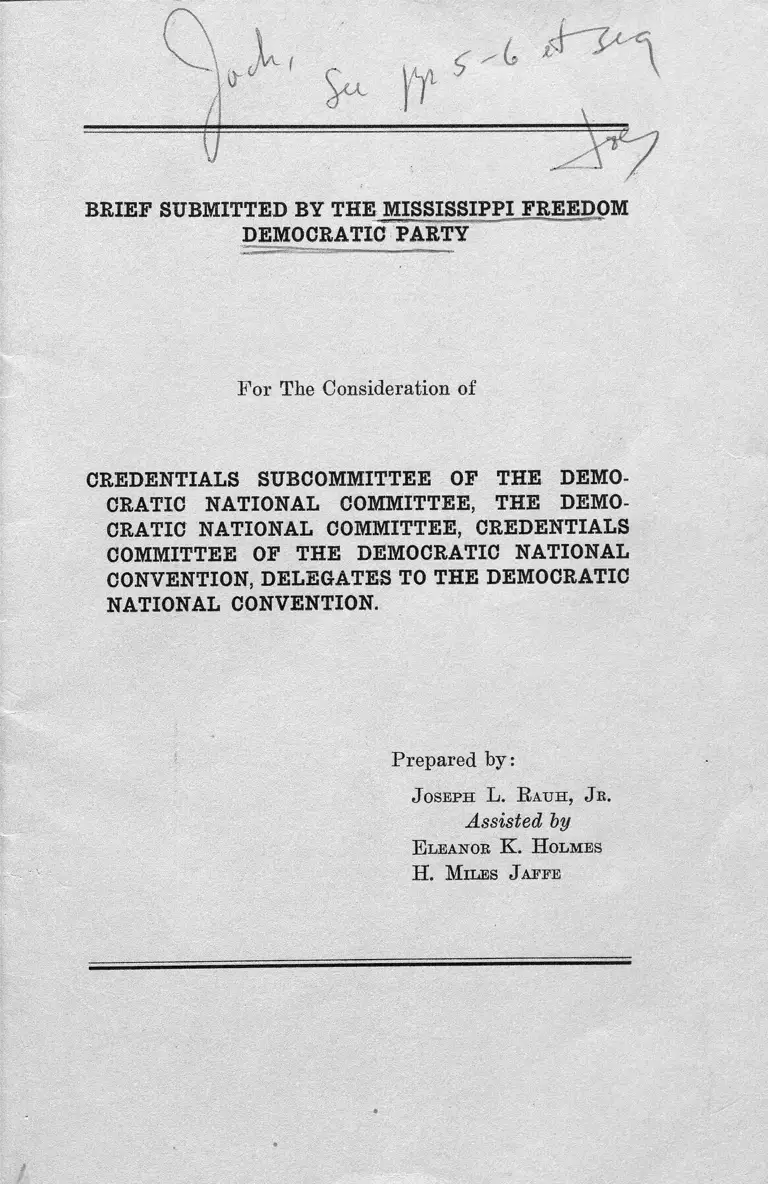
BRIEF SUBMITTED BY THE MISSISSIPPI FREEDOM
DEMOCRATIC PARTY
For The Consideration of
CREDENTIALS SUBCOMMITTEE OF THE DEMO
CRATIC NATIONAL COMMITTEE, THE DEMO
CRATIC NATIONAL COMMITTEE, CREDENTIALS
COMMITTEE OF THE DEMOCRATIC NATIONAL
CONVENTION, DELEGATES TO THE DEMOCRATIC
NATIONAL CONVENTION.
Prepared by:
Joseph L. Rauh , Jk.
Assisted by
E leanor K . H olmes
H. M iles Jappe
INDEX
INTRODUCTION ..................................................................... 1
STATEMENT OF FA C TS.. ................................................... 5
I. W HY THE MISSISSIPPI FREEDOM DEMO
CRATIC PARTY WAS FORM ED............................. 5
A. Negroes Have Traditionally Been Excluded From All
Participation in the Mississippi Democratic P a rty .. 5
(i) Party Runs State................................................... 5
(ii) Party Prevents Negro Registration.................... 6
(iii) Total Exclusion of Negroes......................... 11
(iv) Conclusion ................................................. 13
B. The Mississippi Freedom Democratic Party Desires
to Work Within the Framework of the National
Democratic Party........................................................... 14
II. ORGANIZATION AND OPERATION OF THE MIS
SISSIPPI FREEDOM DEMOCRATIC PA R TY .......... 15
(i) Freedom Party Formed....................................... 15
(ii) Freedom Party Follows Law ............................... 15
(iii) Freedom Party Convention........ ................. . 18
(iv) Freedom Party Delegates Certified.................... 20
III. OPERATION OF THE MISSISSIPPI DEMOCRATIC
PARTY ................................................................................ 21
(i) “ Traditional” Party Asserts Independence. . . . . 21
(ii) “ Traditional” Party Opposes National Platform 22
(iii) “ Traditional” Party Attacks National Leaders 23
(iv) “ Traditional” Party Villifies Negroes................ 26
(v) “ Traditional” Party for Goldwater............... 31
(vi) Twenty Years of Political Perfidy...................... 32
(vii) “ Traditional” Party Leaders Duck Convention 33
(viii) Conclusion ............................................................. 34
Page
— 2216-0
11 INDEX
LEGAL ARGUMENTS FOR SEATING MISSISSIPPI
FREEDOM DEMOCRATIC PA R TY ............................. 36
I. THE RULES OF THE CONVENTION FORBID
THE SEATING OF THE “ TRADITIONAL” MIS
SISSIPPI DEMOCRATIC PARTY DELEGATION.. 36
A. Paragraph (1) of the Rules Forbids the Seating of the
Delegation of the “ Traditional” Party Because That
Party Has Not and Can Not Give the Required As
surances Concerning the November Ballot................ 37
B. Paragraph (2) of the Rules of the Convention For
bids the Seating of the Delegation of the “ Tradi
tional” Party Because the Delegates Do Not Come
as “Bona Fide Democrats” Willing to “ Participate in
the Convention in Good Faith” ................................. 43
II. THE DELEGATION OF THE “ TRADITIONAL”
PARTY SHOULD NOT BE SEATED BECAUSE
THE STATE CONVENTION WHICH SELECTED
AND CERTIFIED IT WAS ILLEGAL AND UN
CONSTITUTIONAL ......................................................... 47
A. The Convention of the “ Traditional” Party Was
Illegal and Unconstitutional Because That Party
Runs the State of Mississippi and Uses Its Power to
Exclude Negroes From Registration and Participa
tion in the Political Processes of the State.............. 47
B. The “ Traditional” Party and Its Convention Are
Regulated in Detail By the State and Its Actions in
Excluding Negroes Are State Action in Violation of
the Fourteenth Amendment......................................... 50
Page
INDEX
HI. ANY FAIR COMPARISON OF THE TWO PARTIES
CAN, IN LAW AND IN EQUITY, LEAD ONLY TO
THE SEATING OF THE DELEGATION REPRE
SENTING THE FREEDOM PARTY .......................... 53
A. The Standard to Govern Convention Action Is Which
of the Two Groups Exhibits Good Faith to the Na
tional Party and Carries on Its Activities Openly and
Fairly .............................................................................. 56
B. The Freedom Party Delegation Must Be Seated
Under Any Standard Relating to Fairness and Good
Faith ............................................................................... 60
CONCLUSION ........................................................................... 62
APPENDIX A ................................................................. 63
APPENDIX B ........................................................................... 67
APPENDIX C ........................................................................... 72
T able of Cases
Bell v. Hill, 74 S.W. 2d 113, 123 Tex. 531 (1934).................. 48
Cain v. Page, 42 S.W. 336, 19 K.L.R. 977 (1897).................. 2
Davis v. Hambrick, 58 S.W. 779, 109 Ky. 276 (1900).......... 1
Davis v. State, 23 So. 2d 87, 156 Fla. 178 (1945).................. 47
Kearns v. Ilowley, 41 A. 273, 188 Pa. 116 (1898).................. 2
Nixon v. Condon, 286 U.S. 73 (1932)....................................... 47
Nixon v. Herndon, 273 U.S. 536 (1927)................................... 47
Phelps v. Piper, 67 N.W. 755, 48 Neb. 724 (1896).................. 1
Ray v. Blair, 343 U.S. 214 (1952)............................................. 37
Ray v. Gardner, 57 So. 2d 824, 257 Ala. 168 (1952).............. 58
Re Woodworth, 16 N.Y. Supp. 147 (1891)............................. 57
Smith v. Allwright, 321 U.S. 649 (1944)........................47,48,49
Smith v. McQueen, 166 So. 788, 232 Ala. 90 (1936)...... 1
Spencer v. Maloney, 62 Pac. 850, 28 Colo. 38 ( 1900 ) . . . . . . . 57
State v. Hogan, 62 Pac. 583, 24 Mont. 383 (1900)......... 57,58
State v. Johnson, 46 Pac. 533, 18 Mont. 548 (1896)...... 58,59
State v. Rotwitt, 46 Pac. 370, 18 Mont. 502........... .............. 58,59
State v. Weston, 70 Pac. 519, 27 Mont. 185 (1902)................ 58
Page
IV INDEX
Stephenson v. Board of Election Commissioners, 76 N.W. 914,
118 Mich. 396 (1898)............................................................... 56
Terry v. Adams, 345 U.S. 461 (1953)....................................... 47,49
Tonis v. Board of Regents of XJ. of State of New York, 295
N.Y. 286, 67 N.E. 2d 245 (1946)......................................... 44
United States v. Classic, 313 U.S. 299 (1941)........................ 47
Wood v. State, 169 Miss. 790, 142 So. 747 (1932)................. 1
M iscellaneous
Address by Judge Tom Brady to the Commonwealth Club of
; California at San Francisco, Oct. 4, 1957............................. 30
Annotation, 151 A.L.R. 1121..................................................... 52
Bfady, Tom P., Black Monday (1955) pp. 12, 73, 69............ 29,30
Cannon, Democratic Manual for the Democratic National
Convention of 1964, PP- 15, 35............................................. 5,37
18 Am. Jur., Elections, §§ 135, 136........................................... 2,57
18 U.S.C. 241, 242......................................................................... 53
Holtzman, The Loyalty Pledge Controversy in the Demo
cratic Party, 1960, p. 21........................................................... 44,45
Law Enforcement in Mississippi, a Special Report of the
' Southern Regional Council, July 14, 1964........................... 3,52
Life Magazine, February 7, 1964, p. 4 ..................................... 27
Mississippi Code...................................................................8,10, 50, 51
Mississippi Free Press, April 18, 1964, p. 1, 4 . ....................... 8
Mississippi—Subversion of the Right to Vote, Pamphlet of
1 the Student Nonviolent Coordinating Committee, Atlanta,
V-Georgia.............................................................................. 9
Official Proceedings of the Democratic National Convention,
1956, p. 822....................... 45
Platform and Principles of the Mississippi Freedom Demo
cratic Party............................................................................... 19, 63
Report on Mississippi, January, 1963, p. 23........................... 10
Report of the United States Commission mi Civil Rights,
0-1963, p. 2 0 . . . ..........i ............. ......................... ....................... 6
Page
INDEX V
Page
Resolution of the Democratic National Committee contained
in February 26, 1964 Call for the 1964 Democratic Na
tional Convention..................................................................... 2
Silver, James W., The Closed Society (1963), p. 60.............. 26,31
The Citizen, Official Journal of the Citizens’ Councils of
America, December, 1963, p. 10............................................. 29
The Johnson Journal, Vol. I l l , 1963, p. 1............................... 21
Time Magazine, August 16, 1963, p. 17................................... 23
BRIEF SUBMITTED BY
THE MISSISSIPPI FREEDOM DEMOCRATIC PARTY
Introduction
The question whether to seat the delegation of the Mis
sissippi Freedom Democratic Party or the delegation of
the “ regular” or “ traditional” Mississippi Democratic
Party may well prove the most significant contest before
the Democratic National Convention of 1964. For the issue
is not simply which of two groups wears shiny badges of
accreditation, but, far more fundamentally, whether the
National Democratic Party takes its place with the op
pressed Negroes of Mississippi or their white oppressors,
with those loyal to the National Democratic Party or those
who have spewed hatred upon President Kennedy and
President Johnson and the principles to which they dedi
cated their lives. In the final analysis, the issue is one of
principle: whether the National Democratic Party, the
greatest political instrument for human progress in the
history of our nation, shall walk backward with the bigoted
power structure of Mississippi or stride ahead with those
who would build the State and the Nation in the image of
the Democratic Party’s greatest leaders—Thomas Jeffer
son, Andrew Jackson, and Franklin D. Roosevelt.
This is a legal brief and as such will cover both the facts
and the law. But the legal precedents are necessarily lim
ited, for the courts of this country have many times made
clear that they will not decide political questions or inter
vene in disputes between rival delegations seeking recogni
tion at a party convention.1 This Convention and only this 1
1 Davis v. Hambrack, 58 S.W. 779, 109 Ky. 276 (1900); Phelps v.
Piper, 67 N.W. 755, 48 Neb. 724 (1896); Smith v. McQueen, 166 So.
788, 232 Ala. 90 (1936); Wood v. State, 142 So. 747, 169 Miss. 790
(1932).
(1)
2
Convention can decide who are the proper delegates per
mitted to join in its deliberations.2 3 As Governor Paul B.
Johnson said in his keynote address to the Mississippi
Democratic Party Convention on July 28, 1964, the ques
tion of which delegation to seat “ is a decision that the
National Party will have to make.” And this was also
conceded ten days earlier by Mississippi Democratic Party
Chairman, Bidwell Adam, who said that the National Con
vention ‘ 4 * * could seat them [Freedom Party] if they wanted
to . . . They could seat a dozen dead dodos brought there
in silver caskets and nobody could do anything about it.” 8
Without appreciating Mr. Adam’s analogy, the principle is
clear beyond peradventure of doubt that this Convention is
the court of last resort.
But the sparsity of legal precedents does not mean an
absence of legal principles and guideposts to assist the
Convention in arriving at its choice between two rival
delegations. We believe that the rules of the Convention
and accepted legal principles, as applied to the facts of
this dispute, demonstrate overwhelmingly that the only
valid decision this Convention can make—both in law and
in equity—is to seat the delegation duly chosen by the
state convention of the Mississippi Freedom Democratic
Party on August 6, 1964.
The Freedom delegation comes as “ bona fide Democrats
who have the interests, welfare and success of the Demo
cratic Party at heart, and will participate in the Conven
tion in good faith . . J We come as volunteers to lend sup
2 18 Am. Jur., Elections, §136; Cain v. Page, 42 S.W. 336, 19
K.L.R. 977 (1897); Kearns v. Howley, 41 A. 273, 188 Pa. 116 (1898).
3 New York Times, July 20, 1964, p. 21.
4 Resolution of the Democratic National Committee contained in
February 26, 1964 Call For the 1964 Democratic National Con
vention.
3
port to the nominees of this Convention and to spread the
principles and platform of the Democratic Party. We come
as representatives of a functioning political organization;
for this and other reasons 5 6 7 8 the challenge of the Freedom
Party has no counterpart anywhere else in the South. And
we come with the support of State Democratic Conventions
or State Democratic Committees of California, Colorado,
District of Columbia, Massachusetts, Michigan, Minnesota,
New York, Oregon, Washington and Wisconsin who have
recognized the legality of our position and the justice of
our cause.
The “ traditional” Mississippi delegation does not come
as “ bona fide Democrats” willing to “ participate in the
Convention in good faith . . .6 The delegates to the state
convention of the Mississippi Democratic Party on July
28th arrived in cars bearing Goldwater bumper stickers,7
“ openly voiced themselves during recess and prior to the
convention being called to order, as favoring the candidacy
of Senator Barry Goldwater, ’ ’ 8 adopted a Goldwater plat
form,9 and then recessed until September 9 “ for the purpose
of allowing the Convention to swing to Goldwater . . . ” 10 11
This recess is the regular short interlude which takes place
once every 4 years to attend the National Convention while
the rest of the time is spent in calling President Kennedy
a “ dimwit” 11 and President Johnson a “ counterfeit con
5 See Law Enforcement in Mississippi, a Special Report of the
Southern Regional Council, July 14, 1964, which concluded that
Mississippi is “ not like any place else” (p. 6).
6 See n. 4, supra.
7 New York Times, July 29, 1964, p. 18.
8 Jackson Clarion-Ledger, July 29, 1964, p. 18.
9 See pp. 22 to 23, infra.
10 Jackson Clarion-Ledger, July 29, 1964, p. 18.
11 See p. 24, infra.
4
federate.” 12 13 Indeed, it is not clear why the “ traditional”
Party leaders should even want to send delegates to the
Convention of a national party from which they regularly
declare their independence and to which they continuously
profess deep-seated animosity. Quite likely it is because
they do not want any other group—e.g. the Mississippi
Freedom Democratic Party—to function in Mississippi as
the representative of the National Party. Obviously, this
strategy of fighting against the National Party and still
not allowing any other group to represent it in Mississippi
is what Governor Johnson had in mind when, in his key
note to the July 28th state convention, he said “ this is a
time . . . for carefully-designed strategy . . . for judiciously-
chosen words.” But no matter how “ judiciously-chosen”
the words, the “ carefully-designed strategy” is one of “ bad
faith” to the National Democratic Party.
We are not only willing to serve the National Democratic
Party here and in Mississippi, we assert our right and
our determination to do so. We hope that the delegates of
the Freedom Party may be placed on the temporary rolls
of the Convention by the Democratic National Committee
or Subcommittee 1S and that the contest may end at that
point. If it does not, we hope that a majority of the Cre
dentials Committee of the Convention will determine that
the Freedom Party be placed on the permanent rolls of the
12 See p. 25, infra.
13 The Democratic National Committee has always heard chal
lenges prior to determining which of two groups should he placed on
the temporary rolls. For example, the Credentials Subcommittee of
the Democratic National Committee heard the dispute over which
Puerto Rican delegation should be seated in 1960 prior to the
National Committee’s action on the temporary rolls. Certainly the
challenge made by the Freedom Party is at least as significant to
the future of the Democratic Party as that made by the Puerto Rican
rivals in 1960.
5
Convention. But if unsuccessful there, too, we are deter
mined to put our case before the delegates themselves.14
We are confident that the assembled representatives of this
great, liberal Party will not turn its back on those who
have sacrificed so much to support it.
STATEMENT OF FACTS
I
WHY THE MISSISSIPPI FREEDOM DEMOCRATIC
PARTY WAS FORMED
A. Negroes Have Traditionally Been Excluded From All
Participation in the Mississippi Democratic Party
(i) Party Runs State. The Mississippi Democratic
Party runs the State of Mississippi. It controls the Legis
lative, Executive and Judicial Branches of the Government
of the State. All 49 Senators and all but one of the 122
Representatives are Democrats. There is no substantial
Republican Party; there is no third party. There is just
the Mississippi Democratic Party and its leaders are the
State. As Governor Johnson said in his keynote to the
“ traditional” state convention, the Mississippi Democratic
Party “ holds all but a handful of the elective and appoint
ive offices, from constable to governor . . . for the past 89
14 We understand that 10% of the 108-member Credentials Com
mittee or eleven members may file a minority report (Cannon,
Democratic Manual far the Democratic National Convention of
1964, p. 35) and that a majority of eight State delegations may
obtain a roll call (Id., p. 54). We are sending a copy of this Brief to
Speaker John McCormack, the Permanent Chairman of the Con
vention, and to Senator John 0. Pastore, the Temporary Chairman
of the Convention, and are calling their attention to this footnote,
so that they may be advised of the intentions of the Freedom Party
and may in turn advise us if they have any different construction of
the rules of the Convention.
6
years, [it] is the framework, or the structure, through
which Mississippians maintain political unity, and operate
self-government. ’ ’
(ii) Party prevents Negro Registration. The Missis
sippi Democratic Party uses its powers to exclude Ne
groes from registering and voting. Though Negroes rep
resent over 40% of the State’s population, all voter regis
trars in Mississippi are white. Today only some 28,500
Negroes are registered in Mississippi, as compared to
500,000 whites. This represents only 6.7% of the 435,000
Negroes 21 years of age in the State; this 6.7% should he
compared with 39.1% in Georgia, 51.1% in Florida and
57.7% in Texas, and even Governor Wallace’s Alabama has
over three times as high a percentage of registered Negroes
as does Mississippi.15 While Negro registration in other
Southern States increased sharply in recent months and
years,16 Mississippi went in the other direction; “ the best
estimate of 1962 registration indicates a drop in registra
tion of 534.” 17
Keeping Negroes from registering and voting has been
accomplished in a myriad of ways. The legislature and the
white voter registrars have combined to make an obstacle
course out of the simple process of registration. A series
of state laws culminating in 1962 gives unlimited discre
tion to the white registrars to find that Negro applicants
cannot interpret the constitution, cannot understand the
obligations of citizenship, are not of good moral character,
15 See report of Southern Regional Council for complete study
of Negro registration in South. Washington Post, Aug. 3, 1964, p. 2.
16 Ibid. For example, in the two years ending this past April,
Negro registration in South Carolina increased by 32,140—more
than the total Mississippi Negro registration.
17 Report of the United States Commission on Civil Rights— 1963,
p. 20.
7
etc. As Professor Russell H. Barrett of the University of
Mississippi said in a recent speech:
“ First, the whole pattern of voting requirements
and of the registration form is calculated to make the
process appear to the voter to be a hopelessly for
midable one. The pattern is supposed to bristle with
complexities which culminate in the publication of the
would-be voter’s name in the local newspaper for two
weeks. A major purpose of all this is to so overwhelm
the voter that he will not have the audacity even to
attempt registration. Behind this approach is supposed
to be—and all too often is—a collection of fears that
someone will challenge the voter’s moral character,
that he may be prosecuted for perjury, or that he may
be subjected to economic or other pressures if he
attempts to register. Those who have for years con
trolled state politics assume that this fear will be a
powerful weapon against voter registration, yet the
plain fact is that it is by far the most vulnerable of
their defenses . . .
“ A second important point is that the law provides
no clear or meaningful standards for its highly general
requirements. These now familiar generalities require
the voter to be able to explain any section of the con
stitution, to describe the obligations of citizenship, and
to demonstrate to the Circuit Clerk that he is good
moral character. It is clear that those requirements
were stated vaguely for one simple reason, to permit
the Registrar to apply different standards to different
people.
“ . • • it is worth quoting what was said in 1955 by
the man who was then President of the Mississippi Cir
cuit Clerks’ Association, Rubel Phillips. In complain
ing about the burden placed by the new law on circuit
clerks, lie said, ‘ Many clerks feel the law is discrimi
natory and that a burden is placed on them to dis
franchise many persons who have been voting for
years. . . . Lawyers with less than 10 years of experi
ence probably wouldn’t be able to answer the questions
properly . . . ’ ” 18
If the Negro finally does surmount all these hurdles,
cruel economic harassment follows. Jobs are lost, credit
withdrawn, supplies refused. Indeed, the 1962 Mississippi
law expressly provides for publication of the names and
addresses of applicants in the newspapers, enabling eco
nomic pressure to be applied during the registration
process.19
If the Negro should be able to run the registration obstacle
course and brave the economic reprisals, dangers to life
and limb are very real.
* In 1955, Lamar Smith, a Negro, was killed after
urging other Negroes to vote in a gubernatorial elec
tion. He was shot to death on the Brookhaven, Miss.,
courthouse lawn. A grand jury refused to indict the
three men who were charged with the slaying.
* In 1961, Herbert Lee, a Negro active in voter regis
tration activities in Liberty, Miss., was shot to death
by a member of the Mississippi State Legislature.
Representative E. E. Hurst, a Citizens’ Council mem
ber, was vindicated by the coroner’s jury, which ruled
the murder a “ justifiable homicide.”
* In 1964, a witness to the Lee killing, Louis Allen,
was shot to death near his home. Allen had been
harassed by local police officials several times since
18 Mississippi Free Press, April 18, 1964, p. 1, 4.
19 Mississippi Code, § 3212.7, approved May 26, 1962. See also
Washington Daily News, August 12, 1964, p. 27.
9
the Lee killing. Local authorities there say they have
not come up with any clues in the Allen killing.
* In 1962, Mrs. Fannie Lou Hamer of Euleville, Miss.,
Vice Chairman of the Freedom Party delegation here,
was fired from her plantation job, where she had
worked for 18 years, the same day she had gone to
the county courthouse to attempt to register. The
plantation owner informed her that she had to leave
if she didn’t withdraw her application for regis
tration.
* Leonard Davis of Euleville was a sanitation worker
for the city until 1962, when he was told by Euleville
Mayor Charles M. Dorrough, “ W e’re going to let
you go. Your wife’s been attending that school.”
Dorrough was referring to the Student Nonviolent
Coordinating Committee registration school in Eule
ville.
* Marylene Burkes and Vivian Hillet of Euleville were
severely wounded when an unidentified assailant fired
a rifle through the window of Miss Hillet’s grand
parents’ home. The grandparents had been active
in voter registration work.
* In Eankin County in 1963, the sheriff and two deputies
assaulted three Negroes in the courthouse who were
applying to register, driving the three out before
they could finish the forms.
* In Philadelphia, Mississippi, in 1964, three students,
part of the 1964 summer registration drive, were
killed.20
20 Mississippi—Subversion of the Right to Vote, Pamphlet of the
Student Nonviolent Coordinating Committee, Atlanta, Georgia,
1964. This pamphlet reports each of the above examples except
the last—which requires no documentation.
10
In the words of the Mississippi Advisory Committee to
the United States Commission on Civil Eights, a body com
posed entirely of Mississippians, “ terror hangs over the
Negro in Mississippi and is an expectancy for those who
refuse to accept their color as a badge of inferiority. ’ ’ 21
And the Southern Eegional Council, a body composed en
tirely of Southerners, recently documented “ the almost
unrestrained lawlessness which is permitted within the
state against one class of people.” 22
Strange as it may seem, even obstacle course registra
tion, intense economic pressure and frightening terror are
not all. The statutes of Mississippi provide that “ No person
shall be eligible to participate in any primary election unless
he . . . is in accord with the statement of the principles of
the party holding such primary, which principles shall have
been declared by the state convention of the party holding
the primary . . . ” 23 And, carrying this out, the 1960 Plat
form and Principles of the Mississippi Democratic Party
adopted June 30, 1960, provides:
“ We hold as a prerequisite to voting in the Missis
sippi Democratic Primaries, or otherwise participating
in the affairs of the Mississippi State Democratic Party,
that the voter shall subscribe to the principles and plat
form of the party, and shall thereby repudiate his
affiliation with any other party whatsoever, and affirm
his allegiance to the Democratic Party of the State of
Mississippi and to its principles and platform.”
Probably the single most sacred principle of the Missis
sippi Democratic Party is segregation. The 1960 Platform
provides:
21 Report on Mississippi, January, 1963, p. 23.
22 See n. 5, supra.
28 Mississippi Code, §3129.
11
“ We believe in the segregation of the races and are
unalterably opposed to the repeal or modification of
the segregation laws of this State, and we condemn
integration and the practice of non-segregation.”
The resolution at the 1964 State Convention on July 28
provides:
“ We believe in separation of the races in all phases
of our society. It is our belief that the separation of the
races is necessary for the peace and tranquility of all
the people of Mississippi and the continuing good rela
tionship which has existed over the years.”
In a nutshell, the Mississippi Democratic Party makes a
belief in segregation a prerequisite to participation in its
affairs and thus in the political life and government of the
State. A Negro’s mere belief in his own dignity and the
United States Constitution makes him ineligible to partici
pate in the political processes of Mississippi.
(iii) Total Exclusion of Negroes. Never was the exclu
sion of Negroes more successfully carried on than in the
selection of the delegation representing the Mississippi
Democratic Party at this Convention.
Negroes in several parts of Mississippi attempted to
attend the June 16th precinct meetings of the “ traditional”
Party. These meetings, in which all registered voters are
theoretically entitled to participate, form the base of a pyra
mid which culminates in the Democratic State Convention.
It is in the course of this series of meetings (precinct,
county and state conventions) that state party officials and
National Convention delegates are elected. In this Presi
dential election year the registered Negroes, though few in
number, were fighting not only for their right to be included
in the Party, but also to insure that the State Party would
1 2
remain loyal to the candidates of the National Democratic
Party in November. To accomplish this, they pressed for the
election of delegates who shared their views, as well as for
the adoption of resolutions affirming loyalty to the national
ticket.
The amount of Negro activity in the precinct meetings was
sharply circumscribed at the outset by the outstanding fact
of Mississippi politics: the almost complete disfranchise
ment of Negro voters. The climate of fear that pervades the
state acted as a further check: a sworn affidavit from a resi
dent of Neshoba County, for example, explains that no Ne
groes went to precinct meetings there ‘ because it was im
possible . . . to make the attempt . . . without suffering-
great economic and physical harm.” 24 This is, of course,
the county where the three students were killed in June.
But despite the obstacles, many Negroes did attempt to
participate in the precinct, county and state conventions.
To no avail.
In many precincts Negroes went to their polling stations
before the time designated by statute for the precinct meet
ings (10:00 AM), but were unable to find any evidence
of a meeting. Inquiries addressed to public officials proved
futile: some officials denied knowledge of any meeting,
others claimed that the meeting had already taken place.
In these precincts Negroes proceeded to hold their own meet
ings and elected their own delegates to the county conven
tions. In other precincts Negroes found the white precinct
meetings, hut were excluded. In Hattiesburg Negroes were
told that they could not participate without poll tax receipts,
despite the recent Constitutional amendment outlawing such
requirements. In still other precincts Negroes were allowed
to attend the meetings, but were restricted in some way
24 This and other affidavits referred to are in the possession of
the counsel for the Freedom Party.
13
from exercising their full rights: some were not allowed
to vote, some were not allowed to nominate delegates from
the floor, others were not allowed to take part in choosing
those who tallied the votes. In several meetings the Negroes
were unable to introduce their resolution calling for loyalty
to the National Party; in others they were unable to bring
their “ loyalty” resolutions to a vote; and in the three
instances where “ loyalty” resolutions were brought to a
vote, they were overwhelmingly defeated.
On June 23,1964, Negroes tried to take part in the second
level of Democratic Party meetings, the county conventions.
Most of them had been elected delegates to the county level
by all-Negro precinct meetings. One, however, was a dele
gate from a multi-racial meeting in Jackson. In Madison
county, Negro delegates were excluded by a claim that the
meeting was of the County Executive Committee (not a
convention) and was thus open only to members. In Le
flore county, the white convention officials refused to recog
nize the Negroes’ credentials. In Washington county, Negro
delegates were not allowed to participate meaningfully-—
the meeting refused even to consider their resolution of
loyalty to the National Democratic Party. And so on.25
By the time the apex of the pyramid was reached—the
state convention—there was not a single Negro delegate in
a state with 435,000 Negroes of voting age. The exclusion
was complete. Furthermore, and possibly even more signifi
cant here, there was not a single delegate to the state con
vention, white or black, willing even to offer a resolution
of support for the National Democratic Party.
(iv) Conclusion. There has not been a single Negro
State office holder in Mississippi since 1892—the inevitable
25 The facts concerning the precinct and county conventions are
documented by affidavits and statements in the possession of the
counsel for the Freedom Party.
14
result of this total exclusion from the political process.
Negroes have been harassed and brutalized by the officials
of a state wholly controlled by the “ traditional” Demo
cratic Party. Yet, despite the hopelessness and tragedy of
their position, the Negroes of Mississippi have maintained
their belief in the democratic process and in the Democratic
Party.
B. The Mississipi Freedom Democratic Party Desires to
Work Within the Framework of the National
Democratic Party
At its convention on August 6,1964, the Mississippi Free
dom Democratic Party unanimously resolved that, “ We
deem ourselves part and parcel of the National Democratic
Party and proudly announce our adherence to it. We affirm
our belief that the National Democratic Platform of recent
years has been a great liberal manifesto dedicated to the
best interest of the people of our Nation of all races, creeds
and colors.”
These were not just words to bring to this Convention.
Those who organized the Freedom Party had a deep dedi
cation to the National Democratic Party. They did not
seek an alliance with Eepublicans; they did not try to form
a third party. They sought and still seek to be a part of
the National Democratic Party.
Indeed, earlier this year and despite the obstacles that
have been outlined above and more, the Freedom Party ran
candidates in the June 2nd Democratic primary. Mrs.
Victoria Gray, Freedom Party National Committeewoman,
opposed Senator John Stennis; Mrs. Fannie Lou Hamer,
likewise a Freedom delegate, opposed Representative Jamie
L. Whitten; the Reverend John Cameron opposed Repre
sentative William M. Colmer; and Mr. James Houston
opposed Representative John Bell Williams. Defeat cannot
15
blur this very real effort to work within the framework of
the Democratic Party.
These primary candidates of the Freedom Party ran on
the Platform of the National Democratic Party. They
articulated the needs of all the people of Mississippi, such
as anti-poverty programs, medicare, aid to education, rural
development, urban renewal, civil rights. They identified
themselves with the National Party and its leaders. They
demonstrated, even before the August 6th Freedom Party
state convention, that they were “ part and parcel of the
National Democratic Party.”
* # # =K= * # . #
That is the story of why the Mississippi Freedom Demo
cratic Party was formed—because the Negroes of Missis
sippi, totally excluded from political life by the Mississippi
Democratic Party, nevertheless made their choice to work
within the framework of the National Democratic Party.
Now we turn from why the Mississippi Freedom Democratic
Party was formed, to its organization and its operation.
II
ORGANIZATION AND OPERATION OF THE
MISSISSIPPI FREEDOM DEMOCRATIC PARTY
(i) Freedom Party Formed. The Mississippi Freedom
Democratic Party was officially established at a meeting in
Jackson, Mississippi, on April 26, 1964. The 200 to 300
delegates present elected a temporary state executive com
mittee of 12 persons and the committee met regularly there
after. The Party is open to all Democrats in Mississippi
of voting age, regardless of race, creed or color.
(ii) Freedom Party Follows Law. The Mississippi
Freedom Democratic Party has made every possible
16
effort to follow the laws of Mississippi regulating political
parties.
* It prepared a Freedom Registration Form and en
rolled voters into the Freedom Party. As of the
moment of the completion of this Brief, over 50,000
Mississippi residents of voting age were registered
in the Freedom Party. Rev. Robert Spike, Executive
Director of the Commission on Race and Religion of
the National Council of Churches, described the
Freedom Registration as “ a remarkable achievement
in the face of the most serious obstacles.” 26
* During the weeks of July 19 and 26, 1964, there were
precinct meetings in 26 counties throughout the State
of Mississippi. An estimated total of 3500 persons
participated in these meetings.
■* During the week of July 27, 1964, county conven
tions were held in 35 counties at which a total of 282
delegates were elected to the state convention. In 9
of the 35 counties the Freedom Party was unable to
hold precinct meetings in the precincts because of
various forms of harassment; instead, the precinct
meetings were held immediately preceding the county
conventions.
* Some county meetings in addition to the 35 were held
in Jackson, since holding them in the proper coun- 28
28 In November, 1963, 83,000 Mississippi citizens, largely Negroes
barred from the “ traditional'’ Party, voted for Mr. Aaron Henry
(Chairman of the Freedom delegation here) for Governor in a mock
election. Only the cruelest harassment prevented the Freedom Party
from doubling that figure in the present registration. The type of
harassment ranged from the murder of the three boys in Philadelphia
down to the beating of two Freedom registration workers driving a
truck containing Freedom registration forms.
17
ties would have endangered lives. Neshoba county,
with the county seat at Philadelphia, Mississippi, was
an example of such a county.
* On August 6, 1964, 240 delegates assembled at the
Freedom Party state convention in Jackson to elect
the officers of the Freedom Party, choose the dele
gation to this Convention and adopt a Platform and
Principles.
* Efforts were made to register the Freedom Party
with the Secretary of State of Mississippi both before
and after the state convention of August 6th, but all
such efforts were rebuffed.
The figures on Freedom Party registration and the at
tendance at precinct and county conventions demonstrate
the seriousness with which the Party has gone at its task
of organizing a state party to serve the National Party. And
all of this was accomplished in the face of ugly harass
ment and intimidation.
Harassment took a variety of forms. Bequests made in
Sunflower County, Lauderdale County, and Madison County
for maps or descriptions of precinct boundaries were not
even answered. Attempts to publicize precinct meetings as
required by state law proved futile as newspapers and radio
stations refused to print the advertisements or to announce
them. In some areas of the state it was felt that the meet
ings could not be safely publicized as earlier announcements
had led to bombings or attempted burnings in Pike County.
In Leake County a radio station requested the Party to
withdraw- its announcement. The manager of the station,
displaying letters from the mayor, the chief of police, and
the sheriff, feared reprisals against the property of the
station as well as the families of the employees of the sta
18
tion. Meeting's were often followed by arrests of local par
ticipants for minor driving offenses or interrogation of
those who had attended. In one case, a truck carrying
Freedom Registration forms was detained for over a day,
two of its occupants taken to jail and beaten and two other
of its occupants told to start walking back to Jackson.
These incidents only complemented the continual harass
ment of the Party. In one day, June 24, 1964, the Jackson
office of the Council of Federated Organizations reported
16 incidents of intimidation or violence, and other days in
which ten or more such incidents were reported were not
uncommon.27.
(iii) Freedom Party Convention. The Freedom Party
convention of August 6 democratically elected a National
Committeeman (Rev. Edwin King), a National Committee-
woman (Mrs. Victoria Gray), 44 delegates and 22 alter
nates to the Convention. They are honorable, hard-work
ing and loyal Mississippians; 28 their names are set forth in
Appendix B, but addresses and biographies, in the posses
sion of counsel, are withheld for reasons of personal safety.
Many of them are making great personal sacrifices to attend
this Convention; they do so because of their deep dedication
to the liberal principles of the National Democratic Party.29
The delegates to the state convention unanimously ex
27 The facts concerning harassment and intimidation are docu
mented by affidavits and statements in the possession of the Counsel
for the Freedom Party.
28 The delegation has 64 Negroes and 4 whites. The Party is open
to all Democrats, and the number of whites on the delegation was
limited solely by the number willing to brave certain reprisal.
29 By secret ballot, as required by Mississippi statute, Mr. Aaron
Henry and Mrs. Fannie Lou Hamer were elected Chairman and
Vice Chairman of the delegation, respectively. Mrs. Annie Devine
was elected Secretary.
19
pressed their dedication to the National Party in the fol
lowing Statement of Loyalty:
“ As members of the Mississippi Freedom Democratic
Party:
“ 1. "We undertake to assure that voters of the State
of Mississippi will have the opportunity to cast their
election ballots for President Lyndon B. Johnson and
the Vice Presidential nominee selected by the Demo
cratic National Convention at Atlantic City, and for
electors pledged formally or in good conscience to the
election of President Johnson and the Vice Presiden
tial nominee, under the Democratic Party label and
designation.
“ 2. We go farther than the above undertaking re
quired by the rules of the Democratic National Con
vention and pledge to work dauntlessly for the election
of President Lyndon B. Johnson and the Vice Presi
dential nominee selected by the Atlantic City con
vention.
“ 3. We deem ourselves part and parcel of the Na
tional Democratic Party and proudly announce our
adherence to it.
“ 4. We affirm our belief that the National Demo
cratic Platform of recent years has been a great liberal
manifesto dedicated to the best interest of the people
of our Nation of all races, creeds, and colors. We will
proudly support the 1964 platform and the 1964 candi
dates of the Democratic National Party.”
The Convention also adopted a platform supporting full
employment, collective bargaining, food stamp programs,
medicare, civil rights, reapportionment, job retraining, an
anti-poverty program, United Nations, foreign aid, and
20
the Peace Corps. In a word, it identified itself with the
basic programs and principles of the National Democratic
Party.30
(iv) Freedom Party Delegates Certified. The Free
dom Party delegates elected at the August 6th con
vention were certified to the Chairman, John W. Bailey,
and the Secretary, Mrs. Dorothy Vredenburgh Bush,
of the Democratic National Committee that same day and
the certification was delivered to Mr. Bailey’s office on
August 7th, the day after the convention. This certification
was contained in a letter of August 6th from Mr. Lawrence
Guyot, Chairman of the Freedom Party, to Mr. Bailey,
requesting that the delegation be seated in place of the
delegation chosen on July 28th by the Mississippi Demo
cratic Party. This challenge followed an earlier letter from
Mr. Aaron Henry, previous chairman of the Freedom Party,
to Mr. Bailey, dated July 17, 1964, challenging “ the dele
gation of the ‘ regular’ Democratic Party” and asserting
“ the right of the delegation of the Mississippi Freedom
Democratic Party to be seated at the National Convention
as the true representative of Mississippi Democrats.” Mr.
Bailey was invited in the July 17th letter to attend the state
convention on August 6th or send an observer, but he was
not able to do so. The text of the Freedom Party letters of
July 17th and August 6th are set forth in Appendix B.
30 The Platform and Principles of the Mississippi Freedom Demo
cratic Party, adopted at the state convention on August 6th, is set
forth in full in Appendix A.
21
III
OPERATION OF THE MISSISSIPPI DEMOCRATIC
PARTY
(i) “ Traditional” Party Asserts Independence. Where
as the Freedom Party has made every effort to work
within the framework of the National Democratic Party,
the “ traditional” Party has been at equal pains to
demonstrate its independence of the National Party. The
Mississippi Democratic Party has over and again declared
in public speeches and printed matter that it is not a part
of the National Democratic Party. The campaign litera
ture for the election of Governor Paul B. Johnson, in Novem
ber of 1963, could not be clearer on this point: ‘ * Our Mis
sissippi Democratic Party is entirely independent and free
of the influence or domination of any national party” . . .
“ The Mississippi Democratic Party, which long ago sepa
rated itself from the National Democratic Party, and which
has fought everything both national parties stand for . . .”
“ Both the National Democratic Party and the National
Republican Party are the dedicated enemies of the people
of Mississippi.” 31 As late as June 25th of this year, Gov
ernor Johnson announced, “ We haven’t left the National
Democratic Party, the National Democratic Party has left
us.” 32 Former Governor Ross Barnett flatly stated that
“ there is no place for Mississippi today in national Demo
cratic or Republican parties. ’ ’ 33 Former Governor J. P.
Coleman said, “ This party has always been separate and
distinct from the national party.” 34 And Bidwell Adam,
State Democratic Chairman, publicly announced he was
31 The Johnson Journal, Vol. I ll , 1963, p. 1.
32 Jackson-Clarion-Ledger, June 26, 1964, p. 14.
88 Biloxi-Gulfport Daily Herald, March 26, 1963, p. 1
34 Biloxi-Gulfport Daily Herald, May 10,1963, p. 1.
22
“ through with the National Democratic Party. The Na
tional Democratic Party will have to get somebody else to
carry their banner. ’ ’ 35 Governors Coleman, Barnett and
Johnson and State Chairman Adam, the leaders of the
“ traditional” party, may sing a different tune through their
underlings at this Convention, but they cannot hide the
words they use in Mississippi—that they will have nothing
whatever to do with the National Democratic Party.
(ii) “ Traditional” Party Opposes National Platform.
The Mississippi Democratic Party has done far more
than merely shout that it is not a part of the National
Democratic Party. More fundamentally, it has opposed, and
today opposes, everything for which the National Party
stands.
On August 16,1960, after the Kennedy-Johnson ticket was
nominated, the recessed state convention resolved “ that we
reject and oppose the platforms of both National Parties
and their candidates.” Their leaders—the same leaders
who are sending a delegation to this Convention—success
fully campaigned for unpledged electors who cast their votes
against President John P. Kennedy and Vice President
Lyndon B. Johnson.
At their state convention just last month the “ tradi
tional” Party passed resolution after resolution opposing
everything which the Democratic National Party has done
and for which it stands. The state convention called for
the repeal of the Civil Eights Act of 1964 which it denounced
“ as a naked grasp for extreme and unconstitutional Fed
eral power” and “ a betrayal of the American people.” It
favored “ getting the United States out of the United Na
tions, and the United Nations out of the United States.” It
favored limiting the jurisdiction of the Supreme Court and
removing certain of its members. The general philosophy
35 Montgomery Advertiser, September 29, 1962, p. 7A.
23
of the “ traditional” state convention was probably best
expressed in the following resolution:
“ We express our admiration, and appreciation of
Governor Eoss E. Barnett and Governor George C.
Wallace, of Alabama for their able, courageous, patri
otic and effective work in awakening the American
people to the utter necessity of the return of this
country to true Constitutional Government and indi
vidual freedom.
“ We are greatly indebted to Governor Wallace for
his tremendous visit to Mississippi, and he and Gov
ernor Barnett occupy a permanent place in the heart
of every true Mississippian. ” 86
(iff) “ Traditional” Party Attacks National Leaders.
The violent opposition of the “ traditional” party to
the National Democratic leaders is almost too well known
to repeat in this Brief. Governor Johnson may now speak
with “ judiciously-chosen” words so he can get his delega
tion seated here, but he was not so judicious in his cam
paign in 1963. Time after time he referred to the “ Ken
nedy albatross” around the neck of his opponent or around
the country’s neck.* 37 Four days before his election, Gov
ernor Johnson shouted that “ my determination is to do
anything I can to get the Kennedy dynasty out of the White
86 This resolution sanctifying Governor Wallace only highlights
the irony of excluding the Alabama delegation (apparently everyone
agrees to this exclusion), while at the same time even considering
the seating of the “ traditional” Mississippi delegation. The 20 years
of political perfidy of the “ traditional” Mississippi Party makes
the Alabama record seem almost like one of continued loyalty.
37 See e.g. Biloxi-Guljport Daily Herald, July 2, 1963, p. 11; id.,
July 18, 1963, p. 26; Jackson Clarion-Ledger, July 17, 1963, p. 1;
Time Magazine, August 16, 1963, p. 17.
24
House.” 38 Johnson’s campaign advertisement spoke of
eliminating ‘ ‘ Kennedyism from our state ” ; 39 he said the
choice was between “ political dictatorship sponsored by
John Kennedy” or constitutional government.40 He said
that unless President Kennedy is defeated in 1964, “ you’ve
seen your last free election;” 41 and only this past July
28th at the state convention, Governor Johnson repeated
his belief that this “ threatens to be the last free election
in this fair land.” Johnson said point number one in his
program “ will be to spearhead an all-out effort to secure
cooperation from other governors and leaders to get the
Kennedys out of the White House” 42—small wonder, too,
since he had already referred to them as “ dimwits” . 43 An
official Johnson campaign ad showed a picture of a bed in
which President Kennedy had slept and then stated: ‘ 4 Make
sure that Kennedy never sleeps there again . . ,” 44 As
though to clinch the matter, Governor Johnson’s victory
statement after his election proclaimed to the voters that
“ your victory is one over the Kennedys, the Adlai Steven-
sons and the northern Democratic overlords who also would
like to destroy our way of life.” 45 And as recently as
August 13 of this year, the Washington Post reported that
Governor Johnson laced into the Johnson Administration
as that “ shifting, vacillating, crawfish government in
Washington.”
Other spokesmen for the “ regular” party have also made
38 Jackson Clarion-Ledger, Nov. 2, 1963, p. 8.
39 Biloxi-Gulfport Daily Herald, August 16,1963, p. 9.
40 Biloxi-Gulfport Daily Herald, August 17, 1963, p. 1.
41 Biloxi-Gulfport Daily Herald, Sept. 5, 1963, p. 9.
42 Memphis Commercial Appeal, October 26, 1963, p. 9.
43 Biloxi-Gulfport Daily Herald, July 18, 1963, p. 26.
44 Biloxi-Gulfport Daily Herald, July 9, 1963, p. 6.
45 Jackson Clarion-Ledger, Nov. 7, 1963, p. 1.
25
clear their violent opposition to the National Party’s lead
ers. Former Governor Eoss Barnett, the true hero of the
“ traditional” state convention, has time and again referred
to President Johnson as a “ counterfeit confederate” . On
the 4th of July of this year he termed President Johnson
a “ counterfeit confederate who resigned from the South
and may one day soon resign from the white race as well
. . . ” 40 A few days later he said, “ I would vote for Senator
Goldwater before I would vote for Lyndon Johnson, a coun
terfeit confederate.” 46 47 And on July 22nd the Clarion-
Ledger reported from Houston, Texas: “ Calling Lyndon
Johnson ‘ a counterfeit confederate, ’ Barnett said ‘ he ’ll need
more than an 87-vote landslide in Texas’ to win the Novem
ber election.”
Governors Johnson and Barnett have been ably assisted
by other leaders of the “ traditional” party in their attacks
upon Presidents Kennedy and Johnson. Mrs. Florence
Sillers Ogden of Eosedale, sister of the Speaker of the Mis
sissippi House of Eepresentatives, “ flayed the Kennedy
administration and called on America’s woman-power to
turn back the tide of constitutional destruction which is en
gulfing the nation . . . Never, never vote for a liberal . . .
[We stand for] free enterprise and prayer in the schools
[and oppose] ‘Kennedys, disarmament, and Commu
nism’ ” 48 Congressman John Bell Williams said that
“ Kennedy is the most predatory chief executive of all time.
If we don’t stop him and his brother Bobby, human liberty
will disappear from this nation and the face of the earth. ’ ’ 49
Judge Thomas Brady, temporary chairman at the recent
“ traditional” state convention, went beyond attacks on
46 Jackson Clarion-Ledger, July 6, 1964, p. 5.
47 Jackson Clarion-Ledger, July 18, 1964, p. 8.
48 Jackson Clarion-Ledger, Jan. 20, 1963, p. 10.
49 Biloxi-Gulfport Daily Herald, July 23, 1963, p. 7.
26
Presidents Johnson and Kennedy and called Speaker Sam
Rayburn, who presided over Democratic National Con
ventions more often than any man in history, “ that egg-
headed man from Texas who is an arch-traitor to the
South.” 50
Quite possibly a short excerpt from the Jackson Clarion-
Ledger just after President Kennedy was assassinated best
sums up the Mississippi “ hate” campaign against the lead
ers of the National Democratic Party:
“ At Pascagoula, attorney Robert Oswald resigned
as president of the Mississippi Young Democrats. ‘ The
tragic event in Dallas, Texas, in the light of the ‘ Hate
the Kennedy’ attitude of the leadership of the Missis
sippi Democratic Party and its present administration
should require no further explanation for my ac
tion.’ ” 51
(iv) “ Traditional” Party Villifies Negroes. This atti
tude of hatred towards Presidents Kennedy and John
son, who worked so hard and effectively for civil
rights, is hardly surprising when one pauses to consider the
almost barbaric attitude of the leadership of the “ tradi
tional” Party to Negro citizens. To seat the delegation of
Paul B. Johnson and Ross Barnett, while barring the Free
dom Party from the convention door, would be a deliberate
insult to the Negroes of America who support the National
Party at the behest of those who would destroy it.
The undisputed leader of the Mississippi Democratic
Party is Governor Paul B. Johnson. Mr. Johnson’s attitude
is, purely and simply, one of bigotry. On July 9, 1963, he
bragged that “ in the past few years we lost 270,000 good-
50 Silver, James W., The Closed Society (1963), p. 50.
51 Jackson Clarion-Ledger, Nov. 23,1963, p. 5.
27
for-nothing lazy Negroes . . . ” 52 On July 27, 1963, he said
that Mississippi needs “ an education program to teach some
of our Negroes that they are wasting their time staying in
Mississippi.” 53 Along the same lines, he said, “ You can’t
ask . .. Negro leaders what they want. Y ou . . . tell ’em what
they’re going to get.” 54 And in the Citizens Council Maga
zine for December, 1963, he is quoted as saying: “ I am
proud to have been part of the resistance last Pall to Mere
dith’s entrance at Ole Miss” —resistance for which he is
now under criminal charges for contempt of federal court.
During his 1963 campaign, he repeatedly said, “ You know
what the NAACP stands for: Niggers, alligators, apes,
coons and possums.” 55 And on July 3rd of this year, when
Governor Johnson was asked if owners of public accommo
dations should comply with the Civil Eights Act signed by
President Johnson the day before, he told newsmen, “ I don’t
think they should.” 56 And a few days later, Johnson re
fused even to talk with Commerce Secretary Luther Hodges
and former Governor LeEoy Collins, President Johnson’s
civil rights relations team.57
Governor Eoss Barnett, Paul Johnson’s co-leader of the
“ traditional” Party and his co-defendant in the criminal
contempt case, has a similar attitude towards Negroes. Only
last month he cried out, “ Let there be no misunderstanding
regarding ?ny position and my determination to unflineh-
52 Jackson Clarion-Ledger, July 9, 1963, p. 10.
53 Jackson Clarion-Ledger, July 27, 1963, p. 6.
54 Life Magazine, Feb. 7, 1964, p. 4.
55 Time Magazine, Aug. 16, 1963, p. 17.
56 Jackson Daily News, July 3, 1964, p. 2. Again illustrating how
Mississippi stands aloof from, the changing South, Governor John
son’s statement on the Civil Rights Act should be compared with
that of those numerous other Southern leaders who have called for
compliance.
57 Jackson Clarion-Ledger, July 8, 1964, p. 1.
28
ingly and steadfastly continue to support Governor Wallace
as long as he is in the race.” 08 Nothing less could have
been expected from the Governor, who, like Governor Wal
lace, was in open and malicious defiance of the Supreme
Court and the President of the United States. Flatly stat
ing that “ there is no case in history where the Caucasian
race has survived social integration,” 58 59 he interposed the
rights of the Sovereign State of Mississippi against the
Federal Government. His disregard of constitutional au
thority impelled President Kennedy to use federal marshals
and troops so that a single Negro could enter the University
of Mississippi.
The bigotry of both Governors Barnett and Johnson to
ward the Negroes of their State is nowhere better evidenced
than in their successful warfare against public school in
tegration. Governor Johnson, in a speech to the Citizens
Council on October 25, 1963, made clear his determination
to keep Negro children out of white schools at any cost:
“ As your governor, and as a man, I will resist the
integration of any school anywhere in Mississippi. The
closing of our schools is not the only answer. We can
and will maintain a system of segregated schools! When
local authorities are organized to resist and not sur
render, your governor has great powers which have not
yet been used.
“ We learn from our mistakes. I am proud to have
been part of the resistance last Fall to Meredith’s en
trance at Ole Miss. Mississippi stirred the admiration
of the world by her spirited stand against the Federal
invaders. Yet, it is plain now that we might have done
more, and should do more the next time. Interposition
58 Jackson Clarion-Ledger, July 18,1964, p. 1.
59 M em phis Commercial Appeal, Sept. 14,1962, p. 1.
29
of your governor’s body between the forces of Federal
tyranny and bis people, including our children, is a
price not too great to pay for racial integrity. I pledge
you here tonight that I am prepared to pay such a price!
Remember, there is no such thing as ‘ token’ integration.
So-called ‘ token’ integration is just a break in the levee
that leads to the flood. ’ ’ 60
What this means in further Mississippi violence only time
can tell. Federal court orders are already in existence re
quiring partial integration of schools in Jackson, Biloxi and
Leake County, Governor Johnson has yet to withdraw the
position he so vigorously espoused before the Citizens
Council last fall.
Possibly the most notorious bigot in the leadership of the
“ traditional” Party is Judge Thomas Brady, who acted as
temporary chairman of the “ traditional” state convention
on July 28th and is the present “ traditional” National Com
mitteeman. He is the author of the famous ‘ ‘Black Monday”
in which he called for the formation of a 49th state where
Negroes could be sent and in. which he termed the CIO and
NAAOP “ Communist-front organizations.” 61 In 1957 in
an address to a California audience, Brady, who doubles as
a State Supreme Court Judge, told his audience:
“ I can, however, safely say that based upon the tests
which are available from World War I, and from per
sonal experience, there is a vast gulf of difference be
tween the I. Q. of the Negro of the South, as well as in
America, and the average white man. It is because of an
inherent deficiency in mental ability, of psychological
and temperamental inadequacy. It is because of in
60 The Citizen, Official Journal of the Citizens’ Councils of
America, December, 1963, p. 10.
61 Brady, Tom P., Black Monday (1955), p. 73, 69.
30
difference and natural indolence on the part of the
Negro. All the races of the earth started out at approxi
mately the same time in God’s calendar, hut of all the
races that have been on this earth, the Negro race is the
only race that lacked mental ability and the imagination
to put its dreams, hopes and thoughts in writing. The
Negro is the only race that was unable to invent even
picture writing. ’ ’ 62
Equally degrading to Negroes is this statement by Judge
Brady:
“ The purpose of this comparison is not to embarrass
or humiliate anyone. You can dress a chimpanzee,
housebreak him, and teach him to use a knife and fork,
but it will take countless generations of evolutionary
development, if ever, before you can convince him that
a caterpillar or a cockroach is not a delicacy. Likewise
the social, political, economic and religious preferences
of the negro remain close to the caterpillar and the
cockroach . . . It is merely a matter of taste. A cock
roach or caterpillar remains proper food for a chim
panzee.” 63
In 1960, Judge Brady was the only National Committee
man who refused to take the loyalty oath required by the
rules of the Democratic National Convention. He returned
to Mississippi and supported the unpledged elector slate
against those pledged to John F. Kennedy and Lyndon B.
Johnson and termed the Democratic Platform “ very similar
to the Constitution of the Union of Soviet Socialist Repub-
; 62 Address by Judge Tom Brady to the Commonwealth Club of
California at San Francisco, Oct. 4, 1957.
63 Black Monday, p. 12.
31
lies. . . . ” 64 65 Only recently he called for an economic boycott
against businessmen who voluntarily comply with the Civil
Rights A ct.66 Although he has never previously had the
gall to present his credentials to the Democratic National
Committee, the “ traditional” state convention had the
effrontery to elect him as a delegate to this Convention.00
(v) “ Traditional” Party for Goldwater. The “ tra
ditional” state convention of July 28 showed the true
colors of that Party in more ways than just electing
Brady a delegate. The delegates arrived in ears bearing
Goldwater bumper stickers,67 “ openly voiced themselves
during recess and prior to the Convention being called to
order as favoring the candidacy of Senator Barry Gold-
water” 68 and then recessed until September 9 “ for the pur
pose of allowing the Convention to swing to Goldwater
. . ,69 As Richard Corrigan reported to the Washington Post
from Jackson on August 2, 1964:
‘ ‘ In their convention last week, the Democrats muffled
their enthusiams for Sen. Goldwater to protect their
delegation to Atlantic City. They voted to send an un
instructed delegation and resolved that the national
convention’s nominees will appear on the ballot here
next November, come what may.
“ The Jackson convention took these steps to head off
64 Jackson Clarion-Ledger, October 26, I960, p. 14.
65 Jackson Daily News, July 8, 1964, p. 6.
86 Recently, Brady has even announced that he will attend the
Democratic National Committee meeting prior to the Convention.
Memphis Commercial Appeal, August 6, 1964, p. 18. Brady’s suc
cessor as committeeman will be E. K. Collins, who, on Sept. 25, 1962,
proclaimed: “ We must win this fight regardless of the cost in human
lives.” Silver, n. 50, p. 118.
67 See n. 7, supra.
68 See n. 8, supra.
69 See n. 10, supra.
32
the challenge of the Mississippi Freedom Democratic
Party, a bi-racial pro-Johnson organization which will
try to unseat the regulars at the national convention.
“ When the State convention reconvenes on Sept. 9
it is expected to endorse Sen. Goldwater.”
But all this was only the final act of 20 years of political
perfidy by the Mississippi Democratic Party, to which we
now turn.
(vi) Twenty Tears of Political Perfidy. In 1944,
the Mississippi State Democratic Convention freed its
presidential electors from the obligation to vote for the
National Convention nominees.
In 1948, the Mississippi delegates bolted the National
Democratic Convention. National committee members and
other leaders of the Mississippi Democratic Party disasso
ciated themselves from the National Democratic nominees
and supported the “ States Rights” candidates. The Gov
ernor of Mississippi, Fielding L. Wright, joined the States
Rights ticket as Vice Presidential nominee and helped cap
ture the State for Strom Thurmond.
In 1952 and 1956 the Mississippi Democratic Party con
tinued this guerrilla warfare against the National Party.
It redoubled its efforts to exclude Negroes loyal to the Na
tional Party and it “ interposed” segregation against the
principles of the National Party. Nevertheless, in both the
1952 and 1956 National Conventions, the “ regulars” were
seated at the expense of loyalist delegations seeking the
right to support the National Party.
In 1960 the 4 4 traditional ’ ’ state convention recessed so its
delegation could attend the National Convention. After the
nomination of President Kennedy and Vice President John
son, the reconvened state convention rejected these candi
dates and opposed the platform adopted by the National
33
Party. With the vociferous support of then Governor Bar
nett, the unpledged electors won the November election and
all eight Mississippi electorial votes were cast for Senator
Byrd of Virginia.
In 1964 history is about to repeat. As we have already
seen, the “ traditional” convention recessed so it could
send delegates to this Convention and then reconvene “ for
the purpose of allowing the [State] Convention to swing to
Goldwater . . .” 70 Can this Convention blind itself to what
everybody sees?
(vii) “ Traditional” Party Leaders Duck Convention.
The “ traditional” Party’s contempt for the National Party
is evidenced once more in the delegation which it is
sending to this convention. Governor Johnson is not a
delegate; neither is the Lieutenant Governor, the Attorney
General, ex-Governor Barnett, ex-Governor Coleman, Sen
ator Stennis, Senator Eastland, any of the five Congress
men, or even the Party Chairman. As George Carmack, a
Scripps-Howard staff writer, reported from Jackson the
day after the Convention, this is a “ Joe Doakes delega
tion.” 71
The state convention had obvious reasons for sending a
“ Joe Doakes delegation. ’ ’ There is no one among the group
who can be asked to make a pledge to the National Conven
tion or whose pledge, if asked and given, would bind the
leaders of the “ traditional” Party. There is no one to
pledge the leadership of the Party to support President
Johnson. There is no one to pledge the leadership to admit
Negroes to the Party in the future. There are only the
Joe Doakeses to warm the Mississippi seats at the National
Convention and thus to keep the Freedom delegates from
being seated. We believe we have the right to ask whether
70 See n. 10, supra.
71 Washington Daily News. July 29, 1964, p. 7.
34
this Convention is going to prefer the Johnson-Barnett
minions to loyal Democrats who have been crushed under
their boots.
(viii) Conclusion. For 20 years, the Mississippi Demo
cratic Party has not wanted to be a part of the National
Party. It has claimed its independence of the National
Party and its leaders have spewed hatred upon the
candidates and principles of the National Party. Why,
then, do they come here every four years and ask to
be seated in the National Party? The answer is not
far to seek. While the “ traditional” Party does not
want to be a part of the National Party, it does not want
any other group to represent the National Party in Missis
sippi.72 They want their cake and they want to eat it,
too. They want the seats at the National Convention (so no
one else can have them and represent the National Party
back in Mississippi) and they want to be independent. They
are engaged in political preclusive buying—they are trying
to buy the seats at the Convention so the Freedom delegates
won’t get them, but they don’t want to pay for the seats
with loyalty to the National Party.
The Democratic Party has permitted this political double
dealing for two decades. After 20 years, the questions before
the Convention are becoming clear: Is the National Party
once again going to seat those who oppose it? Is it going to
seat the representatives of a recessed state convention that
72 On August 12, 1964, the “ traditional” Party obtained a tem
porary restraining order forbidding the Freedom Party from using
the word “ Democratic” in its name. This order is obviously a
nullity—no state can deny Negroes participation in its Democratic
Party and then bar them from forming a state group of their own
to represent the National Democratic Party in that state. More
significantly here, this is simply another device to keep the National
Party out of Mississippi.
35
will find a method of supporting Barry Goldwater on Sep
tember 9? Or is it, at long last, going to seat loyal Demo
crats ready and willing to support the National Party, its
candidates and its principles?
We turn now to the legal answers to these questions.*
* The above statement of facts has been reviewed for accuracy
by Barney Frank, Teaching Fellow in Government and General Edu
cation at Harvard University, who spent substantial time in Mis
sissippi collecting facts for the Freedom Party. Many others assisted
in providing the facts outlined above.
36
LEGAL ARGUMENTS FOR SEATING MISSISSIPPI
FREEDOM DEMOCRATIC PARTY
I
The Rules of the Convention Forbid the Seating of the
“ Traditional” Mississippi Democratic Party Delegation.
The 1956 and 1960 Democratic National Conventions
adopted the following rules :
“ (1) It is the understanding that a State Demo
cratic Party, in selecting and certifying delegates to
the Democratic National Convention, thereby under
takes to assure that voters in the State will have the
opportunity to cast their election ballots for the Pres
idential and Vice Presidential nominees selected by
said Convention, and for electors pledged formally
or in good conscience to the election of these Presi
dential and Vice Presidential nominees, under the
Democratic Party label and designation;
“ (2) It is understood that the Delegates to the
Democratic National Convention, when certified by the
State Democratic Party, are bona fide Democrats who
have the interests, welfare and success of the Demo
cratic Party at heart, and will participate in the Con
vention in good faith, and therefore no additional
assurances shall be required of Delegates to the Demo
cratic National Convention in the absence of cre
dentials contest or challenge. . .”
The Democratic National Committee has recommended
that the rules quoted above again “ be adopted as rules
applicable to the 1964 Democratic National Convention.”
In line with this recommendation, these rules are contained
in the Call for the 1964 Democratic National Convention
issued by Chairman John M. Bailey on February 26,
1964.73
These two rules, considered separately or considered
jointly, prevent the seating of the “ traditional” Missis
sippi Democratic Party. We deal with each paragraph
of the rules separately.
A. Paragraph (1) of the Rules Forbids the Seating of
the Delegation of the “ Traditional” Party Because
That Party Has Not and Can Not Give the Required
Assurances Concerning the November Ballot.
Paragraph (1) of the rules requires a State Democratic
Party in certifying delegates to this convention to under
take to assure that voters in the State will have the op
portunity to vote for the presidential and vice presidential
nominees selected by the Convention with pledged electors
under the Democratic Party label and designation.74 The
“ traditional” Democratic Party has not and under the
laws of Mississippi cannot give this assurance; thus its
delegation cannot be seated at this Convention.
On March 2, 1963, the Mississippi State Legislature at
the “ 1st Extraordinary Session of 1963” amended the
laws of Mississippi to beep electors pledged to the nominees
73 Cannon, Democratic Manual for the Democratic National Con
vention of 1964, P- 15.
74 Paragraph (1) of the rules is solidly based on the Constitu
tion. Where a state authorizes a political party to choose its
nominees for presidential electors in a state-controlled party pri
mary election and to fix qualifications for the candidates, it is no
violation of the Federal Constitution for the party to require the
candidates for the office of presidential elector to take a pledge
to support the party’s National Convention choices for President and
Vice President or for the Party’s officers to refuse to certify as a
candidate for presidential elector a person otherwise qualified who
refuses to take such a pledge. Ray v. Blair. 343 U.S. 214 (1952).
38
of the Democratic National Convention off the ballot in
1964 and to put unpledged electors on the ballot in their
place. Section 4 of Senate Bill No. 1522 adopted by the
legislature on that date provides that “ a primary election
shall be held the first Tuesday in September in the year
of the general election for President and Vice President
. . . ” Section 3 provides that at this September primary
election there is to be on the ballot a slate of electors sup
porting the candidates for president and vice president of
the national political party if 10% of the membership of
the state convention so determines; also, upon motion sup
ported by 10% of the membership of the state convention,
a group of unpledged electors is to be on the primary ballot.
Under Section 4 “ the group of electors receiving the most
votes at said [primary] election shall be placed upon the
ballot in said general election as the electors of the said
political party in this state, and no other group of electors
shall be placed upon the said ballot as such electors of the
said political party in this state.”
The purpose of this 1963 law is as clear as its language—
to keep electors pledged to the presidential and vice presi
dential nominees of the national ticket off the ballot. The
sponsors of the bill described it as an attempt to keep
Kennedy off the ballot as a Democrat in Mississippi.76
Under the plan, two sets of electors would be proposed,
one for the national ticket and one against. Whichever
set lost would have to run as independents in the final
presidential election. “ Legislative backers said the move
would show before election time that Democratic senti
ment in the state was opposed to the National Administra
tion . . ,” 7C And the Johnson Journal (Vol. I l l ) in sup- * 78
76 Biloxi-Gulfport Daily Herald, March 26, 1963, p. 1.
78 Biloxi-Gulfport Daily Herald, April 4, 1963, p. 1.
39
porting the candidacy of Paul B. Johnson for Governor
stated as follows:
“ ‘ The Free Elector Plan is the foundation to future
political independence for Mississippi and, as your
governor, I shall utilize my every resource to assure
the success of this plan.’ Lt. Gov. Paul B. Johnson,
who steered the enabling legislation to Senate passage
earlier this year, has made this commitment to the
the great majority of Mississippians who join with
him in demanding that the decent, conservative citizens
of America take the offensive in the national struggle
against alien ideologies.
“ The Free Elector Plan is designed to withhold the
electoral votes of several states (17 now have the neces
sary laws) from the presidential candidates of both
national political parties so that, in a close contest
like the 1960 election, these withheld votes would con
stitute the ‘ balance of power.’ ”
In view of the language and purpose of last year’s
Mississippi law, it is impossible for the “ traditional”
State Democratic Party to undertake to assure that Presi
dent Johnson and his vice presidential running mate will
be on the ballot in November with pledged electors. On
the contrary, under existing Mississippi law, President
Johnson must subject himself to a primary contest under
the most unfavorable and improbable circumstances. In
simple terms, the President of the United States and the
head of the Democratic Party is required to run a primary
election for the privilege of a place on the ballot under
the name of his own party. Certainly this is the farthest
thing from an assurance that he will be placed on the
ballot with pledged electors. And what happened at the
40
July 28th “ traditional” state convention in no way changes
this. Let us examine what did in fact happen there.
To begin with, the “ traditional” Party adopted a reso
lution stating that:
“ In keeping with the fair-play of Chapter 32 of
the Laws of Mississippi of the First Extraordinary
Session of 1963 providing for one slate of electors to
support the candidates for President and Vice-Presi
dent of the National Democratic Party, and a separate
slate of electors who have announced their purpose
not to support the said candidates of the National
Democratic Party, that the voters of Mississippi will
definitely have the opportunity, in the November,
1964, General Election, to cast their election ballots
for the Presidential and Vice-Presidential Nominees
selected by the National Democratic Party at the
Atlantic City Convention with electors pledged to sup
port said Nominees.”
The pledge contained in the above resolution is mean
ingless under the existing laws of the State of Mississippi.
Unless electors pledged to President Johnson and his run
ning mate win the September primary,77 there is no way
of their getting on the ballot under existing Mississippi
law. Apparently, Governor Paul Johnson understands
this very well. Thus he “ said in Ms keynote address [at
the State Convention] that he was ready to call a special
session of the Legislature ‘ to make sure that everyone in
the state has a right to a choice’ in November.” 78
Even Governor Johnson now recognizes that, under the
77 It now appears unlikely that there will even be a September
primary as required by law.
78 New York Times, July 29, 1964, p. 18.
41
existing laws of Mississippi, President Johnson and his
running mate will not be on the ballot in November with
pledged electors. He therefore promised to call a special
session of the legislature to get President Johnson on the
ballot. But he has not done it. The significant point is
that the Governor, after saying he would call a special
session of the legislature to change the law of Mississippi,
has failed to do so and there is nothing to stop the recon
vened convention of September 9th. from reversing the
meaningless pledge it gave at its July 28tli Convention.
Furthermore, and equally importantly, the resolution of
the “ traditional” Party quoted above is not in conform
ance with paragraph (1) of the rules. Paragraph (1) re
quires that there be assurance that the presidential and
vice presidential nominees will be on the ballot with
pledged electors “ under the Democratic Party label and
designation.’ ’ The resolution of the “ traditional” Party
does not mention “ under the Democratic Party label and
designation” ; that resolution would be fully met if the
electors for President Johnson and his running mate were
placed on the ballot as independents, but this would, of
course, wholly fail to satisfy paragraph (1) of the rules.
Nor can this refusal to promise to put the electors for
President Johnson and his running mate on the ballot
“ under the Democratic Party label and designation” pos
sibly be considered an oversight. Paragraph (1) of the
rules is crystal clear. The Freedom Party with no real
experience in politics followed the rule with precision (see
p. 19, supra). The “ traditional” Party had a reason
for leaving out this part of the pledge—they wanted to
find a way of letting Mississippians vote Democratic and
still not vote for President Johnson. Consequently, they
decided to withhold the Democratic Party label and desig
nation from President Johnson, so they could use it for
42
unpledged electors or for electors pledged to Senator
Goldwater.
As pointed out earlier in this Brief, Mississippi is send
ing a Joe Doakes delegation which can pledge nothing as
far as the leadership of the “ traditional” Party is con
cerned. Thus, any pledge by the delegates at this Con
vention to put the electors for President Johnson and his
running mate “ under the Democratic Party label and des
ignation” would be meaningless. What is more, such a
pledge would be worthless for the “ traditional” Party
violated the pledge it gave four years ago on this same
point. At that time, in accordance with the rules of the
National Convention, the “ traditional” Party undertook
to assure that the electors for President Kennedy and
Vice President Johnson would be on the ballot “ under
the Democratic Party label and designation.” After mak
ing this pledge, the “ traditional” Party put two slates of
electors on the ballot under the designation of “ the Demo
cratic Party of the State of Mississippi” —one pledged to
Kennedy-Johns on and one unpledged. In other words,
after promising to give the nominees of the 1960 Conven
tion the benefit of the Party label, it added a slate of un
pledged electors under that Party label and thus rendered
the label worthless in violation of its pledge under para
graph (1) of the rules. As if to compound their infrac
tion of the rules, the Mississippi “ traditional” Party lead
ers then supported the unpledged slate as the real Demo
cratic Party of the State of Mississippi.
This is the situation as the Democratic Convention meets
at Atlantic City: the laws of Mississippi prevent Presi
dent Johnson and his running mate from being on the
ballot with pledged electors; the Governor promises a spe
cial session, but does not call it and instead awaits a
reconvened session of the state convention to determine
43
Ms course. The state convention adopts a resolution which
is meaningless under the laws of Mississippi and which
does not meet the rules because it does not promise the
Party label to President Johnson and his running mate
(a provision of the rules which it breached in 1960). If
the rules of this Convention are to mean anything, the
“ traditional” state delegation cannot be seated under
paragraph (1).
B. Paragraph (2) of the Rules of the Convention Forbids
the Seating of the Delegation of the “ Traditional”
Party Because The Delegates Do Not Come As “ Bona
Fide Democrats” Willing to “ Participate in the Con
vention in Good Faith.”
Paragraph (2) reads in full as follows:
“ (2) It is understood that the Delegates to the
Democratic National Convention, when certified by the
State Democratic Party, are bona fide Democrats who
have the interests, welfare and success of the Demo
cratic Party at heart, and will participate in the Con
vention in good faith, and therefore no additional as
surances shall be required of Delegates to the Demo
cratic National Convention in the absence of credentials
contest or challenge”
This provision is clear. First, it means that, “ in the
absence of credentials contest or challenge,” all delegates
who meet the requirements of paragraph (1) with respect
to candidates being on the ballot will be seated without any
issue being made of good faith. But, second, it equally
means that in the presence of credentials contest or chal
lenge, the delegates must demonstrate that they “ are bona
fide Democrats who have the interests, welfare and success
of the Democratic Party at heart, and will participate in
the Convention in good faith.” In a nutshell, where, as
44
here, there is a contest or challenge, the delegates must
demonstrate their good faith to the Convention. To read
paragraph (2) any other way would be to violate the
standard rule of construction requiring that “ each word
will have a meaning, and not so read that one word will
cancel out and render meaningless another. . . , ” 79
Although the history of this paragraph (2) is scant,
what history there is also supports the construction that
paragraph (2) is an addition in substantive requirement to
paragraph (1) and that challenged delegates must demon
strate their good faith. The addition of this second para
graph to supplement the undertaking in the first paragraph
was a concession to the “ Loyal Democrats,” at the time
led by Governor Daniels of Texas, who feared that the
Loyalists in the South would be destroyed by a weaker
pledge.80 Two challenges were presented in 1956 and the
issue was whether the “ traditional” delegations from Mis
sissippi and South Carolina could conform, to paragraph
(2) of the rules:
“ To the South Carolina ‘ loyalists’ Rawlings [Chair
man o f the Credentials Committee] explained that
delegates elected in accordance with the rules of their
state would be seated unless it were demonstrated
that they ‘ are not Democrats to the point where they
do not comply with the Call.’ He re-read the Call
and inquired whether it had been read to the state con
vention and ‘whether or not those delegates subscribed
to those resolutions.’ The state chairman of the of
ficial party assured him that it had been read at the
convention, and that the delegates were elected subject
79 Tonis v. Board of Regents of U. of State of New York, 67 N.E.
2d 245, 248, 295 N.Y. 286, 293 (1946).
80 Holtzman, The Loyalty Pledge Controversy in the Democratic
Party, 1960, p. 21.
45
to the Call and would subscribe to the rules proposed
in it.” 81 (italics supplied)
The Mississippi Democrats also agreed to conform to the
Call assuring the Chairman that the state convention had
been conducted “ in absolute compliance with the Call.” 82 *
That same year, 1956, Adlai Stevenson stated that he was
not then in accord with the loyalty oath. “ But, speaking
generally, I just don’t believe that honorable men who have
been elected to high office as Democrats and by Democrats
will come to a Democratic Convention if they are publically,
secretly, or even conditionally pledged to support the Re
publican candidate. . . . ” 88
Indeed, this was the interpretation put on paragraph
(2) by the Chairman of the Credentials Committee of the
National Convention in 1956. A rival Mississippi delega
tion appeared to challenge the “ traditional” Party. The
following colloquy took place:
“ Sweetland: ‘ Now, under the rules under which we
are now operating, under the present rules of the
Democratic National Committee, isn’t an exception
made in requiring a pledge of loyalty to the Party in
the ease of contested delegations, where such pledges
may be required?’ ”
“ Rawlings: ‘Yes, I think that is true.’ ” 84
Under paragraph (2) of the rules, there can be little
question that where, as here, there is a contest or chal
81 Holtzman, op. cit., p. 26.
82 Holtzman, op. cit., p. 26.
88 Holtzman, op. cit., p. 24.
84 Official Proceedings of the Democratic National Convention,
1956, p. 822.
46
lenge, the challenged delegation must show its good faith.
And this the “ traditional” delegation cannot do.
As we have already seen, the “ traditional” state con
vention recessed so it could reconvene in September and
then come out for Goldwater (see pp. 31 to 32, supra).
The “ regulars” of Mississippi are unwilling to throw
in their lot with the National Democratic Party.
They proclaim their independence of it; they attack its
leaders; they support its opposition. They bar Negroes
(overwhelmingly for President Johnson) from voting. They
come here for the sole purpose of warming 68 seats so
that loyal Democrats cannot have them. It is hard to con
jure up anything more clearly bad faith than coming
to a Convention not to help the National Party win, but
rather to exclude someone else.
Both under paragraph (1) and paragraph (2) of the
rules the Mississippi Democratic Party delegation cannot
legally be seated. The only procedure at this Convention
under which the “ traditional” delegation could possibly
be seated would be to suspend the rules and seat them
despite the rules. Yet everyone knows that the “ tradi
tional” Mississippi delegation could not obtain the votes
of two-thirds of the delegates to this Convention needed
to suspend the rules and seat them; they could not get one-
third or one-sixth to take such action. Certainly it is not
the task of the Credentials Subcommittee of the National
Committee or the Credentials Committee of the Convention
to suspend the rules. Rather it is their duty to interpret
and apply the rules—so doing, the “ traditional” delegation
cannot possibly be seated.
47
II
The Delegation, of the “ Traditional” Party Should Not
Be Seated Because the State Convention Which Selected
and Certified it was Illegal and Unconstitutional.
It is hard to believe that anyone—even the “ traditional”
Party itself—will have the temerity to challenge the propo
sition that the state convention which selected and certified
the “ traditional” delegation was both illegal and uncon
stitutional. For the state convention of the “ traditional”
Party was the culmination of a process of exclusion of
Negroes in blatant violation of the Fourteenth and Fif
teenth Amendments to the Constitution. Negroes were
excluded from every aspect of the political process leading
up to the state convention—registration, precinct conven
tions predicated on registration, county conventions and
finally the state convention—and this exclusion permeated
and invalidated the state convention.85 It is thus unneces
sary to go beyond this simple proposition. Nevertheless,
to make assurance doubly sure, we are adding the points
contained in the succeeding pages.
A. The Convention of the “ Traditional” Party was Illegal
and Unconstitutional Because That Party Runs the
State of Mississippi and Uses Its Power to Exclude
Negroes From Registration and Participation in the
Political Processes of the State.
Nowhere else in this country has a single party such per
vasive control of the entire state governmental machinery
as has the Mississippi Democratic Party. As Governor
85 Nixon v. Herndon, 273 U.S. 536 (1927); Nixon v. Condon, 286
U.S. 73 (1932); United States v. Classic, 313 U.S. 299 (1941);
Smith v. Allwright, 321 U.S. 649 (1944); Terry v. Adams, 345 U.S.
461 (1953); Davis v. State, 23 So. 2d 87, 156 Fla. 178 (1945).
48
Paul Johnson said in his keynote address to the July 28th
state convention:
“ The Mississippi Democratic Party, for the past 89
years, is the framework, or the structure, through which
Mississippians maintain political unity, and operate
self-government. ’ ’
Hence that Party is almost solely responsible for the daily
state-sponsored discrimination against Negroes in all areas
of life in violation of the Fourteenth Amendment. And
that Party, through its control of the State, is the primary
barrier to the aspiration of Mississippi Negroes to vote—all
in violation of the Fourteenth and Fifteenth Amendments.
Yet, 20 years ago, the Supreme Court ruled that a politi
cal party may not obstruct the free exercise of the right to
vote. The leading case, Smith v. Allwright,se forbids the
exclusion of Negroes from primaries through the denial
of party membership pursuant to a resolution of the party
convention. In the Allwright decision, the Supreme Court
quoted extensively from a Texas opinion to make a point
no less applicable to Mississippi:
‘ ‘ Since the right to organize and maintain a political
party is one guaranteed by the Bill of Rights of this
State, it follows that every privilege essential or rea
sonably appropriate to the exercise of that right is
likewise guaranteed,—including, of course, the privilege
of determining the policy of the party and its mem
bership.” * 87
In a later decision, Terry v. Adams, the Supreme Court
refused to allow the evasion of the Constitutional responsi
88 321 U.S. 649 (1944).
87 Id., at 655, quoting Bell v. Hill, 74 S.W. 2d 113, 120, 123 Tex.
531, 546 (1934).
49
bilities outlined in Smith v. Alhvright. Since its own pri
maries were subject to state regulation and therefore to
Constitutional requirements, the Democratic Party of
Texas had simply ratified the results of the primaries of
the Jaybird Party which claimed the right to exclude
Negroes, having declared itself a voluntary club. The
Supreme Court pierced the facade and found that the real
purpose of the Texas Democratic Party, not unlihe that of
the Mississippi Democratic Party here, was to “ strip Ne
groes of every vestige of influence in selecting officials who
control the local county matters that intimately touch the
lives of citizens.” 88
No stronger case for unseating a delegation from a state
party committed to racial segregation can be found than
these words from the Supreme Court in the Allwright
opinion:
“ The United States is a constitutional democracy.
Its organic law grants to all citizens a right to partici
pate in the choice of elected officials without restriction
by any State because of race. This grant to the people
of the opportunity for choice is not to be nullified by a
State through casting its electoral process in a form
which permits a private organization to practice racial
discrimination in the election. Constitutional rights
would be of little value if they could be thus indirectly
denied.” 89
The Supreme Court’s decisive language is a mandate
that the “ traditional” Mississippi delegation be unseated
for its participation in discriminatory practices that rob
Negroes of the franchise.
88 345 U.S. 461, 470 (1953).
89 Smith v. Allwright, 321 U.S. 649, 664 (1944).
50
B. The “ Traditional” Party and Its Convention Are Reg
ulated in Detail By the State and Its Actions in Ex
cluding Negroes Are State Action in Violation of the
Fourteenth Amendment.
The State of Mississippi not only regulates party pri
maries, but also provides an extensive scheme for the regu
lation of the internal affairs of political parties and their
state conventions.90 Significantly, this scheme of state
control is not at the mere suffrance of the legislature, but
is a constitutional duty imposed by Article 12 of the Mis
sissippi Constitution, which requires in Section 24 that:
“ The legislature shall enact laws to secure fairness
in party primary elections, conventions, and other
methods of naming party candidates.”
Using its authority under this section, the Mississippi
legislature has declared that ‘ ‘ It shall be unlawful for any
person or group of persons to set up or establish any
political party in this state, except in the manner provided
by the laws of this state . . . ” 91 When this section is
read together with the quoted section of the Mississippi
Constitution, the conclusion is unavoidable that the state
has undertaken to regulate political parties, thereby creat
ing a relationship between state and party not unlike that
recognized between state and primary in the cases that
have come before the Supreme Court.92
The type of state regulation prescribed for political par
ties and state conventions closely parallels legislation reg
ulating state primaries. A party must register with the
90 See Mississippi Code, § 3105 et seq.
91 Mississippi Code, § 3107-06.
92 See n. 85 and pp. 47 to 49, infra.
51
state before it can conduct primaries or elections.93 A
wealth of detailed regulations surrounds the election of
the state, district, and county committees of a party as well
as the party convention itself.94 * The statute, for example,
prescribes the mode of selection of delegates, the number
of votes each county has at the convention, the apportion
ment of delegates, etc.93 Whenever the statute requires
the convening of the electors of the party, its language
belies an interpretation condoning exclusion.96 The bar
ring of Negroes from the state convention is thus at odds
with Mississippi law. And the extensive state regulation
of the “ traditional” state Democratic Party would, if fol
lowed, free a body intimately and officially tied in with
voting rights from the unfairness that would and has
tainted the electoral process in violation of the Fifteenth
Amendment.
It is more than coincidental that the type of state regu
lation prescribed for political parties and state conventions
in Mississippi closely parallels legislation regulating state
primaries in Mississippi and the rest of the country. For
the purpose of both kinds of legislation is precisely the
same—to insure fairness in the pre-election procedure so
that free elections will not be subverted somewhere early
in the process. What has been said of the state’s relation
93 Mississippi Code, § 3107-03.
94 Id., § 3107.
85 Ibid.
96 For example, Sec. 3154, providing for the election of municipal
executive committees mandates that the chairman of the county
executive committee “ shall . . . call a mass meeting of the electors of
their political faith,” and Sec. 3155 requires publication of that call,
for a three-week period preceding the mass meeting, apparently
to assure the largest representation.
52
to party primaries is equally applicable to the convention,
situation:
“ Under the holding in Smith v. Allwright, any statu
tory regulation or recognition of a primary election
would seem to be sufficient to warrant the conclusion
that the state had taken the party and its officials as
their agents in the conduct of a necessary part of the
whole electoral process, and as a matter of public policy
had elected to treat the party primary as a legitimate
part of that process.97
Whether or not the exclusion is from primaries or from
the convention of the chief political organ of the state, the
result is the same—ostracism from political activity based
solely on race. The Democratic National Convention
should not ratify the unconstitutional practices of the State
of Mississippi by seating delegates whose position in their
state and Party flows from layers of unconstitutional con
duct, and who are pledged to continue the subjugation of
a people in violation both of the Constitution and the law7.
* # * * # * #
It is no answer to this fundamental legal and Constitu
tional argument to suggest that it might also be applicable
to one or more other southern states. To begin with, there
are no contesting delegations in any of the other southern
states. Furthermore, Mississippi “ is not like any place
else. ’ ’ 98 Its exclusion process—from registration, from
precinct conventions, from county conventions, from the
state convention—is so complete that not a single Negro
07 Annotation, 151 A.L.R. 1121, 1122.
98 Special Report, Southern Regional Council, Law Enforcement
in Mississippi, July 14, 1964, p. 6.
53
was permitted in the state convention which elected the
delegates to Atlantic City. In other words, Mississippi Ne
groes were not merely hampered in joining in the selection
of delegates to this Convention; they were totally excluded
from the process of choice. Not only in this respect, but
also in the state-wide and unending harassment and terror
used to keep Negroes from the polling booth, Mississippi
differs from other southern states.
Finally, it should never be forgotten that it is a crime
to exclude Negroes from voting." The “ traditional” dele
gation to this Convention is part and parcel of a con
spiracy to commit that crime. While criminal action is
not possible in Mississippi because white juries will not
convict white men for excluding Negroes from political
processes, it is a totally different thing for delegates at
this Convention to condone these felonies. This Conven
tion would, indeed, be compounding a felony if it were to
seat the “ traditional” delegation and turn away the Mis-
issippi Freedom Democratic Party.
I ll
Any Fair Comparison of the Two Parties Can, in Law and in
Equity, Lead Only to the Beating of the Delegation Repre
senting the Freedom Party.
As has been pointed out earlier, Mississippi is not like
any place else, and that is the starting point of any legal
analysis of the relative merits of the two delegations.
In order to illustrate this point, let us take a hypothetical
case. Suppose Senator John Doe of State X, leading a
conservative delegation to the Democratic National Con
vention, was challenged by a liberal delegation headed by
Governor Richard Roe. The Convention would have little
" 1 8 U.S.C. §§241, 242.
54
difficulty in finding a standard to use in determining which
of the two delegations to seat. The standard could only
be: “ Which of the delegations better represents the regis
tered Democratic voters of State X ? ” Since State X. has a
primary election for delegates to the National Conventions,
all that the Democratic National Convention would have
to do would be to determine which group was elected in the
Democratic primary. And the same situation would apply
in State Y where two delegations were sent to the Demo
cratic National Convention representing rival state con
ventions—the question would be which of those two state
conventions better represented the registered Democrats of
State Y?
But this test simply does not work in Mississippi. Over
forty per cent of the population, the group most likely to
support the nominees of this Convention, has been ex
cluded from the “ traditional” Party and thus from the
political processes of the State of Mississippi. The “ tradi
tional” Party cannot ask this Convention to use the test
as to who represents the registered Democratic voters of
Mississippi when it has itself blocked the Negroes rep
resented by the Freedom Party from becoming registered
voters. In more legal terms, the “ traditional” Party is
estopped from contending that Freedom Party people are
not registered voters when it is solely responsible for their
not being registered.
What then should be the standard to determine which of
the two competing Mississippi groups is to be seated at
this Convention? Based on the legal precedents available
and applying them to a situation where one of the con
testing groups is excluded from the other contesting group,
the following standard should govern: Where two groups,
each representing a substantial number of Democratic
voters or potential Democratic voters, appear at the Con
55
vention and ask to be seated, the Convention should choose
that group which exhibits good faith to the National Party
and carries on its activities fairly and openly. Or, to couch
this standard in terms of paragraph (2) of the rules dis
cussed earlier (pp. 43 to 46, supra), the Convention
should choose that group which has “ the interests, welfare
and success of the Democratic Party at heart, and will par
ticipate in the Convention in good faith. . . . ”
It is clear, of course, that the Freedom Party does rep
resent a substantial number of actual and potential Demo
cratic voters. Its registration of over 50,000 persons accom
plished in the face of harassment and terror is a remarkable
achievement, and there can be little doubt that the Partj-
actually represents the full Negro potential vote of 435,000
Mississippi Negro citizens, as well as at least some white
citizens. The ability of the Freedom Party to carry on
precinct meetings and county conventions throughout the
State and to carry on a state convention in the face of
this same harassment and terror demonstrates the great
depth of feeling for the Freedom Party among the Negroes
of Mississippi. Its Statement of Loyalty (p. 19, supra)
and its other activities demonstrate that it has the ability
and the intention to operate in accordance with the rules
of the National Party. In a word, it is not a paper party;
it is a real party with a great potential for the future. It
is the only hope for the National Democratic Party in Mis
sissippi.
Two points remain to be developed. First, the legal
precedents do in fact support the proposition that the
Convention should choose the group which exhibits good
faith to the National Party and carries on its activities
fairly and openly. Second, applying such a standard, the
Convention must choose the delegation representing the
Freedom Party.
A. The Standard to Govern Convention Action is Which
of the Two Groups Exhibits Good Faith to the Na
tional Party and Carries on Its Activities Openly and
Fairly
Democratic National Conventions from 1836 to 1960 have
many times been faced with competing delegations.100
Whatever may have been in the minds of the delegates to
the Conventions when these conflicts were resolved, the
standard utilized to determine the outcome of the con
tests was not articulated. Indeed, the most common
method of resolving those conflicts has been the seating
of both delegations without the adoption of a standard.
But in no single instance were the equities as clearly
with one side or the other as they are with the delega
tion of the Freedom Party here. In light of this, and
especially in light of the violations of the rules by
the “ traditional” Party (Point I) and the illegality of its
state convention (Point II), the only result consonant with
fairness and equity is the seating of the Freedom Party
and the exclusion of the “ traditional” Party.
Though the precedents from earlier conventions are not
helpful in providing a standard to resolve the present con
flict, judicial precedents do offer certain base-line stand
ards, despite the current reluctance of courts to intervene
in the disputes of political parties.101 Since judicial inter
vention in political matters has always been cautious,
these decisions, largely from a period when courts more
readily took such cases, yield a moderate and minimum
100 For the convenience of the delegates to this Convention, we
set forth in Appendix C a summary of these contests.
101 For a particularly complete opinion emphasizing the inade
quacy of courts to handle disputes within parties, as well as a
survey of some of the important cases, see Stephenson v. Board of
Election Commissioners, 76 N.W. 914, 118 Mich. 396 (1898).
57
standard of fairness not alone for courts but wherever
the concern is with what is equitable.
Judgments as to fairness almost always require looking
beyond the trappings of mere form. One decision, rec
ognizing how inadequate is the standard based on “ which
of the two nominating conventions was the regular one,” 102
offered a more penetrating standard similar to that em
bodied in paragraph (2) of the rules of the Convention
dealing with delegate qualifications.103 The convention
“ organized and conducted more in consonance with the
principles of honesty and good faith which should govern
men” was to be recognized. Where the essential fair
dealing was missing, courts often shunned the easy deci
sion for the group appearing on the surface to be regular
or traditional.104 These decisions stand for the important
proposition that legality, while incorporating form, pro
cedure, and precedent, also transcends them, at least to
the extent that what is clearly unfair is seldom legal.
The single most serious defect offending fairness that
emerges from the judicial decisions is the failure of a state
convention to fairly represent all members of the party.
“ Every elector of a particular party faith or belief is en
titled to be represented in the conventions and primaries
of his party when party measures are to be taken, or
delegates are to be selected . . .” 105 * The almost exclusive
and supreme powers of state conventions to govern their
own affairs assumes, as one court put it, that “ such con
ventions are . . . organized assemblages of electors or dele
gates fairly representing the entire body of electors of
102Spencer v. Maloney, 62 Pac, 850, 852, 28 Colo. 38, 48 (1900).
108 See p. 36, supra.
104 See e.g., In re Woodworth, 16 N.Y. Supp. 147 (1891).
105 State v. Hogan, 62 Pac. 583, 584, 24 Mont. 383, 393 (1900).
See also 18 Am. Jur. Elections, § 135.
58
the political party which may lawfully vote for the candi
dates of any such convention. ’ ’ 106 The decisions leave the
requirement of fair representation a near-axiom in such
matters by their repeated emphasis on the simple proposi
tion that “ a convention must be a representative body.” 107
And they leave no doubt that an unrepresentative conven
tion is illegal. One decision put it bluntly: “ No action by
a state convention could validate a nomination . . . where
the convention making it does not properly represent the
electors of the district. ’ ’ 108
The failure fairly to represent is most offensive where
it flows from deliberate and arbitrary exclusion, as in
Mississippi. The only ground for exclusion recognized in
the decisions is best stated in a well known recent case,
Ray v. Gardner,109 where the Supreme Court of Alabama
recognized the right to “ exclude from party action all
persons save those holding a present party allegiance.”
The “ traditional” Democratic Party in Mississippi, whose
“ party allegiance” is questionable at best, has tossed away
this standard to replace it with a requirement of belief in
racial segregation (pp. 10-11, supra).
Moreover, the Freedom Party has met the test of exclu
sion found in the few cases which discuss such a situation.
The court in State v. Weston,110 refused to seat a group
which claimed it had been excluded from a Democratic
Party county convention because, as the court pointed up,
there had indeed been an “ opportunity for all claiming to
be delegates to present their credentials to the regularly
we State v. Rotwitt, 46 Pac. 370, 372, 18 Mont. 502, 507 (1896).
i°7 State v. Johnson, 46 Pac. 533, 534, 18 Mont. 548, 552 (1896).
ios State v. Hogan, 62 Pac. 583, 587, 24 Mont. 383, 395 (1900);
see also State v. Weston, 70 Pac. 519, 27 Mont. 185 (1902).
109 57 So. 2d 824, 826, 257 Ala. 168 (1952).
110 See n. 108, supra.
59
appointed committee of the convention [and] the contest
ing delegates made no attempt to be admitted to the con
vention by presenting their credentials to the proper com
mittee or otherwise.” In contrast, Mississippi Negroes
made futile attempts all over the state to do just what
State v. Weston impliedly requires, instead of what it
disapproves as premature—“ immediately proceed[ing] to
organize another convention.” Similarly, the court in
another case, State v. Johnson,m held that “ if such
electors fail or decline to send delegates to the conven
tion or if delegates sent disagree or act unwisely, then
other matters may arise.” But the wholesale refusal of
Mississippi Democratic Party officials to admit or hear the
Freedom Party people at all levels from precinct meetings
to state convention left them with the choice of organizing
their own convention or remaining outside the party. No
court has frowned upon independent action under such
circumstances of arbitrary exclusion; surely no political
body would require citizens to choose to remain outside
the party under the same circumstances.
The “ traditional” Democratic Party of Mississippi,
in excluding all except those committed to segregation,
is entitled to no greater recognition than was the con
vention at issue in State v. Johnson, where the call was is
sued to “ gentlemen whom I knew to be in sympathy with
the principles of the financial plank of the party.7 7112 The
Court found that this convention was illegal because no
“ opportunity” had been given all the electors “ to say
whether or not they desire their . . . principles to be rep
resented.77 The result was the same in a case where a
county was excluded.111 112 113
11146 Pac. 533, 535, 18 Mont. 548, 552 (1896).
112 Ibid.
113 State v. Rotwitt, 46 Pac. 370, 18 Mont. 502 (1896).
60
Exclusion from a state convention based on race and
belief on matters of race is at least as serious as exclusion
based on differences in economic policy or geographical
location. The resulting illegality, long recognized in our
law as offensive to the most elementary principles of fair
ness, arises from the arbitrary denial of voice and vote.
The representatives and proceedings of a convention il
legal when judged by the decisions of courts and unfair
when judged by ordinary standards of fair play, deserve
no recognition by a national convention with the power
to make the fair and legal choice.
B. The Freedom, Party Delegation Must Be Seated Under
Any Standard, Relating to Fairness and Good Faith
We shall not repeat the Statement of Facts here. But
every word in that Statement demonstrates the Freedom
Party’s good faith towards the National Party and the
‘ ‘ traditional” Party’s bad faith.
The Freedom Party has demonstrated its good faith b y :
* Remaining within the Democratic Party despite the
persecution of the Mississippi Democratic Party.
* Building a substantial organization over the opposi
tion of the “ traditional” Party and opening it to all
Democrats.
* Undertaking to assure that Mississippi voters will
have the opportunity to vote for President Johnson
and his running mate with pledged electors under
the Democratic Party label and designation.
* Pledging to work dauntlessly for the election of Presi
dent Johnson and his running mate.
* Proudly announcing their adherence to the National
Democratic Party.
61
* Affirming their belief in the Democratic platform.
* Disking- harassment and even death to participate in
this Convention.
The “ traditional” Party has demonstrated its bad faith
by:
* Excluding Negroes (the group most likely to sup
port President Johnson) from registration and from
the Party, by harassment and terror.
* Repeatedly proclaiming its independence of the Na
tional Party.
* Opposing the platform and principles of the National
Party.
* Spewing hatred upon Presidents Kennedy and John
son.
* Viciously attacking Negroes and Negro organiza
tions.
* Enacting laws to keep the National Party off the
ballot.
* Recessing their convention so that they can turn to
Goldwater.
* Coming here only to keep the Freedom Party from
being seated.
The contrast is clear; the choice is clear.114
114 The suggestion has been made that the legal case for ousting
the “ Traditional” Party has been more clearly established than the
legal case for seating the Freedom Party. But these cases are really
junctions of each other. The National Democratic Party must have
loyal representation in Mississippi. If the “Traditional” Mississippi
Party will not provide it, the National Party must look elsewhere
62
Conclusion
The Democratic Party cannot fight the white backlash by
surrendering to it. The seating of the Freedom delegation
is legally and equitably right. The liberal principles upon
which the Democratic Party has grown great demand that
it stand with the Freedom Party at this Convention. The
Democratic Party has won over the years when it stood
fast for principle; it cannot win this time by hauling down
the flag.
Respectfully submitted,
J oseph L . R atjh, J b .,
E leanor K. H olm es ,
H . M iles J affe .
and the National Convention may legally seat a loyal group repre
senting substantial numbers of citizens, in the interest of building
such representation in Mississippi for the future. The fact that the
loyal group may be small today— or that many of its members have
been barred from registering by the harassment and terror of the
disloyal group— hardly demonstrates that the best interests of the
National Party will not be served by seating the loyal group and
thus helping it to grow. Indeed, the seating of both delegations on
numerous occasions in the past (see Appendix C) was obviously
designed to encourage groups other than the “ regular” group in the
hope they would one day help the National Party.
63
APPEN D IX A
Platform and Principles of the Mississippi Freedom
Democratic Party
The Freedom Democratic Party, believing that racial
equality is only the first step in solving the basic problems
of poverty, disease and illiteracy confronting American,
society, welcomes the participation of all Mississippi citi
zens in a joint effort to realize the goals of economic growth
and individual self-fulfillment in a. spirit of humane con
cern for the welfare of every person.
With all humility we ask the guidance of Almighty God in
these difficult times. May his power and spirit fill us all
as we approach these problems that beset us all.
We pledge to support the candidates and principles
adopted by the National Democratic Party at its conven
tion in Atlantic City in August, 1964.
National Affairs
B e I t R esolved :
1. That we support the 1960 National Democratic Party
platform, specifically insofar as the following prin
ciples apply to the State of Mississippi.
a. Full employment as a fundamental objective of
national policy and the necessity for federal aid
to the depressed areas of Mississippi and the rest
of the nation.
b. Strong state and national action to eliminate arti
ficial barriers to employment based on race, sex,
religion, or national origin.
c. The right to a job requires the full restoration of
collective bargaining, and the repeal of anti-labor
legislation designed to prevent the effective organi
zation of unions.
d. The right of every farmer, tenant, sharecropper
and migrant worker to a decent living through the
raising of farm incomes and wages, national and
64
state legislation affecting wages and living condi
tions, food stamp programs to feed needy children,
the aged and the unemployed, and the expansion
of school lunch and milk programs,
e. Medical care benefits to be provided as part of the
Social Security insurance system.
2. That we wholeheartedly endorse the program embodied
in the Civil Eights Law of 1964 and that we demand
both state and national officials to implement the prin
ciples of this law.
3. That we insist that all officials of the state and national
governments take steps to insure the impartial regis
tration of all qualified voters in the State of Missis
sippi. We urge vigorous enforcement of the civil
rights laws to guarantee the right to vote to all citizens
in all areas of the country. We urge the abolition of
the literacy test as a voting requirement. We further
urge use of the 14th Amendment clause which allows
for a reduction in Congressional representation when
qualified voters are not registered.
4. That we vigorously support the Supreme Court school
desegregation decision of 1954 and demand that imme
diate measures should be undertaken by the state and
national governments to guarantee that the decision
be enforced in the State of Mississippi.
5. That we support the Supreme Court re-apportionment
decision of 1964 and call for a just system of represen
tation in every legislative body in the United States
consistent with the principle that each individual has
an equal vote.
6. That we believe that an extensive job re-training pro
gram should be vigorously pursued by both the state
and national governments in order that middle-aged
people who are victims of an era of economic transition
may continue to be self-sufficient members of the com
munity.
65
7. That we applaud the start which has been made toward
the amelioration of poverty under Presidents John F.
Kennedy and Lyndon B. Johnson in such measures as
area redevelopment, a broadened minimum wage, man
power training’, food stamp legislation, and the omni
bus anti-poverty measure. We call for the intensifi
cation of these programs during the next four years
under continued liberal Democratic leadership and for
the integration of these efforts with a creative public
works program.
8. That we strongly endorse the efforts of Presidents
John F. Kennedy and Lyndon B. Johnson to achieve
international development and cooperation through
such measures as support of the United Nations, a
vigorous foreign aid program, attempts to bring about
control of nuclear weapons, and the creation of the
Peace Corps.
9. That we applaud the advance of freedom throughout
the world and advocate American cooperation with
the United Nations in a peaceful effort to eradicate
tyranny in those areas of the world—such as South
Africa, Angola, Southern Bhodesia, Hungary, and
East Germany—where it still prevails.
10. That we oppose attempts by any nation or bloc to
impose alien political systems or ideologies—commu
nistic or otherwise—on any other nation.
11. That we vigorously condemn extremist and hate
groups such as the Ku Klux Klan, the White Citizens ’
Council, the Association for the Preservation of the
White Race, the John Birch Society, and the Black
Muslims.
Mississippi Affairs
B e I t R esolved :
1. That we urge careful consideration of the use of federal
funds in Mississippi to insure that such grants will not
be used for the perpetuation of segregation.
66
Specifically:
a. That we oppose the nse of federal funds for the
construction or maintenance of segregated commu
nity facilities in Mississippi.
b. That we advocate the establishment of a state Fair
Employment Practices Committee to assist in re
viewing cases of employment discrimination.
2. That we advocate careful supervision of the use of
federal funds in order that the withholding of federal
funds will no longer be used as a means to threaten
and harass Mississippi citizens who try to exercise their
constitutional rights.
3. That we look for the appointment of federal referees to
supervise all Mississippi electoral procedures—from
the first attempt to register to vote to the final counting
of ballots—until all citizens of the state can rest assured
of a meaningful voice in a democratic society.
4. That we advocate a substantial reduction in the state
sales tax and a proportionate increase in the income tax.
5. That we condemn the use of state tax monies to support
the Sovereignty Commission and other organizations
whose aim is to perpetuate the segregated society.
67
APPENDIX B
M ississippi F reedom D emocratic P arty
Post Office Box 3127
Jackson, Mississippi
July 17, 1964.
Mr. John M. Bailey, Chairman,
Democratic National Committee,
1730 K Street, N.W.,
Washington 6, D.C.
Dear Mr. Bailey:
I am writing as Chairman of the Mississippi Freedom
Democratic Party to inform you that the Party will send
a full delegation of delegates and alternates to the Demo
cratic National Convention in Atlantic City next month.
Our delegation will represent Democratic residents of the
State of Mississippi who are loyal to the United States
Constitution and to the National Democratic Party and
most of whom are barred from the “ regular” Democratic
Party by terroristic and other unconstitutional methods.
We hereby challenge the delegation of the “ regular”
Democratic Party and assert the right of the delegation
of the Mississippi Freedom Democratic Party to be seated
at the National Convention as the true representative of
Mississippi Democrats. We shall present our case in full
to the Democratic National Committee and the Democratic
Convention in accordance with established procedures.
We request tickets, floor privileges, badges, housing, and
all the rights that accrue to a regular delegation.
Our delegation will be chosen through a nominating process
of precinct and county meetings, district caucuses, and a
state convention in accordance wnth Mississippi law. The
procedure will be similar to that of the “ regular” party
except that our meetings will be open to all Democrats,
while their meetings effectively bar Negroes.
68
You or your personal representative or representatives
are invited to attend as observers our State Convention,
which will be held in Jackson on August 6, 1964.
Yours for a National Democratic Party landslide in 1964!
(Signed) A aron H en ry ,
Chairman,
Mississippi Freedom Democratic Party.
M ississippi F reedom D emocratic P arty
Post Office Box 3127
Jackson, Mississippi
August 6, 1964.
By Hand.
Mr. John M. Bailey, Chairman
Democratic National Committee
1730 “ K ” Street, N.W.
Washington, D. C. 20036
Dear Mr. Bailey:
On July 17, 1964, Mr. Aaron Henry, acting Chairman of
the Mississippi Freedom Democratic Party, wrote and in
formed you that, at the State Convention of the Mississippi
Freedom Democratic Party on August 6, there would be
elected delegates and alternates to the Democratic National
Convention in Atlantic City.
This is to inform you officially that the State Convention
of the Freedom Party met in Jackson earlier today, and
to further inform you that I have now been elected chair
man of the Freedom Party.
The State Convention consisted of delegates from county
conventions which, in turn, were predicated upon precinct
conventions, as required by Mississippi law.
The State Convention elected a delegation to the National
Convention and the members of this delegation are listed
in full on the attachment. I hereby certify on behalf of
the Mississippi Freedom Democratic Party that these dele
gates and alternates were duly elected by the Freedom
Party at its State Convention on this date, that they are
loyal to the.United States Constitution and to the National
Democratic Party and are the true representatives of Mis
sissippi Democrats. They are therefore entitled to be
seated at the Atlantic City Convention in place of the
“ regular” delegation which seeks to be seated in violation
of the Rules of the Convention and the Constitution of
the United States and with total disloyalty to the National
Party.
Mr. Aaron Henry has been elected Chairman of the dele
gation to the National Convention. I ask that he. be per
mitted to appear before the Credentials Subcommittee of
the National Democratic Committee, along with our Coun
sel, Joseph L. Ranh, Jr., to present our case for seating
on the temporary rolls of the Convention and before the
Credentials Committee of the Convention to present our
case for seating on the permanent rolls of the Convention.
A Brief on the factual and legal aspects of this contest
is being prepared by Mr. Rauh and will be submitted to
your office not later than noon, Tuesday, August 18.
Yours for a National Democratic Party landslide in 1964!
Sincerely yours,
(S ig n ed ) L aurence G txyot,
Chairman,
Mississippi Freedom Democratic Party.
Certified by:
------- , --------, (S ign ed )
Mrs. Peggy J. Connoe,
Secretary,
Mississippi Freedom Democratic Party.
Enclosure
70
.. M ississippi F reedom D em ocratic P arty D elegation :
National Oommitteewoman: Mrs. Victoria Gray
National Committeeman: Rev. Edwin King
Chairman of the delegation: Mr.. Aaron Henry
Vice-chairman of the delegation: Mrs. Fannie Lou Hamer
Secretary: Mrs.. Annie Devine...........
Delegates
Mrs. Helen Anderson
Dr. A. D. Beittel
Mrs. Elizabeth Blackwell
-Mrs. Marie Blalock
Mr. Sylvester Bowens
Mr, J, W. Brown
Mr. "i Charles.. Bryant
Mr. James. Carr .
Miss. Lois Chaffee
Mr. Chois Collier
Mr. Willie Ervin
Mr. J. C. Fairley
Mr. Dewrey Green
Mr. Laurence Guyot
Mrs. Wins on Hudson
Mr. Johnny Jackson
Mr. N. L. Kirkland
Miss Mary Lane
Rev. Merrill W. Lindsay
Mr. Eddie Mack
Mrs. Lula Matthews
Mrs. Yvonne MacGowan
Mr. Charles McLaurin
Mr. Leslie McLemore
Mr. Robert Miles
Mr. Otis Millsaps
Mrs. Hazel Palmer
Rev. R. 8. Porter
Mr. Willie Scott
Mr. Henry Sias
Alternates:
Mr. C. R. Darden
Mrs. Ruby Evans
Mr. Oscar Giles
Mr. Charlie Graves
Mrs. Pinkie Hall
Mr. George Harper
Mrs. Macy Hardaway
Mr. Andrew Hawkins
Mr. William Jackson
Mrs. Alta Lloyd
Rev. J. F. McRee
Rev. W. G. Middleton
Mr. Joe Newton
Mrs. M. A. Phelps
Mrs. Beverly Polk
Mr. Henry Reaves
Mr. Harold Roby
Mrs. Emma Sander
Mrs. Cora Smith
Rev. R. L. T. Smith
Mrs. Elmira Tvson
Mr. L. H. Waborn
71
Delegates:
Mr. Eobert Lee Stinson
Mr. Slate Stallworth
Mr. E. W. Steptoe
Mr. Joseph Stone
Mr. Eddie Thomas
Mr. James Travis
Mr. Hartman Tnrnbow
Mr. Abraham Washington
Mr. Clifton B. Whitley
Mr. Eobert W. Williams
Mr. J. Walter Wright
72
APPEN D IX C
Summary of Contested Delegations—Democratic National
Conventions
Year State Action taken 1
1836 Pa. Both delegations seated and split
vote of the state.
1848 N.Y. Both delegations appeared be
fore the Credentials Committee
without voting rights. Both
seated, splitting the vote of the
state.
1852 Ga. Both delegations again seated,
splitting the vote of the state.
1856 Mo. Delegation seated which was
originally approved by the Com
mittee on Arrangements.
1860 N.Y.
(Charleston, S.C.)
Majority report of Credentials
Committee approved, seating
pro-Douglas delegation.
1864 Ky. Both delegations seated, splitting
the vote of the state.
1880 Mass.
N.Y.
Both delegations from Mass,
seated and split vote of state.
Only one faction from N.Y. was
seated.
1896 Neb. Ruling by the Credential Com-
mittee favoring contesting dele
gates reversed a decision by the
National Committee.
11836-1956 Adapted from Richard C. Bain. Convention D ecisions and
V oting R ecords (Wash. The Brookings Institution, 1960).
73
Year State Action taken 1
1900 D.C. Both delegations from each was
Okla. Territory
Indian Territory
seated splitting the vote of each.
1904 111. Contesting delegation lost in a
floor vote on credentials.
1912 S.D. Floor upheld delegation approved
by the National Committee and
defeated that substituted by the
Credentials Committee.
1936 P.R, Both sets of delegations from
C.Z. each state seated and their votes
Minn. were split.
1944 Tex. Both delegations seated and split
the vote of the state.
1952 Tex. ‘ ‘ Regular ’ ’ delegation seated
Miss. while contesting delegation lost
out.
Va. Delegation challenged over com-
La. pliance with requirements of the
S.C. Moody (Loyalty Oath) resolu
tion. All were seated following
verbal pledges of support.
1956 Miss. Delegations challenged over loy-
S.C. alty issue again. The delegations
were seated after accepting the
“ Loyalty Pledge.”
1960 P.R. Both delegations seated and split
the vote of the state.2
1 1836-1956 Adapted from Richard C. Bain. C onvention D ecisions and
V oting R ecords (Wash. The Brookings Institution, 1960).
2 N ew Y ork Tim es, July 12 and 13, I960.
(2216-0)