Plaintiff's Pre-Trial Memorandum
Public Court Documents
August 26, 1988
-
Case Files, Bozeman v. Pickens County Board of Education. Plaintiff's Pre-Trial Memorandum, 1988. ab8b5183-f192-ee11-be37-6045bdeb8873. LDF Archives, Thurgood Marshall Institute. https://ldfrecollection.org/archives/archives-search/archives-item/ac5e0d69-7317-4b67-a155-207f69026cc5/plaintiffs-pre-trial-memorandum. Accessed October 21, 2026.
Copied!
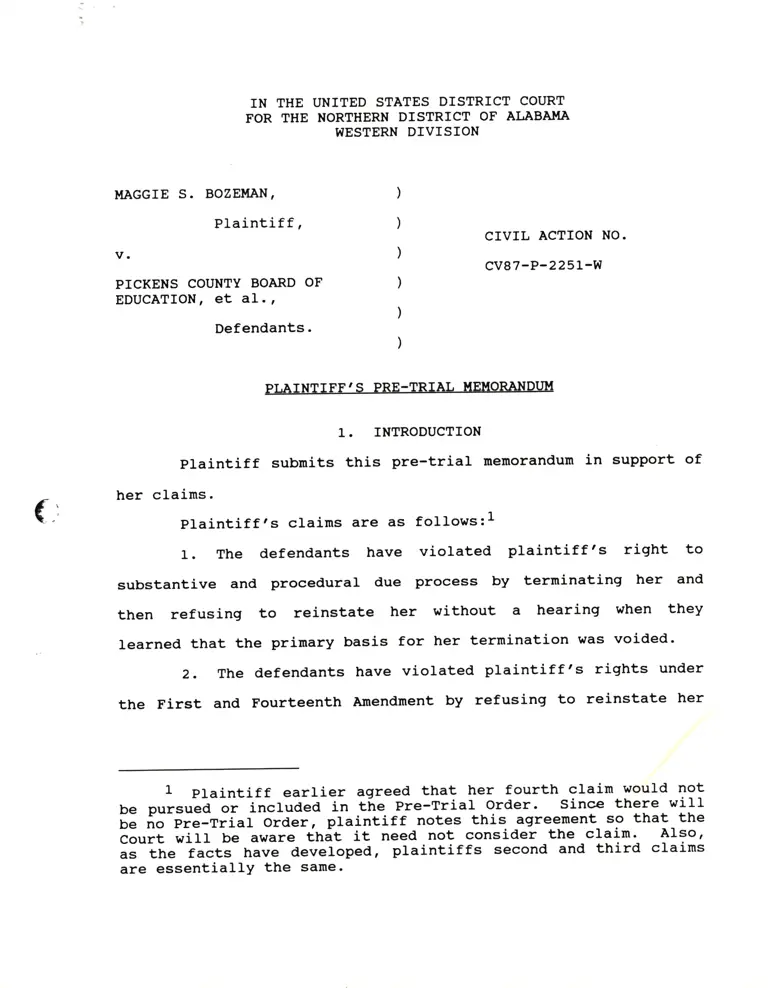
    IN THE UNITED STATES DISTRTCT COURT
FOR THE NORTHERN DISTRICT OF ALABAI'TA

WESTERN DTVTSION

UAGGTE S. BOZEMAN, )

Plaintiff, )
CIVIL ACTION NO.

v. )
cv87-P-2251-W

PTCKENS COUNTY BOARD OF )
EDUCATION, et aI.,

)
Defendants.

)

PI,AINTIFF' S PRE-TRIAL I,IEI,IORANDI'U

1. INTRODUCTION

Plaintiff submits this pre-trial memorandum in support of

- her claims.
( -l Plaintiff 's craims are as follows:l

1,. The defendants have violated plaintiff's right to

substantive and procedural due process by terrninating her and

then refusing to reinstate her without a hearing when they

Iearned that the prirnary basis for her termination was voided.

2. The defendants have violated plaintiff's rights under

the First and Fourteenth Amendment by refusing to reinstate her

l- plaintiff earlier agreed that her fourth claim would not
be pursued or--inlfuaea in tlre Pre-Tria1 order. Since there will
U" f,"-pr.-Trial Order, plaintiff notes this agreement so that the
Court will bg.iware dnit it need not consider the clairn. AIso,
as the facts have developed, plaintiffs second and third claims
are essentiallY the same.


after they learned that the primary basis for her termination was

voided. 2

2. STATEMENT OF FACTS

Plaintiff was a long-term, tenured teacher with the

pickens County Board of Education. By L979 she had taught within

the Pickens County Schoo1 System for 25 years. She is Black.

She has been extremely active politically as a leader of the

Alabaura Democratic Conference, a predorninantly black political

organization. The defendants were well ahrare of Bozeman's

political activity, 8s shown by the excerpts from defendant

parkrs deposition. PX25. She lrras not politically aligned with

any of the Board members, all of whom have been white. Id. at 34

e.g seq.

rn Lg78, she publicly and actively supported a black

candidate to oppose Park, a long-term member of the Board' As a

result of her activity during that campaign Bozeman was charqed

with voting fraud in the circuit court for Pickens county,

Alabama. On November 2, Lg7g, she h,as found guilty of those

charges by a jury in Pickens county. The defendants then, for

the first tirne, began efforts to terminate her. Pxl.

2 plaintiff must concede that so far as she can deternine,
the primary issue in this case is novel. In the words of
defen-dantsr- t[; rprimary reasonrr for the taking of plaintiff's
lenurea ioL was a'convidtion which has since been declared void.
When the conviction was declared void, Bozeman requested her job,
and defendants refused. For reasons discussed below, the
defendants have therefore violated the rights of plaintiff'


C

Bozenan was found guilty on a Friday. The sane day the

Superintendent told her not to return to work because of the

conviction. The following Tuesday, November 6, L979, dt 6:30

p.n., the Board held a specially called neeting to deal with

Bozeman in executive session. She was suspended from her tenured

teaching position, and the process for terminating her was begun.

She was not present for the meeting. The only specific reason

for the termination was the conviction with only a vague

reference to ltvarious conplaints concerning Mrs. Bozeman's

performance. rr PXl .

The letter notifying Bozeman of the proposed termination

is dated November 6' Lg7g, the same day as the night-tine

neeting. The first charge was her conviction. Px2

By letter dated November L2, L979, Bozeman contested her

termination. PX3. By letter dated November 2L, L979, she

requested a one year leave of absence. PX4'

On November 27, Lg7g, the Board met in another specially

called neeting and granted the request for a one year leave of

absence on the condition Itprovided that the Board receive a

conditional resignation from her should the conviction be upheld

by the aPPellate courts. rr PX5.

In compliance with the condition required by the Board,

Bozeman subrnitted a conditional resignation which provided as

follows:

In the unlikely event that ny felony
conviction is upneta in the Courts of
Alabana, and in the Courts of these United


(

States, please be advised that I will
resign' ny position as a teacher in the
Pickens Cbunty Schoot System. If my felony
conviction i; reversed, however, I wilI
insist on ny rights under the tenure laws
of Alabama is they relate to the discharge
of tenured teachers.

PX6.

By letter dated December 10, L979, the Superintendent

acknowledged the acceptance of the conditional resignation and

approved the leave of absence. Px7'

On Decenber !7, Lg7g, the Board ttunanimously approved the

continuance of the hearing for Maggie Bozeman based on her

request for a leave of absence and conditional resignation.rr

PX8,

As the one-year leave of absence neared an end, the

attorney for the Board wrote the attorney for the plaintiff'

px9. In that letter, the Board explained that the rrproposed

cancellation of her contract [was] for the primary reason that

she had been convicted of a felony offense by the Pickens county

Circuit Court. rr Px9 -

The attorney wrote directly to Ms. Bozeman on the same

date. pxl-o. Again, the only specific reason given for the

proposed cancellation lrras trthe fact that you had been convicted

by the Pickens county circuit court of a felony offense.rr Id'

Bozemanrequestedanotherleaveofabsence.Pxll.
on December 5, 1980, the BOard ldas informed that Bozeman

had requested a leave of absence. PX12' On December L5' 1980'

the Board extended that leave of absence through November 27,


c,",

lggL. pxL3. Bozeman was informed of the extended leave of

absence by Ietter dated December L9 , 1980, fron the

Superintendent. PXI'4.

on April 3, 1981, the superintendent inforned the Board

that the Appellate Court had upheld the
circuit courlTs decision in finding Mrs'
l,laggie Bozeman, f ormer school teacher 'guiriy of voter fraud. He further informed
tfre 'noard that I'lr. Ray Ward, Board
attorneyrhadadvisedhirnthattheBoard
could n6t "c"ept

Mrs. Bozemanrs resignation
aSstatedinnerletterrequestingaleave
of absence until she had exhausted the
appeals process available to her through
tha judicial sYstem of Alabana'

PX15

By letter dated November 11, 1981, the attorney for the

Board informed the attorney for Bozenan that the second one-year

Ieave of absence was about to expire. Px16. Again, the Board

confirmed the basis for the trproposed cancellation effort

contract, the major charge being that of the felony conviction'rr

The letter also confirmed an awareness that Bozeman pursuing her

conviction ltthrough the Federal Court'rt However, the Board had

'rgiven some preliminary indication that it does not wish to

continue this natter further.rr Therefore, Bozeman's resignation

was requested. Id. By November L'7, 1981, the attorney for the

Board had learned that Bozeman was represented by another lawyer'

lrlr. Solomon Seay, and wrote him. PXI-7' By that point, the Board

had apparently concluded that rrno further leaves of absence' or

extensions thereof, would be appropriaterr'


C

By letter dated December I, L98L, the Board through its

attorney inforned Bozeman that it would meet on December L4, L981

and act on her resignation at that tine. PX18

By letter dated December 15, 1981, the defendants notified

plaintiff of a hearing to be held on the cancellation of her

contract. PX19

on January 8, L982, the Board met, held a hearing on this

matter, and approved the cancellation of Bozeman's contract.

px2o. Since the Board hras continuing to consider the issue of

the conviction, which Bozeman was stiIl challenging, she saw

nothing to be served by attending that hearing.

The Board informed Bozeman of its decision by letter dated

January 8, L982, from its Superintendent. PX21.

As she had previously informed the defendants, and as they

h,ere aware, Bozeman continued to challenge her conviction through

the federal court system. On april L3, 1984, the United States

District Court for the Middle Division of Alabama granted her

petition for writ of habeas corpus and vacated the conviction.

pXZ2. The Court found that there was rrno evidence[ to support

the conviction of Bozeman. I-d. at 11. In addition, the Court

held that she was tttried upon charges that lrere never made and of

which Ishe was] never notified.tt Id. at 22. AccordinglY, on

August 9, 1984, Bozeman,s attOrney wrote and asked that the Board

return Bozeman to work. PX23.

The Board met on August 2L, Lg84, witnout informing

plaintiff that it hras then rneeting to consider her request, and


denied her request. PX24-

request to be reinstated.

Excerpts from the depositions of the individual defendants

are enclosed as pX25-30. The depositions confirn PX9 that the

prirnary reason for the termination was the conviction which has

now been declared void.

No hearing lrras held on Bozeman's

A.

3. ARGT'I,TENT

Since Due Process Requires that Defendant's
Action be Supported by Substantial Evidence,
It Cannot be based on a Conviction Which

(

The Court of Appeals has repeatedly ruled that when a

public employer takes ahray property interest, there is a

requirement that rrthe action taken is supported by substantial

evidence.rr Hatcher v. Board of Public Education and OrPhanage

for Bibb County, 809 F.2d L546, L552 (11'th Cir' 1987)' Accord,

Holley v. Seminole County School District' ?55 F'2d L492, L496

1499-1500 (llth cir. 1985); Viverette v. Lurleen B. l{allace state

Junior Colleoe,587 F.2d LgL, L94 (sth Cir. L979li Ferguson v'

IhgUAS., 430 F.2d 852, 859 (5th Cir' 1970)'

Here, the evidence defendants used to support the primary

reason for the termination has been declared void. Therefore, Do

substantial evidence exists to support the deprivation of

Bozeman,s property interest in her job. AccordinglY, the

property interest should be returned to her'


The Principle of itJust Treatmentrr
Inherent in Due Process and Its
Prohibition Against ArbitrarY or
Capricious conduct Forbid PubIic
Ernployers From SuPPorting the
Teinination of a Tenured Teacher
Based on Void Conviction-

The best known description of due Process is that of

Justice Frankfurter:

rr
I D ] ue process , tt unl ike some lgVql rules ,

i; i:ot a technical conception with a fixed
content unrelated to tine, place and
circumstances. Expressing as it does in
its ultimate analysis respect enforced by
Iaw for that' feeling of just treatment
which has evolved through centuries of
Anglo-Anerican constitutional history and
ciiilization, trdue processrr cannot be
irnprisoned within the tleacherous linits of
any formula.

, 34L U.S. L23, L62,

7L S.Ct. 624, 643, 95 L.Ed. 817 (1951) (Frankfurter' J.

concurring), quoted, among other places, in Hatcher, 809 F.2d

L552-53. In Hatcher, 809 F.2d 1553, the Eleventh Circuit

recognized ttthe versatile nature of the due process requirenentrr

and quoted Ferguson v. Thomas,43O F.2d 852,856 (Sth cir. 1970),

as follows:

the standards of procedural due process are
rro wooden absolutes. The suf f iciency of
procedures employed- in - anY . parti-cular
^situation must be judged in light of the
parties, the sub je-ct matter and the
Lircumstances involved

B.

f'-'


The Eleventh Circuit has also

prevents teacher firing at Public

or capriciousrr. Holley ' 755 F.2d

335 F. SuPP. 1086, 1088 (D. Neb'

(8th Cir. Le72).

FinaIIY, ds recognized in

852, 857 (sth Cir. 1970):

stated: ttDue Process Clause

university which was arbitrarY

L499, citing Rozman v. Elliott,
L97Ll, affirmed, 457 F.2d 1145

Egrguson v. Thomas, 43O F.2d

The substance of due process requlres
that no instructor who has an expectancy of
continued ernployment be deprived of that
expectancy by nere cerenonial compliance
with Procedural due Process'

Here, Bozeman has experienced grossly unfair treatment'

First, she suffered a felony conviction in Pickens county and a

prison sentence when there was rrno evidencert to convict her and

when she trras in fact tried upon charges that were never rnade and

of which she was never notified. Defendants concede that they

relied upon the conviction as the primary reason for plaintiff's

ternination. Nevertheless, when they were informed that the

conviction had been voided, they refused to take any action, even

granting plaintiff a hearing, to correct their ohrn injustice'

under the circumstances, defendants have failed to provide

plaintiff with just treatment, have acted arbitrarily and

capriciously, and have attenpted to rely upon mere ceremonial

compliance with procedural due process'

9


c.

Both the fifth and Eleventh Circuits have held that

substantive due process prohibits the deprivation of a property

interest for reasons other than those given'

In Kelly v. Snith, 764 F.2d L4L2, L4L3 (1Lth cir. 1985),

the Court made it clear that one states a clain for violation of

substantive due process when he is deprived of a property

interest rfor an inproper motive or . for reasons other than

those given. . . .tt

This Court has recognized that the
rrdeprivation of a property interest for an
inploper motive and by mea-ns that {arel
prete-xtua1, arbitrary ?nd capriciousrr
constitutes a substantive due process
violation. Hearn Iv. City of Gainesville],
688 F.2d [1328] at L332 t(l1th Cir' L9e2l1i
see also Roane v. Callisburg, 511 F'2d 633,
63e (sth Cir. L9751.

Barnett v. Housing Authority of the City of Atlanta ' 7O7 F'2d

L57L, L577 (l1th cir. 1983). There, the court affirned a

judgrment for a plaintiff on a substantive due process claim where

there was evidence that the reasons offered for praintiff's

termination Lrere pretextual and the real reason h'as to make

ptaintiff a scapegoat for mounting public pressure.

The Fifth Circuit has accepted a sinilar substantive due

process theory in Russell v. Harrison,736 F.2d 283r-287 e! seq'

(5th Cir. L983), where the Court held:

Since the
Bozeman's

Prinary Reason Given
Termination is Void,

for
Due

f

10


Despite ptaintiffs' failure to elaborate,
howevLr, iL is clear that they are claining
deprivation of substantive due process
based on the fact that their contracts were
terninated while the contracts of other
enployees rrere maintained, all in absence
of any rational plan to explain this
action- This is all that is required.

Id. at 288.

Here, the PrimarY basis for the

plaintiff was voided. Nevertheless,

reconsider their decision. Since the

decision is gone, it logically follows

the ternination was something e1se.

decision to terminate

defendants refused to
primary basis for the

that the true reason for

The Court Should Find that Bozeman
was Terminated or Not Reinstated
in Violation of her First and
Fourteenth Amendment Rights.

public officials cannot make emplolnnent decisions for

enployees like teachers on the basis of their political activity.

8.g., Rankin v. McPherson, Lo7 S. Ct. 289L (1987)t Hatcher, 809

F.2d 1555 el seq.

In this case, when plaintiff requested reinstatement in

19g4, defendants knew that the prinary reason for her termination

had been voided. The Court should conclude that the true reason

that the defendants did not want to reinstate her h'as her

politicat activity in opposition to the Board members.

D.

11


For aII of

enter a judgment in

4. CONCLUSION

the reasons stated

favor of plaintiff.
herein, the Court should

OF COUNSEL:

cooPER, t{rTcH, CRAWFORD,
KUYKENDALL & WHATLEY

Suite zOL, 409 North 21st Street
Birmingham, Alabama 35203
(z0sl 328-e576

RespectfulIY submitted,

CERTIFICATE OF SERVICE

copy

I herebY certifY that I

of the foregoing upon the

have served a true and correct

following counsel of record bY

depositing same in the u. s. l{ail, postage prepaid, on this e6

day of ,4 , ,-t , 1988.
J

Ray Ward, Esquire
Ray, Oliver, Ward & Parsons
P. o. Box 65
Tuscaloosa, Alabama 35402

L2