Thomason v. Cooper Brief for Appellees
Public Court Documents
January 1, 1957
-
Brief Collection, LDF Court Filings. Thomason v. Cooper Brief for Appellees, 1957. bc60ad0a-c69a-ee11-be37-00224827e97b. LDF Archives, Thurgood Marshall Institute. https://ldfrecollection.org/archives/archives-search/archives-item/ac93abce-8882-4787-8766-651c606db560/thomason-v-cooper-brief-for-appellees. Accessed October 08, 2026.
Copied!
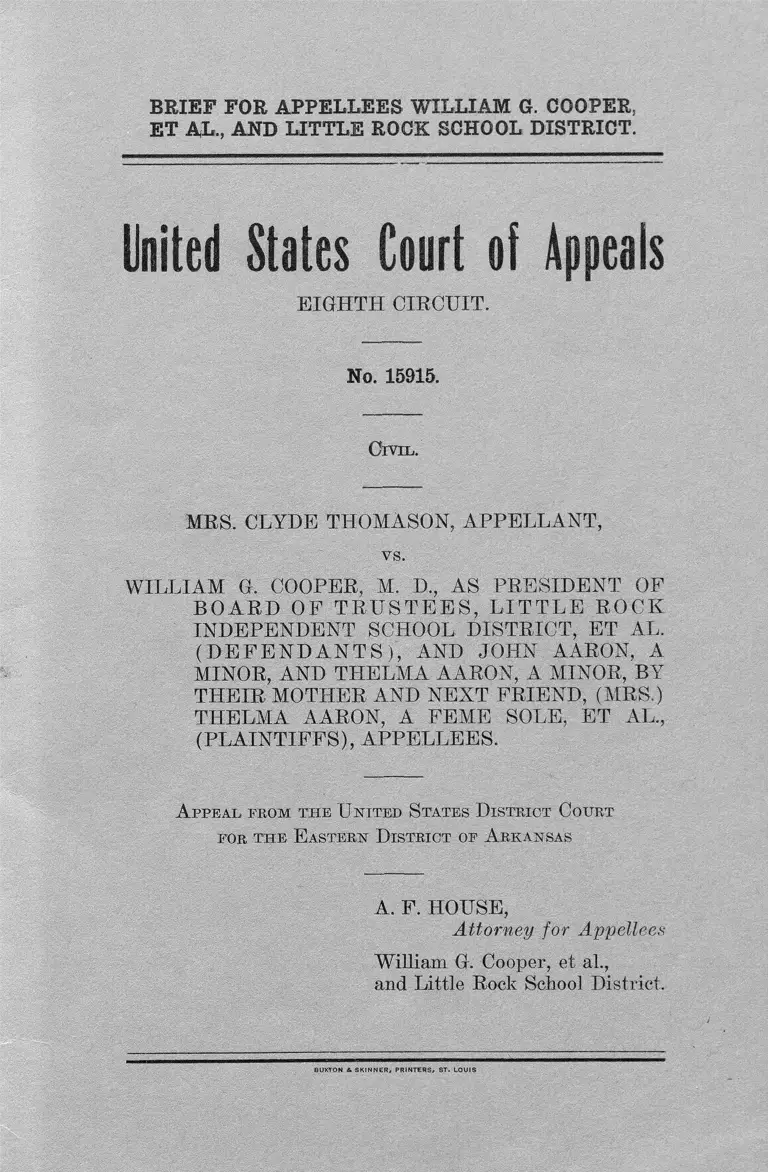
BRIEF FOR APPELLEES WILLIAM G. COOPER,
ET AL., AND LITTLE ROCK SCHOOL DISTRICT.
United States Court of Appeals
EIGHTH CIRCUIT.
No. 15915.
Q rm ,.
MRS. CLYDE THOMASON, APPELLANT,
vs.
WILLIAM G. COOPER, M. D., AS PRESIDENT OF
B O A R D OF T R U S T E E S , L I T T L E R O C K
INDEPENDENT SCHOOL DISTRICT, ET AL.
( D E F E N D A N T S ) , AND JOHN AARON, A
MINOR, AND THELMA AARON, A MINOR, BY
THEIR MOTHER AND NEXT FRIEND, (MRS.)
THELMA AARON, A FEME SOLE, ET AL.,
(PLAIN TIFFS), APPELLEES.
A p p e a l fr o m t h e U n it e d S tates D istr ic t C ourt
for t h e E aste rn D istr ic t of A r k an sa s
A. F. HOUSE,
Attorney for Appellees
William G. Cooper, el al.,
and Little Rock School District.
BUXTON & SKINNER, PRINTERS, ST. LOUIS
INDEX.
Page
Statement of the C ase .......................... 1
Argument..................................................................................................... 4
Conclusion ................................................................................................... 7
Table of Cases:
Capella v. Zurich General Accident & Liability Insurance Co.,
194 F. (2d) 558 .................................................................................... 6
Fort Worth & D. Railway Co. v. Harris, 230 F. (2d) 680 ................. 6
Other Authority:
Rule 46, Federal Rules of Civil Procedure....................................... 6
United States Court of Appeals
FOR THE EIGHTH CIRCUIT.
No. 15915.
MRS. CLYDE THOMASON, APPELLANT,
vs.
WILLIAM G. COOPER, M. D., AS PRESIDENT OF
B O A R D OF T R U S T E E S , L I T T L E R O C K
INDEPENDENT SCHOOL DISTRICT, ET AL.
( D E F E N D A N T S ) , AND JOHN AARON, A
MINOR, AND THELMA AARON, A MINOR, BY
THEIR MOTHER AND NEXT FRIEND, (AIRS.)
THELMA AARON, A FEAfE SOLE, ET AL,,
(PLAIN TIFF), APPELLEES.
BRIEF FOR APPELLEES. WILLIAM G. COOPER,
ET AL., AND LITTLE ROCK SCHOOL DISTRICT.
STATEMENT OF THE CASE.
We have here not a preliminary injunction but a perma-
ment injunction, and that part of Rule 65, Federal Rules of
Civil Procedure, relied on by appellant is not applicable.
The schools operated by appellee Little Rock School
District, hereinafter referred to as ‘ ‘ District, ’ ’ were to
[ 2 ]
open on September 3, 1957. Instead of intervening in the
United States District Court, hereinafter referred to as
“ District C ourt/’ to show cause why operations under the
plan of integration approved by the District Court on Au
gust 15, 1956, should be. postponed, the appellant filed suit
on August 27, 1957, in the Chancery Court of Pulaski Coun
ty, a court of the State of Arkansas hereinafter referred to
as the “ Chancery Court.”
Under State court procedural rules the District would
have been entitled to a reasonable time in which to plead
and prepare for a hearing. Counsel for appellant and coun
sel for the District realized that they must move rapidly if
the question involved were to be finally settled before the
opening of schools on September 3rd. Counsel for the Dis
trict realized that if the Chancery Court decree interfered
with the operation of the plan as approved by the District
Court it would be required to go to the District Court for
injunctive relief. In view of the existing emergency, coun
sel for appellant and counsel for the District agreed that
the District would immediately file its Answer and be ready
for a hearing in the Chancery Court on September 29, 1957,
and that if the Chancery Court did enter an order forbid
ding operations under the plan, and if the District deemed
it advisable to go to the District Court for relief, counsel
for appellant would waive all formalities and appear before
the District Court for a hearing on the District’s petition
to enjoin appellant from endeavoring to enforce the Chan
cery Court order.
On August 28th the District filed its Answer and on the
29th there was a trial in the Chancery Court. On that date
an order was entered by the Chancery Court forbidding
integration of the races in the schools of the District. On
the afternoon of the 29th the District applied to the District
Court for a permanent injunction (R. 7) and asked for a
hearing on August 30th.
Inasmuch as under the agreement of counsel all proce
dural formalities were to be waived, it was not contempla
ted that a summons would be issued. However, it was
[ 3 ]
deemed proper to enter an order fixing the time of the
hearing in the District Court. The Order (R. 16-17) uses
the phrase “ temporarily enjoined.” This is the only sug
gestion in the record of an application for a temporary
order. The Petition asked for a permanent order (R. 5)
and the order which was entered was of a permanent na
ture (R. 17-18). The Court of its own motion suggested the
provision that the petitioner would not be required to file a
bond (R. 18), but that did not change the nature of the pro
ceeding. It only emphasized the fact that there was per
manency in the restraint placed on appellant.
After the order of August 29th was entered, counsel for
appellant, in keeping with the agreement to dispense with
procedural delays, waived official service on the appellant,
and on the day fixed for the hearing both appellant and her
counsel were before the Court, On September 17, 1957,
appellant filed her Notice of Appeal. It recites that the
appeal is from the final order dated August 30, 1957, “ issu
ing an injunction against her. ’ ’ It is significant that it was
not termed a temporary injunction. It should be added that
the agreement herein discussed was made with Arthur
Frankel who filed the Complaint in the Chancery Court.
Counsel who appears here for appellant first came into
the proceeding on August 29th, but later he was informed
of the agreement and courteously waived service of a copy
of the order of August 29th and appeared on August 30th.
[ 4 ]
ARGUMENT.
As stated, the hearing on the Petition which asks for a
permanent injunction was held on August 30, 1957. Coun
sel for appellees Aaron, et ah, the plaintiffs in the original
suit, was present. He also had waived service of a copy of
the order of August 29th. Appellant and her counsel were
present. Counsel for appellant took no exception to the
order fixing the date of hearing. He took no exception to
the Petition, and he did not ask for an opportunity to pre
sent testimony. He realized that within the confines of the
original order of the District Court and the Complaint and
the Answer filed in the Chancery Court, and the Decree of
the Chancery Court, the solution to the only question pre
sented would be found. As background material for consid
eration by the District Court, counsel for appellant sum
marized the testimony in the Chancery Court and argued at
length that non-acceptance of the plan by residents of the
District and the possibility of danger were sufficient to jus
tify the Chancery Court’s decree. A stenographic tran
script of his argument was taken by the official reporter of
the District Court. Counsel did not question the accuracy
of the exhibits attached to the Petition (R. 11-13). As a
matter of fact, Exhibit “ C ” was prepared by counsel for
appellant and he knew that Exhibit “ B ” was a true copy
of the Answer filed by the District in the Chancery Court
and that Exhibit “ A ” was a true copy of the Complaint
filed by Mr. Frankel in behalf of the appellant.
Only a question of law was presented to the District
Court, to-wit, whether it was proper for a State court to
interfere with the operation of the plan of integration which
was to be put into effect in accordance with the order of the
District Court, such court having retained jurisdiction of
the original suit. No question was involved as to the sover
eign power of a State, acting through its chief executive, to
take measures to preserve the peace. The question was
whether a State court could order the District to disobey
the order of the Federal Court. The impropriety of enjoin
ing the District from doing what it had been ordered to do
by the District Court was manifest, and it was a plain viola
tion of the rule of comity and in disregard of the suprem
acy clause of the Federal Constitution. To avoid repetition,
we adopt and cite in support of the foregoing proposition
the cases cited in Subdivision I of the Brief for Appellees,
Aaron, et al.
The appellant is in no position to argue here that there
was “ no adequate presentation of the facts.” There was
full opportunity to present any facts appellant deemed
material, but that opportunity was deliberately waived.
Counsel well knew that no conceivable testimony from wit
nesses could affect the application of the rule of law which
the District and Aaron et al contended was controlling. He
well knew the exhibits attached to the Petition presented
the one and only issue in the contest, to-wit, whether the
Chancery Court had imposed upon the District a command
in direct conflict with the command imposed by the District
Court’s order of August 15,1956.
The Judge of the District Court did not act precipitantly,
He heard all counsel had to say. He saw in the exhibits an
undermining of the principle of federal supremacy, and he
acted accordingly. The appellant did not even see fit to file
a response to the Petition. The only point he could have
stated in a response was implicitly raised in the exhibits
which were attached to the Petition, and that was one of
law and not fact. In the decree which was entered in the
Chancery Court and which was prepared by counsel for
appellant, he endeavored to put into words the idea that a
State court, in the exercise of State sovereignty, can impair
a Federal Court order on the premise that it is necessary to
do so to preserve the peace. The allegations in the Com
plaint filed in the State court reveal that the idea of State
sovereignty being exercised by a trial court was in a meas
ure extracted from a constitutional amendment and certain
State statutes which were designed to “ prevent federal en
[ 6 ]
croachment on the operation of public schools in Arkan
sas” (R. 9). The appellant speaks too late. Having been
given every opportunity to offer proof and except to pro
cedural orders, she was willing to rest her case on the
exhibits to the Petition and her counsel’s oral argument.
Under Rule 46 of the Federal Rules of Civil Procedure, for
mal exception to rulings and orders of the court are unnec
essary, but no litigant will be heard on appeal who has not
made known to the trial court the action he desires the trial
court to take. Without timely objections and an opportu
nity to make corrections, a trial court may not be put in
error. Capella v. Zurich General Accident & Liability Insur
ance Co., 194 F.(2d) 558; Ft. Worth & D. Railway Co. v.
Harris, 230 F. (2d) 680.
Were this case to be remanded, it would again be submit
ted on the Petition and its exhibits, and testimony from in
numerable witnesses as to why the Chancery Court entered
its decree of August 29th could not possibly change the re
sult.
[ 7 ]
CONCLUSION.
Affirmance is proper.
Respectfully submitted,
A. F. HOUSE,
Attorney for Appellees
William G. Cooper, et al.,
and Little Rock School District.