Independent Federation of Flight Attendants v. Zipes Brief for Respondents
Public Court Documents
January 1, 1988
-
Brief Collection, LDF Court Filings. Independent Federation of Flight Attendants v. Zipes Brief for Respondents, 1988. ba0206c8-b89a-ee11-be36-6045bdeb8873. LDF Archives, Thurgood Marshall Institute. https://ldfrecollection.org/archives/archives-search/archives-item/b1e55843-d234-48b5-bef6-60dd0a962a0b/independent-federation-of-flight-attendants-v-zipes-brief-for-respondents. Accessed October 06, 2026.
Copied!
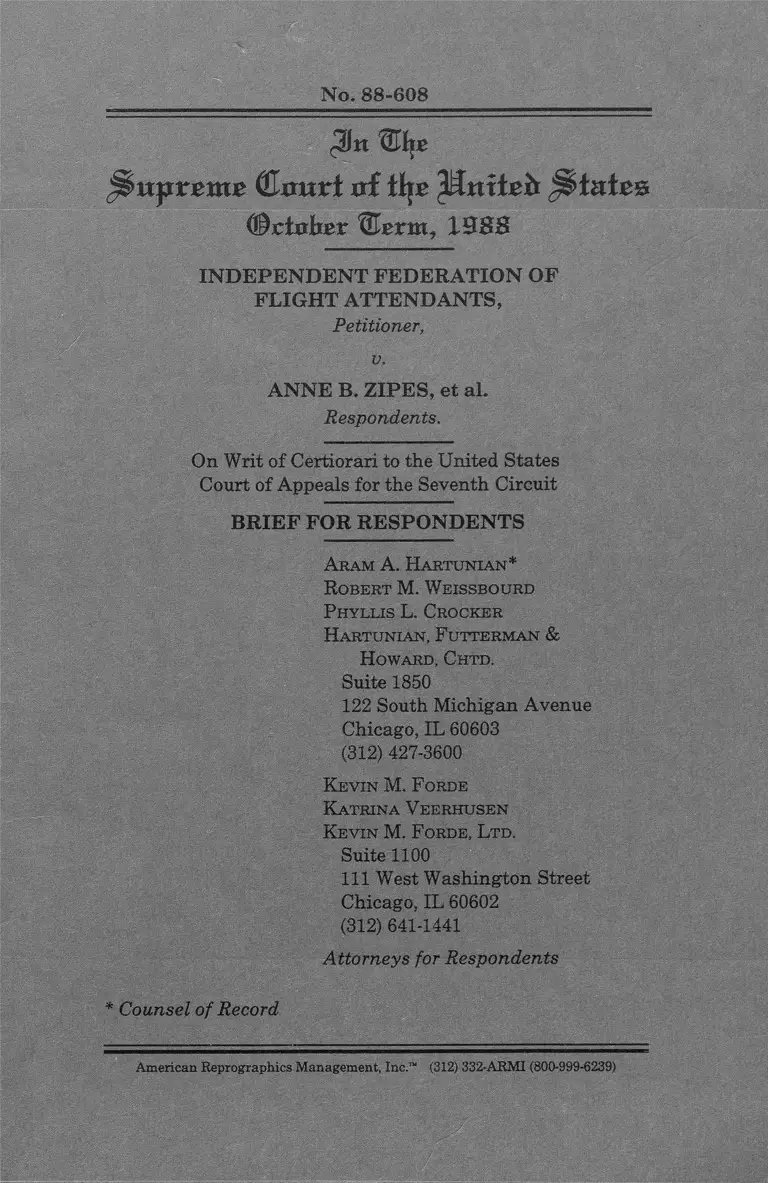
No. 88-608
<31 tt
^ tx p rzm t Court of tfyr jHtttfeit jilu tes
(©rtdbuer ®«rm, 19HS
IN D EPEN D EN T FEDERATION OF
FLIGHT ATTENDANTS,
Petitioner,
v,
ANNE B. ZIPES, e t al.
Respondents.
On Writ of Certiorari to the United States
Court of Appeals for the Seventh Circuit
B R IEF FOR RESPONDENTS
Aram A. Hartunian*
Robert M. Weissbourd
P hyllis L. Crocker
Hartunian, Futterman &
Howard, Chtd.
Suite 1850
122 South Michigan Avenue
Chicago, IL 60603
(312) 427-3600
Kevin M. F orde
Katrina Veerhusen
Kevin M. Forde, Ltd.
Suite 1100
111 West Washington Street
Chicago, IL 60602
(312) 641-1441
Attorneys for Respondents
* Counsel of Record
American Reprographics Management, Inc.™ (312) 332-ARMI (800-999-6239)
QUESTION PRESENTED
The question presented is fairly stated by Amicus United
States and the Equal Employment Opportunity Commission
(“amicus E.E.O.C.” herein).
TABLE OF CONTENTS
Page
STATEMENT OF FACTS........................................................... 1
SUMMARY OF ARGUMENT .................................................... 3
I. THE CONGRESSIONAL PURPOSE OF ENCOURAG
ING PRIVATE PLAINTIFFS WOULD BE FRUS
TRATED IF ATTORNEYS’ FEES WERE NOT
FORTHCOMING AT THE VITAL STAGE OF
FASHIONING RELIEF......................................... 5
H. LIABILITY FOR FEES IS NOT RESTRICTED TO
DEFENDANT-WRONGDOERS ............................ 6
Introduction ........... 6
A. The Statute Makes No Connection Between
Wrongdoing And Liability For F e e s .............. 6
B. There Is No Basis For Exempting Inter-
venors From § 706(k)............................... 10
HI. THE UNION WAS NOT A FUNCTIONAL
PLAINTIFF....... ....................................................... 12
IV. IN A CONTEST BETWEEN TWO GENUINE PLAIN
TIFFS, THE LOSING PLAINTIFF SHOULD PAY
THE ATTORNEYS’ FEES OF THE WINNING
PLAINTIFF .................................................... 16
A. In Contests Between Plaintiffs, The Defensive
Protection Of Christiansburg Should Be
Eliminated ............................................................. 16
B. Attorneys’ Fees For The Work Made Neces
sary By A Plaintiff-Intervenor Should Not
Be Imposed On The Original Defendant . . . . . . . . . . 17
CONCLUSION.................................................. 19
11
U1
TABLE OF AUTHORITIES
Cases: Page
Air Line Stewards and Stewardesses Ass’n, Local 550
v. Trans World Airlines, Inc., 713 F.2d 319 (7th Cir. 1983)....... 1
Air Line Stewards And Stewardesses Ass’n, Local 550
v. American Airlines And Trans World Airlines, 490 F.2d
636 (7th Cir. 1973), cert, denied, 416 U.S. 993 (1974).............. 2
Albemarle Paper Co. v. Moody, 422 U.S. 405 (1975).................. 5
Akron Center for Reproductive Health v. City of Akron,
604 F. Supp. 1268 (N.D. Ohio 1984)...................................... 10
Allen v. Terminal Transport Co., 653 F.2d 1016
(5th Cir. 1981), cert, denied, 455 U.S. 989 (1982).................. 10
ALSSA v. TWA, 630 F.2d 1164 (7th Cir. 1980), aff’d,
sub nom. Zipes v. TWA, 455 U.S. 385 (1982)................ 2, 3,17
Alyeska Pipeline Service Co. v. Wilderness Society,
421 U.S. 240 (1975)...................................................... 6, 7, 8,11
Annunziato v. The Gan, Inc., 744 F.2d 244 (2d Cir. 1984)....... 10
Avoyelles Sportsmen’s League v. Marsh, 786 F.2d 631
(5th Cir. 1986)................... 18
Baker v. City of Detroit, 504 F. Supp. 841 (E.D. Mich. 1980),
aff’d, sub nom. Bratton v. City of Detroit, 704 F.2d 878,
(6th Cir. 1983), cert, denied, 464 U.S. 1040 (1984)............... 16
Charles v. Daley, 846 F.2d 1057 (7th Cir. 1988), petition for
cert, filed 57 U.S.L.W. 3314 (Oct. 20,1988)
(No. 88-664)......................................................................... 7,10
Christiansburg Garment Co. v. E.E.O.C., 434 U.S. 412
(1978)................................................................................passim
In re Consolidated Pretrial Proceedings in the Airline
Cases, 582 F.2d 1142 (7th Cir. 1978), rev’d, sub nom.
Zipes v. TWA, 455 U.S. 385 (1982) 2
Decker u. U.S. Dept, of Labor, 564 F. Supp. 1273
(E.D. Wis. 1983) ....................... ............................................ 10
Fleischmann Distilling Corp. v. Maier Brewing Co.,
386 U.S. 714 (1967) ...................... .......................................... 8
Franks v. Bowman Transportation Co., 424 U.S. 747
(1976)....................... ............. .................................... . 5, 9
Grano u. Barry, 783 F.2d 1104 (D.C. Cir. 1986)....................... 12
Haycraft u. Hollenbach, 606 F.2d 128 (6th Cir. 1979) . . . . . . . . 10
Kentucky v. Graham, 473 U.S. 159 (1985)............................ 8
Kirkland u. New York State Dept, of Correctional Services,
524 F. Supp. 1214 (S.D.N.Y. 1981) .................................. . 12
May v. Cooperman, 578 F. Supp. 1308 (D.N.J. 1984)......... . 10
Moten v. Bricklayers, Masons and Plasterers, 543 F.2d 224
(D.C. Cir. 1976)...................................................................... 10
Natural Resources Defense Council, Inc. v. Thomas,
801 F.2d 457 (D.C. Cir. 1986).............•.................................. 10
Newman v. Piggie Park Enterprises, Inc., 390 U.S. 400
(1968)................. .5
Pennsylvania v. Delaware Valley Citizens’ Council, 478
U.S. 546 (1986) .............. ........................................... 11
Planned Parenthood v. Citizens For Community Action,
558 F.2d 861 (8th Cir. 1977) .................................................... 7
Planned Parenthood Ass’n v. Commonwealth of Pa.,
508 F. Supp. 567 (E.D. Pa. 1980) ........................................... 10
Prate v. Freedman, 583 F.2d 42 (2d Cir. 1978) .................. . 16
Reeves v. Harrell, 791 F.2d 1481 (11th Cir. 1986), cert, denied,
479 U.S. 1033 (1987).............. 12
Rich v. United States, 417 U.S. 116 (1974) .............................. 14
iv
Page
V
Richardson v. Alaska Airlines, Inc., 750 F.2d 763
(9th Cir. 1984) ........................................................................ 10
Robideau v. O’Brien, 525 F. Supp. 878 (E.D. Mich. 1981)....... 10
S&R Wrecker Service, Inc. v. Mecklenburg County, 652
F. Supp. 527 (W.D.N.C. 1987) ............................................... 10
Sierra Club v. EPA, 769 F.2d 796 (D.C. Cir. 1985) .................. 10
Sims v. Amos, 340 F. Supp. 691 (M.D. Ala.), aff’d mem.,
409 U.S. 942 (1972)................................................................. 11
Thompson v. Sawyer, 586 F. Supp. 635 (D.D.C. 1984)............. 10
Tunstall v. Office of Judicial Support, 820 F.2d 631
(3d Cir. 1987)......................................................................... 10
United States v. Turkette, 452 U.S. 576 (1981)...........................6
Vulcan Society of Westchester County, Inc. v. Fire
Department of the City of White Plains, 533 F. Supp.
1054 (S.D.N.Y. 1982) ............................................ 10
Wilderness Society v. Morton, 495 F.2d 1026 (D.C. Cir. 1974),
rev’d on other grounds, sub nom. Alyeska Pipeline
Service Co. v. Wilderness Society, 421 U.S. 240 (1975).........7
Wis. Socialist Workers 1976 Campaign Comm. v. McCann,
460 F. Supp. 1054 (E.D. Wis. 1978)....................................... 10
Zipes v. Trans World Airlines, 455 U.S. 385
(1982) .................................................................... 2,3,9,13,15
Statutes and rules:
Age Discrimination in Employment Act, 29 U.S.C.
§ 626(b).................................................................................... 10
Civil Eights Act of 1964, 42 U.S.C. § 2000e, et seq......................4
Civil Rights Act of 1964:
§ 706(g), 42 U.S.C. § 2000e-5(g)....................................... 11,13
§ 706(k), 42 U.S.C. § 2000e-5(k) ................................... passim
Page
V I
Clean Water Act, § 505(d), 33 U.S.C. § 1365(d)........................ 10
Fair Labor Standards Act, 29 U.S.C. § 216(b)......................... 10
Federal Water Pollution Control Act, 33 U.S.C. § 1367(c)....... 10
Toxic Substances Control Act, 15 U.S.C. § 2605(c) (4) (A). . . . . 14
42 U.S.C. § 1988 .................................................... ......... passim
Rule 23(e), Fed.R.Civ.P. ....................................................... . 3
Miscellaneous:
H.R. Rep. No. 1558, 94th Cong., 2d Sess. (1976) ...................... 11
S. Rep. No. 1011, 94th Cong., 2d Sess. (1976) .................. .. 11,12
Note, Attorney’s Fees: Where Shall The Ultimate Burden Lie?,
20 Vand. L. Rev. 1216 (1967) .................................................. 8
Page
No. 88-608
<3Itt
up rente fflxmrt uf the Jlnfteh ^States
©ctuker 1088
INDEPENDENT FEDERATION OF
FLIGHT ATTENDANTS,
Petitioner,
v.
ANNE B. ZIPES, et al.
Respondents.
On Writ of Certiorari to the United States
Court of Appeals for the Seventh Circuit
BRIEF FOR RESPONDENTS
STATEMENT OF FACTS
Before 1970, Trans World Airlines fired stewardesses who
became pregnant or adopted children, but not male employees
who became parents. On August 8, 1970, the union1 filed the
complaint, alleging discrimination in violation of Title VII. Air
Line Stewards And Stewardesses Ass’n, Local 550 v. Trans World
Airlines, Inc., 713 F.2d 319, 320 (7th Cir. 1983).
The union members were incumbent stewardesses as to
whom only prospective relief was warranted. In the lawsuit, the
union also purported to represent the previous, illegally fired,
stewardesses who were no longer union members. In July 1971,
the union entered into a settlement agreement with TWA that
obtained the prospective relief desired by the incumbents but
provided the former stewardesses with no back pay, retroactive
1 The union w as then the predecessor to Petitioner IFFA. These
successive representatives of incumbent stewardesses are referred to
herein as “the union”.
2
seniority (either company seniority or competitive seniority), or
even the right to return to work except as openings might occur.
Air Line Stewards A nd Stewardesses A ss ’n, Local 550 v.
American Airlines And Trans World Airlines, 490 F.2d 636, 638
(7th Cir. 1973), cert, denied, 416 U.S. 993 (1974). Because of the
union’s conflict of interest and its refusal to give opt-out notices
to the former stewardesses, the Seventh Circuit vacated the
District Court’s approval of the settlement, ejected the union as
the class representative, and remanded for resolution of the
merits. Id. at 640, 643.
After remand, plaintiffs obtained summary judgment. On
appeal, the Seventh Circuit affirmed on the merits but reversed
as to those class members who did not file timely EEOC charges.
In re Consolidated Pretrial Proceedings in the Airline Cases, 582
F.2d 1142 (7th Cir. 1978), rev’d, sub nom. Zipes v. TWA, 455
U.S. 385 (1982). The mandate was stayed and both sides filed
petitions for certiorari. This Court granted a motion to defer
consideration of the certiorari petitions, pending effectuation of
a settlement which was then being negotiated.
A settlement was approved by the District Court which
provided for $3,000,000 in back pay, reinstatement, retroactive
company seniority and (as amended, J.A. 27)2 such retroactive
competitive seniority as the District Court might order after a
hearing in which the union participated. ALSSA u. TWA, 630
F.2d 1164, 1166 (7th Cir. 1980). The class was divided into Sub-
Class A (those who had filed timely charges) and Sub-Class B
(those who did not). Id. at 1166.
At the suggestion of plaintiffs, the union was invited to take
part in a hearing on the question of competitive seniority. Instead,
the union filed a full-blown petition to intervene, claiming that
the court lacked jurisdiction over the claims of Sub-Class B, that
the settlement could not be approved without the union’s consent,
and that any grant of retroactive seniority would impermissibly
infringe upon the contract rights of the incumbents. (J.A. 23 f f
11, 16, 18) If the union had its way, the settlement would have
2 Citations to the Joint Appendix are “(J.A .___ )”, and to the Appendix
to Petitioner’s Certiorari Petition as “(P .A ___ )”.
3
been held for naught, and the plaintiffs and TWA would have
been forced to continue litigating the claims on the merits (and
the question of jurisdiction) to the bitter end, in a winner-take-
all contest. (J.A. 32)
The District Court rejected the union’s jurisdiction objection
(J.A. 30) and, after three days of evidentiary hearings (P.A. 4a),
entered two orders. In one, the settlement was approved under
Rule 23(e), Fed.RCiv.P. (J.A. 35-36) In the other order, the District
Court concluded that granting retroactive competitive seniority
would not have an unusual adverse impact on the incumbents
in an untypical way, and accordingly ordered that all re-employed
class members be credited with full competitive seniority
retroactive to the dates when they would have returned to work
(upon completion of pregnancy leaves) in the absence of TWA’s
no-mothers policy. (J.A. 37-38)
The union appealed not only from the seniority order, but
also from the orders which approved the settlement and rejected
the union’s jurisdictional challenge. The Seventh Circuit
affirmed, ALSSA v. TWA, 630 F.2d 1164 (7th Cir. 1980), and
the union obtained certiorari. This Court affirmed those orders,
and reversed the earlier Seventh Circuit holding regarding subject
matter jurisdiction. Zipes v. Trans World Airlines, 455 U.S. 385
(1982).
Because of the union’s intervention and appeals, the plaintiff
class’ ultimate enjoyment of the settlement’s benefits was delayed
and came at a greatly increased cost. (P.A. 35a) On July 16,
1986, the District Court’s amended order required the union to
pay a total of $180,915.84 for plaintiffs’ attorneys’ fees and $5,978
for expenses. (P.A. 37a, 40a)3
SUMMARY OF ARGUMENT
1. The Congressional purpose underlying § 706(k), 42 U.S.C.
§ 2000e-5(k), is to enable Title VII victims to obtain lawyers,
3 $57,258 thereof is for the work of counsel for Sub-Class A, who have
already been paid from the $3,000,000 settlement fund for their work
in fighting with the union. If plaintiffs prevail here, this amount will
be refunded to the members of Sub-Class A (P.A 37a)
4
thereby facilitating private enforcement of the Civil Rights Act
of 1964, 42 U.S.C. § 2000e et seq. Since rightful place seniority
is a vital part of the relief available under Title VII, Congress’
intention to ensure the payment of a plaintiffs legal fees must
be applied to the relief stage as well as to the liability phase
of the case.
2. The fee-shifting provision is neither punitive nor limited
to wrongdoing defendants. It is to encourage plaintiffs to
vindicate a national policy of the highest priority. While
Christiansburg Garment Co. v. E.E.O.C., 434 U.S. 412 (1978),
observed that fee awards are ordinarily imposed on violators
of the law, this Court did not hold th a t wrongdoing is a
precondition for fee awards to plaintiffs.
3. Congress intended that plaintiffs pay defendants’ attor
neys’ fees only in groundless suits, in order not to discourage
potential plaintiffs. That being the underlying purpose of a
p la in tif fs semi-im m u n ity for a defendant’s fees, it is applicable
only when he is genuinely a plaintiff — that is, when he seeks
redress for a violation of either Title VH or some other federal
statute which carries a similar fee-shifting provision. The union
was not a “functional plaintiff’ because it neither asserted a
violation of, nor a right to relief under, Title VII or any other
fee-shifting statute. Moreover, the history of this case, including
the union’s litigation posture at the relief stage, demonstrates
that the union was a functional defendant. The union’s interests
were diametrically opposed to the plaintiffs; the union presented
the only opposition to plaintiffs’ obtaining complete relief; and
the union’s efforts were aimed at destroying plaintiffs’ entire case. 4
4. The rare case in which the opposing parties are both
seeking redress from each other for violations of Title VII (or
some other statute with a fee-shifting provision) would not be
resolvable by the scriptures of Christiansburg. In such a case,
the policy considerations underlying § 706(k) require tha t
attorneys’ fees for work made necessary by an intervenor should
be borne by the intervenor rather than the winning plaintiff.
Reasons of policy also militate against imposing plaintiffs’
attorneys’ fees on the defendant for work made necessary by
an intervenor.
5
I
TH E CONG RESSIO N A L P U R PO S E OF
ENCOURAGING PRIVATE PLAINTIFFS
WOULD BE FRU STRA TED IF ATTOR
NEYS’ FEES WERE NOT FORTHCOMING
AT THE VITAL STAGE OF FASHIONING
RELIEF
The two central goals of the Civil Rights Act of 1964 were
to eradicate discriminatory practices and make persons whole
for injuries suffered by reason of unlawful employment practices.
Albemarle Paper Co. v. Moody, 422 U.S. 405, 421 (1975). Rec
ognizing that enforcement of the Act would be largely dependent
upon private plaintiffs, who typically lack the means to attract
competent lawyers, Congress intended § 706(k)4 to encourage the
bringing of private actions in order to facilitate enforcement of
Title VII. See Christiansburg Garment Co, v. E.E.O.C., 434 U.S.
412, 420 (1978) (citing 110 Cong. Rec. 12724 (1964) (remarks of
Sen. Humphrey)); Newman u. Piggie Park Enterprises, Inc., 390
U.S. 400, 401-402 (1968).
The legal services performed at the relief stage comprise an
important aspect of Title VII enforcement. In particular, seniority
is a vital part of the make-whole remedy of Title VII. Franks
v. Bowman Transportation Co., 424 U.S. 747,774 (1976). Lawyers
will not be attracted as easily if they cannot expect payment
for the work at the relief stage. Thus, ensuring the payment of
plaintiffs’ attorneys’ fees for the work involved in a seniority
dispute is critical. Since the fee-shifting scheme was designed
to encourage a p laintiffs obtaining benefits to the public,
requiring victorious plaintiffs to bear the costs of that significant
a part of the proceeding could not be squared with Congress’
purpose.
Every Title VII plaintiff (and his lawyer) should anticipate
the performance of substantial legal services even after the
defendant’s violation is proved. At the stage when relief must
be fashioned, the plaintiff will frequently encounter opposition
42 U.S.C. § 2000e-5(k).
6
from non-defendant parties. This case serves as an instructive
example. After the settlement with TWA in 1979, four years
elapsed before the plaintiffs enjoyed the first benefit of that
settlement.* 4 5 And from that time until the plaintiffs’ lawyers
obtained a fee award against the union in 1986 for those 4 years
of work, another 2 years elapsed.
To the extent this case is any guide, if attorneys’ fees were
not recoverable for post-settlement work, it would serve as a
serious disincentive, which cannot be reconciled with either the
language or purpose of § 706(k).
II
L IA B ILIT Y FO R FE E S IS NOT R E
STR IC TED TO D EFEN D A N T-W RO N G
DOERS
Introduction
Someone will inevitably bear the costs of necessary legal
services. Inasmuch as the performance of legal representation
in itself incurs a cost, the question is not whether that cost must
be borne, but upon whom the burden should fall.
A. T he S ta tu te M akes N o C o n n ec tio n
Betw een W rongdoing And Liability For
Fees
As this Court held in Alyeska Pipeline Service Co. v.
Wilderness Society, “the circumstances under which attorneys’
fees are to be awarded and the range of discretion of the courts
in making those awards are matters for Congress to determine.”
421 U.S. 240, 262 (1975). The interpretation of the statute begins,
as it must, with the language of the statute. United States v.
Turkette, 452 U.S. 576, 580 (1981). Section 706(k) provides that
“the court, in its discretion, may allow the prevailing party . . .
a reasonable attorney’s fee.” In the absence of wording to the
contrary, the natural and logical meaning of those words is that
5 As shown post (at 13-14), it was not merely a matter of waiting those
4 years. Plaintiffs were required to fend off the union in order to succeed
at all.
7
the party who must pay a winning plaintiffs attorneys’ fees
is the party against whom the plaintiff prevailed.6 Plaintiffs here
are indisputably the “prevailing party”.
The argument of the union and amicus E.E.O.C. th a t
“innocent” intervenors are not liable for attorneys’ fees is
premised on the notion that Congress designed § 706(k) to punish
violators of Title VTL That reading of § 706(k) is not warranted
because this section was intended to facilitate private enforce
ment, not to punish violators.7 To interpret it as the union and
amicus E.E.O.C. want would require reading § 706(k) as though
it states “the court may allow the prevailing party a reasonable
attorney’s fee against the party found guilty of violating the
statute”, words which are conspicuously absent.
Fee shifting ordinarily is intended to ensure that those who
act in the public interest will not be forced to shoulder the cost
of litigation, rather than to punish law violators. Wilderness
Society v. Morton, 495 F.2d 1026, 1036 (D.C. Cir. 1974), rev’d
on other grounds, sub nom. Alyeska Pipeline Service Co. v.
Wilderness Society, 421 U.S. 240 (1975). Nothing in § 706(k) or
its legislative history indicates that Congress thought otherwise.
On the contrary, in enacting 42 U.S.C. § 1988 Congress was
fully aware of the opinion in Wilderness Society which preceded
this Court’s decision in Alyeska.
In deciding that a winning defendant should not ordinarily
get its fees paid by the plaintiff, this Court mentioned two
considerations, both of which support fee awards to winning
plaintiffs in the usual case: (1) a Title VII plaintiff is the chosen
instrument of Congress to vindicate a policy that Congress
considered of the highest priority and (2) when a plaintiff is
awarded attorneys’ fees, they are awarded against a violator
6 As stated in Charles v. Daley, 846 F.2d 1057, 1064 (7th Cir. 1988),
petition for cert, filed, 57 U.S.L.W. 3314 ((Dct. 20, 1988) (No. 88-664), the
only question is: “Did the p laintiffs in fact prevail against the
intervenors?”
7 As explained in Planned Parenthood v. Citizens For Community
Action, 558 F.2d 861, 871 (8th Cir. 1977), “an award of attorneys’ fees
is compensatory, not punitive.”
8
of federal law. Christiansburg Garment Co. v. E.E.O.C., 434 U.S.
412, 418 (1978). However, this Court did not hold tha t both
considerations are required, only that both considerations are
ordinarily present and that both of those considerations militate
in the same direction. In Christiansburg, the fact that both
considerations were absent fortified the decision not to require
plaintiff to pay the defendant’s fees. But nothing in Christians
burg indicates that one of them is not enough. And while both
of those considerations are ordinarily present, the private
plaintiff’s incentive to enforce an important national policy is
clearly the more important.
As this Court observed, the two purposes that emerge from
the legislative history are:
First, Congress desired to “make it easier for a plaintiff
of limited means to bring a meritorious suit” [and]
second, . . . Congress intended to “deter the bringing
of lawsuits without foundation.”
Id. at 420. Those are, indeed, the only two purposes of § 706(k)
— not to punish law violators.8
Absent fee-shifting, a winning plaintiffs recovery is dim
inished by the expense he incurs in order to obtain the relief
sought. This is the major criticism of the American Rule.9 But
the American Rule may be changed by statute or contract.
Fleischmann Distilling Corp. v. Maier Brewing Co., 386 U.S. 714,
717 (1967). Once the American Rule is reversed, as it has been
under Title VII (at least for plaintiffs), a losing party can no
longer enjoy its protection. The losing side perforce becomes
obligated to repay the winning plaintiff s attorneys’ fees, simply
because the loser’s opposition is what caused those attorneys’
fees to become necessary.
8 Kentucky v. Graham, 473 U.S. 159 (1985), is inapposite because the
plaintiff there did not prevail against the defendant against whom fees
were sought.
9 See authorities listed generally in Alyeska Pipeline Service Co. v.
The Wilderness Society, 421 U.S. 240, 270 n.45 (1975); Note, Attorney’s
Fees: Where Shall The Ultimate Burden Lie?, 20 Vand. L. Rev. 1216
(1967).
9
The union’s argument that it is not liable under § 706(k)
because it was innocent of the underlying violation is flawed
in the same respect as was its defense in Zipes v. Trans World
Airlines, 455 U.S. 385 (1982). In Zipes, the union resisted the
relinquishment of a small portion of each of the incumbent’s
seniority on the ground that the union itself had not been found
guilty of discrimination, a contention which this court found
“meritless”. Id. at 399. Six years earlier, Franks u. Bowman
Transportation Co., 424 U.S. 747 (1976), held that seniority relief
cannot be denied to Title VII victims on the ground that it
diminishes the expectations of innocent incumbents, because that
would frustrate the make whole objective of Title VII. Id. at 774.
This situation is analogous to recovery from an “innocent”
bona fide purchaser of an article that was stolen from the plaintiff.
It is the plaintiffs superior right to the thing in the hands of
the innocent converter that controls; the absence of fault on the
part of the converter is irrelevant. Just as the plaintiffs had a
superior right to the seniority held by the union members,
Congress has determined that the plaintiffs’ right to get their
fees paid is paramount. By not mentioning any countervailing
equities, Congress must be taken to mean that the plaintiffs
right to attorneys’ fees is superior to the rights of any adversary
over whom the plaintiff prevails.
10
B. There Is No Basis For Exem pting In ter-
venors From § 706(k)10
Nothing in the language of § 706(h) limits the species of
litigant against whom an award may be made and nothing in
it exempts any species of losing parties from the burden of paying
the attorneys’ fees of the successful plaintiff. The absence of
language in either § 706(k) or § 1988 restricting the parties against
whom fees may be awarded stands in contrast to the Age
Discrimination in Employment Act, 29 U.S.C. § 626(b) (incor
porating the Fair Labor Standards Act, 29 U.S.C. § 216(b)), where
liability for the winner’s attorneys’ fees can be imposed only
on the “defendant”. Congress clearly knows how to limit fees
liability when it wishes to do so. See also, Federal Water Pollution
Control Act, 33 U.S.C. § 1367(c).
10 The courts unanimously hold that fee awards are available against
voluntary intervenors opposing relief to plaintiffs, except when they
function as plaintiffs asserting rights covered by § 706(k) or § 1988.
See Charles v. Daley, 846 F.2d 1057 (7th Cir. 1988); Allen v. Terminal
Transport Co., 653 F.2d 1016 (5th Cir. 1981), cert, denied, 455 U.S. 989
(1982); Haycraft u. Hollenbach, 606 F.2d 128 (6th Cir. 1979); Moten v.
Bricklayers, Masons and Plasterers, 543 F.2d 224 (D.C. Cir. 1976); S&R
Wrecker Service, Inc. v. Mecklenburg County, 652 F. Supp. 527 (W.D.N.C.
1987); Akron Center for Reproductive Health v. City of Akron, 604 F.
Supp. 1268 (N.D. Ohio 1984); Thompson v. Sawyer, 586 F. Supp. 635
(D.D.C. 1984); May v. Cooperman, 578 F. Supp. 1308 (D.N.J. 1984); Decker
v. U.S. Dept, of Labor, 564 F. Supp. 1273 (E.D. Wis. 1983); Vulcan Society
of Westchester County, Inc. v. Fire Department of the City of White
Plains, 533 F. Supp. 1054 (S.D.N.Y. 1982); Robideau v. O’Brien, 525 F.
Supp. 878 (E.D. Mich. 1981); Planned Parenthood A ss’n v. Common
wealth of Pa., 508 F. Supp. 567 (E.D. Pa. 1980); Wis. Socialist Workers
1976 Campaign Comm. v. McCann, 460 F. Supp. 1054 (E.D. Wis. 1978).
The cases cited by the union as contra (Brief for Pet. at 26-27) are
inapposite. In Tunstall v. Office of Judicial Support, 820 F.2d 631 (3d
Cir. 1987), the party involved was a defendant. In Annunziato v. The
Gan, Inc., 744 F.2d 244 (2d Cir. 1984), an innocent defendant was “caught
in the cross-fire between plaintiffs and the [defendant]”, id. at 255, in
that it was brought into the case against its will. In Natural Resources
Defense Council, Inc. v. Thomas, 801 F.2d 457 (D.C. Cir. 1986), fees
were denied because the language of the Clean Water Act, § 505(d),
33 U.S.C. § 1365(d), (“where appropriate”) was different than the § 1988
standard of “prevailing parties”, the same basis for the decision in Sierra
Club v. EPA, 769 F.2d 796 (D.C. Cir. 1985). In Richardson v. Alaska
Airlines, Inc., 750 F.2d 763 (9th Cir. 1984), fees were denied because
under the ADEA they are available only against an offending employer.
11
Carving out an exception for intervenors cannot be justified
on the theory that Congress did not have intervenors in mind.
Section 1988 uses the same wording as § 706(k) and both statutes
should be interpreted in a similar manner. Pennsylvania v.
Delaware Valley Citizens’ Council, 478 U.S. 546,559-560 (1986).11
Section 1988 was enacted to correct the “gap” pointed out in
Alyeska.12 Congress was surely aware of the fact that in Alyeska
the party against whom fees were sought and denied was an
intervenor. Also, the legislative history cited with approval Sims
v. Amos, 340 F. Supp. 691 (M.D. Ala.), aff’d mem., 409 U.S. 942
(1972), where fees were assessed against intervening legislators.
S. Rep. No. 1011 at 3 n.3.13
Congress recognized that civil rights plaintiffs are less likely
to recover damages, rather than non-monetary relief, and
therefore less likely to attract lawyers who might otherwise be
willing to look to contingent fees. In Title VII cases, money
damages are not available, only backpay under § 706(g), 42 U.S.C.
§ 2000e-5(g), when the court in its discretion deems it proper.
Moreover, because of the greater likelihood of non-monetary relief,
any Title VH plaintiff can expect to encounter intervenors more
frequently than in other cases. Granting exemption from § 706(k)
to intervenors would thus undercut the availability of lawyers
for plaintiffs in precisely the kinds of cases in which they have
the most difficulty attracting lawyers.
Imposing the winning plaintiffs attorneys’ fees upon an
intervenor whose opposition was unsuccessful is not inequitable.
Awarding compensation to a winning plaintiff accomplishes the
purpose of the fee-shifting statute, and has the salutary effect
of making an intervenor think twice before entering the fray.
11 The legislative history of § 1988 shows the same purpose as § 706(k)
- to encourage private citizens to initiate court action to correct violations
of the Nation’s civil rights statutes. See H.R. Rep. No. 1558, 94th Cong.,
2d Sess. 1 (1976).
12 See H.R. Rep. No. 1558 at 2. See also S. Rep. No. 1011, 94th Cong.,
2d Sess. 1, reprinted in 1976 U.S. Code Cong. & Admin. News 5908.
13 Congress also explicitly contemplated “defendant-intervenors”, albeit
as potential enforcers of Title VII. Id. at 4 n.4.
12
III
THE UNION WAS NOT A FUNCTIONAL
PLAINTIFF
Section 706(k) arms a plaintiff with a sword and a shield,
both of which stem from the underlying Congressional purpose
of obtaining private enforcement. When a plaintiff wins, he gets
his attorneys’ fees reimbursed as a matter of course, absent special
circumstances. Christiansburg Garment Co. v. E.E.O.C., 434 U.S.
412, 416 (1978); S. Rep. No. 1011 at 4. When a plaintiff loses,
he must pay the winning defendant’s fees only when the case
is frivolous, unreasonable or groundless. Christiansburg, 434 U.S.
at 424; S. Rep. No. 1011 at 5. The plaintiffs shield serves the
purpose of assuaging concern about the cost of losing, thereby
furthering the Congressional purpose of encouraging private
enforcement. For that reason, a plaintiff is entitled to the shield
only when he brings into court an alleged violator of Title VII
and seeks redress for that violation. Only then can he be regarded
as a “plaintiff’ within the meaning of § 706(k) and Christians
burg.
The formal labels “plaintiff’, “defendant” and “intervenor”
are not helpful in assessing responsibility for the fees of the
winning party. For example, if an employer brought an action
seeking a declaratory judgment over the legality of a new
promotion policy, he would be regarded as a “plaintiff’ under
the Federal Rules of Civil Procedure but he would not be entitled
to the benefits of § 706(k). The real question is whether the losing
party acted like a plaintiff or a defendant.
Only when an intervenor presents a claim of a violation of
Title VII and seeks redress for it can he be characterized as
a party taking part in the eradication of discrimination. Only
then does an intervenor have Congress’ encouragement to act
as a “private attorney general”; only then can an intervenor
be regarded as a “functional plaintiff’; and only then does he
earn the shield of Christiansburg.14 If the rights asserted by an 14
14 See Reeves v. Harrell, 791 F.2d 1481 (11th Cir. 1988), cert, denied,
479 U.S. 1033 (1987); Grano v. Barry, 783 F.2d 1104 (D.C. Cir. 1986);
Kirkland v. New York State Dept, of Correctional Services, 524 F. Supp.
1214 (S.D.N.Y. 1981).
13
intervenor fall short of those that Congress deemed worthy of
encouraging via fee-shifting, the intervenor has no claim to the
mantle of a “functional plaintiff’ or the protection of Christians-
burg.
The union did not qualify for protection under Christiansburg
as a “plaintiff’ because the union asserted neither a Title VII
claim nor any other claim covered by a fee-shifting statute.
Moreover, the nature and extent of the union’s opposition to the
p la in tiffs’ quest for relief places it even farther away from its
desired status as a “functional plaintiff’. The union challenged
not only the restoration of the plaintiffs’ competitive seniority,
but the entire settlement agreement, arguing that the Court lacked
jurisdiction. Zipes v. Trans World Airlines, 455 U.S. 385, 391
(1982). If the union had its way, the Sub-Class B plaintiffs would
have taken nothing by their suit, just as surely as if TWA had
prevailed on the merits.15
In fact, the procedural history of this case demonstrates that
from the beginning the union was a wolf in sheep’s clothing.
When it filed the complaint, the union purported to be the class
representative of the former stewardesses. At that time, the union
wanted an end to TWA’s no-mothers policy for the benefit of
the incumbents (union members). Section 706(g) made it clear
to the union that re-employment and retroactive seniority were
available to the former stewardesses, both of which were
antagonistic to the union’s members. In the settlement agreement
negotiated with TWA, the union gave up any meaningful right
to re-employment (at least to the extent that it would have any
adverse affect on the incumbents16), and gave up all rights to
retroactive seniority. In order to get what the union wanted, it
also gave up all of the plaintiffs’ claims for backpay and company
seniority. That was of value to TWA and cost the union nothing.
The use of tha t bargaining chip to benefit the incumbents
illuminated the union’s conflict of interest.
15 Even as to the Sub-Class A plaintiffs, the union argued that the
District Court could not award retroactive seniority in derogation of
the employment agreement between TWA and the incumbent employees.
16 The settlement provided for re-employment only when openings
occurred.
14
After the union was ejected as the plaintiffs’ class repre
sentative, the union was not heard from again until the plaintiffs
achieved their hard won settlement. At that point, the union
asserted the very argument which TWA had given up in the
1979 settlement — the jurisdictional challenge to plaintiffs’ entire
case. If the union had its way, the plaintiffs would have walked
away with nothing, as surely as if TWA had won the case. The
union could not have chosen grounds for combat more typical
of a defendant.17
Essentially conceding that the union did not assert the kinds
of rights which elevate it to a private attorney general, amicus
E.E.O.C. suggests that an intervenor should be immune from
§ 706(k) fee awards whenever the views it presents at the relief
stage are merely important or socially desirable. However, had
Congress desired to immunize intervenors who present argu
ments that are “important” (either to the intervenor or society,
generally), it could easily have done so.18 There is simply nothing
in the language of § 706(k), § 1988, or their respective legislative
histories that supports this attempt to carve out an exception
to the “prevailing party” standard.
Amicus E.E.O.C. and the union similarly argue that the
im position of fee awards would have a “chilling effect” upon
intervenors who desire to contest the claims of Title VII plaintiffs
for relief. Concern about “chilling” is precisely one of the two
principal underpinnings of the American Rule. Cf. Rich v. United
States, 417 U.S. 116, 130 (1974). But the American Rule was
reversed in 706(k) as to those who choose to oppose plaintiffs
in Title VII cases. See Christiansburg, 434 U.S. at 415-416.19
17 That the union was not “required” to intervene on account of its
duty of fair representation is explained at length in the Seventh Circuit’s
opinion below. (P.A. 14a-16a)
18 For example, in the Toxic Substances Control Act, 15 U.S.C. § 2605
(c) (4) (A), Congress provided for fee awards to persons who represent
“an interest which would substantially contribute to a fair determination
of the issues to be resolved in the proceeding.”
19 In the context of § 706(k), the “chilling effect” argument is atavistic.
Under the English Rule, where the loser pays as a matter of course,
no one would give a second thought to imposing upon an intervenor
the attorneys’ fees of the party who prevailed against him.
15
In any event, the argument that the expressions of the union’s
points in Zipes v. Trans World Airlines, 455 U.S. 385 (1982), were
important and socially useful is belied by the contrary assess
ments of both this Court and amicus E.E.O.C. in Zipes. The union
argued there that the plaintiffs’ settlement could not be approved
for lack of subject matter jurisdiction and that, in any event,
because the case was settled without an adjudicated finding that
TWA had violated Title VII, the predicate for relief was missing.
This Court found both arguments to be “without merit”.20
In its brief in Zipes (Nos. 78-1545 and 80-951), amicus E.E.O.C.
observed: “there is no merit to either of [the union’s] contentions”
(at 9); “there is no merit to IFFA’s contention that seniority may
never be restored in a settlement without the consent of a non-
party union representing incumbent employees” (id. at 9-10);
“IFFA’s contention that a settlement may not provide for the
restoration of seniority without the approval of a union that is
not a defendant, and thus has no potential liability . . . is both
extravagant and flatly inconsistent with Congress’ intent” (id.
at 26-27).
20 After disposing of the jurisdiction argument, this Court concluded
that the second contention “is also without merit”, 455 U.S. at 398,
and stated: “Equally meritless is the union’s contention that retroactive
seniority contrary to the collective-bargaining agreement should not be
awarded over the objection of a union that has not itself been found
guilty of discrimination’’, id. at 399.
16
IV
IN A CO NTEST BETW EEN TWO
G EN U IN E P L A IN T IF F S , THE LOSING
PLA IN TIFF SHOULD PAY THE ATTOR
N EY S’ FE E S OF TH E W INNING
PLA IN TIFF
A. In C o n te s ts B e tw een P la in tif f s , T he
Defensive P ro tec tion Of Christiansburg
Should Be E lim inated
Once the labels are cast aside and meaningful analysis has
determined whether the contending parties are functional
plaintiffs or defendants, it is apparent that only rarely will
plain tiffs oppose each other in Title VII or civil rights cases.
The likelihood of two parties opposing one another, each of whom
either asserts a violation against the other or seeks redress from
the other for a violation, is slim. It would seem that it can occur
only when a Title VII or civil rights lawsuit results in an order
which is then challenged as being a violation (of Title VII, etc.).21
In that sort of deadlock, it is literally impossible for both
plain tiffs to enjoy both the shield and sword of Christiansburg.
Several reasons favor elimination of the defensive shield, and
that the winning plaintiff should receive compensation for his
attorneys’ fees from the losing plaintiff.
Since the goal established by Congress is to encourage private
enforcement, the solution should adopt whatever is most likely
to enhance private enforcement. However intimidating it might
be to a plaintiff to contemplate paying the attorneys’ fees of
the “plaintiff’ he is about to sue, it would seem that it will be
outweighed by the prospect of receiving his attorneys’ fees if
he wins, providing he has a greater than 50% confidence of
21 Two such cases are Prate v. Freedman, 583 F.2d 42 (2d. Cir. 1978)
and Baker v. City of Detroit, 504 F. Supp. 841 (E.D. Mich. 1980) aff’d,
sub nom. Bratton v. City of Detroit, 704 F.2d 878 (6th Cir. 1983), cert,
denied, 464 U.S. 1040 (1984). In those cases, the “second plaintiff” accused
the original plaintiff not of a violation in the usual sense but, rather,
of instigating or supporting a violation by obtaining an order that
violated Title VII.
17
winning. For the same reason, would-be plaintiffs who have less
than 50% confidence will be less likely than otherwise to file
suits in cases that pit plaintiffs against one another. The result
of the foregoing suggestion is likely to be that more cases will
be filed in which plaintiffs are relatively confident, and fewer
cases in which plaintiffs are less than sanguine.
Here, even if it had been the case that the union was truly
a “functional plaintiff’, the choice would be between: (a) an
innocent victim of a Title VII violation who, having demonstrated
a right to relief, was put to added litigation expense in order
to obtain redress; and (b) an intervenor who, while innocent of
the underlying violation, was the party who imposed those
additional costs upon the plaintiff. In making the choice, it would
have to be kept in mind that the union’s opposition was not
“rightful”. After all, the reason why the union lost was that its
position was without merit.
B. A tto rn e y s ’ F ees F o r The W ork Made
N ecessa ry By A P la in tif f - In te rv e n o r
Should N ot Be Imposed On The Original
D efendant
In a contest between a plaintiff and an intervenor-plaintiff,
one possible solution too obvious to ignore would impose the
winner’s attorneys’ fees on the original wrongdoer-defendant.
That is not a good solution.
In the case of a settled lawsuit, that would be contrary to
the policy of encouraging settlements. A wrongdoer defendant
who settles typically and understandably has the motive and
expectation of quantifying his total cost and terminating his
involvement in the proceedings. Subjecting a settling wrongdoer
defendant to open-ended liability for attorneys’ fees made
necessary thereafter by a party not under his control would serve
as a disincentive to settle.22
22 Of course, settlements are encouraged. ALSSA v. Trans World
Airlines, 630 F.2d 1164,1166-7 (7th Cir. 1980).
18
That rule would also be unworkable in fully htigated cases,
inasmuch as the tenacity and vigor of an intervenor’s later
litigation posture, and hence the amount of attorneys’ fees that
will later flow therefrom, are unpredictable.23 In this case in
particular, TWA could not reasonably be expected to anticipate
that the union would assert lack of jurisdiction — the very
argument that TWA gave up by settling.
In any event, inasmuch as the union does not come close
to being a “functional plaintiff’, these questions ought not be
addressed in this case.
23 In Avoyelles Sportsmen’s League v. Marsh, 786 F.2d 631 (5th Cir.
1986), plaintiff prevailed against the government, but the government
was held to be not liable for fees in the later phase of the litigation
in which plaintiff was opposed by other parties. Id. at 632, 637.
19
CONCLUSION
The issue on which the Seventh and Eleventh Circuits
disagree is not appropriate for decision in this case because the
union was not a functional plaintiff. Consequently, the writ of
certiorari should be dismissed. In any event, the judgment of
the Seventh Circuit Court of Appeals should be affirmed.
Respectfully submitted,
Aram A. Hartunian*
Robert M. Weissbourd
P hyllis L. Crocker
Hartunian, Futterman &
Howard, Chtd.
Suite 1850
122 South Michigan Avenue
Chicago, XL 60603
(312) 427-3600
Kevin M. Forde
Katrina Veerhusen
Kevin M. Forde, Ltd.
Suite 1100
111 West Washington Street
Chicago, EL 60602
(312) 641-1441
Attorneys for Respondents
* Counsel of Record