DeRonde v. University of California Regents Brief Amicus Curiae
Public Court Documents
January 1, 1980
-
Brief Collection, LDF Court Filings. DeRonde v. University of California Regents Brief Amicus Curiae, 1980. e41b37a8-af9a-ee11-be37-00224827e97b. LDF Archives, Thurgood Marshall Institute. https://ldfrecollection.org/archives/archives-search/archives-item/bb1418ab-0f78-4101-a302-bc70b6938f47/deronde-v-university-of-california-regents-brief-amicus-curiae. Accessed October 06, 2026.
Copied!
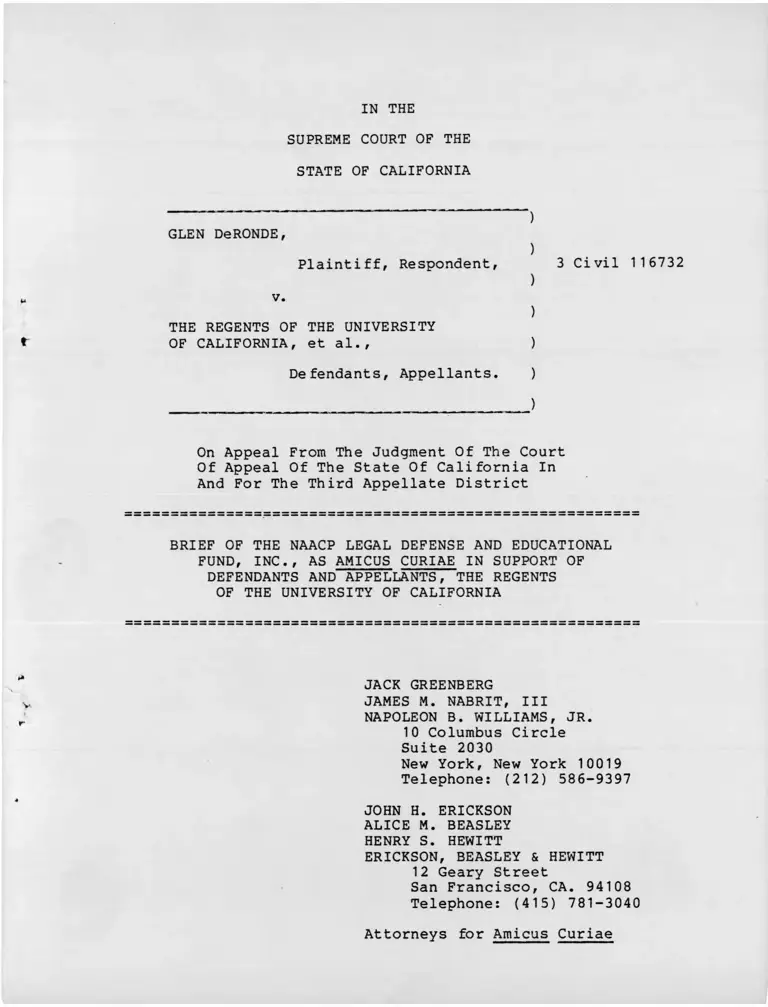
IN THE
SUPREME COURT OF THE
STATE OF CALIFORNIA
r
GLEN DeRONDE,
)
)
Plaintiff, Respondent,
)
v.
)
THE REGENTS OF THE UNIVERSITY
OF CALIFORNIA, et al., )
3 Civil 116732
Defendants, Appellants. )
)
On Appeal From The Judgment Of The Court
Of Appeal Of The State Of California In
And For The Third Appellate District
BRIEF OF THE NAACP LEGAL DEFENSE AND EDUCATIONAL
FUND, INC., AS AMICUS CURIAE IN SUPPORT OF
DEFENDANTS AND APPELLANTS, THE REGENTS
OF THE UNIVERSITY OF CALIFORNIA
V
JACK GREENBERG
JAMES M. NABRIT, III
NAPOLEON B. WILLIAMS, JR.
10 Columbus Circle
Suite 2030
New York, New York 10019
Telephone: (212) 586-9397
JOHN H. ERICKSON
ALICE M. BEASLEY
HENRY S. HEWITT
ERICKSON, BEASLEY & HEWITT
12 Geary Street
San Francisco, CA. 94108
Telephone: (415) 781-3040
Attorneys for Amicus Curiae
TABLE OF CONTENTS
TABLE OF AUTHORITIES .............................. m
STATEMENT OF FACT ................................. 2
SUMMARY OF ARGUMENT .............. 4
ARGUMENT .......................................... 4
I. THE JUDGMENT BELOW SHOULD BE VACATED
AND THE ACTION DISMISSED BECAUSE OF
MOOTNESS .................................. 5
II. THE UNIVERSITY'S REMEDIAL USE OF RACE
CONSCIOUS ADMISSIONS CRITERIA IS A
PERMISSIBLE MEANS FOR ELIMINATING THE
EFFECTS OF PRIOR DISCRIMINATION ......... 7
A. Applicable Legal Standards .......... 7
B. History of Official Discrimination
Against Blacks and Other
Minorities ........................... 1 1
C. Compliance With the Price
Standards ............................ 22
III. THE LAW SCHOOL'S USE OF RACE CONSCIOUS
ADMISSIONS CRITERIA IS A LEGITIMATE
MEANS TO FURTHER IMPORTANT AND COMPELLING
INTERESTS OF THE STATE ................... 2 6
CONCLUSION ........................................ 33
Page
1
TABLE OF AUTHORITIES
Cases
Associated General Contractors of Massachusetts,
Inc. v. Altshuler, 490 F .2d 9 (1st Cir.
1973), cert, denied, 416 U.S. 957
(1974) ..... 77777."................................................... 1 5
Bakke v. Regents of the University of
California, 18 Cal.3d 34 (1976) ............. 6,26
Brice v. Landis, 314 F. Supp. 94 (N.D.
Cal. 1 969) ................................... 1 2
Brown v. Board of Education, 347 U.S. 483
("I 954) ........................................ 2, 1 3, 1 4,
1 5
Brown v. Weinberger, 417 F. Supp. 1215 (D.
D.C. 1 976) ................................... 1 2
Consol. Etc. Corp. v. United A. Etc. Workers,
27 Cal.2d 859 (1 946) ........................ 5
Crawford v. Board of Education, 17 Cal.3d
280, 130 Cal. Rptr. 724, 551 P.2d
28 ( 1 976) .................................... 1 2
DeFunis v. Odegaard, 416 U.S. 312 ( 1 974) ........ 5
Gay Law Students Assn. v. Pacific Telephone
& Telegraph Co., 24 Cal.3d 458, 156
Cal. Rptr. 1 4, 595 P.2d 592 ( 1 979) ......... 28
Green v. County School of Board of New
Kent County, 391 U.S. 430 (1 968) ............ 14
Guey Heung Lee v. Johnson, 404 U.S. 1215
(1971) ....................................... 18
Jackson v. Pasadena City School District,
59 Cal.2d 876, 31 Cal. Rptr. 606, 382
P. 2d 878 ( 1 963) (en banc) ................... 12
Page
Johnson v. San Francisco Unified School
District, 339 F. Supp. 1315 (N.D. Cal.
1971) vacated and remanded, 500 F .2d
349 (9th Cir. 1 974 ) ......................... 12, 1 8,1 9
- i i -
Page
Kelsey v. Weinberger, 498 F.2d 701 (D.C.
Cir. 1 974) ................................... 12
Keyes v. School District No. 1, Denver, 413
U.S. 1 89 ( 1 973) ............................. 1 5
Lau v. Nichols, 414 U.S. 563 ( 1 954) .............. 1 6
Louisiana v. United States, 380 U.S. 145
( 1 965) ....................................... 1 4
People ex rel. Lynch v. San Diego Unified School
District, 19 Cal. App.3d 252, 96 Cal.
Rptr. 658 (Ct. App. 1971) cert, denied
405 U.S. 1 016 ( 1 972) ........ '. . ............. 12
McLaurin v. Oklahoma State Regents, 339
U.S. 637 ( 1 950) ............................. 2
Milliken v. Bradley, 433 U.S. 267 (1977) ........ 13,14,15
NAACP v. San Bernardino City Unified School
District, 17 Cal.3d 311, 130 Cal.
Rptr. 744, 551 P. 2d 48 ( 1 976) ............... 1 2
Paul v. Milk Depots, Inc., 62 Cal.2d 129
( 1 964) ....................................... 5,6
Pena v. Superior Court, 50 Cal. App.3rd 694,
123 Cal. Rptr. 500 (Ct. App. 1 975) ......... 1 2
People v.. Riles, 343 F. Supp. 1306 (N.D.
Cal. 1972), affirmed, 502 F.2d 963
(9th Cir. 1 974) .............................. 1 1
People v. San Diego Unified School District,
19 Cal. App.3d 252, 96 Cal. Rptr. 658
(Ct. App. 1971) ............................. 11
Price v. Civil Service Commission of Sacramento
County, Cal.3d , 161 Cal. Rptr.
475, 604 P. 2d 1365 (1 980) ............... 2, 7,8,9, 10, 17,
23,24,25,26,27,
28,29,31,32,33
Regents of the University of California v.
Bakke, 438 U.S. 265 (1978) ................. 2,26,30,31
- iii -
San Antonio Ind. School District v. Rodriquez,
411 U.S. 1 ( 1 973) ........................... 28
Serrano v. Priest, 5 Cal.3d 584, 96 Cal. Rptr.
601 , 487 P. 2d 1 241 ( 1 971 ) ................... 28
Santa Barbara School District v. Superior
Court, 13 Cal.3rd 315, 118 Cal. Rptr.
637, 530 P.2d 605 ( 1 975) (en banc) ......... 12
Soria v. Oxnard School District Board of
Trustees, 386 F. Supp. 539 (C.D. Cal. 1974),
on remand from 488 F .2d 577 (9th Cir. 1973),
cert, denied 416 U.S. 95 ( 1 974) ............. 1 2
Spangler v. Pasadena City Board of Education,
311 F. Supp. 501 (C.D. Cal. 1 970) .......... 1 1
Testa v. Katt, 330 U.S. 386 (1 947) ............... 1 4
United Steelworkers of America, AFL-CIO v.
Weber, 443 U.S. 1 93 ( 1 979) .................. 26
Wysinger v. Crookshank, 82 Cal. 588,
23 P. 54 ( 1 890) ............................. 1 7
Constitutional and Statutory Provisions
Constitution of the United StatesArt. VI, § 2 ................................. 14
Fourteenth Amendment ........................
Civil Rights Act of 1964, Title VII as
amended, 42 U.S.C. § 2000e .................. 9
Constitution of the State of California
Article I, section 7 ........................ 10,15
General School Law of California, § 1662
at 14 (1 880) ................................. 17
Page
- i v -
Page
1860 c. 329, § 8 .................................. 17
1 863 c. 159, § 68 17
1 885 c. 1 17, 1662 ................................ 17
1893 c. 193, §1 662 ................................ 17
1921 c. 685, § 1 ................................... 17
1947 c. 737, § 1 ................................... 17
Sacramento County Civil Service Commission
Rule 7.10 .................................... 9,10
Books
I. Hendrick, The Education of Non-Whites in
California, 1849-1970 (1977) ... ............ 12,17
C. Wollenberg, All Deliberate Speed, Segregation
and Exclusion in California Schools,
1855-1 9*7 5 ~( 1 97 6 ) .... . . . . .'.7 .7 .7 . 7.......... 12,17
Other Authorities
California Legislature, Assembly Permanent
Subcom. on Post Secondary Education, Unequal
Access to College (1975) .................... 13,18,22,32
California Assembly Concurrent Resolution
No. 1 51 , 1 974 ............................... 1 9,21,32
California Legislature, Joint Committee on
Higher Education, The Challenge of Achieve-
ment: A Report on Public and Privace
Higher Education in California 77
(1 969) ....................................... 2 0 , 2 2
v
Page
California Legislature, Joint Committee on the
Master Plan for Higher Education, Report
No. 33,37 ( 1 973) ............................ 21
California Coordinating Council for Higher
Education, J. Kitano & D. Miller, An
Assessment of Educational Opportunity
Programs in California Higher Education(1 970) ....................................... 23
California Postsecondary Education Commis
sion, Planning for Postsecondarv Education
in California: A'Five "Year Plan Update,
1 977-1 978, 32-34 ( 1 977)“. .. . .7777777777..... 20
California State Department of Education,
Racial and Ethnic Survey of California
Public Schools, for Fall T963" "(1 967)
Fall 1968'"(1969) and Fall 1970 (1971) ...... 16,18
Center for National Policy Review, Trends
in .Black School Segregation, 12970-1974, Vol. I
( 1 977) and Trends in His'panic Segregation.
1 970-19 7 4, voTV 'll (1977) ............ 7777... 16
Governor's Commission on the Los Angeles Riots,
Violence in the City; 49 et seq., (1965) ___ 13,18
HEW's Directory of Public Elementary and
Secondary Schools in Selected Districts,
Enrollment and Staff By Racial/Ethnic
Groups, for Fall 1968 (1970) Fall 1970
(T972), and Fall 1972 (.1974 ) 777777777...... 16
22 Cal. Dept, of Justice, Opinions of the
Atty. Gen., Opinion 6735a (January
23, 1 930) at 931-932 ........................ 1 7
U.S. Bureau of the Census, Historical
Statistics of the United States, Colonial
Times to 1970,'Pa~rt 1, 25 (1 976) ......... . 16
U.S. Bureau of Census, 1970 Census of Popula
tion, Series PC (2)-2A State of Birth337“ 61 (1 973) ................................ 16
U.S. Bureau of the Census, Current_Population
Reports, Series P-23, No. 46; The Social
and Economic Status of the Black
Population in the United States, 1972 at
(1973) --- ...----77.'.';.... .............. 16
vi
Page
Bureau of the Census' Statistical Abstract
of the United States, 1976, p. 133 (1976) ... 16
United States Civil Rights Commission, Mexican-
American Education Study Reports
I-VI (1 971-1974) ............................ 13, 18
VI1
IN THE
SUPREME COURT OF THE
STATE OF CALIFORNIA
GLEN DeRONDE, )
Plaintiff, Respondent, ) 3 Civil 116732
v.
)THE REGENTS OF THE UNIVERSITY
OF CALIFORNIA, et al., )
Defendants, Appellants. )
)
On Appeal From The Judgment Of The Court
Of Appeal Of The State Of California In
And For The Third Appellate District
BRIEF OF THE NAACP LEGAL DEFENSE AND EDUCATIONAL
FUND, INC., AS AMICUS CURIAE IN SUPPORT OF
DEFENDANTS AND APPELLANTS, THE REGENTS
OF THE UNIVERSITY OF CALIFORNIA
1. The NAACP Legal Defense and Educational Fund,
Inc., is a nonprofit corporation established under the laws
of the State of New York.
It was formed to assist black persons in securing their
constitutional and other civil rights by prosecuting and
defending lawsuits. Its charter declares that its purposes
include rendering legal services gratuitiously to Negroes
suffering injustice by reason of racial discrimination. For
many years, attorneys for the Legal Defense Fund have
represented black persons seeking to achieve equal oppor
tunity in public education, e.g., Brown v. Board of Education,
347 U.S. 483 (1954); McLaurin v. Oklahoma State Regents,
339 U.S. 637 (1950). As part of this representation, attor
neys for the Legal Defense Fund filed an amicus curiae brief
for consideration by the Supreme Court of the United States
in Regents of the University of California v. Bakke, 438 U.S.
265 (1978).
The Legal Defense Fund believes that its litigation
experience in the fields of discrimination, public education,
and affirmative action may be of assistance to the Court in
the present case. This amicus curiae brief is filed pursuant
to the Court’s order of April 28, 1980. It supports the
position of the defendants in this action.
STATEMENT OF FACT
For the purposes of this brief, amicus curiae accept the
facts as stated by the Court of Appeal below. Because that
court held that the admissions criteria of the School of Law
of the University of California at Davis contravened article I,
section 7 of the California Constitution, but did not violate
federal requirements as set forth in Regents of University of
California v. Bakke, 438 U.S. 265 (1978), the scope of this o f ’
amicus curiae brief is limited to the narrow question of whether
the implementation of the University's admissions criteria con-
2
stitutes a violation of California State law, as determined
by article I, section 7 of the State Constitution.
In making its decision below, the Court of Appeal
ignored the history of discrimination against minorities
committed by educational institutions of the State of Califor
nia. Because this history is relevant for understanding the
remedial purposes of the Law School's affirmative action
program, we have endeavored in this brief to set forth
judicially cognizable facts concerning the nature and extent
of prior discrimination against minorities in California.
These facts, we contend, demonstrate that the Law School's use
of race conscious admissions criteria is reasonable and
permissible under the State Constitution. Furthermore, they
show that the lower court erred when it held that this
Court's recent decision in Price v. Civil Service Commission
of Sacramento County, _ __ Cal.3d ___, 161 Cal. Rptr. 475, 604
P.2d 1365 (1980), was inapplicable to the facts of this case.
Finally, it is submitted that these facts evidence
the existence of a parallelism between historical practices
in California of racial discrimination against minorities
and similar historical practices across the nation of racial
discrimination against minorities. Thus, the facts show
that there is no basis in reason for interpreting the equal
protection guarantees of the California Constitution to
be more restrictive than the federal equal protection clause
of the remedial use of race conscious affirmative action
programs for minorities.
3
SUMMARY OF ARGUMENT
Several reasons exist for vacating the judgment below
and dismissing the action.
First, plaintiff's graduation from law school deprives
the Court of any substantial reasons for deciding the merits
of this case and requires instead that the lower court's
judgment be vacated and the action dismissed for mootness.
Second, the race conscious admissions policy of the
School of Law of the University of California is, under
California law, a reasonable means for discharging the
State's duty to eradicate the lingering, injurious conse
quences of racial discrimination.
Third, the Law School's remedial use of race conscious
admissions criteria represents a legitimate attempt, based
upon judicial, executive, and legislative findings, to
satisfy lawful governmental and educational purposes.
ARGUMENT
I. THE JUDGMENT BELOW SHOULD BE VACATED AND
THE ACTION DISMISSED BECAUSE OF MOOTNESS
The judgment entered below should be vacated and the
action dismissed on grounds of mootness. Plaintiff prayed
for an order declaring his entitlement to admission to the
School of Law at the University of California at Davis, and
for an injunction ordering defendants to admit him to the
4
School of Law. The complaint, however, failed to include aVclaim for damages.
At trial, plaintiff testified that following his rejec
tion for admission by the defendant School of Law, he intended
to enroll at the University of San Diego School of Law (R.T.,
p. 17). He duly enrolled in the San Diego School of Law and
2/
subsequently graduated from there.
In light of plaintiff's graduation from law school
the action has become moot and should be dismissed. See
DeFunis v. Odegaard, 416 U.S. 312 (1974). It has been the
consistent holding of this Court that the state courts of
California are not to be used for the purpose of addressing
moot questions or deciding abstract propositions. Consol.
Etc. Corp. v. United A. Etc. Workers, 27 Cal.2d 859, 863
(1946). This principle was affirmed in Paul v. Milk Depots,
1/ At the conclusion of the trial, plaintiff moved to
amend his complaint to include a claim for damages. The
motion was denied on the ground that plaintiff had acted
unwarrantedly in delaying the filing of his claim for
damages. The court also denied the motion on the ground that
plaintiff had, in fact, suffered no damages. The Court of
Appeal below found that the trial court had not abused its
discretion in denying the motion on these grounds.
2/ During his enrollment at the University of San Diego
School of Law, plaintiff applied for transfer to the School
of Law of the University of California at Davis for enroll
ment there during his second year. However, he subsequently
withdrew the application before it had been considered by the
Law School (C.T. Vol. II, pp. 49-54).
5
I_nc. , 62 Cal. 2d 1 29 (1964), where an action raising the issue
of the power of the California Department of Agriculture to
fix minimum prices was ordered dismissed after the plaintiff
had lost its license to do business. The Court stated there
that
It is settled that "the duty of this Court,
as of every other judicial tribunal, is to
decide actual controversies by a judgment
which can be carried into effect, and not
to give opinions upon moot questions or
abstract propositions, or to declare prin
ciples or rules of law which cannot affect
the matter in issue in the case before it."
Paul v. Milk Depots, Inc., supra, 62 Cal.2d at 132. The
principle stated in Paul, supra, is equally applicable to the
facts of the present case.
Moreover, there are no special circumstances present
here which would support making an exception to this general
rule. While it is possible that the issue raised here by the
plaintiff may be recurrent, there is no need to decide the
facts of this particular case since the issue is not one
which will necessarily evade judicial review as a result of
mootness. See this Court's opinion in Bakke v. Regents of
the University of California, 18 Cal.3d 34 (1976). Thus,
there is no reason here to make an exception to the general
rule requiring the dismissal of moot actions.
6
II. THE UNIVERSITY'S REMEDIAL USE OF RACE CONSCIOUS
ADMISSIONS CRITERIA IS A PERMISSIBLE MEANS FOR
ELIMINATING THE EFFECTS JOF PRIOR DISCRIMINATION _
A . Applicable Legal Standards
In Price v. Civil Service Commission of Sacramento
County, ___ Cal.3d ___, 161 Cal. Rptr. 475, 604 P.2d 1365
(1980), this Court set forth the legal principles, as deter
mined by State law, governing the validity of remedial, race
conscious, affirmative action programs. It held that public
agencies of the State of California may, consistently with
the laws of California and the United States, voluntarily
adopt race conscious, affirmative action programs, including
the use of goals and timetables, for the purpose of alleviat
ing underrepresentation of minorities caused by past dis
criminatory practices of the State.
The decision in Price, supra, supports the validity
of affirmative action programs involving the use of admis
sions criteria which permit universities to give favorable
consideration to an applicant's status as a member of a
minority group in determining the applicant's eligibility of
admission. Under the Court's rationale in Price v. Civil
Service Commission of Sacramento County, supra, the use by
admissions officers of race conscious admissions criteria
is proper if used for the purpose of reducing the under
representation of minorities in higher education which exists
by virtue of the injurious effects of racial discrimination.
The decision in Price, supra, is therefore an adequate basis
7
for sustaining the Law School's use of its race conscious
admissions criteria.
In Price, supra, the Sacramento County Civil Service
Commission conducted in 1974 an extensive investigation of
the county's past hiring practices. the investigation showed
that the traditional civil service selection procedures,
including the use of alleged objective written examinations,
operated to discriminate against minorities. The Commission
found, and the Court in Price affirmed, that the County's
written civil service examinations frequently bore little or
no relationship to the requirements of the employment posi-
tions for which the examinations were allegedly designed.
As a result of the County's discriminatory practices,
members of minority groups were substantially underrep
resented in the workforce of Sacramento County. To counter
the effects of the discrimintory practices, the Commission
adopted a regulation which required that adjustments be made
in the disproportionate representation of minority personnel
in the County's employment caused by prior discriminatory
employment practices.
As part of its implementation of the regulation, the Com
mission announced that it would require, where appropriate,
public agencies of the county to hire minority persons on a
preferential basis from an eligible list. The Commission
further provided that any program of preferential hiring for
minorities adopted by a public agency in pursuance to the regula
tion must terminate in any job classification once a fair
8
approximation of minority representation, consistent with the
pupulation mix of the County of Sacremento, existed in the
3/
classi fication.
When the Commission sought to compel compliance with
its rules by the County's district attorney's office, the
latter commenced an action in the trial court below to
declare the Commission's rules and procedures to be in
violation of local, state, and federal laws. This Court
rejected the challenge. It held that the preferential hiring
program satisfied the requirements of local law, California's
statutes, Title VII of the Civil Rights Act of 1964, as
amended, 42 U.S.S. § 2000e, and the Constitutions of Califor
nia and the United States. In upholding the Commission's
actions, the Court said:
Inasmuch as the Commission after a duly
authorized investigation ... determined
that it had grounds to suspect that the
County's past competitive examinations
had had a racially discriminatory effect
and that such examinations were not job-
related, we have no doubt that the Com
mission's enforcement authority empowered
it to take action to remedy the situation.
Under these circumstances, the promulgation
of an affirmative action plan, directed spe
cifically at ameliorating minority under
representation which is found to have re
sulted from the County's own discriminatory
employment practices, falls within the
authority of the Commission.
3/ Rule 7.10 of the Sacramento County Civil Service Com
mission. Rule 7.10 also provided, the Court noted, for
"'continuing oversight' ... so as to enable the Commission
to guarantee that the order ... will not impose undue bur
dens on ... interested parties". Price, supra, 604 P.2d at
1381. See also Rule 7.10(f) of the Sacramento County
Civil Service Commission.
9
Price, supra, 604 P.2d at 1372. In subsequent parts of its
opinion, the Court specifically noted that the equal protec
tion clause of the Constitution of the State of California
was not a bar to the adoption of affirmative action plans
promulgated in accordance with Rule 7.10. Price, supra, 604
P.2d at 1382, 1383.
This Court's decision in Price conclusively determined that
the equal protection provisions of the California State Con
stitution does not prohibit a public agency's use of a race
conscious affirmative action program to alleviate an under
representation of minority groups attributable to prior dis
crimination by public agencies of the State. The Court
recognized, however, that in attempting to design remedies to
eliminate the consequences of prior discrimination and to
correct an imbalance in minority representation, it would be
necessary to afford the State sufficient latitude to take
into account the present condition of minorities in the
State. In addressing itself to this problem, the Court
stated that:
Our past decisions construing Artitle I,
section 7, subdivision (a) reflect this
Court's recognition of the importance of
interpreting the provision in light of
the realities of the continuing problems
faced by minorities today. 4/
4/ Article I, section 7 of the California State Consti
tution reads as follows:
10
604 P.2d at 1382. It is submitted that the Law School's use
of race conscious admissions criteria is addresssed to the
"realties of continuing problems faced by minorities" today
in California, and that it is specifically designed to reduce
the extent of the underrepresentation of blacks, and other
minorities, caused by prior discrimination. The truth of
this assertion is borne out by the history in California of
extensive discrimination against minorities in the field of
public education. What follows constitutes a cursory review
of that history.
B. History of Official Discrimination Against Blacks
and Othe Minorities_______________________________
The history of racial discrimination against blacks and
other minorities in the public schools in California has been
well documented. See e.g., Spangler v. Pasadena City Board
of Education, 311 F. supp. 501 (C.D. Cal. 1970). People v.
San Diego Unified School District, 19 Cal. App.3d 252, 96
Cal. Rptr. 658 (Ct. App. 1971); People v. Riles, 343 F. Supp.
1306 (N.D. Cal. 1972), affirmed, 502 F.2d 963 (9th Cir.
4/ cont'd.
(a) A person may not be deprived of life,
liberty, or property, without due pro
process of law or denied equal protection
of the laws.
(b) A citizen or class of citizens may not be
granted privileges or immunities not
granted on the same terms to all citizens.
Privileges or immunities granted by the
Legislature may be altered or revoked.
11
1974); Kelsey v. Weinberger, 498 F.2d 701, 704 n.19 (D.C.
Cir. 1974); Soria v. Oxnard School District Board of Trustees,
386 F. Supp. 539 (C.D. Cal. 1974), on remand from 488 F .2d
577 (9th Cir. 1973), cert, denied 416 U.S. 95 (1974);
Brice v. Landis, 314 F. Supp. 94 (N.D. Cal. 1969); Brown
Vv. Weinberger, 417 F. Supp. 1215, 1223, (D. D.C. 1976).
In addition to judicial decisions evidencing the exis
tence in the State of wide-spread practices of official acts
of discrimination against minorities, there exists a consider
able body of the literature which also attests to the
pervasiveness of racial discrimination in California's
public schools. See, e.g., C. Wollenberg, All Deliberate
Speed, Segregation and Exclusion in California Schools,
1855-1975 (1976); I. Hendrick, The Education of Non-Whites in
California, 1849-1970 (1977). Thus, there is abundant
authority establishing the state-wide scope of racial
discrimination and showing the devastating impact of segrega
tion and discrimination upon the lives of minority group
5/ Also see Crawford v. Board of Education, 17 Cal.3d 280,
1*30 Cal. Rptr. 724, 551 P.2d 28 (1 976); People ex rel.
Lynch v. San Diego Unified School District, 19 Cal. App.3d
252, 96 Cal. Rptr. 658 (Ct. App. 1971), cert. denied 405
U.S. 1016 (1972); Jackson v. Pasadena City School District,
59 Cal. 2d 876, 31 CalT"Rptr.' "6'0'6,.J8'2"p"'.T3"878( 1 963)-----
(en banc); Pena v. Superior Court, 50 Cal. App.3rd 694,
123 Cal. Rptr. 500 (Gt. App. 1975); NAACP v. San Bernardino
City Unified School District, 17 Cal.3rd 31 1 , 130 Cal.
Rptr. 744, 551 P.2d 48 (9176); Santa Barbara School District
v. Superior Court, 13 Cal.3rd 315, 319, 118 Cal. Rptr. 637,
530 P. 2d 605 (T975) (en banc). See also Johnson v. San
Francisco Unified School District, 339 F. Supp. 1315 (N.D.
Cal. 1971), vacated and remanded, 500 F.2d 349 (9th Cir. 1974).
12
members. Moreover, these authorities, and others, show
that, as a result of school segregation, minority students
have suffered severe educational deprivations. See Governor's
Commission on the Los Angeles Riots, Violence in the City;
49 et seq. , ( 1 965); California Legislature, Assembly Per
manent Subcom. on Post Secondary Education, Unequal Access to
y — --------------------------------------
College (1975). The evidence shows that the impact
of segregation and discrimination has been particularly
harmful for the minority- students who are preparating for
enrollment in institutions of higher education. They are, in
several respects, hampered by their education in a segregated
»
environment.
In Brown v. Board of Education, 347 U.S. 483 (1954), The
Supreme Court noted that primary and secondary education is a
"principal instrument in ... preparing (the child) ... for
later professional training." 347 U.S. at 493. Moreover,
the Supreme Court, in its decision in Brown v. Board of
Education, made elaborate findings of the far-reaching
effects which segregated education had upon the educational
and mental development of minority school children. For
example, with respect to minority children in grade and
high school, it found that:
To separate them from others of similar
age and qualifications solely because
of their race generates a feeling of
6/ Also, United States Civil Rights Commission, Mexican-
American Education Study Reports I-VI (1971-1974).
13
inferiority as to their status in the com
munity that may affect their hearts and minds
in a way unlikely ever to be undone....
347 U.S. at 494. Accordingly, it concluded
"Segregation of white and colored children
in public schools has a detrimental effect
upon the colored children. "Id̂ . 7/
The State has a duty to alleviate the effects of its own
discrimination. Under federal law, the public agency respon
sible for discrimination has the "primary responsibility" for
remedying it. Milliken v. Bradley, 433 U.S. 267, 281 (1977).
8/
This is, of course, also the rule under State law. The
duty is to "eliminate the discriminatory effects of the past
as well as bar like discriminatory effects in the future."
Louisiana v. United States, 380 U.S. 145, 154 (1965). The
scope of the duty extends to the elimination of the vestiges
of past discrimination "root and branch." Green v. County
School Board of New Kent County, 391 U.S. 430, 438 (1968).
In assessing the extent of a State's obligation to
eliminate the consequences of past discrimination, public
officials, including public officials of California, must
realize that "discriminatory student assignment policies can
themselves manifest and breed other inequalities . . ."
7/ For some of the literature of the effects of school
segregation on minority students, see footnote 11, in Brown v.
Board of Education, supra.
8/ Under the Supremacy clause of the United States Con
stitution, Art. VI, § 2, the policy of a federal constitu
tional or statutory provision is "the prevailing policy
in every state." Testa v. Katt, 330 U.S. 386, 392 (1947).
14
Milliken v. Bradley, supra, 433 U.S. at 283. As the Supreme
Court noted in the Denver school desegregation case, "common
sense dictates the conclusion that racially inspired school
board actions have an impact beyond the particular schools
that are the subjects of those actions." Keyes v. School
District No. 1, Denver, 413 U.S. 189, 203 (1973). In par
ticular, the existence of discrimination and segregation at
the primary and secondary levels affects the availability
of educational opportunities at the higher educational level.
Brown v. Board of Education, supra, 347 U.S. a5 493.
Ascertaining the full extent of the effects of unlawful
discrimination, however, is not always a simple task.
There are many complexities in the situation. This is
especially true when the task is to redress the effects of
educational deprivations in primary and secondary schooling.
Because of the difficulties and the need to devise remedies
to existinguish the advise effects of unlawful discrimination,
the courts have recognized that "the discretionary power of
public authorities to remedy past discrimination is even
broader than that of the judicial branch." Associated General
Contractors of Massachusetts, Inc, v. Altshuler, 490 F .2d 9,
17 (1st Cir. 1973), cert, denied, 416 U.S. 957 (1974).
The pervasiveness of the effects in California of for
mer conditions of segregation and discrimination in the public
schools warrants the adoption of state-wide measures to redress
the continuing educational deprivation of minority students.
15
For example, in 1972, approximately three-quarters of the
black students in the elementary and secondary public schools
of California attended schools which were 50-100% black,
2 /Chicano, Asian or Indian." Moreover, substantial num
bers of black students, and other minority students, attended
schools in districts previously found to have been in viola-
^O/
tion of federal or state laws prohibiting school segregation.
Additionally, it should be noted, that a considerable portion
of the black students in California eligible for enrollment
in the University of California probably received a substan
tial part of their education in schools in Southern states
11/where conditions of d^ jure segregation existed. This fact
9/ Forty percent of the black students attended schools
which were 95-100% minority. Bureau of the Census' Satisti-
cal Abstract of the United States, 1976, p. 133 (1976); HEW's
Directory of Public Elementary and Secondary Schools in
Selected Districts, Enrollment and Staff By Racial/Ethnic
Groups, Fall 1968 (1T7fl77"F a rT~r?7Trm 7 2 )7 'and"~FafTT97?
(1974). Also California State Department of Education,
Racial and Ethnic Survey of California Public Schools,
for Fall 1'966 ( V967)T Fall Tf66'(1'969) and' YaTl T575" (1971);
Center for National Policy Review, Trends in Black School
Segregation, 1970-1974, Vol. I (1977) and Trends in Hispanic
Segregation, 19/0—1974, Vol. II (1977).
10/ See cases cited in footnote 5 and text accompanying same.
Also see Lau v. Nichols, 414 U.S. 563 (1954); and HEW's
Directory of Public Elementary and Secondary Schools in
Selected Districts, Enrollment and Staff by Racial/Ethnic
Groups, Fall 1970, supra.
11/ According to Census reports, 42% of California's black
population was born in the South. See U. S. Bureau of Census,
1970 Census of Population, Series PC (2)-2A, State of Birth,
55, 61 (1973). Also, U. S. Bureau of the Census, Current
Population Reports, Series P-23, No. 46; The Social and
Economic Status of the Black Population in the United States,
1972 at 12 (1973); U. S. Bureau of the Census, Historical
Statistics of the United States, Colonial Times to 1^70,
Part 1, 25 (1976).
16
is important in view of this Court's statement in Price
that article I, section 7 of the California Constitution
must be construed "in light of the realities of the continuing
problems faced by minorities today," Price, 604 P.2d at 1382.
The history of discrimination and segregation which11/has characterized the public schools of California justi
fies the adoption by this Law School, and other schools of
the University of California, of admissions criteria which
consider race as one of the factors requiring competitive 11/evaluation in the determination of eligibility for admission.
Indeed, an examination of the groups denominated by the Law
School as the minority groups whose members are entitled to
have their race taken into account for the purpose of admis
sion, shows that discrimination and segregation were practiced11/in the public schools against each group listed.
12/ At one time, California law specifically provided for
the maintenance of separate schools for blacks. 1860 Cal.
Stats., c. 329, § 8 ; 1863 Cal. Stats., c. 159, § 6 8, but
in 1880 the statute was repealed. General School Law of
California § 1662 at 14 (1880). The repeal, however, did
not end the practice of segregation and discrimination
against black students. See Wysinger v. Crookshank, 82
Cal. 588, 23 P. 54 (1890); I. Hendrick, supra, at 78-80,
98-100. The repeal of statutes permitting separate schools
for other minorities, however, did not occur until 1947. See
1947 Cal. Stats., c. 737, § 1.
13/ In other contexts, this Court has noted that "state
policy strongly favors the adoption of ... voluntary
affirmative action plans." Price, supra, 604 P.2d at 1372.
14/ Separate schools were once maintained for the various
racial groups. See 1885 Cal. Stats., c. 117 § 1662 (Chinese);
1893 Cal. Stats., c. 193, § 1662 (Indiana); 1921 Cal. Stats.,
c. 685, § 1 (Japanese); Mexican American were regarded as
Indians. 22 Cal. Dept, of Justice, Opinions of the Atty.
Gen. Opinions 6735a, (January 23, 1930) at 931-932.
17
Governmental bodies of the State of California have
confirmed the existence of past discrimination in the school
system and the denial of equal educational opportunities to
minorities in institutions of higher education. See e.g.,
Governor's Commission on the Los Angeles Riots, supra;
California Legislature, Assembly Permanent Subcommittee on15/
Postsecondary Education, Unequal Access to College, supra.
Furthermore, the California State Department of Education has
found that
despite efforts to implement the policies
of the State Board of Education and the
progress made by the Department of Education,
the task of eliminating segregation and pro
viding equal educational opportunities remains
formidable.
California State Department of Education, Racial and Ethnic
Survey of California's Public Schools, Fall 1966, iii (1967).
The failure of the State initially to make energetic
efforts to elininate the adverse consequences of prior dis
crimination was singled out by Justice Douglas in Guey v.16/
Heung Lee v. Johnson, 404 U.S. 1215 (1971). He noted,
14/ cont'd.
The Law School's admissions program defined minorities as
"Native American, Black, Filipino, Asian, and Chicano."
15/ See also U. S. Civil Rights Commission, Mexican American
Education Study, Reports I-VI (1917-1974) and cases cited in
footnote 5 and text accompanying same.
16/ The district court's order in Johnson v. San Francisco
Unified School District, 339 F. Supp. 1315 (N.D. Cal. 1971)
was vacated by the Court of Appeals for the Ninth Circuit and
the action was remanded to the district court to determine if
the school board had acted with a discriminatory purpose. 559
F.2d 349 (9th Cir. 1974).
18
in a memorandum opinion denying an application by Americans
of Chinese ancestry for a stay of a district court order
reassigning pupils of Chinese ancestry in order to reduce
racial imbalance in certain schools in California, that the
district court had made
findings that plainly indicated the force
of the old polcy has persisted: "(T)he
school board ... had drawn school attend
ance lines, year ater year, knowing that
the lines maintain or heighten racial
imbalance." And further, that no evidence
has been tendered to show that since Brown I
"the San Francisco school authorities had
ever changed any school attendance line
for the purpose of reducing or eliminating
racial imbalance." 404 U.S. at 1216, quoting
from Johnson v. San Francisco Unified School
District, 339 F. Supp. 1315, 1319 (N.D. Cal.
1971).
In recent years, however, there has been accumulating
evidence of the State's interest in carrying out its consti
tutional function of eliminating the vestiges of discrimina
tion. A resolution has been enacted by the Legislature of
the State requiring the adoption, by educational authorities,
of steps to "overcom(e) .. ethnic ... underrepresentation in
the makeup of the student bodies of institutions of public
higher education." California Assembly Concurring Resolution
No. 151, 1974 Cal. Stats., Res. c. 209. Even prior to this
time the State had, acting through the University of California
in 1964-65, the California State University of Colleges in
1966-67, and the California Community Colleges in 1969-1970,
19
instituted undergraduate "Equal Opportunity programs" to
increase opportunities for socio-economically disadvantaged
students. Experience, however, was later to show that these
programs were not sufficient to provide for equal educational
opportunities for minority students in higher education. See
e.g., California Legislature, Joint Com. on Higher Education,
The Challenge of Achievement; A Report on Public and Private
Higher Education in California 77 ( 1 969); California Post-
secondary Education Commission, Planning for Postsecondarv .
Education in California; A Five Year Plan Update, 1977-1972,
32-34 (1977). In light of this failure, the University of
California turned to the adoption of affirmative actions
programs. California Postsecondary Education Commission,
supra, 43-34.
The California Legislature has clearly perceived that a
connection exists between the quality of education made
available in the primary and secondary schools of the State
and the ability of graduates of those schools to obtain
admission to institutions of higher education. In a report by
one of its committees, of the Legislature found that:
(E)quality of opportunity in post-secondary
education is still a goal rather than a
reality. Economic and social conditions and
early schooling must be significantly improved
before equal opportunity can be realized. But
there is much that can be done by and through
higher education.
17/
17/ These programs provided assistance in the areas of re
cruitment, tutoring, financial aid, etc. California Post
secondary Education Commission, supra, 32-34.
20
California Legislature, Joint Committee on the Master Plan
for Higher Education, Report 33, 37 (1973). Following thi
report, the Legislature adopted Assembly Concurrent Resolu
tion No. 151 (1974). This Resolution provides, in part,
as follows:
"WHEREAS, The Legislature recognizes
that certain groups, as characterized by
sex, ethnic, or economic background, are
underrepresented in our institutions of
public higher education as compared to the
proportion of these groups among recent
California high school graduates; and
"WHEREAS, It is the intent of the
Legislature that such underrepresentation
be eliminated by providing additional
student spaces rather than by rejecting
any qualified student; and
"WHEREAS, It is the intent of the
Legislature to commit the resources to
implement this policy; and
"WHEREAS, It is the intent of the
Legislature that institutions of public
higher education shall consider the fol
lowing methods for fulfilling this policy;
(a) Affirmative efforts to search
out and contact qualified students.
(b) Experimentation to discover
alternate means of evaluating student
potential.
(c) Augmented student financial
assistance programs.
(d) Improved counseling for dis
advantaged students;
now, therefore, be it
"Resolved_by_ the Assembly of the State
of California, the Senate thereof con
curring, That the Regents of the Uni
versity of California, the Trustees of
the California State University of Col
leges, and the Board of Governors of
the California Community Colleges are
hereby requested to prepare a plan that
will provide for addressing and over
coming, by 1980, ethnic, economic, and
sexual underrepresentation in the make
up of the student bodies of institu
tions of public higher education as com
pared to the general ethnic, economic,
and sexual composition of recent Califor
nia high school graduates ..."
Following the adoption of this Resolution, it was noted
by one of the Committees of the Legislature that
"In adopting Assembly Concurrent Resolution 151 (1954),
the Legislature acknowledged that additional effort
by colleges and universities is necessary to over
come underrepresentaion of ethnic minorities and the poor. 18/
California Legislature, Assembly Permanent Subcom. On Post
secondary Education, supra, Unequal Access To College 1 (1975).
C . Compliance With The Price Standards
This review of the history of discrimination in Califor
nia and the State's response to it demonstrates several
points. First, it shows that there is ample proof that
discrimination in California against minorities has been
continuous and systematic in the field of public education.
Second, it establishes that discrimination against minorities
in primary and secondary education has caused minority
students to suffer educational deprivation at these levels
18/ The Report of the Joint Committee on the Master Plan
for Higher Education, supra, at 38, had recommended that:
Each segment of California public higher
education shall strive to approximate by
1980 the general ethnic, sexual, and eco
nomic composition of the recent California
high school graduates.
22
and in higher education. Third, it shows the reasona
bleness of efforts to eradicate vestiges of discrimination by
adopting race conscious policies in higher education.
Fourth, it shows that the Law School's use of a race conscious
admissions criteria is in consonance with State policy as
defined by the Legislature and required by the courts. There
is therefore, in view of this history and the conformity of
the Law School's action to State policy, an adequate basis
for this Court to find that the Law School's adoption of a
remedial, race conscious admissions program is in compliance
with the Court's decision in Price v. Civil Service Commission
of Sacramento County, supra.
It was conceded below that admission to the Law School
of the University of California at Davis is governed by
a variety of different criteria. The criteria determining
admissions included the use of the following factors: (1 ) the
predicted first year academic grades (PFYA) based upon the
college grade point average and the score of the Law School
Admissions Test (LSAT); (2) growth, maturity, and commitment
to law study; (3) previously existing factors, such as
temporary handicaps and changes in school environment, which
19/
I V The California Coordinating Council for Higher Education,
subsequently renamed the California Postsecondary Education
Commission, found that: "(0)ne of the most serious blocks
to participation in higher education for minority students
occurs in the secondary educational system." California
Coordinating Council for Higher Education, H. Kitano & D.
Miller, An Assessment of Educational Opportunity Programs
in California Higher Education (1970)' at ~3.
23
adversely affected grades; (4) evidence other than grades and
LSAT scores which indicate ability and motivation; (5) ethnic
20/
minority status, and (6 ) economic disadvantage. No
quotas were applied by the Law School with respect to its
admissions criteria. Ethnic minority status was merely one
of the factors which admissions officers could take into
account.
Testimony offered at trial by Professor Edward L.
Barrett, who was the founding Dean of the Davis Law School,
established that it was necessary to give consideration to
ethnic minority status in the Law School's admissions criteria.
Such consideration was necessary, he testified, (1) to insure
that the legal profession in California encompassed a "reason
able cross section of society" (R. T., p. 155); (2) to
obtain a class in the law school that "reflects, to a signifi
cant degree, the community at large (C. T. Vol. I, p. 71);
and (3) to insure that the Law School would not "exclude
from the legal profession, under the current circumstances,
the greatest bulk of the minority applicants" (R. T., p.
157). Professor Barrett testified emphatically that without
the use of race conscious criteria, minority students
"would not get into the law school and they would not get
into the legal profession". (R. T., p. 157).
On these facts, this Court's decision in Price, supra, is
determinative. The proof of discrimination against minorities
20/ See footnote 14, supra.
24
in the field of public education is overwhelming. Indeed, it
is confirmed by the findings of virtually every agency of
State government which has considered the problem. Under
these circumstances, Price requires that California's
constitutional and statutory laws not be used to prohibit or
frustrate reasonable application of race conscious criteria
to remedy underrepresentation of minorities substantially
caused by official acts in California of racial discrimination.
This holding in Price is clear and unequivocal. Examining
the underlying need for affirmative action programs, this
Court noted in Price, supra, that:
Only in the last quarter century ... have
we undertaken a serious and concerted effort
to eliminate the pervasive discrimination
long endured by minorities in our society ...
We have found that affirmative steps are at
time necessary to overcome the legacy of past
degredation of minorities and to bring minor
ities into full membership in American society.
One such instance of that essential affir
mative action is the correction of an em
ployer's past discriminatory employment prac
tice by a race-conscious ... program ...
Price, supra, 604 P.2d at 1383. Given this declaration by the
Court, it is clear that the holding of Price is applicable in
the field of higher education and that therefore the lower
court erred in refusing to apply Price to the facts of this
case. On this ground alone, the judgment below should be
vacated and the action dismissed.
This result is especially necessary since the Law School's
use of its race conscious admissions criteria does not unnecessarily
25
trammel upon the interests of white applicants for
admission. The record shows that the Law School has made
every effort to insure that all qualified applicants are
given an individual assessment of their worth, quality, and
potential contribution. Furthermore, as Professor Barrett's
testimony establishes, the Law School's use of the special
admissions criteria will terminate once there is no longer an
underrepresentation of minorities in the Law School (R. T.
pp. 154-157). The application of Price, supra, is, under
these circumstances, clear. There can be no doubt that the
requirements set forth in Price for sustaining the use of
race conscious criteria are satisfied. Accordingly, the
decision of the Law School to employ its admissions criteria
to lessen the effects upon minority students of prior dis
crimination committed against them must be sustained.
11/
III. THE LAW SCHOOL'S USE OF RACE CONSCIOUS
ADMISSIONS CRITERIA IS A LEGITIMATE MEANS
TO FURTHER IMPORTANT AND COMPELLING
INTERESTS OF THE STATE
The vice of the holding below was the assumption by the
court of appeal that the Law School's admissions program, while
concededly validly under the Fourteenth Amendment's equal pro
tection clause, see Regents of the University o f California
21/ The avoidance of an affirmative action plan which
unnecessarily trammels upon the interests of whites is
one of the requirements for validity suggested in United
Steelworkers of America v. Weber, 443 U.S. 1 93, 20"8 (1 979) .
26
v. Bakke, 438 U.S. 265 (1978), was invalid under the State Con
stitution's equal protection provision. This assumption,
however, was in direct contradiction with this Court's asser
tion in Price, supra, that there is
... no authority which suggests that the
California equal protection clause should
be interpreted to place greater restric
tions on bona fide affirmative action
programs than are imposed by the Four
teenth Amendment. To the contrary, our
past decisions construing Article I, sec
tion 7, subdivision (a) reflect this Court's
recognition of the importance of interpret
ing the provision in light of the realities
of the continuing problems faced by
minorities today.
Price v. Civil Service Commission of Sacramento County,
supra, 604 p.2d 1382. Consequently, there was no basis for
the court of appeal to conclude that proof of prior discrimi
nation by the agency erecting the affirmative action program
was an indispensable requirement under state law for the
validity of the program.
While the State's equal protection clause must generally
be construed to protect the same basic rights and privileges
as those protected by the Fourteenth Amendment, it must,
nevertheless, be conceded, as this Court has recognized, that
there are times when
... the state equal protection guarantee
embodied in Article I, section 7, subdivi
sion -*(a) of the California Constitution
does provide safeguards separate and dis-
27
tinct from those afforded by the Four
teenth Amendment, ..." 22/
Price, supra, 604 P.2d at 1382.
Although initially this, might appear to be inconsistent
with this Court's aforementioned statement in Price, supra,
as well as inconsistent with this Court's earlier declaration
that "We have construed these provisions as 'substantially
and equivalent' of the equal protection clause of the Four
teenth Amendment to the federal Constitution", Serrano v.
Priest, 5 Cal.3d 584, 96 Cal. Rptr. 601, 487 P.2d 1241, n.11
(1971), the conflict is apparent only. With respect to the
allowable scope of governmental programs providing for
remedial use of race conscious criteria, the conflict may be
resolved by recognizing that California's enforcement of its
equal protection guarantee will diverge from the requirements
of the federal equal protection clause only when conditions
and circumstances relevant to both differ substantially in
the State of California from those which exist nationally.
Compare, for example, Serrano v. Priest, supra, with San
Antonio Ind. School District v. Rodriquez, 411 U.S. 1 (1973).
Also see Price, supra, 604 P.2d at 1376.
22/ See, e.g. , Gay Law Students Assn, v. Pacific Tele
phone & Teleqraph_Co., 24 Cal.3d 458, 469, 1?6 Cal. Rptr.
14, 595 P.’fd (1*979). Compare Serrano v. Priest, 5 Cal.3d
584, 96 Cal. Rptr. 601 , 487 P. 2d 1241 (1971*)* with San Antonio
Ind. School District v. Rodriquez, 411 U.S. 1 (1973).
28
This Court applied the essence of this principle in
Price, supra. The plaintiff there argued that the Commis
sion's affirmative action provisions violated both Title VII
of the Civil Rights Act and local laws prohibiting dis
crimination. After rejecting the plaintiff's argument that
the defendant's actions contravened Title VII of the Civil
Rights Act, the Court in Price similarly rejected the plain
tiff's assertion that the affirmative action program violated
local antidiscrimination laws. In explaining its actions the
Court stated that:
Although the United States Supreme
Court's interpretation of the antidis
crimination provisions of Title VII does
not, of course, necessarily determine the
appropriate interpretation of the anti-
discrimination provisions of the Sacramento
County Charter or the FEPA, we believe tht
those provisions should similarly not be
interpreted to bar all such race-conscious
affirmatie action plans. First, the
relevant provisions of both the country
charter and the FRPA arose out of the same
historical context as the federal Civil
Rights Act and were intended to achieve
the same general objectives as the anti-
discrimination prohibitions contained
in the federal law.
Price, supra, 604 P.2d at 1376.
The same analysis is, of course, applicable to alleged
differences in treatment of affirmative action programs by
the State and federal constitutional provisions for equal
protection. Both equal protection clauses arose out of the
same historical context and both, in dealing with discrimina
tion against blacks, are concerned with the same historical
29
problems. Moreover, both must confront the same obstacles
existing today in society to creating equal opportunity for
minorities.
The court below found that the Law School's race conscious
affirmative action program did not violate criteria set forth
in Regents of the University of California v. Bakke, supra.
The Law School's program does not employ either quotas or
goals. Race is treated as only one of a series of competing
factors bearing upon eligibility for admission. Obviously
therefore, the program is in strict compliance with Justice
23/
Powell' opinion in Bakke.
Justice Powell upheld in Bakke, supra, affirmative
action programs which met the criteria stated in his opinion,
because they enabled a university to select "students who
will contribute the most to the 'robust exchange of ideas.'"
438 U.S. at 313. This purpose was important, he held,
because it "invoke(d) a countervailing constitutional interest,
that of the First Amendment." Id_. at 313. Ultimately,
therefore he upheld the power of universities to apply race
conscious criteria for the purpose of diversifying its
student body because a university's diversification of
its student population "is of paramount importance in the
fulfillment of its mission." Id.
23/ See Justice Powell's opinion in Bakke at 438 U.S.
311-319.
30
California's interest in promoting diversity of its
student body is, under the State Constitution, equally
compelling. It seeks also to further First Amendment
goals in the education of its young. This interest is under
state law no less important than the interest recognized
in Justice Powell's opinion in Bakke under the Fourteenth
Amendment. In view of the identity of interests, this
Court's decision in Price, supra, requires lower courts to
permit public bodies of California, such as the Law School,
to employ, under State law, race conscious admissions criteria
to the same extent as permitted under federal law.
Also in Bakke, the joint opinion by Justices Brennan,
White, Marshall, and Blackmun, held that a public university
can adopt a race conscious admissions program whenever "there
is a sound basis for concluding that minority underrepresenta
tion is substantial and chronic, and that the handicap of
past discrimination is impeding access of minorities to ...
(s)chool." Bakke, 438 U.S. 363. Under this standard, race
conscious remedies may be utilized by a State irrespective of
whether the need for the program is generated by discrimina
tion committed by the State or by society at large. _Id. at
369.
Justices Brennan, White, Marshall, and Blackmun recognized,
under the Fourteenth Amendment, a federally protected interest
in curing chronic minority underrepresentation caused by
societal discrimination. Their protection of this interest
31
was based upon an assessment of the national experience
with respect to racial discrimination. There is no reason why
California, given its similar experience, should afford less
recognition and protection to this interest than the federal
government. California's undisputed interest in ameliorating
chronic underrepresentation of minorities, at least in the
• field of higher education, is demonstrated by its enactment
*
of Assembly Concurrent Resolution 151, supra. Thus, there is
no basis in fact or law for concluding that California's
interest under its State Constitution in allowing the use of
race conscious programs to cure chronic underrepresentation
of minorities, is less than that under the federal Constitu
tion. See Price, supra, 604 P.2d at 1382, 1383.
In conclusion, it is submutted that the allowable scope
of race conscious programs under the California State Con
stitution is at least co-extensive with that permitted under
the Fourteenth Amendment. This Court should therefore
hold that the Law School's admissions program is valid and
that it constitutes a reasonable means for implementating the
< California Legislature's policy, based on its finding that
minorities "are underrepresented in institutions of public
higher education", to increase the number of minority students
in higher education. Assembly Legislature, Assembly Permanent
Subcom. on Postsecondary Education, supra.
To uphold, under these circumstances, the validity of
a university's admissions program which merely vindicates
32
official State policy would only confirm the correctness of
this Court's previous assertion that "affirmative steps
are at times necessary to overcome the legacy of the past
degradation of minorities and to bring minorities into full
membership in American society." Price, supra, 604 P.2d
1 365.
CONCLUSION
For the reasons indicated herein the judgment of the
Court of Appeal should be vacated and the action dismissed.
Respectfully submitted,
JACK GREENbY rG
JAMES M. NABRIT, III
NAPOLEON B. WILLIAMS, JR.
10 Columbus Circle
Suite 2030New York, New York 10019
Telephone: (212) 586-9397
JOHN H. ERICKSON
ALICE M. BEASLEY
HENRY S. HEWITT
ERICKSON, BEASLEY & HEWITT
12 Geary Street
San Francisco, CA. 94108
Telephone: (415) 781-3040
Attorneys for Amicus Curiae
33
A
I