Gregg v. Georgia Slip Opinion
Public Court Documents
July 2, 1976
-
Brief Collection, LDF Court Filings. Gregg v. Georgia Slip Opinion, 1976. 0423ef9a-b49a-ee11-be36-6045bdeb8873. LDF Archives, Thurgood Marshall Institute. https://ldfrecollection.org/archives/archives-search/archives-item/c0147eac-c92a-4046-8c12-0b9113e8b67c/gregg-v-georgia-slip-opinion. Accessed October 06, 2026.
Copied!
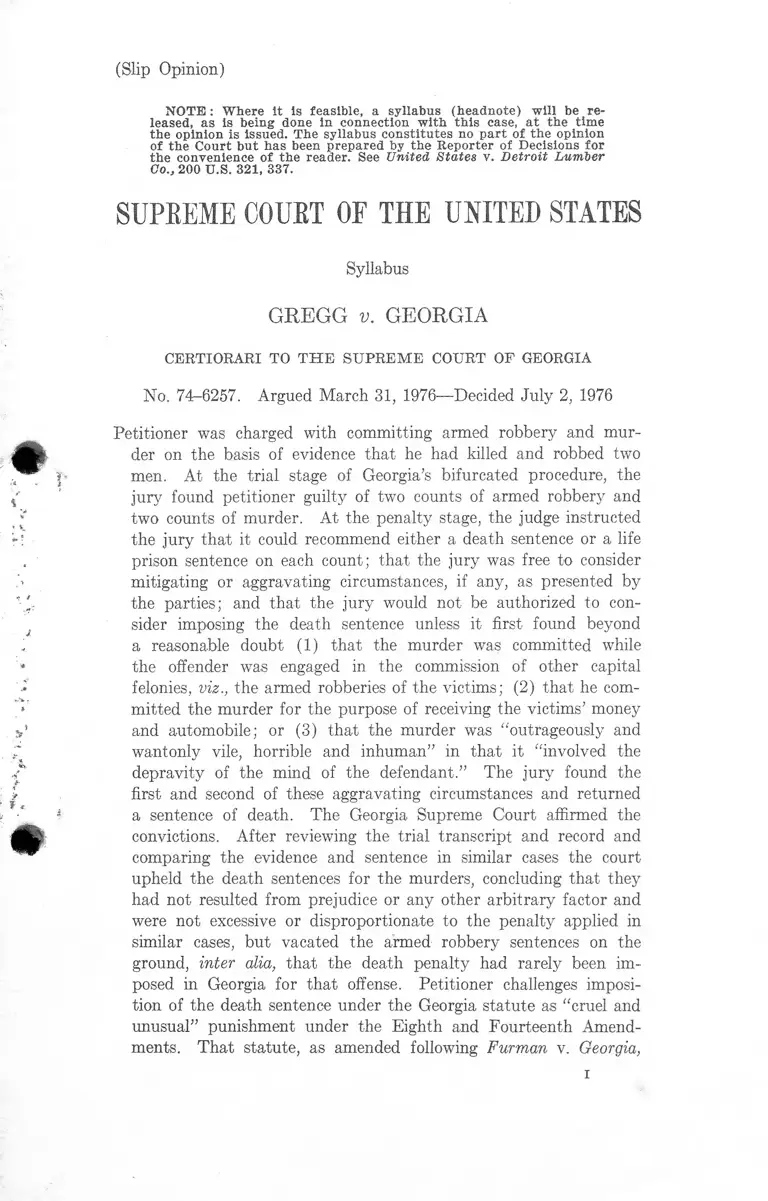
(Slip Opinion)
N O TE: W here i t is feasible, a syllabus (headnote) w ill be re
leased, as is being done in connection w ith th is case, a t th e tim e
th e opinion is issued. The syllabus constitu tes no p a r t of th e opinion
of th e C ourt b u t h as been prepared by th e R eporter of Decisions fo r
th e convenience of th e reader. See U nited S ta te s v. D etro it Lum ber
Co., 200 U.S. 321, 337.
SUPREME COURT OF THE U SITED STATES
Syllabus
GREGG v. GEORGIA
CERTIORARI TO THE SUPREME COURT OF GEORGIA
No. 74-6257. Argued March 31, 1976—Decided July 2, 1976
Petitioner was charged with committing armed robbery and mur
der on the basis of evidence that he had killed and robbed two
men. At the trial stage of Georgia’s bifurcated procedure, the
jury found petitioner guilty of two counts of armed robbery and
two counts of murder. At the penalty stage, the judge instructed
the jury that it could recommend either a death sentence or a life
prison sentence on each count; that the jury was free to consider
mitigating or aggravating circumstances, if any, as presented by
the parties; and that the jury would not be authorized to con
sider imposing the death sentence unless it first found beyond
a reasonable doubt (1) that the murder was committed while
the offender was engaged in the commission of other capital
felonies, viz., the armed robberies of the victims; (2) that he com
mitted the murder for the purpose of receiving the victims’ money
and automobile; or (3) that the murder was “outrageously and
wantonly vile, horrible and inhuman” in that it “involved the
depravity of the mind of the defendant.” The jury found the
first and second of these aggravating circumstances and returned
a sentence of death. The Georgia Supreme Court affirmed the
convictions. After reviewing the trial transcript and record and
comparing the evidence and sentence in similar cases the court
upheld the death sentences for the murders, concluding that they
had not resulted from prejudice or any other arbitrary factor and
were not excessive or disproportionate to the penalty applied in
similar cases, but vacated the armed robbery sentences on the
ground, inter alia, that the death penalty had rarely been im
posed in Georgia for that offense. Petitioner challenges imposi
tion of the death sentence under the Georgia statute as “cruel and
unusual” punishment under the Eighth and Fourteenth Amend
ments. That statute, as amended following Furman v. Georgia,
i
II GREGG v. GEORGIA
Syllabus
408 U. S. 238 (where this Court held to be violative of those
Amendments death sentences imposed under statutes that left
juries with untrammeled discretion to impose or withhold the
death penalty), retains the death penalty for murder and five
other crimes. Guilt or innocence is determined in the first stage
of a bifurcated trial, and if the trial is by jury, the trial judge
must charge lesser included offenses when supported by any view
of the evidence. Upon a guilty verdict or plea a presentence
hearing is held where the judge or jury hears additional extenuat
ing or mitigating evidence and evidence in aggravation of punish
ment if made known to the defendant before trial. At least one
of 10 specified aggravating circumstances must be found to
exist beyond a reasonable doubt and designated in writing before
a death sentence can be imposed. In jury cases, the trial judge
is bound by the recommended sentence. In its review of a death
sentence (which is automatic), the State Supreme Court must
consider whether the sentence was influenced by passion, preju
dice, or any other arbitrary factor; whether the evidence sup
ports the finding of a statutory aggravating circumstance; and
whether the death sentence “is excessive or disproportionate to
the penalty imposed in similar cases, considering both the crime
and the defendant.” If the court affirms the death sentence it
must include in its decision reference to similar cases that it has
considered. Held: The judgment is affirmed. Pp. 11-50 (opinion
of Stewart, Powell, and Stevens, J J . ) ; pp. 14-20 (opinion of
White, J . ) ; p. 1 (statement of Blackmun, J.).
233 Ga. 117, 210 S. E. 2d 659, affirmed.
Mr. J ustice Stewart, Mr. J ustice Powell, and Mr. J ustice
Stevens concluded that:
(1) The punishment of death for the crime of murder does
not, under all circumstances, violate the Eighth and Fourteenth
Amendments. Pp. 11-30.
(a) The Eighth Amendment, which has been interpreted
in a flexible and dynamic manner to accord with evolving stand
ards of decency, forbids the use of punishment that is “excessive”
either because it involves the unnecessary and wanton infliction
of pain or because it is grossly disproportionate to the severity of
the crime. Pp. 14-17.
(b) Though a legislature may not impose excessive punish
ment, it is not required to select the least severe penalty possible,
and a heavy burden rests upon those attacking its judgment.
Pp. 17-19.
GREGG v. GEORGIA h i
Syllabus
(c) The existence of capital punishment was accepted by the
Framers of the Constitution, and for nearly two centuries this
Court has recognized that capital punishment for the crime of
murder is not invalid per se. Pp. 20-22.
(d) Legislative measures adopted by the people’s chosen rep
resentatives weigh heavily in ascertaining contemporary standards
of decency; and the argument that such standards require that
the Eighth Amendment be construed as prohibiting the death
penalty has been undercut byr the fact that in the four years
since Furman, supra, was decided, Congress and at least 35 States
have enacted new statutes providing for the death penalty. Pp.
22-26.
(e) Retribution and the possibility of deterrence of capital
crimes by prospective offenders are not impermissible considera
tions for a legislature to weigh in determining whether the death
penalty should be imposed, and it cannot be said that Georgia’s
legislative judgment that such a penalty is necessary in some cases
is clearly wrong. Pp. 26-30.
(f) Capital punishment for the crime of murder cannot be
viewed as invariably disproportionate to the severity of that
crime. P. 30.
2. The concerns expressed in Furman that the death penalty
not be imposed arbitrarily or capriciously can be met by a care
fully drafted statute that ensures that the sentencing authority
is given adequate information and guidance, concerns best met by
a system that provides for a bifurcated proceeding at which the
sentencing authority is apprised of the information relevant to
the imposition of sentence and provided with standards to guide
its use of that information. Pp. 30-38.
3. The Georgia statutory system under which petitioner was
sentenced to death is constitutional. The new procedures on
their face satisfy the concerns of Furman, since before the death
penalty can be imposed there must be specific jury- findings as to
the circumstances of the crime or the character of the defendant,
and the State Supreme Court thereafter reviews the comparability
of each death sentence with the sentences imposed on similarly
situated defendants to ensure that the sentence of death in a par
ticular case is not disproportionate. Petitioner’s contentions that
the changes in Georgia’s sentencing procedures have not removed
the elements of arbitrariness and capriciousness condemned by
Furman are without merit. Pp. 39-50.
(a) The opportunities under the Georgia scheme for affording
IV GREGG v. GEORGIA
Syllabus
an individual defendant mercy—whether through the prosecutor’s
unfettered authority to select those whom he wishes to prosecute
for capital offenses and to plea bargain with them; the jury’s
option to convict a defendant of a lesser included offense; or the
fact that the Governor or pardoning authority may commute a
death sentence—do not render the Georgia statute unconstitu
tional. Pp. 41-42.
(b) Petitioner’s arguments that certain statutory aggravating
circumstances are too broad or vague lack merit, since they need
not be given overly broad constructions or have been already
narrowed by judicial construction. One such provision was held
impermissibly vague by the Georgia Supreme Court. Petitioner’s
argument that the sentencing procedure allows for arbitrary
grants of mercy reflects a misinterpretation of Furman and ig
nores the reviewing authority of the Georgia Supreme Court to
determine whether each death sentence is proportional to other
sentences imposed for similar crimes. Petitioner also urges that
the scope of the evidence and argument that can be considered
at the presentence hearing is too wide, but it is desirable for a
jury to have as much information as possible when it makes the
sentencing decision. Pp. 43-47.
(c) The Georgia sentencing scheme also provides for auto
matic sentence review by the Georgia Supreme Court to safeguard
against prejudicial or arbitrary factors. In this very case the
court vacated petitioner’s death sentence for armed robbery as an
excessive penalty. Pp. 47-49.
Mr. Justice White, joired by T he Chief J ustice and Mr.
J ustice Rehnquist, concluded that:
1. Georgia’s new statutory scheme, enacted to overcome the
constitutional deficiencies found in Furman v. Georgia, 408 U. S.
238, to exist under the old system, not only guides the jury in its
exercise of discretion as to whether or not it will impose the death
penalty for first-degree murder, but also gives the Georgia Su
preme Court the power and imposes the obligation to decide
whether in fact the death penalty was being administered for any
given class of crime in a discriminatory, standardless, or rare
fashion. If that court properly performs the task assigned to
it under the Georgia statutes, death sentences imposed for dis
criminatory reasons or wantonly or freakishly for any given
category of crime will be set aside. Petitioner has wholly failed to
establish that the Georgia Supreme Court failed properly to per
form its task in the instant case or that it is incapable of perform-
GREGG v. GEORGIA v
Syllabus
ing its task adequately in all cases. Thus the death penalty may
be carried out under the Georgia legislative scheme consistently
with the Furman decision. Pp. 14-18.
2. Petitioner’s argument that the prosecutor’s decisions in plea
bargaining or in declining to charge capital murder are standard
less and will result in the wanton or freakish imposition of the
death penalty condemned in Furman, is without merit, for the
assumption cannot be made tha t prosecutors will be motivated
in their charging decisions by factors other than the strength of
their case and the likelihood that a jury would impose the death
penalty if it convicts; the standards by which prosecutors decide
whether to charge a capital felony will be the same as those by
which the jury will decide the questions of guilt and sentence.
Pp. 18-19.
3. Petitioner’s argument that the death penalty, however im
posed and for whatever crime, is cruel and unusual punishment
is untenable for the reasons stated in Mr. J ustice White’s dis
sent in Roberts v. Louisiana, post, p. — . P. 20.
Me. J ustice Blackmun concurred in the judgment. See Fur
man v. Georgia, 408 U. S. 238, 405-414 (1972) (Blackmun, J.,
dissenting), and id., a t 375, 414 and 465.
Stewart, Powell, and Stevens, JJ., announced the judgment
of the Court and filed an opinion delivered by Stewtart, J. Burger,
C. J., and Rehnquist, J., filed a statement concurring in the judg
ment. White , J., filed an opinion concurring in the judgment, in
which Burger, C. J., and Rehnquist, J., joined. Blackmun, J.,
filed a statement concurring in the judgment. Brennan and
Marshall, JJ., filed dissenting opinions.
NOTICE : This opinion is subject to form al revision before publication
in the p relim inary p r in t of th e U nited S ta tes Reports. R eaders are re
quested to notify th e R eporter of Decisions, Supreme C ourt of the
U nited S ta tes, W ashington, D.C. 20543, of any typograph ical or o ther
form al erro rs, in o rder th a t corrections may be made before th e p re
lim inary p rin t goes to press.
SUPREME COURT OF THE UNITED STATES
No. 74-6257
Troy Leon Gregg, Petitioner, ] On Writ of Certiorari to
v. the Supreme Court of
State of Georgia. j Georgia.
[July 2, 1976]
M r . J u stice Stew art , M r . J u stice P o w ell , and M r .
J u stice Steven s announced the judgment of the Court
and filed an opinion delivered by M r . J u stice Stew art.
The issue in this case is whether the imposition of
the sentence of death for the crime of murder under the
law of Georgia violates the Eighth and Fourteenth
Amendments.
I
The petitioner, Troy Gregg, was charged with com
mitting armed robbery and murder. In accordance with
Georgia procedure in capital cases, the trial was in two
stages, a guilt stage and a sentencing stage. The evi
dence at the guilt trial established that on November 21,
1973, the petitioner and a traveling companion, Floyd
Allen, while hitchhiking north in Florida were picked up
by Fred Simmons and Bob Moore. Their car broke
down, but they continued north after Simmons pur
chased another vehicle with some of the cash he
was carrying. While still in Florida, they picked
up another hitchhiker, Dennis Weaver, who rode with
them to Atlanta, where he was let out about 11 p. m.
A short time later the four men interrupted their journey
for a rest stop along the highway. The next morning
the bodies of Simmons and Moore were discovered in a
ditch nearby.
2 GREGG v. GEORGIA
On November 23, after reading about the shootings
in an Atlanta newspaper, Weaver comunicated with the
Gwinnett County police and related information con
cerning the journey with the victims, including a descrip
tion of the car. The next afternoon, the petitioner and
Allen, while in Simmons’ car, were arrested in Asheville,
N. C. In the search incident to the arrest a .25-caliber
pistol, later shown to be that used to kill Simmons and
Moore, was found in the petitioner’s pocket. After re
ceiving the warnings required by Miranda v. United
States, 384 U. S. 436 (1966), and signing a written
waiver of his rights, the petitioner signed a statement
in which he admitted shooting, then robbing Simmons
and Moore. He justified the slayings on grounds of
self-defense. The next day, while being transferred to
Lawrenceville. Ga., the petitioner and Allen were taken
to the scene of the shootings. Upon arriving there, Allen
recounted the events leading to the slayings. His ver
sion of these events v7as as follows: After Simmons and
Moore left the car, the petitioner stated that he intended
to rob them. The petitioner then took his pistol in
hand and positioned himself on the car to improve his
aim. As Simmons and Moore came up an embankment
towards the car, the petitioner fired three shots and the
two men fell near a ditch. The petitioner, at close
range, then fired a shot into the head of each. He
robbed them of valuables and drove away with Allen.
A medical examiner testified that Simmons died from
a bullet wound in the eye and that Moore died from
bullet wounds in the cheek and in the back of the head.
He further testified that both men had several bruises
and abrasions about the face and head which probably
were sustained either from the fall into the ditch or
from being dragged or pushed along the embankment.
GREGG v. GEORGIA 3
Although Allen did not testify, a police detective re
counted the substance of Allen’s statements about the
slayings and indicated that directly after Allen had made
these statements the petitioner had admitted that Allen’s
account was accurate. The petitioner testified in his
own defense. He confirmed that Allen had made the
statements described by the detective, but denied their
truth or ever having admitted to their accuracy. He
indicated that he had shot Simmons and Moore because
of fear and in self-defense, testifying they had attacked
Allen and him, one wielding a pipe and the other a
knife.1
The trial judge submitted the murder charges to the
jury on both felony-murder and nonfelony-murder theo
ries. He also instructed on the issue of self-defense but
declined to instruct on manslaughter. He submitted the
robbery case to the jury on both an armed-robbery
theory and on the lesser included offense of robbery by
intimidation. The jury found the petitioner guilty of
two counts of armed robbery and two counts of murder.
At the penalty stage, which took place before the same
jury, neither the prosecutor nor the petitioner’s lawyer
offered any additional evidence. Both counsel, however,
made lengthy arguments dealing generally with the
propriety of capital punishment under the circumstances
and with the weight of the evidence of guilt. The trial
judge instructed the jury that it could recommend either
a death sentence or a life prison sentence on each count.
The judge further charged the jury that in determining
what sentence was appropriate the jury was free to con- 1
1 On cross-examination the State introduced a letter written by
the petitioner to Allen entitled, “ [a] statement for you,” with the
instructions that Allen memorize and then burn it. The statement
was consistent with the petitioner’s testimony at trial.
4 GREGG v. GEORGIA
sider the facts and circumstances presented by the par
ties, if any, in mitigation or aggravation.
Finally, the judge instructed the jury that it “would
not be authorized to consider [imposing] the sentence
of death” unless it first found beyond a reasonable doubt
one of these aggravating circumstances:
“One—That the offense of murder was committed
while the offender was engaged in the commission
o[f] two other cap it [ a] 1 felonies, to-wit the armed
ro[b]bery of [Simons and Moore].
“Two—That the offender committed the offense
of murder for the purpose of receiving money and
the automobile described in the indictment.
“Three—The offense of murder was outrageously
and wantonly vile, horrible and inhuman, in that
they [sic] involved the depravity of the mind of
the defendant.”
Finding the first and second of these circumstances, the
jury returned verdicts of death on each count.
The Supreme Court of Georgia affirmed the convic
tions and the imposition of the death sentences for
murder. 233 Ga. 117, 210 S. E. 2d 659 (1974). After
reviewing the trial transcript and the record, including
the evidence, and comparing the evidence and sentence
in similar cases in accordance with the requirements of
Georgia law, the court concluded that, considering the
nature of the crime and the defendant, the sentences of
death had not resulted from prejudice or any other arbi
trary factor and were not excessive or disproportionate
to the penalty applied in similar cases.2 The death
sentences imposed for armed robbery, however, were
2 The court further held, in part, that the trial court did not err
in refusing to instruct the jury with respect to voluntary man
slaughter since there was no evidence to support that verdict.
GREGG v. GEORGIA 5
vacated on the grounds that the death penalty had rarely
been imposed in Georgia for that offense and that the
jury improperly considered the murders as aggravating
circumstances for the robberies after having considered
the armed robberies as aggravating circumstances for the
murders. 233 Ga., at 127, 210 S. E. 2d, at 667.
We granted the petitioner’s application for a writ of
certiorari challenging the imposition of the death sen
tences in this case as “cruel and unusual” punishment
in violation of the Eighth and the Fourteenth Amend
ments. ----U. S. -— - (1976).
II
Before considering the issues presented it is necessary
to understand the Georgia statutory scheme for the im
position of the death penalty.3 The Georgia statute,
as amended after our decision in Furman v. Georgia, 408
U. S. 238 (1972), retains the death penalty for six cate
gories of crime: murder,4 kidnapping for ransom or where
3 Subsequent to the trial in this case limited portions of the
Georgia statute were amended. None of these amendments changed
significantly the substance of the statutory scheme. All references
to the statute in this opinion are to the current version.
4 Section 26-1101 (1972) provides:
“ (a) A person commits murder when he unlawfully and with
malice aforethought, either express or implied, causes the death
of another human being. Express malice is that deliberate intention
unlawfully to take away the life of a fellow creature, which is mani
fested by external circumstances capable of proof. Malice shall be
implied where no considerable provocation appears, and where all
the circumstances of the killing show an abandoned and malignant
heart.
“ (b) A person also commits the crime of murder when in the
commission of a felony he causes the death of another human being,
irrespective of malice.
“ (c) A person convicted of murder shall be punished by death
or by imprisonment for life.”
GREGG v. GEORGIA
the victim is harmed, armed robbery,5 rape, treason, and
aircraft hijacking.6 Ga. Code Ann. §§ 26-1101, 26-1311,
26-1902, 26-2001, 26-2201, 26-3301 (1972). The capital
defendant’s guilt or innocence is determined in the tradi
tional manner, either by a trial judge or a jury, in the
first stage of a bifurcated trial.
If trial is by jury, the trial judge is required to charge
lesser included offenses when they are supported by any
view of the evidence. Sims v. State, 203 Ga. 668, 47
S. E. 2d 862 (1948). See Linder v. State, 132 Ga.
App. 624, 625, 208 S. E. 2d 630, 631 (1974). After a
verdict, finding, or plea of guilty to a capital crime, a
presentence hearing is conducted before whomever made
the determination of guilt. The sentencing procedures
are essentially the same in both bench and jury trials.
At the hearing,
“the judge [or jury] shall hear additional evidence
in extenuation, mitigation, and aggravation of pun
ishment, including the record of any prior criminal
convictions and pleas of guilty or pleas of nolo
contendere of the defendant, or the absence of any
5 Section 26-1902 (1972) provides:
“A person commits armed robbery when, with intent to commit
theft, he takes property of another from the person or the imme
diate presence of another by use of an offensive weapon. The
offense robbery by intimidation shall be a lesser included offense in
the offense of armed robbery. A person convicted of armed robbery
shall be punished by death or imprisonment for life, or by im
prisonment for not less than one nor more than 20 years.”
6 These capital felonies currently are defined as they were when
Furman was decided. The 1973 amendments to the Georgia statute,
however, narrowed the class of crimes potentially punishable by
death by eliminating capital perjury. Compare § 26-2401 (Supp.
1975) with §26-2401 (1972).
GREGG v. GEORGIA 7
prior conviction and pleas: Provided, however, that
only such evidence in aggravation as the State has
made known to the defendant prior to his trial shall
be admissible. The judge [or jury] shall also hear
argument by defendant or his counsel and the prose
cuting attorney . . . regarding the punishment to be
imposed.” § 27-2503. (Supp. 1975.)
The defendant is accorded substantial latitude as to the
types of evidence that he may introduce. See Brown v.
State, 235 Ga. 644, 647-650, ---- S. E. 2d ---- (1975).7
Evidence considered during the guilt stage may be con
sidered during the sentencing stage without being resub
mitted. Eberheart v. State, 232 Ga, 247, 253, 206 S. E.
2d 12, 17 (1974).8
In the assessment of the appropriate sentence to be im
posed the judge is also required to consider or to include
in his instructions to the jury “any mitigating circum
stances or aggravating circumstances otherwise author
ized by law and any of [10] statutory aggravating cir
cumstances which may be supported by the evidence.. . . ”
§27-2534.1 (b) (Supp. 1975). The scope of the non-
statutory aggravating or mitigating circumstances is not
delineated in the statute. Before a convicted defendant
may be sentenced to death, however, except in cases of
treason or aircraft hijacking, the jury, or the trial judge
in cases tried without a jury, must find beyond a reason
7 I t is not clear whether the 1974 amendments to the Georgia
statute were intended to broaden the types of evidence admissible
at the presentence hearing. Compare § 27-2503 (a) (Supp. 1975)
with §27-2534 (1972) (deletion of limitation “subject to the laws
of evidence”).
8 Essentially the same procedures are followed in the case of a
guilty plea. The judge considers the factual basis of the plea, as
well as evidence in aggravation and mitigation. See Mitchell v.
State, 234 Ga. 160, 214 S. E. 2d 829 (1974).
GREGG v. GEORGIA
able doubt one of the 10 aggravating circumstances speci
fied in the statute.9 The sentence of death may be
9 The statute provides in part:
“ (a) The death penalty may be imposed for the offenses of air
craft hijacking or treason, in any case.
“ (b) In all cases of other offenses for which the death penalty
may be authorized, the judge shall consider, or he shall include in
his instructions to the jury for it to consider, any mitigating circum
stances or aggravating circumstances otherwise authorized by law
and any of the following statutory aggravating circumstances which
may be supported by the evidence:
“ (1) The offense of murder, rape, armed robbery, or kidnapping
was committed by a person with a prior record of conviction for a
capital felony, or the offense of murder was committed by a person
who has a substantial history of serious assaultive criminal
convictions.
“ (2) The offense of murder, rape, armed robbery, or kidnapping
was committed while the offender was engaged in the commission
of another capital felony, or aggravated battery, or the offense of
murder was committed while the offender was engaged in the
commission of burglary or arson in the first degree.
“ (3) The offender by his act of murder, armed robbery, or
kidnapping knowingly created a great risk of death to more than
one person in a public place by means of a weapon or device which
would normally be hazardous to the lives of more than one person.
“ (4) The offender committed the offense of murder for himself
or another, for the purpose of receiving money or any other thing
of monetary value.
“ (5) The murder of a judicial officer, former judicial officer, dis
trict attorney or solicitor or former district attorney or solicitor
during or because of the exercise of his official duty.
“ (6) The offender caused or directed another to commit murder
or committed murder as an agent or employee of another person.
“ (7) The offense of murder, rape, armed robbery, or kidnapping
was outrageously or wantonly vile, horrible or inhuman in that it
involved torture, depravity of mind, or an aggravated battery to
the victim.
“ (8) The offense of murder was committed against any peace
officer, corrections employee or fireman while engaged in the per
formance of his official duties.
“ (9) The offense of murder was committed by a person in, or
GREGG v. GEORGIA 9
imposed only if the jury (or judge) finds one of the
statutory aggravating circumstances and then elects to
impose that sentence. §26-3102 (Supp, 1975). If the
verdict is death the jury or judge must specify the aggra
vating circumstance(s) found. § 27-2534.1 (c). (Supp.
1975.) In jury cases, the trial judge is bound by
the jury’s recommended sentence. §§ 26-3102, 27-2514
(Supp. 1975).
In addition to the conventional appellate process avail
able in all criminal cases, provision is made for special
expedited direct review by the Supreme Court of Georgia
of the appropriateness of imposing the sentence of death
in the particular case. The court is directed to consider
“the punishment as well as any errors enumerated by way
of appeal,” and to determine:
“ (1) Whether the sentence of death was imposed
who has escaped from, the lawful custody of a peace officer or place
of lawful confinement.
“ (10) The murder was committed for the purpose of avoiding,
interfering with, or preventing a lawful arrest or custody in a place
of lawful confinement, of himself or another.
“ (c) The statutory instructions as determined by the trial judge
to be warranted by the evidence shall be given in charge and in writ
ing to the jury for its deliberation. The jury, if its verdict be a
recommendation of death, shall designate in writing, signed by the
foreman of the jury, the aggravating circumstance or circumstances
which it found beyond a reasonable doubt. In non-jury cases the
judge shall make such designation. Except in cases of treason or
aircraft hijacking, unless at least one of the statutory aggravating
circumstances enumerated in section 27-2534.1 (b) is so found,
the death penalty shall not be imposed.” § 27-2534.1 (Supp.
1975).
The Supreme Court of Georgia, in Arnold v. State, 236 Ga. 534,
540,----S. E. 2 d ----- , ---- (1976), recently held unconstitutional the
portion of the first circumstance encompassing persons who have
a “substantial history of serious assaultive criminal convictions” be
cause it did not set “sufficiently ‘clear and objective standards.’ ”
10 GREGG v. GEORGIA
under the influence of passion, prejudice, or any
other arbitrary factor, and
“ (2) Whether, in cases other than treason or air
craft hijacking, the evidence supports the jury’s or
judge’s finding of a statutory aggravating circum
stance as enumerated in section 27.2534.1 (b), and
“ (3) Whether the sentence of death is excessive or
disproportionate to the penalty imposed in similar
cases, considering both the crime and the defend
ant.” § 27-2537 (Supp. 1975).
If the court affirms a death sentence, it is required to
include in its decision reference to similar cases that it
has taken into consideration. § 27-2537 (e).10
A transcript and complete record of the trial, as well
as a separate report by the trial judge, are transmitted
to the court for its use in reviewing the sentence.
§ 27-2537 (a) (1972). The report is in the form of a
six and one-half page questionnaire, designed to elicit
information about the defendant, the crime, and the cir
cumstances of the trial. I t requires the trial judge to
characterize the trial in several ways designed to test
for arbitrariness and disproportionality of sentence. In
cluded in the report are responses to detailed questions
concerning the quality of the defendant’s representation,
whether race played a role in the trial, and, whether, in
the trial court’s judgment, there was any doubt about
the defendant’s guilt or the appropriateness of the sen
10 The statute requires that the Supreme Court of Georgia obtain
and preserve the records of all capital felony cases in which the
death penalty was imposed after January 1, 1970, or such earlier
date that the Court considers appropriate. § 27-2537 (f) (Supp.
1975). To aid the Court in its disposition of these cases the statute
further provides for the appointment of a special assistant and
authorizes the employment of additional staff. § 27-2537 (f)-(h)
(Supp. 1975).
GREGG v. GEORGIA 11
tence. A copy of the report is served upon defense
counsel. Under its special review authority, the court
may either affirm the death sentence or remand the case
for re,sentencing. In cases in which the death sentence
is affirmed there remains the possibility of executive
clemency.11
I l l
We address initially the basic contention that the pun
ishment of death for the crime of murder is, under all
circumstances, “cruel and unusual” in violation of the
Eighth and Fourteenth Amendments of the Constitution.
In Part IV of this opinion, we will consider the sentence
of death imposed under the Georgia statutes at issue in
this case.
The Court on a number of occasions has both assumed
and asserted the constitutionality of capital punish
ment. In several cases that assumption provided a nec
essary foundation for the decision, as the Court was
asked to decide whether a particular method of carrying
out a capital sentence would be allowed to stand under
the Eighth Amendment.11 12 But until Furman v. Georgia,
408 U. S. 238 (1972) , the Court never confronted squarely
the fundamental claim that the punishment of death al
ways, regardless of the enormity of the offense or the
procedure followed in imposing the sentence, is cruel and
unusual punishment in violation of the Constitution.
11 See Ga. Const. Ann. § 2-3011 (1972); Ga. Code Ann. §§77-
501, 77-511, 77-513 (Board of Pardons and Paroles is authorized
to commute sentence of death except in cases where Governor
refuses to suspend that sentence).
12 Louisiana ex rel. Francis v. Resweber, 329 U. S. 459, 464
(1947); In re Kemmler, 136 U. S. 436, 447 (1890); Wilkerson v.
Utah, 99 U. S. 130, 134-135 (1879). See also McGautha v. Califor
nia, 402 U. S. 183 (1971); Witherspoon v. Illinois, 391 U. S. 510
(1968); Trop v. Dulles, 356 U. S. 86, 100 (1958) (plurality opinion).
12 GREGG v. GEORGIA
Although this issue was presented and addressed in
Furman, it was not resolved by the Court. Four Jus
tices would have held that capital punishment is not un
constitutional per s e ;13 two Justices would have reached
the opposite conclusion; 14 and three Justices, while
agreeing that the statutes then before the Court were in
valid as applied, left open the question whether such
punishment may ever be imposed.15 We now hold that
the punishment of death does not invariably violate the
Constitution.
A
The history of the prohibition of “cruel and unusual”
punishment already has been reviewed by this Court at
length.16 The phrase first appeared in the English Bill
of Rights of 1689, which was drafted by Parliament at the
accession of William and Mary. See Granucci, “Nor
Cruel and Unusual Punishments Inflicted:” The Original
Meaning, 57 Cal. L. Rev. 839, 852-853 (1969). The
English version appears to have been directed against
punishments unauthorized by statute and beyond the ju
risdiction of the sentencing court, as well as those dispro
portionate to the offense involved. Id., at 860. The
American draftsmen, who adopted the English phrasing
13408 U. S., at 375 (Bukger, C. J., dissenting), 405 (Blackmun,
J., dissenting), 414 (Powell, J., dissenting), 465 (Rehnquist, J.,
dissenting).
14Id., a t 257 (Brennan, J., concurring), 314 (Marshall, J.,
concurring).
15 Id., at 240 (Douglas, J., concurring), 306 (Stewart, J., concur
ring), 310 (White, J., concurring).
Since five Justices wrote separately in support of the judgments
in Furman, the holding of the Court may be viewed as that posi
tion taken by those Members who concurred in the judgments on
the narrowest grounds—Mr . J ustice Stewart and Mr. J ustice
White . See n. 35, infra.
10Id., at 316-328 (Marshall, J., concurring).
GREGG v. GEORGIA 13
in drafting the Eighth Amendment, were primarily con
cerned, however, with proscribing “tortures” and other
“barbarous” methods of punishment.” Id,., at 842.17
In the earliest cases raising Eighth Amendment claims,
the Court focused on particular methods of execution to
determine whether they were too cruel to pass consti
tutional muster. The constitutionality of the sentence
of death itself was not at issue, and the criterion used to
evaluate the mode of execution was its similarity to
“torture” and other “barbarous” methods. See Wilker-
son v. Utah, 99 U. S., at 136 (“ [ I ] t is safe to affirm
that punishments of torture, . . . and all others in the
same line of unnecessary cruelty, are forbidden by that
amendment. . . .”); In re Kemmler, 136 U. S., a t 447
(“Punishments are cruel when they involve torture or
a lingering death . . . .”). See also Louisiana ex rel.
Francis v. Resweber, 329 IT. S. 459, 464 (1947) (A second
attempt at electrocution found not to violate the Eighth
17 This conclusion derives primarily from statements made during
the debates in the various state conventions called to ratify the
Federal Constitution. For example, Virginia delegate Patrick Henry
objected vehemently to the lack of a provision banning “cruel and
unusual punishments” :
“What has distinguished our ancestors?—That they would not
admit of tortures, or cruel and barbarous punishment. But Con
gress may introduce the practice of the civil law, in preference to
that of the common law. They may introduce the practice of
France, Spain, and Germany—of torturing, to extort a confession of
the crime.”
3 J. Elliot, The Debates in the Several State Conventions On the
Adoption of the Federal Constitution 447-448 (1861). A similar
objection was made in the Massachusetts convention:
“They are nowhere restrained from inventing the most cruel and
unheard-of punishments and annexing them to crimes; and there is
no constitutional check on them, but that racks and gibbets may be
amongst the most mild instruments of their discipline.” 2 id,.,
a t 111 (1876).
14 GREGG v. GEORGIA
Amendment, since the failure of the initial execution at
tempt was “an unforeseeable accident” and “ [t]here
[was] no purpose to inflict unnecessary pain nor any
unnecessary pain involved in the proposed execution.”).
But the Court has not confined the prohibition em
bodied in the Eighth Amendment to “barbarous” meth
ods that were generally outlawed in the 18th century.
Instead, the Amendment has been interpreted in a flex
ible and dynamic manner. The Court early recognized
that “a principle to be vital must be capable of wider
application than the mischief which gave it birth.”
Weems v. United States, 217 U. S. 349, 373 (1910). Thus
the clause forbidding “cruel and unusual” punishments
“is not fastened to the obsolete but may acquire meaning
as public opinion becomes enlightened by a humane
justice.” Id., at 378. See also Furman v. Georgia, 408
U. S., at 429-430 ( P o w ell , J., dissenting); Trop v. Dul
les, 356 U. S., at 100-101 (plurality opinion).
In Weems the Court addressed the constitutionality of
the Philippine punishment of cadena temporal for the
crime of falsifying an official document. That punish
ment included imprisonment for at least 12 years and
one day, in chains, at hard and painful labor; the loss of
many basic civil rights; and subjection to lifetime sur
veillance. Although the Court acknowledged the possi
bility that “the cruelty of pain” may be present in the
challenged punishment, 217 U. S., at 366, it did not rely
on that factor, for it rejected the proposition that the
Eighth Amendment reaches only punishments that are
“inhuman and barbarous, torture and the like.” Id., at
368. Rather, the Court focused on the lack of propor
tion between the crime and the offense:
“Such penalties for such offenses amaze those who
have formed their conception of the relation of a
state to even its offending citizens from the practice
GREGG v. GEORGIA 15
of the American commonwealths, and believe that
it is a precept of justice that punishment for crime
should be graduated and proportioned to offense.”
Id., at 366-367.18
Later, in Trop v. Dulles, 356 U. S. 86 (1958), the Court
reviewed the constitutionality of the punishment of de
nationalization imposed upon a soldier who escaped from
an Army stockade and became a deserter for one day.
Although the concept of proportionality was not the
basis of the holding, the plurality observed in dicta that
“ [fjines, imprisonment and even execution may be im
posed depending upon the enormity of the crime.” Id.,
at 100.
The substantive limits imposed by the Eighth Amend
ment on what can be made criminal and punished were
discussed in Robinson v. California, 370 U. S. 660 (1962).
The Court found unconstitutional a state statute that
made the status of being addicted to a narcotic drug a
criminal offense. I t held, in effect, that it is “cruel and
unusual” to impose any punishment at all for the mere
status of addiction. The cruelty in the abstract of the
actual sentence imposed was irrelevant: “Even one day
in prison would be cruel and unusual punishment for the
‘crime’ of having a common cold.” Id., at 667. Most
recently, in Furman v. Georgia, 408 U. S. 238 (1972),
three Justices in separate concurring opinions found the
Eighth Amendment applicable to procedures employed
to select convicted defendants for the sentence of death.
I t is clear from the foregoing precedents that the
Eighth Amendment has not been regarded as a static
18 The Court remarked on the fact that the law under review
“has come to us from a government of a different form and genius
from ours,” but it also noted that the punishments it inflicted “would
have those bad attributes even if they were found in a Federal en
actment and not taken from an alien source.” 217 U. S., at 377.
16 GREGG v. GEORGIA
concept. As Chief Justice Warren said, in an oft-quoted
phrase, “ [t]he Amendment must draw its meaning from
the evolving standards of decency that mark the progress
of a maturing society.” Trop v. Dulles, supra, at 101.
See also Jackson v. Bishop, 404 F. 2d 571, 579 (CA8
1968). Cf. Robinson v. California, supra, at 666. Thus,
an assessment of contemporary values concerning the
infliction of a challenged sanction is relevant to the
application of the Eighth Amendment. As we develop
below more fully, see pp. 18-19, infra, this assessment
does not call for a subjective judgment. I t requires,
rather, that we look to objective indicia that reflect the
public attitude toward a given sanction.
But our cases also make clear that public perceptions
of standards of decency with respect to criminal sanctions
are not conclusive. A penalty also must accord with
“the dignity of man,” which is the “basic concept under
lying the Eighth Amendment.” Trop v. Dulles, supra, at
100 (plurality opinion). This means, at least, that the
punishment not be “excessive.” When a form of punish
ment in the abstract (in this case., whether capital pun
ishment may ever be imposed as a sanction for murder)
rather than in the particular (the propriety of death as a
penalty to be applied to a specific defendant for a spe
cific crime) is under consideration, the inquiry into
“excessiveness” has two aspects. First, the punishment
must not involve the unnecessary and wanton infliction
of pain. Furman v. Georgia, supra, at 392-393 (B ur
ger, C. J., dissenting). See Wilkerson v. Utah, 99
U. S., at 136; Weems v. United States, 217 U. S., at 381.
Second, the punishment must not be grossly out of pro
portion to the severity of the crime. Trop v. Dulles,
supra, at 100 (plurality opinion) (dictum) ; Weems v.
United States, supra, at 367.
GREGG v. GEORGIA 17
B
Of course, the requirements of the Eighth Amend
ment must be applied with an awareness of the limited
role to be played by the courts. This does not mean
that judges have no role to play, for the Eighth Amend
ment is a restraint upon the exercise of legislative
power.
‘'Judicial review, by definition, often involves a con
flict between judicial and legislative judgment as to
what the Constitution means or requires. In this
respect, Eighth Amendment cases come to us in no
different posture. I t seems conceded by all that
the Amendment imposes some obligations on the
judiciary to judge the constitutionality of punish
ment and that there are punishments that the
Amendment w'ould bar whether legislatively ap
proved or not.” Furman v. Georgia, supra, at 313-
314 (White , J., concurring).
See also id., at 433 (Powell, J., dissenting).19
But, while we have an obligation to insure that con
19 Although legislative measures adopted by the people’s chosen
representatives provide one important means of ascertaining con
temporary values, it is evident that legislative judgments alone
cannot be determinative of Eighth Amendment standards since that
Amendment was intended to safeguard individuals from the abuse
of legislative power. See Weems v. United States, supra, a t 371-
373; Furman v. Georgia, supra, at 258-269 (Brennan, J., concur
ring). Robinson v. California, 370 U. S. 660 (1962), illustrates the
proposition that penal laws enacted by state legislatures may violate
the Eighth Amendment because “in the light of contemporary human
knowledge” they “would doubtless be universally thought- to be an
infliction of cruel and unusual punishment.” Id., at 666. At the
time of Robinson nine States -in addition to California had criminal
laws that punished addiction similar to the law declared unconstitu
tional in Robinson. See Brief for Appellant in Robinson v. Califor
nia, No. 61-554, a t 15.
18 GREGG v. GEORGIA
stitutional bounds are not overreached, we may not act
as judges as we might as legislators.
“Courts are not representative bodies. They are
not designed to be a good reflex of a democratic
society. Their judgment is best informed, and
therefore most dependable, within narrow limits.
Their essential quality is detachment, founded on
independence. History teaches that the independ
ence of the judiciary is jeopardized when courts
become embroiled in the passions of the day and
assume primary responsibility in choosing between
competing political, economic and social pressures.”
Dennis v. United States, 341 U. S. 494, 525 (1951)
(Frankfurter, J., concurring in affirmance).20
Therefore, in assessing a punishment selected by a
democratically elected legislature against the constitu
tional measure, we presume its validity. We may not
require the legislature to select the least severe penalty
possible so long as the penalty selected is not cruelly
inhumane or disproportionate to the crime involved.
And a heavy burden rests on those who would attack
the judgment of the representatives of the people.
This is true in part because the constitutional test is
intertwined with an assessment of contemporary stand
ards and the legislative judgment weighs heavily in
ascertaining such standards. “ [I]n a democratic society
legislatures, not courts, are constituted to respond to the
will and consequently the moral values of the people.”
Furman v. Georgia, 408 U. S., at 383 (B urger, C. J., dis
20 See also Furman v. Georgia, supra, at 411 (Blackmun, J.,
dissenting):
“We should not allow our personal preferences as to the wisdom of
legislative and congressional action, or our distaste for such action,
to guide our judicial decision in cases such as these. The tempta
tions to cross that policy line are very great.”
GREGG v. GEORGIA 19
senting). The deference we owe to the decisions of the
state legislatures under our federal system, id., at 465-470
(R e h n q u is t , J., dissenting), is enhanced where the speci
fication of punishments is concerned, for “these are pecu
liarly questions of legislative policy.” Gore v. United
States, 357 U. S. 386, 393 (1958). Cf. Robinson v. Cali
fornia, 370 U. S., at 664-665; Trop v. Dulles, 356 U. S.,
at 103 (plurality opinion); In re Kemmler, 136 U. S.,
at 447. Caution is necessary lest this Court become,
“under the aegis of the Cruel and Unusual Punishment
Clause, the ultimate arbiter of the standards of crim
inal responsibility . . . throughout the country.” Powell
v. Texas, 392 U. S. 514, 533 (1968). A decision
that a given punishment is impermissible under the
Eighth Amendment cannot be reversed short of a consti
tutional amendment. The ability of the people to ex
press their preference through the normal democratic
processes, as well as through ballot referenda, is
shut off. Revisions cannot be made in the light of fur
ther experience. See Furman v. Georgia, supra, at 461-
462 ( P ow ell, J., dissenting).
C
In the discussion to this point we have sought to iden
tify the principles and considerations that guide a court
in addressing an Eighth Amendment claim. We now
consider specifically whether the sentence of death for
the crime of murder is a per se violation of the Eighth
and Fourteenth Amendments to the Constitution. We
note first that history and precedent strongly support a
negative answer to this question.
1
The imposition of the death penalty for the crime of
murder has a long history of acceptance both in the
20 GREGG v. GEORGIA
United States and in England. The common-law rule
imposed a mandatory death sentence on all convicted
murderers. McGautha v. California, 402 U. S., at 197-
198. And the penalty continued to be used into
the 20th century by most American States, although the
breadth of the common-law rule was diminished, initially
by narrowing the class of murders to be punished by
death and subsequently by widespread adoption of laws
expressly granting juries the discretion to recommend
mercy. Id., at 199-200. See Woodson v. North Caro
lina, post, p . ---- .
I t is apparent from the text of the Constitution it
self that the existence of capital punishment was ac
cepted by the Framers. At the time the Eighth Amend
ment was ratified, capital punishment was a common
sanction in every State. Indeed, the First Congress of
the United States enacted legislation providing death
as the penalty for specified crimes. 1 Stat. 112 (1790).
The Fifth Amendment, adopted at the same time as the
Eighth, contemplated the continued existence of the capi
tal sanction by imposing certain limits on the prosecution
of capital cases:
“No person shall be held to answer for a capital, or
otherwise infamous crime, unless on a presentment
or indictment of a Grand Jury . . . ; nor shall any
person be subject for the same offense to be twice
put in jeopardy of life or limb; . . . nor be deprived
of life, liberty, or property, without due process of
law. . .
And the Fourteenth Amendment, adopted over three-
quarters of a century later, similarly contemplates the
existence of the capital sanction in providing that no
State shall deprive any person of “life, liberty, or prop
erty” with out due process of law.
For nearly two centuries, this Court, repeatedly and
GREGG v. GEORGIA 21
often expressly, has recognized that capital punishment
is not invalid per se. In Wither son v. Utah, 99 U. S., at
134-135, where the Court found no constitutional vio
lation in inflicting death by public shooting, it said:
“Cruel and unusual punishments are forbidden by
the Constitution, but the authorities referred to are
quite sufficient to show that the punishment of
shooting as a mode of executing the death penalty
for the crime of murder in the first degree is not in
cluded in that category, within the meaning of the
eighth amendment.”
Rejecting the contention that death by electrocution was
“cruel and unusual,” the Court in In re Kemmler, 136
U. S., at 447, reiterated:
. . the punishment of death is not cruel, within
the meaning of that word as used in the Constitu
tion. I t implies there something inhuman and bar
barous, something more than the mere extinguish
ment of life.”
Again, in Louisiana ex rel. Francis v. Resweber, 329
U. S., at 464, the Court remarked: “The cruelty against
which the Constitution protects a convicted man is
cruelty inherent in the method of punishment, not the
necessary suffering involved in any method employed to
extinguish life humanely.” And in Trap v. Dulles, 356
U. S., at 99, Chief Justice Warren, for four Justices,
wrote:
“Whatever the arguments may be against capital
punishment, both on moral grounds and in terms
of accomplishing the purposes of punishment . . .
the death penalty has been employed throughout
our history, and, in a day when it is still widely ac
cepted, it cannot be said to violate the constitutional
concept of cruelty.”
22 GREGG v. GEORGIA
Four years ago, the petitioners in Furman and its
companion cases predicated their argument primarily
upon the asserted proposition that standards of de
cency had evolved to the point where capital punish
ment no longer could be tolerated. The petitioners in
those cases said, in effect, that the evolutionary process
had come to an end, and that standards of decency re
quired that the Eighth Amendment be construed finally
as prohibiting capital punishment for any crime regard
less of its depravity and impact on society. This view
was accepted by two Justices.21 Three other Justices
were unwilling to go so far; focusing on the procedures
by which convicted defendants were selected for the
death penalty rather than on the actual punishment
inflicted, they joined in the conclusion that the statutes
before the Court were constitutionally invalid.22
The petitioners in the capital cases before the Court
today renew the “standards of decency” argument, but
developments during the four years since Furman have
undercut substantially the assumptions upon which
their argument rested. Despite the continuing debate,
dating back to the 19th century, over the morality and
utility of capital punishment, it is now evident that a
large proportion of American society continues to regard
it as an appropriate and necessary criminal sanction.
The most marked indication of society’s endorsement
of the death penalty for murder is the legislative re
sponse to Furman. The legislatures of at least 35
States23 have enacted new statutes that provide for the
21 See concurring opinions of Mr. J ustice Brennan and Mr.
J ustice Marshall, 408 U. S., at 257 and 314.
22 See concurring opinions of Mr. Justice Douglas, Mr. J ustice
Stewart, and Mr. J ustice White , 408 U. S., at 240, 306, and 310.
23 Ala. H. B. 212, §§ 2-4, 6-7 (1975); Ariz. Rev. Stat. Ann. §§ 13-
452 to 13-454 (Supp. 1973); Ark. Stat. Ann. § 41-4706 (Cum. Supp.
1975); Cal. Penal Code §§ 190.1, 209, 219 (West Supp. 1974); Col.
GREGG v. GEORGIA 23
death penalty for at least some crimes that result in the
death of another person. And the Congress of the
United States, in 1974, enacted a statute providing the
death penalty for aircraft piracy that results in death.* 17 * * * * * * 24
These recently adopted statutes have attempted to ad
dress the concerns expressed by the Court in Furman
primarily (i) by specifying the factors to be weighed and
the procedures to be followed in deciding when to im
pose a capital sentence, or (ii) by making the death
penalty mandatory for specified crimes. But all of the
S. .B. No. 46, §4 (1974 Sess.); Gen. Stat. Conn. §§ 53a—25, 53a-35
(b), 53a-46a, 53a-54b (1975); 11 Del. Code Ann. §4209 (Cum.
Supp. 1975); Fla. Stat. Ann. §§ 782.04, 921.141 (Cum. Supp. 1975-
1976); Ga. Code Ann. §§26-3102, 27-2528, 27-2534.1, 27-2537
(Supp. 1975); Idaho Code § 18-4004 (Cum. Supp. 1975); 111. Rev.
Stat. c. 38, §§ 9-1, 1005-5-3, 1005-8-1A (1973); Burns Ind. Stat,
Ann. §35-13-4-1 (1975); 16 Ivy. Rev. Stat. § 507.020 (1975) ; La.
Rev. Stat. Ann. § 14:30 (Supp. 1974); Md. Code Ann., Art, 27, § 413
(Cum. Supp. 1975); Miss. Code Ann. §§ 97-3-19, 97-3-21, 97-25-55,
99-17-20 (Cum. Supp. 1975); Vernon’s Mo. Stat. Ann. § 559.009,
559.05 (Supp. 1976); Mont, Rev. Codes Ann. § 94-5-105 (Spec.
Crim. Code Supp. 1973), as amended, c. 262, 43d Legislative Assem
bly (Mar. 21, 1974); Neb. Rev. Stat. §§ 28-401, 29-2521 to 29-2523
(Cum. Supp. 1974); Nev. Rev. Stat, § 200.030 (1973): N. H. Rev.
Stat. Ann. § 630:1 (1974); N. M, Stat, Ann § 40A-29-2 (Supp.
1973); N. Y. Penal Law § 60.06 (added by S. 21028 (Cal. No.
1548) (Ass. B 11474-A), N. Y. Laws 1974) ; N. C. Gen. Stat, § 14-
17 (Cum. Supp. 1974); Ohio Rev. Code Ann. §§ 2929.02-2929.04
(Page Spec. Supp. 1973); 21 Okla. Stat, Ann. §701.1-701.3 (Supp.
1973); Pa. Act. No. 46, 158th General Assembly (Mar. 26, .1974);
R. I. Gen. Laws Ann. § 11-23-2 (Supp. 1975); S. C. Code § 16-52
(Cum. Supp. 1975); Tenn. Code Ann. §§ 39-2402, 39-2406 (1975) ;
Vernon’s Tex. Pen. Code Ann. § 19.03 (a) (1974); Utah Code Ann.
§§ 76-3-206-207, 76-5-202 (Supp. 1975); Va. Code § 18.2-10, 18.2-
31 (1975); Wash. Rev. Code §§ 9A.32.045, 9A.32.046 (Supp. 1975):
Wyo. Stat. Ann. §6-54 (Cum. Supp. 1975).
24 Antihijacking Act of 1974, 49 U. S. C. §§ 1472 (i), (n) (Supp.
IV).
24 GREGG v. GEORGIA
post-Furman statutes make clear that capital punish
ment itself has not been rejected by the elected rep
resentatives of the people.
In the only statewide referendum occurring since Fur
man and brought to our attention, the people of Califor
nia adopted a constitutional amendment that authorized
capital punishment, in effect negating a prior ruling by
the Supreme Court of California in People v. Anderson,
6 Cal. 3d 628, 493 P. 2d 880, cert, denied, 406 U. S. 958
(1972), that the death penalty violated the California
Constitution.24 25
The jury also is a significant and reliable objective
index of contemporary values because it is so directly
involved. See Furman v. Georgia, 408 U. S., at 439-440
P ow ell, J., dissenting). See generally Powell, Jury
Trial of Crimes, 23 Wash. & Lee L. Rev. 1 (1966). The
Court has said that “one of the most important functions
any jury can perform in making . . . a selection [between
life imprisonment and death for a defendant convicted in
a capital case] is to maintain a link between contempo
rary community values and the penal system.” Wither
spoon v. Illinois, 391 U. S. 510, 519 n. 15 (1968). I t may
24 Antihijacking Act of 1974, 49 U. S. C. §§ 1372 (i), (n) (Supp.
IV).
25 In 1968, the people of Massachusetts were asked “Shall the
commonwealth . . . retain the death penalty for crime?” A sub
stantial majority of the ballots cast answered “Yes.” Of 2,348,005
ballots cast, 1,159,348 voted “Yes,” 730,649 voted “No,” and 458,008
were blank. See Commonwealth v. O’Neal, 339 N. E. 2d 676, 708
and n. 1 (Mass. 1975) (Reardon, J., dissenting). A December 1972
Gallup poll indicated that 57% of the people favored the death pen
alty, while a June 1973 Harris survey showed support of 59%. Vid-
mar & Ellsworth, Public Opinion and the Death Penalty, 26 Stan. L.
Rev. 1245, 1249 n. 22 (1974). In a December 1970 referendum, the
voters of Illinois also rejected the abolition of capital punishment
by 1,218,791 votes to 676,302 vo te . Report of the Governor’s Study
Commn. on Capital Punishment, p. 43 (Pa. 1973).
GREGG v. GEORGIA 25
be true that evolving standards have influenced juries in
recent decades to be more discriminating in imposing
the sentence of death.26 27 But the relative infrequency of
jury verdicts imposing the death sentence does not indi
cate rejection of capital punishment per se. Rather, the
reluctance of juries in many cases to impose the sentence
may well reflect the humane feeling that this most irre
vocable of sanctions should be reserved for a small
number of extreme cases. See Furman v, Georgia,
supra, at 388 (B urger, C. J., dissenting). Indeed, the
actions of juries in many States since Furman is fully
compatible with the legislative judgments, reflected in
the new statutes, as to the continued utility and necessity
of capital punishment in appropriate cases. At the close
of 1974 at least 254 persons had been sentenced to death
since Furman?1 and by the end of March 1976, more
than 460 persons were subject to death sentences.
As we have seen, however, the Eighth Amendment
demands more than that a challenged punishment be
acceptable to contemporary society. The Court also
must ask whether it comports with the basic concept
of human dignity at the core of the Amendment. Trop
v. Dulles, 356 U. S., at 100 (plurality opinion). Al
though we cannot “invalidate a category of penalties be
26 The number of prisoners who received death sentences in the
years from 1961 to 1972 varied from a high of 140 in 1961 to a
low of 75 in 1972, with wide fluctuations in the intervening years:
103 in 1962; 93 in 1963; 106 in 1964; 86 in 1965; 118 in 1966; 85
in 1967; 102 in 1968; 97 in 1969; 127 in 1970; and 104 in 1971.
Department of Justice, Capital Punishment 1971-1972, National
Prisoner Statistics Bulletin, p. 20 (December 1974). I t has been
estimated that before Furman less than 20% of those convicted
of murder were sentenced to death in those States that authorized
capital punishment. See Woodson v. North Carolina, post, p. —
n. 31.
27 Law Enforcement Assistance Administration, Capital Punish
ment 1974, p. 1 and Table 7, p. 26 (1975).
26 GREGG v. GEORGIA
cause we deem less severe penalties adequate to serve
the ends of penology,” Furman v. Georgia, supra, at
451 (P o w ell , J., dissenting), the sanction imposed cannot
be so totally without penological justification that it re
sults in the gratuitous infliction of suffering. Cf. Wil-
kerson v. Utah, 99 U. S., at 135-136 ; In re Kemmier, 136
U. S., at 447.
The death penalty is said to serve two principal social
purposes: retribution and deterrence of capital crimes
by prospective offenders.2 * * 28
In part, capital punishment is an expression of society’s
moral outrage at particularly offensive conduct.29 This
function may be unappealing to many, but it is essential
in an ordered society that asks its citizens to rely on
legal processes rather than self-help to vindicate their
wrongs.
“The instinct for retribution is part of the nature
of man, and channeling that instinct in the adminis
tration of criminal justice serves an important pur
pose in promoting the stability of a society governed
by law. When people begin to believe that orga
nized society is unwilling or unable to impose upon
criminal offenders the punishment they ‘deserve,’
then there are sown the seeds of anarchy—of self-
help, vigilante justice, and lynch law.” Furman v
Georgia, supra, at 308 (Stew art, J., concurring).
“Retribution is no longer the dominant objective of the
criminal law,” Williams v. New York, 337 U. S. 241, 248
(1949), but neither is it a forbidden objective nor one
2S Another purpose that has been discussed is the incapacitation
of dangerous criminals and the consequent prevention of crimes
that they may otherwise commit in the future. See People v. An-
denson, 6 Cal. 3d 628, 651, 493 P. 2d 880, 896, cert, denied, 406 U. S.
958 (1972); Commonwealth v. O’Neal, 339 N. E. 2d 676, 685-686
(Mass. 1975).
29 See Packer, The Limits of the Criminal Sanction 43-44 (1968).
GREGG v. GEORGIA 27
inconsistent with our respect for the dignity of men.
Furman v. Georgia, supra, at 394-395 (B urger, C. J.,
dissenting), 452-454 ( P ow ell , J., dissenting) ; Powell v.
Texas, 392 U. S., at 531, 535-536. Indeed, the decision
that capital punishment may be the appropriate sanction
in extreme cases is an expression of the community’s
belief that certain crimes are themselves so grievous an
affront to humanity that the only adequate response may
be the penalty of death.30
Statistical attempts to evaluate the worth of the death
penalty as a deterrent to crimes by potential offenders
have occasioned a great deal of debate.31 The results
30 Lord Justice Denning, Master of the Rolls of the Court of
Appeal in England, spoke to this effect before the British Royal
Commission on Capital Punishment:
“Punishment is the way in which society expresses its denunciation
of wrong doing: and, in order to maintain respect for law, it is es
sential that the punishment inflicted for grave crimes should ade
quately reflect the revulsion felt by the great majority of citizens
for them. I t is a mistake to consider the objects of punishment
as being deterrent or reformative or preventive and nothing else___
The truth is that some crimes are so outrageous that society insists
on adequate punishment, because the wrong-doer deserves it, irre
spective of whether it is a deterrent or not.” Royal Commission on
Capital Punishment, Minutes of Evidence, Dec. 1, 1949, p. 207
(1950).
A contemporary writer has noted more recently that opposition
to capital punishment “has much more appeal when the discussion is
merely academic than when the community is confronted with a
crime, or a series of crimes, so gross, so heinous, so cold-blooded
that anything short of death seems an inadequate response.” Rasp
berry, Death Sentence, The Washington Post, March 12, 1976, at
A27, col. 5-6.
31 See, e. g., Peck, The Deterrent Effect of Capital Punishment:
Ehrlich and His Critics, 85 Yale L. J. 359 (1976); Baldus & Cole,
A Comparison of the Work of Thorsten Sellin and Isaac Ehrlich
on the Deterrent Effect of Capital Punishment, 85 Yale L. J. 170
(1975); Bowers & Pierce, The Illusion of Deterrence in Isaac Ehr-
28 GREGG v. GEORGIA
simply have been inconclusive. As one opponent of
capital punishment has said:
. . after all possible inquiry, including the prob
ing of all possible methods of inquiry, we do not
know, and for systematic and easily visible reasons
cannot know, what the truth about this ‘deterrent’
effect may be . . . .
The inescapable flaw is . . . that social conditions
in any state are not constant through time, and that
social conditions are not the same in any two states.
If an effect were observed (and the observed effects,
one way or another, are not large) then one could
not at all tell whether any of this effect is attribut
able to the presence or absence of capital punish
ment. A ‘scientific’—that is to say, a soundly
based—conclusion is simply impossible, and no
methodological path out of this tangle suggests it
self.” C. Black, Capital Punishment: The Inevita
bility of Caprice and Mistake 25-26 (1974).
Although some of the studies suggest that the death
penalty may not function as a significantly greater de
terrent than lesser penalties,32 there is no convincing
empirical evidence either supporting or refuting this view.
We may nevertheless assume safely that there are mur
derers, such as those who act in passion, for whom the
threat of death has little or no deterrent effect. But for
many others, the death penalty undoubtedly is a signifi
lich’s Research on Capital Punishment, 85 Yale L. J. 187 (1975);
Ehrlich, The Deterrent Effect of Capital Punishment: A Question
of Life and Death, 65 Am. Econ. Rev. 397 (1975); Hook, The Death
Sentence, in The Death Penalty in America 146 (H. Bedau ed.
1967); Selim, The Death Penalty (1959).
32 See, e. g., The Death Penalty in America 258-332 (H. Bedau
ed. 1967); Report of the Royal Commission on Capital Punishment,
1949-1953, Cmd. 8932.
GREGG v. GEORGIA 29
cant deterrent. There are carefully contemplated mur
ders, such as murder for hire, where the possible penalty
of death may well enter into the cold calculus that pre
cedes the decision to act.33 And there are some cate
gories of murder, such as murder by a life prisoner, where
other sanctions may not be adequate.34
The value of capital punishment as a deterrent of
crime is a complex factual issue the resolution of which
properly rests with the legislatures, which can evaluate
the results of statistical studies in terms of their own
local conditions and with a flexibility of approach that
is not available to the courts. Furman v. Georgia, 408
U. S., at 403^05 (B urger, C. J., dissenting). Indeed,
many of the post-Furman statutes reflect just such a
responsible effort to define those crimes and those crim
inals for which capital punishment is most probably an
effective deterrent.
In sum, we cannot say that the judgment of the Geor
gia legislature that capital punishment may be necessary
33 Other types of calculated murders, apparently occurring with
increasing frequency, include the use of bombs or other means of
indiscriminate killings, the extortion murder of hostages or kidnap
victims, and the execution-style killing of witnesses to a crime.
34 We have been shown no statistics breaking down the total num
ber of murders into the categories described above. The overall
trend in the number of murders committed in the nation, however,
has been upward for some time. In 1964, reported murders totaled
an estimated 9,250. During the ensuing decade, the number reported
increased 123%, until it totalled approximately 20,600 in 1974. In
1972, the year Furman was announced, the total estimated was 18,-
550. Despite a fractional decrease in 1975 as compared with 1974,
the number of murders increased in the three years immediately
following Furman to approximately 20,400, an increase of almost
10%. See Federal Bureau of Investigation, Crime in the United
States, Uniform Crime Reports, for 1964, 1972, and 1974; 1975 Pre
liminary Annual Release, Uniform Crime Reports.
30 GREGG v. GEORGIA
in some cases is clearly wrong. Considerations of fed
eralism, as well as respect for the ability of a legislature
to evaluate, in terms of its particular state the moral
consensus concerning the death penalty and its social
utility as a sanction, require us to conclude, in the ab
sence of more convincing evidence, that the infliction of
death as a punishment for murder is not without justi
fication and thus is not unconstitutionally severe.
Finally, we must consider whether the punishment of
death is disproportionate in relation to the crime for
which it is imposed. There is no question that death as
a punishment is unique in its severity and irrevocability.
Furman v. Georgia, supra, at 286-291 (B r e n n a n , J.,
concurring), 306 (S tew art, J., concurring). When a
defendant’s life is at stake, the Court has been particu
larly sensitive to insure that every safeguard is observed.
Powell v. Texas, 287 U. S. 45, 71 (1932); Reid v. Covert,
354 U. S. 1, 77 (1957) (Harlan, J., concurring in the re
sult). But we are concerned here only with the imposi
tion of capital punishment for the crime of murder, and
when a life has been taken deliberately by the offender,35
we cannot say that the punishment is invariably dispro
portionate to the crime. I t is an extreme sanction, suit
able to the most extreme of crimes.
We hold that the death penalty is not a form of pun
ishment that may never be imposed, regardless of the
circumstances of the offense, regardless of the character
of the offender, and regardless of the procedure followed
in reaching the decision to impose it.
35 We do not address here the question whether the taking of the
eriminars life is a proportionate sanction where no victim has been
deprived of life—for example, when capital punishment is imposed
for rape, kidnapping, or armed robbery that does not result in the
death of any human being.
GREGG v. GEORGIA 31
IV
We now consider whether Georgia may impose the
death penalty on the petitioner in this case.
A
While Furman did not hold that the infliction of the
death penalty per se violates the Constitution’s ban on
cruel and unusual punishments, it did recognize that the
penalty of death is different in kind from any other
punishment imposed under our system of criminal
justice. Because of the uniqueness of the death penalty,
Furman held that it could not be imposed under sentenc
ing procedures that created a substantial risk that it
would be inflicted in an arbitrary and capricious manner.
M r . J ustice W h it e concluded that “the death penalty is
exacted with great infrequency even for the most atro
cious crimes and . . . there is no meaningful basis for
distinguishing the few cases in which it is imposed from
the many cases in which it is not.” 408 U. S., at 313.
Indeed, the death sentences examined by the Court in
Furman were “cruel and unusual in the same way that
being struck by lightning is cruel and unusual. For, of
all the people convicted of [capital crimes], many just
as reprehensible as these, the petitioners [in Furman
were] among a capriciously selected random handful
upon which the sentence of death has in fact been im
posed. . . . [T]he Eighth and Fourteenth Amendments
cannot tolerate the infliction of a sentence of death under
legal systems that permit this unique penalty to be so
wantonly and so freakishly imposed.” Id., at 309-310
(S tew art, J., concurring).36
36 This view was expressed by other Members of the Court who
concurred in the judgments. See 408 U. S., at 255-257 (Douglas, J.,
concurring); 291-295 (Brennan, J., concurring). The dissenters
viewed this concern as the basis for the Furman decision: “The de
32 GREGG v. GEORGIA
Furman mandates that where discretion is afforded a
sentencing body on a matter so grave as the determina
tion of whether a human life should be taken or spared,
that discretion must be suitably directed and limited so
as to minimize the risk of wholly arbitrary and capricious
action.
I t is certainly not a novel proposition that discretion
in the area of sentencing be exercised in an informed
manner. We have long recognized that “ [f]or the deter
mination of sentences, justice generally requires . . . that
there be taken into account the circumstances of the
offense together with the character and propensities of
the offender.” Pennsylvania v. Ashe, 302 U. S. 51, 55
(1937). See also Williams v. Oklahoma, 358 U. S. 576,
585 (1959); Williams v. New York, 337 U. S. 241, 247
(1949).37 Otherwise, “the system cannot function in
a consistent and rational manner.” ABA Standards
Relating to Sentencing Alternatives and Procedures
§4.1 (a), Commentary, p. 201. See also President’s
Comm’n on Law Enforcement & Administration of Jus
tice, The Challenge of Crime in a Free Society 144
(1967); Model Penal Code § 7.07, Comment 1, pp. 52-53
(Tent. Draft No. 2, 1954).38
cisive grievance of the opinions . . . is that the present system of dis
cretionary sentencing in capital cases has failed to produce even
handed justice; . . . that the selection process has followed no ra
tional pattern.” Id., at 398-399 (Burger, C. J., dissenting).
37 The Federal Rules of Criminal Procedure require as a matter of
course that a presentence report containing information about a
defendant’s background be prepared for use by the sentencing judge.
Fed. Rule Crim. Proc. 32 (c). The importance of obtaining accurate
sentencing information is underscored by the Rule’s direction to
the sentencing court to “afford the defendant or his counsel an
opportunity to comment [on the report] and, at the discretion of
the court, to introduce testimony or other information relating to
any alleged factual inaccuracy contained in the presentence report.”
Red. Rule Crim. Proc. 32 (c) (3) (A).
38 Indeed, we hold elsewhere today that in capital cases it is con-
GREGG v. GEORGIA 33
The cited studies assumed that the trial judge would
be the sentencing authority. If an experienced trial
judge, who daily faces the difficult task of imposing
sentences, has a vital need for accurate information
about a defendant and the crime he committed in order
to be able to impose a rational sentence in the typical
criminal case, then accurate sentencing information is
an indispensable prerequisite to a reasoned determina
tion of whether a defendant shall live or die by a jury
of people who may never before have made a sentenc
ing decision.
Jury sentencing has been considered desirable in
capital cases in order “to maintain a link between con
temporary community values and the penal system—a
link without which the determination of punishment
could hardly reflect ‘the evolving standards of decency
that mark the progress of a maturing society.’ ” 39 But
it creates special problems. Much of the information
that is relevant to the sentencing decision may have no
relevance to the question of guilt, or may even be
extremely prejudicial to a fair determination of that
question.40 This problem, however, is scarcely insur
mountable. Those who have studied the question sug
gest that a bifurcated procedure—one in which the
stitutionally required that the sentencing authority have information
sufficient to enable it to consider the character and individual cir
cumstances of a- defendant prior to imposition of a death sentence.
See Woodson v. North Carolina, post, pp. 22-24.
39 Witherspoon v. Illinois, 391 U. S. 510, 519 n. 15 (1968), quoting
Trop v. Dulles, 356 U. S. 86, 101 (1958). See also Report of the
Royal Commission on Capital Punishment, 1949-1953, Cmd. 8932,
II571.
40 In other situations this Court has concluded that a jury cannot
be expected to consider certain evidence before it on one issue,
but not another. See, e. g„ Bruton v. United States, 391 U. S. 123
(1968); Jackson v. Denno, 378 IT. S. 368 (1964).
34 GREGG v. GEORGIA
question of sentence is not considered until the determi
nation of guilt has been made—is the best answer. The
drafters of the Model Penal Code concluded that if a
unitary proceeding is used
“the determination of punishment must be based
on less than all the evidence that has a bearing on
that issue, such for example as a previous criminal
record of the accused, or evidence must be admitted
on the ground that it is relevant to sentence, though
it would be excluded as irrelevant or prejudicial with
respect to guilt or innocence alone. Trial lawyers
understandably have little confidence in a solution
that admits the evidence and trusts to an instruction
to the jury that it should be considered only in
determining the penalty and disregarded in assessing
guilt.
. . The obvious solution . . . is to bifurcate the
proceeding, abiding strictly by the rules of evidence
until and unless there is a conviction, but once guilt
has been determined opening the record to further
information that is relevant to sentence. This is
the analogue of the procedure in the ordinary case
when capital punishment is not in issue; the court
conducts a separate inquiry before imposing sen
tence.” Model Penal Code § 201.6, Comment 5,
pp. 7T-75 (Tent. Draft No. 9, 1959).
See also Spencer v. Texas, 385 U. S. 554, 567-569; Re
port of the Royal Commision on Capital Punishment,
1949-1953, Cmd. 8932, fflf 555, 574; Knowlton, Problems
of Jury Discretion in Capital Cases, 101 U. Pa. L. Rev.
1099, 1135-1136 (1953). When a human life is at stake
and when the jury must have information prejudicial
to the question of guilt but relevant to the question of
penalty in order to impose a rational sentence, a bifur
GREGG v. GEORGIA 35
cated system is more likely to ensure elimination of the
constitutional deficiencies identified in Furman.*1
But the provision of relevant information under fair
procedural rules is not alone sufficient to guarantee that
the information will be properly used in the imposition
of punishment, especially if sentencing is performed by a
jury. Since the members of a .jury will have had little,
if any, previous experience in sentencing, they are un
likely to be skilled in dealing with the information they
are given. See ABA Standards Relating to Sentencing
Alternatives & Procedures, § 1.1 (b), Commentary, pp.
46-47; President’s Comm’n on Law Enforcement & Ad
ministration of Justice: The Challenge of Crime in a
Free Society, Task Force Report : The Courts 26 (1967).
To the extent that this problem is inherent in jury sen
tencing, it may not be totally correctible. I t seems clear,
however, that the problem will be alleviated if the jury
is given guidance regarding the factors about the crime
and the defendant that the State, representing organized
society, deems particularly relevant to the sentencing
decision.
The idea that a jury should be given guidance in its
decisionmaking is also hardly a novel proposition. Juries 41
41 In Jackson v. United States, 390 U. S. 570 (1968), the Court
considered a statute that provided that if a defendant pleaded
guilty, the maximum penalty would be life imprisonment, but if a
defendant chose to go to trial, the maximum penalty upon convic
tion was death. In holding that the statute was constitutionally
invalid, the Court noted:
“The inevitable effect of any such provision is, of course, to dis
courage assertion of the Fifth Amendment right not to plead guilty
and to deter exercise of the Sixth Amendment right to demand a
jury trial. If the provision had no other purpose or effect than
to chill the assertion of constitutional rights by penalizing those
who choose to exercise them, then it would be patently unconstitu
tional.” Id., a t 581.
36 GREGG v. GEORGIA
are invariably given careful instructions on the law and
how to apply it before they are authorized to decide the
merits of a lawsuit. I t would be virtually unthinkable
to follow any other course in a legal system that has tra
ditionally operated by following prior precedents and
fixed rules of law.42 See Gasoline Products Co. v.
Champlin Refining Co., 283 U. S. 494, 498; Fed.
Rule Civ. Proc. 51. When erroneous instructions are
given, retrial is often required. I t is quite simply a
hallmark of our legal system that j uries be carefully and
adequately guided in their deliberations.
While some have suggested that standards to guide
a capital jury’s sentencing deliberations are impossible to
formulate,43 the fact is that such standards have been
developed. When the drafters of the Model Penal Code
faced this problem, they concluded “that it is within
the realm of possibility to point to the main circum
stances of aggravation and of mitigation that should be
weighed, and weighed against each other, when they are
presented in a concrete case.” Model Penal Code
§ 201.6, Comment 3, p. 71 (Tent. Draft No. 9, 1959)
(emphasis original).44 While such standards are by ne
42 But see Md. Const., art. XV, § 5: “In the trial of all criminal
cases, the jury shall be the Judges of the Law, as well as of fa c t. . .
See also Md. Code Ann., art. 27, § 593 (1971). Maryland judges,
however, typically give advisory instructions on the law to the
jury. See Md. Rule 756; Wilson v. State, 239 Md. 245, 210 A. 2d
824 (1965).
43 See McGautha v. California, 402 U. S. 183 , 204—207 (1971);
Report of the Royal Commission on Capital Punishment, 1949-1953,
Cmd. 8932, If 595.
44 The Model Penal Code proposes the following standards:
“ (3) Aggravating Circumstances.
“ (a) The murder was committed by a convict under sentence of
imprisonment.
GREGG v. GEORGIA 37
cessity somewhat general, they do provide guidance to
the sentencing authority and thereby reduce the likeli
hood that it will impose a sentence that fairly can be
“ (b) The defendant was previously convicted of another murder
or of a felony involving the use or threat of violence to the person.
“ (c) At the time the murder was committed the defendant also
committed another murder.
“ (d) The defendant knowingly created a great risk of death to
many persons.
“ (e) The murder was committed while the defendant was engaged
or was an accomplice in the commission of, or an attempt to com
mit, or flight after committing or attempting to commit robbery,
rape or deviate sexual intercourse by force or threat of force, arson,
burglary or kidnapping.
“ (f) The murder was committed for the purpose of avoiding or
preventing a lawful arrest or effecting an escape from lawful custody.
“ (g) The murder was committed for pecuniary gain.
“ (h) The murder was especially heinous, atrocious or cruel, man
ifesting exceptional depravity.
“ (4) Mitigating Circumstances.
“ (a) The defendant has no significant history of prior criminal
activity.
“ (b) The murder was committed while the defendant was under
the influence of extreme mental or emotional disturbance.
“ (c) The victim was a participant in the defendant’s homicidal
conduct or consented to the homicidal act.
“ (d) The murder was committed under circumstances which the
defendant believed to provide a moral justification or extenuation
for his conduct.
“ (e) The defendant was an accomplice in a murder committed
by another person and his participation in the homicidal act was
relatively minor.
“ (f) The defendant acted under duress or under the domination
of another person.
“ (g) At the time of the murder, the capacity of the defendant to
appreciate the criminality [wrongfulness] of his conduct or to con
form his conduct to the requirements of law was impaired as a
result of mental disease or defect or intoxication.
“ (h) The youth of the defendant at the time of the crime.” Model
Penal Code § 210.6 (Proposed Official Draft, 1962).
38 GREGG v. GEORGIA
called capricious or arbitrary.45 Where the sentencing
authority is required to specify the factors it relied upon
in reaching its decision, the further safeguard of mean
ingful appellate review is available to ensure that death
sentences are not imposed capriciously or in a freakish
manner.
In summary, the concerns expressed in Furman that
the penalty of death not be imposed in an arbitrary or
capricious manner can be met by a carefully drafted stat
ute that ensures that the sentencing authority is given
adequate information and guidance. As a general propo
sition these concerns are best met by a system that pro
vides for a bifurcated proceeding at which the sentencing
authority is apprised of the information relevant to the
imposition of sentence and provided with standards to
guide its use of the information.
We do not intend to suggest that only the above-
described procedures would be permissible under Furman
or that any sentencing system constructed along these
general lines would inevitably satisfy the concerns of
Furman,46 for each distinct system must be examined on
an individual basis. Rather, we have embarked upon
this general exposition to make clear that it is possible to
construct capital-sentencing systems capable of meeting
Furman’s constitutional concerns.47
45 As Mr. J ustice Brennan noted in McGautha v. California,
402 U. S. 183, 285-286 (1971) (dissenting opinion):
“ [E]ven if a State’s notion of wise capital sentencing policy is
such that a policy cannot be implemented through a formula capable
of mechanical application . . . there is no reason that it should not
give some guidance to those called upon to render decision.”
46 A system could have standards so vague that they would fail ade
quately to channel the sentencing decision patterns of juries with
the result that a pattern of arbitrary and capricious sentencing like
that found unconstitutional in Furman could occur.
47 In McGautha v. California, 402 U. S. 183 (1971), this Court
GREGG v. GEORGIA 39
B
We now turn to consideration of the constitutionality
of Georgia’s capital-sentencing procedures. In the wake
of Furman, Georgia amended its capital punishment stat
ute, but chose not to narrow the scope of its murder pro
visions. See Part II, supra. Thus, now as before Fur
man, in Georgia “ [a] person commits murder when he
unlawfully and with malice aforethought, either express
or implied, causes the death of another human being.”
Ga. Code Ann., § 26-1101 (a) (1972). All persons con
victed of murder “shall be punished by death or by im
prisonment for life.” § 26-1101 (c) (1972).
Georgia did act, however, to narrow the class of mur
derers subject to capital punishment by specifying 10
statutory aggravating circumstances, one of which must
held that the Due Process Clause of the Fourteenth Amendment
did not require that a jury be provided with standards to guide its
decision whether to recommend a sentence of life imprisonment or
death or that the capital-sentencing proceeding be separated from
the guilt determination process. McGautha was not an Eighth
Amendment decision, and to the extent it purported to deal with
Eighth Amendment concerns, it must be read in light of the opinions
in Furman v. Georgia. There the Court ruled that death sentences
imposed under statutes that left juries with untrammeled discretion
to impose or withhold the death penalty violated the Eighth and
Fourteenth Amendments. While Furman did not overrule Mc
Gautha, it is clearly in substantial tension with a broad reading of
McGautha’s holding. In view of Furman, McGautha can be viewed
rationally as a precedent only for the proposition that standardless
jury sentencing procedures were not employed in the cases there
before the Court so as to violate the Due Process Clause. We note
that McGautha’s assumption that it is not possible to devise stand
ards to guide and regularize jury sentencing in capital cases has
been undermined by subsequent experience. In view of that ex
perience and the considerations set forth in the text, we adhere to
Furman’s determination that where the ultimate punishment of
death is at issue a system of standardless jury discretion violates
the Eighth and Fourteenth Amendments.
40 GREGG v. GEORGIA
be found by the jury to exist beyond a reasonable doubt
before a death sentence can ever be imposed.48 In addi
tion, the jury is authorized to consider any other
appropriate aggravating or mitigating circumstances.
§ 27.2534.1 (b) (Supp. 1975). The jury is not required
to find any mitigating circumstance in order to make a
recommendation of mercy that is binding on the trial
court, see § 27-2302 (Supp. 1975), but it must find a
statutory aggravating circumstance before recommend
ing a sentence of death.
These procedures require the jury to consider the cir
cumstances of the crime and the criminal before it rec
ommends sentence. No longer can a Georgia jury do
as Furman’s jury did: reach a finding of the defendant’s
guilt and then, without guidance or direction, decide
whether he should live or die. Instead, the jury’s at
tention is directed to the specific circumstances of the
crime: Was it committed in the course of another capital
felony? Was it committed for money? Was it com
mitted upon a peace officer or judicial officer? Was it
committed in a particularly heinous way or in a manner
that endangered the lives of many persons? In addition,
the jury’s attention is focused on the characteristics of
the person who committed the crime: Does he have a
record of prior convictions for capital offenses? Are
there any special facts about this defendant that mitigate
against imposing capital punishment (e. g., his youth, the
extent of his cooperation with the police, his emotional
state at the time of the crime).49 As a result, while
some jury discretion still exists, “the discretion to be
43 The text of the statute enumerating the various aggravating
circumstances is set out at n. 9, supra.
49 See Moore v. State, 233 Ga. 861, 865, 213 S. E. 2d 829, 832
(1975).
GREGG v. GEORGIA 41
exercised is controlled by clear and objective standards
so as to produce non-discriminatory application.” Coley
v. State, 231 Ga. 829, 834, 204 S. E. 2d 612, 615.
As an important additional safeguard against arbitrari
ness and caprice, the Georgia statutory scheme provides
for automatic appeal of all death sentences to the State’s
supreme court. That court is required by statute to re
view each sentence of death and determine whether it
was imposed under the influence of passion or prejudice,
whether the evidence supports the jury’s finding of a
statutory aggravating circumstance, and whether the
sentence is disproportionate compared to those sentences
imposed in similar cases. § 27-2537 (c) (Supp. 1975).
In short, Georgia’s new sentencing procedures require
as a prerequisite to the imposition of the death penalty,
specific jury findings as to the circumstances of the
crime or the character of the defendant. Moreover to
guard further against a situation comparable to that
presented in Furman, the Supreme Court of Georgia
compares each death sentence with the sentences im
posed on similarly situated defendants to ensure that
the sentence of death in a particular case is not dis
proportionate. On their face these procedures seem to
satisfy the concerns of Furman. No longer should
there be “no meaningful basis for distinguishing
the few cases in which [the death penalty] is imposed
from the many cases in which it is not.” 408 U. S., at
313 (W h it e , J., concurring).
The petitioner contends, however, that the changes
in the Georgia sentencing procedures are only cosmetic,
that the arbitrariness and capriciousness condemned by
Furman continue to exist in Georgia—both in traditional
practices that still remain and in the new sentencing pro
cedures adopted in response to Furman.
42 GREGG v. GEORGIA
1
First, the petitioner focuses on the opportunities for
discretionary action that are inherent in the processing
of any murder case under Georgia law. He notes that
the state prosecutor has unfettered authority to select
those persons whom he wishes to prosecute for a capital
offense and to plea bargain with them. Further, at the
trial the jury may choose to convict a defendant of a
lesser included offense rather than find him guilty of a
crime punishable by death, even if the evidence would
support a capital verdict. And finally, a defendant who
is convicted and sentenced to die may have his sentence
commuted by the Governor of the State and the Georgia
Board of Pardons and Paroles.
The existence of these discretionary stages is not deter
minative of the issues before us. At each of these stages
an actor in the criminal justice system makes a decision
which may remove a defendant from consideration as a
candidate for the death penalty. Furman, in contrast,
dealt with the decision to impose the death sentence on a
specific individual who had been convicted of a capital of
fense. Nothing in any of our cases suggests that the de
cision to afford an individual defendant mercy violates the
Constitution. Furman held only that, in order to mini
mize the risk that the death penalty would be imposed
on a capriciously selected group of offenders, the decision
to impose it had to be guided by standards so that the
sentencing authority would focus on the particularized
circumstances of the crime and the defendant.50
50 The petitioner’s argument is nothing more than a veiled con
tention that Furman indirectly outlawed capital punishment by
placing totally unrealistic conditions on its use. In order to repair
the alleged defects pointed to by the petitioner, it would be neces
sary to require that prosecuting authorities charge a capital offense
whenever arguably there had been a capital murder and that they
GREGG v. GEORGIA 43
2
The petitioner further contends that the capital-
sentencing procedures adopted by Georgia in response to
Furman do not eliminate the dangers of arbitrariness
and caprice in jury sentencing that were held in Furman
to be violative of the Eighth and Fourteenth Amend
ments. He claims that the statute is so broad and vague
as to leave juries free to act as arbitrarily and capri
ciously as they wish in deciding whether to impose the
death penalty. While there is no claim that the jury
in this case relied upon a vague or overbroad provision
to establish the existence of a statutory aggravating cir
cumstance, the petitioner looks to the sentencing system
as a whole (as the Court did in Furman and we do
today) and argues that it fails to reduce sufficiently the
risk of arbitrary infliction of death sentences. Specifi-
cally, Gregg urges that the statutory aggravating circum
stances are too broad and too vague, that the sentencing
procedure allows for arbitrary grants of mercy, and that
refuse to plea bargain with the defendant. If a jury refused to
convict even though the evidence supported the charge, its verdict
would have to be reversed and a verdict of guilty entered or a new
trial ordered, since the discretionary act of jury nullification would
not be permitted. Finally, acts of executive clemency would have
to be prohibited. Such a system, of course, would be totally alien
to our notions of criminal justice.
Moreover, it would be unconstitutional. Such a system in many
respects would have the vices of the mandatory death penalty stat
utes we hold unconstitutional today in Woodson v. North Carolina,
post, p. , and Roberts v. Louisiana, post, p . ---- . The suggestion
that a jury’s verdict of acquittal could be overturned and a defend-
ant. retried would run afoul of the Sixth Amendment jury-trial guar
antee and the Double Jeopardy Clause of the Fifth Amendment.
In the federal system it also would be unconstitutional to prohibit a
President from deciding, as an act of executive clemency, to reprieve
one sentenced to death. U. S. Const., Art. II, § 2.
44 GREGG v. GEORGIA
the scope of the evidence and argument that- can be
considered at the presentence hearing is too wide.
The petitioner attacks the seventh statutory aggravat
ing circumstance, which authorizes imposition of the
death penalty if the murder was “outrageously or
wantonly vile, horrible or inhuman in that it involved
torture, depravity of mind, or an aggravated battery to
the victim,” contending that it is so broad that capital
punishment could be imposed in any murder case.51 It
is, of course, arguable that any murder involves depravity
of mind or an aggravated battery. But this language
need not be construed in this way, and there is no reason
to assume that the Supreme Court of Georgia will adopt
such an open-ended construction.52 In only one case has
it upheld a jury’s decision to sentence a defendant to
death when the only statutory aggravating circumstance
found was that of § 7, see McCorquodale v. State, 233
Ga. 369, 211 S. E. 2d 577 (1974), and that homicide was
a horrifying torture-murder.53
The petitioner also argues that two of the statu
51 In light of the limited grant of certiorari, see p. 5, supra, we
review the “vagueness” and “overbreadth” of the statutory aggra
vating circumstances only to consider whether their imprecision
renders this capital-sentencing system invalid under the Eighth and
Fourteenth Amendments because it is incapable of imposing capital
punishment other than by arbitrariness or caprice.
52 In the course of interpreting Florida’s new capital-sentencing
statute, the Supreme Court of Florida has ruled that the phrase
“especially heinous, atrocious or cruel” means a “conscienceless or
pitiless crime which is unnecessarily torturous to the victim.”
State v. Dixon, 283 So. 2d 1, 9 (1973). See Proffitt v. Florida, post,
pp. 12-13.
53 Two other reported cases indicate that juries have found ag
gravating circumstances based on § 7. In both cases a separate
statutory aggravating circumstance was also found, and the Su
preme Court of Georgia did not explicitly rely on the finding of the
§ 7 circumstance when it upheld the death sentence. See Jarrell v.
State, 234 Ga. 410, 216 S. E. 2d 258 (1975) (state supreme court
GREGG v. GEORGIA 45
tory aggravating circumstances are vague and therefore
suspectible to widely differing interpretations, thus creat
ing a substantial risk that the death penalty will be
arbitrarily inflicted by Georgia juries.54 In light of the
decisions of the Supreme Court of Georgia we must dis
agree. First, the petitioner attacks that part of § 1 that
authorizes a jury to consider whether a defendant has
a substantial history of serious assaultive criminal con
victions.” The Supreme Court of Georgia, however
victions.” The Supreme Court of Georgia, however,
cedures provide guidance to juries. I t held this provision
to be impermissably vague in Arnold v. State, 236 Ga.
534, 54 0 ;---- - S. E. 2 d ---- , ---- (1976), because it did not
provide the jury with “sufficiently ‘clear and objective
standards.’ ” Second, the petitioner points to § 3 ' which
speaks of creating a “great risk of death to more than
one person.” While such a phrase might be susceptible
to an overly broad interpretation, the Supreme Court of
Georgia has not so construed it. The only case in which
the court upheld a conviction in reliance on this aggra
vating circumstance involved a man who stood up in a
church and fired a gun indiscriminately into the audience.
See Chenault v. State, 234 Ga. 216, 215 S. E. 2d 223
(1975). On the other hand, the court expressly reversed
upheld finding that defendant committed two other capital felonies—
kidnapping and armed robbery—in the course of the murder (§ 2) ;
jury also found that the murder was committed for money (§ 4)
and that a great risk of death to bystanders was created (§3))-
Floyd v. State, 233 Ga. 280, 210 S. E. 2d 810 (1974) (found to have
committed a capital felony—armed robbery—in the course of the
murder (§2)).
The petitioner also attacks § 7 as vague. As we have noted in
answering his overbreadth argument concerning § 7, however, the
state court has not given a broad reading to the scope of this pro
vision, and there is no reason to think that juries will not be able
to understand it. See n. 51, supra; Proffitt v. Florida, post, p .__ .
46 GREGG v. GEORGIA
a finding of great risk when the victim was simply kid
napped in a parking lot. See Jarrell v. State, 234 Ga.
410, 424, 216 S. E. 2d 258, 269 (1975).55
The petitioner next argues that the requirements of
Furman are not met here because the jury has the power
to decline to impose the death penalty even if it finds
that one or more statutory aggravating circumstances is
present in the case. This contention misinterprets Fur
man. See pp. 41-42, supra. Moreover, it ignores the
role of the Supreme Court of Georgia which reviews
each death sentence to determine whether it is propor
tional to other sentences imposed for similar crimes.
Since the proportionality requirement on review7 is in
tended to prevent caprice in the decision to inflict the
penalty, the isolated decision of a jury to afford mercy
does not render unconstitutional death sentences im
posed on defendants who were sentenced under a system
that does not create a substantial risk of arbitrariness
or caprice.
The petitioner objects, finally, to the wide scope of
evidence and argument allowed at presentence hearings.
We think that the Georgia court wisely has chosen not
to impose unnecessary restrictions on the evidence that
can be offered at such a hearing and to approve open and
far-ranging argument. See, e. g., Brown v. State, 235
Ga. 644, ---- S. E. 2d ---- (1975). So long as the
evidence introduced and the arguments made at the pre
sentence hearing do not prejudice a defendant, it is pref
erable not to impose restrictions. We think it desirable
55 The petitioner also objects to the last part of § 3 which requires
that the great risk be created “by means of a weapon or device
which wrould normally be hazardous to the lives of more than one
person.” While the state court has not focused on this section, it
seems reasonable to assume that if a great risk in fact is created,
it will be likely that a weapon or device normally hazardous to
more than one person will have created it.
GREGG v. GEORGIA 47
for the jury to have as much information before it as
possible when it makes the sentencing decision. See pp.
32-33, supra.
3
Finally, the Georgia statute has an additional provision
designed to assure that the death penalty will not be
imposed on a capriciously selected group of convicted
defendants. The new sentencing procedures require that
the state supreme court review every death sentence to
determine whether it was imposed under the influence of
passion, prejudice, or any other arbitrary factor, whether
the evidence supports the findings of a statutory aggra
vating circumstance, and “ [wjhether the sentence of
death is excessive or disproportionate to the penalty im
posed in similar cases, considering both the crime and the
defendant.” § 27-2537 (c )(3) (Supp. 1975).56 In per
66 The court is required to specify in its opinion the similar cases
which it took into consideration. § 27-2537 (e) (Supp. 1975).
Special provision is made for staff to enable the court to compile
data relevant to its consideration of the sentence’s validity. §§ 27-
2537 (f)-(h ) (Supp. 1975). See generally pp. 9-11, supra.
The petitioner claims that this procedure has resulted in an in
adequate basis for measuring the proportionality of sentences. First,
he notes that nonappealed capital convictions where a life sentence
is imposed and cases involving homicides where a capital conviction
is not obtained are not included in the group of cases which the
Supreme Court of Georgia uses for comparative purposes. The
Georgia court has the authority to consider such cases, see Ross v.
State, 233 Ga. 361, 365-366, 211 S. E. 2d 356, 359 (1974), and it
does consider appealed murder cases where a life sentence has been
imposed. We do not think that the petitioner’s argument establishes
that the Georgia courts review process is ineffective. The petitioner
further complains about the Georgia court’s current practice of using
some pre-Furman cases in its comparative examination. This prac
tice was necessary at the inception of the new procedure in the ab
sence of any post-Furman capital cases available for comparison. It
is not unconstitutional.
48 GREGG v. GEORGIA
forming its sentence review function, the Georgia court
has held that “if the death penalty is only rarely imposed
for an act or it is substantially out of line with sentences
imposed for other acts it will be set aside as excessive.”
Coley v. State, 231 Ga. 829, 834, 204 S. E. 2d 612, 616
(1974). The court on another occasion stated that “we
view it to be our duty under the similarity standard to as
sure that no death sentence is affirmed unless in similar
cases throughout the state the death penalty has been im
posed generally . . . .” Moore v. State, 233 Ga. 861, 864,
213 S. E. 2d 829, 832 (1975). See also Jarrell v. State,
234 Ga. 410, 425, 216 S. E. 2d 258, 270 (1975) (standard
is whether “juries generally throughout the state have im
posed the death penalty”) ; Smith v. State, 236 Ga. 12,
24, — - S. E. 2d ---- (1976) (found “a clear pattern”
of jury behavior).
I t is apparent that the Supreme Court of Georgia has
taken its review responsibilities seriously. In Coley, it
held that “ [t]he prior cases indicate that the past prac
tice among juries faced with similar factual situations
and like aggravating circumstances has been to impose
only the sentence of life imprisonment for the offense
of rape, rather than death.” 231 Ga., at 835, 204 S. E.
2d, at 617. I t thereupon reduced Coley’s sentence from
death to life imprisonment. Similarly, although armed
robbery is a capital offense under Georgia law, § 26-
1902 (1972), the Georgia court concluded that the death
sentences imposed in this case for that crime were “un
usual in that they are rarely imposed for [armed rob
bery], Thus, under the test provided by statute, . . .
they must be considered to be excessive or dispropor
tionate to the penalties imposed in similar cases.” Gregg
v. State, 233 Ga. 117, 127, 210 S. E. 2d 659, 667 (1974).
The court therefore vacated Gregg’s death sentences
for armed robbery and has followed a similar course in
GREGG v. GEORGIA 49
every other armed robbery death penalty case to come be
fore it. See Floyd v. State, 233 Ga. 280, 285, 210 S. E. 2d
810, 814 (1974); Jarrell v. State, 234 Ga. 410, 424-425,
216 S. E. 2d 258, 270 (1975). See Dorsey v. State, 236
Ga. 591,----S. E. 2 d ----- (1976).
The provision for appellate review in the Georgia cap
ital-sentencing system serves as a check against the ran
dom or arbitrary imposition of the death penalty. In
particular, the proportionality review substantially elim
inates the possibility that a person will be sentenced to
die by the action of an aberrant jury. If a time comes
when juries generally do not impose the death sentence
in a certain kind of murder case, the appellate review
procedures assures that no defendant convicted under
such circumstances will suffer a sentence of death.
V
The basic .concern of Furman centered on those de
fendants who were being condemned to death capriciously
and arbitrarily. Under the procedures before the Court
in that case, sentencing authorities were not directed to
give attention to the nature or circumstances of the
crime committed or to the character or record of the
defendant. Left unguided, juries imposed the death
sentence in a way that could only be called freakish.
The new Georgia sentencing procedures, by contrast,
focus the jury’s attention on the particularized nature
of the crime and the particularized characteristics of
the individual defendant. While the jury is permitted
to consider any aggravating or mitigating circumstances,
it must find and identify at least one statutory aggra
vating factor before it may impose a penalty of death.
In this way the jury’s discretion is channeled. No longer
can a jury wantonly and freakishly impose the death
sentence; it is always circumscribed by the legislative
50 GREGG v. GEORGIA
guidelines. In addition, the review function of the Su
preme Court of Georgia affords additional assurance that
the concerns that prompted our decision in Furman are
not present to any significant degree in the Georgia pro
cedure applied here.
For the reasons expressed in this opinion, we hold that
the statutory system under which Gregg was sentenced
to death does not violate the Constitution. Accordingly,
the judgment of the Georgia Supreme Court is affirmed.
I t is so ordered.
SUPREME COURT OF THE UNITED STATES
No. 74-6257
Troy Leon Gregg, Petitioner, | On Writ of Certiorari to
v. the Supreme Court of
State of Georgia. J Georgia.
[July 2, 1976]
M r . J ustice W h it e , w ith w hom T h e C h ie f J ustice
and M r . J ustice R e h n q u is t join, concurring in th e
judgm en t.
In Furman v. Georgia, 408 U. S. 238 (1972), this
Court held the death penalty as then administered in
Georgia to be unconstitutional. That same year the
Georgia Legislature enacted a new statutory scheme under
which the death penalty may be imposed for several
offenses, including murder. The issue in this case is
whether the death penalty imposed for murder on peti
tioner Gregg under the new Georgia statutory scheme
may constitutionally be carried out. I agree that it
may.
I
Under the new Georgia statutory scheme a person
convicted of murder may receive a sentence either of
death or of life imprisonment. Ga. Code Ann. § 26-1101
(1972).1 Under Georgia Code Ann. § 26-3102 (1975 1
1 Section 26-1101 provides, as follows:
“Murder, (a) A person commits murder when he unlawfully
and with malice aforethought, either express or implied, causes the
death of another human being. Express malice is that deliberate
intention unlawfully to take away the life of a fellow creature,
which is manifested by external circumstances capable of proof.
Malice shall be implied where no considerable provocation appears,
and where all the circumstances of the killing show an abandoned
and malignant heart.
"(b) A person also commits the crime of murder when in the
2 GREGG v. GEORGIA
Supp.), the sentence will be life imprisonment unless
the jury at a separate evidentiary proceeding immedi
ately following the verdict finds unanimously and beyond
a reasonable doubt at least one statutorily defined
“aggravating circumstance.” * 2 The aggravating circum
stances are,
“ (1) The offense of murder, rape, armed robbery,
commission of a felony he causes the death of another human being,
irrespective of malice.
"(c) A person convicted of murder shall be punished by death
or by imprisonment for life.”
The death penalty may also be imposed for kidnapping, Ga. Code
Ann. § 26—1311; armed robbery, Ga. Code Ann. § 26—1902; rape,
Ga. Code Ann. §26-2001; treason, Ga. Code Ann. §26-2201; and
aircraft hijacking, Ga. Code Ann. § 26-3301.
2 Ga. Code Ann. §26-3102 (1975 Supp.) provides:
“Capital offenses; jury verdict and sentence. Where, upon a
trial by jury, a person is convicted of an offense which may be
punishable by death, a sentence of death shall not be imposed un
less the jury verdict includes a finding of at least one statutory ag
gravating circumstance and a recommendation that such sentence
be imposed. Where a statutory aggravating circumstance is found
and a recommendation of death is made, the court shall sentence
the defendant to death. Unless the jury trying the case makes a
finding of at least one statutory aggravating circumstance and
recommends the death sentence in its verdict, the court shall not
sentence the defendant to death, provided that no such finding of
statutory aggravating circumstance shall be necessary in offenses
of treason or aircraft hijacking. The provisions of this section shall
not affect a sentence when the case is tried without a jury or when
the judge accepts a plea of guilty.”
Ga. Laws, 1973, p. 159, 162 Act No. 74, provides:
"At the conclusion of all felony cases heard by a jury, and after
argument of counsel and proper charge from the court, the jury
shall retire to consider a verdict of guilty or not guilty without any
consideration of punishment. Where the jury or judge returns a
verdict or finding of guilty, the court shall resume the trial and
conduct a pre-sentence hearing before the jury or judge at which
time the only issue shall be the determination of punishment to
GREGG v. GEORGIA 3
or kidnapping was committed by a person with a
prior record of conviction for a captial felony, or
the offense of murder was committed by a person
who has a substantial history of serious assaultive
criminal convictions.
“ (2) The offense of murder, rape, armed robbery,
or kidnapping was committed while the offender was
engaged in the commission of another capital felony
or aggravated battery, or the offense of murder was
committed while the offender was engaged in the
commission of burglary or arson in the first degree.
“ (3) The offender by his act of murder, armed
be imposed. In such hearing, subject to the laws of evidence, the
jury or judge shall hear additional evidence in extenuation, mitiga
tion, and aggravation of punishment, including the record of any
prior criminal convictions and pleas of guilty or pleas of nolo
contendere of the defendant, or the absence of any such prior crim
inal convictions and pleas; provided, however, that only such evi
dence in aggravation as the State has made known to the defendant
prior to his trial shall be admissible. The jury or judge shall also
hear argument by the defendant or his counsel and the prosecuting
attorney, as provided by law, regarding the punishment to be im
posed. The prosecuting attorney shaE open and the defendant shall
conclude the argument to the jury or judge. Upon the conclusion
of the evidence and arguments, the judge sha-lll give the jury ap
propriate instructions and the jury shall retire to determine the
punishment to be imposed. In cases in which the death penalty
may be imposed by a jury or judge sitting without a jury, the ad
ditional procedure provided in Code section 27-2534.1 shaE be fol
lowed. The jury, or the judge in cases tried by a judge, shall fix
a sentence within the limits prescribed by law. The judge shall
impose the sentence fixed by the jury or judge, as provided by law.
If the jury cannot, within a reasonable time, agree to the punish
ment, the judge shall impose sentence within the limits of the law;
provided, however, that the judge shall in no instance impose the
death penalty wrhen, in cases tried by a jury, the jury cannot agree
upon the punishment. If the trial court is reversed on appeal be
cause of error only in the pre-sentence hearing, the new trial which
may be ordered shall apply only to the issue of punishment.”
4 GREGG v. GEORGIA
robbery, or kidnapping knowingly created a great
risk of death to more than one person in a public
place by means of a weapon or device which would
normally be hazardous to the lives of more than one
person.
“ (4) The offender committed the offense of mur
der for himself or another, for the purpose of receiv
ing money or any other thing of monetary value.
“ (5) The murder of a judicial officer, former
judicial officer, district attorney or solicitor or former
district attorney or solicitor during or because of the
exercise of his official duty.
“(6) The offender caused or directed another to
commit murder or committed murder as an agent
or employee of another person.
“ (7) The offense of murder, rape, armed robbery,
or kidnapping was outrageously or wantonly vile,
horrible or inhuman in that it involved torture,
depravity of the mind, or an aggravated battery to
the victim.
“ (8) The offense of murder was committed
against any peace officer, corrections employee or
fireman while engaged in the performance of his
official duties.
“ (9) The offense of murder was committed by a
person in, or who has escaped from, the lawful
custody of a peace officer or place of lawful
confinement.
“ (10) The murder was committed for the purpose
of avoiding, interfering with, or preventing a lawfful
arrest or custody in a place of lawful confinement,
of himself or another.”
Having found an aggravating circumstance, however, the
jury is not required to impose the death penalty. In
stead, it is merely authorized to impose it after con
GREGG v. GEORGIA 5
sidering evidence of “any mitigating circumstances or
aggravating circumstances otherwise authorized by law
and any of the [enumerated] statutory aggravating
circumstances. . . Ga. Code Ann. § 27-2534.1 (b)
(1975 Supp.). Unless the jury unanimously determines
that the death penalty should be imposed, the defendant
will be sentenced to life imprisonment. In the event
that the jury does impose the death penalty, it must
designate in writing the aggravating circumstance which
it found to exist beyond a reasonable doubt.
An important aspect of the new Georgia legislative
scheme, however, is its provision for appellate review.
Prompt review by the Georgia Supreme Court is pro
vided for in every case in which the death penalty is
imposed. To assist it in deciding whether to sustain the
death penalty, the Georgia Supreme Court is supplied, in
every case, with a report from the trial judge in the form
of a standard questionnaire. Ga, Code Ann. § 27-2537
(1975 Supp.). The questionnaire contains, inter alia,
six questions designed to disclose whether race played a
role in the case and one question asking the trial judge
whether the evidence forecloses “all doubt respecting the
defendant’s guilt.” In deciding whether the death pen
alty is to be sustained in any given case, the court shall
determine:
“ (1) Whether the sentence of death was imposed
under the influence of passion, prejudice, or any
other arbitrary factor, and
“ (2) Whether in cases other than treason or air
craft hijacking, the evidence supports the jury’s or
judge’s finding of a statutory aggravating circum
stance as enumerated in Code section 27-2534.1 (b),
and
“(3) Whether the sentence of death is excessive
6 GREGG v. GEORGIA
or disproportionate to the penalty imposed in
similar cases, considering both the crime and the
defendant. . .
In order that information regarding ‘'similar cases” may
be before the court, the post of Assistant to the Supreme
Court was created. The Assistant must “accumulate
the records of all capital cases in which sentence was
imposed after January 1, 1970, or such earlier date as
the court may deem appropriate.” Ga. Code Ann. § 27-
2537 (f).3 The court is required to include in its de
cision a reference to “those similar cases which it took
into consideration.” Ga. Code Ann. § 27-2537 (e).
II
Petitioner Troy Gregg and a 16-year-old companion,
Sam Allen, were hitchhiking from Florida to Asheville,
N. C., on November 21, 1973. They were picked up in
an automobile driven by Fred Simmons and Bob Moore,
both of whom were drunk. The car broke down and
Simmons purchased a new one—a 1960 Pontiac—using
part of a large roll of cash which he had with him.
After picking up another hitchhiker in Georgia and
dropping him off in Atlanta, the car proceeded north to
Gwinnett County, Ga., where it stopped so that Moore
and Simmons could urinate. While they were out of
the car Simmons was shot in the eye and Moore was
shot in the right cheek and in the back of the head.
Both died as a result.
On November 24, 1973, at 3 p. m., on the basis of in
formation supplied by the hitchhiker, petitioner and Allen
3 Ga. Code Ann. § 27-2537 (g) provides:
“ (g) The court shall be authorized to employ an appropriate
staff and such methods to compile such data as are deemed by the
Chief Justice to be appropriate and relevant to the statutory ques
tions concerning the validity of the sentence. . . .”
GREGG v. GEORGIA 7
were arrested in Asheville, N. C. They were then in
possession of the car which Simmons had purchased;
petitioner was in possession of the gun which had killed
Simmons and Moore and $107 which had been taken
from them; and in the motel room in which petitioner
was staying was a new stereo and a car stereo player.
At about 11 p. m., after the Gwinnett County police
had arrived, petitioner made a statement to them ad
mitting that he had killed Moore and Simmons, but as
serting that he had killed them in self-defense and in
defense of Allen. He also admitted robbing them of
$400 and taking their car. A few moments later peti
tioner was asked why he had shot Moore and Simmons
and responded, “By God, I wanted them dead.”
At about 1 a. m. the next morning, petitioner and Allen
were released to the custody of the Gwinnett County
police and were transported in two cars back to Gwinnett
County. On the way, at about 5 a. m., the car stopped
at the place where Moore and Simmons had been killed.
Everyone got out of the car. Allen was asked, in
petitioner’s presence, how the killing occurred. He said
that he had been sitting in the back seat of the 1960
Pontiac and was about half asleep. He woke up when
the car stopped. Simmons and Moore got out, and as
soon as they did petitioner turned around and told Allen,
“get out, we’re going to rob them.” Allen said that he
got out and walked toward the back of the car, looked
around and could see petitioner, with a gun in his hand,
leaning up against the car so he could get a good aim.
Simmons and Moore had gone down the bank and had
relieved themselves and as they were coming up the
bank petitioner fired three shots. One of the men fell,
the other staggered. Petitioner then circled around the
back and approached the two men, both of whom were
now lying in the ditch, from behind. He placed the gun
GREGG v. GEORGIA
to the head of one of them and pulled the trigger. Then
he went quickly to the other one and placed the gun to
his head and pulled the trigger again. He then took the
money, whatever was in their pockets. He told Allen
to get in the car and they drove away.
When Allen had finished telling this story, one of the
officers asked petitioner if this was the way it had hap
pened. Petitioner hung his head and said that it was.
The officer then said, “You mean you shot these men in
cold blooded murder just to rob them,” and petitioner
said yes. The officer then asked him why and petitioner
said he didn’t know. Petitioner was indicted in two
counts for murder and in two counts for robbery.
At trial, petitioner’s defense was that he had killed in
self-defense. He testified in his own behalf and told
a version of the events similar to that which he had orig
inally told to the Gwinnett County police. On cross-
examination, he was confronted with a letter to Allen
recounting a version of the events similar to that to
which he had just testified and instructing Allen to
memorize and burn the letter. Petitioner conceded writ
ing the version of the events, but denied writing the por
tion of the letter which instructed Allen to memorize
and burn it. In rebuttal, the State called a handwriting
expert who testified that the entire letter was written by
he same person.
The jury was instructed on the elements of m urder4
4 The court, said:
“And, I charge you that our law provides, in connection with the
offense of murder the following. A person commits murder when
he unlawfully and with malice aforethought, either express or im
plied causes the death of another human being.
“Express malice is that deliberate intention, unlawfully to take
away the life of a fellow creature which is manifested by external
circumstances, capable of proof.
“Malice shall be implied where no considerable provocation ap-
GREGG v. GEORGIA 9
and robbery. The trial judge gave an instruction on
self-defense, but refused to submit the lesser included
offense of manslaughter to the jury. I t returned ver
dicts of guilty on all counts.
pears and where all of the circumstances of the killing show an
abandoned and malignant heart.
“Section B of this Code Section, our law provides that a person
also commits the crime of murder when in the commission of a
felony he causes the death of another human being irrespective of
malice.
“Now, then, I charge you that if you find and believe beyond a
reasonable doubt that the defendant did commit the homicide in
the two counts alleged in this indictment, a t the time he was engaged
in the commission of some other felony, you would be authorized to
find him guilty of murder.
“In this connection, I charge you that in order for a homicide to
have been done in the perpetration of a felony, there must he some
connection between the felony and the homicide. The homicide
must have been done in pursuance of the unlawful act not collateral
to it. I t is not enough that the homicide occurred soon or pres
ently after the felony was attempted or committed, there must be
such a legal relationship between the homicide and the felony that
you find that the homicide occurred by reason of and a part of the
felony or that it occurred before the felony was at an end, a t an end,
so that the felony had a legal relationship to the homicide and was
concurrent with it in part at least, and a part of it in an actual
and material sense. A homicide is committed in the perpetration
of a felony when it is committed by the accused while he is en
gaged in the performance of any act required for the full execution
of such felony.
“I charge you that if you find and believe beyond a reasonable
doubt that the homicide alleged in this indictment was caused by
the defendant while he, the said accused was in the commission of
a felony as I have just given you in this charge, you would be au
thorized to convict the defendant of murder.
“And this you would be authorized to do whether the defendant
intended to kill the deceased or not. A homicide, although un
intended, if committed by the accused at the time he is engaged in
the commission of some other felony constitute murder.
“In order for a killing to have been done in perpetration or at-
10 GREGG v. GEORGIA
No new evidence was presented at the sentencing pro
ceeding. However, the prosecutor and the attorney for
petitioner each made arguments to the jury on the
issue of punishment. The prosecutor emphasized the
strength of the case against petitioner and the fact that
he had murdered in order to eliminate the witnesses to
the robbery. The defense attorney emphasized the pos
sibility that a mistake had been made and that petitioner
was not guilty. The trial judge instructed the jury on
their sentencing function and in so doing submitted to
them three statutory aggravating circumstances. He
stated:
“Now, as to counts one and three, wherein the
defendant is charged with the murders of—has been
found guilty of the murders of Fred Edward Sim
mons and Bob Edward Moore, the following aggra
vating circumstances are some that you can consider,
as I say, you must find that these existed beyond a
tempted perpetration of a felony, or of a particular felony, there
must be some connection as I previously charged you between the
felony and the homicide.
“Before you would be authorized to find the defendant guilty of
the offense of murder, you must find and believe beyond a reason
able doubt, that the defendant did, with malice aforethought either
express or implied cause the deaths of Fred Simmons or Bob Moore
or you must find and believe beyond a reasonable doubt that the
defendant, while in the commission of a felony caused the death of
these two victims just named.
“I charge you, that if you find and believe that, a t any time prior
to the date this indictment was returned into this court that the
defendant did, in the county of Gwinnett, State of Georgia, with
malice aforethought kill and murder the two men just named in
the way and manner set forth in the indictment or that the defend
ant caused the deaths of these two men in the way and manner
set forth in the indictment, while he, the said accused was in the
commission of a felony, then in either event, you would be author
ized to find the defendant guilty of murder.”
GREGG v. GEORGIA II
reasonable doubt before the death penalty can be
imposed.
“One—That the offense of murder was committed
while the offender was engaged in the commission
of two other capitol felonies, to-wit the armed rob
bery of Fred Edward Simmons and Bob Edward
Moore.
“Two—That the offender committed the offense of
murder for the purpose of receiving money and the
automobile described in the indictment.
“Three—The offense of murder was outrageously
and wantonly vile, horrible and inhuman, in that
they involved the depravity of mind of the defendant.
“Now, so far as the counts two and four, that is
the counts of armed robbery, of which you have
found the defendant guilty, then you may find—
inquire into these aggravating circumstances.
“That the offense of armed robbery was committed
while the offender was engaged in the commission
of two capitol felonies, to-wit the murders of Fred
Edward Simmons and Bob Edward Moore or that
the offender committed the offense of armed rob
bery for the purpose of receiving money and the
automobile set forth in the indictment, or three,
that the offense of armed robbery was outrageously
and -wantonly vile, horrible and inhuman in that
they involved the depravity of the mind of the
defendant.
“Now, if you find that there was one or more of
these aggravating circumstances existed beyond a
reasonable doubt, then and I refer to each indi
vidual count, then you would be authorized to con
sider imposing the sentence of death.
If you do not find that one of these aggravating
circumstances existed beyond a reasonable doubt, in
12 GREGG v. GEORGIA
either of these counts, then you would not be
authorized to consider the penalty of death. In
that event, the sentence as to counts one and three,
those are the counts wherein the defendant was.
found guilty of murder, the sentence could be im
prisonment for life. . . .”
The jury returned the death penalty on all four counts
finding all the aggravating circumstances submitted to
it, except that it did not find the crimes to have been
“outrageously or wantonly vile,” etc.
On appeal the Georgia Supreme Court affirmed the
death sentences on the murder counts and vacated the
death sentences on the robbery counts Gregg v. State,
233 Ga. 117, 210 S. E. 2d 659 (1974). I t concluded that
the murder sentences were not imposed under the influ
ence of passion, prejudice, or any other arbitrary factor;
that the evidence supported the finding of a statutory
aggravating factor with respect to the murders; and,
citing several cases in which the death penalty had been
imposed previously for murders of persons who had wit
nessed a robbery, held that
“After considering both the crimes and the defend
ant and after comparing the evidence and the
sentences in this case with those of previous murder
cases, we are also of the opinion that these two
sentences of death are not excessive or dispropor
tionate to the penalties imposed in similar cases
which are hereto attached.” 5 Id., at 127, 210 S. E.
2d, at 667.
5 In a subsequently decided robbery-murder case, the Georgia
Supreme Court had the following to say about the same “similar
cases” referred to in this case:
“We have compared the evidence and sentence in this case with
other similar cases and conclude the sentence of death is not ex
cessive or disproportionate to the penalty imposed in those cases.
GREGG v. GEORGIA 13
However, it held with respect to the robbery sentences;
“Although there is no indication that these two
sentences were imposed under the influence of pas-
Those similar cases we considered in reviewing the case are: Lingo
v. State, 226 Ga. 496 (175 SE 2d 657), Johnson v. State, 226 Ga.
511 (175 SE 2d 840), Pass v. State, 227 Ga. 730 (182 SE 2d 779),
Watson v. State, 229 Ga. 787 (194 SE 2d 407), Scott v. State, 230
Ga. 855 (199 SE 2d 805), and Gregg v. State, 233 Ga. 117 (210 SE
2d 659).
“In each of the comparison cases cited, the records show that the
accused was found guilty of murder of the victim of the robbery7
or burglary committed in the course of such robbery or burglary. In
each of those cases, the jury imposed the sentence of death. In Pass
v. State, supra, the murder took place in the victim’s home, as
occurred in the case under consideration.
“We find tha t the sentence of death in this case is not excessive
or disproportionate to the penalty imposed in similar cases, consid
ering both the crime and the defendant. Code Ann. § 27-2537 (c)
(3). Notwithstanding the fact that there have been cases in which
robbery victims were murdered and the juries imposed life sentences
(see Appendix), the cited cases show that juries faced with similar
factual situations have imposed death, sentences. Compare Coley
v. State, 231 Ga. 829, 835, supra. Thus the sentence here was not
‘wantonly and freakishly imposed’ (see above).” Moore v. State,
233 Ga. 861, 865-866, 213 S. E. 2d 829, 833 (1975).
In another case decided after the instant case the Georgia Supreme
Court stated:
“The cases reviewed included all murder cases coming to this
court since January 1, 1970. All kidnapping cases were likewise
reviewed. The comparison involved a search for similarities in
addition to the similarity of offense charged and sentence imposed.
“All of the murder cases selected for comparison involved mur
ders wherein all of the witnesses were killed or an attempt was
made to kill all of the witnesses, and kidnapping cases where the vie-
time was killed or seriously injured.
“The cases indicate that, except in some special circumstance
such as a juvenile or an accomplice driver of a get-away vehicle,
where the murder was committed and trial held at a time when the
death penalty statute was effective, juries generally throughout the
state have imposed the death penalty. The death penalty has also
14 GREGG v. GEORGIA
sion, prejudice or any other arbitrary factor, the
sentences imposed here are unusual in that they are
rarely imposed for this offense. Thus, under the
test provided by statute for comparison (Code Ann.
§27-1537 (b), (3)), they must be considered to be
excessive or disproportionate to the penalties im
posed in similar cases.” Ibid.
Accordingly, the sentences on the robbery counts were
vacated.
Ill
The threshold question in this case is whether the
death penalty may be carried out for murder under the
Georgia legislative scheme consistent with the decision
in Furman v. Georgia, supra. In Furman, this Court’s
judgment operated to preclude the practice of giving the
sentencer unguided discretion to impose or not to impose
the death penalty for murder had resulted in Georgia and
other States, in that the penalty was being imposed dis-
criminatorily,* 6 wantonly and freakishly7 and so infre
quently 8 that any given death sentence was cruel and
been imposed when the kidnap victim has been mistreated or seri
ously injured. In this ease the victim was murdered.
“The cold blooded and callous nature of the offenses in this case
are the types condemned by death in other cases. This defend
ant’s death sentences for murder and kidnapping are not excessive
or disproportionate to the penalty imposed in similar cases. Using
the standards prescribed for our review by the statute, we conclude
that the sentences of death imposed in this case for murder and
kidnapping were not imposed under the influence of passion, preju
dice or any other arbitrary factor.” Jarrell v. State, 234 Ga. 410,
425-426, 216 S. E. 2d 258, 270 (1975).
6 See Furman v. Georgia, supra, concurring opinion of Mr. Jus
tice Douglas, a t p. ■— .
7 See Furman v, Georgia, supra, concurring opinion of Me. J us
tice Stewart, at p. •— .
8 See Furman v. Georgia, supra, concurring opinion of Mr. J us
tice White .
GREGG v. GEORGIA 15
unusual. Petitioner argues that, as in Furman, the jury
is still the sentencer; that the statutory criteria to be con
sidered by the jury on the issue of sentence under Geor
gia’s new statutory scheme are vague and do not purport
to be all inclusive ; and that, in any event, there are no
circumstances under which the jury is required to impose
the death penalty.9 Consequently, the petitioner argues
that the death penalty will inexorably be imposed in as
discriminatory, standardless, and rare a manner as it was
imposed under the scheme declared invalid in Furman.
The argument is considerably overstated. The Geor
gia Legislature has made an effort to identify those
aggravating factors which it considers necessary and
relevant to the question whether a defendant convicted
of capital murder should be sentenced to death.10 The
jury which imposes sentence is instructed on all statu
tory aggravating factors which are supported by the
9 Petitioner also argues that the differences between murder—for
which the death penalty may be imposed—and manslaughter—for
which it may not be imposed are so difficult to define and the jury’s
ability to disobey the trial judge’s instructions so unfettered that
juries will use the guilt determination phase of a trial arbitrarily
to convict some of a capital offense while convicting similarly situ
ated individuals only of noncapital offenses. I believe this argu
ment is enormously overstated. However, since the jury has dis
cretion not to impose the death penalty at the sentencing phase of
a case in Georgia, the problem of offense definition and jury nulli
fication loses virtually all its significance in this case.
10 The factor relevant to this case is that the “murder . . . was
committed while the offender was engaged in the commission of
another capital felony.” The State in its brief refers to this type
of murder as “witness-elimination” murder. Apparently the State
of Georgia wishes to supply a substantial incentive to those engaged
in robbery to leave their guns at home and to persuade their co
conspirators to do the same in the hopes that fewer victims of rob
beries will be killed.
16 GREGG v. GEORGIA
evidence, and is told that it may not impose the death
penalty unless it unanimously finds at least one of those
factors to have been established beyond a reasonable
doubt. The Georgia Legislature has plainly made an
effort to guide the jury in the exercise of its discretion,
while at the same time permitting the jury to dispense
mercy on the basis of factors too intangible to write
into a statute and I cannot accept the naked assertion
that the effort is bound to fail. As the types of murders
for which the death penalty may be imposed become
more narrowly defined and are limited to those which
are particularly serious or for which the death penalty
is peculiarly appropriate as they are in Georgia by reason
of the aggravating circumstance requirement, it becomes
reasonable to expect that juries—even given discretion
not to impose the death penalty—will impose the death
penalty in a substantial portion of the cases so defined.
If they do, it can no longer be said that the penalty is
being imposed wantonly and freakishly or so infrequently
that it loses its usefulness as a sentencing device. There
is, therefore, reason to expect that Georgia’s current sys
tem would escape the infirmities which invalidated its
previous system under Furman. However, the Georgia
Legislature was not satisfied with a system which might
but might not turn out in practice to result in death sen
tences being imposed with reasonable consistency for cer
tain serious murders. Instead, it gave the Georgia Su
preme Court the power and the obligation to perform
precisely the task which three Justices of this Court,
whose opinions were necessary to the result, performed
in Furman: namely the task of deciding whether in
fact the death penalty was being administered for any
given class of crime in a discriminatory, standardless, or
rare fashion.
In considering any given death sentence on appeal,
GREGG v. GEORGIA 17
the Georgia Supreme Court is to determine whether
the sentence imposed was consistent with the relevant
statutes—i. e., whether there was sufficient evidence to
support the finding of an aggravating circumstance. Ga.
Code Ann. § 27-2537 (c)(2) (1975 Supp.). However, it
must do much more than determine whether the penalty
was lawfully imposed. I t must go on to decide—after
reviewing the penalties imposed in “similar cases”—
whether the penalty is “excessive or disproportionate”
considering both the crime and the defendant. Ga. Code
Ann. § 27-2537 (c)(3) (1975 Supp.). The new Assistant
to the Supreme Court is to assist the court in collecting
the records of “all capital cases” 11 in the State of Geor
gia in which sentence was imposed after January 1,
1970. Ga. Code Ann. § 27-2537 (f) (1975 Supp.).
The court also has the obligation of determining
whether the penalty was “imposed under the in
fluence of passion, prejudice, or any other arbitrary
factor.” Ga. Code Ann. § 27-2537 (c)(1) (1975 Supp.).
The Georgia Supreme Court has interpreted the appel
late review statute to require it to set aside the death
sentence whenever juries across the State impose it only
rarely for the type of crime in question; but to require
it to affirm death sentences whenever juries across the
State generally impose it for the crime in question.
Thus, in this case the Georgia Supreme Court concluded
that the death penalty was so rarely imposed for the
crime of robbery that it set aside the sentences on the
robbery counts, and effectively foreclosed that penalty
11 Petitioner states several times without citation that the only
cases considered by the Georgia Supreme Court are those in which
an appeal was taken either from a sentence of death or life im
prisonment. This view finds no support in the language of the rele
vant statutes. Moore v. State, 233 Ga. 861, 864, 213 S. E. 2d 829,
832 (1975).
18 GREGG v. GEORGIA
from being imposed for that crime in the future under
the legislative scheme now in existence. Similarly, the
Georgia Supreme Court has determined that juries im
pose the death sentence too rarely with respect to certain
classes of rape. Compare Coley v. State, 231 Ga. 829,
204 S. E. 2d 612 (1974), with Coker v. State, 234 Ga. 555,
216 S. E. 2d 782 (1975). However, it concluded that
juries “generally throughout the State” have imposed
the death penalty for those who murder witnesses to
armed robberies. Jarrell v. State, 234 Ga. 410, 425, 216
S. E. 2d 258, 270 (1975). Consequently, it affirmed the
sentences in this case on the murder counts. If the
Georgia Supreme Court is correct with respect to this
factual judgment, imposition of the death penalty in this
and similar cases is consistent with Furman. Indeed, if
the Georgia Supreme Court properly performs the task
assigned to it under the Georgia statutes, death sentences
imposed for discriminatory reasons or wantonly or freak
ishly for any given category of crime will be set aside.
Petitioner has wholly failed to establish, or even at
tempted to establish, that the Georgia Supreme Court
failed properly to perform its task in this case or that it
is incapable of performing its task adequately in all cases;
and this Court should not assume that it did not do so.
Petitioner also argues that decisions made by the prose
cutor—either in negotiating a plea to some offense lesser
than capital murder or in simply declining to charge cap
ital murder—are standardless and will inexorably result
in the wanton and freakish imposition of the penalty
condemned by the judgment in Furman. I address this
point separately because the cases in which no capital
offense is charged escape the view of the Georgia Supreme
Court and are not considered by it in determining
whether a particular sentence is excessive or
dispr op or tionate.
GREGG v. GEORGIA 19
Petitioner’s argument that prosecutors behave in a
standardless fashion in deciding which cases to try as
capital felonies is unsupported by any facts. Petitioner
simply asserts that since prosecutors have the power not
to charge capital felonies they will exercise that power in
a standardless fashion. This is untenable. Absent facts
to the contrary, it cannot be assumed that prosecutors
will be motivated in their charging decision by factors
other than the strength of their case and the likelihood
that a jury would impose the death penalty if it convicts.
Unless prosecutors are incompetent in their judgments,
the standards by which they decide whether to charge
a capital felony will be the same as those by which the
jury will decide the questions of guilt and sentence.
Thus defendants will escape the death penalty through
prosecutorial charging decisions only because the offense
is not sufficiently serious; or because the proof is insuf
ficiently strong. This does not cause the system to be
standardless anymore than the jury’s decision to impose
life imprisonment on a defendant whose crime is deemed
insufficiently serious or its decision to acquit someone
who is probably guilty but whose guilt is not established
beyond a reasonable doubt. Thus the prosecutor’s charg
ing decisions are unlikely to have removed from the sam
ple of cases considered by the Georgia Supreme Court
any which are truly “similar.” If the cases really were
“similar” in relevant respects, it is unlikely that prose
cutors would fail to prosecute them as capital cases; and
I am unwilling to assume the contrary.
Petitioner’s argument that there is an unconstitutional
amount of discretion in the system which separates those
suspects who receive the death penalty from those who
receive life imprisonment, a lesser penalty, or are acquit
ted or never charged, seems to be in final analysis
an indictment of our entire system of justice. Peti
2 0 GREGG v. GEORGIA
tioner has argued, in effect, that no matter how effective
the death penalty may be as a punishment, government,
created and run as it must be by humans, is inevitably
incompetent to administer it. This cannot be accepted
as a proposition of constitutional law. Imposition of
the death penalty is surely an awesome responsibility
for any system of justice and those who participate in
it. Mistakes will be made and discriminations will
occur which will be difficult to explain. However, one
of society’s most basic tasks is that of protecting the
lives of its citizens and one of the most basic ways in
which it achieves the task is through criminal laws
against murder. I decline to interfere with the manner
in which Georgia has chosen to enforce such laws on
what is simply an assertion of lack of faith in the ability
of the system of justice to operate in a fundamentally
fair manner.
IV
For the reasons stated in dissent in Roberts v. Loui
siana, post, neither can I agree with the petitioner’s
other basic argument that the death penalty, however
imposed and for whatever crime, is cruel and unusual
punishment.
I therefore concur in the judgment of affirmance.
Statement of T h e C h ie f J u stice and M r . J u stice
R e h n q u is t :
We join the opinion of M r. J u stice W h it e , agreeing
with its analysis that Georgia’s system of capital pun
ishment comports with the Court’s holding in Furman
v. Georgia, 408 U. S. 238 (1972).
SUPREME COURT OE THE UNITED STATES
No. 74-6257
Troy Leon Gregg, Petitioner,
v.
State of Georgia.
On Writ of Certiorari to
the Supreme Court of
Georgia.
[July 2, 1976]
Mr. J u stice B l a c k m u n , concurring in the judgment.
I concur in the judgment. See Furman v. Georgia, 40S
U. S. 238, 405-414 (1972) (B l a c k m u n , J., dissenting),
and id., at 375, 414, and 465.
SUPREME COURT OF THE UNITED STATES
Nos. 74-6257, 75-5394, and 75-5706
Troy Leon Gregg,
Petitioner,
7L-6257 v.
State of Georgia.
Jerry Lane Jurek, Petitioner,
75-5394 v.
State of Texas.
Charles William Proffitt,
Petitioner,
75-5706 v.
State of Florida.
On Writ of Certiorari to
i the Supreme Court of
Georgia.
On Writ of Certiorari to
the Court of Criminal
Appeals of Texas.
On Writ of Certiorari to
the Supreme Court of
Florida.
[July 2, 1976]
M r . J u stice B r e n n a n , dissenting.
The Cruel and Unusual Punishments Clause “must
draw its meaning from the evolving standards of de
cency that mark the progress of a maturing society.” 1
The opinions of M r . J u stice Stenvart, M r . J ustice
P o w ell , and M r . J u stice Stevens today hold that
“evolving standards of decency” require focus not on the
essence of the death penalty itself but primarily upon the
procedures employed by the State to single out persons
to suffer the penalty of death. Those opinions hold
further that, so viewed, the Clause invalidates the man
datory infliction of the death penalty but not its infliction
under sentencing procedures that M r . J u stice Stew art ,
M r . J u stice P ow ell, and M r . J u stice Steven s conclude
adequately safeguard against the risk that the death
1 Trop v. Dulles, 356 U. S. 86, 101 (1958) (opinion of Warren,
C. J.).
2 GREGG v. GEORGIA
penality was imposed in an arbitrary and capricious
manner.
In Furman v. Georgia, 408 U. S. 238, 257 (1972), 1
read “evolving standards of decency” as requiring focus
upon the essence of the death penalty itself and not
primarily or solely upon the procedures under which
the determination to inflict the penalty upon a par
ticular person was made. I there said:
“From the beginning of our Nation, the punish
ment of death has stirred acute public controversy.
Although pragmatic arguments for and against the
punishment have been frequently advanced, this
longstanding and heated controversy cannot be ex
plained solely as the result of differences over the
practical wisdom of a particular government policy.
At bottom, the battle has been waged on moral
grounds. The country has debated whether a so
ciety for which the dignity of the individual is the
supreme value can, without a fundamental incon
sistency, follow the practice of deliberately putting
some of its members to death. In the United States,
as in other nations of the western world, The strug
gle about this punishment has been one between
ancient and deeply rooted beliefs in retribution,
atonement or vengenance on the one hand, and, on
the other, beliefs in the personal value and dignity
of the common man that were born of the demo
cratic movement of the eighteenth century, as well
as beliefs in the scientific approach to an under
standing of the motive forces of human conduct,
which are the result of the growth of the sciences
of behavior during the nineteenth and twentieth
centuries.’ I t is this essentially moral conflict that
forms the backdrop for the past changes in and the
GREGG v. GEORGIA 3
present operation of our system of imposing death
as a punishment for crime.” Id., at 296.2
That continues to be my view. For the Clause for
bidding cruel and unusual punishments under our con
stitu tio n a l system of government embodies in unique
degree moral principles restraining the punishments that
our civilized society may impose on those persons who
transgress its laws. Thus, I too say: “For myself, I do
not hesitate to assert the proposition that the only way
the law has progressed from the days of the rack, the
screw and the wheel is the development of moral con
cepts, or, as stated by the Supreme Court . . . the appli
cation of ‘evolving standards of decency’ . . . . ” 3
This Court inescapably has the duty, as the ultimate
arbiter of the meaning of our Constitution, to say
whether, when individuals condemned to death stand
before our Bar, “moral concepts” require us to hold that
the law has progressed to the point where we should
declare that the punishment of death, like punishments
on the rack, the screw and the wheel, is no longer morally
tolerable in our civilized society.4 My opinion in Fur
man v. Georgia concluded that our civilization and the
law had progressed to this point and that therefore the
punishment of death, for whatever crime and under all
circumstances, is “cruel and unusual” in violation of the
Eighth and Fourteenth Amendments of the Constitu
tion. I shall not again canvass the reasons that led to
that conclusion. I emphasize only that foremost among
2 Quoting T. Selim, The Death Penalty, A Report for the Model
Penal Code Project of the American Law Institute 15 (1959).
3 Novak v. Beta, 453 F. 2d 661, 672 (CA5 1971) (Tuttle, J., con
curring in part and dissenting in p a rt) .
4 Tao, Beyond Furman v. Georgia: The Need for a Morally Based
Decision on Capital Punishment, 51 Notre Dame Lawyer 722, 736
(1976).
4 GREGG v. GEORGIA
the “moral concepts” recognized in our cases and in
herent in the Clause is the primary moral principle that
the State, even as it punishes, must treat its citizens
in a manner consistent with their intrinsic worth as
human beings—a punishment must not be so severe as
to be degrading to human dignity. A judicial determina
tion whether the punishment of death comports with
human dignity is therefore not only permitted but com
pelled by the Clause. 408 U. S., at 270.
I do not understand that the Court disagrees that “ [i]n
comparison to all other punishments today . . . the
deliberate extinguishment of human life by the State
is uniquely degrading to human dignity.” Id., at 291.
For three of my Brethren hold today that mandatory
infliction of the death penalty constitutes the penalty
cruel and unusual punishment. I perceive no principled
basis for this limitation. Death for whatever crime and
under all circumstances “is truly an awesome punish
ment. The calculated killing of a human being by the
State involves, by its very nature, a denial of the exe
cuted person’s humanity. . . . An executed person has
indeed ‘lost the right to have rights.’ ” Id., at 290.
Death is not only an unusually severe punishment, un
usual in its pain, in its finality, and in its enormity, but it
serves no penal purpose more effectively than a less
severe punishment; therefore the principle inherent in
the Clause that prohibits pointless infliction of excessive
punishment when less severe punishment can adequately
achieve the same purposes invalidates the punishment.
Id., at 279.
The fatal constitutional infirmity in the punishment of
death is that it treats “members of the human race as
nonhumans, as objects to be toyed with and discarded.
[It is] thus inconsistent with the fundamental premise of
the Clause that even the vilest criminal remains a human
GREGG v. GEORGIA 5
being possessed of common human dignity.” Id., at 273.
As such it is a penalty that “subjects the individual to a
fate forbidden by the principle of civilized treatment
guaranteed by the [Clause].” 5 I therefore would hold,
on that ground alone, that death is today a cruel and
unusual punishment prohibited by the Clause. “Justice
of this kind is obviously no less shocking than the crime
itself, and the new ‘official’ murder, far from offering re
dress for the offense committed against society, adds
instead a second defilement to the first.” 6
I concur in the judgments in No. 75-5491, Woodson v.
North Carolina, and No. 75-5844, Roberts v. Louisiana,
that set aside the death sentences imposed under the
North Carolina and Louisiana death sentence statutes as
violative of the Eighth and Fourteenth Amendments.
I dissent, however, from the judgments in No. 74-6257,
Gregg v. Georgia, No. 75-5706, Proffitt v. Florida, and No.
75-5394, Jurek v. Texas, insofar as each upholds the
death sentences challenged in those cases. I would set
aside the death sentences imposed in those cases as vio
lative of the Eighth and Fourteenth Amendments.
5 Trop v. Dulles, supra, at 99 (opinion of Warren, C. J .) .
0 A. Camus, Reflections on the Guillotine 5-6 (Fredjof-Karla Pub.
1960).
SUPREME COURT OF THE UNITED STATES
Nos. 74-6257, 75-5394, and 75-5706
Troy Leon Gregg,
Petitioner,
74- 6257 v.
State of Georgia.
Jerry Lane Jurek, Petitioner,
75- 5394 v.
State of Texas.
Charles William Proffitt,
Petitioner,
75-5706 v.
State of Florida.
On Writ of Certiorari to
the Supreme Court of
Georgia.
On Writ of Certiorari to
the Court of Criminal
Appeals of Texas.
On Writ of Certiorari to
the Supreme Court of
Florida.
[July 2, 1976]
M r . J u stice M arshall , dissenting.
In Furman v. Georgia, 408 U. S. 238, 314 (1972), I
set forth at some length my views on the basic issue pre
sented to the Court in these cases. The death penalty,
I concluded, is a cruel and unusual punishment pro
hibited by the Eighth and Fourteenth Amendments.
That continues to be my view.
I have no intention of retracing the “long and tedious
journey,” id., at 370, that led to my conclusion in Fur
man. My sole purposes here are to consider the sugges
tion that my conclusion in Furman has been undercut
by developments since then, and briefly to evaluate the
basis for my Brethren’s holding that the extinction of
life is a permissible form of punishment under the Cruel
and Unusual Punishments Clause.
In Furman I concluded that the death penalty is con
stitutionally invalid for two reasons. First, the death
2 GREGG v. GEORGIA
penalty is excessive. Id., at 331-332; 342-359. And
second, the American people, fully informed as to the
purposes of the death penalty and its liabilities, would
in my view reject it as morally unacceptable. Id., at
360-369.
Since the decision in Furman, the legislatures of 35
States have enacted new statutes authorizing the imposi
tion of the death sentence for certain crimes, and Con
gress has enacted a law providing the death penalty for
air piracy resulting in death. 49 U. S. C. (Supp. IV)
§§ 1472, 1473. I would be less than candid if I did not
acknowledge that these developments have a significant
bearing on a realistic assessment of the moral accept
ability of the death penalty to the American people.
But if the constitutionality of the death penalty turns,
as I have urged, on the opinion of an informed citizenry,
then even the enactment of new death statutes cannot
be viewed as conclusive. In Furman, I observed that
the American people are largely unaware of the informa
tion critical to a judgment on the morality of the death
penalty, and concluded that if they were better informed
they would consider it shocking, unjust, and unaccept
able. 408 U. S., at 360-369. A recent study, conducted
after the enactment of the post-Furman statutes, has
confirmed that the American people know little about
the death penalty, and that the opinions of an informed
public would differ significantly from those of a public
unaware of the consequences and effects of the death
penalty.1
Even assuming, however, that the post-Furman enact
ment of statutes authorizing the death penalty renders
the prediction of the views of an informed citizenry an
1 Sarat and Vidmar, Public Opinion, The Death Penalty, and the
Eighth Amendment: Testing the Marshall Hypothesis, 1976 Wise.
L. Rev. 171.
GREGG v. GEORGIA 3
uncertain basis for a constitutional decision, the enact
ment of those statutes has no bearing whatsoever on
the conclusion that the death penalty is unconstitutional
because it is excessive. An excessive penalty is invalid
under the Cruel and Unusual Punishments Clause “even
though popular sentiment may favor” it. Id., at 331;
ante, at 16—17, 26 (Opinion of Stew art, P o w ell , and
St ev en s , J J .) ; Roberts v. Louisiana,----U. S . ----- , ----
(W h it e , J., dissenting) (slip op., at 17-18). The in
quiry here, then, is simply whether the death penalty is
necessary to accomplish the legitimate legislative pur
poses in punishment, or whether a less severe penalty—
life imprisonment—would do as well. Furman, supra,
at 342 (M arsha ll , J., concurring).
The two purposes that sustain the death penalty as
nonexcessive in the Court’s view are general deterrence
and retribution. In Furman, I canvassed the relevant
data on the deterrent effect of capital punishment. 408
U. S., at 347-354.2 The state of knowledge at that
point, after literally centuries of debate, was summarized
as follows by a United Nations Committee:
“It is generally agreed between the retentionists and
abolitionists, whatever their opinions about the va
lidity of comparative studies of deterrence, that the
data which now exist show no correlation between
the existence of capital punishment and lower rates
of capital crime.” (Footnote omitted.)3
The available evidence, I concluded in Furman, was con
vincing that “capital punishment is not necessary as a
deterrent to crime in our society.” Id., at 353.
The Solicitor General in his amicus brief in these cases
2 See e. g., T. Sellin, The Death Penalty, A Report for the Model
Penal Code Project of the American Law Institute (ALI) (1959).
3 United Nations, Department of Economic and Social Affairs,
Capital Punishment, Pt. II, f 159, at 123.
4 GREGG v. GEORGIA
relies heavily on a study by Isaac Ehrlich,4 * reported a
year after Furman, to support the contention that the
death penalty does deter murder, Since the Ehrlich
study was not available at the time of Furman and since
it is the first scientific study to suggest that the death
penalty may have a deterrent effect, I will briefly con
sider its import.
The Ehrlich study focused on the relationship in the
Nation as a whole between the homicide rate and “execu
tion risk”—The fraction of persons convicted of murder
who were actually executed. Comparing the differences
in homicide rate and execution risk for the years 1933
to 1969, Ehrlich found that increases in execution risk
were associated with increases in the homicide rate/1
But when he employed the statistical technique of mul
tiple regression analysis to control for the influence of
other variables posited to have an impact on the homicide
rate,6 Ehrlich found a negative correlation between
changes in the homicide rate and changes in execution
risk. His tentative conclusion was that for the period
from 1933 to 1967 each additional execution in the
United States might have saved eight lives.7
The methods and conclusions of the Ehrlich study
41- Ehrlich, The Deterrent Effect of Capital Punishment: A
Question of Life and Death (Working Paper No. 18, National
Bureau of Economic Research, November 1973); Ehrlich, The
Deterrent Effect of Capital Punishment: A Question of Life and
Death, 65 Am. Econ. Rev. 397 (1975) [hereinafter cited as Ehrlich
1975],
6 Ehrlich 1975, supra, n. 4, 409.
6 The variables other than execution risk included probability of
arrest, probability of conviction given arrest, national aggregate
measures of the percentage of the population between age 14 and 24,
the unemployment rate, the labor force participation rate, and
estimated per capita income.
7 Ehrlich 1975, supra, n. 4, at 398, 414.
GREGG v. GEORGIA 5
have been severely criticized on a number of grounds.8
I t has been suggested, for example, that the study is
defective because it compares execution and homicide
rates on a nationwide, rather than a State-by-State, basis.
The aggregation of data from all States—including those
that have abolished the death penalty—obscures the
relationship between murder and execution rates. Under
Ehrlich’s methodology, a decrease in the execution risk in
one State combined with an increase in the murder rate
in another State would, all other things being equal,
suggest a deterrent effect that quite obviously would not
exist. Indeed, a deterrent effect would be suggested if,
once again all other things being equal, one State abol
ished the death penalty and experienced no change in
the murder rate, while another State experienced an
increase in the murder rate.9
The most compelling criticism of the Ehrlich study is
that its conclusions are extremely sensitive to the choice
of the time period included in the regression analysis.
8 See Passell & Taylor, The Deterrent Effect of Capital Punish
ment: Another View (March 1975) (unpublished Columbia Uni
versity Discussion Paper 74-7509); Passell, The Deterrent Effect
of the Death Penalty: A Statistical Test, 28 Stan. L. Rev. 61
(1975); Baldus & Cole, A Comparison of the Work of Thorsten
Sellin and Isaac Ehrlich on the Deterrent Effect of Capital Punish
ment, 85 Yale L. J. 170 (1975); Bowers & Pierce, The Illusion of
Deterrence in Isaac Ehrlich’s Research on Capital Punishment, 85
Yale L. J. 187 (1975) ; Peck, The Deterrent Effect of Capital Pun
ishment: Ehrlich and His Critics, 85 Yale L. J. 359 (1976). See
also Ehrlich, Deterrence: Evidence and Inference, 85 Yale L. J. 209
(1975); Ehrlich, Rejoinder, 85 Yale L. J. 368 (1976). In addition
to the items discussed in text, criticism has been directed at the
quality of Ehrlich’s data, his choice of explanatory variables, his
failure to account for the interdependence of those variables, and
his assumptions as to the mathematical form of the relationship
between the homicide rate and the explanatory variables.
9 See Baldus & Cole, supra, n. 8, at 175-177.
6 GREGG v. GEORGIA
Analysis of Ehrlich’s data reveals that all empirical sup
port for the deterrent effect of capital punishment dis
appears when the five most recent years are removed
from his time series—that is to say, whether a decrease
in the execution risk corresponds to an increase or a
decrease in the murder rate depends on the ending point
of the sample period.1'0 This finding has cast severe
doubts on the reliability of Ehrlich’s tentative conclu
sions.11 Indeed, a recent regression study, based on
Ehrlich’s theoretical model but using cross-section state
data for the years 1950 and 1960, found no support for
the conclusion that executions act as a deterrent.10 11 12 13
The Ehrlich study, in short, is of little, if any, assist
ance in assessing the deterrent impact of the death pen
alty. Accord, Commonwealth v. O’Neal, 339 N. E. 2d
676, 684 (Mass. 1975). The evidence I reviewed in
Furman13 remains convincing, in my view, that “capital
punishment is not necessary as a deterrent to crime in
our society.” 408 U. S., at 353. The justification for
the death penalty must be found elsewhere.
The other principal purpose said to be served by the
death penalty is retribution.14 The notion that retribu
10 Bowers & Pierce, supra, n. 8, at 197-198. See also Passell &
Taylor, supra, n. 8 (Appendix E to Brief for Petitioner in Jurek v.
Texas, No. 75-5394, at 2-66—2-68).
11 See Bowers & Pierce, supra, n. 8, at 197-198; Baldus & Cole,
supra, n. 8, at 181, 183-185; Peck, supra, n. 8, at 366-367.
12 Passell, supra, n. 8.
13 See also Bailey, Murder and Capital Punishment: Some Further
Evidence, 45 Am. J. Orthopsychiatry 669 (1975); Bowers, Execu
tions in America 121-162 (1974).
14 In Furman, I considered several additional purposes arguably
served by the death penalty. 408 U. S., a t 342, 355-358. The
only additional purpose mentioned in the opinions in these cases is
specific deterrence—preventing the murderer from committing an
other crime. Surely life imprisonment and, if necessary, solitary
confinement would fully accomplish this purpose. Accord, Common
wealth v. O’Neal, 339 N. E. 2d 676, 685 (Mass. 1975); People v.
GREGG v. GEORGIA 7
tion can serve as a moral justification for the sanction
of death finds credence in the opinion of my Brothers
Stew art , P o w ell , and St ev en s , and that of my Brother
W h it e in Roberts v. Louisiana, post. See also Furman
v. Georgia, 408 U. S. 238, 394-395 (1972) (B urger, C. J.,
dissenting). I t is this notion that I find to be the most
disturbing aspect of today’s unfortunate decision.
The concept of retribution is a multifaceted one, and
any discussion of its role in the criminal law must be
undertaken with caution. On one level, it can be said
that the notion of retribution or reprobation is the basis
of our insistence that only those who have broken the
law be punished, and in this sense the notion is quite
obviously central to a just system of criminal sanctions.
But our recognition that retribution plays a crucial role
in determining who may be punished by no means re
quires approval of retribution as a general justification
for punishment.15 I t is the question whether retribution
can provide a moral justification for punishment—in par
ticular, capital punishment—that we must consider.
My Brothers Stew art, P o w ell , and Steven s offer the
following explanation of the retributive justification for
capital punishment:
“ ‘The instinct for retribution is part of the nature
of man, and channeling that instinct in the adminis
tration of criminal justice serves an important pur
pose in promoting the stability of a society governed
by law. When people begin to believe that orga
nized society is unwilling or unable to impose upon
criminal offenders the punishment they ‘deserve,’
then there are sown the seeds of anarchy—of self
Anderson, 6 Cal. 3d 628, 651, 100 Cal. Rptr. 152, 168 (1972), cert,
denied sub nom, California v. Anderson, 406 U. S. 958 (1972)
15 See, e. g., H. L. A. Hart, Punishment and Responsibility 8-10,
71-83 (1968); H. Packer, The Limits of the Criminal Sanction
38-39, 66 (1968).
8 GREGG v. GEORGIA
help, vigilante justice, and lynch law.’ ” Ante, at
26-27, quoting from Furman v. Georgia, 408 U. S.,
at 308 (S tew art , J., concurring).
This statement is wholly inadequate to justify the death
penalty. As my Brother B r e n n a n stated in Furman,
“ [t]here is no evidence whatever that utilization of im
prisonment rather than death encourages private blood
feuds and other disorders.” 408 U. S., at 303.16 It
simply defies belief to suggest that the death penalty
is necessary to prevent the American people from taking
the law into their own hands.
In a related vein, it may be suggested tha t the expres
sion of moral outrage through the imposition of the
death penalty serves to reinforce basic moral values.—
that it marks some crimes as particularly offensive and
therefore to be avoided. The argument is akin to a de
terrence argument, but differs in that it contemplates the
individual’s shrinking from anti-social conduct not be
cause he fears punishment, but because he has been told
in the strongest possible way that- the conduct is wrong.
This contention, like the previous one, provides no sup
port for the death penalty. I t is inconceivable that any
individual concerned about conforming his conduct to
what society says is “right” would fail to realize that
murder is “wrong” if the penalty were simply life
imprisonment.
The foregoing contentions—that society’s expression of
moral outrage through the imposition of the death pen
alty pre-empts the citizenry from taking the law into its
own hands and reinforces moral values—are not retribu
tive in the purest sense. They are essentially utilitarian
in that they portray the death penalty as valuable be
cause of its beneficial results. These justifications for the
16 See Commonwealth v. O’Neal, 339 N. E. 2d 676, 687 (Mass.
1975); Bowers, supra, n. 13, at 335; Sellin, supra, n. 2, at 79.
GREGG v. GEORGIA 9
death penalty are inadequate because the penalty is,
quite clearly I think, not necessary to the accomplish
ment of those results.
There remains for consideration, however, wThat might
be termed the purely retributive justification for the
death penalty—that the death penalty is appropriate,
not because of its beneficial effect on society, but because
the taking of the murderer’s life is itself morally good.17
Some of the language of the plurality’s opinion appears
positively to embrace this notion of retribution for its
own sake as a justification for capital punishment.18 My
Brothers Stew art, P o w ell , and Stevens sta te :
“ [T]he decision that capital punishment may be
the appropriate sanction in extreme cases is an ex
pression of the community’s belief that certain
crimes are themselves so grievous an affront to hu
manity that the only adequate response may be the
penalty of death.” Ante, at 27 (footnote omitted).
The plurality then quotes with approval from Lord Jus
tice Denning’s remarks before the British Royal Com
mission on Capital Punishment:
“The truth is that some crimes are so outrageous
that society insists on adequate punishment, because
17 See H. L. A. Hart, supra, n. 15, at 72, 74-75, 234-235;
H. Packer, supra, n. 15, at 37-39.
18 Mr. J ustice White’s view of retribution as a justification for
the death penalty is not altogether clear. “The widespread re
enactment of the death penalty,” he states at one point, “answers
any claims that life imprisonment is adequate punishment to satisfy
the need for reprobation or retribution.” Roberts v. Louisiana,
---- - U. S. ---- , ---- (White, J., dissenting) (slip op., a t 18). But
Mr. J ustice White later states: “I t will not do to denigrate these
legislative judgments as some form of vestigial savagery or as purely
retributive in motivation; for they are solemn judgments, reason
ably based, that imposition of the death penalty will save the lives
of innocent persons.” Id., at 19.
10 GREGG v. GEORGIA
the wrong-doer deserves it, irrespective of whether it
is a deterrent or not.” Ante, at 27 n. 30.
Of course it may be that these statements are intended
as no more than observations as to the popular demands
that it is thought must be responded to in order to pre
vent anarchy. But the implication of the statements
appears to me to be quite different—namely, that so
ciety’s judgment that the murderer “deserves” death
must be respected not simply because the preservation of
order requires it, but because it is appropriate that society
make the judgment and carry it out. I t is this latter
notion, in particular, that I consider to be fundamentally
at odds with the Eighth Amendment. See Furman v.
Georgia, 408 U, S., at 343-345 (M arshall , J.,
concurring). The mere fact that the community de
mands the murderer’s life in return for the evil he has
done cannot sustain the death penalty, for as the plur
ality reminds us, “the Eighth Amendment demands more
than that a challenged punishment be acceptable to con
temporary society.” Ante, at 26. To be sustained under
the Eighth Amendment, the death penalty must “ [com
port] with the basic concept of human dignity at the
core of the Amendment,” ante, at 26 (opinion of Stew
art, P ow ell , and St ev en s , J J .) ; the objective in impos
ing it must be “ [consistent] with our respect for the dig
nity of other men.” Id., at 27. See Trop v. Dulles, 356
U. S. 86, 100 (1958). Under these standards, the taking
of life “because the wrong-doer deserves it” surely must
fall, for such a punishment has as its very basis the total
denial of the wrong-doer’s dignity and worth.19
The death penalty, unnecessary to promote the goal of
19 See Commonwealth v. O’Neal, 339 N. E. 2d 676, 687 (Mass.
1975); People v. Anderson, 6 Cal. 3d 628, 651, 100 Cal. Rptr. 152,
168 (1972), cert, denied sub nom. California v. Anderson, 406 U. S.
958 (1972).
GREGG v. GEORGIA 11
deterrence or to further any legitimate notion of retri
bution, is an excessive penalty forbidden by the Eighth
and Fourteenth Amendments. I respectfully dissent
from the Court’s judgment upholding the sentences of
death imposed upon the petitioners in these cases.
N O T E : W here i t is feasible, a syllabus (headnote) w ill be re
leased, as is being done in connection w ith th is case, a t th e tim e
th e opinion is issued. The syllabus constitu tes no p a r t of th e opinion
of th e C ourt bu t has been prepared by th e R eporter of Decisions fo r
th e convenience of the reader. See U nited S ta tes v. D etroit Lum ber
Co., 200 U.S. 321, 337.
SUPREME COURT OF THE UNITED STATES
Syllabus
PROFFITT v. FLORIDA
CERTIORARI TO THE SUPREME COURT OF FLORIDA
No. 75-5706. Argued March 31, 1976—Decided July 2, 1976
Petitioner, who was convicted of first-degree murder, attacks the
constitutionality of the Florida capital-sentencing procedure, that
was enacted in response to Furman v. Georgia, 408 U. S. 238.
Under the new statute, the trial judge (who is the sentencing
authority) must weigh eight statutory aggravating factors against
seven statutory mitigating factors to determine whether the death
penalty should be imposed, thus requiring him to focus on the
circumstances of the crime and the character of the individual
defendant. The Florida system resembles the Georgia system
upheld in Gregg v. Georgia, ante, p. ---- , except for the basic
difference that in Florida the sentence is determined by the trial
judge rather than by the jury, which has an advisory role with
respect to the sentencing phase of the trial. Held: The judgment
is affirmed. Pp. 7-16 (opinion of Stewart, Powell, and Stevens,
J J . ) ; pp. 1-2 (opinion of White, J . ) ; p. 1 (statement of
Blackmon, J.).
315 So. 2d 461, affirmed.
Mr. J ustice Stewart, Mr. J ustice Powell, and Mr. J ustice
Stevens, concluded that:
1. The imposition of the death penalty is not per se cruel and
unusual punishment in violation of the Eighth and Fourteenth
Amendments. Gregg, ante, a t 11-30, P. 3.
2. On its face, the Florida procedures for imposition of the
death penalty satisfy the constitutional deficiencies identified in
Furman, supra. Florida trial judges are given specific and detailed
guidance to assist them in deciding whether to impose a death
penalty or imprisonment for life, and their decisions are reviewed
to ensure that they comport with other sentences imposed under
similar circumstances. Petitioner’s contentions that the new
i
II PROFFITT v. FLORIDA
Syllabus
Florida procedures remain arbitrary and capricious lack merit.
Pp. 7-15.
(a) The argument that the Florida system is constitutionally
invalid because it allows discretion to be exercised at each stage
of the criminal proceeding fundamentally misinterprets Furman.
Gregg, ante, at 41-42. Pp. 10-11.
(b) The aggravating circumstances authorizing the death
penalty if the crime is “especially heinous, atrocious, or cruel,”
or if “ [t]he defendant knowingly created a great risk of death
to many persons,” as construed by the Florida Supreme Court,
provide adequate guidance to those involved in the sentencing
process and as thus construed are not overly broad. Pp. 11-13.
(c) Petitioner’s argument that the imprecision of the miti
gating circumstances makes them incapable of determination by
a judge or jury and other contentions in a similar vein raise
questions about line-drawing evaluations that- do not differ from
factors tha t juries and judges traditionally consider. The Florida
statute gives clear and precise directions to judge and jury to
enable them to weigh aggravating circumstances against mitigat
ing ones. Pp. 13-14.
(d) Contrary to petitioner’s contention, the State Supreme
Court’s review role is neither ineffective nor arbitrary, as evidenced
by the careful procedures it has followed in assessing the imposi
tion of death sentences, over a third of which that court has va
cated. Pp. 14-15.
Mr. J ustice White , joined by T he Chief J ustice and Mr.
Justice Rehnquist, concluded that under the Florida law the
sentencing judge is required to impose the death penalty on all
first-degree murderers as to whom the statutory aggravating fac
tors outweigh the mitigating factors, and as to those categories
the penalty will not be freakishly or rarely, but will be regularly,
imposed; and therefore the Florida scheme does not run afoul of
the Court’s holding in Furman. Petitioner’s contentions about
prosecutorial discretion and his argument that the death penalty
may never be imposed under any circumstances consistent with
the Eighth Amendment are without substance. See, respectively,
Gregg v. Georgia, ante, at — (White, J., concurring in judg
ment) and Roberts v. Louisiana, post, at ---- (White , J., dis
senting) . Pp. 1-2.
Mr. Justice Blackmun concurred in the judgment. See Fur
man v. Georgia, 408 U. S. 238, 405-414 (Blackmun, J., dissent
ing), and id., at 375, 414, and 465.
PROFFITT v. FLORIDA in
Syllabus
Stewart, Powell, and Stevens, JJ., announced the judgment of
the Court and filed an opinion delivered by Powell, J. White , J.,
filed an opinion concurring in the judgment, in which Burger, C. J.,
and Rehnquist, J., joined. Blackmun, J., filed a statement con
curring in the judgment. Brennan and Marshall, JJ., filed dis
senting opinions, see No. 7L-6257.
NOTICE : This opinion is subject to form al revision before publication
in th e p relim inary p rin t of th e U nited S ta tes Reports. R eaders a re re
quested to notify th e R eporter of Decisions, Supreme C ourt of the
U nited S ta tes, W ashington, D.C. 20543, of any typographical or o ther
form al erro rs, in o rder th a t corrections may be made before th e pre
lim inary p r in t goes to press.
SUPREME COURT OF THE UNITED STATES
No. 75-5706
Charles William Proffitt,
Petitioner,
v.
State of Florida.
On Writ of Certiorari to the
Supreme Court of Florida.
[July 2, 1976]
M r . J u stice Stew art, M r . J u stice P ow ell, and M r .
J u stice Steven s announced the judgment of the Court
and filed an opinion delivered by M r . J u stice P ow ell .
The issue presented by this case is whether the imposi
tion of the sentence of death for the crime of murder
under the law of Florida violates the Eighth and Four
teenth Amendments.
I
The petitioner, Charles William Proffitt, was tried,
found guilty, and sentenced to death for the first-degree
murder of Joel Medgebow. The circumstances surround
ing the murder were testified to by the decedent’s wife,
who was present at the time it was committed. On
July 10, 1973, Mrs. Medgebow awakened around 5 a. m.
in the bedroom of her apartment to find her husband
sitting up in bed, moaning. He was holding what she
took to be a ruler.1 Just then a third person jumped
up, hit her several times with his fist, knocked her to
the floor, and ran out of the house. I t soon appeared
that Medgebow had been fatally stabbed with a butcher
knife. Mrs. Medgebow was not able to identify the at-
1 I t appears that the “ruler” was actually the murder weapon
which Medgebow had pulled from his own chest.
2 PROFFITT v. FLORIDA
tacker, although she was able to give a description of
him.2
The petitioner’s wife testified that on the night before
the murder the petitioner had gone to work dressed in
a white shirt and gray pants, and that he had returned
at about 5:15 a. m. dressed in the same clothing but
without shoes. She said that after a short conversa
tion the petitioner had packed his clothes and departed.
A young woman boarder, who overheard parts of the
petitioner’s conversation with his wife, testified that the
petitioner had told his wife that he had stabbed and
killed a man with a butcher knife while he was burglar
izing a place, and that he had beaten a woman. One
of the petitioner’s coworkers testified that they had been
drinking together until 3:30 or 3:45 a. m. on the morn
ing of the murder and that the petitioner had then
driven him home. He said that the petitioner at this
time was wearing gray pants and a white shirt.
The jury found the defendant guilty as charged. Sub
sequently, as provided by Florida law, a separate hearing
was held to determine whether the petitioner should be
sentenced to death or to life imprisonment. Under the
state law that decision turned on whether certain statu
tory aggravating circumstances surrounding the crime
outweighed any statutory mitigating circumstances found
to exist.3 At that hearing it was shown that the peti
tioner had one prior conviction, a 1967 charge of breaking
and entering. The State also introduced the testimony
of the physician at the jail where the petitioner had been
held pending trial, Dr. Crumbley. He testified that the
petitioner had come to him as a physician, and told him
that he was concerned that he would harm other people
2 She described the attacker as wearing light pants and a pin
striped shirt with long sleeves rolled up to the elbow. She also
stated that the attacker was a medium-sized white male.
3 See pp. &-7, infra.
PROFFITT v. FLORIDA 3
in the future, that he had had an uncontrollable desire
to kill that had already resulted in his killing one man,
that this desire was building up again, and that he
wanted psychiatric help so he would not kill again. Dr.
Crumbley also testified that, in his opinion, the petitioner
was dangerous and would be a danger to his fellow
inmates if imprisoned, but that his condition could be
treated successfully.
The jury returned an advisory verdict recommending
the sentence of death. The trial judge ordered an in
dependent psychiatric evaluation of the petitioner, the
results of which indicated that the petitioner wTas not,
then or at the time of the murder, mentally impaired.
The judge then sentenced the petitioner to death. In
his written findings supporting the sentence, the judge
found as aggravating circumstances that (1) the murder
was premeditated and occurred in the course of a felony
(burglary); (2) the petitioner has the propensity to
commit murder; (3) the murder was especially heinous,
atrocious, and cruel; and (4) the petitioner knowingly,
through his intentional act, created a great risk of serious
bodily harm and death to many persons. The judge
also found specifically that none of the statutory miti
gating circumstances existed. The Supreme Court of
Florida affirmed. Proffitt v. State, 315 So. 2d 461
(1975). We granted certiorari, ---- U. S. ---- , to con
sider whether the imposition of the death sentence in
this case constitutes cruel and unusual punishment in
violation of the Eighth and Fourteenth Amendments.
II
The petitioner argues that the imposition of the death
penalty under any circumstances is cruel and unusual
punishment in violation of the Eighth and Fourteenth
Amendments. We reject this argument for the reasons
stated today in Gregg v. Georgia, ante, pp. 11-30.
4 PROFFITT v. FLORIDA
III
A
In response to Furman v. Georgia, 408 U. S. 238
(1972), the Florida Legislature adopted new statutes that
authorize the imposition of the death penalty on those
convicted of first-degree murder. Fla. Stat. Ann. § 782.04
(1) (Supp. 1976-1977) ,4 At the same time Florida
adopted a new capital-sentencing procedure, patterned
in large part on the Model Penal Code. See § 921.141
(Supp. 1976-1977).5 Under the new statute, if a defend
ant is found guilty of a capital offense, a separate evi
dentiary hearing is held before the trial judge and jury
to determine his sentence. Evidence may be presented
on any matter the judge deems relevant to sentencing
4 The murder statute under which petitioner was convicted reads
as follows:
“ (l) (a ) The unlawful killing of a human being, when perpetrated
from a premeditated design to effect the death of the person killed
or any human being, or when committed by a person engaged in
the perpetration of or in the attempt to perpetrate, any arson,
involuntary sexual battery, robbery, burglary, kidnapping, aircraft
piracy, or unlawful throwing, placing, or discharging of a destructive
device or bomb, or which resulted from the unlawful distribution of
heroin by a person 18 years of age or older when such drug is
proven to be the proximate cause of the death of the user, shall be
murder in the first degree and shall constitute a capital felony,
punishable as provided in s. 775.082.
“ (b) In all cases under this section, the procedure set forth in
s. 921.141 shall be followed in order to determine sentence of death
or life imprisonment.” Fla. Stat. Ann. §782.04 (Supp. 1976-1977).
Another Florida statute authorizes imposition of the death penalty
upon conviction of sexual battery of a child under 12 years of
age. Fla.-Stat. Ann. §794.011 (2) (Supp. 1976-1977). We do not
in this opinion consider the constitutionality of the death penalty
for any offense other than first-degree murder.
5 Compare Model Penal Code § 210.6 (Proposed Official Draft,
1962) (set out in Gregg v. Georgia, ante, p. 36 n. 44).
PROFFITT v. FLORIDA 5
and must include matters relating to certain legislatively
specified aggravating and mitigating circumstances.
Both the prosecution and the defense may present argu
ment on whether the death penalty shall be imposed.
At the conclusion of the hearing the jury is directed
to consider “ [wjhether sufficient mitigating circumstances
exist . . . which outweigh aggravating circumstances
found to exist; and . . . fbjased on those considerations,
whether the defendant should be sentenced to life [im
prisonment] or death.” §§ 921.141 (2) (b)-(c) (Supp.
1976-1977).6 The jury’s verdict is determined by ma
6 The aggravating circumstances are:
“ (a) The capital felony was committed by a person under sentence
of imprisonment.
“ (b) The defendant was previously convicted of another capital
felony or of a felony involving the use or threat of violence to the
person.
“ (c) The defendant knowingly created a great risk of death to many
persons.
“ (d) The capital felony was committed while the defendant was
engaged, or was an accomplice, in the commission of, or an attempt
to commit, any robbery, rape, arson, burglary, kidnapping, or air
craft piracy or the unlawful throwing, placing, or discharging of a
destructive device or bomb.
“ (e) The capital felony was committed for the purpose of avoiding
or preventing a lawful arrest or effecting an escape from custody.
“ (f) The capital felony was committed for pecuniary gain.
“ (g) The capital felony was committed to disrupt or hinder the
lawful exercise of any governmental function or the enforcement
of laws,
“ (h) The capital felony was especially heinous, atrocious, or cruel.”
The mitigating circumstances are:
“ (a) The defendant has no significant history of prior criminal
activity.
“ (b) The capital felony was committed while the defendant was
under the influence of extreme mental or emotional disturbance.
[Footnote 6 is continued on p. (?]
6 PROFFITT v. FLORIDA
jority vote. I t is only advisory; the actual sentence is
determined by the trial judge. The Florida Supreme
Court has stated, however, that “ [i]n order to sustain a
sentence of death following a jury recommendation of
life, the facts suggesting a sentence of death should be
so clear and convincing that virtually no reasonable per
son could differ.” Tedder v. State, 322 So. 2d 908, 910
(1975) . Accord, Thompson v. State, 328 So. 2d 1, 5
(1976) . Cf. Spinkellink v. State, 313 So. 2d 666, 671
(1975).* 7
The trial judge is also directed to weigh the statutory
aggravating and mitigating circumstances when he de
termines the sentence to be imposed on a defendant.
The statute requires that if the trial court imposes a
sentence of death, “it shall set forth in writing its findings
upon which the sentence of death is based as to the facts:
(a) [t]hat sufficient [statutory] aggravating circum
stances exist . . . and (b) [t]hat there are insufficient
“ (c) The victim was a participant in the defendant’s conduct or
consented to the act.
“ (d) The defendant was an accomplice in the capital felony com
mitted by another person and his participation was relatively
minor.
“ (e) The defendant acted under extreme duress or under the sub
stantial domination of another person.
“ (f) The capacity of the defendant to appreciate the criminality
of his conduct or to conform his conduct to the requirements of law
was substantially impaired.
“ (g) The age of the defendant at the time of the crime.” § 921.141
(6) (Supp. 1976-1977).
7 Tedder has not always been cited when the Florida Court has
considered a judge-imposed death sentence following a jury recom
mendation of life imprisonment. See, e. g., Thompson v. State,
328 So. 2d 1 (1976) ; Douglas v. State, 328 So. 2d 18 (1976);
Dohbert v. State, 328 So. 2d 433 (1976). But in the latter case
two judges relied on Tedder in separate opinions, one in support
of reversing the death sentence and one in support of affirming it.
PROFFITT v. FLORIDA 7
[statutory] mitigating circumstances . . . to outweigh the
aggravating circumstances.” § 921.141 (3) (Supp. 1976-
1977).8
The statute provides for automatic review by the Su
preme Court of Florida of all cases in which a death
sentence has been imposed. § 921.141 (4) ( Supp. 1976-
1977). The law differs from that of Georgia in that it does
not require the court to conduct any specific form of re
view. Since, however, the trial judge must justify the
imposition of death sentence with written findings, mean
ingful appellate review of each such sentence is made pos
sible, and the Supreme Court of Florida, like its Georgia
counterpart, considers its function to be to “guarantee . . .
that the [aggravating and mitigating] reasons present in
one case will reach a similar result to that reached under
similar circumstances in another case. . . . If a defend
ant is sentenced to die, this Court can review that case
in light of the other decisions and determine whether or
not the punishment is too great.” State v. Dixon, 283
So. 2d 1, 10 (1973).
On their face these procedures, like those used in
Georgia, appear to meet the constitutional deficiencies
identified in Furman. The sentencing authority in
8 In one ease the Florida Court upheld a death sentence where
the trial judge had simply listed six aggravating factors as justifica
tion for the sentence he imposed. Sawyer v. State, 313 So. 2d 680
(1975). Since there were no mitigating factors, and since some of
these aggravating factors arguably fell within the statutory cate
gories, it is unclear whether the Florida Court would uphold a
death sentence that rested entirely on nonstatutory aggravating
circumstances. I t seems unlikely that it would do so, since the
capital-sentencing statute explicitly provides that “ [aggravating
circumstances shall be limited to the following [eight specified
factors.].” §921.141(5) (Supp. 1976-1977). (Emphasis added.)
There is no such limiting language introducing the list of statutory
mitigating factors. See §921.141 (6) (Supp. 1976-1977). See also
n. 14, infra.
PROFFITT v. FLORIDA
Florida, the trial judge, is directed to weigh eight aggra
vating factors against seven mitigating factors to deter
mine whether the death penalty shall be imposed. This
determination requires the trial judge to focus on the
circumstances of the crime and the character of the indi
vidual defendant. He must, inter alia, consider whether
the defendant has a prior criminal record, whether the
defendant acted under duress or under the influence of
extreme mental or emotional disturbance, whether the
defendant’s role in the crime was that of a minor accom
plice, and whether the defendant’s youth argues in favor
of a more lenient sentence than might otherwise be
imposed. The trial judge must also determine whether
the crime was committed in the course of one of several
enumerated felonies, whether it was committed for
pecuniary gain, whether it was committed to assist in
an escape from custody or to prevent a lawful arrest,
and whether the crime was especially heinous, atrocious,
or cruel. To answer these questions, which are not un
like those considered by a Georgia sentencing jury, com
pare Gregg v. State, ante, p. 40, the sentencing judge
must focus on the individual circumstances of each homi
cide and each defendant.
The basic difference between the Florida system and
the Georgia system is that in Florida the sentence is
determined by the trial judge rather than by the j ury.®
This Court has pointed out that jury sentencing in a
capital case can perform an important societal function,
Witherspoon v. Illinois, 391 U. S. 510, 519 n. 15, but it
9 Because the trial judge imposes sentence, the Florida court has
ruled that he may order preparation of a presentence investigation
report to assist him in determining the appropriate sentence. See
Swan v. State, 322 So. 2d 485, 488-489 (1975); Songer v. State, 322
So. 2d 481, 484 (1975). These reports frequently contain much
information relevant to sentencing. See Gregg v. Georgia, ante.
p. 32 n. 37.
PROFFITT v. FLORIDA 9
has never suggested that jury sentencing is constitution
ally required. And it would appear that judicial sentenc
ing should lead, if anything, to even greater consistency in
the imposition at the trial court level of capital punish
ment, since a trial judge is more experienced in sentenc
ing than a jury, and therefore is better able to impose
sentences similar to those imposed in analogous cases.10
The Florida capital-sentencing procedures thus seek to
assure that the death penalty will not be imposed in an
arbitrary or capricious manner. Moreover, to the extent
that any risk to the contrary exists, it is minimized by
Florida’s appellate review system, under which the evi
dence of the aggravating and mitigating circumstances is
reviewed and reweighed by the Supreme Court of Florida
“to determine independently whether the imposition of
the ultimate penalty is warranted.” Songer v. State, 322
So. 2d 481, 484 (1975). See also Sullivan v. State 303
So. 2d 632, 637 (1974). The Supreme Court of Florida,
like that of Georgia, has not hesitated to vacate a death
sentence when it has determined that the sentence
should not have been imposed. Indeed, it has vacated
eight of the 21 death sentences that it has reviewed to
date. See Taylor v. State, 294 So. 2d 648 (1974); La-
Madline v. State, 303 So. 2d 17 (1974); Slater v. State,
316 So. 2d 539 (1974); Swan v. State, 322 So. 2d 485
(1975); Tedder v. State, 322 So. 2d 908 (1975); Halli-
10 See ABA Standards Relating to Sentencing Alternatives &
Procedures § 1.1, Commentary, pp, 43-48; President’s Comm’n on
Law Enforcement & Administration of Justice: The Challenge of
Crime in a Free Society, Task Force Report : The Courts 26 (1967)
See also Gregg v. Georgia, ante, pp. 32-33. In the words of the
Florida Court, “a trial judge with experience in the facts of
criminality possesses the requisite knowledge to balance the facts of
the case against the standard criminal activity which can only be
developed by involvement with the trials of numerous defendants.”
State v. Dixon, 283 So. 2d, at 8.
10 PROFFITT v. FLORIDA
well v. State, 323 So. 2d 557 (1975); Thompson v. State,
328 So. 2d 1 (1976) ; Messer v. State, 330 So. 2d 137
(1976).
Under Florida’s capital-sentencing procedures, in sum,
trial judges are given specific and detailed guidance to
assist them in deciding whether to impose a death pen
alty or imprisonment for life. Moreover, their decisions
are reviewed to ensure that they are consistent with
other sentences imposed in similar circumstances. Thus,
in Florida, as in Georgia, it is no longer true that there
is “ ‘no meaningful basis for distinguishing the few cases
in which [the death penalty] is imposed from the many
cases where it is not.’ ” Gregg v. Georgia, ante, p. 31,
quoting Furman v. Georgia, 408 U. S., at 313 (White ,
J., concurring). On its face the Florida system thus
satisfies the constitutional deficiencies identified in
Furman.
B
As in Gregg, the petitioner contends, however, that,
while perhaps facially acceptable, the new sentencing
procedures in actual effect are merely cosmetic, and that
arbitrariness and caprice still pervade the system under
which Florida imposes the death penalty.
( 1)
The petitioner first argues that arbitrariness is inherent
in the Florida criminal justice system because it allows
discretion to be exercised at each stage of a criminal
proceeding—the prosecutor’s decision whether to charge
a capital offense in the first place, his decision whether
to accept a plea to a lesser offense, the jury’s considera
tion of lesser included offenses, and, after conviction and
unsuccessful appeal, the Executive’s decision whether to
commute a death sentence. As we noted in Gregg, this
argument is based on a fundamental misinterpretation
PROFFITT v. FLORIDA 11
of Furman, and we reject it for the reasons expressed in
Gregg. See ante, pp. 41-42.
( 2)
The petitioner next argues that the new Florida sen
tencing procedures in reality do not eliminate the arbi
trary infliction of death that was condemned in Furman.
Basically he contends that the statutory aggravating and
mitigating circumstances are vague and overbroad,11 and
that the statute gives no guidance as to how the miti
gating and aggravating circumstances should be weighed
in any specific case.
(a)
Initially the petitioner asserts that the enumerated ag
gravating and mitigating circumstances are so vague and
so broad that “virtually any first degree murder convict
[is] a candidate for a death sentence.” In particular,
the petitioner attacks the eighth and third statutory ag
gravating circumstances, which authorize the death pen
alty to be imposed if the crime is “especially heinous,
atrocious, or cruel,” or if “ [t]he defendant knowingly
created a great risk of death to many persons.” § 921.141
(5)(h), (c) (Supp. 1976-1977). These provisions must
be considered as they have been construed by the Su
preme Court of Florida.
That Court has recognized that while it is arguable
“that all killings are atrocious, . . . [s] till we believe
that the Legislature intended something ‘especially’
heinous, atrocious, or cruel when it authorized the death
11 As in Gregg, we examine the claims of vagueness and over
breadth in the statutory criteria only insofar as it is necessary to
determine whether there is a substantial risk that the Florida
capital-sentencing system, when viewed in its entirety, will result
in the capricious or arbitrary imposition of the death penalty. See
Gregg v. Georgia, ante, p. 43 n. 51.
12 PROFFITT v. FLORIDA
penalty for first degree murder.” Tedder v. State, 322
So. 2d 908, 910 (1975). As a consequence, the Court
has indicated that the eighth statutory provision is di
rected only at “the conscienceless or pitiless crime which
is unnecessarily torturous to the victim.” State v. Dixon,
283 So. 2d 1, 9 (1973). See also Alford v. State, 307 So.
2d 433, 445 (1975); Halliwell v. State, 323 So. 2d 557,
561 (1975).12 We cannot say that the provision, as so
construed, provides inadequate guidance to those charged
with the duty of recommending or imposing sentences in
capital cases. See Gregg v. Georgia, ante, pp. 43-44.
In the only case, except for the instant case, in which
the third aggravating factor—“the defendant knowingly
created a great risk of death to many persons”—was
found, Alvord v. State, 322 So. 2d 533 (1975), the State
Supreme Court held that the defendant created a great
risk of death because he “obviously murdered two of the
victims in order to avoid a surviving witness to the
[first] murder.” 322 So. 2d, at 540.13 As construed by
12 The Supreme Court of Florida has affirmed death sentences in
several cases, including the instant case, where this eighth statutory
aggravating factor was found, without specifically stating that the
homicide was “pitiless” or “torturous to the victim.” See, e. g.,
Hallman v. State, 305 So. 2d 180 (1974) (victim’s throat slit with
broken bottle); Spinkellink v. State, 313 So. 2d 666 (1975) (“career
criminal” shot sleeping traveling companion); Gardner v. State, 313
So. 2d 675 (1975) (brutal beating and m urder); Alvord v. State, 322
So. 2d 533 (1975) (three women killed by strangulation, one raped);
Douglas v. State, 328 So. 2d 18 (1976) (depraved murder); Henry
v. State, 328 So. 2d 430 (1976) (torture m urder); Dobbert v. State,
328 So, 2d 433 (1976) (torture and killing of two children). But
the circumstances of all of these cases could accurately be charac
terized as “pitiless” and “unnecessarily tortuous,” and it thus does
not appear that the Florida Court has abandoned the definition
that it announced in Dixon and applied in Alford, Tedder, and
Halliwell.
13 While it might be argued that this case broadens that construc
tion, since only one person other than the victim was attacked at
PROFFITT v. FLORIDA 13
the Supreme Court of Florida these provisions are not
impermissibly vague.14
(b)
The petitioner next attacks the imprecision of the mit
igating circumstances. He argues that whether a de
fendant acted “under the influence of extreme mental
or emotional disturbance,” whether a defendant’s ca
pacity “to conform his conduct to the requirements of
law was substantially impaired,” or whether a defend
ant’s participation as an accomplice in a capital felony
was “relatively minor,” are questions beyond the capacity
of a jury or judge to determine. See §§ 921.141 (6)(b),
(f), (d) (S upp.1976-1977).
He also argues that neither a jury nor a judge is ca
all and then only by being hit with a fist, this would be to read
more into the State Supreme Court’s opinion than is actually there.
That Court considered 11 claims of error advanced by the peti
tioner, including the trial judge’s finding that none of the statutory
mitigating circumstances existed. I t did not, however, consider
whether the findings as to each of the statutory aggravating cir
cumstances were supported by the evidence. If only one aggravat
ing circumstance had been found, or if some mitigating circumstance
had been found to exist but not to outweigh the aggravating circum
stances, we would be justified in concluding that the State Supreme
Court had necessarily decided this point even though it had not
expressly done so. However, in the circumstances of this case, when
four separate aggravating circumstances were found and where each
mitigating circumstance was expressly found not to exist, no such
holding on the part of the State Supreme Court can be implied.
14 The petitioner notes further that Florida’s sentencing system
fails to channel jury or judge discretion because it allows for con
sideration of nonstatutory aggravating factors. In the only case
to approve such a practice, Sawyer v. State, 313 So. 2d 680 (1975),
the Florida Court recast the trial court’s six nonstatutory aggravat
ing factors into four aggravating circumstances—two of them statu
tory. As noted earlier, it is unclear that the Florida Court would
ever approve a death sentence based entirely on nonstatutory aggra
vating circumstances. See n. 8, supra.
14 PROFFITT v. FLORIDA
pable of deciding how to weigh a defendant's age or de
termining whether he had a “significant history of prior
criminal activity." See §§ 921.141 (6 )(g), (a) (Supp.
1976-1977). In a similar vein the petitioner argues
that it is not possible to make a rational determination
whether there are “sufficient” aggravating circumstances
that are not outweighed by the mitigating circumstances,
since the state law assigns no specific weight to any of
the various circumstances to be considered. See § 921.141
(Supp. 1976-1977).
While these questions and decisions may be hard,
they require no more line-drawing than is commonly re
quired of a fact finder in a lawsuit. For example, juries
have traditionally evaluated the validity of defenses such
as insanity or reduced capacity, both of which involve
the same considerations as some of the above-mentioned
mitigating circumstances. While the various factors to
be considered by the sentencing authorities do not have
numerical weights assigned to them, the requirements
of Furman are satisfied when the sentencing authority’s
discretion is guided and channeled by requiring examina
tion of specific factors that argue in favor of or against
imposition of the death penalty, thus eliminating total
arbitrariness and capriciousness in its imposition.
The directions given to judge and jury by the Florida
statute are sufficiently clear and precise to enable the
various aggravating circumstances to be weighed against
the mitigating ones. As a result, the trial court’s sen
tencing discretion is guided and channeled by a system
that focuses on the circumstances of each individual
homicide and individual defendant in deciding whether
the death penalty is to be imposed.
(c)
Finally, the Florida statute has a provision designed
to assure that the death penalty will not be imposed
PROFFITT v. FLORIDA 15
on a capriciously selected group of convicted defendants.
The Supreme Court of Florida reviews each death sen
tence to ensure that similar results are reached in sim
ilar cases.15
Nonetheless the petitioner attacks the Florida appel
late review process because the role of the Supreme
Court of Florida in reviewing death sentences is neces
sarily subjective and unpredictable. While it may be
true that that Court has not chosen to formulate a rigid
objective test as its standard of review for all cases, it
does not follow that the appellate review process is in
effective or arbitrary. In fact, it is apparent that the
Florida Court has undertaken responsibly to perform its
function of death sentence review with a maximum of
rationality and consistency. For example, it has sev
eral times compared the circumstances of a case under
review with those of previous cases in which it has as
sessed the imposition of death sentences. See, e. g., Al
ford v. State, 307 So. 2d 433, 445 (1975); Alvord v. State,
322 So. 2d 533, 540-541 (1975). By following this pro
cedure the Florida Court has in effect adopted the type
of proportionality review mandated by the Georgia stat
ute. Cf. Gregg v. Georgia, ante, pp. 47-49. And any
suggestion that the Florida Court engages in only cursory
or rubber stamp review of death penalty cases is to
tally controverted by the fact that it has vacated over
one-third of the death sentences that have come before
it. See pp. 9-10, supra.16
15 State v. Dixon, 283 So. 2d, a t 10.
16 The petitioner also argues that since the Florida Court does
not review sentences of life imprisonment imposed in capital cases
or sentences imposed in cases where a capital crime was charged
but where the jury convicted of a lesser offense, it will have an
unbalanced view of the way that the typical jury treats a murder
case and it will affirm death sentences under circumstances where
the vast majority of judges would have imposed a sentence of life
16 PROFFITT v. FLORIDA
IV
Florida, like Georgia, has responded to Furman by
enacting legislation that passes constitutional muster.
That legislation provides that after a person is convicted
of first-degree murder, there shall be an informed,
focused, guided, and objective inquiry into the question
whether he should be sentenced to death. If a death
sentence is imposed, the sentencing authority articulates
in writing the statutory reasons that led to its decision.
Those reasons, and the evidence supporting them, are
conscientiously reviewed by a court which, because of
its statewide jurisdiction, can assure consistency, fairness,
and rationality in the evenhanded operation of the state
law. As in Georgia, this system serves to assure that sen
tences of death will not be “wantonly” or “freakishly”
imposed. See Furman v. Georgia, 408 U. S., at 310
(S t ew a r t , J., concurring). Accordingly, the judgment
before us is affirmed.
I t is so ordered.
imprisonment. As we noted in Gregg v. Georgia, ante, p. 47 n. 56,
this problem is not sufficient to raise a serious risk that the state
capital-sentencing system will result in arbitrary and capricious
imposition of the death penalty.
SUPREME COURT OF THE UNITED STATES
No. 76-5706
Charles William Proffitt,
Petitioner,
v.
State of Florida.
On Writ of Certiorari to the
Supreme Court of Florida.
[July 2, 1976]
M r . J ustice W h it e , with whom T h e C h ie f J ustice
and M r . J u stice R e h n q u is t join, concurring in the
judgment.
There is no need to repeat the statement of the facts
of this case and of the statutory procedure under which
the death penalty was imposed, both of which are de
scribed in detail in the opinion of M r . J ustice Stew art,
M r . J u stice P ow ell, and M r . J u stice Steven s (here
inafter the plurality). I agree with the plurality, see
Part III-B (2) (a) and (b), ante, at 11-14, that although
the statutory aggravating and mitigating circumstances
are not susceptible to mechanical application as they are
by no means so vague and overbroad as to leave the dis
cretion of the sentencing authority unfettered. Under
Florida law, the'sentencing judge is required to impose
the death penalty on all first-degree murderers as to
whom the statutory aggravating factors outweigh the
mitigating factors. There is good reason to anticipate,
then, that as to certain categories of murderers, the pen
alty will not be imposed freakishly or rarely but will be
imposed with regularily; and consequently it cannot be
said that the death penalty in Florida as to those cate
gories has ceased “to be a credible deterrent or measur
ably to contribute to any other end of punishment in the
criminal justice system.” Furman v. Georgia, 408 U. S.
2 PROFFITT v. FLORIDA
238, 311 (1972) (concurring opinion). Accordingly, the
Florida statutory scheme for imposing the death penalty
does not run afoul of this Court’s holding in Furman v.
Georgia, swpra.
For the reasons set forth in my concurring opinion in
Gregg v. Georgia, ante, at 18-20, and my dissenting opin
ion in Roberts v. Louisiana, post, at 13-14, this conclusion
is not undercut by the possibility that some murderers
may escape the death penalty solely through exercise of
prosecutorial discretion or executive clemency. For the
reasons set forth in my dissenting opinion in Roberts v.
Louisiana, post, at 14-17, I also reject petitioner’s argu
ment that under the Eighth Amendment the death pen
alty may never be imposed under any circumstances.
I concur in the judgment of affirmance.
SUPREME COURT OF THE UNITED STATES
No. 75-5706
Charles William Proffitt,
Petitioner,
v.
On Writ of Certiorari to the
Supreme Court of Florida.
State of Florida,
[July 2, 1976]
Mr. J u stice B l a c k m u n , concurring in th e judgment.
I concur in the judgment. See Furman v. Georgia, 408
U. S. 238, 405-414 (1972) (B l a c k m u n , J., dissenting),
and id., at 375, 414, and 465.
(Slip Opinion)
NOTE : W here i t is feasible, a syllabus (headnote) w ill be re
leased, as is being done in connection w ith th is case, a t th e tim e
the opinion is issued. The syllabus constitu tes no p a r t of th e opinion
of the C ourt bu t has been prepared by th e R eporter of Decisions for
th e convenience of th e reader. See U nited S ta tes v. D etroit Lum ber
Co., 200 D.S, 321, 337.
SUPREME COUBT OE THE UNITED STATES
Syllabus
JITREK v. TEXAS
CERTIORARI TO THE COURT OF CRIMINAL APPEALS OF TEXAS
No. 75-5394. Argued March 30, 1976—.Decided July 2, 1976
Petitioner, who was convicted of murder and whose death sentence
was upheld on appeal, challenges the constitutionality of the
Texas procedures enacted after this Court’s decision in Furman
v. Georgia, 408 U. S. 238. The new Texas Penal Code limits
capital homicides to intentional and knowing murders committed
in five situations. Texas also adopted a new capital-sentencing
procedure, which requires the jury to answer the following three
questions in a proceeding that takes place after a verdict finding
a person guilty of one of the specified murder categories:
(1) whether the conduct of the defendant causing the death
was committed deliberately and with the reasonable expectation
that the death would result; (2) whether it is probable that the
defendant would commit criminal acts of violence constituting a
continuing threat to society; and (3) if raised by the evidence,
whether the defendant’s conduct was an unreasonable response to
the provocation, if any, by the deceased. If the jury finds that
the State has proved beyond a reasonable doubt that the answer
to each of the three questions is affirmative the death sentence
is imposed; if it finds that the answer to any question is nega
tive a sentence of life imprisonment results. The Texas Court
of Criminal Appeals in this case indicated that it will interpret
the “continuing threat to society” question to mean that the
jury could consider various mitigating factors. Held: The judg
ment is affirmed. Pp. 4-12 (opinion of Stewart, Powell, and
Stevens, J J . ) ; p. — • (statement of Burger, C. J . ) ; pp. — -
(opinion of White, J . ) ; p. ---- (statement of Blackmun, J.).
522 S. W. 2d 934, affirmed.
Mr. J ustice Stewart, Mr. J ustice Powell, and Mr. J ustice
Stevens concluded that:
1. The imposition of the death penalty is not per se cruel and
i
JUREK v. TEXAS
Syllabus
unusual punishment in violation of the Eighth and Fourteenth
Amendments. Gregg, ante, at 11-30. Pp. 4—5.
2. The Texas capital-sentencing procedures do not violate the
Eighth and Fourteenth Amendments. Texas’ action in narrow
ing capital offenses to five categories in essence requires the jury
to find the existence of a statutory aggravating circumstance be
fore the death penalty may be imposed, thus requiring the sen
tencing authority to focus on the particularized nature of the
crime. And, though the Texas statute does not explicitly speak
of mitigating circumstances, it has been construed to embrace the
jury’s consideration of such circumstances. Thus, as in the cases
of Gregg v. Georgia, ante, p. — , and Proffitt v. Florida, ante,
p. ---- , the Texas capital-sentencing procedure guides and focuses
the jury’s objective consideration of the particularized circum
stances of the individual offense and the individual offender be
fore it can impose a sentence of death. The Texas law has thus
eliminated the arbitrariness and caprice of the system invalidated
in Furman. Petitioner’s contentions to the contrary are without
substance. Pp. 5-12.
(a) His assertion that arbitrariness still pervades the entire
Texas criminal justice system fundamentally misinterprets Furman.
Gregg, ante, at 41-42. P. 11.
(b) Petitioner’s contention that the second statutory ques
tion is unconstitutionally vague because it requires the prediction
of human behavior lacks merit. The jury’s task in answering that
question is one that must commonly be performed throughout the
American criminal justice system, and Texas law clearly satisfies
the essential requirement that the jury have all possible relevant
information about the individual defendant. Pp. 11-12.
T he Chief Justice concurred in the judgment. See Furman
v. Georgia, 408 U. S. 238, 375 (Burger, C. J., dissenting).
Mr. J ustice White, joined by T he Chief J ustice and Mr.
J ustice Rehnquist, concluded that under the revised Texas law
the substantive crime of murder is narrowly defined and when
murder occurs in one of the five circumstances detailed in the stat
ute, the death penalty must be imposed if the jury makes the
certain additional findings against the defendant. Petitioner’s
contentions that unconstitutionally arbitrary or discretionary
statutory features nevertheless remain are without substance, as
is his assertion that the Eighth Amendment forbids the death
penalty under any and all circumstances. Roberts v. Louisiana,
post, at •— (White, J., dissenting). P p .---------—.
JUREK v. TEXAS i n
Syllabus
Mb, J ustice Blackmun concurred in the judgment. See Fur
man v. Georgia, 408 U. S. 238, 405-414 (Blackmun, J., dissent
ing), and id., at 375, 414, and 465.
Stewart, Powell, and Stevens, JJ., announced the judgment of
the Court and filed an opinion delivered by Stevens, J. Burger,
C. J., filed a statement concurring in the judgment. White, J.,
filed an opinion concurring in the judgment, in which Burgee, C. J.,
and Rehnquist, J., joined. Blackmun, J., filed a statement con
curring in the judgment. Brennan and Marshall, JJ., filed
dissenting opinions, see No. 74^-6257.
NOTICE : T his opinion is sub ject to form al revision before publication
in th e p relim inary p r in t of th e U nited S ta tes Reports. R eaders are re
quested to notify th e R eporter of Decisions, Supreme C ourt of the
U nited S ta tes, W ashington, D.C. 20543, of any typographical or o ther
form al erro rs, in o rder th a t corrections may be made before th e pre
lim inary p r in t goes to press.
SUPREME COURT OF THE UNITED STATES
No. 75-5394
Jerry Lane Jurek, Petitioner,
v.
State of Texas.
On Writ of Certiorari to
the Court of Criminal
Appeals of Texas.
[July 2, 1976]
M r . J u stice Stew art, M r . J u stice P o w ell , and M r .
J u stice Stevens announced the judgment of the Court
and filed an opinion delivered by M r . J u stice Stev en s .
The issue in this case is whether the imposition of the
sentence of death for the crime of murder under the law
of Texas violates the Eighth and Fourteenth Amend
ments to the Constitution.
I
The petitioner in this case, Jerry Lane Jurek, was
charged by indictment with the killing of Wendy Adams
“by choking and strangling her with his hands, and by
drowning her in the water, by throwing her into a
river . . . in the course of committing and attempting to
commit kidnapping of and forcible rape upon the said
Wendy Adams.” 1
1 At the time of the charged offense, Texas law provided that
“ [wjhoever shall voluntarily kill any person within this state shall
be guilty of murder. Murder shall be distinguished from every
other species of homicide by the absence of circumstances which
reduce the offense to negligent homicide or which excuse or justify
the killing.” Texas Penal Code, Art. 1256 (1973).
Under the new Texas Penal Code (effective January 1, 1974),
murder is now defined by § 19.02 (a ) :
“A person commits an offense if he:
“ (1) intentionally or knowingly causes the death of an individual;
2 JUREK v. TEXAS
The evidence at his trial consisted of incriminating
statements made by the petitioner,2 the testimony of
several people who saw the petitioner and the deceased
“ (2) intends to cause serious body injury and commits an act clearly
dangerous to human life that causes the death of an individual; or
“ (3) commits or attempts to commit a felony, other than voluntary
or involuntary manslaughter, and in the course of and in furtherance
of the commission or attempt, he commits or attempts to commit
an act clearly dangerous to human life that causes the death of an
individual,”
Texas law prescribed the punishment for murder as follows:
“ (a) Except as provided in subsection (b) of this Article, the
punishment for murder shall be confinement in the penitentiary for
life or for any term of years not less than two.
“ (b) The punishment for murder with malice aforethought shall be
death or imprisonment for life if:
“ (1) the person murdered a peace officer or fireman who was
acting in the lawful discharge of an official duty and who the
defendant knew was a peace officer or fireman;
“ (2) the person intentionally committed the murder in the course
of committing or attempting to commit kidnapping, burglary, rob
bery, forcible rape, or arson;
“ (3) the person committed the murder for remuneration or the
promise of remuneration or employed another to commit the murder
for remuneration or the promise of remuneration;
“ (4) the person committed the murder while escaping or attempt
ing to escape from a penal institution;
“ (5) the person, while incarcerated in a penal institution, mur
dered another who was employed in the operation of the penal
institution.
“ (c) If the jury does not find beyond a reasonable doubt that the
murder was committed under one of the circumstances or conditions
enumerated in Subsection (b) of this Article, the defendant may be
convicted of murder, with or without malice, under Subsection (a)
of this Article, or of any other lesser included offenses.” Texas
Penal Code, Art. 1257 (1973).
Article 1257 has been superseded by Section 19.03 of the new Texas
Penal Code, which is substantially similar to Article 1257.
2 The court held a separate hearing to determine whether these
JUREK v. TEXAS 3
during the day she was killed, and certain technical evi
dence. This evidence established that the petitioner, 22
years old at the time, had been drinking beer in the
afternoon. He and two young friends later went driving
together in his old pickup truck. The petitioner ex
pressed a desire for sexual relations with some young
girls they saw, but one of his companions said the girls
were too young. The petitioner then dropped his two
friends off at a pool hall. He was next seen talking to
Wendy, who was 10 years old, at a public swimming pool
where her grandmother had left her to swim. Other
witnesses testified that they later observed a man resem
bling the petitioner driving an old pickup truck through
town at a high rate of speed, with a young blond girl
standing screaming in the bed of the truck. The last
witness who saw them heard the girl crying “help me,
help me.” The witness tried to follow them, but lost
them in traffic. According to the petitioner’s statement,
he took the girl to the river, choked her,* 3 and threw her
unconscious body in the river. Her drowned body was
found downriver two days later.
At the conclusion of the trial the jury returned a
verdict of guilty.
Texas law requires that if a defendant has been con
victed of a capital offense, the trial court must conduct
a separate sentencing proceeding before the same jury
that tried the issue of guilt. Any relevant evidence may
be introduced at this proceeding, and both prosecution
statements were given voluntarily, and concluded that they were.
The question of the voluntariness of the confessions was also sub
mitted to the jury. The Court of Criminal Appeals affirmed the
admissibility of the statements. 522 S. W. 2d, at 943.
3 The petitioner originally stated that he started choking Wendy
when she angered him by criticizing him and his brother for their
drinking. In a later statement he said that he choked her after
she refused to have sexual relations with him and started screaming.
4 JUREK v. TEXAS
and defense may present argument for or against the
sentence of death. The jury is then presented with two
(sometimes three) questions,4 the answers to which de
termine whether a death sentence will be imposed.
During the punishment phase of the petitioner’s trial,
several witnesses for the State testified to the petitioner’s
bad reputation in the community. The petitioner’s
father countered with testimony that the petitioner had
always been steadily employed since he had left school
and that he contributed to his family’s support.
The jury then considered the two statutory questions
relevant to this case: (1) whether the evidence estab
lished beyond a reasonable doubt that the murder of the
deceased was committed deliberately and with the rea
sonable expectation that the death of the deceased or
another would result, and (2) whether the evidence
established beyond a reasonable doubt that there was
a probability that the defendant would commit criminal
acts of violence that would constitute a continuing threat
to society. The jury unanimously answered yes to both
questions, and the judge, therefore, in accordance with
the statute, sentenced the petitioner to death. The
Court of Criminal Appeals of Texas affirmed the judg
ment. Jurek v. State, 522 S. W. 2d 934 (1975).
We granted certio ra ri,----U. S. ------ •, to consider
whether the imposition of the death penalty in this case
violates the Eighth and Fourteenth Amendments of the
United States Constitution.
II
The petitioner argues that the imposition of the death
penalty under any circumstances is cruel and unusual
punishment in violation of the Eighth and Fourteenth
4 See pp. 5-6, infra.
JUREK v. TEXAS 5
Amendments. We reject this argument for the reasons
stated today in Gregg v. Georgia, ante, pp. 11—30.
I l l
A
After this Court held Texas’ system, for imposing capital
punishment unconstitutional in Branch v. Texas, decided
sub nom. Furman v. Georgia, 408 U. S. 238 (1972), the
Texas Legislature narrowed the scope of its laws relating
to capital punishment. The new Texas Penal Code
limits capital homicides to intentional and knowing mur
ders committed in five situations: murder of a peace
officer or fireman; murder committed in the course of
kidnapping, burglary, robbery, forcible rape, or arson;
murder committed for remuneration; murder committed
while escaping or attempting to escape from a penal
institution; and murder committed by a prison inmate
when the victim is a prison employee. See Texas Penal
Code § 19.03 (1974).
In addition, Texas adopted a new capital-sentencing
procedure. See Texas Code of Crim. Proe., Art. 37.071
(Supp. 1975-1976). That procedure requires the jury
to answer three questions in a proceeding that takes
place subsequent to the return of a verdict finding a
person guilty of one of the above categories of murder.
The questions the jury must answer are these:
“(1) whether the conduct of the defendant that
caused the death of the deceased was committed
deliberately and with the reasonable expectation
that the death of the. deceased or another would
result ;
“(2) whether there is a probability that the defend
ant would commit criminal acts of violence that
would constitute a continuing threat to society;
and
6 JUREK v. TEXAS
“ (3) if raised by the evidence, whether the conduct
of the defendant in killing the deceased was unrea
sonable in response to the provocation, if any, by
the deceased.” Texas Code Crim. Proc., Art. 37.071
(b) (Supp. 1975-1976).
If the jury finds that the State has proved beyond
a reasonable doubt that the answer to each of the three
questions is yes, then the death sentence is imposed. If
the jury finds that the answer to any question is no, then
a sentence of life imprisonment results. Texas Code
Crim. Proc., Art. 37.071 (c), (e) (Supp. 1975-1976).5
The law also provides for an expedited review by the
Texas Court of Criminal Appeals. See Texas Code Crim.
Proc., Art. 37.071 (f) (Supp. 1975-1976).
The Texas Court of Criminal Appeals has thus far
affirmed only two judgments imposing death sentences
under its post-Furman law—in this case and in Smith v.
State, No. 49,809 (Feb. 18, 1976). In the present case
the state appellate court noted that its law “limits the
circumstances under which the State may seek the death
penalty to a small group of narrowly defined and par
ticularly brutal offenses. This insures that the death
penalty will be imposed only for the most serious crimes
[and] that [it] will only be imposed for the same type
of offenses which occur under the same type of circum
stances.” 522 S. W. 2d, at 939.
While Texas has not adopted a list of statutory aggra
vating circumstances the existence of which can justify
the imposition of the death penalty as have Georgia and
5 The jury can answer yes only if all members agree; it can
answer no if 10 of 12 members agree. Texas Code Crim. Proc.,
Art. 37.071 (d) (Supp. 1975-1976). Texas law is unclear as to the
procedure to be followed in the event that the jury is unable to
answer the questions. See Vernon’s Texas Codes Annotated—Penal
§19.03, Practice Commentary, p. 107 (1974).
JUREK v. TEXAS 7
Florida, its action in narrowing the categories of murders
for which a death sentence may ever be imposed serves
much the same purpose. See McGautha v. California,
402 U. S. 183, 206 n. 16 (1971); Model Penal Code
§ 201.6, Comment 3, pp. 71-72 (Tent. Draft No. 9, 1959).
In fact, each of the five classes of murders made capital
by the Texas statute is encompassed in Georgia and
Florida by one or more of their statutory aggravating
circumstances. For example, the Texas statute requires
the jury at the guilt determining stage to consider
whether the crime was committed in the course of a
particular felony, whether it was committed for hire, or
whether the defendant was an inmate of a penal insti
tution at the time of its commission. Cf. Gregg v.
Georgia, ante, pp. 8-9, n. 9; Proffitt v. Florida, ante, pp.
5-6, n. 6. Thus, in essence, the Texas statute requires that
the jury find the existence of a statutory aggravating cir
cumstance before the death penalty may be imposed. So
far as consideration of aggravating circumstances is con
cerned, therefore, the principal difference between Texas
and the other two States is that the death penalty is
an available sentencing option-—even potentially—for a
smaller class of murders in Texas. Otherwise the stat
utes are similar. Each requires the sentencing authority
to focus on the particularized nature of the crime.
But a sentencing system that allowed the jury to con
sider only aggravating circumstances would almost cer
tainly fall short of providing the individualized sentenc
ing determination that we today have held in Woodson v.
North Carolina, post, pp. 22-24, to be required by the
Eighth and Fourteenth Amendments. For such a system
would approach the mandatory laws that we today hold
unconstitutional in Woodson and Roberts v. Louisiana,
post.6 A jury must be allowed to consider on the basis
6 When the drafters of the Model Penal Code considered a pro-
8 JUREK v. TEXAS
of all relevant evidence not only why a death sentence
should be imposed, but also why it should not be
imposed.
Thus, in order to meet the requirement of the Eighth
and Fourteenth Amendments, a capital-sentencing sys
tem must allow the sentencing authority to consider
mitigating circumstances. In Gregg v. Georgia, we today
hold constitutionally valid a capital-sentencing system
that directs the jury to consider any mitigating factors,
and in Proffitt v. Florida we likewise hold constitutional
a system that directs the judge and advisory jury to
consider certain enumerated mitigating circumstances.
The Texas statute does not explicitly speak of mitigating
circumstances; it directs only that the jury answer three
questions. Thus, the constitutionality of the Texas pro
cedures turns on whether the enumerated questions allow
consideration of particularized mitigating factors.
The second Texas statutory question * 7 asks the jury
posal that would have simply listed aggravating factors as sufficient
reasons for imposition of the death penalty, they found the proposal
unsatisfactory:
“Such an approach has the disadvantage, however, of according
disproportionate significance to the enumeration of aggravating cir
cumstances when what is rationaEy necessary is . . . the balancing
of any aggravations against any mitigations that appear. The object
sought is better attained, in our view, by requiring a finding that
an aggravating circumstance has been established and a finding
that there are no substantial mitigating circumstances.” Model
Penal Code §201.6, Comment 3, p. 72 (Tent. Draft No. 9, 1959)
(emphasis original).
7 The Texas Court of Criminal Appeals has not yet construed
the first and third questions (which are set out in the text a t 5-6,
supra) ; thus it is as yet undetermined whether or not the jury’s
consideration of those questions would properly include considera
tion of mitigating circumstances. In at least some situations the
questions could, however, comprehend such an inquiry. For,
example, the third question asks whether the conduct of the defendant
JUREK v. TEXAS 9
to determine “whether there is a probability that the
defendant would commit criminal acts of violence that
would constitute a continuing threat to society” if he
were not sentenced to death. The Texas Court of Crim
inal Appeals has yet to define precisely the meanings of
such terms as “criminal acts of violence” or “continuing
threat to society.” In the present case, however, it indi
cated that it will interpret this second question so as to
allow a defendant to bring to the jury’s attention what
ever mitigating circumstances he may be able to show:
“In determining the likelihood that the defendant
would be a continuing threat to society, the jury
could consider whether the defendant had a signifi
cant criminal record. I t could consider the range
and severity of his prior criminal conduct. I t could
look further to the age of the defendant and whether
or not at the time of the commission of the offense
he was acting under duress or under the domination
of another. I t could also consider whether the de
fendant was under an extreme form of mental or
emotional pressure, something less, perhaps, than
insanity, but more than the emotions of the aver
age man, however inflamed, could withstand.” 522
S. W. 2d, at 939-940.
In the only other case in which the Texas Court of
Criminal Appeals has upheld a death sentence, it focused
on the question of whether any mitigating factors were
was unreasonable in response to any provocation by the deceased.
This might be construed to allow the jury to consider circumstances
which, though not sufficient as a defense to the crime itself, might
nevertheless have enough mitigating force to avoid the death
penalty—a claim, for example, that a woman who hired an assassin
to kill her husband was driven to it by his continued cruelty to
her. We cannot, however, construe the statute; that power is
reserved to the Texas courts.
10 JUREK v. TEXAS
present in the case. See Smith v. State, No. 49,809
(Feb. 18, 1976). In that case the state appellate court
examined the sufficiency of the evidence to see if a “yes”
answer to question 2 should be sustained. In doing so
it examined the defendant's prior conviction on narcotics
charges, his subsequent failure to attempt to rehabilitate
himself or obtain employment, the fact that he had not
acted under duress or as a result of mental or emotional
pressure, his apparent willingness to kill, his lack of
remorse after the killing, and the conclusion of a psy
chiatrist that he had a soeiopathic personality and that
his patterns of conduct would be the same in the future
as they had been in the past.
Thus, Texas law essentially requires that one of five
aggravating circumstances be found before a defendant
can be found guilty of capital-murder, and that in con
sidering whether to impose a death sentence the jury
may be asked to consider whatever evidence of mitigat
ing circumstances the defense can bring before it. I t
thus appears that, as in Georgia and Florida, the Texas
capital-sentencing procedure guides and focuses the
jury’s objective consideration of the particularized cir
cumstances of the individual offense and the individual
offender before it can impose a sentence of death.
B
As in the Georgia and Florida cases, however, the peti
tioner contends that the substantial legislative changes
that Texas made in response to this Court’s Furman
decision are no more than cosmetic in nature and have
in fact not eliminated the arbitrariness and caprice of
the system held in Furman to violate the Eighth and
Fourteenth Amendments.8
8 See Branch v. Texas, decided sub nom. Furman v. Georgia, 408
U. S. 238 (1972).
JUREK v. TEXAS 11
( 1)
The petitioner first asserts that arbitrariness still per
vades the entire criminal justice system of Texas—from
the prosecutor’s decision whether to charge a capital
offense in the first place and then whether to engage
in plea bargaining, through the jury’s consideration of
lesser included offenses, to the Governor’s ultimate power
to commute death sentences. This contention funda
mentally misinterprets the Furman decision, and we
reject it for the reasons set out in our opinion today
in Gregg v. Georgia, ante, pp. 41-42.
( 2)
Focusing on the second statutory question that Texas
requires a jury to answer in considering whether to
impose a death sentence, the petitioner argues that it
is impossible to predict future behavior and that the
question is so vague as to be meaningless. I t is, of
course, not easy to predict future behavior. The fact
that such a determination is difficult, however, does not
mean that it cannot be made. Indeed, prediction of
future criminal conduct is an essential element in many
of the decisions rendered throughout our criminal justice
system. The decision whether to admit a defendant to
bail, for instance, must often turn on a judge’s prediction
of the defendant’s future conduct.9 And any sentencing
authority must predict a convicted person’s probable
9 See, e. g., ABA Standards Relating to Pretrial Release § 5.1 (a ) :
“I t should be presumed that the defendant is entitled to be released
on order to appear or on his own recognizance. The presumption
may be overcome by a finding that there is substantial risk of non-
appearance. . . . In capital cases, the defendant may be detained
pending trial if the facts support a finding that the defendant is
likely to commit a serious crime, intimidate witnesses or otherwise
interfere with the administration of justice or will flee if released.”
12 JUREK v. TEXAS
future conduct when it engages in the process of deter
mining what punishment to impose.10 11 For those sen
tenced to prison, these same predictions must be made
by parole authorities.11 The task that a Texas jury
must perform in answering the statutory question in
issue is thus basically no different from the task per
formed countless times each day throughout the Ameri
can system of criminal justice. What is essential is that
the jury have before it all possible relevant information
about the individual defendant whose fate it must deter
mine. Texas law clearly assures that all such evidence
will be adduced.
IV
We conclude that Texas’ capital-sentencing proce-
10 See, e. g., ABA Standards Relating to Sentencing Alternatives
and Procedures § 2.5 (c ) : “A sentence not involving total confine
ment is to be preferred in the absence of affirmative reasons to the
contrary. Examples of legitimate reasons for the selection of total
confinement in a given case are: (i) Confinement is necessary in
order to protect the public from further criminal activity by the
defendant . . .
A similar conclusion was reached by the drafters of the Model
Penal Code:
“The Court shall deal with a person who has been convicted of
a crime without imposing sentence of imprisonment unless, having
regard to the nature and circumstances of the crime and the history,
character and condition of the defendant, it is of the opinion that
his imprisonment is necessary for protection of the public because:
(a) there is undue risk that during the period of a suspended sen
tence or probation the defendant will commit another crime.”
Model Penal Code §7.01 (1) (Proposed Official Draft, 1962).
11 See, e. g., Model Penal Code §305.9 (1) (Proposed Official
Draft, 1962):
“Whenever the Board of Parole considers the first release of a
prisoner who is eligible for release on parole, it shall be the policy
of the Board to order his release, unless the Board is of the opinion
that his release should be deferred because: (a) there is a substan
tial risk that he will not conform to the conditions of parole . . .
JUREK v. TEXAS 13
dures, like those of Georgia and Florida, do not violate
the Eighth and Fourteenth Amendments. By narrow
ing its definition of capital murder, Texas has essentially
said that there must be at least one statutory aggravat
ing circumstance in a first-degree murder case before a
death sentence may even be considered. By authorizing
the defense to bring before the jury at the separate
sentencing hearing whatever mitigating circumstances
relating to the individual defendant can be adduced,
Texas has ensured that the sentencing jury will have
adequate guidance to enable it to perform its sentencing
function. By providing prompt judicial review of the
jury’s decision in a court with statewide jurisdiction,
Texas has provided a means to promote the evenhanded,
rational, and consistent imposition of death sentences
under law. Because this system serves to assure that
sentences of death will not be “wantonly” or “freakishly”
imposed, it does not violate the Constitution. Furman
v. Georgia, 408 U. S., at 310 (S tew art, J., concurring).
Accordingly, the judgment of the Texas Court of Crim
inal Appeals is affirmed.
I t is so ordered.
SUPREME COUKT 0 1 THE UNITED STATES
No. 75-5394
Jerry Lane Jurek, Petitioner,
v.
State of Texas.
On Writ of Certiorari to
the Court of Criminal
Appeals of Texas.
[July 2, 1976]
Mr. C h ie f J u stice B urger, concurring.
I concur in the judgment. See Furman v. Georgia, 408
U. S. 238, 375 (1972) (B urger, C. J., dissenting).
SUPEEME COUET OF THE UNITED STATES
No. 75-5394
Jerry Lane Jurek, Petitioner,
v.
State of Texas.
On Writ of Certiorari to
the Court of Criminal
Appeals of Texas.
[July 2, 1976]
Mr. J u stice W h it e , with whom T h e C h ie f J ustice
and Mr. J u stice R e h n q u is t join, concurring in the
judgment.
Following the invalidation of the Texas capital pun
ishment statute in Branch v. Texas, decided with Fur
man v. Georgia, 408 U. S. 238 (1972), the Texas Legisla
ture re-enacted the death penalty for five types of mur
der, including murders committed in the course of certain
felonies and required that it be imposed providing that,
after returning a guilty verdict in such murder cases and
after a sentencing proceeding at which all relevant evi
dence is admissable, the jury answers two questions in
the affirmative—and a third if raised by the evidence:
“ (1) whether the conduct of the defendant that
caused the death of the deceased was committed de
liberately and with the reasonable expectation that
the death of the deceased or another would result;
(2) whether there is a probability that the defend
ant would commit criminal acts of violence that
would constitute a continuing threat to society; and
(3) if raised by the evidence, whether the conduct of
the defendant in killing the deceased was unreason
able in response to the provocation, if any, by the
deceased.”
The question in this case is whether the death penalty
imposed on Jerry Lane Jurek for the crime of felony
murder may be carried out consistently with the Eighth
and Fourteenth Amendments.
2 JUREK v. TEXAS
The opinion of Mr. J u stice Stew art, Mr. J ustice
P ow ell, and Mr. J u stice Steven s (hereinafter the
plurality) describes, and I shall not repeat, the facts of
the crime and proceedings leading to the imposition of
the death penalty when the jury unanimously gave its
affirmative answers to the relevant questions posed in
the judge’s post-verdict instructions. I also agree with
the plurality that the judgment of the Texas Criminal
Court of Appeals, which affirmed the conviction and
judgment, must be affirmed here. Jurek v. State, 522
S. W. 2d 934 (1975).
For the reasons stated in my dissent in Roberts v.
Louisiana, post, I cannot conclude that the Eighth
Amendment forbids the death penalty under any and
all circumstances. I also cannot agree with petitioner’s
other major contention that under the new Texas stat
ute and the State’s criminal justice system in general,
the criminal jury and other law enforcement officers ex
ercise such a range of discretion that the death penalty
will be imposed so seldom, so arbitrarily and so freak
ishly that the new statute suffers from the infirmities
which Branch v. Texas found in its predecessor. Under
the revised law, the substantive crime of murder is de
fined; and when a murder occurs in one of the five cir
cumstances set out in the statute, the death penalty
must be imposed if the jury also makes the certain ad
ditional findings against the defendant. Petitioner
claims that the additional questions upon which the
death sentence depends are so vague that in essence the
jury possesses standardless sentencing power; but I
agree with the plurality that the issues posed in the
sentencing proceeding have a common-sense core of
meaning and that criminal juries should be capable of
understanding them. The statute does not extend to
juries discretionary power to dispense mercy, and it
JUREK v. TEXAS 3
should not be assumed that juries will disobey or nullify
their instructions. As of February of this year, 33
persons, including petitioner, had been sentenced to
death under the Texas murder statute. I cannot con
clude at this juncture that the death penalty under this
system will be imposed so seldom and arbitrarily as to
serve no useful penological function and hence fall within
reach of the decision announced by five Members of the
Court in Furman v. Georgia.
Nor, for the reasons I have set out in Roberts, post,
and Gregg, ante, am I convinced that this conclusion
should be modified because of the alleged discretion
which is exercisable by other major functionaries in the
State’s criminal justice system. Furthermore, as the
plurality states and as the Texas Court of Criminal Ap
peals has noted, the Texas capital punishment statute
limits the imposition of the death penalty to a narrowly
defined group of the most brutal crimes and aims at
limiting its imposition to similar offenses occurring under
similar circumstances. 522 S. W. 2d, at 939.
I concur in the judgment of affrmance.
SUPREME COURT OF THE UNITED STATES
No. 75-5394
Jerry Lane Jurek, Petitioner,
v.
State of Texas.
On Writ of Certiorari to
the Court of Criminal
Appeals of Texas.
[July 2, 1976]
M r . J u stice B l a c k m u n , concurring in th e judgm ent.
I concur in the judgment. See Furman v. Georgia, 408
U. S. 238, 405-414 (1972) (B l a c k m u n , J., dissenting),
and id., at 375, 414, and 465.
(Slip Opinion)
N O TE: W here i t is feasible, a syllabus (headnote) w ill be re
leased, as is being done in connection w ith th is case, a t th e tim e
the opinion is issued. The syllabus constitu tes no p a r t of th e opinion
of th e C ourt bu t has been prepared by th e R eporter of Decisions for
th e convenience of th e reader. See United S ta te s v. D etroit Lum ber
Co., 200 U.S. 321, 337.
SUPBEME COURT OF THE UNITED STATES
Syllabus
WOODSON E T AL. V . NORTH CAROLINA
C ER TIO R A R I TO T H E S U P R E M E CO U RT O F N O R T H CA R O LIN A
No. 75-5491. Argued March 31, 1976—Decided July 2, 1976
Following this Court’s decision in Furman v. Georgia, 408 U. S.
238, the North Carolina law that previously had provided that
in cases of first-degree murder the jury in its unbridled discretion
could choose whether the convicted defendant should be sen
tenced to death or life imprisonment was changed to make the
death penalty mandatory for that crime. Petitioners, whose
convictions of first-degree murder under the new statute were up
held by the Supreme Court of North Carolina, have challenged the
statute’s constitutionality. Held: The judgment is reversed and
the case is remanded. Pp. 3-24 (opinion of St e w a r t , P o w e l l ,
and St e v e n s , J J . ) ; p. 1 (statement of B r e n n a n , J . ) ; p. 1
(statement of M a r s h a l l , J.).
287 N. C. 578, 215 S. E. 2d 607, reversed and remanded.
M.r . J u s t ic e S t e w a r t , M r . J u s t ic e P o w e l l , and M r . J u s t ic e
S t e v e n s concluded that North Carolina’s mandatory death sen
tence statute violates the Eighth and Fourteenth Amendments.
Pp. 3-24.
(a) The Eighth Amendment serves to assure that the State’s
power to punish is “exercised within the limits of civilized stand
ards,” Trop v. Dulles, 356 U. S. 86, 100 (plurality opinion), and
central to the application of the Amendment is a determination of
contemporary standards regarding the infliction of punishment,
Gregg v. Georgia, ante, a t -— . Pp. 6-7.
(b) Though at the time the Eighth Amendment was adopted,
all the States provided mandatory death sentences for specified
offenses, the reaction of jurors and legislators to the harshness of
those provisions has led to the replacement of automatic death
penalty statutes with discretionary jury sentencing. The two
crucial indicators of evolving standards of decency respecting the
i
WOODSON v. NORTH CAROLINA
Syllabus
imposition of punishment in our society—jury determinations and
legislative enactments—conclusively point to the repudiation of
automatic death sentences. “The belief no longer prevails that
every offense in a like legal category calls for an identical pun
ishment without regard to the past life and habits of a particular
offender,” Williams v. New York, 337 U. S. 241, 247. North
Carolina’s mandatory death penalty statute for first-degree mur
der, which resulted from the State Legislature’s adoption of the
State Supreme Court’s analysis that Furman required the sev
erance of the discretionary feature of the old law, is a constitu
tionally impermissible departure from contemporary standards re
specting imposition of the unique and irretrievable punishment
of death. Pp. 7-20.
(c) The North Carolina statute fails to. provide a constitution
ally tolerable response to Furman’s rejection of unbridled jury
discretion in the imposition of capital sentences. Central to the
limited holding in that case was the conviction that vesting a
jury with standardless sentencing power violated the Eighth
and Fourteenth Amendments, yet that constitutional deficiency
is not eliminated by the mere formal removal of all sentencing
power from juries in capital cases. In view of the historic rec
ord, it may reasonably be assumed that many juries under man
datory statutes will continue to consider the grave consequences
of a conviction in reaching a verdict. But the North Carolina
statute provides no standards to guide the jury in determining
which murderers shall live and which shall die. Pp. 21-22.
(d) The respect for human dignity underlying the Eighth
Amendment, Trop v. Dulles, supra, at 100 (plurality opinion),
requires consideration of aspects of the character of the individual
offender and the circumstances of the particular offense as a con
stitutionally indispensable part of the process of imposing the
ultimate punishment of death. The North Carolina statute im
permissibly treats all persons convicted of a designated offense
not as uniquely individual human beings, but as members of a
faceless, undifferentiated mass to be subjected to the blind inflic
tion of the death penalty, Pp. 22-24.
Mr. J u s t ic e B r e n n a n concurred in the judgment for the rea
sons stated in his dissenting opinion in Gregg v. Georgia, ante,
a t ---- .
Mr. J u s t ic e M a r s h a l l , being of the view that death is a cruel
and unusual punishment forbidden by the Eighth and Fourteenth
WOODSON v. NORTH CAROLINA in
Syllabus
Amendments, concurred in the judgment. Gregg v. Georgia, ante,
at — ( M a r s h a l l , J., dissenting).
St e w a r t , P o w e l l , and S t e v e n s , JJ., announced the judgment of
the Court and filed an opinion delivered b y S t e w a r t , J. B r e n n a n
and M a r s h a l l , JJ., filed statements concurring in the judgment.
W h i t e , J., filed a dissenting opinion, in which B u r g e r , C. J., and
R e h n q u i s t , J., joined. B l a c k m u n , J., filed a dissenting statement.
R e h n q u i s t , J., filed a dissenting opinion.
NOTICE : T his opinion is subject to form al revision before publication
in th e p relim inary p r in t of th e U nited S ta tes Reports. R eaders a re re
quested to notify th e R eporter of Decisions, Supreme C ourt of the
U nited S ta tes, W ashington, D.C. 20543, of any typographical or o ther
form al erro rs, in o rder th a t corrections may be made before th e pre
lim inary p rin t goes to press.
SUPREME COURT OF THE UNITED STATES
No. 75-5491
James Tyrone Woodson
and Luby Waxton,
Petitioners,
v.
On Writ of Certiorari to the
Supreme Court of North
Carolina.
State of North Carolina.,
[July 2, 1976]
Mr. J u stice Stew art, Mr. J u stice P o w ell , and Mr.
J u stice Steven s announced the judgment of the Court
and filed an opinion delivered by Mr. J u stice Stew art .
The question in this case is whether the imposition of
a death sentence for the crime of first-degree murder un
der the law of North Carolina violates the Eighth and
Fourteenth Amendments.
I
The petitioners were convicted of first-degree murder
as the result of their participation in an armed robbery
of a convenience food store, in the course of which the
cashier was killed and a customer was seriously wounded.
There were four participants in the robbery: the peti
tioners Tyrone Woodson and Luby Waxton and two
others, Leonard Tucker and Johnnie Lee Carroll. At
the petitioners’ trial Tucker and Carroll testified for the
prosecution after having been permitted to plead guilty
to lesser offenses; the petitioners testified in their own
defense.
The evidence for the prosecution established that the
four men had been discussing a possible robbery for
some time. On the fatal day Woodson had been drink
ing heavily. About 9.30 p. m., Waxton and Tucker came
2 WOODSON v. NORTH CAROLINA
t o . the trailer where Woodson was staying. When
Woodson came out of the trailer, Waxton struck him
in the face and threatened to kill him in an effort to
make him sober up and come along on the robbery. The
three proceeded to Waxton’s trailer where they met Car-
roll. Waxton armed himself with a nickel-plated der
ringer, and Tucker handed Woodson a rifle. The four
then set out by automobile to rob the store. Upon ar
riving at their, destination Tucker and Waxton went
into the store while Carroll and Woodson remained in the
car as lookouts. Once inside the store, Tucker purchased
a package of cigarettes from the woman cashier. Waxton
then also asked for a package of cigarettes, but as the
cashier approached him he pulled the derringer out of his
hip pocket and fatally shot her at point-blank range.
Waxton then took the money tray from the cash register
and gave it to Tucker, who carried it out of the store,
pushing past an entering customer as he reached the door.
After he was outside, Tucker heard a second shot from
inside the store, and shortly thereafter Waxton emerged,
carrying a handful of paper money. Tucker and Wax-
ton got in the car and the four drove away.
The petitioners’ testimony agreed in large part with
this version of the circumstances of the robbery. I t dif
fered diametrically in one important respect: Waxton
claimed he never had a gun, and that Tucker had shot
both the cashier and the customer.
During the trial Waxton asked to be allowed to plead
guilty to the same lesser offenses to which Tucker had
pleaded guilty,1 but the solicitor refused to accept the
1Tucker had been allowed to plead guilty to charges of accessory
after the fact to murder and to armed robbery. He was sentenced
to 10 years imprisonment on the first charge, and to not less
than 20 years nor more than 30 years on the second, the sentences
to run concurrently.
WOODSON v. NORTH CAROLINA 3
pleas.2 Woodson, by contrast, maintained throughout
the trial that he had been coerced by Waxton, that he
was therefore innocent, and that he would not consider
pleading guilty to any offense.
The petitioners were found guilty on all charges,3 and,
as was required by statute, sentenced to death. The
Supreme Court of North Carolina affirmed. State v.
Woodson, 287 N. C. 578, 215 S. E. 2d 607 (1975). We
granted certiorari,----U. S. — to consider whether the
imposition of the death penalties in this case comports
with the Eighth and Fourteenth Amendments to the
United States Constitution.
II
The petitioners argue that the imposition of the death
penalty under any circumstances is cruel and unusual
punishment in violation of the Eighth and Fourteenth
Amendments. We reject this argument for the reasons
stated today in Gregg v. Georgia, ante, pp. 11-30.
III
At the time of this Court’s decision in Furman v.
Georgia, 408 U. S. 238 (1972), North Carolina law pro
2 The solicitor gave no reason for refusing to accept Waxton’s
offer to plead guilty to a lesser offense. The Supreme Court of
North Carolina, in finding that the solicitor had not abused his
discretion, noted:
‘‘The evidence that Waxton planned and directed the robbery and
that he fired the shots which killed Mrs. Butler and wounded
Mr. Stancil is overwhelming. No extenuating circumstances gave
the solicitor any incentive to accept the plea he tendered at the
close of the State’s evidence.” 287 N. C. 578, 595-596; 215 S. E.
2d 607, 618 (1975).
3 In addition to first-degree murder, both petitioners were found
guilty of armed robbery. Waxton was also found guilty of assault
with a deadly weapon with intent to kill, a charge arising from the
wounding of the customer.
4 WOODSON v. NORTH CAROLINA
vided that in cases of first-degree murder, the jury in its
unbridled discretion could choose whether the convicted
defendant should be sentenced to death or to life im
prisonment.4 After the Furman decision the Supreme
Court of North Carolina in State v. Waddell, 282 N. C.
431, 194 S. E. 2d 19 (1973), held unconstitutional the
provision of the death penalty statute that gave the jury
the option of returning a verdict of guilty without cap
ital punishment, but held further that this provision was
severable so that the statute survived as a mandatory
death penalty law.5
The North Carolina General Assembly in 1974 fol
lowed the court’s lead and enacted a new statute that
was essentially unchanged from the old one except that
4 The murder statute in effect in North Carolia until 1973 read
as follows:
Ҥ 14-17. Murder in the first and second degree defined; punish
ment.—A murder which shall be perpetrated by means of poison,
lying in wait, imprisonment, starving, torture, or by any other
kind of willful, deliberate and premeditated killing, or which shall
be committed in the perpetration or attempt to perpetrate any
arson, rape, robbery, burglary or other felony, shall be deemed to
be murder in the first degree and shall be punished with death:
Provided, if at the time of rendering its verdict in open court, the
jury shall so recommend, the punishment shall be imprisonment for
life in the State’s prison, and the court shall so instruct the jury.
All other kinds of murder shall be deemed murder in the second
degree, and shall be punished with imprisonment of not less than
two nor more than thirty years in the State’s prison.” N. C. Gen.
Stat. § 14-17 (1969 repl. volume).
5 The Court characterized the effect of the statute without the
invalid provision as follows:
“Upon the return of a verdict of guilty of any such offense, the
court must pronounce a sentence of death. The punishment to be
imposed for these capital felonies is no longer a discretionary ques
tion for the jury and therefore no longer a proper subject for an
instruction by the judge.” 282 N. C., at 445, 194 S. E. 2d, at 28-29.
WOODSON v. NORTH CAROLINA 5
it made the death penalty mandatory. The statute now
reads as follows:
“Murder in the first and second degree defined;
punishment.—A murder which shall be perpetrated
by means of poison, lying in wait, imprisonment,
starving, torture, or by any other kind of willful,
deliberate and premeditated killing, or which shall
be committed in the perpetration or attempt to per
petrate any arson, rape, robbery, kidnapping, bur
glary or other felony shall be deemed to be murder
in the first degree and shall be punished with death.
All other kinds of murder shall be deemed murder
in the second degree, and shall be punished by im
prisonment for a term of not less than two years nor
more than life imprisonment in the State’s prison.”
N. C. Gen. Stat. §14-17 (Cum. Supp. 1975).
I t was under this statute that the petitioners, who
committed their crime on June 3, 1974, were tried, con
victed, and sentenced to death.
North Carolina, unlike Florida, Georgia, and Texas,
has thus responded to the Furman decision by making
death the mandatory sentence for all persons convicted
of first-degree murder.6 In ruling on the constitution
ality of the sentences imposed on the petitioners under
this North Carolina statute, the Court now addresses for
the first time the question whether a death sentence re
turned pursuant to a law imposing a mandatory death
penalty for a broad category of homicidal offenses7 con
6 North Carolina also has enacted a mandatory death sentence
statute for the crime of first-degree rape. N. C. Gen. Stat. § 14-21
(Cum. Supp. 1975).
7 This case does not involve a mandatory death penalty statute
limited to an extremely narrow category of homicide, such as murder
by a prisoner serving a life sentence, defined in large part in terms of
6 WOODSON v. NORTH CAROLINA
stitutes cruel and unusual punishment within the mean
ing of the Eighth and Fourteenth Amendments.* 8 The
issue, like that explored in Furman, involves the proce
dure employed by the State to select persons for the
unique and irreversible penalty of death.9 10
A
The Eighth Amendment stands to assure that the
State’s power to punish is “exercised within the limits
of civilized standards.” Trop v. Dulles, 356 U. S. 86, 100
(1958) (plurality opinion). See id., at 101; Weems v.
United States, 217 U. S. 349, 373, 378 (1910); Louisiana
ex rel. Francis v. Resweber, 329 U. S. 459, 468-469 (1947)
(Frankfurter, J., concurring); 10 Robinson v. California,
the character or record of the offender. We thus express no opinion
regarding the constitutionality of such a statute. See n. 25, infra.
8 The Eighth Amendment’s proscription of cruel and unusual pun
ishment has been held to be applicable to the States through the
Fourteenth Amendment. See Robinson v. California, 370 U. S.
660 (1962).
The Court’s decision in Furman v. Georgia, 408 U. S. 238 (1972),
involved statutes providing for jury discretion in the imposition of
death sentences. Several members of the Court in Furman ex
pressly declined to state their views regarding the constitutionality
of mandatory death sentence statutes. See id,., a t 257 (Douglas, J.,
concurring); id., at 307 (S t e w a r t , J., concurring); id., at 310-311
( W h i t e , J., concurring).
9 The petitioners here, as in the other four death penalty cases be
fore the Court, contend that their sentences were imposed in viola
tion of the Constitution because North Carolina has failed to elimi
nate discretion from all phases of its procedure for imposing capital
punishment. We have rejected similar claims today in Gregg, Prof
fitt, and Jurek. The mandatory nature of the North Carolina death
penalty statute for first-degree murder presents a different ques
tion under the Eighth and Fourteenth Amendments.
10 Mr. Justice Frankfurter contended that the Eighth Amendment
did not apply to the States through the Fourteenth Amendment. He
believed, however, that the Due Process Clause of the Fourteenth
WOODSON v. NORTH CAROLINA 7
370 U. S. 660, 666 (1962); Furman v. Georgia, 408 U. S.
238, 242 (1972) (Douglas, J., concurring); id., at 269-270
(B r e n n a n , J., concurring); id., at 329 (M arshall , J.,
concurring); id., at 382-383 (B urger, C. J., dissenting);
id., at 409 (B l a c k m u n , J., dissenting); id., at 428-429
( P ow ell, J., dissenting). Central to the application of
the Amendment is a determination of contemporary
standards regarding the infliction of punishment. As
discussed in Gregg v. Georgia, ante, pp. 19-25, indicia
of societal values identified in prior opinions include
history and traditional usage,11 legislative enactments,11 12
and jury determinations.13
In order to provide a frame for assessing the relevancy
of these factors in this case we begin by sketching the
history of mandatory death penalty statutes in the
United States. At the time the Eighth Amendment was
adopted in 1791, the States uniformly followed the com
mon-law practice of making death the exclusive and
Amendment itself “expresses a demand for civilized standards.”
Louisiana ex rel. Francis v. Resweber, 329 U. S., at 468 (concurring
opinion).
11 See Trop v. Dulles, 356 U. S. at 99 (plurality opinion) (dictum).
See also Furman v. Georgia, 408 U. S., at 291 (B r e n n a n , J.,
concurring).
12 See Weems v. United States, 217 U. S. 349, 377 (1910) (noting
that the punishment of cadena temporal at issue in that case had “no
fellow in American legislation”) ; Furman v. Georgia, 408 IT. S. 238,
436-437 (1972) ( P o w e l l , J., dissenting); Gregg v . Georgia, ante,
p. 19.
13 See Witherspoon v. Illinois, 391 U. S. 510, 519 and n. 15 (1968) ;
McGautha v. California, 402 U. S. 183, 201-202 (1971); Fur
man v. Georgia, 408 U. S., at 388 (B u r g e r , C. J., dissenting); id., at
439-441 ( P o w e l l , J., dissenting) (“Any attempt to discern, there
fore, where prevailing standards of decency lie must take careful
account of the jury’s response to the question of capital
punishment.”) .
WOODSON v. NORTH CAROLINA
mandatory sentence for certain specified offenses.14 Al
though the range of capital offenses in the American
colonies was quite limited in comparison to the more
than 200 offenses then punishable by death in England,15
the colonies a t the time of the Revolution imposed
death sentences on all persons convicted of any of a
considerable number of crimes, typically including at
a minimum, murder, treason, piracy, arson, rape, rob
bery, burglary, and sodomy.16 As at common law, all
homicides that were not involuntary, provoked, justified,
or excused constituted murder and were automatically
punished by death.17 Almost from the outset jurors
reacted unfavorably to the harshness of mandatory death
sentences.18 The States initially responded to this ex
pression of public dissatisfaction with mandatory stat
utes by limiting the classes of capital offenses.19
14 See H. Bedau, The Death Penalty in America 5-6, 15, 27-28
(rev. ed. 1967).
15 See id., at 1-2; R. Bye, Capital Punishment in the United States
1-2 (1919).
16 See H. Bedau, The Death Penalty in America, supra, at 6;
R. Bye, Capital Punishment in the United States, supra, a t 2-3
(Most New England colonies made 12 offenses capital. Rhode Is
land, with 10 capital crimes, was the “mildest of all of the colo
nies.”) ; Hartung, Trends in the Use of Capital Punishment, 284
Annals of the Amer. Academy 8, 10 (1952) (“The English colonies
in this country had from ten to eighteen capital offenses.”) .
17 See H. Bedau, The Death Penalty in America, supra, at 23-24.
18 See id., at 27; Knowlton, Problems of Jury Discretion in Capi
tal Cases, 101 U. Pa. L. Rev. 1099, 1102 (1953); Mackey, The
Inutility of Mandatory Capital Punishment: An Historical Note,
54 B. U. L. Rev. 32 (1974); McGautha v. California, 402 U. S. 183,
198-199 (1971); Andres v. United States, 333 U. S. 740, 753 (1948)
(Frankfurter, J., concurring); Winston v. United States, 172 U. S.
303, 310 (1899).
19 See R. Bye, Capital Punishment in the United States, supra, a t
5. During the colonial period, Pennsylvania under the Great Law
of William Penn limited capital punishment to murder in 1682.
WOODSON v. NORTH CAROLINA 9
This reform, however, left unresolved the problem
posed by the not infrequent refusal of juries to con
vict murderers rather than subject them to automatic
death sentences. In 1794, Pennsylvania attempted to
alleviate the undue severity of the law by confining
the mandatory death penalty to “murder of the first
degree” encompassing all “willful, deliberate and pre
meditated” killings. Pa. Laws 1794 c. 1777,* 20 Other
jurisdictions, including Virginia and Ohio, soon enacted
similar measures, and within a generation the practice
spread to most of the States.21
Despite the broad acceptance of the division of mur
der into degrees, the reform proved to be an unsatisfac
tory means of identifying persons appropriately punish
able by death. Although its failure was due in part to
the amorphous nature of the controlling concepts of will
fulness, deliberateness, and premeditation,22 a more fun
damental weakness of the reform soon became apparent.
Juries continued to find the death penalty inappropriate
in a significant number of first-degree murder cases and
refused to return guilty verdicts for that crime.23
Following Penn’s death in 1718, however, Pennsylvania greatly ex
panded the number of capital offenses. See Hartung, Trends in the
Use of Capital Punishment, supra, at 9-10.
Many States during the early 19th century significantly reduced
the number of crimed punishable by death. See Davis, The Move
ment to Abolish Capital Punishment in America, 1787-1861, 63
Amer. Hist. Rev. 23, 27 and n. 15 (1957).
20 See H. Bedau, The Death Penalty in America, supra, at 24.
21 See ibid.; Davis, The Movement to Abolish Capital Punishment
in America, 1787-1861, supra, at 26-27 n. 13. By the late 1950s,
some 34 States had adopted the Pennsylvania formulation, and only
10 States retained a single category of murder as defined at common
law. See Model Penal Code §201.6, Comment 2, p. 66 (Tent.
Draft No. 9, 1959).
22 See McGautha v. Cailfomia, 402 U. S. 183, 198-199 (1971).
23 See H. Bedau, The Death Penalty in America, supra, a t 27;
10 WOODSON v. NORTH CAROLINA
The inadequacy of distinguishing between murderers
solely on the basis of legislative criteria narrowing the
definition of the capital offense led the States to grant
juries sentencing discretion in capital cases. Tennessee
in 1838, followed by Alabama in 1841, and Louisiana in
1846, were the first States to abandon mandatory death
sentences in favor of discretionary death penalty stat
utes.24 This flexibility remedied the harshness of man
datory statutes by permitting the jury to respond to
mitigating factors by withholding the death penalty.
By the turn of the century, 23 States and the Federal
Government had made death sentences discretionary for
first-degree murder and other capital offenses. During
the next two decades 14 additional States replaced their
mandatory death penalty statutes. Thus, by the end
of World War I, all but eight States, Hawaii, and the
District of Columbia either had adopted discretionary
death penalty schemes or abolished the death penalty
altogether. By 1963, all of these remaining jurisdic
tions had replaced their automatic death penalty stat
utes with discretionary jury sentencing.25
The history of mandatory death penalty statutes in
Mackey, The Inutility of Mandatory Capital Punishment: An His
torical Note, supra; McGautha v. California, supra, at 199.
24 See Tenn.Laws 1837-1838, c. 29; Ala. Laws 1841, c. 3; La. Laws
1846, c. 139. See also W. Bowers, Executions in America 7 (1974).
Prior to the Tennessee reform in 1838, Maryland had changed
from a mandatory to an optional death sentence for the crimes of
treason, rape, and arson. Md. Laws 1809, c. 138. For a time
during the early colonial period Massachusetts, as part of its
“Capital! Lawes” of 1636, had a nonmandatory provision for the
crime of rape. See H. Bedau, The Death Penalty, supra, at 28.
25 See W. Bowers, Executions in America, supra, at 7-9 (Table 1-2
sets forth the date each State adopted discretionary jury sentenc
ing) ; Brief for the United States as Amicus Curiae in McGautha v.
California, No. 70-203, App. B (listing the statutes in each State
initially introducing discretionary jury sentencing in capital cases),
WOODSON v. NORTH CAROLINA 11
the United States thus reveals that the practice of sen
tencing to death all persons convicted of a particular
offense has been rejected as unduly harsh and unwork-
ably rigid. The two crucial indicators of evolving stand-
App. C (listing the state statutes in force in 1970 providing for dis
cretionary jury sentencing in capital murder cases).
Prior to this Court’s 1972 decision in Furman v. Georgia, 408
U. S. 238, there remained a handful of obscure statutes scattered
among the penal codes in various States that required an automatic
death sentence upon conviction of a specilfied offense. These
statutes applied to such esoteric crimes as trainwrecking resulting in
death, perjury in a capital case resulting in the execution of an in
nocent person, and treason against a state government. See H.
Bedau, The Death Penalty in America, supra, at 46-47 (1964 com
pilation). The most prevalent of these statutes dealt with the
crime of treason against state governments. Ibid. I t ap
pears that no one has ever been prosecuted under these or other
state treason laws. See Hartung, Trends in the Use of Capital
Punishment, supra, a t 10. See also T. Sellin, The Death Penalty:
A Report for the Model Penal Code Project of the American Law
Institute 1 (1959) (discussing the Michigan statute, subsequently
repealed in 1963, and the North Dakota statute). Several States
retained mandatory death sentences for perjury in capital cases re
sulting in the execution of an innocent person. Data covering the
years from 1930 to 1961 indicate, however, that no State employed
its capital perjury statute during that period. See H. Bedau, The
Death Penalty in America, supra, at 46.
The only category of mandatory death sentence statutes that ap
pears to have had any relevance to the actual administration of the
death penalty in the years preceeding Furman concerned the crimes
of murder or assault with a deadly weapon by a life-term prisoner.
Statutes of this type apparently existed in five States in 1964. See
id., at 46-47. In 1970, only five of the more than 550 prisoners
under death sentence across the country had been sentenced under
a mandatory death penalty statute. Those prisoners had all been
convicted under the California statute applicable to assaults by life-
term prisoners. See Brief of the NAACP as Amicus Curiae in
McGautha v. California, No. 70-203, at 15 n. 19. We have no
occasion in this case to examine the constitutionality of mandatory
death sentence statutes applicable to prisoners serving life sentences.
12 WOODSON v. NORTH CAROLINA
ards of decency respecting the imposition of punish
ment in our society—jury determinations and legislative
enactments—both point conclusively to the repudiation
of automatic death sentences. At least since the Revo
lution, American jurors have, with some regularity, dis
regarded their oaths and refused to convict defendants
where a death sentence was the automatic consequence
of a guilty verdict. As wre have seen, the initial move
ment to reduce the number of capital offenses and to
separate murder into degrees was prompted in part by
the reaction of jurors as well as by reformers who ob
jected to the imposition of death as the penalty for
any crime. Nineteenth century journalists, statesmen,
and jurists repeatedly observed that jurors were often
deterred from convicting palpably guilty men of first-
degree murder under mandatory statutes.2’6 Thereafter,
continuing evidence of jury reluctance to convict persons
of capital offenses in mandatory death penalty jurisdic
tions resulted in legislative authorization of discretion
ary jury sentencing—by Congress for federal crimes in
1897,26 27 28 by North Carolina in 1949,“ and by Congress for
the District of Columbia in 1962.29
26 See Mackey, The Inutility of Mandatory Capital Punishment:
An Historical Note, su-pra.
27 See H. R. Rep. No. 108, 54th Cong, 1st Sess. (1896) (The re
port noted that the modification of the federal capital statutes to
make the death penalty discretionary was in harmony with “a
growing public sentiment.” Id., a t 2, quoting H. R. Rep. No. 545,
53d Cong, 2d Sess. 1 (1894)); S. Rep. No. 846, 53d Cong., 3d Sess.
(1895).
28 See Report of the Special Commission for the Improvement of
the Administration of Justice, Improving the Administration of Jus
tice in North Carolina, Popular Government 13 (Jan. 1949).
29 See Hearings before the Subcommittee on the Judiciary of the
Senate Committee on the District of Columbia 19-20 (May 17, 1961)
(testimony of Sen. Keating). Data compiled by a former United
States Attorney for the District of Columbia indicated that juries
WOODSON v. NORTH CAROLINA 13
As we have noted today in Gregg v. Georgia, ante, pp,
17 n. 19, 18-19, legislative measures adopted by the
people’s chosen representatives weigh heavily in ascer
taining contemporary standards of decency. The con
sistent course charted by the state legislatures and by
convicted defendants of first-degree murder in only 12 of the 60 jury
trials for first-degree murder held in the District of Columbia
between July 1, 1953, and February 1960. Ibid. The convic
tion rate was “substantially below the general average in prosecut
ing other crimes.” Id., at 20. The lower conviction rate was
attributed to the reluctance of jurors to impose the harsh conse
quences of a first-degree murder conviction in cases where the record
might justify a leaser punishment. Ibid. See McCaffert.y, Major
Trends in the Use of Capital Punishment, 1 Crim, L. Q. 9, 14-15
(1963) (discussing a similar study of first-degree murder cases in
the District of Columbia during the period July 1, 1947, through
June 30, 1958).
A study of the death penalty submitted to the American Law In
stitute noted that juries in Massachusetts and Connecticut had “for
many years” resorted to second-degree murder convictions to avoid
the consequences of those States’ mandatory death penalty statutes
for first-degree murder, prior to their replacement with discretionary
sentencing in 1951. See T. Sellin, The Death Penalty: A Report to
the Model Penal Code Project of the American Law Institute 13
(1959).
A 1973 Pennsylvania legislative report surveying the available
literature analyzing mandatory death sentence statutes concluded:
“Although the data collection techniques in some instances are
weak, the uniformity of the conclusions in substantiating what these
authors’ termed ‘jury nullification’ (i.e. refusal to convict because of
the required penalty) is impressive. Authors on both sides of the
capital punishment debate reached essentially the same conclusions.
Authors writing about the mandatory death penalty who wrote in
1892 reached the same conclusions as persons writing in the 1950’s
and 1960’s.”
McCloskey, A Review of the Literature Contrasting Mandatory and
Discretionary Systems of Sentencing Capital Casas, Pa. GSCCP
Report No. 2, published in Report of the Governor’s Study Com
mission on Capital Punishment 101 (Sept. 1973).
14 WOODSON v. NORTH CAROLINA
Congress since the middle of the past century demon
strates that the aversion of jurors to mandatoiy death
penalty statutes is shared by society at large.30
Still further evidence of the incompatibility of manda
tory death penalties with contemporary values is pro
vided by the results of jury sentencing under discretion
ary statutes. In Witherspoon v. Illinois, 391 U. S. 510
(1968), the Court observed that “one of the most im
portant functions any jury can perform” in exercising its
discretion to choose “between life imprisonment and
capital punishment” is “to maintain a link between con
temporary community values and the penal system.”
Id., at 519 and n. 15. Various studies indicate that even
in first-degree murder cases juries with sentencing dis
cretion do not impose the death penalty “with any great
frequency.” H. Kalven and H. Zeisel, The American
Jury 436 (1966).31 The actions of sentencing juries sug
30 Not only have mandatory death sentence laws for murder been
abandoned by legislature after legislature since Tennessee replaced
its mandatory statute 138 years ago, but, with a single exception, no
State prior to this Court’s Furman decision in 1972 ever returned
to a mandatory scheme after adopting discretionary sentencing.
See H. Bedau, The Death Penalty in America, supra, a t 30; W7.
Bowers, Executions in America, supra, a t 9. Vermont, which first
provided for jury discretion in 1911, was apparently prompted to re
turn to mandatory sentencing by a “veritable crime wave of twenty
murders” in 1912. See H. Bedau, The Death Penalty in America,
supra, at 30. Vermont reinstituted discretionary jury sentencing in
1957.
31 Data compiled on discretionary jury sentencing of persons con
victed of capital murder reveal that the penalty of death is gen
erally imposed in less than 20% of the cases. See Furman v. Geor
gia, 408 U. S. 238, 386-387, n. 11 (1972) (B u r g e r , C. J., dissent
ing) ; id., at 435-436 n. 19 ( P o w e l l , J., dissenting); Brief for the
Petitioner in Aikens v. California, No. 68-5027, at App. F (collect
ing data from a number of jurisdictions indicating that the per
centage of death sentences in many States was well below 20%).
Statistics compiled by the Department of Justice show that only
WOODSON v. NORTH CAROLINA 15
gest that under contemporary standards of decency
death is viewed as an inappropriate punishment for a
substantial portion of convicted first-degree murderers.
Although the Court has never ruled on the constitu
tionality of mandatory death penalty statutes, on several
occasions dating back to 1899 it has commented upon
our society’s aversion to automatic death sentences. In
Winston v. United States, 172 U. S. 303 (1899), the
Court noted that the “hardship of punishing with death
every crime coming within the definition of murder at
common law, and the reluctance of jurors to concur in a
capital conviction, have induced American legislatures, in
modern times, to allow some cases of murder to be pun
ished by imprisonment, instead of by death.” Id., at
310.32 Fifty years after Winston, the Court underscored
the marked transformation in our attitudes towards man
datory sentences: “The belief no longer prevails that
every offense in a like legal category calls for an identical
punishment without regard to the past life and habits of
66 convicted murderers were sentenced to death in 1972. See Law
Enforcement Assistance Administration, Capital Punishment, 1971-
1972 (National Prisoner Statistics Bulletin Dec. 1974) (Table 7a)
(the figure does not include persons retained in local facilities during
the pendancy of their appeals).
32 Later, in Andres v. United States, Justice Frankfurter observed
that the 19th century movement leading to the passage of legisla
tion providing for discretionary sentencing in capital cases “was im
pelled both by ethical and humanitarian arguments against capital
punishment, as well as by the practical consideration that jurors
were reluctant to bring in verdicts which inevitably called for its
infliction.” 333 U. S. 740, 753 (1948) (concurring opinion). The
Court in Andres noted that the decision of Congress at the end of
the 19th century to replace mandatory death sentences with dis
cretionary jury sentencing for federal capital crimes was prompted
by “ [dissatisfaction over the harshness and antiquity of the federal
criminal laws.” Id., at 747-748, n. 11.
16 WOODSON v. NORTH CAROLINA
a particular offender. This whole country has traveled
far from the period in which the death sentence was an
automatic and commonplace result of convictions . . .
Williams v. New York, 337 U. S. 241, 247 (1949).
More recently, the Court in McGautha v. California,
402 U. S. 183 (1971), detailed the evolution of discre
tionary imposition of death sentences in this country,
prompted by what it termed the American “rebellion
against the common-law rule imposing a mandatory
death sentence on all convicted murderers.” Id., at 198.
See id., at 198-202. Perhaps the one important factor
about evolving social values regarding capital punish
ment upon which the members of the Furman Court
agreed was the accuracy of McGautha’s assessment of
our Nation’s rejection of mandatory death sentences.
See Furman v. Georgia, 408 U. S., at 245-246 (Douglas,
J., concurring); id., at 297-298 (B r e n n a n , J., concur
ring) ; id., at 339 (M arsha ll , J., concurring); id., at
402-403 (B urger, C. J., with whom B l a c k m u n , P o w ell ,
and R e h n q u is t , JJ., joined, dissenting); id., at 413
(B l a c k m u n , J., dissenting). M r . J u stice B l a c k m u n ,
for example, emphasized that legislation requiring an
automatic death sentence for specified crimes would be
“regressive and of an antique mold” and would mark
a return to a “point in our criminology [passed beyond]
long ago.” Id., at 413. T h e C h ie f J u st ic e , speaking
for the four dissenting justices in Furman, discussed the
question of mandatory death sentences at some length:
“I had. thought that nothing was clearer in history,
as we noted in McGautha one year ago, than the
American abhorrence of ‘the common-law rule im
posing a mandatory death sentence on all convicted
murderers.’ 402 U. S., at 198. As the concurring
opinion of M r . J ustice M arshall shows, ante, at
339, the 19th century movement away from manda
WOODSON v. NORTH CAROLINA 17
tory death sentences marked an enlightened intro
duction of flexibility into the sentencing process. I t
recognized that individual culpability is not always
measured by the category of the crime committed.
This change in sentencing practice was greeted by
the Court as a humanizing development. See Win
ston v. United States, 172 U. S. 303 (1899); cf.
Calton v. Utah, 130 U. S. 83 (1889). See also
Andres v. United States, 333 U. S. 740, 753 (1948)
(Frankfurter, J., concurring).” 408 U. S., at 402.
Although it seems beyond dispute that, at the time of
the Furman decision in 1972, mandatory death penalty
statutes had been renounced by American juries and
legislatures, there remains the question whether the
mandatory statutes adopted by North Carolina and a
number of other States following Furman evince a sud
den reversal of societal values regarding the imposition
of capital punishment. In view of the persistent and
unswerving legislative rejection of mandatory death pen
alty statutes beginning in 1838 and continuing for more
than 130 years until Furman,™ it seems evident that the
post-Furman enactments reflect attempts by the States
to retain the death penalty in a form consistent with the
Constitution, rather than a renewed societal acceptance
of mandatory death sentencing.33 34 The fact that some
33 See n. 30, supra.
34 A study of public opinion polls on the death penalty concluded
that “despite the increasing approval for the death penalty reflected
in opinion polls during the last decade, there is evidence that many
people supporting the general idea of capital punishment want its
administration to depend on the circumstances of the case, the
character of the defendant, or both.” Vidmar and Ellsworth, Pub
lic Opinion and the Death Penalty, 26 Stan. L. Rev. 1245, 1267
(1974). One poll discussed by the authors revealed that a “sub
stantial majority” of persons opposed mandatory capital punish
ment. Id., at 1253. Moreover, the public through the jury sys
18 WOODSON v. NORTH CAROLINA
States have adopted mandatory measures following Fur
man while others have legislated standards to guide jury
discretion appears attributable to diverse readings of
this Court’s multi-opinioned decision in that case.35
A brief examination of the background of the current
North Carolina statute serves to reaffirm our assessment
of its limited utility as an indicator of contemporary
values regarding mandatory death sentences. Before
1949, North Carolina imposed a mandatory death sen
tence on any person convicted of rape or first-degree
murder. That year, a study commission created by the
state legislature recommended that juries be granted dis
cretion to recommend life sentences in all capital cases:
“We propose that a recommendation of mercy by
the jury in capital cases automatically carry with
it a life sentence. Only three other states now
have the mandatory death penalty and we believe
that its retention will be definitely harmful. Quite
frequently, juries refuse to convict for rape or first
degree murder because, from all the circumstances,
they do not believe the defendant, although guilty,
should suffer death. The result is that verdicts are
returned hardly in harmony with evidence. Our
proposal is already in effect in respect to the crimes
tem has in recent years applied the death penalty in anything but
a mandatory fashion. See n. 31, supra.
35 The fact that, as Mr. J u s t ic e R e h n q u i s t ’s dissent properly
notes, some States “preferred mandatory capital punishment to no
capital punishment at all,” post, at p. 6, is entitled to some weight.
But such an artificial choice merely establishes a desire for some
form of capital punishment; it is hardly “utterly inconsistent with
the notion that [those states] regarded mandatory capital sentenc
ing as beyond ‘evolving standards of decency.’ ” Id., a t 6-7. I t
says no more about contemporary values than would the decision of
a State thinking itself faced with a choice between a barbarous pun
ishment and no punishment at all to choose the former.
WOODSON v. NORTH CAROLINA 19
of burglary and arson. There is much testimony
that it has proved beneficial in such cases. We
think the law can now be broadened to include all
capital crimes.”
Report of the Special Commission For the Improvement
of the Administration of Justice, Improving the Admin
istration of Justice in North Carolina, Popular Govern
ment 13 (Ja n .1949).
The 1949 session of the General Assembly of North
Carolina adopted the proposed modifications of its rape
and murder statutes. Although in subsequent years nu
merous bills were introduced in the legislature to limit
further or abolish the death penalty in North Carolina,
they were rejected as were two 1969 proposals to return
to mandatory death sentences for all capital offenses.
See State v. Waddell, 282 N. C. 431, 441, 194 S. E. 2d 19,
26 (opinion of the C ourt); 282 N. C., at 456-457, 194
S. E. 2d, at 32-33 (Bobbitt, C. J., concurring in part and
dissenting in part).
As noted above, supra, p. 4, when the Supreme Court
of North Carolina analyzed the constitutionality of the
State’s death penalty statute following this Court’s de
cision in Furman, it severed the 1949 proviso authorizing
•jury sentencing discretion and held that “the remainder
of the statute with death as the mandatory punish
ment . . . remains in full force and effect.” State v. Wad
dell, 282 N. C., at 444-445, 194 S. E. 2d, at 28. The
North Carolina General Assembly then followed the
course found constitutional in Waddell and enacted a
first-degree murder provision identical to the mandatory
statute in operation prior to the authorization of jury
discretion. The State’s brief in this case relates that
the legislature sought to remove “all sentencing discre
tion [so that] there would be no successful Furman
based attack upon the North Carolina statute.”
20 WOODSON v. NORTH CAROLINA
I t is now well established that the Eighth Amendment
draws much of its meaning from “the evolving standards
of decency that mark the progress of a maturing so
ciety.” Trop v. Dulles, 356 U. S., at 101 (plurality
opinion). As the above discussion makes clear, one of
the most significant developments in our society’s
treatment of capital punishment has been the rejection
of the common-law practice of inexorably imposing a
death sentence upon every person convicted of a speci
fied offense. North Carolina’s mandatory death penalty
statute for first-degree murder departs markedly from
contemporary standards respecting the imposition of the
punishment of death and thus cannot be applied con
sistently with the Eighth and Fourteenth Amendments’
requirement that the State’s power to punish “be exer
cised within the limits of civilized standards.” Id., at
1QQ.36
36 Dissenting opinions in this case and in Roberts v. Louisiana,
post, argue that this conclusion is “simply mistaken” because the
American rejection of mandatory death sentence statutes might
possibly be ascribable to “some maverick juries or jurors.” Post, at
3 , 6 ( R e h n q u i s t , J., dissenting). See Roberts v. Louisiana, post, at
25 (W h i t e , J., dissenting). Since acquittals no less than convic
tions required unanimity and citizens with moral reservations con
cerning the death penalty were regularly excluded from capital
juries, it seems hardly conceivable that the persistent refusal of
American juries to convict palpably guilty defendants of capital
offenses under mandatory death sentence statutes merely “repre
sented the intransigence of only a small minority” of jurors. Post,
at 5 ( R e h n q u i s t , J., dissenting). Moreover, the dissenting opinions
simply ignore the experience under discretionary death sentence
statutes indicating that juries reflecting contemporary community
values, Witherspoon v. Illinois, 391 U. S. 510, 519 and n. 15, found
the death penalty appropriate for only a small minority of con
victed first-degree murderers. See n. 31, supra. We think it evi
dent that the uniform assessment of the historical record by mem
bers of this Court beginning in 1899 in Winston v. United States,
WOODSON v. NORTH CAROLINA 21
B
A separate deficiency of North Carolina’s mandatory
death sentence statute is its failure to provide a consti
tutionally tolerable response to Furman’s rejection of
unbridled jury discretion in the imposition of capital sen
tences. Central to the limited holding in Furman was
the conviction that the vesting of standardless sentencing
power in the jury violated the Eighth and Fourteenth
Amendments. See Furman v. Georgia, 408 TJ. S., at 309
310 (Stew art , J., concurring); id., at 313 (W h it e , J.,
concurring); cf. id., at 253-257 (Douglas, J., concur
ring). See also id., at 398-399 (B urger, C. J,, dissent
ing). I t is argued that North Carolina has remedied
the inadequacies of the death penalty statutes held un
constitutional in Furman by withdrawing all sentencing
discretion from juries in capital cases. But when one
considers the long and consistent American experience
with the death penalty in first-degree murder cases, it
becomes evident that mandatory statutes enacted in re
sponse to Furman have simply papered over the problem
of unguided and unchecked jury discretion.
As we have npted in Part III-A , supra, there is gen
eral agreement that American juries have persistently
refused to convict a significant portion of persons charged
with first-degree murder of that offense under mandatory
death penalty statutes. The North Carolina study com
mission, supra, pp. 18-19, reported that juries in that
state “ [qjuite frequently” were deterred from rendering
guilty verdicts of first-degree murder because of the enor
mity of the sentence automatically imposed. Moreover,
supra, and continuing through the dissenting opinions of T h e C h i e f
J u s t ic e and Mr. J u s t ic e B l a c k m u n four years ago in Furman, see
pp. 15-17 and n. 32, supra, provide a far more cogent and per
suasive explanation of the American rejection of mandatory death
sentences than do the speculations in today’s dissenting opinions.
22 WOODSON v. NORTH CAROLINA
as a matter of historic fact, juries operating under discre
tionary sentencing statutes have consistently returned
death sentences in only a minority of first-degree murder
cases.37 In view of the historic record, it is only reason
able to assume that many juries under mandatory stat
utes will continue to consider the grave consequences of
a conviction in reaching a verdict. North Carolina’s
mandatory death penalty statute provides no standards to
guide the jury in its inevitable exercise of the power to
determine which first-degree murderers shall live and
which shall die. And there is no way under the North
Carolina law for the judiciary to check arbitrary and ca
pricious exercise of that power through a review of death
sentences.38 Instead of rationalizing the sentencing proc
ess, a mandatory scheme may well exacerbate the prob
lem identified in Furman by resting the penalty deter
mination on the particular jury’s willingness to act
lawlessly. While a mandatory death penalty statute
may reasonably be expected to increase the number of
persons sentenced to death, it does not fulfill Furman’s
basic requirement by replacing arbitrary and wanton
jury discretion with objective standards to guide, regu
larize, and make rationally reviewable the process for
imposing a sentence of death.
C
A third constitutional shortcoming of the North Car
olina statute is its failure to allow the particularized
consideration of relevant aspects of the character and
record of each convicted defendant before the imposition
upon him of a sentence of death. In Furman, members
of the Court acknowledged what cannot fairly be de
nied—that death is a punishment different from all other
37 See n. 31, supra.
38 See Gregg v. Georgia, ante, pp. 47-49.
WOODSON v. NORTH CAROLINA 23
sanctions in kind rather than degree. See 408 U. S.,
at 286-291 (B r e n n a n , J., concurring); id., at 306
(S tew art, J., concurring). A process that accords no
significance to relevant facets of the character and record
of the individual offender or the circumstances of the
particular offense excludes from consideration in fixing
the ultimate punishment of death the possibility of com
passionate or mitigating factors stemming from the di
verse frailties of humankind. I t treats all persons con
victed of a designated offense not as uniquely individual
human beings, but as members of a faceless, undifferen
tiated mass to be subjected to the blind infliction of the
penalty of death.
This Court has previously recognized that “ [f]or the
determination of sentences, justice generally requires
consideration of more than the particular acts by which
the crime was committed and that there be taken into
account the circumstances of the offense together with
the character and propensities of the offender.” Penn
sylvania v. Ashe, 302 U. S. 51, 55 (1937). Consideration
of both the offender and the offense in order to arrive
at a just and appropriate sentence has been viewed as a
progressive and humanizing development. See Williams
v. New York, 337 U. S. 241, 247-249 (1949); Furman v.
Georgia, 408 U. S., at 402-403 (B urger, C. J., dissent
ing). While the prevailing practice of individualizing
sentencing determinations generally reflects simply en
lightened policy rather than a constitutional imperative,
we believe that in capital cases the fundamental respect
for humanity underlying the Eighth Amendment, see
Trop v. Dulles, 356 U. S., at 100 (plurality opinion),
requires consideration of the character and record of
the individual offender and the circumstances of the
particular offense as a constitutionally indispensable
part of the process of inflicting the penalty of death.
24 WOODSON v. NORTH CAROLINA
This conclusion rests squarely on the predicate that
the penalty of death is qualitatively different from a sen
tence of imprisonment, however long. Death, in its
finality, differs more from life imprisonment than a 100-
year prison term differs from one of only a year or two.
Because of that qualitative difference, there is a corre
sponding difference in the need for reliability in the de
termination that death is the appropriate punishment
in a specific case.39
For the reasons stated, we conclude that the death
sentences imposed upon the petitioners under North Car
olina’s mandatory death sentence statute violated the
Eighth and Fourteenth Amendments and therefore must
be set aside.40 The judgment of the Supreme Court of
North Carolina is reversed insofar as it upheld the death
sentences imposed upon the petitioners, and the case is
remanded for further proceedings not inconsistent with
this opinion.
I t is so ordered.
39 Mr. J ustice Rehnquist’s dissenting opinion proceeds on the
faulty premise that if, as we hold in Gregg v. Georgia, ante, the
penalty of death is not invariably a cruel and unusual punishment
for the crime of murder, then it must be a proportionate and appro
priate punishment for any and every murderer regardless of the cir
cumstances of the crime and the character and record of the offender.
See post, a t pp. 16-17.
40 Our determination that the death sentences in this case were
imposed under procedures that violated constitutional standards
makes it unnecessary to reach the question whether imposition of
the death penalty on petitioner Woodson would have been so dis
proportionate in comparison in the nature of his involvement in
the capital offense as independently to violate the Eighth and Four
teenth Amendments. See Gregg v. Georgia, ante, p. 30,
SUPEEME COUET OF THE UNITED STATES
No. 75-5491
James Tyrone Woodson
and Luby Waxton,
Petitioners,
v.
State of North Carolina.,
On Writ of Certiorari to the
Supreme Court of North
Carolina.
[July 2, 1976]
M r . J u stice B r e n n a n , concurring in th e judgm en t.
For the reasons stated in my dissenting opinion in
Gregg v. Georgia,----U. S .----- , ---- (1976). I concur in
the judgment that sets aside the death sentences im
posed under the North Carolina death sentence statute
as violative of the Eighth and Fourteenth Amendments.
SUPREME COURT OE THE UNITED STATES
No. 75-5491
James Tyrone Woodson
and Luby Waxton,
Petitioners,
v.
State of North Carolina..
On Writ of Certiorari to the
Supreme Court of North
Carolina.
[July 2, 1976]
M r . J u stice M arsha ll , concurring in th e judgm en t.
For the reasons stated in my dissenting opinion in
Gregg v. Georgia, ---- U. S. ---- , ---- (1976), I am of
the view that the death penalty is a cruel and unusual
punishment forbidden by the Eighth and Fourteenth
Amendments. I therefore concur in the Court’s
judgment.
SUPREME COURT OF THE UNITED STATES
No. 75-5491
James Tyrone Woodson
and Luby Waxton,
Petitioners,
v.
On Writ of Certiorari to the
Supreme Court of North
Carolina.
State of North Carolina.
[July 2, 1976]
Mr. J ustice W h it e , with whom T h e C h ie f J ustice
and Mr. J u stice R e h n q u is t join, dissenting.
Following Furman v. Georgia, 408 U. S. 238 (1972),
the North Carolina Supreme Court considered the effect
of that case on the North Carolina criminal statutes
which imposed the death penalty for first-degree murder
and other crimes but which provided that “if the jury
shall so recommend at the time of rendering its verdict in
open court, the punishment shall be imprisonment for
life in the State’s prison, and the court shall so instruct
the jury.” State v. Waddell, 282 N. C. 431, 194 S. E.
2d 19 (1973), determined that Furman v. Georgia invali
dated only the proviso giving the jury the power to limit
the penalty to life imprisonment and that thenceforward
death was the mandatory penalty for the specified capital
crimes. Thereafter N. C. Gen. Stat. § 14-17 was
amended to eliminate the express dispensing power of the
jury and to add kidnapping to the underlying felonies
for which death is the specified penalty. As amended,
the section reads as follows:
“A murder which shall be perpetrated by means
of poison, lying in wait, imprisonment, starving, tor
ture, or by any other kind of willful, deliberate and
premeditated killing, or which shall be committed
2 WOODSON NORTH CAROLINA
in the perpetration or attempt to perpetrate any
arson, rape, robbery, kidnapping, burglary or other
felony, shall be deemed to be murder in the first
degree and shall be punished with death. All other
kinds of murder shall be deemed murder in the sec
ond degree, and shall be punished by imprisonment
of not less than two years nor more than life im
prisonment in the State’s prison.”
It was under this statute that the petitioners in this case
were convicted of first-degree murder and the mandatory
death sentences imposed.
The facte of record and the proceedings in this case
leading to petitioners’ convictions for first-degree murder
and their death sentences appear in the opinion of Mr.
J ustice Stew art, M r. J u stice P ow ell , and Mr. J ustice
Stevens (hereinafter the plurality). The issues in the
case are very similar, if not identical, to those in Roberts
v. Louisiana, post. For the reasons stated in my dissent
ing opinion in that case, I reject petitioners’ arguments
that the death penalty in any circumstances is a violation
of the Eighth Amendment and that the North Carolina
statute, although making the imposition of the death
penalty mandatory upon proof of guilt and a verdict of
first-degree murder, will nevertheless result in the death
penalty being imposed so seldom and arbitrarily that it is
void under Furman v. Georgia. As is also apparent from
my dissenting opinion in Roberts v. Louisiana, I also dis
agree with the two additional grounds which the plurality
sua sponte offers for invalidating the North Carolina
statute. I would affirm the judgment of the North Caro
lina Supreme Court.
SUPREME COURT OF THE UNITED STATES
No. 75-5491
James Tyrone Woodson
and Luby Waxton,
Petitioners,
v.
State of North Carolina.
On Writ of Certiorari to the
Supreme Court of North
Carolina.
[July 2, 1976]
M r . J u stice B l a c k m u n , dissenting.
I dissent for the reasons set forth in my dissent in
Furman v. Georgia, 408 U. S. 238, 405-414 (1972), and
in the other dissenting opinions I joined in that case.
Id., at 375, 414, and 465.
SUPREME COURT OF THE UNITED STATES
No. 75-5491
James Tyrone Woodson
and Luby Waxton,
Petitioners,
v.
State of North Carolina.,
On Writ of Certiorari to the
Supreme Court of North
Carolina.
[July 2, 1976]
Mr. J u stice R e h n q u is t , dissenting.
I
The difficulties which attend the plurality’s explana
tion for the result it reaches tend at first to obscure
difficulties at least as significant which inhere in the
unarticulated premises which necessarily underlie that
explanation. I advert to the latter only briefly, in order
to devote the major and following portion of this dissent
to those issues which the plurality actually considers.
As an original proposition, it is by no means clear
that the prohibition against cruel and unusual punish
ments embodied in the Eighth Amendment, and made
applicable to the States by the Fourteenth Amendment,
Robinson v. California, 370 U, S. 660 (1962), was not
limited to those punishments deemed cruel and unusual
at the time of the adoption of the Bill of Rights.
McGautha v. California, 402 U. S. 183, 225 (1971)
(Black, J., concurring). If Weems v. United States, 217
U. S. 349 (1910), dealing not with the Eighth Amend
ment but with an identical provision contained in the
Philippine Constitution, and the plurality opinion in
Trop v. Dulles, 356 U. S. 86 (1958), are to be taken
as indicating the contrary, they should surely be weighed
against statements in cases such as Wilkerson v. Utah,
2 WOODSON v. NORTH CAROLINA
99 U. S. 130 (1879); In re Kemmler, 136 U. S. 436
(1890); Louisiana ex rel. Francis v. Resweber, 329 U. S.
459, 464 (1947); and the plurality opinion in Trap itself,
that the infliction of capital punishment is not in itself
violative of the Cruel and Unusual Punishment Clause.
Thus for the plurality to begin its analysis with the
assumption that it need only demonstrate that “evolv
ing standards of decency” show that contemporary “so
ciety” has rejected such provisions is itself a somewhat
shaky point of departure. But even if the assumption
be conceded, the plurality opinion’s analysis nonetheless
founders.
The plurality relies first upon its conclusion that
society has turned away from the mandatory imposition
of death sentences, and second upon its conclusion that
the North Carolina system has “simply papered over”
the problem of unbridled jury discretion which two of
the separate opinions in Furman v. Georgia, 408 U. S.
238 (1972), identified as the basis for the judgment
rendering the death sentences there reviewed unconsti
tutional. The third “constitutional shortcoming” of the
North Carolina statute is said to be “its failure to allow
the particularized consideration of relevant aspects of
the character and record of each convicted defendant be
fore the imposition upon him of a sentence of death.”
Ante, at 22.
I do not believe that any one of these reasons singly,
nor all of them together, can withstand careful analysis.
Contrary to the plurality’s assertions, they would import
into the Cruel and Unusual Punishment Clause proce
dural requirements which find no support in our cases.
Their application will result in the invalidation of a
death sentence imposed upon a defendant convicted of
first-degree murder under the North Carolina system,
and the upholding of the same sentence imposed on an
WOODSON v. NORTH CAROLINA 3
identical defendant convicted on identical evidence of
first-degree murder under the Florida, Georgia, or Texas
systems—a result surely as “freakish” as that condemned
in the separate opinions in Furman.
II
The plurality is simply mistaken in its assertion that
“ [t]he history of mandatory death penalty statutes in
the United States thus reveals that the practice of sen
tencing to death all persons convicted of a particular
offense have been rejected as unduly harsh and unwork-
ably rigid.” Ante, at 10-11. This conclusion is purport
edly based on two historic developments: the first a
series of legislative decisions during the 19th century
narrowing the class of offenses punishable by death; the
second a series of legislative decisions during both the
19th and 20th centuries, through which mandatory im
position of the death penalty largely gave way to jury
discretion in deciding whether or not to impose this
ultimate sanction. The first development may have
some relevance to the plurality’s argument in general
but has no bearing at all upon this case. The second
development, properly analyzed, has virtually no rele
vance even to the plurality’s argument.
There can be no question that the legislative and other
materials discussed in the plurality’s opinion show a
widespread conclusion on the part of state legislatures
during the 19th century that the penalty of death was
being required for too broad a range of crimes, and that
these legislatures proceeded to narrow the range of crimes
for which such penalty could be imposed. If this case
involved the imposition of the death penalty for an
offense such as burglary or sodomy, see ante, at 8, the
virtually unanimous trend in the legislatures of the States
to exclude such offenders from liability for capital pun
4 WOODSON v. NORTH CAROLINA
ishment might bear on the plurality’s Eighth Amendment
argument. But petitioners were convicted of first-degree
murder, and there is not the slightest suggestion in the
material relied upon by the plurality that there had been
any turning away at all, much less any such unanimous
turning away, from the death penalty as a punishment
for those guilty of first-degree murder. The legislative
narrowing of the spectrum of capital crimes, therefore,
while very arguably representing a general societal judg
ment since the trend was so widespread, simply never
reached far enough to exclude the sort of aggravated
homicide of which petitioners stand convicted.
The second string to the plurality’s analytical bow is
that legislative change from mandatory to discretionary
imposition of the death sentence likewise evidences
societal rejection of mandatory death penalties. The
plurality simply does not make out this part of its case,
however, in large part because it treats as being of equal
dignity with legislative judgments the judgments of par
ticular juries and of individual jurors.
There was undoubted dissatisfaction, from more than
one sector of 19th century society, with the operation of
mandatory death sentences. One segment of that society
was totally opposed to capital punishment, and was ap
parently willing to accept the substitution of discretion
ary imposition of that penalty for its mandatory imposi
tion as a halfway house on the road to total abolition.
Another segment was equally unhappy with the operation
of the mandatory system, but for an entirely different
reason. As the plurality recognizes, this second seg
ment of society was unhappy with the operation of the
mandatory system, not because of the death sentences
imposed under it, but because people obviously guilty of
criminal offenses were not being convicted under it. See
WOODSON v. NORTH CAROLINA 5
ante, at 12. Change to a discretionary system was ac
cepted by these persons not because they thought man
datory imposition of the death penalty was cruel and un
usual, but because they thought that if jurors were per
mitted to return a sentence other than death upon the
conviction of a capital crime, fewer guilty defendants
would be acquitted. See McGautha, supra, 402 U. S.,
at 199.
So far as the action of juries is concerned, the fact
that in some cases juries operating under the manda
tory system refused to convict obviously guilty defend
ants does not reflect any “turning away” from the death
penalty, or the mandatory death penalty, supporting the
proposition that it is “cruel and unusual.” Given the
requirement of unanimity with respect to jury verdicts
in capital cases, a requirement which prevails today in
States which accept a nonunanimous verdict in the case
of other crimes, see Johnson v. Louisiana, 406 U. S. 356,
363-364 (1972), it is apparent that a single juror could
prevent a jury from returning a verdict of conviction.
Occasional refusals to convict, therefore, may just as
easily have represented the intransigence of only a small
minority of 12 jurors as well as the unanimous judg
ment of all 12. The fact that the presence of such
jurors could prevent conviction in a given case, even
though the majority of, society, speaking through
legislatures, had decreed that it should be imposed, cer
tainly does not indicate that society as a whole rejected
mandatory punishment for such offenders; it does not
even indicate that those few members of society who
serve on juries, as a whole, had done so.
The introduction of discretionary sentencing likewise
creates no inference that contemporary society had re
jected the mandatory system as unduly severe. Legisla
tures enacting discretionary sentencing statutes had no
reason to think that there would not be roughly the
same number of capital convictions under the new sys
tem as under the old. The same subjective juror re
sponses which resulted in juror nullification under the
old system were legitimized, but in the absence of those
subjective responses to a particular set of facts, a capital
sentence could as likely be anticipated under the discre
tionary system as under the mandatory. And at least
some of those who would have been acquitted under the
mandatory system would be subjected to at least some
punishment under the discretionary system, rather than
escaping altogether a penalty for the crime of which they
were guilty. That society was unwilling to accept the
paradox presented to it by the actions of some maverick
juries or jurors—the acquittal of palpably guilty
defendants—hardly reflects the sort of an “evolving
standard of decency” to which the plurality professes
obeisance.
Nor do the opinions in Furman which indicate a pref
erence for discretionary sentencing in capital cases sug
gest in the slightest that a mandatory sentencing
procedure would be cruel and unusual. The plurality
concedes, as they must, that following Furman 10 States
enacted laws providing for mandatory capital punish
ment. See State Capital Punishment Statutes Enacted
Subsequent to Furman v. Georgia, Congressional Re
search Service Pamphlet 17-22 (June 19, 1974). These
enactments the plurality seeks to explain as due to a
wrong-headed reading of the holding in Furman. But
this explanation simply does not wash. While those
States may be presumed to have preferred their prior
systems reposing sentencing discretion in juries or judges,
they indisputably preferred mandatory capital punish
ment to no capital punishment at all. Their willingness
to enact statutes providing that penalty is utterly incon
6 WOODSON v. NORTH CAROLINA
WOODSON v. NORTH CAROLINA 7
sistent with the notion that they regarded mandatory
capital sentencing as beyond “evolving standards of
decency.” The plurality’s glib rejection of these legisla
tive decisions as having little weight on the scale which
it finds in the Eighth Amendment seems to me more an
instance of their desire to save the people from them
selves than a conscientious effort to ascertain the content
of any “evolving standard of decency.”
I l l
The second constitutional, flaw which the plurality
finds in North Carolina’s mandatory system is that it
has simply “papered over” the problem of unchecked
jury discretion. The plurality states that, ante, at 21,
“there is general agreement that American juries have
persistently refused to convict a significant portion of
persons charged with first-degree murder of that of
fense under mandatory death penalty statutes.” The
plurality also states, ante, at 21-22, that “as a mat
ter of historic fact, juries operating under discre
tionary sentencing statutes have consistently returned
death sentences in only a minority of first degree mur
der cases.” The basic factual assumption of the plural
ity seems to be that for any given number of first-degree
murder defendants subject to capital punishment, there
will be a certain number of jurors who will be unwilling
to impose the death penalty even though they are en
tirely satisfied that the necessary elements of the sub
stantive offense are made out.
In North Carolina jurors unwilling to impose the death
penalty may simply hang a jury or they may so assert
themselves that a verdict of not guilty is brought in;
in Louisiana they will have a similar effect in causing
some juries to bring in a verdict of guilty of a lesser
included offense even though all the jurors are satisfied
that the elements of the greater offense are made out.
8 WOODSON v. NORTH CAROLINA
Such jurors, of course, are violating their oath, but such
violation is not only consistent with the majority’s hy
pothesis; the majority’s hypothesis is bottomed on its
occurrence.
For purposes of argument, I accept the plurality’s
hypothesis: but it seems to me impossible to conclude
from it that a mandatory death sentence statute such as
North Carolina enacted is any less sound constitution
ally than are the systems enacted by Georgia, Florida,
and Texas which the Court upholds.
In Georgia juries are entitled to return a sentence of
life, rather than death, for no reason whatever, simply
based upon their own subjective notions of what is right
and what is wrong. In Florida the judge and jury are
required to weigh legislatively enacted aggravating fac
tors against legislatively enacted mitigating factors, and
then base their choice between life or death on an esti
mate of the result of that weighing. Substantial discre
tion exists here, too, though it is somewhat more
canalized than it is in Georgia. Why these types of dis
cretion are regarded by the plurality as constitutionally
permissible, while that which may occur in the North
Carolina system is not, is not readily apparent. The
freakish and arbitrary nature of the death penalty de
scribed in the separate opinions of Stew art, J., and
W h it e , J., in Furman arose not from the perception that
so many capital sentences were being imposed, but from
the perception that so jew were being imposed. To con
clude that the North Carolina system is bad because
juror nullification may permit jury discretion while con
cluding that the Georgia and Florida systems are sound
because they require this same discretion, is, as the plu
rality opinion demonstrates, inexplicable.
The Texas system much more closely approximates
the mandatory North Carolina system which is struck
down today. The jury is required to answer three statu
WOODSON v. NORTH CAROLINA 9
tory questions. If the questions are unanimously an
swered in the affirmative, the death penalty must be
imposed. I t is extremely difficult to see how this system
can be any less subject to the infirmities caused by juror
nullification which the plurality concludes are fatal to
North Carolina’s statute. The plurality apparently
thinks it can sidestep this inconsistency because of its
belief that one of the three questions will permit con
sideration of mitigating factors justifying imposition of
a life sentence. I t is, however, as the plurality recog
nizes, Jurek v. Texas, ante, at 9, far from clear that
the statute is to be read in such a fashion. In any
event, while the imposition of such unlimited considera
tion of mitigating factors may conform to the plurality’s
novel constitutional doctrine that “ [a] jury must be
allowed to consider on the basis of all relevant evidence
not only why a death sentence should be imposed, but
also why it should not be imposed,” id., at 7-8, the
resulting system seems as likely as any to produce the
unbridled discretion which was condemned by the sepa
rate opinions in Furman.
The plurality seems to believe, see ante, at 22, that
provision for appellate review will afford a check upon
the instances of juror arbitrariness in a discretionary
system. But it is not at all apparent that appellate
review of death sentences, through a process of compar
ing the facts of one case in which a death sentence was
imposed with the facts of another in which such a sen
tence was imposed, will afford any meaningful protection
against whatever arbitrariness results from jury discre
tion. All that such review of death sentences can pro
vide is a comparison of fact situations which must in
their nature be highly particularized if not unique, and
the only relief which it can afford is to single out the
occasional death sentence which in the view of the re
10 WOODSON v. NORTH CAROLINA
viewing court does not conform to the standards estab
lished by the legislature.
I t is established, of course, that there is no right
to appellate review of a criminal sentence. McKane v.
Durston, 153 U. S. 684 (1894). That question is not at
issue here, since North Carolina, along with the other
four States whose systems the petitioners are challenging
in these cases, provides appellate review for a death
sentence imposed in one of its trial courts.
By definition, of course, there can be no separate appel
late review of the factual basis for the sentencing decision
in a mandatory system. If it is once established in a
fairly conducted trial that the defendant has in fact com
mitted the crime in question, the only question as to the
sentence which can be raised on appeal is whether a
legislative determination that such a crime should be
punished by death violates the Cruel and Unusual Pun
ishment Clause of the Eighth Amendment. Here both
petitioners were convicted of first-degree murder, and
there is no serious question raised by the plurality that
death is not a constitutionally permissible penalty for
such a crime.
But the plurality sees another role for appellate review
in its description of the reasons why the Georgia, Texas,
and Florida systems are upheld, and the North Carolina
system stricken down. And it is doubtless true that
Georgia in particular has made a substantial effort to
respond to the concerns expressed in Furman, not an
easy task considering the glossolalial manner in which
those concerns were expressed. The Georgia Supreme
Court has indicated that the Georgia death penalty
statute requires it to review death sentences imposed
by juries on the basis of rough “proportionality.” I t has
announced that it will not sustain, at least at the present
time, death penalties imposed for armed robery because
WOODSON v. NORTH CAROLINA 11
that penalty is so seldom imposed by juries for that
offense. I t has also indicated that it will not sustain
death penalties imposed for rape in certain fact situa
tions, because the death penalty has been so seldom
imposed on facts similar to those situations.
But while the Georgia response may be an admirable
one as a matter of policy, it has imperfections, if a failure
to conform completely to the dictates of the separate
opinions in Furman be deemed imperfections, which the
plurality opinion does not point out. Although there
may be some disagreement between the plurality opinion,
and the opinion of my Brother W h it e in Gregg v.
Georgia, which I have joined, as to whether the propor
tionality review conducted by the Supreme Court of
Georgia is based solely upon capital sentences imposed,
or upon all sentences imposed in cases where a capital
sentence could have been imposed by law, 1 shall assume
for the purposes of this discussion that the system con
templates the latter. But this is still far from a guar
antee of any equality in sentencing, and is likewise no
guarantee against juror nullification. Under the Georgia
system, this jury is free to recommend life imprison
ment, as opposed to death, for no stated reason whatever.
The Georgia Supreme Court cannot know, therefore,
when it is reviewing jury sentences for life in capital
•cases, whether the jurors. found aggravating circum
stances present, but nonetheless decided to recommend
mercy, or instead found no aggravating circumstances at
all and opted for mercy. So the “proportionality” type
of review, while it would perhaps achieve its objective
if there were no possible factual lacunae in the jury
verdicts, will not achieve its objective because there are
necessarily such lacunae.
Identical defects seem inherent in the systems of ap
pellate review provided in Texas and Florida, for neither
12 WOODSON v. NORTH CAROLINA
requires the sentencing authority which concludes that
a death penalty is inappropriate to state what mitigat
ing factors were found to be present or whether certain
aggravating factors urged by the prosecutor were actually
found to be lacking. Without such detailed factual
findings the plurality’s praise of appellate review as a
cure for the constitutional infirmities which it identifies
seems to me somewhat forced.
Appellate review affords no correction whatever with
respect to those fortunate few who are the beneficiaries
of random discretion exercised by juries, whether under
an admittedly discretionary system or under a purport
edly mandatory system. I t may make corrections at
one end of the spectrum, but cannot at the other. It
is even less clear that any provision of the Constitution
can be read to require such appellate review. If the
States wish to undertake such an effort, they are un
doubtedly free to do so, but surely it is not required by
the United States Constitution.
The Court’s insistence on “standards” to “guide the
jury in its inevitable exercise of the power to decide
which murderer shall live and which shall die” is squarely
contrary to the Court’s opinion in McGautha, supra,
authored by Mr. Justice Harlan and subscribed to by
five other Members of the Court only five years ago. So
is the Court’s latter-day recognition, some four years
after the decision of the case, that Furman requires “ob
jective standards to guide, regularize, and make ration
ally reviewable the process for imposing a sentence of
death.” Its abandonment of stare decisis in this repudi
ation of McGautha is a far lesser mistake than its sub
stitution of a superficial and contrived constitutional
doctrine for the genuine wisdom contained in McGautha.
There the Court addressed the “standardless discretion”
contention in this language:
“In our view, such force as this argument has
WOODSON v. NORTH CAROLINA 13
derives largely from its generality. Those who have
come to grips with the hard task of actually attempt
ing to draft means for channeling capital sentencing
discretion have confirmed the lesson taught by the
history recounted above. To identify before the
fact those characteristics of criminal homicide and
their perpetrators which call for the death penalty,
and to express these characteristics in language
which can be fairly understood and applied by the
sentencing authority, appear to be tasks which are
beyond present human ability.
Thus the British Home Office, which before the
recent abolition of capital punishment in that coun
try had the responsibility for selecting the cases from
England and Wales which should receive the benefit
of the Royal Prerogative of Mercy, observed:
“ ‘The difficulty of defining by any statutory pro
vision the types of murder which ought or ought not
to be punished by death may be illustrated by refer
ence to the many diverse considerations to which
the Home Secretary has regard in deciding whether
to recommend clemency. No simple formula can
take account of the innumerable degrees of culp
ability, and no formula which fails to do so can
claim to be just or satisfy public opinion.’ 1-2
Royal Commission on Capital Punishment, Minutes
of Evidence 13 (1949).” 402 U. S., at 204-205.
“In light of history, experience, and the present
limitations of human knowledge, we find it quite
impossible to say that committing to the untram
meled discretion of the jury the power to pronounce
life or death in capital cases is offensive to anything
in the Constitution. The States are entitled to
assume that jurors confronted with the truly awe
14 WOODSON v. NORTH CAROLINA
some responsibility of decreeing death for a fellow
human will act with due regard for the consequences
of their decision and will consider a variety of fac
tors, many of which will have been suggested by the
evidence or by the arguments of defense counsel.
For a court to attempt to catalog the appropriate
factors in this elusive area could inhibit rather than
expand the scope of consideration, for no list of cir
cumstances would ever be really complete. The in
finite variety of cases and facets to each case would
make general standards either meaningless ‘boiler
plate’ or a statement of the obvious that no jury
would need.” 402 U. S., at 207-208 (citation
omitted).
I t is also worth noting that the plurality opinion re
pudiates not only the view expressed by the Court in
McGautha, but also, as noted in McGautha, the view
which had been adhered to by every other American
jurisdiction which had considered the question. See 402
U. S., at 196 n. 8.
The plurality opinion’s insistence, in Part III-C , that
if the death penalty is to be imposed there must be “par
ticularized consideration of relevant aspects of the char
acter and record of each convicted defendant” is but
tressed by neither case authority nor reason. Its
principal claim to distinction is that it contradicts
important parts of Part III-A in the same opinion.
Part III-A , which describes what it conceives to have
been society’s turning away from the mandatory imposi
tion of the death penalty, purports to express no opinion
as to the constitutionality of a mandatory statute for
“an extremely narrow category of homicide, such as mur
der by a prisoner serving a life sentence.” See ante, at
5 n. 7. Yet if “particularized consideration” is to be
required in every case under the doctrine expressed in
WOODSON v. NORTH CAROLINA 15
Part III-C , such a reservation in Part III-A is dis
ingenuous at best.
None of the cases half-heartedly cited by the plurality
in Part III-C comes within a light year of establishing
the proposition that individualized consideration is a
constitutional requisite for the imposition of the death
penalty. Pennsylvania v. Ashe, 302 U. S. 51 (1937),
upheld against a claim of violation of the Equal Protec
tion Clause a Pennsylvania statute which made the sen
tence imposed upon a convict breaking out of a peniten
tiary dependent upon the length of the term which he
was serving at the time of the break. In support of its
conclusion that Pennsylvania had not denied the convict
equal protection, the Court observed:
“The comparative gravity of criminal offenses and
whether their consequences are more or less injurious
are matters for [the State’s] determination. . . . I t
may inflict a deserved penalty merely to vindicate
the law or to deter or to reform the offender or for
all of these purposes. For the determination of
sentences, justice generally requires consideration of
more than the particular acts by which the crime
was committed and that there be taken into account
the circumstances of the offense together with the
character and propensities of the offender. His past
may be taken to indicate his present purposes and
tendencies and significantly to suggest the period of
restraint and the kind of discipline that ought to be
imposed upon him.” 302 U. S., at 55.
These words of Mr. Justice Butler, speaking for the
Court in that case, and those of Mr. Justice Black in
Williams v. New York, 377 U. S. 241 (1949), the other
opinion relied on by the plurality, lend no support what
ever to the principle that the Constitution requires indi
vidualized consideration. This is not surprising, since
16 WOODSON v. NORTH CAROLINA
even if such a doctrine had respectable support, which
it has not, it is unlikely that either Mr. Justice Butler
or Mr. Justice Black would have embraced it.
The plurality also relies upon the indisputable propo
sition that “death is different” for the result which it
reaches in Part III-C . But the respects in which death
is “different” from other punishment which may be im
posed upon convicted criminals do not seem to me to
establish the proposition that the Constitution requires
individualized sentencing.
One of the principal reasons why death is different
is because it is irreversible; an executed defendant can
not be brought back to life. This aspect of the differ
ence between death and other penalties would undoubt
edly support statutory provisions for especially careful
review of the fairness of the trial, the accuracy of the
factfinding process, and the fairness of the sentencing
procedure where the death penalty is imposed. But
none of those aspects of the death sentence is at issue
here. Petitioners were found guilty of the crime of first
degree murder in a trial the constitutional validity of
which is unquestioned here. And since the punishment
of death is conceded by the plurality not to be a cruel
and unusual punishment for such a crime, the irre
versible aspect of the death penalty has no connection
whatever with any requirement for individualized con
sideration of the sentence.
The second aspect of the death penalty which makes
it “different” from other penalties is the fact that it is
indeed an ultimate penalty, which ends a human life
rather than simply requiring that a living human being
be confined for a given period of time in a penal insti
tution. This aspect of the difference may enter into the
decision of whether or not it is a “cruel and unusual”
penalty for a given offense. But since in this case the
WOODSON v. NORTH CAROLINA 17
offense was first-degree murder, that particular inquiry
need proceed no further.
The plurality’s insistence on individualized considera
tion of the sentencing, therefore, depends not upon any
traditional application of the prohibition against cruel
and unusual punishment contained in the Eighth
Amendment. The punishment here is concededly not
cruel and unusual, and that determination has tradi
tionally ended judicial inquiry in our cases construing
the Cruel and Unusual Punishment Clause. Trop v.
Dulles, supra; Robinson v. California, supra; Louisiana
ex rel. Francis v. Resweber, supra; Wilkerson v. Utah,
supra. What the plurality opinion has actually done
is to import into the Due Process Clause of the Four
teenth Amendment what it conceives to be desirable pro
cedural guarantees where the punishment of death, con
cededly not cruel and unusual for the crime of which the
defendant was convicted, is to be imposed. This is
squarely contrary to Mc,Gautha, and unsupported by any
other decision of this Court.
I agree with the conclusion of the plurality, and with
that of M e . J u stice W h it e , that death is not a cruel
and unusual punishment for the offense of which these
petitioners were convicted. Since no member of the
Court suggests that the trial which led to those convic
tions in any way fell short of the standards mandated by
the Constitution, the judgments of conviction should
be affirmed. The Fourteenth Amendment, giving the
fullest scope to its “majestic generalities,” Fay v. New
York, 332 U. S. 261, 282 (1947), is conscripted rather
than interpreted when used to permit one but not an
other system for imposition of the death penalty.
N O T E : W here it is feasible, a syllabus (headnote) w ill be re
leased, as is being done in connection w ith th is case, a t th e tim e
the opinion is issued. The syllabus constitu tes no p a r t of th e opinion
of the C ourt bu t has been prepared by the R eporter of Decisions for
th e convenience of the reader. See United S ta te s v. D etroit Lum ber
Co., 200 D.S. 321, 337.
SUPKEME COUET OF THE UNITED STATES
Syllabus
ROBERTS v. LOUISIANA
CERTIORARI TO THE SUPREME COURT OF LOUISIANA
No. 75-5844. Argued March 30-31, 1976—Decided July 2, 1976
Petitioner was found guilty of first-degree murder and sentenced to
death under amended Louisiana statutes enacted after this Court’s
decision in Furman v. Georgia, 408 U. S. 238. The Louisiana Su
preme Court affirmed, rejecting petitioner’s contention that the
new procedure for imposing the death penalty is unconstitutional.
The post-Furman legislation mandates imposition of the death
penalty whenever, with respect to five categories of homicide (here
killing during the perpetration of an armed robbery), the jury
finds the defendant had a specific intent to kill or to inflict great
bodily harm. If a verdict of guilty of first-degree murder is re
turned, death is mandated regardless of any mercy recommenda
tion. Every jury is instructed on the crimes of second-degree
murder and manslaughter and permitted to consider those ver
dicts even if no evidence supports the lesser verdicts; and if a
lesser verdict is returned it is treated as an acquittal of all
greater charges. Held: The judgment must be reversed and the
case is remanded. Pp. 5-10 (opinion of Stewart, Powell, and
Stevens, J J . ) ; p. 1 (statement of Brennan, J . ) ; p. 1 (state
ment of Marshall, J,).
319 So. 2d 317, reversed and remanded.
Mr. J ustice Stewart, Mr. J ustice Powell, and Mr. Justice
Stevens concluded that:
1. The imposition of the death penalty is not per se cruel and
unusual punishment violative of the Eighth and Fourteenth
Amendments. Gregg v. Georgia, ante, a t 11-30. P. 5.
2. Louisiana’s mandatory death penalty statute violates the
Eighth and Fourteenth Amendments. Pp. 5-10.
(a) Though Louisiana has adopted a different and somewhat
narrower definition of first-degree murder than North Carolina,
i
II ROBERTS v. LOUISIANA
Syllabus
the difference is not of constitutional significance, and the Louisi
ana statute imposing a mandatory death sentence is invalid for
substantially the same reasons as are detailed in Woodson v. North
Carolina, ante, at — . Pp. 5-8.
(b) Though respondent State claims that it has adopted satis
factory procedures to comply with Furman’s requirement that
standardless jury discretion be replaced by procedures that safe
guard against the arbitrary and capricious imposition of death
sentences, that objective has not been realized, since the respon
sive verdict procedure not only lacks standards to guide the jury
in selecting among first-degree murderers, but it plainly invites
the jurors to disregard their oaths and choose a verdict for a lesser
offense whenever they feel that the death penalty is inappropriate.
See Woodson, ante, a t 21-22. Pp. 8-10.
Mr. J ustice Brennan concurred in the judgment for the rea
sons stated in his dissenting opinion in Gregg v. Georgia, ante,
a t — .
Mr. J ustice Marshall, being of the view that death is a cruel
and unusual punishment forbidden by the Eighth and Fourteenth
Amendments, concurred in the judgment. Gregg v. Georgia, ante,
a t — (Marshall, J., dissenting).
Stewart, Powell, and Stevens, JJ., announced the judgment of
the Court and filed an opinion delivered by Stevens, J. Brennan
and Marshall, JJ., filed statements concurring in the judgment.
Burger, C. J., filed a dissenting statement. White, J., filed a dis
senting opinion, in which Burger, C. J., and Blackmun and Re h n -
quist, JJ., joined. Blackmun, J., filed a dissenting statement.
NOTICE : This opinion is subject to form al revision before publication
in the p relim inary p r in t of the U nited S ta tes Reports. R eaders are re
quested to notify the R eporter of Decisions, Suprem e C ourt of the
U nited S ta tes, W ashington, D.C. 20543, of any typographical or o ther
form al errors, in order th a t corrections may be made before the pre
lim inary p rin t goes to press.
SUPEEME COUKT OF THE UNITED STATES
No. 75-5844
Stanislaus Roberts,
Petitioner, On Writ of Certiorari to the Su-
v. preme Court of Louisiana.
State of Louisiana.
[July 2, 1976]
Mr. J u stice Stew art, Mr. J u stice P ow ell , and Mr.
J u stice Steven s announced the judgment of the Court
and filed an opinion delivered by Mr. J u stice St ev en s .
The question in this case is whether the imposition of
the sentence of death for the crime of first-degree murder
under the law of Louisiana violates the Eighth and Four
teenth Amendments.
I
On August 18, 1973, in the early hours of the morning,
Richard G. Lowe was found dead in the office of the
Lake Charles, La., gas station at which he worked. He
had been shot four times in the head. Four men—the
petitioner, Huey Cormier, Everett Walls, and Calvin
Arcenaux—were arrested for complicity in the murder.
The petitioner was subsequently indicted by a grand
jury on a presentment that he “ [d]id unlawfully with
the specific intent to kill or to inflict great bodily harm,
while engaged in the armed robbery of Richard G. Lowe
commit first degree murder by killing one Richard G.
Lowe, in violation of Section One (1) of L. S. A.-R S
14:30.”
At the petitioner’s trial, Cormier, Walls, and Arcenaux
testified for the prosecution. Their testimony estab-
2 ROBERTS v. LOUISIANA
lished that just before midnight on August 17, the peti
tioner discussed with Walls and Cormier the subject of
“ripping off that old man at the station,” and that on the
early morning of August 18, Arcenaux and the petitioner
went to the gas station on the pretext of seeking employ
ment. After Lowe told them that there were no jobs
available they surreptitiously made their way into the
office of the station, where Arcenaux removed a pistol
from a desk drawer. The petitioner insisted on taking
possession of the pistol. When Lowe returned to the
office, the petitioner and Arcenaux assaulted him and
then shoved him into a small back room. Shortly there
after a car drove up. Arcenaux went out and, posing as
the station attendant, sold the motorist about three dol
lars’ worth of gasoline. While still out in front, Arcen
aux heard four shots from inside the station. He went
back inside and found the petitioner gone and Lowe lying
bleeding on the floor. Arcenaux grabbed some empty
“money bags” and ran.
The jury found the petitioner guilty as charged. As
required by state law, the trial judge sentenced him to
death. The Supreme Court of Louisiana affirmed the
judgment. State v. Roberts, 319 So. 2d 317 (La. 1975).
We granted certiorari,----U. S .----- (1976), to consider
whether the imposition of the death penalty in this case
violates the Eighth and Fourteenth Amendments of the
United States Constitution.
II
The Louisiana Legislature in 1973 amended the state
statutes relating to murder and the death penalty in
apparent response to this Court’s decision in Furman v.
Georgia, 408 U. S. 238 (1972). Before these amend
ments, Louisiana law defined the crime of “murder” as
the killing of a human being by an offender with a spe
cific intent to kill or to inflict great bodily harm, or by an
ROBERTS v. LOUISIANA 3
offender engaged in the perpetration or attempted perpe
tration of certain serious felonies, even without an intent
to kill.1 The jury was free to return any of four ver
dicts: guilty, guilty without capital punishment, guilty
of manslaughter or not guilty.1 2
In the 1973 amendments, the legislature changed this
discretionary statute to a wholly mandatory one, requir
ing that the death penalty be imposed whenever the jury
finds the defendant guilty of the newly defined crime of
first-degree murder. The revised statute, under which
the petitioner was charged, convicted, and sentenced,
provides in part that first-degree murder is the killing of
a human being when the offender has a specific intent to
kill or to inflict great bodily harm and is engaged in the
perpetration or attempted perpetration of aggravated
kidnapping, aggravated rape, or armed robbery.3 In a
1 La. Rev. Stat. Ann. § 14:30 (1951). The felonies were aggra
vated arson, aggravated burglary, aggravated kidnapping, aggravated
rape, armed robbery and simple robbery.
2 La. Code Crim. Proc. Ann., Art 814 (1967).
3 La. Rev. Stat. Ann. § 14:30 (1974):
“First degree murder. First degree murder is the killing of a
human being:
“ (1) When the offender has a specific intent to kill or to inflict
great bodily harm and is engaged in the perpetration or attempted
perpetration of aggravated kidnapping, aggravated rape or armed
robbery; or
“ (2) When the offender has a specific intent to kill, or to inflict
great bodily harm upon, a fireman or a peace officer who was en
gaged in the performance of his lawful duties; or
“ (3) Where the offender has a specific intent to kill or to inflict
great bodily harm and has previously been convicted of an unrelated
murder or is serving a life sentence; or
“ (4) When the offender has a specific intent to kill or to inflict
great bodily harm upon more than one person; [or]
“ (5) When the offender has specific intent to commit murder and
4 ROBERTS v. LOUISIANA
first-degree murder case, the four responsive verdicts are
now guilty, guilty of second-degree murder, guilty of
manslaughter, and not guilty. La. Code Grim. Proc.
Ann., Art. 814 (A)(1) (Supp. 1975). The jury must be
instructed on all these verdicts, whether or not raised, by
the evidence or requested by the defendant.4
Under the former statute, the jury had the unfettered
choice in any case where it found the defendant guilty of
murder of returning either a verdict of guilty, which re
quired the imposition of the death penalty, or a verdict
has been offered or has received anything of value for committing
the murder.
‘T or the purposes of paragraph (2) herein, the term peace officer
shall be defined and include any constable, sheriff, deputy sheriff,
local or state policeman, game warden, federal law enforcement
officer, jail or prison guard, parole officer, probation officer, judge,
district attorney, assistant district attorney or district attorney’s
investigator.
‘‘Whoever commits the crime of first degree murder shall be pun
ished by death.”
(In 1975, § 14.30 (1) was amended to add the crime of aggravated
burglary as a predicate felony for first-degree murder. La. Acts
1975, No. 327.)
La. Rev. Stat. Ann. § 14:30.1 (1974):
“Second degree murder. Second degree murder is the killing of
a human being:
“ (1) When the offender has a specific intent to kill or to inflict
great bodily harm; or
“ (2) When the offender is engaged in the perpetration or a t
tempted perpetration of aggravated arson, aggravated burglary,
aggravated kidnapping, aggravated escape, armed robbery, or simple
robbery, even though he has no intent to kill.
“Whoever commits the crime of second degree murder shall be im
prisoned at hard labor for life and shall not be eligible for parole,
probation or suspension of sentence for a period of twenty years.”
(In 1975, § 14:30.1 was amended to increase the period of parole
ineligibility from twenty to forty years following a conviction for
second-degree murder. La. Acts 1975, No. 380.)
* See State v. Cooley, 260 La. 768, 257 So. 2d 400 (1972).
ROBERTS v. LOUISIANA 5
of guilty without capital punishment, in which case the
punishment was imprisonment at hard labor for life.5 6
Under the new statute the jury is required only to deter
mine whether both conditions existed at the time of the
killing; if there was a specific intent to kill or to inflict
great bodily harm, and the offender was engaged in an
armed robbery, the offense, is first-degree murder and
the mandatory punishment is death. If only one of
these conditions existed, the offense is second-degree mur
der and the mandatory punishment is imprisonment at
hard labor for life. Any qualification or recommenda
tion which a jury might add to its verdict—such as a
recommendation of mercy where the verdict is guilty of
first-degree murder—is without any effect.6
III
The petitioner argues that the imposition of the death
penalty under any circumstances is cruel and unusual
punishment in violation of the Eighth and Fourteenth
Amendments. We reject this argument for the reasons
stated today in Gregg v. Georgia, ante, pp. 11-30.
IV
Louisiana, like North Carolina, has responded to Fur
man by replacing discretionary jury sentencing in capital
cases with mandatory death sentences. Under the pres
ent Louisiana law, all persons found guilty of first-degree
murder, aggravated rape, aggravated kidnapping, or
treason are automatically sentenced to death. See La.
5 La. Code Crim. Proc. Ann., Art. 814 (1967), enumerated ''guilty
without capital punishment” as one of the responsive verdicts avail
able in a murder case. La. Code Crim. Proc. Ann., Art. 817 (1967),
provided that the jury in a capital case could qualify its verdict of
guilty with the phrase “without capital punishment.”
6 La. Code Crim. Proc. Ann., Art. 817 (Supp. 1975).
6 ROBERTS v. LOUISIANA
Rev. Stat. Ann. §§ 14:30, 14:42, 14:44, 14:113 (1974).
There are two major differences between the Louisiana
and North Carolina statutes governing first-degree mur
der cases. First, the crime of first-degree murder in
North Carolina includes any willful, deliberate, and
premeditated homicide and any felony murder, whereas
Louisiana limits first-degree murder to five categories of
homicide—killing in connection with the commission of
certain felonies; killing of a fireman or a peace officer in
the performance of his duties; killing for remuneration;
killing with the intent to inflict harm on more than one
person; and killing by a person with a prior murder con
viction or under a current life sentence.7 Second, Loui
siana employs a unique system of responsive verdicts
under which the jury in every first-degree murder case
must be instructed on the crimes of first-degree murder,
second-degree murder, and manslaughter and must be
provided with the verdicts of guilty, guilty of second-
degree murder, guilty of manslaughter, and not guilty.
See La. Code Crim. Proc. Ann., Arts. 809, 814 (Supp.
1975); State v. Cooley, 260 La. 768, 771, 257 So. 2d 400,
401 (1972). By contrast, in North Carolina instructions
on lesser included offenses must have a basis in the evi
dence adduced at trial. See State v. Spivey, 151 N. C.
676, 65 S. E. 995 (1909); cf. State v. Vestal, 283 N. C.
249, 195 S. E. 2d 297 (1973).
That Louisiana has adopted a different and somewhat
narrower definition of first-degree murder than North
Carolina is not of controlling constitutional significance.
The history of mandatory death penalty statutes indi
cates a firm societal view that limiting the scope of capi
tal murder is an inadequate response to the harshness
and inflexibility of a mandatory death sentence statute.
See Woodson v. North Carolina, ante, pp. 7-15. A large
7 See La. Rev. Stat. Ann. § 14:30 (1974), set forth at n. 3, supra.
ROBERTS v. LOUISIANA 7
group of jurisdictions first responded to the unacceptable
severity of the common-law rule of automatic death
sentences for all murder convictions by narrowing the
definition of capital homicide. Each of these jurisdic
tions found that approach insufficient and subsequently
substituted discretionary sentencing for mandatory death
sentences. See Woodson v. North Carolina, ante, pp.
9-10.8
The futility of attempting to solve the problems of
mandatory death penalty statutes by narrowing the scope
of the capital offense stems from our society’s rejection
of the belief that “every offense in a like legal category
calls for an identical punishment without regard to the
past life and habits of a particular offender.” Williams
v. New York, 337 U. S. 241, 247 (1949). See also Penn
sylvania v. Ashe, 302 U. S. 51, 55 (1937). As the dis
senting justices in Furman noted, the 19th century move
ment away from mandatory death sentences was rooted
in the recognition that “individual culpability is not al
ways measured by the category of crime committed.”
408 U. S. 238, 402 (1972) (B urger, C. J„ dissenting).
The constitutional vice of mandatory death sentence
statutes—lack of focus on the circumstances of the par
ticular offense and the character and propensities of the
offender—is not resolved by Louisiana’s limitation of
first-degree murder to various categories of killings. The
diversity of circumstances presented in case’s falling
within the single category of killings during the commis
sion of a specified felony, as well as the variety of possi
ble offenders involved in such crimes, underscores the
rigidity of Louisiana’s enactment and its similarity to
the North Carolina statute. Even the other more nar
8 At least 27 jurisdictions first limited the scope of their capital
homicide laws by dividing murder into degrees and then later made
death sentences discretionary even in first-degree murder cases.
ROBERTS v. LOUISIANA
rowly drawn categories of first-degree murder in the
Louisiana law afford no meaningful opportunity for con
sideration of mitigating factors presented by the circum
stances of the particular crime or by the attributes of the
individual offender.9
Louisiana’s mandatory death sentence statute also fails
to comply with Furman’s requirement that standardless
jury discretion be replaced by procedures that safeguard
against the arbitrary and capricious imposition of death
sentences. The State claims that it has adopted satisfac
tory procedures by taking all sentencing authority from
juries in capital murder cases. This was accomplished,
according to the State, by deleting the jury’s pre-Furman
authority to return a verdict of guilty without capital
punishment in any murder case. See La. Rev. Stat. Ann.
§ 14:30 (1974); La. Code Crim. Proc. Ann., Arts. 814, 817
(Supp. 1975).10
Under the current Louisiana system, however, every
jury in a first-degree murder case is instructed on the
crimes of second-degree murder and manslaughter and
permitted to consider those verdicts even if there is not a
scintilla of evidence to support the lesser verdicts. See
La. Code Crim. Proc. Ann., Arts. 809, 814 (Supp. 1975).
9 Only the third category of the Louisiana first-degree murder
statute, covering intentional killing by a person serving a life sen
tence or by a person previously convicted of an unrelated murder,
defines the capital crime at least in significant part in terms of the
character or record of the individual offender. Although even this
narrow category does not permit the jury to consider possible miti
gating factors, a prisoner serving a life sentence presents a unique
problem that may justify such a law. See Gregg v. Georgia, ante,
p. 29; Woodson v. North Carolina, ante, pp. 5-6 n. 7, 10-11 n. 25.
10 Louisiana juries are instructed to return a guilty verdict for the
offense charged if warranted by the evidence and to consider lesser
verdicts only if the evidence does not justify a conviction on the
greater offense. See State v. Hill, 297 So. 2d 660, 662 (La. 1974);
cf. State v. Selman, 300 So. 2d 467, 471-473 (La. 1974).
ROBERTS v. LOUISIANA 9
And, if a lesser verdict is returned, it is treated as an ac
quittal of all greater charges. See La. Code Grim. Proc.
Ann., Art. 598 (Supp. 1975). This responsive verdict
procedure not only lacks standards to guide the jury in
selecting among first-degree murderers, but it plainly
invites the jurors to disregard their oaths and choose a
verdict for a lesser offense whenever they feel the death
penalty is inappropriate. There is an element of capri
ciousness in making the jurors’ power to avoid the death
penalty dependent on their willingness to accept this
invitation to disregard the trial judge’s instructions. The
Louisiana procedure neither provides standards to chan
nel jury judgments nor permits review to check the arbi
trary exercise of the capital jury’s de facto sentencing
discretion. See Woodson v. North Carolina, ante, pp.
21- 22.11
The Louisiana statute thus suffers from constitutional
deficiencies similar to those identified in the North Caro
lina statute in Woodson v. North Carolina, ante. As in
North Carolina, there are no standards provided to guide
11 While it is likely that many juries will follow their instructions
and consider only the question of guilt in reaching their verdict, it
is only reasonable to assume, in light of past experience with man
datory death sentence statutes that a significant number of juries
will take into account the fact that the death sentence is an auto
matic consequence of any first-degree murder conviction in Louisi
ana. See Woodson v. North Carolina, ante, pp. 21-22. Those
juries that do consider sentencing consequences are given no guid
ance in deciding when the ultimate sanction of death is an appro
priate punishment and will often be given little or no evidence
concerning the personal characteristics and previous record of an
individual defendant. Moreover, there is no judicial review to
safeguard against capricious sentencing determinations. Indeed,
there is no judicial review of the sufficiency of the evidence to sup
port a conviction. See State v. Brumfield, 319 So. 2d 402, 404 (La.
1975); State v. Evans, 317 So. 2d 168, 170 (La. 1975); State v.
Douglas, 278 So. 2d 485, 491 (La. 1973).
10 ROBERTS v. LOUISIANA
the jury in the exercise of its power to select those first-
degree murderers who will receive death sentences, and
there is no meaningful appellate review of the jury’s de
cision. As in North Carolina, death sentences are man
datory upon conviction for first-degree murder. Louisi
ana’s mandatory death sentence law employs a procedure
that was rejected by that State’s legislature 130 years
ago 12 and that subsequently has been renounced by legis
latures and juries in every jurisdiction in this nation.
See Woodson v. North Carolina, ante, pp. 10-14. The
Eighth Amendment, which draws much of its meaning
from “the evolving standards of decency that mark the
progress of a maturing society,” Trop v. Dulles, 356 U. S.
86, 101 (plurality opinion), simply cannot tolerate the
reintroduction of a practice so thoroughly discredited.
Accordingly, we find that the death sentence imposed
upon the petitioner under Louisiana’s mandatory death
sentence statute violates the Eighth and Fourteenth
Amendments and must be set aside. The judgment of
the Supreme Court of Louisiana is reversed insofar as it
upheld the death sentence imposed upon the petitioner,
and the case is remanded for further proceedings not
inconsistent with this opinion.
I t is so ordered.
12 See La. Laws 1846, c. 139.
8UPEEME COUKT OF THE UNITED STATES
No. 75-5844
Stanislaus Roberts, ■
Petitioner, On Writ of Certiorari to the Su-
v. preme Court of Louisiana.
State of Louisiana.'
[July 2, 1976]
M r . J u stice Br e n n a n , concurring in th e judgm ent.
For the reasons stated in my dissenting opinion in
Gregg v. Georgia,----U. S .----- , ---- (1976), I concur in
the judgment that sets aside the death sentence im
posed under the Louisiana death sentence statute as
violative of the Eighth and Fourteenth Amendments.
SUPEEME COURT OF THE UNITED STATES
No. 75-5844
Stanislaus Roberts,,
Petitioner, On Writ of Certiorari to the Su-
v. preme Court of Louisiana.
State of Louisiana.
[July 2, 1976]
Mr. J u stice M arshall , concurring in the judgment.
For the reasons stated in my dissenting opinion in
Gregg v. Georgia, ---- U. S. ---- , ---- - (1976), I am of
the view that the death penalty is a cruel and unusual
punishment forbidden by the Eighth and Fourteenth
Amendments. I therefore concur in the Court’s
judgment.
SUPBEME COUET OE THE UNITED STATES
No. 7-5-5844
Stanislaus Roberts,,
Petitioner,
v.
State of Louisiana.
On Writ of Certiorari to the Su
preme Court of Louisiana.
[July 2, 1976]
M r . Ch ie f J u stice B urger, dissenting.
I d issen t for th e reasons se t fo rth in m y d issen t in
Furman v. Georgia, 408 U. S. 238, 375 (1972).
SUPEEME COURT OF THE UNITED STATES
No. 75-5844
Stanislaus Roberts,
Petitioner,
v.
State of Louisiana.
On Writ of Certiorari to the Su
preme Court of Louisiana.
[July 2, 1976]
M e . J u stice W h it e , w ith w hom T h e C h ie f J u stice ,
M r . J ustice B l a c k m u n , an d M r . J u stice R e h n q u is t
join, d issenting.
Under the Louisiana statutes in effect prior to 1973,
there were three grades of criminal homicide—murder,
manslaughter, and negligent homicide. La. Rev. Stat.
§ 14:29 (1951). Murder was punishable by death, La.
Rev. Stat. § 14:30 (1951); but a jury finding a defend
ant guilty of murder was empowered to foreclose the
death penalty by returning a verdict of “guilty without
capital punishment.” La. Rev. Stat. § 14:409 (1951).
Following Furman v. Georgia, 408 U. S. 238 (1972),
which the Louisiana courts held effectively to have in
validated the Louisiana death penalty,1 the statutes were
1 Sinclair v. Louisiana, 408 U. S. 939, on remand sub nom. State
v. Sinclair, 263 La. 377, 268 So. 2d 514 (1972); Poland v. Louisiana,
408 U . S. 936, on remand sub nom. State v. Poland, 263 La. 269,
268 So. 2d 221 (1972); Johnson v. Louisiana, 408 U. S. 932, on
remand sub nom. State v. Singleton, 263 La. 267, 268 So. 2d 220
(1972); Williams v. Louisiana, 408 U . S. 934, on remand sub nom.
State v. Williams, 263 La. 284, 268 So. 2d 227 (1972); Square v.
Louisiana, 408 U. S. 938, on remand sub nom. State v. Square,
263 La. 291, 268 So. 2d 229 (1972); Douglas v. Louisiana, 408 U. S.
937, on remand sub nom. State v. Douglas, 263 La. 294, 268 So. 2d
231 (1972); McAllister v. Louisiana, 408 U. S. 934, on remand sub
nom. State v. McAllister, 263 La. 296, 268 So. 2d 231 (1972);
Strong v. Louisiana, 408 U. S. 937, on remand sub nom. State v.
2 ROBERTS v. LOUISIANA
amended to provide four grades of criminal homicide:
first-degree murder, second-degree murder, manslaughter,
and negligent homicide. La. Rev. Stat. § 14:29 (1974
Supp.). First-degree murder was defined as the killing
of a human in prescribed situations, including where the
offender, with specific intent to kill or to inflict great
bodily harm, takes another’s life while perpetrating or
attempting to perpetrate aggravated kidnapping, aggra
vated rape, or armed robbery. La. Rev. Stat. § 14:30
(1974 Supp.). The new statute provides that “whoever
commits the crime of first degree murder should be pun
ished by death,” and juries were no longer authorized to
return guilty verdicts without capital punishment.2 As
Strong, 263 La. 298, 268 So. 2d 232 (1972); Marks v. Louisiana,
408 U. S. 933, on remand sub nom. State v. Marks, 263 La. 355,
268 So. 2d 253 (1972).
^Section 14:30 of La. Rev. Stat. (1974 Supp.), which became
effective July 2, 1973, provided:
“First degree murder is the killing of a human being:
“ (1) When the offender has a specific intent to kill or to inflict
great bodily harm and is engaged in the perpetration or attempted
perpetration of aggravated kidnapping, aggravated rape or armed
robbery; or
“ (2) When the offender has a specific intent to kill, or to inflict
great bodily harm upon, a fireman or a peace officer who was en
gaged in the performance of his lawful duties; or
“ (3) Where the offender has a specific intent to kill or to inflict
great bodily harm and has previously been convicted of an unrelated
murder or is serving a life sentence; or
“ (4) When the offender has a specific intent to kill or to inflict
great bodily harm upon more than one person;
“ (5) When the offender has specific intent to commit murder and
has been offered or has received anything of value for committing
the murder.
“For the purposes of paragraph (2) herein, the term peace officer
shall be defined and include any constable, sheriff, deputy sheriff,
local or state policeman, game warden, federal law enforcement
officer, jail or prison guard, parole officer, probation officer, judge,
ROBERTS v. LOUISIANA 3
had been the case before 1973, the possible jury verdicts
in first-degree murder cases were also specified by statute.
As amended in 1973, these “responsive verdicts,” as to
which juries were to be instructed in every first-degree
murder case, are: “guilty,” “guilty of second degree mur
der,” “guilty of manslaughter” and “not guilty.” La.
Code Crim. Proc. Art. 814(A )(1) (1975 Supp.).
The issue in this case is whether the imposition of the
death penalty under this statutory scheme upon a de
district attorney, assistant district attorney or district attorneys’
investigator.
“Whoever commits the crime of first degree murder shall be
punished by death.
“Amended by Acts 1973, No. 109, § 1.”
Subsection (1) of the the statute was amended in 1975 to include
“aggravated burglary.” La. Acts 1975, No. 327, § 1.
As petitioner here concedes, Louisiana’s -post-Furman legislation,
supra, “narrowed” “the range of cases in which the punishment of
death might be inflicted.” Brief for Petitioner 31 (original
emphasis). Prior to the 1973 legislation, all murders were pun
ishable by the death penalty. Section 14:30, La.. Rev. Stat. (1951),
which was applicable prior to Furman, provided:
“Murder is the killing of a human being.
“ (1) When the offender has a specific intent to kill or to inflict
great bodily harm; or
“ (2) When the offender is engaged in the perpetration or a t
tempted perpetration of aggravated arson, aggravated burglary,
aggravated kidnapping, aggravated rape, armed robbery, or simple
robbery, even though he has no intent to kill.
“Whoever commits the crime of murder shall be punished by
death.”
In addition to murder, Louisiana prior to Furman provided for
the death penalty in cases of aggravated rape (§ 14:42 La. Rev.
Stat.), aggravated kidnapping (§ 14:44 La. Rev. Stat.), and treason
(§14:113 La. Rev. Stat.). Louisiana’s post -Furman legislation re
enacted the death penalty for aggravated rape (§ 14:42 La. Rev.
Stat. (1975 Supp.)), aggravated kidnapping (§ 14:44 La. Rev. Stat.
(1974 Supp.)), and treason (§ 14:133 La. Rev. Stat. (1974 Supp.)).
The constitutionality of these statutes is not before the Court.
4 ROBERTS v. LOUISIANA
fendant found guilty for first-degree murder is consistent
with the Eighth Amendment, which forbids the infliction
of “cruel and unusual punishments” and which by virtue
of the Fourteenth Amendment is binding upon the States.
Robinson v. California, 370 U. S. 660 (1962). I am
convinced that it is and dissent from the Court’s
judgment.
I
On August 18, 1973, Richard G. Lowe of Lake Charles,
La., was found dead in the Texaco service station where
he worked as an attendant. He had been shot four times
in the head with a pistol which was not found on the
scene, but which, as it turned out, had been kept by the
station manager in a drawer near the cash register. The
gun was later recovered from the owner of a bar and was
traced to petitioner, who was charged with first-degree
murder in an indictment alleging that “with the specific
intent to kill or to inflict great bodily harm” and “while
engaged in . . . armed robbery,” he had killed Richard G.
Lowe.
At the trial Calvin Arceneaux, testifying for the prose
cution, stated that he had participated in the robbery
and that he had taken the gun from the drawer and
given it to petitioner, who had said he wanted it because
he had “always wanted to kill a white dude.” The at
tendant, who had been overpowered, remained inside the
station with petitioner while Arceneaux, posing as the
station attendant, went outside to tend a customer.
According to Arceneaux, Lowe was shot during this inter
val. Another witness, Everett Walls, testified that he
had declined to participate in the robbery but by chance
had seen the petitioner at the station with a gun in his
hand. According to a third witness, Huey Cormier, who
also had refused petitioner’s invitation to participate, peti
tioner had come to Cormier’s house early on August 18
ROBERTS v. LOUISIANA 5
and had said that he “had just shot that old man . . . at
the filling station.” (Record 134-135.)
The case went to the jury under instructions advising
the jury of the State’s burden of proof and of the charge
in the indictment that petitioner had killed another per
son with “specific intent to kill or to inflict great bodily
harm and done when the accused was engaged in the
perpetration of armed robbery.” The elements which
the State was required to prove beyond reasonable doubt
were explained, including the elements of first-degree
murder and of armed robbery.3 In accordance with the
3 “There are certain facts that must be proved by the State to
your satisfaction and beyond a reasonable doubt before you can
return a verdict of guilty in this case.
“First, the State must prove that a crime was committed and
that it was committed within the Parish of Calcasieu.
“Second, the State must prove that the alleged crime was com
mitted by Stanislaus Roberts, the person named in the indictment,
and on trial in this case.
“Third, the State must prove that Richard G. Lowe, the person
named in the indictment as having been killed, was in fact killed.
“Fourth, the State must prove that the killing occurred while
the defendant was engaged in an armed robbery.
“Fifth, the State must prove that the killing occurred on or about
the date alleged in the indictment, although I charge you that it
is not necessary that the State prove that exact date alleged in the
indictment.
“Sixth, the State must prove that the offense committed was
murder.
“First degree murder is defined in LSA-R. S. 14:30 as follows:
“ ‘First degree murder is the killing of a human being:
‘“ (1) When the offender has a specific intent to kill or to inflict
great bodily harm and is engaged in the perpetration or attempted
perpetration of aggravated kidnapping, aggravated rape or armed
robbery; . . .’
“The indictment in this case charged Stanislaus Roberts under
the statute. The State then, under this indictment, must prove
that the killing was unlawful and done with a specific intent to kill
6 ROBERTS v. LOUISIANA
statute the court also explained the possible verdicts
other than first-degree murder: “the law provides that
in a trial of murder in the first degree, if the jury is not
or to inflict great bodily harm and done when the accused was
engaged in the perpetration of armed robbery.
“Armed robbery is defined in LSA-R. S. 14:64 as follows:
“ ‘Armed robbery is the theft of anything of value from the per
son of another or which is in the immediate control of another, by
use of force or intimidation, while armed with a dangerous weapon.'
“Theft includes the taking of anything of value which belongs
to another without his consent. An intent to deprive the other per
manently of whatever may be the subject of the taking is essential.
“A ‘dangerous weapon’ is defined by the law of Louisiana as ‘any
gas, liquid or other substance or instrumentality, which, in the
manner used, calculated or likely to produce death or great bodily
harm.’
“The test of a dangerous weapon is not whether the weapon is
inherently dangerous, but whether it is dangerous ‘in the manner
used.’ Whether a dangerous weapon was used in this case is a
question to be determined by the jury in considering: (1) whether
a weapon was used; (2) the nature of a weapon if so used; (3) and
the manner in which it may have been used; under the law and
definition referred to above.
“An essential element of the crime of armed robbery is specific
criminal intent, which is that state of mind which exists when the
circumstances indicate that the offender actively desired the pre
scribed criminal consequences to follow his act or failure to act.
“The requisite intent may be established by direct or positive
evidence, or it may be inferred from the acts or conduct of the
defendant or from other facts or circumstances surrounding the
alleged commission of the offense. You may consider the acts or
conduct of the defendant prior to, at the time of, or after the
alleged offense, as well as all other facts by which you might ascer
tain whether the accused intended to commit the offense charged.
“To constitute the crime of first degree murder, the offender must
have a specific intent to kill or inflict great bodily harm, and this
‘specific intent’ must actually exist in the mind of the offender at
the time of the killing. If a human being is killed, when the
offender is charged under this statute, but at the time of the killing,
the offender did not have a specific intent to kill or inflict great
ROBERTS v. LOUISIANA
convinced beyond a reasonable doubt that the accused is
guilty of the crime of murder in the first degree, but is
convinced beyond a reasonable doubt that he is guilty
of murder in the second degree, it should render a verdict
of guilty of murder in the second degree.” The elements
of second-degree murder and also of manslaughter were
then explained, whereupon the court instructed:
“If you should conclude that the defendant is not
guilty of murder in the first degree, but you are
convinced beyond a reasonable doubt that he is
guilty of murder in the second degree it would be
your duty to find that defendant guilty of murder
in the second degree.
“If you would conclude that the defendant is not
guilty of murder in the first degree or murder in the
second degree, but you are convinced beyond a rea
sonable doubt that he is guilty of manslaughter, it
would then be your duty to find the defendant guilty
of manslaughter.
“If you should conclude that the defendant is not
guilty of murder in the first degree, or murder in the
bodily harm, then, the killing could not be murder in the first
degree, although it might me murder in the second degree, man
slaughter, justifiable homicide or an accident. The specific intent
to kill or to inflict great bodily harm not only must exist a t the
time of the killing, but it must also be felonious, that is, it must
be wrong or without any just cause or excuse.
“I charge you that it is not necessary that this specific intent
should have existed in the mind of the offender for any particular
length of time before the killing in order to constitute the crime
of murder. If the will accompanies the act, that is, if the specific
intent to kill or to inflict great bodily [sic] actually exists in the
mind of the offender at the moment of the killing, even though this
specific intent was formed only a moment prior to the act itself
which causes death, it would be as completely insufficient to make
the act murder as if the intent had been formed on the previous
day, an hour earlier, or any other time.”
8 ROBERTS v, LOUISIANA
second degree or manslaughter, it would then be
your duty to find the defendant not guilty.”
Finally, the court instructed the jury:
“To summarize, you may return any one of the
following verdicts:
“1. Guilty as charged.
“2. Guilty of second degree murder.
“3. Guilty of manslaughter.
“4. Not guilty.
“Accordingly, I will now set forth the proper form
of each verdict that may be rendered, reminding
you that only one verdict shall be rendered.
“If you are convinced beyond a reasonable doubt
that the defendant is guilty of the offense charged,
the form of your verdict should be: ‘We, the jury,
find the defendant guilty as charged/
“If you are not convinced beyond a reasonable
doubt that the defendant is guilty of murder in the
first degree but you are convinced beyond a reason
able doubt that the defendant is guilty of murder
in the second degree, the form of your verdict would
be: ‘We, the jury, find the defendant guilty of sec
ond degree murder/
“If you are not convinced beyond a reasonable
doubt that the defendant is guilty of murder in the
first degree or murder in the second degree, but you
are convinced beyond a reasonable doubt that the
defendant is guilty of manslaughter, the form of
your verdict would be: ‘We, the jury, find the de
fendant guilty of manslaughter/
“If you are not convinced that the defendant is
guilty of murder in the first degree, murder in the
second degree or manslaughter, the form of your
verdict would be: ‘We, the jury, find the defendant
not guilty/ ”
ROBERTS v. LOUISIANA 9
The jury found the defendant guilty of first-degree
murder and the death sentence was imposed. On ap
peal, the conviction was affirmed, the Louisiana Supreme
Court rejecting petitioner’s challenge to the death pen
alty based on the Eighth Amendment. State v. Roberts,
319 So. 2d 317 (1975).
II
Petitioner mounts a double attack on the death penalty
imposed upon him: first, that the statute under which
his sentence was imposed is too little different from
the provision at issue in Furman v. Georgia to escape
the strictures of our decision in that case; second, that
death is a cruel and unusual punishment for any crime
committed by any defendant under any conditions, an
argument presented in Furman and there rejected by
four of the six Justices wrho addressed the issue. I
disagree with both submissions.
I cannot conclude that the current Louisiana first-
degree murder statute is insufficiently different from the
statutes invalidated in Furman’s wake to avoid invalida
tion under that case. As I have already said, under
prior Louisiana law, one of the permissible verdicts that
a jury in any capital punishment case was authorized
by statute and by its instructions to return was “guilty
without capital punishment.” Dispensing with the
death penalty was expressly placed within the uncon
trolled discretion of the jury and in no case involved a
breach of its instructions or the controlling statute. A
guilty verdict carrying capital punishment required an
unanimous verdict; any juror, consistent with his in
struction and whatever the evidence might be, was free
to vote for a verdict of guilty without capital punish
ment, thereby, if he persevered, at least foreclosing a
capital punishment verdict at that trial.
Under this or similar jury sentencing arrangements
10 ROBERTS v. LOUISIANA
which were in force in Louisiana, Georgia, and most other
States that authorized capital punishment, the death
penalty came to be imposed less and less frequently, so
much so that in Furman v. Georgia the Court concluded
that in practice criminal juries, exercising their lawful dis
cretion, were imposing it so seldom and so freakishly and
arbitrarily that it was no longer serving the legitimate ends
of criminal justice and had come to be cruel and unusual
punishment violative of the Eighth Amendment. I t was
in response to this judgment that Louisiana sought to
re-enact the death penalty as a constitutionally valid pun
ishment by redefining the crime of first-degree murder
and by making death the mandatory punishment for
those found guilty of that crime.
To implement this aim, the present Louisiana law
eliminated the “guilty without capital punishment” ver
dict. Jurors in first-degree murder cases are no longer
instructed that they have discretion to withhold capital
punishment. Their instructions now are to find the
defendant guilty if they believe beyond a reasonable
doubt that he committed the crime with which he is
charged. A verdict of guilty carries a mandatory death
sentence. In the present case, the jury was instructed
as to the specific elements constituting the crime of
felony murder which the indictment charged. They
were also directed that if they believed beyond reason
able doubt that Roberts committed these acts, they
were to return a verdict of guilty as charged in the in
dictment. The jury could not, if it believed the defend
ant had committed the crime, nevertheless dispense with
the death penalty.
The difference between a jury having and not having
the lawful discretion to spare the life of the defend
ant is apparent and fundamental. I t is undeniable
that the unfettered discretion of the jury to save the
ROBERTS v. LOUISIANA 11
defendant from death was a major contributing factor in
the developments which led us to invalidate: the death
penalty in Furman v. Georgia. This factor Louisiana
has now sought to eliminate by making the death penalty
compulsory upon a verdict of guilty in first-degree mur
der cases. As I see it, we are now in no position to rule
that the State’s present law, having eliminated the overt
discretionary power of juries, suffers from the same con
stitutional infirmities which led this Court to invalidate
the Georgia death penalty statute in Furman v. Georgia.
Even so, petitioner submits that in every capital case
the court is required to instruct the jury with respect to
lesser included offenses and that the jury therefore has
unlimited discretion to foreclose the death penalty by
finding the defendant guilty of a lesser included offence
for which capital punishment is not authorized. The
difficulty with the argument is illustrated by the instruc
tions in this case. The jury was not instructed that it
could in its discretion convict of a lesser included offense.
The jury’s plain instructions, instead, were to return a
verdict of guilty of murder as charged if it believed
from the evidence that Roberts had committed the spe
cific acts constituting the offense charged and defined
by the court. Only if they did not believe Roberts had
committed the acts charged in the indictment were the
jurors free to consider whether he was guilty of the lesser
included offense of second-degree murder, and only if
they did not find beyond a reasonable doubt that Rob
erts was quilty of second-degree murder were they free
to consider the offense of manslaughter. As the Supreme
Court of Louisiana said in State v. Hill, 297 So. 2d 660,
662 (1974), and repeated in this case, 319 So. 2d, at
321-322, “the use of these lesser verdicts . . . is contin
gent upon the jury finding insufficient evidence to con
12 ROBERTS v. LOUISIANA
vict the defendant of first degree murder, with which he
is charged.” See also State v. Selman, 300 So. 2d 467,
473 (1974), petition for cert, pending, No. 74-6065.
Is is true that the jury in this case, like juries in other
capital cases in Louisiana and elsewhere, may violate
its instructions and convict of a lesser included offense
despite the evidence. But for constitutional purposes I
am quite unwilling to equate the raw power of nullifica
tion with the unlimited discretion extended jurors under
prior Louisiana statutes. In McGautha v. California, 402
U. S. 183 (1971), we rejected the argument that vesting
standardless sentencing discretion in the jury was un
constitutional under the Due Process Clause. In arriv
ing at that judgment, we noted that the practice of jury
sentencing had emerged from the “rebellion against the
common law rule imposing a mandatory death sentence
on all convicted murderers” and from the unsatisfactory
experience with attempting to define the various grades
of homicide and to specify those for which the death
penalty was required. Vesting complete sentencing
power in the jury was the upshot. The difficulties ad
verted to in McGautha, however, including that of jury
nullification, are inadequate to require invalidation of
the Louisiana felony murder rule on the grounds that
jurors wall so often and systematically refuse to follow
their instructions that the administration of the death
penalty under the current law will not be substantially
different from that which obtained under prior statutes.
Nor am I convinced that the Louisiana death penalty
for first-degree murder is substantially more vulnerable
because the prosecutor is vested with discretion as to the
selection and filing of charges, by the practice of plea
bargaining or by the power of executive clemency. Peti
tioner argues that these characteristics of the criminal
justice system in Louisiana, combined with the discre
ROBERTS v. LOUISIANA 13
tion arguably left to the jury as discussed above, insure
that the death penalty will be as seldom and arbitrarily
applied as it was under the predecessor statutes. The
Louisiana statutes, however, define the elements of first-
degree murder, and I cannot accept the assertion that
state prosecutors will systematically fail to file first-
degree murder charges when the evidence warrants it or
to seek convictions for first-degree murder on less than
adequate evidence. Of course, someone must exercise
discretion and judgment as to what charges are to be
filed and against whom; but this essential process is
nothing more than the rational enforcement of the State’s
criminal law and the sensible operation of the criminal
justice system. The discretion with which Louisiana’s
prosecutors are invested and which appears to be no
more than normal, furnishes no basis for inferring that
capital crimes will be prosecuted so arbitrarily and fre
quently that the present death penalty statute is invalid
under Furman v. Georgia.
I have much the same reaction to plea bargaining
and executive clemency. A prosecutor may seek or
accept pleas to lesser offenses where he is not confident
of his first-degree murder case, but this is merely the
proper exercise of the prosecutor’s discretion as I have
already discussed. So too, as illustrated by this case
and the North Carolina case, Woodson v. North Carolina,
ante, some defendants who otherwise would have been
tried for first-degree murder, convicted and sentenced to
death are permitted to plead to lesser offenses because
they are willing to testify against their codefendants.
This is a grisly trade, but it is not irrational; for it is
aimed at insuring the successful conclusion of a first-
degree murder case against one or more other defend
ants. Whatever else the practice may be, it is neither
inexplicable, freakish nor violative of the Eighth Amend
14 ROBERTS v. LOUISIANA
ment. Nor has it been condemned by this Court under
other provisions'of the Constitution. Santobello v. New
York, 404 U. S. 257 (1971); North Carolina v. Alford,
400 U. S. 25 (1970); Parker v. North Carolina, 397 U. S.
790 (1970); Brady v. United States, 397 U. S. 742
(1970). See also Chaffin v. Stynchcombe, 412 U. S.
17, 30-31 (1973).
As for executive clemency, I cannot assume that this
power, exercised by governors and vested in the President
by Art. II, § 2, of the Constitution, will be used in a
standardless and arbitrary manner. I t is more reason
able to expect the power to be exercised by the Executive
Branch whenever it is concluded that the criminal justice
system has unjustly convicted a defendant of first-degree
murder and sentenced him to death. The country’s ex
perience with the commutation power does not suggest
that it is a senseless lottery, that it operates in an arbi
trary or discriminatory manner or that it will lead to
reducing the death penalty to a merely theoretical threat
that is imposed only on the luckless few.
I cannot conclude, as do M r . J u stice Stew art, M r .
J u stice P o w ell , and M r . J u stice Steven s (hereinafter
the plurality), that under the present Louisiana law,
capital punishment will occur so seldom, discriminatorily
or freakishly that it will fail to satisfy the Eighth
Amendment as construed and applied in Furman v.
Georgia.
Ill
I also cannot agree with the petitioner’s other basic
argument that the death penalty, however imposed and
for whatever crime, is cruel and unusual punishment.
The opposing positions on this issue, as well as the
history of the death penalty, were fully canvassed by
various Justices in their separate opinions in Furman v.
Georgia, and these able and lucid presentations need not
ROBERTS v. LOUISIANA 15
be repeated here. I t is plain enough that the
Constitution drafted by the Framers expressly made room
for the death penalty. The Fifth Amendment provides
that “no person shall be held to answer for a capital,
or otherwise infamous crime, unless on a presentment or
indictment by a grand jury . . .” and that no person shall
be “twice put in jeopardy of life or limb . . . nor be
deprived of life . . . without due process of law.” The
Fourteenth Amendment, adopted three-quarters of a
century later, likewise enjoined the States from depriv
ing any person of “his life” without due process of law.
Since the very first Congress, federal law has defined
crimes for which the death penalty is authorized. Capi
tal punishment has also been part of the criminal justice
system of that great majority of the States ever since
the Union was first organized. Until Furman v. Georgia,
this Court’s opinions, if they did not squarely uphold
the death penalty, consistently assumed its constitution
ality. Wilkerson v. Utah, 99 U. S. 130 (1878); In re
Kemmler, 136 U. S. 436 (1890); Louisiana ex rel. Francis v.
Resweber, 329 U. S. 459 (1946); McGautha v. California,
402 U. S. 183 (1971); Witherspoon v. Illinois, 391 U. S.
510(1968). In Trop v. Dulles, 356 U. S. 86,99 (1958), four
Members of the Court—Chief Justice Warren and Justices
Black, Douglas, and Whittaker—agreed that “whatever
the arguments may be against capital punishment, both
on moral grounds and in terms of accomplishing the pur
poses of punishment—and they are forceful—the death
penalty has been employed throughout our history, and,
in a day when it is still widely accepted, it cannot be
said to violate the constitutional concept of cruelty.”
Until Furman v. Georgia, this was the consistent
view of the Court and of every Justice who in a pub
lished opinion had addressed the question of the validity
of capital punishment under the Eighth Amendment. In
16 ROBERTS v. LOUISIANA
Furman, it was concluded by at least two Justices4 that
the death penalty had become unacceptable to the great
majority of the people of this country and for that rea
son, alone or combined with other reasons, was invalid
under the Eighth Amendment, which must be construed
and applied to reflect the evolving moral standards of the
country. Trop v. Dulles, 365 U. S., at 111; Weems v.
United States, 217 U. S. 349, 378 (1910). That argu
ment, whether or not accurate at that time, when meas
ured by the manner in which the death penalty was be
ing administered under the then prevailing statutory
schemes, is no longer descriptive of the country’s atti
tude. Since the judgment in Furman, Congress and 35
state legislatures re-enacted the death penalty for one
or more crimes.5 All of these States authorize the death
4 M r . J u s t ic e M a r s h a l l wrote that the death penalty was in
valid for several independent reasons, one of which was that “it is
morally unacceptable to the people of the United States at this time
in our history.” 408 U. S., a t 360. That capital punishment “has
been almost totally rejected by contemporary society,” 408 U. S.,
at 295, was one of four factors which together led Mr. J ustice
B r e n n a n to invalidate the statute before us in Furman v. Georgia.
5 The statutes are summarized in the Appendix to petitioner’s
brief in No. 73-7031, Fowler v. North Carolina, cert, granted, 419
U. S. 963 (1974), and in Appendix A to the petitioner’s brief in
No. 75-5394, Jurek v. Texas, ante, decided this day. The various
types of post-Furman statutes which have been enacted are de
scribed and analyzed in the Note, Discretion and the Constitution
ality of the New Death Penalty Statutes, 87 Harv. L. Rev. 1690
(1974).
Following the invalidation of the death penalty in California by
the California Supreme Court on state constitutional grounds in
People v. Anderson, 6 Cal. 3d 628, 493 P. 2d 880, cert, denied, 406
U. S. 958 (1972), the state constitution was amended by initiative
and referendum to reinstate the penalty (with approximately two-
thirds of those voting approving the measure). Cal. Const.,
Art. I, § 27 (effective Nov. 7, 1972). Approximately 64% of the
voters at the 1968 Massachusetts general election voted “yes”
ROBERTS v. LOUISIANA 17
penalty for murder of one kind or another. With these
profound developments in mind, I cannot say that cap
ital punishment has been rejected by or is offensive to
the prevailing attitudes and moral presuppositions in the
United States or that it is always an excessively cruel or
severe punishment or always a disproportionate punish
ment for any crime for which it might be imposed.6
These grounds for invalidating the death penalty are
foreclosed by recent events, which this Court must ac
cept as demonstrating that capital punishment is accept
able to the contemporary community as just punishment
for at least some intentional killings.
I t is apparent also that Congress and 35 state legisla
tures are of the view that capital punishment better
to a referendum asking “Shall the commonwealth of Massachusetts
retain the death penalty for crime?” See Commonwealth v. O’Neal,
---- M ass.----- , ---- , 339 N. E. 2d 676, 708 (1975) (Reardon, J., dis
senting). For other state referenda approving capital punishment,
see Furman v. Georgia, 408 U. S., at 437-439 ( P o w e l l , J., dissent
ing): Oregon (1964), Colorado (1966), Illinois (1970).
There have also been public opinion polls on capital punishment,
see, e. g., S. Rep. No. 93-721, a t 13-14 (1974), but their validity and
reliability have been strongly criticized, see e. g., N. Vidmar & P.
Ellsworth, Public Opinion and the Death Penalty, 26 Stan. L. Rev.
1245 (1974), and indeed neither the parties here nor amici rely on
such polls as relevant to the issue before us. Brief of United States,
supra, at 54.
6 As shown by Mr. J u s t ic e P o w e l l ’s opinion in Furman v. Geor
gia, 408 U. S., at 442-443 n. 37, state death penalty statutes with
stood constitutional challenge in the highest courts of 25 States.
Post-Fwrmaw legislation has been widely challenged but has been
sustained as not contrary to the Eighth and Fourteenth Amendments
in the five States now before us and in Oklahoma (e. g., Davis v.
State, 542 P. 2d 532 (1975)). Final resolutions of cases in many
other States is apparently waiting our decision in the cases decided
today. But see Commonwealth v. O’Neal, ------ Mass. ------, 339
N. E. 2d 676 (1975), and Rice v. Cunningham, 61 111. 2d 353, 336
N. E. 2d 1 (1975), invalidating the death penalty on state law
grounds.
18 ROBERTS v. LOUISIANA
serves the ends of criminal justice than would life im
prisonment and that it is therefore not excessive in the
sense that it serves no legitimate legislative or social
ends. Petitioner Roberts, to the contrary, submits that
life imprisonment obviously would better serve the end
of reformation or rehabilitation and that there is no
satisfactory evidence that punishing by death serves more
effectively than does life imprisonment the other major
ends of imposing serious criminal sanctions: incapacitation
of the prisoner, the deterrence of others and moral re-
enforcement and retribution. The death penalty is
therefore cruel and unusual, it is argued, because it is
the purposeless taking of life and the needless imposition
of suffering.
The widespread re-enactment of the death penalty, it
seems to me, answers any claims that life imprisonment
is adequate punishment to satisfy the need for reproba
tion or retribution. I t also seems clear enough that
death finally forecloses the possibility that a prisoner will
commit further crimes, whereas life imprisonment does
not. This leaves the question of general deterrence as
the principal battleground: does the death penalty more
effectively deter others from crime than does the threat
of life imprisonment?
The debate on this subject started generations ago and
is still in progress. Each side has a plethora of fact and
opinion in support of its position,7 some of it quite old
7 The debate over the general deterrent effect of the death pen
alty and the relevant materials were canvassed exhaustively by
M r . J u s t ic e M a r s h a l l in his separate concurring opinion in Fur
man, 408 U. S., at 345-354. The debate has intensified since then.
See Brief for Petitioner in No. 73-7301, Fowler v. North Carolina,
cert, pending, Part I I I (esp. pp. 121-130, and Appendix E, pp. le -
10e), incorporated by reference in Petitioner’s Brief in this case.
See also Brief for United States as amicus curiae in this and related
cases, a t 34-45. The focal point of the most recent stage of the
ROBERTS v. LOUISIANA 19
and some of it very new; but neither has yet silenced
the other. I need not detail these conflicting mate
rials, most of which are familiar sources. I t is quite
apparent that the relative efficacy of capital punishment
and life imprisonment to deter others from crime re
mains a matter about which reasonable men and reason
able legislators may easily differ. In this posture of the
case, it would be neither a proper or wise exercise of the
power of judicial review to refuse to accept the reason
able conclusions of Congress and 35 state legislatures
that there are indeed certain circumstances in which the
death penalty is the more efficacious deterrent of crime.
I t will not do to denigrate these legislative judgments
as some form of vestigial savagery or as purely retribu
tive in motivation; for they are solemn judgments, rea
sonably based, that imposition of the death penalty will
save the lives of innocent persons. This concern for life
and human values and the sincere efforts of the States
to pursue them are matters of the greatest moment with
debate has been Prof. Isaac Ehrlich’s study of the issue. Ehrlich,
The Deterrent Effect of Capital Punishment, 65 Am. Econ. Rev.
397 (1975). For reactions to and comments on the Ehrlich study,
see Statistical Evidence on the Deterrent Effect of Capital Punish
ment, 85 Yale L. J. 164—227 (1975). See also Passell, The Deterrent
Effect of the Death Penalty: A Statistical Test, 28 Stan. L. Rev. 61
(1975).
For analysis of some of the reasons for the inconclusive nature
of statistical studies on the issue, see, e. g., Royal Commission on
Capital Punishment, 1949-1953 Report (1953), a t 62-67; Gibbs,
Crime, Punishment, and Deterrence, 48 Sw. Soc. Sci. Q„ 515 (1968);
H. L. A. Hart, Murder and the Principles of Punishment: England
and the United States, 52 Nw. U. L. Rev. 433, 457-458 (1957). See
also R. Posner, The Economic Approach to Law, 53 Tex. L. Rev.
757, 766-768 (1975).
For a study of the deterrent effect of punishment generally,
see F. Zimring & G. Hawkins, Deterrence (1973), and esp. pp. 16,
18-19, 31, 62-64, 186-190 (for a general discussion of capital
punishment as a deterrent).
2 0 ROBERTS v. LOUISIANA
which the judiciary should be most reluctant to interfere.
The issue is not whether, had we been legislators, we
would have supported or opposed the capital punishment
statutes presently before us. The question here under
discussion is whether the Eighth Amendment requires us
to interfere with the enforcement of these statutes on
the grounds that a sentence of life imprisonment for the
crimes at issue would as well have served the ends of
criminal justice. In my view, the Eighth Amend-
rtient provides no warrant for overturning these convic
tions on these grounds.
IV
The plurality offers two additional reasons for invali
dating the Louisiana statute, neither of which had been
raised by the parties and with both of which I disagree.
The plurality holds the Louisiana statute unconstitu
tional for want of a separate sentencing proceeding in
which the sentencing authority may focus on the sen
tence and consider some or all of the aggravating and
mitigating circumstances. In McGautha v. California,
402 U, S. 183 (1971), after having heard the same issues
argued twice before in Maxivell v. Bishop, see 395 U. S.
918 (1969), we specifically rejected the claims that a
defendant’s “constitutional rights were infringed by per
mitting the jury to impose the death penalty without
governing standards” and that “the jury’s imposition of
the death sentence in the same proceeding and verdict as
determined the issue of guilt was [not] constitutionally
permissible.” 402 U. S., at 185. With respect to the
necessity of a bifurcated criminal trial, we had reached
essentially the same result in Spencer v. Texas, 385 U. S.
554 (1967). In spite of these cases, the plurality holds
that the State must provide a procedure under which
the sentencer may separately consider the character and
record of the individual defendant, along with the eir-
ROBERTS v. LOUISIANA 21
cumstances of the particular offense, including any miti
gating circumstancees that may exist. For myself, I see
no reason to reconsider McGautha and would not invali
date the Louisiana statute for its failure to provide
what McGautha held it need not provide. I still share
the concluding remarks of the Court in McGautha v.
California:
“It may well be, as the American Law Institute and
the National Commission on Reform of Federal
Criminal Laws have concluded, that bifurcated trials
and criteria for juiy sentencing discretion are su
perior means of dealing with capital cases if the
death penalty is to be retained at all. But the Fed
eral Constitution, which marks the limits of our
authority in these cases, does not guarantee trial
procedures that are the best of all worlds, or that
accord with the most enlightened ideas of students
of the infant science of criminology, or even those
that measure up to the individual predilections of
members of this Court. See Spencer v. Texas, 385
U. S. 554 (1967). The Constitution requires no
more than that trials be fairly conducted and that
guaranteed rights of defendants be scrupulously re
spected. From a constitutional standpoint we can
not conclude that it is impermissible for a State to
consider that the compassionate purposes of jury
sentencing in capital cases are better served by hav
ing the issues of guilt and punishment determined
in a single trial than by focusing the jury’s attention
solely on punishment after the issue of guilt has
been determined.
“Certainly the facts of these gruesome murders
bespeak no miscarriage of justice. The ability of
juries, unassisted by standards, to distinguish be
tween those defendants for whom the death pen
2 2 ROBERTS v. LOUISIANA
alty is appropriate punishment and those for whom
imprisonment is sufficient is indeed illustrated by the
discriminating verdict of the jury in McGautha’s
case, finding Wilkinson the less culpable of the two
defendants and sparing his life.
“The procedures which petitioners challenge are
those by which most capital trials in this country
are conducted, and by which all were conducted un
til a few years ago. We have determined that these
procedures are consistent with the rights to which
petitioners were constitutionally entitled, and that
their trials were entirely fair. Having reached
these conclusions we have performed our task of
measuring the States’ process by federal constitu
tional standards, . . . .” 402 U. S., at 221-222.
Implicit in the plurality’s holding that a separate pro
ceeding must be held at which the sentencer may consider
the character and record of the accused is the proposition
that States are constitutionally prohibited from consider
ing any crime no matter how defined so serious that
every person who commits it should be put to death
regardless of extraneous factors related to his character.
Quite apart from McGautha v. California, supra, I can
not agree. I t is axiomatic that the major justification
for concluding that a given defendant deserves to be
punished is that he committed a crime. Even if the
character of the accused must be considered under the
Eighth Amendment, surely a State is not constitutionally
forbidden to provide that the commission of certain
crimes conclusively establishes that the criminal’s char
acter is such that he deserves death. Moreover, quite
apart from the character of a criminal, a State should
constitutionally be able to conclude that the need to
deter some crimes and that the likelihood that the death
penalty will succeed in deterring these crimes is such
ROBERTS v. LOUISIANA 23
that the death penalty may be made mandatory for all
people who commit them. Nothing resembling a rea
soned basis for the rejection of these propositions is to
be found in the plurality opinion.
The remaining reason offered for invalidating the
Louisiana statute is also infirm. I t is said that the
Eighth Amendment forbids the legislature to require
imposition of the death penalty when the elements
of the specified crime have proven to the satisfaction of
the jury because historically the concept of the manda
tory death sentence has been rejected by the community
and departs so far from contemporary standards with
respect to the imposition of capital punishment that it
must be held unconstitutional.
Although the plurality seemingly makes an unlimited
pronouncement, it actually stops short of invalidating
any statute making death the required punishment for
any crime whatsoever. Apparently there are some
crimes for which the plurality in its infinite wisdom will
permit the States to require the death sentence to be im
posed without the additional procedures which its opinion
seems to mandate. There have always been mandatory
death penalties for at least some crimes, and the legisla
tures of at least two States have now again embraced
this approach in order to serve what they deem to be
their own penological goals.
Furthermore, the plurality upholds the capital punish
ment statute of Texas, under which capital punishment
is required if the defendant is found guilty of the crime
charged and the jury answers two additional questions in
the affirmative. Once that occurs, no discretion is left
to the jury; death is mandatory. Although Louisiana
juries are not required to answer these precise questions,
the Texas law is not constitutionally distinguishable
from the Louisiana system under which the jury, to
24 ROBERTS v. LOUISIANA
convict, must find the elements of the crime, including
the essential element of intent to kill or inflict great
bodily harm, which, according to the instructions given
in this case, must be felonious, “that is, it must be wrong
or without any just cause or excuse.”
As the plurality now interprets the Eighth Amendment,
the Louisiana and North Carolina statutes are infirm
because the jury is deprived of all discretion once it finds
the defendant guilty. Yet in the next breath it invali
dates these statutes because they are said to invite or
allow too much discretion: despite their instructions,
when they feel that defendants do- not deserve to die,
juries will so often and systematically disobey their in
structions and find the defendant not guilty or guilty of
a noncapital offense that the statute fails to satisfy the
standards of Furman v. Georgia. If it is truly the case
that Louisiana juries will exercise too much discretion—
and I do not agree that it is—than it seems strange in
deed that the statute is also invalidated because it pur
ports to give the jury too little discretion by making the
death penalty mandatory. Furthermore, if there is dan
ger of freakish and too infrequent imposition of capital
punishment under a mandatory system such as Louisi
ana’s, there is very little ground for believing that ju
ries will be any more faithful to their instructions under
the Georgia and Florida systems where the opportunity
is much, much greater for juries to practice their own
brand of unbridled discretion.
In any event the plurality overreads the history upon
which it so heavily relies. Narrowing the categories of
crime for which the death penalty was authorized re
flected a growing sentiment that death was an excessive
penalty for many crimes, but I am not convinced, as
apparently the plurality is, that the decision to vest dis
cretionary sentencing power in the jury was a judgment
that mandatory punishments were excessively cruel
ROBERTS v. LOUISIANA 2 5
rather than merely a legislative response to avoid jury
nullifications which were occurring with some frequency.
That legislatures chose jury sentencing as the least
troublesome of two approaches hardly proves legislative
rejection of mandatory sentencing. State legislatures
may have preferred to vest discretionary sentencing
power in a jury rather than to have guilty defendants go
scot-free; but I doubt that these events necessarily reflect
an affirmative legislative preference for discretionary
systems or support an inference that legislatures would
have chosen them even absent their experience with jury
nullification.
Nor does the fact that juries at times refused to con
vict despite the evidence prove that the mandatory
nature of the sentence was the burr under the jury’s
saddle rather than that one or more persons on those
juries were opposed in principle to the death penalty un
der whatever system it might be authorized or imposed.
Surely if every nullifying jury had been interrogated at
the time and had it been proved to everyone’s satis
faction that all or a large part of the nullifying
verdicts occurred because certain members of these juries
had been opposed to the death penalty in any form,
rather than because the juries involved were reluctant
to impose the death penalty on the particular defendants
before them, it could not be concluded that either those
juries or the country had condemned mandatory punish
ments as distinguished from the death penalty itself.
The plurality nevertheless draws such an inference even
though there is no more reason to infer that jury nulli
fication occurred because of opposition to the death
penalty in particular cases than because one or more of
the 12 jurors on the critical juries were opposed to the
death penalty in any form and stubbornly refused to
participate in a guilty verdict. Of course, the plurality
does not conclude that the death penalty was itself placed
26 ROBERTS v. LOUISIANA
beyond legislative resuscitation either by jury nullifica
tion under mandatory statutes or by the erosion of the
death penalty under the discretionary sentencing systems
that led to the judgment in Furman v. Georgia. I see no
more basis for arriving at a contrary conclusion with re
spect to the mandatory statutes.
Louisiana and North Carolina have returned to the
mandatory capital punishment system for certain crimes.8
Their legislatures have not deemed mandatory punish
ment, once the crime is proven, to be unacceptable; nor
8 It is unclear to me why, because legislatures found shortcomings
in their mandatory statutes and decided to try vesting absolute
discretion in juries, the legislatures are constitutionally forbidden to
return to mandatory statutes when shortcomings are discovered
in their discretionary statutes. See Furman v. Georgia, supra.
Florida has in effect at the present time a statute under which the
death penalty is mandatory whenever the sentencing judge finds
that statutory aggravating factors outweigh the mitigating factors.
Georgia has in effect a statute which gives the sentencer discretion
in every case to decline to impose the death penalty. If Florida
and all other states like it choose to adopt the Georgia statutory
scheme, will the Eighth Amendment prevent them from later chang
ing their minds and returning to their present scheme? I would
think not.
Most of the States had in effect prior to Furman v. Georgia,
supra, statutes under which even the least culpable first-degree
murderer could be put to death. I simply cannot find from the
decision to adopt such statutes a constitutional rule preventing the
States from removing the standardless nature of sentencing under
such statutes and replacing them with statutes under which all or
a substantial portion of first-degree murderers are put to death.
This is particularly true in Louisiana. The most that the plu
rality can possibly infer from its own description of the history of
capital punishment in this country is that the legislatures have
rejected the proposition that all first-degree murderers should be
put to death. This is so. because the only mandatory statutes
which were historically repealed or replaced were those which
made death the mandatory punishment for all first-degree murders.
Louisiana has now passed a statute -which makes death the
ROBERTS v. LOUISIANA 27
have their juries rejected it, for the death penalty has
been imposed with some regularity. Perhaps we would
prefer that these States had adopted a different system,
but the issue is not our individual preferences but the
constitutionality of the mandatory systems chosen by
these two States. I see no warrant under the Eighth
Amendment for refusing to uphold these statutes.
Indeed, the more fundamental objection than the
plurality’s muddled reasoning is that in Gregg v. Georgia,
ante, a t ---- , it lectures us at length about the role and
place of the judiciary and then proceeds to ignore its
own advice, the net effect being to suggest that observers
of this institution should pay more attention to wThat we
do than what we say. The plurality claims that it has not
forgotten what the past has taught about the limits of
judicial review; but I fear that it has again surrendered
to the temptation to make policy for and to attempt to
govern the country through a misuse of the powers given
this Court under the Constitution.
y
I conclude that § 14:30 of the Louisiana statutes
imposing the death penalty for first-degree murder
is not unconstitutional under the Eighth Amendment.
I am not impressed with the argument that this result
reduces the amendment to little more than mild advice
from the Framers to state legislators. Weems, Trop,
and Fur?nan bear witness to the contrary.
For the foregoing reasons, I dissent.
mandatory penalty for only five narrow categories of first-degree
murder, not for all first-degree murders by any means. The his
tory relied upon by the majority is utterly silent on society’s reaction
to such a statute. I t cannot be invalidated on the basis of contem
porary standards because we do not know that it is inconsistent
with such standards.
SUPREME COURT OF THE UNITED STATES
No. 75-6844
Stanislaus Roberts,
Petitioner,
v.
State of Louisiana.
On Writ of Certiorari to the Su
preme Court of Louisiana.
[July 2, 1976]
M r . J u stice B l a c k m u n , dissenting.
I dissent for the reasons set forth in my dissent in
Furman v. Georgia, 408 U. S. 238, 405-414 (1972), and
in the other dissenting opinions I joined in that ease.
Id., at 375, 414, and 465.
<
i
t
4