McGhee v. Sipes Transcript of Record
Public Court Documents
January 1, 1947
-
Brief Collection, LDF Court Filings. McGhee v. Sipes Transcript of Record, 1947. 57449296-bc9a-ee11-be36-6045bdeb8873. LDF Archives, Thurgood Marshall Institute. https://ldfrecollection.org/archives/archives-search/archives-item/c0911ea9-5ab9-4319-85f9-9f9b885770a8/mcghee-v-sipes-transcript-of-record. Accessed October 05, 2026.
Copied!
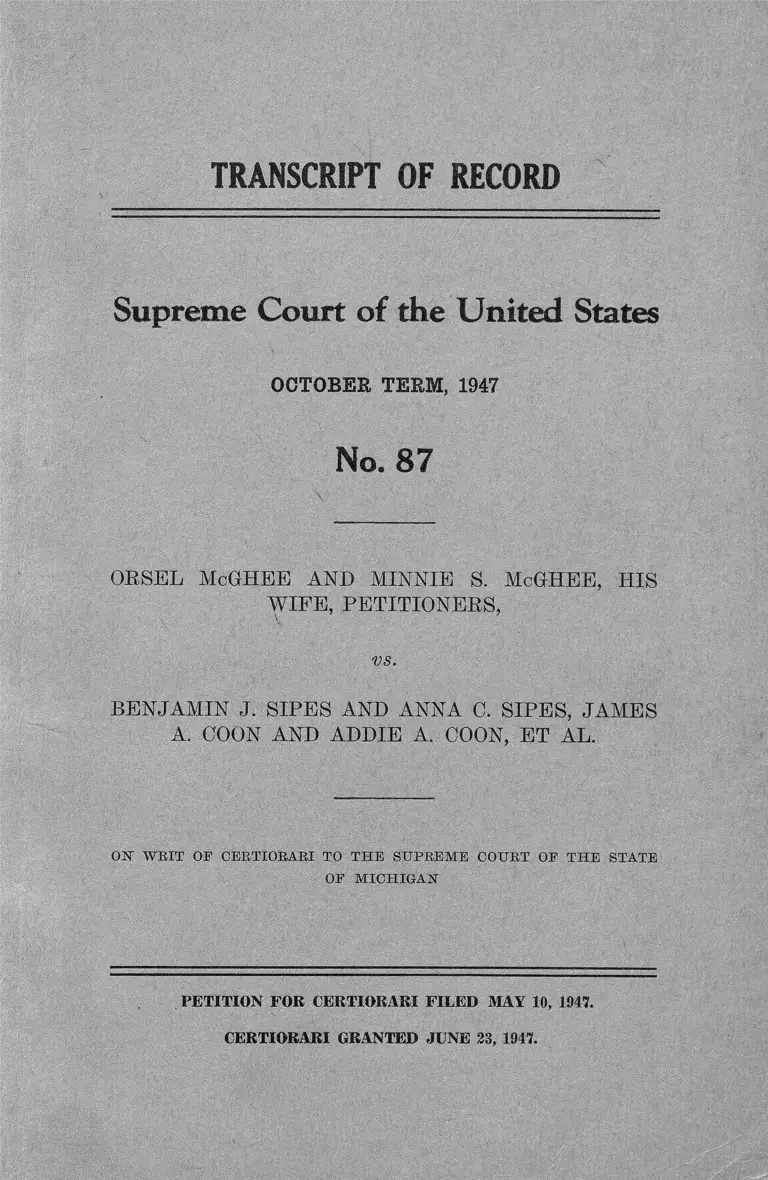
TRANSCRIPT OF RECORD
S u p re m e C o u r t o f th e U n ite d States
OCTOBER TERM, 1947
N o. 8 7
ORSEL McGHEE AND MINNIE S. McGHEE, HIS
W IFE, PETITIONERS,
VS,
BENJAMIN J. SIPES AND ANNA C. SIPES, JAMES
A. COON AND ADDIE A. COON, ET AL.
O N W R IT OF CERTIORARI TO T H E SU PRE M E COURT OF T H E STATE
OF M IC H IG A N
PETITION FOR CERTIORARI FILED MAY 10, 1947.
CERTIORARI GRANTED JUNE 23, 1947.
SUPREME COURT OF THE UNITED STATES
ORSEL McGHEE AND MINNIE S. McGHEE, HIS
BENJAMIN J. SIPES AND ANNA C. SIPES, JAMES
A. COON AND ADDIE A. COON, ET AL.
ON W R IT OF CERTIORARI TO T H E SU PRE M E COURT OF T H E STATE
OCTOBER TERM, 1947
N o . 8 7
W IFE, PETITIONERS,
vs.
OF M IC H IG A N
IN D E X
Original Print
Proceedings in Supreme Court of Michigan.......................... 1 1
Docket entries............................................................................. 1 1
Order granting stay of proceedings...................................... 2 2
Order granting leave to appeal................................................ 2 2
Order denying motion to dismiss, etc...................................... 3 2
Minute entries of argument and submission.......................... 3 3
Reeord from Circuit Court of Wayne County...................... 9 3
Calendar entries ................................................................ 9 3
Defendants’ reasons and grounds of appeal.................. 12 5
Bill of complaint................................................................ 14 6
Answer to bill of complaint.............................................. 19 10
Plaintiffs’ pre-trial statement.......................................... 23 12
Order allowing plaintiffs’ pre-trial statement to be
filed ................................................................................... 27 14
Defendants’ pre-trial statement...................................... 28 15
Pre-trial statement of c o u r t ............................................ 30 16
Amended answer to bill o f complaint.............................. 31 16
J udd & D e t w e iu s r ( I n c J , P r in t e r s , W a s h in g t o n , D. C., J u l y 15,1947.
— 1562
11 INDEX
Record from Circuit Court of Wayne County— Continued
Original Print
Settled case on appeal...................................................... 32 17
Caption and appearances......................................... 32 17
Colloquy between Court and counsel...................... 32 17
Testimony of Benjamin J. Sipes.............................. 37 21
Charles R. Robert.............................. 40 23
Dr. Norman D. Humphrey.............. 45 27
Melvin Tumin .................................. 50 31
Exhibits:
1— Plaintiffs’ pre-trial statement.................... 51 32
2— Defendants’ pre-trial statement................ 55 35
3— 4— Signed restrictions............................. 58 37
7— Quotation from testimony o f Mr. Sipes. . . 38 22
8— Plat o f Brooks & Kingons Subdivision. . . 64 43
9— Plat of Seebaldt’s Subdivision................... 65 44
10— Warranty deed ................................................. 66 45
15— Birth certificate .......................................... 68 47
16— Affidavit for license to marry.................... 69 48
17— Certified copy of reeord of marriage.... 70 49
Opinion of the court, Miller, J ............................................ 71 51
Decree ................................................................................. 74 52
Motion to set aside decree..................................................... 76 54
Affidavit attached to motion set aside decree. . . . . . 78 55
Opinion on motion for rehearing, Miller, J ........................ 79 55
Order denying rehearing.................................................. 80 56
Order granting leave to appeal........................................ 81 57
Claim of a p p ea l................................................................. 83 57
Stipulation as to printed record...................................... 84 58
Stipulation as to service of papers and certification of
exhibits ........................................................................... 85 59
Certificate of court ........................................................... 86 59
Opinion, Bushnell, J ........................................................................... 87 60
Judgment ................................................................................... 97 70
Submission of motion for rehearing........................................ 97 70
Application and motion for rehearing........................................ 100 70
Affidavit of Willis M. G raves.............................................. 102 71
Argument .............................................................................. 101 72
Objections to rehearing .............................................................. 113 77
Order denying motion for rehearing.......................................... 118 80
Order granting stay of proceedings............................................ 118 80
Clerk’s certificate.............................. (omitted in printing) . 119
Order allowing certiorari............................................................ 120 81
1
[fol. 1] IN SUPREME COURT OF MICHIGAN
No. 43271
D ocket E ntbies
Parties:
B e n ja m in J. S ipes, et al., Plaintiffs,
vs.
Obsel M cG h ee , et al., Defendants and Appellants
Plaintiffs’ Attorneys: Younglove & Chockley.
Defendants’ Attorneys: Willis M. Graves, Francis M.
Dent.
Appeal from Wayne, In Chancery
Date Proceedings
1945
Dec. 1. Application for leave to appeal filed.
Dec. 5. Stay order issued.
Dec. 6. Motion to dismiss and brief in opposition filed.
1946
Jan. 10. Application granted, stay continued.
Apr. 17. Record on appeal filed.
Apr. 26. Note of argument filed.
May 17. Motion to dismiss filed.
May 22. Motion to continue filed.
June 3. Motion to continued granted, to dismiss denied,
no costs.
Oct. 3. Stipulation to docket filed.
Oct. 16. Argued in part.
Oct. 17. Concluded and submitted.
1947
Jan. 7. Affirmed, costs.
Jan. 17. Record returned to Court below.
Feb. 18. Motion for rehearing submitted.
Mar. 3. Motion for rehearing denied, costs to plaintiffs.
Mar. 24. Motion for stay of proceedings filed.
Apr. 8. Motion for stay of proceedings granted.
1—87
2
[ fo l . 2] I n S uprem e Court op M ichigan
[Title omitted]
O rder G ran tin g S tay—December 5, 1945
In this cause an application is filed for leave to appeal
from the decree of the Circuit Court for the County of
Wayne, in Chancery, and a motion is filed for the allowance
of an stay of proceedings, and due consideration thereof
having been had by the Court, it is ordered that all proceed
ings under the trial court’s decree and order to show cause
are hereby stayed pending determination of application
for leave to appeal and until the further order of this Court.
I n S uprem e C ourt o r M ichigan
[Title omitted]
Order G ran tin g L eave to A ppeal— January 10, 1946
In this cause an application is filed by defendants for
leave to appeal from the decree of the Circuit Court for the
County of Wayne, in Chancery, and a motion is filed to dis
miss said application, and a brief in opposition to said appli-
[fol. 3] cation having been filed by plaintiffs, and due con
sideration thereof having been had by the Court, it is
ordered that the application be and the same is hereby
granted. It is further ordered that the stay order issued
herein on December 5, 1945, be and the same is hereby con
tinued in full force and effect until the further order of this
Court.
I n S u prem e C ourt oe M ichigan
[Title omitted]
O rder D en yin g M otion to D ismiss etc .— June 3, 1946
In this cause a motion is filed by defendants to continue
the cause over the June, 1946, Term of this Court and a
motion is filed by plaintiffs to dismiss the appeal heretofore
taken herein by defendants, and due consideration thereof
3
having been had by the Court, it is ordered that the motion
to dismiss be and the same is hereby denied, but without
costs, and that the motion to continue be and the same is
hereby granted, but without costs.
I n S u prem e Court of M ichigan
[Title omitted]
M in u te E n try— October 16, 1946
[fols. 4-8] This cause coming on to be heard is argued in
part.
I n S uprem e C ourt of M ichigan
[Title omitted]
M in u te E ntry—October 17, 1946
The argument heretofore commenced herein is concluded
and the cause duly submitted.
[ fo l. 9 ] I n C ircuit C ourt of W ayn e C o u n y
Calendar E ntries
1945
Jan. 30 Bill of complaint filed. Summons issued.
30 Order to show cause signed, filed.
Feb. 2 Summons returned served, filed.
9 Appearance of defendants, filed.
16 Answer, filed.
21 Motion and notice to advance, filed.
23 Praecipe for causes ready for trial filed no. 58889.
Mar. 1 Proof of service of motion to advance cause, no
tice, filed.
2 Order granting motion to advance cause signed,
filed.
Apr. 5 Pre-trial statement, filed.
7 Proof of service of pre-trial statement, filed.
2— 87
4
1945
18 Fee paid. Case returned to call. Court sheet,
Judge Guy A. Miller. $6.00.
20 Transcript of testimony, filed.
May 28 Heard by the court. Hearing in progress. Court
sheet, Judge Miller.
29 Amended answer, filed.
29 Hearing in progress. Court sheet, Judge Miller.
Aug. 23 Opinion of the court signed, filed.
24 Brief in support of motion to dismiss bill, filed.
24 Brief of plaintiffs, filed.
29 Proof of service of decree and notice of settle
ment, filed.
29 Proof of service of notice of entry of decree, filed,
[fol. 10]
29 Decree signed, filed, entered. Judge Guy A.
Miller.
Sep. 19 Enrolled this date.
Oct. 26 Affidavit, motion to set aside decree and notice,
filed.
Nov. 13 Opinion on motion for rehearing signed, filed.
16 Order denying rehearing and notice, filed.
16 Proof of service of order denying rehearing and
notice, filed.
20 Notice of entry of order denying motion and
proof of service, thereof, filed.
23 Motion for granting of a stay bond and a bond
on appeal heard and denied. Court sheet,
Judge Miller.
23 Motion for granting stay bond, and notice, filed.
27 Proof of service of claim of appeal, filed.
27 Claim of appeal, filed ($5 fee paid).
Dec. 3 Petition and order to show cause signed, filed.
6 Order staying proceedings, filed.
1946
Jan. 28 Order granting leave to appeal received, filed.
28 Claim of appeal, filed ($5 fee paid).
28 Bond to stay proceedings on appeal to Supreme
Court, filed #71867.
29 Motion to extend time and notice, filed.
29 Order extending time signed, filed, entered.
Judge Guy A. Miller.
5
1946
Feb. 20 Motion to extend time and notice, filed.
20 Order extending time signed, filed, entered.
Judge Guy A. Miller.
Mar. 13 Order extending time signed, filed, entered.
Judge Guy A. Miller.
[fol. 11]
Apr. 9 Record on appeal settled and certified this date.
Referred to Mr. Graves. Court sheet, Judge
Guy A. Miller.
9 Settled case on appeal, filed.
9 Notice of transmission of record on appeal to the
Supreme Court, filed.
[ fo l. 12] I n t h e C ircuit C ourt for t h e Cou nty of W ay n e .
I n C hancery
Hon. Guy A. Miller, Circuit Judge
Calendar No. 43271
B e n ja m in J . S ipes and A n n a C. S ipes, J am es A. C oon and
Addie A. Coon, et al., Plaintiffs and Appellees,
v.
Orsel M cG hee and M in n ie S. M cG h ee , his wife, Defendants
and Appellants
D efen d an ts ’ R easons and G rounds of A ppeal—Filed
April 9, 1946
The reasons and grounds of appeal are:
The Court erred:
1. In holding that the doctrine of reciprocal negative
easement applied in this case.
2. In holding that the instruments relied on by the plain
tiffs as establishing a general plan or agreement were com
plete as a matter of law.
3. In determining that the race of the defendants had
been proved to the court.
6
[fol. 13] 4. In holding that the relief prayed was not
directly against Section 16, Article II, and other sections
of the Constitution of the State of Michigan.
5. In holding that the alleged restriction was not void
for uncertainty.
6’. In holding that the alleged restriction was not void
as being against public policy.
7. In holding that the enforcement of the race restriction
set forth in the Bill of Complaint by a court of Equity or
by a decree of a court of Equity or by a decree of any Court
of the State of Michigan was not violative of the Four
teenth Amendment to the Constitution of the United States
of America and in that the enforcement of the decree by a
court of Equity would not deny to the defendants, and each
of them, equal protection of the laws of the State of Michi
gan, and of the United States of America, and in that it
would not constitute a taking of the defendant’s property
without due process or any process of law.
8. In failing to hold that the general plan of developing
the Subdivision had not been violated when 90% of resi
dents on Tireman Avenue in Subdivision are Negroes.
Willis M. Graves and Francis M. Dent, Attorneys for
Defendants and Appellants.
[fol. 14] I n C ircuit C ourt of W atn e C ou nty
B il l of C om plain t— Filed January 30, 1945
To the Circuit Court for the County of Wayne, In Chan
cery:
Now comes the above named plaintiffs, by Younglove
and Chockley, their attorneys, filing this bill on behalf of
themselves and all other owners of property in Seebaldt’s
Subdivision and Brooks and Kingon’s Subdivision, located
on Seebaldt Avenue, between Firwood and Beechwood Ave
nues, in the City of Detroit, Wayne County, Michigan, who
7
may care to join herein, and respectfully show unto the
court as follows:
1. That plaintiffs, respectively, own lots in Seebaldt’s
Subdivision as follows:
Lot No. 53, by Benjamin J. Sipes and Anna E. Sipes, his
w ife;
Lot No. 68, by James A. Coon and Addie A. Coon, his
w ife ;
Lot No. 45, by Edward F. Secunda and Anna L. Secunda,
his w ife ;
Lot No. 49, by C. James Donovan and Elizabeth Donovan,
his w ife;
Lot No. 69, by William A. Kresin and Freda A. Kresin,
his w ife ;
Lot No. 54, by Kathryn Lynn;
Lot No. 50, by Alvin C. Smith.
[fol. 15] 2. That plaintiffs, respectively, own lots in
Brooks and Kingon’s Subdivision as follows:
Lot No. 193, by Lora D. McMurdy;
Lot No. 196, by Herman Guse;
Lot No. 195, by August J. Becker and Anna Becker, his
w ife ;
Lot No. 192, by Daniel J. Kuntz and Carolyn Kuntz, his
w ife;
Lot No. 200, by George A. Strohmer and Gertrude T.
Strohmer, his w ife ;
Lot No. 199, by Irene L. Stoffletf.
3. That all of the above described lots are located on
Seebaldt Avenue, between Firwood and Beechwood Ave
nue, in the City of Detroit, Michigan, and are, with one or
two exceptions, used and occupied by plaitiffs as their re
spective homes.
4. That defendants, Orsel McGhee and Minnie S. Mc
Ghee, his wife, are the owners of Lot 52 Seebaldt’s Subdi
vision, commonly known as 4626 Seebaldt Avenue, located
between Firwood and Beechwood Avenues, in the same block
in which plaintiffs ’ homes are located.
8
5. That both plaintiffs’ and defendants’ properties above
described are subject to the following restriction:
“ This property shall not be used or occupied by
any person or persons except those of the Caucasian
race.”
which restriction was signed and imposed on defendants’
property by John C. Furgeson and Meda Furgeson, his
wife, through whom defendants claim title, and was re
corded on September 7, 1935, in Liber 4505 of Deeds, at
page 610, Wayne County Register of Deeds Office.
6. That defendants Orsel McGhee and Minnie S. Mc-
[fol. 16] Ghee, his wife, are not of the white or Caucasian
race, but are of the colored or Negro race.
7. That said defendants, being of the Negro race and
well knowing the restricted character of the neighborhood
and particularly of the block on Seebaldt Avenue, between
Firwood and Beechwood Avenues, have moved into and
are now using and occupying the house at 4626 Seebaldt
Avenue, in direct violation of said restriction limiting the
use and occupancy thereof to persons of the white or Cau
casian race.
8. That the restricted character of Seebaldt Avenue,
and particularly of the block where defendants’ property
is located, as an exclusively white residential neighbor
hood, has been uniformly observed since the property was
subdivided and the continued violation of said restriction
will cause irreparable injury to these plaintiffs and all other
owners in the vicinity by greatly reducing the desirability
and value of their properties.
9. That defendants have been asked to abide by said
restriction and to limit the use of the occupancy of their
said property to persons of the Caucasian race, but have
refused to do so.
10. That plaintiffs will suffer irreparable injury and
damages in excess of $1000.00 each if said violation con
tinues and are without remedy except in a court of equity.
Wherefore, plaintiffs pray:
I. That defendants Orsel McGhee and Minnie S. Mc
Ghee, his wife, may full, true and perfect answer make to
the matters herein stated and charged.
9
II. That a temporary injunction be issued by this Hon.
[fol. 17] Court restraining defendants from using or occu
pying the property known as Lot No. 52 Seebaldt’s Sub
division and commonly known as 4626' Seebaldt Avenue,
or permitting said property to be used or occupied by any
person or persons except those of the Caucasian race.
III. That upon the hearing of this cause that said tem
porary injunction be made permanent.
IV. That plaintiffs have such other, further or different
relief as to the court shall seem just and proper.
Benjamin J. Sipes
Anna E. Sipes
James A. Coon
Addie A. Coon
Edward F. Secunda
Anna L. Secunda
C. James Donovan
Elizabeth Donovan
William A. Kresin
Freda A. Kresin
Irene L.
Kathryn Lynn
Alvin C. Smith
Lora D. McMurdy
Herman Duse
August J. Becker
Her cross (X ) Anna Becker
Daniel J. Kuntz
Carolyn Kuntz
George A. Strohmer
Gertrude T. Strohmer
Stofflett
S tate of M ich ig an ,
County of Wayne— ss.
On this 29th day of January, A. D. 1945, before me, a
Notary Public in and for said County, personally appeared
Benjamin J. Sipes, Anna E. Sipes, James A. Coon, Addie
A. Coon, Edward F. Secunda, Anna L. Secunda, C. Janies
Donovan, Elizabeth Donovan, William A. Kresin, Freda
A. Kresin, Kathryn Lynn, Alvin C. Smith, Lora D. Mc
Murdy, Herman Guse, August J. Becker, Anna Becker,
[fol. 18] Daniel J. Kuntz, Carolyn Kuntz, George A. Stroh
mer, Gertrude T. Strohmer and Irene L. Stofflett, to me
known to be the parties above named and who made oath
that they had read the foregoing bill of complaint by them
subscribed, that they knew the contents thereof and that
the same is true of their own knowledge, except as to mat
ters therein stated to be upon information and belief and
as to such matters they believe it to be true.
Evelyn G. McCaske, Notary Public, Wayne County,
Michigan.
My commission expires Dec. 12, 1947.
10
A nsw er to B il l of C o m plain t—Filed February 16, 1945
Now come the defendants, Orsel McGhee and Minnie S.
McGhee, his wife, by their attorneys, Willis M. Graves and
Francis M. Dent, and saving and reserving unto themselves
all manner of benefit of objection and exception to the many
errors and inconsistencies in the Bill of Complaint con
tained, for answer thereto or such parts thereof as they
are advised it is material or necessary to answer, say:
1. The defendants, not having sufficient knowledge of
the allegations set forth in paragraph 1, of the Bill of Com
plaint, neither admit nor deny the said allegations but leave
the plaintiffs to their proofs.
2. The defendants, not having sufficient knowledge of
the allegations set forth in paragraph 2, of the Bill of
Complaint, neither admit nor deny the said allegations but
leave the plaintiffs to their proofs.
3. The defendants, not having sufficient knowledge of the
allegations set forth in paragraph 3, of the Bill of Com
plaint, neither admit nor deny the said allegations but
leave the plaintiffs to their proofs.
4. The defendants admit the ownership of Lot 52 of
Seebaldt’s Subdivision as alleged in paragraph 4 of the
Bill of Complaint, but neither admit nor deny the remainder
of said paragraph and leave the plaintiffs to their proofs.
[fol. 20] 5. The defendants deny that the restriction:
“ This property shall not be used or occupied by
any person or persons except those of the Caucasian
race”
as alleged in paragraph 5 of the Bill of Complaint, if valid,
applies to them or their use of the property owned by them.
6. The defendants say in answer to paragraph 6 of
the Bill of Complaint that they do not have sufficient
knowledge of their ancestry to say to which race they be
long, but leave the plaintiffs to their proofs and further the
defendants will demand complete and absolute proof of
those allegations.
7. In answering paragraph 7, of the Bill of Complaint,
the defendants say that it contains nothing but conclusions
[fol. 19] In Circuit Court of W ayne County
11
and therefore it is not subject to affirmation or denial ex
cept the allegations of moving into the house at 4626 See-
baldt Avenue and as to that allegation, they admit the same
to be true.
8. The defendants say, in answer to paragraph 8 of the
Bill of Complaint, that there is no connection between the
allegations of the said paragraph 8 and the allegations of
paragraph 5 of the Bill of Complaint and therefore un
answerable in that form except the portion that alleges
“ desirability and value” and as to that portion, the defend
ants neither affirm nor deny but leave the plaintiffs to their
proofs.
9. In answering the paragraph 9 of the Bill of Complaint,
the defendants state that persons, who are not known to
them visited them on more than one occasion and talked about
the neighborhood and threatened them if they did not ac
cede to some unreasonable and unconscionable requests,
[fol. 21] and they now ask that if such persons are the plain
tiffs herein that they be more particularly described so that
the defendants can more fully answer the said paragraph.
10. The defendants deny that any violation of any agree
ment or contract made by them exists and that no injury or
damage is caused by them to the plaintiffs.
Further answering the plaintiffs Bill of Complaint, the
defendants say that the relief therein prayed cannot be
granted because:
1. The Bill of Complaint does not give the court jurisdic
tion to hear and determine the matters therein alleged.
2. The relief therein prayed is directly against Section
16, Article II, and other sections of the Constitution of
the State of Michigan.
The defendants say that the prayers of the said Bill
of Complaint ought not to be granted and the said bill
should be dismissed with costs to these defendants most
wrongfully sustained.
Orsel McGhee, Minnie S. McGhee.
(Signed) Willis M. Graves, Francis M. Dent, Attorneys
for Defendants. Business Address: 446 East Warren Ave
nue, Detroit 1, Michigan.
[fol. 22] Duly sworn to by Orsel McGhee and Minnie S.
McGhee. Jurat omitted in printing.
3—87
12
P l a in t if f s ’ P re-trial S tatem en t— Filed April 5, 1945
It is hereby agreed between the plaintiffs and defendants
herein, as follows:
1. Property on Seebaldt Avenue, between Firwood and
Beechwood Avenue, in the City of Detroit, Wayne County,
Michigan, consists of lots 36 to 71, both inclusive, of See-
baldt’s Subdivision of part of Joseph Tireman’s Estate,
Quarter Sections 51 and 52, Ten Thousand Acre Tract and
Fractional Section 3, Town 2 South, Range 11 East, ac
cording to the plat recorded in Liber 27 of Plats, page 34,
and lots 188 to 205, both inclusive, of Brooks and Kingons
Subdivision of part of Joseph Tireman’s Estate, Quarter
Sections 51 and 52, Ten Thousand Acre Tract and Frac
tional Section 3, Town 2 South, Range 11 East, according
to the plat recorded in Liber 27 of Plats, page 32, Wayne
County Records.
2. Plaintiffs own property in said block, as follows:
In Seebaldt’s Subdivision
Deed Recorded in
[fol. 23] In Circuit Court of W ayne County
Lot No. Plaintiff Liber at page
53 Benjamin J. Sipes and wife 4148 201
68 James A. Coon and wife 2376 183
45 Edward F. Secunda and wife 5901 159
49 C. James Donovan and wife 5375 274
69 William A. Kresin and wife 1296 56
54 Kathryn Lynn 4202 321
50 Alvin C. Smith 5293 275
[fol. 24] In Brooks & Kingons Subdivision
Deed Recorded :
Lot No. Plaintiff Liber at page
193 Lora D. McMurdy 1367 475
196 Herman (fuse 4224 61
195 August J. Becker and wife 6483 168
192 Daniel J. Kuntz and wife 1563 243
200 George A. Strohmer and wife 3888 63
199 Irene L. Stofflett 4750 440
13
3. Defendants own and occupy property in said block
described as Lot 52, Seebaldt’s Subdivision, by Warranty
Deed from Walter A. Joachim and Helen M. Joachim, his
wife, recorded in Liber 7284, at page 135. Walter A.
Joachim and wife obtained their title by Warranty Deed
from John C. Ferguson and Meda Ferguson, his wife,
recorded in Liber 7284, at page 137. John C. Ferguson and
wife executed the restriction described below and it is
recorded in Liber 4505, at page 610.
4. Instruments similar in form, reciting:
“ We, the undersigned, owners of the following de
scribed property, situate and being in the City of De
troit, Wayne County, Michigan, known and described
as follows, to-wit: * * * for the purpose of defining,
recording and carrying out the general plan of de
veloping the subdivision which has been uniformly
recognized and followed, do hereby agree that the fol
lowing restriction be imposed on our property above
described to remain in force until January 1st, 1960,
to run with the land, and to be binding on our heirs,
executors and assigns:
“ This property shall not be used or occupied
by any person or persons except those of the
Caucasian race.”
[fol. 25] It is further agreed that this restriction shall
not be effective unless at least eighty per cent of the
property fronting on both sides of the street in the
block where above property is located is subject to this
or a similar restriction.”
have been executed by owners of property in said block and
are recorded as follows:
Seebaldt’s Subdivision
Lot Liber Page Lot Liber Page Lot Liber Page
36 4505 587 49 4505 587 61 4505 587
37 4505 587 50 4505 561 62 4505 561
38 4505 609 51 None 63 None
39 None 52 4505 610 64 4505 587
40 None 53 4505 587 65 6190 241
41 4505 587 6040 251 66 4505 587
14
Seebaldt’s Subdivision—Continued
Lot Liber Page Lot Liber Page Lot Liber Page
42 4505 561 54 4505 612 67 4505 587
43 4505 561 55 4505 587 68 4505 607
44 4505 561 56 4505 587 69 4505 561
45 4505 614 57 45Q5 587 70 4505 613
46 4505 561 58 4505 587 71 None
47 4505 587 59 4505 587
48 4505 561 60 4505 608
Brooks & Kingons Subdivision
Lot Liber Page Lot Liber Page Lot Liber Page
188 4505 606 194 4505 585 200 4505 587
189 4505 606 195 6040 248 4505 585
190 4505 611 196 4505 585 201 7350 75
191 7358 134 197 7347 480 4505 585
192 4505 585 198 4505 585 202 4505 615
193 4505 585 199 4505 587 203 4505 585
6020 19 7350 74 204 4505 586
[fol. 26] 5. All mention herein of liber and page of the
recordings of all instruments are understood to refer to the
records in the office of the Register of Deeds for Wayne
County, Michigan, unless the context clearly indicates other
wise. All mention of “ said block” is understood to refer
to the block on Seebaldt Avenue, between Firwood and
Beechwood Avenue, in the City of Detroit, Wayne County,
Michigan.
Younglove and Chockley, Attorneys for Defendants.
[ fo l. 27] l x C ircuit C ourt op W ayne C ou nty
Order A llow ing P l a in t if f s ’ P re-trial S tatem ent to B e
F iled— April 4,1945
The court is advised by Mr. Chockley, attorney for plain
tiff, that a copy of the annexed pre-trial statement has been
submited to the attorneys for the defendants, and that no
amendments or corrections have been proposed. Mr.
Chockley has been present in court all morning and defend
ants ’ attorneys have not appeared, although Mr. Chockley
called their office. It is therefore, ordered that the annexed
pre-trial statement be filed.
James E. Chenot, Circuit Judge.
15
D efen d an t ’s P re-T rial S tatem ent
The defendants file herewith their objections to the pro
posed exhibits of the plaintiffs.
Defendants challenge legality of execution of following
lots in accordance with Section 13284 and other sections of
the Compiled Laws of the State of Michigan for the year
1929.
In Seebaldt’s Subdivision
[fol. 28] In Circuit Court of W ayne County
Lot No. Deed Recorded in
Liber at Page
36 (N. 30') 4505 587
37 4505 587
41 4505 587
47 4505 587
49 4505 587
53 4505 587
56 4505 587
57 4505 587
59 4505 587
61 4505 587
66 4505 587
38 Executed by Executor without 4505 587
authority of Probate Court.
68 Executed out of State and no 4505 587
certificate of court of record.
[fol. 29] In Brooks and Kingon’s Subdivision
Lot No. Deed Recorded in
Liber at Page
192 4505 585
193 4505 585
194 4505 585
196 4505 585
200 4505 585
203 4505 585
204 4505 585
188 and 189 executed by officers 4505 585
of a corporation on behalf of
corporation
16
All libers and pages herein mentioned are found in the
office of the Register of Deeds for Wayne County.
Willis M. Graves, Francis M. Dent, Attorneys for
Defendants.
Business Address: 446 East Warren Avenue, Detroit 1,
Michigan.
[ fo l. 30] I n C ircuit C ourt of W ayn e C ou nty
P re-T rial, S tatem en t o f C ourt— April 19, 1945
This is a restriction case in which the plaintiffs seek to
enforce restrictions:
“ This property shall not be used or occupied by any
person or persons except those of the Caucasian race.”
The plaintiffs plant themselves primarily on a written
restriction which includes a general plan, marked Pre-trial
Exhibits 1 and 2 respectively.
Included and attached to this pre-trial statement is a list
of lots covered by these agreements, the original of which
are in the possession of the plaintiff and will be produced at
the trial.
The defendants challenge the legality of certain of these
agreements as contravening Sections 13284, 13332 to 13335,
13330 of Compiled Laws of 1929, a list of which they have
submitted and is also attached to this pre-trial statement.
Counsel for each side admit the correctness of the list as
attached. The issue of the legality of these signatures and
acknowledgements is of course an issue for the trial judge.
(Signed) I. W. Jayne, Circuit Judge.
[ fo l . 31] I n C ircuit C ourt of W ayn e Cou nty
A mended A n sw er to B ill of C om plain t—Filed May 29,1945
Now come the defendants, Orsel McGhee and Minnie
McGhee, his wife, by their attorneys, Willis M. Graves and
Francis M. Dent, and file herewith an Amended Answer to
the Bill of Complaint by adding to the general answers of
the bill added paragraphs to be known as paragraphs 3, 4
and 5 of the general answer.
17
3. The restriction against occupancy based upon the race
or color of the occupant is void under the 14th Amendment
to the Federal Constitution.
4. The issuance of an injunction by this court, as prayed
for, would enforce a restrictive covenant and would pre
vent defendants from occupying* their property, because of
their race or color, and would therefore contravene the 14th
Amendment to the Federal Constitution.
5. The restrictive covenant, relied upon by the plaintiffs,
would prevent occupancy of the property because of the
race or color of the occupant, and is therefore void as
against public policy.
Willis M. Graves, Francis M. Dent.
[fol. 32] I n C ircuit C ourt op W ayne C ounty
Calendar No. 371-498
Settled Case on Appeal—Filed April 9, 1946
_ Proceedings had and testimony taken in the above en
titled matter before the Honorable Guy A. Miller, Circuit
Judge, at Detroit, Michigan, on May 28,1945.
A ppearan ces :
Mr. Lloyd Chockley, appearing on behalf of the plaintiffs.
Messrs F. M. Dent and Willis M. Graves, appearing on
behalf of the defendants.
Colloquy
Mr. Chockley: This is a suit brought by some of the prop
erty owners on Seebaldt Avenue in the City of Detroit, for
the purpose of enforcing a restriction which provides that
no property in this block shall be used or occuped by any
person other than that of the Caucasian race. It is the claim
of the plaintiffs that this restriction has been violated by the
defendant, Orsel McGhee and his wife who are of the colored
race, and who have purchased and moved into this property
contrary to the restrictions.
[fol. 33] Mr. Dent: I have a proposed amendment. I state
the proposed amendment. It is to the effect that the re
18
striction in question is a violation of the Fourteenth Amend
ment of the Constitution of the United States. Does counsel
object to that amendment?
Mr. Chockley: No, it is perfectly all right.
Mr. Dent: We will file the written amendment in answer
to that effect.
Mr. Chockley: I wish to offer this Exhibit No. 1, which
is the Pre-Trial Statement which I prepared and filed in
this court on April 3, which is a statement of the Public
Records that we rely upon and a summary or synopsis of
what they contain, which has not been denied under oath
and which under Third Circuit Rule No. 14-b is admissible
into evidence as proof of the facts therein stated.
(Plaintiff’s Exhibit No. 1 received in evidence.)
I will also offer into evidence plaintiff’s Exhibits 3 and 4.
These are the two papers that were called into question on
the Pre-Trial and are marked Pre-Trial Exhibit 1 and Pre-
Trial Exhibit 2. Those were the ones you questioned at
that time.
Mr. Dent: We object to their admission into evidence.
Our claim is that they cannot be admitted into evidence
under the statutes of the State.
The Court: They may be received and you may state your
objections, but I would like to listen to the arguments when
the case is in. I will admit them and whatever objections
you make—we will argue out the objection when all the
questions of law can be gathered up and argued at the same
time.
(Plaintiff’s Exhibits No. 3 and 4 received in evidence.)
[fol. 34] Mr. Dent: We claim this might decide the entire
case because the restriction says that at least eighty per
cent of the property owners on each side of the street must
sign these agreements and if under our contention, eighty
per cent have not signed, then, that would conclude the
case. That is, they have not been signed properly. As to
that Lot 68 in Seebaldt Subdivision, it was executed in the
State of Indiana and there is no certificate by the clerk of
the court or by the Secretary of State that the Notary
Public, who executed it, had authority to execute it on that
date, and under the Section recited to the court, such an
instrument may not be admitted into evidence.
19
Mr. Chockley: My answer to that objection is contained
in the Statute, Michigan Statutes Annotated, Section
26.604,, which says no such certificate is necessary.
Mr. Dent: No certificate of Notary Public as required by
Statute. It should be in the form as the certificate by the
County Clerk, who certifies thereto under his seal of office.
That, is the way the Statute reads and there is no certificate
in that acknowledgment.
The Court: Well, it reads: “ 18 day of September, A. D.
1934, before me a Notary Public in and for said county,
personally appeared James A. Coon and Addie Coon, to me
known to be the same persons described in and who executed
the within instrument who then severally acknowledged
same to be their free act and deed. Dena P. Brickelle,
Notary Public, St. Joseph County, Indiana. My commis
sion expires 1-20-35.” And impressed on it is a seal:
“ Notary Public, St. Joseph, County, Indiana.” What
should be there!
Mr. Dent: A certificate that he is a Notary Public in that
county.
[fol. 35] The Court: He describes himself as a Notary
Public and I don’t think anything else is necessary. What
are Exhibits 3 and 4!
Mr. Chockley: The Pre-Trial Exhibits that were offered
on the Pre-Trial and the statement says that they should
be produced and I am producing them in accordance with
the agreement made at the Pre-Trial, although I don’t think
they are necessary to make out our case.
Mr. Dent: We have objections to those. As to Lot 38 of
Seebaldt Subdivision, the restriction agreement was filed
by an executor of an estate without authority from the Pro
bate Court. We hold he had no right to do that.
The Court: I think he is right about that.
Mr. Chockley: I think he is right.
Mr. Dent: In Brooks-Kingon Subdivision, lots 188 and
189 the restriction agreement was executed by officers of a
corporation— on behalf of the corporation. The acts of
neither the United States Gfovernment or the State Govern
ment may put such restrictions on property. I think all
the states in the country agree upon that. We claim that
the state cannot create a corporation which can do some
thing which the state itself cannot do. It was my thought
that even though the people of the State of Michigan ordi
narily tell the state that it may pass such resolutions, it
20
.would still be declared unconstitutional by the Supreme
Court of the United States. The state cannot go into this
business under any circumstances and I don’t see how they
themselves, acting through any other of its authorities,
that is the executive, judicial or legislative could authorize
such a corporation—that is, authorizing a corporation to do
such a thing.
The Court: But the Statute provides here on the “ blank
day of blank before me appeared AB, to me personally
[fol. 36] known, by me being duly sworn did say that he is
the President or other officer or agent and that the seal
affixed to said instrument is the corporate seal of the said
corporation that said instrument was signed and sealed in
behalf of said coropration by authority of this Board of
Directors and said AB acknowledged said instrument to be
the free act and deed of this association. ’ ’ This form totally
lacks the statement that these two parties are the officers
and it makes no statement that the corporate seal is at
tached. As a matter of fact, there isn’t any corporate seal
attached and there lacks a statement that this is executed
by authority of the Board of Directors. So, I don’t think
that instrument is entitled to record under our record laws.
That is the ruling I am making. I don’t think that instru
ment is notice to anyone because I don’t think it is properly
received for a record.
Mr. Dent: If the court will look at the instrument before
it, it will see that there are a number of people who have
signed and practically none of them on the same date. The
acknowledgment does not state the people who appeared
before him. It does not state what date and I think under
these two sections that I have quoted to the court, these
acknowledgments are not good. It does not show the people
who appeared before him.
The Court: Well, Mr. Dent, opposite each name there is
a date, for instance, February 26, 1934, and so on down the
line, down to March 7, 1934, and the certificate of acknowl
edgment says, “ Before me a Notary Public in and for said
county, personally appeared each of the persons whose
names are subscribed above, who respectively acknowledged
that they signed same on the date appearing opposite their
[fol. 37] names and severally acknowledged same to be their
free act and deed.’ ’ What is wrong with that?
Mr. Dent: We claim that does not comply with the
Statute.
21
The Court: What would you have it dof
Mr. Dent: He should name the people who appeared
before him in the certificate and the dates that they ap
peared before him in the Certificate. The certificate itself
must bear a date and there is no date in the certificate.
The Court: You mean the certificate cannot refer to the
dates set opposite to the names of the respective parties?
Mr. Dent: That is our contention.
The Court: On the face of the certificate that is a certifi
cate that on the 20th day of February, 1934, Mabel S. Ball,
owner of Lot 204, appeared before the Notary and executed
it and acknowledged it.
S ipes, B e n ja m in J ., one o f the p la in tiffs bein g first du ly
sw orn testified as fo l lo w s :
Direct examination.
By Mr. Chockley:
My name is Benjamin J. Sipes. 1 live at 4634 Seebaldt,
and that is next door to the defendant, Mr. McGhee, and I
have lived there approximately eighteen years. I own the
house, and signed one of the restrictions, restricting the
property against colored people. I have seen two sons and
Mr. and Mrs. McGhee.
Mr. Chockley: Can you tell from looking at these people
whether they are colored people or white people?
[fol. 38] Mr. Dent: If the court please, I must object to
that. The only person qualified to testify as to race would
be someone who is an expert in that field.
Mr. Chockley: If the court please, I don’t believe that is
true. I believe the man can testify in accordance with the
average individual of ordinary intelligence that they can
tell the difference between a white man and a negro, and
I think he has a right to testify for whatever his testimony
may be worth.
The Court: You may answer subject to objection.
Mr. Sipes: Colored people. During the eighteen or
twenty years I lived in this house no colored people lived
in this block or in the district north of Tireman and between
Grand River on the east and Epworth Boulevard on the
west and Joy Road on the north. If my memory serves me
22
correctly, I think it was in 1928 there was a doctor that
moved in on Spokane—a colored doctor—-and they got him
out. He did not live there very long. I had talks with Mr.
McGhee regarding this restriction. I presented a letter
that I composed and a committee of taxpayers in the neigh
borhood got together and I composed this letter, and asked
them if it was satisfactory to everybody concerned in this
group and they said it was. We went into the house and
I read the letter to Mr. McGhee.
(Whereupon, a document was marked Plaintiff’s Exhibit
7 by the Reporter.)
Q. Tell us what you said to Mr. McGhee?
A. I says, “ We are a group of taxpapers in the neighbor
hood, who are representing the Civic Association. We are
a group and we are asking you to kindly vacate the property.
We don’t know if at the time you bought the property from
[fol. 39] Larchmont to Joy Road it was restricted to the
Caucasian only and we also wish to inform you that unless
you vacate this—unless you move out, the Civic Association
will take you to court. ’ ’
Q. And what did Mr. McGhee say, if anything, in answer
to that?
A. He just says, “ Do you want to buy the property?”
And I said, “ That isn’t for us to decide.” He still lives
there.
Cross-examination.
By Mr. Dent:
I changed my name in Probate Court on December 13,
1937, from Swipes to Sipes. I am buying the property on
contract, and have been buying for approximately around
eighteen years. At the time I signed this agreement I was
buying on contract.
Mr. Dent: Will counsel bring in his land contract?
Mr. Chockley: I can’t because he hasn’t any, he has a
deed, which is recorded in Liber 4148, Page 201.
Witness Continuing: There are colored and whites that
live on Tireman, and at the time I signed the agreement
here, colored people lived on the north side of Tireman, and
they are living there now. I have seen Mr. McGhee, and
he appears to have colored features. They are more darker
than mine. I haven’t got near enough to the man to recog
23
nize his eyes. I have seen Mrs. McGhee, and she appears
to he the muBat-o type. Any white man to me is a Caucasian,
and I haven’t heard of any colored people who are Cau
casians.
Mr. Dent: You are depending entirely upon this written
restriction, is that true counsel?
Mr. Chockley: That is correct.
[fol. 40] Witness: I made the M'ortgage to IT. 0. L. C.,
May 1, 1934.
Mr. Dent: We have a case in 298 Michigan 160.
The Court: The Court holds the mortgagor cannot de
crease the title of mortgagee on property by entering into
restrictive covenants like this and, therefore, as against the
mortgagee that agreement is not binding and enforceable.
We do not have enough facts here. Well, this agreement
here, would create an encumbrance on the property which
would be subsequent to and Is subordinate to the bank’s
mortgage—the H. 0. L. C. mortgage—and if that mortgage
were to be foreclosed it would wipe out this agreement so
far as he is concerned.
Charles E . E obebt, ca lled b y p la in tiffs bein g first duly
sw orn testified as fo l lo w s :
Direct examination.
By Mr. Chockley:
My name is Charles E. Eobert. I live at 4311 Seebaldt,
and I am in the Eeal Estate Business, and have been since
1915. My office is now at 7539 Grand Eiver, between See
baldt and Allendale. I have seen the result of influx of
colored people moving into a white neighborhood. There
is a depression of values to start with, general run down of
the neighborhood within a short time afterwards. I have,
however, seen one exception. The colored people on
Scotten, south of Tireman have kept up their property
pretty good and enjoyed them. As a result of this particu
lar family moving in the people in the section are rather
panic-stricken and they are willing to sell—the only thing
[fol. 41] that is keeping them from throwing their stuff on
the market and giving it away is the fact that they think
they can get one or two colored people in there out of there.
My own sales have been affected by this family. Since the
24
fact got around there and it seems to have gotten around
the northwest section that colored people are on Seebaldt,
which is one of our nicest streets, and nine out of ten calls
on the telephone—that, of course, is the section I operate in
—they ask which side of Grand River it is on, and the south
side is where the colored people are. Six or seven weeks
ago I sold a house at 5673 Seebaldt and got a deposit one
day and got the owner’s acceptance in the evening and
before I could deliver the owner’- acceptance to the pur
chaser, he found out there was a colored family in the dis
trict and he called me and stopped the deal, and on the
request of the Securities Commission, we returned the
deposit. I am familiar with Seebaldt Avenue.
Q. Are there any other colored families that live on See
baldt other than the Defendants in this case?
A. Not to my knowledge. • I specialize in the section
bounded by Underwood, Colfax, Dexter, Clairmont, down
to the colored section of Tireman.
Q. So far as you know are there any colored people in that
section other than the Defendants ?
A. So far as I know, no.
Cross-examination.
By Mr. Dent:
Mr. Robert: There are colored people living on the north
side of Tireman, and they have lived there for the last
eight or ten years.
Q. Do you know anybody living there as long ago as 1928?
[fol. 42] A. I never fooled with property with colored
people and I did not pay attention, but I think that was
originally laid out as business property. Tireman is a busi
ness street.
The Court: Let me ask you. Do you understand that in
the subdivision in the plat as it was originally dedicated,
that Tireman Avenue is designated as a business street?
The Witness: Sir, I never searched the records and I
don’t know what it is.
The Court: Do you know if in the original dedication
there was any restriction in the plat?
The Witness: I don’t know.
25
By Mr. Dent:
Q. Can you name any new business on the north side of
Tireman between Firwood and Beechwood or along the two
or three blocks there?
(Exhibit 8, plat of Brooks & Kingon’s Subdivision, and
Exhibit 9, plat of Seebaldt’s Subdivision, received in
evidence.)
A. I believe there are some businesses—not an the north
side—there are some on the south side.
Q. That would be out of the subdivision?
A. That is right.
Mr. Robert: I am familiar with the property at 4626
Seebaldt, and the value of it with a colored family in it is
fifty-two hundred, and if there was no colored family in it
I would say sixty-eight hundred. I would say seven thou
sand is a fair price for that property. Very often they put
on more stamps than it is required in order to get more
mortgage. The mortgage evaluators very often look at the
deeds to find out how much stamps were put on and pay
accordingly and I know of many cases that they put on
three or four dollars more.
(Deed to Orsel McGhee and wife, Exhibit 10 admitted in
evidence.)
[fol. 43] By Mr. Dent:
Q. After looking at the stamps on Exhibit 10, what would
that indicate?
A. That the worth was over a fraction of seven thousand
dollars------
Mr. Chockley: I wish to offer into evidence exhibits 11,
12, 13, and 14, which are four additional restrictions in this
block which have been obtained since this case was started.
They haven’t been recorded.
Mr. Dent: If the Court please, these restrictions are all
dated since this case has been started—the 23rd of April,
1945, and for that reason I don’t think they are proper evi
dence as to whether there have been any violations. There
was certainly no notice to Defendants in this case.
Mr. Chockley: This restriction reads that it will be valid
when eighty per cent have signed and if—which I don’t
think is true—and if he buys without the eighty per cent
26
having signed, and it subsequently becomes eighty per cent,
he knows that the restriction is pending and it is subject to
be made valid by the addition of some more lots or property
to that restriction, and for that reason it seems to be to me
a proper method of showing the restrictions that are on.
Those matters are all in the record. He knows when he
takes it that when eighty per cent sign, that the property is
restricted.
The Court: Irrespective of whether this particular lot 52
is restricted?
Mr. Chockley: Here is the restriction on lot 52, the lot
in question.
(The Court excluded Exhibits 11, 12, 13, and 14.)
Mr. Dent: May I ask off the record as to whether counsel
claims this Exhibit 15, is the birth certificate of Defendant?
[fol. 44] Mr. Chockley: No, this is the birth certificate
of Defendant’s son.
Mr. Dent: May it please the Court, we object to the
introduction of this because it is not the birth certificate
of any of the parties to this suit.
The Court: I am assuming, of course, that is the birth
certificate of a child of these two parties.
Mr. Dent: It does not show that. The party named is
Orsel McGhee. The Defendant in this case. This shows
the father is Oswald McGhee------
The Court: All right, but as a matter of fact the birth
certificate is made evidence only for two reasons only.
By the Statute it says: “ Such certified copies shall be
accepted in all courts and places as prima facie evidence
of the date and birth of said child.” And with that stat
utory authority I don’t think such certified copies are
evidence at all. Strictly reading the statute—as I think
I got to—that is evidence that a child of the parents named
on the certificate was named at a certain place and at a
certain time and that is all it is evidence of. The statute,
Mr. Chockley, says, ‘ ‘ Such certified copy shall be accepted
as prima facie evidence of the date and place of birth of
said child. ’ ’ That is the only purpose for which the statute
make them acceptable.
Mr. Dent: The exhibit that the Court has before it, the
Court will notice that the name of either Defendants of
this suit, Orsel McGhee or Minnie McGhee are not on it.
They are different names altogther.
27
Mr. Chockley: Mr. Dent, is Mr. McGhee in the court
room?
Mr. Dent: No, he is not.
Mr. Chockley: Do you expect to produce him?
Mr. Dent: At present, we don’t.
The Court: While there are a lot of things on here that
[fol. 45] are purely hearsay, such as, for example, the
ages, the birthplace, the occupation, the number of other
children and so on, it may be admitted for the purpose of
showing the date and place of birth and the names of the
parents, which is as far as you can stretch the statute.
(Plaintiff’s Exhibit 15 admitted into evidence.)
Mr. Chockley: I will now offer Plaintiff’s Exhibit 16,
the affidavit for license to marry.
Mr. Dent: I think Mr. Graves w-ould like to see it. May
it please the Court, I don’t know what counsel w’ants to
prove by this— that the people in this exhibit are the
Defendants in this case or not? In case that is the pur
pose, I don’t believe that this is a proper way to prove it.
I have no objection to having it admitted for what it shows
on the face, but not to show that it has anything to do
with the defendants in this case.
The Court: It may be received.
(Plaintiff’s Exhibit 16 received in evidence.)
Mr. Chockley: That is plaintiff’s case.
Dr. N or,m a x D. H u m p h r e y , called b y Defendants being
first duly sworn testified as follows:
Direct examination.
By Mr. Dent:
My name is Norman D. Humphrey. I live in the City
of Detroit. I am Professor of Sociology and Anthropology
at Wayne University, or Assistant Professor. I got my
Bachelor of Arts degree at the University of Michigan,
Master of Arts degree of Anthropology at the University
of Michigan, Master of Sociology degree at the University
[fol. 46] Institute of Social and Public Administration,
Doctor of Philosphy degree at University of Michigan. I
28
have written a number of articles in the anthropological
journals. I belong to the American Sociological Society
and the Alpha Kappa Delta, which is a sociological society.
Mr. Dent: Mr. Chockley, would you want to ask the
doctor any questions as to his qualifications as an expert
in anthropology.
Mr. Chockley: I have no questions.
By Mr. Dent:
Q. In anthropology, doctor, how many races of man
kind are there?
A. The most common conception is that all mankind
consists of the same genesis and species, namely Homo
sapiens, and within that group there are three major
races and stocks, Mongoloid, Caucasoid, and Negroid.
Q. Is there any particular way that you can determine
whether a man is a member of one of those three classifica
tions ?
A. There isn’t any simple one, single criterion of mem
bership.
— . How do you determine the particular race of any par
ticular person?
A. In order to approach knowing what racial derivative
a person possesses, one would proceed to measure a number
of known points by means of califeers and develop their
relation, that is, measurements to certain averages which
have been worked out and then work out from the measure
ments, ratios of indexes or measurement and relate those
in turn into average indigenous, and he would also, prob
ably, observe further mortal observations.
The Court: I don’t follow you. You are using a lot
of words that I cannot know what you mean.
The Witness: Structural features such as the eyefold,
[fol. 47] degree of freeness in the upper lid which isn ’t
subject to measurement, but which is subject to observa
tion. The shape of the nose and that sort of thing, which
is both subject to measurement and observation.
By Mr. Dent:
Q. Professor, did you or would say that looking at an
ordinary person you could tell which of the three races he
belonged to ?
29
A. Only insofar as you approach the ideal types of each
of these categories.
Q. Would you say, in your opinion, the average layman
could look at a person and tell what racial qualifications—
or racial classification they should be put under?
A. I should say, no, because I think the average person
is unfamiliar with the anthropological scientific determina
tion of racial stocks.
The Court: That ending “ oid” has the general meaning
of being predominantly of the given characteristic?
The Witness: Yes, sir.
By Mr. Dent:
Q. Would you say there are any pure Caucasoid, Mon
goloid or Negroids?
A. Well, it would be very difficult to say whether a per
son would be a pure Mongoloid, Negroid, or Caucasoid.
The anthropologists assume that at one time isolated
groups inbred points-certain physical types predominant
for this particular inbred group. However, there has been
shown from examinations of skeleton material from even
Paleolithic have in Europe—the last Ice Age in Europe—
there is evidence of admixture of the so-called Neanderthal
skeletons—the Neanderthal skeletons from Palestine are
deviated from the anthropology in France and Germany,
and it would appear, or at least it is induced that admixture
took place at this time.
Q. On the question of color, white, brown, black, or
[fol. 48] yellow, would that determine necessarily whether
a person was Caucasoid, Negroid, or Mongoloid?
A. No, sir, it would not determine necessarily whether
he were one or the other because skin color has been shown
to be a very poor index because it is not well correlated
with other features.
Q. Do you know of any dark Causcasoids?
A. Yes, sir, I do.
Q. Will you give us an example of that?
A. Well, the average native of India whether he be a
Moslem or a Hindu in religion.
Q. Are classified as Caucasoids ?
A. Yes, sir.
Q. Do you know any light or white Negroids?
A. Yes, sir, I know of people who are called Negroids
30
who are light in skin coloring, and it is also a possibility
for an albino to be in any one of the several racial groups.
Cross-examination.
By Mr. Chockley:
Q. Doctor, the approach that you have testified to here,
has been the purely scientific and academic approach, has
it not?
A. It has been the scientific and academic approach,
yes, sir.
Q. In other words, you are not testifying to the popular
concepts of these things, you are testifying solely as to
the academic concepts?
A. Yes, sir.
Q. In just ordinary language that the man in the street
uses, what does the Negroid consist of? What is the
common word for that?
[fol. 49] A. The average person in the street calls it
“ nigger” and spells it with two “ g ’s” .
Q. What is the Mongoloid? What is the term for that?
A. Again, the man in the street uses variable language—
He may use Mongolian.
Q. And the Caucasoid, what is the common word for that?
A. Well, the commonly used term is the white race, so
to speak, but actually there is a variance here between
the man in the streets usage of the term and the anthrop
ologists ’, just as there is a difference between the chemist—
Q. I understand, but I am talking about common, ordi
nary meaning of the man on the street—the Negroids are
known as the black race?
A. That is right, but I am not competent to talk about
the language of the man on the street because it is an
ambiguous language.
Q. I grant you that, but generally speaking, the Negroid
is the black race?
A. It is commonly felt that Negroids are black.
Q. Isn ’t it a fact that they are commonly called black?
A. Commonly—to me they would be more brown than
black.
Q. Or black or brown; but the Mongolians or Mongoloids
are talked of by the ordinary people as a yellow race ?
A. In some references, yes, and in some references, no.
Q. They are talked about commonly in ordinary language
as the “ Yellow Race” , isn’t that so?
A. Yes, sir.
Q. And the Caucasoid is what is commonly considered
to be the white race?
A. Yes, sir.
[fob 50] M elvin T umin, called by Defendants, being first
duly sworn, testified as follows: i
Direct examination.
By Mr. Dent:
My name is Melvin Tumin. I am a resident of the City
of Detroit and an instructor of Sociology and Anthrop
ology at'Wayne University. I had my B.A., at Wisconsin,
my M.A. at the University of Wisconsin and my Ph.D., at
Northwestern in Sociology and Anthropology.
By Mr. Dent:
Q. Doctor, you have heard the testimony of Dr. Hum
phrey, do you agree with his testimony?
A. Yes, sir.
Q. Is there any place that you disagree with his testi
mony?
A. I can’t think of any substantial disagreements.
Mr. Dent: That is the defendants’ case. The defense
rests.
32
[ fo l . 51] E x h ib it 1
Plaintiffs’ Pre-Trial Statement—Filed April 4, 1945
S tate oe M ich ig an ,
In the Circuit Court for the County of Wayne, In
Chancery.
No. 371,498
B e n ja m in J. S ipes , et al., Plaintiffs,
vs.
Ousel M cG h e e , et al., Defendants
It is hereby agreed between the plaintiffs and defendants
herein, as follows:
1. Property on Seebaldt Avenue, between Firwood and
Beechwood Avenue, in the City of Detroit, Wayne County,
Michigan, consists of lots 36 to 71, both inclusive, of See
baldt’s Subdivision of part of Joseph Tireman’s Estate,
Quarter Sections 51 and 52, Ten Thousand Acre Tract
and Fractional Section 3, Town 2 South, Range 11 East,
according to the plat recorded in Liber 27 of Plats, page
34, and lots 188 to 205, both inclusive, of Brooks and K-ingons
Subdivision of part of Joseph Tireman’s Estate, Quarter
Sections 51 and 52, Ten Thousand Acre Tract and Frac
tional Section 3, Town 2 South Range 11 East, according
to the plat recorded in Liber 27 of Plats, page 32, Wayne
County Records.
2. Plaintiffs own property in said block, as follows:
[fol. 52] In Seebaldt’s Subdivision
Deed Recorded in
Lot No. Plaintiff Liber at page
53 Benjamin J. Sipes and wife 4148 201
68 James A. Coon and wife 2376 183
45 Edward F. Seeunda and wife 5901 159
49 C. J ames Donovan and wife 5375 274
69 William A. Kresin and wife 1296 56
54 Kathryn Lynn 4202 321
50 Alvin C. Smith 5293 275
33
In Brooks & Kingons Subdivision
Deed Recorded in
Lot No. Plaintiff Liber at page
193 Lora D. McMurdy 1367 475
196 Herman Ouse 4224 61
195 August J. Becker and wife 6483 168
192 Daniel J. Kuntz and wife 1563 243
200 George A. Strohmer and wife 3888 63
199 Irene L. Stofflett 4750 440
3. Defendants own and occupy property in said block
described as Lot 52, Seebaldt’s Subdivision, by Warranty
Deed from Walter A. Joachim and Helen M. Joachim, his
wife, recorded in Liber 7284, at page 135. Walter A.
Joachim and wife obtained their title by Warranty Deed
from John C. Ferguson and Meda Ferguson, his wife,
recorded in Liber 7284, at page 137. John C. Ferguson
and wife executed the restriction described below and it is
recorded in Liber 4505, at page 610.
4. Instruments similar in form, reciting:
“ We, the undersigned, owners of the following de
scribed property, situate and being in the City of De
troit, Wayne County, Michigan, known and described
[fol. 53] as follows, to-wit: * * * for the purpose
of defining, recording and carrying out the general plan
of developing the subdivision which has been uniformly
recognized and followed, do hereby agree that the fol
lowing restriction be imposed on our property above
described to remain in force until January 1st, 1960, to
run with the land, and to be binding on our heirs,
executors and assigns:
“ This property shall not be used or occupied by
any person or persons except those of the Caucasian
race.”
It is further agreed that this restriction shall not be
effective unless at least eighty per cent of the property
fronting on both sides of the street in the block where
above property is located is subject to this or a similar
restriction. ’ ’
34
have been executed by owners of property in said block and
are recorded as follows:
Seebaldt’s Subdivision
Lot Liber Page Lot Liber Page Lot Liber Page
36 4505 587 49 4505 587 61 4505 587
37 4505 587 50 4505 561 62 4505 561
38 4505 609 51 None 63 None
39 None 52 4505 610 64 4505 587
40 None 53 4505 587 65 6190 241
41 4505 587 6040 251 66 4505 587
42 4505 561 54 4505 612 67 4505 587
43 4505 561 55 4505 587 08 4505 607
44 4505 561 56 4505 587 69 4505 561
45 4505 614 57 4505 587 70 4505 613
46 4505 561 58 4505 587 71 None
47 4505 587 59 4505 587
48 4505 561 60 4505 608
[fol. 54]
Brooks & Kingons Subdivision
Lot Liber Page Lot Liber Page Lot Liber Page
188 4505 606 194 4505 585 200 4505 587
189 4505 606 195 6040 248 4505 585
190 4505 611 196 4505 585 201 7350 75
191 7358 134 197 7347 480 4505 585
192 4505 585 198 4505 585 202 4505 615
193 4505 585 199 4505 587 203 4505 585
6020 19 7350 74 240 4505 585
5. All mention herein of liber and page of the recordings
of all instruments are understood to refer to the records in
the office of the Register of Deeds for Wayne County, Michi
gan, unless the context clearly indicates otherwise. All
mention of “ said block” is understood to refer to the block
on Seebaldt Avenue, between Firwood and Beechwood Ave
nue, in the City of Detroit, Wayne County, Michigan.
Younglove and Chockley, Attorneys for Defendants.
35
[fol. 55] Exhibit 2
D efendants ’ P re-trial S tatem ent
I n th e C ircu it C ourt for th e C ou nty of W ayn e , S tate of
M ich ig an , in C hancery
Calendar No. 371,498
B e n ja m in J. S ipes, et al., Plaintiffs,
v.
Orsel M cG h ee , et al., Defendants
The defendants file herewith their objections to the pro
posed exhibits of the plaintiffs.
Defendants challenge legality of execution of following
lots in accordance with Section 13284 and other sections of
the Compiled Laws of the State of Michigan for the year
1929.
In Seebaldt’s Subdivision
Deed Recorded in
Lot No. Liber at Page
36 (N. 30') 4505 587
37 4505 587
41 4505 587
47 4505 587
49 4505 587
[fol. 56]
53 4505 587
56 4505 587
57 4505 587
59 4505 587
61 4505 587
66 4505 587
38 Executed by Executor without 4505 587
authority of Probate Court
68 Executed out of State and no 4505 587
certificate of court of record
36
In Brooks and Kingon’s Subdivision
Deed recorded in
Lot No. Liber at Page
192 4505 585
193 4505 585
194 4505 585
196 4505 585
200 4505 585
203 4505 585
204 4505 585
188 and 189 executed by officers of
a corporation on behalf of
corporation
4505 585
[fol. 57] All libers and pages herein mentioned are found
in the office of the Register of Deeds for Wayne County.
Willis M. Graves, Francis M. Dent, Attorneys for
Defendants.
Business Address: 446 East Warren Avenue, Detroit 1,
Michigan.
58
37
/ Exhibits 3 and 4
t 1 • .kii 4505 wwf5H5
: i sep 7 \maltL^nmAs
HAkOLD E. STOLL RESmt*
* a , the u n d e r s ig n s !, oansre © f j poj * r ty i r i..« f o i i o s l r .g
su b d iv is io n *
breaks arwi Klrvgons sufc, o f part o f
J © s s p ii T iP a t a r e i * t . 1 / 4 S e e s . 1 . s,5J 10CCC A. t, a rd :-Y*i £ « e . 3,;T a S R 11 2.
for purposs of dafthirg, pacopJtng an-S carrying out ins
gangrs* plan o; .Java.aping tha tubdlvislOii anted has ©*»n
uniformly PeeogBita., and f« lisa «4 , <*» bora by agr«« »Un each
©trial*' t .u t toa faitatiag *4»«Tlftloa be t«^e»*.s «s ©ur
yroparty ,i« said la F«s«eS» in fore* unt'li
January 1st, 106C, a© run kita i m *»-«. »,u to s» blrdlgg on
-oat* haire,
“this groparty shall, set b® Med or eecuplad by an/ parson
or parsers saespt tbosa of ut* eauesslan raea ■.
is is fbrtnsr agread that tn it rtatrtelloa snail rot b«
IffM ttV o unltaa at -aaat at gbtjrpe reset of liw prsparty s
fronting on bath side* of the street In toa bleak share
©ur isrrt ia located i » eubjaeted t » thte on a etriier
rsslrtetiess,
IK MTKES/ "iiEHSOK me have hartunta #lg«ed ©up t’ arf® or tha
date dalle*lag hit ?e»f««i4*e
JJUL,
m ix
'&A +4- ") * J.
59 38
H «r-
X z
J U £
i
2
r
n
-i
b>
O
ej
&
tj(O
S's
a
\Affl
QCO
.** 4505 9**?58<i
Exhibit® 3 sad 4
(Contiwsed)
A *re»«eni rocanSlrm re stfS oU eo cn^teaa^B %sKkA%mm»» S»tfe*-------
th a t
■th is property ahaU not. ha u t t ' o r ooeupiod hy any person or
parsons oxoopt those s i the C«ua«iotun r.\o«»»
mm
j u * ± m l
IftL
JjM L / $<t
t^rr^ $ . / f J
£%., / f j
«&■*/ ^
A - A Z - J ?
3 ~jt/ - 3 y
, <a<
tet« e# utaa ) J
-n-.;- o f "ayag J*®
£ £ _
'fz£ L r / jL J L lU L/
ê frtcaa.„ annrw ̂f 1 , ---
®for« » a ■ otary ■»t>l!o, In and far said ooonty, O r a l l y arrears*
* *■ a earthed shore, ntw reepeatlTaV aaiaiawladc® that they •noali^thaiy^ps^nfe afta-aasag&Uff ita .»» -a® tm
is Z ^ U L
i « f the -ereess®
> es *&» «a«
w r a r a r
zmcrt%j ® i-ifl3<n'.i<«irm azrtras .’air to. u y t.
60 63
Exhibits 3 and 4
(Continued)
3 i f %
slp f
HAHOLD E. STOU. I t M I U g"¥- 7/
s ur>2 <ti
«®, tte swdersif*»ii8 omera of propirty 4« th* following
n U M iln i
s*» u ‘ ap tw> »,4 J«H of !»**• Etil
N Sort. f e s i s i «**» S.1 .SM h it*«•
to r t&» parpo^t a* to .' ■ .*.ij, reeoi 'ii «3 tnt w riy lag out ttw.
gsneral pi®» atf doW ••. : V - r. <• •. .*•■!<»» ««»•• M boon
w ifen sly r#s»|p»tgai *-•' fo lio tv ., #® hereby sgpse- *s«-A «wH
atfeor that 4&® M iM ln j roatriatiaa M «* aur
property in said M Aiisiaioa, to rasa&a 4* fores «astil
January 1s t , 1M0 , to r a with tha lo&S and-ta b# binding on
ear heirs, sweater* aat .aaatpiss
*Hhis projsorty aha»* **»» os used or eeaapiod my person
( t r a m oxoept those *t tow ©taeaaioa » » « * .
is farther « ^ e ®4 that this restriction shall fiat he
affoatlva snlesa at least eighty jserooat o f taa property
front lag on both sides a? t t t street in ates e#r
laaa is laostod is gs&jacrbad to taia ar a afcsilsr rostrietten.
W Misiga- » S » 88f we zaer* ImromXo aiffad oor agg@* on ths
date following aar ror?oo»»*i signataroa.
if.JLBl*
-£ £ —-
QjuJkm Ji <+> U*mtrkc , £ £
3T. - ts#&& - 91 X * -* -S t
61 40
an 4505 «r j$88
HsiAHi $ sed %
AgTewsftfit f'oet.ratftg reM rtetiftft oft g c ebaldt Subdlv: a lon .
that 0L 't I t , oX J3r 5I? £Sswj1?® "*»• i See. 11 • 52 to.^oo a . ?»
a»* itru JJk.llA i
•Bits propftrtjr «1iaU m i M seed or eooupiod by any paraon o*
p®r**sta ft unapt th«$e o f th* Oaboestan ro o e * .
v b s .v o .
■ 1 v ... 7 a j J . 4 ^ .
J j fctkyL. ^ ^ g y ^ r t ^ a t - .~ _
^ ‘̂ ^.i fi +
•*/ t/ a *t______
‘A ! *J4 /&*&
J L & j.
y 7 # # / /
v?«*
2 r^ £ + * tr& J ____ _______________
S1^as£ ^ 1 ^ £ c .- ^LJfO ajU S^o^^tM ,
^ S A flA - CLi. 3 * e / '.y s ~ |§y
______^ i . ^Gj hsJLL,., //JL4if$' :
JSaL g /
g jLm ££i S3 ^£^42L
8 .T . NWCA-0 3 18 - 5 - 3*7
■^n i uix.
62 41
.<■; r.n:, • ;.vt
yl(.:r,(r.(r.t r ••.rlino r t . t r . U n r
that & * . . .
•M *. ; 11 . - ‘ '
“ T h is p ro p e rty s h a ll not 1>V us/S . , : a ly ar.y p - r c 'r .->r
persons «xci ;-t - f thi Cs. ...at . : a
3U U ■’'* * ! Mil
•'« -v
9 »' Of© ® " !.»!■»,* ft ■ *' - • ftf • •*.-* X t
f ■ ft- ~rr r ... ; " 7“
1 ". ■ ft** o - -ait®
S .T . NWCA-fS I S - i -S
4263
Exhibits :! and 4
(Continiuxi)
UM 4 V0193 l« /^ lt«£ «
I E. STOLL, REWSTtS * ' ̂“I S i D O
*1 r— l
J4&ROL0 E. STOiL, REWTS* • .
We ” h« under s i ./ted, owners o f the f o l l o ju i^ described ir - .u
; ro-.ierty: ̂ , t« .,,
l 4 P i » . ,<ft2 dosbaldts tub . e f f w » o f
Jteesafc ? t f i « i Bsfe X/* S ee . SI S SS
1| «S» * t I r f l t ’ f see. ! . I i l , 1 U t.
for the ,'Wre»» ef dofinln ;, re cord in a-sd eerryinj
.RJf*,b!je jtneral plan ef develo, In the mi’ <; twin io n
"* W i he# Seetl u n ifon ly raee^il«ted end folio .cd, do
hereby *.;ree that the fo ilo ~ in ; rostrletlon be iepoeed
on our property shore described, to rerein in force
until danwary le t , 15JO - to run with the lend, end
to be binding an ear heirs, executors, an) aestjns:
•this property shall net fee used «r eesutfied by any
person or parsons sxoapt those of the Causaalen race*
It is further ajreed t h a t this restriction shall not
be of footles unless at least eighty psrosnt ef the
property fronting on both sides of the street in the
blool: where our lead is located is subjeoted to this
sr s * toiler restriction.
a w itm m shshsop \0% tuireun&o # « i our hands &nd
seals this 4 0 ^ day ef a . 0. 1934.
i l k'.;. \ t.m > U'.*trier.eat - > the*., nevar^lly
i l V' r tn be t h o l r f r » c a c t *;*S d ie d .
BROOKS * KINCONS SUB.
O F
I-Kr t °j J o s e f r STTr e m a i Ns E s t a t e , t S e c t i o n s Nfi 5 B 5 2 ,
lo.ooo a T "» j F r a c t i o n a l S e c t i o n 3-T2.5R .ii E<
D E T r o t t , \ \ fe r t A i ; C o . F I i g h t i^ / o st .
CD
Ave Nwoa^ (>QFvWn-.. *w- '■ wv* I |— .<r^g«g^FT~J ’ V 1 :" ‘
SAV.r'KSfljjii. ? n t v -
M l J.pj Is 16;
Ŝ KmjM̂ DfT
i f c W w w s t
5*1
* - ‘ ....- ' '"fr
̂ feO T V .W n . T
...................................... j * f .......... - !
tfifcSB■ l ' * g g r ^ s i t § ; i | * k p i 5 *. ? v ? l * c
ISTfeS* 17 £,. T
fpi* r*
T T T T
:?**&?*'31 Bh-1128.H? . 5 Sa tflfai'SSS&S^S*Ss&§ S5[iW aSS&s 3* ** -f
T r f
Av e T f̂o»*17 E, feO F V V & —►
*7- ......t- -- r*>
iS?2sJiS?|SS.NS53s.;S;1S35S5«rit(*.«!esjf:,l>,E8le':»i€'S‘S«‘d 3 foSSS* £* $.*
a - ■ i : i i i Uh i i . u u. i 11 m 1 J £
CO
I93W A
8 EEBAL.DTS SUB
OF*
/
6 6 45
Exhibit 10
C 803559 hr*7 2 8 # m
ms m o
36
m * I t t & m f t t r e , ..3QX *..
JbUnMtttr........... la sfc* y«ar si aw L®?* e«a tkamiaad ala* kaadrai aad .S9$%'$~.S.9%B.-
artvwm T»lt»r A....JoieiLl*...a«fl, t o lw ii. u-t r i f » , ... -..........
.................................. parti *8. of tka Srss part.................................................. ~
...Qwwi *«
o f
w»A Mlsai* blA..si£»-----^ 8 * d ^ xa**
.....
------- -
_____ !, t-Stas ika siM partial ai Iks fes* part. t o sad to (wtoAirattoi o* tka saw a<.....
paa D o l la r 181.Q O l kBd oAhar^gaiod and. *>i.iiAt>i-a o a p a ld T a U .o a a
& tJ m .. to hand paid by !ke aaid part.AssW ft® oacoad part, tka racaSpt wtowwf is teafcy coo
mi mkes«Me<̂ . <fe...... by tbtos press***. gras*, bwfata, a*B. reads*. retass®, altea aad
w>to add parfLaa of tka seeaad part. aa d ...*O ...U «ir .-........Intel aad saatfaa, * « • « * , all
t h » » atalala ptoes ....ar pascal....... at toad ritaaM aad baiac to the............. 8* * * ..................«*
........ .......... B S U a i.t ........psaaiy «| ....... _....WUW»....- ................- ..........- etoto to MfcklS«a.
^ fir^ - . m follows, to Wit: A aM M 'loa
Ti*****.*. s»Mt«[.....4UAr.tii£..»MtloaA..lirtx-aM C5i)
y i pa o t i o n th ra a .(,3).* tow n..tw o .|3J ( M l
j i f t f o r d in A to...t.l)w...BX»t 1U i> t« a f * * a a r 4*A A *f.** .. 1S.7.1
ja f p i r n OA PM * X b m j lo u r 1.3* 1 * Mura*. Cauat*..tt*eord**...*sA...w>M .
k n a u i. a a ~ a a t o > 4 ( M 3 a a t o U i - A « « « M r « a U a U i » « f c d g s * .
Ts»«ksr w*tk all and (d o llar tba hsredito*#®® a*» t e r n btoooe>°« « la aajrwiw
,.„... ,.,.,»..,r To te w am! to kato tba said p r e s t o . as bsrete datoribad. with to . appurt«.»o»
mto «fcs add p w tik P o f tbs aocood P««, aod to..........................................**» “ **«“ • Fn" ~ r-
msS ̂ „m \V * ■ ■ .*«••*»». M» wlf*
pat£*A of to. firto part aad ...U k kl* ................... * + •■ ««=*<»« tost adatoutorato.. do cov-
tosat ptaat, tou**ta sad sgw* to aad » » «*• a«M parti**... al A* ss«»od t*rtUi- 1 T U ,r , awl
ttat M tka tiaw of tka aasaaSae aad dtortsty of toaaa ******** t h a y a r a
'. , - y w ^ »ba»»^»atod premia®® to t o stoptos tkat tkagr m» t o . freaa ad locumbrancM
mmrn, a w waaptoi te*a tka ®a»»aas tetowtae, aad tkto - t b a J -IK aad‘. t o i r
fs
aj
m
ol
u
w
to
)
fl
u
a
id
ia
a
}
•y
u
K
a
m
fp
.
fl
ip
q
u
a
yn
u
yq
lf
'<
n
p
|
w
ad
t
od
67 46
ccn
Exhibit 10
(Continued)
. ri»8«aia|ia£e**«rt>af
a u b le c .t t,o « j c l » t l B * . r e * t r le ^ ia iU i JM QC .re co rd ......
In witness whereat tfco nM parties el t&s * m port h* V« h n n lo set ttu s lr hand s ----- aad
t h e i r Sttl.< the da, mi fear tem atom wrens*.
SI«»«d, <w®M sad Mvsrnt fa ,
Suts ot Michigan, 1
coast, of.... ?•?«»•..... ..........h
Oa ett>................................. « a ,o l .. m * * »h * X
in the ,ear one thonsaad sins haadred sad f o r t y f o u r ....
a Notar, Public, in sad tor said eoaat,, ^enteral!, appeared ” a i t a r A • JooC hin 6,ltd,.
H e len U» J o e c h la . h ie n l f e , .....................
4
«
H<
e
-
6 8
47
Exhibit 15
V
s w o t OBKrossT ar u n
W »l« lo r . o f V ita l S to tU t lM
PLic« o f i n n su H itu i
DirUKTME.1T or HEALTH
B2I3A lO-ll-rr—30.0
! io-»' / corUfy -Ant- 41a ror®gfl«i *• * * f » »|» **,#_̂ *®or* ''■* *'
4i» ^ t r o l t to n r taint of Sonltfe
S»«®«
»f MU1D
lte s * itn r .W te J
69
48
H bit 18 i
< ?l t f . /<>
-T - v V ' -^ -T
STATE OF MICHIGAN
AFFIDAVIT FOR LICENSE TO MARRY
STATE OF MICHIGAN
COUNTY OF WAYNE
C
£j^ L - ______
> s 3 T / r u
uiv i !
SB applicant (or a iiceaae let
duly
I t
to acquainted with the l i n of Michigan relatin' to marriage. m priatml i
hack of t h ik blank ; that t Ilf re to no legal impediment to the marriage of h eelf and the otter
that to SStsJteaurf J kaowledge and belief the following statement* are true:
_ M A I.B .
ick. Unlailn. lu lla ii. etc r~ *~ - ^ ~ ~ ~
4L y / 1 t vZ
M A IJt
/ ' /? { /
Fall
A** at last t»irJlbd*y 3 ?
Wlihf, nurk. Miilslin, Indian, at
A
Tm.kSJt /
/ /v /> /£- v
3 3
®4rthi»ljt&i-
■sC
fefatjwr'ii a u ld m o a m t '^ ’/ Mot her'* i
V married ^ 7Number at timt-t prer|on*l.
Sworn and subscribed to hpfnr* me. a N otary P u b lie
W i(m County, Michigan,. this . ...................................... .
roll
A«e at teat WrtSaSay
White. Black. MaSsfta, India a. He
, 11,,,., / y j 3 0 -
BIrthptoc* 7
OcciiyatSoo
Father'* a « « * U ^ H ^ V S / / 2 S 1 S -
Number rf fimee gwartoaaiy
M s t e i earn? of bride if a widow
ViiD A4aU
_ <ky ®f
ia and far
____ IS __
„ ^ 7 ^ 3 .g -^ j*-
Hy cotnlfsion tapirs* ^
70 49
EXH1BI. 17
B M W
CERTIFIED COPY OF RECORD OF MARRIAGE
M M n u
FaS N «a«.. , . . 08LBL MC SttBB Pwi N m . . . . DORBS DIPPAY
A * s . . . . . . » . Shift# A a e .....8 3 <r«a— Shift®
D ® ftro lt» M ic h . .D e t r o i t , A ^ t> .
A l a . ■at—.a-̂ ||̂|| A l a .
- u .. S l a v . L t a r t e r Ora S . T e a c h e r
M s ' s Haas., 3 r e e l Fatfcar’a M an. - o e e p h
U M NfaH. E l l a K a r r la a a t h , MoAak Maaaa E l le n
Nanfar ef Ham pmHamHf m uttiai....... *!?.. Naartar at Hama rrrhmmt, aanisi........A®
tte jprts* a im sanssl owe jafesO fe far ...........St.-i&BiACAUAft...............
.Ittfti® at........................PMMto...................... iflcwp*. *a...utn
•*............../-“ A y . . . . ...............A. D. tettMpraaawai
..................f l/.\ . ?.*.. ?.*»?*••.................................. . .Dftftr.c} i.ft,. JiUtu..
.....................f M ™ . .....................at.................... . Mioa.........................
•a
l CASPAM J. UMGEMAM, Oak el fts Cnaey ai Wayaa aaO e( At O ra* Cewt Owns*.
Os faerofcjr as«SSr, fee I k m cawpwaO &a <sa«a% saw at BasoaO at Marries a M fa
■T aAn aaO m M la Ufam.. .M ........... Ptg».........W R ....... is l «naO An aaiO caff a a M
tnancHfa tiaaeaf
la WaCheaay afaarasO, 1 fane faswwsan sal aay
feaaO aaO aftasd tkt Hal o( asM CSrcafa Coon
* k . . .U M .% 0 < .......... M o*,...A . D. » * . . £
(SEAL> C A »A * A W i W O aalr O n *
Dafafay Comatj darii
N» 4984
50
51
Opin io n of th e C ourt— Filed August 23,1945
This is a bill to enjoin violation of reciprocal negative
easements against occupation by persons not of the Cau
casian race. The restrictions were created by mutual agree
ments among owners after Subdivision. It is conceded that
defendants are not of that race, but it is claimed that there
are reasons preventing enforcement.
I
It is claimed that several acknowledgements are defective.
One is of an outstate execution before a notary with seal.
This is expressly authorized by 'Section 26,604, Michigan
Statutes Annotated.
Again, an agreement by the officers of a corporation within
the apparent scope of their authority is valid as against
mere irregularities. There is no proof that the corporate
covenants were executed without authority. These cove
nants were executed in 1934 and 1935, have been relied upon
till now and the parties are barred by laches and estopped
from now questioning the technical correctness of their
execution.
Defendants rely on Moore v. Kimball 291 Mich. 455.
That case does not support them. It merely holds that
a restriction which by its term ran for 25 years expired in
25 years, a very reasonable conclusion.
[fol. 72] Finally mutual covenants are founded on mutual
considerations. Each covenantor agrees with all the coven
antors.
II
These agreements are recorded. Each lot owner had
notice of them thereby. In terms they run with the land, and
are binding on heirs, executors, and assigns. They are not
mere personally covenants. Each purchaser wha takes sub
ject to such negative restrictive easements agrees with all
others subject to them that he will observe them. This ap
plies not only to such easements as this, but to all others, as
for example, restrictions to residential purposes; to brick or
stone houses; to building line restrictions, to those forbid
ding saloons, gambling, factories, livery stables, and so on
through the long list of restrictions, all limiting the use of
property, and all held valid.
4—87
[fol. 71] In Circuit Court of W ayne County
52
III IV V
This restriction does not violate either the Federal or the
State Constitution. This court is bound on that point b y :
Paramalee v. Morris, 218 Mich. 625
Schulte v. Starks, 238 Mich. 102
Corrigan v. Buckley, 271 U. S. 323
The restriction which is invalid is one preventing aliena
tion to any person or class of persons entitled to hold inter
ests in land. Porter v. Barrett, 233 Mich. 374.
The other points in question are ruled by the following
cases:
Erickson v. Tapert, 127 Mich. 457
Allen v. Detroit, 167 Mich. 464
[fol. 73] Northwertern Home Ownes v. Sheehan, 310
Mich. 188
Wilcox v. Mueller, 250 Mich. 167
Moreton v. Palmer, 239 Mich. 409
Decree may enter for plaintiffs with costs to be taxed.
Guy A. Miller, Circuit Judge.
Dated: August 22, 1945.
f fo l. 74] l x C ircuit C ourt of W ayne C ounty
D ecree;— Filed August 29, 1945
At a session of said court, held in the Wayne County
Building, in the City of Detroit, said County and State, on
this 29th day of August, A. D. 1945.
Present: The Hon. Guy A. Miller, Circuit Judge.
This case came on to be heard upon the pleadings and
proofs taken in open court and was argued by counsel for
the respective parties, and the court being fully advised in
the premises and upon due consideration thereof, finds
that all the material allegations in the bill of complaint are
true as therein stated.
The court further finds that the property known as Lot
No. 52 of Seebaldt’s Subdivision, located on the north side
of Seebaldt Avenue, between Firwood and Beechwood Ave
53
nues, in the City of Detroit, Michigan, and commonly known
as 4626 Seebaldt Avenue, is restricted as follows:
“ This property shall not be used or occupied by any
person or persons except those of the Caucasian race;”
that defendants, Orsel McGhee and Minnie S. McGhee, his
wife, are not of the Caucasian race but are of the colored or
Negro race; that defendants purchased said property with
full knowledge of said restriction and are now using and
occupying it as their residence, in violation of the above
quoted restriction, which was placed upon said property and
[fol. 75] duly recorded in the Office of the Wayne County
Register of Deeds many years prior to the date said de
fendant acquired the property.
On motion of Lloyd T. Chockley, attorney for plaintiffs,
It is Ordered, Adjudged and Decreed that defendants
Orsel McGhee and Minnie S. McGhee, within 90 days from
the date hereof move from said property, and that there
after said defendants be and they are hereby restrained and
enjoined from using or occupying said premises, and
It Is Further Ordered, Adjudged and Decreed that after
the expiration of 90 days from the date hereof that said
defendants and all persons claiming through or under them
he and they are hereby restrained and enjoined from violat
ing the above restriction and from permitting or suffering
said premises to be used or occupied by any person or per
sons excepting those of the Caucasian race, and
The particular description of the property hereinabove
mentioned and referred to is as follows:
Lot No. 52 Seebaldt’s Subdivision of part of Joseph
Tireman Estate, Quarter Sections 51 and 52, Ten Thou
sand Acre Tract and Fractional ;Section 3, Town 2
South, Range 11 East, in the City of Detroit, Wayne
County, Michigan, according to the plat thereof re
corded in the Office of the Register of Deeds for Wayne
County, Michigan, in Liber 27 of Plats, at page 34;
commonly known as 4626 Seebaldt Avenue, Detroit,
Michigan.
(Signed) Guy A. Miller, Circuit Judge.
54
M otion to S et A side D ecree—Filed October 26, 1945
Now come the defendants, Orsel McG-hee and Minnie S.
McGhee, his wife, by their attorneys, Willis M. Graves and
Francis M. Dent, and move the court to grant a rehearing in
the above matter, and to vacate and set aside the decree
heretofore entered, for the following reasons:
1. Because there is no valid proof of record that the de
fendants are not of the Caucasian Race.
2. Because 80% of the property in question was not
validly restricted.
3. Because the general plan of developing the subdivision
included a large number of persons not members of the
Caucasian Race as shown by the testimony.
4. Because the court did not follow the rule of construc
tion in interpreting the restriction against use of the prop
erty as laid down by the Supreme Court of the State of
Michigan.
5. Because the restriction itself is a clear violation of
Article 2, ^Section 16, of the Constitution of the State of
Michigan.
6. Because an enforcement of a restriction of this kind
would in itself be a violation of the 14th Amendment of the
United States Constitution.
[fol. 77] This application and motion is based upon the
files and records in the above entitled cause, and the affidavit
of Francis M. Dent, hereto attached.
Willis M. Graves, 446 E. Warren Avenue, Detroit 1,
Michigan; Francis M. Dent, 4256 Russell Street,
Detroit 7, Michigan, Attorneys for Defendants.
[fol. 76] In Circuit Court or W ayne, County
Dated: Oct. 26, 1945.
55
[fol. 78] A ffidavit A ttached to M otion to S et A side
D ecree
C ounty of W ayn e , ss :
Francis M. Dent, being duly sworn, deposes and says that
he was one of the trial attorneys for the defendants in the
above entitled cause, and that he is familiar with the evi
dence and believes that the matter as set out in the motion
and application for a rehearing are true. Deponent further
believes that certain cases and law not cited by the court or
by the plaintiffs are decisive in this matter and for that
reason, he believes that the defendants are entitled to a re
hearing.
Further, deponent saith not.
Francis M. Dent, Deponent.
Subscribed and sworn to before me this 26th day of
October, A.D. 1945. (Signed) Herbert L. Dudley,
Notary Public, Wayne County, Mich. My commis
sion expires 5-31-49.
[fol. 79] I n C ircuit C ourt of W ayn e C ou nty
Opin io n on M otion for R ehearing—Filed November 13,
1945
Five reasons for this motion were given upon the argu
ment.
I. That plaintiffs did not prove defendants were not of
the Caucasian race.
Plaintiffs produced photostatic copies of public records
relating to the marriage license and marriage of defendants.
These show that they described themselves as of the Negro
race. These records are admissible as evidence of transac
tions in the business of the office of County Clerk, and con
stitute an admission by defendants. They were in court and
did not take the stand. If they wish to do so they may until
November 17, 1945. However, as the evidence now stands,
a prima facie case has been made. I do not remember that
defendants denied being of the Negro race, in their Answer.
II, III, and IV are merely restatements of arguments
made on the trial and are adequately covered by the previous
decision.
56
V : That the restriction in question violates the Federal
and State Constitutions.
That it does not is conclusively established by
Corrigan v. Buckley, 271 U. S. 322;
Porter v. Barrett, 233 Mich. 374.
I have examined the cases cited by defendants. It is nec-
[fol. 80] essary only to say that none of them is in point, and
none is inconsistent with the decisions above cited. Those
decisions are conclusive of the law of the United States
and of this State.
Motion denied except as indicated.
Guy A. Miller, Circuit Judge.
Dated:
l x C ircuit C ourt W ayne C ounty
Order D enying R ehearing— Filed November 16, 1945
Defendants’ motion for a rehearing of the above entitled
cause came on to be heard and the court, after hearing the
arguments of counsel for the respective parties and having
given careful consideration to the brief submitted by coun
sel for defendants, finds no merit in the motion and it is
Ordered that said motion be and it is hereby denied.
Guy A. Miller, Circuit Judge.
A true copy, Caspar J. Lingeman, Clerk, By Elizabeth
Holder, Deputy Clerk.
57
Order G ranting L eave to A ppeal— Filed January 28, 1946
At a session of the Supreme Court of the State of Michi
gan, held at the Supreme Court Room, in the Capitol, in the
City of Lansing, on the tenth day of January, in the year of
our Lord one thousand nine hundred and forty-six.
Present: The Honorable Henry M. Butzel, Chief Justice,
Leland W. Carr, George E. Bushnell, Edward M. Sharpe,
Emerson R. Boyles, Neil E. Reid, Walter II. North, Ray
mond W. Starr, Associate Justices.
Calendar No. 43271
B e n ja m in S. S ipes, et al., Plaintiffs,
v.
O rsel M cG h ee , et al., Defendants and Appellants
In this cause an application is filed by defendants for
leave to appeal from the decree of the Circuit Court for the
County of Wayne, in Chancery, and a motion to dismiss said
application and a brief in opposition to the application
having been had by the court, It is ordered that the applica
tion be and the same is hereby granted. It is further ordered
that the stay order issued herein on December 5, 1945, be
and the same is hereby continued in full force and effect until
the further order of this court.
[fol. 82] Clerk’s Certificate to foregoing paper omitted in
printing.
[fol. 81] In Circuit Court of W ayne County
[ fo l . 83] I n C ircuit C ourt of W ayn e C ounty
Claim of A ppeal— Filed January 28, 1946
Orsel McGhee and Minnie S. McGhee, defendants in the
above entitled cause, claim appeal from the Decree and
Order Denying a Re-Hearing, dated November 16, 1945, by
58
the Honorable Guy A. Miller, one of the judges of the
Wayne Circuit Court.
Appellants take general appeal.
Francis M. Dent, 4256 Russell Street, Detroit 7,
Michigan. Willis M. Graves, 446 East Warren
Avenue, Detroit 1, Michigan, Attorneys for Ap
pellants.
Dated: January 28,1946.
[fol. 84] 1st C ircu it C ourt of W ayne County
S tipulation as to P rinted R ecord
It is hereby stipulated that:
1. The printed record on the appeal herein shall con
sist o f :
Calendar Entries
Bill of Complaint
Defendant’s Answer
Plaintiff’s Pre-Trial Statement
Pre-Trial Statement signed by Judge Chenot
Defendants’ Pre-Trial Statement
Amended Answer to Bill of Complaint
Pre-Trial Statement by Judge Jayne
Opinion of Court
Decree
Motion for Re-Hearing
Opinion on Motion
Order Denying Motion
Order Granting Leave to Appeal
Claim of Appeal
Settled Case on Appeal
Statement of Reasons and Grounds of Appeal
This Stipulation.
2. Any claimed mistakes in the printed record shall be
settled by the original files and record and the edited tran
script and exhibits used in preparing the printed record.
59
[fol. 85] 3. All orders extending time for appeal and serv
ice thereof were duly and timely made.
Youngiove and Chockley, Attorneys for Plaintiffs.
Willis M. Graves and Francis M. Dent, Attorneys
for Defendants
Dated: ------ ------------ -.
It is hereby stipulated that all papers requiring service
have been duly and timely served and that all exhibits bear
the proper certifications.
Lloyd T. Chockley of Youngiove & Chockley, Attor
neys for Plaintiffs and Appellees. Willis M.
Graves and Francis M. Dent, Attorneys for De
fendants and Appellants.
[fol. 86] In C ircu it C ourt of W ayn e C ounty
Certificate of C ourt—Filed April 9,1946
I, Guy A. Miller, Circuit Judge, hereby settle the fore
going case which sets forth the substance of all the material
testimony taken at, and all of the proceedings during, the
hearing resulting in the decree of August 29,1945, appealed
from, including testimony and exhibits taken on separate
record.
I further certify that as to the testimony as set forth in
full by question and answer, the same are so incorporated
because I deem same to be necessary to a full understanding
of the questions involved.
Guy A. Miller, Circuit Judge.
We consent to the settlement of the foregoing as the
settled case on appeal and waive notice of settling and sign
ing same.
Youngiove and Chockley, Attorneys for Plaintiffs
and Appellees. Willis M. Graves and Francis M.
Dent, Attorneys for Defendants and Appellants.
A true copy: Caspar J. Lingeman, Clerk, by Victor L.
Hicks, Deputy Clerk.
Dated at Detroit, Michigan, this 9th day of April, 1946.
60
B e n ja m in J . S ipes and A n n a C. S ipes, J ames A . C oon and
A ddie A . Coon, et al.,
[fol. 87] In Supreme Court of Michigan
v.
Orsel M cG hee and M in n ie S. M cG h e e , His Wife,
Defendants-Appellants
Before the Entire Bench
Opin io n—Filed January 7, 1947
B u sh n ell , J .:
Plaintiffs Benjamin J. Sipes, Anna C. Sipes, and others
own and occupy property located in Seebaldt’s subdivision
and Brooks and Kingon’s subdivision on Seebaldt avenue,
between Firwood and Beechwood avenues, in the City of
Detroit.
Defendants Orsel McGhee and Minnie S. McGhee, his
wife, own and occupy property located on the same street
in Seebaldt’s subdivision. All of the properties occupied
by the parties hereto are encumbered by the following re
corded covenant:
‘ ‘ This property shall not be used or occupied by any
person or persons except those of the Caucasian race.”
Defendants seek reversal of a decree upholding and en
forcing this restriction. In order to obtain that result, this
court is asked to overrule its holding in Parmalee v. Morris,
218 Mich. 625, (38 A. L. R. p. 1180) where a restriction was
upheld, which read:
‘ ‘ Said lot shall not be occupied by a colored person, nor
for the purposes of doing a liquor business thereon.”
The questions involved in defendants’ appeal concern
the execution of recorded instruments relied upon by plain
tiffs, the proof of racial indentity of the defendants, and
the uncertainty of the language of the covenant and its
validity.
[fol. 88] Originally there were no racial restrictions af
fecting the property in question. Subsequently, certain
property owners, in the block in which defendants’ home is
61
located, entered into mutual agreements imposing the above
quoted restrictions. These various agreements were re
corded in the office of the register of deeds of Wayne County
on September 7, 1935. The agreements provide that the
restriction in question should not be effective unless at least
80 per cent of the property fronting* on both sides of the
street in the block is subjected “ to this or a similar restric
tion.” The deed running* to defendants, which is dated
November 30, 1944, and recorded on December 1, 1944, is
“ subject to existing restrictions as of record.”
The testimony taken was not extensive and decision turns
here, as it did in the circuit court, principally on legal ques
tions. The main factual issue was with respect to the racial
identity of the defendants. Sipes testified, over objections
as to his qualifications as an expert, that defendants and
their two sons are colored people. On cross-examination,
he testified:
“ I have seen Mr. McGhee, and he appears to have colored
features. They are more darker than mine. I haven’t got
near enough to the man to recognize his eyes. I have seen
Mrs. McGhee, and she appears to be the muhat-o type.”
Defendants did not take the witness stand, and the only
testimony produced in their behalf was that of Dr. Norman
Humphrey, an assistant professor of Sociology and An
thropology at Wayne University. He expressed the opinion
that there is no simple way in which to determine whether
a man is a member of the Mongoloid, Caucasoid, or Neg*roid
race. He explained that such classifications are very diffi
cult and cannot be determined without scientific tests.
Melvin Trunin, an instructor in the same department, stated
that he agreed with the testimony of Dr. Humphrey.
The trial judge did not mention this subject in the written
opinion which he filed, but the circuit court decree contains
a finding—
“ that defendants, Orsel McGhee and Minnie S. McGhee, his
wife, are not of the Caucasian race but are of the colored or
Negro race.”
[fol. 89] The testimony of Sipes is sufficient to sustain this
finding. See People v. Dean, 14 Mich. 406, 423.
Appellants claim that the restrictive agreement was not
properly executed by at least 80 per cent of the property
owners in the block. The signature of one of the property
62
owners was acknowledged before a notary public in Indiana.
There is no certificate of the clerk of the court or the secre
tary of state of Indiana attached showing that the notary
public who executed the acknowledgment had authority to
do so on the date mentioned.
Under the uniform acknowledgment act (3 Comp. Laws
1929, 13333, Stat. Ann. 26.604) it was held in Reid v. Ry-
lander, 270 Mich. 263, that such certificate was not neces
sary, the notary’s seal of office being sufficient.
Defendants also question the validity of the group ac
knowledgments, and the authority of certain corporate
officers to execute the restrictive agreement. Our de novo
examination of the recorded instruments discloses that they
were properly executed and acknowledged by the owners
of more than 80 per cent of the property covered by the
restriction.
The policy was early established in this State that courts
will uphold acknowledgments wherever possible and will
not suffer conveyances or proof of them to be defeated by
technical or unsubstantial objections. See Morse v. Hewett,
28 Mich. 481; Nelson v. Graff, 44 Mich. 433; King v. Merritt,
67 Mich. 194; and Carpenter v. Dexter, 8 Wall. 513 (75
L. Ed. 426).
Appellants argue that the restriction under considera
tion is void for uncertainty. This argument is based upon
the following quotation from in the Matter of the Applica
tion of Drummond Wren, Supreme Court of Ontario, No.
669-45, decided in October, 1945, where that trial court held
that the phrase, “ Land not to be sold to Jews or persons of
objectionable nationality,” was too indefinite to be enforce
able. Mr. Justice Mackay said in that case:
“ Counsel for the applicant contended before me that the
restrictive covenant here in question is void for uncertainty.
So far as the words ‘ persons of objectionable nationality’
are concerned, the contention admits of no contradiction.
The conveyancer who used these words surely must have
realized, if he had given the matter any thought, that no
[fol. 90] court could conceivably find legal meaning in such
vagueness. So far as the first branch of the covenant is
concerned, that prohibiting the sale of the land to ‘ Jews,’
I am bound by the recent decision of the House of Lords in
Clayton v. Ramaden, (1943) 1 All. E. R. 16, to hold that the
covenants is in this respect also void for uncertainty; and
63
I may add, that I would so hold even if the matter were res
i%tegra. The Law Lords in Clayton v. Ramsden were
unanimous in holding that the phrase ‘ Jewish parentage’
was uncertain and Lord Romer was of the same opinion in
regard to the phrase ‘ of Jewish faith.’ I do not see that
the hare term ‘ Jews’ admits of any more certainty.”
This observation could not be made concerning the lan
guage of the restriction now under consideration. It is
difficult to see how language could be more certain than that
employed, i. e., ‘ ‘ This property shall not be used or occupied
by any person or persons except those of the Caucasian
race.”
No one could contend either that persons of the Mon
goloid or Negroid races are embraced within the term
“ Caucasian,” or that this term does not specifically exclude
all other races. The covenant in question is not void on the
ground that it is uncertain.
The principle that contracts in contravention of public
policy are not enforceable should be applied with caution,
and only in cases plainly within the reasons on which that
doctrice rests. Skutt v. City of Grand Rapids, 2/5 Mich.
258, 264. In this same case this court adopted the meaning
of public policy from Pittsburgh, C. C. & St. L. R. Co. v.
Kinney, 95 Ohio St. 64 (115 N. E. 505, L. R. A. 1917D, 641,
643, Ann. Cas. 1918 B, 286) :
“ What is the meaning of ‘ public policy?’ A correct defi
nition, at once concise and comprehensive, of the words
‘ public policy,’ has not yet been formulated by.our courts.
Indeed, the term is as difficult to define with accuracy as
the word ‘ fraud’ or the term ‘ public welfare.’ In sub
stance, it may be said to be the community common sense
and common conscience, extended and applied throughout
the State to matters' of public morals, public health, public
safety, public welfare, and the like. It is that general and
well-settled public opinion relating to man s plain palpable
[fol. 91] duty to his fellow man, having due regard to_ all
the circumstances of each particular relation and situation.
‘ ‘ ‘ Sometimes such public policy is declared by Consti
tution; sometimes by statute; sometimes by judicial deci
sion. More often, however, it abides oxdy in the customs
and conventions of the people, in their clear conscious
ness and conviction of what is naturally and inherently
64
just and right between man and man. It regards the pri
mary principles of equity and justice and is sometimes ex
pressed under the title of social and industrial justice, as
it is conceived by our body politic. When a course of con
duct is crewl or shocking to the average man’s conception
of justice, such course of conduct must be held to be ob
viously contrary to public policy, though such policy has
never been so written in the bond, whether it be Constitu
tion, statute or decree of court. It has frequently been
said that such public policy is a composite of constitutional
provisions, statutes and judicial decisions, and some courts
have gone so far as to hold that it is limited to these. The
obvious fallacy of such a conclusion is quite apparent from
the most superficial examination. When a contract is con
trary to some provision of the Constitution, we say it is
prohibited by a statute, not by a public policy. When a
contract is contrary to a settled line of judicial decisions,
we say it is prohibited by the law of the land, but we do not
says it is contrary to public policy. Public policy is the
cornerstone—the foundation—of all Constitutions, statutes,
and judicial decisions, and its latitude and longitude, its
height and its depth, greater than any or all of them. If
this be not true, whence came the first judicial decision on
matter of public policy? There was no precedent for it,
else it would not have been the first.’ ”
The public policy of this state as to racial discrimination
has been expressed in various ways. In chapter 21 of the
penal code the Civil Eights sections prohibit such dis
criminations in public educational institutions and places
of public accommodation, amusement, and recreation,
146-148 of Act No. 328, Pub. Acts 1931, (Stat. Ann. 28.343-
28.345) and Ferguson v. Gies, 82 Mich. 358, and Bolden v.
Grand Rapids Operating Corp., 239 Mich. 318.
Discrimination by State Mental institutions and in the
public schools because of race or color is prohibited by
statute. 2 Comp. Laws 1929, 6922 (Stat. Ann. 14.845) 2
[fol. 92] Comp. Laws 1929, 7156 (1)., Stat. Ann. 15.76 and
2 Comp. Laws 1929, 7368 (Stat, Ann. 15.380).
Life insurance companies doing business in this State
are prohibited from making any distinction or discrimina
tion between white and colored persons. 3 Comp. Laws
1929,12457 (Stat. Ann. 24.293).
65
It is also the public policy of this State, as expressed in
decisions of this court too numerous to mention, to permit
and enforce certain restrictions upon the use and occupancy
of real property. See authorities listed in Callaghan’s
Michigan Digest, Yol. 3, pp. 371-403.
Restrictions of a contractual nature are valuable prop
erty rights. They cannot even be taken under the power of
eminent domain without compensation. Allen v. City of
Detroit, 167 Mich. 464, and Johnstone v. Detroit, Grand
Haven & Milwaukee R. R. Co., 245 Mich. 65, (67 A. L. R.
373). See, also 122 A. L. R. 1464. These rules of property,
which have existed during most of the life of the State,
should not be brushed aside in the absence of strong and
cogent reasons.
As indicated in Dolby v. State Highway Commissioner,
283 Mich. 609, 615:
“ A recognized rule of property ought not to be over
turned without the very best of reasons. Lewis v. Sheldon,
103 Mich. 102; Pleasant Lake Hills Corp. v. Eppinger, 235
Mich. 174.”
In Parmalee v. Morris, 218 Mich. 625, it was held that a
restrictive covenant similar to the one now under consid
eration was not void as against public policy.
Restrictions against alienation are quite aonther matter.
This court pointed out the difference in Porter v. Barrett,
233 Mich. 373 (42 A. L. R. 1267) following the rule enunci
ated in Mandlebaum v. McDonall, 29 Mich. 78, and held
that a restriction prohibiting the sale of certain lands “ to
a colored person” was void.
The Parmalee and Porter authorities were followed in
Schulte v. Starks, 238 Mich. 102. See annotations in 66
A. L. R. at page 531.
Defendants argue that a restriction prohibiting the use
of property by other than those of the Caucasian race vio
lates the due process clause of the Constitution of Michi
gan. (Art. 2, 16) This applicability of this clause was not
discussed in Parmalee y. Morris, 218 Mich. 625. While we
[fob 93] recognize that the concept of “ due process” is in
capable of exact definition, yet, ever since Buck v. Sherman,
2 Doug. 176, we have held that this constitutional right
means that every person having property rights affected by
litigation is entitled to notice, and a day in court, or a rea
66
sonable opportunity to appear and defend his interest. See
Chrysler Corporation v. Unemployment Compensation
Commission, 301 Mich. 351, and Dation v. Ford Motor Co.,
314 Mich. 152. Such rights were accorded the defendants
in the instant case.
It is argued that the restriction in question violates the
14th Amendment to the Constitution of the United States.
Appellees say that this argument was answered in Corri
gan v. Buckley, 271 U. S. 323 (70 L. ed. 969). We so read
the Corrigan case, although that decision partly turned on
the inapplicability of the equal protection clause of the
14th Amendment to the District of Columbia, and the
appeal was dismissed for want of jurisdiction.
Defendants argue that the language—
“ No State shall make or enforce any law which shall
abridge the privileges or immunities of citizens of the
United States; nor shall any State deprive any person of
life, liberty, or property, without due process of law; nor
deny to any person \vithin its jurisdiction the equal pro
tection of the laws.’ ’ (art. 14, 1 U. S. Const.)
means that the judicial acts of courts of a sovereign state
are the acts of that state within the constitutional inhibi
tion. They conclude therefrom that the decree in this cause
was unconstitutional state action in that it deprived them
of “ the equal protection of the laws.” To accept this rea
soning would also at the same time deny “ the equal protec
tion of the laws” to the plaintiffs and prevent the enforce
ment of their private contracts.
We have never hesitated to set aside a law which was
repugnant to the equal protection clause of the amendment
but, on the other hand, we have never applied the constitu
tional prohibition to private relations and private contracts.
W e were recently urged to apply a racial restriction to
property under a claimed general plan, in Kathan v. Stev
enson, 307 Mich. 485. This we declined to do. See, also,
Kathan v. Williams, 309 Mich. 219, and Grableman v. Depart
ment of Conservation, 309 Mich 416. We are not aware of
any decision of courts of last resort, State or Federal, which
have applied this constitutional prohibition to private agree
ments containing racial restrictive covenants.
The several amicus curiae briefs indulge in considerable
[fol. 94] amplification and elaboration upon appellant’s
67
arguments on public policy and tie constitutional questions
involved in this appeal. In addition, these briefs contain
valuable material with respect to the related social and
economic problems. We are impressed with the fact that the
Negro population of Detroit has increased from 40,438 in
1920 to approximately 210,000 in 1944, and that it then was
approximately 12 per cent, of the population of the city.
The arguments based on the factual statement pertaining
to questions of public health, safety and delinquency are
strong and convincing. However, we must confine our deci
sion to the matters within the record submitted to us and
the questions raised in the briefs of the parties to the cause.
It is suggested that the intervention of a World War
and the declarations of statesmen and international delib
erative bodies now makes the device of restrictive cove
nants against minority racial groups a matter of concern
and public policy rather than that of private contract, as
was assumed by the court in the Parmalee decision in 1922.
Some of the briefs go so far as to insist that the declaration
of the Atlantic Charter and the United Nations’ conference
at San Francisco are international treaties and have the
effect of law.
We do not understand it to be a principle of law that
a treaty between sovereigM nations is applicable to the
contractual rights between citizens of the United States
when a determination of these rights is sought in State
courts. So far as the instant case is concerned, these pro
nouncements are merely indicative of a desirable social
trend and an objective devoutly to be desired by all well
thinking peoples. These arguments are predicated upon a
plea for justice rather than the application of the settled
principles of established law.
We direct attention to the differentiation made by Mr.
Justice Oran M. Butler, between justice and law, in Duncan
v. Magette, 25 Tex. 241, 251 decided in 1861. He said:
“ I avail myself of the opportunity afforded by this ap
plication, to present my own views upon the foundation
and force of this appeal to the sense of justice of the court,
whether used as an influencing consideration, in interpret
ing and enforcing the rules of law, or directly urged as the
basis of judicial action. A frequent recurrence to first
[fol. 95] principles is absolutely necessary in order to keep
precedents within the reason of the law.
5—87
68
“ Justice is the dictate of rights, according to the com
mon consent of mankind generally, or of that portion of
mankind who may he associated in one government, or who
may be governed by the same principles and morals.
“ Law is a system of rules, conformable, as must be sup
posed, to this standard, and devised upon an enlarged view
of the relations of persons and things, as they practically
exist. Justice is a chaotic mass of principles. Law is the
same mass of principles, classified, reduced to order, and
put in the shape of rules, agreed upon by this ascertained
common consent. Justice is the virgin gold of the mines,
that passes for its intrinsic worth in every case, but is sub
ject to a varying value, according to the scales through
which is passes. Law is the coin from the mint, with its
value ascertained and fixed, with the stamp of government
upon it which insures and denotes its current value.
“ The act of moulding justice into a system of rules de
tracts from its capacity of abstract adaptation in each par
ticular case; and the rules of law, when applied to each case,
are most usually but an approximation to justice. Still,
mankind have generally thought it better to have their
rights determined by such a system of rules, than by the
sense of abstract justice, as determined by any one man,
or set of men, whose duty it may have been to adjudge them.
“ Whoever undertakes to determine a case solely by his
own notions of its abstract justice, breaks down the bar
riers by which rules of justice are erected into a system, and
thereby by annihilates law.
“ A sense of justice, however, must and should have
an important influence upon every well organized mind in
the adjudication of causes. Its proper province is to super
induce an anxious desire to search out and apply, in their
true spirit, the appropriate rules of law. It cannot be lost
sight of. In this, it is like the polar star that guides the
Voyager, although it may not stand over the port of desti
nation..
“ To follow the dictates of justice, when in harmony with
the law, must be a pleasure; but to follow the rules of law,
in their true spirit, to whatever consequences they may
lead, is a duty. This applies as well to rules establishing
remedies, as to those establishing rights. These views will,
[fol. 96] of course, be understood as relating to my own con
victions of duty, and as being the basis of my own judicial
action. ’ ’
69
In tins appeal we are obliged to differentiate between
public rights and private or contractual rights. The former
is unquestionably the responsibility of the State, but the
action of a State court in requiring or refusing enforce
ment of private contractual rights is, in our opinion, not
within the prohibitions of the 14th Amendment. To hold
otherwise would be to nullify many sta-utory enactments
and overrule countless adjudicated cases. The unsettling
effect of such a determination by this court, without prior
legislative action or a specific Federal mandate, would be,
in our judgment, improper.
It is impossible, within the confines of this opinion, to
distinguish and differentiate the numerous authorities cited
pro and con in the various briefs. We do, however, direct
attention to a most recent annotation of authorities on the
subject in 162, A. L. R, 180, et seq., which follows the opin
ion in Mays v. Burgess, 79 App. D. C. 343 U. 8. 868; rehear
ing denied, 325 U. S. 896. See, also 36 Harvard Law Re
view, December, 1922; 12 University of Chicago Law Re
view, February, 1945; 33 California Law Review, March,
1945.
What we must determine in this appeal is whether we
shall now overrule Parmalee v. Morris, 218 Mich. 625.
We are guided in our consideration of this problem by
our statements in the recently decided case of Brieker v.
Green, 313 Mich. 218.
After a careful study, we are not persuaded that the
rule laid down in the Parmalee case was wrong, or is wrong
now.
It is controlling with respect to the instant case.
The decree entered by . the trial court is affirmed, with
costs to appellees.
Signed: George E. Bushnell, Leland W. Carr, Henry
M. Butzel, Edward M. Sharpe, Neil E. Reid, John
R. Dethmers, Walter H. North, Emerson R. Boyles.
([File endorsement omitted.]
[ fo ls . 97-99] I n S uprem e Court op M ichigan
Present the Honorable Leland W. Carr, Chief Justice,
Henry M. Butzel, George E. Bushnell, Edward M. Sharpe,
Emerson R. Boyles, Neil E. Reid, Walter H, North, John
R. Dethmers, Associate Justices.
B e n ja m in J. S ipes, et al., Plaintiffs,
vs.
Orsel M cG hee , et al., Defendants and Appellants
J udgment— January 7, 1947
This cause having been brought to this Court by appeal
from the Circuit Court for the County of Wayne, in Chan
cery, and having been argued by counsel, and due delibera
tion had thereon, it is now ordered, adjudged and decreed
by the Court, that the decree of the Circuit Court for the
county of Wayne, in Chancery be and the same is hereby
in all things affirmed.
And it is further ordered, adjudged and decreed that
the plaintiffs do recover of and from the defendants, their
costs to be taxed.
70
I n S upreme C ourt op M ichigan
[Title omitted]
S ubmission op M otion for R ehearing—February 18, 1947
In this cause a motion for rehearing is duly submitted.
[fol. 100] In S uprem e C ourt of M ichigan
[Title omitted]
A pplication and M otion for R ehearing
Now come the defendants and appellants by their attor
neys, Willis M. Graves and Francis M. Dent, and move the
court to grant a rehearing in the above matter, which was
decided on January 7, 1947 because the court erred in the
following respects:
71
_ I- In holding that it was requested to overrule its deci
sion in the case of Parmalee v. Morris, 218 Michigan 625.
II. In holding that the racial identity of the defendants
had been established as Negroes.
III. In holding that the defendants were not deprived
of equal protection of the law as guaranteed by the X IV
Amendment of the United States Constitution.
[fol; 101] IV. In holding that the decree of a court of
equity, holding enforcement of agreements restricting the
legal occupancy of a man’s own home is not such State
action as is prohibited by the X IV Amendment to the United
States Constitution.
V. In holding that property held by title in Fee Simple
cannot be used in any legal way by its owner.
VI. In holding that a restrictive covenant against occu
pancy against certain races is not against the public policy
of the State of Michigan.
VII. In holding that state courts are not bound by treaties
of the United States as set out in Article VI, Section 2 of
the United States Constitution.
VIII. In holding that contracts and property rights
supersede human rights.
This motion is based upon files and record in the above
entitled cause and upon the affidavit of Willis M. Graves
hereto attached.
Francis M. Dent, Willis M. Graves, Attorneys for
Defendants and Appellants.
Dated: 20th of January, 1947.
[fol. 102] [Title omitted]
A ffidavit in S upport of M otion for R ehearing
S tate of M ich ig an ,
County of Wayne, ss:
Willis M. Graves, being first duly sworn, deposes and
says that he is one of the trial attorneys in the above
entitled cause and that he has read the opinion of this
72
court as handed down on January 7, 1947, and that he
is familiar with all of the records and briefs in this cause
filed herein.
Deponent further states that he believes that the rea
sons and arguments, herein set forth for the purpose of
the application for a rehearing, are substantial and not
dilatory and that this motion is made to protect the rights
[fol. 103] of the defendants and appellants and especially
in application for an appeal to the Supreme Court of the
United States.
Further than this deponent says not.
Willis M. Graves.
Subscribed and sworn to before me this 20th day of
January, A. D. 1947. Oza A. Jolly, Notary Public,
Wayne County, Michigan.
My commission expires June 7, 1949.
[fol. 104] [Title omitted]
A rgument in S upport of M otion for R ehearing
I. The defendants did not specifically ask the court to
overrule the case of Parmalee v. Morris, 218 Michigan 625.
In fact, the defendants requested that the court follow that
opinion in the following respect:
“ Were defendant’s claim of rights based upon any
action taken by the authority of the State an entirely
different question would be presented.”
Page 625—Parmalee v. Morris, supra.
We have shown or attempted to show that the authority
of the state has been used at every point in a proceeding
of this kind. That is, for example, the Register of Deeds
accepts the covenant for record for which the Statute gives
[fol. 105] him no authority to do. Then the court, acting
as an arm of the state first holds such a restrictive covenant
valid, and then by virtue of its constitutional authority
seeks to enforce said covenant by contempt proceedings and
with the aid of the sheriff.
II. The burden of proof was upon the plaintiff as to
the defendants’ racial identity. In fact, no competent evi-
73
denee was submitted by the plaintiffs—since it has been
held repeatedly by this court that only experts could give
opinion evidence. The only such evidence introduced was
that by the defendants. We desire that the courts specif
ically say whether or not a layman may give opinion evi
dence on the question of a person’s racial identity. The
case cited by this court in People v. Dean, 14 Michigan 406,
423, holds that:
“ All persons in whom white blood so far prepon
derates that they have less than one-fourth of African
blood are white, and no other persons of African des
cent can be so regarded.”
No evidence at all as to the percentage of any kind of
blood or descent was offered in the instant case. The
Statutes of Michigan give the plaintiffs the right to subpoena
the defendants for close examination. Since they did not
do this there is no burden upon the defendants, themselves,
to attempt to prove the plaintiffs’ case.
III. This court in Kuhn v. Common Council, 70 Michigan
537, makes the following statement:
“ Property does not consist merely of the title and
possession. It includes the rights to make any legal
use of it * * * or to sell and transfer it * *
[fob 106] Holden v. Hardy, 169 U. S. 366, 391, uses the
following language:
“ Property is more than the thing .which a person
owns. It is elementary that it includes the right to
acquire, use and dispose of it. The Constitution pro
tects these essential attributes of property.”
“ That one may dispose of his property, subject only
to the control of lawful enactments curtailing that
right in the public interest, must be conceded. ’ ’
Buchanan v. Warley, 245 U. 8. 60, 75.
“ Property consists of the free, use, enjoyment and
disposal of a person’s acquisition without control or
diminution save by the law of the land.”
1 Blackstone’s Commentaries (Cooley’s Ed.) 127.
Certainly by no stretch of the imagination can private
agreements by individuals make occupancy of one’s own
property illegal.
74
IV. The defendants and appellants show in their brief
before the Supreme Court in the instant case, pages 45 to
47, both inclusive, that the decree of a court upholding
restrictions is such state action as is prohibited by the
X IV Amendment to the Federal Constitution.
We quote here a case, cited in our briefs and not dis
cussed in the court’s opinion, that we contend is conclusive
in that it discusses fully the question of “ occupancy.”
That case, quoted here, did not deal primarily with pur
chase and sale of property, but solely with the question
of the color of the occupant. The question before the
United States Supreme Court was stated:
[fol. 107] “ The concrete question here is: May the
occupancy, and necessarily, the purchase and sale of
property of which occupancy is an incident, be inhibited
by the States, or by one of its municipalities, solely be
cause of the color of the proposed occupant of the prem
ises'? That one may dispose of his property, subject only
to the control of lawful enactments curtailing that right
in the public interest, must be conceded. The question
now presented makes it pertinent to inquire into the
Constitutional right of the white man to sell his prop
erty to a colored man, having in view the legal status
of the purchaser and the occupant.”
Buchanan v. Warley, 245 U. S. 60, 75.
We therefore contend that any action depriving a person
of occupancy by reason of the occupant’s color, under state
authority, is state action prohibited by the X IV Amendment
to the United States Constitution.
V. The Statutes of the State of Michigan define a title
in Fee Simple in Section 12922— Sec. 2 of the Michigan
Compiled Laws, 1929:
“ Every estate of inheritance shall continue to be
termed a fee simple, or fee; and every such estate,
when not defeasible or conditional, shall be a fee
simple absolute, or an absolute fee.”
Certainly if a person is prohibited to occmpy his own
property he does not have a title in Fee Simple. The due
processes of law clause of the X IV Amendment to the Con
stitution, would fully protect him against any attempt of
75
a State Court to deprive him of the principal incident of
property.
VI. The Constitutional Convention of the State of Michi
gan has seen fit to grant people/ of Negro descent all the
[fol. 108] rights that people of any other racial identity
have in the State of Michigan. The people of the State
of Michigan then adopted this Constitution. Nothing in
our judgment could show more clearly the public policy
of the entire state as opposed to some subdivision in an
over-crowded city than this action by the people.
The elected representatives in the state legislature have
taken every means in their power to also set out the same
public policy for the state.
The courts of the state also followed this public policy
until the case of Parmalee v. Morris decided in June, 1922.
The case of Ferguson v. Gies, 82 Michigan 358, was until
the decree of Parmalee v. Morris, possibly the strongest
statement of the absolute rights of Negroes of the public
policy of the State of Michigan toward them in the United
States. The only instances in which this has been departed
from are cases in which restrictions against the legal use
of property has been attempted by private individuals,
under color of law and with state authority. The only thing
that has given these restrictions the force of a law (for
all intents and purposes, a statute) has been the court-made
law in this line of cases. It is difficult to say, in view of the
above facts, how the courts of this state can say such race
restrictions are not against public policy.
VII. Article VI, Clause 2 of the Constitution of the
United States declares:
“ The Constitution, and the Laws of the United
States which shall be made in Pursuance thereof; and
all Treaties made, or which shall be made, under the
Authority of the United States, shall be the supreme
[fol. 109] Law of the Land and the Judges in every State
shall he bound thereby, any Thing in the Constitution or
Laws of any State to the Contrary notwithstanding”
(Italics added).
The Constitution in so many words, says that a treaty
entered into by the United States with another or other
nations constitutes law which has precedence over all other
law throughout this country.
76
The rationale underlying this supremacy has been fully
interpreted in Kennett v. Chambers, 14 How. 38, by Mr.
Justice Taney, whose opinion states, in part, that:
“ * * * as the sovereignty resides in the people,
every citizen is a portion of it, and is himself per
sonally bound by the laws which the representatives
of the sovereignty may pass, or the treaties into
which they may enter, within the scope of their dele
gated authority.”
Missouri v. Holland, 252 United States 416;
Hauenstein v. Lynham, 100 United States 483;
Nielson v. Johnson, 279 United States 47;
De Geofrey v. Riggs, 133 United States 258;
United States v. Pink, 315 United States 203.
The court, per Taney, J. states in Kenneth v. Chambers:
“ These treaties, while they remained in force were,
by the Constitution of the United States, the supreme
law, and binding not only upon the government, but
upon every citizen. No contract could lawfully be
made in violation of their provisions.”
VIII. We quote the following from the opinion of the
court in the instant case:
‘ ‘ These rules of property, which have existed during
[fol. 110] most of the life of the state, should not be
brushed aside in the absence of strong and cogent
reasons.”
We believe that an opinion handed down as recently as
January 7, 1946, should be a strong and cogent reason why
this court should put human rights above property rights.
We quote from the opinion of Mr. Justice Black:
“ When we balance the Constitutional rights of own
ers of property against those of the people to enjoy
freedom of press and religion, as we must here, we re
main mindful of the fact that the latter occupy a pre
ferred position. As we have stated before the rights to
exercise the liberties safeguarded by the First Amend
ment ‘ lies at the foundation of free government by free
men and we must in all cases’ weigh the circumstances
77
and appraise the reasons in support of the regulation
of those rights.”
Marsh v. State of Ala., 90 Lawyers Ed. No. 6,
page 227, 66 Supreme Court 276;
Schneider v. Irvington, 308 U. S. 147, 161.
In a concurring opinion in Marsh v. Alabama, supra, Mr.
Justice Frankfurter said:
“ So long as the scope of the guaranties of the Due
Process Clause of the 14th Amendment by absorption
of the First remains that which the court gave in the
series of cases in the October term 1942, the circum
stances of the present case appear to me to clearly
fall within it.”
[fols. 111-112] Conclusion
In view of the above reasons and the argument in support
thereof, we believe that the court should grant a rehearing
and that such a rehearing should reverse and set aside the
decree of the court below. In case this court does not feel so
inclined, we ask that it grant a stay of proceedings in order
that the defendants and appellants may apply for reference
to appeal to the Supreme Court of the United States.
Respectfully submitted, Francis M. Dent, Willis N.
Graves, Attorneys for Defendants and Appellants.
[ fo l. 113] In S uprem e C ourt oe M ichigan
[Title omitted]
Objections to R ehearing
Plaintiffs and appellants herein object to the granting of
a rehearing as prayed by defendants and appellees, and
for answer to the eight assignments of error, say:
[fol. 114] I
As this court in Parmalee v. Morris, 218 Mich. 625, held
a racial restriction valid and enforced it, we cannot see how
it would be possible for the court to hold the restriction in
this case invalid without overruling the Parmalee case. It
is therefore clear that appellants by asking that the restric-
78
tion be held invalid did by necessary implication ask that
Parmalee v. Morris be overruled.
II
The racial identity of defendants as negroes was clearly
established by the testimony of the neighbors and by an
affidavit made by defendant, Orsel McGhee, in his applica
tion for license to marry, in which he stated under oath that
both he and his wife were colored.
This court has repeatedly held that the language in a
restriction is to be taken in its ordinary and generally
understood or popular sense, and is not to be subjected to
technical refinement.
Gallon v. Heftier, 284 Mich. 445;
Seeley v. Phi Sigma Delta, 245 Mich. 253;
Tabern v. Gates, 231 Mich. 581;
Library, etc. A ss ’n v. Goosen, 229 Mich. 89.
Under this rule there can be no doubt or misunderstand
ing as to what was intended by this restriction or of its ap
plication to defendants herein, who do not deny that they
are negro.
III
The claim that defendants were deprived of equal protec
tion of the law as guaranteed by the X IY Amendment to
the Constitution of the United States has been passed upon
and decided adversely to such claim by this court in
[fol. 115] Parmalee v. Morris, 218 Mich. 625, by the United
States Supreme Court in Corrigan v. Buckley, 271 U. S. 323,
and by every other court of last resort to which it has ever
been submitted. See note to Mays v. Burgess, 162 A. L.
The claim that this court by its decree enforcing a private
contract violates the XIV Amendment finds no support
either in reason or precedent. The Amendment provides
that “ no State shall make or enforce any law * * and
in this case no law is involved, only a private contract which
defendants admit is not unconstitutional (appellants’ brief,
p. 45-46). To refuse to enforce this valid contract would
deny to plaintiffs the equal protection of the law. On prece
dent defendants have been unable to find a single case in
79
which any court of last resort has ever refused to enforce a
private contract because of the provisions of the X IV
Amendment.
V
To claim broadly as defendants do under this head that
property held by title in fee simple can be used in any legal
way by its owner, is so obviously wrong as to scarcely re
quire argument. To so hold would invalidate all restric
tions, easements, and leases. All the foregoing are examples
of valid and legal contracts which curtail the right of an
owner to make certain uses of his property. All are lawful
and all have been universally upheld and enforced by the
courts without question.
VI
That racial restriction covenants are not contrary to the
public policy of Michigan has been decided by this court in
[fol. 116] Parmalee v. Morris, supra, and by the courts of
every other State to which the question has ever been sub
mitted. Note to Mays v. Burgess, 162 A. L. R. 168.
VII
This court did not hold that it was not bound by treaties
of the United States. It merely held that generalized state
ments in certain public documents would not control the
rights of private citizens of the United States to make con
tracts between themselves regarding their own private
property.
VIII
This court did not hold that contracts and property rights
supersede human rights, and plaintiffs did not and do not
claim that such holding should be made. We simply claim
that white people have rights as well as negroes and that
among these is the right to make their homes and rear their
children in white neighborhoods. The issue as stated on
page 632 of the Parmalee case, is a simple one, i.e., “ shall
the law applicable to restrictions as to occupancy contained
in deeds to real estate be enforced or shall one be absolved
from the provisions of the law simply because he is a
negro?”
80
[fol. 117] Conclusion
In tlieir motion for a rehearing defendants do not claim
that the court has misapprehended the facts nor do they cite
any authorities or advance any reasons which have not been
fully argued and considered.
It is respectfully submitted the motion should be denied.
Younglove & Chockley, Attorneys for Plaintiffs and
Appellees. Business Address : 1510 Ford Building,
Detroit 26, Michigan.
[ fo l . 118] I n S upreme C ourt op M ichigan
[Title omitted]
O rder D en yin g M otion for R ehearing— March 3, 1947
A motion for rehearing having been heretofore submitted
herein, it is hereby denied, with costs to plaintiffs.
I n S upreme C ourt of M ichigan
[Title omitted]
Order G ranting .Stay—April 8, 1947
In this cause a motion is filed by defendants for a stay of
proceedings pending appeal to the Supreme Court of the
United States, and due consideration thereof having been
[fol. 119] had by the Court. It is ordered that all proceed
ings in said cause be stayed for a period of thirty days from
and after this date, and that any further stay must be ob
tained from the Supreme Court of the United States.
Clerk’s Certificate to foregoing transcript omitted in
printing.
Order A llow ing Certiorari—Filed June 23, 1947
The petition herein for writ of certiorari to the Supreme
Court of the State of Michigan is granted, and the case is
assigned for hearing immediately following the argument in
No. 1268, Shelley vs. Kraemer.
And it is further ordered that the duly certified copy of
the transcript of the proceedings below which accompanied
the petition shall be treated as though filed in response to
such writ.
Mr. Justice Reed took no part in the consideration or
decision of this application.
[ fo l. 120] S uprem e C ourt op th e U nited S tates
(1562)
| afegffii;;