Cruz v. United States Brief Amici Curiae in Support of the Petition
Public Court Documents
May 9, 1974
-
Brief Collection, LDF Court Filings. Cruz v. United States Brief Amici Curiae in Support of the Petition, 1974. c04db9b5-ae9a-ee11-be37-00224827e97b. LDF Archives, Thurgood Marshall Institute. https://ldfrecollection.org/archives/archives-search/archives-item/c74eade8-cd11-4f36-8f20-618734279106/cruz-v-united-states-brief-amici-curiae-in-support-of-the-petition. Accessed October 05, 2026.
Copied!
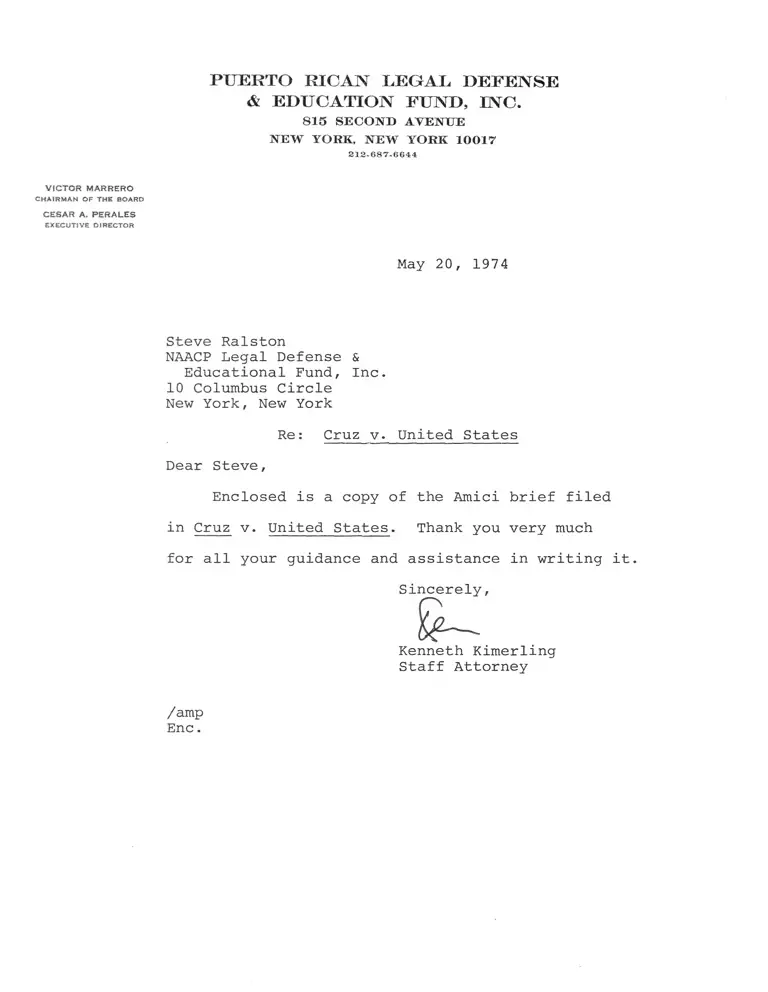
P U E R T O R IC A N L E G A L D E F E N S E
& E D U C A T IO N F U N D , IN C .
8 1 5 SECOND AVENUE
N E W YORK, N E W YOR K 1 0017
3 1 2 -6 8 7 - 6 6 4 4
VICTOR MARRERO
CHAIRMAN OF THE BOARD
CESAR A, PERALES
8XECUTIVE DIRECTOR
May 20, 1974
Steve Ralston
NAACP Legal Defense &
Educational Fund, Inc.
10 Columbus Circle
New York, New York
Re: Cruz v. United States
Dear Steve,
Enclosed is a copy of the Amici
in Cruz v. United States. Thank you
for all your guidance and assistance
Sincerely,
brief filed
very much
in writing it.
Kenneth Kimerling
Staff Attorney
/amp
Enc.
§«jirm r (Emtrt nf % Intipfc H>tat£a
October Term:, 1973
No. 73-6484
I n th e
J ose T orres Cruz and R uben A lberto Y ega y Merced,
Petitioners,
United States oe A merica,
Respondent.
p e t i t i o n e o r w r i t o p c e r t io r a r i t o t h e u n it e d s t a t e s
COURT OE APPEALS FOR THE SECOND CIRCUIT
BRIEF AMICI CURIAE OF THE PUERTO RICAN
DEFENSE AND EDUCATION FUND, INC., AND
THE NATIONAL CONFERENCE OF BLACK
LAWYERS IN SUPPORT OF THE PETITION
Cesar A. P erales
Herbert Teitelbaum
K enneth K imerling
Jose A. R ivera
Puerto Rican Legal Defense and
Education Fund, Inc.
815 Second Avenue
New York, New York 10017
L ennox S. H inds
National Conference of Black Lawyers
126 West 119th Street
New York, New York 10026
Attorneys for Amici Curiae
I N D E X
PAGE
Interest of Amici Curiae ................................................ 1
Preliminary Statement .................................................... 2
Reasons for Granting the W r it :
Introduction ............. 3
Discussion.......... ........................................................ 3
Conclusion........................................................................... 11
Table of A uthorities
Cases:
Aldridge v. United States, 283 U.S. 308 (1931) ............ 4, 8
Ballard v. United States, 329 U.S. 187 (1946) .............. 8
Communist Party of U.S.A. v. Subversive Activities
Control Board, 351 U.S. 115 (1956).................... 8
Earn v. South Carolina, 409 U.S. 524 (1965).................. 4
Hernandez v. Texas, 347 U.S. 475 (1954) ... .................. 4
Hurd v. Hodge, 334 U.S. 24 (1948) ................................. 9
Irvin v. Dowd, 336 U.S. 717 (1961) ..........................4, 5, 6, 7
McGlotten v. Connally, 338 P. Supp. 449 (D.D.C.
1972)............................................................................. 4, 9,10
11
PAGE
Patriarca v. United States, 402 F.2d 314 (1st Cir. 1968),
cert, denied, 393 U.S. 1022, rehearing denied, 303 U.S.
1124 (1969) ..................................................................... 6,7
Rideau v. Louisiana, 373 U.S. 723 (1963) ...........'........... 7
Sheppard v. Maxwell, 384 U.S. 333 (1966) .................... 7
Silverthorne v. United States, 400 F.2d 627 (9th Cir.
1968)....................................................................... ......... 6, 7
Shelley v. Kraemer, 334 U.S. 1 (1948) ........................... . 9
Smith v. Texas, 311 U.S. 128 (1940) ............................. 4
Strauder v. West Virginia, 100 U.S. 303 (1880) ........... 3
Thiel v. Southern Pacific Co., 328 U.S. 217 (1946) ....... 8
United States v. Dellinger, 472 F.2d 340 (7th Cir. 1972) 6
United States ex rel. Bloeth v. Denno, 313 F.2d 364 (2nd
Cir.), cert, denied, 372 U.S. 978 (1963) ...................... 6, 7
Constitution of the United States:
Fifth Amendment ............................................................. 5
Sixth Amendment ............................................................. 5
Miscellaneous:
New York Times, August 13,1973, Section VI, p. 7 4
I n t h e
CEmirt of % Inttefc Stairs
October Term, 1973
No. 73-6484
J ose T orres Cruz and R uben A lberto Y e g a y Merced,
Petitioners,
United States oe A merica,
Respondent.
PETITION FOR WRIT OF CERTIORARI TO THE UNITED STATES
COURT OF APPEALS FOR THE SECOND CIRCUIT
BRIEF AMICI CURIAE OF THE PUERTO RICAN
DEFENSE AND EDUCATION FUND, INC., AND
THE NATIONAL CONFERENCE OF BLACK
LAWYERS IN SUPPORT OF THE PETITION
Interest o f Amici Curiae
The Puerto Rican Legal Defense and Education Fund,
Inc. (the “PRLDEF” ) is a privately funded, not-for-profit,
New York corporation organized in 1972. Its mandate
includes conducting litigation concerning issues which af
fect the Puerto Rican community as a whole. In that
connection, the PRLDEF has commenced and participated
in lawsuits involving education, voting rights, public as
sistance, migrant labor, employment discrimination, and
2
the administration of justice. The issues presented by
question one of the petition are important issues for the
Puerto Bican community.
The National Conference of Black Lawyers (NCBL) is
an incorporated association of approximately 500 black
lawyers in the United States and Canada, and 2,500 law
students affiliated with NCBL through their membership
in the Black American Law Student Association (BALSA).
Since its inception in December of 1968, NCBL, through
its national office, local chapters, co-operating attorneys
and the BALSA organization has defended black men
and women in the halls of criminal justice, filed civil suits
on behalf of the black community, monitored governmental
activity involving black interests and provided services to
the black bar. The right to have a jury free of racial
prejudice is central to NCBL’s functioning and mandate.
Preliminary Statement
Amici present this brief in support of the petition for
a Writ of Certiorari with consent of all parties, pursuant
to Supreme Court Rule 42 (1). Copies of the letters of
consent are attached to our covering letter to the Clerk
of this Court. Amici rely on petitioners’ treatment of this
Court’s jurisdiction, the questions presented for review,
constitutional and statutory provisions involved and the
statement of the case.
3
REASONS FOR GRANTING THE WRIT
Introduction
The petition for Writ of Certiorari raises an issue of
importance to the Nation and especially to Puerto Ricans,
blacks and other minorities. As framed by petitioners,
the question is whether Puerto Rican defendants were
denied a fair trial by the trial judge’s refusal to grant
challenges for cause to prospective jurors who knowingly
and voluntarily were members of organizations which ex
clude Puerto Rican and black persons. Petitioners have
adequately briefed the issue whether the status of member
ship in discriminatory organizations is a sufficient basis
for challenge for cause. Accordingly, amici will address
another issue included in the question presented—i.e.
whether the inference of racial prejudice resulting from
membership in an organization which discriminates on
the basis of race requires the same type of probing of
prospective jurors as does the inference of prejudice
caused by extensive pre-trial publicity. This question,
which is a novel one for this Court, has importance not
only because of its constitutional dimensions, but also
in regards to this Court’s supervisory powers over the
federal judiciary. Accordingly, review is warranted.
Discussion
Racial prejudice in the jury process has long been an
area of concern for this Court. Almost a hundred years
ago, it struck down a “whites only” jury system in the
State of West Virginia. Strauder v. West Virginia, 100
U.S. 303 (1880). This decision has been constantly re
4
inforced by the Court. See e.g. Smith v. Texas, 311 U.S.
128 (1940); Hernandez v. Texas, 347 U.S. 475 (1954).
The Court has also mandated that inquiries into the
racial prejudices of prospective jurors be allowed. Al
dridge v. United States, 283 U.S. 308 (1931). This directive
was recently extended to the state courts under the Four
teenth Amendment. Ham v. South Carolina, 409 U.S. 524
(1965).
This Court’s attempt to keep the jury process free
from racial prejudice was undermined by the trial court’s
ruling below. Eight prospective jurors admitted under
questioning that they were members of an organization
which excludes Puerto Ricans and blacks—the Benevolent
and Protective Order of Elks. The Elks, under their con
stitution, have a “whites only” membership policy. See,
McGlotten v. Connally, 338 F. Supp. 449, 450 fn. 1 (D.D.C.
1972). This discriminatory policy is not simply a vestige
of a now renounced past, but was reaffirmed through three
recent membership votes.1 Moreover, the policy is not
benign but is based on a philosophy of racial supremacy.
McGlotten v. Connally, supra at 454.
Membership in a discriminatory organization is a status
which creates an inference of racial prejudice. Once this
inference is raised, it must be overcome through an in
depth probe of the individual prospective juror in order
to protect petitioners’ rights to “ a panel of impartial, ‘in
different’ jurors.” Irvin v. Dowd, 336 U.S. 717, 722 (1961).
1 New York Times, August 13, 1972, Section VI, p. 7. The vot
ing was held at the annual membership conferences in 1968, 1969,
1971 and 1972, and each time an amendment to change the whites
only membership clause in the constitution was defeated.
5
That inference was not overcome in this case, and the
judge’s denial of petitioners’ challenges for cause violated
their Fifth and Sixth Amendment rights.2
It was not sufficient to ask the jurors whether or not
membership in the Elks “ [w]ould . . . in any wav cause
you to be prejudiced in hearing this type of criminal case,
where the defendants are Puerto Rican!” [Trial Tran
script p. 57]. Assurances of impartiality in response to such
general questions do not remove the taint of prejudice from
these prospective jurors who have segregated their social
lives with a “whites only” policjv
The influence that lurks in opinion once formed is so
persistent that it unconsciously fights detachment from
the mental process of the average man. Irvin v. Dowd,
supra at 727.
The trial judge recognized the futility of these general
inquiries made in the presence of the whole jury panel.
Mr. Amsterdam: Frankly, I don’t think that peo
ple may respond affirmatively to some of the ques
tions unless they are asked in an individual way. I
mean, you see one person standing among 54, saying
that he would regard the testimony of Puerto Ricans
with less weight than whites—I don’t think he would
say that in the presence of the other people.
2 The need for close scrutiny to exclude racially prejudiced
prospective jurors was of particular importance herein because
the crimes of which petitioners were accused arose out of the racial
disorders in Hartford, Connecticut in 1970. Moreover, not only
were the jurors going to be called on to decide the guilt or inno
cence of Puerto Rican defendants, but also to determine the credi
bility of Puerto Rican and black witnesses called by petitioners.
6
The Court: He probably wouldn’t say it on the
jury stand, either. But, we have already implanted
the seed, for your purposes to protect the Defen
dants, because that is the real purpose of establishing
a relationship with jurors, as you know. [Trial Tran
script p. 67.]
The Court below had a duty to inquire further than “ . . .
merely going through the form of obtaining jurors’ assur
ances of impartiality.” United States ex ret. Bloeth v.
Denno, 313 F.2d 364, 372 (2nd Cir.), cert, denied, 372 U.S.
978 (1963).
Once the inference of prejudice is raised, there should
be a duty on the trial court to probe those tainted with
prejudice individually outside of the presence of others.
The court should not seek out general assurances of im
partiality but should probe with more particularized ques
tions which would draw out the hidden prejudices of the
prospective jurors. Irvin v. Dowd, supra at 728 ;3 Silver-
thorne v. United States, 400 F.2d 627, 639 (9th Cir. 1968) ;
United States v. Dellinger, 472 F.2d 340, 374 (7th Cir. 1972),
cert, denied, 410 U.S. 970 (1973); Patriarca v. United States,
402 F.2d 314, 318 (1st Cir. 1968), cert, denied, 393 U.S. 1022,
rehearing denied, 393 U.S. 1124 (1969). This was not done
in the instant case despite requests by counsel for individual
questioning of the jurors [Trial Transcript p. 67] and the
submission of a large number of voir dire questions to as
sist the court’s probe of the panel [Becord, Document 42],
3 “No doubt each juror was sincere when he said he would be
fair and impartial to petitioner, but the psychological impact re
quiring such declaration before one’s fellows if often its father.” Id.
7
In the past this Court has established a duty upon lower
courts to probe for prejudice when there has been a show
ing of extensive pretrial publicity. Irvin v. Dowd, supra;
Bideau v. Louisiana, 373 U.S. 723 (1963); Sheppard v. Max
well, 384 U.S. 333 (1966). These decisions have been inter
preted by the circuit courts to require a careful examina
tion of each prospective juror by the trial courts. United
States ex rel. Bloeth v. Denno, supra at 372; Silvertkorne
v. United States, supra at 639-640; United States v. Del
linger, supra at 374-375; Patriarca v. United States, supra
at 318. As the court said in Silvertkorne v. United States,
supra:
Recognizing that “we must spare no effort to secure
an impartial panel,” United States v. Dennis, 183 F.2d
201, 226 (2nd Cir. 1950) aff’d 341 U.S. 494, 71 S. Ct.
857, 95 L.Ed. 1137 (1951), we conclude the least re
quired of the district court was to conduct a careful
examination of each of the jurors.
̂ ̂ ^
The defendant in a criminal case has the right to
“probe for the hidden prejudices of the jurors.” Lurd-
ing v. United States, 179 F.2d 419, 421 (6th Cir. 1950).
Id. at 639-640.
The duty to probe the prejudices of prospective jurors
should be no less when there is a showing of a status which
creates an inference of racial prejudices than where there
is pretrial publicity which creates an inference of impar
tiality. The issues raised concerning the duty of a trial
court to probe for racial prejudice in prospective jurors
who admit membership in discriminatory organizations
8
strikes at the heart of the jury system as envisioned by the
Constitution and requires a pronouncement from this Court.
Moreover, because of the constitutional dimensions of
the questions presented, this Court should exercise its
supervisory powers over the federal court system in order
to insure that every step is taken to prevent prejudice in
the jury box.4 The duty to remove the taint caused by the
trial judge’s denial of the challenges in this case is clear:
The untainted administration of justice is certainly
one of the most cherished aspects of our institutions.
Its observance is one of our proudest boasts. This
Court is charged with supervisory functions in relation
to proceedings in the federal courts. See McNabb v.
United States, 318 U.S. 332, 87 L.ed. 819, 63 S. Ct. 608.
Therefore, fastidious regard for honor of the adminis
tration of justice requires the Court to make certain
that the doing of justice be made so manifest that only
irrational or perverse claims of its disregard can be
asserted. Communist Party of TJ.S.A. v. Subversive
Activities Control Board, 351 U.S. 115, 124 (1956).
As in Communist Party of TJ.S.A. petitioners are con
cerned with a lower court’s discretionary decisions which
severely affect the administration of criminal justice. The
issues raised herein are neither irrational nor perverse.
Additionally, the taint caused by the trial court’s denial
of petitioners’ challenge spreads beyond the instant case
4 The Supreme Court in the past has exercised its supervisory
powers to correct discrimination in the jury system. Aldridge v.
United States, supra; Thiel v. Southern Pacific Co., 328 U.S. 217
(1946); Ballard v. United States, 329 U.S. 187 (1946).
9
and infects the whole federal judiciary. The decision not
to intensively probe these prospective jurors legitimizes
the private discrimination practiced by the Elks by per
mitting its members to participate in judicial processes to
which their prejudices directly and adversely relate. See
Shelley v. Kraemer, 334 U.S. 1 (1948), and Hurd v. Hodge,
334 U.S. 24 (1948); McGlotten v. Connolly, supra. It is
incumbent upon this Court to disinvolve the federal courts
from the segregation practiced by Elks and similar organ
izations. Judge Bazelon, speaking for the three-judge court
in McGlotten, stated, generally, the responsibility of gov
ernment to carefully scrutinize situations where private
discrimination intermingles with government action:
Better than one hundred years ago, this country
sought to eliminate race as an operative fact in deter
mining the quality of one’s life. The decision has yet
to be fully implemented. As Mr. Justice Douglas has
pointedly stated: “ Some badges of slavery remain
today. While the institution has been outlawed, it has
remained in the minds and hearts of many white men.”
The minds and hearts of men may be beyond the pur
view of this or any other court; perhaps those who
cling to infantile and ultimately self-destructive no
tions of their racial superiority cannot be forced to
maturity. But the Fifth and Fourteenth Amendments
do require that such individuals not be given solace in
their delusions by the Government. Nor is this em
phasis on the conduct of the Government misplaced.
“ Government is the social organ to which all in our
society look for the promotion of liberty, justice, fair
and equal treatment, and the setting of worthy norms
and goals for social conduct. Therefore something is
10
uniquely amiss in a society where the government, the
authoritative oracle of community values, involves
itself in racial discrimination.” Where that involve
ment is alleged, the courts have exercised the most
careful scrutiny to ensure that the State lives up to
its own promise. [Footnotes omitted.] McGlotten v.
Connally, supra, at 454-455.
This Court should require detailed questioning of prospec
tive jurors belonging to segregated organizations with
policies of racial superiority in order to avoid even the
appearance of the federal judiciary’s legitimizing the “ in
fantile and ultimately self-destructive notions of their racial
superiority.” Id.
11
CONCLUSION
The issues raised are important ones calling into ques
tion whether or not the trial judge had a duty to inquire
in depth into the racial prejudices of prospective jurors
where membership in a discriminatory organization raised
the inference of prejudice. These issues also bring into
question whether the whole federal court system is tainted
when, without any substantial probing by the trial court,
admitted segregationists are allowed to sit on juries judg
ing those against whom they discriminate. Amici respect
fully request that petitioners’ Writ of Certiorari be granted.
Dated: New York, New York
May 9, 1974
Respectfully submitted,
C e s a r A. P e r a l e s
H e r b e r t T e it e l b a t t m
K e n n e t h K im e r l in g
J ose A. R iv e r a
Puerto Rican Legal Defense and
Education Fund, Inc.
815 Second Avenue
New York, New York 10017
L e n n o x S. H in d s
National Conference of Black Lawyers
126 West 119th Street
New York, New York 10026
Attorneys for Amici Curiae
RECORD PRESS, INC., 95 MORTON ST., NEW YORK, N. Y. 10014— (212) 243-5775
10608 CROSSING CREEK RD., POTOMAC, MD. 20854— (301) 299-7775
38