Swint v. Pullman-Standard Brief for Respondent in Opposition
Public Court Documents
October 3, 1988
-
Brief Collection, LDF Court Filings. Swint v. Pullman-Standard Brief for Respondent in Opposition, 1988. b6cc38a9-c59a-ee11-be37-00224827e97b. LDF Archives, Thurgood Marshall Institute. https://ldfrecollection.org/archives/archives-search/archives-item/c81a9a54-b315-4cf0-92be-70785c0317f0/swint-v-pullman-standard-brief-for-respondent-in-opposition. Accessed September 21, 2026.
Copied!
C.Si?
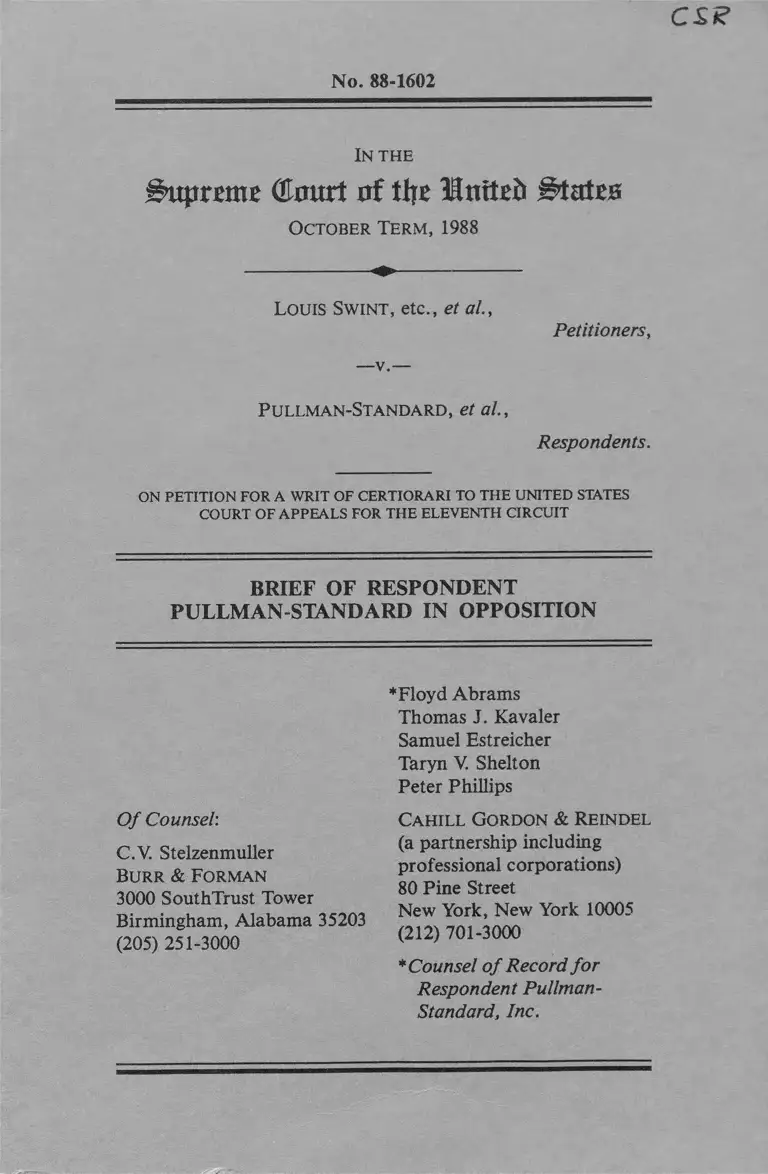
No. 88-1602
In the
Supreme CCmtrt of tire United 1*1 cites
October Term, 1988
Louis Swint, etc., et al.,
Petitioners,
-v.-
Pullman-Standard, et al.
Respondents.
ON petitio n for a w rit of certiorari to th e un ited states
court o f a ppe a l s for th e eleventh circuit
BRIEF OF RESPONDENT
PULLMAN-STANDARD IN OPPOSITION
O f Counsel:
C.V. Stelzenmuller
Burr & Forman
3000 SouthTrust Tower
Birmingham, Alabama 35203
(205) 251-3000
* Floyd Abrams
Thomas J. Kavaler
Samuel Estreicher
Taryn V. Shelton
Peter Phillips
Cahill Gordon & Reindel
(a partnership including
professional corporations)
80 Pine Street
New York, New York 10005
(212) 701-3000
* Counsel o f Record fo r
Respondent Pullman-
Standard, Inc.
1
QUESTION PRESENTED
Did the Court of Appeals err in holding not “ clearly errone
ous” the findings of the District Court that respondent’s senior
ity system with one of its unions was neither adopted nor
maintained with discriminatory intent, and hence was bona fide
under Section 703(h) of Title VII of the Civil Rights Act of
1964?
11
Pullman-Standard (“Pullman” or “ the Company”) respect
fully offers to correct the list of parties, as it appears on page iii
of the Petition. William B. Larkin, Spurgeon Seals, Jesse B.
Terry and Edward Lofton are not properly parties to this
appeal. They were plaintiffs-appellants in appeal No. 84-7319
below—an independent action consolidated on appeal with
Nos. 87-7057 and 86-7886—seeking review of the District
Court’s denial of their motion to transform the 1976 dismissal
of their action with prejudice into a dismissal without preju
dice. The denial was affirmed by the Eleventh Circuit below; it
is not mentioned in this Petition, and no issue presented in that
case has been asserted in this Petition.
LIST OF PARTIES
Ill
PAGE
TABLE OF A U T H O R I T I E S . . . . . . . . . . . . ..................... v
OPINIONS B E L O W . . . . . ................................................ 1
JURISDICTION ................................................................ 2
STATUTES INVOLVED ............................... .................. 2
STATEMENT OF THE CASE ........................................ 2
REASONS FOR DENYING THE W RIT....................... 8
A. Petitioners’ Alleged “ Four Seniority Related
Practices” Mischaracterize The Record And, At
Bottom, Constitute Merely A Disagreement
With The Factual Findings Of Both Courts
Below......................................................... 9
1. Post-Act Intradepartmental Promotions . . . 9
2. The Creation of Separate IAM and USW
Departments in 1941............................ 10
3. The Alleged Creation of Eight New Depart
ments in 1954 ................... 10
4. The 1965 Training Requirement................. 11
B. The Purported Conflicts Among The Circuits
Do Not Withstand Analysis ............................... 12
1. Petitioners Improperly Characterize The
Focus Of The Court Below As Restricted To
The Neutrality Of The Literal Terms Of The
Seniority Rules..................... ..................... • • 12
2. IAM’s Motive May Not Properly Be
Imputed To Pullman................. 14
TABLE OF CONTENTS
IV
PAGE
3. The Court Below Properly Placed The Bur
den of Persuasion On Plain tiffs.................. 15
C. Petitioners’ Challenge To The Validity Of A
Facially Neutral Seniority System Adopted In
1954 Is Time-Barred............................................. 17
CONCLUSION................... 18
V
TABLE OF AUTHORITIES
Cases p a g e
American Tobacco Co. v. Patterson, 456 U.S. 63 (1982) 16
Bernard v. Gulf Oil Corp., 841 F.2d 547 (5th Cir. 1988) 17n
Black Law Enforcement Officers A ss’n v. City o f Akron,
824 F.2d 475 (6th Cir. 1987) ....................................... 16-17
EEOC v. Ball Corp., 661 F.2d 531 (6th Cir. 1981). . . . . 16
Franks v. Bowman Transportation Co., 424 U.S. 747
(1976)......................... ................................ ............. . . . . 13 , 16
Harris v. Plastics Manufacturing Co., 617 F.2d 438 (5th
Cir. 1980)..................... 17n
Henn v. National Geographic Society, 819 F.2d 824 (7th
Cir.), cert, denied, 108 S. Ct. 454 (1987) .................... 16n
International Brotherhood o f Teamsters v. United
States, 431 U.S. 324 (1977)................. 5, 5n, 12-13, 15, 15n
James v. Stockham Valves and Fittings Co., 559 F.2d 310
(5th Cir. 1977), cert, denied, 434 U.S. 1034
(1978)...................................................5, 5n, 8n, 12, 15, 15n
Larkin v. Pullman-Standard (Swint XI), 854 F.2d 1549
(11th Cir. 1988), pet. fo r cert, filed sub nom. Pullman-
Standard v. Swint, 51 U.S.L.W. 3670 (U.S. March 31,
1989) (Nos. 88-1601, 1602)........,3n, 7-8, 8n, 10, 11, 12, 15
Lorance v. A T & T Technologies, In c .,____U.S_____ _
109 S. Ct. 2261 (1989)....................... .. .3, 9, 13, 15-16, 17
Mitchell v. Mid-Continent Spring Co., 583 F.2d 275 (6th
Cir. 1978), cert, denied, 441 U.S. 922 (1979)............. 14
Peters v. City o f Shreveport, 818 F.2d 1148 (5th Cir.
1987), cert, dismissed, 108 S. Ct. 1101 (1988)............ 16n
VI
PAGE
Pullman-Standard v. Swint (Swint VII), 456 U.S. 273
(1982)................................................. 2-3, 7, 14, 14n, 15, 15n
Robinson v. Lorillard Corp., 444 F.2d 791 (4th Cir.),
cert, dismissed, 404 U.S. 1006 (1971)........................... 15
Sears v. Bennett, 645 F.2d 1365 (10th Cir. 1981), cert,
denied, 456 U.S. 964 (1982).................................15, 15n, 16
Swint v. Pullman-Standard {Swint I), 11 FEP Cas.
(BNA) 943 (N.D. Ala. 1974)........................... .4, 4n, 9n, 11
Swint v. Pullman-Standard {Swint II), 539 F.2d 77 (5th
Cir. 1976)................................................................. 5, lOn, 11
Swint v. Pullman-Standard {Swint III), 15 FEP Cas.
(BNA) 144 (N.D. Ala. 1977)........................................ 5n, 11
Swint v. Pullman-Standard (Swint IV), 15 FEP Cas.
(BNA) 1638 (N.D. Ala. 1977)....................................... 5n
Swint v. Pullman-Standard (Swint V), 17 FEP Cas.
(BNA) 730 (N.D. Ala. 1978)........3n, 4n, 5-6, 7, 10, 11, 17
Swint v. Pullman-Standard {Swint VI), 624 F.2d 525 (5th
Cir. 1980), rev’d, 456 U.S. 273 (1982)......................... 6
Swint v. Pullman-Standard (Swint VIII), 692 F.2d 1031
(5th Cir. 1983)............................................................... 7n
Swint v. Pullman-Standard {Swint IX), No. CV 71-P-
0955-S (N.D. Ala. Sept. 8, 1986) ................................ 7
Swint v. Pullman-Standard {Swint X), No. CV 71-P-
0955-S (N.D. Ala. Nov. 26, 1986)............................... 7n
Taylor v. Mueller Co., 660 F.2d 1116 (6th Cir. 1981) .. 14
Trans World Airlines, Inc. v. Hardison, 432 U.S. 63
(1977)...............................................................................13, 15
PAGE
United Airlines, Inc. v. Evans, 431 U.S. 553 (1977)---- 13, 15
Wattleton v. International Brotherhood o f Boiler
Makers, Local 1509, 686 F.2d 586 (7th Cir. 1982), cert,
denied, 459 U.S. 1208 (1983).........................................14, 16
Rule
Federal Rules of Civil Procedure
Rule 52(a)................. .......... ....................................... 2-3, 6-7
Statutes
Age Discrimination in Employment Act, 29 U.S.C.
§§ 621-634 (1982 & Supp. V 1987)............................... 16n
Civil Rights Act of 1964
Title VII, 42 U.S.C. §§ 2000e et seq. (1982)............. passim
§ 703(h), 42 U.S.C. § 2000e-2(h) (1982)............... .passim
Civil Rights Law
42 U.S.C. § 1981 (1982)................................................ 3
Equal Pay Act, 29 U.S.C. § 206(d) (1982)..................... 16n
Judicial Code
vii
28 U.S.C. § 1254(1) (1982), as amended 2
No. 88-1602
In the
(Cnurt xtf tli* Mnxtzb l&nte
October Term, 1988
Louis Swint, etc., et al.,
Petitioners,
Pullman-Standard, et al.,
Respondents.
ON PETITION FOR A WRIT OF CERTIORARI TO THE UNITED STATES
COURT OF APPEALS FOR THE ELEVENTH CIRCUIT
BRIEF OF RESPONDENT
PULLMAN-STANDARD IN OPPOSITION
OPINIONS BELOW
For the complete text of all opinions below in this action, the
Court is respectfully referred to the Appendix to the Petition
for a Writ of Certiorari filed by Pullman-Standard on March
31, 1989, in No. 88-1601. In the course of this Brief in Opposi
tion, citations to sections of the opinions contained in the
Appendix to the instant Petition will appear as “ Pet. App.
____ ” Citations to sections of other opinions below contained
in the Appendix to Pullman’s petition will appear as “ Pullman
2
A p p .____ ” Citations to the trial transcript will appear as
“T r.,” and to the instant Petition as “Pet.”
JURISDICTION
The decision of the Court of Appeals was entered on Septem
ber 21, 1988, and a timely petition for rehearing was denied on
January 3, 1989. The jurisdiction of this Court is invoked under
28 U.S.C. § 1254(1) (1982), as amended.
STATUTES INVOLVED
The pertinent text of Title VII of the Civil Rights Act of 1964,
42 U.S.C. §§ 2000e etseq. (1982), and Rule 52(a) of the Federal
Rules of Civil Procedure is set out at Pullman App. 293a-298a.
STATEMENT OF THE CASE
Petitioners seek review of the validity of a seniority system
which the District Court below has found to be non-
discriminatory on four separate occasions over the past fifteen
years, and which the Court of Appeals has affirmed as bona
fide within the meaning of Section 703(h) of Title VII of the
Civil Rights Act of 1964, 42 U.S.C § 2000e-2(h) (1982). Indeed,
the validity of Pullman’s seniority system under Section 703(h)
was previously before this Court in Pullman-Standard v. Swint
(Swint VII), 456 U.S. 273 (1982) (Pullman App. 231a-258a),
which held that the Court of Appeals, in substituting its own
findings, had transgressed the proper limits of appellate review
under Rule 52 of the Federal Rules of Civil Procedure. On
remand from that decision, the District Court reaffirmed its
earlier determination that the seniority system had not been
adopted or maintained with racially discriminatory intent, and
the Eleventh Circuit agreed that these findings were not clearly
erroneous. While laboring in this Petition to assert several spe
cious conflicts among the Circuits with respect to the principles
governing Section 703(h), petitioners actually seek to have this
Court review the findings of both courts below that Pullman
3
instituted and maintained a seniority system without a discrimi
natory motive—“ a pure question of fact, subject to Rule
52(a)’s clearly-erroneous standard.” Swint VII, 456 U.S. at
287-88 (Pullman App. 243a). In any event, petitioners’ chal
lenge to Pullman’s seniority system is time-barred under this
Court’s recent ruling in Lorance v. A T & T Technologies, Inc.,
____U.S_______ 109 S. Ct. 2261 (1989).
On October 19, 1971, Louis Swint and Willie James Johnson
initiated this class action under Title VII and 42 U.S.C. § 1981
(1982), naming Pullman and the United Steelworkers of Amer
ica, AFL-CIO (as well as Local 1466 of the United Steelwork
ers) (collectively “ USW”) as defendants. As pertinent to this
Petition, they challenged the departmental seniority system at
Pullman’s Bessemer, Alabama plant-maintained in accord
ance with the collective bargaining agreements between Pull
man and the USW—charging that the system perpetuated the
effects of pre-Title VII discrimination. The USW represented
production and maintenance employees in twenty-six of the
plant’s twenty-eight departments; a second union, the Interna
tional Association of Machinists, AFL-CIO (“ LAM”), which
represented employees in the remaining two departments, was
later joined only for limited remedial purposes.1
1 Although the LAM had not been named in the original complaint,
the amended complaints, or any of the charges filed with the Equal
Employment Opportunity Commission (“EEOC”), the District Court
permitted joinder of the LAM and its Local Lodge 372 on the eve of
trial—not for the purpose of liability, but solely in the event the relief
sought by plaintiffs’ challenge to the Pullman-USW seniority system
might require some modification of the IAM labor agreement. See
Swint v. Pullman-Standard (Swint V), 17 FEP Cas. (BNA) 730, 732
n.2 (N.D. Ala. 1978) (Pullman App. 203a n.2).
Petitioners now seek to alter the focus of the entire litigation. Hav
ing conceded below that the USW was not acting with discriminatory
intent in adopting or maintaining the Pullman-USW seniority system,
see Larkin v. Pullman-Standard (Swint XI), 854 F.2d 1549, 1578 n.46
(11th Cir. 1988), pet. fo r cert, filed sub nom. Pullman-Standard v.
Swint, 57 U.S.L.W. 3670 (U.S. March 31, 1989) (Nos. 88-1601, 1602)
(Pet. App. 179a n.45), they offer this Court the wholly novel conten-
4
Under the Pullman-USW labor agreements, seniority was
measured by length of continuous service in a particular depart
ment and considered for purposes of layoff, recall and promo
tion. All employees, white or black, who sought transfer to a
new department lost any seniority they had accrued in the old
department. This departmental seniority system in effect since
1954 remained virtually unchanged until 1972, when Pullman
entered into an agreement with the United States Department of
Labor enabling black employees hired before 1965 to transfer
from predominantly black departments or to predominantly
white departments without losing seniority.2
After a 16-day trial, the District Court concluded in 1974 that
“ the seniority system at Bessemer is not perpetuating the effects
of prior discrimination.” Swint v. Pullman-Standard (Swint I),
11 FEP Cas. (BNA) 943, 952; see also id. at 954 (Pullman App.
74a, 78a). Indeed, the trial court pointed out that the “ Steel
workers local, which was organized principally by blacks, and
whose policies over the years have been shaped as much by
blacks as by whites,” had advocated departmental seniority and
rejected Pullman’s proposals to merge several departments for
broader seniority units. Swint /, 11 FEP Cas. (BNA) at 954
(Pullman App. 78a). On appeal, the Fifth Circuit nevertheless
remanded for a new determination of the validity of the senior
tion that this case “ also presents” a dispute as to the bona-fides of the
Pullman-IAM seniority system (Pet. at 25 n.25). The District Court
made clear, however, that “ [t]he seniority system under attack in this
case has its essence in the 1954 company-wide collective bargaining
agreement between Pullman and the United Steelworkers,” that the
IAM seniority units are “ not directly at issue in this litigation,” and
that evidence concerning IAM is relevant only to the extent it sheds
light on the validity of the USW-Pullman system. See Swint V, 17 FEP
Cas. (BNA) at 732 & n.2 (Pullman App. 185a & 203a n.2). Moreover,
the IAM agreements provided for seniority by occupation rather than
department, see id. at 733 n.4 (Pullman App. 204a n.4); a challenge to
occupation-based seniority was simply not preserved among the “ class
issues” listed in the District Court’s pre-trial order. See Swint v.
Pullman-Standard (Swint I), 11 FEP Cas. (BNA) 943 , 948 (N.D. Ala.
1974) (Pullman App. 66a-67a).
2 See Swint V, 17 FEP Cas. (BNA) at 732 (Pullman App. 185a).
5
ity system in light of its rulings as to plaintiffs’ evidence of dis
crimination in initial assignments to departments. Swint v.
Pullman-Standard(Swint II), 539 F.2d 77, 97-98 (5th Cir. 1976)
(Pullman App. 127a-128a).
While the matter was on remand, this Court rendered its deci
sion in International Brotherhood o f Teamsters v. United
States, 431 U.S. 324 (1977), holding that a bona fide seniority
system under Section 703(h) could not be invalidated on the
ground that it perpetuated the effects of pre-Title VII discrimi
nation. Teamsters requires proof of discriminatory intent in the
adoption or maintenance of the system in order to find a Title
VII violation. Also in the interim, the Fifth Circuit, in James v.
Stockham Valves and Fittings Co., 559 F.2d 310, 352 (5th Cir.
1977), cert, denied, 434 U.S. 1034 (1978), developed a four-
factor test consistent with Teamsters for assessing the validity
of a seniority system.3 On remand in 1978, the District Court
held further evidentiary hearings and, in an opinion extensively
discussing Teamsters and the Stockham Valves factors, sus
tained the validity of the Pullman-USW system for the third
time. Swint v. Pullman-Standard (Swint V), 17 FEP Cas.
(BNA) 730, 732-739 (N.D. Ala. 1978) (Pullman App. 182a-
201a).4
3 Stockham Valves requires an inquiry into “ 1) whether the seniority
system operates to discourage all employees equally from transferring
between seniority units; 2) whether the seniority units are in the same
or separate bargaining units (if the latter, whether that structure is
rational and in conformance with industry practice); 3) whether the
seniority system had its genesis in racial discrimination; and 4) whether
the system was negotiated and has been maintained free from any ille
gal purpose.” See 559 F.2d at 352.
4 In its second pronouncement on the issue, the District Court, after
taking additional evidence, again found the seniority system bona fide.
The court did not issue its opinion, however, until after Teamsters had
been decided. Swint v. Pullman-Standard (Swint III), 15 FEP Cas.
(BNA) 144 (N.D. Ala. 1977) (Pullman App. 156a-164a). Subsequently,
in view of the fact that plaintiffs had predicated their challenge on a
theory rejected by Teamsters—the perpetuation of pre-Title VII
discrimination—the court reopened the case for what was a third evi
dentiary hearing and ruling. Swint v. Pullman-Standard (Swint IV), 15
FEP Cas. (BNA) 1638 (N.D. Ala. 1977) (Pullman App. 178a).
6
First, as to the neutrality of the system, the trial court found
that “ [t]o the extent the system ‘locks’ employees into a depart
ment and discourages transfers, it does so equally for both
white and black,” at least until the 1972 Labor Department
agreement favoring certain black employees. Id. at 733 (Pull
man App. 187a). Second, the seniority unit structure was found
to be consistent with industry practice and a rational response
to both the extreme fluctuation in employment levels and the
absence of lines of progression within departments. Addressing
the existence of two (one USW and one IAM) Die & Tool and
Maintenance departments, the court determined that this sepa
ration was not orchestrated with discriminatory purpose by
Pullman, but was imposed by specific unit determination deci
sions of the National Labor Relations Board (NLRB). Id. at
736 (Pullman App. 193a-194a). Third, although the seniority
system had its genesis at a time when racial discrimination was
practiced, ‘‘this system was not itself the product of this bias,”
but ‘‘came about as a result of colorblind objectives” of a
union that ‘‘was not an arm of a segregated society.” Id. at 738
(Pullman App. 198a). Declining to make any findings as to the
motives of the IAM, the court ruled that any possible discrimi
natory motive on the part of that union could not be attributed
to Pullman or to the USW. Id. at 739 (Pullman App. 199a-
200a). Finally, the court found that the Pullman-USW system
had been ‘‘negotiated and maintained free from any discrimina
tory purpose.” Id. at 739 (Pullman App. 200a). Based on the
totality of the circumstances, the trial court concluded that the
seniority system was bona fide under Section 703(h).
On appeal, the Fifth Circuit reviewed the evidence de novo.
Stressing the existence of separate Die & Tool and Maintenance
departments, the appeals court concluded that the purpose of
the IAM was to exclude black workers from its own units, and
therefore the motivation of that union infected the validity of
the Pullman-USW system. Swint v. Pullman-Standard (Swint
VI), 624 F.2d 525, 532-34 (5th Cir. 1980), rev’d, 456 U.S. 273
(1982) (Pullman App. 218a-222a).
This Court granted certiorari and reversed the Fifth Circuit’s
failure to honor the limits of appellate review mandated by Rule
7
52 of the Federal Rules of Civil Procedure. Pullman-Standard
v. Swint (Swint VII), 456 U.S. 273, 276 (1982) (Pullman App.
231a-258a). The Court of Appeals had failed to appreciate that
under Section 703(h), “ there must be a finding of actual intent
to discriminate on racial grounds on the part of those who
negotiated or maintained the system . . .[, which finding is] a
pure question of fact.” Id. at 289 (Pullman App. 244a-245a).
Stating unequivocally that “ IAM’s discriminatory motivation,
if it existed, cannot be imputed to USW,” this Court explained
that evidence of a discriminatory purpose on the part of the
LAM is relevant only to the extent it may shed some light on the
purpose of the USW or Pullman “ in creating and maintaining
the separate seniority system at issue in these cases.” Id. at 292
n.23 (Pullman App. 248a).
On remand,5 after yet another trial, the District Court con
cluded that nothing in plaintiffs’ most recent presentation
altered the conclusion it had reached in Swint V that “ [t]he
defendants have successfully carried their burden of showing
that the seniority system is bona fide . . . .” Swint v. Pullman-
Standard (Swint IX), No. CV 71-P-0955-S, slip op. at 11 (N.D.
Ala. Sept. 8, 1986) (Pet. App. 30a-31a).6
The Eleventh Circuit (which inherited this litigation)
affirmed on the Section 703(h) issue. Larkin v. Pullman-
Standard (Swint XI), 854 F.2d 1549 (11th Cir. 1988), pet. fo r
cert, filed sub nom. Pullman-Standard v. Swint, 57 U.S.L.W.
3670 (U.S. March 31, 1989) (Nos. 88-1601, 1602) (Pet. App.
58a-211a). Relying on Teamsters, the Court of Appeals found
no showing that “ the [seniority] system itself was negotiated or
maintained with an actual intent to discriminate,” and con
cluded that “ none” of plaintiffs’ “ evidence goes directly to
Pullman’s intent regarding the system.” 854 F.2d at 1576-77
(Pet. App. 171a-175a) (emphasis in original). The Court of
Appeals further held that the District Court was warranted in
5 Swint v. Pullman-Standard (Swint VIII), 692 F,2d 1031 (5th Cir.
1983) (per curiam) (Pet. App. la-4a).
6 The District Court thereafter granted plaintiffs’ motion for entry of
judgment in Swint v. Pullman-Standard (Swint X), No. CV 71-P-0955-
S, slip op. at 5 (N.D. Ala. Nov. 26, 1986) (Pet. App. 41a-57a).
8
discounting “ the plaintiffs’ circumstantial evidence in the face
of considerable direct evidence that the system was not the
product of discriminatory intent,” and that “ there was nothing
to suggest that Pullman acted with discriminatory intent in
negotiating or maintaining nontransferable seniority.” Id. at
1577-78 (Pet. App. 175a-178a).7
REASONS FOR DENYING THE WRIT
Although this Petition purports to raise a number of sup
posed legal issues and to articulate a number of conflicts among
the Circuits, it in fact seeks this Court’s review of purely factual
findings of both courts below that the Pullman-USW seniority
system was not adopted or maintained with a racially discrimi
natory motive. The putative conflicts either do not exist or have
already been fully resolved by this Court. Furthermore, peti
7 The Court of Appeals observed that the District Court “ carefully
analyzed the evidence presented, paying special attention to the four
factors” emphasized in the Stockham Valves decision. As to whether
the seniority system equally discouraged transfers by blacks and
whites, the appeals court noted that “ [t]he evidence revealed that
whites as well as blacks often desired to transfer but were disinclined to
do so because they would lose their seniority.” On the rationality of
the units, the evidence “ also showed that systems including nontrans
ferable seniority between given units are quite common not only with
manufacturers generally but with manufacturers of railroad cars.”
Although the seniority system was established at a time when Pullman
was “ discriminatory in other respects,” there was “ nothing to suggest
that Pullman acted with discriminatory intent in negotiating or main
taining nontransferable seniority.” Rather, it was Pullman that sought
without success to merge seniority units:
“ Indeed, there was evidence that Pullman would have preferred no
seniority or the narrowest seniority possible so that it could have the
greatest flexibility in filling vacant positions. There was also evi
dence that at a meeting of primarily black USW employees, a pro
posal to merge certain departments was voted down.”
In sum, the Court of Appeals concluded that “ [h]aving thus found
that three of the four James factors went against a finding of discrimi
natory intent, the [district] court was not clearly erroneous in conclud
ing that the seniority system was bona fide.” 854 F.2d at 1577-78 (Pet.
App. 175a-178a).
9
tioners’ challenge to Pullman’s seniority system, adopted in
1954, is time-barred under this Court’s ruling in Lorance v.
A T & T Technologies, In c .,____U .S ._____, 109 S.Ct. 2261
(1989). The Petition should be denied.
A. Petitioners’ Alleged “Four Seniority Related Practices’’
Mischaracterize The Record And, At Bottom, Constitute
Merely A Disagreement With The Factual Findings Of Both
Courts Below
In an effort to create the mirage of a legal issue warranting
this Court’s attention, petitioners argue that the courts below
erroneously concluded that the Pullman-USW system was bona
fide in the face of four allegedly racially motivated “ seniority
related practices” : (1) post-Act intradepartmental promotions;
(2) the creation of separate LAM and USW Maintenance and
Die and Tool departments in 1941; (3) the alleged creation of
eight new departments in 1954; and (4) Pullman’s requirement
after 1965 that individuals seeking positions as welders demon
strate either past experience as a welder or completion of a
welder training program (with tuition reimbursement by Pull
man).8 This list of so-called “ seniority related practices” mis-
characterizes the record and, at bottom, merely constitutes
petitioners’ disagreement with the manner in which the courts
below weighed the evidence.
1. Post-Act Intradepartmental Promotions
Petitioners claim the existence of post-Act discrimination in
intradepartmental assignments and describe this alleged prac
tice as “ an unresolved dispute” (Pet. at 12). As the Court of
Appeals noted, however, because plaintiffs could offer no justi
fication for belatedly attempting to produce evidence on this
theory for the first time at the fourth trial in 1984, the District
8 Black employees were principal beneficiaries of this reimbursement
program. Swint I, 11 FEP Cas. (BNA) at 947 & n.16 (Pullman App.
65a & 94a n.16).
10
Court did not abuse its discretion in excluding it. Swint X I, 854
F.2d at 1578 (Pet. App. 180a-182a).9
2. The Creation of Separate IAM and USW Departments
in 1941
Petitioners complain of the creation in 1941 of separate IAM
and USW Maintenance and Die and Tool Departments, along
with the LAM’s agreement in 1944 to cede certain of its own job
classifications to the USW (Pet. at 15-20). Both courts below
found that these events did not undermine the validity of the
Pullman-USW seniority system. The District Court determined
that the existence of these divided departments was “ due to
actions of the NLRB in 1941,” that there was no evidence of
“ any industry practice to combine positions represented by dif
ferent unions into the same seniority unit,” and that any dis
pute over the IAM’s motivation in ceding the job classifications
was irrelevant because neither Pullman nor the USW had been
motivated by racial discrimination. Swint V, 17 FEP Cas.
(BNA) at 736, 738-39 (Pullman App. 193a, 199a-200a). The
Court of Appeals upheld the findings as to the rationality of the
seniority units and the absence of a discriminatory motive on
Pullman’s part. Swint XI, 854 F.2d 1577-78 (Pet. App. 179a-
180a).
3. The Alleged Creation of Eight New Departments In
1954
Petitioners also challenge the failure to resolve whether Pull
man acted with racial motivation in allegedly creating eight new
departments in 1954 (Pet. at 24). There has never been a finding
below, however, that eight new departments were created that
year. In any event, the District Court, after assessing the evi
dence presented as to all of Pullman’s departments, expressly
9 As to the issue of posting job vacancies, which petitioners attempt to
link to this foreclosed issue of intradepartmental assignments (Pet. at
13-14), the Court of Appeals in Swint II agreed with the District Court
that any failure to post vacancies did not state an independent Title VII
violation. See Swint II, 539 F.2d at 102 (Pullman App. 134a).
11
determined that the Company’s departmental structure was
“ rational, in accord with the industry practice, and consistent
with NLRB policies,” and “ that the seniority system between
the company and the USW has been negotiated and maintained
free from any discriminatory purpose.” Swint V, 17 FEP Cas.
(BNA) at 737, 739 (Pullman App. 195a, 200a). Moreover, it
was the USW—who petitioners now concede was not motivated
by racial animus (see note 1, supra)—that resisted Pullman’s
efforts to merge departments for broader seniority units. Id. at
736-37 n.18, 738 (Pullman App. 205a n.18, 198a). The Court of
Appeals admitted that its previous conclusion to the contrary
did not survive this Court’s Swint decision, and sustained the
District Court’s findings both as to the rationality of the senior
ity units and the absence of evidence of discriminatory intent on
Pullman’s part in negotiating or maintaining the nontransfer-
able seniority system. Swint X I, 854 F.2d at 1577-78 & n.45
(Pet. App. 177a-179a & n.44).
4. The 1965 Training Requirement
Petitioners’ final dispute with the record concerns Pullman’s
decision in 1965 to assign to welding positions only those who
had prior experience as welders or who had completed a welder
training program (with tuition reimbursement by Pullman)
(Pet. at 24-28). Initially, as both courts below noted in earlier
decisions, it is doubtful whether this issue—not listed among
the “ class issues” in the pre-trial order—is properly in the case.
See Swint I, 11 FEP Cas. (BNA) at 947 n. 16 (Pullman App. 94a
n.16); Swint II, 539 F.2d at 89 (Pullman App. 114a). In any
event, the District Court’s factual findings—that Pullman
“ actively sought and trained blacks” to be welders, imposed a
training requirement for the non discriminatory reason of “pre
vent [ing] on-the-job training of unqualified whites,” and did so
only after “ black employees were given an opportunity to dem
onstrate their skills as welders” —remain undisturbed. Swint
III, 15 FEP Cas. (BNA) at 152 & n.21 (Pullman App. 170a &
176a n.21).10
10 Petitioners’ selective quotation from the testimony of Harry
Debrow, a black equal employment officer at Pullman, (Pet. at 27
12
B. The Purported Conflicts Among The Circuits Do Not With
stand Analysis
None of petitioners’ purported conflicts among the Circuits
withstands analysis.
1. Petitioners Improperly Characterize The Focus Of The
Court Below As Restricted To The Neutrality Of The
Literal Terms Of The Seniority Rules
Petitioners first assert that the Eleventh Circuit is in conflict
with several other Circuits in confining its assessment of the
validity of a seniority system to the neutrality of the rules as
written. This assertion mistakes the nature of the inquiry under
taken by the District Court and affirmed by the Court of
Appeals. By their careful consideration of all of the factors sug
gested in Teamsters and Stockham Valves, both courts below
plainly did not restrict their focus to the literal terms of the
Pullman-USW system. The Court of Appeals concluded, more
over, that on the record it could not say that “ the district court
attributed insufficient significance to plaintiffs’ circumstantial
evidence in the face of considerable direct evidence that the sys
tem was not the product of discriminatory intent.” Swint XI,
854 F.2d at 1577 (Pet. App. 175a-176a).
Ultimately, petitioners are questioning the holding of this
Court in Teamsters. Central to that decision is the distinction
between discriminatory practices—independent of a seniority
system—that may impact upon seniority rights and intentional
n. 12), indicates only that whites may have been unwilling to train more
senior employees, whether black or white, who could then displace
them. This emerges clearly from Debrow’s testimony on direct:
“A * * * So this young man, he agreed to go to school. Nobody
there in his department would teach him how to do the job. The
operators who were there said they weren’t going to train him
because he had seniority over them.
“ Q Was the man you are talking about a Black man?
“A Black and White. It was a White man operating at the present,
and they wouldn’t train him.” (1984 Tr. 121-22) (emphasis sup
plied)
13
discrimination in the adoption or maintenance of the seniority
system itself. There was no question in the Teamsters case that
the union and employer had engaged in purposeful discrimina
tion by deliberately barring black employees from higher
paying line driver jobs. The non-transferable departmental
seniority system, in turn, perpetuated the effects of that dis
crimination by discouraging blacks from transferring thereafter
to the higher-paying jobs and forfeiting their seniority. Never
theless, this Court held that the seniority system itself was
shielded under Section 703(h) in the absence of a finding of dis
criminatory intent in the adoption or maintenance of the sys
tem.
Findings of intentional discriminatory practices that affect
senority rights—such as the exclusion of black employees from
higher-paying jobs—certainly warrant specific remedies for the
victims of those practices, including awards of competitive sen
iority under Franks v. Bowman Transportation Co., 424 U.S.
747 (1976). But to hold, as petitioners suggest, that such
practices—insofar as they impact upon entitlements under a
seniority system—therefore render the entire seniority system
invalid, would undermine the thrust of Teamsters and would
require relief for a vastly larger group that would not otherwise
qualify for relief under Franks. This Court has therefore con
cluded repeatedly that “ ‘absent a discriminatory purpose, the
operation of a seniority system cannot be an unlawful employ
ment practice even if the system has some discriminatory conse
quences.’ ” Lorance v. A T & T, supra, 109 S. Ct. at 2265,
quoting Trans World Airlines, Inc. v. Hardison, 432 U.S. 63,
82 (1977). Rather, there must be a showing—not made in this
case—of discriminatory purpose infecting the system itself. See
id. at 83 n. 13; see also United Air Lines, Inc. v. Evans, 431 U.S.
553, 558-60 (1977).
Moreover, none of the cases cited by petitioners in their
endeavor to chart a conflict embraces their expansive theory or
is inconsistent with the ruling below by the Eleventh Circuit. To
the extent these cases are remotely on point, they involve appel
late affirmance of trial court findings that the seniority system
itself was adopted or maintained with discriminatory intent. See
14
Wattleton v. International Brotherhood o f Boiler Makers,
Local 1509, 686 F.2d 586, 590-91 (7th Cir. 1982), cert, denied,
459 U.S. 1208 (1983) (affirming trial court’s factual finding that
the seniority system itself was negotiated and maintained for
illegal discriminatory purpose) Taylor v. Mueller Co., 660 F.2d
1116, 1123 (6th Cir. 1981) (requiring proof of an “ illegal pur
pose [that] entered into the negotiation of the seniority sys
tem”); Mitchell v. Mid-Continent Spring Co., 583 F.2d 275,
280 (6th Cir. 1978), cert, denied, 441 U.S. 922 (1979) (overt sex-
based seniority lists; no discussion of Section 703(h)).
2. IAM’s Motive May Not Properly Be Imputed To
Pullman
Petitioners also urge this Court to resolve a putative conflict
between the Eleventh Circuit and the Tenth and Fourth Circuits
over whether an employer can escape liability under Title VII by
claiming that it was merely accommodating the discriminatory
preferences of a union. This, too, misstates what the Court of
Appeals held below.
The Eleventh Circuit simply followed this Court’s instruc
tions in Swint VII:
“ IAM’s discriminatory motivation, if it existed, cannot be
imputed to USW. It is relevant only to the extent that it
may shed some light on the purpose of the USW or the
Company in creating and maintaining the separate senior
ity system at issue in these cases. A discriminatory intent
on the part of LAM, therefore, does not control the out
come of these cases. Neither does the fact, if true, that
USW acquiesced in racially discriminatory conduct on the
part of the IAM. Such acquiescence is not the equivalent
of a discriminatory purpose on the part of the USW.”
Swint VII, 456 U.S. at 292 n.23 (Pullman App. 248a).11
11 Recognizing the force of this Court’s Swint VII instructions, peti
tioners abandoned in the latest appeal their contention that the USW
acted with a discriminatory purpose (see note 1, supra). They neverthe
less struggle to keep Pullman in the case by contending, for the first
time in this Petition, that this case somehow “also involves” the valid
ity of the Pullman-IAM system (see id.).
15
The Court of Appeals did not ignore evidence of the IAM’s
possibly racial motives. Rather, the court held—in agreement
with the District Court—that there was “ nothing” in the record
“ to suggest that Pullman acted with discriminatory intent in
negotiating or maintaining nontransferable seniority.” Swint
XI, 854 F.2d at 1577-78 (Pet. App. 175a-178a) (emphasis
added).
The cases cited by petitioners in support of a purported con
flict among the Circuits on this issue are either off the mark, see
Robinson v. Lorillard Corp., 444 F.2d 791, 799 (4th Cir.), cert,
dismissed, 404 U.S. 1006 (1971) (jpie-Teamsters decision apply
ing disparate impact analysis), or simply involve an application
of the Teamsters-Stockham Valves factors to a different set of
facts, see Sears v. Bennett, 645 F.2d 1365 (10th Cir. 1981), cert,
denied, 456 U.S. 964 (1982).12
3. The Court Below Properly Placed The Burden Of Per
suasion On Plaintiffs
Finally, petitioners maintain that the Eleventh Circuit is in
conflict with other Circuits in placing on plaintiffs the burden
of persuading the trier of fact that a seniority system is the
product of discriminatory intent. This burden-allocation is con
sistent, however, with decisions of this Court that Section
703(h) “ unequivocally mandates that there is no statutory vio
lation in the absence of a showing of discriminatory purpose.”
Trans World Airlines, Inc. v. Hardison, supra, 432 U.S. at 83
n.13; see also Swint VII, 456 U.S. at 289; Teamsters v. United
States, supra, 431 U.S. at 353; United Airlines, Inc. v. Evans,
supra, 431 U.S. at 553-54. This Court’s recent decision in Lor-
ancev. A T & T, supra, 109 S.Ct. 2261, makes clear that Section
703(h) does not create an affirmative defense to be proved by
12 In Sears, decided before this Court’s Swint VII decision, the appeals
court’s brief discussion of employer liability was not predicated on an
imputation of the union’s discriminatory motives to the employer.
Rather, employer liability was found because the application of the
Teamsters-Stockham Valves factors led to the conclusion that the sen
iority system was not bona fide under Section 703(h). Moreover, the
employer in that case had settled, rendering the court’s discussion of
the employer’s liability dictum. See 645 F.2d at 1368.
16
defendant, but rather stipulates that discriminatory intent is an
element of the statutory offense to be established by plaintiff. A
contrary interpretation of Section 703(h) is:
“ foreclosed by our cases, which treat the proof of discrim
inatory intent as a necessary element of Title VII actions
challenging seniority systems. At least as concerns senior
ity plans, we have regarded subsection (h) not as a defense
to the illegality . . . but as a provision that itself ‘deline
ates which employment practices are illegal and thereby
prohibited and which are not.’ Franks, 424 U.S., at 758,
96 S. Ct., at 1261. Thus, in American Tobacco Co. [v.
Patterson, 456 U.S. 63 (1982)] we determined § 703(h) to
mean that ‘the fact that a seniority system has a discrimi
natory impact is not alone sufficient to invalidate the sys
tem; actual intent to discriminate must be proved.’ 456
U.S., at 65, 102 S. Ct., at 1535.” Lorance v. A T & T,
supra, 109 S.Ct. at 2267.13
Moreover, petitioners fail to identify any conflict among the
Circuits on the issue. Two cases—cited in other parts of the
Petition—place the burden of persuasion properly on the plain
tiff. See Wattleton v. Boiler Makers, supra, 686 F.2d at 590;
Sears v. Bennett, supra, 645 F.2d at 1370. Although the Sixth
Circuit initially referred to the issue in an ambiguous manner,
see EEOC v. BallCorp., 661 F.2d 531, 538-39 (6th Cir. 1981), it
has subsequently stated unequivocally—as did the Eleventh Cir
cuit here—that the burden is on the plaintiff. See Black Law
13 Petitioners’ reliance on decisions arising under other statutes—the
Equal Pay Act, 29 U.S.C. § 206(d) (1982) and the Age Discrimination
in Employment Act (ADEA), 29 U.S.C. §§ 621-634 (1982 & Supp. V
1987)—is misplaced. The Equal Pay Act does not require proof of dis
criminatory intent; a statutory violation is made out by demonstrating
unequal pay between men and women in equal jobs. See, e.g., Peters
v. City o f Shreveport, 818 F.2d 1148, 1153 (5th Cir. 1987), cert, dis
missed, 108 S. Ct. 1101 (1988). The seniority plan defense under Sec
tion 4(f)(2) of ADEA, 29 U.S.C. § 623(f)(2), does not come into play
until what would otherwise be a statutory violation already has been
proven. See, e.g., Henri v. National Geographic Society, 819 F.2d 824,
827-28 (7th Cir.), cert, denied, 108 S. Ct. 454 (1987).
17
Enforcement Officers A ss’n v. City o f Akron , 824 F.2d 475,
481 (6th Cir. 1987).14
C. Petitioners’ Challenge To The Validity of a Facially Neutral
Seniority System Adopted In 1954 Is Time-Barred
The departmental seniority system challenged in this case was
established as a result of the 1954 collective bargaining agree
ment between Pullman and USW. See Swint V, 17 FEP Cas.
(BNA) at 732 & n.2 (Pullman App. 184a & 203a). Under the
Court’s Lorance v. A T & T decision, a Title VII challenge to a
facially neutral seniority system, as here, requires the filing of a
charge with the EEOC within 180 days of adoption of the sys
tem, or it is time-barred. As this Court observed: “ allowing a
facially neutral system to be challenged, and entitlements under
it to be altered, many years after its adoption would disrupt
those valid reliance interests that § 703(h) was meant to pro
tect.” Lorance v. A T & T, supra, 109 S. Ct. at 2269.
14 Petitioners point also to the Fifth Circuit in Bernard v. Gulf Oil
Corp., 841 F.2d 547, 551, 554 (5th Cir. 1988). The Bernard court,
however, did not hold that a defendant has the burden of proving that
its seniority system is valid; at the pages cited, the court simply restated
plaintiffs’ characterization of the issues as including defendant’s fail
ure of proof with respect to Section 703(h). Moreover, as cited by the
Court of Appeals below, the Fifth Circuit previously has indicated its
view that the burden rests with plaintiff. See Harris v. Plastics Manu
facturing Co., 617 F.2d 438, 440 (5th Cir. 1980) (per curiam).
18
CONCLUSION
Petitioners are seeking review of findings of fact adopted by
both courts below and present no significant legal issue or con
flict among the Circuits warranting this Court’s resolution. The
Petition therefore should be denied.
O f Counsel:
C.V. Stelzenmuller
Burr & Forman
3000 SouthTrust Tower
Birmingham, Alabama 35203
(205) 251-3000
Respectfully submitted,
Floyd Abrams*
Thomas J. Kavaler
Samuel Estreicher
Taryn V. Shelton
Peter Phillips
Cahill Gordon & Reindel
(a partnership including
professional corporations)
80 Pine Street
New York, New York 10005
(212) 701-3000
* Counsel o f Record fo r
Respondent
Goldner P ress, Inc. Law and F inancial P rinters 966-5525
75805 • 52