Dobbins v. Virginia Reply Brief on Behalf of Plaintiff in Error
Public Court Documents
January 1, 1957
-
Brief Collection, LDF Court Filings. Dobbins v. Virginia Reply Brief on Behalf of Plaintiff in Error, 1957. 900b07fb-af9a-ee11-be36-6045bdeb8873. LDF Archives, Thurgood Marshall Institute. https://ldfrecollection.org/archives/archives-search/archives-item/c8b278dc-f9b1-4617-a5e4-e0af84a623ab/dobbins-v-virginia-reply-brief-on-behalf-of-plaintiff-in-error. Accessed September 15, 2026.
Copied!
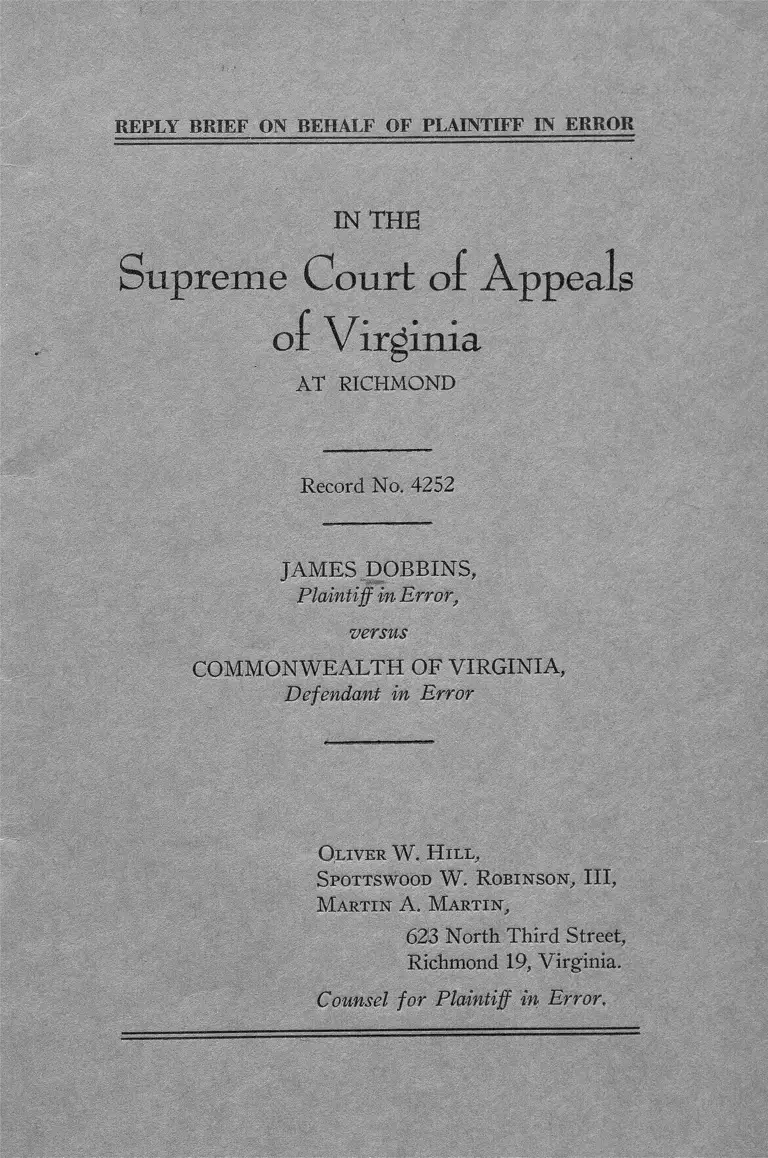
REPLY BRIEF ON BEHALF OF PLAINTIFF IN ERROR
IN THE
Supreme Court of Appeals
of Virginia
AT RICHMOND
Record No. 4252
JAM ES DOBBIN S,
Plaintiff in Error,
versus
C O M M O N W E A L TH OF V IR G IN IA ,
Defendant in Error
Oliver W . H ill,
Spottswood W . Robinson, III,
Martin A. Martin,
623 North Third Street,
Richmond 19, Virginia.
Counsel for Plaintiff in Error,
SUBJECT IN D E X
Preliminary Statement................................................... 1
Questions Not Involved in the Appeal ..................... 2
Argument ......................................................................... 3
I. The Elements of Racial Segregation and Dis
crimination Consequent upon Attendance of
Defendant’s Child at Hamilton-Holmes
High School Are Relevant and Material to
the Issues Involved ......................................... 3
II. The Elements of Racial Segregation and Dis
crimination Consequent upon Attendance of
Defendant’s Child at Hamilton-Holmes
High School Are Available in Defense
Against the Prosecution in This C ase........ 6
A. The Poulos Case ...................................... 7
The New Hampshire Proceedings ........ 8
The Supreme Court Proceedings .......... 10
Conclusions as to the D ecision................. 15
B. Other Cases ............................................... 19
Conclusion ................................................................ 26
T A B L E O F C ITA TIO N S
Cases
Campbell v. Bryant, 104 Va. 509, 52 S.E. 638
(1905) ............................................ 20
Cantwell v. Connecticut, 310 U.S. 296 (1940) 10, 14, 20
Carpel v. Richmond, 162 Va. 833, 175 S.E. 316
(1934)
Page
6
Chicot County District v. Baxter State Bank, 308
U.S. 371 (1940) ........................................................ 20
Dahnke-Walker Milling Co. v. Bondurant, 257 U.S.
282 (1921) ................................................................ 5
Dejonge v. Oregon, 299 U.S. 353 (1936) ............20,21
Estep v. United States, 327 U.S. 114 (1 9 4 6 ) ............ 10
Fisher v. Hurst, 333 U.S. 147 (1948) ..................... 19
Foster v. Commonwealth, (Record No. 2747, Oc
tober, 1943, Term, Supreme Court of Appeals of
Virginia, Unreported) ...................................... 5, 20, 2J
Gibson v. United States, 329 U.S. 338 (1946) ........ 10
Griffin v. Norfolk County, 170 Va. 370, 196 S.E.
698 (1938) ................................................................... 6
Hague v. Congress of Industrial Organizations, 307
U.S. 496 (1939) ........................................................ 10
Jones v. County School Board of Brunswick County,
(Record No. 4090, October, 1952, Term, Unre
ported) ................. 18
Lane v. Wilson, 307 U.S. 268 (1939) ....................... 5
Louthan v. Commonwealth, 79 Va. 196 (1884) ... 20, 21
Miller v. Commonwealth, 88 Va. 618, 14 S.E. 161
(1892) ....................................................................... 20,21
Morgan v. Virginia, 328 U.S. 373 (1946) ............ 20,21
Niemotko v. Maryland, 340 U.S. 268 (1 9 5 1 ) ............ 5
Norton v. Shelby County, 118 U.S. 425 (1886) ........ 19
Pierce v. Society of Sisters, 268 U.S. 510 (1925) ... 5
Poindexter v. Greenhow, 114 U.S. 270 (1885) ......5,23
Porter v. Commonwealth, (Record No. 2746, Oc
tober, 1943, Term, Supreme Court o f Appeals of
Virginia, Unreported) .......................................5,20,21
Page
Poulos v. New Plampshire, 345 U.S. 395
(1953) ...........................7,8, 11, 12, 13, 14, 15,24,25
Poulos v. State, 97 N. H. 352, 88 A. 2d 860
(1952) ......................................................................... 9,10
Quong W ing v. Kirdendall, 223 U.S. 59 (1912) ...... 5
Richmond v. Deans, 281 U.S. 704 (1930) ................. 5
Royall v. Virginia, 116 U.S. 572 (1886) ... 5, 14, 20, 21
23, 25
Shelley v. Kraemer, 334 U.S. 1 (1948) ..................... 5
Sipuel v. Board of Regents, 332 U.S. 631 (1948) ... 19
Smith v. Allwright, 321 U.S. 649 (1944) ................ 5
Snyder v. Massachusetts, 291 U.S. 97 (1934) ........ 5
State v. Derrickson, 97 N. H. 91, 81 A. 2d 312
(1951) ......................................................................... 8
State v. Poulos, 97 N. H. 91, 81 A. 2d 312 (1 9 5 1 )... 8
State v. Stevens, 78 N. H. 268, 99 A. 723, L. R. A.
1917C, 528 (1916) ................................................... 9
Thomas v. Collins, 323 U.S. 516 (1945) ................ 14, 20
C O N ST IT U T IO N A L A N D S T A T U T O R Y
A U T H O R IT IE S
Constitution of the United States:
Page
First Amendment................................................... 12
Fourteenth Amendment..................................5, 10, 17
United States Code:
Title 8, Section 41 ............................................... 5
Code of Virginia (1950) :
Section 22-57 17
IN THE
Supreme Court of Appeals
of Virg inia
AT RICHMOND
Record No. 4252
JAM ES D OBBIN S,
Plaintiff in Errorr
versus
C O M M O N W E A L TH OF V IR G IN IA ,
Defendant in Error
REPLY BRIEF ON BEHALF OF PLAINTIFF IN ERROR
P R E L IM IN A R Y STA TE M E N T
The Commonwealth’s brief presents certain arguments
which plaintiff in error desires to answer. Hence this
reply brief.
Plaintiff in error will hereinafter be referred to as
the defendant, the position he occupied in the trial court.
References to the record, and to the petition for writ of
error, adopted as and hereinafter referred to as defend
ant’s opening brief, are to the page numbers printed in the
upper left and right corners of the page rather than to
the original page numbers. A statement of the material
proceedings in the lower court, the errors assigned, the
questions involved in the appeal, a statement of the facts,
and defendant’s opening argument, are contained in de
fendant’s opening brief.
Q U ESTIO N S N O T IN V O L V E D IN T H E A P P E A L
The Commonwealth addresses argument to three ques
tions which may be eliminated at the outset because they
are not involved in this appeal.
It argues that the compulsory attendance laws are valid
on their face (Commonwealth’s Brief, pp. 6, 7). De
fendant does not contend that the invalidity o f such laws,
as to him, appears on their face. As was stated in his
opening brief (pp. 8-9), he claims no immunity to such
laws when so enforced as to affect all similarly situated
persons in substantially the same manner. He does com
plain that such laws, as here enforced, produce dissimilar
effects upon a group o f children and parents, including
himself, differentiated from others only by race. He does
contend that upon the facts and in the circumstances
shown by the evidence received and the evidence tendered
in this case, such laws cannot constitutionally be en
forced against him. And he further contends that these
laws, properly construed with reference to the facts and
circumstances of this case, were never violated by him.
The Commonwealth further argues that the reasons for
nonattendance specified in the compulsory attendance
laws are exclusive (Commonwealth’s Brief, pp. 18-21).
Defendant does not contend that there are nonstatutory
[ 3 ]
justifications for nonattendance in cases where the laws
have valid and proper operation. Defendant does contend
that he is not confined to statutory justifications where,
as here, the statutes neither validly nor properly apply
to him.
Additionally, the Commonwealth argues that defend
ant’s beliefs do not exempt him from compliance with
the compulsory attendance laws (Commonwealth’s Brief,
pp. 7, 15-19, 24). Defendant has never contended that
beliefs, as such, do. Defendant claims exemption because
the laws can neither constitutionally nor properly be
applied or enforced against him upon the facts and cir
cumstances of this case.
A R G U M E N T
I
The Elements of Racial Segregation and Discrimination
Consequent upon Attendance o f Defendant's Child at
Hamilton-Holmes High School are Relevant and Ma
terial to: the Issues Involved.
The Commonwealth urges that considerations o f racial
segregation and discrimination— necessary concommit-
ants of defendant’s child’s attendance at Hamilton-
Holmes High School— are irrelevant (Commonwealth’s
Brief, pp. 13-15, 21-22, 25, 30). On this basis, it further
contends that defendant’s evidence offered at the trial
upon these matters was properly held to be inadmissible
on the merits of the case. (Commonwealth’s Brief, pp.
22-24.)
While this case is necessarily based upon an alleged
violation of the compulsory attendance laws, it is clear
[ 4 ]
that their invalidity, as applied to the situation presented
in the instant case, arises from their operation integrally
with the segregation laws and upon the differentials
developing as between attendance at West Point High
School and attendance at Hamilton-Holmes High
School. This was extensively discussed in defendant’s
opening brief (pp. 7-10). As was there pointed out, the
conviction in this case did not follow a refusal by de
fendant to send his child to West Point High, where the
Town’s white secondary students attend, but resulted
because defendant refused to send the child to Hamilton-
Holmes (1 ) the students in which are kept apart from
all other racial groups in the Town, (2 ) which is unequal
and inferior to West Point High, (3 ) which is owned
and controlled by an entirely different governmental
agency, and (4 ) attendance at which would subject all
Negro parents and children to burdens and hardships to
which white parents and children are not subjected. The
compulsory attendance laws, as here applied, would com
pel the child to attend Hamilton-Holmes and compel the
parent to send her there, and this solely because of their
race and color.
The Commonwealth fails to appreciate these considera
tions. Indeed, it twice undertakes to restate defendant’s
contentions upon this appeal (Commonwealth’s Brief,
pp. 2, 9 ). Neither restatement is acceptable to defend
ant. His position, insofar as the constitutional validity
of the compulsory attendance laws is concerned, is that
the application or enforcement o f such laws to require
defendant to send his child to attend, or to require the
child to attend, (1 ) a racially segregated school, or (2 )
a school inferior to the school attended by similarly
situated white children, or (3 ) a school attendance at
[ 5 ]
which would subject defendant and the child to burdens
and inconveniences to which white parents and their
children are not subjected, or (4 ) a school over which the
School Board of West Point Town has no jurisdiction or
control, denies rights of both defendant and the child
secured by the due process and equal protection clauses of
the Fourteenth Amendment of the Constitution of the
United States, and by Title 8, United States Code, Sec
tion 41, and accordingly is unconstitutional and void.
As defendant pointed out in his opening brief (pp.
9-10), this challenge is not confined to segregation laws,
but extends to any other type of state law or action ac
complishing the same results. Defendant repeats that
constitutional protections extend to “ sophisticated as
well as simple-minded modes of discrimination,” Lane v.
Wilson 307 U.S. 268, 275; see also Smith v. Allwright,
321 U.S. 649 (1944) ; Richmond v. Deans, 281 U.S. 704
(1930 ); Shelley v. Kraemer, 334 U.S. 1 (1948), and
that compulsory school attendance laws, if constitutionally
infirm, are not beyond their reach. Pierce v. Society of
Sisters, 268 U.S. 510 (1925). See also Foster v. Com-
monwealth, Porter v. Commonwealth, (Records Nos.
2747, 2746, October, 1943, Term, Supreme Court of
Appeals o f Virginia, Unreported). Nor is the Common
wealth’s position in this connection assisted by the claim
that such laws are valid on their face (Commonwealth’s
Brief, pp. 6, 7 ). It is well settled that laws valid in gen
eral and ordinary operation may become invalid and un
constitutional as applied to particular situations. Dahnke-
Walker Milling Co. v. Bondurant, 257 U.S. 282, 289
(1921 ); Royall v. Virginia, 116 U.S. 572, 583 (1886 );
Poindexter v. Greenhow, 114 U.S. 270, 295 (1885) ; see
also Niemotko v. Maryland, 340 U.S. 268 (1951 ); Sny
[ 6 ]
der v. Massachusetts, 291 U.S. 97, 115-116 (1934 );
Quong Wing v. Kirkendall, 223 U.S. 59 (1912) ; Griffin
v. Norfolk County, 170 Va. 370, 376, 196 S.E. 698, 700
(1938) ; Carpel v. Richmond, 162 Va. 833, 843-844, 175
S.E. 316, 319 (1934).
Additionally, defendant further contends that the
compulsory attendance laws, properly construed with
reference to the facts and circumstances o f this case,
were not violated. The operative effect o f the segregation
laws is a factor relevant to determination o f this issue.
This was discussed in his opening brief (pp. 30-31), and
further elaboration is unnecessary.
Finally, if the unconstitutionality o f a statute may be
demonstrated by consideration of extrinsic evidence, it is
clear that the evidence offered by defendant at the trial is
competent, relevant and material to the issues presented
in this case. As the authorities discussed in the section
o f defendant’s opening brief devoted to this point (pp.
31-37) establish that unconstitutionality may be demon
strated in this fashion, the trial court erred in refusing
to receive and consider the same on the merits o f the
case.
II.
The Elements of Racial Segregation and Discrimination
Consequent Upon Attendance o f Defendant’s Child at
Hamilton-Holmes High School are Available in Defense
Against the Prosecution in this Case.
The Commonwealth claims that the elements of racial
segregation and discrimination consequent upon attend
ance of defendant’s child at Hamilton-Holmes High
[ 7 ]
School were matters as to which defendant’s exclusive
remedy was corrective civil proceedings and are not avail
able in defense against the prosecution in this case (Com
monwealth’s Brief, pp. 25-31). Examination o f this
position must commence with analysis o f Poulos v.
New Hampshire, 345 U.S. 395 (1953), upon which the
Commonwealth chiefly relies.
A. T he Poulos Case.
An ordinance of the City of Portsmouth, New
Hampshire, prohibited open air meetings on grounds
abutting public streets or ways unless a license therefor
should first be obtained from the City Council, and made
a violation of this requirement an offense punishable by
fine. Poulos and Derrickson, Jehovah’s Witnesses, applied
to the City Council for a license to conduct religious serv
ices in Goodwin Park, a public facility. They offered
payment o f all proper fees and charges and complied with
all procedural requirements. The license was refused.
They nevertheless held the planned services, and were
prosecuted for violation of the ordinance.
Significant differences between the instant case and
the Poulos case may be noted at the outset. Neither the
ordinance on which the prosecution was based, nor any
other law having operation in the factual situation
presented, made any distinction or classification on the
basis of religion or otherwise. From beginning to end
the defendants conceded, and the courts all held, that the
ordinance was valid in its general operation. There
appeared nothing that would render the ordinance invalid
in its application to Poulos or his companion; the arbi
trary refusal o f the license, while a correctable error,
[ 8 ]
would not affect the validity of the ordinance as to which
the error was committed. Consequently, the questions
in the case were different. A somewhat detailed analysis
o f the proceedings is essential to precise demonstration
o f the issues presented and the points decided.
The New Hampshire Proceedings:
Poulos and Derrickson were first tried, and wTere con
victed and fined, in the Portsmouth Municipal Court.
They took an appeal entitling them to a plenary trial in
the Superior Court. Before that trial, they moved to dis
miss the complaints on the ground that the ordinance
as applied was unconstitutional and void. Pursuant to
New Hampshire practice, this motion on the constitutional
question was transferred to the Supreme Court of New
Hampshire which sustained the validity of the ordinance
and discharged the case, State v. Derrickson, State v.
Poulos, 97 N. H. 91, 81 A. 2d 312 (1951), construing the
ordinance, and stating the issue and its holding, as follows
(97 N. H. at 93, 95, 81 A. 2d at 313, 315) :
“ The discretion thus vested in the authority
[city council] is limited in its exercise by the bounds
o f reason, in uniformity of method of treatment upon
the facts o f each application, free from improper or
inappropriate considerations and from unfair dis
crimination . . . The issue which this case presents
is whether the city of Portsmouth can prohibit re
ligious and church meetings in Goodwin Park on
Sundays under a licensing system which treats all
religious groups in the same manner . . . What we
do decide is that a city may take one o f its small
parks and devote it to public and nonreligious pur
poses under a system which is administered fairly
and without bias or discrimination.”
The result o f this action was to open the case for trial
in the Superior Court. That Court held that the ordinance
was valid, that the refusal of the licenses by the City
Council was arbitrary and unreasonable, but, in the
view that defendants should have raised the question of
their right to the license by appropriate civil proceedings,
refused to dismiss the prosecution on that ground.
The defendants appealed to the Supreme Court of
New Hampshire. Derrickson died before the appeal was
heard. That Court affirmed. Poulos v. State, 97 N. H.
352, 88 A. 2d 860 (1952). It considered that the prose
cution was “under a valid ordinance which requires a
license before open air public meetings may be held.”
(97 N. H. at 357, 88 A. 2d at 863.) It pointed out
that in State v. Stevens, 78 N. H. 268, 99 A. 723, L.R.A.
1917C, 528 (1916), the Court had established the rule
that a wrongful refusal to grant a license is not a bar
to a prosecution for acting without the license and that
“ This case clearly set forth the procedure to be followed
in New Hampshire by one who has wrongfully been denied
a license.” (97 N. H. at 355-356, 88 A. 2d at 861-862.)
Attention was called to the fact that “ in this jurisdiction if
a licensing statute is constitutional and applies to those
seeking a license, the remedy here provided consists of
proceedings against the licensing authority that has
wrongfully denied the license.” (97 N. H. at 356, 88 A.
2d at 862-863.) “ The remedy of the defendant Poulos
for any arbitrary and unreasonable conduct o f the
City Council was accordingly in certiorari or other ap
[ 1 0 ]
propriate civil proceedings.” (97 N. H. at 357, 88 A. 2d
at 863.)
Thus, the New Hampshire determination was that the
ordinance was valid on its face and that, accordingly,
Poulos’ remedy was by certiorari to review the unlawful
refusal o f the Council to grant the license, and not by
holding the services without a license and then defending
because the refusal of the license was arbitrary. That the
Supreme Court o f New Hampshire considered the issue
different where the law on which the prosecution is based
is invalid, either on its face or because of its application
in the particular case, is apparent from the fact that the
Court distinguished Cantwell v. Connecticut, 310 U.S.
296 (1940) and Hague v. Congress of Industrial Organi
sations, 307 U.S. 496 (1939) on the ground that they
involved prosecutions based on ordinances held to be un
constitutional, and Estep v. United States, 327 U.S. 114
(1946) and Gibson v. United States, 329 U.S. 338 (1946)
on the ground that the Selective Service orders there
violated were invalid. (97 N. H. at 356-357, 88 A. 2d
at 862-863.)
The Supreme Court Proceedings:
Poulos appealed to the Supreme Court of the United
States. The Court concluded that his contentions, which
the Court found “ difficult to epitomize,” (345 U.S. at
400), were as follows (Id. at 401-402) :
. . first, no license for conducting religious cere
monies in Goodwin Park may be required because
such a requirement would abridge the freedom of
speech and religion guaranteed by the Fourteenth
[ 1 1 ]
Amendment; second, even though a license may be
required, the arbitrary refusal o f such a licejnse by
the Council, resulting in delay, if appellant must, as
New Hampshire decided, pursue judicial remedies,
was unconstitutional, as an abridgement of free
speech and a prohibition of the free exercise of reli
gion. The abridgement would be because o f delay
through judicial proceedings to obtain the right of
speech and to carry out religious exercises. The due
process question raised by appellant as a part o f the
latter constitutional contention disappears by our
holding, as indicated later in this opinion, that the
challenged clause of the ordinance and New Hamp
shire’s requirement for following a judicial remedy
for the arbitrary refusal are valid . . . The state
ground for affirmance, i. e., the failure to take cer
tiorari from the action refusing a license, depends
upon the constitutionality of the ordinance.”
On the first contention, the majority of the Court,
accepting the New Hampshire construction, denominated
the license requirement “ a ministerial, police routine”
(Id. at 403) requiring “ uniform, nondiscriminatory and
consistent administration o f the granting of licenses for
public meetings on public streets or ways or such a park
as Goodwin Park, abutting thereon,” (Id. at 402) and
leaving the licensing officials “ no discretion as to granting
permits, no power to discriminate, no control over speech.”
(Id. at 404.) It considered that New Hampshire’s con
struction of the ordinance “ made it obligatory upon
Portsmouth to grant a license for these religious services
in Goodwin Park,” (Ibid), and assumed that “ with the
determination o f the Supreme Court of New Hampshire
[ 1 2 ]
that the present ordinance entitles Jehovah’s Witnesses
to hold religious services in Goodwin Park at reasonable
hours and times, the Portsmouth Council will promptly
and fairly administer their responsibility in issuing per
mits on request.” (Id. at 408.)
On the second issue, the majority concluded as follows
(Id. at 408-409) :
“ New Hampshire’s determination that the or
dinance is valid and that the Council could be com
pelled to issue the requested license on demand brings
us face to face with another constitutional problem.
May this man be convicted for holding a religious
meeting without a license when the permit required
by a valid enactment— the ordinance in this case—
has been wrongfully refused by the municipality?
“ Appellant’s contention is that since the Con
stitution guarantees the free exercise o f religion,
the Council’s unlawful refusal to issue the license
is a complete defense to this prosecution. His ar
gument asserts that if he can be punished for viola
tion o f the valid ordinance because he exercised his
right of free speech, after the wrongful refusal of the
license, the protection of the Constitution is illusory.
He objects that by the Council’s refusal of a license,
his right to preach may be postponed until a case,
possibly after years, reaches this Court for final
adjudication o f constitutional rights. Poulos takes
the position that he may risk speaking without a
license and defeat prosecution by showing the license
was arbitrarily withheld.
“ It must be admitted that judicial correction of
arbitrary refusal by administrators to perform offi
[ 1 3 ]
cial duties under valid laws is exulcerating and costly.
But to allow applicants to proceed without the re
quired permits to run businesses, erect structures,
purchase firearms, transport or store explosives or
inflammatory products, hold public meetings without
prior safety arrangements or take other unauthorized
action is apt to cause breaches of the peace or create
public dangers. The valid requirements of license are
for the good o f the applicants and the public. It would
be unreal to say that such official failures to act in
accordance with state law, redressable by state judi
cial procedures, are state acts violative o f the Federal
Constitution. Delay is unfortunate but the expense
and annoyance of litigation is a price citizens must
pay for life in an orderly society where the rights of
the First Amendment have a real and abiding mean
ing. Nor can we say that a state’s requirement that
redress must be sought through appropriate judicial
procedure violates due process.”
It is thus clear that the decision on the second issue
simply upheld New Hampshire’s procedural requirement
— o f correction by civil proceedings of a wrongful denial
o f a license— as applied to a criminal prosecution, under
a law valid both on its face and in its application, for con
duct without the license. The precise holding is epitomized
in the concluding sentences of the majority opinion {Id.
at 414) :
“ In the present prosecution there was a valid
ordinance, an unlawful refusal of a license, with
remedial state procedure for the correction of the
[ 1 4 ]
error. The state had authority to determine, in the
public interest, the reasonable method for correction
o f the error, that is, by certiorari. Our Constitution
does not require that we approve the violation of a
reasonable requirement for a license to speak in public
parks because an official error occurred in refusing a
proper application.”
But, more importantly, the majority and dissenting
opinions each emphatically pointed out that such a re
quirement could not obtain, nor could the defendant be
precluded from asserting the matter in his defense in
a criminal prosecution, if the law upon which the prose
cution is based is invalid either on its face or in its appli
cation. The majority opinion elaborately discussed Royali
v. Virginia, 116 U.S. 572 (1886), Cantwell v. Connecti
cut, 310 U.S. 296 (1940), and Thomas v. Collins, 323
U.S. 516 (1945), upon which Poulos relied in support
of his position, and stated (Id. at 413-414):
“ It is clear to us that neither of these decisions is
contrary to the determination of the Supreme Court
o f New Hampshire. In both of the above cases the
challenged statutes were held unconstitutional. In
the Royali case, the statute requiring payment of the
license fee in money was unconstitutional. In the
Cantwell case the statute had not been construed by
the state court ‘to impose a mere ministerial duty
on the secretary of the welfare council.’ The right to
solicit depended on his decision as to a ‘religious
cause.’ 310 U.S. at page 306, 60 S. Ct. at page 904,
84 L. Ed. 1213. Therefore we held that a statute
authorizing this previous restraint was unconstitu-
[ I S ]
tional even though an error might be corrected after
trial. In the Thomas case the section of the Texas
Act was held prohibitory o f labor speeches any
where on private or public property without registra
tion. This made Section 5 unconstitutional. The
statutes were as though they did not exist. There
fore there were no offenses in violation of a valid
law.”
Likewise, Mr. Justice Douglas and Mr. Justice Black,
dissenting, forcefully pointed out (Id. at 422) :
“ The Court concedes, as indeed it must under our
decisions, see Royall v. State o f Virginia, 116 U.S.
572, 6 S. Ct. 510, 29 L. Ed. 735; Thomas v. Collins,
323 U.S. 516, 65 S. Ct. 315; 89 L. Ed. 430, that if
denial o f the right to speak had been contained in a
statute, appellant would have been entitled to flout
the law, to exercise his constitutional right to free
speech, to make the address on July 2, 1950, and
when arrested and tried for violating the statute, to
defend on the grounds that the law was unconstitu
tional.”
Conclusions As To The Decision:
The Poulos decision does not sustain the Common
wealth’s position in the instant case. Rather, the differ
ences between the cases are quite obvious.
1. In the Poulos case, neither the ordinance on which
the prosecution was based, nor any other law having oper
ation in the factual situation presented, made any distinc
tion or classification on the basis of religion or other-
[ 1 6 ]
wise. The ordinance was valid on its face. There appeared
nothing that would render the ordinance invalid as ap
plied to Poulos; the arbitrary refusal of the license, while
an error for which the state provided corrective machin
ery, did not affect the validity o f the ordinance as to
which the error was committed. Thus, the case is simply
one in which “ there was a valid ordinance, an unlawful
refusal o f a license, with remedial state procedure for the
correction o f the error.” (345 U.S. at 414.) In these
circumstances, the requirement that Poulos resort to an
adequate civil remedy afforded by state law to correct the
error did not constitute a denial o f due process, and no
equal protection issue was involved.
On the other hand, the statutes upon which the present
prosecution was based are unconstitutional and void as
applied to the facts and circumstances of the instant
case. Since it is not the law that one must obey a void
statute, defendant is uninhibited as to making his defense
in this prosecution.
2. The issuance o f the license sought in the Poulos
case was a routine, ministerial function. As was found,
Poulos was plainly entitled to the license and the City
Council had no valid ground for refusing it. The proce
dure to correct the refusal, and the issue thereon, were
simple; lawyers would hardly consider the undertaking
magnitudinous. Mr. Justice Frankfurter, in his con
curring opinion, pointed out (345 U.S. at 419-420) :
“ There is nothing in the record to suggest that the
remedy to which the Supreme Court o f New Hamp
shire confined Poulos effectively frustrated his right
of utterance, let alone that it circumvented his con
stitutional right by a procedural pretense. Poulos’
[ 17]
application for a permit was denied on May 4, 1950,
and the meetings for which he sought the permit
were to be held on June 25 and July 2, In the absence
of any showing that Poulos did not have available a
prompt judicial remedy to secure from the Council
his right, judicially acknowledged and emphatically
confirmed on behalf o f the State at the bar o f this
Court, the requirement by New Hampshire that
Poulos invoke relief by way of mandamus or cer
tiorari and not take the law into his own hands did
not here infringe the limitations which the Due
Process Clause o f the Fourteenth Amendment places
upon New Hampshire.”
The Commonwealth points to the fact that the School
Board’s decision to relegate Negro secondary school
pupils to Hamilton-Holmes was known in July and argues
that defendant “ had a period as long or longer than
Poulos in which to seek relief. Section 22-57 of the
Code o f Virginia, 1950, provides for a quick and ex
peditious method of adjudication.” (Commonwealth’s
Brief, p. 28; see also p. 27.) The section referred to pro
vides as follows:
“ Any five interested heads of families, residents
o f the county, or city, who may feel themselves
aggrieved by the action of the county or city school
board, may, within thirty days after such action,
state their complaint, in writing, to the division
superintendent of schools who, if he cannot within
ten days after the receipt o f the complaint, satis
factorily adjust the same, shall, within five days
thereafter, at the request of any party in interest,
grant an appeal to the circuit court o f the county or
[ 1 8 ]
corporation court of the city or the judge thereof
in vacation who shall decide finally all questions at
issue, but the action of the school board on questions
o f discretion shall be final unless the board has ex
ceeded its authority or has acted corruptly.”
It is highly unlikely that this section provides a remedy
comparable to the New Hampshire remedies— certiorari
or mandamus— or of the character that the Supreme
Court had in mind. It may well be doubted that it affords
a judicial remedy; apparently the court simply exercises
administrative functions and issues an administrative
order on the appeal. The extent to which, if at all, issues
of the kind defendant raised in this case could be litigated
on such appeal is not clear. It is certain, however, that,
as the statute expressly provides that the court “ shall
decide finally all questions at issue,” its decision is final
and binding, and this Court has no jurisdiction to review
the proceedings, irrespective of the character of questions
presented. Jones v. County School Board of Brunswick
County, (Record No. 4090, October, 1952, Term, Un
reported). Significantly, any appeal by defendant under
the provisions of Section 22-57 would have gone to the
court in which the instant case was tried, and upon the
trial that Court stated that public school segregation is
valid (R . 100).
More importantly, the issue arising from the refusal
to grant Poulos a license, and the issues developing in
the instant case, are hardly in the same class. It is a matter
of common knowledge that substantially similar issues
have remained in litigation for years. Could the issues
presented in this case have been resolved in the short
space of two months in proceedings under Section 22-
119]
57, or for injunctive or other relief? To ask the question
is to answer it.
3. It was not incumbent upon defendant to seek cor
rection of unlawful conditions existing in the school
system. This was made clear in Sipuel v. Board of
Regents, 332 U.S. 631 (1948) where plaintiff, a Negro,
was refused admission to the only state-supported law
school in Oklahoma because o f her race. The courts of
that state denied mandamus compelling admission on the
ground that plaintiff should have requested the establish
ment o f a separate law school. The Supreme Court of
the United States reversed. When the case again came
before the Supreme Court, Fisher v. Hurst, 333 U.S.
147 (1948), the Court said (at 150) :
“The Oklahoma Supreme Court upheld the refusal
to admit petitioner on the ground that she had failed
to demand establishment of a separate school and
admission to it. On remand, the district court cor
rectly understood our decision to hold that the equal
protection clause permits no such defense.”
It is accordingly submitted that the holding in the
Poulos case has no application to the instant case.
B. Other Cases
The classic statement as to the effect o f an uncon
stitutional statute was made in Norton v. Shelby County,
118 U.S. 425, (1886 ):
“ An unconstitutional act is not a law; it confers
no rights; it imposes no duties; it affords no protec
[2 0 ]
tion; it creates no office; it is, in legal contemplation,
as inoperative as though it had never been passed.”
And that is precisely what this Court has stated its
effect to be. Campbell v. Bryant, 104 Va. 509, 516, 52
S.E. 638, 640 (1905).
This is the original and still the general doctrine. While
there have been some departures, see Chicot County Dis
trict v. Baxter State Bank, 308 U.S. 371 (1940), they
have not extended to conviction of a defendant upon a law
that is unconstitutional as applied to him. If the law
upon which the prosecution rests is unconstitutional, the
defendant cannot be guilty, and so must be acquitted.
See Morgan v. Virginia, 328 U.S. 373 (1946 ); Thomas
v. Collins, 323 U.S. 516 (1945 ); Cantwell v. Connecti
cut, 310 U.S. 296 (1940) ; DeJonge v. Oregon, 299 U.S.
353 (1936 ); Royall v. Virginia, 116 U.S. 572 (1886 );
Miller v. Commonwealth, 88 Va. 618, 14 S.E. 161
(1892) ; Louthan v. Commonwealth, 79 Va. 196 (1884 );
Foster v. Commonwealth, Porter v. Commonwealth
(Records Nos. 2747, 2746, October, 1943, Term, Un
reported).
One would consider self-contradictory a contention
that the individual must conform to an unconstitutional
statute or must, if its enforcement invades his constitu
tional rights, seek redress in civil proceedings appro
priate for the purpose. Clearly he may elect to adopt the
latter course. But an unconstitutional statute cannot
impose an obligation to obey it and, without more, the
defendant prosecuted for violation of the statute may
assert the defense of invalidity in the criminal prosecu
tion. Thomas v. Collins, supra; Cantwell v. Connecti
[ 21 ]
cut, supra; Royall v. Virginia, supra. See also Morgan v.
Virginia, supra; DeJonge v. Oregon, supra; Miller v.
Commonwealth, supra; Louthan v. Commonwealth,
supra; Foster v. Commonwealth, Porter v. Common
wealth, supra. The rule is the same whether the uncon
stitutionality of the law appears on its face or arises from
its application in the particular situation. Royall v. Vir
ginia, supra. See also Foster v. Commonwealth, Porter v.
Commonwealth, supra.
In Royall v. Virginia, supra, there were statutes re
quiring- attorneys practicing in the state to obtain a
special “revenue license” and constituting practice with
out such a license a misdemeanor. When this legislation
was enacted, Virginia law permitted license fees to be
paid in either “ tax due coupons” o f the state or money.
Virginia subsequently enacted another statute requiring
license fees to be paid “ in lawful money o f the United
States.” Royall applied for a revenue license, tendering,
partly in “ tax due coupons” and partly in money, the
amount of the license fee. The license was refused.
Royall then engaged in practice without the license and
was prosecuted for doing so. The Supreme Court of the
United States held that the statute requiring payment
in money, as applied to this case, was unconstitutional
as impairing the obligations of a contract. (116 U.S. at
578-582.) The Commonwealth nevertheless pressed the
same contention made here, to which the Court gave
full and complete answers (116 U.S. at 582-583) :
“ Admitting this, it is still contended, on behalf o f
the commonwealth, that it was unlawful for the
plaintiff in error to practice his profession without a
license, and that his remedy was against the officers
[ 2 2 ]
to compel them to issue it. It is doubtless true, as a
general rule, that where the officer whose duty it is
to issue a license refuses to do so, and that duty is
merely ministerial, and the applicant has complied
with all the conditions that entitle him to it, the
remedy by mandamus would be appropriate to com
pel the officer to issue it. That rule would apply to
cases where the refusal o f the officer was willful and
contrary to the statute under which he was com
missioned to act. But here the case is different. The
action of the officer is based on the authority of an
act of the general assembly of the state, which, al
though it may be null and void, because unconstitu
tional, as against the applicant, gives the color of
official character to the conduct of the officer in his
refusal; and although, at the election of the aggrieved
party, the officer might be subjected to the com
pulsory process of mandamus to compel the perform
ance of an official duty, nevertheleess the applicant,
who has done everything on his part required by the
law, cannot be regarded as violating the law if,
without the formality of a license wrongfully with
held from him, he pursues the business of his calling,
which is not unlawful in itself, and which, under the
circumstances, he has a constitutional right to prose
cute. As to the plaintiff in error the act o f the gen
eral assembly o f the state of Virginia forbidding
payment of his license tax in its coupons, receivable
for that tax by a contract protected by the constitu
tion of the United States is unconstitutional and its
unconstitutionality infects and nullifies the antecedent
legislation o f the state, of which it becomes a part,
when applied, as in this case, to enforce an uncon
[ 23 ]
stitutional enactment against a party, not only with
out fault, but seeking merely to exercise a right
secured to him by the constitution. It is no answer
to the objection o f unconstitutionality, as was said
in Poindexter v. Greenhorn, ubi supra, [114 U.S.
270, 295, (1885)] ‘that the statute whose applica
tion in the particular case is sought to be restrained,
is not void on its face, but is complained of only
because its operation in the particular instance works
a violation of a constitutional right; for the cases
are numerous where the tax laws of a state, which in
their general and proper application are perfectly
valid, have been held to become void in particular
cases, either as unconstitutional regulations of com
merce, or as violations of contracts prohibited by
the constitution, or because in some other way they
operate to deprive the party complaining of a right
secured to him by the constitution of the United
States.’
“ In the present case the plaintiff in error has been
prevented from obtaining a license to practice his
profession, in violation of his rights under the con
stitution of the United States. To punish him for
practicing it without a license thus withheld is
equally a denial of his rights under the constitution of
the United States, and the law under the authority o f
which this is attempted must on that account and in
his case be regarded as null and void.”
The Royall case and the instant case are strikingly
similar in several respects:
(1 ) In the Royall case, like here, two different laws had
[ 2 4 ]
conjunctive operation. One was the law requiring the
revenue license and its companion section making it a
misdemeanor to practice without the license. The other
was the statute requiring payment of the license fee in
money, which conflicted with the Federal Constitution.
The prosecution, o f course, was under the misdemeanor
section, which was valid on its face. Nevertheless, it was
held that the prosecution could not be maintained. The
Court recognized that the laws there involved, like those
here involved, had an integral operation upon the de
fendant and the situation he occupied. Consequently, it
was held that the unconstitutionality of the statute re
quiring payment in money “ infects and nullifies the
antecedent legislation o f the state of which it becomes a
part, when applied, as in this case, to enforce an uncon
stitutional enactment against a party, not only without
fault, but merely seeking to exercise a right secured to
him by the constitution.”
(2 ) It was there contended, like in the Poulos case, that
Royall should have pursued his civil remedy against the
officers to compel the issuance o f the license, and that
Royall was nonetheless guilty because he practiced with
out the license. This claim was rejected. The Court
pointed out that mandamus would lie where the action
of the officer was wilful and contrary to the statute
under which he acted, but that in the case under considera
tion, like in the instant case, “ The action of the officer
is based upon the authority of an act o f the general
assembly of the state, which, although it may be null
and void, because unconstitutional, as against the appli
cant, gives the color of official character to the conduct
of the officer in his refusal.” So, while, as here, Royall
might, at his election, have initiated civil proceedings to
[ 2 5 ]
compel the issuance of the license, ‘ ‘nevertheless the appli
cant, who has done everything on .his. part required, by the
law, cannot be regarded as violating the law if, without
the formality of. a license wrongfully withheld from him,
he pursues the business of his calling, which is not
unlawful in itself and which, under the circumstances,
he has a constitutional right to prosecute.” Similarly, de
fendant may assert his defense in the instant prosecution.
(3 ) As stated before, the misdemeanor section, like
the compulsory attendance, laws here, involved, was valid
on its face, and invalidity developed through application
to the particular case. That made no difference. “ It is
no answer to the objection o f unconstitutionality .
‘that the statute whose application in the particular case
is sought to be restrained, is not void on its face, but is
complained of only because its' operation in the particular
instance works a violation of constitutional right.’ ” The
same conclusion necessarily follows: in the instant case.
(4 ) The Court significantly stated that Royall had
already been prevented from, obtaining a license to prac
tice his profession, in violation of his constitutional
rights, and that “ To punish him for practicing it without
a license thus withheld is equally a denial o f hisr rights
under the constitution o f the United States, and the law
under the authority of which this is attempted must on
that account and in his case be regarded as null and void.”
The same considerations obtain in the instant case.
Additional authorities might be considered. But. the
analogy of the Royall case is complete. It is strengthened
by the fact that in the Poulos case the Court took great
pains to distinguish it, and other cases like it, on the
ground that, unlike the Poulos case, the laws upon which
[ 2 6 ]
the prosecutions were based were unconstitutional either
on their face or in application.
The remaining cases cited by the Commonwealth are
inapposite. None involved a prosecution based on a void
law.
It is submitted that the Commonwealth’s contention
in this regard is without merit.
CONCLUSION
For the reasons stated herein and in his opening brief,
defendant respectfully submits that the judgment com
plained o f is erroneous and should be reversed.
Respectfully submitted,
Oliver W . H ill,
Spottswood W . Robinson, III,
Martin A. Martin,
Counsel for Plaintiff in Error.
623 North Third Street,
Richmond 19, Virginia.