Board of Control v. Florida Motion for Leave to File and Petition for Rehearing of Order Granting Writ of Certiorari
Public Court Documents
April 2, 1956
-
Brief Collection, LDF Court Filings. Board of Control v. Florida Motion for Leave to File and Petition for Rehearing of Order Granting Writ of Certiorari, 1956. a2506730-ae9a-ee11-be37-00224827e97b. LDF Archives, Thurgood Marshall Institute. https://ldfrecollection.org/archives/archives-search/archives-item/c90c1f92-75d9-4ebd-b18d-c2ee9a71a011/board-of-control-v-florida-motion-for-leave-to-file-and-petition-for-rehearing-of-order-granting-writ-of-certiorari. Accessed October 07, 2026.
Copied!
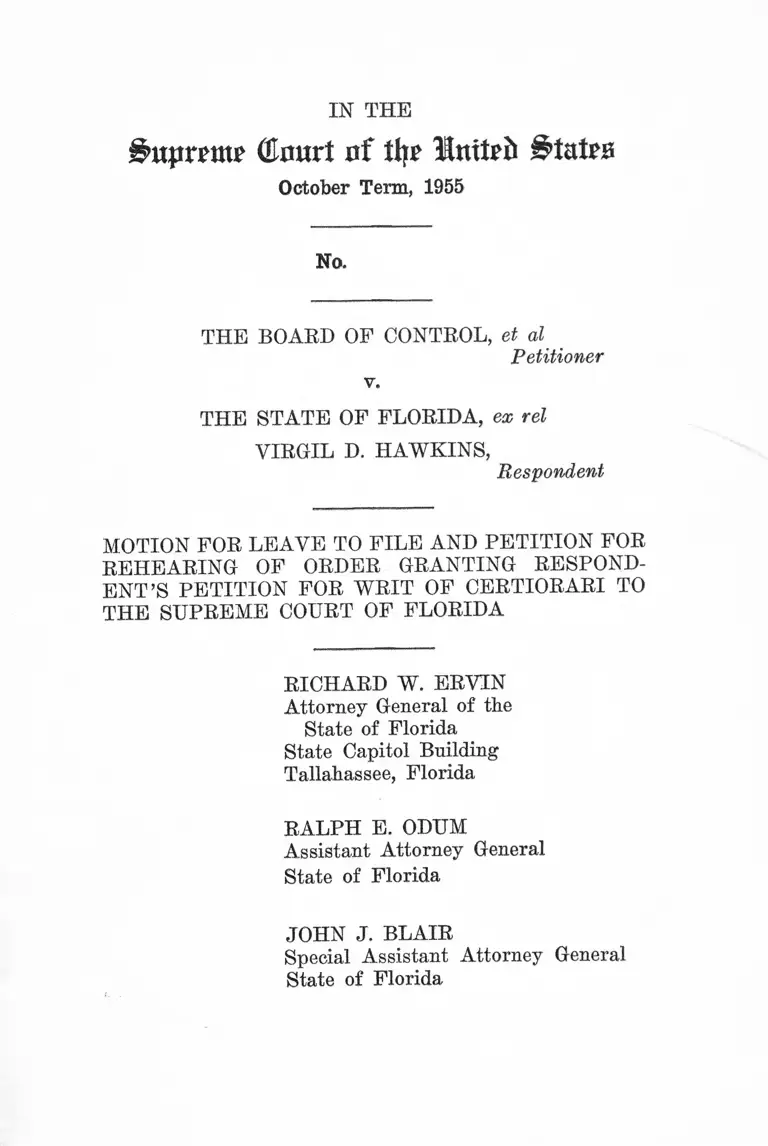
IN THE
iatpmtu' (Emirt of tho States
October Term, 1955
No.
THE BOARD OF CONTROL, et al
Petitioner
v.
THE STATE OF FLORIDA, ez rel
VIRGIL D. HAWKINS,
Respondent
MOTION FOR LEAVE TO FILE AND PETITION FOR
REHEARING OF ORDER GRANTING RESPOND
EN T’S PETITION FOR W RIT OF CERTIORARI TO
THE SUPREME COURT OF FLORIDA
RICHARD W. ERVIN
Attorney General of the
State of Florida
State Capitol Building
Tallahassee, Florida
RALPH E. ODUM
Assistant Attorney General
State of Florida
JOHN J. BLAIR
Special Assistant Attorney General
State of Florida
IN THE
&uprmp Court of thr llmtvb States
October Term, 1955
No.
T he B oard op Control, et al
Petitioner
v.
T he S tate op F lorida, ex rel V irgil D . H a w k in s ,
Respondent
MOTION FOR LEAVE TO FILE PETITION
FOR REHEARING
The Attorney General of the State of Florida respect
fully moves for leave to file the annexed petition for re
hearing of the order of this Court denying respondent’s
petition for certiorari and granting respondent’s petition
for writ of certiorari with an order for respondent’s prompt
admission to the College of Law at the University of Flor
ida, such order bearing the date of March 12, 1956.
Rehearing is sought at this time because, as is pointed
out more fully in the annexed petition, the Court was
not properly apprized of the reasoning involved in the
cases cited in support of its order or of the import of
said cases, nor has the Court been informed as to the
grave problems of public interest involved in the admis
sion of negro students to the University of Florida College
of Law at this time and the serious consequences affecting
the administration and operation of Florida’s institutions
of higher learning as a result of the order of the Court.
IN THE
f>uprm? (tart of thr Initefc States
October Term, 1955
No.
T he B oaed op C ontrol, et al
Petitioner
v.
T he S tate of F lorida, exrel V irgil D. H aw k in s ,
Respondent
PETITION FOE REHEARING OF ORDER GRANTING
RESPONDENT’S PETITION FOR WRIT OF CERTI
ORARI TO THE SUPREME COURT OF FLORIDA
The Attorney General of the State of Florida prays
that this Court grant rehearing of its order of March 12,
1956, which denied respondent’s petition for certiorari
hut granted respondent’s petition for writ of certiorari
and required prompt admission of respondent to the
College of Law of the University of Florida. The At
torney General further requests that this Court make its
order recognizing authority in the Florida Supreme Court
to allow the petitioner, the Board of Control of the State
of Florida, the same latitude in dealing with the grave
problems presented the State of Florida, on the college grad
uate school level as is permitted on the elementary and
secondary school levels, under the Court’s second or imple
mentation decision of May 31, 1955, in Brown v. Board of
Education of Topeka, 347 U. S. 483, 98 L, Ed. 873, 74 S. Ct.
686.
2
Reasons for Rehearing and Order Permitting Ex
ercise of Judicial Discretion and Reasonable Time for
Compliance.
First This Court in denying to the highest appellate
court of the State of Florida the judicial authority to con
sider and apply equitable principles in cases involving the
admission of negro students to graduate professional
schools, regardless of local conditions, the public welfare,
or any other untoward or aggravating circumstance, has
departed from judicial principles long established and rec
ognized by this Court. This is particularly true in this
instance when the Court forbids, at the very threshold of
the consideration of the problems, the receiving and con
sideration of evidence which may be pertinent to the ex
istence of problems of administration, public safety, and
welfare which traditionally and historically are consid
ered by a court of equity. We respectfully submit that
equity is a concept of justice which has always been rec
ognized by this Court and which has been in existence
longer than the United States Supreme Court itself; that
it is a fundamental and inherent right in the American
system of jurisprudence which should not be abrogated
by a decision of this Court, that it is a right which can only
be exercised or denied in accord with the specific facts in
volved in each particular case and cannot be abridged as
a general rule of law or conclusion of fact prior to a con
sideration of pertinent evidence as to the facts or the
granting of an opportunity to present such evidence when
it is sought. Since the original decision of this Court in
Brown v. Board of Education of Topeka, 347 U. S. 483,
entered May 17, 1954, the State of Florida has followed a
sound and stable course in dealing with problems arising
in the public schools and universities of Florida as a result
of said decision.
3
In considering the petition of respondent in this case
for admission to the University of Florida Law School, the
Florida Supreme Court felt it necessary to a proper con
sideration of the issue to adopt equitable principles in the
application of the decree of this Court. The Florida court
took into consideration factors known to it at the time,
and exercising its judicial discretion, ruled that a reason
able time should be allowed for the taking of testimony
to disclose facts which might indicate serious problems
which would result if an order of immediate admission
was entered. A court of equity is never active against
conscience or public convenience. Bowman v. Wathen, 1
How. 189, 11 L. Ed. 97. This Court has always felt it
proper to apply equitable principles against the enforce
ment of legal doctrines when it was disclosed that public
interest might be affected adversely by the enforcement of
a legal decree. Courts of equity may appropriately with
hold their aid when the plaintiff is using the right asserted
in a manner contrary to the public interest. Morton Salt
Co. v. Suppiger Co., 314 U. S. 488, 62 S. Ct. 402, 86 L. Ed.
363.
The Supreme Court of Florida followed these long ad
hered to principles in order to avoid the emotional furor
and disorder which commonly result in the agitation of
racial antagonists, as has been demonstrated recently at
the University of Alabama in a case involving the abrupt
admission of a negro student. The extent to which a court
of equity may grant or withhold its aid and the manner
of molding its remedies may be affected by the public in
terest involved. U. S. v. Morgan, 307 U. S. 183, 59 S. Ct.
795, 83 L, Ed. 1211.
The State of Florida has been more successful than any
other southern state in maintaining an emotional equilib
4
rium during its attempts to solve the dilemma created by
this Court’s ruling that segregation in public schools can
not be required by law. This is attributable to the fact
that the Florida Supreme Court and school officials have
consistently followed long established equitable principles
in dealing with this problem. Traditionally, equity has been
characterized by practical flexibility in shaping its rem
edies and by the facility for adjusting and recognizing
public and private needs. Brown v. Board of Education
of Topeka, 349 U. S. 294, 75 S. Ct. 753, 99 L, Ed. 1083. It
is the duty of a court of equity to strike a proper balance
between the needs of the plaintiff and the consequence of
giving the desired relief. Eccles v. Peoples Bank, 333 U. S.
426, 68 S. Ct. 641, 92 L. Ed. 784.
Their established forms being flexible, courts of equity
may adapt proceedings and remedies to the circumstances
of cases and may formulate them to safeguard, adjust and
enforce the rights of all parties. Alexander v. Hillman, 296
U. S. 222, 56 S. Ct. 204, 80 L, Ed. 192.
The Florida Supreme Court in this case has determined
that the need for equity is as urgent on the college grad
uate level as on the elementary and secondary school lev
els. Having so decided, the Florida court requested that
information be obtained as to the factual circumstances
involved at the University of Florida to assist it in making
a decision as to whether or not Hawkins could be admitted
forthwith without a serious disruption of the University,
or whether there was a genuine need for the application
of equitable principles in coping with the problems in
volved. The Florida Supreme Court properly concluded
that since equity jurisdiction was part and parcel in the
implementation of the U. S. Supreme Court’s segregation
decision, it should not be denied application to afford com
5
plete relief as the justice and equity of the instant case
might require. Hepburn v. Dunlop, 1 Wheat 179, 4 L. Ed.
65. A court of equity which has jurisdiction of a question
may proceed to its final and complete decision. Stephens
v. M ’Cargo, 9 Wheat 502, 6 L. Ed. 145. The whole contro
versy will be settled by a court of equity where it has jur
isdiction of a part involving the problems upon which the
whole depends. Massie v. Watts, 6 Crunch 148, 3 L. Ed.
181. This Court has consistently permitted time in imple
mentation of decrees involving long established public pol
icy and affecting public interest. Recognizing the need for
adjustment, the Court has granted time in dissolution of
corporations in anti-trust cases. United States v. American
Tobacco Co., 221 U. S. 106, 31 S. Ct. 632, 55 L. Ed. 663;
Standard Oil Co. v. United States, 221 U. S. 1, 31 S. Ct.
502, 55 L. Ed. 619. In the area, of nuisance litigation, this
Court has recognized the need for a period of gradual tran
sition. New Jersey v. New York, 283 U. S. 473, 51 S. Ct.
519, 75 L. Ed. 1176; Georgia v. Tennessee Copper Co., 206
U. S. 230, 27 S. Ct. 618, 51 L. Ed. 1038; People of the State
of New York v. State of New Jersey and Passaic Valley
Sewerage Commissioners, 256 U. S. 296, 41 S. Ct. 492, 65
L. Ed. 937.
Second This Court in this case has in effect denied the
application of equitable principles on the assumption that
no problems exist which would justify the ameliorating in
fluence of equity in seeking compliance. This Court in its
order makes the statement that “ . . . there is no reason for
delay.” This statement appears to be the sole basis and
justification for the Court’s order. The statement is in
error and candidly is ipse dixit unsupported by any evi
dence before the Court in this or any other case under its
jurisdiction. This Court has reached a premature legal
conclusion as to matters of fact, since no facts have been
6
considered by this Court and the Court has denied the
petitioner an opportunity to present evidence pertaining to
and substantiating such facts, and more to be deplored,
has abruptly denied the Florida Supreme Court the right
to proceed with its orderly review of the case in a thor
ough, careful manner in the light of equity principles
essential to the public interest involved.
Third The prior decisions cited by this Court in sup
port of its order are irrelevant to the sole issue involved
in the present case at this time, to wit: Do factual prob
lems exist which must be considered by courts of first
instance in making proper determinations of pertinent ques
tions relating to the feasibility or practicability of now
allowing admission of a negro student and others similarly
situated to graduate schools of the University of Florida!
As a predicate for its decree, the Court cited its ruling
in Sweatt v. Painter, 339 U. 8. 629; Sipuel v. Board of
Regents of the University of Oklahoma, 332 U. S. 631; and
McLaurin v. Oklahoma State Regents for Higher Educa
tion, 339 U. S. 637. These cases, however, were decided
under the “ separate but equal doctrine.” In all of these
cases the question presented to the Court and decided by
the Court was whether or not petitioner had a legal right
to enter the university in question because of unequal fa
cilities or benefits. That question is not involved in this
case. This case involves a situation where segregation per
se has been held unconstitutional and now presents the
question whether equitable principles will be applied in
balancing Hawkins’ individual rights, and those of others
similarly situated, against the public interest and welfare.
The question relating to the application of equitable prin
ciples in permitting a reasonable time for delay by a lower
court was not advanced or considered in the earlier cases
7
which this Court cited in its order.
In other words, in the earlier cases cited, the Court was
concerned with the question of the petitioner’s right to
admission because of unequal facilities or benefits. In this
case, the Court is now concerned only with the question as
to when respondent and those similarly situated should be
admitted.
Fourth Petitioner is prepared to submit competent and
conclusive evidence, if permitted by the Court, to show
that valid, sufficient and urgent reasons do exist in Florida
for delay in admitting negroes to the graduate professional
schools; that if such evidence is ignored the public safety
in Florida will be endangered and the administration and
operation of institutions of higher learning in Florida will
be disrupted. Pursuant to an order of the Florida Supreme
Court in this case, a commissioner of the court was desig
nated to take testimony as to the factual conditions at
the University of Florida which might be pertinent to the
problems here considered. A survey of the University of
Florida Law College and of the state university system as
a whole was undertaken by the State Board of Control in
order to comply with the Florida Supreme Court’s order.
Although this survey is now in the process of being made
and has not been completed, certain preliminary informa
tion has already been obtained which is at variance with
the statement of this Court in its order to the effect that
“ there are no reasons for delay.” For example, the sur
vey demonstrates an acute shortage of physical facilities
available for students already enrolled at the University
of Florida and at all state universities. It demonstrates an
annual growth of student enrollment which is so larg’e
that the present multi - million dollar construction pro
gram now in progress on all of the university campuses
8
may be insufficient to meet the minimum requirements of
students even in the absence of an abrupt shift in college
populations resulting from integration. These factors are
further complicated by the attitudes of state university
students and their parents. For example, all students now
enrolled at the University of Florida were requested to
fill out a questionnaire designed to ascertain as accurately
as possible the future actions of students in the event that
integration takes place immediately at the University. 21.04
per cent of the questionnaires returned stated that the
students would not be willing to admit negroes to the Uni
versity of Florida under any circumstances. 14.01 per cent
stated that they wanted to delay admission of negroes to
the white universities as long as legally possible, and 41.45
per cent stated that they thought negroes should not be
admitted until after a reasonable period of preparation for
integration. Only 22.39 per cent indicated that they were
willing to admit negroes to the white universities imme
diately.
Questionnaires were mailed to all students at the Uni
versity of Florida and 75.31 per cent of the students re
turned their questionnaires, so it is felt that this is a rep
resentative expression of student body opinion and rea
sonably accurate in attempting to predict or foresee prob
able future actions of the student body.
Questionnaires were also sent to the parents of all stu
dents now enrolled at the University of Florida and 46.8
per cent have been returned at this time. Only 9.04 per
cent of the parents indicated a willingness to accept negro
students at the white universities immediately. 24.10 per
cent stated that they believed that integration should not
take place until after a reasonable period of preparation.
23.98 per cent stated that they thought that integration
9
should be delayed as long as legally possible. 41.62 per
cent, which is by far the largest group, stated that inte
gration should not take place under any circumstances. A
factor which is of even more significance in administrative
planning for the university is the indication that large
numbers of parents would cause their sons or daughters
to leave the university if integration takes place at this
time. 32.29 per cent of the parents indicated that they
would transfer their sons or daughters to another institu
tion which does not admit negroes if integration is required
at the University of Florida at this time.
It is submitted that these facts indicate a strong prob
ability of a serious disruption at the University of Florida
if respondent is admitted at this time. Although the sur
vey has not as yet been completed, it is being made as
rapidly as possible and the information which it will dis
close will be available to the courts by the May 31, 1956
deadline set by the Florida Supreme Court. This study
which is being made will in no way affect the time of
Hawkins' admission to the University of Florida (since un
der the regulations of the University applicable to all stu
dents, he could not enter until next September), unless of
course, the information obtained reveals that such serious
problems of readjustment do actually exist as to require
the courts in the public interest to permit still further
delay. A major problem of readjustment to an inte
grated university system, which is now being diligently
studied and solutions sought as rapidly as possible, has to
do with the effect of an order of immediate integration in
the University of Florida upon the Florida university for
negroes (Florida Agricultural and Mechanical University).
As we have demonstrated to the Court in our amicus curiae
brief filed in the Brown case, there is a significant gap in
10
achievement levels between white and colored students in
Florida, Only five per cent of the negro high school stu
dents are in the upper 50 percentile of the white students.
This factor, from a realistic standpoint, requires, lower ad
mission standards at the State University for negroes than
those in existence at the white universities. This has been
recognized and accepted under a segregated public school
system which has prevailed in Florida up until this time
as a necessary expedient in dealing with the problem
of trying to provide the best possible college education for
both races. If, however, the state universities are inte
grated at either the graduate or undergraduate level at
this time, it will of course entail a revision of this policy
and the State Board of Control will be forced to place all
state universities on the same basis from the standpoint
of admission requirements. Such an abrupt change could
only result in the elimination of at least 90 per cent of
negro students who wish to attend a state supported in
stitution of higher learning in Florida,
It is submitted that an abrupt change of this kind would
be inequitable and grossly unfair to the negro population
in Florida, and that rather than an abrupt, drastic change
in admission requirements forced by the Court at Florida
Agricultural and Mechanical University at this time, it
would be more equitable and in the public interest to per
mit the negro university to continue to improve its stand
ards in an orderly and realistic manner. We submit that
it would be grossly unfair to deprive 90 per cent of the
negroes in Florida of the opportunity for an education in
a state university simply to compel the admission of one
individual into the University of Florida.
Fifth, It is respectfully submitted that factual condi
tions in Florida cannot be accurately measured by the
11
experience of other states in admitting negroes to white
universities. As has been recognized by this Court in the
Brown case, there are significant regional differences and
variations throughout the south on the problem of inte
gration and these local conditions should be given con
sideration. Although integration has taken place at the
college graduate level in some state universities without
creating serious problems of administration, it is equally
true that the attempt to force an immediate integration
at the University of Alabama did create serious problems.
It would be unrealistic and dangerous to assume in ad
vance as the Court has done in its order of March 12, 1956,
in this case, that Florida will fall in either category. There
are many significant and real differences between Florida,
Oklahoma and Alabama or any other state in which this
problem has previously been considered by the Court. These
distinctions involve the social structure, the economics and
attitudes of the people in the several states and cannot in
good conscience be ignored. They must not be ignored by
this court if the public interest is to be considered, simply
on the assumption that “ there are no reasons for delay.”
Recent events indicating a sharp deterioration in racial
relations in Florida would preclude the serious considera
tion of this assumption. This deterioration has reached
such serious proportions that it has been officially noted
by the chief executive of the state, who felt it necessary
to call a conference of state, governmental and educational
leaders on March 21 of this year for the purpose of dis
cussing and seeking a solution to what appears to be a
problem involving the peace and safety of the people of
Florida. Such diverse leaders of national prominence as
the President of the United States and Nobel prize win
ning author William Faulkner, on separate occasions when
12
discussing the problems encountered in effectuating inte
gration, have stressed the need for moderation.
It is respectfully submitted and with all due deference,
that this Court did not act in a moderate manner when it
abruptly vacated its order of May 24, 1954, and thereby
interrupted the calm, careful, moderate and equitable ap
proach of the Florida Supreme Court in its study of this
problem. Previous pronouncements have all indicated that
it is the policy of this Court to permit time and allow liti
gants to be heard when a decision of the Court involved
long established policy. This was permitted in each in
stance in order to avoid hardship or injury to public or
private interests. The present decision requires even more
consideration of the problem of time and adjustment than
in the earlier cases. This is clearly true because it involves
a vast problem of human engineering, as contrasted to pre
vious delays for adjustment granted in anti-trust cases,
nuisance cases and similar cases where economic problems
of great magnitude confronted the Court. Many of these
cases were cited to the Court and discussed by the petitioner
in our amicus curiae brief in the Brown case.
Sixth The factual matters which petitioners seek to
bring before the Court are of such grave importance to
the public safety and welfare of the people of Florida and
to the institutions of higher learning in Florida that the
Honorable LeBoy Collins, Governor of the State, as its
chief executive and spokesman for the people, has requested
that we hereby transmit his request for permission to ap
pear with the Attorney General of Florida before this Court
in this appeal in order to avert, if possible, a disruption
in public affairs of statewide and even national importance.
Accordingly, we do hereby respectfully request that the
Honorable LeBoy Collins be permitted to appear and be
13
heard orally along with the Attorney General of Florida
in behalf of this petition for re-consideration.
CONCLUSION
For the reasons set forth above, it is respectfully urged
that rehearing be granted and that, upon such rehearing,
the application of equitable principles be permitted in put
ting into effect this Court’s decree of integration in the
Florida University College of Law.
Respectfully submitted,
R ichard W . E rvin
Attorney General
State of Florida
R alph E . Odu m
Assistant Attorney General
State of Florida
J o h n J . B lair
Special Assistant Attorney General
State of Florida
CERTIFICATE OF COUNSEL
I hereby certify that the foregoing petition for rehearing
is presented in good faith and not for unnecessary delay
and is restricted to grounds specified in Rule 58 of the
rules of this Court.
R a l p h E . Odum
Assistant Attorney General
State of Florida
14
CERTIFICATE OF SERVICE
I do hereby certify that copies hereof have been fur
nished to Horace E. Hill, Esq., 610 Second Avenue, Day
tona Beach, Florida, and to Robert L. Carter, Esq., 20
West 40th Street, New York, Attorneys for Respondent,
by Registered Mail, the 2nd day of April, 1956.
R alph E. O dum
Assistant Attorney General
State of Florida
APPENDIX
SUPREME COURT OF THE UNITED STATES
No. 624.— October Term, 1955.
T h e S tate of F lobida, ex rel.
V ibgil D. H a w k in s ,
Petitioner
v.
T h e B oard of C ontrol, et al.
On Petition for Writ
of Certiorari to the
Supreme Court of
Florida.
(March 12, 1956.)
Per Curiam.
The petition for certiorari is denied.
On May 24, 1954, we issued a mandate in this case to
the Supreme Court of Florida. 347 U. S. 971. We directed
that the case be reconsidered in light of our decision in
the Segregation Cases decided May 17, 1954, Brown v.
15
Board of Education, 347 U. S. 483. In doing so, we did
not imply that decrees involving graduate study present
the problems of pxiblic elementary and secondary schools.
We had theretofore, in three cases, ordered the admission
o f Negro applicants to graduate schools without discrimi
nation because of color. Sweatt v. Painter, 339 U. S. 629;
Sipuel V: Board of Regents of the University of Oklahoma,
332 U. S. 631; cf. McLaurm v. Oklahoma State Regents for
Higher Education, 339 U. S. 637. Thus, our second deci
sion in the Brown case, 349 U. S. 294, which implemented
the earlier one, had no application to a case involving a
Negro applying for admission to a state law school. Ac
cordingly, the mandate of May 24, 1954, is recalled and
is vacated. In lieu thereof, the following order is entered:
Per Curiam: The petition for writ of certiorari is
granted. The judgment is vacated and the case is remanded
on the authority of the Segregation Cases decided May 17,
1954, Brown v. Board of Education, 347 U. S. 483. As this
case involves the admission of a Negro to a graduate pro
fessional school, there is no reason for delay. He is en
titled to prompt admission under the rules and regulations
applicable to other qualified candidates. Sweatt v. Painter,
339 IT. S. 629; Sipuel v. Board of Regents of the University
of Oklahoma, 332 U. S. 631; cf. McLaurm v. Oklahoma State
Regents for Higher Education, 339 U. S. 637.
I