Response in Opposition to Plaintiffs-Appellants' Motion for Appointment of a Trial Judge
Public Court Documents
February 12, 1971
11 pages
-
Case Files, Milliken Hardbacks. Response in Opposition to Plaintiffs-Appellants' Motion for Appointment of a Trial Judge, 1971. 791c5f55-52e9-ef11-a730-7c1e5247dfc0. LDF Archives, Thurgood Marshall Institute. https://ldfrecollection.org/archives/archives-search/archives-item/c95d72ab-ca3d-4bb1-aef0-5ec04752e4ff/response-in-opposition-to-plaintiffs-appellants-motion-for-appointment-of-a-trial-judge. Accessed October 12, 2026.
Copied!
    IN THE
UNITED STATES COURT OF APPEALS

FOR THE SIXTH CIRCUIT

RONALD BRADLEY, et al,

Plaintiffs-Appellants, v s . J

WILLIAM G. MILLIKEN, et al,

Defendants-Appellees,and 5

DETROIT FEDERATION OF TEACHERS
LOCAL 2 3 1, AMERICAN FEDERATION * OF
TEACHERS, AFL-CIO,

Intervening Defendant.
/

APPfcAL PROM THE DISTRICT COURT OF THE UNITED STATES
FOR THE EASTERN DISTRICT OF MICHIGAN S

SOUTHERN DIVISION

RESPONSE IN OPPOSITION TO PLAINTIE’FS-APPELLAN'I'S '
MOTION FOR APPOINTMENT OF A TRIAL JUDGE

FRANK J. KELLEY
Attorney General

Robert A. Derengoski
Solicitor General

Business Address:
Seven Story Office Bldg.
525 West Ottawa Street
Lansing, Mich 48926

Eugene Krasicky
Assistant Attorney General

Attorneys for Defendants-Appelle


0

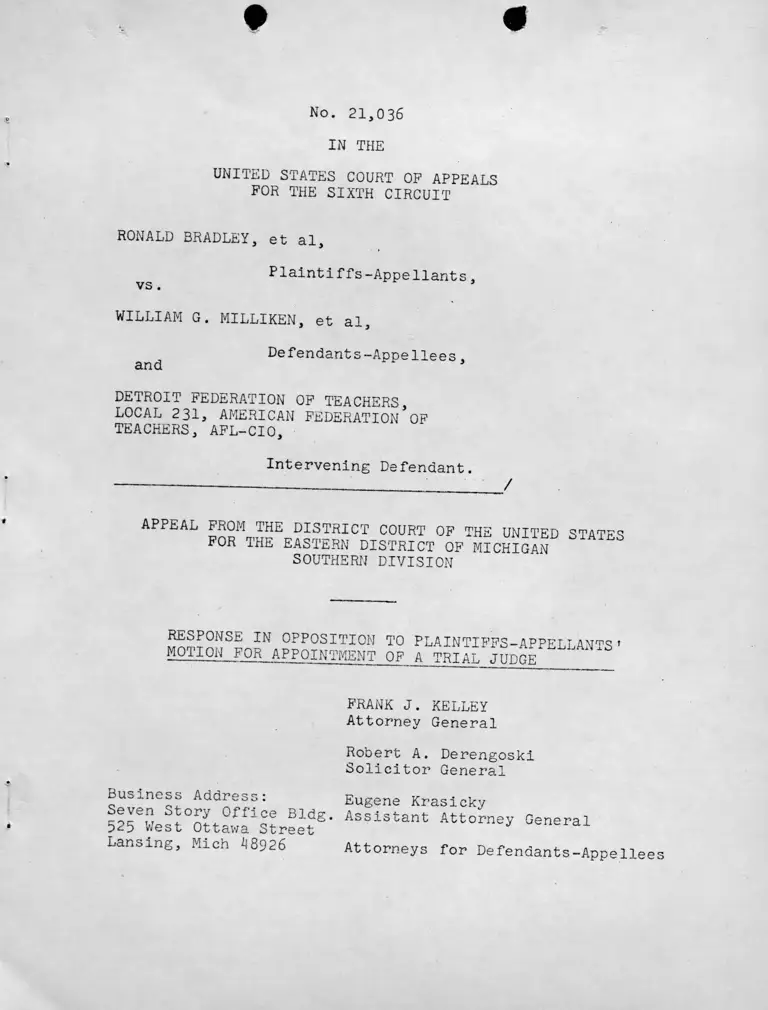
No. 21,036

IN THE
UNITED STATES COURT OF APPEALS

FOR THE SIXTH CIRCUIT

RONALD BRADLEY, et al,

vs .
Plaintiffs-Appellants,

WILLIAM G. MILLIKEN, et al,

Defendants-Appellees,
and

DETROIT FEDERATION OF TEACHERS,
LOCAL 231, AMERICAN FEDERATION OF
TEACHERS, AFL-CIO,

Intervening Defendant.
__________ /

RESPONSE IN OPPOSITION TO PLAINTIFFS-
APPELLANTS 1 MOTION FOR APPOINTMENT OF
A TRIAL JUDGE.________________________

Nov; come the state defendants -appellees, William
G. Milliken, Governor of the State of Michigan, Frank J.
Kelley, Attorney General of the State of Michigan, Michigan
State Board cf iiQUcation and John W. Porter, Superintendent
of Public Instruction, by their attorneys Robert A.
Derengoski, Solicitor General, and Eugene Krasicky,

Assistant Attorney General, and in opposition to plaintiffs-


#

appellants' "Motion pursuant to 28 U.S.C. §292(b) for
Appointment of Trial Judge," say as follows:

I.
PLAINTIFFS-APPELLANTS ARE RESPONSIBLE FOR
THE DELAY IN TRYING THIS CAUSE ON THE MERITS.

A brief chronology of events in this cause will

conclusively demonstrate that plaintiffs-appellants alone
are responsible for the delay in a trial of this cause.
They have sought preliminary relief at every turn, both
in the trial court and before this Court. The district
court has gone to great lengths to accommodate plaintiffs-
appellants. Yet, plaintiffs-appellants now attempt to
shift the cause of delay from their shoulders to those of
the trial judge.

On August 18, 1970 the complaint was filed. The
rcgxt day the trial judge held an 8:30 A.M. conference with
the various counsel in chambers concerning plaintiffs’
request for an ex parte order. On August 19, 1 970 the
lower court denied ex parte relief and issued an order to

show cause why plaintiffs-appellants’ request for preliminary
injunction should not be granted. The Court held hearings
on August 27, 28 and September 1 , 1970 on the request for a
preliminary injunction.

- 2-


#

Then, realizing the need for an immediate decision

because of the impending opening of the Detroit schools,
the Court notified the parties by telephone of its decision.

Subsequently, the Court, issued its written opinion on
September 3, 1970 denying the preliminary injunction and

reserving two weeks, commencing November 2, 1970, for a

trial on the merits.

Plaintiffs-appellants responded by appealing the
denial of a preliminary injunction. This Court expedited
the appeal by advancing the cause on its docket for oral
argument on October 2, 1970. On October 13, 1970 this
Court issued its opinion affirming the denial of plaintiffs-
appellants sought after preliminary injunction to, inter alia,
compel implementation of the April 7 plan.

Yet, on October 30, 1970 plaintiffs-appellants filed
a motion for immediate implementation of the April 7 plan.
On November 4, 1970 the district court heard argument on
the motion for immediate implementation. At that time,
with plaintlffs-appellantsT approval, the Court moved the
trial on the merits to December 8, 1970. Concurrently, the
Court ruled that the Detroit Board of Education was to submit
integration plans to the district court.

Once the integration plans were submitted, the

- 3-


#

trial judge held evidentiary hearings on the plans on

November 18, 19 and 25, 1970. In addition, the Detroit
Board of Education moved for a continuance of the trial.

On December 3v 1970 the district court released its
opinions ordering implementation of the McDonald plan and

granting the motion for continuance with a clear indication
that the trial would commence "in early Spring 1971."

The trial court’s wisdom in not establishing a
fixed trial date at that time was demonstrated by the
subsequent course of these proceedings. Presently plaintiffs-
appellants are before this Court with their second interlocutory
appeal and, once again, this Court advanced this cause for

oral argument on the merits. Thus, currently this case is

pending before this Court for disposition of the issues
raised by plaintiffs-appellants’ second interlocutory appeal.

This chronology of prior proceedings compels the
conclusion that plaintiffs-appellants repeated attempts to
obtain preliminary relief, prior to a trial on the merits,
are the cause of delay in hearing this case on the merits.
The trial judge has been consistently faced with plaintiffs-
appellants’ numerous requests for preliminary relief and he
has accommodated their requests at every turn with prompt
hearings and rulings on such requests. In point of fact,
the trial judge has scheduled a hearing for February 11, 1971

- 4-


on the questions of plaintiffs’ standing to sue and the
appropriateness of plaintiffs’ suit as a class action under

F.R.C.P. 23. Thus, it cannot be said that the conduct of
the trial judge has delayed the trial. Rather, it must be
concluded that the cause is plaintiffs-appellants ’ desire to

obtain judicial relief without undergoing the traditional
process of a trial on the merits prior to obtaining the relief
sought.

II.

PLAINTIFFS-APPELLANTS* MOTION CONSTITUTES
FORUM S H O P P I N G . _______ ________________

At least 6 days of evidentiary hearings have already
been concluded in this cause on plaintiffs-appellants’
preliminary motions. The trial judge has made it perfectly
clear in his opinions to date that plaintiffs-appellants
have proved neither de jure nor de facto segregation of
the Detroit public schools. Thus, it is not surprising
that plaintiffs-appellants would seek to, in effect,
disqualify and remove Judge Roth from this cause. He has
heard plaintiffs-appellants' proofs to date and found them
wanting.

If a new trial judge is appointed, all the testimony
taken to date will lose its integrity and credibility as
part of the trial record for the reason that the newly
appointed judge was not present at the hearings. Although

- 5-


•  •

this would undoubtedly please plaintiffs-appellants, it
is manifestly unfair to all the defendants-appellees

herein.
In addition, a newly appointed trial judge would

need time to familiarize himself with plaintiffs-appellants *

complex and far reaching cause of action as illustrated by
the allegations and prayer for multiple relief in the
complaint. To further illustrate this point, it should be
noted that plaintiffs-appellantsf pretrial statement, filed
at the request of the trial judge, lists over 30 issues for

resolution by the Court in this cause. Further, a newly
appointed judge would require time to familiarize himself
with the prior proceedings and the present posture of this
cause. In short, the appointment of a new trial judge could
delay rather than expedite a trial on the merits. The efficient
use of judicial manpower would be served by retaining the same

j-udge for all of the proceedings in this cause.

The question of whether the district court abused its

discretion in granting a continuance is already before this
Court. The state defendants-appellees do not intend to reargue
that issue herein except to reiterate their position that, in

light of the 5 sound reasons advanced by the trial judge, the
granting of the continuance was not an abuse of discretion.

Moreover, assuming arguendo that this Court decides that the

6 -


#  #

continuance constituted an abuse of discretion and
orders an immediate trial on the merits, the appointment

of a new trial judge would only delay the commencement of
trial while he familiarized himself with this cause.

Plaintiffs-appellants, having been unsuccessful
to date in their attempts to establish de jure segregation
of the Detroit public schools and to obtain preliminary
injunctive relief, are now attempting to substitute a new
judge for the trial on the merits. It must be emphasized
that this Court should look with disfavor upon plaintiffs-
appellants* attempt to accomplish a change of forums in
such circumstances.

Finally, state defendants-appellees would inform
this Court that, at the February 11, 1971 hearing referred
to above, the trial judge ruled that plaintiffs-appellants
had standing to bring this suit. Further, as required by

*F.R.C.P. 23, the Court determined that this was a proper
case for a class action and defined the class as all resident
parents of Detroit who have children of school age and all
school children in the City of Detroit. In addition, in
the exercise of his sound discretion, the trial judge ruled
that notice should be given the members of this extremely
large class and established a tentative schedule, as follows,

leading up to the commencement of trial.

- 7-


4

The notice to the class, through the communications

media, will be given on February 16, 1971. Intervenors

must file their appearances by March 8, 1971 and and hearings

on intervention will be held March 16, 1971. The pre-trial
order is due on March 21, 1971, all exhibits are to be marked
by April 5, 1971 and the trial is to commence on April 6,
1971. The present assessment of the parties is that the trial
will take 6 weeks. The Court will fix this or a substantially
similar schedule by entry of an order on February 16, 1971.
Therefore, there is every reason to believe that the schedule
will be fixed by court order and the trial will be promptly
forthcoming.

Thus, it is abundantly clear that the trial judge has
established an expeditious schedule of proceedings leading up

to a trial date in approximately 7 weeks. Any newly appointed
trial judge would be compelled to establish a similar schedule

of proceedings leading up to trial. Consequently, it is beyond
dispute that the appointment of a new trial judge will not
hasten the time in which this cause is tried on the merits.

In summary, plaintiffs-appellants, having been
responsible for the delay In the trial on the merits, should
not now be heard to complain in their attempt to secure a
newly appointed trial judge.

- 8-


# 4

WHEREFORE, state defendants-appellees respectfully
request that this Court deny plaintiffs-appellants’ Motion
for Appointment of Trial Judge.

Respectfully submitted,
FRANK J. KELLEY
Attorney General

Robert A. Derengoski
Solicitor General

■Eugene ArasiCKy
Assistant Attorney General
Attorneys for Defendants-Appellees
Business Address:

Seven Story Office Building
525 West Ottawa Street
Lansing, Michigan 48913

- 9-


#

CERTIFICATE OF SERVICE

This is to certify that a copy of the foregoing

Response in Opposition to Plaintiffs-Appellants* Motion

for Appointment of a Trial Judge has been served on counsel
for Appellants, Louis R. Lucas, William E. Caldwell, 525

Commerce Title Building, Memphis, Tennessee 38103; E. Winther
McCroom, 3245 Woodburn Avenue, Cincinnati, Ohio 45207;
Nathaniel Jones, 1790 Broadway, New York, N.Y., Jack

Greenberg, James M. Nabrit III, Norman J. Chachkin, 10
Columbus Circle, New York, N. Y. 10019; Bruce Miller,
Lucille Watts, 3426 Cadillac Tower, Detroit, Michigan
48226; J. Harold Flannery, Paul Dimond, 38 Kirkland Street,
Cambridge, Mass; Counsel for Defendants-Appellees, George

E. Bushnell, Jr., 2500 Detroit Bank & Trust Building,
Detroit, Michigan 48226; and Counsel for Intervening
Defendant, Theodore Sachs, 3610 Cadillac Tower, Detroit,
Michigan 48226, by United States Mail, postage prepaid,

this 12th day of February, 1971.

-10