Spencer v Casavilla Reply Brief for Petitioner Appellant
Public Court Documents
January 14, 1983
18 pages
-
Brief Collection, LDF Court Filings. Spencer v Casavilla Reply Brief for Petitioner Appellant, 1983. f55254ec-c49a-ee11-be37-00224827e97b. LDF Archives, Thurgood Marshall Institute. https://ldfrecollection.org/archives/archives-search/archives-item/cb51cd81-5902-4465-ab48-2a178007290a/spencer-v-casavilla-reply-brief-for-petitioner-appellant. Accessed October 09, 2026.
Copied!
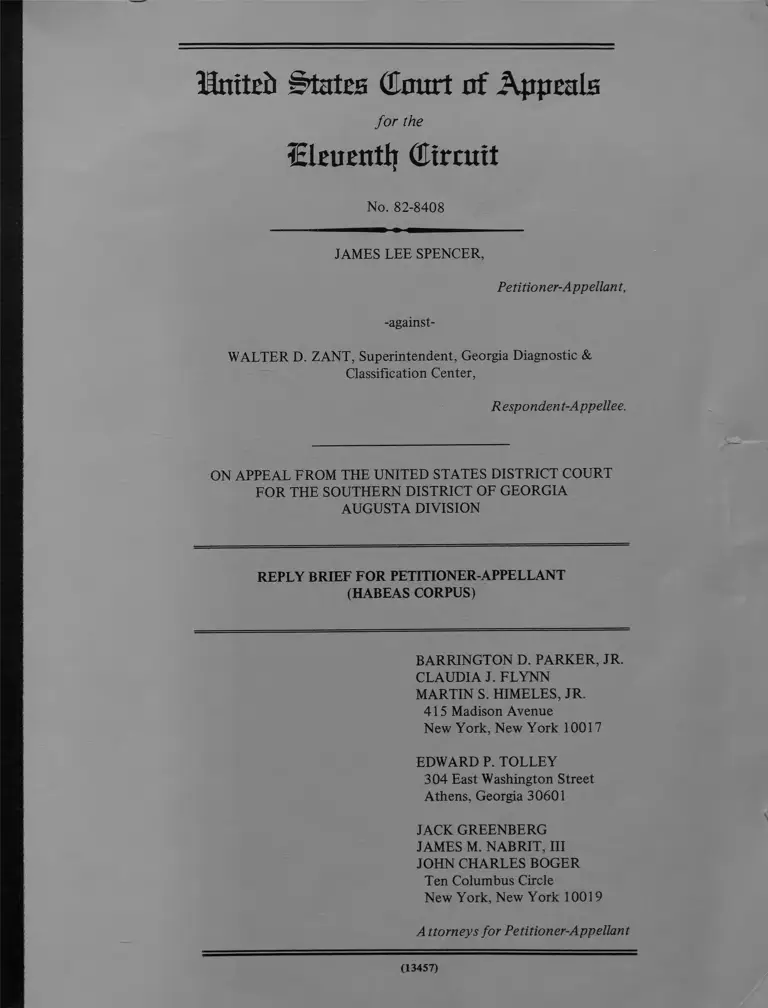
33mtei> States (Court uf Appeals
fo r the
Eleuentij (Circuit
No. 82-8408
JAMES LEE SPENCER,
Peti tio n er-A pp ellan t,
-against-
WALTER D. ZANT, Superintendent, Georgia Diagnostic &
Classification Center,
Respondent-Appellee.
ON APPEAL FROM THE UNITED STATES DISTRICT COURT
FOR THE SOUTHERN DISTRICT OF GEORGIA
AUGUSTA DIVISION
REPLY BRIEF FOR PETITIONER-APPELLANT
(HABEAS CORPUS)
BARRINGTON D. PARKER, JR.
CLAUDIA J. FLYNN
MARTIN S. HIMELES, JR.
415 Madison Avenue
New York, New York 10017
EDWARD P. TOLLEY
304 East Washington Street
Athens, Georgia 30601
JACK GREENBERG
JAMES M. NABRIT, III
JOHN CHARLES BOGER
Ten Columbus Circle
New York, New York 10019
A ttorneys for Petitioner-Appellant
(13457)
TABLE OF CONTENTS
Page No.
Table of Authorities................................ . (jj
Argument
I. Spencer's Early, Multiple, Pro Se
Challenges To The Jury Array Were
Sufficient To Preserve His Objection
To Its Unconstitutional Composition . . . . . \
II. The Trial Court's Instructions
Relieved The State Of Its Burden Of
Proving Every Element Of The Crime
Beyond A Reasonable Doubt . . . . . . . . . . 4
III. The Trial Court Directed A Verdict
Against Petitioner On His Special
Plea Of I n s a n i t y ........ ...................7
IV. Petitioner Did Not Receive An
Adequate Opportunity To Introduce
Evidence In The District Court
Demonstrating The Arbitrary And
Discriminatory Imposition Of The
Death Penalty In G e o r g i a ................... 8
Conclusion . . . . . . . . . . . . . . . ........ • • 11
TABLE OF AUTHORITIES
Page
Albuquerque v. Bara,
628 F . 2d 767 (2d Cir. 1980) ..................3
Henry v. Mississippi,
379 U.S.443 (1965) . . . . . . . . ........ 3
Holloway v. McElroy,
632 F .2d 605 (5th Cir. 1980), cert, denied,
451 U.S. 1028 (1981) ............... 5
Lamb v. Jernigan,
683 F . 2d 1332 (11th Cir. 1982) . ........ 5
Mason v. Balkcom,
669 F . 2d 222 (5th Cir. 1979) ............... 7
Mullaney v. Wilbur,
421 U.S. 684 (1975) .......................... 6
Proffitt v. Wainwright,
685 F .2d 1227 (11th Cir. 1982) . ........ 10
Sandstrom v. Montana,
442 U.S. 510 (1979) .......................... 4, 5, 8
Sapp v. Rowland,
CV-176-94 (S.D. Ga. May 20, 1 9 7 7 ) ........ .. 1, 3
Smith v, Balkcom,
671 F .2d 858 (5th Cir. 1982) (per curiam). . . 10
Spencer v. Hopper,
243 Ga. 532, 255 S.E.2d 1, cert, denied,
444 U.S. 885 (1979)................... .. 3, 4
Spinkellink v. Wainwright,
578 F .2d 582 (5th Cir. 1978), cert, denied,
440 U.S. 976 (1979)......................... 8 , 10
United States v. Chiantese,
560 F .2d 1244 (5th Cir. 1977)(en banc),
cert, denied, 441 U.S. 922 (1979)...........5
(i)
Page
United States v. Hull,
565 F .2d 917 (5th Cir. 1 9 7 8 ) ............... 2, 3
In re Wainwright,
678 F .2d 951 (11th Cir. 1982) ............. 10
Wainwright v. Sykes,
433 U.S. 72 (1977) ...................... 1, 3
In re Winship,
397 U.S. 358 (1970) .................... 6
(ii)
IN THE UNITED STATES COURT OF APPEALS
FOR THE ELEVENTH CIRCUIT
No. 32-8408
JAMES LEE SPENCER,
Petitioner-Appellant,
-against-
WALTER D. ZANT, Superintendent,
Georgia Diagnostic & Classification Center,
Respondent-Appellee.
On Appeal From The United States District Court
For The Southern District Of Georgia
Augusta Division
REPLY BRIEF FOR PETITIONER-APPELLANT
(HABEAS CORPUS)
ARGUMENT
I. SPENCER'S EARLY, MULTIPLE, PRO SE
CHALLENGES TO THE JURY ARRAY WERE
SUFFICIENT TO PRESERVE HIS OBJECTION
TO ITS UNCONSTITUTIONAL COMPOSITION
In his main brief, petitioner demonstrated that at
the beginning of his trial, before the jury had been impaneled,
he made multiple, unambiguous objections on constitutional
grounds to the racial and sexual composition of the array from
which his trial jury was selected. (See Brief for Petitioner-
Appellant at 5-12) He further demonstrated that the objec
tions were meritorious ones because shortly after his trial
the United States District Court for the Southern District of
Georgia examined the composition of the Burke County jury
panels, found unlawful racial and sexual discrimination, and
enjoined such discrimination. See Sapp v, Rowland, CV-176-94
(S.D. Ga. May 20, 1977).
In response, the State argues that the challenge was
waived since it occurred after the jury had been "put on"
Spencer and, in any event, was abandoned during trial. The
State also insists that "cause" for relief from the waiver
does not exist'and that in the absence of evidence that the
array was improperly constituted in 1975, the year Spencer
was tried, "prejudice" has not been demonstrated. See Wain-
wright v. Sykes, 433 U.S. 72 (1977).
Neither of these contentions has merit. As the
Court's perusal of the record will undoubtedly show, Spencer
challenged this array before it was "put on" him. Spencer
challenged it in unmistakable terms at the very beginning of
his trial both in his removal petition and in his pro se
motion. Both were presented before the jury had been selected
and well before the trial on the merits commenced. Further
more, at the conclusion of the trial, Spencer again unambiguously
indicated that he had intended to raise a challenge to the jury
array, that he had done so before the jury was impaneled, and
that the motion had been ignored by the trial court. (Trial
Tr. 842-43) Significantly, neither the prosecutor nor the
trial court indicated that Spencer's challenge was late or
suffered from any other procedural infirmity. They simply
ignored it.
But even if the State's hostile reading of its
waiver provisions were accepted, petitioner has established
ample "cause" and has shown sufficient "prejudice" to require
a federal court to reach the merits. Spencer does not contend,
as the State cautiously suggests, that the "cause" for the
waiver stemmed from the inadvertance of his counsel, although
that may have been a contributing factor. See United States v.
Hull, 565 F.2d 917, 920 (5th Cir. 1978). "Cause" is adequately
demonstrated by the difficulties in complying with an imprecise,
confused state procedural requirement. Significantly, the
Georgia Supreme Court itself evidenced this confusion by hold
ing that the jury was "put on" Spencer both on January 7 and
-2-
January 15. Spencer v. Hopper, 243 Ga. 532, 535, 255 S.E.2d
1, cert, denied, 444 U.S. 885 (1979). If the Georgia Supreme
Court is confused as to when a jury is "put on" a defendant,
the rule should not be permitted to serve as the predicate in
a capital case for the waiver of so important a right as that
to a trial by a lawfully constituted jury. Henry v,
Mississippi, 379 U.S. 443, 447-48 (1965); Albuquerque v. Bara,
628 F.2d 767, 776 (2d Cir. 1980)(Brieant, J., concurring).
Cause is also supplied by the fact that Spencer was, in connec
tion with his jury challenge, a pro se defendant acting without
the assistance of counsel. See United States v. Hull, supra.
Even without the assistance of counsel, he made early, precise
objections which the trial court undoubtedly understood but
ignored. No valid policy otherwise served by the Wainwright v.
Sykes rule requires Spencer to have done anything more.
Finally, the State argues that prejudice was not
demonstrated because Sapp v. Rowland involved the Burke County
jury composition in 1976. Although Sapp standing alone is a
powerful indication that Spencer was correct, he went beyond
that case and showed discrimination in the array from which
his jury was selected. In state habeas proceedings he intro
duced binding admissions of the Burke County Jury Commissioners
that established the illegal underrepresentation of blacks and
women on the 1975 traverse jury list. (See Appellant's Brief
at 12, Brief for Petitioner-Appellant in Forma Pauperis at
-3-
21, Spencer v. Hopper (Appeal to Georgia Supreme Court from
Denial of State Habeas Corpus Petition))
II. THE TRIAL COURT'S INSTRUCTIONS RELIEVED
THE STATE OF ITS BURDEN OF PROVING
EVERY ELEMENT OF THE CRIME CHARGED BEYOND
A REASONABLE DOUBT__________
Spencer was convicted on the basis of a charge that
permitted the jury to presume homicide if a deadly weapon was
used. The charge violated due process. The State defends
that unconstitutional murder instruction by arguing that the
instruction only created a permissive inference, and that even
if it were an error the error was harmless. Neither argument
has merit.
The Supreme Court held in Sandstrom v. Montana, 442
U.S. 510, 518-19 (1979), that the mere possibility that a jury
might interpret an instruction as creating an irrebuttable,
burden-shifting presumption is sufficient to establish a due
process violation. The deficiency in the charge here was
equally serious since the jury charge here permitted the jury
to presume the existence of intent. Intent unquestionably is
a factual issue under Georgia law. (See Brief for Petitioner-
Appellant at 36) More important, it was virtually the only
disputed issue for the jury's consideration.
Since Sandstrom, in case after case, courts have
concluded that instructions identical in all material respects
to the instructions here fail to pass constitutional muster.
-4-
E . g . , Lamb v. Jernigan, 683 F.2d 1332, 1336-37 & n.8 (11th
Cir. 1982) ("the law presumes that every homicide is malicious");
Holloway v. McElroy, 632 F.2d 605, 619-36 (5th Cir. 1980)(same),
cert, denied, 451 U.S. 1038 (1981). Indeed, in Sandstrom
itself, the court found that the instruction " [t]he law presumes
that a person intends the ordinary consequences of his
voluntary acts" might be interpreted by the jury as creating
an irrebuttable presumption and was, therefore, improper. Id.
at 513 (emphasis added).
The State seeks to rescue the improper instruction
by pointing to the trial judge's instruction that the burden
was on the State to prove intent. An identical argument was
rejected in Sandstrom. As the court pointed out there, the
jury might have interpreted the instructions as indicating
that, although the burden of proof was on the State, it could
meet that burden by resort to the presumption. 442 U.S. at
518 n.7. Thus, it is settled that a burden-shifting instruc
tion is not saved by general instructions with respect to the
burden of proof. See Lamb v. Jernigan, 683 F.2d at 1341;
United States v. Chiantese, 560 F.2d 1244, 1255 (5th Cir. 1977)
(en banc), cert, denied, 441 U.S. 922 (1979).*
*The State also points to the court's instruction that the
presumptions were rebuttable. The argument takes the instruc
tion out of context. The jury was instructed:
I give you certain presumptions of law that are
applicable to this case. A presumption is a
conclusion that the law draws from given facts.
(footnote continued on next page)
-5-
The State is therefore left with its harmless error
argument, but that argument does not withstand analysis.
Though the bulk of its argument is devoted to harmless error,
the State fails to cite a single capital case in which the
doctrine has been applied. As we demonstrated in our main
brief, the cases all indicate the harmless error rule does
not salvage a deficient charge in a capital case. (See Brief
for Petitioner-Appellant at 38-40)
Since it cannot really defend the charge, the State
argues the evidence of intent was overwhelming. The fact is,
however, that there was sufficient doubt about petitioner's
sanity for the trial judge to feel obligated to charge the
jury on the issue. In light of the dispute as to petitioner's
state of mind, as well as the fact that petitioner's life is
at stake, an argument that an instruction that unconstitution
ally shifted the burden of proof on that issue was harmless
(footnote contined from previous page)
Each of these presumptions are [sic] rebuttable,
that is, they are subject to being overcome by
evidence to the contrary, and they are: [recital
of presumptions follows].
Trial Tr. 797. It is quite clear that the instructions referred
only to the list of presumptions which immediately followed,
and not to the presumption challenged here, which appears a
full nine pages later in the transcript. Moreover, placing
the burden on the petitioner to overcome a presumption afforded
to the State on an element of a crime is prohibited by In re
Winship, 397 U.S. 358 (1970), and Mullaney v. Wilbur, 421 U.S.
684 (1975).
-6-
error should be rejected. Mason v. Balkcom, 669 F.2d 222,
227 (5th Cir. 1979) .
III. THE TRIAL COURT DIRECTED A VERDICT
AGAINST PETITIONER ON HIS SPECIAL
PLEA OF INSANITY___________________
The trial court's instruction that a preponderence of
the evidence sufficient to carry defendant's burden of proof
is "evidence that a person with a reasonable and impartial mind
would believe is stronger that the evidence which has been
produced by this witness" was unquestionably reversible error.
Indeed, the State itself is unable to deny that the charge was
insufficient. As we pointed out in our main brief, the error
was a reversible one because under Georgia law the determina
tion of what constitutes a preponderence of the evidence is
for the jury to determine. And, of course, the Constitution
requires that a defendant be tried only when he is legally
competent. (See Brief for Petitioner-Appellant at 40-41)
In the face of a clearly erroneous charge, the State
argues that the "witness" referred to is one of the psychia
tric witnesses and not Spencer. This is naked speculation.
The State offers this conjecture without the slightest record
support. Since, by the time of jury charge, it would have
been natural for the various witnesses, particularly expert
witnesses, to have departed the courtroom, the context in
which the reference was made unquestionably suggests that it
was directed at Spencer. In any event, any reasonable juror
-7-
could have concluded that the "witness" was Spencer— as it
undoubtedly was— and the charge could easily have been con
strued as directing a verdict against Spencer. In Sandstrom
the Court emphasized that the mere possibility that a juror
could have interpreted an instruction as constituting such
a presumption violated due process. 442 U.S. at 524.
IV. PETITIONER DID NOT RECEIVE AN ADEQUATE
OPPORTUNITY TO INTRODUCE EVIDENCE IN THE
DISTRICT COURT DEMONSTRATING THE
ARBITRARY AND DISCRIMINATORY IMPOSITION
OF THE DEATH PENALTY IN G E O R G I A _____
In District Court proceedings Spencer sought an evi
dentiary hearing to support his claims that the death penalty
is systematically imposed in an arbitrary and discriminatory
manner in Georgia. The request was denied. The State argues
that the State hearing was adequate and the rejection of
additional evidence was proper under this Court's decision in
Spinkellink v. Wainwright, 578 F.2d 582 (5th Cir. 1978), cert,
denied, 440 U.S. 976 (1979). The State claims that the only
reason that the evidence was not presented in state court was
a purported lack of funds by Spencer, a claim belied by the
later availability of the same evidence in the District Court,
notwithstanding the same ostensible lack of funds.
This contention totally misconstrues Spencer's claim.
To be sure, not only did Spencer, an indigent pro se defendant,
not have adequate funds to procure and present the type of
-8-
evidence that was later available, the most important and
persuasive evidence that Spencer sought to introduce, and
which was rejected by the District Court, was the work of
Dr. David Baldus. Baldus' study, exhaustively demonstrating
the arbitrary, discriminatory nature of the imposition of
the death penalty in Georgia in the post-Furman period, 1973-
1979, was simply not available at the time of state habeas
proceedings.
The State makes two additional arguments in support
of its contention that the evidentiary record before the
District Court was complete. First, it argues that the record
before the District Court was adequate because appellant had
called expert witnesses to testify at his state habeas hearing,
citing the testimony of Dr. David Lawrence Sjoquist, Brian
Forst, and Ms. Stephanie Auerbach. Although they testified,
they did not testify at all on racial discrimination or
arbitrariness but on totally different issues. Brian Forst
testified on the absence of any correlation between the death
penalty and deterrence. Dr. Sjoquist testified that, due to
its lack of deterrent effect, the death penalty is without
any valid penological justification. Stephanie Auerbach did
not testify at all. Her research covered the period 1943 to
1965 and was deemed not probative or admissible by the State
court.
Finally, the State argues that even the evidence
-9-
that Spencer sought to admit, including the Baldus study,
would not have been admissible under Spinkellink v. Wainwright,
supra. As we pointed out in our main brief, however, decisions
of this court since Spinkellink have discarded the view that it
bars a federal evidentiary hearing on Spencer's claims.
Proffitt v. Wainwright, 685 F .2d 1227, 1262 n .52 (11th Cir.
1982); see In re Wainwright, 678 F2d 951 (11th Cir. 1982);
Smith v. Balkcom, 671 F.2d 858 (5th Cir.)(per curiam). Baldus'
evidence directly addresses the evidentiary issues this court
identified in Smith on rehearing. The Smith court identified
these issues as: whether charges or indictments grew out of
reported incidents; whether murder or another crime was involved
and, if murder, what degree; whether mitigating circumstances were
advanced or found; whether there were aggravating circumstances
sufficient to warrant submission of the death penalty to the jury;
and whether there were incidents resulting in not guilty
verdicts. Smith v. Balkcom, 671 F.2d at 860 n.33. Dr. Baldus'
evidence demonstrates that the statistically significant
racial discrimination in Georgia's capital sentencing system,
based on the race of the defendant and the race of the victim,
persists even when only those homicides resulting in murder
indictments— 'including that subset of murder indictments
accompanied by aggravating circumstances— are examined. More
over, the discrimination persists even in the subset of those
cases submitted to a 'jury at a capital sentencing phase. The
-10-
absence or presence of mitigating circumstances in the various
cases does not provide a sufficient basis rationally to
explain the discrimination found. Therefore, not only was the
evidence Spencer sought to present admissible, but it was
exactly the evidence sought by the Smith court to support a
claim of arbitrary and discriminatory imposition of the death
penalty.
CONCLUSION
For the reasons set forth above, petitioner urges
this Court to grant the relief sought in his main brief.
Dated: New York, New York
January 14, 1983
Respectfully submitted,
BARRINGTON D. PARKER, JR.
CLAUDIA J. FLYNN
MARTIN S. HIMELES, JR.
415 Madison Avenue
New York, New York 10017
EDWARD P. TOLLEY
304 East Washington Street
Athens, Georgia 30601
JACK GREENBERG
JAMES M. NABRIT, III
JOHN CHARLES BOGER
Ten Columbus Circle
New York, New York 10019
ATTORNEYS FOR PETITIONER-APPELLANT
-11-
CERTIFICATE OF SERVICE
I do hereby certify that I have this day served
the within and foregoing brief, prior to filing the same,
by depositing a copy thereof, postage prepaid, in the United
States Mail, properly addressed upon:
VIRGINIA H. JEFFRIES, ESQ.
132 State Judicial Building
40 Capitol Square, S.W.
Atlanta, Georgia 30334
This 14th day of January, 1983.
COUNSEL PRESS INC., 30 EAST 40TH STREET, NEW YORK, N.Y. 10016; (212) 689-1303