Davis v. Prince Edward County, VA School Board Statement as to Jurisdiction
Public Court Documents
May 5, 1952
-
Brief Collection, LDF Court Filings. Davis v. Prince Edward County, VA School Board Statement as to Jurisdiction, 1952. 1a27753a-af9a-ee11-be37-00224827e97b. LDF Archives, Thurgood Marshall Institute. https://ldfrecollection.org/archives/archives-search/archives-item/cfb4e24f-2a78-438f-bbc8-a0f26f0eb2c7/davis-v-prince-edward-county-va-school-board-statement-as-to-jurisdiction. Accessed October 05, 2026.
Copied!
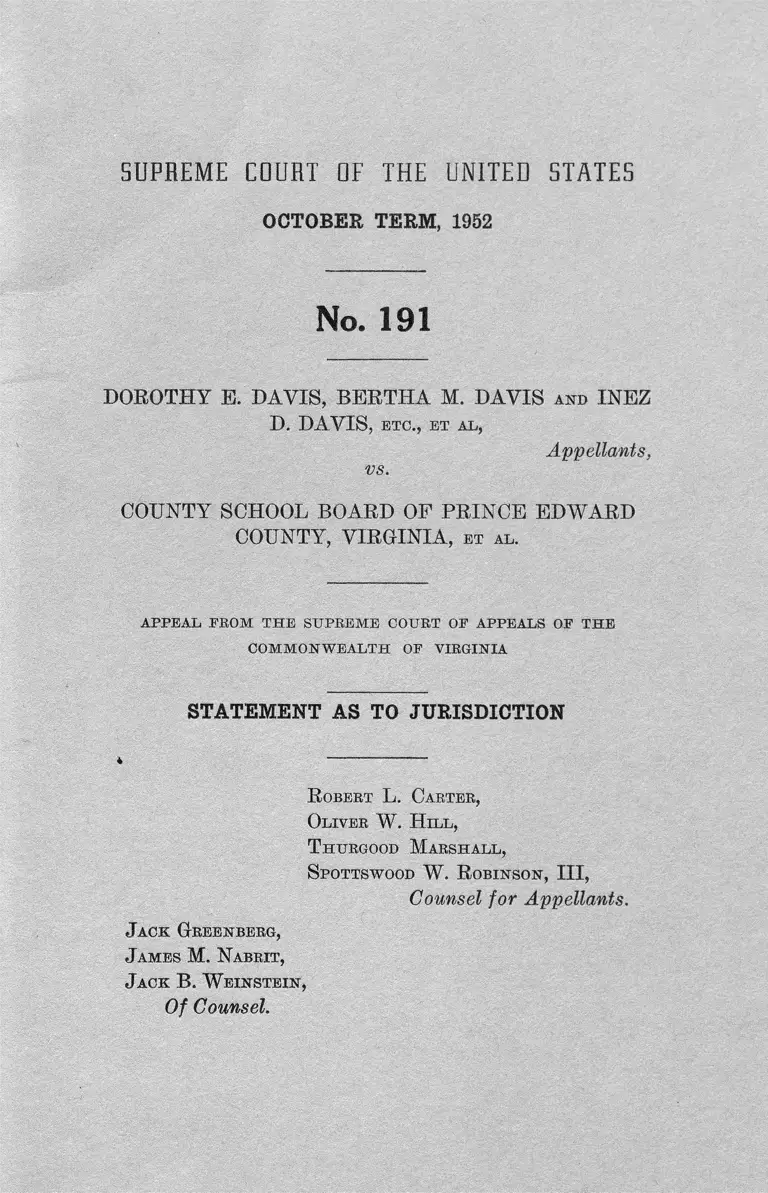
SU P RE M E COURT OF THE UNITED STA T E S
OCTOBER TERM, 1952
No. 191
DOROTHY E. DAVIS, BERTHA M. DAVIS a n d INEZ
D. DAVIS, BTC., ET AL,
VS.
Appellants,
COUNTY SCHOOL BOARD OF PRINCE EDWARD
COUNTY, VIRGINIA, e t a l .
APPEAL FROM THE SXJPBEME COURT OB APPEALS OB THE
COMMONWEALTH OF VIRGINIA
STATEMENT AS TO JURISDICTION
R obert L. Carter,
Oliver W. H ill,
T hurgood Marshall,
Spottswood W. R obinson, III,
Counsel for Appellants.
Jack Greenberg,
James M. Nabrit,
Jack B. W einstein,
Of Counsel.
TABLE OP CONTENTS
S u b je c t I n d ex
Page
Statement as to Jurisdiction.......................................... 1
Opinion B e lo w ........................................................ 1
Jurisdiction ............................................................ 2
Questions Presented ............................................. 2
Statutes Involved ................................................... 3
Statement ................................................................ 3
Questions Involved Are Substantial................... 4
1. In offering educational facilities and op
portunities, the state is without power
under the equal protection and due
process clauses of the Fourteenth
Amendment to make distinctions among
its citizenry based upon race and color. 6
2. Application of the separate school laws
has resulted in continued and unbroken
discrimination against Negro children
in Prince Edward County in violation
of the Fourteenth Amendment............... 12
3. The findings of the court below entitle
appellants to admission at once to the
superior schools in Prince Edward
County...................................................... 16
4. Equal educational opportunities in fact
cannot be provided under Virginia’s
separate school laws................................. 19
5. The decree of the court below fails to
grant appellants effective relief from an
admitted deprivation of their constitu-
tutional rights ..................................... 25
Conclusion ...................................................................... 29
Appendix A .................................................................... 30
Appendix B .................................................................... 38
—2858
11 INDEX
T able oe C ases
Page
American Communications Association v. Dowds, 339
U.S. 389 ...................................................................... 5
Bailey v. Alabama, 219 U.S. 219................................... 12
Belton et al. v. Gebhart et al., — Del. Ch. —, -— A.
2d —, decided April 11, 1952..................................... 17
Board of Supervisors v. Wilson, 340 U.S. 909........... 4
Briggs v. Elliott, 342 U.S. 350....................................... 32
Carr v. Corning, 182 F.2d 14 (C.A.D.C. 1950)'.......... 28, 32
Camming v. Board of Education, 175 U.S. 528.......... 15, 32
Dominion Hotel v. Arizona, 249 U.S. 285..................... 7
Gonzales v. Sheeley, 96 F.Supp. 1004 (D. Arizona
1951) ....................................................................; 7
Gray v. University of Tennessee, — U.S. —, decided
March 3, 1952 .............................................................. 14
Groessart v. Cleary, 335 U.S. 464................................. 7
Guinn v. United States, 283 U.S. 347........................... 12
Hawkins v. Board of Control, 47 So. 2d 608 and 53 So.
2d 116; cert, denied — U.S. —, Nov. 13, 1951.......... 14
Hirabayashi v. United States, 320 U.S. 81................. 8
Korematsu v. United States, 323 U.S. 214................... 8
McKissick v. Carmichael, 187 F.2d 949 (C.A. 4th
1951) ............................................................................ 24
McLaurin v. Board of Regents, 339 U.S. 637............. 4
Missouri ex rel. Gaines v. Canada, 305 U.S. 337......... 14
Oyama v. California, 332 U.S. 633....................... . 8
Plessy v. Ferguson, 163 U.S. 537................................. 32
Quaker City Cab Co. v. Pennsylvania, 277 U.S.
389 ............................................................................... 7
Scott v. Sanford, 19 How. 393...................................... 9
Shelley v. Kraemer, 334 U.S. 1 ..................................... 8
Sipuel v. Board of Regents, 332 U.S. 631..................... 14
Skinner v. Oklahoma, 316 U.S. 535............................... 7
Smith v. Allwright, 321 U.S. 649................................... 20
Strauder v. West Virginia, 100 U.S. 303..................... 6
Swanson v. University of Virginia, (Civil Action
No. 30, W.D.Va. 1950, unreported)........................... 14,15
Sweatt v. Painter, 339 U.S. 629..................................... 4
Takahashi v. Fish <& Game Commisison, 334 U.S.
410 ................................................................................ 8
ISTDEX
Page
United States v. Paramount Pictures, Inc., 334 U.S.
131 ................................................................................ 28
Wolf v. Colorado, 338 U.S. 25......................................... 6
Yick Wo v. Hopkins, 118 U.S. 356................................. 12
S ta tu te s C ited
United States Statutes:
Title 28, United States Code, Section 2281.......... 2
Title 28, United States Code, Section 2284........ 2
Title 28, United States Code, Section 1253......... 2
Title 28, United States Code, Section 2101(b) . . . 2
State Provisions:
Section 140, Constitution of Virginia of 1902, as
amended .............................................................. 3
Section 22-221, Code of Virginia of 1950, as
amended ............................................................. 2, 3,13
Section 22-251, 22-256, Code of Virginia of 1950,
as amended........................................................... 6
O t h e r A u th o r it ie s
American Teachers Association, The Black & White
of Rejections for Military Service (1944).............. 7
Horace M. Bond, The Education of the Negro in the
American Social Order (1934)................................. 10
Horace M. Bond, Negro Education in Alabama
(1939) ....................... 10
Ralph Bunche, The Political Status of the Negro (Un
published manuscript, Carnegie-Myrdal study) . . . 9
Clark, Negro Children, Educational Research Bulle
tin (1923) .................................................................... 7
Henry S. Commager, 1 Documents of American His
tory (1935) .................................................................. 9
Allison Davis, et ah, Deep South (1941)..................... 10
Douglas, Stare Decisis, 49 Col. L. Rev. (1939)............ 20
W.E.B. DuBois, Black Reconstruction (1935)............ 10
Frank and Munro, The Original Understanding of
‘ Equal Protection of the Laws,’ 50 Col. L. Rev.
(1950) .......................................................................... 19
iii
IV INDEX
Page
E. Franklin Frazier, The Negro in the United States
(1949) ...................................................................................10
Graham, The Early Anti-Slavery Backgrounds of the
14th Amendment, Wis. L. Rev. (1950)..................... 19
Klineberg, Race Differences (1935)............................... 7
Klineberg, Negro Intelligence and Selective Migra
tion (1935) ........................... 7
Paul Lewinson, Race, Class and Party (1932)............. 9
Charles S. Mangum, Legal Status of the Negro
(1940) ......................................................................... 10
Montague, Man’s Most Dangerous Myth— The Fal
lacy of Race (1945) .................................................. _ 7
Peterson & Lanier, Studies in the Comparative Abili
ties of Whites and Negroes, Mental Measurement
Monograph (1929) .................................................... 7
Keport of the Proceedings and Debates of the Con
stitutional Convention, State of Virginia, Rich
mond, June 12, 1901-June 26, 1902, Hermitage
Press, Inc., 1906, Vol. 1 ................................................. 10
Sidney Sutherland, The 14th and 15th and 18th
Amendments, Liberty Magazine V, No. 16, 10
(April 21, 1928) .............................................................. 11
IN THE UNITED STATES DISTRICT COURT FDR THE
FDR THE EASTERN DISTRICT DF VIRGINIA
RICHMOND DIVISION
CIVIL ACTION NO. 1333
DOROTHY E. DAVIS, BERTHA M. DAVIS and INEZ
D. DAVIS, I n f a n t s , b y JOHN DAVIS, T h e ir F a t h e r
an d N e x t F r ie n d , et a l .,
vs.
Plaintiffs,
COUNTY SCHOOL BOARD OF PRINCE EDWARD
COUNTY, VIRGINIA, an d T. J. McILWAINE, DIVI
SION SUPERINTENDENT OF SCHOOLS OF
PRINCE EDWARD COUNTY, VIRGINIA, et a l .,
Defendants
STATEMENT AS TO JURISDICTION
In compliance with Rule 12 of the Supreme Court of the
United States, as amended, plaintiffs-appellants submit
herewith their statement particularly disclosing the basis
upon which the Supreme Court has jurisdiction on appeal
to review the judgment of the district court entered in this
cause.
Opinion Below
The opinion of the United States District Court for the
Eastern District of Virginia, ------F. Supp.------ , has not
yet been reported and a copy of the opinion, along with the
final decree, is attached hereto as Appendix “ A .”
2
Jurisdiction
The district court, convened pursuant to Title 28, United
States Code, Sections 2281 and 2284, entered final judg
ment on 7 March 1952. A petition for appeal is presented
to the district court herewith, to wit, on 5 May 1952. Juris
diction of the Supreme Court to review this judgment by
direct appeal is conferred by Title 28, United States Code,
Sections 1253 and 2101(b) and has been sustained by the
following decisions: McLaurin v. Board of Regents, 339
U.S. 637; Board of Supervisors v. Wilson, 340 U.S. 909;
Briggs v. Elliott, 342 U.S. 350.
Questions Presented
1. Whether Sections 140 of the Constitution of Virginia
of 1902, as amended, and Sections 22-221 of the Code of
Virginia of 1950, as amended, are invalid and unenforce
able under the equal protection and due process clauses of
the Fourteenth Amendment to the Constitution of the
United States because they mandate segregated public
secondary schools for colored children in Prince Edward
County, Virginia, and because they compel infant-
appellants to attend such segregated schools to their detri
ment.
2. Whether after finding that the buildings, facilities,
curricula and means of transportation furnished appellants
are inferior to those provided for white students, the court
below was required by the equal protection clause of the
Fourteenth Amendment to the Constitution of the United
States to issue a decree restraining appellees forthwith
from denying appellants admission to the superior state
facilities solely because of their race and color.
3. Whether in addition to parity in curricula and physi
cal facilities the constitution guarantees appellants equality
3
in all other educationally. significant factors affecting the
development of skills, mind, and character.
Statutes Involved
Section 140 of the Constitution of Virginia of 1902, as
amended, and Section 22-221, Code of Virginia of 1950, as
amended, are set forth in Appendix “ B ” hereto.
Statement
Appellants are colored persons defined by law in the
state of Virginia as a person with “ any” “ ascertainable”
Negro blood and are citizens of the state of Virginia and
of the United States and residents of Prince Edward
County. They are: (1) children of public school age at
tending secondary public schools in Prince Edward County;
and (2) the parents and guardians of these children. Ap
pellees are state officers charged with the duty and re
sponsibility of providing, operating and maintaining public
elementary and secondary schools in Prince Edward
County, Virginia.
Section 140 of the Constitution of Virginia of 1902, as
amended, and Section 22-221 of the Code of Virginia of
1950, as amended, compel appellees to maintain separate
schools for colored and white children. Appellants are
seeking to enjoin enforcement of these provisions on the
grounds that they are in direct conflict with the equal
protection and due process clauses of the Fourtenth Amend-
Amendment.
Three public high schools are now in operation in the
county—the Moton High School for colored children and
the Worsham and Parmville High Schools for white chil
dren. The Moton High School has a larger enrollment (Tr.
37), average daily attendance and average daily member
ship (Tr. 77) than the combined totals at the other two
schools.
4
Appellees admitted in their answer and in their opening
statement that the buildings and equipment of the Negro
school were inferior to those of the white schools but alleged
that equal educational opportunities were furnished in all
other respects, (Tr. 9010). Blueprints of a proposed new
Negro high school designed to correct the inequalities in
physical facilities by September 1953 were placed in evi
dence (Tr. 521-541).
After hearing the evidence, the court below found the
Moton High School inferior not only in buildings and
equipment, but also in curricula and means of transporta
tion as well. Appellees were ordered forthwith to provide
appellants with curricula and means of transportation
“ substantially” equal to that available to white high school
students. Appellees were also ordered to “ proceed with
all reasonable diligence and dispatch to remove the in
equality existing as aforesaid in said buildings and facili
ties, by building, furnishing and providing a high school
building and facilities for Negro students, in accordance
with the program mentioned in said opinion and in the
testimony on behalf of the defendants herein, or other
wise . . . ” (See Appendix “ A ” .) As indicated, according
to appellees’ testimony, this new high school will not be
available until September 1953 (Tr. 541).
The court refused either to enjoin enforcement of the
state constitutional and statutory provisions requiring the
maintenance of radically segregated schools or to restrain
appellees from assigning school space in the county on the
basis of race and color.
Questions Involved Are Substantial
The issues raised in this case are similar to those raised
in Sweatt v. Painter, 339 U.S. 629; McLaurin v. Board of
Piegents, 339 U.S. 637; and Board of Supervisors v. Wilson,
340 U.S. 909. Under the federal constitution, appellants
5
are entitled to equal state educational opportunities. Since
the Negro high school was found to be inferior in bus
transportation, curricula, buildings and facilities, appel
lants are entitled to effective and immediate relief. Such
relief, we submit, requires the issuance of a decree which
permits appellants to share now in the superior state
facilities without regard to their race or color. A decree
that does less makes meaningless appellants’ constitutional
rights to equal educational opportunities.
Moreover, without regard to the present inequality with
respect to physical facilities, appellants contend that the
racial barriers and restrictions mandated by the state sep
arate school laws block the full and complete development
of their educational potential and make it impossible for
them to benefit from public education to the same extent
as white children. Thus by enforcing its invidious racial
classifications and distinctions among children of public
school age in Prince Edward County, as well as by fur
nishing appellants inferior physical facilities because of
race, the state violates the Fourteenth Amendment.
This is not only a local problem but is a question with
both national and international implications. The full
development of human resources of this country are
certainly as important to the nation and the world as the
full development of our natural resources, such as steel,
aluminum, coal and oil. As Mr. Justice Jackson said in
American Communications Association v. Douds, 339 U.S.
383, 442: ‘ ‘ Thoughtful, bold and independent minds are
essential to wise and considered self-government.” Inso
far as a majority of the public school population in Prince
Edward County is retarded in the full development of its
mental resources, the state of Virginia and the United
States are weakened in their efforts to develop that strong,
enlightened citizenry essential to the preservation of our
democratic institutions.
6
1. In offering educational facilities and opportunities,
the state is without power under the equal protection and
due process clauses of the Fourteenth Amendment to make
distinctions among its citizenry based upon race and color.
Sections 22-251 to 22-256 of the Code of Virginia of 1950,
as amended, require that all children between the ages of
7 and 16 attend public school or receive instruction in pri
vate schools. The state provides free public elementary and
secondary education. Negro children, whose parents object
to their attending racially segregated schools, must seek
their education in states where racial segregation is not
practiced. To most there is, therefore, no practicable alter
native to attending the segregated public schools.
While appellants have no abstract or natural right to a
public school education, as Mr. Justice Frankfurter noted
in his concurring opinion in American Communications
Association v. Bonds, supra at 417, the government is under
no obligation to furnish any public facilities, but once it
does it cannot make its facilities “ available in an obviously
arbitrary manner nor exact surrender of freedoms unre
lated to the facilities.” In this case, the state tells appel
lants that they must attend school, but if they choose to
attend the schools which the state maintains, they must
attend the segregated Moton High School solely because
they are Negroes.
The Fourteenth Amendment was designed to secure full
and equal citizenship rights for Negroes; it made freedom
from state action based upon race or color fundamental to
our way of life Strauder v. West Virginia, 100 U.S. 303.
Protection of this freedom is secured by due process which
is “ the compendious expression for all those rights which
courts must enforce because they are basic to our free
society . . . ” Wolf v. Colorado, 338 U.S. 25, 27. In requiring
appellants to attend specially designated public schools
solely because of their color, the state denies to them the
7
enjoyment of a freedom and liberty which they would
otherwise have except for the fact that they are Negroes.
In the infringement of this freedom, the state has further
magnified the harm to which appellants are subjected by
requiring them to attend inferior schools and to receive
inferior educational advantages.
As to equal protection, it must be conceded that a state
may classify its citizenry to accomplish some legitimate
governmental objective Dominion Hotel v. Arizona, 249
U.S. 265; Groessart v. Cleary, 335 U.S. 464. The classifi
cation, however, must be based upon some real difference
pertinent to a lawful legislative end. Quaker City Cab Co.
v. Pennsylvania, 277 U.S. 389; Skinner v. Oklahoma, 316
TJ.S. 535. Admittedly the only difference between appellants
and white public school children is a difference of race and
color, and this cannot be considered a difference in the con
stitutional sense.
The state has not attempted to show, nor can it show, that
this separation is based upon inherent differences between
appellants and white children in the county because of
their racial origin.1 There is not even here the question
of language differences upon which Arizona unsuccessfully
sought to sustain the segregation of children of Mexican
descent. Gonzales v. Skeeley, 96 F. Supp. 1004 (D. Ari
zona, 1951). As the court declared at 1008, 1009:
“ Segregation of school children in public school
buildings because of racial or national origin . . . consti
tutes a denial of equal protection of the laws as guaran
teed . . . by the provisions of the Fourteenth Amend
ment to the Constitution of the United States.”
1 Montague, Man’s Most Dangerous Myth— The Fallacy of Race, 188
(1945) ; American Teachers Association, The Black & White of Rejec
tions for Military Service 5 at 29 (1944) ; Klineberg, Negro Intelligence
and Selective Migration (1935); Peterson & Lanier, Studies in the Com
parative Abilities of Whites and Negroes, Mental Measurement Mono
graph (1929) ; Clark, Negro Children, Educational Research Bulletin
(1923); Klineberg, Race Differences 343 (1935).
8
The purposes of public education in Virginia, defined in
its official pronouncements, is to develop fundamental skills,
provide experience for emotional, moral and social develop
ment, develop good citizenship in a democracy, provide
studies appropriate to the child’s needs and aptitudes, pre
pare students for occupations and college and serve adults
by providing facilities needed as they attempt to solve the
problems of life (Tr. 46-47). There is no rational con
nection between these aims and racial segregation. Thus
the separate school laws not only fail to satisfy the con
stitutional requirements of due process, but also equal
protection of the laws. They are, therefore, invalid under
both provisions.
Indeed, we take the unqualified position that the Four
teenth Amendment has totally stripped the state of power
to make race and color the basis for governmental action.
See Skinner v. Oklahoma, supra, at 541. While an excep
tion may be made with respect to the federal government
in a grave national emergency, Hirabayashi v. United
States, 320 U. S. 81; Korematsu v. United States, 323 U. S.
214, no state can show any such overriding necessity which
would warrant sustaining state action founded upon these
constitutionally irrelevant and arbitrary considerations.
See Oyama v. California, 332 U. S. 633; Takahashi v. Fish
and Game Commission, 334 IT.S. 410; Shelley v. Kraemer,
334 IT. S. 1. For this reason alone, we submit, the state
separate school laws in this case must fall.
In our view, the law also violates the privileges and im
munities clause of the Fourteenth Amendment. Under that
Amendment a privilege and immunity incident to national
citizenship is freedom from governmental restrictions
founded upon race.
Appellants contend further that the state separate school
laws are motivated by racial prejudice and are based upon
9
a belief in the inherent inferiority of the Negro directly
flowing from his racial origin and that they are invalid for
this additional reason. Cf. Korematsu v. United States,
supra, at 216; Oyarna v. California, supra, at 646; and see
concurring opinion of Mr. Justice Murphy in Takahashi v.
California, supra, at 412, 427.
The court below concluded that the state school segre
gation laws are not the result of racial animosity or an
tipathy, but declare “ one of the ways of life in Virginia”
and are “ a part of the mores of her people.” ''See Appen
dix “ A ” .) The available historical evidence does not sus
tain these conclusions. Doubts concerning the status of
the free Negro prior to the Civil War were resolved by the
Dred Scott decision which expressly decided that a Negro
had no citizenship rights equal to those enjoyed by a white
person.2 After the Civil War the Negro was affirmatively
granted full and equal citizenship by the Thirteenth and
Fourteenth Amendments, and the legal basis for racial
distinctions inherent in the institution of slavery was de
stroyed. The white South, however, not content with this
constitutional change, immediately undertook to reestablish
the Negro status to accord with the ante-bellum philosophy
expressed in the Dred Scott decision.
These attempts were first manifested in the Black Codes
(1865-1866) which in many instances permitted the effec
tive reestablishment of slavery through the apprenticeship
system.3 Subordination of the Negro was temporarily re
strained by Congress but between 1870-1871 gained momen
tum in North Carolina, Virginia and Georgia4 and through
out the South after the Presidential election of 1877.5
2 Scott v. Sandford, 19 How. 393.
3 Henry S. Commager, 1 Documents of American History 5 (1935);
Paul Lewinson, Race, Class and Party, 34 (1932).
4 Bunche, The Political Status of the Negro, 1, 230 (Unpublished manu
script, Carnegie-Myrdal study.)
B Bunche, op. cit. supra note 5 at 230-233,
10
Implicit in the plan to relegate the Negro to a subordinate
political, economic and social status was the separate school
system. There was determined resistance to any public
education whatsoever for the Negro, and where public edu
cation was provided, there was resistance to affording such
education in mixed schools. Mixed education was in fact
undertaken in Louisiana and South Carolina, but proponents
of mixed schools were- persuaded that abandonment of
mixed schools woplft help the cause of public education
throughout the- South.6
The records of the southern state constitutional conven
tion, 1890-1910, reveal that segregation was looked upon
js 'a means of giving the Negro as little education as possible
and of assuring the progress of white education unham
pered by the economic burden of Negro education.7 Equality
under segregation in education was never intended, and
certainly has never been achieved.8
At the Constitutional Convention for the state of Vir
ginia, 1901-1902, devices were specifically sought which
would give the Negro as little education as possible,9 and to
6 Horace M. Bond, The Education of the Negro in the American Social
Order, 37-57 (1934).
7 E. Franklin Frazier, The Negro in the United States, 421-427 (1949).
8 Charles S. Mangum, Legal Status of the Negro, 132-133 (1940);
W. E. B. DuBois, Black Reconstruction, 642-677 (1935) ; Allison Davis,
et al., Deep South, 240, 417-419 (1941) ; H. M. Bond, Negro Education in
Alabama, 190 (1939).
8 Report of the Proceedings and Debates of the Constitutional Conven
tion, State of Virginia, Richmond, June 12, 1901-June 26, 1902, Hermitage
Press, Inc., 1906. In the debate over a resolution that state funds for
schools must be used to maintain primary schools for four months before
these funds could be used for establishment of schools of higher grades,
the following exchange took place. See Vol. 1, p. 1677:
Mr, Turnbull:
“ Might not the effect of this provision be to tend to prevent the estab
lishment of schools in sections of the country where it ought to be
prevented?”
Mr. Glass:
“ I do not think so. Those matters were discussed. The committee dis
cussed this provision perhaps more earnestly and longer than any other
11
make certain that he remained in an inferior position. The
late Senator Carter Glass, who was a delegate at the Con
vention, took a relatively moderate position. During the
course of the debates he stated:10
“ Discrimination! . . . that is precisely what we pro
pose ; that, exactly, is what this convention was elected
for—to discriminate to the very extremity of permis
sible action under the limitations of the Federal Con
stitution, with a view to the elimination of every Negro
voter who can be gotten rid of, legally, without mate
rially impairing the numerical strength of the white
electorate. ’ ’
As late as 1928, in commenting upon the Fourteenth and
Fifteenth Amendments and the South, Walter F. George of
Georgia—now Senator—declared :u
“ No statutory law, no organic law, no military law,
supersedes the law of racial necessity and social iden
tity.
“ Why apologize or evade? We have been, very care
ful to obey the letter of the Federal Constitution—but
we have been very diligent and astute in violating the
spirit of such amendments and such statutes as would
lead the Negro to believe himself the equal of a white
man. ’ ’
Thus, it is clear that the purpose and intent of Virginia’s
separate school laws was to avoid according to Negroes
the full citizenship rights which the Fourteenth Amendment
provision contained in this report; and as I have said, it was a discussion
to this very demand— certainly in my judgment a very reasonable demand
—that the white people of the black sections of Virginia should be per
mitted to tax themselves, and after a certain point had been passed,
which would safeguard the poorer classes of those communities, divert
that fund to the exclusive use of the white children, and I do not think
we ought to go beyond that point.”
10 Lewinson, op. cit. supra, at 86.
11 Sidney Sutherland, “ The 14th, 15th and 18th Amendments,” Liberty
Magazine, V, No. 16,10 (April 21, 1928).
12
was designed to secure. On this basis alone, we submit,
these laws should be struck down.
In summation, appellants contend that these state laws
violate due process, deny the equal protection of the laws,
abridge a privilege and immunity of national citizenship,
exceed the permissible limits of state power and are moti
vated by racial prejudice. For each and all of these reasons,
we submit, the laws must fall.
2. Application of the separate school laws has resulted
in continued and unbroken discrimination against Negro
children in Prince Edward County in violation of the
Fourteenth Amendment.
Even assuming that Virginia had a proper motive in
the enactment of its separate school laws, an examination
of the natural and actual effect of these laws—which is
clearly relevant to a determination of constitutionality,
Bailey v. Alabama, 219 U. S. 219; Guinn v. United States,
283 U. S. 347; Yiclt Wo v. Hopkins, 118 U. S. 356—discloses
that in Prince Edward County public educational facilities
for Negroes are inferior to those available for white chil
dren and that this condition has existed for a continuous
period of at least thirty-four years. The present Super
intendent of Schools of Prince Edward County took office
in 1918 and has held the position ever since (Tr. 638-639).
Although a high school for white children was available
when he took office, no high school facility of any sort was
open to Negroes until 1927-1928 when a combination ele
mentary-high school was erected; no accredited high school
was available until 1931; in 1924-25, public school bus trans
portation was made available for whites, but it was not
until 1938 that such transportation was offered to Negroes
(Tr. 639-642). Discrimination in salary between teachers
in the white schools and teachers in the Negro schools was
in effect in 1918, and no steps were made to end this
13
practice until 1940 (Tr. 645-646). At no time during the
thirty-four year period in the regime of the present Super
intendent have physical school facilities for Negroes been
equal to those available for white children. These are
the undisputed facts.
The inequality which existed when the present Super
intendent took office necessarily predated 1918. It is, there
fore, fair to conclude that educational opportunities for
Negroes have never been equal to those for white children
in Prince Edward County under the separate school laws.
The present Superintendent knew that school facilities for
Negro children were inferior when he took office in 1918.
The present school board knew of the dissatisfaction among
Negro citizens with conditions at the Moton High School
at least as long ago as December of 1947 (Tr. 463). The
school board even ordered a school survey which was
completed in 1948 (Tr. 464-465), yet no affirmative steps
were taken to remedy this discrimination until after the
present law suit was filed in 1951.
Section 22-221 of the State Code, which has been in force
since 1869-70, provides that the separate schools be under
the “ same general regulations as to management, useful
ness and efficiency.” If this provision is interpreted as
requiring equality, it has been ignored as scrupulously as
the requirement for separation has been observed.
While it may be true, as the district court pointed out,
that separate schools have been “ one of the ways of life
of Virginia,” systematic and deliberate discrimination
against Negroes has been its inevitable result in Prince
Edward County.12 Appellants are seeking to modify that
12 Nor does the situation in Prince Edward County differ materially in
this regard from that in the rest of the state. The opinion of the district
court indicates that in a large number of counties and cities in Virginia
the schools and facilities for Negroes are equal and superior to those
14
way of life so that it will conform with the requirements
of the Fourteenth Amendment.
The records of this Court disclose beyond cavil that the
“ separate but equal” doctrine has not provided equal edu
cational opportunities consistent with the demands of the
federal Constitution. In 1938, this Court held that a state
had to provide equal legal facilities for Negro applicants
within the state or admit them to the state university de
spite segregation laws. Missouri ex rel Gaines v. Canada,
305 U. S. 337. This decision gave notice to all that states
could not provide legal training without making provi
sions for training of Negro applicants on the same basis.
Yet, ten years later Oklahoma was still attempting to do
just that. Sipuel v. Board of Regents, 332 U. S. 631. Until
the case of Sweatt v. Painter, supra, had been in the state
court for about a year, no law school other than the Uni
versity of Texas was available. In Hawkins v. Board of
Control, 47 So. 2d 608 and 53 So. 2d 116 (Fla.) ; cert. den.
U. S. , November 13, 1951, for want of final judg
ment, and in Gray v. University of Tennessee, U. S. ,
decided March 3, 1952, the only law schools available were
at the state universities to which Negroes had been denied
admission. In Virginia, a court decree in Swanson v. U n
available for white children. There is nothing in the record to justify this
broad conclusion.
Uncontroverted testimony was introduced to establish those facts only
with respect to high school buildings (Tr. 545-547), but that evidence
is not a sufficient basis for the court’s unqualified statement.
As a matter of fact, the Annual Report of the State Superintendent
of Public Instruction for 1950-1951, pages 322-324, discloses that in every
city and county in Virginia the white schools are superior to Negro
schools in terms of value of sites and buildings, value of furniture and
equipment, and value of school buses. Appellants took the appellees’ own
figures and demonstrated at the trial without challenge that for every
dollar the state had spent on instruction in white schools, eighty-five
cents had been spent in the Negro schools in 1933-1934; and that in 1950
the figure in the Negro schools had increased to eighty-nine cents (Tr.
955-g-h) ; that taking into account the state’s ambitious construction
program even after these proposed projects are completed, for every
dollar invested in sites and buildings in the white schools, seventy-four
cents would have been invested in Negro schools (Tr. 956).
15
versity of Virginia, unreported, Civil Action No. 30, (W.D.
Va. 1950) was necessary to secure admission of a Negro
to the only state facility where legal training was being-
offered.
In all the cases which heretofore have reached this Court
involving the equality of educational opportunities as be
tween the segregated and nonsegregated groups, either
the separate facilities have been inferior to those available
to other racial groups or nonexistent. Camming v. Board
of Education, 175 U. S. 528; Missouri ex rel Gaines v.
Canada, supra; Sipuel v. Board of Regents, supra; Sweatt
v. Painter, supra; McLaurin v. Board of Regents, supra;
Gray v. University of Tennessee, supra. The present case
falls into the same pattern. The “ separate but equal”
theory as a rule of law has been a total failure in provid
ing that protection against racial discrimination which
was concededly one of the primary purposes of the Four
teenth Amendment. Shelley v. Kraemer, supra. Acutal
experience has demonstrated the fallacy of the theory and
it should now be discarded.
With respect to the operation of the separate school
laws in this case, this Court is in exactly the same posi
tion as it was in Tick Wo v. Hopkins, supra. There, after
finding that the ordinance in question made possible uncon
stitutional discrimination against Chinese solely because
of race, the Court struck it down. It declared at 373:
“ . . .w e are not obliged to reason from the probable
to the actual . . . For the cases present the ordinances
in actual operation, and the facts shown establish an
administration directed so exclusively against a par
ticular class of persons as to warrant and require the
conclusion that . . . with a mind so unequal and
oppressive as to amount to a practical denial by the
State of that equal protection of the laws which is
secured , , , the Fourteenth Amendment to the Consti
16
tution of the United States. Though the law itself he
fair on its face and impartial in appearance, yet, if it
is applied and administered by public authority with
an evil eye and an unequal hand, so as practically to
make unjust and illegal discrimination between per
sons in similar circumstances, material to their rights,
the denial of equal justice is still within the prohibition
of the Constitution. ’ ’
The separate school laws make possible discrimination
against Negroes because of their color, deliberate and
invidious discrimination has been its actual result for more
than thirty-four continuous years in Prince Edward County.
No law should be allowed to stand where discrimination
forbidden by the federal Constitution is made possible
and indeed actually and inevitably results. Yick Wo v.
Ilopkins, supra.
Looking at the application of these laws in Prince Edward
County, the conclusion is inescapable, we submit, that
appellants’ rights as guaranteed under the Fourteenth
Amendment can only be secured if the state’s separate
school laws are held unconstitutional, and appellees are
required to admit appellants to the superior schools in the
county without regard to race or color.
3. The findings of the court below entitle appellants to
admission at once to the superior schools in Prince Edward
County.
In Missouri ex rel Gaines v. Canada, supra, at 352, this
Court, even without a record showing the injury incident
to racial segregation, held that a Negro applicant must
be admitted to the state university “ in the absence of
other and proper provisions for his legal training. ” “ The
admissibility of laws separating the races in the enjoyment
of privileges afforded by the State rests wholly upon the
quality of the privileges which the laws give the separated
17
groups within the State.” Id at 349. Subsequently, in
Sipuel v. Board of Regents, supra, the state was held under
obligation to furnish educational opportunities for Negro
applicants as soon as these were furnished any other group.
Finally, in Sweatt v. Painter, supra, after finding the state
had failed to provide equal educational opportunities to a
Negro applicant, this Court said at pages 635, 636: “ . . . pe
titioners may claim his full constitutional right: legal edu
cation equivalent to that offered by the State to students
of other races . . . the Equal Protection Clause of the
Fourteenth Amendment requires that petitioner be ad
mitted to the University of Texas Law School.”
Eights secured under the Fourteenth Amendment are
personal and present, Sweatt v. Painter, supra, at 605;
McLaurin v. Board of Regents, supra; Shelley v. Kraemer,
supra; Sipuel v. Board of Regents, supra; Missouri ex rel
Gaines v. Canada, supra, and having established a clear
and unmistakable violation of these constitutional guaran
tees, appellants are entitled to full and effective relief at
once which in this instance is their immediate admission
to the white schools. It should be remembered that appel
lants are high school students. For many this represents
their last opportunity to obtain equal educational oppor
tunities. A decree effective at some future time when the
state gets around to completing a new Negro high school
after they graduated will mean in fact that they will secure
no relief.
In Belton et al. v. Gebhart et aL, Del. Ch,, A 2d ,
decided April 1, 1952, the Delaware Court dealt with the
same problem raised here. The state presented evidence
to show that it was engaged in a building program designed
to better the Negro schools and argued that under such
circumstances, the court should merely direct the equaliza
18
tion of facilities and allow the state time to comply with
such an order. While recognizing that some courts in
similar cases had taken this course, Chancellor Seitz rejected
this proposal on the grounds that where a showing has
been made of an existing and continuing “ violation of the
‘ separate but equal’ doctrine, [a Negro applicant] is en
titled to have made available to him the State facilities
which have been shown to be superior. ’ ’ Otherwise, he said,
a complainant would be told that although his constitutional
rights had been violated, he would have to patiently wait
for the court to find out whether they were still being
violated at some future date. “ To postpone such relief is
to deny relief, in whole or in part, and to say that the
protective provisions of the Constitution offer no imme
diate protection.” The court concluded that despite the
state’s future plans, immediate injunctive relief was nec
essary and issued a decree restraining the state from deny
ing admission to the white school based upon race and
color.
The only basis upon which the court below could have
sustained the constitutionality of Virginia’s separate school
laws is under the “ separate but equal” doctrine. While
appellants contend that their rights should not be measured
by that formula, and that no state has power to make
racial distinctions among its citizenry with respect to edu
cational facilities, certainly they are entitled to no less
than the Plessy v. Ferguson doctrine requires, i.e., equal
educational opportunities.
While upholding the constitutionality of the segrega
tion of appellants in the public high schools of Prince
Edward County, the court below found that equal educa
tional opportunities with respect to buildings, facilities,
curricula and means of transportation were not being of
fered at the Moton High School and would not be offered
19
until 1953.13 Since a sine qua non to a finding of constitu
tionality even under the minimum constitutional standard—
the “ separate but equal” doctrine—is the equality of the
facilities provided for the segregated group, the state in
this case has failed to build the constitutional flooring
essential to its argument that its separate school laws are
valid. Under these circumstances the court below was at
least obligated to order appellants’ admission to the supe
rior schools without regard to the state’s policy of racial
segregation. In failing to issue such a decree, the court
below committed a fatal error, and its judgment should
be reversed.
4. Equal educational opportunities in fact cannot be
provided under Virginia’s separate school laws.
Controversy has raged for many years over the question
as to whether the framers of the Fourteenth Amendment
specifically intended to deprive the state of power to pro
mulgate and enforce racial segregation in public schools.
Modern-day scholars have demonstrated that racial segre
gation was one of the evils which the framers of the Four
teenth Amendment sought to eradicate.14 It has always
been clear and undisputed, however, that the Fourteenth
Amendment sought to secure forever against state abridg
ment full and equal civil and political rights for Negroes.
Shelley v. Kraemer, supra, at 23. It is against this undis
puted objective that Virginia’s separate school laws must
be measured.
18 Appellants introduced evidence to show that even when the new
Moton High School is completed, for every dollar spent on white high
school buildings and facilities in Prince Edward County, eighty-two
cents would be spent for Negro schools (Tr. 958).
14 E.g., see Graham, “ The Early Anti-Slavery Backgrounds of the 14th
Amendment,” Wis. L.Rev., 478, 610 (1950) ; Frank and Munro, “ The
Original Understanding of ‘Equal Protection of the Laws,’ ” 50 Col.
L.Rev. 131 (1950).
20
Racial segregation has been sustained in the past under
the “ separate but equal” philosophy. Upon the evidence
introduced at the trial of this case, there is little doubt that
appellants have been subjected to invidious discrimination
under the shield of the segregation laws. Whatever inter
pretation may have been placed upon the Constitution by
past courts, constitutional guarantees can only be given
meaning and vitality in the light of present knowledge
and experience. See Smith v. Allwright, 321 U. S. 649, 665;
see also Douglas, Stare Decisis, 49 Col. L. Rev. 735 (1939).
It is difficult to conclude today that separate schools can
ever be equal schools.
Appellants contend that they have been denied equal edu
cational opportunities in Prince Edward County because
they are required to attend racially segregated schools
and that these schools are in fact inferior to schools which
the state provides for white children. The court has found
that the segregated schools are inferior with respect to
buildings, facilities, curricula and means of transportation.
Appellants contend that in deciding the constitutional
question involved here—whether appellants are receiving-
equal educational opportunities—the inquiry cannot be
limited to a comparison of curricula and physical facilities
alone but must embrace every significant factor which
relates to educational and mental development.
Appellants introduced experts in the fields of education
and psychology who testified that racial segregation stig
matizes the Negro child with a sense of inferiority; that
it impedes the natural development of his mental resources;
that it is conductive to the development of an unhealthy
personality; and that it bars contact with the dominant
groups in the community thereby making it impossible for
the Negro child to receive educational opportunities equal
to those which would be available to him in an unsegregated
21
school system (Tr. 241, 276, 318-321, 391-393, 404-406). Cf.
Siveatt v. Painter, supra. Appellees introduced experts
in the fields of education, psychology and psychiatry to*show
that given equal facilities in a separate school, the Negro
would receive equal educational opportunities.
As to this phase of the case, the court said that appellants
had introduced expert witnesses who unanimously agreed
that segregation in schools “ immeasurably abridged [the
Negro child’s] educational opportunities” ; and that on the
other hand appellees had introduced equally distinguished
expert witnesses who agreed that given equal physical
facilities, offerings and instruction, “ the Negro would re
ceive in a separate school the same educational opportunity
as he would obtain in the classroom “ and on the campus
of a mixed school . . . On this fact issue the Court cannot
say that the plaintiffs’ evidence overbalances the defend
ants.” (Appendix “ A ” .)
Four experts in education testified for appellees—Dr.
Colgate Darden, President of the University of Virginia
and former Governor of the State (Tr. 741-761) ; Dr. Dabney
Lancaster, President of Longwood College (Tr. 762-793) ;
Dr. Dowell J. Howard, State Superintendent of Public
Instruction (Tr. 717-740); and Dr. Lindley Stiles, Dean of
the Department of Education of the University of Virginia
(Tr. 803-855). All testified that segregated schools with
equal facilities would be better for Negroes than mixed
schools and expressed fear of withdrawal of public support
if segregation were abolished.
Appellees’ witness, Dr. Darden, however, stated that seg
regation in many instances had been used as a shield for
oppression, discrimination and mistreatment although he
was of the opinion that this should not necessarily follow
from segregation (Tr. 752).
Appellees’ witness, Dr. Stiles, stated that he could not
accept segregation as a social practice (Tr. 825), and that
22
to the degree that Negroes are given equal educational
opportunities to learn and to the extent that all Virginians
get better schools, segregation was in the process of being
abolished (Tr. 826). He said that the debate was not
over whether society could or should be cured of the ail
ment of segregation, but rather on how to treat the disease
(Tr. 825-827). With better education for both groups,
he felt the time would come when segregation would be
considered unnecessary (Tr. 835).
Also testifying for appellees were Dr. William Kelly, a
psychiatrist and Director of the Memorial Foundation
and Memorial Guidance Clinic, Richmond, Virginia (Tr.
856-883) ; John Buck, a retired clinical psychologist (Tr.
884-910) ; and Dr. Henry E. Garrett, Chairman of the
Department of Psychology, Columbia University (Tr. 911-
955C). Again, all voiced the opinion that Negroes could
get equal training in separate schools.
Appellees’ witness, Dr. Kelly, while of the opinion that
segregation was going to end, feared its abrupt termina
tion (Tr. 871 and 875). He conceded, however, that racial
segregation was adverse to the personality development
of the individual, although lie expressed doubt that its
elimination would per se change the personality defect
or remove the adverse influence (Tr. 882).
Appellees’ witness, Mr. Buck, stated that racial segre
gation in the abstract was bad (Tr. 903), and that it was
the consensus of members of his profession that segrega
tion was harmful, although he felt the harm done depended
upon many other circumstances (Tr. 908).
Appellees’ witness, Dr. Garrett, felt that segregation
could not be defended if the segregated group is stigma
tized or put into an inferior position, but that the mere
fact of segregation did not necessarily mean discrimination
(Tr. 920-921). In view of the present state of mind of
Virginia and given equal facilities, it was Ms feeling that
Negro children could get a better education in segregated
schools (Tr. 953). However, in answer to a question as
to whether segregation as practiced in the United States
today was harmful, Dr. Garrett stated : “ In general, when
ever a person is cut off from the main body of society or
a group, if he is put in a position that stigmatizes him
and makes him feel inferior, I say, yes, it is detrimental
and deleterious to him.” (Tr. 954.)
Thus, four of appellees’ seven expert witnesses admit
that segregated schools have harmful effects on Negro
children, and while favoring the eventual elimination of
separate schools, they presently support the immediate
preservation of separate schools primarily because of the
climate of public opinion in the state. A fifth witness for
appellees recognized that segregation made possible racial
discrimination. Only two of appellees’ witnesses gave un
qualified support to the state practice, and even they placed
emphasis upon public opinion.
Whether segregation in the public schools of the state
is a wise or sound policy is not involved in this litigation;
nor can the state practice be defended on the grounds
that even if removed appellants will be no better off since
the teachers and white students might not accept them.
This Court dealt firmly with that argument in McLaurin v.
Board of Regents, supra, at 641, 642, where it said:
‘ ‘ It may be argued that appellant will be in no better
position when these restrictions are removed, for he
may still be set apart by his fellow students. This we
think irrelevant. There is a vast difference—a Con
stitutional difference—between restrictions imposed by
the state which prohibit the intellectual commingling
of students, and the refusal of individuals to commingle
where the state presents no such bar. The removal
of the state restrictions will not necessarily abate in
24
dividual and group predilections, prejudices and
choices. But at the very least, the state will not he
depriving appellant of the opportunity to secure accept
ance by his fellow students on his own merits.”
And as Judge Soper noted in McKissick v. Carmichael,
187 F. 2d 949, 953, 954 (CA 4th 1951) the state cannot suc
cessfully defend against the assertion of constitutional
rights on the grounds that it is in the individual’s interest
that he be deprived of them. We quote his apt language:
“ . . . the defense seeks in part to avoid the charge
of inequality by the paternal suggestion that it would
be beneficial to the colored race in North Carolina as
a whole, and to the individual plaintiffs in particular,
if they would cooperate in promoting the policy adopted
by the State rather than seek the best legal education
which the State provides. The duty of the federal
courts, however, is clear. We must give first place
to the rights of the individual citizen, and when and
where he seeks only equality of treatment before the
law, his suit must prevail. It is for him to decide in
which direction his advantage lies.”
It must be remembered that the Fourteenth Amendment
requires that the state not deny to appellants, because
of race, educational opportunities equal to those it furnishes
other groups. Only if it were possible to resolve that ques
tion in terms of physical facilities would it be appropriate
to limit the reach of the constitutional mandate to that
phase of the educational picture alone. That the consti
tutional guarantee of equal educational opportunities in
volves more than mere equal physical offerings was settled
beyond doubt in the McLaurin decision. Whatever may be
the present force of the Plessy v. Ferguson “ separate but
equal” doctrine, it is now too late for a court to determine
constitutional equality on the basis of physical facilities
alone as that case seems to imply.
25
Appellants have demonstrated that racial separation in
public schools as practiced in Prince Edward County injures
appellants and is adverse to their educational development.
With this basic thesis at least four of appellees’ expert
witnesses agree. These were the considerations which were
the basis of the McLaurin decision. If the state practice
produces harm forbidden by the Constitution, the fact that
a majority of the state’s population does not want the
practice changed or that it has become a feature of the
state’s way of life cannot insulate the practice against the
reach of the Constitution. Since it has been demonstrated
that segregation in the public schools in Prince Edward
County is injurious and adverse to appellants, we submit
that the separate school laws are forbidden by the Four
teenth Amendment and should be struck down.
5. The decree of the court below fails to grant appellants
effective relief from, an admitted, deprivation of their con
stitutional rights.
The court below found that Moton school is unequal with
respect to curricula and issued a decree designed to imme
diately remove discrimination in this category. Serious
questions arise, however, concerning the meaning of this
decree and the problem of enforcement presents, in our
view, insurmountable difficulties.
In its opinion the trial court stated that:
. . we find physics, world history, Latin, advanced
typing and stenography, metal and machine shop
work and drawing, not offered at Moton, but given in
the white schools.”
We assume that under this decree appellees must provide
at Moton at once courses in physics, world history, Latin,
advanced typing and stenography, metal and machine shop
work and drawing. Yet as to physics, metal and machine
shop work and drawing, there are deficiencies at Moton
26
in the equipment and facilities essential to the proper
teaching of these courses.
The court was not unaware of these deficiencies in facili
ties and equipment. For it is specifically stated in the
court’s opinion that the iVIoton. school lacks a gymnasium,
showers, o r :
“ dressing rooms to accompany physical education
or athletics, no cafeteria, no teachers’ restroom and
no infirmary to give some of the items lacking in Moton
lout present in the white school. Moton’s science equip
ment and facilities are lacking and inadequate. No
industrial art shop is provided . . . ” (emphasis sup
plied)
Inequalities in buildings and facilities under the court’s
decree need not be removed until the new Moton High
School, promised for occupancy in September, 1953, is
completed.
Either appellees must provide equality in curricula at
once by offering courses in physics, metal and machine
shop work and drawing without the necessary equipment—
in which case they cannot provide substantial equality now;
or appellees are permitted to wait until the promised new
school is finished at some subsequent date before being
required to equalize the curricula—in which case the decree
ordering equalization at once is meaningless.
The record further shows that Moton is overcrowded.
If courses in physics, metal and machine shop work and
drawing, advanced typing and stenography must be added
at once, this may require special rooms which Moton can
not spare without dropping some of the program presently
in force. Thus, in order to comply with this decree, appel
lees may have to create new curricula inequalities without
curing the old ones.
Confusion is also created by the court’s phraseology.
The court states:
27
“ While the school authorities tender their willing
ness to give any course in the Negro school now obtain
able in the white school, all courses in the latter should
be made more readily available to the students at
Moton. ’ ’
It is difficult to conclude exactly what appellees are required
to do in this regard.
Concerning bus transportation, the court had this to say
in its opinion:
“ In supplying school buses the Negro students have
not been accorded their share of the newer vehicles.
This practice must cease. In the allocation of new
conveyances, as replacements or additional equipment,
there must be no preference in favor of the white
students. ’ ’
It issued a decree ordering immediate equality in means of
transportation. Yet, the court did not indicate what
appellees must now do to satisfy this order. One could
assume that appellees could satisfy the court’s decree in
operating school transportation facilities under present
conditions as long as Negro children got their proportionate
share of any new equipment which might be added in the
future. On the other hand, the decree may require appel
lees to buy new equipment for Negro children at once.
With reference to buildings and facilities, after pointing-
out some of the inequalities in the Negro school, the court
uses the all-inclusive and vague terminology “ in many
other ways the structures and facilities do not meet the
level of the white school.” The expert witness for appel
lants who surveyed the schools testified that Moton was
at a great disadvantage in respect to attractiveness, ar
rangement of physical plant, location, construction and
compactness (Tr. 114-115). Unless there is equality of
buildings in these features, even conceding the possibility
of a separate equality, the new structure cannot be the
equal of the white school. It is not clear whether under
this decree appellees must take these features into account.
A school building program is constantly in progress.
Teaching methods change as educators gain added insight
into the problems of mass education. Public school edu
cation is materially different from what public school edu
cation was ten or twenty years ago or will be several years
hence. With public school education always in flux, no
two schools can retain a constant and fixed relation to each
other.
Certainly this relationship cannot be fixed by court decree.
As Judge Edgerton dissenting in Carr v. Corning, 182 F.
2d 14, 22, 31 (CADC 1950), said:
“ . . . two schools are seldom if ever fully equal to
each other in location, environment, space, age, equip
ment, size of classes, and faculty.’ '
While the meaning and effect of the decree is far from
clear, its enforcement would necessarily involve the court
in the daily operation of the public school system in Prince
Edward County. It is clear that this is a task for which
the judiciary is unsuited, and “ control through the power
of contempt is crude and clumsy and lacking in the flexibility
necessary to make detailed and continuous supervision
effective.” United States v. Paramount Pictures, Inc., 334
U. S. 131, 163.15
As a matter of fact this decree seems to require no more
than the statute itself—which has been in force since 1869-
70—under which appellees are required to maintain the
15 See Belton et al. v. Bebhart et al., supra, where in refusing to merely
issue an injunctive decree ordering the state to equalize the Negro school
facilities within the framework of segregation, the court stated that one
of the bases for its refusal was that it could not see how the court could
implement such an injunction against the state.
29
colored schools under the “ same general regulations as to
management, usefulness and efficiency” as the white schools.
Unquestionably, this statutory requirement has not pre
vented discrimination against Negro children. For more
than thirty-four years, officials of Prince Edward County
have been either woefully derelict and disinterested, ac
tively prejudiced against Negroes or are unable to pro
vide equal educational facilities under the state’s separate
school laws. Except to insure the involvement of appel
lants and the class they represent in constant and consid
erable litigation to obtain enforcement and clarification of
the court’s decree, the judgment accomplishes little. It is
indeed difficult to believe that this decree will succeed where
specific statutory requirements have failed.
On the other hand, by declaring the separate school laws
unconstitutional and by restraining appellees from deny
ing admission to the superior schools on the basis of race
and color, the court settles and resolves the basic problem
once and for all. Its only future concern would be upon
a showing that appellees were attempting to avoid the
decree. n tConclusion
For the foregoing reasons, it is respectfully submitted,
the judgment of the court below should be reviewed by
the United States Supreme Court and reversed.
R obert L. Carter,
Oliver W . H ill,
T hurgood Marshall,
Spottswood W. R obinson, III,
Counsel for Plaintiffs-Appellants.
J ack G-reenberg,
J ames M. Nabrit,
Jack B. W einstein,
Of Counsel.
Dated: May 5, 1952.
30
APPENDIX “A ”
IN THE UNITED STATES DISTRICT COURT FOR
THE EASTERN DISTRICT OF VIRGINIA,
AT RICHMOND.
Civil Action No. 1333.
DOROTHY E. DAVIS, et al.,
v.
COUNTY SCHOOL BOARD OF PRINCE EDWARD
COUNTY, VIRGINIA, et al.
(Heard February 25-29, 1952. Decided March 7, 1952)
Before Dobie, Circuit Judge, and H utcheson and Bryan,
District Judges.
Oliver W. Hill, Esquire, Spottswood W. Robinson, 3rd, Es
quire (Hill, Martin & Robinson) of Richmond, Virginia,
and Robert L. Carter, Esquire, of New York City, for
the plaintiffs;
T. Justin Moore, Esquire, Archibald G. Robertson, Esquire
and T. Justin Moore, Jr., Esquire (Hunton, Williams, An
derson, Gay & Moore) of Richmond, Virginia, for the
defendant school board and superintendent.
Honorable J. Lindsay Almond, Attorney General of Vir
ginia, and Henry T. Wickham, Esquire, Assistant Attor
ney General of Virginia, for the Commonwealth of Vir
ginia.
B ryan, District Judge:
Prince Edward is a county of 15,000 people in the southern
part of Virginia. Slightly more than one-half of its in
habitants are Negroes. They compose 59 percent of the
county school population. At the high school plane the
average pupil attendance is 386 colored, 346 white. For
themselves and their classmates, a large number of these
Negro students, their parents, or guardians now demand
31
that their county school board and school superintendent
refrain from further observance of the mandate of section
140 of the Constitution of Virginia and its statutory coun
terpart.,16 the former reading: “ White and colored children
shall not be taught in the same school. ’ ’ Defendants ’ adher
ence to this command, it is averred, creates a positive dis
crimination against the colored child solely because of his
race or color, constituting both a deprivation of his privi
leges and immunities as a citizen of the United States and a
denial to him of the equal protection of the laws. _ The pro
hibition is denounced as a breach of the Civil Rights Act17
and as inimical to section 1 of the 14th Amendment of the
Federal Constitution.
Defendants pray a declaration of the invalidity, and an
injunction against the enforcement of the separation pro
visions. In the alternative, they ask a decree noting and
correcting certain specified inequalities between the white
and colored schools. That the schools are maintained with
public tax moneys, that the defendants are public officials,
and that they separate the children according to race in obe
dience to the State law are conceded. The Commonwealth
of Virginia intervenes to defend.
Plaintiffs urge upon us that Virginia’s separation of the
Negro youth from his white contemporary stigmatizes the
former as an unwanted, that the impress is alike on the
minds of the colored and the white, the parents as well as
the children, and indeed of the public generally, and that the
stamp is deeper and the more indelible because imposed by
law. Its necessary and natural effect, they say, is to preju
dice the colored child in the sight of his community, to im
plant unjustly in him a sense of inferiority as a human being
to other human beings, and to seed his mind with hopeless
frustration. They argue that in spirit and in truth the col
ored youth is, by the segregation law, barred from asso
ciation with the white child, not the white from the colored,
that actually it is ostracism for the Negro child, and that
the exclusion deprives him of the equal opportunity with
16 Constitution of 1902; See. 22-221, Code of Virginia 1950, q.v. post
p. 6.
it 8 USCA 41.
32
the Caucasian of receiving an education unmarked, an im
munity and privilege protected by the statutes and consti
tution of the United States.
Eminent educators, anthropologists, psychologists and
psychiatrists appeared for the plaintiffs, unanimously ex
pressed dispraise of segregation in schools, and unequivo
cally testified the opinion that such separation distorted the
child’s natural attitude, throttled liis mental development,
especially the adolescent, and immeasurably abridged his
educational opportunities. For the defendants, equally dis
tinguished and qualified educationists and leaders in the
other fields emphatically vouched the view that, given equiv
alent facilities, offerings and instruction, the Negro would
receive in a separate school the same educational opportu
nity as he would obtain in the classroom and on the campus
of a mixed school. Each witness offered cogent and appeal
ing grounds for his conclusion.
On this fact issue the Court cannot say that the plaintiffs’
evidence overbalances the defendants’. But on the same
presentation by the plaintiffs as just recited, Federal
courts18 19 have rejected the proposition, in respect to elemen
tary and junior high schools, that the required separation of
the races is in law offensive to the National statutes and
constitution. They have refused to decree that segregation
be abolished incontinently. We accept these decisions as
apt and able precedent. Indeed we might ground our con
clusion on their opinions alone. But the facts proved in our
case, almost without division and perhaps peculiar here, so
potently demonstrate why nullification of the cited sections
of the statutes and constitution of Virginia is not warranted,
that they should speak our conclusion.
Regulations by the State of the education of persons
within its marches is the exercise of its police power—‘ ‘ the
power to legislate with respect to the safety, morals, health
and general welfare. ’ ,19 The only discipline of this power by
18 Briggs et al. V. Elliott et aL, 98 F.Supp. 529, and Carr v. Coming,
182 F2d 14, citing Plessy v. Ferguson, 163 U.S. 537, 41 L.Ed., 256; Gong
Lum v. Rice, 275 U.S. 78, 72 L.Ed. 172, and Cumming v. County Board
of Education, 175 U.S. 528, 44 L.Ed. 262.
19 Briggs v. Elliott, supra, 98 F. Supp. 529, 532.
33
the 14th Amendment and the Civil Rights Act of Congress is
the requirement that the regulation be reasonable and uni
form. We will measure the instant facts by that yardwand.
It indisputably appears from the evidence that the sep
aration provision rests neither upon prejudice, nor caprice,
nor upon any other measureless foundation. Rather the
proof is that it declares one of the ways of life in Virginia.
Separation of white and colored “ children” in the public
schools of Virginia has for generations been a part of the
mores of her people. To have separate schools has been
their use and wont.
The school laws chronicle separation as an unbroken
usage in Virginia for more than eighty years. The General
Assembly of Virginia for its session of 1869-70, in providing
for public free schools, stipulated “ that white and colored
persons shall not be taught in the same school, but in sep
arate schools, under the same general regulations as to man
agement, usefulness and efficiency.” 20 It was repeated at
the session 1871-2,21 and carried into the Code of 1873.22
As is well known, all this legislation occurred in the period
of readjustment following the Civil War when the interests
of the Negro in Virginia were scrupulously guarded. The
same statute was re-enacted by the Legislature of 187723
Virginia. In almost the same words separation in the
schools was carried into the Acts of Assembly of 1881-2,25
and similarly embodied in the Code of 1887,26 in the Code of
1919,27 in the same words: “ White and colored persons shall
not be taught in the same school, but shall be taught in sep
arate schools under the same general regulations as to man
agement, usefulness and efficiency.” The importance of
the school separation clause to the people of the State is
20 Acts of 1869-70, cp. 259, p. 402.
21 Acts of 1871-2, c. 370, p. 461.
22 Title 23, c. 78, sec. 58.
23 Acts of General Assembly 1876-7, c. 38, p. 28.
and again in 1878,24 still within the Reconstruction years of
24 Acts of General Assembly 1877-8, c. 14, p. 10.
25 C. 40, pp. 36, 37.
2« Sec. 1492.
27 Sec. 719.
34
signalized by the fact that it is the only racial segregation
direction contained in the Constitution of Virginia.
Maintenance of the separated systems in Virginia has not
been social despotism, the testimony points out, and suggests
that whatever its demerits in theory, in practice it has be
gotten greater opportunities for the Negro. Virginia alone
employs as many Negro teachers in her public schools, ac
cording to undenied testimony, as are employed in all of
the thirty-one non-segregating States. Likewise it was
shown that in 29 of the even hundred counties in Virginia,
the schools and facilities for the colored are equal to the
white schools, in 17 more they are now superior, and upon
completion of work authorized or in progress, another 5
will be superior. Of the twenty-seven cities, 5 have Negro
schools and facilities equal to the white and 8 more have
better Negro schools than white.
So ingrained and wrought in the texture of their life is
the principle of separate schools, that the president of the
University of Virginia expressed to the Court his judgment
that its involuntary elimination would severely lessen the
interest of the people of the State in the public schools, lessen
the financial support, and so injure both races. His testi
mony, corroborated by others, was especially impressive
because of his candid and knowledgeable discussion of the
problem. A scholar and a former Governor and legislator
of the State, we believe him delicately sensible of the cus
toms, the mind, and the temper of both races in Virginia.
With the whites comprising more than three-quarters of
the entire population of the Commonwealth, the point he
makes is a weighty practical factor to be considered in de
termining whether a reasonable basis has been shown to
exist for the continuation of the school segregation.
In this milieu we cannot say that Virginia’s separation
of white and colored children in the public schools is with
out substance in fact or reason. We have found no hurt or
harm to either race. This ends our inquiry. It is not for
us to adjudge the, policy as right or wrong—that, the Com
monwealth of Virginia “ shall determine for itself.” 28
28 Judge Parker in Briggs v. Elliott, supra, 98 F. Supp. 529.
35
On the second phase of this case, the inequality in the
Negro schools when compared with the white, the defendants
confess that the building and facilities furnished for Negro
high school education are below those of the white schools.
We think the discrepancy extends further. We find in
equality also in the curricula of the schools and in the
provision for transportation of the students.
Undoubtedly frankness required admission by the de
fendants of their dereliction in furnishing an adequate
school plant and facilities for the Negro. His high school
is the Robert R. Moton. It is composed of one permanent
brick building and three temporary, one-story, frame build
ings. No gymnasiums are provided, no shower or dressing
rooms to accompany physical education or athletics, no
cafeteria, no teachers’ rest room and no infirmary, to give
some of the items absent in Moton but present in the white
school. Moton’s science facilities and equipment are lack
ing and inadequate. No industrial art shop is provided, and
in many other ways the structures and facilities do not meet
the level of the white school.
In offerings we find physics, world history, Latin, ad
vanced typing and stenography, wood, metal and machine
shop work, and drawing, not offered at Moton, but given
in the white schools. While the school authorities tender
their willingness to give any course in the Negro school now
obtainable in the white school, all courses in the latter should
be made more readily available to the students at Moton.
In supplying school buses the Negro students have not
been accorded their share of the newer vehicles. This prac
tice must cease. In the allocation of new conveyances, as
replacements or additional equipment, there must be no
preference in favor of the white students.
On the issue of actual inequality our decree will declare
its existence in respect to buildings, facilities, curricula
and buses. We will restrain immediately its continuance in
respect to the curricula and conveyances. We will order the
defendant to pursue with diligence and dispatch their pres
ent program, now afoot and progressing, to replace the
Moton buildings and facilities with a new building and new
equipment, or otherwise remove the inequality in them.
36
The frame structures at Moton were erected in 1948 and
1949 as temporary expedients, upon the advice and author
ity of the State Board of Education. Through the activities
of the school board and the division superintendent, defend
ants here, $840,000.00 has been obtained, the land acquired,
and plans completed, for a new high school and necessary-
facilities for the Negroes. Both local and State authori
ties are moving with speed to complete the new program.
An injunction could accomplish no more.
A decree will be entered in accordance with this opinion.
(S.) A lbert V. Bryan,
United States District Judge.
IN THE UNITED STATES DISTRICT COURT FOR
THE EASTERN DISTRICT OF VIRGINIA,
AT RICHMOND.
Civil Action No. 1333
DOROTHY E. DAVIS, et al.,
vs.
COUNTY SCHOOL BOARD OF PRINCE EDWARD
COUNTY, VIRGINIA, et al.
Civil Action No. 1333
Final Decree
This cause came on to be heard upon the complaint, the
answer of the original defendants, as well as the answer of
the Commonwealth of Virginia, the intervening defendant,
and upon the evidence, oral and documentary, adduced by
all parties, and was argued by counsel.
Upon consideration whereof, the Court, for the reasons
set forth in its written opinion filled herein, hereby
(1) (a) Denies the prayer of the complaint that the
Court declare the provisions of section 140, Constitution
of Virginia of 1902, as amended, and section 22-221, Code of
Virginia of 1950, as amended, as invalid and in conflict with
the statutes or Constitution of the United States; and with
the statutes or Constitution of the United States ; and
(b) ADJUDGES AND DECLARES that the buildings,
facilities, curricula and means of transportation furnished
for the education of the Negro high school students in Prince
Edward County, Virginia, are not substantially equal to
those provided for the white high school students in said
county; and hereby
(2) ' ADJUDGES, ORDERS and DEGREES that the
defendants, their officers, agents, servants, employees and
attorneys, and all persons in active concert or participation
with them be, and they are hereby, forthwith and perpet
ually enjoined and restrained from continuing to provide,
or maintaining, curricula and means of transportation for
the white high school students in said county without pro
viding and maintaining substantially equal curricula and
means of transportation to the Negro high school students of
said county; and it is further
(3) ADJUDGED, ORDERED and DECREED that the
said defendants proceed with all reasonable diligence and
dispatch to remove the inequality existing as aforesaid in
said buildings and facilities, by building, furnishing and
providing a high school building and facilities for Negro
students, in accordance with the program mentioned in said
opinion and in the testimony on behalf of the defendants
herein, or otherwise; and it is also
4. ORDERED that the plaintiffs recover their costs of
their defendants.
Nothing further remaining to be done in this cause, it is
stricken from the docket.
(S.) A bmistead M. Dobie,
United States Circuit Judge.
(S.) Sterling Hutcheson,
United States District Judge.
(S.) A lbert V. Bryan,
United States District Judge.
38
APPENDIX “ B”
CONSTITUTION OF THE COMMONWEALTH OF
VIRGINIA
Article IX, section 140
White and colored children shall not be taught in the
same school.
CODE OF VIRGINIA OF 1950
Title 22, Chapter 12, Article 1, section 22-221
White and colored persons shall not be taught in the
same school, but shall be taught in separate schools, under
the same general regulations as to management, usefulness
and efficiency.
(2858)