Ritter v. State Court Opinion
Working File
July 6, 1979
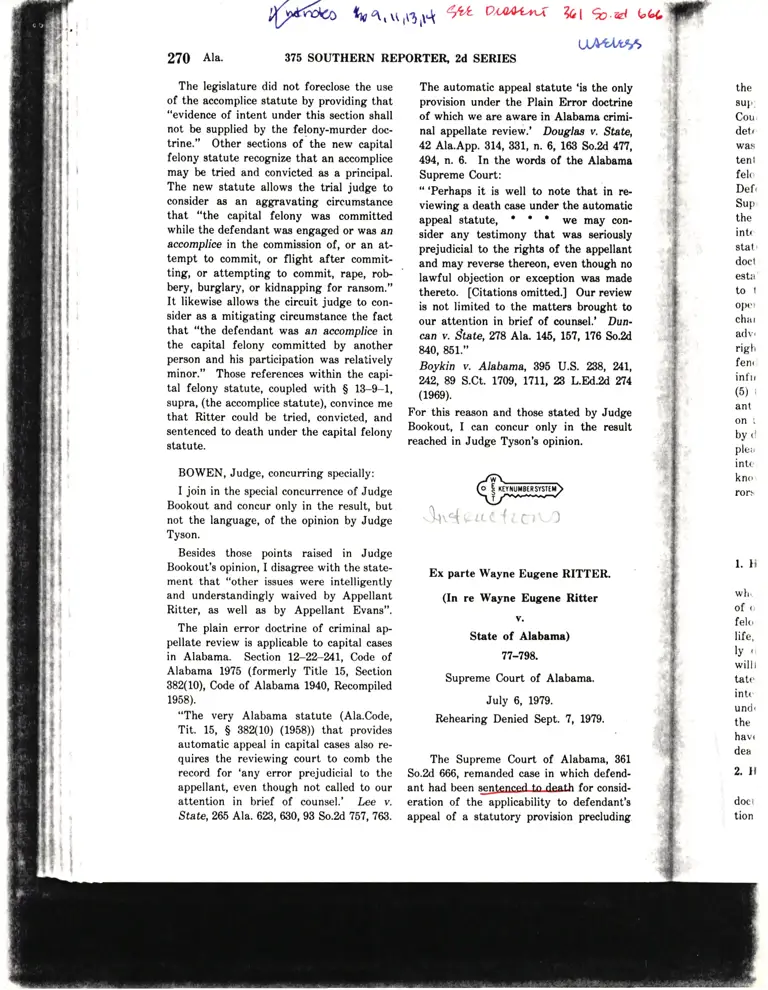
-
Case Files, Bozeman & Wilder Working Files. Ritter v. State Court Opinion, 1979. d6350b25-f092-ee11-be37-6045bdeb8873. LDF Archives, Thurgood Marshall Institute. https://ldfrecollection.org/archives/archives-search/archives-item/d254472f-d2e0-491e-8658-ab2b0971eeca/ritter-v-state-court-opinion. Accessed September 21, 2026.
Copied!
    270 Ala.

The legislature did not foreclose the use
of the accomplice statute by providing that
"evidence of intent under this section shall
not be supplied by the felony-murder doc-
trine." Other sections of the new capital
felony statute recog'nize that an aecomplice
may be tried and convicted as a principal.
The new statute allows the trial judge to
congider a8 an aggravating circumstance
that "the capital felony was committed
while the defendant was engaged or was an
accomplice in the commission of, or an at-
tempt to commit, or flight after commit
ting, or attempting to commit, rape, rob.
bery, burglary, or kidnapping for ransom."
It likewise allows the circuit judge to con-
sider as a mitigating circumstance the fact
that "the defendant was 8n accomplice in
the capital felony committed by another
person and his participation was relatively
minor." Those references within the capi-
tal felony statute, coupled with S 13-9-1,
supra, (the accomplice statute), convince me
that Ritter could be tried, convicted, and
sentenced to death under the capital felony
statute.

BOWEN, Judge, concurring specially:

I join in the special concurrenoe of Judge
Bookout and concur only in the result, but
not the language, of the opinion by Judge
Tyson.

Besides those points raised in Judge
Bookout's opinion, I disagree with the state-
ment that "other issues were intelligently
and understandingly waived by Appellant
Ritter, as well as by Appellant Evans".

The plain error doctrine of criminal ap-
pellate review is applicable to capital cases
in Alabama. Section l2-22-?ll, Code of
Alabama 1975 (formerly Title 15, Section
382(10), Code of Alabama 1940, Recompiled
1958).

"The very Alabama statute (Ala.Code,
Tit. 15, $ 38410) (1958)) that provides
automatic appeal in capital cases also re-
quires the reviewing court to comb the
record for 'any error prejudicial to the
appellant, even though not called to our
attention in brief of counsel.' l,ee v.

State,Zffi AIa.623, &30,93 So.zd 757,763.

l

I{

I
t
I
t

I

i
t
I

I

t

the
sul,
Cou,
detr
was
tenl
felt
Def,
sup
the
intr
stat,
docl
estu
tot
OIx'f

chttr
adv,
rigl,
fen,
infrr
(5) ,

ant
onl
by.'
ple;,

intr.
kno
rors

l. Ii

wh,.

ofr
felt,
life,
ly,
willr
tatr'
intr'
und,
the
hav,
dea

2.y

docr
tion

O{*" ruq,ur\trr.t qe'L oo+Lai kt %4 boL7;r
t^Jft,l,?h\

375 SOUTHERN REPORTER, 2d SERIES

The automatic appeal ststute 'is the only
provision under the Plain Error doctrine
of which we are aware in Alabama crimi-
nal appellate review.' Douglas v. Statc,
42 Ala.App. 814, 3i11, n. 6, 1&3 fu.?rl477,
494, n. 6. In the words of the Alabama
Supreme Court:

"'Perhaps it is well to note that in re'
viewing a death case under the automatic
appeal statute, ' ' t we may con-
sider any teetimony that was seriouely
prejudicial to the rights of the appellant

. and may neverse thereon, even though no
lawful objection or exception was made
thereto. [Citations omitted.] Our review
is not limited to the mattors brought to
our attention in brief of counael.' Dun-
can v. State, ?78 Ala. 146, 16?, 1?6 So.2d

840, 851."

Boykin v. Alabama,895 U.S. n:8, ?AL,

?t2,89 S.Ct. 1709, t?tt, iB L.EA.% n4
(1e6e).

For this rea{lon and those stated by Judge
Bookout, I can concur only in the result
reached in Judge Tyson's opinion.

Ex parte Wayne Eugene RITTER.

(In re 'ffayne Eugene Ritter

v.

State of Alabama)

77-798.

Supreme Court of Alabama.

July 6, 1979.

Rehearing Denied Sept. ?, 1979.

The Supreme Court of Alabama, 861

So.2d 666, remanded case in which defend-
ant had been ss!$c.nceilta-de8th for consid-
eration of the applicability to defendant's
appeal of a statutory provision precluding

--6\-Io t xrviluxgrnsvsttt)\,ry


the only
doctrine

na crimi-
v. State,
.o.%! 477,
Alabama

at in re-
. utomatic
.nay con-
seriously
appellant
,hough no
.vas made
tur review

'rought to
el.' Dun-
176 So.2d

23,8, ?{,
FA,?A N4

by Judge
the result

TTER.

itter

rma,

, 19?9.

,rlxrma, 861

rich defend-
, for consid-
defendant's
, precluding

EX IIARTE RITTER
Clte qs, AlE., 37t So.2d 2?0

the use of the felony-murder doctrine to is, one in which he should have known that
supply evidence of intent. On remand, the there was a substantial possibility that
Court of Criminal Appeals, 375 So.2d 266, someone would be killed.
determined that the felony-murder doctrine
was not improperly used to supply the in-
tent required to convict under the capital
felony statute and affirmed the conviction.
Defendant petitioned for certiorari, and the
Supreme Court, Faulkner, J., held that: (1)

the jury was not allowed to supply the
intent required under the capital felony
statute through the use of a felony-murder
doctrine; (2) the evidence was sufficient to
establish that defendant was an accomplice
to the intentional killing of a pawnshop

operator; (3) any error in the trial court's
charge on the law of accomplices did not
adversely affect defendant's substantial
rights and was knowingly waived by de-

fendant; (4) there was no constitutional
infirmity in imposing the death sentence;
(5) the possibility of any injury to defend-
ant from the trial court's failure to charge
on the elements of robbery was eliminated
by defendant's prior knowing and voluntary
plea of guilty to charges of robbery and
intentional killing; and (6) defendant
knowingly and voluntarily waived any er-
rors in the charge.

Affirmed.

Beatty, J., dissented.

1. Homicide e=18(l)
Under the felony-murder doctrine,

when a homicide is committed in the course

of or during an attempt to commit certain
felonies which are inherently dangerous to
life,t@,various-
ly described as mqllgealorelhousltg a

willful. deliberate. malicious and premedi-

tated killinq, is suoplied bv the criminal
intent involved in the underlvins felonv:
under the doctrine, it is not necessary that
the individual accused of murder should
have contemplated, intended or willed the
death of the victim.

2. Homlclde o-18(l)
C:]pgEI!y. undcr the felony-murder

doctrine stems from the accused's partieipa-
tion in an inherently dg!gg@y, that

Ara. 271

3. Homicide 618(f)
Felony-murder is murder in the first

degree, a crime punishable by life imprison-
ment. Code of A1a.1975, SS 13-1-?0, 13-1-
74.

4. Homicide 6354
The inclusion of accomplice liability as

a factor to be considered during the sen-

tencing hearing under both aggravating cir-
cumstances and mitigating circumstances
reflects a legislative intent that an accom-

plice in a capital felony can be sentenced to
death under the capital felony statute.
Code of Ala.l975, SS 13-11-5(4), 18-11-7(4).

5. Criminal Law e'59(l)
In order to hold an individual liable as

an accomplice, the State must prove that he

aided and abetted in the crime and, for
purposes of this rule, the terms "aided and
abetted" comprehend all assistance ren'
dered by acts or words of encouragement or
support or by actual or constructive pres-

ence to render assistance should it become

necessary.
See publication Words and Phrases

for other judicial constructions and
definitions.

6. Criminal Law c-59(l)
The key elements of accomplice liabili-

ty are encouragement or presence with a
view to render aid should it become neces'

sary and when liability is predicated on the
latter, it is essential that the principal was

aware of the accomplice's support and will'
ingness to lend assistsnce. Code of Ala.
1975, S 13-9-1.

7. Homicide e-18(5)
Record of trial of defendant charged

under the capital felony statute with the
intentional killing and robbery of a pawn'
shop owner established that the trial court
rlid noL impropcrly use the felony-murdor
doctrine to aupply the intont requlred to
convict under the capital felony statute.
Code of A1a.1976, $ l3-11-qb).

'i
tl


272 Ala.

8. Homicide e.249
Evidence that defendant and his com-

panion had a prior agreement that anyone

who attempted to go for his gun during
robbery would be killed and that defendant
and his companion had discussed and

planned for such possibility before the rob-
bery was sufficient to establish that defend-
ant was an accomplice to his companion's

intentional killing of pawnshop owner.

( $ Criminal 1,s$' c5792(3), 847
V Though trial court's jury charge on the

law of accomplices which stated "The law is
that anyone who aids or abets in the com-

mission of an offense must be indicted,
tried, and punished as if he were the princi'

/ pal" was admittedly brief and should pref-

\ erabty have included some explanation of

J thu t"r*. "aid" and "abet", any error did

/ not adversely affect defendant's substantial
'l rights and was knowingly waived when de-

I fendant did not offer any charge or object

f to ttre charge as given.

10. Constitutional Law e270(f)
Criminal Law el2l3
Evidence that it was defendant, not his

companion, who asked to see a .3S-caliber

revolver at pawnshop and began to load the
revolver with ammunition that he had

brought with him specifically for that pur-
pose and that it was defendant who carried
the revolver out of the pawnshop after his

companion shot the pawnshop operator es-

tablished that defendant was not a minor
participant in the robbery and killing and,

therefore, imposition of the death penalty
on defendant was not so disproportionate to
his involvement in the felony as to violate
the Eighth and Fourteenth Amendments.

U.S.C.A.Const. Amends. 8, 14.

@ Cri.inal Law F273.4(f)
At trial before a jury under the capital

felony statute, any Dossibilitv of i
defendant arisins from trial court'g failure
to-charce the iury on the elements ot the-

killing and robbery of a pawnshop operator.
Code of A1a.1975, S 13-f1-2(aX2).

375 SOUTHERN BEPORTE& 2d SERIES

12. Criminal Law e273.1(4)
Extremely thorough colloquy smong

trial judge, attorneys and defendant him'
self demonstrated that the trial judge as

well as defendant'e attorney made every

effort to insure that defendant understood

the benefits of a jury trial which would be

forfeited by a guilty plea and egtsblished

that defendant's plea of guilty to robbery

and intentional killing was knowing and

voluntary.

[s) c.i.inrl Law ca&{7
V D"f"nd"nt may knowingly and volun'l
tarily waive errors in the trial court's jury

I

charge. I

@ Crimin.t Law c=ll?2.1(l)
Where it was apparent that defendant

knowingly and voluntarily rglyerLgny er'
rors in the jury charge, any omissions in the

charge did not provide a basis for reversing
jury's finding that defendant was guilty of

robbery and intentional killing, for which
jury fixed defendant'e punishment at death

by electrocution. Code of A1a.1975' SS 18-

11-l et seq., 13-11-4aX2).

John L. Carroll, Montgomery, for peti'

tioner,

Charles A. Graddick, Atty. Gen., and JacL

M. Curtis, Asst. Atty. Gen', for the Stat€,

respondent.

FAUIKNER, Justice.

This appeal comes to this Court on certio
rari for the second time. Previously we

remanded to the Court of Criminal Appealr

for that court to consider whether or mt
the felony-murder doctrine was used to sup
ply the requisite intent under our capitd

felony statute. Evans and Rittcr v. Strtg
361 So.2d 666 (A1a.1978). On remand tbrt
court determined that the felony-murdr
doctrine was not so used and affirmed Rit'
ter's conviction. Rittcr v. State' [MS. Att3;

9, 19?81 3?5 So.2d 266 (Ala.Crim'APP

19?8). For the reasons set out below, re
also conclude that the conviction must b.
affirmed. r":

Ir

I
t,
1.\

I,
C

t,
il
fl
ot
br
ll.

on

de.

$
Str
Rit
te.
ori
A1

So.

Str

as

t<r

gi
al,
h,

Rr

or,

Sllr'
sta'
thr
36r
tiall
kiri
bot'
ofI

C8S('

"w,
duri
bef,
wha
him.
bacl

Fr
judr

actl
Ritr
thar
had

inr


)

'lloquy among
iefendant him-
trial judge as

y made every
,rnt understood
vhich would be
,nd estsblished
ilty to robbery
' knowing and

gly and volun-
ial court's jury

(l)
that defendant
waived any er-
,rmissions in the
,is for reversing
rt was guilty of
,ling, for which
hment at death

\1a.1975, SS 13-

rnery, for peti-

Gen., and Jack
for the State,

Court on certio-
Previously we

riminal Appeals
whether or not
.vas used to sup-
,der our capital
Ritter v. State,
)n remand that

felony-murder
,d affirmed Rit-
Itnte, [MS. Aug.
(Ala.Crim.App.
out below, we

viction must be

EX PARTE RITTER
Clte as, Ala., 376 tu.2d27$

Briefly, the facts of this case are as fol- were made to the cha

lows; Ritter, along with a companion, John Ritter "guilty as charged in the indictment"
Iouis Evans, was charged under the capital and fixed his punishment at death by elec-
felony statute, $ 13-11-2(a)(2), Code 1975, trocution. The trial judge subsequently
with the intentional'killing and robbery of conducted a sentencing hearing as required
Edward Nassar, a Mobile pawn shop owner. by $S 13-f1i and 13-11-4, Code 1976, and
Contrary to the repeated advice of his at- entered findings of fact regarding the ag-
torney, gravating and mitigating circumstances
tt " "t

*g". At arraignment and prior to listed in SS lS-f 1-6 and 13-11-7, Code
the entry of his guilty plea Ritter was thor- 1975. In his findings of fact the trial judge
oughly advised of his constitutional rights noted that, ". while Mr. Wayne Eu-
both by the trial judge and by his attorney gene Ritter was an accomplicc in the Capi-
in open court. Ritter was continuously hl Felony committed by another person, hia
asked if he understood what was being said, participation was not relatively minor, and
to which he replied that he did. He was by Mr. Ritter's own statement, bre_lEg-
given the opportunity to ask questions pared119. shoo! Mward A. Nessar, deceased,
about his rights and the trial procedure, but Urt c*fa n"t_1ife because his accomplice,

John L. Evans, III, was in his line of fire."
Ritter entered his guilty plea the trial judge The trial judge then ,,ac""pted,' the death
ordered the matter presented to a jury since penalty

", ri*"a by the jury.
only a jury may gentence a defendant to
death under our capital felony statute. FDLoNY-MURDER v' AccoMPLIcE LI'

S 13-11-1, et seq., Code 19?5. At trial the ABILITY

State presented a prima facie case against
Ritter which included his confession. (The

testimony of each witness is outlined in the
original opinion of the Court of Criminal
Appeals, Evans and Ritter v. State, 361

So.2d 654 (Ala.Crim.App.1977). After the
State rested, Ritter himself took the stand
and detailed the robbery and killing. (His
statement is set out in full in the opinion by
the Court of Criminal Appeals noted above.

361 So.2d at 660-661.) Although Ritter ini-
tially refused to say who fired the shot that
killed Nassar, it was apparent at trial from
both the State's evidence and the testimony
of Evans that it was Evans, not Ritter, who
actually fired the fatal shot. In this regard
Ritter testified that his gun was loaded and
that he would have killed Nassar if he had
had an opportunity, but "John [Evans] was
in my line of fire I was there in

se he missed." Ritter further stated,
"We knew we might have to kill somebody
during any robbery. We had discussed it

Ala. 213

The jury found

tl-31 The first issue presented for our
consideration is whether or not the jury was
allowed to supply the requisite intent under
the capital felony statute through the use

of the felony-murder doctrine. S f3-11-
2(b), Code 1975, specifically states: "Evi-
dence of intent under this section shall not
be supplied by the felony-murder doctrine."
The felony-murder doctrine provides that
when a homicide is committed in the course
of or during an attempt to commit certain
felonies which are inherently dangerous to
life, the inte"t *hi.h -".
s@(variously
described as malice aforethought, the spe-

cific intent to take life, or a willful, deliber-
ate, malicious, and premeditst€d killing) !g
s

the underlying felony. Under the doctrine
it]s@ttrat the individual ac-

cused of murder should have contemplated,
intended, or willed the death of the victim.
Hardley v. State,202 Ala.24, 79 So. 862

(1918); Kilgore v. State,74 AIa. I (1888);

Mitchell v. State,60 Ala. 26 (L877); Fields

i;
I
Irl
I

ir
j

I
lr
t

di
(l

I

I

before. If anybody went for a gun, that's
what was going to happen. We did kill
him, so, really, the only thing you can come

back with is the death penalty."

Following closing arguments the trial
jury. No objectionsjudge charged the

v. State, 62 Ala. 848 (f876).

tio-n in
"n

inh"*ntly d n"
in which he should have known that there

375 So2d-a


274 Ala.

was a substantial possibility that someone

would be killed. In this state felony-mur-
der is statutorily classified as murder in the
first degree, S 13-1-?0, Code 1975, a crime
punishable by life imprisonment. S 13-1-
74, Code 1975.

The felony-murder doctrine has been se-

verely criticized, primarily because in a va-

riety of fact situations it often operates to

charge an individual wiih first degree mur-
der when the accused did not have the
required intent for murder or when the
homicide was the result of the actions of a
third party over whom the accused had

little or no control. See e. g. W. LaFave &
A. Scott, Criminal Law 545461 (19?2);

Comment, The Constitutionality of Impos-

ing the Death Penalty for Felony Murder,
15 Hous.L.Rev. 356, 365-371 (1978); Com-

ment, Constitutional Limitations Upon the

Use of Statutory Criminal Presumptions

and the Felony-Murder Rule, 46 Miss.L.J.

1e21(1e?5)'T@-
ted from the Model Penal Code, lwhich in-

s@iumption
of extreme recklessness when a homicide

occurs in the course of certain felonies.

Model Penal Code $ 210.2 (Proposed Official
Draft, 1962). See also Model Penal Code

S 201.2, Comments, Para. 4 at 33 (Tent.

Draft No. 9, 1959). The use of the felony-

murder doctrine is considered particularly
harsh in the capital punishment context,
where constitutional safeguards and public

attitudes demand that the extreme penalty
be meted out only for the most reprehensi-

ble crimes. As one commentator has ob-

served, "[T]he death penalty is an untenable
sanction for negligent or accidental homi-

cide." 15 Hous.L.Rev. supra at 381. It
was, no doubt, this dissatisfaction with the

doctrine which led our legislature to prohib-

it its use in the trial of capital felonies in

$ 13-r1-2(b).

t44l The legislature did, however, indi-
cate that an accomplice in a capital felony

could be sentenced to death under our stat-
ute, for it included accomplice liability as a

factor to be considered during the sentenc-

ing hearing under both aggravating circum-

stances, S 13-11-6(4), and mitigating cir-

375 SOUTHERN REPORTER,2d SERIES

cumstances, S 13-11-7(4). The significant
distinction between use of the felony-mur-
der doctrine and use of accomplice liability
in this contpxt is that accomplice liability
requires a greatnr showing of the defend-

ant's individual intent. Under Alabam
law, in order to hold an individual as an

accomplice the State must prove that he

aided and abetted in the crime, terms which

"'comprehend all assistance rendered by

acts or words of encouragement or support

or presence, actual or constructive, to ren-

der assistance should it become necessary."'
Jones v. State,l74 Ala. i3, 57 So. 3l (f911).

As we noted in Jones, keY elements of
accomplice liability are encouragement or
presence "with a view to render aid should

it become necessary." When liability is

predicated on the lattcr it is essential that
the principal be aware of the accomplice's

support and willingness to lend assistance.

Jones, supra, Thus an accomplice, while he

may not have actually committed the crime

by delivering the blow or firing the shot,

has sanctioned and facilitated the crime so

that his culpability is comparable to that of
the principal. In Alabama' 8!l in many

states. this pre$ise is statutorily recognized

in *'ffiGrch abolished the old com-

mor=-I66-w<tistinctionsamongaccessoriesbe-
fore the fact, principals in the second de-

gree, and principals in the first degree and

provides that ". all Persons con-

cerned in the commission of a felopY,

w
slflqlitrSlbC-p$e6C-or aid or shet in its-
cgmmteii@
aft€r be indicted, trie

Pllnctpgls- . ' ""
[?,8] From the foregoing it is clear that

the felony-murder doctrine was not used in

this trial. (Indeed, it was never even men-

tioned.) Instead Ritter could be convicted

and sentenced to death under our capital

felony statute as an accomplice in the inten'

tional killing of Nassar. (There was slso

evidence from which the jury could have

found that Ritter, aside from his ststus a!

an accomplice, had the particularized intent

to kill. Of course, it is not contended that

Ritter is not fully liable as a principal for

\

s.

a

ci
A

jr
al
fr

As

di
ch

\{ri

clt
An'

for
en(

nol
rig'

I

pe,

ligir
ny
Fot.
tob
83:
min,
killir
ever
part
Ritt,
ealib
with
Specr

earri,
after
not sr


EX PARTE RITTER
Clte as, Ala., 375 So.2d 270

Ala. 275

the robbery.) The question then becomes,
did the State prove that Ritter was an
accomplice to the intentional killing? We
think that it did. Through Ritter's confes-
sion and again throufh his voluntary state-
ments at trial the State showed that Ritter
and Evans had a prior agreement that any-
one who attempted to go for a gun would
be killed. This possibility was discussed

beforehand and planned for. As Ritter
himself stated, the only reason he did not
shoot Nassar himself was because Evans
was in the way. Clearly Ritter encouraged
and supported the killing and was present
with Evans'knowledge to render assistance

should it become necessary.

tgl The further point is raised in this
appeal that the trial judge did not properly
charge the jury on the law of accomplices.

Apparently at the State's request the trial
judge charged, "The law is that anyone who
aids or abets in the commission of an of-

lfense must be indicted, tried, and punished

l as if he were the principal." The defendant

I aia not offer any charges or object to the

'charge as given. Admittedly, the charge

,t

.pificant
)ny-mur-
liabilitY
liabilitY

, defend-
Alabama
ral as an

' that he

ms which
,dered by
rr suPPort
e, to ren-
'cessary.t t'

31 (1911).

ements of
gement or

aid should
liabilitY is
,ential that

'.ccomplice's
assistance.

,:e, while he

'd the crime
rg the shot,

he crime so

le to that of
rs in manY

.v recognized
he old com-

cessories be-
,r second de-

I degree and

persons con-
,f a felony,
the act con-

,r abet in its
rt, must here-
punished as

rt is clear that
ls not used in
;er even men-

I lrc convicted
r)r our caPital
'e in the inten-
here was also

,ry could have

rr his atatus aa

'rultrized intcnt
,rrntended that
a princiPal for

was brief ln-
the terms "aid"

.and "abet." NEertheless, we beTiile that,
for the same reasons stated below in refer-
ence to the robbery charge, any error did
not adversely affect Ritter's substantial
rights and was knowingly waived by Ritter.

UOl Ritter also contends that the death
penalty is a disproportionate sentence in
light of his involvement in the capital felo-
ny and therefore violates the Eighth and
Fourteenth Amendments. Ritter attempts
to bolster his position by portraying himself
as a mere accomplice to the robbery, "a
minor participant" in a crime which led to a
killing by someone else. The record, how-
ever, refutes this description of Ritter's
part in the crime at every point. It was
Ritter, not Evans, who asked to see a .38

caliber Colt revolver, who began to load it
with ammunition hc had brought with him
clrccifimlly for this l)url)osc, trnrl who

carricrl thc revolver out of the plwn shop

after Nassar was shot. Thus Ritter could

not seriously be considered a "minor partici-

pant" in the robbery, and, as we have noted
above, he was clearly an accomplice to the
killing.

With this mone accur&te description of
Ritter's participation in the intentional kill-
ing and robbery in mind we must consider
whether the death penalty is a dispropor-
tionate sentence for an accomplice to the
killing. This is a question which has not
yet been decided by the Unitcd States Su-
preme Court, although several cases before
that Court have raised the issue. See Lock-
ett v. Ohio,4i!8 U.S. 586, 98 S.Ct. 2954, 67

L.Ed.2d 973 (1978); Bell v. Oho, 488 U.S.
6il?, 98 S.Ct. 2977, 57 L.FA.ZI1010 (1978);

Woodson v. North Carclina,428 U.S. Zl0, 96

S.Ct. 2978, 49 L.Fd.2d 944 (1976). In each

of these cases the Court reversed on other
grounds and did not reach the issue of
disproportionality. While we opine that
there may be situations where an aocom-
plice's participation is so minor that the
death penalty would be constitutionally im-
permissible, such is not the case here. As
the trial judge stated, Ritter's participation
was not relatively minor. The Court of
Criminal Appeals agreed, and so do we.

Ritter stands at the most culpable end of
the spectrum of accomplice liability. He is
closer to an individual who fires a non-fatal
shot in a killing rather than one who waits
outside as a lookout. By Ritter's own state-
ment it was mere fortuity which made John
Evans the triggerman and not Rittcr. Con-
sequently, we see no constitutional infirmi-
ty in imposing the death sentence in thie
case.

THE ROBBERY CHARGE

UU By way of supplemental brief Rit-
ter asserts that the trial judge committed
reversible error by failinq to charqe the
j@. lnclem-
ents v. Statc,370 So.2d 723 (Ala.19?9), we

noted that an instruction on the elements of
robbery must be given when a defendant is
charged under $ 13-f1-2(aX2), as wae Rit
ter. It is undisputed that no charge ex'
Jrlaining robbcry waa given to the jury hore.

u2I

ir
L

ll
tl
1t

li
il
,l
I

li

ever. lead to a reversal in this caEe.

39(k), TRCP, now providee:

i
I

i
I
I
i
I
I
I


276 Ala. 375 SOUTHERN RI]PORTE& 2d SERIES

"In all cases in which the death penalty [13, f4] We also decline to reverse this
has been imposed, upon review of the case on the basis of any omissions in the
opinion of the court of criminal appeals charge because it is apparent that Ritter
oncertiorari,thesupreme,courtmayno.knowinglyandv@
tice any plain error or defect in the pro- ro>iql.he-g@. That such.a waiver may
eeeding under review, whether or not tlke place goes-without saying, since de-
brought to the attention of the trial fendants are regularly allowed to waive the
court, and take appropriate appellate ac- entire panoply of constitutional rights, as
tion by reason thereof, whenever such well as those accorded under state law. (In
error has or probably has adversely af- fact, in the present case Ritter waived a
fected the substantial rights of the peti- challenge to the make-up of the grand and
tioner. (Amended L0-2*78, eff. 12-1- petit juries which had previously been de-
78.)" clared unconstitutional by the United

In the instant case it is abundantly clear States District Court.) Here Ritter volun-

r
,
a

i

I
i
i
t
I
I

:.

I

i
I

I

that no injury resulted from the trial tarily maintained a counre of assisting the
jrag"'. *i..i"* Un9g_!h" "i."r-ttr*., State in proving its case, even to the point

Cr

Y.
al'
B.'
h,'

l.(

con
8ft.'
rool,
scior

in,
whir
that
bee r.

u8e(l
gesl

ruch

2. C,
i

defer

t of telling the jury himself from the witness
t stand, "the only thing you san come back
earlier plea of guilty. with is the death penalty." Consequently,

tn ttris regard we note that Ritter's guilty we can only conclude that his failure to
plea was without doubt knowingly and vol- object to the charge, to present proposed

untarily entered. Prior to his arraignment charges, or otherwise to bring any omissions

Ritter filed a "motion of intent to enter in the charge to the court's attention was I
guilty plea" which, among other matters, calculated decision on the part of Ritter
asserted, "That the defendant has openly himself, and not an oversight on the part of
and publicly admitted his guilt after being his attorney. To grant a reversal now, un-
advised of his constitutional rights numer- der these circumstances, on the basis of the
ous times, and still admits his guilt as charge would be a travesty of justice and

charged in both indictments." At his ar- would simply invite defendants to ignore
raignment Ritter was advised of his rights errors during a trial in the hopes that, if
under both the United States Constitution convicted and reverred on appeal, a second

and state law. Indeed, the colloquy smong jury would be more lenient.
the trial judge, the attorneys, and Ritter
himself was extremely thorough and dem- For the foregoing reasons petitioner's

onstrates that the trial judge as well as conviction and sentence of death is 8f-

Ritter's attorney made every effort to as- firmed'

sure that Ritter understood the benefits of AFFIRMED'

a jury trial which would be forfeited by a
plea of guilty. Nevertheless, against the TORBERT' C' J'' and BLOODWORTH'

advice of his attorney, Ritter entered a MADDOX' JONES' ALMON' SHORES and

guilty plea to the robLery and intentional EMBRY' JJ', concur'

killing of Nassar. (He also pled guilty to BEATTY, J., dissents.
the robbery of a Radio Shack in Mobile.)
The trial judge, however, did not accept the BEATTY' Justice (dissenting):

guilty plea but instead set the matter for I adhere to the views expressed in my

presentation to a jury. At the trial the dissent(in Evans v. State, Ala.,r361 So.2l

Stutu p...unted its case in considerable de- 666 (1978)'l "-----
tnil and showotl ench of thc clenrents of - ('
robbcry, all of which were admittcd by Rit-
ter on the witness stand. Thus Ritter, aftcr
having entered a guilty plea, had the addi-

tional benefit of a full jury trial as well.

an

ci;'
f1,t i

SC;

pr,
ger

SU(

Phi
sta
ttc(

cal
pr(

tior