Correspondence between Chachkin and Court; from Miller to Caldwell; Brief for Appellants (Redacted)
Correspondence
December 15, 1970 - December 18, 1970
50 pages
-
Case Files, Milliken Hardbacks. Correspondence between Chachkin and Court; from Miller to Caldwell; Brief for Appellants (Redacted), 1970. 266c6025-0b0f-f011-9989-0022482c18b0. LDF Archives, Thurgood Marshall Institute. https://ldfrecollection.org/archives/archives-search/archives-item/d4093d79-b3a2-4268-acaf-e25c78368f92/correspondence-between-chachkin-and-court-from-miller-to-caldwell-brief-for-appellants-redacted. Accessed October 06, 2026.
Copied!
#
December 18 , 197 0
Honorable Harry Phillips
Chief Judge U.S. Court of Appeals
for the Sixth Circuit
U.S. C ou r th ouse
Nashvi11e, Tennessee
Honorable John Peck
U.S. Ci.rcu it Judge
U.S. Courthouse
C inc innat i , Oh io
Honorable George Edwards, Jr.
U . S.. Circuit Judge
U .S . Cour thous e
Detrioc, Michigan
RE Bradley v ie053£
1:, and
.C: ~y*~
. X- Appe11 a
in the alterna
.s case which w
Judge Edwards:
In connection with the Br:
and Motion for Summary Reversal or,
for injunction pending appeal in th;
filed today, I wish to direct the Court's attention
to a decision reported in the latest copy of the aa~~ ̂
vance sheets for Federal Reporter received at my o£ f j-C».
I regret that I had not had an opportunity to read ̂
the decision prior to the completion of the brief in
Memphis.
131
In U .S .v . Texas Education Agency, 431 F. h
(Fifth Circuit," 1970), a panel granted per curiam
- -i • _ _ “L.. ... -i vnsummary reversal of an order delaying a hearing 1“
school desegregation cases until after the start
the school year.
? o1 0 C O L U M B U S C I R C L E 5 8 6 - 8 3 9 7 N E W Y O R K , N . Y
• #
Honorable Harry Phillips, Honorable John Peck,
and Honorable George Edwards, Jr.
December 18, 1970
Page 2
I regret not having been able to include
this citation in the Brief for Appellants, but I
am taking the liberty of calling it to the Court's
attention because it is so apposite to our situation
in Detroit.
Respectfully yours,
Norman J. Chachkin
NJC:am
cc: all counsel
{
N E W Y O R K ,l O C O L U M B U S C I R C L E S 8 6 - 8 3 9 7 N . Y . 1 0 0 1 9
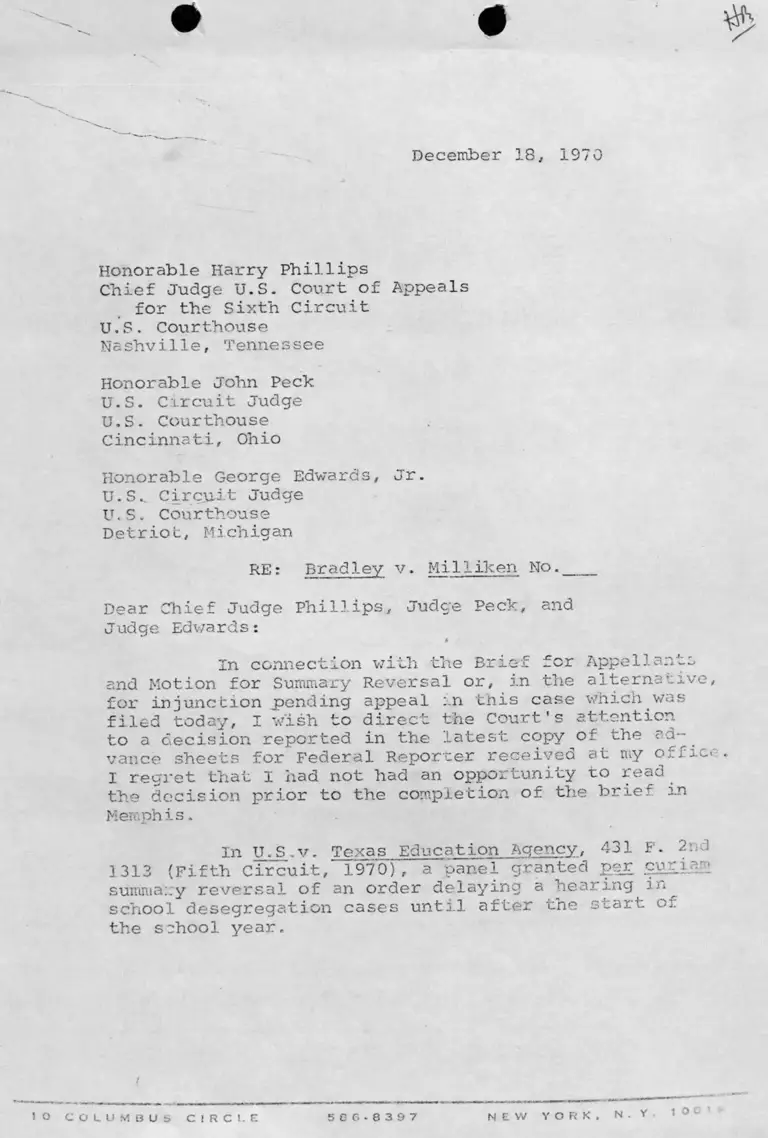
December 18, 1970
Honorable Harry Phillips
Chief Judge U.S. Court of Appeals
for the Sixth Circuit
U.S. Courthouse
Nashville, Tennessee
Honorable John Peck
U.S. Circuit Judge
U.S. Courthouse
Cincinnati, Ohio
Honorable George Edwards, Jr.
U.S. Circuit Judge
U.S. Courthouse
Detriot, Michigan
RE: Bradley v. Milliken No.
*
i
Dear Chief Judge Phillips, Judge Peck, and
Judge Edwards:
IIn connection with the Brief for Appellants
and Motion for Summary Reversal or, in the alternative,
for injunction ̂ pending appeal in this case which was
filed today, I wish to direct the Court's attention
to a decision reported in the latest copy of the ad-^
vance sheets for Federal Reporter received at ray office.
I regret that I had not had an opportunity to read^
the decision prior to the completion of the brief in
Memphis. j
In U.S.v. Texas Education Agency, 431 F. 2nd
1313 (Fifth Circuit, 1970),'a panel granted per curiam
summary reversal of an order delaying a hearing in-
school desegregation cases until after the start of
the school year.
.
O Ot o C O L U M B U S C I R C L E 5 8 6 - 8 3 9 7 N E W Y O R K , N . Y .
»
Honorable Harry Phillips, Honorable John Peck,
and Honorable George Edwards, Jr.
December 18, 1970
Page 2
I regret not having been able to include
this citation in the Brief for Appellants, but I
am taking the liberty of calling it to the Court's
attention because it is so apposite to our situation in Detroit.
Respectfully yours,
- / / / ■ Q / m , // / / /!, ? ' / f s**/.r ( yAjly /
i, u" V is
Norman J. Chachkin
NJC:am
cc: all counsel
/
l O C O L U M B U S C I R C L E 5 8 6 - 8 3 9 7 N E W Y O R K , N . Y . 1 0 0 1 9
21,03*
O FFICE OF THE CLERK
C A R L W . R E U S S
CLERK
U N IT E D S T A T E S C O U R T O F A P P E A L S
F O R T H E S IX T H C I R C U I T
C IN C IN N A T I , O H I O 4 5 2 0 2December 17? 1970
Mr. William E. Caldwell
Mr. Louis R. Lucas
Memphis, Tennessee
Mr. Nathaniel Jones
N.A.A.C.P.
New York, New York
Mr. Jack Greenberg
Mr. James M. Nabrit, 111
New York, New York
Mr. Bruce Miller
Miss Lucille Watts
N.A.A,C*P.
Detroit, Michigan
Re: Ronald Bradley and Richard Bradley
et Plaintiffs-Appellants,
vs No. 21,Q3frWilliam J. Milliken, Governor of
the State of Michigan, et al,Defendants-Appellees.
Gentlemen:
We have today filed the certified record on appeal
and docketed the above-styled case as No. 21,031 in this
Court. Receipt for the $25.00 filing fee is enclosed to
Mr. Caldwell and Mr. Lucas.
Please take note of the enclosed Notices Concerning
Sixth Circuit Policy.
ance.
Please sign and return the enclosed entry of appear-
Very truly yours,
cc: Mr. George E. Bushnell, Jr.
Mr. Carl H. Von Ende2500 Detroit Bank & Trust Bldg.
Detroit, Michigan 48226
Mr. Frank J. Kelley
Attorney General of Michigan
525 W. Ottawa Lansing, Michigan
9 9
IN THE UNITED STATES COURT OP APPEALS
FOR THE SIXTH CIRCUIT
NO.
RONALD BRADLEY,
vs.
et al.,
Plaintiffs-Appellants,
WILLIAM G. MILLIKEN, et al.,
Defendants-Appellees,
DETROIT FEDERATION OF TEACHERS, LOCAL 231
AMERICAN FEDERATION OF TEACHERS, AFL-CIO,
Defendant-Intervenor.
BRIEF FOR APPELLANTS
Of counsel:
J. HAROLD FLANNERY
PAUL DIMOND
Center for Law and
Education, Harvard
University
Cambridge, Massachusetts
f/
i
LOUIS R. LUCAS
WILLIAM E. CALDWELL
Ratner, Sugarmon & Lucas
525 Commerce Title Bldg.
Memphis, Tennessee 38103
E. WINTHER McCROOM
3245 Woodburn Avenue
Cincinnati, Ohio 45207
NATHANIEL JONES
General Counsel, N.A.A.C.P.
1790 Broadway New York, New York
JACK GREENBERG
JAMES M. NABRIT, III
NORMAN J. CHACHKIN
10 Columbus Circle
New York, New York 10019
BRUCE MILLER and
LUCILLE WATTS, Attorneys for
Legal Redress Committee
N.A.A.C.P., Detroit Branch
342b Cadillac Towers
Detroit, Michigan
Attorneys for Appellants
Page
Table of Cases................................... ii
Preliminary Statement •• ...................... 1
Issues Presented for Review .......... • • • • • 3
Stat e m e n t ............ ^
Procedural History • • • • • • • • • • • • • 4
The Rulings Below . . . ........................9
The April 7 Plan ............................. 10
Alternative Proposals.................... . 14
A. The McDonald P l a n .................... 15
B. The Campbell Plan • .................. 18
C. Staff Proposals...................... 19
Further Continuance of the Trial
on the Merits......................... . . . 21
ARGUMENT....................................... 25
Introduction.............. . # 2 6
The District Court's Postponement of Relief
Until September, 1971 Denies Plaintiffs'
Constitutional Rights In Direct Violation Of
The Rule Of Alexander v. Holmes County Board
of Education and Carter v. West" Feliciana
Parish School Board . .........................28
The District Court Erred In Approving A Free'
Choice Plan Despite Compelling Evidence That
The Technique Had Never Worked in Detroit,
And On The Explicit Ground of White Community
Hostility To Other, More Effective Means Of
Desegregation........ .................. .. • 32
Further Delay of The Trial On The Merits
Results In Denial Of Plaintiffs' Fourteenth
Amendment Rights .............. 42
Conclusion ................. .................... ..
TABLE OF CONTENTS
IN THE UNITED STATES COURT OF APPEALS
FOR THE SIXTH CIRCUIT
NO. _____
RONALD BRADLEY, et al.,
Plaintiff s-Appe Hants,
vs.
WILLIAM G. MILLIKEN, et al.,
Defendants-Appellees,
DETROIT FEDERATION OF TEACHERS, LOCAL 231
AMERICAN FEDERATION OF TEACHERS, AFL-CIO,
Defendant-Intervenor.
BRIEF FOR APPELLANTS
\ Preliminary Statement
Appellants file this Brief both as their submis
sion in chief to this Court on the pending appeal, and also
in support of their Motion for Summary Reversal or in the
Alternative for Injunction Pending Appeal, and for Leave to
Proceed Upon the Original Papers filed herewith.
• •
The necessity for expedited action by this Court
arises because this is an appeal from the denial of the motion
below seeking implementation of the April 7, 1970 plan of
school desegregation exactly as adopted and unrescinded by the
Detroit School Board. Extraordinary procedures shortening
the normal processing time for an appeal are required if
tenth graders are to be accorded their Constitutional right
to attend a high school with an improved racial balance effec
tive with the February 1, 1971 commencement of the second
semester of the current school year. Failure to give such
relief would be to give full force and effect to the first
sentence of Section 12 of Act 48 of the 1970 Michigan Legis
lature — a provision ruled unconstitutional by this Court on
October 13, 1970 in Bradley v. Milliken, ___ F.2d __, No.
20794 (6th Cir., October 13, 1970).
There is ample precedent in this and other Circuits
for expeditious appeal in school desegregation cases. E.g•,
Bradley v. Milliken, supra; Singleton v. Jackson Municipal
Separate School Dist., 419 F.2d 1211, 1222 (5th Cir. 1969);
Boykins v. Fairfield Bd. of Educ., 421 F.2d 1330, 1331 n.l,
1332 (5th Cir. 1970); United States v. School Bd. of Franklin
City, 428 F.2d 373 (4th Cir. 1970). Appellate procedures
should be "suitably adopted" to follow the "immediacy" require
ment of the substantive law as stated in Alexander v. Holmes
County Bd. of Educ., 396 U.S. 19 (19^9). See Moses v. Wash
ington Parish School Bd., 421 F.2d 658 (5th Cir. 1970).
-2-
• •
>
[ Issues Presented for Review
i
On April 7, 1970, the Detroit Board of Education
adopted a high school desegregation plan affecting twelve
Detroit high school entering-tenth-grade classes in September,
1970. The operation of that plan was suspended prior to its
implementation by Section 12 of Act 48 of the 1970 Michigan
Legislature, October 13, 1970, on appeal from the district
court's denial of a preliminary injunction, this Court declared
that section of the law unconstitutional and remanded the
cause. December 3, 1970, the lower court denied plaintiffs'
motion to implement the April 7 plan for the second semester
of the current school year, delayed the trial on the merits
a second time, and ordered into September, 1971 effect a "free
choice" plan.
1. Did the court below err in perpetuating, for
the second semester of the 1970-71 school year, the racial
separation of pupils effected by Act 48?
2. Did the court below err in granting defendants'
motion for a second continuance of the trial on the merits?
i
-3-
Statement
Procedural History
This action was commenced August 18, 1970 to deseg
regate the public schools of the City of Detroit. The matter
was tried August 27* 1970 before Honorable Stephen J. Roth,
United States District Judge, on plaintiffs-appellants1
1/ 2/Motion for Preliminary Injunction. (A. 1 ) September 3,
1/ This action is a classic Fourteenth Amendment suit seek
ing complete desegregation of the Detroit public school
system, as well as declaratory and injunctive relief against
certain provisions of Act 48 of the 1970 Michigan Legislature.
By way of preliminary relief, plaintiffs sought to: (l) en
join defendants from giving any force or effect to §12 of Act
48; (2) require September, 1970 implementation of the April 7
partial high school desegregation plan on an accelerated basis,
eliminating therefrom the three-year stair-step approach and
the brother-sister exception; (3) enjoin defendants from im
plementing the eight racially segregated administrative
regions drawn pursuant to Act 48, or from taking any steps
which would impair implementation of the seven racially inte
grated regions as adopted by the defendant Board on April 7»
1970; (4) enjoin the defendant Board from all further school
construction until a Constitutional plan of operation had been
approved; (5 ) require September, 1970 assignment and/or
reassignment of faculty members in accordance with the system-
wide ratio of black and white faculty members.
The district court scheduled the August 27 hearing as a
full trial on the merits, but on the second day of the hear
ing (August 28, 1970), the court limited its scope to the
matters presented in plaintiffs’ Motion for Preliminary In
junction. The thrust of plaintiffs’ presentation on the
trial days of August 28 and September 1, 1970 was directed at
§12 of Act 48 and implementation of the April 7 plan by the
commencement of the school year, which began on September 8,
1970.
The relationship of §12 of Act 48 to the April 7 plan (i.e.,
§12 suspended and, in effect, prohibited implementation and
operation of the April 7 plan) is set out in this Court's
October 13, 1970 opinion. Bradley v. Mill!ken, supra, slip
op. at pp. 5-8, 13.
2/ "A. M references are to the Appendix to this Brief. By
separate motion filed herewith, plaintiffs seek leave to
-4-
#
1970, the district court denied the motion for preliminary
relief and dismissed the action as to the Governor and
Attorney General of Michigan.
Plaintiffs immediately appealed to this Court; the
matter was heard by the Chief Judge upon plaintiffs' Motion
for Injunction Pending Appeal, and then by a panel of this
Court on an expedited basis pursuant to the order of the
3/ ;Chief Judge denying the Motion. October 13, 1970, this
Court reversed the judgment of the district court insofar as
it dismissed the State defendants and insofar as it upheld
the constitutionality of §12 of Act 48. The district court's
denial of plaintiffs' motion for preliminary injunction was
affirmed, however, because
The complaint in the present case seeks relief
going beyond the scope of the plan of April 7,
1970, and Act 48, such as the assignment of
teachers, principals and other school personnel
2/ (continued) proceed on the original papers without the
necessity of filing the Appendix required by Rule 30,
F.R.A.P.. See Rule 30(f), F.R.A.P.. Due to printing limi
tations, plaintiffs are filing only four (4) copies of the
Brief Appendix at this time but will submit additional
copies as soon as they are reproduced.
3/ The Motion for Injunction Pending Appeal, heard in Nash
ville on September 8, 1970 before the Chief Judge pursuant
to Rule 8, F.R.A.P., sought only to enjoin the effect of §12
of Act 48 insofar as it impeded implementation of the April 7
plan and to preserve the status quo by immediate implementation
of the plan. In his September 11 order denying the Motion,
the Chief Judge advanced the appeal for hearing on the merits
before a panel of this Court on October 2, 1970 (A. 5 ).
. r
i •'
t • .
-5-
#
to each school in accordance with the ratio
of white and Negro personnel throughout the
Detroit school system, and an injunction
against all future construction of public
school buildings pending Court approval. As
previously stated, the District Judge not
only conducted an expeditious hearing on the
application for a preliminary injunction,
but has advanced the case on his docket to
November 2, 1970 and allotted two weeks for
the trial. '2/
We conclude that the issues presented in
this case, involving the public school
system of a large city, can best be determined
only after a full evidentiary hearing.
Bradley v. Milliken, supra, slip op. at p. 14.
Upon remand, plaintiffs filed in the district court
on October 30, 1970 a motion limited to requesting immediate
5/implementation of the April 7 plan. November 4, 1970* the
district court continued the trial on the merits to December
8 and conducted instead a hearing on plaintiffs' motion to
6/implement the April 7 plan.
4/ The November 2 trial date was subsequently changed by the
district court to November 4 because of a judges' confer
ence .
5/ This motion did not seek elimination of the stair-step '
and brother-sister features of the April 7 plan but
merely implementation of the plan as to students who entered
the tenth grade in September and as to those who will enter
the tenth grade at the beginning of the second semester,
February 1, 1971*
6/ Plaintiffs acquiesced in the continuance upon the basis
that the district court set a definite December trial date.
-6-
At that hearing, Superintendent Drachler testified
that his staff was studying the April 7 plan in light of the
pupil racial count which had just been completed, in an ef
fort to determine whether the April 7 plan needed certain
modifications so as to accomplish the desired result (11/4 Tr.
7/38-40). At the conclusion of the hearing, the district
court took under advisement the motion to implement the April
7 plan, stating that
(i)n order to provide the Board of Education
with an opportunity to demonstrate what Mr.
Bushnell (Detroit Board’s attorney) says
they are planning to do and what they nope to
do and what they hope to achieve in the way
of implementing the April 7, Plan or an updated
version of it, I will give the Board an op
portunity to, not later than November 16,
submit a plan which the Court may find accept
able and one designed to become effective aS/o / q /\
of February 1, 1971 (A. l6 ).
November 6, 1970, the district court entered an order
requiring
that no later than November 16, 1970,
Defendant Detroit Board of Education submit
7/ The transcripts of the three hearings in this cause nave
not been paginated consecutively. Transcript citations
are therefore preceded by the date on which each hearing
commenced. The first hearing was held August 27, 28 and
September 1, 1970; the second, November 4, 1970; and the
third, November 18, 19 and 25, 1970.
8/ That portion of the November 4 transcript containing the
district court's oral ruling was typed separately and is
reproduced in the Brief Appendix, A. 15 -20 .
9/ The district court's reference to "what Mr. Bushnell says
they are planning to do" relates to statements similar to
the following: "And there has been a consensus as between
board superintendent and counsel that this board in light of
the Court of Appeals decision is under an obligation to
either implement the April 7 plan or its equivalent, depend
ing upon how the facts develop . . . " (11/4 Tr. 27;. See
also, 11/4 Tr. 53; 11/4 Tr. 55; 11/4 Tr. 56.
-7-
#
a high school attendance area plan to this
Court consisting of that portion of tne
action taken by Defendant Detroit Board of
Education on April 7, 1970, going to the
changing of attendance areas of certain
named high schools in the City of Detroit,
or an updated version thereof which achieves
no less pupil integration; the" said plan
to be submitted to this Court is to become
effective and shall be implemented on the
first day of the Spring Semester of the school
year 197O-1971, being February 1, 19 71. (A.
21 )(emphasis supplied).
November 16, 1970, following a special Board of
Education meeting, counsel for the Board filed, in addition
to the April 7 (Plan "C") plan of integration,-^^ two addi
tional plans referred to respectively as the ’’McDonald Plan"
(Plan "A" or "Magnet School Plan") and the "Campbell Plan"
(Plan "B” or "Magnet Curriculum Plan") (A. 23 -39 )• At its
meeting, the Board designated "priorities," assigning top
priority to the McDonald Plan, followed by the Campbell Plan
and the April 7 plan. The district court conducted a hearing
on the plans November 18, 19 and 25, 1970.
November 19, 1970, the Detroit Board filed a motion
to continue the trial on the merits "from December 8, 1970 to
a date certain on or after Monday, January 18, 1971" (A. 40 ).
Plaintiffs opposed the motion for continuance (11/18 Tr. 236).
At the conclusion of the evidence and following
arguments of counsel on November 25* 1970* the district court
10/ The April 7 plan is contained in plaintiffs' Complaint as
Exhibit D thereto (A. 49 ) and also in the official minutes
of the April 7, 1970 meeting of the Board (Defendants' Exhibit
F, A. 63-65)•
-8-
• •
J
. /
r
took the case under advisement but stated that the pretrial
conference which had been set for December 3, 1970 would go
on as scheduled (11/18 Tr. 368). On that date, however, the
conference was obviated by the court's "Ruling on School Plans
Submitted" (A. 90 ) and "Ruling on Motion for Continuance"(A.
100). The same day, the district court entered its order in
accordance with the rulings (A. 102) and plaintiffs filed
Notice of Appeal (A. 104),
The Rulings Below
In its "Ruling on Motion for Continuance" the dis
trict court granted the Board's motion "for a continuance to
a date to be fixed by the Court"; counsel for plaintiffs were
subsequently advised in Chambers that the trial would take
place some time in late March or April, the exact date to be
fixed at a later time.
In its "Ruling on School Plans Submitted," the
district court, despite its finding "that any action or failure
to act by the Board of Education designed in effect to 'delay,
obstruct or nullify' the previous (April 7th) step toward
improving racial balance in the Detroit schools is prohibited
State action, approved the McDonald Plan and ordered that
ii/ The court also held, on the basis of this Court's October
13 decision and the cases cited by this Court in its
opinion (slip op. at pp. 10-1 1 ), that "where a school district
has taken steps enhancing integration in its schools it may
not reverse direction. In the setting of our case nonaction
is (or amounts to) prohibited action" (A. 98 ).
-9-
• •
"preparations should be started immediately for its insti
tution at the beginning of the next full school year in
September 1971" (A.98-99) (emphasis supplied).
The April 7 Plan
This Court already has considerable familiarity with
the April 7, 1970 plan of high school desegregation from the
previous proceedings in this cause. By way of reiteration,
the April 7 plan provided changes which would "affect 18
junior high school feeder patterns out of 55 and will influence
12 senior high schools" (Defendants* Exhibit F at 504, A. 64 ).
The passage of time has not made any basic change in
the effect. The staff task force report (see ;n.25 infra)
i t
describes the situation as follows:
Although changes in racial percentages have
occurred during the past year, the relation
ship of the paired schools in that plan are
still, relatively, the same. (IS/) That is,
Redford, Cody, Osborn, Denby, Western and Ford
have a significant majority of white students.
Mackenzie, Cooley, Mumford, Pershing, Kettering
and Southwestern have a preponderance of black
students. It should be noted that all boundary
changes occur within the established eight re
gions, with the exception of the Denby-Kettering,. /
areas. (Plaintiffs' Exhibit 13, A. 123). '±2/
12/ An increase in racial isolation in Detroit's high schools
was noted by Superintendent Drachler at the November 4
hearing (11/4 Tr. 5)*
13/ "If, the April 7 plan is compared to the current 8-region
organization, it is apparent that all facets of that plan
may be initiated within the current organization, except Denby-
Kettering. The fact of a violation of region boundaries as a
requirement to re-institute April 7 should not be a major de
terrent to carrying out the plan. Precedent exists currently
in the Post-Cooley, Burroughs-Kettering, and the Vernor-
Vandenberg-Ford combinations for student attendance areas which
do not fit adult voting areas." (Plaintiffs' Exhibit 11, A. 126).
-10-
0 0
The April 7 plan would he effectuated by changing
the attendance area boundary lines separating the twelve
high schools from a north-south to an east-west direction
(11/4 Tr. 38), affording more efficient utilization of exist
ing public transit routes in Detroit (11/18 Tr. 254-55)* It?
would involve the movement of only 1% of Detroit's public
school enrollment for the 1970-71 school year (8/27 Tr. 222,
231) and would affect only 3$ to 4$ of the total system popu
lation over the three-year full implementation period (8/27 Tr.
232-33). The plan would not cause any increase in the number
of schools operating on extended-day sessions (11/18 Tr. 295)
with a few individual exceptions, there would be no problem of
subject-matter continuity for those students who would change
schools under the plan (11/4 Tr. 8-9); it would not require
building or equipment changes (11/4 Tr. 13); and only one or
two teacher changes would be necessitated by the April 7 plan
(11/4 Tr. 16).
The following table demonstrates the effect of the
April 7 plan as compared to the current enrollment and
racial composition of Detroit's 21 attendance-area high
schools:
/
r/
i
- i i -
w
*
High Schools*
#
Current Enrollment**
Total Black % Black
Pr^^scted
% Black
Without April
7 Plan***
Projected
% Black
Under April
7 Plan****
1 . Central 2140 2140 100%
2. Chadsey 1654 907 54.8%
3. CODY 3516 141 4% 3.3% 9.7%
4. COOLEY 2876 2192 76.2% 61.5% 53%
5. DENBY 2949 73 2.5% 2.4% 19.3%
6. Finney 2658 973 36.6%
7. FORD 3082 617 20% 13.5% 16.3%
8. KETTERING 3472 3373 97.1% 91.4% 81.3%
9. King 1879 1876 99.8%
10. MACKENZIE 3250 3145 96.8% 90.7% 83.8%
1 1 . MUMFORD 3059 3001 98.1% 95.8% 94.9%
12. Murray-Wright 2072 1974 95.3%
13. Northeastern 1437 1339 93.2%
14. Northern 1767 1748 98.9%
15. Northwestern 2981 2977 99.9%
16. OSBORN 3071 431 14% 17.5% 22.6%
17. PERSHING 3244 2069 63.8% 58.3% 50.9%
18. REDFORD 3781 107 2.8% 3.6% 11.4%
19. Southeastern 2710 2630 97%
20. SOUTHWESTERN 1767 1312 74.3% - 71.3%
2 1. WESTERN 2241 827 36.9% - 39.2%
* The underlined schools are the twelve high schools affected
by the April 7 plan.
** The "Current Enrollment" columns are taken from the defendant
Board' s Oct.1970 racial count (Plaintiffs' Exhibit 10) and the
percentages are computed therefrom.
*** This column is taken from the "Without Change" columns of the
April 7 plan (Exhibit D to Complaint; A. 58 - 60 ) and repre
sents the Board's April 7, 1970 projections as to the 1970-71
racial composition of the 12 high schools without the April 7
plan.
**** This column represents the April 7, 1970 projections as to the
effect of the April 7 plan on the 12 high schools. (Exhibit D
to Complaint; A . 58 - 60 ) .
-12-
At the November 4 hearing/ Superintendent Drachler
reiterated his belief that integration is a necessary ingred
ient of quality education (see Bradley v. Mllllken, supra, slip
op. at pp. 3-4), stating that the April 7 plan was good and
that it was his hope the Board would select a plan of inte
gration along April 7 lines (ll/4 Tr. 29). The Superintendent
apparently now feels, however, that no plan should be imple
mented until next September because of administrative difficul
ties (11/18 Tr. 288, 295, 315), although he testified on
September 1, 1970 (seven days before the school year began),
that his staff "would need anywhere from four to six days to
reschedule these approximately 3000 students (who would be
affected by the April 7 plan)" (8/27 Tr. 224). The Superin
tendent also testified at the first hearing that 50 to 100
14
attendance area changes are made each year (8/27 Tr. 188-91).— /
Another member of the school administration and
two School Board members with training in education, supported
15/the April 7 plan.
14/ In contrast to the procedure followed with regard to the
April 7 feeder pattern changes for the purpose of inte
gration, the Superintendent normally makes changes in feeder
patterns every semester without Board approval (11/18 Tr. 225).
15/ Board Member Dr. Cornelius Golightly, Associate Dean of
the College of Liberal Arts and Professor of Philosophy at
Wayne State University (ll/l8 Tr. 151) and a member of the
Milwaukee Board of Education for six years (11/18 Tr. 155),
testified that the April 7 plan "is educationally sound" and
"in terms of the plans presented it is simple, straightforward,
involves established and proven ways in which you would inte
grate . . . ." (11/18 Tr. 156-57, 159-60).
Board Member Gardner, an attorney with a Master’s Degree
in Education who taught for 8 years in Detroit’s public schools
(11/18 Tr. 2l6, 218), testified that in his opinion "implemen
ting the April 7, plan would bring about the immediate
-13-
The April 7 plan is the only one existing which
has been worked out logistically and which has detailed pro
cedures for implementation. It is the only plan that will
affect, by February, 1971, the students deprived of their
constitutional rights by §12 of Act 48.
Alternative Proposals
As previously stated, the Detroit Board on November
l6, 1970 submitted two alternatives to the April 7 plan: the
McDonald Plan and the Campbell Plan. Although the Board
superficially assigned top priority to the McDonald Plan, four
of the seven Board members who testified at the last hearing
preferred plans other than the McDonald Plan: Campbell (11/18
15/ (continued) required integration and that at the very same
time one of the other plans can be included and join with
the Apri-1 7, plan to give a wider Integration to the system”
(11/18 Tr. 217. See also, ll/l8 Tr. 157-68 (Dr. Golightly);
11/18 Tr. 99 (MrsTUampToell)). ”(T)he April 7, plan could be
Implemented faster and more complete than the other two plans.
I think it is less expensive and actually causes least movement
than any of the other plans and it is just a matter of being
a little simpler to accomplish" (ll/l8 Tr. 219* See also, 11/18
Tr. 172-73 (Dr. Golightly)).
Dr. Freeman A. Flynn, Divisional Director of the Department
of Intergroup Relations in the system’s Division of School-
Community Relations, who has been a teacher, department head,
assistant principal and principal prior to assuming his present
position in 1968 (ll/l8 Tr. 245), also testified in favor of
the April 7 plan. Although he felt it "was a modest effort at
desegregation," he favored the April 7 plan because he felt
that given the social dynamics of the community the plan might
address itself to those social dynamics and might tend to im
prove the emotional climate and psychological climate of the
schools" (11/18 Tr. 253). As a professional educator, he felt
"that the April 7, plan is a reasonable program for the school
system to adopt" (ll/l8 Tr. 257). He supported it at the time
it was adopted (11/18 Tr. 253) and believes "it is a reasonable
plan to adopt in February" (11/18 Tr. 258). Dr. Flynn found
that under the plan "there are probably no students who would
have to go further to school than what students currently do who attend Finney High School or Southwestern High School under
the currently operating high school plan" (11/18 Tr. 276).
-14-
Tr. 108-10); Rambo (ll/l8 Tr. 141-47, 149-50); Golightly
' 16/(11/18 Tr• 156-57, 159-63); Gardner (11/18 Tr. 217-18).
A. The McDonald Plan
The district court described the McDonald Plan as
follows (A. 94 - 95):
The McDonald Plan is intended to achieve inte
gration by providing a specialized curriculum
at certain high schools. Each of such special
izing schools would serve two of the eight
regions of the school system, with the expecta
tion of drawing students from a wider area,
thus bringing about a built-in and, hopefully,
a greater degree of integration. The categories
of specialization would be Vocational, Business,
Arts and Science. The plan is voluntary, and
all high schools, including the so-called magnet
scTTooTs7 would offer a regular "high school
curriculum for students living" in "the present
high school‘~a¥tendance~areas. “(emphasis supplied)
The McDonald Plan on the other hand, we believe,
offers the student an opportunity to advance in
his search for identity, provides stimulation
through choice of d^Lrection, and tends to estab
lish security. (21/) That it will promote
integration to the extent projected remains to
be seen, but based on the experience in this
16/ Member McDonald, of course, preferred his plan (11/18 Tr.
20), while Board President Hathaway preferred either the
McDonald or Campbell Plan over the April 7 plan (11/18 Tr.
229, 231, 232). (Both have opposed the April 7 plan since its
inception). Member Mogk expressed no preference (11/18 Tr.
173-79). Thus, only two members actually expressed any sort
of preference for the McDonald Plan. (Compare the district
court's finding that the Detroit Board ''has on its own shown
a preference for the McDonald Plan . . . " (A. 95 )).
17/ These "identity," "stimulation" and "security" criteria
— are nowhere found in the record, in the form of expert
testimony or otherwise, but apparently stem from the District
Judge's personal views on education and what the law ought
to be.
- 15-
m
same school system, i.e., Cass Technical
High School (18/) it holds out the best
promise of effective, long-range integration.
It appears to us the most likely of the three
plans to provide the children of the City of
Detroit with quality education as we have
defined it. The McDonald Plan has been char
acterized by the plaintiffs as an experiment.
The short answer to this is that all plans
are experiments, just as is life itself. To
sum up, in our view the McDonald Plan is the
best of the plans before the Court.
The plan "is based upon the concept of excellence in education
acting as a magnet to voluntarily draw students of all races
and socio-economic classes together for educational progress"
• (A. 25 )(emphasis supplied). Parents desiring to send their
children to another high school would bear transportation
expenses, unless the majority of the parents in a particular
region favored transportation at Board expense (11/18 Tr. 55).
However, four of the current seven Board members believe that
the McDonald Plan would not result in pupil integration because
19/, 20/of its "free choice" aspects.
18/ See pp. 34 - 35 infra.
19/ Board member Campbell criticized the voluntary aspect of
the McDonald Plan on this basis : "It seems to me that
the specialization, that students would voluntarily leave the
familiar and move into a strange situation for their entire
high school career because it had a better teacher or because
it had more automobile engines than their home school had. I
find that assumption difficult to accept" (11/18 Tr. 108).
Two of Mrs. Campbell’s responses to the district court's ques
tions are representative:
THE COURT: You put it in this focus, then, as
I see it, basically the difference between the approach
in Plan B, and Plan A, is that Plan A is purely
voluntary, isn't it?
A. That's correct. (11/18 Tr. 109)
-16-
• •
A concept similar to the current McDonald Plan
was previously rejected as a substitute to the April 7 plan
by the Detroit Board as it was constituted on April 7, 1970*
19/ ( continued)
THE COURT: . . . It's your judgment that the
voluntary aspect of the plan will be its defeat
so far as substantial progress is concerned, that
is, Plan A; that that is really the achilles heel
of Plan A. You don't think it will bring forth
the response that is expected.
A. That's correct. (11/18 Tr. 110).
Board member Rambo, in reference to the voluntary aspect
of the McDonald Plan, said: "my reading of past experience in
other places leads me to feel that it would not be an unsound
thing to consider some — and you (the Court) used the term —
help in the choice of selecting a curriculum, help possibly
from the system" (11/18 Tr. 146).
Similarly, Board member Golightly had reservations about
the voluntary aspects of the McDonald Plan and preferred the
April 7 plan as a plan of school desegregation (11/18 Tr. 167).
Board member Gardner preferes the April 7 plan supplemented by
the Campbell Plan "because I happen to believe that no inte
gration will occur in the City of Detroit if there is not an
element of requirement. I think the voluntary concept of the
A plan proposed by member McDonald . . . it is impractical in
this world today and particularly in the City of Detroit to
accomplish integration" (11/18 Tr. 217-18).
20/ The McDonald Plan as presented to the district court also
contained a proposal for February 1, 1971: that "all
senior high schools shall be open to enrollments which will
contribute to the integration of the school up to a total 125$
of their capacity . . . with the further provision that any
high school already in excess of 125 per cent shall receive
open enrollments up to 10 per cent over their current enrol
lment" (A. 31 ). Plaintiffs urged that any plan of integration
which placed the burden on black children and their parents
would be unconstitutional (11/18 Tr. 334) and, in view of
the testimony of Superintendent Drachler and Member McDonald
(based on past experience with open enrollment), that such a
policy would at best result in one-way integration. The
court apparently perceived the defect: (question to Dr. Drach
ler) "As I understand it, you have misgivings about the effect
or about Plan A, bringing about integration in terms of white
students moving into black schools, predominantly black
schools" (11/18 Tr. 291). Cf. Green v. County School Bd. of
New Kent County, 391 U.S. 430, 441-42 (1968).
- 17-
m
Board Member McDonald was one of the two Board members who
voted against the April 7, 1970 plan of desegregation (the
other being current Board President Hathaway)(A. 83, 87). As
the defendant Board states in its Answer to the Complaint,
"as recently as April 14, 1970 . . . Member Patrick A. McDonald
formally introduced a ’magnet1 plan to the Detroit Board of
Education . . . " (A. 113). (The plan itself is attached to
defendants' Answer as Exhibit 2, A. 118). This "magnet"
plan was introduced by McDonald as an alternative to the April
7 plan (11/18 Tr. 30, 36-37), but was tabled by vote of the
Board on April 14, I97O (11/18 Tr. 32-33) . ^
B. The Campbell Plan
The district court referred to the Campbell Plan
as follows (A. ):
For the purposes of our present ruling we
consider the Campbell, or "Magnet Curriculum"
Plan, albeit perhaps an "exciting concept of
secondary education," as one which does not
lend itself to early implementation because
of the programming and operational difficulties
which attend it. It is a distinctive departure
from past and present practices, and lacks a
background of experience. The most obvious
question mark concerning it is its impact upon
21/ The "magnet" plan which was rejected on April 14, I97O is
like the plan approved below, with the exceptions that it
involved 5 geographic areas rather than the present 4, and it
did not contain the "middle school" (see n. 22 infra) and "open
enrollment" aspects of the present plan (ll/l8 Tr. 31, 34-35).
22/ In addition to magnet high schools and open enrollment, the
McDonald Plan also contains a "middle school" proposal to
create one school in each of the eight regions housing the fifth,
sixth, seventh and eighth grades. Enrollment would be limited
to 500 in each of the schools, and each would have a controlled
racial quota black and 50$ white. Admission "would be on
a voluntary basis and would necessitate application by inter
ested parents" (A. 27 ; 11/18 Tr. 12-14).
-18-
9
the achievement of identity. It is best
viewed as an educational concept meriting
study by our educators.
The Campbell Plan (A. 36 - 39) is to some extent
similar to the McDonald Plan in that
high schools would offer specialized
it provides that certain
curricula 23/, 24/
C. Staff Proposals
At least three other proposals for desegregation
originated within the administrative staff, and one was
23/ The difference between the Campbell Plan and the McDonald
Plan lies in the proposal that a student would attend his
base, attendance area high school for approximately one-half
of his courses, those being the courses which are required for
graduation. In addition, a student would participate in stu
dent activities, athletics, student government and graduation
ceremonies at his base high school (11/18 Tr. 74). The
remaining one-half of his studies would be electives and might
require attendance at another school. If his base school was
the locale of the electives he chose, he would remain there.
Some testimony indicated that some method could be devised to
eliminate this problem (11/18 Tr. 74, 80-81). The plan would
be effectuated by providing a series of free shuttle buses to
take students between schools (11/18 Tr. 78). The premise,
in the written plan submitted to the court, is that since stu
dents would be able to take certain non-required courses in
other schools, all required courses would continue to be pro
vided at each base school.
The Campbell Plan has not been "fleshed out" in detail (11/18
Tr. 84), but one of its problems at this stage of development
is that required courses predominate in the first and second
years of the high school curriculum while electives are generally
taken in the junior and senior years (11/18 Tr. 144). Much of
the operation of the plan, insofar as integration is concerned,
depends on the selection of course offerings' by the students
(11/18 Tr. 95-96); the plan too easily lends itself to classroom
and curriculum segregation. (See 11/18 Tr. 92-95)*
24/ The Board also considered and rejected two other proposals
proffered by members: an open enrollment plan suggested by
Board member Mogk (11/18 Tr. 182) and a different "magnet" plan
offered by member McDonald himself (11/18 Tr. 189-90)*
-19-
presented to the Board of Education. The proposals contained
alternatives but basic to each one was February 1 implementa
tion of the April 7, 1970 plan as the starting point for
further desegregation.^-^
25/ One of the rejected alternatives was a November 9 staff
task force "Proposal for School Desegregation" which had
? ^ no ^ ese?ted to the Board by Dr. Freeman Flynn (11/18 Tr. 187-88). (Plaintiffs' Exhibit 13, A. 123). There are three
aspects to this proposal: (1) implementing the April 7 plan
as it affects those students entering school on February 1,
19 71; (2 ) reorganizing the grade structure on a 4-4-4, rather
than 6-3-3, basis "(ajs part of a long-range plan to provide
further desegregation • . . " (A. 123j(in essence, this is a
pairing proposal); (3) refining and expanding the magnet
school approach (A. 123) by "clos(ing), as regular junior or
senior high schools, those schools with seriously declining
enrollments, and reorganiz(ing) them as specialized schools
or as experimental 'open' schools with a city-wide enrollment"
(A. 124)(11/18 Tr. 265-68). in contrast to this latter pro
posal to utilize underfilled high schools to increase
desegregation, the present Board policy with regard to over
crowding — to bus students to underutilized schools so as
to increase integration at the receiving schools — is not
applied at the high school level (8/27 Tr. 153-54), despite
the existence of six inner-city black high schools which are
under capacity and six outer-city white high schools which
are over capacity. Last year, 2000 to 3000 lower grade pupils
were transported at Board expense under this policy (8/27 Tr.
In addition to the staff proposal of November 9, Dr. Flynn
testified about two other desegregation proposals which were
made following this Court's October 13 opinion: one recommen
dation dated October 24, I97O from Dr. Flynn's Department of
Intergroup Relations to its parent Division of School-Community
Relations (Plaintiffs' Exhibit 11, A. 126); and a series of
Proposals in the Matter of School Integration" dated November
î 1970, submitted to the staff task force (which subsequently
made the November 9 proposal to the Board discussed above) by
the Division of School-Community Relations (Plaintiffs' Exhibit
12, A. 130). These last two suggestions (Plaintiffs' Exhibits
11 and 12 ) were objected to and were not admitted into evidence
by the district court but were filed as an offer of proof
under Rule 43(c), F.R.C.P. (11/18 Tr. 265). Plaintiffs offered
these three proposals not as alternatives to the McDonald and
Campbell plans but to demonstrate the availability of more
effective techniques of desegregation. Compare Green v. County
School Bd. of New Kent County, supra, 391 U.S. at 439•
-20-
• •
Further Continuance of the Trial on the Merits
This Court, on October 13, 1970> In refusing to
disturb the district court’s denial of a preliminary injunc
tion, noted the extent of the relief requested by plaintiffs
(see note 1 supra) and the fact that the District Judge "has
advanced the case on his docket to November 2, 1970 and
allotted two weeks for the trial." Bradley v. Mllllken, supra,
slip op. at p. 14.
25/ (continued)
Of course, the availability to the board of
more promising courses of action may indicate
a lack of good faith; and at the very least it
places a heavy burden upon the board to explain
its preference for an apparently less effective
method. . . . It is incumbent upon the district
court to weigh . . . (a proposed plan) in
light of the facts at hand and in light of
any alternatives which may be shown as feasible
and more promising in their effectiveness.
The October 24 proposal by the defendant Board's Depart
ment of Intergroup Relations made four recommendations for
integrating Detroit's public schools: (l)reinstate the April
7 boundary changes on February 1, 1971 increase the ef
fectiveness of the April 7 plan by applying it to all
incoming tenth graders and all students presently enrolled in
the tenth and eleventh grades; (2 ) pair certain junior high
schools; (3 ) close certain inner-city junior and senior high
schools with declining enrollments and reorganize them as
specialized or "open" schools together with a magnet concept;
(4) transport students as in Berkeley, California to achieve
a structured student racial ratio at each school in the
system of at least 40$ minority race students (A. 126-129;
11/18 Tr. 249-52, 258-62).
The November 2, 1970 submission by the Division of School-
Community Relations to the staff task force contained five
alternative suggestions: (l) implement the April 7 plan on
February 1, 1971; (2) increase the scope of the April 7 plan by
making it effective as to eleventh graders, as well as current
and incoming tenth graders; (3) pair certain junior high and
elementary schools with less than 5$ of either white or black
students (the proposal notes that there are currently "(t)hirty-
nine elementary schools (which) have less than 5% black
students'and 94 schools have less than 5% white students" (A.
-21-
• *
Following this Court's remand on October 13, 1970,
plaintiffs, in an effort to avoid confusing the issues sur
rounding the April 7 plan and 812 of Act 48 with the issues
involved in the trial on the merits, filed a limited motion
to require the Detroit Board to implement the April 7 plan.
On November 4, 1970, the scheduled trial date, the district
court sua sponte continued the trial on the merits to December
8, 1970, and conducted a separate hearing on plaintiffs'
26/motion to implement the April 7 plan.—
During the course of the latest hearing, which
commenced on November 18, the defendant Detroit Board on
November 19 filed a motion to continue the trial on the merits
"from December 8, 1970, to a date certain on or after Monday,
January 18, 1971” (A. 40 ). As grounds for the motion, the
defendant Board set forth four reasons: (1) "Plaintiffs'
counsel has estimated that presentation of his proofs will
25/ (continued) 132)),* (4) utilize a magnet concept by
reorganizing inner-city schools with declining enrollments
(5) cross-bus as in Berkeley, California "for a structured
student ratio" (A. 134; 11/18 Tr. 263-64). .
The Division's report to the task force notes one
disadvantage of the magnet concept — "integration of students
will not immediately result from the magnet school concept.
The city-wide attraction to both white and black parents is
a function of sufficient time to 'prove' to the community
the educational strength and the merit of the specialized
magnet schools" (A. 134).
26/ As previously noted (n. 6 supra), plaintiffs assented to
tnis procedure on the condition that the district court set
a definite December trial date, as plaintiffs had gone to
considerable trial preparation, scheduled the appearance of
numerous witnesses, and desired a speedy determination of their
rights.
-22-
##
require eight to twelve trial days"^^ and "Defendants'
proofs will require a minimum of two weeks" which would cause
interruption of the trial by the holidays; (2) the Detroit
Board is in the process of administrative decentralization
pursuant to Act 48; (3) ten new Board members would be taking
office on January 1, 1971, and it would "be a severe denial
of due process" not to give the incoming board "full opportunity
to have actively participated in the trial on the merits"
should the court order any relief; (4) the trial on the
merits should await action by the Supreme Court on school
desegregation matters now pending before it (A. 40 - 43).
In its "Ruling on Motion for Continuance" the
district court granted the Detroit Board's motion, stating as
its reasons: (1) commencing trial on December 8 "would
result in fragmentation of the proceedings because of the
impending holidays"; (2) the Detroit Board was engaged in
preparation for administrative decentralization to take effect
on January 1, 1971; (3) "it would be grossly unfair to the new
central Board of thirteen members, only three of whom would be
carry-overs, not to allow them time in which to warm their
chairs and prepare for their participation in the trial on
the merits"; (4) "there is a possibility that decisions in
cases now before the Supreme Court of the United States
27/ This"same estimate was given to the court on November 4,
1976, at which time it selected the December 8 trial
date, i
-23-
•
will be forthcoming in the near future, and they may well
affect the format and trial of this cause”; (5) that the
Court's ruling on plaintiffs' motion to implement the April
7 plan had resolved "the most urgent issue in the case” (A.100-01).
Plaintiffs were subsequently advised in Chambers
that the district court would not schedule the trial on the
merits to commence until some time in late March or April.
-24-
ARGUMENT
"THE COURT: ... Naturally, but for the
legislative action and the recall move
ment, the April 7 plan would have been
fully implemented this fall, would it not?
A [Superintendent Drachler] Yes, sir."
(11/4 Tr. 33).
Introduction
Before embarking upon an analysis of plaintiffs'
position and the opinion of the court below, it seems
pertinent to summarize, stripped of legal formalism, what
has happened to the rights of Negro plaintiffs in the
context of this case.
On April 7, 1970, the Detroit Board of Education
as then constituted adopted a plan of desegregation designed,
in the words of former Board President Rev. Darneau L.
Stewart, to correct the effects of the racial discriminatory
policies of the past: "This Board in past years helped to
perpetuate segregation and must now undo the wrongs of the
past" (8/27 Tr. 327-28). The plan adopted was a simple
pairing plan. It paired predominantly white high schools
with predominantly black high schools merely by redrawing
the attendance boundaries for the schools in an east-west
rather than north-south direction. By so redrawing the
boundaries, because of the pattern of racial containment in
Detroit, substantial numbers of black and white children
would be included in each high school.
The plan was a "modest" one (11/18 Tr. 253),
but in the words of Superintendent Drachler, "(w)ithout
it each constellation (high school attendance area and
feeder schools) will continue a growing pattern of segregated
racial or economic enclaves . . . " (quoted in Bradley v.
Mllliken, supra, slip op. at p. 4).
-26-
This modest effort at desegregation was met, however,
by a massive outpouring of white community hostility, racial
fear and general furor in Detroit (E.g., 11/18 Tr. l6o). The
four School Board members who voted in favor of the April 7
plan were recalled by Detroit’s 6o$-white electorate;^/
the Michigan Legislature passed Section 12 of Act 48 which
purposefully nullified the April 7 plan. To black parents
in Detroit, the lesson of §12 and the recall movement was
crystal clear: the schools which their children must attend
would remain segregated so long as a majority-white Legis
lature and a majority-white electorate could so maintain
them.
In this situation, as Dr. Golightly said (11/18
Tr. 171), "since as a minority they (black people) could
not win politically they need to have the support of the
courts." Yet plaintiffs return to this Court four months
after the filing of this lawsuit, after three extensive
hearings and one earlier reversal by this Court of a district
court ruling, because black plaintiffs and parents in Detroit
have been told that desegregation under the effective and
simple April 7 plan need not occur precisely because of
the same hostility to desegregation which spawned the recall
movement and §12 of Act 48 itself.
28/ Although Detroit’s public school enrollment is 65# black,
its voters are 60$ white (11/18 Tr. l6l).
-27-
I
The District Court's Postponement
Of Relief Until September, 1971
Denies Plaintiffs' Constitutional
Rights In Direct Violation Of The Rule Of
Alexander v . Holmes County Board
b*i Education and" Carter v . West
Feliciana Parish School Boarcf
The Fourteenth Amendment rights which plaintiffs-
appellants assert in the present litigation "are, like all
such rights, present rights; they are not merely hopes to some
future enjoyment of some formalistic constitutional promise.
. The basic guarantees of our Constitution are warrants for the
here and now, and, unless there is an overwhelmingly
compelling reason, they are to be promptly fulfilled." Watson
v. City of Memphis, 373 U.S. 526, 533 (1963)(emphasis in
original). "(A)ny deprivation of constitutional rights calls
for prompt rectification." Id. at 532-33.
In its October 13, 1970 opinion in this case,
this Court held that the State of Michigan, through legislative
enactment, had deprived plaintiffs of their Fourteenth Amend
ment rights. The Court said: "The tenth grade students who
would have attended a high school with an improved racial
balance as determined by the Board of Education on April 7 have
been deprived of that opportunity from the beginning of the
1970-71 school year until the time of the rendering of this
opinion•M Bradley v. Mllliken, supra, slip op. at p. 8.
-28-
The order now appealed from, postponing any relief
until September, 1971, deprives the Detroit students whom
this Court found had been denied their constitutional rights
by action of the Michigan Legislature of any opportunity to
enjoy their rights as tenth grade students.
Alexander v. Holmes County Bd. of Educ., 396 U.S.
19 (1969) commands that deprivations of the Fourteenth Amend
ment right to equal educational opportunity be vindicated
"at once"; the certainty of that command was made indelible
in Carter v. West Feliciana Parish School Bd., 396 U.S. 226
(1969)(injunction pending certiorari), 396 U.S. 290 (1970)
x 29/(per curiam reversal of delay).
29/ Following Alexander, the Fifth Circuit delayed pupil
integration 3n sixteen school districts until September,
1970. Pending action on the petition for certiorari in
Carter v. West Feliciana Parish School Bd., the^Supreme Court
entered an order (39b U.S. 22b (December T3, 1969)) requiring
the school boards, pendente lite, to "take such preliminary
steps as may be necessaryto prepare for complete student
desegregation by February 1, 1970." Following the Supreme
Court's interim order in Carter, the Fifth Circuit, ruling on
motions for summary reversal, for injunctions pending appeal
and on petitions to recall and amend mandates, ordered school
districts to take all steps preliminary and preparatory to
second-semester implementation of complete pupil desegregation
plans, Baird v. Benton County Bd. of Educ., 421 F.2d 700 (5th
Cir. 1970); Valley v. Rapides Parish School Bd., 422 F.2d 8l4
(5th Cir. 1970); United States v.Greenwood Municipal Separate
School Dist., 422 F.2d 125O '('5th Cir. 1970); HIIson v * Ouzts,"
421 F.2d"”6'3Z (5th Cir. 1970); Jones v. Caddo ParTsK School Bd.,
421' F.2d 313 (5th Cir. 1970); Boykins v. Fairfield Bd. of Educ.,
421 F.2d 1330 (5th Cir. 1970); Williams v. Iberville Parish
School Bd., 421 F.2d l6l (5th Cir. 1970'); Charles v. Ascension
Parish""ochioo 1 Bd., 421 F.2d 656 (5th Cir. 19/0);' Williams v.
Kimbrough”, 421" F72d 1351 (5th Cir. 1970). On January 14, 1970,
’the' "Supreme Court entered its per curiam opinion in Carter
(396 U.S. 290), reversing the FlTth Circuit insofar as it had
delayed complete student desegregation for one semester. It
was now crystal clear to all that the "at once command of
-29-
• •
In Christian v. Board of Educ. of Strong School
Dlst. No. 83, No. 20038 (8th Cir., December 8, 1969)* the
Eighth Circuit entered an order summarily reversing a
district court’s one-year delay in desegregating a school
system which had come under court order for the first time
(p. 2):
Upon review of the abbreviated record before
us it is clear that the district has not
taken steps to effectively implement a
desegregated unitary school system and is
operating contrary to law and the Constitution
of the United States. The only defense pre
sented is that this is the first time the
district has been compelled to act by court
decree and that it would be impractical and
detrimental to the educational process to
require immediate desegregation. These
claims can no longer serve as deterrents to
immediate compliance with the law. Alexander
v. Holmes, supra. It has long been incumbent
upon the school boards to voluntarily accom
plish an end to segregation without Judicial
prodding. See Brown v. Board of Educ., 347
U.S. 483 (1954)T [emphasis in original)
29/ (continued) Alexander meant exactly what it said. In
Stanley v. Darlington County School Dlst., 424 F.2d 195,
196 (4th Clr. 197O), Chief Judge Haynsworth,on the basis
of Alexander and Carter, ordered mid-year "reassignment of
58,000 pupils and their teachers"(424 F.2d at 197), noting that
These decisions leave us with no discretion
to consider delays in pupil integration
until September 1970* Whatever the state
of progress in a particular school district
and whatever the disruption which will be
occasioned by the immediate reassignment
of teachers and pupils in mid-year, there
remains no judicial discretion to postpone
immediate implementation of the constitu
tional principles as announced in Green
• • . Alexander . . . Carter • • • •
-30-
• •
The same arguments which were urged upon the Eighth
Circuit in the Strong case were pressed upon the court
below; indeed, those very same reasons for deferring the
enjoyment of plaintiffs' constitutional rights were argued
to this Court in October. But the response of this Court can
be no different from that of the Fourth, Fifth and Eighth
C i r c u i t s t h e constitutional rights involved are those
guaranteed by the Fourteenth Amendment — the remedy must be
accorded "at once."
Despite the district court's attempted distinction
(A. 97), Alexander and Carter do apply to this case just as
this Court held in October that the principles announced in
other school desegregation cases applied in determining the
constitutionality of §12 of Act 48 (Bradley v. Milllken,
supra, slip op. at pp. 10-11); and the order below must be
reversed because it fails utterly to provide a timely remedy
for the deprivation of constitutional rights.
30/ Since the Supreme Court's command in Alexander (with the
emphasis added by Carter), the federal courtshave not
hesitated to carry out the mandate in mid-year and often in
mid-semester. See, e.g., Stanley v. Darlington County School
Dist., supra (discussed in note 2‘9 supra); Ûnited' "States vl
Hinds County School Bd., 423 F.2d 1264, 126b (5th Cir. 1969)
(implementing the Supreme Court's decision in Alexander by
ordering mid-year "transfer of thousands of schoolchildren and
hundreds of faculty members to new schools"); Nesblt v.
Statesville City Bd. of Educ., 4l8 F.2d 1040 (4th Cfr. 1969)
(en banc); United States v. Board of Educ. of Baldwin County,
42^ fTZB 1013 ( Sth Cir ri970) (mid-semester) ;~"Chrlstlan~
Board of Educ. of Strong School Dist. No. 83, supra. In a
pre-Alexander case, the Eighth Circuit sitting"~erPBanc ordered
a complete desegregation plan fully imp1ementedHSy the start
of the second semester. Jackson v. Marvell School Dist. No.
22, 4l6 F.2d 380 (8th Cir. 19b$')'(en banc).
-31-
• •
II
The District Court Erred In Approving
A "Free Choice" Plan Despite Compelling
Evidence That The Technique Had Never
Worked In Detroit, And On The Explicit
Ground Of White Community Hostility To
Other, More Effective Means Of Deseg
regation
Aside from the patently impermissible delay, the
district court has erred substantively by ordering into
September, 1971 effect a plan of high school organization
which in effect has no relationship to plaintiffs' Fourteenth
Amendment rights.
The district court makes the following findings:
1. "(W)e have in Detroit a community (society)
generally divided by racial lines" (A. '92).
2. "A good education, to say nothing of the best
a
education, cannot be achieved without integration" (A. 92).
3. The April 7 plan's "principal aim is to improve
integration by the 'numbers' . . ." (A. 94).
4. "(W)here a school district has taken steps
enhancing integration in its schools it may not reverse
direction. In the setting of our case nonaction is (or amounts
to) prohibited action . . . (A)ny action or failure to act
by the Board of Education designed in effect to 'delay,
obstruct or nullify' the previous (April 7th) step toward
improving racial balance in the Detroit schools is prohibited
State action" (A. 9&)•
-32-
• •
j '
In the face of these conclusions and this Court's
opinion, the district court has denied plaintiffs' motion
31/to adopt "the best available plan" in the record— ' (United
States v. Board of Educ. of Baldwin County, supra) which
will effectively integrate a "number" of black and white
children in the Detroit public schools pending the trial
on the merits at which a more comprehensive desegregation
plan for all schools may be ordered. In doing so, the court
has permitted a reversal of direction by the Detroit Board,
i.e., from a pairing plan of desegregation with the pupil
assignments by the Board to a "free choice" or "magnet school"
plan effective not September, 1970 or February 1, 1971 but
"delayed" until September, 1971*
The McDonald Plan is but "freedom of choice" (South)
gone North ("open enrollment"); the McDonald open enrollment
concept has already proved itself to be as ineffective in
32/Detroit as "free choice" has been in the South.— The
31/ The district court is simply incorrect, however, when it
states: "It is plaintiffs' view, as we understand it,
that the Court is limited to considering only the April Plan
at this time" (A. 93), Plaintiffs initially opposed a
hearing on the two alternative plans because on their face,
they did not promise as much integration as the April 7 plan
as required by the district court's November 6 order (11/18 Tr.
4-5). And in closing argument, in response to a direct ques
tion by the court, plaintiffs' counsel stated that the Court
was not limited to consideration of the April 7 plan but
that the McDonald and Campbell plans were simply inadequate.
(11/18 Tr. 335-36). Ĉf. Keyes v. School Dist. No. 1, Denver,
303 F. Supp. 289, 296TD. Colo." 1969).
32/ No "free choice" or "free transfer" plan has been approved
' in any reported post-Green decision of which plaintiffs
are aware; such plans have been rejected in numerous decisions
of federal courts. See, e .g ., Steele v. Board of Public
Instruction of Leon County, 421 F.2d 1382 (5th Cir. I969);
-33-
• •
Detroit experience with past "open enrollment" programs
portends the failure of the McDonald Plan. Prior to 1966,
the Detroit Board operated an open enrollment policy which
provided that any pupil in the system could transfer to
certain under-capacity schools which were listed as "open
schools" each semester (8/27 Tr. 63-64). Because the policy
operated in a manner adverse to integration, it was modified
in 1966 by adding the qualification that a student could
transfer to an "open school" only if his entry into that
school would enhance integration. But, even with this
qualification, as both the Superintendent and Member McDonald
admitted, the policy resulted in a few blacks exercising the
r
option to go to white schools, but no whites exercising
the option in reverse (8/27 Tr. 53; 11/18 Tr. 17, 290, 291,
315).
The McDonald Plan, in contrast to the April 7
plan of two-way integration, will thus operate "simply to
32/ (continued) United States v. Greenwood Municipal
Separate School Dist., 422 F .2d 1250 (5th Cir. 1970);
Singleton v. Jackson Municipal Separate School Dist., 419
F.2d 1211 (5th Cir. I969), rev1d on other grounds sub nom.
Carter v. West Feliciana Parish--School 3d., "3"9'6~~U.S. 2pD
(I97O); Lemon v. Bossier Parish School BdT, 421 F.2d 121
(5th Cir." I970); Hall ,v. 31. Helena Parish School _Bd., 417
F .2d 801 (5th Cir. T969)(3b school districts);1 United States
v. Hinds County School Bd., 417 F.2d 852 (5th Cir. I969) ('33
school districts'); Anthony y . Marshall County Bd. of Bduc.,
409 F .2d 1287 (5th Cir. 1969); Walker v. County School Bd.
of Brunswick County, 413 F.2d 53 (4th Cir. 1970);" Jackson"!
v .''''Ma'rveII Sc'hboTHPlst. No. 22, 4l6 F.2d 380 (8th Cir. 1969)
(en banc~]TI ~
-34-
#
burden children and their parents with the responsibility
which Brown II placed squarely on the School Board." Green
v. County School Bd, of New Kent County, supra, 391 U.S. at
441-42.
Conclusive evidence of the ineffectiveness of the
McDonald Plan appears in past efforts by the Detroit Board
to duplicate the integration which has occurred at Cass
33/Technical High School,-— ' relied on so heavily by the district
court and the plan itself. This effort, known as "Project
One," arose out of concern by the Board in 1965 or 1966 that
three of its high schools were becoming increasingly black in
student enrollment. In an attempt to stabilize the racial
balance, the Board concentrated its specialized Science and
Arts program in these three high schools and spent $1 million
a year "adding drawing power to this magnet." Superintendent
Drachler testified that the project was abandoned last year
as a total failure (11/18 Tr. 293-94).
33/ Cass Tech is a non-attendance-area high school in the
Detroit School System which draws its pupil enrollment on
a city-wide basis. (8/27 Tr. 53). Cass Tech is 60.9^ black,
enrolling 4,302 students (Plaintiffs' Exhibit 10). Cass Tech
is utilized as a college preparatory school and accepts for
admission only those public school children who graduate from
junior high school with a minimum B average; because of this
selectivity, it has a reputation for academic excellence which
makes it attractive to all parents in the City of Detroit (11/18
Tr. 56), demonstrated by its highest mean scores on tenth and
twelfth grade achievement tests of any other high school (Plain
tiffs' Exhibit 9A, p. 28; A. 107). Because of its academic
superiority Cass is able to draw from the other high schools
in the City of Detroit the most qualified students and also,
apparently, most of the better qualified white students who
desire an integrated education. Cass Tech is distinguishable
from the McDonald Plan since the latter does not (and could not)
limit admission to academically superior students and it will
not attempt to draw on a city-wide basis; rather, each high
school will attempt to draw students from two regions, one black and one white. (See A. 34-35).
-35-
Further, this same "magnet" plan was presented
to the April 7 Board by Mr. McDonald in the first attempt
to halt the desegregation effected by the April 7 plan, but
it was rejected by that Board on April 14, 1970 (see page
18 supra). The next attempt to nullify the April 7 plan
came in the form of §12 of Act 48 wherein the Michigan
Legislature commanded the Detroit Board to operate on a
"free choice" basis "but providing priority acceptance . . .
to those students residing nearest the school and to those
students desiring to attend the school for participation in
vocationally oriented courses or other specialized curriculum."
Bradley v. Milliken, supra, slip op. at p. 23. The "special
ized curriculum" exception in the Section was added by the
Legislature as a result of Board Member McDonald’s efforts
to obtain legislative sanction for his "magnet" plan which
had been rejected by the Board on April 14, 1970 (11/18 Tr.
37).
This Court held §12 unconstitutional on October 13,
1970. Yet, §12 survives in the form of the district court’s
order as effectively as if this Court had never spoken. The
majority of the current Board do not believe that the McDonald
Plan will result in integration,^/ and the district court
35/itself has serious reservations.— 1
34/ See note 19, supra.
35/ "That it will promote integration to the extent projected
remains to be seen . . . " (A. 95)• McDonald himself
admitted that a valid projection could not be made (11/18 Tr.
203).
-36-
In contrast to the demonstrated ineffectiveness
36/of the McDonald Plan, the professional staff— ' and two
Board members with backgrounds in education^ urged the
38/
April 7 plan.
In a community "generally divided by racial lines"
the adoption by the school board and approval by the court of
previously used and ineffective techniques for desegregating
or improving the racial balance of Detroit's public schools
does not accord plaintiffs their constitutional rights. This
Court, noting that "the April 7 plan came into being . . . by
the voluntary action of the Detroit Board of Education in its
effort further to implement the mandate of the Supreme Court
in Brown . . . and succeeding cases, such as Alexander . . .
and Green . . . " (slip op. at pp. 9-10), held that the tenth
grade students in the twelve April 7 high schools have been
deprived of.their constitutional rights by §12 of Act 48.
Those students and others similarly affected and to be affected
are clearly entitled to a remedy for the wrong done them by
36/ See pages 19-20, supra, and note 25, supra.
37/ See note 15, supra.
38/ Dr. Golightly testified (11/18 Tr. 156-57, 158-59):
"(T)here is something fundamentally good about
integrated education, or desegre^ed education,
even if it merely means having in the classroom
a black person and a white person together. . . •
If the issue is integration the simplest way to
integrate a school system is to irtegrate it. I
feel that in terms of the plans presented it
(Apr-a 7 plan) is simple, straightforward,
involves established and proven ways in which
you would integrate, you start out with elementary
schools that feed into junior high schools and
-37-
• •
Act 48. On remand, the lower court's obligation was to
assess available methods of operating the Detroit public
schools according to accepted judicial standards to determine
what method would best vindicate the rights of plaintiffs.
The McDonald Plan should have thereby been rejected, for
"if there are reasonably available other ways, such for
illustration as zoning (e.g., the April 7 plan) . . .
'freedom of choice' must be held unacceptable." Green v.
County School Bd. of New Kent County, supra, 391 U.S. at 44l.
Yet even a hurried reading of the district court's
"Ruling on School Plans Submitted" reveals that the court has
substituted its own educational theories for constitutional
principles, and has dignified in a most unseemly manner the
white hostility to desegregation which led to Act 48, the
recall election, and the submission by the new Board of "free
choice" plans by finding in that very hostility a justification
for less effective means of desegregation than the April 7,
1970 plan.
The district court did not weigh the plans before
it according to the result-oriented test of Green v. County
School Bd. of New Kent County, supra; it did not implement
the rule of Alexander v. Holmes County Bd. of Educ., supra
38/ (continued)
junior high schools that feed into senior high
schools. How the April 7 plan was not as compre
hensive as that. I understand they merely wished
to start feeding from certain junior high schools
into the senior high schools but I repeat in terms of simplicity . . . I have always felt if you are
going to hire a black man, you hire him, if you are going to integrate, you simply put whites and
blacks together. -38-
# •
J./
t
and Carter v. West Feliciana Parish School Bd., supra
that Fourteenth Amendment rights must be immediately vindi
cated; it did not order into effect the plan before it which,
however imperfect, promised the greatest immediate progress
toward redressing the loss of plaintiffs* rights, United
States v. Board of Educ, of Baldwin County, supra. In fact,
these and other decisions which appellants suggest are very
relevant (and many of which were cited in this Court's
opinion at pp. 10-1 1 ), are conspicuously absent from the
lower court's ruling. Instead, the court implicitly premises
its decision upon the white flight-community hostility theories
rejected by the Supreme Court and this Court in Monroe v.
Board of Comm'rs of Jackson, 391 U.S. 450 (1968), on appeal
following remand, 427 F.2d 1005 (6th Cir. 1970)-
Board member McDonald testified that his plan was
the best because it had the support of the community and
warned that if the April 7 plan were implemented, white
people would resist and would send their children to other
schools "or else they would block admission to the school
or would keep their children from attending such schools"
(11/18 Tr. 46). The district court adopted the McDonald view
of the April 7 plan: "It appears to us that the April Plan's
principal aim is to improve integration by the 'numbers,' as
(39/)several witnesses described it. • • • Whether in the
39/ The only witnesses who so described it were McDonald and
Hathaway (who were not recalled since they voted against
the April 7. plan)(11/18 Tr. 223, 228). Member McDonald objects
to the April 7 plan because it "makes integration the goal
itself" (11/18 Tr. 23). The district court's ruling tracks
-39-
# •
long run it would do even that is a serious question" (A. 94).
The McDonald Plan itself proceeds from the premise that
"(t)ime would be required to create a community climate of
„ , . 40/acceptance for the concept' (A. 32).—
This reason for refusing to implement the April 7
plan cannot stand in the face of Monroe v. Board of Comm’rs
of Jackson, supra,' Watson v. City of Memphis, supra; Cooper
v. Aaron, 358 U.S. 1 (1958); and Buchanan v. Warley, 254 U.S.
60 (1917). Accord, Walker v. County Bd. of Educ. of Brunswick
County, 413 F.2d 53 (4th Cir. 1970)> Jackson v. Marvell School
Dlst. No. 22, 4l6 F.2d 380 (8th Cir. 1969)(on banc); United
States v. Hinds County School Bd., 417 F.2d 852 (5th Cir. 1969).
\
Hopefully the Detroit school system will not become
an all-black system. As Dr. Golightly so eloquently put it,
"(i)f it is.an all-black system it will probably survive but
I think America will be the loser" (11/18 Tr. 163). The proper
deterrent, however, in the view of both Dr. Golightly (11/18
Tr. 165-66) and Dr. Flynn (11/18 Tr. 253), is not capitulation
39/ (continued) this reasoning: "Instead of offering a change
of diet, it offers forced-feeding" (A. 94-95)* Indeed, the
District Judge injects some new ideas of his own in preferring
the McDonald Plan because "(i)t places the emphasis not on
•desegration' (sic) (representing the legal rights of Blacks),
but on 'integration1 (an ideal of social acceptability)" (A. §6).
While we disagree with the Court1s distinction, we are quick to
agree that the McDonald Plan does not "represent the legal
rights of Blacks."
40/ The record indicates that the "acceptance" sought is "accep
tance" on the part of the white community only. Dr.
Golightly testified that although "the April 7 plan has consid
erable support in the community" (ll/l8 Tr. 159)> "I understand
there is a real problem about obedience to the law on the one
hand and consent on the other. But I also feel that speaking
-40-
plan which would limit the number of "safe white havens'’ and
thereby seriously curtail the options available for white
f l i g h t ^ As Dr. Drachler testified, under the April 7 plan
the boundary lines of the twelve affected high schools were
c .
changed from a north-south direction to an east-west direc
tion, running to the city limits; thus, so long as white fam
ilies remain in the City of Detroit, they cannot escape
integrated high schools by merely moving across attendance
area boundary lines (11/18 Tr. 310-11).
As a remedy for the constitutional deprivations suf
fered and to be suffered by Detroit’s students, therefore, the
record categorically refutes the two proposed alternatives to
the April 7 plan. The April 7 plan must be implemented by the
start of the second semester, for "the road to integration is
served neither by covert capitulation nor by overt compromise.
• •" Brunson v. Board of Trustees, 429 F.2d 820, 827 (4th
Cir. 1970)(concurring opinion of Sobeloff and Winter, JJ.).
40/ (continued) for the black people of the community that
we always have a feeling that obedience to the law re
quires acceptance on the part of the black, obedience to the
law requires an element of consent involving whites and that
we all recognize one of the basic objections to the April 7
plan, was the resistance of a large part of the white community
(11/18 Tr. 160).
41/ Dr. Golightly points out that "one of the reasons why we
— ' have had shifts in population has been an effort on th.
part of some members of the community to move into areas where
they would have a homogeneous population and that tne experience
has been, I believe in some places and has been argued at eas
theoretically that if it is understood that there will be a ra-
cial balance in the far northwest side of the City of Detroit
then there is no special reason to move to an all-white enclave.
that one possibility might be to have some sort of commitment
sSch m Iht April 7, pl|n that it might conceivably stabilize
neighbors" (11/18 Tr. 165-06).
-41-