Petition for Writ of Certiorari Motion for Leave and Brief Amici
Public Court Documents
20 pages
-
Case Files, Milliken Hardbacks. Petition for Writ of Certiorari Motion for Leave and Brief Amici, 0c80d675-54e9-ef11-a730-7c1e5247dfc0. LDF Archives, Thurgood Marshall Institute. https://ldfrecollection.org/archives/archives-search/archives-item/dff0b59b-98e5-4fea-92eb-d43f7da6cf8e/petition-for-writ-of-certiorari-motion-for-leave-and-brief-amici. Accessed October 07, 2026.
Copied!
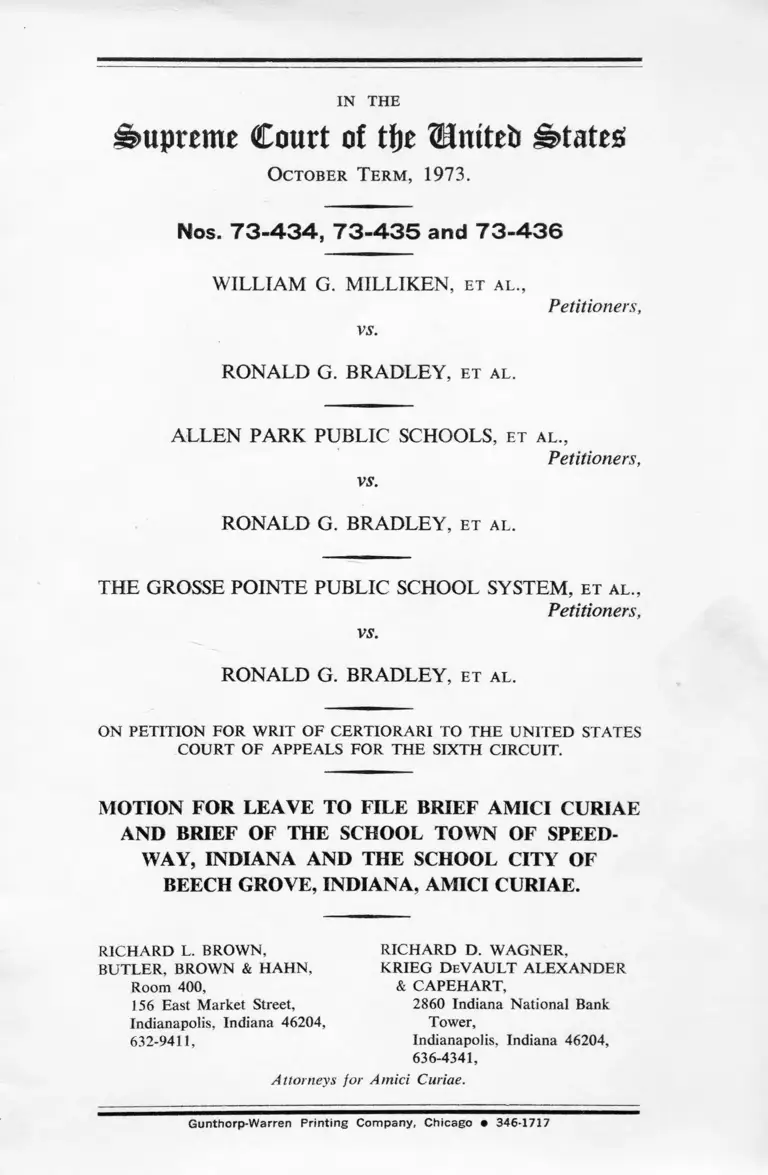
IN THE
Supreme Court ot tfje Uniteb States:
O c t o b e r T e r m , 1973.
Nos. 73-434, 73-435 and 73-436
WILLIAM G. MILLIKEN, e t a l .,
vs.
Petitioners,
RONALD G. BRADLEY, e t a l .
ALLEN PARK PUBLIC SCHOOLS, e t a l .,
Petitioners,
vs.
RONALD G. BRADLEY, e t a l .
THE GROSSE POINTE PUBLIC SCHOOL SYSTEM, e t a l .,
Petitioners,
vs.
RONALD G. BRADLEY, e t a l .
ON PETITION FOR WRIT OF CERTIORARI TO THE UNITED STATES
COURT OF APPEALS FOR THE SIXTH CIRCUIT.
MOTION FOR LEAVE TO FILE BRIEF AMICI CURIAE
AND BRIEF OF THE SCHOOL TOWN OF SPEED
WAY, INDIANA AND THE SCHOOL CITY OF
BEECH GROVE, INDIANA, AMICI CURIAE.
RICHARD L. BROWN,
BUTLER, BROWN & HAHN,
Room 400,
156 East Market Street,
Indianapolis, Indiana 46204,
632-9411,
RICHARD D. WAGNER,
KRIEG D eVAULT ALEXANDER
& CAPEHART,
2860 Indiana National Bank
Tower,
Indianapolis, Indiana 46204,
636-4341,
Attorneys for Amici Curiae.
Gunthorp-Warren Printing Company, Chicago • 346-1717
IN THE
Supreme Court of tfje Mntteb States
O c t o b e r T e r m , 1 9 7 3 .
Nos. 73-434, 73-435 and 73-436
WILLIAM G. MILLIKEN, e t a l .,
Petitioners,
vs.
RONALD G. BRADLEY, e t a l .
ALLEN PARK PUBLIC SCHOOLS, e t a l .,
Petitioners,
vs.
RONALD G. BRADLEY, e t a l .
THE GROSSE POINTE PUBLIC SCHOOL SYSTEM, e t a l .,
Petitioners,
vs.
RONALD G. BRADLEY, e t a l .
ON PETITION FOR WRIT OF CERTIORARI TO THE UNITED STATES
COURT OF APPEALS FOR THE SIXTH CIRCUIT.
MOTION FOR LEAVE TO FILE BRIEF
AMICI CURIAE.
2
The School Town of Speedway, Indiana and The School City
of Beech Grove, Indiana hereby respectfully move for leave to
file the attached Brief Amici Curiae in these cases. All attorneys
for the parties in these appeals have been contacted and their
consent requested to file such Brief. Some of such attorneys
have given such consent, but movants have been unable to ob
tain same from all such attorneys.
The interest of The School Town of Speedway, Indiana and
The School City of Beech Grove, Indiana, arises from the follow
ing facts. Both movants are school corporations created and
existing under Indiana law. They own and operate school sys
tems, which serve, respectively, the civil town of Speedway and
the civil city of Beech Grove, Indiana, two small Communities
adjacent to the City of Indianapolis.
On August 18, 1971, the United States District Court for the
Southern District of Indiana, after a trial of an action brought
by the United States, entered a judgment in which it found that
the Indianapolis Public School System (IPS) was guilty of seg-
regatory practices in the operation of its schools.1 The trial
court speculated in its opinion that a desegregation plan limited
to IPS would not remain demographically stable and that IPS
would at some future point have enrolled a higher percentage
of black students than was acceptable to the district court.
Subsequently an intervening complaint was filed and nineteen
school corporations and certain state officials added as defend
ants. Movants were among the added school corporations.
Following another trial, the court entered a judgment in which
it found, inter alia: (1) that the prior judgment against IPS
was res judicata against the added school corporations, and state
officials; (2) that none of the added school corporations were
guilty of segregatory practices; and (3) that all of the school
corporation defendants were amenable to orders effecting stu
dent transfers between such defendants in quantities designed
1. U. S. v. Bd. of School Commissioners, 332 F. Supp. 655,
aff’d., 474 F. 2d 81 (7th Cir. 1973), cert. den. 37 L. Ed. 2d
1041 (1973).
3
to achieve a prescribed degree of racial balance within IPS.
That decision is presently on appeal to the United States Court
of Appeals for the Seventh Circuit.2 Thus, movants are in
volved in an action similar to the case at bar. A decision by
this Court in the instant action may provide precedent for the
Seventh Circuit’s decision.
Both the School Town of Speedway, Indiana and The School
City of Beech Grove, Indiana are independent school corpora
tions which have territorial boundaries coterminous with the
municipalities which they serve. As such entities, they have com
munity interests distinct and separate from other types of school
corporations which will be adversely affected if this Court ap
proves the power of district courts to enter orders such as those
made in the cases at bar. The distinct interests of school corpora
tions serving towns and cities has not heretofore been argued by
the parties in this appeal or considered in the Court of Appeals
below, and such interests are relevant to any disposition of this
appeal. Movants do not believe that the arguments made in the
attached Brief will be made by any other party to these appeals.
Respectfully submitted,
/ s / RICHARD L. BROWN,
BUTLER, BROWN & HAHN,
Room 400,
156 East Market Street,
Indianapolis, Indiana 46204,
632-9411,
RICHARD D. WAGNER,
KRIEG D eVAULT ALEXANDER
& CAPEHART,
2860 Indiana National Bank
Tower,
Indianapolis, Indiana 46204,
636-4341,
Attorneys for The School Town of Speedway, Indiana, and The School City
of Beech Grove, Indiana.
2. United. States, Plaintiff-Appellant and Donny Brurell Buckley,
et al., Intervening Plaintiffs-Appellees v. Board of School Com
missioners, et al., Nos. 73-1968 through 73-1984, in the Seventh
Circuit Court of Appeals.
IN THE
Supreme Court of tfje Urntrb States
O c t o b e r T e r m , 1973.
Nos. 73-434, 73-435 and 73-436.
WILLIAM G. MILLIKEN, e t a l .,
vs.
Petitioners,
RONALD G. BRADLEY, e t a l .
ALLEN PARK PUBLIC SCHOOLS, e t a l .,
Petitioners,
vs.
RONALD G. BRADLEY, e t a l .
THE GROSSE POINTE PUBLIC SCHOOL SYSTEM, e t a l .,
vs.
Petitioners,
RONALD G. BRADLEY, e t a l .
ON p e t it i o n f o r w r it o f c e r t io r a r i t o t h e u n i t e d s t a t e s
c o u r t o f a p p e a l s f o r t h e s i x t h c i r c u i t .
BRIEF OF THE SCHOOL TOWN OF SPEEDWAY,
INDIANA AND THE SCHOOL CITY OF
BEECH GROVE, INDIANA,
AMICI CURIAE.
TABLE OF CONTENTS.
------------- PAGE
Table of Authorities . ......................................................... i
Interest of Amici C u ria e ....................................................... 1
Argument ............................................................................... 2
Conclusion................................................................. 7
T a b l e o f A u t h o r it ie s .
Cases.
Deal v. Cincinnati Bd. of Ed., 369 F. 2d 55 (6th Cir.
1966), cert, den., 389 U. S. 847 (1967 )........................ 4
Gomillion v. Lightfoot, 364 U .S. 339 (1960 ).................. 5
Hunter v. Pittsburgh, 207 U. S. 161 (1907)...................... 5
Keyes v. School District No. 1, Denver, Colorado, ........
U. S.......... , 37 L. Ed. 2d 548 (1973)............................. 4
Pierce v. Society of Sisters, 268 U. S. 510 (1925 )........... 5
Spencer v. Kugler, 326 F. Supp. 1235 (D. N. J. 1971),
aff’d. per curiam, 404 U. S. 1027 (1972 )......................... 5
Swann v. Charlotte-Mecklenburg Bd. of Ed., 402 U. S. 1
(1971) .......................................................................... 5
United States of America, Plaintiff-Appellant, and Donny
Brurell Buckley, et al., Intervening Plaintiffs-Appellees
v. Bd. of School Commissioners, et al., Nos. 73-1968
through 73-1984, in the U. S. Court of Appeals, Seventh
Circuit ................................................................................. 2
U. S. v. Bd. of School Commissioners, 332 F. Supp. 655,
aff’d., 474 F. 2d 81 (7th Cir. 1973), cert. den. 37 L.
Ed. 2d 1041 (1973) ............................................................ 1
11
Statutes and State Constitution.
Bums Ind. Stat. § 28-2603 ................................................... 6
Indiana Constitution, Art. 2, § 2 .......................................... 6
Other.
P. Smith, As a City Upon a Hill, The Town in American
History (Alfred A. Knopf, 1 9 6 6 ) ................................. 2, 4, 7
U. S. Dept, of Commerce, Bureau of the Census, Vol. 1,
Governmental Organization, 1972 Census of Govern
ments .................................................................................... 2
Will Herberg, Ed.: The Writings of Martin Buber (New
York: Meridian Books; 1956) ........................................ 4
1
INTEREST OF AMICI CURIAE.
The interest of The School Town of Speedway, Indiana and
The School City of Beech Grove, Indiana, arises from the
following facts. Both movants are school corporations created
and existing under Indiana law. They own and operate school
systems which serve, respectively, the civil town of Speedway
and the civil city of Beech Grove, Indiana, two small com
munities adjacent to the City of Indianapolis.
On August 18, 1971, the United States District Court for
the Southern District of Indiana, entered a judgment in which
it found that the Indianapolis Public School System (IPS) was
guilty of segregatory practices in the operation of its schools.1
The trial court speculated in its opinion that a desegregation
plan limited to IPS would not remain demographically stable
and that IPS would at some future point have enrolled a higher
percentage of black students than was acceptable to the district
court.
Subsequently an intervening complaint was filed and nine
teen school corporations and certain state officials added as
defendants. Movants were among the added school corpora
tions. Following another trial, the court entered a judgment in
which it found, inter alia: (1) that the prior judgment against
IPS was res judicata against the added school corporations and
state officials; (2) that none of the added school corporations
were guilty of segregatory practices; and (3) that all of the
school corporation defendants were amenable to orders effect
ing student transfers between such defendants in quantities
designed to achieve a prescribed degree of racial balance within
IPS. That decision is presently on appeal to the United States
1. U. S. v. Bd. of School Commissioners, 332 F. Supp. 655,
aff’d., 474 F. 2d 81 (7th Cir. 1973), cert. den. 37 L. Ed. 2d
1041 (1973).
2
Court of Appeals for the Seventh Circuit.2 3 Thus, movants are
involved in an action similar to the case at bar. A decision by
this Court in the instant action may provide precedent for the
Seventh Circuit’s decision.
ARGUMENT.
"It is not the time to try to say with final authority
what the town has meant in American life. Its mean
ings are profound and various. But of its importance
there can be no question.”*
One of the questions in the case at bar and in the action in
which these amici are parties is whether a federal district court
may order the busing of school students between separate, in
dependent school corporations in order to remedy discriminatory
practices found to exist in only one of such school corpora
tions. These amici believe that the far reaching impact of such
an order may be seen in clearer detail when viewed from the
vantage point of a school corporation which serves a city or
town separate and distinct from the school district in which
such discriminatory practices were effected.
Throughout this country, hundreds of school corporations
exist which have geographical boundaries coextensive with small
towns and cities.4 Several of such school corporations are
2. United States, Plaintiff-Appellant and Donny Brurell Buckley,
et al., Intervening Plaintiffs-Appellees v. Board of School Com
missioners, et al., Nos. 73-1968 through 73-1984, in the Seventh
Circuit Court of Appeals.
3. P. Smith, As a City Upon a Hill, The Town in American
History (Alfred A. Knopf, 1966), p. 307.
4. In 1972, the U. S. Bureau of the Census reported the
existence in the United States of 15,281 “independent school dis
tricts,” i.e., school districts which are administratively and fiscally
independent of any other government. Of this number, 597 of
such districts had coterminous “citywide” boundaries. The same
source reported a total of 1457 “dependent school districts” of which
247 had coterminous “citywide” boundaries. In total, there were,
in 1972, 844 “citywide” systems with 8.2 million pupils. U. S.
Dept, of Commerce, Bureau of the Census, Vol. 1, Governmental
Organization, 1972 Census of Governments, pp. 3, 6, 8 and 40.
3
parties to these appeals. These amici are also school corpora
tions which have such territorial boundaries and which serve
small municipalities located in the State of Indiana.
Typical of such municipal school corporations is one of
these amici, The School Town of Speedway. The civil town of
Speedway, Indiana, which it serves, has a population of approxi
mately 17,500. The town is governed by a board of trustees
elected by the citizens of the town. The town board is em
powered to control all other municipal departments and ap
points their administrators. Schools which serve the com
munity are owned and administered by an independent corpora
tion created by statute and designated as The School Town of
Speedway. The administration of that school corporation is
vested in a three-man board of school trustees appointed by
the civil town board of trustees on a non-partisan basis. The
School Town of Speedway neither owns nor operates school
buses. All schools are physically located within the town
boundaries so that students have access thereto either by walk
ing or other means of transportation provided by the students
or their parents. The operational funds for the schools are
provided almost entirely through taxes paid by citizens of the
Town. Although this small community is geographically
dwarfed by the adjacent City of Indianapolis, it encompasses
large industries in which many of its citizens work. In short,
it is a distinct community whose citizens take pride in local
community projects and operations, and which has a municipal
government and school system responsive to the local problems
and needs of the community.
The rationale of state legislatures in fixing school boundaries
to the boundaries of the small towns and cities which they serve
is not limited to mere physical convenience:
[I]f we except the family and the church, the basic
form of social organization experienced by the vast major
ity of Americans up to the early decades of the 20th
Century was the small town. In the words of Thorstein
Veblen: “The country town is one of the great American
4
institutions; perhaps the greatest, in the sense that it has
and had and continues to have a greater part than any
other in shaping public sentiment and giving character to
American culture.”3
The real essence of a community is found in the fact that it
has a center, and the beginning of a community arrives when
its members have a common relation to the center.5 6 It is this
common relationship which gives vitality to a school system
serving the small community. The importance of this common
relationship becomes readily apparent when one views the chaos
of many big city school systems as contrasted to the stability
and quality of those found in smaller communities.
The small community, then, as many legislatures and educa
tors have found, provides a desirable environment for imple
mentation of a community-wide school system which can truly
give consideration to such important factors as home-school
communication, children attending school within the vicinity
of home, minimization of transportation safety hazards, economy
of cost and ease of pupil placement and administration. See
opinion of Mr. Justice Powell, concurring in part and dissent
ing in part, Keyes v. School District No. 1, Denver, Colorado,
........ U. S............, 37 L. Ed. 2d 548 (1973); Deal v. Cincinnati
Bd. of Ed., 369 F. 2d 55 (6th Cir. 1966), cert, den., 389
U. S. 847 (1967).
It is thus beyond argument that towns and cities provide a
logical, reasonable and desirable setting for operation of in
dependent school corporations. The essential question is whether
federal courts can forcibly transfer children attending such a
school system, and otherwise disregard the independent nature
of such a system,7 in order to effect a judicially prescribed
degree of racial balance in a given geographical area.
5. P. Smith, supra, pp. vii-viii.
6. Will Herberg, Ed.: The Writings of Martin Buber (New
York: Meridian Books; 1956), p. 129.
7. In one of the district court orders entered in the case in
which these dmici were parties, the trial court has presumed the
power to consolidate all of the school corporations in the Indianapolis
Absent an overt, affirmative state act which contravenes a
Constitutionally protected right, federal courts have no power
to circumscribe the rights of the states to establish municipalities
and school corporations to serve the members of such com
munities. Spencer v. Kugler, 326 F. Supp. 1235 (D. N. J.
1971), aff’d. per curiam, 404 U. S. 1027 (1972); Gomillion v.
Lightfoot, 364 U. S. 339 (1960); and Hunter v. Pittsburgh,
207 U. S. 161 (1907). These principles alone, in addition to
this Court’s rejection of the concept of “racial balance or mix
ing”, Swann v. Charlotte-Mecklenburg Bd. of Ed., 402 U. S.
1 at 24 (1971), provide sufficient authority for a reversal of
the lower courts in the instant case.
In an attempt to avoid the limitations found in the above
precedents and other cases, the Sixth Circuit Court of Appeals
in the cases at bar apparently adopted the theory that all school
corporations are agents of the state and since the state is
responsible for school matters, the rights of individual school
corporations could be ignored. Such a theory is flawed in many
respects. These amici wish to only point out that if this concept
is not rejected by this Court, it will allow one school corporation
to be held to answer for the wrongdoings of another. In ad
dition to the fact that guilt by association is anathema to our
jurisprudence, such a novel concept would effect a fundamental
deprivation of the Constitutional rights of the innocent school
corporation. Long ago this Court held that private corporations
created under state law for school purposes were entitled to the
protection afforded by the guarantees of the United States
Constitution. Pierce V. Society of Sisters, 268 U. S. 510 (1925).
No reason exists for holding that public school corporations
are to be treated differently.
Many other legal arguments could be discussed, but they will
undoubtedly be made by the parties to these appeals. It is the
area “along metropolitan lines”. Supplemental Memorandum of
Decision, entered December 6, 1973, by The U. S. District Court,
Southern District of Indiana, Cause No. IP 68-C-225, Slip Opinion,
p. 19.
5
6
practical and factual impact of the opinion of the Sixth Circuit
in the instant case which these amici wish to primarily empha
size. If that opinion is allowed to stand and becomes the law
of the land, judicial power in desegregation cases will know no
bounds. Students will be transported from the small towns and
cities in which they, their families and friends reside, into the
schools of large metropolitan areas. The burden of busing for
racial balance may fall upon school children who have always
walked to a nearby school (as is the case with most Speedway
students). Parental interest and participation in school affairs
will be frustrated. Many school officials are elected by voters
who reside within the territorial boundaries of the school cor
poration or district.8 Small town citizens may thus experience
the anomaly of being required to send their children to a school
system administered by officials over whom they exercise no
voting control. Every school corporation located in any degree
of proximity to a large metropolitan area will become amenable
to remedial racial balancing decrees, no matter how separate or
independent those school corporations may be. The touchstone
of judicial power will be demography, not equity.
8. This is the case for example, with respect to school officials
of the Indianapolis Public School System. See Indiana Constitution,
Art. 2, § 2; Burns Ind. Stats. § 28-2603. Thus in the case in which
these amici are parties, residents of Beech Grove and Speedway
cannot vote for Indianapolis school officials.
7
CONCLUSION.
The district courts involved in the cases with which this Brief
is concerned have promulgated decrees which eventually could
destroy one of the traditional fabrics of American life. Their
decrees formulate a blueprint for federally constituted school
systems which ignore the natural community interests of parents,
teachers and children. Our nation has drawn its life from small
communities, and it is itself a community of communities.9
This Court should not affirm a court decree which would forever
destroy the rights of the citizens of the towns and cities of this
nation to educate their children in school corporations designed
and established to serve individual communities.
Respectfully submitted,
RICHARD L. BROWN,
BUTLER, BROWN & HAHN,
Room 400,
156 East Market Street,
Indianapolis, Indiana 46204,
632-9411,
RICHARD D. WAGNER,
KRIEG D eVAULT ALEXANDER
& CAPEHART,
2860 Indiana National Bank
Tower,
Indianapolis, Indiana 46204,
636-4341,
Attorneys for The School Town of Speedway, Indiana, and The School City
of Beech Grove, Indiana.
9. P. Smith, supra, p. 14.
•‘r .