Oklahoma City Public Schools Board of Education v. Dowell Brief Amicus Curiae Landmark Legal Foundation Center
Public Court Documents
January 1, 1989
-
Brief Collection, LDF Court Filings. Oklahoma City Public Schools Board of Education v. Dowell Brief Amicus Curiae Landmark Legal Foundation Center, 1989. 16a7402d-c09a-ee11-be36-6045bdeb8873. LDF Archives, Thurgood Marshall Institute. https://ldfrecollection.org/archives/archives-search/archives-item/e14a1bfa-e950-4bd5-aac7-71e21ec8a7a8/oklahoma-city-public-schools-board-of-education-v-dowell-brief-amicus-curiae-landmark-legal-foundation-center. Accessed October 14, 2026.
Copied!
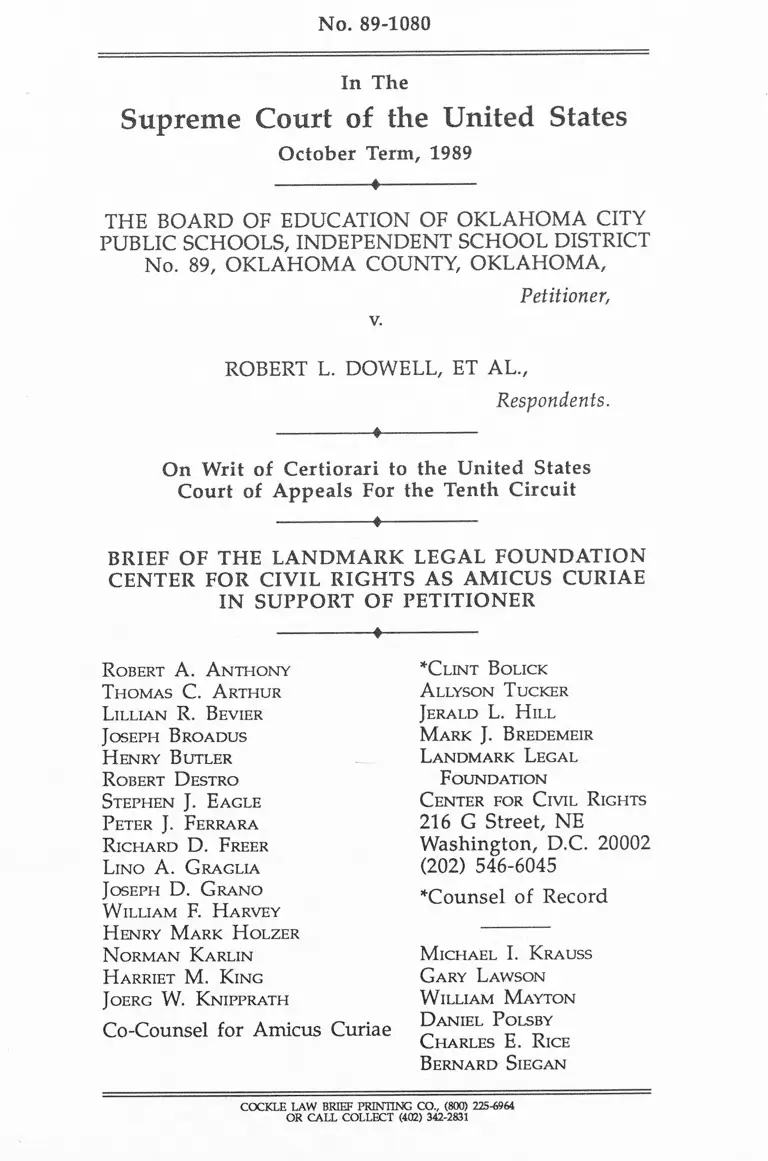
No. 89-1080
In The
Supreme Court of the United States
October Term, 1989
--------------- «---------------
THE BOARD OF EDUCATION OF OKLAHOMA CITY
PUBLIC SCHOOLS, INDEPENDENT SCHOOL DISTRICT
No. 89, OKLAHOMA COUNTY, OKLAHOMA,
Petitioner,
v.
ROBERT L. DOWELL, ET AL.,
Respondents.
--------------- «---------------
On Writ of Certiorari to the United States
Court of Appeals For the Tenth Circuit
--------------- *---------------
BRIEF OF THE LANDMARK LEGAL FOUNDATION
CENTER FOR CIVIL RIGHTS AS AMICUS CURIAE
IN SUPPORT OF PETITIONER
--------------- «---------------
R o bert A. A n th o n y
T h o m as C . A rthur
L illia n R . B evier
J oseph B ro a d u s
H enry B u tler
R o bert D estro
S teph en J . E a gle
P eter J . F erra ra
R ich a rd D . F reer
L ino A . G ra glia
J oseph D . G rano
W illia m F. H a rvey
H enry M a r k H o lzer
N o rm a n K a rlin
H a r riet M . K ing
JOERG W . KNIPPRATH
Co-Counsel for Amicus Curiae
*C lent B o lick
A llyson T ucker
J era ld L . H ill
M a rk J. B redem eir
L a n d m a rk L eg a l
F oundation
C en ter for C ivil R ights
216 G Street, NE
Washington, D.C. 20002
(202) 546-6045
’•'Counsel of Record
M ichael I. K rauss
G ary L awson
W illiam M ayton
D a n iel P o lsby
C h a rles E . R ice
B ern a rd S iegan
COCKLE LAW BRIEF PRINTING CO., (800) 225-6964
OR CALL COLLECT (402) 342-2831
1
Table of Authorities............................................ ii
Interest of Amicus Curiae............................................ 1
Summary of Argument ........................... 2
Argument.................................................................... 4
I. THE REMEDIAL AUTHORITY OF THE COURTS
MUST END WHEN A SCHOOL DISTRICT AS
SURES THAT EDUCATIONAL OPPORTUNITIES
ARE AVAILABLE TO ALL ON EQUAL TERMS... 4
II. EXPERIENCE DEMONSTRATES THAT LONG
TERM COERCIVE MEASURES DESIGNED TO
MAINTAIN RACIAL BALANCE ARE INCON
SISTENT WITH THE OBJECTIVE OF EQUAL
EDUCATIONAL OPPORTUNITIES...................... 10
A. White flight............................................................ 11
B. Black flight and the burden of busing on
blacks............................................................. 13
C. Effects on educational achievement.............. 15
D. Availability of sound educational alterna
tives ................................................................. 17
E. A unitary school district reasonably may
consider these factors in determining educa
tional policies........................................ 19
CONCLUSION ............................................. 21
TABLE OF CONTENTS
Page
11
C a ses :
Brown v. Board of Educ. of Topeka, 892 F.2d 851 (10th
Cir. 1989) petition for cert, filed, No. 89-1681 .. 2, 4, 19
Milliken v. Bradley, 418 U.S. 717 (1974) . . . . . . . . . . . . . . . 4
Morgan v. Nucci, 831 F.2d (1st Cir. 1987) . . . . . . . . 4, 6, 9
Pasadena City Board of Education v. Spangler, 427
U.S. 424 (1976).................... ......................................... 5, 8
Riddick v. School Board of City of Norfolk, 784 F.2d 521
(4th Cir.), cert, denied, 479 U.S. 938 (1986).......... 5, 9, 12
Swann v. Charlotte-Mecklenburg Board of Education,
402 U.S. 1 (1971)............................... ............................5, 8
United States v. Overton, 824 F.2d 1171 (5th Cir.
1 9 8 7 ) . . . . . . . . . . . . . . ............................................. 6, 8, 9, 10
Keyes v. School District No. 1, Denver, Colorado, 895
F.2d 659 (10th Cir. 1990), petition for cert, filed,
No. 89-1698 ....................................... ............. 2, 13, 14, 15
Pitts v. Freeman, 887 F.2d 1438 (10th Cir. 1989),
petition for cert, filed, No. 89-1290 ................................ 2
TABLE OF AUTHORITIES
Page
A rttct.es a n d B o o k s :
Alves and Willie, "Controlled Choice Assignment:
A New and More Effective Approach to School
Desegregation," 19 Urban Review (1987)......... . .18, 19
Armor, "After Busing: Education and Choice,"
Current (October 1989).................................................... 18
Armor, "School Busing," in Katz and Taylor, eds.,
Eliminating Racism (1988)............................................... 12
I l l
TABLE OF AUTHORITIES - Continued
Page
Ascik, "An Investigation of School Desegregation
and Its Effects on Black Student Achievement,"
American Education (December 1984)................. .. 16
Bennett, "A Plan for Increasing Educational Op
portunities and Improving Racial Balance in
Milwaukee," in Willie and Greenblatt, School
Desegregation Plans That Work (1984)......................... 18
Bolick, C , Changing Course: Civil Rights at the
Crossroads (1988)................................................................ 15
Committee on the Status of Black Americans, A
Common Destiny (1989)..................................................... 16
Cuddy, "A Proposal to Achieve Desegregation
Through Free Choice," American Education (May
1983).................................................... ..........................14, 18
Graglia, L. Disaster by Decree (1976)..................... .. 15
Jennings, "Studies Link Parental Involvement,
Higher Student Achievement," Education Week,
(April 4, 1990)................. 14
National Institute of Education, School Desegrega
tion and Black Achievement (1984)....................... 13
Pride, R. and J. Woodard, The Burden of Busing
(1985)............................... ................................ 3, 12, 13, 14
Raspberry, "The Easy Answer: Busing," Washing
ton Post (Apr. 20, 1985).................................................. 10
Snider, William, "Voucher System For 1,000 Pupils
Adopted in Wisconsin," Education Week (March
28, 1990) ......................................... 18
Yarmolinsky, A., L. Liebman, and C. Schelling,
eds., Race and Schooling in the City (1981)......... 17
IV
TABLE OF AUTHORITIES - Continued
Page
S tatutes a n d R u les :
Wise. St at. § 119.23 (1990)................................. 18
No. 89-1080
In The
Supreme Court of the United States
October Term, 1989
THE BOARD OF EDUCATION OF OKLAHOMA CITY
PUBLIC SCHOOLS, INDEPENDENT SCHOOL DISTRICT
No. 89, OKLAHOMA COUNTY, OKLAHOMA,
Petitioner,
v.
ROBERT L. DOWELL, ET AL„
Respondents.
- ----------------------------- ♦----------------------- --
On Writ of Certiorari to the United States
Court of Appeals For the Tenth Circuit
---------------- ♦ ------------ -
BRIEF OF THE LANDMARK LEGAL FOUNDATION
CENTER FOR CIVIL RIGHTS AS AMICUS CURIAE
IN SUPPORT OF PETITIONER
--------------- *---------------
INTEREST OF AMICUS CURIAE
The Landmark Legal Foundation Center for Civil
Rights is a public interest law center dedicated to promot
ing the core principles of civil rights: equality under law
and individual liberty.
1
2
A vital aspect of this mission is the pursuit of equal
educational opportunities. We represent parents, school-
children, and teachers in a variety of cases raising issues
of equal educational opportunities and educational
choice.
We are joined as co-counsel by a number of distin
guished law professors who share our conviction that the
decision under review in this case is incompatible with
fundamental principles of justice and with sound public
policy.
--------------- #----------------
SUMMARY OF ARGUMENT
In a very real sense, the appearance of this case and
others like it1 before this Court is a cause for celebration -
specifically, a celebration of the triumph of our nation's
most cherished principles. These cases mark an important
epoch in America's quest to make good on its commit
ment to civil rights, for they present the question not of
how to remedy discriminatory educational systems, but
rather what happens when that task is accomplished.
This case does not require the Court to make new
law, but merely to apply well-established equitable prin
ciples. The dispositive principle in this case is that the
1 The three other cases pending on petitions for writs of
certiorari include Keyes v. School District No. 1 Denver, Colorado,
895 F.2d 659 (10th Cir. 1990), petition for cert, filed, No. 89-1698;
Brown v. Board of Edue. of Topeka, 892 F.2d 851 (10th Cir. 1989),
petition for cert, filed, No. 89-1681; Pitts v. Freeman, 887 F.2d 1438
(10th Cir. 1989), petition for cert, filed, No. 89-1290.
3
scope of judicial remedies is defined and limited by the
scope of the constitutional violation.
Mandatory busing is harsh medicine even in its lim
ited role as a remedy for egregious violations of constitu
tional rights. However critical the need to employ
extraordinary remedies, just as vital is the necessity to
restrict such measures to extraordinary circumstances.
For coercive measures such as busing that displace com
munity control over education can detract substantially
from the educational mission, to the detriment of the very
youngsters they are intended to benefit. Accordingly,
such measures should seek to spend themselves as quick
ly as possible so as to return discretion to those entrusted
with the high responsibility of educating our children.
As two scholars who have studied extensively the
impact of sustained busing in a community have ob
served, "The politics of race can only end when . . .
people no longer think of themselves in racial terms
above all else, but identify themselves first as parents or
teachers, . . . and only secondarily as black or white. . .
R. Pride and J. Woodard, The Burden of Busing 283 (1985).
The Court can hasten the arrival of that day by limiting
the use of coercive race-based remedies to the most ex
traordinary circumstances, and by allowing communities
that have accomplished the task of desegregation to turn
their attention to the task of pursuing educational objec
tives in a race-neutral fashion.
4
ARGUMENT
I. THE REMEDIAL AUTHORITY OF THE COURTS
MUST END WHEN A SCHOOL DISTRICT AS
SURES THAT EDUCATIONAL OPPORTUNITIES
ARE AVAILABLE TO ALL ON EQUAL TERMS.
At issue here is the question of when, if ever, judicial
supervision of a "unitary" school system ceases. The
Tenth Circuit, in its decision below reversing the contrary
ruling of the district court, departed from well-estab
lished equitable principles when it ruled, in essence, that
formerly segregated school districts must permanently
retain coercive measures designed to maximize racial bal
ance.
The constitutional right at stake in school desegrega
tion cases is "the opportunity of an education . . .
available to all on equal terms." Brown v. Board of Educa
tion, 347 U.S. 483, 493 (1954). The vindication of this right
throughout an entire school district represents the attain
ment of "unitary" status - what one court has aptly called
"the 'accomplishment' of desegregation." Morgan v. Nuc-
ci, 831 F.2d 313, 318 (1st Cir. 1987).
This Court has carefully delineated the authority of
courts to engage in remedial action in the desegregation
context. "The controlling principle consistently ex
pounded in our holdings is that the scope of the remedy
is determined by the nature and extent of the constitu
tional violation." Milliken v. Bradley, 418 U.S. 717, 744
(1974).
The Court has established a number of specific lim
itations to ensure that desegregation decrees are tailored
to the scope of the violation. First, judicial remedies are
5
permissible only upon a finding of causation; racial im
balance cannot justify a race-conscious remedy unless the
"school authorities have in some manner caused uncon
stitutional segregation." Pasadena City Board of Education
v. Spangler, 427 U.S. 424, 434 (1975). Second, coercive race
conscious remedies should play as limited a role as pos
sible in the desegregation process. Thus, this Court has
approved "the very limited use . . . of mathematical
ratios" only as "a starting point in the process of shaping
a remedy, rather than as an inflexible requirement."
Swann v. Charlotte-Mecklenburg Board of Education, 402 U.S.
1, 25 (1971). Third, the Court repeatedly has stressed that
the remedial goal is desegregation, not racial balancing.
"The constitutional command to desegregate schools does
not mean that every school in every community must
always reflect the racial composition of the school system
as a whole." Id. at 24. Finally, once the indicia of past
discrimination are removed from a dual school system,
courts are "not entitled" to take further steps "to ensure
that the racial mix desired by the court [is] maintained in
perpetuity." Spangler, 427 U.S. at 436.
Once unitary status is attained, the predicate for
further relief ends. Thereafter, remedial relief is permis
sible only if the school district "deliberately attempts]
to fix or alter demographic patterns to affect the racial
composition of the schools. . . Swann, 402 U.S. at 32;
accord, Spangler, 427 U.S. at 435.
In conformity with these standards, the Fourth Cir
cuit has held that once the underlying violation is cured,
as reflected by the attainment of unitary status, the trial
court is without authority to make further orders. Riddick
v. School Board of City of Norfolk, 784 F.2d 521, 535 (4th
6
Cir.), cert denied, 479 U.S. 938 (1986), More specifically, the
First Circuit has ruled that unitariness triggers the "man
datory devolution of power to local authorities," Morgan,
831 F.2d at 318 (emphasis in original); and that once the
school district has achieved desegregation goals in any
facet of its school system, the Court may not "perpetuate
an injunction requiring adherence to a particular formu
la" in that area. Id. at 326. The Fifth Circuit likewise has
adopted this approach. United States v. Overton, 824 F.2d
1171 (5th Cir. 1987).
Were Oklahoma City in any other circuit, this case
would not have appeared before this Court in its current
posture. By any reasonable measure, the school district
here has earned the right to pursue its educational mis
sion free from judicial control, precisely the conclusion
reached by the district court in this case.
The Oklahoma City school district was declared uni
tary in 1977, following an evidentiary hearing in which
the district court found that the Finger Plan, a compre
hensive remedial program that included massive cross
town busing, had eliminated all vestiges of state-imposed
racial discrimination (App. 2a). The court entered an
order declaring:
Now sensitized to the constitutional implica
tions of its conduct and with a new awareness of
its responsibility to citizens of all races, the
Board is entitled to pursue in good faith its
legitimate policies without the continuing con
stitutional supervision of this Court. The Court
believes and trusts that never again will the
Board become the instrument and defender of
racial discrimination so corrosive of the human
7
spirit and so plainly forbidden by the Constitu
tion.
Id. At that time, the district court relinquished jurisdic
tion over the case and returned the responsibility for
race-neutral educational decisions to the Board of Educa
tion of the Oklahoma City Public Schools.
For eight years following the unitary declaration, the
Oklahoma City School Board continued to implement the
Finger Plan. In 1984, however, it became apparent that
demographic changes had taken place within the school
district and that the Finger Plan, if continued on the
elementary level, would increase the burden of busing on
young black children in grades K-5 and lead to the clo
sure of a large number of schools in a predominantly
black area of the city. In response, the school board
adopted a Student Reassignment Plan, which was imple
mented for the 1985-86 school year. The plan eliminated
compulsory busing in grades one through four and reas
signed elementary students to their neighborhood
schools, which resulted in the existence of a number of
heavily black schools. The board retained a "majority to
m inority" transfer option which allowed students
assigned to a school in which they were in the majority
race to transfer to a school in which they would be in the
minority. The new plan also appointed an "equity officer"
who, assisted by an equity committee, would monitor all
schools to insure the equality of facilities, equipment,
supplies, books, and instructors (App. 5a).
Although the district court upheld this plan, finding
that it was nondiscriminatory and served valid educa
tional objectives (App. 17-19a), the Tenth Circuit re
versed. Viewing the Finger Plan as a permanent
8
injunction, the court placed the burden on the school
district to demonstrate changed circumstances to justify
modification of the injunction (App. 14a). The court con
cluded that the district failed to carry its burden, in part
because continued residential racial imbalance caused
similar racial imbalance in the schools (App. 19a).
The Tenth Circuit's rule that coercive desegregation
measures are in the nature of a permanent injunction and
modifiable only by a showing of significantly changed
circumstances amounts to a radical departure from deseg
regation jurisprudence. By sanctioning a remedy virtually
without end, the Tenth Circuit's rule, by definition, far
exceeds remedial authority as limited by the scope of the
constitutional violation. As the Fifth Circuit has observed,
the "difficulty with Dowell's approach is that it denies
meaning to unitariness by failing even to end judicial
superintendence of schools." Overton, 824 F.2d at 1175.
The Tenth Circuit's rule upsets as well the specific
boundaries of permissible judicial action established by
this Court. Its requirement of permanent adherence to
racial ratios confuses the constitutional right to equal
educational opportunities with the objective of racial bal
ance, an approach this Court has warned "would be
disapproved and [which] we would be obliged to re
verse." Swann, 402 U.S. at 24. It seeks to hold the school
district responsible for residential racial imbalance de
spite the absence of any showing that it is "in any manner
caused by segregative actions chargeable" to the district.
Spangler, 427 U.S. at 435. In sum, the Tenth Circuit's
imposition of extraordinary remedial measures long after
the wrong has been righted amounts to "a heady call for
raw judicial power." Overton, 834 F.2d at 1176.
9
The Tenth Circuit attempts to rationalize its sweeping
departure from well-established remedial principles by
invoking the procedural cover of a permanent injunction.
A court may not, however, evade limitations on its power
by emphasizing form over substance. As the other cir
cuits that have considered this issue have concluded,
affirmative relief is no longer warranted - or authorized -
when unitary status is achieved. See e.g., Morgan, Riddick,
and Overton, supra. To state it in the vernacular of an
injunction, the "changed circumstance" justifying the ter
mination of injunctive relief is unitary status; and a sig
nificant change it is, for it means that the dual system of
education no longer exits.
In a very real sense, school districts that have at
tained unitary status do operate under a permanent in
junction: the constitutional command of nondiscrimi
nation. Any individual is free to challenge school district
policies as intentionally discriminatory. This prospect
provides a sufficient safeguard to ensure that school dis
trict will not once again adopt discriminatory practices,
and to ensure swift and meaningful relief if they do. In
sum, the rule this Court should ratify is that the only
choice denied to a unitary school district is the choice to
discriminate.
The necessity of removing the scarlet "S" from school
districts that have accomplished the difficult task of
achieving a unitary educational system is supported as
well by the societal interest in encouraging districts to
undertake such efforts. As the Fifth Circuit has remarked,
"The carrot of unitariness can be a meaningful incentive
for school districts to desegregate only if we abide by our
promise to release federal control once the job is done."
10
Overton, 834 F.2d at 1176. For Oklahoma City, which has
successfully travelled the road to unitary status, the time
has come for the court to return to the community the
power to act in the best educational interests of its chil
dren.
II. EXPERIENCE DEMONSTRATES THAT LONG
TERM COERCIVE MEASURES DESIGNED TO
MAINTAIN RACIAL BALANCE ARE INCONSIS
TENT WITH THE OBJECTIVE OF EQUAL EDU
CATIONAL OPPORTUNITIES.
Equitable principles do not develop in a vacuum.
They reflect centuries of acquired wisdom and experience
with respect to the appropriate nature and extent of judi
cial interventions in personal disputes and societal ills.
Departures from these principles thus can produce unex
pected and tumultuous consequences. This risk is no
where more pronounced than in the context of school
desegregation, which affects directly the lives and oppor
tunities of our nation's most precious resource: its chil
dren.
A growing consensus is developing among scholars,
education officials, and parents that forced busing de
tracts from the educational mission. Though strongly
committed to equal opportunities for all youngsters,
many thoughtful individuals have concluded that such
opportunities are not optimally served by measures that,
in the words of columnist William Raspberry are "almost
monomaniacally concerned with the maximum feasible
mixing of races, with educational concerns a distant sec
ond." Raspberry, "The Easy Answer: Busing," Washington
Post, Apr. 20,1985, at A23. A number of factors associated
11
with busing contribute to these concerns, among them the
phenomenon of "white flight," the cost and disruption of
busing, and the availability of sound educational alterna
tives. We express no opinion on the salience of these
factors in any given situation; we are attorneys, not social
scientists. Our point is simply this: once a school district
has purged itself of a segregated school system, it should
once again have the discretion to act in the best educa
tional interests of its children.
In this case, the Oklahoma City School District deter
mined that the burden of busing borne by young black
students was too great. It concluded that neighborhood
schools - enhanced by an "effective schools" program
and combined with the opportunity to transfer - would
improve educational opportunities for these youngsters.
The notion that this policy reflected a return to a dual
system was rejected by the district court as "ludicrous
and absurd" (App. 44b).
Under these circumstances, this conclusion is cer
tainly unremarkable. What is remarkable, however, is the
Tenth Circuit's insistence on adherence to racial balance
as the permanent touchstone of a unitary school system's
educational policies. As we show below, numerous legiti
mate justifications exist for school districts to pursue
objectives other than racial balance. Indeed, a judicial
rule that prohibits or discourages alternatives may harm
most severely those who are the intended beneficiaries of
desegregation.
A. White Flight. A major problem endemic to man
datory busing plans is white flight - the loss of middle-
class white students who move away or enroll in private
12
schools. See e.g., Riddick, supra (approving school system's
return to neighborhood schools due in part to white
flight). The deleterious impacts of white flight are felt
most strongly by the black youngsters left behind.
Most studies on white flight "concur that larger, cen
tral-city school districts with sizable minority enrollments
experience significant long-term white flight following
mandatory busing plans." D. Armor, "School Busing," in
Katz and Taylor, eds., Eliminating Racism 266 (1988).
White flight today appears to be caused more by educa
tional concerns than by racism: in Los Angeles, where
busing resulted in massive white flight, rates of white
withdrawal were essentially unchanged regardless of
whether the new assigned schools were predominantly
white, black, or Hispanic. Id. at 269.
White flight is harmful primarily in two ways. First,
it frustrates the objectives of desegregation. Although
"mandatory [busing] plans do the best job of producing
racial balance," observes social scientist David J. Armor,
they do so "usually only at the cost of converting all
schools to predominantly minority status." Id. at 270-271.
Thus, "mandatory busing has aggravated the growing
racial isolation" of many cities. Id. at 271.
A second consequence of white flight is the loss of
vital community support for public schools. In their
study of the impact of long-term busing in Nashville,
Richard A. Pride and J. David Woodard found that white
flight
was a significant and continuing problem. . . .
Traditionally, the white middle class had been
the public schools' strongest ally; its members
13
had supported the schools politically, finan
cially, and, through countless hours of volunteer
labor, personally. Without their strong support,
the public schools could slip into mediocrity or
worse.
Pride and Woodard at 141. An overwhelming majority of
whites and a large plurality of blacks in Nashville ex
pressed the view2 that community support would return
following a restoration of neighborhood schools. Id. at
153.
Given the reality of white flight, a school board could
reasonably conclude that mandatory busing thwarts ef
fective desegregation and reduces prospects for quality
schooling, particularly for poor youngsters. Unitary
school districts therefore should have discretion to deal
with such problems.
B. Black Flight and the Burden of Busing on
Blacks. Justice Powell observed that "[a]ny child, white
or black, who is compelled to leave his neighborhood and
spend significant time each day being transported to a
distant school, suffers an impairment of his liberty and
privacy." Keyes, 413 U.S. at 247-248 (Powell, J., concurring
in part and dissenting in part). Black children, in particu
lar, "for years have borne the heaviest personal cost of
desegregation by enduring long bus rides, separation
from familiar surroundings, and curtailment of extracur
ricular activities." National Institute of Education, School
2 Surveys were taken on various educational issues in
Nashville between 1977-1981 after several years of court-im
posed busing.
14
Desegregation and Black Achievement 43 (1984) [henceforth
"NIE Study"].
Moreover, "abandonment of neighborhood schools
tends to limit parental participation in, and supervision
of, the operation of the school system and lessens the
importance of the school as a center of community con
cern and cohesion." Keyes, 413 U.S. at 246 (Powell, J.).
This diminished parental involvement is potentially dev
astating to black educational achievement, since studies
show a strong correlation between parental involvement
and higher student grades and test scores, positive stu
dent attitudes and behaviors, and improved school
atmospheres. Jennings, "Studies Link Parental Involve
ment, Higher Student Achievement," Education Week,
April 4, 1990, at 20.
Little wonder then that black parents are growing
increasingly skeptical about busing. As Pride and Wood
ard found in Nashville, "adults of both races believe that
busing is unfair," but such feelings "may be especially
acute among blacks, the very group the policy was de
signed to help." Id. at 284. Surveys in Nashville revealed
that 58% of black parents believed busing was harmful to
the educational development of white and/or black
school children, id. at 151; and that 38% of black parents
would enroll their children in private schools if they
could afford to do so. Id. at 153. A study in Boston found
that 75% of black parents involved in busing would pre
fer their children attend neighborhood schools of equal
quality. Cuddy, "A Proposal to Achieve Desegregation
Through Free Choice," American Education, May 1983, at
28-29.
15
Understandably, a sizable "black flight" away from
inner-city public schools has taken place in many cities.
Fully half the students in urban private schools (includ
ing Catholic schools) are black, and another third are
Hispanic. Moreover, half of urban private schools fami
lies are low-income. See C. Bolick, Changing Course: Civil
Rights at the Crossroads 108 (1988). In many private
schools, "low socioeconomic status minority youth are
scoring above the national average on standardized
tests." Cuddy at 26. Busing appears both a cause of the
desire of many black families to seek alternatives, as well
as an impediment to school districts in responding to
those desires.
The disproportionate burden of busing shouldered
by black youngsters thus provides a legitimate basis for
educational decisionmakers to reject racial balance poli
cies in favor of those that expand choices or improve
educational quality.
C. Effects on Education Achievement: Although
busing is costly in many ways,3 it provides few, if any,
offsetting educational benefits, particularly for its intend
ed beneficiaries. Despite nearly three decades of forced
busing, "there remains a persistent and large gap" be
tween black and white students in achievement test
scores, high school dropout rates, and college attendance
3 As Justice Powell remarked, "At a time when public
education is suffering serious financial malnutrition, the eco
nomic burdens of [busing] may be severe, requiring both initial
capital outlays and annual operating costs in the millions of
dollars." Keyes, 413 U.S. at 248 (Powell, J.). See also L. Graglia,
Disaster by Decree 264 (1976).
16
and completion rates. Committee on the Status of Black
Americans, A Common Destiny 378 (1989). The "assump
tion that integration would improve achievement of low
er class black children has now been shown to be fiction,"
according to James Coleman, whose 1966 study was cited
by many advocates of busing. See Cuddy at 26.
The NIE Study on desegregation and black achieve
ment,4 which produced "the most comprehensive and in-
depth treatment of the issue ever," reached "a definitive
conclusion: desegregation has small positive effects on
black student achievement in reading and no effects on
black achievement in math." See Ascik at 19. Even more
to the point, academic gains took place in school districts
with voluntary desegregation programs, while those with
mandatory plans reported either no gains or actual losses
in black student achievement. NIE study at 26. Other
studies have found that black students' educational and
occupational aspirations remained equal or fell below
those of whites following desegregation, and that blacks
in non-integrated schools have higher self-esteem than
blacks in integrated schools. See Committee on the Status
of Black Americans at 373-374.
4 The NIE study was conceived as "a way to reconcile the
disagreements" among social scientists on this issue. The study
was conducted by seven distinguished social scientists who
previously had reached divergent findings. The study pro
duced "remarkable convergence about the fundamental ques
tion." See Ascik, "An Investigation of School Desegregation
and Its Effects on Black Student Achievement," American Edu
cation, December 1984, at 17.
17
As David Armor has concluded, these findings raise
serious questions about compulsory desegrega
tion methods such as mandatory busing. There
is little justification for forcing . . . children into
expensive, time-consuming cross-town bus rides
when there is no educational advantage. . . . It
should be made clear to all . . . that simply
changing to schools that are more racially bal
anced than one's neighborhood school is no
guarantee of a superior education. Indeed, they
may be giving up possible advantages of special
programs in their own school — programs de
signed specifically to enhance education and
proven to work.
NIE Study at 60-61. The overwhelming weight of the data
thus suggests that policies designed primarily to promote
racial balance do nothing to promote - and may in fact
inhibit - efforts to improve educational quality.
D. Availability of Sound Educational Alternatives.
The failure of forced busing has prompted many advo
cates of expanded educational opportunities for blacks to
call for a different approach. Derrick Bell, among others,
has called for "educationally oriented relief" for past
racial discrimination that embraces policies that provide
"real opportunities for blacks without the cost and dis
ruption of busing." Bell, "Civil Rights Commitment and
the Challenge of Changing Conditions in Urban School
Cases," in A. Yarmolinsky, L. Liebman, and C. Schelling,
eds., Race and Schooling in the City 201 (1981).
Essential elements of successful programs for disad
vantaged minority students include school leadership,
parental participation, and teacher accountability. Id. Pol
icies geared to improved quality of instruction, classroom
18
morale, and stimulation in the home environment, con
cludes Herbert }. Walberg, are far preferable to racial
balancing, which "does not appear promising in the size
or consistency of its effects on learning of Black stu
dents." NIE Study at 187.
What now appears clear is that neighborhood schools
can provide high-quality educational opportunities even
if they are not racially balanced. See, e.g., Bell at 201.
Moreover, a number of wide-ranging reforms offer signif
icant potential for improving educational quality and ex
panding opportunities, such as magnet schools,5
"controlled choice,"6 district-wide open enrollment with
transportation,7 metropolitan area-wide or statewide
open enrollment, and vouchers.8 The State of Wisconsin
recently adopted a voucher program for Milwaukee's
most economically disadvantaged students, providing
free choice among nonsectarian private schools.9 Alterna
tives like these demonstrate that school officials acting in
good faith have a wide variety of options at their disposal
5 See, e.g. Bennett, "A Plan for Increasing Educational Op
portunities and Improving Racial Balance in Milwaukee," in
Willie and Greenblatt, School Desegregation Plans That Work 81
(1984).
6 See, e.g. Alves and Willie, "Controlled Choice Assign
ment: A New and More Effective Approach to School Deseg
regation," 19 Urban Review 67 (1987).
7 See, e.g. Cuddy, supra.
8 Armor, "After Busing: Education and Choice," Current,
October 1989, at 18-20.
9 Wise. Stat. § 119,23 (1990); see also William Snider,
"Voucher System For 1,000 Pupils Adopted in Wisconsin,"
Education Week, March 28, 1990.
19
to make "the opportunity of an education . . . available to
all on equal terms." Brown, 347 U.S. at 493.
E. A Unitary School District Reasonably May Con
sider These Factors in Determining Educational Poli
cies. The sum of the evidence strongly suggests that
"plans that mandatorily assign students to schools out
side of their immediate neighborhoods tend to destabilize
over time and have no inherent educational value." Alves
and Willie at 70. Policymakers legitimately may respond
to this evidence in any number of ways; what is essential
is that they have the discretion to do so. If unitary status
means anything, these real-world considerations compel
it to mean that school districts once again may turn their
primary focus toward educational objectives rather than
racial balance.
These are precisely the type of factors the Oklahoma
City school board took into account when it adopted its
revised plan. The district considered the desirability of
parental and community involvement that a partial re
turn to neighborhood schools would produce (App.
26b-28b). It considered the burden that would be borne
primarily by black students in continuing a forced busing
plan at the first-through-fourth grade levels (App. 7a). In
returning to neighborhood schools at these grade levels,
the district provided to parents the option to exercise
"majority to minority" transfers (App. 4a-5a). The district
also has operated an "effective schools" program that has
"resulted in overall academic gains at 8 of the 10 predom
inantly black elementary schools exceeding the average
gains made by black children nationally," placing the
school district "well on its way to becoming a nationally
recognized model urban school district" (App. 43a). All
20
of these factors convinced the district court that no fur
ther coercive measures were necessary.
Given its sustained and successful efforts in eradicat
ing its prior dual educational system, an order prohibit
ing Oklahoma City from acting in ways that are
demonstrably in the best educational interests of its
schoolchildren turns the notion of equity on its head.
Bigots no longer control the Oklahoma City schools; peo
ple who have demonstrated their commitment to equal
educational opportunities do. The time has arrived for
courts to recognize that in some places, like Oklahoma
City, times have changed.
The critical flaw of the Tenth Circuit's decision in this
case is that it lost sight of the fact that schoolchildren are
the intended beneficiaries of school desegregation, and
that their protected right is equal educational opportunity.
That right is subverted by a judicial rule that makes racial
balance rather than educational opportunities the perma
nent primary governing principle in a school system.
4-
21
CONCLUSION
For the foregoing reasons, we urge this Court to
reverse the decision of the Tenth Circuit.10
Respectfully submitted,
R o bert A . A n th o n y
T h o m a s C . A rth u r
L illia n R . B evier
J o seph B ro a du s
H enry B u tler
R o bert D estro
S teph en J . E a g le
P eter J . F erra ra
R ich a rd D . F reer
L in o A . G raglia
J oseph D . G ra n o
W illia m E H a rvey
H enry M a r k H o lzer
N o rm a n K a rlin
H a rriet M . K ing
J oerg W . K nipprath
M ich a el I. K rauss
G ary L a w son
W illia m M ayton
D a n iel P o lsby
C h a rles E . R ice
B ern a rd S ieg an
Co-Counsel for Amicus
* C lint B o lick
A llyson T ucker
J era ld L. H ill
M a rk J . B redem eir
Landmark Legal
Foundation
Center for Civil Rights
216 G Street, NE
Washington, D.C. 20002
(202) 546-6045
*Counsel of Record
10 We also ask the Court to grant certiorari, and to reverse
and remand in light of its decision in the instant case, the
decisions of the Tenth Circuit cited in footnote 1, supra, pre
senting unitary status issues in the Denver and Topeka deseg
regation cases.