In Re: Paul L. Gault Brief for Appellants
Public Court Documents
January 1, 1966
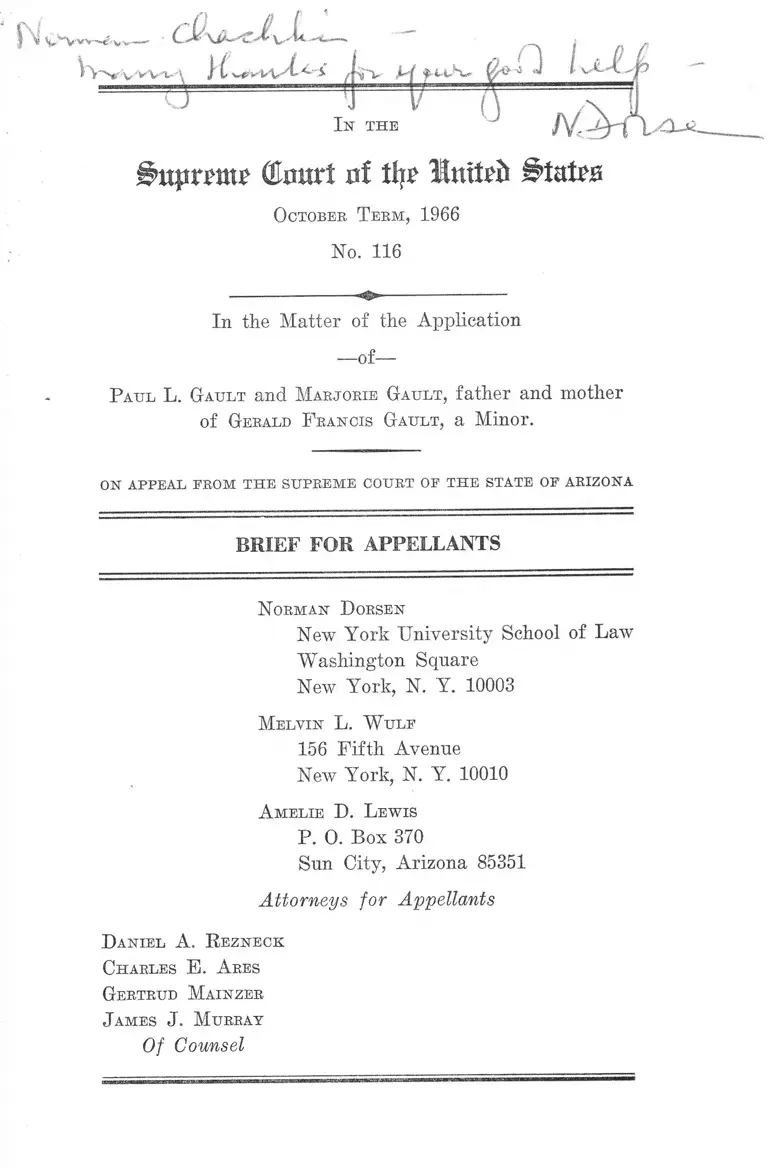
-
Brief Collection, LDF Court Filings. In Re: Paul L. Gault Brief for Appellants, 1966. 2c2ce4eb-b29a-ee11-be36-6045bdeb8873. LDF Archives, Thurgood Marshall Institute. https://ldfrecollection.org/archives/archives-search/archives-item/e48341f5-27d2-4f5e-bb53-82714ed0c11c/in-re-paul-l-gault-brief-for-appellants. Accessed September 21, 2026.
Copied!
' V ' W ^ V V - ----- . W * " - '
K v
-
f44>V» n / v i i .
I n t h e IV- — ____
.#H|inmtT CÊ nrt nf tin' Inttefr Btvdt&
O ctober T erm , 1966
No. 116
In the Matter of the Application
—of—
P aul L. Gault and M arjorie Ga u lt , father and mother
of Gerald F rancis G ault, a Minor.
ON APPEAL PROM T H E SU PR EM E COURT OE T H E STATE OF ARIZONA
BRIEF FOR APPELLANTS
N orman D orsen
New York University School of Law
Washington Square
New York, N. Y. 10003
M elvin L . W u l f
156 Fifth Avenue
New York, N. Y. 10010
A m elie D. L ew is
P. O. Box 370
Sun City, Arizona 85351
Attorneys for Appellants
D a n iel A . R ezneck
C harles E. A res
Gertrud M ainzer
J ames J . M urray
Of Counsel
I N D E X
Opinions Below ............................................................. 1
Jurisdiction .................................................................... 1
Statutes Involved ........................................................... 2
Question Presented ....................................................... 3
Statement of the Case .......................... 4
Summary of Argument.................................................. 9
A rgum ent
I. The historical background of procedural de
ficiencies in Juvenile Courts............................ 13
II. The Arizona juvenile proceedings failed to
provide Gerald Gault with fundamental pro
cedural protections that are required by the
due process clause of the Fourteenth Amend
ment .................................................................. 18
A. Notice of Charges and Hearing................. 29
B. The Bight to Counsel ................................ 34
C. Confrontation and Cross-examination ...... 43
D. The Privilege Against Self-Incrimination 50
E. Right to Appellate Review and to a Tran
script of the Proceedings ......................... 58
PAGE
C onclusion 63
11
PAGE
A ppen dix :
Arizona Constitution, Article 6, Section 15 .......... la
Arizona Criminal Code § 13-377 ............................ la
Juvenile Code of Arizona, §§ 8-201 to 8-239 .......... la
T able of A utho rities
Cases:
Akers v. State, 114 Ind. App. 195, 51 N. E. 2d 91 (1943) 16
Application of Gault, 99 Ariz. 181, 407 P. 2d 760 (1965)
passim
Application of Johnson, 178 F. Supp. 155 (D. N. J.
1957) ......................................................................... 24,33
Application of Vigileos, 84 Ariz. 404, 300 P. 2d 116
(1958) ................................................................... 53
Ballard v. State, 192 S. W. 2d 329 (Tex. Civ. App.
1946) ........................................................................... 46
Benson v. U. S., 332 F. 2d 288 (5th Cir. 1964) .............. 22
Black v. U. S., 355 F. 2d 104 (D. C. Cir. 1965) .......... 35, 39
Brewer v. Commonwealth, 283 S. W. 2d 702 (Ky. 1955) 24
Briggs v. U. S., 96 U. S. App. D. C. 392, 226 F. 2d 350
(1955) ......................................................................... 53
Burrows v. State, 38 Ariz. 99, 297 Pac. 1029 (1931) .... 53
Carnley v. Cochran, 369 U. S. 506 (1962) ..................... 43
Caruso v. Superior Court, 100 Ariz. 167, 412 P. 2d 463
(1966)........................................................................... 54
Chewning v. Cunningham, 368 U. S. 443 (1962) ........37-38
Cole v. Arkansas, 333 U. S. 196 (1948) ..................... 29,30
Counselman v. Hitchcock, 142 U. S. 547 (1892) ............ 55
I l l
Dandy v. Wilson, 179 S. W. 2d 269 (Tex. Sup. Ct.
PAGE
1944) ......................................................................... 56,57
Draper v. Washington, 372 U. S. 487 (1963) ................. 62
Ex parte Tahbel, 46 Cal. App. 755, 189 Pac. 804 (1920)
56, 57
Fay y . Noia, 372 IT. S. 391 (1963) ................................ 43
Florence v. Meyers, 9 Race Eel. L. R. 44 (M. D. Fla.
1964) ............................................................... 29
Flynn v. Superior Court, 414 P. 2d 438 (Ariz. Ct. App.
1966) ........................................................................... 53
Gideon v. Wainwright, 372 U. S. 335 (1963) ...... 11,34,35,
36, 37
Green v. State, 123 Ind. App. 81, 108 N. E. 2d 647
(1952) .......................................................................... 46
Greene v. McElroy, 360 U. S. 474 (1959) ..................... 45,46
Griffin v. Hay, 10 Race Rel. L. R. I l l (E. D. Ya. 1965) 29
Griffin v. Illinois, 351 U. S. 12 (1956) ...... ..................58, 62
Griffin v. State, 380 U. S. 609 (1965) ............................ 51
Hamilton v. Alabama, 368 II. S. 52 (1961) ................. 36
Harris v. Norris, 188 Ga. 610, 4 S. E. 2d 840 (1939) .... 60
Hovey v. Elliot, 167 H. S. 409 (1897) ........................... 29
In Interest of T. W. P., 184 So. 2d 507 (Fla. Ct. of
App. 1966) .................................................................. 16
In re Alexander, 152 Cal. App. 2d 458, 313 P. 2d 182
(1957) ......................................................................... 24
In re Bentley (Harry v. State), 246 Wis. 69, 16 N. W.
2d 390 (1944) 16
In re Contreras, 109 Cal. App. 2d 787, 241 P. 2d 631
(1952) ..........................................................................
In re Coyle, 122 Ind. App. 217, 101 N. E. 2d 192
(1951) ......................................................................... 33-
In re Creely, 70 Cal. App. 2d 186, 160 P. 2d 870 (1945)
In re Davis, 83 A. 2d 590 (Mun. Ct. Apps. D. C.
1951) ...........................................................................
In re Duncan, 107 N. E. 2d 256 (1951) .........................
In re Florance, 47 Cal. 2d 25, 300 P. 2d 825 (1956) ......
In re Holmes, 379 Pa. 599, 109 A. 2d 523 (1954), cert.
denied, 348 U. S. 973 (1955) .....................16,17, 22, 23,
In re Mantell, 157 Neb. 900, 62 N. W. 2d 308, 43 A. L. R.
2d 1122 (1954) .........................................................
In re Murchison, 349 U. S. 133 (1955) ................. 29,60,
In re Oliver, 333 U. S. 257 (1948) ................................
In re Poff, 135 F. Supp. 224 (D. D. C. 1955) .......... 13, 25,
In re Poulin, 100 N. H. 458, 125 A. 2d 672 (1957) ......
In re Ronny, 40 Misc. 2d 194, 242 N. Y. S. 2d 844 (Fam
ily Ct. 1963) ................................................................
In re Roth, 158 Neb. 789, 64 N. W. 2d 799 (1954) ......
In re Sadleir, 97 Utah 291, 85 P. 2d 810 (1938) ..........
In re Santillanes, 47 N. M. 140, 138 P. 2d 503 (1943) .17,
In re Wright, 251 F. Supp. 880 (M. D. Ala. 1965) ......
In the Matter of Gonzalez, 328 S. W. 2d 475 (Tex. Ct.
App. 1959) ..................................................................
Interest of Long, 184 So. 2d 861 (1966) .........................
24
■34
33
57
16
33
57
46
62
29
39
34
26
34
57
,57
29
16
39
43Johnson v. Zerbst, 304 IJ. S. 458 (1938)
Kent v. U. S., 383 H. S. 541 (1966) ....... .9,12,17,19, 25,
35, 36, 54, 59
V
Malloy y . Hogan, 378 U. S. 1 (1964) ............................ 51
Matter of McDonald, 153 A. 2d 651 (D. C. Mnnic. Ct.
App. 1959) .................................................................. 16
Matter of Solberg, 52 N. D. 518, 203 N. W. 898 (1925) 34
McCarthy v. Arndstein, 266 U. S. 34 (1924) .............. 51
Miranda v. Arizona, 384 U. S. 436 (1966) ................. 36
Murphy v. Waterfront Commission, 378 U. S. 52
(1964) ........................................................................12,51
People ex rel. Solemon v. Slattery, 39 N. Y. S. 2d 43
(Sup. Ct. 1942) ........................................................... 60
People v. Dotson, 46 Cal. 2d 891, 299 P. 2d 875 (1956) .. 16
People v. James, 9 N. Y. 2d 82, 211 N. Y. S. 2d 170, 172
N. E. 2d 552 (1961) .............................................. 46,47
People v. Lewis, 260 N. Y. 171, 183 N. E. 353 (1932)
15,17, 58, 59
People v. Silverstein, 121 Cal. App. 2d 140, 262 P. 2d
656 (1953) .................................................................... 17
Petition of O’Leary, 325 Mass. 179, 89 N. E. 2d 769
(1950) ............................................. 34
Pettit v. Engelking, 260 S. W. 2d 613 (Tex. Civ. App.
1953) ........................................................................... 34
Pointer v. Texas, 380 U. S. 400 (1965) .....................43,48
Powell v. Alabama, 287 U. S. 45 (1932) ..............11,29,34,
35, 37, 38
Eeynolds v. Cochran, 365 U. S. 525 (1961) ................. 37
Shioutakon v. District of Columbia, 236 F. 2d 666 (D. C.
Cir. 1956) .... 35,39
State ex rel. Cave v. Tincher, 258 Mo. 1, 166 S. W. 1028
(1914) ..
PAGE
34
V I
State ex rel. Christensen v. Christensen, 119 Utah 361,
227 P. 2d 760 (1951) ................................ .................. 16
State ex rel. Raddue v. Superior Court, 106 Wash. 619,
180 P. 875 (1919) ....................................................... 16
State v. Andersen, 159 Neb. 601, 68 N. W. 2d 146
(1955) ......................................................................... 34
State v. Chitwood, 73 Ariz. 161, 239 P. 2d 353 (1951),
on rehearing, 73 Ariz. 314, 240 P. 2d 1202 (1952) .... 56
State v. Logan, 87 Fla. 348, 100 So. 173 (1924) .......... 60
State v. Naylor, 207 A. 2d 1 (Del. 1965) ......................... 24
State v. Shardell, 107 Ohio App. 338, 153 N. E. 2d 510
(1958) .......................................................................... 57
Sylvester v. Commonwealth, 253 Mass. 244, 148 N. E.
449 (1925) .................................................................. 16
Thompson v. City of Louisville, 362 U. S. 199 (1960) .... 61
Trimble v. Stone, 187 F. Supp. 483 (D. D. €. 1960) ...... 24
U. S. v. Dickerson, 168 F. Supp. 899 (D. C. 1958), rev’d
on other grounds, 106 U. S. App. D. C. 221, 271 F. 2d
487 (1959) .................................................................. 57
U. S. v. Morales, 233 F. Supp. 160 (D. C. Mont. 1964) .... 24
Von Moltke v. Gillies, 332 U. S. 708 (1948) ................. 43
White v. Maryland, 373 U. S. 59 (1963) ..................... 36
Williams v. Kaiser, 323 U. S. 471 (1945) ......................... 38
Williams v. New York, 337 U. S. 241 (1949) ..............22, 29
Williams v. Zuekert, 371 U. S. 531 (1963) .................... 45
Willner v. Committee on Character & Fitness, 373 U. S.
96 (1963) .................................................................... 45
PAGE
Constitutional Provisions:
United States Constitution
Fifth Amendment ........................................... 36
Fourteenth Amendment ...... 3,13,18, 35,44, 51, 60
Arizona Constitution
Article 2, Section 19 ....................................... 54
Article 6, Section 15 ....................................... 52
Statutes and Rules:
28 U. S. C. §1257(2) ...................................................... 2
Criminal Code of Arizona, Ch. 8, §§13-2001 to 2027,
Arizona Revised Statutes (1956) ................................ 1
Juvenile Code of Arizona, §§8-201 to 8-239, Arizona
Revised Statutes ....................................................passim
Title 4, §245 ................................................ -.................. 56
Title 13, §101, Arizona Revised Statutes ..................... 50
Title 13, §377, Arizona Revised Statutes ..............2, 23, 30,
31, 38, 50, 52
Title 44, §1660 .............................................................. 55-56
California Welfare and Institutions Code (1961)
§§500-914 .................................................................. 27
§§653, 656 ................................................................ 31
§679 ......................................................................... 39
Illinois Laws, 1899, at 131 ........................................... 14
VII
PAGE
V l l l
New York Family Court Act (1962)
§241 .............................................
§711 .............................................
§731 ............................................ .
§741 .............................................
PAGE
... 39
.. 27
.. 31
39, 58
Other Authorities'.
Allen, Criminal Justice, Legal Values and the Re
habilitative Ideal, 50 J. Crim. L. C. and P. S. 226
(1959) ......................................................................... 22
Antieau, Constitutional Rights in Juvenile Courts, 46
Cornell L. Q. 387 (1961) ............... 13,16, 25, 33, 39, 49, 57
Beemsterboer, The Juvenile Court—Benevolence in the
Star Chamber, 50 J. Crim. L. C. and P. S. 464 (1960) 25
Biographical Data Survey of Juvenile Court Judges,
George Washington Univ., Center of Behavioral
Sciences (1964) .................... ..................................... 38
Children’s Bureau, U. S. Dept, of Health, Education &
Welfare, Standards for Juvenile and Family Courts
(1966) ....................................... 14, 27, 33, 41-42, 47, 57, 60
Dembitz, Ferment and Experiment in New York:
Juvenile Cases in the New York Family Court, 48
Cornell L. Q. 499 (1963) .......................................... 25
Glueck, Some “Unfinished Business” in the Manage
ment of Juvenile Delinquency, 15 Syracuse L. Rev.
628 (1964) ....................................... ...........................15,16
IX
Guidebook for Judges, prepared by the Advisory Coun
cil of Judges of the National Council on Crime and
Delinquency ................................................................
Horwitz, The Problem of the Quid pro Quo, 12 Buffalo
L. Rev. 528 (1963) ......................................................
Illinois Legislative Council, Juvenile Court Proceed
ings in Delinquency Cases (1958) ............................
Institute of Judicial Administration, Juvenile Courts—
Jurisdiction (1961) .................................................... 14
Ketcham, Legal Renaissance in the Juvenile Court, 60
Nw. U. L. Rev. 585 (1965) ...... ....................-........25, 27, 39
Mack, The Juvenile Court, 23 Harv. L. Rev. 104
(1909)........................................................................... 15
McCune and Skoler, Juvenile Court Judges in the
United States, 11 Crime & Delinquency 121 (1965) ..-38
McKay, The Right of Confrontation, 1959 Wash.
U. L. R. 122 .............................................................44,46
Meltsner, “Southern Appellate Courts: A Dead End”
in Friedman (ed.), “Southern Justice” 152 (1965) .... 29
Molloy, Juvenile Court—A Labyrinth of Confusion for
the Lawyer, 4 Ariz. L. Rev. 1 (1962) .....................50, 54
National Probation and Parole Association (NPPA)
(now the National Council on Crime and Delin
quency, NCCD), Standard Juvenile Court Act (Rev.
1959), 5 NPPAJ 323 (1959) .......................... 14,27,31,39
NCCD, Standard Family Court Act (1959) .......... 14, 47, 60
Note, Juvenile Courts: Applicability of Constitutional
Safeguards and Rules of Evidence Proceedings, 41
Cornell L. Q. 147 (1955)............................................... 16
PAGE
33
17
X
Note, Juvenile Delinquents: The Police, State Courts
and Individualized Justice, 79 Harv. L. Rev. 775
(1966) .......................................................................... 14
NPPA, Guides for Juvenile Court Judges (1957) ...... 14
Paulsen, Fairness to the Juvenile Offender, 41 Minn.
L. Rev. 547 (1957) ................................... 16, 25, 33, 39, 56
Quick, Constitutional Rights in the Juvenile Court, 12
How. L. J. 76 (1966) .................................................. 25
Radzinowicz and Turner, A Study of Punishment I:
Introductory Essay, 21 Canadian Bar Rev. 91-97
(1943) ......................................................................... 22
Rubin, Protecting the Child in the Juvenile Court, 43
J. Crim. L. C. and P. S. 425 (1952) ......................... 25
Schinitsky, The Role of the Lawyer in Children’s
Court, The Record (The Assn, of the Bar of the City
of New York), Vol. 17, No. 1, Jan., 1962 ................. 39,41
Skoler, Juvenile Courts and Young Lawyers, 10 The
Student Law J. 5 (Dec. 1964) ................................... 25
Starrs, A Sense of Irony in Juvenile Courts, 1 Harv.
Civil Rights—Civil Liberties L. Rev. 129 (1966) ....... 29
Sussman, Juvenile Delinquency (1955) ......... 17
Sussman, Law of Juvenile Delinquency (Rev. ed. 1959) 14
The Interstate Compact on Juveniles: Development
and Operation, 8 J. of Pub. Law 24 (1959) .......... 14
Tompkins, In the Interest of a Child (1959) ................. 14
U. S. Commission on Civil Rights Report, Law En
forcement, 1965 ....................................................... 28
PAGE
X I
Watson, The Child and the Magistrate (England 1965) 57
Welch, Delinquency Proceedings—Fundamental Fair
ness for the Accused in a Quasi-Criminal Forum, 50
PAGE
Minn. L. Rev. 653 (1966) ...........................................13, 25
5 Wigmore, Evidence §1400 (3rd ed., 1940) ............... 44
5 Wigmore, Evidence §1367 (3rd ed., 1940) ................. 45
I n t h e
^uprem? Court of % luttrb ^tatro
October T erm , 1966
No. 116
In the Matter of the Application
—of—
P aul L. Gault and M arjorie Gault, father and mother
of Gerald F rancis Gault, a Minor.
BRIEF FOR APPELLANTS
Opinions Below
The opinion of the Supreme Court of Arizona (R. 83-97)
is reported at 99 Ariz. 181, 407 P. 2d 760. The Superior
Court of Maricopa County, Arizona, from which appeal was
taken, wrote no opinion. The Juvenile Court of Gila County
wrote no opinion; its decision is found in the order of
commitment, dated June 15, 1964, contained in the Record
as Exhibit 4 (R. 81-82).
Jurisdiction
Appellants filed a petition for a writ of habeas corpus
in the Supreme Court of Arizona on August 3, 1964, pursu
ant to the provisions of Chapter 8 of the Criminal Code
of the Arizona Revised Statutes (1956), Sections 13-2001-
2027. The same day, the Supreme Court of Arizona
2
ordered a hearing of the application in the Superior Court
of Maricopa County. The hearing was held on August 17,
1964. The Superior Court dismissed the petition, dis
charged the writ, and remanded the juvenile to the State
Industrial School.
The order of the Superior Court was affirmed on appeal
by the Supreme Court of Arizona on November 10, 1965,
and a timely application for rehearing was denied by that
Court on December 16, 1965 (R. 99). Notice of Appeal to
the Supreme Court of the United States was filed with the
Supreme Court of Arizona on February 4, 1966 (R. 100).
On March 21, 1966, Hon. Fred C. Struckmeyer, Chief
Justice of the Supreme Court of Arizona, enlarged appel
lants’ time to file the Jurisdictional Statement and to
docket the appeal to May 5, 1966. The Jurisdictional State
ment was filed on May 2, 1966 and probable jurisdiction
was noted on June 20, 1966. Jurisdiction on appeal is
conferred by 28 U.S.C. §1257(2).
Statutes Involved
Article 6, Section 15 of the Arizona Constitution, the
Juvenile Code of Arizona, Sections 8-201 to 8-239, Arizona
Revised Statutes, and Title 13, Sec. 377, Arizona Revised
Statutes, are set forth in full in the Appendix to this brief.
3
Question Presented
Whether the Juvenile Code of Arizona, Sections 8-201
to 8-239, Arizona Revised Statutes, on its face or as con
strued and applied, is invalid under the Due Process Clause
of the Fourteenth Amendment to the United States Con
stitution because it authorizes a juvenile to be taken from
the custody of his parents and to be committed to a state
institution by a judicial proceeding which confers unlimited
discretion upon the Juvenile Court and dispenses with the
following procedural safeguards required by due process
of law:
1. right to notice of the charges of delinquency;
2. right to counsel;
3. right to confrontation and cross-examination of ad
verse witnesses;
4. privilege against self-incrimination;
5. right to a transcript of the proceedings; and
6. right to appellate review of the juvenile court’s
decision.
4
Statem ent o f th e Case1
Appellants are the parents of fifteen year old Gerald
Francis Gault who was committed as a juvenile delinquent
to the State Industrial School in Arizona after a juvenile
proceeding in the Superior Court of Gila County, Globe,
Arizona, on June 15,1964. No transcript exists of the hear
ing before the juvenile court.2
On June 8, 1964, Gerald Francis Gault and a friend,
Eonald Lewis, were taken into custody by the Sheriff of
Gila County as the result of a complaint by one Mrs. Cook,
a neighbor of the boys, about lewd telephone calls made
to her. Gerald was at this time on six months’ probation
following an incident in February, 1964 (R. 13). Proba
tion officers Flagg and Henderson decided to detain the
children (R. 48). Mr. Flagg interrogated Gerald at some
length during the evening of June 8th and the morning of
June 9th (R. 48).
No notice of the detention or charges was left at the
Gault home. Mrs. Gault, who returned from work at 6 :Q0
P.M., was informed by neighbors about the detention and
went to the detention home. There she was told by proba
tion officer Flagg why Gerald was detained and that a hear
ing would be held at 3 o’clock the following day, June 9th.
1 The statement of facts is based on the habeas corpus hearing
held on August 17, 1964 in the Superior Court of Maricopa County
after a petition for a writ of habeas corpus had been filed by ap
pellants on August 3, 1964 in the Supreme Court of Arizona to
secure the release of the child. The record of that hearing is part
of the record on appeal.
2 The Arizona statute does not require a record to be made of
juvenile hearings but only of the age, place of birth and name of
the child and his parents (§8-229).
No written notice of the hearing or of the charges was
given to Mrs. Gault (R. 29-30).
A petition charging Gerald with juvenile delinquency was
filed by probation officer Flagg with the Court on June 9,
1964, but Mrs. Gault had not received notice of it and did
not see it until August 17, when the habeas corpus hearing
was held (R. 33). A referral report charging Gerald with
making “lewd phone calls” made by the Probation Depart
ment, filed on June 15, 1964, was also not brought to appel
lants’ notice until August 17th, when introduced by appel
lants’ attorney together with the above mentioned petition
(R. 34).
On June 9th a hearing took place in the Juvenile Judge’s
chambers in the presence of Gerald, his mother, Ms older
brother Louis, and Mr. Flagg and Mr. Henderson, the pro
bation officers. Mr. Gault, Gerald’s father, was in Grand
Canyon at work (R. 20). No one was sworn at this hearing
(R. 30). No transcript was made (R. 54).
Gerald testified at the June 9th hearing about the tele
phone call. There was a conflict at the habeas corpus hear
ing about this testimony. Mrs. Gault testified that Gerald
said he only dialed Mrs. Cook’s number and his friend talked
to Mrs. Cook (R. 30), while Judge McGhee, the Juvenile
Judge (R. 59), and Probation Officer Flagg testified
that Gerald admitted having said some of the lewd words
but not the more serious ones (R. 59). At the conclusion of
the hearing, in answer to a question by Gerald or his mother
if Gerald would be sent to Fort Grant,3 Judge McGhee said:
3 The State Industrial School.
6
“No, I will think it over” (E. 31, 39). Gerald stayed in the
detention home until June 12th when he was released to
his parents. At 5 o’clock that day, Mrs. Gault received a
written note4 signed by Officer Flagg which said: “Mrs.
Gault, Judge McGhee has set Monday, June 15th,
1964 at 11:00 A.M. as the day and time for further hearings
on Gerald’s delinquency.” (Exhibit 1, E. 8.)
At the hearing on June 15th, both appellants were pres
ent, Mr. Gault having returned home on June 12th (E. 21).
Others present at this hearing before Judge McGhee were
Eonald Lewis with his father, and probation officer Flagg.
Mrs. Cook, the person who had complained about the
phone call, was not present or called as a witness. Proba
tion officer Flagg had only talked to her over the phone
on June 9th (E. 48) and Judge McGhee had not spoken
to her at all (E. 76). When Mrs. Gault asked the judge
during this hearing why Mrs. Cook was not present, and
said that “she wanted Mrs. Cook present so she could see
which boy had done the talking, the dirty talking over the
phone” (E. 36), Judge McGhee answered, “she didn’t have
to be present at that hearing” (E. 36).
Conflict also exists about Gerald’s testimony at this sec
ond hearing. Appellants (E. 35) and Mr. Flagg (E. 45)
stated that Gerald did not admit having made any lewd
remarks and only dialed the number. Judge McGhee tes
tified that Gerald again admitted having made some of the
obscene remarks but not the more serious ones (E. 61).
4 There was a conflict in the testimony as to when Gerald was
released and when Mrs. Gault received this note. Probation officer
Flagg, without having made a record about these events, testified
that both occurred on Thursday, June 11th.
7
There was no other evidence about Gerald’s use of lewd
language. Probation officer Flagg testified that Gerald
had never admitted to him that he used any indecent lan
guage over the telephone (E. 57). Nevertheless, in the re
ferral report by the probation department (Exhibit 2,
E. 79) the charge against Gerald on June 8, 1964 was
“lewd phone calls.”
The June 9th petition filed by Mr. Flagg with the Su
perior Court, Gila County (Exhibit 3, E. 80) alleged
that Gerald Gault was “a delinquent minor.” Probation
officer Flagg based this charge on the fact that “the phone
calls were made, and when they were traced, they went to
his home. And the fact that when I asked him to recite
Mrs. Cook’s phone number, he recited it like it was his own”
(E, 50). Asked by appellants’ attorney under which part
of Section 8-201 Gerald had been charged with, Officer Flagg
answered “we set no specific charge in it, other than de
linquency” (E. 52).
There was no conflict in the testimony with regard to the
following facts at both the June 9th and June 15th hear
ings : that the parents were not given a copy of the petition
or written notice of the hearing date except Mr. Flagg’s
note concerning the hearing on June 15th; that the parents
were not informed of the right to subpoena witnesses, to
cross-examine witnesses, of the right to confrontation, or
of the right to counsel (E. 35, 46-47, 59, 71) ;5 that at no
time during the juvenile proceeding was an investigation
5 Though appellants testified that they knew of their right to
call witnesses and to retain an attorney (R. 19, 40), both Mr.
Flagg and the Juvenile Judge acknowledged that they never ad
vised the Gaults of their right to counsel, their right to subpoena
witnesses or their right to cross-examine (R. 46, 59, 71).
conducted to examine Gerald’s home conditions or his be
havior (E. 20, 34, 53). The only investigation claimed to
have been made was apparently conducted in February,
1964, when Gerald had been put on probation on a previous
delinquency charge (E. 53). No record exists of this pre
vious charge or hearing other than a referral report made
by the Probation Department (E. 13).
It is difficult, based on the Juvenile Judge’s testimony,
to know with certainty what the basis was for the finding
of delinquency. The Juvenile Court Judge thought that
the phone calls “amount[ed] to disturbing the peace” 6 7
(E. 61) but he also considered that Gerald was “habitu
ally involved in immoral matters” (I b i d He testified
that there was “Probably another ground, too” (E. 73).
As stated by Judge McGhee, the finding of juvenile de
linquency was based on “the boy’s statements” (E. 76) and
upon the admission of Gerald Gault (E. 65) as to the use of
lewd language and on facts not contained in the juvenile
file, i.e., a referral report in the probation file dated July 2,
1962, that Gerald had stolen a baseball glove. On this report
Judge McGhee had based his finding that the boy was delin
quent because “habitually involved in immoral matters”
even though the report was never followed up, no accusation
was made, and no hearing held “because of lack of material
foundation” (E. 61, 62). The report, and the fact that the
judge relied on it, was not brought to appellants’ knowledge
until August 17, 1964 at the habeas corpus hearing (E.
71-72).
6 Thereby bringing the boy within §8-201(6) (a ) .
7 Thereby bringing the boy within §8-201(6) (d).
9
No warning about the possible consequences of the
charges were given to appellants by the probation officer
(R. 17, 35, 54). Judge McGhee stated that he gave the
usual warning in February and “reminded” the parents of
the February admonition on June 9th (R. 66).
Summary of Argument
I.
Juvenile courts developed out of a desire to treat way
ward youths as a prudent parent treats his child—with
concern for the individuality of each person, the causes
of his acts, and the means to rehabilitate him to be a useful
citizen. This concept of the “parens patriae” led, however,
to a court system in which traditional legal safeguards were
dispensed with in determining whether a child was delin
quent. The barter of due process for individualized treat
ment has cost juveniles dearly, leading this Court recently
to state that “there is evidence . . . that the child receives
the worst of both worlds: that he gets neither the protec
tions accorded to adults nor the solicitous care and regen
erative treatment postulated for children.” Kent v. United
States, 383 TT.S. 541, 555-56 (1966).
II.
The Arizona Juvenile Code, and the proceedings taken
under it in this case, lacked the fundamental procedural
protections that comprise due process of law. This depri
vation of rights cannot be justified. First, the “parens
patriae” notion is no substitute for the fairness that the
juvenile is entitled to when his vital interests are at stake.
Further, there is no substance to any contention to the
10
effect that a juvenile proceeding is “civil” and not “crim
inal” and dispenses “treatment” rather than “punishment”.
Apart from the fact that the rehabilitative ideal is equally
present in the conventional criminal law, the accused juve
nile delinquent stands to lose as much of his liberty, and
sometimes more, than the adult charged with a comparable
offense and prosecuted in the criminal courts. The inter
relationship between Arizona juvenile court actions and
criminal prosecutions further points up the weakness of the
suggestion that juvenile proceedings need not provide due
process of law. Impressed by these considerations, state
and federal courts, draftsmen of modern juvenile court acts,
and scholarly commentators all evince a growing recogni
tion that there are compelling reasons of fairness to pro
vide young people with basic procedural protections in
juvenile court.
A.
The first essential of due process, where an individual’s
liberty is in jeopardy, is that he be clearly informed of the
nature of the charge against him so that he can decide on a
course of action and prepare his defense. Here Gerald
Gault was not properly advised of his acts complained of,
the statute or applicable rule of law such acts were alleged
to violate, or the possible consequences of a finding against
him. In these circumstances, the juvenile court’s decision
to deprive him of six years of liberty violated his consti
tutional rights.
B.
The denial of the right to counsel in this case also vitiated
the proceedings. The decision below on this point flies in
the face of principles painstakingly elaborated by this Court
11
over many years. A juvenile proceeding involving a deter
mination of delinquency carries with it sufficient social
stigma and danger of deprivation of liberty so that there
is no less need for the assistance of counsel there than in
criminal cases, where it has been recognized as a funda
mental constitutional right. Poiuell v. Alabama, 287 U.S. 45
(1932); Gideon v. Wainwright, 372 U.S. 335 (1963). Legal
counsel is particularly vital in juvenile proceedings because
of the immaturity of the accused delinquent, the uncertainty
of the rights possessed b)̂ the accused, the fact that many
juvenile judges are laymen or part-time, and the wide dis
cretion of juvenile courts in dealing with young persons
adjudged delinquent.
C.
This court has unanimously held that the Sixth Amend
ment guarantee of confrontation and cross-examination is
an integral part of due process because without them there
can be no fair or reliable determination of truth. Begard-
less of whether juvenile proceedings are denominated crim
inal or civil, these rights must be available. Surely a ju
venile proceeding in which the loss of liberty is at stake
involves interests as great as those involved in adjudicatory
administrative proceedings, where confrontation and cross-
examination have been held to be constitutionally mandated.
Here Gerald Gault was adjudged a delinquent without any
consideration of the testimony of the woman alleged to have
received the obscene telephone call. The confusing testi
mony of others concerning what actually happened and
whether Gerald Gault was involved accentuates the error
of the notion that an individual can be deprived of liberty
without the trier of fact hearing the testimony of the
alleged victim.
12
D.
Gerald Gault was found to have committed a crime under
the law of Arizona and his commitment by the court rested
in part on that finding. There is no dispute that decisive
admissions of elements of this offense were elicited from
him by the juvenile court, which gave him no advice that
he did not have to testify. Under familiar principles, the
privilege against self-incrimination can be claimed “in any
proceeding, be it criminal or civil, administrative or judi
cial, investigative or adjudicatory.” Murpliy v. Waterfront
Commission, 378 U.S. 52, 94 (1964). The relevant inquiry
is whether the witness may in any way incriminate himself
by testifying or making a statement. Under the law of
Arizona, Gerald Gault ran the risk when he testified of
furnishing evidence which could be used against him in a
criminal prosecution. In these circumstances, the State
was required either to afford him the privilege against
self-incrimination or grant him immunity commensurate
with the risk. It did neither, in plain violation of the
Constitution.
E.
The State’s failure to provide a right of appellate review
of the juvenile court decision or a right to a transcript of
the proceedings in the juvenile court constitutes a departure
from the requirements of due process of law. Although
it has been said that a state is not required to provide
appellate review of criminal actions, there can be no “li
cense for arbitrary procedure.” Kent v. United States,
383 U.S. 541, 553 (1966). The Arizona statutory scheme
grants to the juvenile judge practically unlimited discretion
in the conduct of a hearing at which individual liberty is
13
at stake. Such a proceeding cannot be squared with con
stitutional requirements of fundamental fairness unless
there is opportunity for direct review, or at least collateral
review on the basis of an official transcript.
A R G U M E N T
I.
The historical background of procedural deficiencies
in Juvenile Courts.
This case presents the important constitutional question
of the extent to which certain fundamental requirements of
procedural fairness guaranteed by the Due Process Clause
of the Fourteenth Amendment are applicable to juvenile
court proceedings. The history of juvenile courts in this
country is valuable in appreciating the background and
dimensions of this question. It reveals both the high pur
poses of the movement that led to juvenile courts and how
these purposes came to be perverted in the form of pro
ceedings—as exemplified by this case from Arizona—that
lack the most elemental protections of due process.
Before the enactment of juvenile court acts, criminal
prosecutions against juveniles and adults were handled
identically and included the same procedural safeguards.8
At the turn of the century, insights acquired through the
development of the behavioral sciences—penology, psy
chiatry, psychology and social work—led to popular and
8 See Welch, Delinquency Proceedings—Fundamental Fairness
for the Accused in a Quasi-Criminal Forum, 50 Minn. L. Rev. 653,
654-55 (1966) ; In Be Poff, 135 F. Supp. 224, 225 (D. D. C. 1955).
See generally Antieau, Constitutional Rights in Juvenile Courts,
46 Cornell L. Q. 387 (1961).
14
professional dissatisfaction with prosecutions against chil
dren. This led to the establishment of the first juvenile
court in 1899 in Cook County, Illinois (111. Laws, 1899, at
131). Since then, all states have provided by statute that
children who are accused of acts which would violate the
criminal law or who are alleged to be beyond the control
of their parents—“incorrigible”, “wayward”, or “ungovern
able”—are subject to proceedings in a juvenile or family
court.9
Underlying all juvenile law is the concept of the state
as the guardian of the child or “parens patriae”. The princi
ple is that the child who has acted wrongly should be treated
by a court as a prudent parent treats his erring child, not
as a criminal. In the words of an early study:
“ [T]he state must step in and exercise guardianship over
a child found under such adverse social or individual
conditions as develop crime. . . . It proposes a plan
9 State code provisions are compiled and compared in : Institute
of Judicial Administration, Juvenile Courts-Jurisdiction (1961);
Sussman, Law of Juvenile Delinquency (Rev. ed. 1959) ; Tomp
kins, In the Interest of a Child (1959) (prepared for the California
Special Study Commission on Juvenile Justice) ; Illinois Legisla
tive Council, Juvenile Court Proceedings in Delinquency Cases
(1958) (12 selected states).
Model and Uniform legislation and standards appear in: Na
tional Probation and Parole Association (NPPA) (now the National
Council on Crime and Delinquency, NCCD), Standard Ju
venile Court Act (Rev. 1959), 5 NPPAJ 323 (1959); NCCD Stand
ard Family Court Act (1959) ; Children’s Bureau, U. S. Dept, of
Health, Education and Welfare, Standards for Juvenile and
Family Courts (1966); NPPA, Guides for Juvenile Court Judges
(1957); see also The Interstate Compact on Juveniles: Develop
ment and Operation, 8 J. of Pub. Law 524 (1959). A recent study
of the operation of these courts is contained in Note, Juvenile
Delinquents: The Police, State Courts, and Individualized Justice,
79 Harv. L. Rev. 775 (1966).
15
whereby he may be treated, not as a criminal, or legally
charged with a crime, but as a ward of the state, to
receive practically the care, custody and discipline that
are accorded the neglected and dependent child, and
which . . . shall approximate as nearly as may be that
which should be given by its parents.” 10
In brief, the early juvenile courts emphasized the indi
viduality of the child, the causes of his act, and the means
to help him to become a useful citizen. “The problem for
determination by the judge is not, Has this boy or girl
committed a specific wrong, but What is he, how has he be
come what he is, and what had best be done in his interest
and in the interest of the state to save him from a down
ward career.” Mack, The Juvenile Court, 23 Harv. L. Rev.
104, 119 (1909), quoted in People v. Lewis, 260 N. Y. 171,
177, 183 N. E. 353, 355 (1932).
It was a short step from the concept of individualized
justice in the treatment or rehabilitative phase of a pro
ceeding to a greater informality in the trial itself. It was
feared that the fact-finding procedures of our accusatory,
adversary system of criminal trials were inimical to the
establishment of the relationship between court and child
which was thought necessary to his proper treatment and
rehabilitation.
The consequence of this “swapping” of due process for
parens patriae was that many traditional legal safeguards
of criminal proceedings were dispensed with, to the in
10 Report of the Committee of the Chicago Bar, 1899, quoted in
Glueck, Some “Unfinished Business” in the Management of Ju
venile Delinquency, 15 Syracuse L. Rev. 628, n. 2 (1964).
16
evitable detriment of individual rights.11 Some courts even
went so far as to insist flatly that constitutional safeguards
of criminal procedure were not applicable to juvenile pro
ceedings. In re Holmes, 379 Pa. 599, 603, 109 A. 2d 523,
525 (1954), cert, denied, 348 U. S. 973 (1955). In other
courts the result was a host of questionable decisions.
Vague allegations of anti-social behavior were sufficient to
bring a child before some juvenile courts,12 and the infor
mality of the juvenile procedure was often used to accept
uncorroborated admissions, hearsay testimony and the un
tested reports of social investigations.13 The right to coun
sel and the right to notice of charges were sometimes dis
pensed with.14 The protections against self-incrimination
and double jeopardy also were rejected in some courts on
11 Glueck, Some “Unfinished Business” in the Management of
Juvenile Delinquency, 15 Syracuse L. Rev. 628, 629 (1964). See
also Antieau, Constitutional Rights in Juvenile Courts, 46 Cornell
L. Q. 387 (1961); Note, Juvenile Courts: Applicability of Consti
tutional Safeguards and Rules of Evidence to Proceedings, 41
Cornell L. Q. 147 (1955); Paulsen, Fairness to the Juvenile
Offender, 41 Minn. 547 (1957).
12 In re Bentley (Harry v. State), 246 Wise. 69, 16 N. W. 2d 390
(1944); State ex rel. Baddue v. Superior Court, 106 Wash 619
180 P. 875 (1919).
13 Uncorroborated Admissions: In the Matter of Gonzalez, 328
S. W. 2d 475 (Tex. Ct. App. 1959); Matter of McDonald, 153 A. 2d
651 (D. C. Munic. Ct. App. 1959). Hearsay: In re Holmes, 379
Pa. 599, 109 A. 2d 523 (1954), cert, denied, 348 U. S. 973 (1955) ;
State ex rel. Christensen v. Christensen, 119 Utah 361, 227 P. 2d
760 (1951); Sylvester v. Commonwealth, 253 Mass. 244 148 N E
449 (1925). ' ‘
14Notice of charges: In re Duncan, 107 N. E. 2d 256 (1951) •
In re Bentley, 246 Wis. 69, 16 N. W. 2d 390 (1944). Right to
counsel: People v. Dotson, 46 Cal. 2d 891, 299 P. 2d 875 (1956);
Akers v. State, 114 Ind. App. 195, 51 N. E. 2d 91 (1943) • In
Interest of T. W. P., 184 So. 2d 507 (Fla. Ct. of App. 1966).’
17
the ground that the juvenile proceeding is a civil rehabilita
tive procedure and not a criminal proceeding.15
This is not to say that the juvenile court movement
did not lead to advances in the treatment of juveniles.
It is rather to emphasize that the net effect of developments
over the past half century was that juvenile court proceed
ings, which were instituted to protect the young, led in
many jurisdictions to findings of delinquency in proceed
ings that conspicuously failed to protect the child. See
Horwitz, The Problem of the Quid pro Quo, 12 Buffalo
L. Rev. 528 (1963). As stated by the dissenting Judge in
In re Holmes, supra, 379 Pa. at 615, 109 A. 2d at 530.
The concept that the State acts as parens patriae is
being somewhat overdone. Even if the state assumes
the parental role, this assumption does not prove that,
by divine omniscience, it cannot be other than just. It is
not impossible for a father, or even a mother, to be
unreasonable with offspring. What a child charged
with crime is entitled to, is justice, not a parens patriae
which in time may become a little calloused, partially
cynical and somewhat over-condescending. (Emphasis
in original.)
The disturbing state of affairs regarding the quality of
justice meted out to young people recently received the
attention of this Court in Kent v. United States, 383 U. S.
541 (1966). There, with specific reference to the gap be
tween ideal and reality, Mr. Justice Fortas said:
15 Self-incrimination: In re Holmes, supra; People v. Lewis,
260 N. Y. 171, 183 N. E. 353 (1932) ; In re SantiUanes, 47 N. M.
140,138 P. 2d 503 (1943). Double Jeopardy: People v. Silverstein,
121 Cal. App. 2d 140, 262 P. 2d 656 (1953). In re Santillanes,
supra. See generally Sussman, Juvenile Delinquency, pp. 11-16
(1955).
18
“While there can be no doubt of the original laudable
purpose of juvenile courts, studies and critiques in
recent years raise serious questions as to whether
actual performance measures well enough against
theoretical purpose to make tolerable the immunity of
the process from the reach of constitutional guaranties
applicable to adults. . . . There is evidence, in fact,
that there may be grounds for concern that the child
receives the worst of both worlds: that he gets neither
the protections accorded to adults nor the solicitous
care and regenerative treatment postulated for chil
dren.” 383 U. S. at 555-56.
The remainder of this brief will try to demonstrate that
the petitioner in this case, like countless other juveniles in
Arizona and other jurisdictions, has in fact been receiving
the “worst of both worlds” in plain derogation of the
requirements of the due process clause of the Fourteenth
Amendment.
II.
The Arizona juvenile proceedings failed to provide
Gerald Gault with fundamental procedural protections
that are required by the flue process clause of the Four
teenth Amendment.
As the history summarized under Point I indicates,
young persons appearing before juvenile courts throughout
the country are frequently denied many of the protections
accorded adults who are accused of crime. In the instant
case Gerald Gault was “tried” and committed to the State
Industrial School in a proceeding conducted under the
Arizona Code that sharply illustrates the “procedural arbi
19
trariness” (Kent v. United States, supra 383 U. 8. at 555)
that often characterizes juvenile courts.
The Arizona Code does not contain standards for the
arrest of a child charged with a violation of law (§8-221)
and, as interpreted by the Arizona Supreme Court, does
not incorporate the general law of arrest (R. 96); the
statute provides merely for an informal hearing in the
judge’s chambers (§8-229). No written transcript of the
heai’ing is required, regardless whether the proceeding
leads to a commitment or not; only a record of the name,
age, place of birth of the child and names of his parents
must be made. The statute does not impose an}7 limitations
on the judge with respect to the nature of evidence to be
used; it does not contain a requirement for sworn testi
mony or cross examination of witnesses; it does not confer
the privilege against self-incrimination upon the juvenile;
it does not require that a transcript of the proceedings be
made and makes no provision for appellate review. It also
gives the judge authority to make any order for the com
mitment, custody or care of the child “as the child’s welfare
and the interest of the state require” (§8-231). No stand
ards limit this wide discretion of the judge. He may
commit a child until his majority, as in this case. He is not
required to establish a relationship between the specific act
of juvenile delinquency and the period of commitment; he
does not have to show that the juvenile’s parents are unfit
to handle the child when taking a child from the custody
of his parents (407 P. 2d at 769; R. 96).
The boundless discretion conferred upon the juvenile
court by the Arizona Code was exercised in this case to de
prive appellants of due process. This becomes clear by
tracing the events that occurred prior to and during the
hearing.
20
Gerald Gault was arrested by the sheriff, detained by
probation officers without an order of court, and interro
gated at length. His parents were neither notified of the
arrest nor informed of its grounds. The only written
notice they ever received was contained in a note Mrs. Gault
received from officer Flagg on Friday, June 12th, about
the continuance of Gerald’s hearing “on his delinquency.”
The time allowed appellants to prepare their case was
extremely short. The hearing itself consisted mainly of
hearsay statements. No witnesses were sworn. The com
plainant was not called as a witness, even though appel
lants had requested her presence, because the judge de
cided that she was not necessary (E. 36). As conceded by
Judge McGhee, his finding of delinquency was derived not
only from the “boy’s statements” as to the use of lewd
language, but on his “habitual involvement in immoral
matters,” based on a referral report in the probation file
which had never led to an accusation or hearing (R. 61).
Appellants had no notice of this report and no opportunity
to deny or defend against the charges.
In both juvenile hearings appellants appeared without
counsel. They were neither informed of a right to counsel
nor told that they would be furnished counsel in case of
need (R. 35, 46-47, 59). The order of commitment taking
the child from his parents for up to six years was made
without investigation of the conditions in his home and
without any warning that such a draconian remedy might
follow. Finally, there was no transcript kept of the pro
ceeding and no provision for appellate review of possible
procedural errors or the evidentiary basis for the decision.
21
It is plain that in this case Arizona largely if not wholly
dispensed with the basic procedural protections that are
understood to comprise “due process of law.” In attempt
ing to justify this handling of Gerald Gault, the Supreme
Court of Arizona adhered closely to the usual formulation
(407 P. 2d at 765; R. 88-89):
“ . . . [JJuvenile courts do not exist to punish children for
their transgressions against society. The juvenile court
stands in the position of a protecting parent rather
than a prosecutor. It is an effort to substitute protec
tion and guidance for punishment, to withdraw the
child from criminal jurisdiction and use social sciences
regarding the study of human behaviour which permit
flexibilities within the procedures. The aim of the court
is to provide individualized justice for children. What
ever the formulation, the purpose is to provide authori
tative treatment for those who are no longer respond
ing to the normal restraints the child should receive at
the hands of his parents. The delinquent is the child
of, rather than the enemy of society and their interests
coincide. . .
This statement reduces to two overlapping theories. The
first is the “parens patriae” notion, already alluded to under
Point I. The second is that the child is not involved in a
criminal proceeding and is not receiving “punishment” but
“treatment.” Neither of these arguments, nor any other
possible theory, can justify the refusal to accord Gerald
Gault and other juveniles the protection of the Bill of
Rights.
It has already been pointed out that although the parens
patriae has roots in a genuine attempt to rehabilitate juve-
2 2
idle delinquents, what “a child charged with crime is en
titled to, is justice, not a parens patriae.” In re Holmes,
supra, 379 Pa. at 615, 109 A. 2d at 530 (dissenting opinion).
The failure to provide appellants with due process—i.e.,
“justice”—is the basis for the claim in this case, and it is
submitted that the theoretical comforts of a surrogate
parent are barren in the face of the hard realities of a
proceeding in which the vital interests of a child are en
gaged.
These interests of the child are equally compelling in re
jecting the mischievous notion that what is being meted out
in juvenile proceedings is “treatment” and not “punish
ment.” In the first place, modern criminology accords a
high place to “rehabilitation” of criminals, thereby invali
dating any purported distinction between juvenile and adult
proceedings on this score. This Court has said
“Retribution is no longer the dominant objective of the
criminal law. Reformation and rehabilitation of of
fenders have become important goals of criminal juris
prudence.” Williams v. New York, 337 U. S. 241, 248
(1949).
See also Benson v. United States, 332 F. 2d 288, 292 (5th
Cir. 1964); Radzinowicz and Turner, A Study of Punish
ment I : Introductory Essay, 21 Canadian Bar Rev. 91-97
(1943); and Allen, Criminal Justice, Legal Values and the
Rehabilitative Ideal, 50 J. Crim. L. C. and P. S. 226 (1959).
Even apart from the failure of the “rehabilitation” theory
to justify a failure to provide juveniles with procedural
protection, the plain fact is that in this case and in countless
others the juvenile is forcibly removed from his home and
family through the force of the state. He is confined, per
haps until his majority, “to a building with whitewashed
walls, regimented routine and institutional hours”. In re
Holmes, supra, 379 Pa. at 616, 109 A. 2d at 530 (dissenting
opinion). That he is sent to a “home” or a “training school”
rather than a prison does not in the least detract from the
coerced loss of freedom. The child stands to lose every bit
as much as an adult in a comparable situation. In fact, the
child’s situation may be drastically worse, as this very case
demonstrates. While an adult accused of the “crime” of
using obscene language over the telephone could be con
victed in Arizona of a misdemeanor and sentenced to a
maximum of two months imprisonment (Arizona Stats.
§13-377), Gerald Gault was deprived of his liberty for
up to six years (R. 82) for the very same act, even though
he was not convicted of a “crime” and technically was not
“punished.”
The lack of substance to any purported distinction be
tween the usual criminal prosecution and a juvenile pro
ceeding is emphasized by the interrelationship between ju
venile court actions and criminal prosecutions under the
law of Arizona. As developed more fully below (pp. 51-54),
the Arizona constitutional and statutory scheme for han
dling juveniles does not divest the criminal courts of juris
diction. The Arizona system merely charges juvenile judges
to decide in the first instance whether to “suspend criminal
prosecution” or to allow such prosecutions to proceed. Not
until there is an actual adjudication in the juvenile court
is the young person suspected of action constituting a crime
free from the possibility of prosecution.
In these circumstances, it is idle to suggest that the
lax Arizona juvenile procedures relating to notice of
charges, right to counsel, confrontation of witnesses, and
24
the rest, can be justified on the ground that juvenile court
actions are not “criminal.” As stated by a California court,
the fact that delinquency involves the possible deprivation
of liberty makes the differentiation between adult crim
inal proceedings and juvenile civil proceedings “for all
practical purposes . . . a legal fiction presenting a chal
lenge to credulity and doing violence to reason.” In re
Contreras, 109 Cal. App. 2d 787, 789, 241 P. 2d 631, 633
(1952).
As the Contreras case suggests, there is growing recog
nition that “there shall be no greater diminution of the
rights of a child, as safeguarded by the Constitution, than
should be suffered by an adult charged with an offense
equivalent to the alleged act of delinquency of the child.”
Application of Johnson, 178 F. Supp. 155, 160 (D. N. J.
1957). An increasing number of cases have held that “a
juvenile is entitled to fundamental due process of law”.
State v. Naylor, 207 A. 2d 1, 10 (Del. 1965). See In re
Alexander, 152 Cal. App. 2d 458, 461, 313 P. 2d 182, 184
(1957); Brewer v. Commonwealth, 283 S. W. 2d 702, 703
(Ky. 1955); United States v. Morales, 233 F. Supp. 160, 167
(D. C., Mont., 1964); In re Contreras, supra. The underly
ing basis for these holdings has been set forth in Trimble
v. Stone, 187 F. Supp. 483, 485-86 (D. D. C. 1960):
“The fact that the proceedings are to be classified as
civil instead of criminal, does not, however, necessarily
lead to the conclusion that constitutional safeguards
do not apply. It is often dangerous to carry any propo
sition to its logical extreme. These proceedings have
many ramifications which cannot be disposed of by de
nominating the proceedings as civil. Basic human
25
rights do not depend on nomenclature. What if the
jurisdiction of the Juvenile Court were to be extended
by an Act of Congress to the age of twenty-one or even
twenty-five, or what if it were to be reduced to sixteen ?
Could it be properly said that the constitutional safe
guards would be increased or diminished accordingly?
“Manifestly the Bill of Rights applies to every indi
vidual within the territorial jurisdiction of the United
States, irrespective of age. The Constitution contains
no age limits.”
In short, there is growing recognition of the importance
of providing juveniles with the protection of the Consti
tution.16 As stated in In re Poff, 135 F. Supp. 224, 225,
227 (D. D. C. 1955), the original purpose of the juvenile
court movement was “to afford the juvenile protections in
addition to those he already possessed . . . to enlarge, not
to dimmish those protections.” (Emphasis in original.)
This Court in effect recognized the constitutional dimen
sions of the problem in Kent v. United States, 383 U. S.
16 Dembitz, Ferment and Experiment in New York: Juvenile
Cases in The New Family Court, 48 Cornell L. Q. 499 (1963);
Keteham, Legal Renaissance in the Juvenile Court, 60 Nw. U. L.
Rev. 585 (1965); Antieau, Constitutional Rights in Juvenile Courts,
46 Cornell L. Q., 387 (1961) ; Paulsen, Fairness to the Juvenile
Offender, 41 Minn. L. Rev. 547 (1957) ; Rubin, Protecting the Child
in the Juvenile Court, 43 J. Crim. L. C. and P. S. 425 (1952) •
Welch, Delinquency Proceedings—Fundamental Fairness for the
Accused in a Quasi-Criminal Forum, 50 Minn. L. Rev. 653 (1966) ;
Beemsterboer, The Juvenile Court—Benevolence in the Star Cham
ber, 50 J. Crim. L. C. and P. S. 464 (1960) ; Skoler, Juvenile Courts
and Young Lawyers, 10 The Student Law. J. 5 (Dee. 1964) ; Quick,
Constitutional Rights in the Juvenile Court, 12 How. L. J. 76
(1966).
26
541 (1966). Although the Court did not reach petitioner’s
specific constitutional claims, it stated with respect to the
determination of waiver of juvenile court jurisdiction:
“ [T]here is no place in our system of law for reaching
a result of such tremendous consequences without cere
mony—without hearing, without effective assistance of
counsel, without a statement of reasons.” 383 U. S. at
554.
Due process for juveniles is particularly necessary in a
time of an increasing juvenile population. With full ap
preciation of the high stakes in these proceedings both from
the standpoint of the child himself and from that of society
in preventing the permanent loss of a law abiding citizen,
Judge Midonick of the New York Family Court said in
In re Ronny, 40 Misc. 2d 194, 210; 242 N. Y. S. 2d 844,
860-61 (Family Ct. 1963):
“I can think of few worse examples to set for our
children than to visit upon children what would be,
if they were older, unreasonable and unconstitutional
invasions of their all-too-limited privacy and rights,
merely because they are young. . . . We would do
well to stand solidly in behalf of children before us
to avoid contamination of the fact sources and to
see to it that we brook no shabby practices in fact
finding which do not comport with fair play. We
must not only be fa ir; we must convince the child . . .
that the judge, a parent image, is careful to ensure
those civilized standards of conduct toward the child
which we expect of the child toward organized society.17
17 This view has been supported by other judges with long ex
perience in juvenile courts. “The example of a juvenile court that
27
Modern juvenile and family court acts have also been
responsive to the fundamental unfairness of subjecting
young people to proceedings in which their liberty is at
stake without the procedural protections accorded adults
in criminal trials. The Standard Juvenile Court Act, as
well as the California Juvenile Court Law and the New
York Family Court Act, incorporate basic due process
requirements, such as the rights to counsel, a record of
the proceeding and appeal.18 The new 1966 Standards
for Juvenile and Family Courts published by the Children’s
Bureau of the Department of Health, Education, and Wel
fare contain express minimum requirements “as an es
sential part of individualized justice” (p. 7) in juvenile
courts with regard to the right to notice of charges, con
frontation and cross-examination of witnesses, written
findings of fact, to a record of the hearing, right to counsel
and appeal. The HEW Standards state (p. 8):
“Certain procedural safeguards must be established for
the protection of the rights of parents and children.
Although parties in these proceedings may seldom make
use of such safeguards, their availability is none the
less important. They are required by due process
operates under the restraint of due process of law . . . may renew
in our children the respect for law courts and the judicial process
which is said to be on the decline.” Ketcham, Legal Renaissance in
the Juvenile Court, 60 Nw. U. L. Rev. 585, 595 (1965).
13 NPPA, Standard Juvenile Court Act (Rev. 1959); Cal. Wel
fare and Institutions Code §§500-914, 1961; N. Y. Family Court
Act, 1962. §711 of the N. Y. Family Court Act provides:
“The purpose of this article is to provide a due process of law
(a) for considering a claim that a person is a juvenile de
linquent or a person in need of supervision and (b) for devis
ing an appropriate order of disposition for any person ad
judged a juvenile delinquent or in need of supervision.”
2 8
of law and are important not only for the protection
of rights bnt also to help insure that the decisions
affecting the social planning for children are based
on sound legal procedure and will not be disturbed
at a later date on the basis that rights were denied.”
There are, in sum, compelling reasons of fairness and
authority to provide young people with fundamental pro
cedural protections in juvenile court. Accordingly, this
Court should rule that appellants were denied due process
of law by the failure of Arizona to provide the basic ele
ments of procedural fairness in this juvenile proceeding.19
19 Absence of procedural safeguards affects not only the relia
bility of juvenile proceedings but permits arbitrary disposition
of young people who will not “cooperate” or who are involved in
unpopular social movements. Juveniles, for example, have com
prised a large proportion of those who in the past decade have
peacefully demonstrated for their civil rights and have been un
lawfully arrested for asserting constitutionally protected rights.
The treatment accorded these minor Negroes in juvenile courts
demonstrates the capacity of juvenile courts to punish for reasons
totally unrelated to their individual welfare. In one of the few
studies of the subject, the United States Civil Rights Commission
concluded that “ . . . local authorities used the broad definition
afforded them by the absence of safeguards [in juvenile pro
ceedings] to impose excessively harsh treatment on juveniles.”
U. S. Comm’n on Civil Rights Report, Law Enforcement, 1965,
pp. 80-83.
The place the Commission studied was Americus, Georgia where:
“Approximately 125 juveniles were arrested during the
Americus demonstrations, and their eases disposed of in a
unique manner. Some of them were released from jail upon
payment of a jail fee of $23.50, plus $2 per day for food.
These fees were paid by parents who agreed to send their
children to relatives living in the country. No court hearing
was held in these cases; of those juveniles who appeared in
court (approximately 75% of those arrested) about 50 were
sentenced to the State Juvenile Detention Home and placed
on probation on the condition that they would not associate
with certain leaders of civil rights organizations in Americus.
“Many juveniles arrested in Americus were detained for
long periods of time without bail or hearing. The juvenile
29
The specific guarantees of the Bill of Bights denied appel
lants will now be considered with particularity.
A. Notice of Charges and Hearing.
The first essential of due process, where an individual’s
liberty is in jeojoardy, is that he be clearly informed of
the nature of the charge against him so that he can prepare
his defense. Further, he must be given adequate time and
opportunity after notice of charges to decide on his course
of action and to prepare that defense. Cole v. Arkansas,
333 IT. S. 196 (1948). See also Ilove-y v. Elliott, 167 U. S.
409 (1897); Powell v. Alabama, 287 U. S. 45 (1932); In re
Oliver, 333 IT. S. 257 (1948); In re Murchison, 349 IT. S.
133 (1955); Williams v. New York, 337 U. S. 241 (1949).
court judge explained the reason for this in Federal court:
“If one is bad enough to keep locked up, they’re not entitled
to bail; and if they’re not bad enough, there’s no use to make
them make bond.” Id. at pp. 81-82.
See also Meltsner, “Southern Appellate Courts: A Dead End” in
Friedman (ed.), Southern Justice 152 (1965).
Although the reported decisions are few, petitions to adjudge
minors delinquent because of peaceful and lawful civil rights ac
tivity has been a common response in southern states. Ten minor
Negroes were arrested in Montgomery, Alabama on April 15, 1965,
as they were peacefully picketing a store in downtown Montgomery
and objecting to its discriminatory hiring practices. They were
prosecuted under an ordinance which stated that “not more than
six persons shall demonstrate at any one time before the same
place of business or public facility.” Although their conduct was
orderly in every respect attempts were made to declare the chil
dren delinquents. A federal district judge found that they were
merely exercising a constitutionally protected right of free speech
and assembly and dismissed the charges. In re Wright, 251
F. Supp. 880 (M. D. Ala. 1965). See also Florence v. Meyers, 9
Eace Eel. L. E. 44 (M. D. Fla. 1964) (order to arrest juveniles
on sight unlawful; injunction granted) ; Griffin v. Hay, 10 Eace
Eel. L. Ee. I l l (E. D. Ya. 1965) (order that juveniles refrain
from protected activity unlawful; injunction granted). See gen
erally Starrs, A Sense of Irony in Juvenile Courts, 1 Harv. Civil
Bights—Civil Liberties L. Eev. 129 (1966).
30
In Cole, this Court spelled out the vital nature of notice:
“No principle of procedural due process is more clearly
established than that notice of the specific charge, and
a chance to be heard in a trial of the issues raised by
that charge . . . are among the constitutional rights
of every accused in a criminal proceeding in all courts,
state or federal.” 333 U. S. at 201.
Notice, to be fully effective, must contain at least three
ingredients: (1) it must state what acts are complained
of; (2) it must state what statute or applicable rule of law
such acts violate; and (3) it must give some indication of
the consequences of a finding against the accused. All of
these were absent in the proceedings below.
No official notice of the nature of the imminent hearings
was given to appellants. In the most casual fashion, and
only after she requested the information, was Mrs. Gault
orally informed by officer Flagg on the night of June 8th
that Gerald had been detained that afternoon and that a
hearing would be held the very next day (R. 29). The only
written notice of any kind appellants ever received was con
tained in a handwritten note on blank paper addressed to
Mrs. Gault and received from probation officer Flagg on
Friday, June 12th. It merely stated that Judge McGhee
had set Monday, June 15th, as the time “for further hear
ings on Gerald’s delinquency” (R. 78).
No effective notice of the underlying basis for the charge
of delinquency was given to appellants. This worked se
verely to appellants’ prejudice. Judge McGhee testified
that he based his adjudication of delinquency in part on a
finding that Gerald had violated Ariz. Rev. Stats. §13-377,
the obscene language provision of the Arizona Criminal
31
Code20 (R. 61-63). Yet this statute was never cited to ap
pellants.
Indeed, the petition filed with the court on June 9th by
probation officer Flagg recited only that he was informed
and believed that “said minor is a delinquent minor and
that it is necessary that some order be made by the Honor
able Court for said minor’s welfare” (R. 80).21 But even
this totally inadequate notice of the basis of the proceedings
was not given to appellants. They never even saw the
petition on which the adjudication of the delinquency of
their son was based until after the decision had been made.22
Thus appellants’ attention was never called to any stat
ute or statutory language which might have given them
20 Section 13-377 provides : “A person who, in the presence or
hearing of any woman or child, or in a public place, uses vulgar,
abusive or obscene language, is guilty of a misdemeanor punishable
by a fine of not less than five nor more than fifty dollars, or by im
prisonment in the county ja.il for not more than two months.”
21 The petition gave no indication that an adjudication of de
linquency was sought under Section 8-201-6 (a) of the Arizona
Statutes, which defines “delinquent child” as a “child who has
violated a law of the state or an ordinance or regulation of a
political subdivision thereof.” Nevertheless, Judge McGhee testi
fied that this provision formed part of the bases for his decision.
The Arizona statute (§8-222) provides that such a petition, con
taining a igeneral allegation of delinquency (without stating the
facts supporting the allegations), is sufficient, but the clear trend
of current legislation is to require specificity in such pleadings
which are jurisdictional prerequisites to juvenile court action. Cf.
N. Y, Family Ct. Act, Sec. 731; Cal. Welfare and Institutions
Code, Secs. 653, 656; Natl. Probation and Parole Assoc., Standard
Juvenile Court Act, Sec. 12.
22 The Arizona court appears to have held that in the future, a
copy of this petition must be given to the infant and his parents
(407 P. 2d at 767; R. 92). The failure even to serve the con-
clusory petition in this ease on appellants points up the procedural
unfairness to which they were subjected.
32
some guidance as to what the charge of delinquency was
based on, or how to prepare a legal defense to it, or even
how to decide intelligently whether to contest it at all.
Nothing brought home to them the advisability of consult
ing with or retaining counsel, or impressed on them the
potential seriousness of the proceedings for their son as
evidenced by the drastic sanction later imposed by the court.
Even the minimal standards required by the Arizona stat
ute with regard to notice of delinquency charges as inter
preted by the Arizona Court, i.e., that it is sufficient if
the court advises the parents no later than the hearing
itself about “the facts involved in the case” (407 P. 2d at
767; R. 92), were not satisfied in this case. As stated by
Judge McG-hee, his finding of juvenile delinquency was
based not only on the boy’s use of lewd language (R. 61),
but also on the boy’s “habitual involvement in immoral
matters,” based on a referral report in the probation file
which had never led to an accusation or hearing (Ibid.).
The parents never had notice of this report, even at the
hearings held in this case, and had no opportunity to deny
those charges or defend against them. As to this basis for
the adjudication of delinquency, there was simply no notice
and no opportunity to be heard at all.
Finally, the time allowed to appellants to prepare their
case was extremely short. For the first hearing from
8 o’clock at night until 3 o’clock the next day; for the sec
ond hearing from Friday afternoon until Monday morning
at 11 o’clock. The Arizona court contented itself with
adopting the rule that “If the charges are denied, they
[the infant and his parents] must be given a reasonable
time to prepare” (407 P. 2d at 767; R. 92). The court
failed to recognize that reasonable time is necessary not
33
merely to prepare denials and defenses but to decide
whether to deny or defend at all. It was unfair in this
case, in the scanty time afforded them before the hearings,
to make an intelligent decision on how best to proceed in
their son’s interest, especially in the absence of the advice
of counsel.
The Arizona court’s interpretation of adequate notice
does not satisfy due process. As long as the specific alle
gations on which the charges are based are not communi
cated to the infant and his parents in writing before the
hearing, there is no possibility of determining intelligently
whether to admit or contest the charges. A reasonable
time to prepare and contest the charges is required after
full notice and opportunity for appraisal of all facts.
This particular requirement of due process is especially
vital in juvenile proceedings. In the words of one com
mentator,
“As of constitutional right . . . a child brought before
a juvenile court is entitled to a clear statement of the
nature and cause of the proceedings against him so
that he can prepare his defense. Since many children
will be unable to comprehend the accusation, this right
must, of necessity, belong also to the child’s parents or
guardians.” Antieau, Constitutional Rights in Juve
nile Courts, 46 Cornell L. Q. 387, 395 (1961).23
23 See also Paulsen, op. cit. at 557; Guidebook for Judges, pre
pared by the Advisory Council of Judges of the National Council
on Crime and Delinquencjq p. 10 and Standards for Juvenile and
Family Courts, prepared by the U. S. Department of Health, Edu
cation and Welfare, 1966; Application of Johnson, 178 F. Supp.
155 (D. N. J. 1957); In re Florance, 47 Cal. 2d 25, 300 P. 2d
825 (1956); In re Creely, 70 Cal. App. 2d 186, 190, 160 P. 2d
870, 872 (1945) ; In re Coyle, 122 Ind. App. 217, 101 N. E. 2d 192
34
B . T he R ight to Counsel.
In both juvenile hearings appellants and their son ap
peared without counsel. Neither appellants nor their son
were informed that they had a right to counsel or that
they would be provided with counsel in case of need. The
Arizona court stated that “parents of an infant cannot be
denied representation by counsel of their choosing” but
nevertheless went on to hold that due process does not re
quire “that an infant have a right to counsel” (407 P. 2d
at 767; E. 92-93).
The denial of the right of counsel in this case is in
consistent with minimal standards of procedural fairness.
It denies the most basic procedural right, without which all
other procedures in juvenile courts and all other rights
ostensibly given in such proceedings are unsubstantial and
incapable of effective implementation.
The decision below on this point also flies in the face
of principles painstakingly and deliberately elaborated
by this Court over many years. Powell v. Alabama, 287
U. S. 45 (1932) and Gideon v. WainwrigJit, 372 U. S. 335
(1963), have established that the right to counsel in crimi
nal proceedings is an essential part of the Fourteenth
Amendment’s due process clause. Together they also
establish that no distinction may constitutionally be drawn
between the right to appear by retained counsel and the
right to have counsel appointed in criminal proceedings.
(1951); Petition of O’Leary, 325 Mass. 179, 182, 89 N. E. 2d 769,
771 (1950) ; State ex rel. Cave v. Tincher, 258 Mo. 1, 166 S. W.
1028 (1914); State v. Andersen, 159 Neb. 601, 68 N. W. 2d 146
(1955) ; In re Both, 158 Neb. 789, 64 N. W. 2d 799 (1954) ; In re
Poulin, 100 N. H. 458, 459, 125 A. 2d 672, 673 (1957); Matter of
Solberg, 52 N. D. 518, 203 N. W. 898 (1925); Pettit v. Engelking,
260 S. W. 2d 613 (Tex. Civ. App. 1953).
35
“ . . . [I]n our adversary system of criminal justice,” the
Court said in Gideon, “any person hailed into court, who
is too poor to hire a lawyer, cannot be assured a fair trial
unless counsel is provided for him.” 372 IT. S. at 344.
Even if juvenile proceedings are denominated “civil” in
nature, the fact that a juvenile may be deprived of his
liberty through an adjudicatory process in which the aid
of counsel would be indispensable to him requires the ap
plication of the Powell and Gideon principles in such
proceedings.
Just last term in Kent v. United States, 383 IT. S. 541
(1966), the Court held that assistance of counsel in the
“critically important” determination of waiver of jurisdic
tion by a juvenile court is essential to the proper adminis
tration of justice. Indeed, this Court in Kent, explicitly
approved Black v. United States, 355 F. 2d 104 (D. C. Cir.
1965), and Shioutakon v. District of Columbia, 236 F. 2d
666 (D. C. Cir. 1956), which had gone further and “held
that effective assistance of counsel in juvenile court pro
ceedings is essential.” 383 IT. S. at 558. Although these
cases did not involve the Fourteenth Amendment directly,
since they all arose in the District of Columbia, the con
siderations upon which they are based apply as well to
juvenile proceedings in state courts.24
A juvenile proceeding involving a determination of
delinquency carries with it sufficient social stigma and
danger of deprivation of liberty that it must be considered
24 In Kent, the Court did not involve itself only in a problem of
statutory construction. The decision explicitly addressed itself to
“the basic requirements of due process and fairness, as well as
compliance with the statutory requirement of a ‘full investiga
tion.’ ” 383 U. S. at 553.
36
a “critical stage” in the same sense as that term was used
not only in Kent, but also in Hamilton v. Alabama, 368
U. S. 52 (1961), and White v. Maryland, 373 U. S. 59 (1963),
which required appointment of counsel in adult criminal
proceedings prior to the trial itself.25
White, Hamilton, and Miranda related not to the trial
stage but to stages in the criminal process prior to trial.
By contrast, the issue in the case at bar is whether due
process requires the assistance of counsel at the trial
itself, a stage of the juvenile process, needless to say,
which is not merely “critical,” but its very essence. I t is
the central fact-finding inquiry, where the determination
is made whether the accused juvenile committed the acts
charged. The resolution of this inquiry determines whether
the juvenile will be denominated a juvenile delinquent and
possibly deprived of his liberty.26
The decision whether the due process clause of the
Fourteenth Amendment requires the assistance of counsel
in juvenile fact-finding proceedings requires essentially the
same determination made in Gideon that counsel is required
in an adult criminal trial—the proceeding whose purpose
and function, i.e., to find the facts, is identical with the
adjudicatory hearing stage in juvenile proceedings.27
25 Similarly, in Miranda v. Arizona, 384 U. S. 436 (1966), the
right to counsel was recognized in the stage of custodial interroga
tion in order to insure the protection of the Fifth Amendment
privilege against self-incrimination. 384 U. S. at 467.
26 Since an adjudication of delinquency can also, as it did in
this case, deprive parents of the custody of their child, the familial
relationship suffers impairment. That relationship too is a sub
stantial interest of the person which deserves the protection against
arbitrary abridgement afforded by the right to counsel.
27 The fact that the finder of facts may be a jury in one case,
and a judge in the other, is of course irrelevant. Waiver of a jury
37
The decision in Gideon turned on the indispensable role
performed by counsel in the fact-finding process. This
Court quoted at length from Powell v. Alabama, 287 U. S.
45, 68-69 (1932), to describe that role:
“The right to be heard would be, in many cases, of little
avail if it did not comprehend the right to be heard
by counsel. Even the intelligent and educated layman
has small and sometimes no skill in the science of law.
If charged with crime, he is incapable, generally, of
determining for himself whether the indictment is
good or bad. He is unfamiliar with the rules of evi
dence. Left without the aid of counsel he may be put
on trial without a proper charge, and convicted upon
incompetent evidence, or evidence irrelevant to the
issue or otherwise inadmissible. He lacks both the
skill and knowledge adequately to prepare his defense,
even though he have a perfect one. He requires the
guiding hand of counsel at every step in the proceed
ings against him. Without it, though he be not guilty,
he faces the danger of conviction because he does not
know how to establish his innocence.”
This Court has also recognized in other cases the criti
cal role played by counsel. “ [E]ven in the most routine-
appearing proceedings the assistance of able counsel may
be of inestimable value.” Reynolds v. Cochran, 365 U. S.
525, 532-533 (1961). “ [T]he labyrinth of the law is, or may
be too intricate for the layman to master.” Chewning v.
trial in adult criminal proceedings has no bearing whatever on
the right to counsel requirement, any more than it does on the
other due process requirements of a fair trial such as fair notice,
confrontation and cross-examination, and the right to the protec
tion of the privilege against self-incrimination.
Cunningham, 368 U. S. 443, 446 (1962). See also Williams
v. Kaiser, 323 U. S. 471 (1945).28
To say that the juvenile judge can fully protect the
accused juvenile’s interests is no more true in juvenile
proceedings than in adult proceedings, no matter how de
liberately the judge may discharge his duty as the embodi
ment of the parens patriae. As this Court said in Powell v.
Alabama, supra, 287 IT. S. at 61, although the judge may
see to it that the accused “be dealt with justly and fairly,”
he cannot “investigate the facts, advise and direct the de
fense, or participate in those necessary conferences be
tween counsel and accused which sometimes partake of
the inviolable character of the confessional.” Indeed, there
is far less warrant to rely on a judiciary, one-fifth of whose
members are not even lawyers and more than half of whom
devote less than one-fourth of their time to juvenile and
family matters.29
28 As previously pointed out, the adjudication of Gerald Gault’s
delinquency rested in part on the finding that he had violated a
section of the Arizona Criminal Code, §13-377, and was thus a
“delinquent child” under §8-201-6 (a) as having violated a law of
the state. Some difficult and debatable problems arose in this case,
as they commonly do in criminal prosecutions—for example, was
the language allegedly used by the boys “obscene” within the
meaning of the Arizona obscene language statute, and could Gerald
Gault be found to be an aider and abettor of the other boy, who
apparently spoke all or the greater part of the words in question ?
These are hardly questions with which a layman, much less a
fifteen-year old juvenile, can be expected to grapple unassisted.
That they never actually were raised during Gerald’s hearings—
although they are obvious on the face of the record—is plainly
attributable to the absence of counsel.
29 Biographical Data Survey of Juvenile Court Judges, George
Washington University, Center of Behavioral Sciences, 10, 21
(1964). McCune & Skoler, Juvenile Court Judges in the United
States, 11 Crime and Delinquency 121 (1965), puts the figure as
one quarter non-lawyers.
39
The majority of legal writers,30 federal and state court
decisions,31 and modern juvenile codes, such as in Cali
fornia and New York,32 have taken the position that the
right of a child and his parents to the assistance of counsel
in a juvenile proceeding is founded in due process. Follow
ing this trend, the Supreme Court of Mississippi, in Inter
est of Long, 184 So. 2d 861, 862 (1966) recently ruled:
“Where a minor is charged with being a delinquent and
is subject to being deprived of his liberty, minor and
parent should be advised by the court in delinquency
proceedings that they are entitled to legal representa
tion.”
Mr. Schinitsky, op. cit. footnote 30, 17 The Record at
p. 22, offers an example (drawn from a survey of the
experience in the New York Children’s Court prior to
adoption of that state’s new Family Court Act) of the
tangible difficulties confronting a juvenile court judge where
the juvenile is unrepresented by counsel:
“As already stated, in 92% of the Children’s Court
hearings, counsel is not present to participate in its
proceedings. This means the judge must examine all
witnesses. To the conscientious judge this is a physi-
30 Ketcham, Legal Renaissance in the Juvenile Court, 60 Nw.
U. L. Rev. 585, 589, 593; Paulsen, op. cit. at 568; Antieau, op.
cit. at 404; Schinitsky, The Role of the Lawyer in Children’s
Court, The Record (The Association of the Bar of the City of New
York), Vol. 17, No. 1, January 1962, pp. 10-26.
31 In re Doff, 135 F. Supp. 224 (D. D. C. 1955); Shioutakon v.
District of Columbia,, supra; Black v. United, States, supra.
32 Cal. We If. and Inst. Code, Sec. 679; N. Y. Family Ct. Act,
Sec. 241, 741; Nat. Prob. and Parole Assoc., Standard Juvenile
Court Act, Sec. 19.
40
eally and mentally exhausting task when it is repeated
ten or fifteen times a day. Unfamiliar with the case
until the hearing is commenced and with only the peti
tion before it, the Court must grope and seek through
its questioning a full and complete factual picture so
that its decision can be right and just. Quite often the
task is made more difficult by a language difficulty,
the limited intelligence of witnesses or respondents and
the reticence or fear of the children involved. One
such judge remarked to the writer, after extensive
questioning in a delinquency hearing and a dismissal
of the petition, that it was sheer luck that she had
asked the question which when answered placed an
entirely different light on the case. Such a question
would have most assuredly been propounded had there
been an attorney-client relationship instead of the
court-respondent one. The margin of error in an ad
judication is enlarged when the judge is neither dedi
cated, patient nor an experienced examiner.
When a respondent denies the allegations in a peti
tion, the only means of testing the truth of the peti
tioner’s story is by subjecting it to the light of cross
examination. Cross examination is not the haphazard
pointless propounding of questions. To the experi
enced examiner it is a questioning based upon a
foundation of facts obtained from consultation with
his client.
To say that the Children’s Court judge, dedicated or
otherwise, can represent both petitioner and respon
dent in a disputed issue is unrealistic. The principal
function of a presiding judge during the course of a
trial is to conduct it in a fair and impartial manner.
41
If compelled to take on the roles of prosecutor and
defense attorney in addition, there may be the human
tendency at times for him to overzealously associate
himself with one of the added roles to the detriment
of his impartiality.”
To the argument made by some judges, social workers
and lawyers that the introduction of lawyers into juvenile
proceedings would make the proceedings legalistic, over-
technical and argumentative, would prolong the hearings,
create a chaos of crowded dockets, and introduce dilatory
tactics with dismissal of the charges uppermost in the de
fense lawyer’s mind, Mr. Sehinitsky replied (Id. at p. 24):
“The desire for a smoothly operating court should not
be used as an argument to deprive those accused of
the right to determine for themselves their need for
counsel. An essential function of the court is to estab
lish an atmosphere of fairness in its dealings with
those persons appearing before it. Vital to the crea
tion of this atmosphere is that an accused parent or
child, without funds, know they may have counsel to
guide them through their difficulty.”
The study made by the U. S. Department of Health,
Education & Welfare in cooperation with the National
Council on Crime and Delinquency and the National
Council of Juvenile Court Judges has likewise concluded
that:
“As a component part of a fair hearing required by
due process guaranteed under the 14th Amendment,
notice of the right to counsel should be required at all
hearings and counsel provided upon request when the
42
family is financially unable to employ counsel.” U. S.
Department of Health, Education and Welfare, Chil
dren’s Bureau, Standards for Juvenile and Family
Courts, op. cit., supra, p. 57.
The need for counsel in juvenile court proceedings such
as those in the present case is accentuated because of the
wide discretion of the juvenile coui'ts of Arizona in deal
ing with juveniles they have adjudicated delinquent. The
authority of the court over a delinquent child is to “make
such order for the commitment, custody and care of the
child as the child’s welfare and the interests of the state
require.” §8-231. The court has no less than 10 statutorily
approved alternatives open to it for the disposition of de
linquents. Ibid. The aid of a lawyer may be indispensable
to child, parents, and court in determining the appropriate
treatment of the child; indeed the Arizona court itself rec
ognized this, but, paradoxically, concluded nonetheless that
allowing the assistance of counsel to a child is a matter for
judicial discretion, and not a due process right (407 P. 2d
at 767; R. 93).
Finally, it goes almost without saying that if we are
correct in our contentions that other traditional safe
guards of the criminal law should be applicable in juvenile
court proceedings, such as fair notice of charges and the
rights of confrontation and cross-examination, the aid of
counsel is also indispensable to effectuate those rights.
Only an attorney can enable an accused juvenile to assert
such other procedural rights as he may have. Conversely,
even if it were to be held that juvenile court proceedings
can constitutionally be conducted with a procedural in
formality impermissible in adult criminal proceedings, the
assistance of counsel becomes all the more essential. It
43
then may be the only way to keep the adjudicatory hearing
in the juvenile court from becoming a sham and a mere
rubber stamp for the charges made against the juvenile.33
C. C onfrontation and Cross-exam ination.
In Pointer v. Texas, 380 U. S. 400 (1965), this Court
unanimously held that the Sixth Amendment guarantee of
83 Mrs. Gault’s statement in the habeas corpus proceeding that
she knew that she could have appeared with counsel at the juvenile
hearing (R. 40) for a number of reasons cannot be considered
an intelligent waiver of either the child’s or appellants’ own con
stitutional right to counsel under Carnley v. Cochran, 369 U. S.
506 (1962), and Fay v. Noia, 372 U. S. 391 (1963) : (1) The Ari
zona court merely found that the Gaults “knew of their right
to counsel.” 407 P. 2d at 763 (R. 85). At most, therefore, the
Gaults could have waived only their right to appear by retained
counsel. But we are contending that there is also a due process
right to appointed counsel in these proceedings. This right could
not have been waived, since the Gaults were never told they had
it and indeed the Arizona court held that it does not recognize
such a right. Therefore there could be “no intentional relinquish
ment or abandonment of a known right” by appellants, Johnson
v. Zerbst, 304 U. S. 458, 464 (1938). (2) As we have shown,
appellants had not received notiee of the nature and the breadth
of the charges against their son which apparently included, be
sides the allegedly obscene telephone call, being “habitually in
volved in immoral matters” ; they had no way to evaluate their
need for an attorney; (3) the judge’s favorable comments about
appellants’ son (R, 66) and his inconclusive answer after the first
hearing to the question whether Gerald would be committed (R. 31)
gave them a false sense of security prior to the second hearing
and the judge’s decision to commit their son to the State Industrial
School without further warning or investigation of their home
situation; (4) since appellants had been told by Judge McGhee
that they had no right to have the complaining witness Mrs. Cook
present to testify at the hearings (R. 65-66), it was understandably
difficult for them to appreciate how an attorney might assist them;
if, as we contend, the right of confrontation and cross-examina
tion should have been afforded them, they would be entitled to
consider their need for an attorney on the basis of full knowledge
of their legal rights and could not be held to have waived an at
torney’s assistance without such knowledge. Cf. Von Moltke v.
Gillies, 332 U. S. 708 (1948).
44
confrontation and cross-examination applies in State pros
ecutions under the due process clause of the Fourteenth
Amendment. In reaching that result, the Court recognized
the indispensable role played by confrontation and cross-
examination “in exposing falsehood and bringing out the
truth.” 380 U. S. at 404. Few rights are more central to
the idea of fair judicial proceedings:
“ . . . [T]he right of confrontation and cross-examina
tion is an essential and fundamental requirement for
the kind of fair trial which is this country’s constitu
tional goal.” 380 U. S. at 405.
The requirement of confrontation and cross-examination
is one of the most vital and lasting contributions of Anglo-
American law to the attainment of a reliable fact-finding
proceeding. See McKay, The Eight of Confrontation, 1959
Wash. IT. L. Q. 122, 123-25. As Professor Wigmore has
said:
“ [T]hat the judge shall have the power to commit to
long detention any person without giving the person
any opportunity to hear the substance of the testimony
against him, is fundamentally unsound and practically
dangerous.” 5 Wigmore, Evidence '§1400 at 145 (3d
ed., 1940). (Emphasis in original.)
In Wigmore’s famous statement:
“For two centuries past, the policy of the Anglo-
American system of Evidence has been to regard the
necessity of testing by cross-examination as a vital
feature of the law. The belief that no safeguard for
testing the value of human statements is comparable
to that furnished by cross-examination, and the con
45
viction that no statement (except by special exception)
should be used as testimony until it has been probed
and sublimated by that test, has found increasing
strength in lengthening experience . . . [lit is beyond
doubt the greatest legal engine ever invented for the
discovery of truth.'’ 5 Wigmore, Evidence §1367 at
28-29 (3d ed. 1940). (Emphasis added.)
The rule is clear: absent confrontation and cross-exami
nation there can be no fair or reliable determination of
truth sufficient to comply with the requirements of due
process.
It cannot seriously be contended that the right of con
frontation and cross-examination is applicable only in a
criminal proceeding as traditionally defined. Regardless of
whether juvenile proceedings are denominated criminal or
civil in nature, the result must be the same, for this Court
has clearly held that the right of confrontation and cross-
examination applies not only in criminal cases, but to ad
judicatory administrative proceedings as well. Greene v.
McElroy, 360 IJ. S. 474 (1959); Willner v. Committee on
Character Fitness, 373 U. S. 96 (1963); Williams v.
Zuchert, 371 U. S. 531 (1963) (certiorari dismissed on
grounds that petitioner failed to comply with procedure
for exercising right to confront witnesses). The rationale
of Greene demonstrates the necessity for broad application
of the confrontation and cross-examination rule:
“Certain principles have remained relatively immutable
in our jurisprudence. One of these is that where gov
ernmental action seriously injures an individual, and
the reasonableness of the action depends on fact find
ings, the evidence used to prove the Government’s case
46
must be disclosed to the individual so that he has an
opportunity to show that it is untrue. . . . We have
formalized these protections in the requirements of
confrontation and cross-examination. They have an
cient roots. . . . This Court has been zealous to protect
these rights from erosion . . . not only in criminal
cases . . . but also in all types of cases where admin
istrative and regulatory actions were under scrutiny.”
360 U. S. at 496-97 (citations omitted).
Furthermore, since the right to confront and cross-
examine is essential to the fairness of any judicial pro
ceeding, such right should be available even in a proceed
ing deemed to be civil in nature. See McKay, supra at 129.
Surely a judicial order which causes the deprivation of
personal liberty is at least the equivalent of governmental
action which “seriously injures an individual,” and results
in harm at least as grievous as arbitrary denial or termi
nation of employment.
The right of the child in juvenile proceedings to con
front and cross-examine those who bear witness against
him is being increasingly recognized. Numerous courts
have held that this constitutional requirement is applicable
and essential. People v. James, 9 N. Y. 2d 82, 211 N. Y. S.
2d 170,172 N. E. 2d 552 (1961); In Re M ant ell, 157 Neb. 900,
62 N. W. 2d 308, 43 A. L. R. 2d 1122 (1954); Ballard v.
State, 192 S. W. 2d 329 (Tex. Civ. App. 1946); Green v.
State, 123 Ind. App. 81, 108 N. E. 2d 647 (1952). In People
v. James, the New York Court of Appeals ruled that,
“Elementary principles of justice would seem to require
that in this situation the testimony of the mother [in
this case an adversary of the child] should have been
47
tested by some form of cross-examination before the
defendant minor was deprived of Ms liberty.” 9 N. Y.
2d at 87, 211 N. Y. S. 2d at 174, 172 N. E. 2d at 555.
Moreover, officials who must deal daily with the prob
lems of juvenile courts and procedures have similarly urged
that the right of the child to confront and cross-examine
the witnesses be accorded. See National Council on Crime
and Delinquency, Standard Family Court Act, Comments
to §19 (1959); Department of Health, Education and Wel
fare, Standards for Juvenile and Family Courts, supra
at 7 (1966).
As the facts of this case demonstrate, the determination
of delinquency in a juvenile court proceeding is of critical
consequence and the need for procedures guaranteeing its
reliability substantial.
The adjudication of Gerald Gault’s delinquency on
the basis of his alleged participation in an allegedly
obscene telephone call was made without any consideration
of the testimony of the recipient of the call, the complain
ing witness Mrs. Cook. The request of appellants for
Mrs. Cook’s appearance at the hearings was denied by
Judge McGhee because he “didn’t feel it was necessary”
(E. 65-66). Indeed, Judge McGhee, the trier of fact in this
case, did not even elicit Mrs. Cook’s version of what had
happened either in or out of the presence of appellants
(E. 49, 76). It is an extraordinary procedural notion that
an adjudication that a person can be deprived of his liberty
without the trier of fact even hearing the testimony of the
alleged victim, especially when the victim is readily ame
48
nable to the processes of the court.34 Cf. Pointer v. Texas,
380 U. S. 400 (1965). Furthermore, in the light of the
testimony of probation officer Flagg to the effect that
Gerald Gault had not admitted to him making any lewd
or indecent remarks over the telephone but said the other
boy engaged in the conversation (R. 59), the testimony of
the complaining witness Mrs. Cook became even more es
sential. Had she been called as a witness, appellants could
have attempted to show that Gerald had not used any
offensive language toward her. Indeed, the court would
have had a proper basis for ascertaining the exact nature
of the entire incident, what in fact was said and who said it.
The following passage aptly describes the vital elements
of due process which were denied to appellant:
“In a society that long ago deliberately rejected the
inquisitorial method and freely chose the alternative
of confrontation and cross-examination by adversary
counsel in its search for the truth, there is neither
justification nor excuse for the deprivation of liberty
to a single child when supported only by the utterances
not under oath of persons never subjected to court
room confrontation and cross examination. . . . [A]
youth must be given the right to confront and cross
34 The subpoena power over Mrs. Cook was available under
§8-224, although appellants were never advised of it by the court.
In view of their request for Mrs. Cook’s appearance and the fact
that they were unrepresented by counsel at the hearings, they
obviously cannot be held to have waived their right of confronta
tion and cross-examination in this case.
49
examine those who would prove Mm a delinquent.”
Antieau, Constitutional Rights in Juvenile Courts, 46
Cornell L. Q. 387, 403 (1961). (Emphasis added.)
The Arizona Court, however, took the curious view that
“the relevancy of confrontation only arises where the
charges are denied.” (407 P. 2d at 768; R. 93.) Similarly,
Judge McGhee explained that no adult witnesses were heard
or sworn and he did not talk to Mrs. Cook personally, since
he had the “admissions” of the boys to go on (R. 65).
This attitude turns topsy-turvy the concept of the juve
nile hearing as an adjudicatory proceeding to determine
the facts based on evidence. It in effect treats the hearing
as an inquisition of the accused to determine whether,
without hearing any of the evidence against him and with
out the advice of counsel, he will relieve the persons who
made the charges against him of any obligation to support
them by testimony. The purposes served by the right of
confrontation and cross-examination—so important to the
proper performance of the court’s fact-finding functions—
are thereby thwarted.35
35 Confrontation and cross-examination would rarely become
“relevant” in the sense used by the Arizona Court under such a
system. And it appears that this attitude in fact has the dan
gerous consequence of reducing the adjudicatory hearing to an
insubstantial stage in the juvenile court process. As a former
Arizona juvenile court judge has written :
“In the usual juvenile hearing, the phase devoted to determin
ing whether an act of delinquency has occurred (any viola
tion of criminal law or ordinance) takes the minor portion
of the hearing. By reason of the pre-hearing investigation,
and the frank, or semi-frank attitude of the boy and his
parents the essence of the law violation involved is usually
quickly grasped by all present.”
“This court always took the view that it should take as much
evidence to adjudicate a child or delinquent as it would to
50
As we show in the next section of this Brief, this attitude
also resulted in this case in the violation of Gerald Gault’s
privilege against self-incrimination.
D. T he Privilege A gainst Self-Incrim ination.
Gerald Gault was found to have committed a crime under
the law of Arizona, a violation of Section 13-377 of the
Arizona Statutes (R. 62)36 and his commitment by the
court rested in part on that finding (Ibid.).
There can be no dispute that admissions of the elements
of this offense were elicited from him under questioning
by the court at the hearings of June 9 and June 15. In
deed, his own statements were decisive in the court’s
decision to commit him. Judge McGhee described in detail
his questioning of Gerald Gault at these hearings (R. 56-
60). He further testified:
“Q. Were any adult witnesses sworn and/or heard
against the boy Gerald Gault? A. No. It was all, in
my mind, done upon the admissions of Gerald Gault”
(R. 65; see also R. 76).
No advice was given by the court to Gerald that he did
not have to testify or make a statement unless he chose to
convict a child in a criminal court. The court was of the
opinion that police agencies should present just as much evi
dence in a juvenile court as they do in the adult court, i f it
becomes necessary to do so. But this writer saw no point in
spending valuable public funds in long and tedious hearings
i f the child admitted that verified police reports were correct.”
Molloy, Juvenile Court— A Labyrinth of Confusion for the
Lawyer, 4 Ariz. L. Rev. 1, 9, 14 (1962) (emphasis supplied).
36 Section 13-377, which is set forth in the Appendix, is part of
the “Criminal Code” of Arizona and appears in the “Disorderly
Conduct” portion of the Code in a chapter entitled “Crimes of a
Common Law Nature.” See also the definition of “crime” in Sec
tion 13-101.
51
do so. The Supreme Court of Arizona upheld this pro
cedure, holding that the juvenile court is not required to
advise a juvenile of the privilege against self-incrimina-
tion. (407 P. 2d at 767-68; R. 93.)
Under familiar principles governing the privilege against
self-incrimination, this course of proceedings violated
Gerald Gault’s Fourteenth Amendment rights.37 With re
spect to the privilege it is entirely immaterial once again
whether a juvenile court proceeding is labeled criminal,
civil, in the nature of “parens patriae,” or anything else.
The law has long been settled that:
“The privilege can be claimed in any proceeding, be it
criminal or civil, administrative or judicial, investiga
tory or adjudicatory . . . it protects any disclosures
which the witness may reasonably apprehend could be
used in a criminal prosecution or which could lead to
other evidence that might be so used.” Murphy v.
Waterfront Commission, supra, 378 IJ. S. at 94 (con
curring opinion of Mr. Justice White) (emphasis sup
plied).
See also Malloy v. Hogan, supra, 378 U. S. at 11; McCarthy
v. Arndstein, 266 U. S. 34, 40 (1924).
The relevant inquiry in determining the applicability of
the privilege therefore is not the nature of the proceeding,
but whether the witness may in any way incriminate him
self by testifying or making a statement. Under the law
of Arizona, the interrelationship between juvenile proceed
ings and criminal prosecution is such that at the time he
37 The applicability and scope of the privilege are the same in
state as in federal courts. Malloy v. Hogan, 378 U. S. 1 (1964);
Murphy v. Waterfront Commission, 378 U. S. 52 (1964); Griffin
v. State, 380 U. S. 609 (1965).
52
made Ms statements to the juvenile court, Gerald Gault
ran the risk of furnishing evidence which could be used
against him in a criminal prosecution for violation of Sec
tion 13-377.
Under these circumstances and the applicable decisions
of this Court, the state was required either to afford him
the privilege or grant him immunity commensurate with
the risk. It did neither.38
The point is readily demonstrated by reference to the
Arizona law governing the relationship of juvenile pro
ceedings and criminal prosecutions. Article 6, Section 15,
of the Arizona Constitution provides:
“The superior court shall have exclusive original juris
diction in all proceedings and matters affecting de
pendent, neglected, incorrigible or delinquent children,
or children accused of crime, under the age of eighteen
years. The judges shall hold examinations in chambers
for all such children concerning whom proceedings are
brought, in advance of any criminal prosecution of
such children, and may, in their discretion, suspend
criminal prosecution of such children. The powers of
the judges to control such children shall be as pro
vided by law.” (See also Ariz. Rev. Stats. §§8-202;
8-228.)
It is apparent that the Arizona system for handling
juveniles does not exempt them from the criminal law or
divest them of legal capacity to commit crimes. The crimi
nal law remains in full force and effect in its application
38 Gerald Gault’s failure to claim the privilege specifically at his
hearings cannot be a basis for depriving him of it, since he was
without counsel throughout the proceedings. Nor can he be held
to have waived his privilege, since he was never advised that he
had it.
53
to their conduct. The constitutional and statutory scheme
simply provides that judges of the superior courts, sitting
as juvenile court judges, shall consider cases involving
juveniles accused of crime in the first instance, to decide
whether to “suspend criminal prosecution” or to allow
criminal prosecution to proceed. And the Arizona courts
have so held.39
The decision whether to suspend criminal prosecution is
placed in the discretion of the juvenile courts and no stand
ards for its exercise are prescribed by law. Application of
Vigileos, 84 Ariz. 404, 3001 P. 2d 116 (1958); Burrows v.
State, 38 Ariz. 99, 111, 297 Pac. 1029 (1931). The court
may refuse to susj)end criminal prosecution whether the
conduct charged constitutes a felony or a misdemeanor.
See Flynn v. Superior Court, 414 P. 2d 438, 442 ( Ariz. Ct.
App. 1966).
Furthermore, even when a juvenile court holds hearings
on a juvenile accused of conduct constituting a crime, as
it did in the present case, its assertion of jurisdiction over
the juvenile is not final until it actually makes an adjudiea-
39 Application of Gault, 99 Ariz. 181, 407 P. 2d 760 (1965);
Application of Vigileos, 84 Ariz. 404, 330 P. 2d 116 (1958). As
the Supreme Court of Arizona has said, the Arizona juvenile court
act “affects the treatment and not the capacity of the offender.”
Burrows' v. State, 38 Ariz. 99, 110, 297 Pac, 1029, 1034 (1931)
(emphasis in original).
Chief Judge Prettyman has described the operation of a ju
venile court system like that of Arizona:
“The original-and-exclusive jurisdiction clause, coupled with
the waiver clause, is merely a procedural device for putting
child offenders within the remedial treatment of the Juvenile
Court if it appears after investigation that such investiga
tion is in the interest of the public and of the child. The two
courses of justice are not separate and independent systems.
They are correlated parts of a single system. The Juvenile
Court system is an adjunct to the general system of criminal
justice.” Briggs v. United States, 96 U. S. App. D. C. 392, 393,
226 P. 2d 350, 351 (1955) (emphasis supplied).
54
tion of delinquency. The filing of a petition alleging that
the juvenile is delinquent, under Arizona Stat. -§8-222,
merely invokes the juvenile court’s powers for the purpose
of inquiry and investigation into how to handle the offender.
But “ [J]urisdiction in the Juvenile Court does not attach
until there has been an adjudication based upon evidence
that the child is dependent, neglected, incorrigible or de
linquent.” Caruso v. Superior Court, 100 Ariz. 167, 412
P. 2d 463, 467 (1966). Refusal to suspend criminal prose
cution thus remains a possible outcome of the juvenile
court’s inquiry into the juvenile’s conduct. See Molloy,
Juvenile Court—A Labyrinth of Confusion for the Lawyer,
4 Ariz. L. Rev. 1, 11 (1962).40
40 The author, who served for several years as judge of the ju
venile court for Pima County, Arizona, writes that the juvenile’s
cooperation with the court at the hearing by admitting his involve
ment may be decisive in whether the court treats him as a de
linquent or refuses to suspend criminal prosecution. Judge Molloy
states:
“The attitude of the hoy involved is always a, factor in deter
mining the order of the court. I f the boy leaves the court,
scornful of its processes, openly defiant of authority, and
without having made a clean breast of his involvements, the
court knows the boy will soon be back. The court also knows
that delinquency rubs off on others of the same age, and a
boy of this type is very apt to cause some of his acquaintances
to be delinquent who in turn will infect others. Because of
this the attitude of the boy might be the final factor influ
encing the court to institutionalize the child, or to remand
the child for criminal prosecution for the offense charged.”
Id. at 11. (Emphasis supplied.)
Procedures which allow so critical a determination to turn on
the juvenile’s willingness to make admissions of criminal conduct
to the court are open to the gravest constitutional objection. Cf.
Kent v. United States, 383 U. S. 541, 553-555 (1966). The pressure
on the juvenile to make such admissions, whatever the truth of the
matter, is greatly increased by the availability of the sanction of
criminal prosecution for noncooperation. Recognition of the privi
lege is essential to prevent the application of this kind of pressure,
with its resulting danger of distortion of the fact-finding processes
of the juvenile court.
55
It is clear from these authorities that Gerald Gault ran
the risk of self-incrimination when he was questioned at
the hearings of June 9 and June 15. He was accused of
conduct constituting a crime, the statements elicited from
him could have led to his conviction of that crime, and he
had no assurance that he was safe from criminal prosecu
tion based on his statements.
The state did not protect him. from the danger which
its juvenile court procedures created. Its only gesture in
that direction is Section 8-228, which provides:
“B. The disposition of a child or of evidence given in
the juvenile court shall not be admissible as evidence
against the child in any proceeding in another
court. . . . ”
This provision is inadequate to uphold the state’s dis
allowance of the privilege. It is too little and too late.
It does not immunize the juvenile from criminal prosecu
tion based on the matters about which he makes a state
ment. It does not prevent the searching out and use of
other evidence obtained as a result of his statements.
All it prevents is the admission of the statements them
selves in a criminal prosecution. Since Counsel-man v.
Hitchcock, 142 II. S. 547 (1892), it has been settled that
this is not a sufficient grant of immunity to justify deny
ing the privilege.41 As this Court said recently, “a grant
41 The statute which this Court held inadequate to grant im
munity in Counsel-man is virtually the same as the Arizona provi
sion. I t is clear that the Arizona statute does not grant the requi
site immunity. When its lawmakers wanted to grant the complete
immunity necessary to compel testimony, they knew how to do so.
See, e.g., Arizona Constitution, Article 2, Section 19; Ariz. Rev.
56
of immunity is valid only if it is coextensive with the scope
of the privilege against self-incrimination.” Murphy v.
Waterfront Commission, 378 U. S. 52, 54 (1964).
Gerald Gault’s privilege against self-incrimination was
therefore violated by the juvenile court. This Court
should make it clear that if a state allows the risk of self
incrimination to arise in its juvenile proceedings, it must
afford the privilege to the juvenile.42
Stats. §§44-1660, 4-245. See State v. Chitwood, 73 Ariz. 161, 239
P. 2d 353 (1951), on rehearing, 73 Ariz. 314, 240 P. 2d 1202 (1952).
The same statutory provision, which appears in the juvenile
court act of Texas, was held not to grant the requisite immunity in
Dandy v. Wilson, 179 S. W. 2d 269 (Tex. Sup. Ct. 1944). See also
Ex parte Tahbel, 46 Cal. App. 755, 758-59,189 Pac. 804, 806 (1920).
42 In view of the framework of state law, it is unnecessary for
this Court in this ease to decide the question of the applicability
of the privilege in a juvenile proceeding where there is no possi
bility of criminal prosecution of the juvenile, either because the
delinquent conduct charged does not constitute a crime or because
complete immunity from criminal prosecution has been given him.
Even commentators who argue against allowance of the privilege
in juvenile proceedings agree that if criminal prosecution is a
possibility, the privilege must be recognized. See, e.g., Paulsen,
Fairness to the Juvenile Offender, 41 Minn. L. Rev. 547, 562 (1957) :
“One matter should be made clear: the propriety of freely re
ceiving a child’s testimony in a delinquency case assumes that
he may not be criminally prosecuted for offenses revealed by
his statements. If the youth can be turned over to the crimi
nal courts for punishment, or if he can be punished after his
treatment by the juvenile authorities, his privilege against
self-incrimination must be carefully guarded. The common
statutory provision forbidding the use of a juvenile’s testi
mony in another proceeding is not a sufficient guarantee. The
youngster must be protected against prosecution for any of
fense revealed by his testimony before it is fair to strip him
of the right given the worst criminals.” (Emphasis in origi
nal.)
Since this was a clear violation of Gerald Gault’s privilege at
the hearings, it is also unnecessary for this Court to decide whether
the continuing process of extrajudicial interrogation of him also
abridged his privilege. Suffice it to say that the record is clear
57
Contrary to the reasoning of the court below, recogni
tion of the privilege does not impair “the necessary flexi
bility for individualized treatment.” (407 P. 2d at 767.)
There is ample scope for individualized treatment when
the court comes to decide the proper disposition of a
juvenile it has adjudged delinquent. But the adjudicatory
process in juvenile court cannot be allowed to serve, how
ever inadvertently, as a means of compelled self-incrimi
nation.43
that the admissions elicited in court were part and parcel of a
continuing interrogation by probation officers using investigative
techniques familiar in the criminal law, e.g., interrogating Gerald
Gault and his co-defendant in sequence seeking “a change of
stories” and capitalizing on the boys’ evident desire to shift pri
mary responsibility by implicating each other. (See R. 47, 49, 51.)
43 State eourts have divided on the applicability of the privilege
in juvenile court proceedings. Compare Dendy v. Wilson, supra;
Ex parte Tahbel, supra; In re Sadleir, 97 Utah 291, 85 P. 2d
810 (1938), on rehearing, 97 Utah 313, 94 P. 2d 161 (1939) (al
lowing privilege), with In re Santillanes, 47 N. M. 140, 138 P. 2d
503 (1943); In re Holmes, 379 Pa. 599, 109 A. 2d 523 (1954);
State v. Shardell, 107 Ohio App. 338, 153 N. E. 2d 510 (1958)
(disallowing privilege). Cases denying the applicability of the
privilege, however, have almost invariably followed the theory that
the juvenile proceeding is not criminal in nature, without con
sideration of the crucial question of the interrelationship of the
juvenile and criminal proceedings.
The privilege is recognized in adjudicatory hearings in the Ju
venile Court of the District of Columbia, see United States v. Dick
erson, 168 F. Supp. 899, 902 (D. C. 1958), rev’d on other grounds,
106 U. S. App. D. C. 221, 271 F. 2d 487 (1959); In re Davis, 83
A. 2d 590, 593 (Mun. Ct. Apps. D. C. 1951) and in juvenile pro
ceedings in England, see Watson, The Child and the Magistrate
(1965).
The trend of current scholarship and study in the field is clearly
in favor of recognizing the privilege in juvenile proceedings. See
e.g., U. S. Department of Health, Education and Welfare, Chil
dren’s Bureau, Standards for Juvenile and Family Courts, 49, 72
and authorities cited therein (1966); Antieau, Constitutional
Bights in Juvenile Courts, 46 Corn. L. Q. 387, 407 (1961). New
York expressly provides in its new Family Court Act that a ju
58
E. Right to A ppellate Review and to a
Transcript o f the Proceedings.
The Arizona statute’s failure to provide a right of ap
pellate review of juvenile court orders or a right to a
transcript of the proceedings in the juvenile court con
stitutes a departure from the requirements of due process
of law.44
Although it has been said that “a State is not required
by the Federal Constitution to provide appellate courts or
a right to appellate review at all,” Griffin v. Illinois, 351
U. S. 12, 18 (1956), this fact does not “authorize the imposi
tion of conditions that offend the deepest presuppositions
of our society.” Id. at 22 (Frankfurter, J., concurring).
It can hardly be doubted that one of the “deepest presup
positions” of American law is that unbridled and absolute
discretion shall rest in no judicial official. Yet the State of
Arizona lodges practically unlimited discretion in the juve
nile court judge, and permits him to conduct his proceed
ings with virtually total informality. Thus the right to
review by appeal the decisions of such a juvenile court
becomes extremely important. Even in a State where re
venile shall be advised at the commencement of any adjudicatory
hearing in the Family Court that he has a right to remain silent.
N. Y. Family Court Act 741(a). In effect, New York thereby has
overruled by statute the holding of People v. Lewis, 260 N. Y. 171,
183 N. E. 353 (1932), that a juvenile could be required to testify
in a juvenile court proceeding. People v. Lewis has been a prop
on which state courts disallowing the privilege have commonly
relied.
44 The Arizona Supreme Court held flatly that “there is no right
of appeal from a juvenile court order.” (407 P. 2d at 764; R. 94.)
The Court also held that since there is no right to an appeal, there
is no right to a transcript. I t left the matter of the taking of a
transcript of juvenile court hearings entirely to the discretion of
the juvenile courts. (Hid.)
59
view of juvenile court proceedings is provided for, one
judge was moved to comment:
“Absolute power in the hands of a careful and just
man may be a benefit, but most of our Constitutions
have been adopted out of experience, with human na
ture as it is, and is apt to be in the future. We must
minimize the chance of abuse and place limitations
even upon those who have the best of purposes and
the most benevolent dispositions.” People v. Lewis,
supra, 260 N. Y. at 182, 183 N. E. at 357 (Crane, J.
dissenting).
Just last Term, this Court emphasized that the special
concerns and interests sought to be furthered by juvenile
court statutes do not justify placing the procedures em
ployed by these courts beyond the scope of appellate
scrutiny:
“But this latitude [to determine waiver of jurisdiction]
is not complete. At the outset, it assumes procedural
regularity sufficient in the particular circumstances to
satisfy the basic requirements of due process and fair
ness, as well as compliance with the statutory require
ment . . . ” Kent v. United States, supra, 383 U. S. at
553.
Moreover, although a statute may confer on a juvenile
court a “substantial degree of discretion,” it cannot grant
“a license for arbitrary procedure.” Ibid. The fact that
the juvenile court functions as parens patriae is in no way
“an invitation to procedural arbitrariness.” Yet how can
such prohibited exercises of discretion in the juvenile
courts be corrected when the state makes no provision for
60
appellate review?45 Forcing appellant to resort to the
ancillary procedure afforded by habeas corpus, as in this
case, is an inadequate method of meeting the problems
posed by the power vested in juvenile court.46
This Court does not have to rule on the issue whether
the right to appeal per se is required by the Fourteenth
Amendment’s due process clause in order to find that a
Juvenile Code, such as Arizona’s, which grants to the ju
venile judge practically unlimited discretion in the con
duct of a hearing constitutes “an invitation to procedural
arbitrariness” if review by appeal is not provided. Since
“a fair trial in a fair tribunal is a basic requirement of
due process,” In re Murchison, 349 U. S. 133,136 (1955), the
right to challenge the fairness of a juvenile court decision,
i.e., the right to review on the merits, is required by due
process. Absent such right, no effective examination of
the arbitrariness of the decisions by the juvenile judge is
possible.
45 Those who have prepared “model” juvenile court statutes or
have formulated standards in this area have provided for appellate
review as a matter of course, as well as the transcribing of the
hearing. See National Council on Crime and Delinquency, Stand
ard Family Court Act, §19, §28 (1959); Children’s Bureau, De
partment of Health, Education and Welfare, Standards for Ju
venile and Family Courts, 76, 78-79 (1966).
46 The court in the habeas corpus hearing in the present case
took the view that habeas corpus is only available in Arizona to
test “jurisdictional” defects in the juvenile court proceedings.
Whatever the definition of “jurisdictional” defect, is is plain from
the record in the . habeas corpus hearing that the seope of review
is not coextensive with the errors that can be asserted on appeal.
This is the usual rule. E.g., State v. Logan, 87 Fla. 348, 100 So.
173 (1924) ; Harris v. Norris, 188 Ga. 610, 4 S. E. 2d 840 (1939);
People ex rel. Solemon v. Slattery, 39 N. Y. S. 2d 43 (Sup Ct
1942).
61
The absence of an official transcript of the original hear
ings, one of the basic shortcomings of this case which con
fronted appellants in obtaining judicial review, would also
be remedied by allowing review by appeal. This is appar
ent from the fact that the Supreme Court of Arizona in
this case justified the failure to provide for a transcript
mainly by the absence of a right to appeal, reasoning that
one of the main purposes of a transcript is to support an
appeal. (407 P. 2d at 768, R. 94.)
Whether review of juvenile court proceedings is by ap
peal or habeas corpus, a transcript is indispensable. Even
if this Court rules that due process does not require the
right to appellate review of juvenile court proceedings as
a method of controlling unchecked discretion, parties in
juvenile court proceedings will nevertheless continue to be
able to resort to the habeas corpus method, as did appel
lants here, to test the legality of the deprivation of liberty.
Without an official transcript or record of the proceedings
in the juvenile court, even the questionable efficacy of the
habeas corpus remedy will be minimal.47 Among the severe
difficulties with such a system is the obvious problem of
establishing whether there is any evidence justifying the
finding of delinquency and the loss of personal freedom that
this frequently entails. Cf. Thompson v. City of Louisville,
362 XL S. 199 (1960).
47 For example, there was sharp dispute at the habeas corpus
hearing about whether Gerald Gault, at either of the two delin
quency hearings, had admitted speaking any of the allegedly lewd
words over the telephone. Mrs. Gault said that her son, at the
first hearing said he had only dialed (R. 30), but Probation Officer
Flagg and the Judge testified that Gerald admitted saying some
of the words (R. 47, 59). On the other hand, Mrs. Gault and Mr.
Flagg agreed that at the second hearing Gerald had admitted only
having dialed (R. 35, 45) but the Judge insisted that Gerald had
admitted making some of the allegedly obscene remarks (R. 61).
62
What results from a failure of the State to transcribe
juvenile proceedings is the unseemly spectacle of the juve
nile court judge testifying in the habeas corpus hearings
to what transpired before him in the delinquency hearing,
as happened here. In a similar context, this Court has ruled
that:
“ . . . no man is permitted to try cases where he has an
interest in the outcome. That interest cannot be de
fined with precision. Circumstances and relationships
must be considered.” In re Murchison, 349 U. S. 133,
136 (1955).
The juvenile court judge, the legality of whose judicial
judgment is being challenged in that very proceeding,
should not be called upon to recount what transpired in
the juvenile hearing over which he presided. The danger
of transforming him into a witness is manifest since his
own conduct and orders are in question and he may un
avoidably be tempted to try to assure that his decisions
are not declared void and illegal. This latent possibility
of prejudice and threat to the reliability of the habeas
corpus proceeding as a method of review could be easily
overcome by requiring records of the juvenile hearings
which would then furnish an objective basis for the deter
mination of the habeas corpus petition.
This Court has recognized the vital nature of having a
transcript in order to contest the judgment rendered. See
Griffin v. Illinois, supra; Draper v. Washington, 372 U. S.
487 (1963). The essence of the injury to the petitioners
in those cases was that a reviewing court’s ruling “was
made without benefit of a reference to any portion of a
stenographic transcript of the jury trial.” 372 U. S. at
63
493. We now submit that the most elemental notions of
due process require that a transcript of the juvenile court
proceedings be made, in order to provide an adequate basis
for whatever mode of review is deemed appropriate.
CONCLUSION
The judgment of the Supreme Court of Arizona should
be reversed with instructions to grant a writ of habeas
corpus ordering the release from custody of Gerald
Francis Gault.
Respectfully submitted,
N orman D osses '
New York University School of Law
Washington Square
New York, N. Y. 10003
M elvin L. W ijl f
156 Fifth Avenue
New York, N. Y. 10010
A m elie D. L ew is
P. 0. Box 370
Sun City, Arizona 85351
Attorneys for Appellants
D a n iel A . R ezneck
C hables E. A res
Gertrud M ainzer
J ames J . M urray
Of Counsel
APPENDIX
A P P E N D I X
Arizona Constitution, Article 6, Section 15
The superior court shall have exclusive original juris
diction in all proceedings and matters affecting dependent,
neglected, incorrigible or delinquent children, or children
accused of crime, under the age of eighteen years. The
judges shall hold examinations in chambers for all such
children concerning whom proceedings are brought, in ad
vance of any criminal prosecution of such children, and
may, in their discretion, suspend criminal prosecution of
such children. The powers of the judges to control such
children shall be as provided by law.
Arizona Criminal Code § 13-377
A person who, in the presence of or hearing of any woman
or child, or in a public place, uses vulgar, abusive or ob
scene language, is guilty of a misdemeanor punishable by
a fine of not less than five nor more than fifty dollars, or by
imprisonment in the county jail for not more than two
months.
Juvenile Code of Arizona
§§8-201 to 8-239
A rticle 1.
GENERAL PROVISIONS
§ 8-201. Definitions
In this chapter, unless the context otherwise requires:
1. “Juvenile court” means the superior court when ex
ercising its jurisdiction over neglected, dependent, incor
2a
rigible or delinquent children, or children accused of crime
under the age of eighteen years.
2. “Judge” means judge of the juvenile court.
3. “Child” means a person under the age of eighteen
years.
4. “Neglected child” includes:
(a) A child abandoned by its parents, guardian or cus
todian.
(b) A child who lacks proper parental control by reason
of the fault or habits of the parent, guardian or custodian.
(c) A child whose parent, guardian or custodian neglects
or refuses to provide proper or necessary subsistence, edu
cation, medical and surgical care, or other care necessary
for its health, morals or well-being.
(d) A child whose parent, guardian or custodian neglects
or refuses to provide special care made necessary by its
mental condition.
(e) A child who is found in a disreputable place or who
associates with vagrant, vicious or immoral persons.
(f) A child who engages in an occupation, occupies a
position, or invites conditions dangerous to life or limb or
injurious to the health or morals of himself or others.
(g) A child who is subjected to cruel and inhuman treat
ment and shows the effect of being physically mistreated.
5. “Dependent child” includes a child who is homeless
or destitute, or without proper support or care through no
fault of his parent or guardian, and a child who lacks
proper care by reason of the mental or physical condition
of his parent, guardian or custodian.
3a
6. “Delinquent child” includes:
(a) A child who has violated a law of the state or an
ordinance or regulation of a political subdivision thereof.
(b) A child who, by reason of being incorrigible, way
ward or habitually disobedient, is uncontrolled by his
parent, guardian or custodian.
(c) A child who is habitually truant from school or
home.
(d) A child who habitually so deports himself as to in
jure or endanger the morals or health of himself or others.
§ 8-202. Jurisdiction of juvenile court
A. The superior court shall have exclusive original
jurisdiction in all proceedings and matters affecting neg
lected, dependent, incorrigible or delinquent children, or
children accused of crime under the age of eighteen years,
and when exercising that jurisdiction shall be known as
the juvenile court.
B. In a county having more than one judge of the su
perior court, the judges shall designate, for a period of not
less than one year, one of their number to serve as judge
of the juvenile court.
# # * ^ #
§ 8-203. Commissioner; power
In the absence of a judge from his county, the court com
missioner shall make necessary orders for the temporary
care, custody and control of children.
# # * #
§ 8-204. Probation officers
A. The judge presiding in the juvenile court may ap
point a chief probation officer, a deputy probation officer
and such additional deputy probation officers, not exceed
ing one for each fifty persons on probation, as he deems
necessary. In counties of the first class the judge may ap
point necessary office assistants. The probation officers,
deputies and assistants shall be discreet persons of good
moral character.
B. In a county having a population of fifty thousand or
more, a person shall not be appointed chief probation of
ficer until he has passed a competitive examination touch
ing child welfare, juvenile delinquency and dependency
and other subjects associated with social science, pre
scribed and given by a committee of three members to be
appointed by the judge of the juvenile court. The mem
bers of the committee shall be persons engaged in and ac
quainted with educational and welfare work and practices.
C. The probation officer shall have the authority of a
peace officer. He shall:
1. Look after the interests of neglected, delinquent and
dependent children of the county.
2. Make investigations and file petitions.
3. Be present in court when cases are heard concerning
children and represent their interests.
4. Furnish the court information and assistance as it
may require.
5. Assist in the collection of sums ordered paid for the
support of children.
6. Perform other acts ordered by the court.
5a
D. The probation officer shall give bond for the faith
ful performance of his duties, in such sum as the court may
determine, and the cost thereof shall be paid by the county.
# # * # #
§ 8-205. Salaries
The salary of the chief probation officer of the juvenile
court in each county, his deputies, assistants and all other
employees, shall be fixed by the judge presiding in the
juvenile court, with the approval of the board of supervi
sors, and shall be a county charge.
# * # * #
§ 8-206. Venue
A. The venue of proceedings in the juvenile court shall
be determined by the county of the residence of the child,
or the county where the neglect, dependency or delinquency
obtains or is committed.
B. Where the residence of the child and the situs of the
neglect, dependency or delinquency are in different coun
ties, invoking proceedings in one county shall bar proceed
ings in the others.
# * # # *
A bticle 2.
PROCEDURE
§ 8-221. Arrest of child for violation of law
A. A peace officer, other than the probation officer, who
arrests a child under the age of eighteen years shall forth
with notify the probation officer, and shall make such dispo
sition of the child as the probation officer directs.
6a
B. This article shall not be construed to prohibit a
peace officer from taking into custody a child who is found
violating a law or ordinance, who is reasonably believed to
be a fugitive from his parents or from justice, or whose
surroundings are such as to endanger his health, morals or
welfare unless immediate action is taken.
# % * # #
§ 8-222. Initiation of proceedings
A. Any person may, and a peace officer or probation of
ficer shall, give to the juvenile court information in his
possession that a child is delinquent, neglected or de
pendent. Thereupon the court shall make preliminary in
quiry to determine whether the interest of the public or
the child requires further action. When practicable, the
inquiry shall include a preliminary investigation of the
home and environment of the child, his previous history,
his physical, mental and moral well-being, and the circum
stances of the offense committed, if any. If the court de
termines that formal jurisdiction should be acquired, it
shall authorize a petition to be filed invoking its jurisdic
tion in such form as it may prescribe.
B. The powers of the court may be exercised upon the
filing of a petition by any resident of the county, or any
peace officer or probation officer, alleging that a child is
neglected, dependent or delinquent, and needs the care and
protection of the court, without alleging the facts.
̂ ̂ #
§ 8-223. Child charged with crime
When a child under the age of eighteen years is charged
with the commission of a crime or violation of an ordinance
7a
before a magistrate or justice of the peace, the magistrate
or justice of the peace shall certify that the child is so
charged, and shall transmit the records of the case to the
clerk of the superior court, and thereupon the juvenile
court shall exercise jurisdiction.
# # * * #
§ 8-224. Subpoena of parent or guardian; witnesses; con
tempt; attachment
A. When the jurisdiction of the juvenile court has at
tached, the court may make orders necessary for com
pelling the production of the child and the attendance of
the parent, guardian and other persons having custody or
control of the child. If a person other than the parent or
guardian of the child is cited to appear, the parent or
guardian, or both, shall be notified of the pendency of the
case and of the time and place appointed by personal
service, except as otherwise provided in this article.
B. The clerk of the court shall issue subpoenas and
process to compel the attendance of necessary witnesses at
a hearing involving a child. The process may be served
by an officer of the court, probation officer or officer au
thorized to serve process in a civil action. No attendance
or mileage fee shall be paid a witness, unless expressly
authorized by the judge, in which event the fees allowed
shall be as prescribed in civil actions. If the judge is satis
fied that it is impracticable to serve personally a citation
or other notice to appear, he may order service by regis
tered mail or by publication, or both, and service in either
manner twenty-four hours prior to the time fixed in the
citation for the return thereof, if so ordered by the judge,
is sufficient.
8a
C. If a person cited or subpoenaed fails to appear, with
out reasonable cause, he may be proceeded against for con
tempt of court.
D. If the citation cannot be served, or the parties served
fail to obey it, or when it appears to the judge that the
service will be ineffectual or the welfare of the child re
quires that he shall be brought forthwith into the custody
of the court, an attachment may be issued against the parent
or guardian or against the child.
41- -K:-TV- Vl' w '.v
§ 8-225. Custody of child pending hearing
A. Pending final disposition, the child shall be subject
to the order of the court and may be permitted to remain
in the control of his parents, guardian or person having
his custody, or the probation officer, or he may be detained
in a place provided by state or county authorities, or by
an association or agency, public or private, for the care of
delinquent, neglected or dependent children.
B. A dependent and neglected child shall be placed in
the home of a maternal or paternal relative whenever pos
sible, providing the home and the ability of the relative to
provide proper care is approved by the court.
* # # * #
§ 8-226. Detention home; separate custody
A. The board of supervisors shall maintain a detention
home separate and apart from a jail or lockup in which
adults are confined, which shall be under the charge of a
person of good moral character, where children within the
provisions of this article shall, when necessary before or
after trial, be detained.
9a
B. A child, pending a hearing, shall not he placed in an
apartment, cell, place of confinement, court room or vehicle
or transported in company with adults charged with or
convicted of crime.
# # # * *
§ 8-227. Supervision of detention home
The juvenile court shall supervise the detention home,
and shall appoint the person to have charge thereof. The
court shall appoint a visiting hoard of three members to
serve without pay to inspect the detention home not less
than once every ninety days. The visiting hoard shall
make a report to the court of the condition and operation
of the detention home, with such recommendations as it
deems advisable, which shall be filed with the clerk of the
court.
^ ^ •sf -5?
§ 8-228. Effect of adjudication; use as evidence
A. An adjudication by the juvenile court upon the status
of a child shall not operate to impose any civil disability,
nor shall a child be deemed a criminal by reason thereof.
An adjudication by the juvenile court shall not be deemed
a conviction, nor shall a child be charged with or convicted
of a crime in any court, except where the juvenile court
refuses to suspend criminal prosecution.
B. The disposition of a child or of evidence given in the
juvenile court shall not be admissible as evidence against
the child in any proceeding in another court, nor shall
such disposition or evidence disqualify a child in a civil
service application, examination or appointment.
# # # * #
10a
§ 8-229. Hearings; record
The hearing of any matter involving a child shall be in
formal, and the judge shall, in chambers, without the in
tervention of a jury, inquire into the facts, order a medical
or mental examination, if advisable, and make a record of
the name, age and place of birth of the child and the names
of his parents.
# * # # *
§ 8-230. Hearing by referee
A. When it appears to the court, in a proceeding affect
ing a neglected, dependent or delinquent child, that the
interests of the child will be served by an examination and
hearing before a referee, the judge may direct that the
proceeding be so heard, and shall appoint a referee to hear
the matter and report his conclusions and recommenda
tions to the court, in writing, together with all papers re
lating to the matter.
B. A hearing before the juvenile court upon the report
of a referee shall be allowed to the parent, guardian or
custodian of the child concerned, upon the filing of a re
quest therefor within two days after conclusion of the
hearing before the referee. If a hearing by the court is
not requested, the conclusions and recommendations of the
referee, when confirmed by an order of the court, shall be
come the judgment of the court.
# # * # #
§ 8-231. Disposition and commitment; support; transfer of
records; removal from state
A. The judge shall make such order for the commit
ment, custody and care of the child as the child’s welfare
11a
and the interests of the state require. He may commit the
child:
1. To the care of his parents, subject to supervision of
the probation officer.
2. To a probation officer, subject to such conditions as
the judge may impose.
3. To a suitable institution.
4. To an association willing to receive him.
5. To a reputable citizen of good moral character.
6. To an appropriate public or private agency author
ized to care for children.
7. To a suitable school.
8. To the state industrial school.
9. To an institution provided for girl juvenile offenders.
10. To maternal or paternal relatives, provided they are
physically and financially able to provide proper care.
B. The juvenile court may make an order directing the
parent of a child to contribute to his support such sum as
the judge may determine, or may allow a reasonable sum
for the support of the child at the expense of the county.
C. When the court commits a child to an institution or
agency, it shall transmit with the order of commitment a
summary of its information .concerning the child.
D. The juvenile court may permit removal from the
state of a neglected, dependent or delinquent child, by the
person to whom his care may be temporarily awarded,
upon such recognizance, with or without sureties, as may
12a
satisfy the court, obligating the person to produce the child
when required by the court.
# # # # #
§ 8-232. When child may not be committed; medical
examination
A. A delinquent child under the age of twelve years
shall not be committed to the state industrial school, or to
an institution for girl juvenile offenders, unless, after the
care given the child by probation, the court finds that the
interests of the child and the welfare of the community
demand his commitment, nor shall a neglected or dependent
child be committed to any such school.
B. Before commitment, every juvenile offender shall be
given a medical examination, which shall include an x-ray
of the lungs and a blood test for syphilis. A record thereof
shall be made, including medical findings based thereon,
and if the juvenile offender is thereafter committed to an
institution, the record shall accompany his commitment
papers.
# # # # #
§ 8-233. Guardianship
When the juvenile court awards a dependent child to the
care of an association, board or institution, public or pri
vate, or to an individual, the child shall, unless otherwise
ordered, become the ward and be subject to the guardian
ship of that association, board, institution or individual.
The association, board, institution or individual shall have
authority to place the child in a family home, with or with
out indenture, and may be made party to any proceedings
for the legal adoption of the child, and may appear in court
13a
where the proceedings are pending and consent to adoption.
Consent of the association, board or institution, public or
private, or the individual to whom the court has awarded
the dependent child, shall be sufficient to authorize the
court, in its discretion, to include guardianship of the estate
of the child. As amended Laws 1956, Ch. 149, § 1.
# * # # #
§ 8-234. Report of custodian
When a child is committed to the care of any person, the
matter shall be assigned by the juvenile court to a proba
tion officer, who shall require a report quarterly, or oftener
if the court so orders, from the person to whom the child has
been committed, reporting the child’s condition and welfare.
The report shall be filed with the court.
# # # * #
§ 8-235. Physical and mental care
A. When a child concerning whom a petition has been
filed in the juvenile court appears to be in need of medical
or surgical care, the court may order the parent, guardian
or custodian to provide treatment for the child in a hospital
or otherwise. If the parent, guardian or custodian fails
to provide the care as ordered, the court may, after notice,
enter an order therefor, and the expense, when approved by
the court, shall be a county charge. The court may adjudge
that the person required by law to support the child pay
part or all the expense of treatment.
B. If it appears that a child concerning whom a petition
has been filed in the juvenile court is mentally defective or
mentally disordered, the court may commit the child to an
14a
institution authorized by law to receive and care for such
children.
# # # # #
§ 8-236. Jurisdiction; length of commitment; placement
A. When jurisdiction has been acquired by the juvenile
court of a child, the child shall continue under the jurisdic
tion of the court until he becomes twenty-one years of age,
unless sooner discharged, except that from the time of ad
mittance to the state industrial school or to an institution
for girl juvenile offenders, a child shall be subject to the
exclusive control of the board of directors of state institu
tions for juveniles until his absolute release.
B. A commitment of a child shall not extend beyond the
minority of the child, and commitments to the state indus
trial school or an institution for girl juvenile offenders shall
be for the term of the child’s minority, unless sooner dis
charged by the board of directors of state institutions for
juveniles.
C. The court, in making orders for the commitment or
adoption of a child, shall place it, as far as possible, in the
custody of persons having the same religious belief. When
possible the child shall be placed in an appropriate family
home and become a member of the family by adoption or
otherwise.
# # * # #
§ 8-238. Destruction of record
Upon the expiration of the period of probation or follow
ing the expiration of two years after the discharge of a
child from the institution to which he may have been com
mitted, the judge of the juvenile court shall order the clerk
15a
to destroy the records of the proceeding, unless it appears
that prior to the expiration of the prescribed period the
child has been convicted of an offense under the laws of
this or another state. The superintendent of the institution
shall notify the clerk of the court which committed the
child when two years have expired after his discharge.
# # # # #
§ 8-239. Cooperation
County, city and town officials and departments shall ren
der assistance and cooperation within their power which
may further the objects of this article. An institution or
agency to which the juvenile court commits a child shall
give the court or an officer appointed by it such information
concerning the child as the court or the officer may require.
* * * * *
SB HORTON STREET
HEW YORK 1-4, N. %
38