Richmond v JA Croson Company Brief of Amici Curiae in Support of Appellant
Public Court Documents
April 21, 1988
21 pages
-
Brief Collection, LDF Court Filings. Richmond v JA Croson Company Brief of Amici Curiae in Support of Appellant, 1988. 69d2f54f-c29a-ee11-be36-6045bdeb8873. LDF Archives, Thurgood Marshall Institute. https://ldfrecollection.org/archives/archives-search/archives-item/e8ac0e65-aa0f-4a48-b0eb-dce658a43342/richmond-v-ja-croson-company-brief-of-amici-curiae-in-support-of-appellant. Accessed October 07, 2026.
Copied!
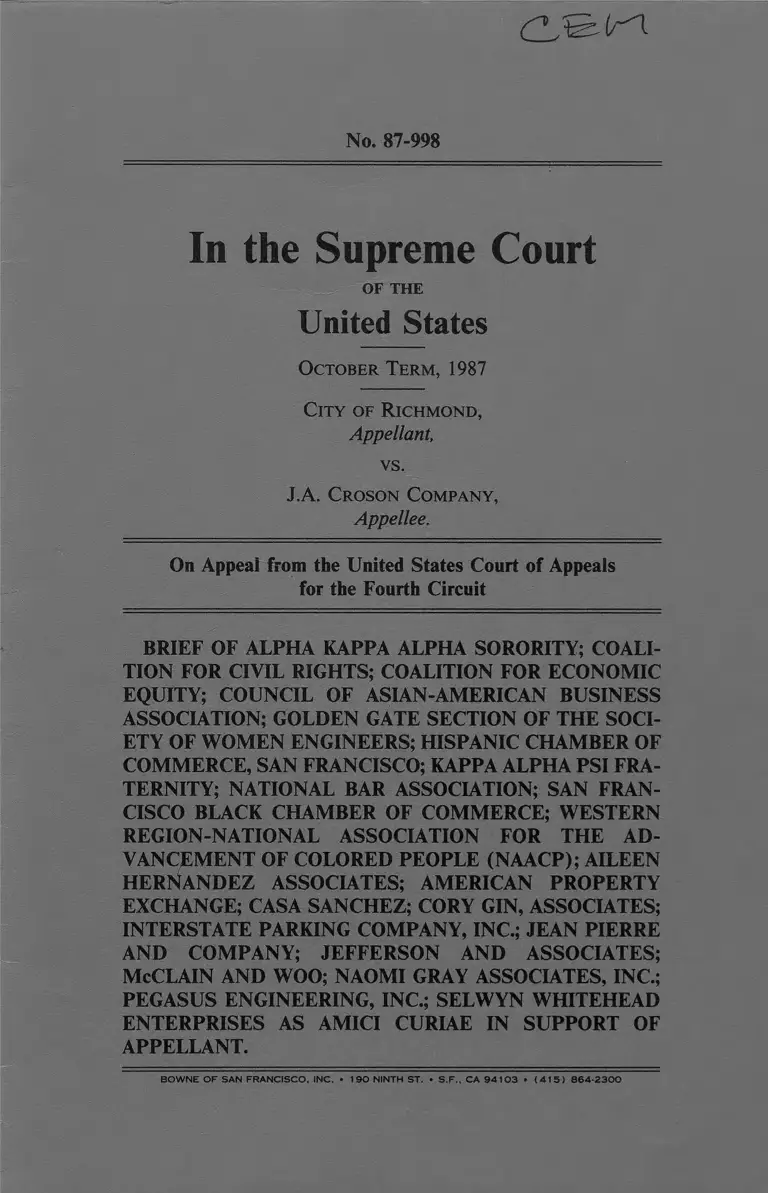
No. 87-998
In the Supreme Court
OF THE
United States
October Term, 1987
City of R ichmond,
Appellant,
vs.
J.A. Croson Company,
Appellee.
On Appeal from the United States Court of Appeals
for the Fourth Circuit
BRIEF OF ALPHA KAPPA ALPHA SORORITY; COALI
TION FOR CIVIL RIGHTS; COALITION FOR ECONOMIC
EQUITY; COUNCIL OF ASIAN -AMERICAN BUSINESS
ASSOCIATION; GOLDEN GATE SECTION OF THE SOCI
ETY OF WOMEN ENGINEERS; HISPANIC CHAMBER OF
COMMERCE, SAN FRANCISCO; KAPPA ALPHA PSI FRA
TERNITY; NATIONAL BAR ASSOCIATION; SAN FRAN
CISCO BLACK CHAMBER OF COMMERCE; WESTERN
REGION-NATIONAL ASSOCIATION FOR THE AD
VANCEMENT OF COLORED PEOPLE (NAACP); AILEEN
HERNANDEZ ASSOCIATES; AMERICAN PROPERTY
EXCHANGE; CASA SANCHEZ; CORY GIN, ASSOCIATES;
INTERSTATE PARKING COMPANY, INC.; JEAN PIERRE
AND COMPANY; JEFFERSON AND ASSOCIATES;
McCLAIN AND WOO; NAOMI GRAY ASSOCIATES, INC.;
PEGASUS ENGINEERING, INC.; SELWYN WHITEHEAD
ENTERPRISES AS AMICI CURIAE IN SUPPORT OF
APPELLANT.
B OW NE O F SAN FR AN CISCO . INC. • 190 NINTH S T . • S .F ., C A 9 41 0 3 • ( 4 1 5 ) 8 6 4 -2 3 0 0
(Inside Front Cover)
Eva Jefferson Paterson*
San Francisco Lawyers’
Committee For
Urban Affairs
301 Mission Street,
Suite 400
San Francisco, CA 94105
(415) 543-9444
Robert L. Harris
Charles Houston Bar
Association
77 Beale Street
P.O. Box 7442
San Francisco, CA 94120
(415) 972-6651
Judith Kurtz
Shauna Marshall
Equal Rights Advocates
1370 Mission Street
4th Floor
San Francisco, CA 94103
(415) 621-0505
Edwin M. Lee
William Tamayo
Asian Law Caucus
36 Waverly Place, Suite 2
San Francisco, CA 94108
(415) 391-1655/835-1474
William C. McNeill, III
Employment Law Center
1663 Mission Street
San Francisco, CA 94103
(415) 864-8848
Al Borvice
Hispanic Chamber of
Commerce
648 Mission Street
San Francisco, CA 94105
(415) 543-3940
Nathaniel Colley
Western Region-NAACP
1810 “S” Street
Sacramento, CA 95814
(916) 446-7584
Attorneys for AMICI
* Attorney o f Record
TABLE OF CONTENTS
Page
Consent for Filing.......................... ......................................... 2
Interest of the Amici ................................................................ 2
Summary of A rgum ent............................................................ 6
Argument..................................................................................... 8
I
Municipalities Have a Compelling Interest in Implementing
Affirmative Action Programs to Remedy the Present Effects
of Past Discrimination.............................................................. 8
A. Richmond had a compelling interest for enacting its
ordinance........................................................................ 8
B. San Francisco, as well as other cities around the
nation, has a compelling interest in implementing
voluntary affirmative action progam s.......................... 9
1. San Francisco’s ordinance which requires affirm
ative action in city contracting will be severely
impaired unless the decision below is reversed. . 9
2. The operation of the San Francisco ordinance has
demonstrated that affirmative action programs
can and do, remedy the effects of past discrimina
tion .......................................................................... 11
C. Affirmative action programs are designed to reduce
the unfair advantage nonminority firms enjoy because
of the exclusion of minority firms from contracting
opporutnities.................................................................. 13
II
The Fourth Circuit’s Decision Would Force Municipalities
to Perpetuate Rather Than Remedy the Present Effects of
Past Discrimination .................................................................. 14
A. Wygant v. Jackson does not require a city to perpetu
ate the present effects of past discrimination ............ 14
B. Public policy is not served by forcing muncipalities to
either prove or admit past discrimination before vol
untarily instituting an affirmative action program . . . 15
Conclusion........ .......................................................................... 16
11
TABLE OF AUTHORITIES CITED
Cases
Page
Associated General Contractors v. City and County of San
Francisco, 619 F. Supp. (334 N.D. Cal.1985) ................ 2, 10
Associated General Contractors v. City and County of San
Francisco, 813 F 2d 922 (9th Cir. 1987) .........................2, 10
Brown v. Board of Education, 347 U.S. 483 (1954) ______ 7
Croson v. City of Richmond, 822 F.2d 1355 (4th
Cir. 1987) ............................................................ ............6 ,7 ,14
Fullilove v. Klutznick, 448 U.S. 448 (1980)...................8, 13, 14
Johnson v. Transportation Agency, Santa Clara County,
____ U.S--------- , 107 S. Ct. 1442 (1987)........ .. 12
McLaurin v. Oklahoma State Regents, 339 U.S. 637 (1950) 7
Morgan v. Virginia, 328 U.S. 373 (1946) ............................. 7
Sweatt v. Painter, 339 U.S. 629 (1950) . ................... .. 7
United States v. Paradise,____ U .S ._____ , 107 S.Ct. 1053
(1987) ...................................... ............ .............................. ..9 , 12
University of California Regents v. Bakke, 438 U.S. 265
(1 9 7 8 )..................................... .............. .......................... .. 7
Wygant v. Jackson Board of Education 476 U.S. 267
(1 9 8 6 )................................. ................ .............. .9, 10, 11, 14, 15
Other Authorities
Bell, And We Are Not Saved: The Elusive Quest for Racial
Justice (1987).......... 7
Contracting Participation Report F Y 1984-1985 And F Y
1985-1986, Human Rights Commission of San Francisco
(1 9 8 7 )..................................................... 11
S.F. Ord. 139-84, Ch. 12D, § 12 D 2 ..................................... 10
S. Rep. No. 92-415, p. 10 (1971) ......................................... 16
U.S. Supreme Court Rule 36.2............................................... 1
No. 87-998
In the Supreme Court
OF THE
United States
October Term, 1987
C ity of Richmond,
Appellant,
v.
J.A. Croson Company,
Appellee.
On Appeal from the United States Court of Appeals
for the Fourth Circuit
BRIEF OF ALPHA KAPPA ALPHA SORORITY; COALI
TION FOR CIVIL RIGHTS; COALITION FOR ECONOMIC
EQUITY; COUNCIL OF ASIAN-AMERICAN BUSINESS
ASSOCIATION; GOLDEN GATE SECTION OF THE SOCI
ETY OF WOMEN ENGINEERS; HISPANIC CHAMBER OF
COMMERCE, SAN FRANCISCO; KAPPA ALPHA PSI FRA
TERNITY; NATIONAL BAR ASSOCIATION; SAN FRAN
CISCO BLACK CHAMBER OF COMMERCE; WESTERN
REGION-NATIONAL ASSOCIATION FOR THE AD
VANCEMENT OF COLORED PEOPLE (NAACP); AILEEN
HERNANDEZ ASSOCIATES; AMERICAN PROPERTY
EXCHANGE; CASA SANCHEZ; CORY GIN, ASSOCIATES;
INTERSTATE PARKING COMPANY, INC.; JEAN PIERRE
AND COMPANY; JEFFERSON AND ASSOCIATES;
McCLAIN AND WOO; NAOMI GRAY ASSOCIATES, INC.;
PEGASUS ENGINEERING, INC.; SELWYN WHITEHEAD
ENTERPRISES AS AMICI CURIAE IN SUPPORT OF
APPELLANT.
2
CONSENT FOR FILING
This Amici Curiae brief is being filed with the consent of the
parties. Their letters of consent have been filed with the Clerk of
the Court pursuant to Rule 36.2 of the Rules of this Court.
INTEREST OF THE AMICI
The common theme linking all Amici in this brief is a commit
ment to ensuring that the historical lock by white male contrac
tors on receipt of contracts from municipalities throughout this
nation be broken so that minority and women businesses can
share in the economic benefits of these contracts which amount to
billions of dollars annually.
The Amici from the San Francisco Bay Area have an especially
critical concern for the outcome of this case. For the final
analysis, the Court’s decision here will probably announce princi
ples which will determine the validity of a similar ordinance
adopted by San Francisco which is currently pending before the
Ninth Circuit Court of Appeals.
In 1984, the Board of Supervisors of San Francisco, by a 10 to
1 vote, enacted a comprehensive ordinance aimed at rectifying the
discrimination and under-representation of minority business en
terprises (MBE’s) and women owned business enterprises
(WBE’s). San Francisco’s ordinance was enacted after extensive
testimony revealed that despite the fact that approximately 40%
of the businesses in the Bay Area are owned by women and
minorities, only 2.87% of the city’s contracting dollars were
awarded to MBE’s and WBE’s. As soon as San Francisco adopted
its remedial ordinance, the Associated General Contractors sued
to enjoin its implementation (.Associated General Contractors v.
City and County o f San Francisco, 619 F. Supp. 334 (N.D.
Cal. 1985).)
The San Francisco ordinance, which is awaiting a decision on a
motion for rehearing and suggestion for rehearing en banc, (Asso
ciated General Contractors v. City and County o f San Francisco,
813 F. 2d 922 (9th Cir. 1987)) has been in litigation for the past
4 years and its fate in all likelihood will be determined by the
3
Court’s decision in the instant action. Minority and female
vendors, as the real parties in interest in any litigation involving
race and gender conscious government contractings, have the
unique vantage point possessed by MBE’s and WBE’s which
should be taken into account when the Court decides these
admittedly thorny issues of grave constitutional import. Since the
primary legal support for race and gender conscious programs
enacted to end discrimination will come from the very govern
mental agencies which have for years excluded people of color
and women from contracting opportunities through overt and
institutional discrimination, the Amici who have suffered years of
discrimination and under-representation in receiving contracts
from municipalities, believe it is critical that the Court consider
their views in this matter.
Many of the Amici herein represent San Francisco’s rich ethnic
diversity. Women, Asians, Hispanics, Blacks and whites, who are
committed to the full desegregation of society, join together to
urge this Court to reverse the opinion of the Fourth Circuit.
Finally, many of the Amici in this action are minority and
women owned businesses who currently contract with the City
and County of San Francisco, California. The other Amici are
civil rights and service organizations which have a keen interest in
the preservation and extension of race and gender conscious
programs designed to remedy past discrimination and the under
representation of minorities and women in the award of govern
ment contracts. Specifically the Amici and their interests are as
follows:
Membership Organizations
Alpha Kappa Alpha Sorority, Inc. is a national Greek-lettered
organization which is comprised of over 100,000 members in
more than 725 undergraduate and graduate chapters. In 1908, the
Sorority became the country’s first Greek-lettered organization
which was established by and for Black women. Since its incorpo
ration in 1913, the Sorority has developed into a vehicle by which
Black college-trained women have improved and impacted upon
the social and economic conditions in their respective cities and
4
states. This influence has stretched to molding policies of this
nation and the world, thereby carrying out the Sorority’s current
theme of “Service with a Global Perspective”. The affirmance of
the opinion below would effect an erosion of the principles
developed by Fullilove and would place a heavy burden upon, and
effectively chill, a municipality from enacting voluntary affirma
tive action programs.
The Coalition for Civil Rights is a multi-racial organization
based in San Francisco. Comprised of twenty-six (26) organiza
tions representing women, Blacks, Hispanics, Asians, and whites,
the Coalition fights to fully desegregate all areas of society
including business and contracting.
The Coalition for Economic Equity is an organization com
prised of whites, Blacks, Hispanics, Asians, men, and women who
are committed to increasing the percentage of contracting dollars
awarded to minority and women owned businesses in San Fran
cisco, The Coalition was active in gaining passage of a minority
and women enterprises ordinance in the City and County of San
Francisco in 1984.
The Council of Asian American Business Association consists
of four trade associations: Asian American Architects and Engi
neers, Asian Business Association, Association of Asian Certified
Public Accountants and the United Asian Contractors Associa
tion totalling approximately 300 firms located in the San Fran
cisco Bay Area. The goal of the Association is to promote
business opportunities for Asian American entrepreneurs.
The Golden Gate Section of the Society of Women Engineers,
founded in 1949, is the local chapter of the National Society of
Women Engineers. The local chapter is 15 years old and has a
membership of over 100 women. The purpose of the organization
is to counsel and encourage women to enter the engineering
profession.
The Hispanic Chamber of Commerce is a membership organi
zation comprised of businesses located in San Francisco. The
chamber reflects the make-up of the Hispanic community.
5
Kappa Alpha Psi Fraternity is an organization of some 80,000
Black men concerned with all aspects of minority affairs in this
country. Long active in struggles aimed at improving the lot,
economic and otherwise, of Black Americans, Kappa Alpha Psi
believes that the future of minority contracting programs, which
have been instituted by a number of municipalities around the
nation, is directly imperiled by the decision of the Fourth Circuit
Court of Appeals.
The National Bar Association, founded in 1925, is a profes
sional membership organization which represents more than
12,000 Black attorneys, judges and law students in the United
States. Its purposes include achieving equal opportunities for
minorities in the legal profession and protecting the civil and
political rights of all citizens. The Association has a particular
interest in this case because of its belief in the importance of
affirmative action as a means of solving America’s racial
problems.
The San Francisco Black Chamber of Commerce is an organi
zation of over 100 businesses and individuals devoted to the
development and advancement of Black entrepreneurs: It has
sought to increase opportunities for minority-owned firms and
supported the passage of the city ordinance to eliminate under
representation of minority firms in business contracting with the
city.
The Western Region of the National Association for the
Advancement of Colored People (NAACP), is the regional
administrative headquarters of the NAACP. The NAACP, the
oldest civil rights organization in the United States, believes that
affirmative action programs are essential means of redressing
discrimination against people of color by both private and public
entities.
Private Businesses
Aileen Hernandez Associates is a consulting firm owned and
operated by Black women. The types of services it provides to the
City and County of San Francisco include research, training and
6
development techniques for public participation and public
relations.
American Property Exchange is a real estate investment firm in
San Francisco which is owned by a white woman.
Casa Sanchez is an Hispanic owned food manufacturing com
pany located in San Francisco.
Cory Gin Associates is an Asian-owned architectural/design
firm located in San Francisco.
Interstate Parking Company, Inc. is a Black-owned San Fran
cisco business that has contracted with the city for parking
concessions and is a registered Minority Business Enterprise.
Jean Pierre & Co. is a Black-owned certified public account
ancy firm that has done business with the city and is a registered
Minority Business Enterprise in San Francisco.
Jefferson Associates is a Black-owned development, planning
and architectural firm which contracts with the city. It is a
registered Minority Business Enterprise in San Francisco.
McClain and Woo, CPA, is an Asian auditing firm located in
San Francisco.
Naomi Gray Associates, Inc. is a consulting firm owned and
operated by a Black woman. The services provided include
management and health related issues.
Pegasus Engineering, Inc. is a structural engineering consulting
firm owned and operated by a white woman.
Selwyn Whitehead Enterprises is a business owned by a Black
woman which designs computer networks, training programs in
telephony and sells date communications hardware.
SUMMARY OF ARGUMENT
The decision of the Fourth Circuit that Richmond’s ordinance,
“prefers some, and in so doing diminishes the rights of all”
(Croson v. City o f Richmond, 822 F.2d 1355, 1362 (4th Cir.
1987) decimates the endeavors of numerous cities across this
nation to eradicate the present effects of prior discrimination.
7
Today, the inability of minorities to compete with white con
tractors for municipal contracts is the tragic, but inevitable result
of years of their unequal treatment and actual exclusion from the
contracting process. Not only have minorities been excluded by
government officials, but also by white male firms who now seek
to protect the huge benefits they have reaped as a result of that
exclusion. Although the Fourth Circuit contends that the “record
of prior discrimination supporting the Richmond plan is deficient”
(822 F.2d at 1360), the inescapable fact is that until the middle
of the 20th century, segregation of Blacks was enforced by law.
(See, Brown v. Board o f Education, 347 U.S. 483 (1954); see
also, Bell, And We Are Not Saved: The Elusive Quest fo r Racial
Justice (1987).)
While Blacks were prevented from participating in the eco
nomic prosperity of this nation, white contractors were given a
virtual monopoly on government contracts. As Blacks fought
desperately to emerge from legally sanctioned segregation (see,
e.g., Morgan v. Virginia, 328 U.S. 373 (1946); Sweatt v. Painter,
339 U.S. 629 (1950); McLaurin v. Oklahoma State Regents, 339
U.S. 637 (1950)), white contractors were steadily building their
firms with government contracts thereby cementing their hold on
those contracts. By the time legal segregation of Blacks ended,
white contractors had firmly established their monopoly on gov
ernment contracts.
This Court, as it struggles to fashion an analysis of affirmative
action programs, under the Equal Protection Clause, should not,
and indeed cannot, ignore “the sorry history of discrimination and
its devastating impact on the lives of [Blacks].” ( University o f
California Regents v. Bakke, 438 U.S. 265, 396 (1978), Marshall
J., dissenting). Moreover, it must also remember “that the
Fourteenth Amendment was not intended to prohibit measures
designed to remedy the effects of the Nation’s past treatment of
[Blacks].” (Id. at 396-397).
The record below substantiates that the Richmond City Coun
cil had ample evidence of the virtual exclusion of Blacks and
others from receiving city contracts. Moreover, not only was the
City Council aware of the City’s history of prior discrimination,
but it was equally mindful of its responsibility to take affirmative
steps to remedy the devastating effects of that discrimination.
Thus, contrary to the opinion of the Fourth Circuit, the Four
teenth Amendment commands, rather than condemns, Rich
mond’s affirmative steps to remedy the exclusion of minorities
and others from city contracting.
ARGUMENT
I
MUNICIPALITIES HAVE A COMPELLING INTEREST
IN IMPLEMENTING AFFIRMATIVE ACTION PRO
GRAMS TO REMEDY THE PRESENT EFFECTS OF
PAST DISCRIMINATION
A. Richmond had a compelling interest for enacting its
ordinance
The existence of discrimination in Richmond’s construction
industry was carefully considered by the City Council. The City
Council determined that the present effects of prior discrimina
tion were so egregious and pervasive that remedial governmental
action was necessary to reverse the virtual exclusion of minorities
from receiving city contracts. Aware that traditional contracting
procedures would not correct the problem, the City Council
concluded, as this Court concluded in Fullilove v. Klutznick, 448
U.S. 448, 478 (1980), “That traditional procurement practices,
when applied to minorities’ businesses, could perpetuate the
effects of prior discrimination.” Accordingly, Richmond, ac
knowledging that continued reliance upon traditional procure
ment practices would not remedy the undisputed fact that white-
owned firms receive 99 percent of the City’s construction busi
ness, took affirmative measures to correct this unfair advantage
enjoyed by white firms.
In 1983, one-half of the population of Richmond was Black,
but in the five years prior to 1983 less than one percent of the
City’s $124 million in construction contracts was awarded to
minority-owned businesses. These facts, inter alia, convinced
both the City Council and the district court that the exclusion of
minorities from city construction contracts was due to racial
9
discrimination in the construction industry. Thus, race conscious
affirmative action programs are appropriate to eradicate the
effects of such discrimination. As Justice Powell astutely observed
in Wygant v. Jackson Board o f Education, 476 U.S. 267, 280-281
(1986) “in order to remedy the effects of prior discrimination, it
may be necessary to take race into account. As part of this
Nation’s dedication to eradicating racial discrimination, innocent
persons may be called upon to bear some of the burden of the
remedy.” Wygant, a plurality opinion, involved a challenge to a
preferential layoff provision in a collective bargaining agreement
for school teachers.
The remedy selected by Richmond, similar to that selected by
other cities, is designed only to eliminate the present effects of
practices that have developed over many years of awarding
contracts which have excluded minority firms, while favoring
white firms. Using race conscious efforts to remedy such prior
discriminatory practices, does not violate the Equal Protection
Clause. For this Court, in United States v. Paradise,____U.S.
------, 107 S.Ct. 1053, 1064 (1987), which upheld race conscious
relief where there was a history of discrimination, recognized that:
“It is now well established that government bodies. . . . may
constitutionally employ racial classifications essential to remedy
unlawful treatment of racial or ethnic groups subject to discrimi
nation”. This is precisely what Richmond did to correct past
racial discrimination which allowed white firms to receive 99
percent of Richmond’s construction contracts. Richmond’s inter
est in remedying this injustice was not only compelling, but
essential in order to maintain the integrity of the City’s con
tracting process.
B. San Francisco, as well as other cities around the nation,
has a compelling interest in implementing voluntary af
firmative action programs
1. San Francisco’s ordinance which requires affirmative
action in city contracting will be severely impaired
unless the decision below is reversed
On April 2, 1984, San Francisco enacted the Minor-
ity/Women/Local Business Utilization ordinance. This ordinance
10
was the culmination of a long effort to increase the participation
of minority and women business enterprises in municipal con
tracting. It was indeed a voluntary effort by San Francisco to
remedy the present effects of past discrimination against such
businesses.
The ordinance was enacted after months of public hearings
where numerous people testified and presented written evidence
regarding their inability to secure city contracts. After the public
hearings, San Francisco, in enacting the ordinance, made the
following findings:
1. “That historic discrimination against minorities and
women, often officially sanctioned and enforced by govern
ment from the inception of our Republic to the present had a
serious, negative impact on their ability to participate fully
and adequately in our society; and
2. That because of centuries of limited access to the
marketplace—as workers and as entrepreneurs—and because
of the failure of local governmental agencies to take affirma
tive steps to remedy overt and subtle discrimination, women
and minorities have suffered severe economic harm;” (S.F.
Ord. 139-84, Ch. 12D, § 12 D2.)
Immediately, after the enactment of said ordinance, white
contractors who, just as in the case at bar, had been the recipients
of substantially all of San Francisco’s contracts, challenged the
validity of the ordinance. (See, Associated General Contractors v.
City and County o f San Francisco, 619 F. Supp. 334 (N.D. Cal.
1985).) The trial court upheld the ordinance, but on appeal a
three-judge panel of the Ninth Circuit reversed, in part, holding
that the race conscious aspects of the ordinance were violative of
the Equal Protection Clause. (See, Associated General Contrac
tors v. City and County o f San Francisco, 813 F. 2d 922 (9th Cir.
1987).) A petition for rehearing with suggestion that it be en banc
has been pending in the Ninth Circuit since June 1987, and the
ordinance has remained in effect pending the outcome of said
petition.
The Ninth Circuit, similar to the Fourth Circuit in the instant
case, incorrectly relied upon Wygant v. Jackson Board o f Educa
11
tion, supra, 476 U.S. 267 to invalidate the race conscious aspects
of the ordinance. As will be discussed later, Wygant does not
support the conclusions of either the Fourth or the Ninth Circuit
Courts of Appeals. But, prior to discussing Wygant, it is important
to discuss the effectiveness of, and necessity for, affirmative action
programs such as the ones adopted by Richmond and San
Francisco.
2. The operation of the San Francisco ordinance has
demonstrated that affirmative action programs can and
do, remedy the effects of past discrimination
Affirmative action programs, like that embodied in the San
Francisco ordinance, are not only necessary to remedy past
discrimination, but if implemented correctly can actually decrease
discrimination and increase the participation of minorities and
women in the economic dream of this Nation. For example, when
San Francisco commenced implementing its ordinance in 1984,
minorities were receiving only 2.87 percent of the total contract
dollars awarded by San Francisco. As a result of the ordinance, by
1986, that participation had climbed to 25.4 percent of the total
contract dollars.1
Prior to implementing the ordinance, only 130 firms which
qualified in 1983 as minority or women-owned businesses, were
doing business with San Francisco. Because of the affirmative
action endeavors of San Francisco, by 1986, 1562 such firms were
receiving contracts from the city.2 These firms are now gaining
the necessary experience and capital to compete successfully with
white firms for city contracts when the ordinance expires in 1989.
One fear commonly held by those who either oppose affirma
tive action or who are uncomfortable with its implications and
implementation is that unqualified members of protected classes
will be foisted upon entities which enforce affirmative action
1 See, Contracting Participation Report FY 1984-1985 And FY 1985-
1986, Human Rights Commission of San Francisco (1987). Copies
have been forwarded by Amici to the Clerk of the United States
Supreme Court.
2 Id at p.4.
12
programs. Another fear that exists is that affirmative action
programs, particularly in the contracting area, will result in
increased costs to municipalities which are already strapped for
working capital. Nothing could be farther from the truth.
In San Francisco, during the 4 years that the ordinance has
been in effect, these fears have failed to materialize. When no
qualified MBE’s nor WBE’s exist to fulfill a contract, the San
Francisco Human Rights Commission has granted a waiver.
Between 1984 and 1986, waivers were granted 78 times. With
regard to the fear of increased costs, ordinances such as that of
San Francisco have actually resulted in savings of millions of
dollars to municipalities. These savings result from the increased
competitiveness which follows the presence of additional contrac
tors doing business with the City. White male contractors now
underbid their own historically acceptable bid levels as their way
of factoring in the presence of MBE’s and WBE’s. Even when
waivers are granted due to the lack of qualified MBE’s and
WBE’s, contract bids are lower simply due to the presence and
potential bids of MBE’s and WBE’s. Finally, it should be specifi
cally noted that contrary to the fears of white contractors, they
have not been impacted substantially by the enforcement of the
San Francisco ordinance. In fiscal year 1985-86, they were
awarded 74.6 percent of the contracting dollars expended by San
Francisco.
In practice, the ordinance has provided a remedial shield for
minorities giving them an opportunity to compete with white
firms, while at the same time protecting the rights of white firms
to continue to receive substantial contracting dollars from San
Francisco. Accordingly, the reasonable expectations of white
contractors have not been frustrated. (See e.g., Johnson v. Trans
portation Agency, Santa Clara County,____U .S ._____, 107 S.
Ct. 1442, 1455 (1987). It is thus clear, as shown by the San
Francisco experience, that affirmative action ordinances can, and
do, remedy past discrimination while not unduly trammeling the
rights of innocent white male firms. Hence, they do not offend the
Equal Protection Clause. (See, United States v. Paradise,____
U .S .____, 107 S.Ct. 1053, 1064 (1987).
13
C. Affirmative action programs are designed to reduce the
unfair advantage nonminority firms enjoy because of the
exclusion of minority firms from contracting
opportunities
The clear objective of government affirmative action programs
is to provide an opportunity for minority firms to compete with
white firms on an equal footing. To achieve this equality, it is, of
course, necessary to institute programs which may occasionally
require white firms to share their monopoly on public contracting
with heretofore excluded minorities. Municipalities, such as Rich
mond and San Francisco, recognize, as has this Court, that “in
the past some nonminority businesses may have reaped competi
tive benefit over the years from the virtual exclusion of minority
firms from these contracting opportunities.” (Fullilove v. Klutz-
nick, supra, 448 U.S. at 485). This Court, in Fullilove, correctly
observed:
It must be conceded that by its objective of remedying the
historical impairment of access, the MBE provision can have
the effect of awarding some contracts to MBE’s which
otherwise might be awarded to other businesses, who may
themselves be innocent of any prior discriminatory actions.
Failure of nonminority firms to receive certain contracts is, of
course, an incidental consequence of the program, not part of
its objective; similarly, past impairment of minority-firm
access to public contracting opportunities may have been an
incidental consequence of ‘business as usual’ by public con
tracting agencies and among prime contractors.” (Id. at
484.)
Thus, Richmond and San Francisco, as well as other cities who
are concerned with divesting white firms of the “competitive
benefits” of years of “virtual exclusion of minority firms from . . .
contracting opportunities” (Fullilove v. Klutznick, supra, 448
U.S. at 485), have a compelling interest in instituting remedial
programs to place heretofore excluded minorities “on a more
equitable footing with respect to public contracting opportuni
ties.” (Id. at 484.) Hence, the underlying principles announced in
Fullilove are still sound today, and they should indeed apply
equally to this case. This is especially true where local govern
14
ments, following the example set by Congress, try to remedy years
of exclusion of minorities from participating in lucrative contracts
awarded by such governmental entities.
II
THE FOURTH CIRCUIT’S DECISION WOULD FORCE
MUNICIPALITIES TO PERPETUATE RATHER THAN
REMEDY THE PRESENT EFFECTS OF PAST
DISCRIMINATION
A. Wygant v. Jackson does not require a city to perpetuate
the present effects of past discrimination
By holding that Richmond was required to demonstrate or
admit its own prior discrimination, the Fourth Circuit embarked
upon a journey which inevitably leads to a freezing of the status
quo. (Croson v. City o f Richmond, 822 F.2d 1355 (4th Cir.
1987). By freezing the status quo, as done by the Fourth Circuit,
the present effects of past discrimination will remain permanently
embedded in the contracting process of not only Richmond, but
also in countless other municipalities throughout the nation. The
Fourth Circuit’s reliance upon Wygant v. Jackson, supra, for this
proposition is wholly misplaced. Wygant requires no such conclu
sion. At most, Wygant says, that: “Societal discrimination, with
out more, is too amorphous a basis for imposing a racially
classified remedy.” {Id. at 276.) But, Wygant explained that:
In particular, a public employer. .. must ensure that before
it embarks on an affirmative action program, it has convinc
ing evidence that remedial action is warranted. That is, it
must have sufficient evidence to justify the conclusion that
there has been prior discrimination.” (Id. at 277.)
Richmond had before it statistics showing that 99 percent of its
$124 million construction contract awards were going to white-
owned firms. There was ample other evidence to convince the
City Council that these white owned firms were receiving this
“competitive benefit” because of years of “virtual exclusion of
minority firms from .. . contracting opportunities.” (Fullilove v.
Klutznick supra, 448 U.S. 485.) Thus, the Wygant test was met
15
and the evidence was not only convincing, but clearly supported
the need for Richmond to take remedial action.
B. Public policy is not served by forcing municipalities to
either prove or admit past discrimination before volunta
rily instituting an affirmative action program
The Fourth Circuit puts cities such as Richmond in the
dilemma that Justice O’Connor discussed in her concurring
opinion in Wygant. Recognizing that no municipality, which has
legal counsel, is likely to admit prior discrimination, Justice
O’Connor explained how the Fourth Circuit’s decision can frus
trate sound public policy which favors the voluntary adoption of
affirmative action programs:
The imposition of a requirement that public employers make
findings that they have engaged in illegal discrimination
before they engage in affirmative action programs would
severely undermine public employers’ incentive to meet
voluntarily their civil rights obligations. ( Wygant v. Jackson,
supra, 476 U.S. at 290, (O’Connor, J., concurring).)
Remedying, not pertpetuating the present effects of past dis
crimination, as would be required if the Fourth Circuit’s decision
is upheld, is the ultimate goal of affirmative action programs such
as those voluntarily instituted by Richmond, San Francisco and
other cities. This point is critical because, as Justice O’Connor
notes in her concurring opinion in Wygant:
The value of voluntary compliance is doubly important when
it is a public employer that acts, both because of the example
its voluntary assumption of responsibility sets and because
the remediation of governmental discrimination is of unique
importance. (Id.)
Thus, the Fourth Circuit’s decision militates against voluntary
affirmative action. Unless reversed, the decision below will en
courage municipalities to protect themselves against exposure to
litigation by refusing to voluntarily remedy past discrimination for
fear of having to admit prior discrimination. Such a result is not
only undesirable, but would virtually assure the continued exclu
sion of minorities and women from effective participation in
16
government contracting opportunities. In the final analysis such a
result would promote “ignorance of minority problems in [the]
community, [and would] create[] mistrust, alienation, and all too
often hostility toward the entire process of government.” {Id. at
290 quoting) S. Rep. No. 92-415, p. 10 (1971).)
CONCLUSION
For the above reasons, Amici Curiae respectfully urge this
Court to reverse the decision of the United States Court of
Appeals for the Fourth Circuit.
Dated: April 21, 1988
Respectfully submitted,
Eva Jefferson Paterson
Attorney of Record
Robert L. Harris
Judith Kurtz
Shauna Marshall
Edwin Lee
W illiam Tamayo
W illiam C. McN eill, III
Al Borvice
N athaniel Colley
.
...
ms