Former Churchill Area School District v. Hoots Brief in Opposition
Public Court Documents
January 1, 1981
-
Brief Collection, LDF Court Filings. Former Churchill Area School District v. Hoots Brief in Opposition, 1981. 280ce933-b29a-ee11-be36-6045bdeb8873. LDF Archives, Thurgood Marshall Institute. https://ldfrecollection.org/archives/archives-search/archives-item/f71d44be-e03a-4fc3-a125-214be3375c13/former-churchill-area-school-district-v-hoots-brief-in-opposition. Accessed October 06, 2026.
Copied!
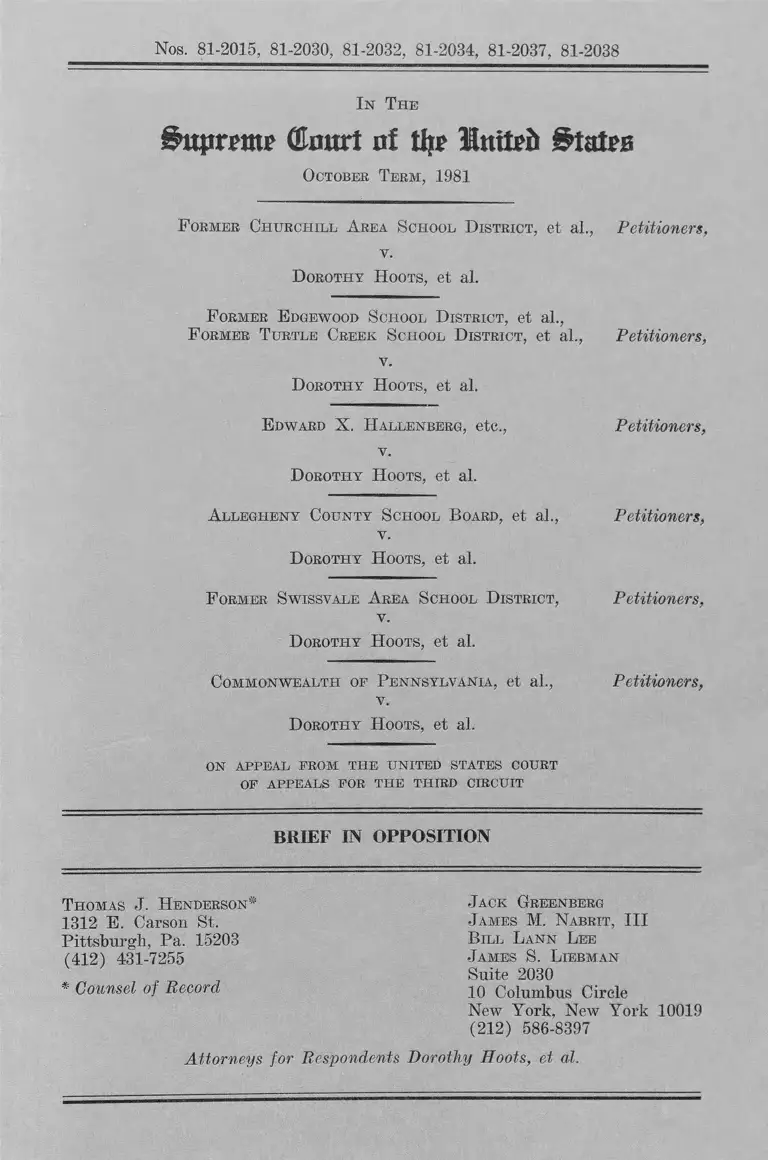
Nos. 81-2015, 81-2030, 81-2032, 81-2034, 81-2037, 81-2038
I n T h e
GJmtrt of tfj? lotted Stairs
October Teem, 1981
F ormer Churchill Area School D istrict, et al,,
v.
Dorothy H oots, et al.
F ormer E dgewood School D istrict, et al.,
F ormer Turtle Creek School D istrict, et al.,
v.
Dorothy H oots, et al.
E dward X. IIallenberg, etc.,
v .
D orothy H oots, et al.
Allegheny County School Board, et al.,v.
D orothy H oots, et al.
F ormer Swissvale Area School D istrict,v.
Dorothy H oots, et al.
Commonwealth of P ennsylvania, et al.,
v.
D orothy H oots, et al.
on appeal from t h e u n ited states court
of appeals for t h e th ird circuit
Petitioners,
Petitioners,
Petitioners,
Petitioners,
Petitioners,
Petitioners,
BRIEF IN OPPOSITION
Thomas J. H enderson*
1312 E. Carson St.
Pittsburgh, Pa. 15203
(412) 431-7255
* Counsel of Record
J ack Greenberg
J ames M. Nabrit, I I I
B ill Lann Lee
J ames S. L iebman
Suite 2030
10 Columbus Circle
New York, New York 10019
(212) 586-8397
Attorneys for Respondents Dorothy Hoots, et al.
QUESTIONS PRESENTED
1. Whether factfindings of the two
courts below that state officials drew
boundary lines with the intent to create
separate racially segregated school dis
tricts — findings based on an extensive
evidentiary record developed during eleven
years of litigation — are clearly errone
ous?
2. Whether the lower courts abused
their discretion in ordering the consolida
tion into a single desegregated district of
five small, contiguous and segregated
school districts, when: (i) each of the
five former districts was found, a decade
before, to have been unconstitutionally
created and isolated from the others by
state, county and local officials; (i i)
the responsibile officials failed, over
the course of eight years, to present any
1
adequate alternative desegregation plan to
cure the constitutional violation; and
(iii) both courts below found that a
five-district consolidation would indis-
putedly provide students with a more
comprehensive and efficient — as well as a
desegregated -- educational program?
3. Whether the courts below abused
their discretion by initially not forcing
the former school districts to join as
defendants, against their wills, when the
districts were at all times provided a
meaningful opportunity to participate in
the proceedings, and in fact did partici
pate in the proceedings by presenting evi
dence, without limitation, on both liabil
ity and relief?
- 1 1 -
Questions Presented ................ i
Table of Authorities ............... iv
Statement .......................... 2
Reasons to Deny the Writ ........... 24
1. Findings of Intentional
Segregation ............ 25
2. The Remedy ................ 40
3. Meaningful Opportunity to
Participate ............ 54
Conclusion ......................... 60
TABLE OF CONTENTS
Page
- i i i -
TABLE OF AUTHORITIES
Page
Cases
Berenyi v. Information Director,
385 U.S. 630 (1 967) .......... . 38
Blau v. Lehman, 368 U.S. 403
( 1962) ......................... 38
Brown v. Board of Education,
349 U.S. 294 (1955) .......____ 37
Chartiers Valley Joint Schools v.
County Board, 418 Pa. 520,
211 A.2d 487 (1967) ............ 9,56
Columbus Board of Education v.
Penick, 443 U.S. 449
( 1979) ................... 35,37,40
Commissioner v. Duberstein, 363
U.S. 278 (1960) ................ 38
Davis v. Schnell, 81 F. Supp. 872
(S.D. Ala.), aff'd, 336 U.S.
933 (1949) ..................... 31
Dayton Board of Education v.
Brinkman, 443 U.S. 526
(1979) ........................ 35,38
Engle v. Isaac, U.S. ,
71 L.Ed.2d 783 (1982) .......... 58
iv -
Page
Evans v. Buchanan, 582 F.2d 750 (3d
Cir. 1978) (en banc), cert, denied,
446 U.S. 923 (1980); 555 F.2d 373
(3d Cir. 1977)(en banc), cert.
denied, 434 U.S. 934 (1978); 393
F. Supp. 428 (D. Del.) (3-judge
court), aff'd, 423 U.S. 963 (1975) .................. 39,46,47
Franks v. Bowman Transportation Co.,
424 U.S. 747 (1976) ............ 51
Gomillion v. Lightfoot, 364 U.S.
339 ( 1960) .................... 33
Graver Mfg. Co. v. Linde Co., 336
U.S. 271 (1979) ............... 38
Green v. County School Board, 391
U.S. 430 (1968) ............... 43
Griffin v. Board of Education, 239
F. Supp. 560 (E.D. Va.
1965) ......................... 57
Hoots v. Commonwealth of Penn
sylvania (Hoots I), 334 F. Supp.
820 (W.D. Pa. 1972) ..... 3,10,28,55,56,57,58
Hoots v. Commonwealth of Penn
sylvania (Hoots II), 359 F. Supp.807 (W.D. Pa. 1973) ...... passim
Hoots v. Commonwealth of Penn
sylvania (Hoots III), 495 F.2d 1095 (3d Cir.), cert, denied,
419 U.S. 884 ( 1974) ......... passim
v
Page
Hoots v. Commonwealth of Penn
sylvania (Hoots IV), 587 F.2d
1340 (3d Giro 1978) .......... 3,6,26
Hoots v. Commonwealth of Penn
sylvania (Hoots V), 639 F.2d
972 (3d C ir. ), cert, denied,
101 S.Ct. 3113 (1981) ........ 3,17,27
Hoots v. Commonwealth of Penn
sylvania (Hoots VI), 510 F. Supp.
615 (W.D. Pa. 1981) passim
Hoots v. Commonwealth of Penn
sylvania (Hoots VII), No. 71- 538 (W.D. Pa. April 16,
1981 ) ............ 3,18,19
Hoots v. Commonwealth of Penn
sylvania (Hoots VIII), No. 71-
538 (W.D. Pa. April 28,
1981) ..................... passim
Hoots v. Commonwealth of Penn
sylvania (Hoots IX), 672 F.2d 1107 (3d Cir. 1982)........ passim
Hoots v. Commonwealth of Penn
sylvania, No. 71-538 (W.D.
Pa. May 12, 1982) .............. 53
Hoots v. Weber, No. 79-1474 (3d
Cir. May 2, 1979) .............. 4
Hoots v. Weber, No. 80-2124 (3d Cir.
Sept. 9, 1 980) ....... ......... 4
Husbands v. Commonwealth of Penn
sylvania, 359 F. Supp. 925
(E.D. Pa. 1973) ________....... 57
vi
57
Lee v. Macon County, 268 F.2d 458
(M.D. Ala.), aff'd, 389 U.S.
215 (1967) ................
Milliken v. Bradley, 418 U.S. 617
(1974) ................. 39,46,47,61
Morrilton School Dist. No. 32 v.
United States, 606 F.2d 222
(8th Cir. 1979), cert, denied,
444 U.S. 1071 (1980) ___ 38,46,47
Personnel Administrator v. Feeney,
442 U.S. 256 (1979) ........... 35
Pullman Standard v. Swint, ___ U.S.
, 50 U.S.L.W. 4425 (April
27, 1982) ..................... 37
Reitman v. Mulkey, 387 U.S. 369
(1967) ........................ 31
Rogers v. Lodge, ___ U.S. ___,
No. 80-2100 (July 1,1982) ................... 32,36,37,38
State Board of Education v. Franklin
Township School District, 209
Pa. Super. 410, 228 A.2d 221
(Pa. Super. 1967) ............. 9
Swann v. Charlotte-Mecklenburg
Board of Education, 402 U.S. 1
( 1971) ...................... 44,50
Swissvale Area School District v.
Weber, No. 73-1849 (3d Cir.
Oct. 12, 1973) ................ 26
United States v. Board of School
Commissioners, 573 F.2d 400
(7th Cir.), cert, denied,
439 U.S. 824, on remand,
456 F. Supp. 183 (1978) .... 31,34,35,
39,45,47
United States v. Johnston, 268 U.S.
220 (1925) ..................... 26
United States v. Missouri, 363 F.
Supp. 739 (E.D. Mo. 1973),
aff'd, 515 F.2d 1365 (8th
Cir.), cert, denied, 423
U.S. 951 (1975) ........ 31,39,47
United States v. United States Gypsum
Co., 333 U.S. 364 (1948) ........ 36
United States v. Yellow Cab Co.,
338 U.S. 338 (1949) ............ 38
Village of Arlington Heights v.
Metropolitan Housing Develop
ment Corp., 429 U.S. 252
M977) ................ 31,33,34
Washington v. Davis, 426 U.S. 229
( 1976) ......... 35
v m
Page
Statutes and Rules
Act of September 12, 1961, P.L.
1283, No. 561, 24 P.S.
§ 2-281, et_ seq. (Act 561) .... 6
Act of August 8, 1963, P.L. 564,
No. 299, 24 P.S. §
2-290, et seq. (Act 299) ..... 6
Act of July 8, 1968, P.L.
299, No. 150, 24 P.S. § 2400-1
(Act 150) ..................... 6
Rule 24, Fed. R. Civ. Pro........... 10
Rule 52, Fed. R. Civ. Pro........... 35
Other Authorities
3A MOORE'S FEDERAL PRACTICE ........ 57
IX
Nos. 81-2015, 81-2030, 81-2032,
81-2034, 81-2037, 81-2038
IN THE
SUPREME COURT OF THE UNITED STATES
October Term, 1981
FORMER CHURCHILL AREA SCHOOL DISTRICT, et al.,
Petitioners,
v.
DOROTHY HOOTS, et al.
FORMER EDGEWOOD SCHOOL DISTRICT, et al.,
FORMER TURTLE CREEK SCHOOL DISTRICT, et al.,
Petitioners,
v.
DOROTHY HOOTS, et al.
EDWARD X. HALLENBERG, etc.,
Petitioners,
v.
DOROTHY HOOTS, et al
ALLEGHENY COUNTY SCHOOL DISTRICT, et al
Petitioners,
v.
DOROTHY HOOTS, et al.
FORMER SWISSVALE AREA SCHOOL DISTRICT,
DOROTHY HOOTS,
Petitioners,
V.
et al.
COMMONWEALTH OF PENNSYLVANIA, et al.,
DOROTHY HOOTS,
Petitioners,
V.
et al.
On Appeal From the United States Court
Of Appeals For The Third Circuit
BRIEF IN OPPOSITION
3
Statement 1/
The various petitioners are asking
this Court to review the ninth reported
2/decision in a longstanding litigation.
J_/ Citations are to the Appendix to the
Petition filed by the Commonwealth of
Pennsylvania, No. 81-2038 (hereinafter
"A." ) and portions of the Record on
Appeal set forth in the Joint Appendix in
the court of appeals (hereinafter "R.").
2/ Hoots v. Commonwealth of Pennsylva
nia, 672 F. 2d 1107 (3d Cir. 1982) ("Hoots
IX"), A. 86a-87a n.1. The other decisions
are: Hoots v. Commonwealth of Pennsylvania , 334 F. Supp. 820 (W.D. Pa. 1972)
("Hoots I" ); Hoots v._Commonwealth of
Pennsylvania, 359 F. Supp. 807 (W.D. Pa.1973) ("Hoots II"); Hoots v. Commonwealth
of Pennsylvania, 495 F.2d 1095 (3d Cir.),
cert, denied, 419 U.S. 884 (1974)("HootsIII"); Hoots v. Commonwealth of Pennsylva
nia, 587 F. 2d 1340 (3d Cir. 1978) ("Hoots
IV" ) ; Hoots v. Commonwealth of Pennsylva-
nia, 639 F.2d 972 (3d Cir.), cert, denied,
101 S.Ct. 3113 (1981) ("Hoots V"); Hoots v.
Commonwealth of Pennsylvania, 510 F. Supp. 615 (W.D. Pa. 1981) ("Hoots VI"); Hoots v.
Commonwealth of Pennsylvania, No. 71-538
(W.D. Pa. April 16, 1981) ("Hoots VII");
Hoots v. Commonwealth of Pennsylvania, No.
71-538 (W.D. Pa. April 28, 1981) ("Hoots
VIII" ).
(footnote continued on next page)
4
Plaintiffs are a class of black and
white parents of school-aged children
living in the former General Braddock Area
School District (hereinafter "General
Braddock"). Prior to 1981, General Brad-
dock was a predominately (63%) black school
district, which, together with the sur
rounding former all- or nearly all-white
districts of Churchill (99.2% white),
Edgewood (97.8% white), Turtle Creek (98.1%
white), and Swissvale (83.7% white), was
created by state and county officials
during Pennslyvania's statutorily mandated
2/ continued
In addition, the court of appeals
denied plaintiffs' applications for writs
of mandamus on two occasions. Hoots v.
Weber, No. 79-1474 (3d Cir. May 2, 1979);
Hoots v. Weber, No. 80-2124 (3d Cir. Sept.
9, 1980).
5
school district reorganizations of the
1960's.-
3/ General Braddock was created in the
1960's by combining the only preexisting
majority-black municipal school districts
in the area, Braddock (72% black) and
Rankin (51% black), with North Braddock
(16% black). Hoots II, A. 17a, 20a-21a
(1970 figures). In its first year of
operation, 1971, General Braddock was 44.5% black. By 1980-81 , the last year of its
existence, General Braddock's black pupil
population had increased to 63%. I<3. , A.
77a. After the reorganization process was
complete, no other district in the violation area — i.e. , the area consistently
referred to in the opinions below as
"central eastern Allegheny County" --
had a black pupil population approaching
General Braddock's.
"Central eastern Allegheny County"
was defined by the district court in 1973
as the area lying
east of the City of Pittsburgh and
north of the Monogahela River, [in
which] the County and State Boards
established [General Braddock] ;
the School Districts of Turtle Creek,
Swissvale Area, Churchill Area and East Allegheny which border on [Gen
eral Braddock]; and the Edgewood
School District which is situated within approximately one mile of
[General Braddock]. I_d. , A. 12a-13a.
See also, id., A. 13a-14a, 20a-22a,
6
Plaintiffs commenced this action on
June 9, 1971. The complaint alleged that
the Pennsylvania State Board of Education
and Allegheny County School Board (now the
Allegheny Intermediate Unit) (hereinafter,
"the state and county boards") deliber
ately created General Braddock, Churchill,
Edgewood, Swissvale and Turtle Creek as
separate racially segregated school dis
tricts during three statutorily mandated
school district reorganizations in the
4/1960!s. Specifically, the complaint al-
3/ continued
27a, 40a; Hoots III, 43a; Hoots IV,
supra, 587 F.2d at 1343-44; Hoots VI,
51a-53a, 55a, 62a-63a; Hoots VIII ,
73a, 76a-79a, 80a; Hoots IX, 90a-92a,
10 0 a-101 a, 105a, 108a-109a, 112a.
4/ See Act of September 12, 1961, P.L.
1283, No. 561 , 24 P.S. § 2-281, et. seq.
(Act 561); Act of August 8, 1963, P.L. 564,
No. 299, 24 P.S. § 2-290, et. seq. (Act
299); Act of July 8, 1968, P.L. 299, No.
150, 24 P.S. § 2400-1 (Act 150).
7
leged that the state and county boards,
in exercising their power to reorganize
school districts, had "compelled the for
mation of school districts which concen
trate and contain blacks in one school
district and whites in the other school
districts so as to create racially iden
tifiable school districts ... not only to
segregate [General Braddock] but the ad
joining [districts] as well." The com
plaint requested that school district
boundaries in the affected area be "al
ter [ e d ] and revise [d] " to establish a
desegregated system of schools. R. 35a,
37a. Churchill, Edgewood, Swissvale and
Turtle Creek were specifically named as the
"adjoining," or "surrounding," school
, . 5/districts. .Id. The complaint named as
5/ Petitioners have stated that the
complaint (i) made no allegation that each
of these districts was racially segregated
8
defendants the Commonwealth of Pennsylvania,
the state and county boards and certain of
their officers. It alleged that defen
dants unconstitutionally created General
5/ continued
(Churchill Petition, No. 81-2015, p. 6);
(ii) requested no alteration of these
school districts' boundaries (Edgewood/
Turtle Creek Petition, No. 81-2030, pp. 3,
14-15); and (iii) provided no notice of the
requested alteration of these school
district boundaries (Churchill Petition,
No. 81-2015, p. 24; Edgewood/Turtle Creek
Petition, No. 81-2030, pp. 14-15 & n.10).
Each of these statements is erroneous.
The amended complaint described
General Braddock and each of the former
white districts, R. 27a-29a, and clearly
identified all five districts as "segre
gated" and "racially identifiable school
districts" created in order to segregate
black students in General Braddock and
white students in Churchill, Edgewood,
Swissvale and Turtle Creek, R. 30a-35a.
See R. 2 0 a-3 7 a. Plaintiffs accordingly
requested injunctive relief "altering and
revising or ordering defendants to alter
and revise the school reorganization plans
..." and to "adopt immediately plans that
will create racially . . . balanced school
systems to serve the residents of [General
Braddock] and the surrounding communities."
R. 37a, 22a.
9
Braddock and the surrounding former white
districts pursuant to power conferred on
g /them by the reorganization statutes- --
specifically, their power to prepare,
review, amend, approve, and effectuate
reorganization plans, including those which
created General Braddock and the surround
ing districts. R. 21a, 26a-29a, 31a.
In December 1971, the district court
denied defendants' motions to dismiss.
The court held that plaintiffs' allegations
that, "[i]n preparing and adopting the
school reorganization plans, the defendants
intentionally and knowingly created ra-
6/ See Chartiers Valley Joint School v.
County Board, 418 Pa. 520, 21 1 A.2d 487,
491-495 (1965) (the reorganization acts
delegated legislative power to define the
geographic boundaries of school districts
to the state and county boards); State
Board of Education v. Franklin Township
School District, 209 Pa. Super. 410, 228
A.2d 221, 223-24 (1967).
10
cially segregated school districts" stated
a cause of action under the Fourteenth
Amendment. Hoots I, A. 1a™2a. At the same
time, the court declined to join General
Braddock and the former white districts as
defendants against their wills, Hoots I, A.
5a, but held that it would permit the dis
tricts to "intervene in this action under
Fed. R. Civ. P. 24 if they so desire." Id.
Although the court "instructed the [Common
wealth] to give notice" of the action to
all five former districts, and the Attorney
General of Pennsylvania thereupon directed
written and later telegraphic notices to
the five districts (with copies of the
amended complaint attached) "urg[ing each]
to intervene in this action immediately,"
the districts informed the court that they
were "deliberately not intervening in this
case" and "had no interest in being" a
- 11 -
7/party to the trial.- As Churchill states
in its petition, the districts' failure to
participate in the initial violation trial
was a considered strategic decision to stay
8/out of the litigation as long as possible.—
, , . . 9/Following trial,- on May 15, 1973, the
2/ R. 56a-61 a, 614a-18a, 272a, 3338a,
3389a. See Hoots II, A. 33a-35a; Hoots
III, A. 45a-46a.
8_/ Churchill Petition, No. 80-2015, p.
23. In its petition, Churchill quotes part of the following explanation of the dis
tricts' actions as summarized at a 1973
hearing by counsel for the Commonwealth:
There is no doubt that prudent lawyer
ing dictates what the school districts
are presently doing. Were I to be in
that situation, I think I would do the
exact same thing. I would sit back
and wait hopefully ... that the
Court's opinion ... would be to their
favor ... and, if not, at the later
date, to seek some way to attack
it .... R. 316a.
2/ At trial, plaintiffs introduced the
testimony of lay witnesses, local school
authorities, state officers and expert
witnesses. In addition, 63 documentary,
summary and graphic exhibits were intro
duced pursuant to stipulation. R. 55a-
748a.
12
district court found that the state and
county boards' intentionally segregative
creation of General Braddock as a predomi
nantly black district, and of Churchill,
Edgewood, Swissvale and Turtle Creek as
virtually all-white districts, "constituted
an act of de jure discrimination in violat
ion of the Fourteenth Amendment. " The
court concluded that "a violation of the
Fourteenth Amendment ha [d ] occurred"
because "public school authorities ... made
educational policy decisions which were
based wholly or in part on considerations
of the race of the students and which
contributed to increasing racial segrega
tion in the public schools." Hoots II,
A. 37a, 35a.
The court ordered defendants to
"prepare and submit to this Court within 45
days ... a comprehensive plan of school
desegregation for the central eastern area
13
of Allegheny County [that would] remedy
the constitutional violations found by this
Court" by "alter[ing] the boundary lines of
General Braddock ... and, as appropriate,
of adjacent and/or nearby school dis
tricts." Hoots II, A. 40a.
None of the defendants appealed.
After the May 1 973 opinion was issued,
however, Churchill and Turtle Creek re
versed their pretrial opposition to inter
vention, and attempted to intervene, asking
the court to set aside its May 1973 opin
ion. The district court denied the motions
as "untimely" insofar as they sought retro
active intervention but granted prospective
intervention, R. 966a, and the court of
appeals affirmed. Hoots III, A. 44a-46a.~'/
10/ Churchill and Turtle Creek filed a
writ of certiorari, R. 2577a, which was
denied. Churchill Area School District
v. Hoots, 419 U.S. 884 (1974).
(footnote continued on next page)
- 14 -
Defendants filed no "comprehensive
plan of desegregation" within 45 days.
Indeed, no remedy was forthcoming for the
next eight years, despite lengthy hearings
conducted by the district court and (on
remand from the district court) by the
state board. During the 1973-1981 period,
the district court not only heard evidence
and argument on remedy, but also, as the
court of appeals found, Hoots IX, A. 102a,
specifically permitted all of the peti
tioner districts to reopen and present
additional evidence on the violation
10/ continued
Contemporaneously, the former white
districts initiated several extended state court proceedings seeking to prevent
the state defendants from proposing and submitting remedial plans to the federal
district court in the instant litigation. R. 2504a, 2730a-31a.
15
issue.— ^ E . g . , R. 1486a-1506a, 2684a-
2766a, 2829a-3015a, see Hoots IX, A.
101a-02a. On each such occasion, the
district court reaffirmed its 1973 finding
of intentional segregation. R. 1031a-32a
(May 1975), 2761a-62a (October 1975), 841a
(November 1977), 3201a-02a (October 1980);
Hoots VI, A. 49a, 59a (March 1981); Hoots
VIII, A. 77a (April 1981). See Hoots IX,
A. 101a-102a.
]_ }_ / Swissvale and Churchill formally
intervened and participated fully in all of
the proceedings in this case from October
1973 to the present. Other school dis
tricts, including Edgewood and Turtle
Creek, in the district court's words,
actually "participated," but "did not [for
mally] intervene because they wished to protect their position on the record...."
R. 1031a. See n.8, supra and accompanying
text. General Braddock voluntarily inter
vened in February 1979, R. 2588a, and the
court mandatorily joined Edgewood and
Turtle Creek in May 1979. R. 853a.
During the 1973-1975 period, the
district court thrice remanded the case to
the state board for remedial hearings, the
16
The district court heard and con
sidered extensive evidence on three plans
submitted by the State and various plans
submitted by the districts -- including
Plans 22W, A, B, Z, the Tuition Plan, the
Upgrade Plan, and variations of these
, 12/plans.—
During the course of the 1973-1981 pro
ceedings in the district court and the
11/ continued
transcripts of which were made part of the
record by the district court. See R .
1128a-29a, 3194a-95a. All the petitioner
school districts participated actively in
the state board hearings. E.g., 9/10/73
St. Bd. Tr. ; 3/6/75 St. Bd. Tr.
1 2/ All six of the plans proposed by
petitioners (notably, by the Commonwealth,
Churchill, Swissvale, and Turtle Creek)
were interdistrict in nature, and all but
one of those plans included the five
former districts presently before this
Court. Similarly, all but one of peti
tioners' plans involved the consolidation
of existing districts into larger units. Hoots IX, A. 93a.
17
court of appeals, General Braddock became a
majority, and then a two-thirds, black
district. Finally, in 1981, the court of
appeals directed the district court to
complete "scope of the violation" and
remedial proceedings within three months,
and to enter a final order granting appro
priate relief beginning with the 1981-1982
school year. Hoots V, supra, 639 F.2d at
980-91. This Court denied certiorari.
Swissvale Area School District v. Hoots,
101 S.Ct. 3113 ( 1981).
On remand, the district court recon
sidered the evidence on violation adduced
not only at the initial liability trial in
1 972, but also at the numerous subsequent
hearings held between 1973 and 1981. Hoots
VI, A. 50a-56a. Based on that evidence,
the court reaffirmed that "racially dis-
criminat[ory] acts of the state ha[d] been
18
a substantial cause of interdistrict
segregation," and concluded "that a multi
district remedy" involving some or all
of seven districts (including General
Braddock and the four petitioner districts)
was "appropriate" to cure the segregative
effects of the unconstitutional "redrawing
of [those] school district boundaries in
that [central eastern] part of Allegheny
13/County." Hoots VI, A. 50a-56a.~“
Turning to the question of remedy, the
district court rejected the plans submitted
by the state and the petitioner districts,
13/ Specifically, the court reaffirmed
that " [t]he State and County Boards
violated the Constitution in the manner
in which the [se] school district lines
were drawn." Hoots VI, A. 58a. The court
expressly implicated all of the former
districts in this conclusion. I_d. , A. 62a;
see Hoots VII, A. 79a; Hoots IX, A. 111a.
The court further found that public school
and municipal officials in what became the
petitioner districts were not "innocent" in
the decade-long reorganization process
19
finding all of them incapable of achieving
any effective desegregation. Based on all
"of the hearings held," the court concluded
that "only a single district formed from the
consolidation" of school districts whose
lines had been drawn as a part of the vio
lation would solve the "many difficulties"
identified in past hearings on prior plans.
Hoots VII, R. 65a-66a. See Hoots VIII, A.
71a-72.
Hearings were scheduled to determine
which districts were "to be consolidated
for the purpose of remedying the constitu
tional violations found." Hoots VII, A.
67a. See Hoots VIII, A. 72a-73a. Plain-
13/ continued
during which those districts' boundaries
were drawn or redrawn," but rather that
the desire of those officials to avoid
including their communities in a school
district with black students caused the
"elimination [of General Braddock] from
consideration for merger with those dis
tricts." Ijl. , A. 59a-60a.
20
tiffs presented expert testimony recommend
ing a consolidation of the Churchill,
Edgewood, General Braddock, Swissvale and
Turtle Creek districts. General Braddock
supported plaintiffs' position. Hoots
VIII, A. 73a. The other districts opposed
their inclusion in plaintiffs' plan, but
presented no evidence designed to establish
that they were not involved in, or affected
by, the underlying constitutional violation.
On April 28, 1981 -- nearly eight years
after the original finding of a constitu
tional violation — the district court for
the first time ordered that defendants take
specific, affirmative steps to remedy that
violation. Reaffirming once again its
finding that the "intentional creation fof
General Braddock] as a racially identifia
ble black district constituted the consti
tutional violation in this case," the court
ordered the consolidation of five of the
21
districts "involve [d] in the violations"
into a single district. The court found
"that a [n]ew [sjchool [djistrict composed
of the [former] school districts of Church
ill, Edgewood, Swissvale, General Braddock,
and Turtle Creek would achieve desegrega
tion ... and would achieve the highest
beneficial results over and above the
results of any other plan submitted to
this Court by any party during the whole
period of this litigation." Hoots VIII, A.
73a, 77a, 79a.
On February 1 , 1 982 , the court of
appeals unanimously concluded that the
district court's finding of intentional
discrimination was supported by substantial
evidence and was not clearly erroneous, and
that the consolidation remedy was well
within the court's equitable discretion.
Hoots IX, A. 86a.
22
The court determined that the finding
of a constitutional violation "was fully
supported by the record," which contained
"specific pieces of direct evidence of
segregative intent" as well as "circumstan
tial or 'objective' evidence." Hoots IX,
A. 108a-09a. Relying on contemporaneous
documents and testimony from both the
1 972 violation trial and from the many
subsequent proceedings, the court found a
substantial body of evidence demonstrating
that the state and county boards intention
ally segregated General Braddock and the
former white districts in order "to sat
isfy" public officials and residents of
neighboring white communities, who admitted
opposing inclusion in a district with
General Braddock expressly because of "the
black issue," "the non-white population ...
factor," the "black-white factor," and the
desire to shield white children from
23
"colored people [of] the kind that live in
North Braddock, Braddock and Rankin!"
Hoots IX, A. 105a-08a.
In addition, the court found that the
intentional-discrimination finding was un
dergirded by substantial objective evi
dence, including: the boards' violation
of almost all the applicable statutory and
administrative reorganization standards,
(such as the criteria requiring a 4000-per
son minimum student population in each dis
trict, the use of existing facilities, ra
cial and cultural diversity, and compre
hensive educational program); the severe
and maximally segregative impact of the
line drawing; the foreseeability — indeed,
the responsible officials' admitted aware
ness — ■ of that segregative result and of
the certain financial insolvency of the
one black district they created; and
the absence of any legitimate purpose or
- 24 -
valid state interest in the reorganization
plans adopted. Hoots IX, A« 108a.
Likewisef the court of appeals found
that "the district court did not abuse its
discretion" in ordering a multi-district
consolidation, since the line-drawing vio
lation was "itself ... interdistrict in
nature" and was properly "located and
defined" by the district court, and since
the remedy was "tailored ... to fit the
actual showing of de jure discrimination by
all of the districts involved" and was
"supported by more than enough evidence."
Hoots IX, A. 111a-13a, 121a-22a (emphasis
in original}.
As of July 1, 1981, the former dis
tricts ceased to exist as legal entities,
and the Woodland Hills School District
(hereinafter "Woodland Hills"), composed of
all the former districts, began to function
as a single desegregated school district.
25
Presently in its second year of operation
under a locally elected board of school
directors, Woodland Hills has a student
population of approximately 8,000, 81.3%
white and 18.7% black. It has graduated
students, adopted budgets, incurred debts
and obligations, levied and collected
taxes, and engaged in long range develop
ment and planning for further desegrega-
tion and other educational programs.
REASONS TO DENY THE WRIT
Respondents Dorothy Hoots, et al. ,
respectfully submit that the petitions for
certiorari should be denied for the reasons
that follow.
Initially, we note that none of the
six petitions asserts that the decision
below conflicts in any way with the deci
sion of any other court of appeals on any
of the numerous questions presented.
26
Nor is any substantial federal ques
tion presented. As we demonstrate below,
petitioners merely seek "certiorari to
review evidence and discuss specific
facts." United States v. Johnston, 268
U.S. 220 , 227 ( 1 925). Indeed, this is
the eighth time over the last nine years
that petitioners have asked a federal
appellate court "to review [the same]
evidence and dicusss [the same] specific
14/facts." Id.- *
1. Findings of Intentional Segrega
tion
Five of the six petitions argue that
14/ See Swissvale Area School District v.
Weber, No. 73-1849 (3d Cir. Oct. 12, 1973);
Hoots v ._Commonwealth of Pennsylvania
(Hoots III), 495 F.2d 1095 (3d Cir. 1974);
Churchill Area School District v. Hoots,
419 U.S. 884 (1974); Hoots v. Commonwealth
of Pennsylvania (Hoots IV), 587 F.2d 1340
(3d Cir. 1978); Hoots v. Commonwealth of
Pennsylvania (Hoots V ), 639 F.2d 972 (3d
Cir. 1981); Swissvale Area School District
v. Hoots, 101 S.Ct. 3113 (1981); Hoots v.
Commonwealth of Pennsylvania (Hoots IX),
672 F.2d 1107 (3d Cir. 1982).
27
no findings of fact of purposeful segrega
tion were made and affirmed by the courts
below and, in the alternative, that the
findings of intentional segregation made
and affirmed below are supported by insuf
ficient evidence. E.g., Churchill Peti
tion, No. 81-2015, pp. 6, 11-13. The sixth
petition concedes and does not challenge
that: "The court of appeals, in affirming
the trial court's judgments, held that the
trial court had made the required findings
of segregative intent and that these
findings were not clearly erroneous."
Swissvale Petition, No. 81-2037, p. 11
(emphasis in emphasis).
In point of fact, precisely the same
arguments on sufficiency of the findings
and evidence have been considered and
rejected by both courts below. Hoots IX,
A. 96a-103a; 49a-63a. Indeed, this Court
28 -
itself has previously refused to review the
same claims. See Churchill Area School
D s t_ r _i c t__ v̂ _Hoots , No. 73-2039, cert .
denied, 419 U.S. 884 (1974), R. 2577a.
With respect to the absence of appro
priate findings, the court of appeals
reviewed the record and concluded that de
jure segregation was expressly alleged
by the plaintiffs and repeatedly found by
the district court. Thus, in denying the
motion to dismiss in 1971, the district
court held plaintiffs' complaint to
allege that "defendants intentionally and
knowingly created racially segregated
school districts." Hoots I, A. 1a. And,
in ruling favorably on that complaint in
1973, the district court found that state
officials made "educational policy deci
sions which were based wholly or in part
on considerations of the race of the
29
students." Hoots IX, A. 99a.
The court of appeals then analyzed the
preliminary factual determinations of the
district court that supported its final
intentional-discrimination determination in
1973 (as reiterated and reaffirmed on
1 5(several occasions between 1975 and 1981). '
The court of appeals concluded that appro
priate findings had been made concerning
15/ In March 1981, the district court
undertook a careful and extensive "review
[of] the facts of this case to determine
whether an interdistrict remedy is appro
priate. " Hoots_VI, A. 49a. The court
reviewed both the original 1973 liability
record and subsequent evidence on viola
tion, much of it presented by the petitioner former districts, jLd_. A. 56a, and
concluded that: the reorganization plan was
devised by state officials to satisfy the
wishes of surrounding municipalities not to
be placed in a district with black stu
dents; the districting was not ration
ally related to any legitimate purpose;
the boundaries promote no valid state
interest; and public officials in the
districts created by the reorganization
plan were not "innocent," but rather were
themselves guilty of injecting racial
animus into the reorganization process.
Id. A. 54a-55a, 59a.
30
the racial motives of the state and county
officials who created the five former
districts, as well as the foreseeably and
advertently segregative consequences of
those line-drawing decisions, and the
absence of any valid state interest served
by those lines. Hoots 1_X , 1 0 0 a - 0 2 a .
Similarly, the claim that there was
insufficient evidence to support the
intentional-segregation findings of the two
courts below is without foundation. As the
court of appeals concluded, "the district
court's constitutional violation finding
was not clearly erroneous and, indeed, was
fully supported by the record." Hoots IX,
A. 109a; see id. ; A. 103a-09a; Hoots VI,
50a-62a.
Moreover, the categories of proof
relied upon by the courts below comport
fully with the evidentiary standards
established by this Court for determining
31
the existence of intentional segregation in
school desegregation cases. First/ as
directed by this Court's prior decisions,
the courts below relied on various "spe
cific pieces of direct evidence of segrega
tive intent or purpose" (see pp. 21-22,
16/supra). Hoots IX, A. 108a. That evi
dence convincingly established that state
and county officials intentionally created
General Braddock as a predominantly black
school district in order to accommodate the
racial antagonism of officials and parents
in the surrounding white districts and
16/ See Village of Arlington Heights v.
Metropolitan Housing Development Corp., 429
U.S. 252, 260, 267 (1977), citing with ap
proval Reitman v. Mulkey, 387 U.S. 369,
373-76 (1967) and Davis v. Schnell, 81 F.
Supp. 872, 875, 880-81 (S.D. Ala.), aff'd,
336 U.S. 933 (1949). See_also United
States v. School Commissioners, 573 F.2d
400, 405-08 (7th Cir.), cert, denied, 439
U.S. 824, on remand, 456 F. Supp. 183,
187-89 (1978); United States v. Missouri,
363 F. Supp. 739, 745-46 (E.D. Mo. 1973),af f 'd, 515 F . 2d 1 365, 1367 (8th Cir.)
cert, denied, 423 U.S. 951 (1975). r
32 -
communities, who did not want their child
ren to attend school with blacks. Thus,
unlike this Court's recent decision in
Rogers v. Lodge, ___ U.S. __No. 80-2100
(July 1, 1982), in which the Court held that
"discriminatory intent need not be proved
by direct evidence," slip op. at 5 (major
ity opinion), both courts here relied
primarily on "direct, reliable, and un
ambiguous indices of discriminatory
intent," slip op. at 4 (Powell, J., dis
senting) (emphasis in original).
Second, the courts also "relied
on circumstantial or 'objective' evidence."
Hoots IX, A. 108a. Such evidence included
(i) the repeated rejection by state and
county officials, over a period of several
years, of desegregative reorganization
proposals and the substitution of boundary
lines that conformed to "the desires of as
33
many of the surrounding municipalities as
possible to be placed in a school district
which did not include" blacks, Hoots II, A.
17/32a; Hoots VI, A. 55a; Hoots IX, A. 108a;—
(ii) those officials' thoroughgoing "dis
regard [for] statutory and administrative
reorganization standards, e.g., the statu
tory 4,000 pupil minimum guideline, the
requirement that existing facilities be
used where possible, ... and the require
ment that each district be capable of
providing a comprehensive educational
program," Hoots IX, A. 108a; Hoots VI, A.
54a; Hoots II, A. 28a-30a; 1 8/ ( iii )
17/ See Village of Arlington Heights,
supra, 429 U.S. at 264-65 ("historical
background of the decision is one eviden
tiary source" of intentional segregation
and the "specific sequence of events leading up to the challenged decision also
may shed some light on the decisionmaker's
purposes").
18/ See Village of Arlington Heights,
supra, 429 U.S. at 267 ("substantive de-
34
those officials' consistent rejection
of desegregative redistricting plans (which
would have complied with the reorganization
standards) in favor of alternatives that
maximized racial segregation, Hoots IX,
A. 108a; Hoots VI, A. 54a-55a; Hoots II, A.
1 9/21a-22a, 27a-28a, 31a-32a;~~ (iv) the
knowing, indeed admittedly advertent, crea
tion by state and county officials of ra
cially segregated school districts, Hoots
IX, A. 106a, 108a; Hoots VI, A. 54a; Hoots
18/ continued
partures [from applicable standards] may be
relevant, particularly if the factors
usually considered important by the desi-
cionmaker strongly favor a decision con
trary to the one reached").
19/ See Village of Arlington Heights,
supra , 429 U . S . at 264; G o m 1̂ _1 _i C3 ri_ v .
L ightfoot, 364 U.S. 339 ( 1 960 ); United
States v. Board of School Commissioners,
supra, 573 F.2d at 413.
35
11, A . 2 6a-2 7a; (v) the foreseeability
of the reorganization plan's harmfully seg
regative consequences, Hoots IX, A. 108a;
Hoots VI, A. 53a; Hoots II, A. 26a-28a,
2 1 /31a; and (vi) the fact that no other
comb ination of school districts in the
central eastern area would have as success
fully isolated black students in one
district (General Braddock) and white
students in the surrounding districts.
20/ See Columbus Board of Education v.
Penick, 443 U.S. 449, 465 (1979) ("Adher
ence to a particular policy or practice
with full knowledge of the predictable
effects of such adherence upon racial
imbalance in a school system is one factor
among many others which may be considered
by a court in determining whether an
inference of segregative intent should be
drawn").
2 1 / See Dayton Board of Education v.
Brinkman, 443 U.S. 526, 536 n. 9 ( 1 979)
("proof of foreseeable consequences is one
type of quite relevant evidence of racially
discriminatory purpose"); Personnel Adminis
trator v. Feeney, 442 U.S. 256, 279 n.25(1979); United States v. Board of School
Commissioners, supra, 573 F.2d at 413.
36
Hoots III, A. 22a-25a; Hoots IX, 108a.'—
Petitioners, therefore, are plainly
wrong that evidence of purposeful segrega-
, ' . 23/tion was lacking. As the court of ap
peals concluded, the findings of fact that
the district court originally made in 1973
and that it supplemented in March 1981 are
not "clearly erroneous." Rule 52(a), Fed.
R. Civ. Pro.; see United States v. United
States Gypsum C o 333 U .S . 364, 395
(1948). The findings of a trial judge who
22/ See Rogers v. Lodge, supra, slip. op.
at 5 (majority opinion); Washington v.
Davis, 426 U.S. 229, 242 (1976) ("it is ...
not infrequently true that the discrimina
tory impact ... may for all practical
purposes demonstrate unconstitutionality").
23/ Their claim, in any event, rests
on no more than inaccurately selective
references to individual aspects of
the comprehensive findings and evidence
below. E .g ., Churchill Petition, No.
81-2015, p. 11 (only finding or evidence
discussed concerns racial disparity);
Commonwealth of Pennsylvania Petition, No. 81-2038, pp. 11-12 (only findings or
evidence discussed concerns racial dispar
ity and foreseeability).
37
had a full opportunity to examine the credi
bility of the witnesses over the course of
eleven years are entitled to substantial
deference, as, indeed, are the conclusions
of a court of appeals that has gained
familiarity with the litigation in the
course of reviewing various matters on
six occasions over the last nine years.
See notes 2, 14, supra.
Such "deference" is especially appro
priate because of the trial court's "proxi
mity to local [school] conditions," Brown
v. Board of Education, 349 U.S. 294, 299
(1955), and because the issue of "whether
... differential impact of [a practice]
resulted from an intent to discriminate on
racial grounds 'is a pure question of fact,
subject to Rule 52's clearly erroneous
standard.'" Rogers v. Lodge, supra, ___
U . S . ___, slip. op. at 9-10 (majority
opinion) , quoting P^l^maan- S^ajidard_v .
38
Swint, ___ U.S. y 50 U.S.L.W. 4425r 4429
(April 27, 1982); Dayton Board of Education
v. Brinkman, 443 U.S. 526 , 534 ( 1 979);
Commissioner v. Duberstein, 363 U.S. 278,
286 (1960); United States v. Yellow Cab
Co.f 338 U.S. 338, 341 (1949).
Moreover, " [tjhe Court of Appeals
did not hold any of the District Court's
findings of fact to be clearly erroneous,
and this Court has frequently noted its
reluctance to disturb findings of fact
concurred in by two lower courts. See,
e.g. , Berenyi v. Information Director, 385
U.S. 630, 635 (1967); Blau v. Lehman, 368
U.S. 403 (1962); Graver Mfg. Co. v. Linde
Co., 336 U.S. 271, 275 (1979)," Rodgers v.
Lodge, supra, __ U.S. , slip, op. at 10
(majority opinion); cjE. Columbus Board of
Education v. Penick, 443 U.S. 449, 468
(Burger, C.J., concurring); _id. at 470-79
(1979) (Stewart, J., concurring).
39
Nor are novel or significant legal
issues presented. As indicated above,
the evidentiary sources utilized by the
lower courts conform perfectly to the
Court's directives on the proper method of
proving intentional segregation. See nn.
16-22, supra, and accompanying text. The
courts below did no more than conscien
tiously apply the well-established and
noncontroversial requirements of Milliken
v. Bradley, 418 U.S. 617 (1974), to the
24/facts at hand. This, accordingly, is
not a case in which the finding of a
24/ Accord, Evans v. Buchanan, 582 F. 2d
750 (3d Cir. 1978)(en banc), cert, denied,
446 U.S. 923 (1980); 555 F.2d 373 (3d Cir.
1977)(en banc), cert, denied, 434 U.S. 934
(1978); 393 F. Supp. 428 (D. Del.), (3-
judge court), af f'd, 423 U.S. 963 ( 1975);
Morrilton School District v. United States,
606 F.2d 222 (8th Cir. 1979), cert, denied,
444 U.S. 1071 (1980). United States v.
Board of Commissioners, su£ra; United
States v. Missouri, 515 F.2d 1365 (8th
Cir.), cert, denied, 423 U.S. 951 (1975).
40
constitutional violation presses the
limits of any doctrine of liability.
Rather, the key violation found, the
"[gerrymandering of boundary lines,"
Columbus Board of Educat ion v. Penick,
supra, 443 U.S. at 462 n„10, is a classic
example in the school context of intention-
ally segregative state action.
Moreover, the record on violation is
unequivocal. For example, the chairman of
the state board of education admitted under
oath that, had reorganization criteria been
properly applied and had racial factors not
been improperly considered, the board
"wouldn't have done it" — e.g. , would not
have created General Braddock and insulated
its predominantly white neighbors. R .
2 702a-*03a (T. Christman). Moreover,
another state official testified that, had
reorganization criteria, rather than racial
biases, been followed in the reorganization
41
process, none of the districts in central
eastern Allegheny County would have been
created as racially segregated units. R.
254a, 260a (T. Anliot).—
2 5/ While conceding that the district
court applied proper standards and relied
on sufficient evidence in finding a consti
tutional violation and that the two courts
below found that all of the petitioner
districts' boundaries were drawn as a
result of their racially motivated efforts
to avoid a merger with any black districts,
Swissvale nevertheless argues that the
matter should be remanded to provide
yet another opportunity for the districts
to present evidence that they would have
been created as they were regardless of the
constitutional violation. Swissvale
Petition No. 81-2037, at pp. 11, 18-19.
This argument simply ignores substantial
record evidence (including the Christman
and Anliot testimony noted in text) and
repeated findings establishing that: none
of the petitioner districts would
been created as they were
constitutional violation;
districts' boundary lines were ally related to any legitimate
"did not promote any valid state interest;"
and that there was no explanation apart
from race that could possibly account for
the configuration of districts actually
created by state and county officials.
Hoots IX, A. 100a; Hoots VI, A. 55a, Hoots
II, A. 32a-33a.
have
absent the
that those
not "ration-
purpose" and
42
2. The Remedy
Five of the six petitions seek certi
orari to review the exercise of discretion
by the courts below in ordering consolida
tion of General Braddock and the four
surrounding white districts into one de
segregated district. The Commonwealth does
26/not oppose the remedy.— Commonwealth
of Pennslyvania Petition, No. 81-2038,
p. 16 n. 9. These identical arguments have
been fully considered and rejected by both
courts below, Hoots VI, A. 56a-62a; Hoots
VIII, A. 79a; Hoots IX, A. 115a-16a, and
this Court has previously declined to
review these claims. Churchill Area School
26/ Indeed, in September 1980, the Common
wealth informed the district court that the
consolidation of these five districts
was a feasible and efficacious remedy
considering educational, administrative and
desegregation criteria. Relying on the
same criteria, the Commonwealth warned the
court against a consolidation of fewer than
these five districts. R. 2644a-45a.
43
District v._Hoots, No. 73-2038, cert.
denied, 419 U.S. 889 (1974), R. 2577a.
In order to assess the district
court's exercise of discretion on remedy,
it is first necessary to note that fully
eight years passed between the time the
district court first found that state,
county and local officials had committed
a constitutional violation and the imposi
tion of any remedy. Notwithstanding the
patient efforts of the district court
during those years, petitioners defaulted
completely on their affirmative duty to
provide an expeditious and adequate remedy
, ,,2 7/to eliminate "root and branch"— the
effects of the violation found, i.e., the
racially motivated drawing of segregative
district boundary lines. Accordingly, it
was only because of petitioners' default
27/ Green v. County School Board, 391 U.S.
430, 439 (1968).
44
that the district court was forced to frame
2 8/a remedy itself.—
The court devised the remedy, however,
only after holding numerous hearings at
which expert and lay testimony and docu
ments were received. The district court,
as discussed above, reviewed the entire
record on violation before considering any
remedy and gave each surrounding district a
full opportunity to prove that it was not
affected by or guilty of any specific vio-
lational act and that it could not be in
volved in any remedy. See Hoots VI, A. 56a.
The district court concluded that Gen
eral Braddock and each of the four peti
tioner districts could properly be included
in an interdistrict remedy for two indi
vidually sufficient reasons. First, the
district court concluded that, since "[t]he
28/ See Swann v. Charlotte-Mecklenburg
Board of Education, 402 U.S. 1, 15 (1971).
45
State and County Boards violated the con
stitution in the manner in which the school
district lines were drawn ... [in] all [of
the] surrounding districts," Hoots VI, A.
58a (emphasis added), "racially discrimi-
nat[ory] acts of the state have been a sub
stantial cause of interdistrict segrega
tion," id. , A. 56a, and "the effects of
[that] unconstitutional state action are
felt in [ a_l _1 of the surrounding] dis
tricts," id., A. 57a. Accordingly, follow
ing the unanimous rule of this Court and
the courts of appeals, the district court
held that "[a] multidistrict remedy can be
applied to surrounding districts that have
not been found to have committed a consti
tutional violation themselves [because]
their boundaries were drawn or redrawn
during the course of the ... violat ion
46
committed by other state actors. Id. ,
A 29/A. 56a.
Second, the court reiterated that, in
any event, public officials in each of
the petitioner districts (or their prede
cessor districts) were actually at fault,
because they "continually sought to avoid
being included in a school district with
[General Braddock] due to the high con-
29/ Accord, Milliken v. Bradley, supra,
418 U.S. 746 (interdistrict remedy appro
priate where "racially discriminatory
acts of state ... officials have been a
substantial cause of interdistrict segrega
tion," particularly "where district lines
have been deliberately drawn on the basis
of race" by those officials; _i d . a t 755 (Stewart, J., concurring) ( interdis
trict "restructuring of district lines"
appropriate where "state officials had
contributed to the separation of the races
by drawing or redrawing school district
lines" ); Morrilton School District No. 32
v. United States, supra; United States v.
Board of School Commissioners, supra, 573
F .2 d at 4 10; Evans v. Buchanan, 416 F.
Supp. 328 (D. Del. 1976), aff1 d, 555 F.2d
373 (3d Cir. 1977)(en banc), cert, denied,
434 U.S. 934 ( 1978).
47
centration of blacks." Hoots VI, A. 59a.
30/See also Hoots IX, A. 114a.—
On appeal, the petitioner districts'
claims of insufficient factfinding and
evidence on their involvement in, and
responsibility for, the unconstitutional
reorganizations were fully briefed and
again rejected. Hoots IX, A. 109a-22a.
The court of appeals concluded that
the evidence relied on by the district
30/ Accord, Milliken v. Bradley, supra,
418 U.S. at 744-45 (interdistrict remedy
appropriate where "racially discriminatory
acts of ... local school officials have
been a substantial cause of interdistrict
segregation," particularly where, as a
result of those acts, "district lines have
been deliberately drawn on the basis of
race"); Morrilton School Dist. No. 32 v.
United States, supra, 606 F.2d at 226-29;
Evans v. Buchanan, 582 F.2d 750, 762-67 (3d
C i r . 1 9 7 8); Dn_ited_States_v_._Board of
School Commissioners, supra, 573 F. 2d at
407-08, 410; United States v. Missouri,
supra, 515 F.2d at 1369-71 , af f1 g 388 F.
Supp. 1058, 1059-60 (E.D. Mo. 1978), and
363 F. Supp. 739, 745-46, 747-50 (E.D. Mo.
1973).
48
court made out an "actual showing of de
jure discrimination by [and affecting] all
of the districts involved" in the remedy.
Hoots IX, A. 111a (emphasis in the origi-
31/ In view of the two-court conclusion
that respondents made out an "actual
showing ... [that] all of the [petitioner]
districts" were (i) affected (indeed
created) by the state and county boards’
invidious actions, and (ii) were themselves
guilty of racially motivated segregative
acts, Hoots IX, A. 111a (emphasis in
original), Swissvale's argument, joined by no
other petitioner, that its inclusion in the
remedy was solely the function of having
some burden of proof allocated to i_t is
completely misdirected. See Swissvale
Petition, No. 81-2037, p. 18. The only
"burden" allocated to Swissvale and the
other districts was the traditional defen
dant’s burden (more accurately, oppor
tunity) to rebut the otherwise legally
sufficient proof of intentional discrimina
tion by and affecting each district that
was introduced by plaintiffs. Like the
other petitioner districts, Swissvale
failed to meet that "burden" because it
failed, despite numerous opportunities, to
adduce any evidence tending to rebut plain
tiffs' showing that Swissvale's boundaries
were the product of the state's, county's
and its own officials' intentionally
segregative acts and decisions.
49
Indeed, even the court of appeals'
summary review of "some of [the] evidence"
relied upon by the district court squarely
implicates each of the four petitioner
districts in the violation — for example,
through (i) the admissions under oath of an
area municipal official that he and his
counterparts in the predecessor districts
of Swissvale and Turtle Crrek "pressured
State and County Board members in the
1960's to insulate their municipalities ...
from merger with [General Braddock] because
of ... the bitterness felt by 'whites'
towards 'blacks' in the area;" (ii) the
contemporary statements of other area
officials involved in the reorganization
process charging Churchill with refusing to
merge with neighboring districts in 1964
for reasons of "'race'" and "'color,'" and
(iii) the state and county boards' creation
of the sub-1000-pupil Edgewood district in
50 -
1969, in stark contravention of the applic
able guidelines' 4000-pupil minimum. Hoots
IX, A. 105a, 106a-07a, 108a, quoting R.
118a-126a, 588a.
The rejection — by both courts below,
after plenary consideration -- of the
claim of each of the petitioner districts
that it should not be included in any
remedy is entitled to substantial defer
ence. For factual and evidentiary claims
on remedy that have been rejected by two
courts below are no more appropriate for
further review than similar issues going to
violation. See pp. 36-38, supra. Indeed,
a "district court's equitable power to
remedy past wrongs is broad, for breadth and
flexibility are inherent in equitable
remedies," Swann v. Charlotte-Mecklenburg
Board of Education, 402 U.S. 1, 15 (1971),
and because breadth is necessary "to allow
the most complete achievement of the
51
[remedial] objectives ... attainable under
the facts and circumstances of the specific
case." Franks v. Bowman Transportation Co.,
424 U.S. 747, 770-71 (1976).
The intimate knowledge and experience
of the trier of fact — and of the court of
appeals — with the circumstances of the
case, as well as the long course of pro
ceedings and the careful and deliberate
framing of relief below even more tho
roughly undermine petitioners' claim of
abuse of discretion. This, after all, is a
case in which the Commonwealth and peti
tioner districts themselves proposed
various interdistrict consolidation
remedies. See n.12, supra. It is hardly
an abuse of discretion for the trial judge
to select from among the available remedial
52
alternatives the remedy that long expe
rience dictated would most effectively cure
the underlying violation and provide
equitable relief.
Furthermore, no petitioner disputes
the express findings of the district court,
Hoots VIII, A. 73a, concurred in by the
court of appeals, Hoots IX, A. 116a-19a,
that the consolidation of the former
districts into the Woodland Hills School
District is the bejs;t remedy in terms
of desegregation, enhanced educational
32/program and administrative efficiency:-—
The consolidation results in an economically
and demographically stable district, with a
32/ In reaching this conclusion, the
courts below relied on the same reorganiza
tion guidelines and criteria that should
have been, but were not, followed by the
state and county boards in the 1 960's,
including racial and cultural diversity,
geographic size, contiguity, transporta
tion, pupil population, economic efficiency
and financial stability. See pp. 23, 33,
supra.
53
racial distribution comparable to that in
the neighboring areas of Allegheny County.
Notwithstanding the consolidation, Woodland
Hills is smaller in size than the average
school district in Allegheny County.
Moreover, the new district's roughly
circular shape lends itself to increased
administrative and transportation efficien
cies — since no point in the district lies
more than 2.5 miles from the center. As a
result, the preexisting transportation
facilities of the merged districts are
adequate to serve the transportation
needs of the new district, and the merger
has accordingly resulted in no increase in
the number of students bused to school.
Hoots v. Commonwealth, No. 71-538 (W.D. Pa.
May 12, 1982).
54
Because of declining enrollment in
all the former districts, consolidation and
desegregation also promotes educational
efficiency and economy. Thus, not only
does the merger place the new district's
student population above the 4000-person
statutory minimum in Pennsylvania (previ
ously, all five former district were below
that minimum), but it also allows for the
closing of old and underutilized facilities
and for a better organized comprehensive
educational program without additional
costs. Indeed, as the courts below found,
e _j_c[. , Hoots IX, A . 118a, there is the
possibility of very substantial monetary
savings as a result of the merger. In any
event, Woodland Hills is financially
viable, having a higher tax base per
student than the state average. Hoots IX,
A. 116a-119a, 73a-75a.
55
In sum, there is no reason to unravel
a constitutionally mandated and effective
remedy that has provided the central
eastern portion of Allegheny County with
equal educational opportunity for the first
time since the 1960's.
3. Meaningful Opportunity to Par
ticipate
Petitioner districts also seek review
of the district court's decision not to
join them as defendants, against their
express wishes, prior to the initial
violation trial in 1973. The Commonwealth
— which failed to appeal the nonjoinder
issue in 1 972 or thereafter, and which
itself submitted proposals for interdis
trict relief that included all four peti
tioner districts, see n.12, supra -- now
also seeks review of the nonjoinder
question. Both the district court and
court of appeals have rejected petitioners'
56
contention on numerous occasions, Hoots I,
A. 4a-5a; Hoots II, A. 33a-~35a? Hoots III,
A. 42a; Hoots IX, A. 111a, and this Court
itself has previously declined to review
the matter. See Church ill Area School
D _i ssJL£jL£ Hoot_s r n o . 73-2038, cert .
denied, 419 U.S. 884 (1974), R. 2578a-79.
In any event, it is clear that petitioner
districts were not in fact denied a mean
ingful opportunity to participate in any
stage or aspect of this litigation.
The original motions to dismiss for
failure to join mandatory parties were
correctly denied in 1972, under Rule 19,
Fed. R. Civ. P., because Pennsylvania law
does not afford local school districts any
legally cognizable interest in their
33/boundaries sufficient to make them man-
33/ See Chartiers Valley Joint Schools v. County Board, 418 Pa. 250, 21 1 A.2d 487,
501 (1965).
57
datory parties in a suit against the state
regarding those boundaries. Hoots I, A.
„ . 34/4a-5a; Hoots II, A. 33a-35a: >phe dis
trict court nevertheless went beyond the
dictates of Rule 19, and directed the par
ties to notify the surrounding districts
that their boundaries might be changed and
to invite them to intervene. See Hoots II,
A. 33a-35a. Indeed, the court stated in a
published order that it would look favor
ably on intervention motions from the
34/ Accord, Husbands v. Commonwealth of
Pennsylvania, 359 F. Supp. 925, 937
(E.D. Pa. 1973)(Pennsylvania reorganization
statutes deprive school districts of
an interest in their boundaries sufficient
to make those districts mandatory parties
in a suit similar to the present one); 3A
MOORE'S FEDERAL PRACTICE M 19.07-1[2] &
n.4, at 129-30 (citing with approval the
district court's joinder ruling in Hoots
II). See also Lee v. Macon County, 268
F.2d 458, 479 (M.D. Ala.)(3-judge court),
aff'd, 389 U.S. 215 (1967); Griffin v.
Board of Education, 23 9 F. Supp. 560, 566(E.D. Va. 1965).
- 58 -
neighboring districts. Hoots X, A. 5a.
See pp. 10-11, supra.
In short, from the very beginning, the
petitioner districts had full notice of,
and a meaningful opportunity to participate
in, the proceedings in this case. Indeed,
it is conceded by the petitioner districts
that their failure to participate in the
original trial was not the result of some
action or inaction on respondents' or the
district court's part, but instead was the
result of a studied decision on their
parts, dictated by considerations of
so-called "prudent lawyering," to "'sand
bag' -- to gamble on [a favorable ruling]
while saving [another] claim in case the
gamble doesn't pay off." Engle v. Isaac,
U.S. 71 L . Ed „ 2d 783, 80 1 n.34
(1982). See n.8, supra, and accompanying
text. If the districts' interests were in
59
any way prejudiced, therefore, it was no
one's fault but their own.
In any event, petitioner district's
interest were not adversely affected
by their deliberate nonparticipation at the
1 972 trial, for, as the court of appeals
found in its most recent discussion of this
issue, Hoots IX, A. 102a, the district
court actually permitted those districts,
following their post-1973 intervention and
joinder, to reopen the violation finding and
to adduce whatever evidence they chose on
the matter — which they did. For in
stance, the chairman of the State Board of
Education, who testified about the reorgan
ization process in central eastern Alle
gheny County and admitted that his agency
knowingly segregated the school districts
there, see p. 40, supra, R. 2702a-03a, was
expressly called in 1 975 by the former
districts to testify as .t h e_ i_ .r witness
60 -
on the issue of the existence and scope of
the violation. R. 2673a, 2799a. At no
time, in fact, have any of the petitioner
districts identified or proffered any
evidence that they were prevented from
presenting on any issue relevant to this
litigation.
Having had formal notice from the
outset about the pendency, substance, and
implications of this litigation, having
been expressly invited by the district
court to participate in it if they so
chose, and having in fact participated
fully on all issues over the course of the
last nine years, see pp. 14-15 & n.11,
supra, the petitioner districts have no
basis in fact or law for asking this Court
to review the district court's exercise of
its discretion not to force them, against
their wills, to participate in a single
61
hearing held more than nine years 35/ago.—
CONCLUSION
The petitions for writs of certiorari
should be denied.
Respectfully submitted,
THOMAS J. HENDERSON*
1312 E. Carson St.
Pittsburgh, Pa. 15203
(412) 431-7255
*Counsel of Record
35/ The claim that the surrounding dis
tricts were denied a meaningful opportunity
to participate can only be made by ignoring
that this case is completely unlike Milliken
v. Bradley, supra, 418 U.S. at 730-3 1 ,
752, where the surrounding districts
did not have formal notice of, were not
invited to participate in, and in fact did
not participate in, any; proceedings.
Milliken, moreover, did not involve either
segregative redistricting by state offi
cials, or state school-district-reorganization statutes under which local districts
were expressly divested by the state
legislature of any legal interest in their
boundaries.
- 62 -
JACK GREENBERG
JAMES M. NABRIT, III
BILL LANN LEE
JAMES S. LIEBMAN
Suite 2030
10 Columbus Circle
New York, New York 10019
(212) 586-8397
Attorneys for Respondents Dorothy Hoots, et al.
MEILEN PRESS INC. — N. Y. C 219