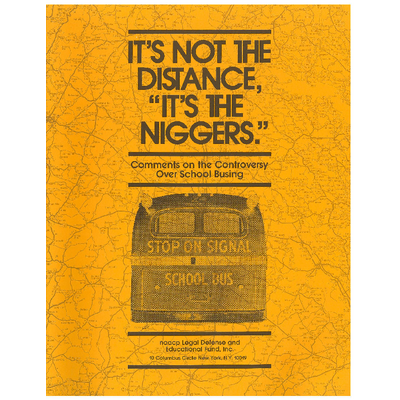
It's Not the Distance - Comments on the Controversy Over School Busing
Reports
May 1, 1972
80 pages
This item is featured in:
-
Division of Legal Information and Community Service, DLICS Reports. It's Not the Distance - Comments on the Controversy Over School Busing, 1972. a4eeed24-799b-ef11-8a69-6045bdfe0091. LDF Archives, Thurgood Marshall Institute. https://ldfrecollection.org/archives/archives-search/archives-item/f9f7d893-c88c-414c-b829-0a6ad4a541e7/its-not-the-distance-comments-on-the-controversy-over-school-busing. Accessed October 05, 2026.
Copied!
naacp Legal Defense and r
Educational Fund, Inc.
~
RICHMOND'S SCHOOL MERGER
SPAWNS A NEW MELTING POT
Mosby sits atop Church Hill,
a heavily black area in the
city's East End, and Mrs. H.,
a white woman with her grey
hair in green plastic roll
ers says, "I hate her going
to school with them niggers.
They teach everybody in school
nowadays to love one another
and I don't believe in that.
I tell her she's got to go
to school somewhere, but I
hate this busing."
D.A. formerly bused herself
up to predominantly white
Highland Springs Elementary
School in Richmond's North
Side, which was just as far
away as Mosby, but Mrs. H.
says distance isn't the is-
sue: "It's the niggers."
The Washington Post,
January 17, 1972
IT'S NOT lFIE
Dl9'ANCE,
"IT'S lFIE
NIGGERS:'
Comments on the Controversy
Over School Busing
The Division of Legal Information
and Community Service
naacp Legal Defense and
Educational Fund, Inc.
10 Columbus Circle New York, N.Y. 10019
May 1972
CHAPTER I
I N T R 0 D U C T I 0 N
American children arrive at school via every conceivable
mode of transportation, including horses, snowmobiles, boats and
airplanes. Assuring their arrival on time and safely every day
is big business. A vast transportation system coordinates the
efforts of citizens of all racial and economic groups: trustees,
administrators, patrons and children of public, private and
parochial schools, Indian families on reservations, professionals
who design the often-computerized travel routes, manufacturers,
the suppliers and mechanics who keep the vehicles running, the
safety experts, the 275,000 drivers.1:/
The school bus has now become the business of judges and
politicians. Because judges have declared that the bus is one
among many tools necessary to eliminate racially and illegally
segregated schools, politicians are clamoring for the curtailment
of the power of the judiciary. A serious constitutional crisis
- 2 -
has been precipitated. The Legal Defense Fund is deeply con
cerned about this attack, for it undermines the confidence in the
judiciary which is vital to the effective functioning of our
constitutional system. Having represented black plaintiffs for
over 30 years in most of the nation's school desegregation cases,
LDF lawyers know, perhaps better than any other group of private
citizens, that Federal judges are extremely reluctant to impose
harsh and unreasonable remedies even for clearly unconstitutional
actions.
The proposed moratorium on busing threatens gains which
have been made in the long and painful struggle to fulfill the
constitutional rights of children to equal educational opportunities.
The reopening of school cases would create pandemonium across the
land and undercut the work of those courageous school officials
who have provided professional leadership during the transition
to unitary school systems. These proposals, which would curtail
only one kind of busing - busing to desegregate schools - and
not any other kind of pupil transportatim, barely camouflage their
racist motivation. They signgl the reversal of the momentum
of equal justice which during the 60's ended a century of Con
gressional silence on the legal rights of the nation's racial
minorities.
The politicizing of the busing issue during an election
year is not a mark of leadership. It has polarized our people
- 3 -
It has diverted attention from the urgent need to eradicate ra-
cism. "Instead of cursing the disease (segregation ) ," as Father
Hesbl.rgh has aptly stated, "we curse the medicine, we curse the
doctors."£/ Emotions have been aroused. Wild, unsubstantiated
charges about judges and about busing have been made. They must
be answered. It is not the school bus which is in trouble. What
is at stake is our sanity as a people, the independence and integ-
rity of our courts, the fulfillment of our commitment to equal
justice.
* * * *
our findings demonstrate that the current sentiments
about busing and courts used to justify opposition to further
school desegregation are popularized myths.
* Federal courts have not exceeded Supreme Court
rulings and have not ordered "massive " or "reck
less" busing in order to implement desegregation
plans.
* Increases in busing in some cities have occurred,
but these increases are not always enormous and
sometimes they are due to factors other than de
segregation.
* Busing is not harmful to children. In fact, school
authorities utilize busing to protect young child
ren.
* Transportation for various school purposes is
used to improve the educational program, not to
undermine it.
*
- 4 -
The cost of school busing is minor. It does
not deplete re s ources for better schools.
* * * *
Ev er since Massachusetts enacted the nation's first pupil
transportation law i n 1869, American children hav e been trans-
ported to school under arrangements which hav e been regulated and
subsidized by state authorities. The early horse-drawn vehicles
and the ubiquitous y e llow school bus have bee n symbols of communi-
ties that care for their children . The two major concerns which
have motivated the steady increase in pupil transportation in the
last century have been America's unwillingness to limit a child's
educational opportunities to those a vailable within walking dis-
tance from his home and a concern for his physical safety.
That the school bus is an established institution in
American education which has received tremendous public support
is evident from the following statistics:
* 43.5% of the total public school enrollment
or 18,975,939 pupils are transported to
school daily, acco~ding to HEW statistics.ll
* There has been a steady increase in pupil
transportation, with annual increases in
the last decade of from .5% to 2.5%. The
decades with the largest percentage gains
were: 11.4% from 1939-40 to 1949-504/
9.9% from 1949-50 to 1959-60
* American taxpayers have been willing to
*
- 5 -
invest significant funds in busing. The
National Highway Traffic Safety Administra
tion reports that the total cost including
capital outlay for pupil transportation for
1971-72 is $1.7 billion.2/
256,000 buses are now traveling 2.2 billion
miles.6/
Busing has been motivated not only by a commitment to
further educational, social and humanitarian objectives, but by
school administrators' concern for more efficient utilization of
facilities. The major increases in busing have accompanied the
moves to provide greater educational opportunities by consolidat-
ing rural schools. Urban school districts are increasingly
busing children threatened by traffic hazards, a service which
must usually be provided from local funds because the miles in-
valved do not meet state requirements for reimbursement. Most
states provide for the transportation of handicapped children.
The bus has made it possible for urban school districts
to relieve overcrowded conditions, to use space wherever it is
available in the community, to prevent double sessions and to
reduce class size. The ERIC study reports the St. Louis experience
where "busing was used as an alternative to having double-sessions,
which would have set one set of children free in the morning and
another set in the afternoon. For those transported, the benefits
of the program were obvious, but they were not the only benefi-
ciaries. As a report to the Superintendent of St. Louis Schools
- 6 -
emphasized, 'reduction of class size, through bus transportation
and other expediences ... made it possible for nontransported as
well as transported children residing in the districts of these
seriously overcrowded schools to suffer minimal education loss.' u7 /
Busing has made it possible for school districts to avoid
expensive new school construction and not just because current
available facilities can be used more efficiently. A school
official in Lynchburg stated candidly that the only alternative
to busing in his district would be the building of new schools
in the ghetto - a capital outlay requiring bond issues which he
8/
felt the taxpayers probably would not approve.-
The desire of local school authorities to use the school
bus as a vehicle for enriching the educational program, particu-
l ar ly of disadvantaged children, can be seen in their use of
ESEA Title I funds for this purpose. In 1967-68, $18 million
of Title I money was used nationally for transportation. Sixty
percent of the Title I districts in California and 75% in Massa
chusetts had transportation components.
91
Now that the school bus is the center of public controversy,
it is most unfortunate that there is no longer any public or
private agency which annually collects and reports statistics
on pupil transportation in the U.S. The most current national
figures available are for the 1969-70 school year. These were
- 7 -
reported by the National Association of State Directors of Pupil
Transportation Services, an informal group which has no budget,
office or staff. The U.S. Office of Education collects some
limited information on pupil transportation as part of its larger
biennial survey of educational statistics, but this information is
out of date at the time it is published.
There never has been a national source of data on pupil
transportation by race. Nor are any statistics available nationally
on the numbers of students bused or the number of miles school
buses travel to further various educational objectives, i.e.,
more efficient use of facilities, vocational education, summer
school, field trips and special educational programs.
The current discussion suffers from a lack of uniform,
objective, factual information. In order to collect some informa-
tion from school districts in which desegregation orders have
been implemented in this school year, Legal Defense fund staff
members interviewed local school officials in fifteen districts
which implemented busing plans this year. Four state departments
of education were visited to gather state-wide information on
pupil transportation. In addition, national data and information
were collected from the of=ice of Education and the Office for
Civil Rights in HEW, from the Department of Transportation, the
National Safety Council, the National Education Association, the
National Association of State Directors of Pupil Transportation
- 8 -
Services, and the U.S. Corrunission on civil Rights. Besides
court records, school budgets and monthly transportation reports
were examined.
We trust that our findings from this survey, done between
March 27 and April 17, 1972, will help put busing into its proper
perspective and thus contribute to a rational discussion of i t s
role in fulfilling the constitutional rights of black and brown
children to equal educational opportunities. The quotes whi ch
begin the following chapters are from President Nixon's Message
to Congress on March 17, 1972, the proposed Student Transportation
Moratorium Act of 1972, and the proposed Equal Educational Opportuni
ties Act of 1972, which were submitted by the White House to
Congress.
- 9 -
CHAPTER II
"Many lower court decisions
have gone far beyond .•.
what the Supreme Court said
is necessary .• . •
"Reckless extension of bus
ing requirements . . • .
"Some of the Federal courts
have lately tended toward
extreme remedies .... "
1 . The President's reference is somewhat difficult to
identify, since the Supreme Court said in Swann and Davis (Mobile)
that an adequate desegregation plan would have to achiev e "the
greatest possible degree of actual desegregation consistent with
the practicalities of the situation," and that in measuring the
performance of proposed plans against this goal, there was a
presumption against schools all or virtually all of one race.
It is apparent from a study of district court orders in school
desegregation cases issued after Swann that most lower court
judges have made a conscientious effort to apply these principles
to the systems before them by being willing to consider desegrega-
tion plans requiring proportionately similar amounts of busing
as were approv ed for Charlotte. (Chief Justice Burger's opinion
denying a stay in the Winston-Sal:em case last summer urged caution
in making such comparisons, but the Court eventually declined to
review Winston-Salem on the merits, without any dissent . )
- 10 -
The inunediate impact of Swann was that district judges
insisted upon the incorporation into plans of techniques such as
non-contiguous zoning and pairing, which many had refused to re
quire prior to the Supreme Court's ruling. However, many courts
rejected unusually long bus rides by applying the Swann standards.
In Jacksonville, Fla., the court declined to order busing to the
North Beach schools in the system , finding that the trip would
take one-and-one-half hours each way. And in Nashville, Tenn.,
the court accepted an HEW-drawn plan which the government's experts
said was deliberately designed not to desegregate some schools in
outlying Davidson County areas because of the length of the bus
rides.
2. It is undoubtedly the concern about metropolitan reme
dies to school segregation which the President refers to in his
comment on "extreme remedies." U.S. District Court Judge Merhige
ordered the consolidation of the Richmond, Va., city schools with
the school districts of the surrounding counties of Henrico and
Chesterfield. The Court found that to accomplish the consolida
tion, 78,000 of the 104,000 students in the new system would have
to be transported, about 10,000 more than those in the three
jurisdictions who are now bused. The Court further found that
no additional buses would be necessary and that busing times and
distances would not exceed those already required of the students
- 11 -
10/ in those counties for many years.~
3. In defense of district judges, one must point out
that some comprehensive school integration plans have been initi-
ated by local school boards and have not been compelled by district
courts under a mandate from Swann. The Winston-Salem-Forsyth
County case was on appeal at the time of the Swann decision. The
Fourth Circuit Court of Appeals remanded the case to the district
judge who ordered the school board to prepare a plan which he
subsequently approved and which is currently in effect. The board
subsequently objected to its own plan and has sought to amend it.
The Columbus-Muscogee County, Ga . , school board developed
on its own initiative a comprehensive and complicated racial balance
plan under which much of the busing is done by the children of
military personnel in the area. The court approved it and the
black plaintiffs were pleased to support a plan which had been
locally initiated.
Federal District Judge James B. McMillan entered a find-
ing in the Swann case in October, 1971 that the "feeder plan"
which the Charlotte-Mecklenburg school board had adopted would
require the transportation of 46 , 667 students , while the "Finger
plan", which the school board rejected after it had been approved
11/
by the U.S. Supreme Court, called for transporting 39,080.~
- 12 -
CHAPTER III
"Some (court orders) have
required that pupils be
bused long distances, at
great inconvenience .... "
1. Our investigations do not support the conclusion that
large numbers of children are being bused long distances to im-
plement desegregation plans. There are individual instances of
long rides, but we suspect that these are far fewer than when
schools were segregated. Speaking in Congress on February 28,
1970, Senator Walter Mondale mentioned counties in Georgia and
Mississippi which bused black children 75 miles and 90 miles
respectively to all-black schools . ..!£/
Judicial notice has been taken of the length of bus rides
prior to desegregation. Judge McMillan observed that an analysis
of principals' reports filed in Swann v. Charlotte-Mecklenburg
had revealed that:
"The average one way bus trip is one hour and
fourteen minutes;
"80% of the buses require more than one hour for
a one way trip;
"75% of1~~e buses make two or more trips each
day .... -
The Honorable Stephen Horn, vice-chairman of the United
States Commission on Civil Rights, testified recently before
Congress:
- 13 -
... before the Charlotte-Mecklenburg decision,
pupils averaged over an hour on the bus. When
the desegregation plan was carried out, however,
bus trips were cut to a maximum of 35 minutes.
Similarly, the Richmond decision would call for
average bus rides of about 30 minutes, which is
less than the current average in an adjacent dis
trict involved in the decision. Where pupils
are bused for the first time, trips are rarely
long. The average travel time reported seems to
be 20-30 minutes. Trips of an hour or more would
be out of the ordinary. A trip of a half hour
or so would not bring the pupil home much later
than if he walked from a neighborhood schoo1.14/
2. In recent testimony before a Congressional committee,
Elliot Richardson, Secretary of the Department of Health, Education
and Welfare, referred to an 80-minute, one-way bus trip in Winston-
Salem, N.C. Prior to the recent court order, there were at least
five bus trips which were 80 minutes or over, one of which was
120 minutes long. Three out of the five schools involved were
overwhelmingly white and had hardly felt the impact of integra-
t
. 15/
ion.~ It is difficult to evaluate how much children are in-
convenienced by these long trips because the mileage reports do
not show how long each child is actually riding. The mileage
begins when the bus leaves the driver's home and ends when he
parks his bus. Children riding varying periods of time have
boarded and left the bus in the meantime.
3. A long bus ride or an inconveniently early departure
time from home does not necessarily reflect a long distance.
Sometimes children must leave home early or travel circuitous
- 14 -
routes because local authorities refuse to provide enough buses.
When it was clear that the court-ordered integration plan for
metropolitan Nashville-Davidson County, Tenn. would increase
the number of bused students from 34,000 to 49,000, Superintendent
Elbert Brooks sought funds from the Metropolitan Council for the
purchase of buses. The Council refused to appropriate these funds,
so the district had to rely on its existing fleet supplemented
only by 18 new buses which had been bought prior to the de
segregation order.
161
According to school officials interviewed
by a Tennessee reporter, the shortage of buses has resulted in
inconvenience and hardships for students:
•.. with buses having to run more than one
route, many children must stand in the dark
to catch buses near their homes in the morn
ing, while others who go to school later get
home after dark .... Some children ride up to
14 mil es in the morning and afternoon , spend
ing up to an hour on the vehicles twice a
day.11./
4. We are indeed concerned about the inconveniences which
children experience, especially when black pupils are expected to
carry a disproportionately heavy share of the busing. In Pinellas
County, Fla., 6.4% of the white students are bused because of the
desegregation order in comparison to 75.2% of the black children. 181
(Sixteen percent of the student population is black.) An official
in Hillsborough County, Fla., reports that of the elementary pupils
transported because of the court order, 8,576 are black and 5,404
- 15 -
19/ .
are white.~ Seventy-five percent of the bused students in
Jackson, Miss., are black.
201
Furthermore, black children are
often bused at an earlier age. When schools are paired or clustered,
it is not unusual for the plan to require black pupils to leave
their neighborhoods for the early elementary grades. The formerly
all-black schools receive the older elementary children, or may
become sixth-grade centers or junior highs for both races - an
arrangement which requires black children to travel in the earliest
years.
5. It is the lack of transportation which is often the
hardship. Local and Federal officials who refuse to provide
transportation to pupils who must travel long distances to school
and archaic state laws which discriminate against cities in their
transportation reimbursements are responsible for inconveniences
to children. Hattiesburg, Miss. and Texarkana, Ark. have plans
which require junior high pupils to travel long distances at their
own expense. Some states do not provide reimbursement for busing
within cities. (See the discussion of Sparrow v. Gill in Chapter
I V.)
The lack of transportation in Norfolk, Va. is a real hard-
ship to students who must pay $63 a year to ride city buses to
school because the district does not operate its own transportation
system. Several hundred students from poor families in Norfolk
~ 16 -
are not in school this year because they do not have transporta-
21/
tion.--
Most of the school districts mentioned in this report have
sought Federal funds for transportation from the Emergency School
Assistance Program (ESAP). Federal officials rejected the request
from Greenville, Miss. for funds to purchase buses to transport
2,000 students who had been reassigned to elementary schools out
. . 22/
of their neighborhoods.--
In 1970-71, Duval County, Fla. received a grant from ESAP
of which over $100,000 was used for pupil transportation. The
district applied for another grant for 1971-72 and requested
several hundred thousand dollars for transportation. The total
application was approved but not the use of the funds for busing .
Accordingly, the school board put over $900,000 of the grant in
escrow and filed suit in Federal court to compel Secretary Richardson
23/
to authorize the use of this money for transportation.--
- 17 -
CHAPTER IV
"Massive Busing"
1. We find no conclusive evidence that the aggregate
amount of busing has increased nationally or regionally as a re-
sult of court-ordered integration. In the absence of data on
pupil transportation by race which would reveal how many white
and black children are being bused to what kinds of schools, it
is impossible to state accurately the number or race of pupils
who are being bused to racially segregated or integrated schools.
The cry of "massive busing" for "forced integration" is completely
irresponsible.
We agree with Donald E. Morrison in his testimony on be-
half of the National Education Association before the House
Committee on the Judiciary: "There is no statistical proof that
desegregation has substantially increased pupil busing, either
24/
nationally or regionally."-
2. HEW has estimated a 3% increase in busing as a result
25/
of integration.- This figure represents the increase in the
Southeastern states in overall pupil transportation between 1967-70
from 52.5% to 55.5%. Our investigation leads us to the conclusion
that this is no more than normal growth. The Southeast has been
subsidizing the transportation of more than 50% of its pupils
since 1957, a larger proportion than any other region. Between
- 18 -
1965 (when HEW's Title VI civil rights enforcement program began)
and 1970, there was a 4% increase in the numbers of pupils trans-
ported in the South. Yet at the same time the percentage of
pupils increased at a more rapid rate in other parts of the nation
. . d f . . 26/ where there were few court orders and limite en orcement activity.~
Nationally 4.9%
North Atlantic 4.9%
Great Lakes 5 .2%
3 .
. 27/ .
The Department of Transportation~ estimates that
the annual increase is attributable to the following causes:
Population growth 95%
Centralization about 3%
Safety less than 1%
Desegregation less than 1%
Other less than 1%
4. Urban school districts which have only bused minimally
or not at all in the past experience a major upsurge when a com-
prehensive plan to eliminate the dual school system is implemented.
Often, however, this does not bring the district up to the state
average. All of the schools in Raleigh, N.C., were effectively
desegregated in 1971-72 under a plan which contributed to the
increase of bused students from 1,342 to 10,126, at least 5,000
of which were Sparrow students. Although the district is now
- 19 -
transporting 46 . 5% of its students, this is less than the North
Carolina state a v erage of 64.9%
281
In Norfolk, Va., where the desegregation order required
most elementary students to travel outside their neighborhoods for
the first time in 1971-72, approx imately 39% of the district's en-
rollment is bused. Yet 63% of all public school students in
29/
Virginia are bused.~·
5. An increase in busing may result from factors which
have nothing to do with integration:
a. There has been an increased use of busing
to protect children from traffic hazards.
In 1971-72, 66,115 students in Florida are
bused at local expense because they do not
meet the 2-mile state reimbursement require-
ment. This is a dramatic increase from 1968-69
when only 40,792 in this category were bused.
Officials report that the main reason is
safety, a concern about busy streets and haz-
ardous walking conditions. The vast majority
of these are elementary pupils . 301
b. Busing is increasing through commitments to
transport younger children. School officials
in Roanoke, Va. took advantage of their new
- 20 -
school buses to provide rides in hazardous
areas for kindergarten children who ordinarily
lk h 1
311 . . . 1973 74 wa to sc oo .-- Beginning in - ,
Florida law will mandate state-supported
kindergartens. All districts will be re-
. d 'd . 32/ quire to provi e transportation.-- Orange
County, Fla. expects to bus 4,000 kinder-
33/
garten pupils that first year.--
c. At the time of desegregation, some school
districts use their newly acquired buses
to further other objectives. Lynchburg, Va .
is transporting students for the first time
this year. The school system's 37 new buses
not only get students to school, they are also
used to provide field trips and to facilitate
string music, choir practice and R.O.T.C.
in high school.
d. The decision of a three-judge Federal Court
34/
in North Carolina in Sparrow v . Gill-- has
increased busing and complicates the effort
to determine the impact of integration on
busing. Prior to the 1970-71 school year,
North Carolina law generally provided that
- 21 -
county children who lived more than a mile
and a half from school would be provided
school bus transportation paid for by the
state. City children, however, living a
mile and a half from school were not pro
vided school bus transportation at state
expense. City children were defined as
those children who lived within the 1957
boundaries of a city. Therefore, those
children who lived in areas of a city which
had been annexed after 1957 and lived more
than one and a half miles from school did
receive bus transportation at state expense.
Additionally, the law was interpreted to
mean that if a school was located outside
of the 1957 limits, then children living
within the 1957 limits more than a mile and
and half from the school were eligible for
transportation. Thus, prior to the 1970-71
school year there was at least some school
bus transportation provided for city children.
Moreover, local boards of education were free
to provide bus transportation at local expense
- 22 -
if they chose to do so. Greensboro, for
instance, has for many years provided trans-
portation for children living more than a
mile and a half from school and has paid
for it out of local funds.
A lawsuit was filed by white children and
their parents in Winston-Salem challenging
the inequity which existed where city children
living more than a mile and a half from school
did not receive bus transportation but county
children living more than a mile and a half
from school did. A three-judge Federal Court
decided that classifying city children differ-
ently from county children in determining who
was to receive bus transportation at public
expense was constitutional. However, the
Court determined that it was unconstitutional
to treat children who lived in the areas of a
-
city prior to 1957 differently from children
who lived in areas of a city annexed after
1957.
The result of the Sparrow decision was that
the State Board of Education required local
- 23 -
school boards to offer transportation to
all city children or to none. If local dis
tricts decided to offer transportation to all
city children living more than a mile and a
half from school, then the state would pro
vide the money for the increased transporta
tion. This new policy went into effect for
the 1970-71 school year. Almost all cities
chose to increase their transportation to in
clude city children. Raleigh was the notable
exception. It began to transport Sparrow
pupils in 1971-72.
The comparison of transportation data before
and after desegregation is complicated by the
effects of the Sparrow decision because de
segregation was beginning to occur in North
Carolina cities at the same time that state
financed transportation was being offered for
the first time for city students. All of the
cities were surveyed by the State Department of
Public Instruction prior to the 1970-71 school
year to determine how many additional children
would be riding school buses to be paid for by
- 24 -
the state. The survey revealed that an
additional 54,000 students, requiring 549
buses, would become eligible throughout the
state as a result of Sparrow. Included in
this figure were 1,900 students (21 buses)
in Asheville, 3,108 pupils (34 buses) in
Winston-Salem-Forsyth County, 6,122 pupils
(68 buses) in Charlotte-Mecklenburg, 2,281
students (25 buses) in Greensboro and 3,801
d (4 ) 1 . h 35/ stu ents 2 buses in Ra eig .~
Therefore, to calculate the extent of in-
creased transportation occasioned by desegre-
gation requirements, it is necessary to sub-
tract the number of children bused in the year
prior to desegregation from the number of child-
ren bused after desegregation and then subtract
the number of additional city children who
would have received transportation under the
new state policy. The resulting figure should
also be discounted further by such factors as
normally expected growth, increases for special
education, and pre-school education, etc .
6. Whether integration brings an overall increase in
busing is difficult to assess . One might expect the implementation
- 25 -
of a busing plan to result in an increase in both the number of
students bused and the mileage . Actually:
*
*
*
*
*
36/
Arlington, Va., buses 1,000 fewer pupils.~
Pinellas County, Fla., buses about the same
number of students but the buses travel 3,200
. . 37/
more miles daily.~
Duval County, Fla . , has increased the number
of pupils bused but there has been a substantial
decrease (11 miles or 20%) in the average num-
38/
ber of miles per day per bus.~
Busing to desegregate in Alabama, according
to the United States Commission on Civil Rights,
has resulted in 1 million fewer passenger miles
h h
. . 39/ tan t e previous year under segregation. · ~
From 1965-66 to 1970-71, the number of pupils
transported in Mississippi has decreased from
40/
312,085 to 292,472.~
- 26 -
CHAPTER V
"Rather than require the spend-
ing of scarce resources on ever
longer bus rides •.. , we should ...
[put] those resources directly in
to education .•••
"Implementation of desegregation
plans will in many cases require
local educational agencies to
expend large amounts of funds for
transportation equipment, which
may be utilized only temporarily,
•.. thus diverting those funds
from improvements in educational
facilities and instruction which
otherwise would be provided."
1. The cost argument against pupil transportation rests
on the assumption that busing costs are so great that they seriously
deplete funds for the regular educational program. But the facts
do not support this assumption. The latest national figures
available show that 3.7% of all educational expenditures in the
United States were spent on pupil transportation of all kinds.
This percentage has declined slightly since the 1953-54 school
year, as the attached table on busing costs 1953-54 through
1967-68 shows. The chart on pupil transportation costs for
individual school districts reveals that even with increased
costs, pupil transportation remains a small percentage of all
educational expenditures.
2. The broad allegations of the cost burden must also
- 27 -
reviewed against the fact that each state reimburses local
school districts for both capital and operating costs. There
are wide variations among states in their patterns of reimburse-
ment, and there is no national average of state reimbursement
of pupil transportation costs. In Florida in the 1970-71 school
year, $11.2 million of the total transportation expenses of more
than $23 million for all school districts were reimbursed by
41/
the state.~
In North Carolina, the state pays a vast majority of all
pupil transportation costs incurred by local school jurisdictions.
For example, the state pays the cost of operating all school buses
which transport students eligible for state reimbursement. It
pays for replacing all school buses. If a local district chooses
to contract with a private company, the state pays the company
even if its charges are higher than the average level of state
reimbursement. The main financial burden for local school dis-
tricts is limited to (1) the initial purchase of the bus , (2)
maintenance and upkeep of facilities, (3) some administrative
costs, and (4) the cost of busing pupils who are not eligible for
42/
state reimbursement.~
3. Cities which have never subsidized busing before de-
segregation claim a terrible financial burden when ordered to
desegregate, yet sometimes the wild projections of costs have
- 28 -
been completely misleading . In the spring of 1971 shortly after
the court ordered desegregation in Pinellas County, Fla., a
local school official was quoted as saying that the order would
require the busing of an additional 11,000 students. In fact,
about 1,700 additional students were transported to comply with
the court order. In Pinellas County, Fla., approximately 2,000
white children left the school system and the district ceased
transporting 1,413 students who were ineligible for busing be-
cause they lived within walking distance of their school. Even
if these 3,413 were transported in addition to the 1,700 who were
bused for desegregation purposes, still less than half of the
43 /
projected 11,000 students would have had to be transported.~
The Raleigh, N.C. school district projected that in order
to comply with its desegregation order, it would have to spend
$980 , 956 from local funds for the 1971-72 school year. Of this
amount, $828,000 was for 138 new buses and $26,500 was for drivers'
44/
salaries.~ The $26,500 represents a local supplement in excess
of state reimbursement for drivers' salaries. In fact, the total
local expenditures required to meet the court order were $643,054 ,
and of that sum, cbout $444,993 represented the cost of buses which
45/
were not delivered in the 1971-72 school year.~
4. The major cost of desegregation is the initial capital
outlay for new buses. This cost can be handled by school authori-
- 29 -
ties in several ways. If the money is spent all in one year,
it represents assets that are carried over a number of years.
However, if the district borrows money for new buses, the actual
cost is carried over the duration of the loan and does not con-
stitute a one-time expense.
School officials in some districts have publicly claimed
enormous expenditures for new buses. While this may sometimes
be true, it may also be that some of the buses were alreadybudg-
eted, that some buses are needed for non-desegregation purposes,
or that some buses paid for in one year are not delivered until
the following year.
5. In some instances, the number of students bused may
vary depending on the management practices in various school dis-
tricts. A Hillsborough County, Fla. school official conunented to
an LDF staff member that his school district transported 10,000
more children with 100 fewer. buses than the Charlotte-Mecklenburg,
. 46/
N.C. district did.--
6. The Norfolk, Va. public schools had not subsidized
bus transportation prior to desegregation. When the school dis-
trict was ordered to desegregate its schools, the school board
and the city council refused to purchase buses to get children
to their assigned schools. The 15,000 children who ride a bus
to get to school must pay $63 per student per year, a financial
- 30 -
burden which families have had to bear. Yet, if Norfolk operated
its own bus fleet, it would cost less than half that much, or
47/
$26.17 (the Virginia cost per pupil for cities),- to trans-
port students. Furthermore, if Norfolk were to operate its own
buses, it would be eligible for 47% of its operating costs from
48/
the state.-
The U.S. Court of Appeals for the Fourth Circuit on
March 7, 1972, ordered the Norfolk school board to provide free
transportation as a part of its desegregation plan on the grounds
that without transportation to the assigned school, the whole
desegregation plan is a "futile gesture" and a "cruel hoax."
The Court recognized that the cost of transportation would be
a burden, but held that $3 million capital outlay for buses and
maintenance could be amortized over the normal· life of the equip-
ment and that the $600,000 increase in annual operating costs
was reasonable in a district with a total school budget of $35
49/
million.-
7. The decision of this Administration to prohibit the
use of ESAP funds for any transportation costs created severe
problems in a number of school districts. Dr. Elbert Brooks
testified before Congress that at a meeting with southern school
superintendents in Atlanta in July, 1971, he and other superinten-
dents were led to believe by HEW officials that their requests
- 31 -
for help to pay busing costs would be honored by HEW. But in
August, after President Nixon's announcement, HEW refused to
fund any of the requests . .1Q/ Dr. Brooks, as well as other
southern school superintendents, felt betrayed.
8. In other cases, it was not only the President, but
also local municipal authorities who prohibited the use of public
funds to buy school buses to meet the requirements of the court's
order. The Nashville Metropolitan Council refused to approve
new buses for desegregation, and as a result schools are operat-
ing on staggered hours, some extra curricular activities have
been curtailed and students and parents have been inconvenienced.
Despite all these problems, Dr. Brooks reported that "the regular
program should not be hurt • .. W
9. In some instances, school districts may spend extra
money for transportation in order to provide conveniences for
students. North Carolina only reimburses local districts for
"mixed" buses, i.e., buses which carry elementary, junior and
senior high school students at the same time. Winston-Salem-
For$yth County, however, has had a practice for several years
of taking elementary students home in the afternoon before junior
and senior high schools are let out for the day. Thus, the local
board must pay for the costs of transporting these elementary
52/
students from local funds.~
- 32 -
10. Some districts pay busing costs out of local funds
because they undertake supplementary costs which are not state
reimbursed. For example, in 1971-72 Winston-Salem-Forsyth County
dJcided to hire adult bus drivers for the first time. They pay
each adult driver $80 a month more than state reimbursement. The
district projected in September that it would cost them about
53/
$150,000 this year for this driver-salary supplement.~
11. Inflation has caused increases in busing costs. In
North Carolina, for example, state reimbursement for bus driver
salaries has gone up considerably in the past few years after bus
drivers came under the minimum wage laws. Salaries for mechanics
have shown a sharp upward trend recently in North Carolina, as have
54/
the costs of parts and gas.~
12. Two North Carolina school systems - Greensboro and
Asheville - desegregated their schools at no additional expense to
local districts. In Greensboro, the additional busing of 6,000
students in 1971-72 was accomplished by the city's existing fleet,
by county buses already utilized by the city to transport some
city children, and by the borrowing of 86 buses owned by the
county and maintained by the state. In Asheville, no local money
was spent to bus over 2,000 children to accomplish desegregation
because all transportation is done by private bus companies which
55/
are reimbursed by the state.~
I
ii
- 33 -
CHAPTER VI
"Curb busing while expanding
educational opportunity"
1. School officials see busing and expanding educational
opportunities as complementary and not contradictory objectives.
Their views are directly contrary to those of the President who
sees busing as a "symbol of social engineering on the basis of
. 56/ abstractions."- School districts throughout the country use
their transportation systems to promote a variety of educational
and social goals including school consolidation, improved voca-
tional education programs, broadened horizons for their children
through field trips, and expanded summer programs and pre-school
education. No one, to our knowledge, has ever held out these
objectives as "social engineering."
As Donald E. Morrison of NEA has testified:
School systems have not hesitated to bus child
ren to vocational education programs and special
education programs concentrated in particular
geographical areas. School children are regu
larly bused on field trips serving some educa
tional purpose. In some school districts, such
as Cleveland's Shaker Heights, children have
been bused~e for lunch to give teachers duty
free time. 5
2. Educators have supported school busing to promote edu-
cational opportunity. The Council of Chief State School Officers
in November 1971, stated:
Although transportation of students as a method
of achieving desegregation has become a highly
- 34 -
controversial issue throughout the nation, the
members of the Council of Chief State School
Officers believe it is a viable means of achiev
ing equal educational opportunity and should be
supported. 58/
3. Transportation is still a relatively modest percent-
age of all educational expenditures. (See discussion in Chapter
V.) Even if the nation were to re-allocate for compensatory
education all funds currently allocated to pupil transportation,
including those which subsidize affluent, middle-class children
attending suburban schools which have never been involved in
integration, we would have little more than is currently in the
budget for Title I. This program has yet to prove its effective-
ness in raising the levels of academic achievement of educationally
disadvantaged children.
4. The effect of transportation for desegregation on the
regular education program has varied from district to district.
In Pinellas County , Fla. desegregation resulted in a decrease in
extra-curricular activities but not an increase in the number of
pupils bused. 591 But in Roanoke, Va. school authorities report
that because of the new buses required for the desegregation plan,
the district can now "do more in a central location than could
formerly be done in separate places." Roanoke operates five
educational centers for elementary school children, including an
oceanography center and a Japanese garden exhibiting the culture
of the Far East. Students are bused to these centers as part
.,
J
1
- 35 -
of their regular program. The cost of duplicating such centers
in each elementary school would prohibit the use of such educa-
. . . 60/ tional innovations.~
Finally, Lynchburg, Va. school authorities report a 3.5%
increase in school attendance this year over last year. This
is the first year that the city has transported students to school,
and officials say the only factor to which they can attribute
improved attendance is busing.
I.
- 36 -
CHAPTER VII
"The school bus ... has become
a symbol of helplessness,
frustration and outrage - of
a wrenching of children away
from their families ..•• "
1. If this sentiment represented the prevailing attitude,
school systems and local taxpayers would long ago have stopped
busing. Many southern school districts have bused 70-100% of
61/
their students for years prior to desegregation.-
Many school officials are obviously proud of their buses
and pleased with the advantages which busing has brought. When
interviewed by our representative, a Roanoke, Va. official ob-
served that busing has me ant "be tte r control, better schedules,
and h . k ' d ,,62 / appier 1 s. -
Of the students who were bused prior to desegregation,
98% in Winston-Salem-Forsyth County, N.C. and over 90% in Greensboro,
. 63/
N.C. were white.- Did the citizens of those communities see the
school bus as an outrage? We doubt it.
2 . A Hillsborough County, Fla. school official, noting
apparently for the first time that the complete desegregation of
the school system might require a one percent increase in total
expenditures , mused aloud that, "maybe it isn't so bad after all;
maybe it is really worthwhile! 1164/
3. It is true that reports of problems with discipline
- 37 -
and with vandalism involving buses have increased. Whether this
is a concomitant to integration is a mixed picture. Some incidents
have involved persons of the same race. Tensions which occurred
on newly integrated buses have sometimes subsided. Some problems
seem to be the result of having young, inexperienced and untrained
drivers, many of whom are students themselves. Where districts
have employed drivers of a different race from the majority of
pupils, especially white drivers for all-black busloads, they have
invited trouble.
As the bus has become politicized, it has become the
symbol of racial divisiveness. Buses have been turned over and
burned by irate white parents. White hostility against integra
tion has been directed against the bus. However, some officials
whom we interviewed believe that the current problems have little
to do with race. They are convinced that parents lack confidence
in public schools, that the bus as a symbol of the educational
establishment is an easy target, and that those who commit acts of
vandalism are merely reflecting the prevailing disenchantment with
public education.
In view of this problem, citizens have urged the employ
ment of monitors and the training of bus drivers. Norfolk, Va.
sought ESAP funds for monitors and was turned down by HEW officials
who referred to President Nixon's veto of the use of ESAP funds
- 38 -
for any purposes related to transportation. As a direct conse
quence of the President's decision, the Norfolk school board
decided to use city police on the buses for the first month of
school.
,-
- 39 -
CHAPTER VIII
"Excessive transportation of
students creates serious risks
to their health and safety ....
"The risks and harms created by
excessive transportation are
particularly great for children
enrolled in the first six grades."
1. One of the most emotional appeals against busing is
that riding a school bus risks the health and safety of children,
especially those in the first six grades of school. National
safety statistics refute this contention.
Data on student accident rates from the National Safety
Council reveal that it is safer to ride a bus to school than to
walk. The accident rate for boys riding a school bus is .03 per
100,000 student days compared with .09 for walking. For girl
students the accident rate is similar - .03 when riding a bus
66/
and .07 when walking to school.~ These rates for the 1968-69
school year are based on the reports of more than 35,000 school
jurisdiction accidents, that is all types of accidents during a
school day. The National Safety Council warns that since report-
ing is voluntary, the figures may not be representative of the
national accident picture. But the figures do show that of
school accidents reported, risks to student safety on a bus were
much lower than risks to students in other school activities,
such as sports and classroom instruction.
NATIONAL SAFETY COUNCIL, ACCIDENT FACTS, 90-91, (1971 EDITIONo)
Boys - Student Accident Rates by School Grade_!_/
Location and Type Total K.gn. 1-3 Gr. 4-6 Gr. 7-9 Gr. 10-12 Gr.
Going to and from school (MV) .19 .40 .22 .13 .20 .15
School bus .03 .04 .02 .02 • 06 .02
Public carrier (incl. bus) .01 .02 .01 .01 .01 .02
Motor scooter .01 0 0 * .02 .02
Other mot. veh.-pedestrian .09 .33 .16 .08 .04 .02
Other mot. veh.-bicycle .02 0 .02 .02 003 *
Other mot. veh.-other type .03 0 .01 .01 .04 .06
Girls - Student Accident Rates by School Grade_!_/
Going to and from school (MV) .14 .29 .13 .08 .14 .19
School bus .03 .01 .01 .03 .04 .02
Public carrier (incl. bus) .01 .02 0 * .01 .02
Motor scooter .01 .01 * * .01 .02
other mot. veh.-pedestrian .07 .23 .10 .04 .06 .04
other mot. veh.-bicycle * 0 .01 * .01 0
Other mot. veh.-other type .03 .01 .01 .01 002 .10
_!/ The figures in the tables are rates which show the number of accidents per
100,000 student days.
*Less than 0.005
- 40 -
Days Lost
per Inj.
3.56
1.24
3.57
2.42
4.53
3.34
3.01
8.26
2.01
4.31
1.83
14.14
4.50
1.95
- 41 -
The risks to health and safety are presumed b y the
President to be even greater for younger children , those in
the first six grades. This unsupported assumption has risen to
the status of a "finding" set forth in the President ' s legisla-
tion establishing national standards for equal educational oppor-
tunity, yet the chart on the previous page demonstrates that
accident rates on school buses for boys and girls in grades 1
through 6 are slightly ·lower than the total accident rate for
all ages for both sexes.
2. Any discussion of safety must recognize that without
adequate vehicles to transport children to school, students may
be subjected to unwarranted hazards. Dr . Elbert Brooks, the
Director of the Nashville Metropolitan schools , testified before
the Senate Select Committee on Equal Educational Opportunity that
because the school board had been unable to purchase the necessary
number of buses some children left home and returned home in the
darkness of winter days and that some buses made trips on an
inter-state highway to shorten the trip . Dr . Brooks felt that
such practices did create risks , but that such risks were directly
due to the fact that both the Nashville City Council and the
President of the United States had made it impossible for the
school board to purchase enough buses to eliminate these potential
67/
hazards . -
- 42 -
3. School officials are not unmindful of potential risks
to children who walk to the nearest school, but who must cross
busy streets, walk down roads with no sidewalks, and traverse
railroad tracks in order to get to their neighborhood school.
In such instances, local school systems often provide transporta-
tion for these students even though they would not otherwise be
eligible for busing. For example, Roanoke, Va. this school year
purchased 20 new yellow school buses in order to comply with
their desegregation order. These were the first large passenger
buses to be operated by the district itself. The new vehicles
permitted the school system not only to bus children to desegrega-
gated schools, but also to bus kindergarten children who last
68/
year had to walk unsafe streets to get to class.~
4. In the state of Florida during this school year, 66,115
children who are ineligible for state-reimbursed transportation
because they live within walking distance of their school, are
nonetheless bused to school. School officials report that this bus-
ing was done at local expense, that it was done mostly for safety
reasons, and that the vast majority of these children are in the
elementary grades.
69/
The following chart ~ shows, for five Florida school
districts, the number of students who were ineligible for state-
reimbursed transportation but who were bused primarily for reasons
- 43 -
of safety or convenience. Again, the majority of these child
ren are in the elementary grades.
District 1968-69 1969-70 1970-71 1971-72
Duval 3,397 3 I 030 3,630 5,764
Hillsborough 1,879 3,211 5,408 3,565
Pinellas 2,701 3I194 2 I 142 729
Manatee 613 504 748 822
Orange 3,767 4,635 6,347 7,834
Apparently, it is the judgment of local educational officials
that busing elementary school students is not a risk to their
health or safety. Indeed, such busing is deemed a protection of
young children.
I,
I!
I
- 44 -
CHAPTER IX
"A remedy for the historic evil
of racial discrimination has
often created a new evil of dis
rupting communities and impos
ing hardships on children .... "
Who has disrupted communities, imposed hardships, and torn
us apart as a people?
It is not the Federal judges who have exercised judicial
restraint.
It is not black citizens who are still trying to secure
equal educational opportunities for their children.
It is not the school bus.
It is the present Administration which has used the powe r
and majesty and authority of the President's office to stir
dissension, confusion, and uncertainty among us by politicizing
the busing issue.
HILLSBOROUGH COUNTY, FLORIDA - A PROFILE
Florida is a state of metropolitan school districts.
Every city in Florida, no matter how large, is part of the county
school system in which it is located. cities like Miami and
Jacksonville are located in county school systems which also have
rural areas, many municipalities, and burgeoning suburbs. In
spite of the state's size and population, it has only 67 school
districts.
Hillsborough County, which includes Tampa, is a sprawling
metropolitan area, composed of diverse racial and ethnic groups.
About 20% of its 500,000 citizens are black and nearly 20% are
Spanish-speaking. Within its l,034 square miles are some fourteen
municipalities which range in population from 5,500 to almost
40,000. There are also many unincorporated, but heavily populated
areas in this county. Like many metropolitan areas in Florida,
significant population growth has occurred in the county, but
little of that growth has occurred in Tampa itself. The county
has experienced an increase in population from 398,000 in 1960
to nearly 500,000 in 1970, while the Tampa population during that
same period grew from 275,000 to 278,000 persons.
Hillsborough County also has a very large, metropolitan
- l -
school system with about 103,000 students (about 20% black)
attending 129 schools. During the 1969-70 school year, the
dual system was still intact. Freedom of choice had produced
only some token desegregation in a few formerly white schools.
In 1970-71, many other formerly white schools became desegregated
for the first time as a result of a Federal Court order.
In the spring of 1971, black plaintiffs filed a Swann
motion with the U. S. District Court asking that the Hillsborough
County schools be desegregated. Accordingly, the Court directed
the board to devise an appropriate school desegregation plan.
The plan adopted by the board and approved by the Court called
for each school in the system to be about 80% white and 20% black.
The plan, which had the approval of the superintendent, the school
board, the Chamber of Commerce, civic groups and the press, was
a combination of pairing, clustering and non-contiguous zoning.
The clusters were composed of one formerly black school and a few
formerly white schools, with the black schools becoming middle
grade centers and the white schools serving grades 1-5. Thus,
white students now attend formerly black schools in grades 6-7
only, while black students attend formerly white schools for 10
of their 12 school years.
Some resistance to this plan existed prior to the opening
of the current school year. A significant portion of the resistance
- ii -
was in the black community. There were threats of demonstrations
by blacks at the two formerly black high schools. The Court-
ordered Bi-Racial Advisory Committee, which reflected the senti-
ment in the black community, told the Court that the plan "essen
tially establishes a 'community school concept' for white students ....
The plan's undue effort to minimize white flight serves to maxi-
mize black busing." The elimination of the two black high schools,
the Advisory Committee said, " .•. deals a punitive blow to the
black community and by so doing .•. is inconsistent with the short
or long range harmony between the races desired and needed to
implement school desegregation in the community at large." Some
white citizens attempted to thwart the Court's order, but no
major organizations opposed the plan or caused disruptions in
the schools.
In 1969-70, 164 buses were bused to transport more than
27,600 students over 15,200 miles daily. In 1970-71, 179 buses
transported some 32,400 students more than 15,700 miles, an in
crease of about 5,000 students.
Just before the Court approved the current desegregation
plan last summer, the board projected that the proposed plan
would require the additional transportation of about 15,700 ele
mentary, 7,400 junior high and 2,200 senior high school students,
a total of 25,300. The projection was close~ 25,200 students
- iii -
are bused this year for the purpose of desegregation. However,
1,800 fewer elementary students are bused than projected. Of
the 14,000 elementary pupils who are bused, 8,600 are black and
5,400 are white. The total number of secondary students of
both races who are bused is 11,300: 8,500 in junior and almost
2,800 in senior high schools.
Transportation statistics for the 1971-72 school year in
Hillsborough County reflect the increased busing necessary to
implement the desegregation plan.
1. The number of buses used increased from 179
to 339, including 29 spares.
2. There are 907 separate bus trips daily this
year compared with 461 last year.
3. Students were transported to 84 schools last
year and 126 this year.
4. The number of elementary students bused in-
creased from 10,600 to 22,500; junior high
school students increased from 8,800 to
.
16,200~ and senior high school students
from 7,500 to 10,400.
5. Buses traveled 6,000 more "essential miles"*
this year.
* "Essential mile" is a state department term meaning the
number of miles a bus travels with one or more students.
- iv -
6. Total mileage has increased from 15,750 per
day to 32,300 miles per day.
Two schools in the county operate on double sessions. Two
separate administrative units operate within the same facility
each day. The morning session has a different principal and
faculty than the afternoon session. This year double sessions
necessitate an additional $18,000 in bus drivers' salaries and
about 5,200 "non-essential miles".** Double sessions result in
less efficient use of buses. Since only students in particular
grade levels are picked up, buses must travel further to obtain
a full load and they must travel more miles empty.
Other non-essential costs have increased this year be-
cause the state computes mileage from the time a bus begins its
route at the driver's house until it stops at the garage after
dropping off the last student, and because the district has had
difficulty in finding bus drivers who live close to the beginning
of their routes.
During the 1970-71 school year, Hillsborough County spent
$1,206,708 for transportation, or about $37.23 per pupil bused.
This cost represented approximately 1.3% of the district's total
budget. Out of a total budget of over $119 million this year,
** "Non-essential miles" is a state department term indicating
the miles a bus travels without students, or miles a bus
travels off the main bus route if that detour is 1.5 miles
or less one way.
- v -
the school district is spending about $1,973,728 or 1.7%, for
transportation. The cost per pupil bused is $37.38.
The purchase of new buses has been a significant factor
in the increase in transportation costs this year. One hundred
and forty-five regular buses were bought, of which 20 had already
been budgeted. One million dollars was borrowed on a four-year
loan to pay for the new buses.
The Florida State Department of Education recommends that
school buses be replaced every ten years, yet in 1961, 1963, 1964,
1965 and 1966, Hillsborough County purchased no new buses. As
a result of this delay in bus replacement, 71 buses are now 11
or more years old, and 29 buses purchased in 1957 and 1958 are
now used as spares. If buses had been replaced on a regular
basis, Hillsborough County's bus fleet might have more easily
accommodated the increased student transportation and 29 old buses
would not have had to be utilized.
This year's total anticipated educational expenditures of
over $119 million are a considerable increase over 1970-71 when
somewhat more than $89 million· was spent. What is most interest
ing to note, however, is the substantial increase in the allocation
for capital improvements and debt service:
- vi -
Capital Improvements
Debt Service
1970-71
$12,034,617
2,838,883
1971-72 (est.)
$32,847,393
7,741,681
The investment in new buses represents a small percentage indeed
of the total capital outlay for Hillsborough County.
Despite the substantial increase in busing in Hillsborough
County and the reassignment of students to new schools, the
citizens of the metropolitan area, black and white alike, have
accommodated to the change brought by conversion to a desegre
gated school system. School officials have taken steps to ease the
transition. Specialists have been employed with ESAP funds to
work in each secondary school in the county. Bi-racial student
advisory committees have been established at each secondary school,
and together with the specialists, have helped to moderate inter
racial antagonisms. Facilities at the formerly black schools have
been improved. Air conditioning was installed and needed supplies
were increased, thus reducing parent complaints. While many black
students have resented losing their identity with their old high
schools, they have increasingly participated in extra-curricular
activities and sports at their new schools. Buses have been pro
vided to transport students home after regular school hours.
In the first week after school opened in the Fall of 1971,
many white parents did not send their children to school, and
others drove their children to schol and picked them up in the
vii -
afternoon because of fear of disruptions at formerly black
schools. But the disruptions failed to materialize, and after
several weeks white children began riding buses to school.
Approximately 2,000 white students left the public schools this
year. The fact that there was no greater amount of "white
flight" was due to the fact that the private schools in the
county resisted expanding their enrollment for students who
sought to avoid desegregation. Superintendent Raymond Shelton
has noted a trend of white students returning to public schools.***
Hillsborough County is an example of what can be accomplished
when a metropolitan-wide desegregation plan becomes the vehicle
for securing the constitutional rights of black children. Most
encouraging, however, is that the plan is not only working but
that at least one school official believes that, "maybe it isn't
so bad after all; maybe it is really worthwhile! 1164/
***Testimony of Chairman Theodore Hesburgh, U.S. Commission on
Civil Rights before Subcommittee No. 5 of the House Committee
on Judiciary, 6-15 (March l, 1972).
- viii -
NORTH CAROLINA - A PROFILE
North Carolina has several large, urban school districts
and is unique because it is the only state in the South that has
completely desegregated its city school systems. In the past
four years, pupil transportation has increased by 10% in the
state, from 55% of North Carolina's enrollment to 65%. Yet
only a small portion of that increase can be attributed to de
segregation of the urban areas.
In 1968-69 no school districts, including those mentioned
in this report, had desegregated school systems. During that
year over 9,200 school buses transported nearly 611,000 students
(almost 55% of all students in the state) at an annual cost of
over $14.2 million, which included the cost of purchasing bus
replacements. Over 352,000 miles were traveled in that year at
a cost of $23.40 per pupil.
In 1969-70 most North Carolina school systems were still
segregated, including all of the large, urban school districts.
In that year, over 9,400 vehicles transported nearly 630,000
students (over 57% of all the students in the state) at a cost
of over $19.1 million, which included the cost of bus replacements.
Over 357,500 miles were traveled at a cost of $30.39 per pupil.
During this year about 15,000 special education students became
- ix -
eligible, for the first time, for state reimbursed transporta
tion costs.
In 1970-71 Charlotte-Mecklenburg became the first urban
district in the state to approach the elimination of the dual
school system. There were other isolated cases where urban dis
tricts made beginning steps as, for example, Winston-Salem
Forsyth. Other urban districts remained almost totally segre
gated, such as Raleigh and Greensboro.
During 1970-71 nearly 10,000 vehicles were used to trans
port over 683,400 students (62% of all students in the state)
at a cost of over $21.3 million, including bus replacement.
375,370 miles were traveled that year with a per pupil cost of
$31.21. Significantly, this was the year when Sparrow v. Gill
became effective.
By 1971-72 nearly all school districts in the state had
made major steps in achieving unitary school systems. During
this year 10,400 vehicles have transported about 717,000 students
(nearly 65% of all pupils in the state).
As the above figures indicate, there has been a constant
increase during each school year (before and after desegregation)
in the number of vehicles, the cost of operations, the number of
miles traveled annually, the number of pupils transported and
the percent of pupils transported. Some items increased at a
- x -
faster rate than others.
The Sparrow decision resulted in approximately 54,000
additional students (requiring 589 additional buses) becoming
eligible for transportation. In the school year prior to 1968-69,
about 5,000 additional students became eligible for transportation
each year due to normal student population growth. A state
transportation official believes that approximately the same
pattern has existed for each school year since 1968-69.
Based upon our interviews with state officials and upon
our examination of their files and documents, we conclude that
of the approximately 106,200 students now transported who were
not transported in 1968-69 that:
Sparrow
Special education
Growth (6,000 students per
year x 3 ye~rs)
resulted in 54,000
accounted for 15,000
resulted in 18,000
Urban desegregation caused
TOTAL
19,000
106,000
Therefore, approximately 19,000 of the 717,000 students
transported in 1971-72 in North Carolina represents a net in-
crease in pupil transportation because of urban, court-ordered
desegregation. Other desegregation steps have decreased trans-
portation in the state.
- xi -
FOOTNOTES
1. N. Mills, Busing: Who's Being Taken For A Ride, 7
(ERIC-IRCD Urban Disadvantaged Series No. 27,
April, 1972) 0
2 a Testimony of Theodore M. Hesburgh, Chairman, U.S.
Commission on Civil Rights before Subcommittee
No. 5 of the House Committee on the Judiciary, 16
(March 1, 1972).
3. HEW Memorandum, from Constantine Menges to Christopher
Cross, 1 (March 30, 1972).
4. Supra, note 1, at 9.
5. U.S. Department of Transportation, Report on School
Busing, 1 (March 24, 1972).
6. Supra, note 1, at 7.
7. Id. at 12-13.
8. Interview with Harlan C. McNeil, Supervisor, Department
of Transportation, Lynchburg Public Schools, April 6,
1972.
9 o U.S. Office of Education, Elementary and secondary
Education Act of 1965 as Amended, Title I, Assistance
for Educationally Deprived Children, Expenditures
for Pupil Transportation services, Fiscal Year 1968.
10. Bradley v. The School Board of the city of Richmond,
Va., C.Aa No. 3353, F. Supp. (E aD. Va., Jan a 5,
1972) Slip Op. at 23"'7": ~
ll a Swann Va Charlotte-Mecklenburg, No. 1974, F. Supp.
(W.D. N.C a , October 21, 1971) Slip Op a 6.
12 0 Congressional Record, February 28, 1970, S2652-2653.
13 a Swann v. Charlotte-Mecklenburg Board of Education,
(W.D a N. c~r. Civ. A. No. 1974; unreported
supplementary Findings of Fact, March 21, 19700 see
petitioner's Appendix to petition for writ of
Certiorari, U.S. Sup. Ct. Oct. Term 1969, Noa 1713,
p. 142a.)
14 0 Testimony of Stephen Horn, Vice Chairman, U.S.
Commission on Civil Rights, before the Committee on
Education and Labor, House of Representatives, 5
(April 11, 1972).
- xii -
15. Winston-Salem-Forsyth county Public Schools,
Principal's Monthly Bus Report, March, 1971.
16. Hearings Before the Select Committee on Egual
Educational Opportunity of the U.S. senate, 92nd
Cong., lsto Sess., Part 18-Pupil Transportation
Costs, 9017 (October 6, 1971).
17 0 Memphis Commercial Appeal, JanQ 30, 1972.
18 0 Speech by c. A. Hunsinger, member, Pinellas County Board
of Education, A Chronology of Pinellas County School
Desegregation, March, 1972.
19. Memorandum from w. P. Patterson, Director of Trans
portation, Hillsborough County Board of Education to
Wayne Hull, Assistant Superintendent for Business,
October 15, 1971.
20. Interview with D. c. Windham, Transportation Supervisor,
Jackson Public Schools, April 10, 1972.
210 Interview with Mrs. Vivian Mason, member Norfolk City
Board of Education, January 24, 1972.
22 0 Remarks of Superintendent w. B. Thompson, Greenville
Municipal Separate School District, Board of Education
Meeting, August, 1971.
23. Interview with Superintendent cecil Hardesty and
Joseph J. Smith, Director of Finance, Duval County
Board of Education, Jan. 17, 1972 and April 4, 1972 0
24 0 Statement of Donald E. Morrison, president, National
Education Association before Subcommittee No. 5 of
the House Committee on Judiciary, 8 (March 2, 1972).
25. Supra, note 3, at 3 o
26. Id. at 2.
270 Supra, note 5.
28. Figures supplied by local and state officials o
29 0 Interview with Dr. John McLaulin, Assistant
Superintendent for Research and Planning, Norfolk
Public Schools, January 28, 1972. Annual Report of
the Superintendent of Public Instruction of the
Commonwealth of Virginia, 110 (Dec. 1971).
- xiii -
30. Florida Department of Education, Mid year Trans
portation Report, 5 (May, 1969}; interviewswith
Department of Education officials, April 4 and
17, 1972; interviews with school officials in
Pinellas County and Hillsborough County, April 5,
1972.
31. Interview with Richard Via, Director, Building and
Grounds, Roanoke Public Schools, April 6, 1972.
32. Interview with Wayne Hull, Assistant Superintendent
for Business, Hillsborough County Board of Educa
tion, Jan. 27, 1972.
33. Interview with Clifton Jones, Assistant Coordinator
for Pupil Transportation, orange County Board of
Education, April 7, 1972.
34. Sparrow v. Gill, 304 F. Supp. 86 (M.D. N.C. 1969).
35. North Carolina Department of Public Instruction,
Division of Transportation, Status of School Trans
portation Within Municipal Corporate Limits, (Sept.
3, 1969.)
36. Interview with Rene Couleman, Supervisor of Trans
portation, Arlington County Pub lic Schools, March
29, 1972.
37. Figures supplied by Florida Department of Education,
Transportation Section.
38 0 Id o
39. Supra, note 14, at 6 0
40. Reports of Advisory Study Groups, Public Elementary
and secondary Education and Junior Colleges To The
Legislative Education Study Committee, Vol. 1
(December, 1961); Mississippi State Department of
Education, Division of Administration and Finance,
Statistical Reports 1961-62 through 1970-71; R.
Barber, Mississippi School Busing, April, 1972 0
41. Figures supplied by Florida Department of Education
Transportation section and Finance Department.
42. Interview with officials of Transportation Division,
North Carolina Department of Public Instruction,
March 27, 1972.
43. Supra, note 37. Interviews with Pinellas County
school officials, April 15, 1972.
- xiv -
44. Raleigh City Board of Education, Estimated Raleigh
Public School Budget - 1971-72; Cost Estimates To
Increase Raleigh city Schools' Bus Fleet to one
Hundred Fifty Nine Buses.
45. Figures supplied by Raleigh Public School officials.
46. Interview with W.P. Patterson, Director of Transportation,
Hillsborough County Board of Education, April 5, 1972.
47. Annual Report of the Superintendent of Public Instruction
of the Commonwealth of Virginia, 125 (Dec. 1971).
48. Brewer v. School Board of the city of Norfolk, Nos.
71-1900 and 71-1901, F.2d (4th cir., March 7,
1972), Slip Op. 3.
49. Id. at 8-9.
50. Supra, note 16, at 9016-9017.
51. Id. at 9022.
52. Interview with Morris Hastings, Transportation Director,
Winston-Salem-Forsyth Board of Education,
March 30, 1972.
53. Id.
54. Supra, note 42.
55. Interview with R. s. walthal, Director of Transportation,
Greensboro Board of Education, March 30, 1972.
56. The President's Message to Congress, 4 (March 17,
1972).
57. Supra, note 24, at 9.
58. Council of Chief State School Officers, Policies and
Resolutions (November 17, 1971).
59. Interview with Superintendent N. G. Mangum and
Assistant Superintendent Mathew Stewart, Pinellas
County Board of Education, April 5, 1972.
60. Supra, note 31.
61. Supra, note 12.
62. Supra, note 31.
- xv -
63. Principal's Annual Bus Report, June 29, 1970;
Simkins v. Greensboro Board of Education, C. No
C-34-G-70, Answers to Interrogatories, September
10, 1970. Annual Pupil Transportation Report
1969-70; Scott V o Winston-Salem-Forsyth County
Board of Education, c. N. c-174-WS-68, Answers
to Interrogatories, December 19, 1969.
64. Supra, note 32.
65. Interview with Dr. John McLaulin, Assistant
Superintendent for Research and Planning, Norfolk
Public Schools, January 28, 1972.
66. National Safety Council, Accident Facts, 90-91
(1971 Edition).
67 0 Supra, note 16, at 9018-9019.
68. Supra, note 31 0
69 0 Florida Department of Education, Mid-Year Trans
portation Reports for 1968- 69, 1969-70, 1970-71.
Interview with officials of Transportation section,
Florida Department of Education, April 17, 1972 0
- xvi -
BUSING COSTS 1953-54 THROUGH 1967-68
Total Trans. as
No. Trans. % of Av. Cost % of Total
u .s. Enroll. Per Pupil Educ. Expend.
1953-54 8,411,719 32.8% $36.55 4. 5%
1955-56 9,695,819 35% $36.51 4.3%
1957-58 10,861,689 36.5% $38.34 4.1%
1959-60 12,225,142 37.6% $39.78 3. 9<'/o
1961-62 13,222,667 38.1% $43.59 3. 9<'/o
1963-64 14,475,778 38.7% $46.53 3. 9<'/o
1965-66 15,536,567 39. 7% $50.68 3.7%
1967-68 17,130,873 42.0% $57.27 3.7%
Source: U.S. Office of Education, National Center for
Educational Statistics
- xvii -
.J
PUPIL TRANSPORTATION BY REGION
RE.GION 1953-54 1955-56 1927-28 1959-60 1961-62 1963-64 1965-66 1967-68
Northeast
No . Trans. 1,396,518 1, 7865231 2,386, 339 2,759 ,515 3,093,701 3,533,950 NA 4,487,990
% of Total 25.2% 30.1% 34.4% 36.9% 38.5% 4o .6% 47%
North Central
No. Trans . 2,140, 803 2,157,035 2,807,469 3,138,674 3,441,681 3,914,131 4,863,556
% of Total 29 .5% 31.3% 33 .4% 34.8% 35.9% 37 . 7% 42 . 7%
South
No. Trans . 3,895,400 4,205,068 3, 730,215 3,990,808 4,254,184 4,459,630 4,855,105
% of Total 43 . 2% 43 .6% 50.6% 5o .6% 51.2% 50 .7% 52 .5%
West
No. Trans. 978,998 1,247,485 1,932, 666 2, 296,145 2,427,901 2,568, 067 2, 924, 222
% of Total 25.5% 29% 27.6% 28.8% 27 . 8% 27% 27 .5%
Source: U.S. Office of Education, National Center for Educational Statistics
- xviii -
~)istrict
Arlington
Asheville
Charlotte
Duval
Greensboro
Hi llsborough
.Jackson
-·
Lynchburg
Manatee
Nashville
·-
Norfolk
Orange
Pinel l as
Raleigh
Richmond
Roanoke
-
Winston- Salem
INCREASE IN PUPIL TRANSPORTATION IN SCHOOL DISTRICTS DUE TO DESEGREGATION COURT ORDERS
Tota l Total Bused % of Enroll. Total Enroll. Total Bused
After Court After Court Enroll. Prior in Dist. Prior Bused in
Court Order Court Order
24, 390 y
8 , 381 11
84,518 y
122,493 y
31, 901 ];./
105,347 y
30,937 y
I 11,590 y
16,923 11
2/
94 ,170 -
59 , 429 11
I 2/
I
85,270 -
85,117 y
I
I 23 ,469 y
I 47,988 y
19,284 y
50,462 y
~/ 1969-70 school year
?i 1970-71 school year
l! 1971- 72 school year
9,532
None
29,737
38 , 750
10,781
32,406
2 ,127
None
6 , 628
34,000
7 , 500
32,964
36.588
1 , 342
13,916 y
2,150
18,444
Distr i ct Order Order
39.0% 23 , 133 y 8,588
None 8,241 y 2 ,170
35.1% 82 , 507 y 39,080
31.6% 118 217 y . , 44 , 706
33.8% 30 ,105 y 16,689
30.8% 102,728 y 52 , 795
7 . 0% 29,031 y 7,300
None 11 , 700 y 4,478
39 .2% 17 , 386 y 8 , 287
36.0% 87,000 y 49 , 000
3/
12.6% 50 , 791 - 15,000
38.7% 86 , 705 11 "35,713
43 .0% 86 , 880 y 36,888
3
5.7% 22 , 236 - 10,126
29.0% 44 , 989 y 17,563
11.1% 18,294 y 4 , 665
36. 5% 50,070 y 32,220
4/ Of the total o f 13,916
- 8,500 rode Vi rginia Transit Co .
b u ses and 5 , 4 16 rode school
district- owned buses.
- xix -
% of Enroll.
Bused after
Court Order
37 . 0%
26. 3%
47 . 3%
37.8%
55.4%
51.4%
25 . 0%
38 . 0%
47. 7%
56.0%
29 . 5%
41. 2%
42.5%
45 . 5%
39 . 0%
25 . 5%
64 . 3%
% Public Bnroll.
Transported
State-
wide
63 .0%
62. 2%
62. 2%
NA
65 -0%
NA
58. 7%
63.0%
NA
49 . 0%
63.0%
NA
NA
65.0%
63.0%
6'.:i . 0%
65.0%
District
Arl ington
Greensboro
Jackson
Lynchburg
Nashville
Norfolk
Orange
Raleigh
Ri clunond
Roanoke
Winston-Salem
Av. Cost
Per Pupil
Prior to Deseg . -
$61.15
NA
79 .50
None
39 . 71
None
30 . 02
75.0l
32 .31
55 .58
20 .26
COST OF STUDENT TRANSPORTATI ON IN INDIVIDUAL
SCHOOL DI STRICTS WHERE DESEDREGATION OCCURRED
(Operating Expensesl)
Total Operating
Cost for Trans.
Prior to Deseg . -
$ 709,300
NA
169,103
None
1,574, 790
None
989,614
l 00,669j
175,000
137,393
373,838
% Trans. Cost
of Total Operating
School Budget
Prior to Deseg . -
2 .8%
NA
.6%
None
2 . 3%
None
1.8%
.7%
.4%
.8%
1.8%
- xx -
Av. Cost
Per Pupil
After Deseg.
NA
NA£'.
$56 .17
32 . 90
49.00
None
30.58
24. 69
28.46
30 .655
30 .67
Total Operating
Costs for Trans .
After Deseg .
NA
NAc
$ 410,110
147,350
2, 704,228
None
1,092,175
250,061
500,000
207,699
988,454
4
continued
% Trans. Cost
of Total
Operating School
Budget After
Deseg.
NA
NA
1.8%
1.3%
3.8%
None
1. 9%
1. 7%
1.1%
1.1%
4%
COST OF STUDENT TRANSPORTATI ON IN INDIVIIUAL
SCHOOL DI STRI CTS WHERE DESEDREGATION OCCURRED
(Total Cost of Transportati on)
Av. Cost
Per Pupil
Total Cost
for Transp.
% Transp . Cost
of Total School
Budget Pr i or to
------ - - - - -- - - - ""' -
6
Asheville None None None
Charlotte $15. 97 $ 475,000 .8%
Duval 6 31.90 1,236,157 1.3%
Hillsborough 37.23 1,206,708 1.35%
Manatee 51. 70 342 , 696 2.3%
Pinellas 29.40 1,075, 850 1.4%
]j Some figures may i ncl ude spare parts or mi nor capital outlays .
2/ No city school district money was spent . State expenditures
- are no~ available .
3/ This includes lunchroom and admi ni strative salaries; thus
- transportation above is cons i derably less.
4/ About $269,300 is paid from local f unds for supplements for
- bus drivers ' sal aries and f or transporting elementary
students who are not eligible for state reimbursement .
51 For elementary students on school owned buses . $35.00 per
- student per year i s spent for 900 elementary students on
public buses contracted for by the district . This cost is
based upon the number of routes. $63.00 per student per year
is spent for 1,000 secondary students who cannot afford the
student fare. The cost is based upon 35¢ per day per student
times 180 school days.
6/ Asheville and Duval Counties own no bus es but contract with a
- private carrier for all transportation.
]J Includes l easing of 18 private buses.
- xxi -
Av. Cost
Per Pupil
f
$56.95
27 .32
48.91
37. 38
46.39
55.38
-
Total Costs
for Trans .
-
$ 123 ,598
1,067,691
2,186, 590
1,973,728
384,468
2,042,970 7
% Transp. Costs
of Total Sch.
Budget After
-
NA
1.6%
2.2%
1. 7%
2.5%
2.4%
DISTRICT -
Arlington
Asheville
Charlotte
Duval
Greensboro
Hillsborough
Jackson
Lynchburg
Manatee i
Nashville
Norfolk
Orange
Pinellas
Raleigh
1971-72 BUSES PURCHASED AND TOTAL SCHOOL BUDGETS
Number of Regular
Buses Purchased -
8
2/
None -
NA
2/
None -
None
145 ]/
69
37
19
1 8 4/
None
None
90
89
Total School Budget
Total Cost of Buses <All Monies) . ----- ----- - -- ,
$ 56,000 (Est. ) NA
2/
None - NA
$ 68 , 231 y I $ 67,252 , 036
I
I
Non e Y $10 1, 909 , 630
None $ 23,971,934
3/
$1,160,000 - $119 ,099,553
$ 500,000 (Est.) $ 23 , 084 , 121
$ 272,387 $ 12,543,342
NA $ 15 , 298,905
$ 3 15, 000 $ 71, 567,152
None
!
None $ 64,000,000
$ 794,237 v $ 85,094,490
$ 534,993 61
$ 18,063 , 007
cont i nued
- xxi i -
1971-72 BUSES PURCHASED AND TOTAL SCHOOL BUDGETS
Number of Regular Total School Budget
DU.;:>..::;;:, I:\..l.L\.-J.J.O~C~ A'-"'-Q ..L. '-""'~ '- ""' ..... ,'-J\-4.,;J~o:;J I \n~..1.. .L'"J.V.&.J.J..t;:;o;:> I J.J.J..U.LL'l..J..'-.J. -
Richmond 115 $ 874,000 $ 60,000,000 (Est.)
Roanoke 16 $ 120,672 $ 18,157,764
Winston-Salem 59 (Est.) $ 343,456 ]_/ $ 37,103,968
1/ About half of this amount was for "major replacements " and the other half repr e sents purchase
of new "buses, trucks, and garage e quipment."
21 Asheville and Duval County contract all pupil transportation so there is no capital out lay.
31 20 buses were already budgeted; $1 million was borrowed on a four year loan to purchase 125 buses .
4/ Already budgeted for replacement.
5/ Includes $341,300 which was for 40 buses already budgeted.
6 / Fiv e buses already budgeted and delivered in 1971-72; 10 other buses purchased and deliv ered
in 1971-72; 74 buses purchased but will not be deliv ered in 1971-72.
7 / Includes about 12 replacement buses purchased by the State.
- xxiii -